Painting a house in NJ costs about $4,000 to $10,000 for the interior of a typical home and about $5,500 to $14,000 for the exterior in 2026, so a whole house inside and out usually lands between $9,500 and $24,000. A single room starts around $450 for walls only, and kitchen cabinets run $3,000 to $9,500.
Put another way, the average cost of painting in NJ works out to roughly $2.75 to $5.00 per square foot of floor area for interiors and $2.75 to $5.25 per square foot of wall area for exteriors, above the national averages because labor costs more here. Those are the numbers we quote most often across Monmouth, Middlesex and Ocean counties, and they are wide on purpose.
Key facts: house painting cost in NJ (2026)
- Interior, typical home: $4,000 to $10,000 for walls, ceilings and trim.
- Exterior: $5,500 to $14,000, more for three-story and shore homes.
- Per square foot: $2.75 to $5.00 of floor area inside, $2.75 to $5.25 of wall area outside.
- National guides run lower: This Old House puts interiors at $1 to $4 and exteriors at $2.20 to $4.40 per square foot.
- Labor is usually 80 to 85 percent of the total on our estimates.
- New Jersey painters' median wage is $28.49 an hour, against $23.75 nationally (BLS, May 2025).
- Painting needs no construction permit in New Jersey, but any home improvement job over $500 needs a written contract.
The spread is real, not padding. A 1,900-square-foot colonial in Marlboro with sound drywall and one accent wall is a different job from a 1930s cape in Long Branch with pre-1978 trim, failed caulk and three elevations of bare cedar. Same square footage, a $6,000 spread in price.
We have been painting houses in central New Jersey for more than twenty years. This guide is the estimate conversation we have on kitchen tables every week, written down: what the national data says, what New Jersey actually costs, what makes a quote go up, and how to read the three bids sitting in front of you.
How Much Does It Cost to Paint a House in NJ by Size?
The interior column covers walls, ceilings and trim throughout, and is our $2.75 to $5.00 per square foot of floor area applied to each size. The exterior column is the range we quote for that size and height of house. For a whole house inside and out, add the two.
| House | Interior (NJ, 2026) | Exterior (NJ, 2026) |
|---|---|---|
| 1,200 sq ft ranch, one story | $3,300 - $6,000 | $4,500 - $8,000 |
| 1,600 sq ft cape, 1.5 stories | $4,400 - $8,000 | $5,500 - $10,000 |
| 2,000 sq ft colonial, two stories | $5,500 - $10,000 | $7,500 - $13,000 |
| 2,800 sq ft colonial, two stories | $7,700 - $14,000 | $9,500 - $16,500 |
| Three-story or shore home on pilings | Priced at the walk-through | $12,000 - $22,000+ |
National cost guides run lower. This Old House puts interior painting at $1 to $4 per square foot of floor space nationally, or roughly $2,000 to $8,000 for a 2,000-square-foot home. Their exterior painting cost guide lands at $2.20 to $4.40 per square foot, or $4,400 to $8,800 for a 2,000-square-foot one-story house. New Jersey sits above those national midpoints, and not by a guess: the two measurable reasons are covered further down.
What Is the Average Cost of Painting in NJ by Project?
The average cost of painting in NJ runs from about $450 for a single room, walls only, to $4,000 to $10,000 for a whole interior. Most jobs are not a whole house. Here is the summary table we work from for the projects we price most often.
| Service | Typical NJ range (2026) | What it usually includes |
|---|---|---|
| Single room, walls only | $450 - $1,100 | Prep, patching, two finish coats |
| Whole interior, 1,500 - 2,500 sq ft | $4,000 - $10,000 | Walls, ceilings, trim, doors |
| Exterior, one story | $5,500 - $10,500 | Wash, scrape, prime, caulk, two coats |
| Exterior, two story | $7,500 - $14,000 | Same, plus ladder and staging time |
| Kitchen cabinets | $3,000 - $9,500 | Degrease, sand, prime, sprayed finish |
| Trim and doors only | $1,200 - $3,500 | Whole-house baseboard, casing, doors |
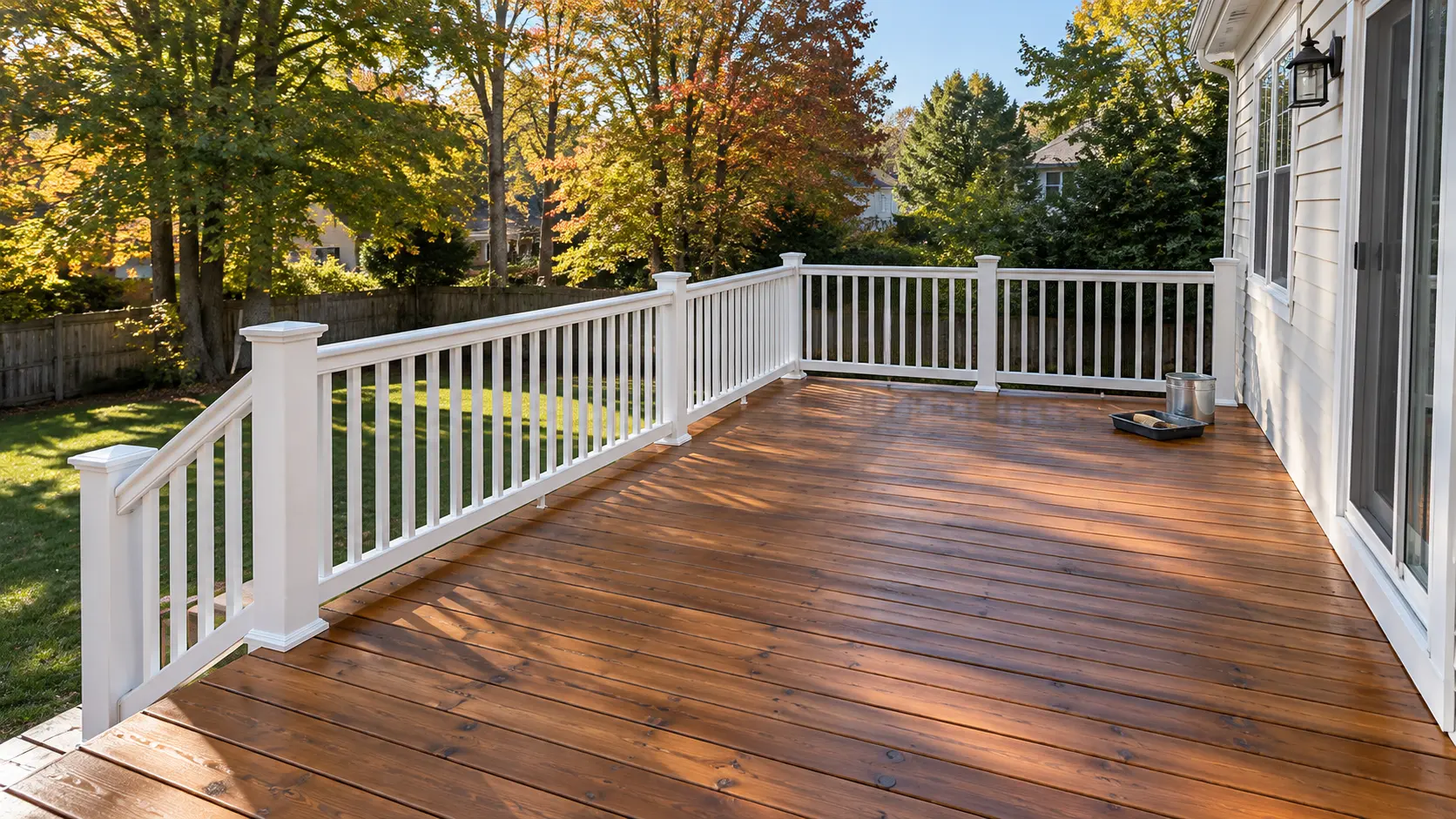
| Deck or fence staining | $800 - $3,000 | Clean, brighten, one or two coats |
| Garage floor epoxy | $1,800 - $5,000 | Grind, patch, base coat, topcoat |
Read these as ranges, not quotes. Every house is different, and the only honest number is the one that comes after somebody walks your rooms with a notepad. Ours are free, and we will tell you on the spot which line items you could skip. Request a free estimate and we will come look.
How Much Does It Cost to Repaint a House?
Almost every house we price is a repaint, so the ranges above already describe repainting. Where a repaint lands inside them depends on the condition of the paint that is already there:
- Sound paint, same or similar color: the low half of each range. Washing, light sanding, spot-priming and two coats. A same-color interior repaint is the cheapest painting there is.
- Peeling, chalking or failed caulk: the upper half. Scraping, priming bare wood and re-running caulk joints are slow, and on a pre-1978 house they have to be done by an EPA Lead-Safe Certified firm, which we are not.
- Dark-to-light color change: add a coat, sometimes a tinted primer as well.
- Repainting over someone else's failed job: often more than the original paint job cost, because the failing film has to come off first. Our guide to why paint peels explains what usually went wrong.
Timing matters as much as condition. A house repainted on schedule needs a maintenance coat; one left until the wood is bare needs a restoration. Our guide to how often to paint a house in NJ gives the usual intervals by siding and exposure.
Why Does Painting Cost More in New Jersey Than the National Average?
Because labor costs more here, and labor is most of a paint bill. Homeowners ask this constantly, usually after reading a national cost calculator and getting a quote 25 percent higher. The gap is real and it is documented.
Labor. The U.S. Bureau of Labor Statistics puts the national median pay for construction and maintenance painters at $49,400 a year, or $23.75 an hour, in its May 2025 data. The same data broken out for New Jersey shows a median of $59,250 a year, or $28.49 an hour. That is roughly 20 percent above the national median, and labor is the large majority of any paint bill.
Everything else. The Bureau of Economic Analysis publishes regional price parities, which measure state price levels against a national index of 100. For 2024, New Jersey came in at 108.8, third highest among the states behind California and Hawaii. Insurance, fuel, vehicle costs, dump fees and rent all ride that curve.
Add New Jersey's contractor registration and insurance requirements on top, and a legitimately run painting company here carries more fixed cost per truck than the same company in Tennessee. That is not a markup. It is the floor.
Interior Painting Prices per Room in NJ
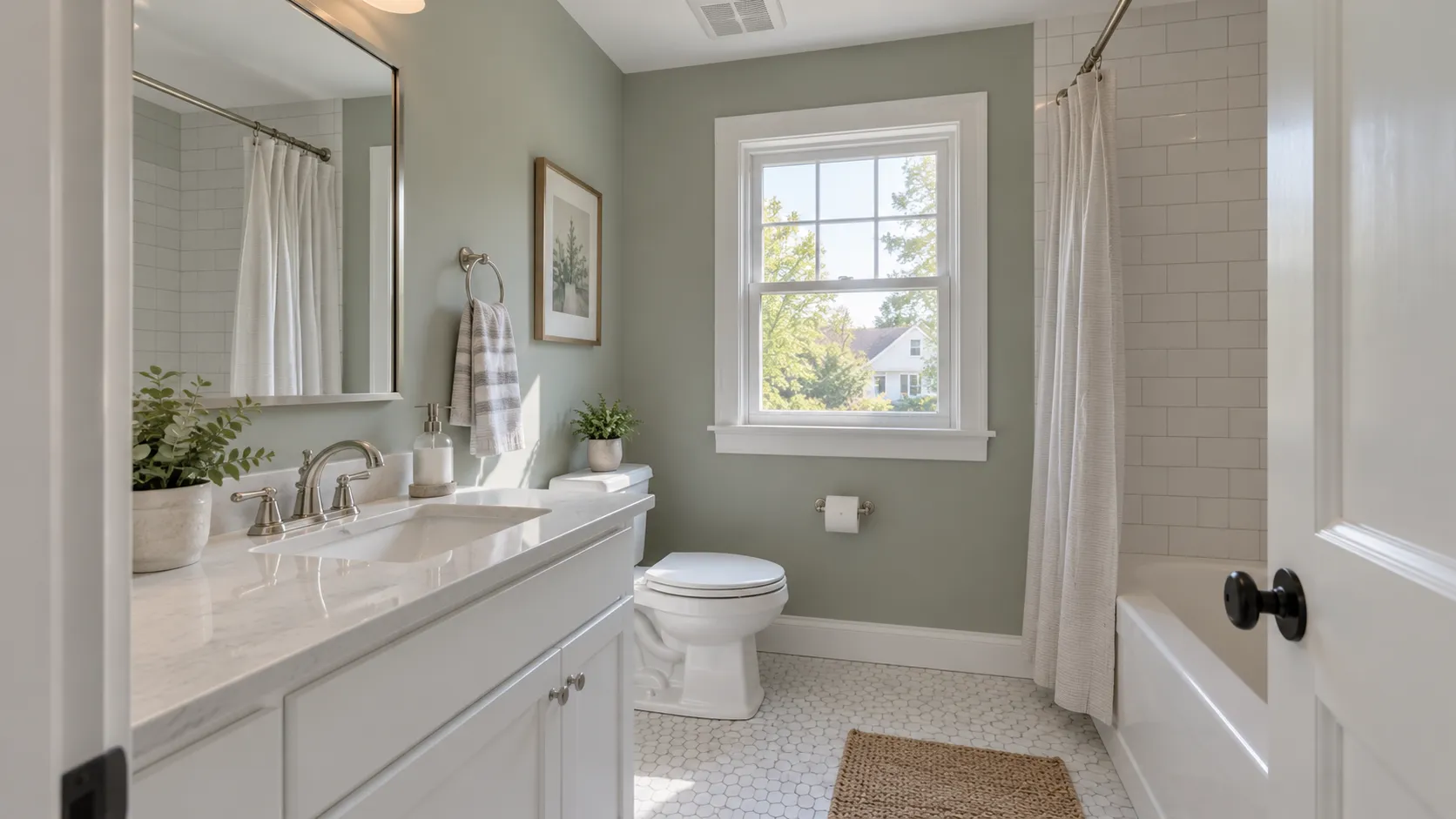
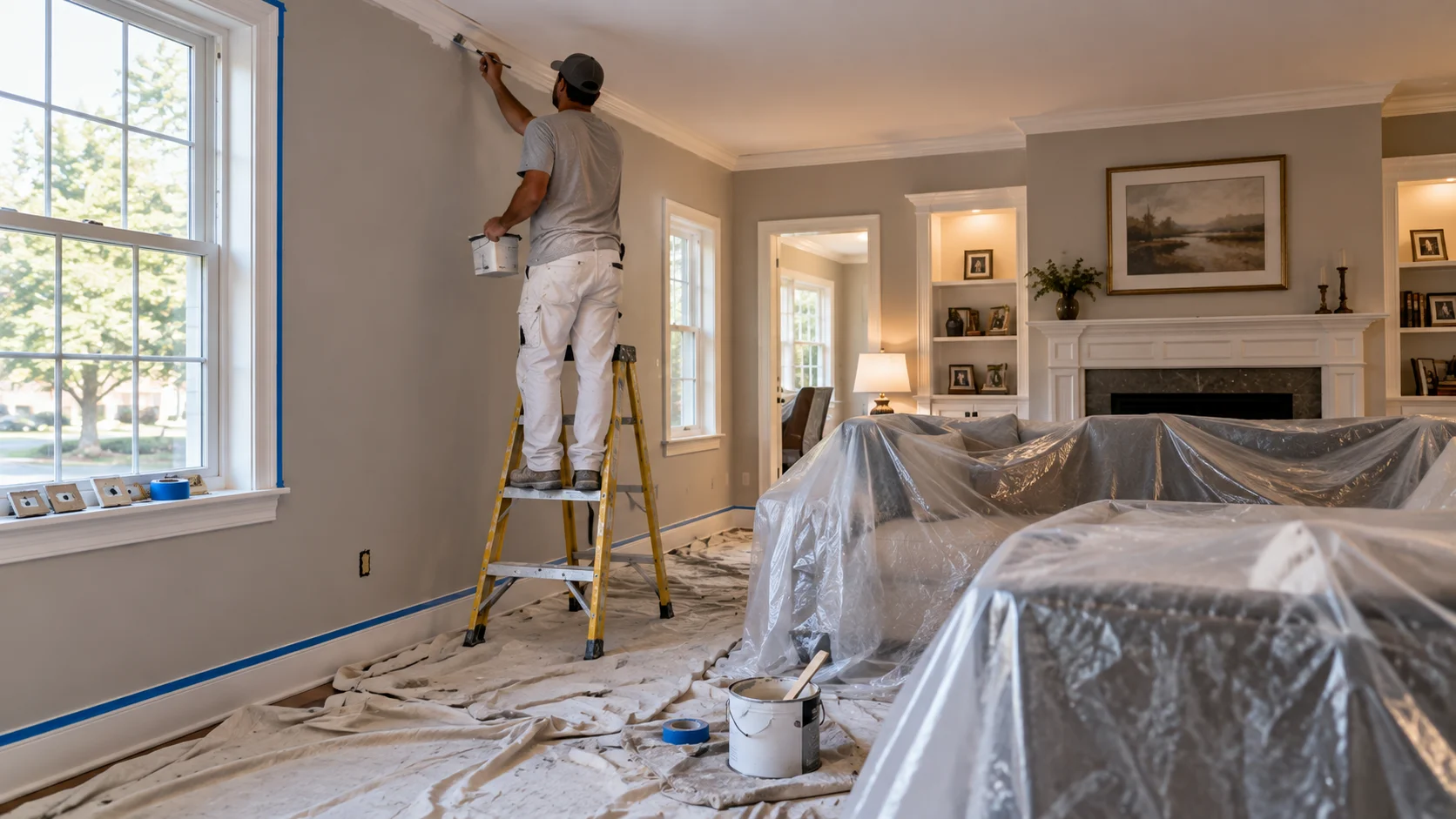
Room painting prices in New Jersey start around $375 for a powder room and $450 for a standard bedroom, walls only, and climb to $1,000 or more once ceilings and trim are included. We price interiors by surface area and by how much prep the room needs, not by a flat per-room fee. A 12 by 14 bedroom with smooth walls and nothing on them takes a crew of two most of a day. The same room with a popcorn ceiling, four windows, crown molding and a closet takes a day and a half.
| Room | Walls only | Walls, ceiling and trim |
|---|---|---|
| Powder room / small bath | $375 - $600 | $500 - $900 |
| Bedroom, 11x12 | $450 - $750 | $700 - $1,300 |
| Primary bedroom, 14x16 | $650 - $1,100 | $1,000 - $1,900 |
| Dining room | $600 - $1,000 | $900 - $1,700 |
| Living room, 15x20 | $800 - $1,500 | $1,200 - $2,400 |
| Kitchen walls and ceiling | $400 - $850 | $600 - $1,200 |
| Hallway and two-story stairwell | $800 - $2,000 | $1,200 - $2,800 |
| Finished basement, 700 sq ft | $1,400 - $2,800 | $2,000 - $4,200 |
Two things move these numbers more than anything else. The first is trim. Baseboard, casing, crown, chair rail and doors are slow, detailed work, and adding trim to a walls-only quote typically adds 50 to 80 percent. The second is ceilings. A flat ceiling is quick. A popcorn ceiling soaks up paint, cannot be rolled aggressively without shedding, and often needs to be primed before it will take a coat at all.
If you are still deciding on colors, use the free in-home color consultation that comes with every estimate, because color choice has a real price consequence that we cover further down. For scope and process on our end, see interior painting.
For room-by-room detail, including what moves each room's number, see our guide to the cost to paint a room in NJ, and for baseboard, casing and doors priced on their own, the cost to paint trim and doors.
If you are collecting interior painting quotes, ask each painter to price the same list: which rooms, whether ceilings, trim, doors and closets are in, how many coats, and which product and sheen. Our paint sheen guide covers the sheen question, and patching beyond ordinary nail holes is priced in our drywall repair cost guide. Textured ceilings are a separate decision, covered in popcorn ceiling removal cost.
How Much Does It Cost to Paint the Outside of a House in NJ?
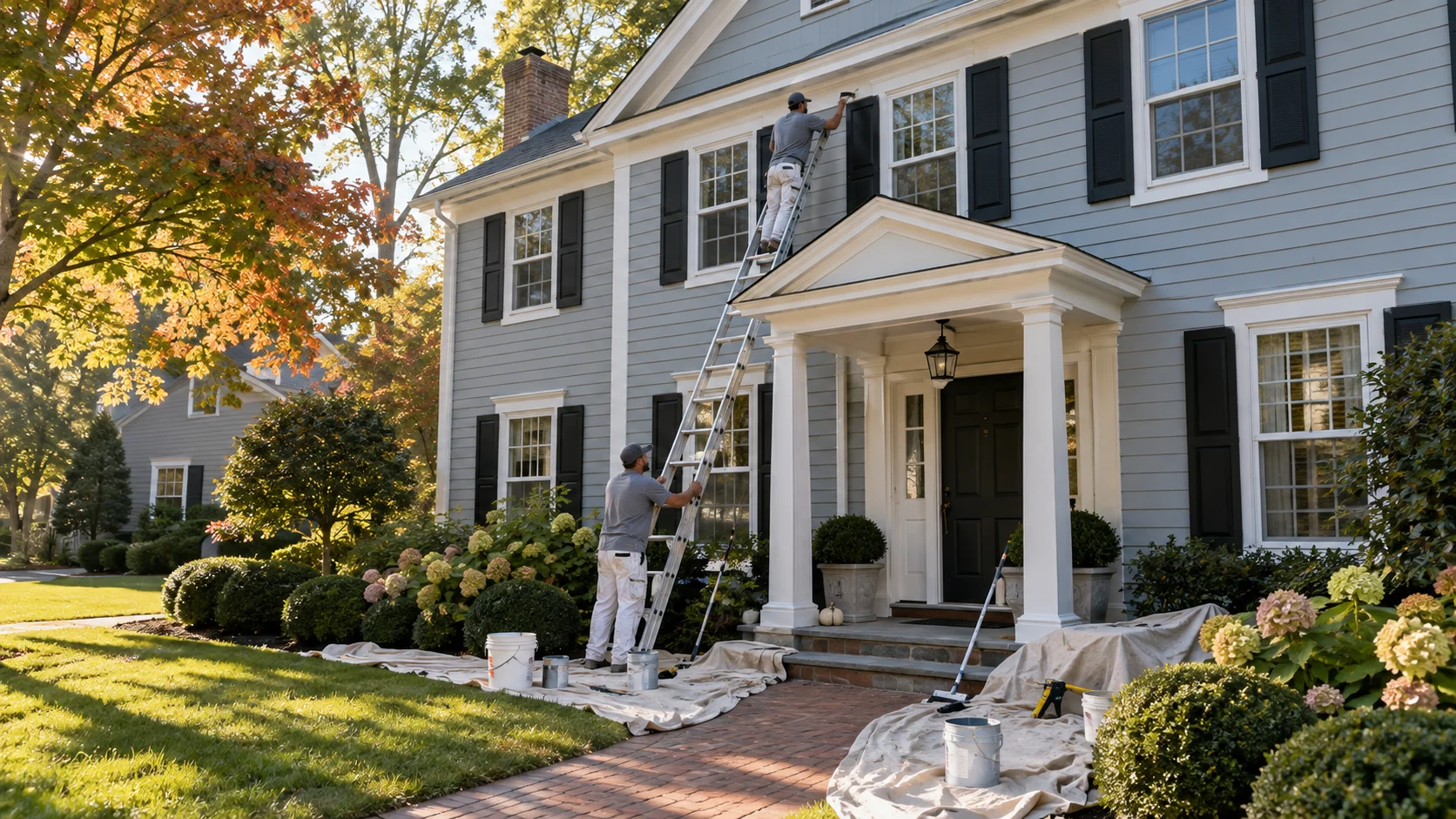
Painting the outside of a house in NJ runs from about $4,500 for a one-story ranch to $22,000 or more for a three-story or shore home. Exteriors are priced on wall area, condition and access. Access is the part homeowners underestimate. Every foot of height adds setup time, and staging a third story over a deck or a sloped side yard can add a full day before a brush touches the house.
| Home size and height | Typical NJ range | Notes |
|---|---|---|
| 1,200 sq ft ranch, one story | $4,500 - $8,000 | Easiest access, fastest job |
| 1,600 sq ft cape, 1.5 stories | $5,500 - $10,000 | Dormers add cut-in time |
| 2,000 sq ft colonial, two stories | $7,500 - $13,000 | Ladder work on all elevations |
| 2,800 sq ft colonial, two stories | $9,500 - $16,500 | More wall area, more caulk joints |
| Three-story or shore home on pilings | $12,000 - $22,000+ | Staging, lifts, wind days |
| Trim, soffit and fascia only | $2,500 - $6,000 | Common on vinyl-sided homes |
| Front door and shutters | $450 - $1,200 | Often done during a trim refresh |
Siding material matters too. This Old House puts wood at $1.70 to $3.60 per square foot nationally, stucco at $2.50 to $4.80, brick at $2.60 to $5.00 and vinyl at $2.80 to $5.20. Our experience matches the shape of that, including the part that surprises people: vinyl repaints price higher than they expect, because a vinyl-safe coating costs more per gallon and the panels need a genuinely clean, chalk-free surface before anything will stick.
Cedar shake along the shore is its own category. Salt air, sun and constant wind-driven moisture mean more of the wall is bare or chalked by the time we get there, and bare wood needs priming. If you are unsure whether you are due, we can tell you on a walk-around at the free estimate, and exterior painting covers our process, with county detail for Monmouth County and Ocean County exteriors.
Masonry and specialty surfaces have their own guides: stucco painting, painting a brick house, limewash brick and painting vinyl or aluminum siding. Washing is the first line of every exterior quote, and our power washing cost guide explains what it costs on its own.
Cabinet Painting Costs by Cabinet Count
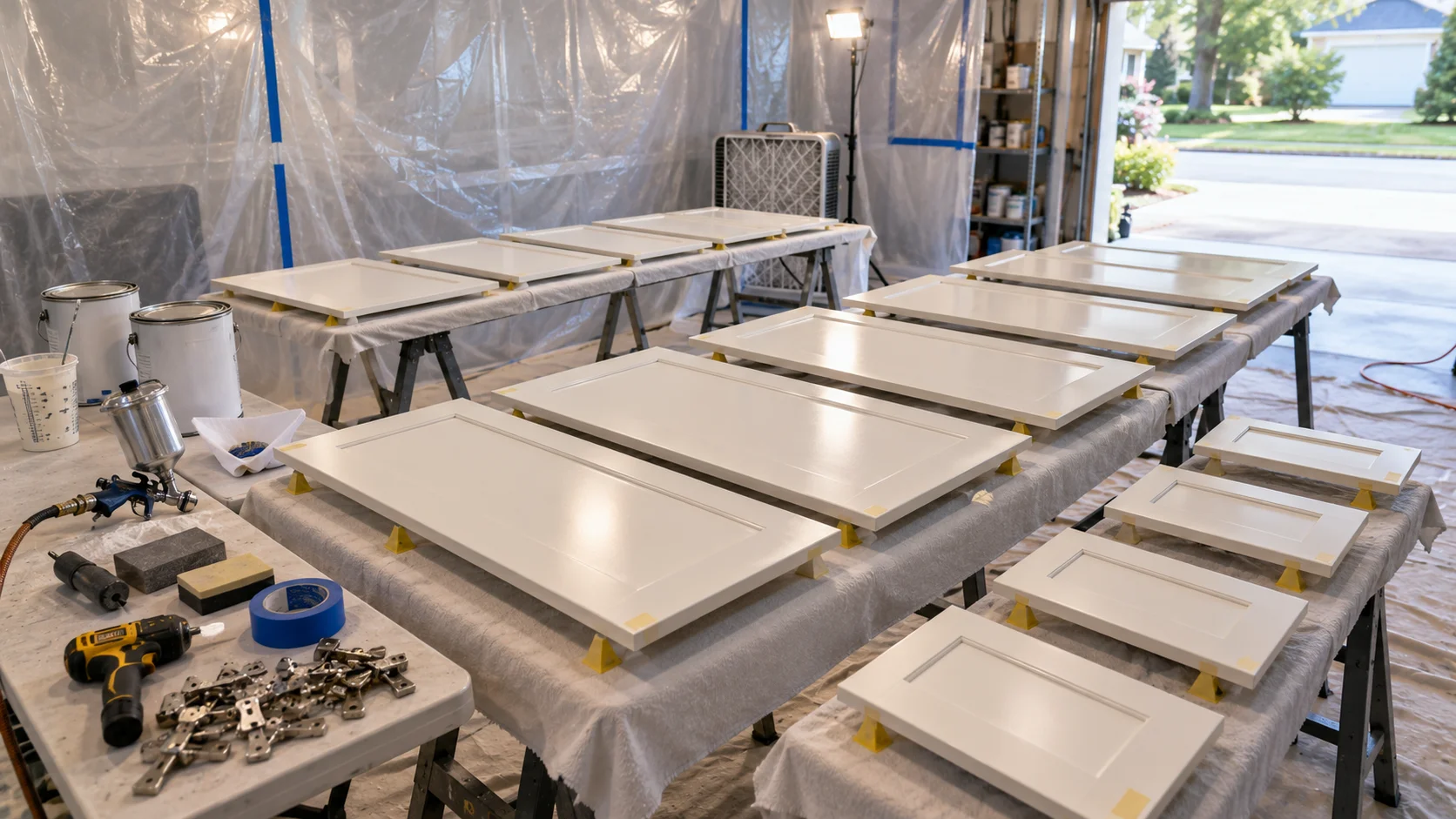
Cabinets are priced by the opening, not by square footage. We count every door and every drawer front, then add setup, because a cabinet job is really a small spray shop built inside your kitchen for a week.
| Kitchen size | Doors + drawer fronts | Typical NJ range |
|---|---|---|
| Small galley or condo kitchen | Up to 20 | $3,000 - $4,500 |
| Standard suburban kitchen | 25 - 35 | $4,200 - $7,000 |
| Large kitchen with island | 40 - 50 | $6,500 - $9,500 |
| Kitchen plus adjoining butler's pantry | 55+ | $9,000 - $14,000 |
| Bathroom vanity, single | 4 - 8 | $500 - $1,100 |
| Two-tone island in a different color | Add-on | +$400 - $900 |
The honest per-opening math behind that table is roughly $110 to $200 per door and $45 to $90 per drawer front, plus a fixed setup charge for masking, ventilation and the spray booth. Anyone quoting a 35-door kitchen at $1,800 is brushing them in place, and you will see every brush mark under the window light by March.
Cabinet work is also the single best value in our price list when the boxes are sound. New cabinets in a kitchen this size run multiples of that number. We laid out the comparison, replacement included, in cabinet refinishing vs. painting vs. refacing, and the service page for cabinet painting shows the finish schedule we use. For a door-by-door breakdown, see our cabinet painting cost guide.
Where Does the Money Go in a Paint Job?
On our estimates, labor is usually 80 to 85 percent of the total. You are buying hours, not paint.
Paint itself is the smaller number, though it is not cheap. Benjamin Moore lists Regal Select interior at about $34 to $85 depending on sheen and container size. Sherwin-Williams rates a gallon of its Emerald interior paint at 350 to 400 square feet in one coat, which means roughly 175 to 200 square feet at the two coats any real job gets.
Run that on a 2,000-square-foot interior and you land somewhere near $900 to $1,400 in paint and primer on a $6,000 job. The other $4,600 is people, and the sundries nobody thinks about: tape, plastic, drop cloths, caulk, spackle, sandpaper, filters, tips, dumpster fees, and the truck that carries all of it.
This is why "just use cheaper paint" saves so little. Dropping from premium to builder-grade on that job saves a few hundred dollars and costs you two or three years of life on the finish. Cutting labor hours, on the other hand, saves thousands, which is exactly what a suspiciously low bid is doing.
What Makes a Painting Quote Go Up?
Here is the list we work through on every walk-through, in rough order of how much money each one moves.
Lead paint on pre-1978 surfaces
This is the big one in older New Jersey housing stock. In the Census Bureau's 2024 American Community Survey, 61 percent of New Jersey housing units were built before 1980, against 48 percent nationally; Monmouth County sits at 56 percent and Ocean County at 47 percent. The survey counts by decade, so that figure includes homes from 1978 and 1979, but the point stands: a large share of houses here are old enough for lead paint to be on the table. The EPA's Renovation, Repair and Painting Rule requires that any firm paid to disturb painted surfaces in homes built before 1978 be lead-safe certified, with workers trained either as certified renovators or on the job by a certified renovator. That means containment, HEPA vacuums, specific work practices and cleanup verification. There is a narrow exemption: EPA treats work that disturbs six square feet or less of interior painted surface per room, or 20 square feet or less on the exterior, as minor repair and maintenance, and jobs in the same room within 30 days count as one job. A repaint that involves scraping and sanding passes that quickly, because the threshold counts paint disturbed, not paint applied. Expect lead-safe work practices to add real hours, mostly in setup and cleanup, on any pre-1978 house with scraping involved. We are not a Lead-Safe Certified firm, so that work is not a service we list: ask any bidder for their firm certificate, and see our guide to lead paint in older NJ homes.
Failed caulk and soft wood
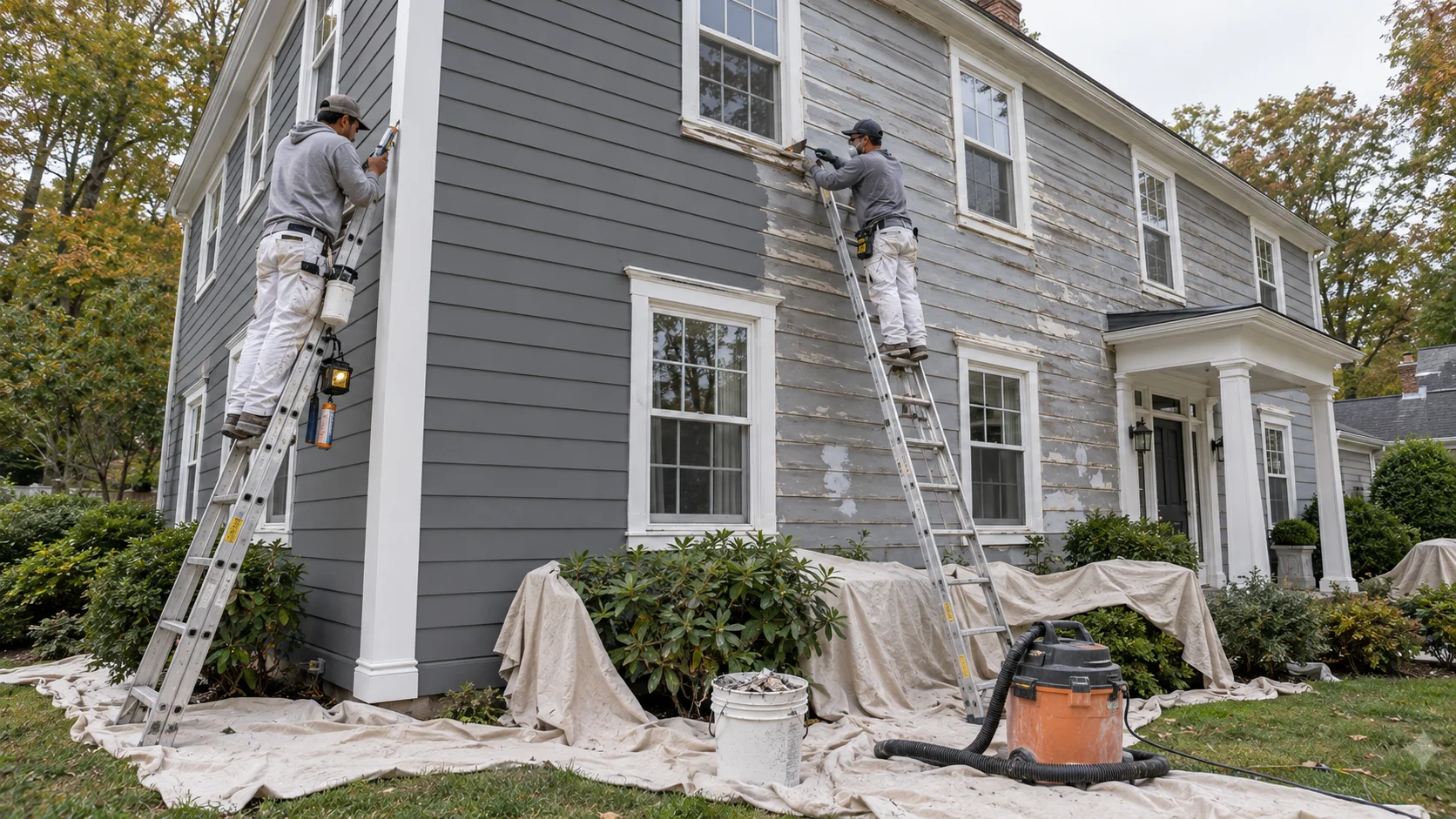
Caulk ages faster than paint. When the joints around windows, corner boards and siding butt seams have pulled away, every one of them has to be cut out and re-run before coating, and a typical two-story colonial can hold several hundred linear feet of joint. Worse, failed caulk usually means water has been sitting somewhere. We probe sills, brickmould and the bottoms of garage jambs on every exterior estimate. Soft wood is carpentry, not painting, and carpentry is the line item that turns an $8,000 exterior into an $11,000 one.
Three-story access and staging
Height is time. A two-story colonial with clear ground on all four sides is straightforward ladder work. A three-story shore home, a walkout basement that makes the back elevation effectively four stories, a deck or sunroom you cannot foot a ladder on, or a hedge line that forces staging, all add setup days. On tall or awkward elevations we sometimes price in a lift, and that is a hard cost with a delivery fee attached.
Popcorn and textured ceilings
Textured ceilings absorb far more material than flat ones and cannot be worked hard with a roller without knocking texture loose. Many need a sealing primer first, especially if there is any water staining. Budget an extra $0.50 to $1.00 per square foot over a flat ceiling, and understand that if the texture is pre-1978 it may also be a lead surface.
Dark-to-light color changes
Going from a deep navy or espresso wall to a soft white is a three-coat job, sometimes four, and usually a tinted primer first. Color changes in the other direction are cheap. If your quote assumes two coats and you switch to a dramatic lightening after the contract is signed, the price should change, and an honest contractor will say so before they start rather than after.
Hand-brushed versus sprayed
Spraying is faster on open surfaces and gives a glass finish on cabinets, doors and new trim. It is also much slower to set up, because everything not being sprayed has to be masked. In an occupied house with furniture, window treatments and a dog, masking for spray can cost more time than brushing would have saved. We brush and roll most occupied interiors, spray most cabinets and empty rooms, and tell you which we are doing and why. A quote that does not specify is hiding something.
Occupied versus empty
An empty house is the cheapest house to paint. Furniture that has to be moved to the center, covered, moved back, and moved again for the second coat adds an hour or two per room across a whole job. If you are painting before a move-in, you are already saving money.
Season and weather
Exterior work in New Jersey has a window, and the shoulder months carry risk: coatings have minimum application temperatures, dew point matters as much as air temperature, and a wet October pushes schedules. Booking in the off-season can genuinely save you money, as long as the work actually gets done in conditions the product is rated for. Our guides to painting in cold weather and how long it takes to paint a house cover the New Jersey calendar in detail.
Why Does the Cheapest Painting Bid Usually Cost More?
Three bids come in at $11,500, $9,200 and $5,400. The $5,400 is not a better deal. It is a different scope, and the difference is almost always prep.
Prep is invisible and it is most of the job. Washing, scraping, sanding, spot-priming bare wood, cutting out and re-running caulk, filling nail holes, taping, masking: none of that shows up in a photograph, and all of it determines whether the finish lasts four years or twelve. The fastest way to cut a bid in half is to skip it, and the homeowner cannot see what was skipped until the second winter.
The other places a lowball number comes from:
- One coat instead of two. Over a color change this is visible within a year as the old color grins through.
- No primer on bare or repaired surfaces. Paint over bare wood or fresh spackle without primer and you get flashing, peeling, or both.
- Thinned or builder-grade product in a job that was sold as premium.
- No insurance. If a painter falls off a ladder on your property and carries no coverage, that becomes your problem.
- Cash, no contract, no registration number. Covered in the next section, and it is a genuine legal exposure for you.
We have repainted plenty of houses that were painted two years earlier by somebody cheaper. Those jobs cost more the second time, because now we are stripping a failing film before we can start. If you want to see the difference between prep-heavy work and the alternative, our project gallery has the before and after shots, and our guide to choosing a painting contractor in NJ lists the questions that separate the bids.
What Should a Painting Estimate Include?
You should be able to read an estimate and know exactly what you are buying. Ours, and any estimate worth comparing, breaks out the following:
- Surfaces included and excluded, by name. Walls, ceilings, trim, doors, closets, shutters, soffits, garage interior. If a surface is not listed, it is not in the price.
- Prep scope. What gets washed, scraped, sanded, patched, caulked and primed, and how much of it is assumed. Carpentry allowances should be called out separately with a unit price.
- Product, by line and sheen. Not "premium paint." The actual manufacturer, product line, and sheen for walls, ceilings and trim.
- Number of coats, stated per surface.
- Application method, brush and roll versus spray, per area.
- Protection plan. How floors, furniture, landscaping and hardware get covered, and who moves what.
- Schedule. Start date, completion date, crew size, working hours.
- Payment schedule and warranty terms. Ours carries a two-year workmanship warranty in writing.
The Painting Contractors Association, which has been publishing trade standards since 1884, maintains industry standards and painter certification programs. A contractor who can point to the standard they are working to is a contractor who has thought about scope in writing.
What New Jersey Rules Protect You When You Hire a Painter?
This part is specific to our state and worth more than any pricing table. New Jersey's Contractors' Registration Act requires home improvement contractors, explicitly including painters, to register with the Division of Consumer Affairs. The Division's consumer brief on hiring home improvement contractors lays out the rest:
- Any home improvement project costing more than $500 must have a written contract, including the contractor's legal name and business address, start and completion dates, a description of the work, the total price, and the registration number.
- The contractor must give you a copy of their commercial general liability insurance policy and the insurer's phone number.
- You can cancel a signed contract for any reason before midnight of the third business day after you receive a copy.
- The law prohibits demanding final payment before the work is complete. Do not pay in cash.
- Unregistered contractors cannot be issued municipal construction permits in New Jersey.
- Painting itself does not need a construction permit. The state's Uniform Construction Code lists exterior and interior painting as ordinary maintenance that can be done without a permit application. Work done for the purpose of lead abatement is excluded from that exemption, and so is anything affecting structural or fire safety.
- Consumer Affairs lists it as a warning sign if a contractor asks for more than a third of the total up front, has only a P.O. box, or tells you a written contract is unnecessary.
NJ Painting Co. is registered, licensed and fully insured, and every job we do is written up before anyone shows up with a ladder.
How Can You Lower the Cost of Painting a House?
Not every dollar in a paint budget is load-bearing. These are the reductions we suggest ourselves when a number comes in over what a homeowner had in mind:
- Phase the work. Do the main level this year and the bedrooms next year. Mobilization is a real cost, so phasing is not free, but it beats cutting prep.
- Skip ceilings that are still white and clean. Ceilings are a third of many interior quotes and they do not wear like walls do.
- Keep the trim color. Repainting trim in the same white is faster than a color change and sometimes can be spot-touched rather than fully recoated.
- Stay within a shade family. A two-coat color is cheaper than a four-coat one.
- Do your own furniture moving and hardware removal.
- Paint before you move in, or between tenants.
- Book exterior work early in the season rather than in the September rush.
What we do not recommend cutting: coats, primer, caulk, or product grade. Those are the four line items that decide whether you are doing this again in five years or fifteen.
Cost Guides for Specific Projects
This article covers whole-house painting. For a single project, these guides go deeper, and the NJ painting cost guide collects our planning ranges for every service on one page.
| Project | Detailed guide |
|---|---|
| Interior rooms, per room and per square foot | Cost to paint the interior of a house |
| Exterior by home size and siding | Cost to paint the exterior of a house |
| Kitchen cabinets | Cabinet painting cost in NJ |
| Deck and fence staining | Deck staining cost in NJ |
| Stucco walls | Stucco painting: best paint and cost |
| Brick, painted or limewashed | Painting a brick house and limewash brick cost |
| Hardwood floors | Hardwood floor refinishing cost |
| Popcorn ceilings | Popcorn ceiling removal cost |
| Drywall patches and cracks | Drywall repair cost |
| House washing | Power washing cost |
| Garage and basement floors | Epoxy garage floor cost and types |
| Offices, retail, HOAs and warehouses | Commercial painting cost in NJ |
Frequently Asked Questions
What is the average cost of painting in NJ?
For a typical New Jersey home in 2026, a full interior repaint runs about $4,000 to $10,000 and a full exterior repaint about $5,500 to $14,000. Per square foot, interiors generally run $2.75 to $5.00 of floor area and exteriors $2.75 to $5.25 of wall area. A single bedroom, walls only, runs about $450 to $750.
How much does it cost to paint the outside of a house in NJ?
About $4,500 to $8,000 for a 1,200-square-foot one-story ranch, $7,500 to $13,000 for a 2,000-square-foot two-story colonial, and $12,000 to $22,000 or more for a three-story or shore home on pilings. Condition, caulk, carpentry and access move a house within its range more than square footage does.
How much does it cost to repaint a house?
The same ranges apply, and where you land depends on the paint already there. Sound paint in a similar color sits in the lower half; peeling paint, failed caulk, bare wood or a dark-to-light color change pushes a repaint into the upper half, because prep and extra coats are labor.
How much does it cost to paint a room in NJ?
A standard 11 by 12 bedroom runs about $450 to $750 for walls only, or $700 to $1,300 with the ceiling and trim. A 15 by 20 living room runs about $800 to $1,500 for walls, and $1,200 to $2,400 with ceiling and trim. Trim typically adds 50 to 80 percent to a walls-only price.
How much does it cost to paint a 2,000 square foot house in NJ?
Interior, expect $5,500 to $10,000 for walls, ceilings and trim throughout. Exterior on a two-story 2,000-square-foot colonial, expect $7,500 to $13,000 depending on siding condition, access and how much caulk and carpentry it needs. A one-story 2,000-square-foot ranch sits lower, closer to $6,000 to $10,000, because access is simpler.
What is the average cost per square foot to paint a house in New Jersey?
Interior work generally runs $2.75 to $5.00 per square foot of floor area, against a national range of $1 to $4. Exterior work generally runs $2.75 to $5.25 per square foot of wall area, against a national $2.20 to $4.40. New Jersey's premium tracks its labor market: state painter wages run about 20 percent above the national median, and overall state price levels are 8.8 percent above the national index.
How much do painters charge per hour in NJ?
Published national guides put painters at $30 to $60 an hour for standard interior work and $40 to $100 an hour for exterior work, and New Jersey sits in the upper part of both. For context, the median wage for painters employed in New Jersey is $28.49 an hour (BLS, May 2025), and a company's billed rate also has to cover insurance, vehicles, equipment and overhead. In practice, reputable companies here price by the job rather than by the hour, because an hourly number gives you no protection against a slow crew. Ask for a fixed price with a defined scope.
Why are painting quotes in NJ so different from each other?
Almost always because the scope is different, not because one painter is greedy. Compare number of coats, whether primer is included, how much surface prep is written in, the specific product line, and whether trim and ceilings are in or out. Put the three estimates side by side on those five points and the spread usually explains itself.
How do I get an accurate interior painting quote?
Have the painter walk every room. A phone or photo quote cannot see wall damage, ceiling texture or how much furniture has to move. Ask for a written quote that lists rooms and surfaces, coats, product and sheen, and what prep is included, and give every bidder the same list so the numbers are comparable.
Do you need a permit to paint a house in NJ?
No. New Jersey's Uniform Construction Code (N.J.A.C. 5:23-2.7) lists exterior and interior painting as ordinary maintenance that can be done without filing a permit application. That changes if the work is done for lead abatement or affects structural or fire safety. Separately, any paid work that disturbs paint in a pre-1978 home falls under the EPA's lead rules, permit or not.
Does painting a house in NJ add resale value?
It usually helps a sale, but nobody can honestly promise a percentage. Fresh interior and exterior paint is consistently one of the lowest-cost, highest-visibility improvements before a sale, because every buyer sees it and inspectors read exterior condition as a proxy for overall maintenance. We would not promise a specific percentage return, since that depends on your market and your starting condition, but peeling sills and mildewed siding get priced into offers immediately.
Do I need to be home while you paint?
No. Most of our interior clients are at work, and plenty of our exterior clients never see us except at the walk-through. We work from a written scope, protect everything we are not painting, and do a punch-list walk with you at the end before final payment.
Get a Real Number for Your House
Every range on this page is a starting point. The number that matters is the one that comes after somebody measures your rooms, probes your window sills and counts your cabinet doors. NJ Painting Co. is a family-owned company at 36 Church Rd in Morganville, and we have been quoting work in Monmouth, Middlesex, Ocean, Mercer, Somerset and Burlington counties, plus Union, Essex, Hudson, Bergen and Passaic in North Jersey, for more than twenty years. Free estimates, in-home color consultation, Benjamin Moore and Sherwin-Williams products, and a two-year workmanship warranty in writing.
Check our service areas to confirm we cover your town, browse the expanded painting cost guide for more pricing detail by service, or look at garage floor epoxy if that is on the list too. When you are ready, get your free estimate and we will walk the house with you and put every line item in writing.
About the author
Written by the NJ Painting Co. team
NJ Painting Co. is a family-owned painting contractor based in Monmouth County, in business since 2004. We are licensed and fully insured, work with Benjamin Moore and Sherwin-Williams paints, and back our work with a 2-year workmanship warranty. We serve Monmouth, Middlesex, Ocean, Mercer, Somerset and Burlington counties, plus Union, Essex, Hudson, Bergen and Passaic in North Jersey.