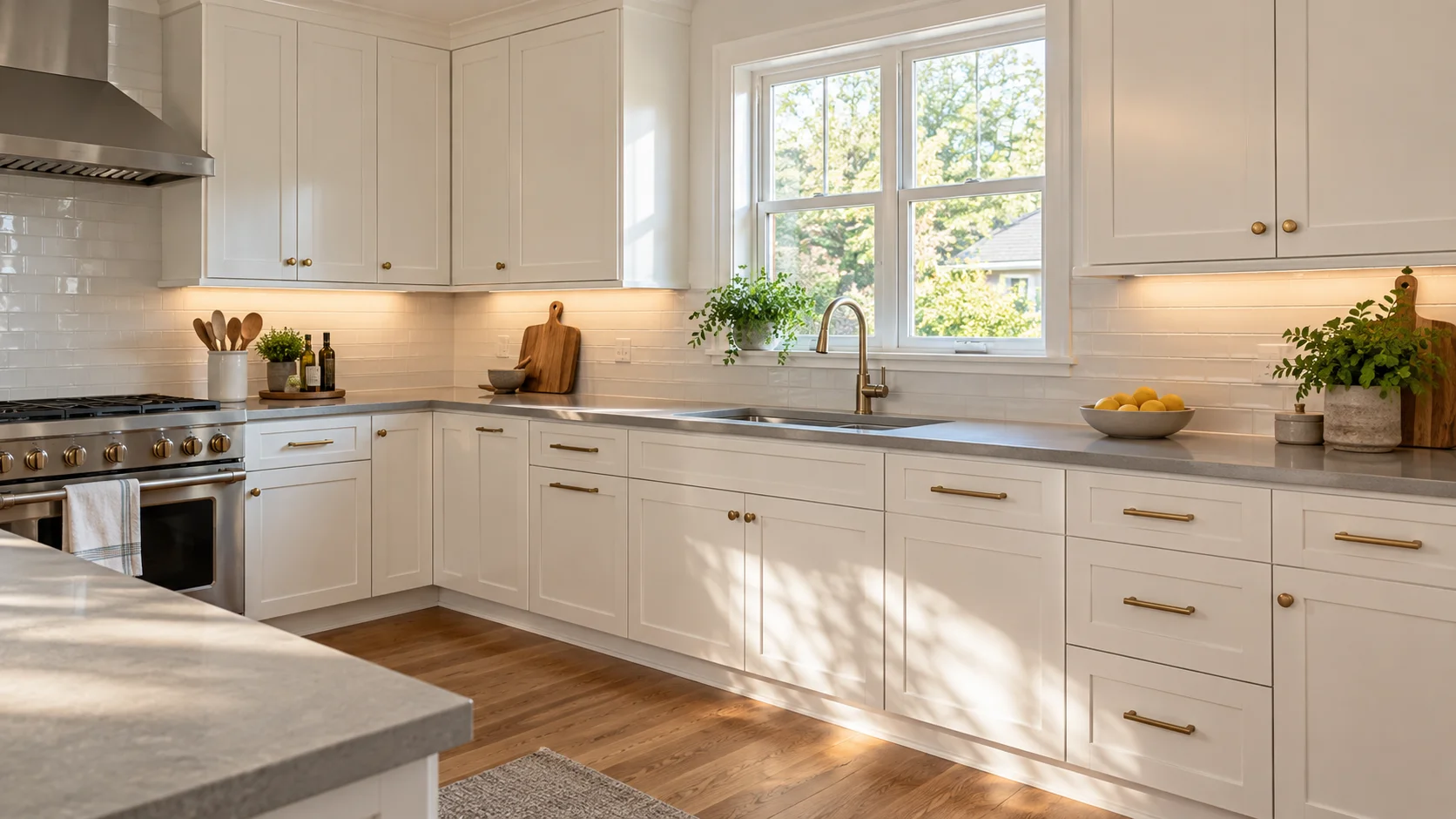
Painting cabinets means spraying a new opaque color over your existing doors and boxes. Refinishing means removing or abrading the old finish and building a new one, clear or pigmented. Reglazing adds a tinted translucent layer over a finish. Refacing replaces the doors and veneers the boxes. Replacement tears everything out. Same kitchen, five projects, and the price spread between the cheapest and the most expensive is roughly ten to one. Nationally, Fixr's 2026 cost guides put the average painted kitchen at about $4,000 and the average refaced kitchen at about $8,250, so for sound cabinets in a layout that works, painting is the least expensive way to change how a kitchen looks.
We spray cabinets nearly every week somewhere between Middletown and Bayville, and the first ten minutes of most estimates are spent untangling those five words. Homeowners call asking for "refinishing" and describe painting. They ask for "refacing" and describe new cabinets. Nobody is wrong — the trade uses the terms loosely too — but the distinctions decide your budget, how long your kitchen is out of service, and how the finish holds up five winters from now. This is the explanation we give at the kitchen table, written down.
The Five Options, Defined Properly
1. Cabinet Painting
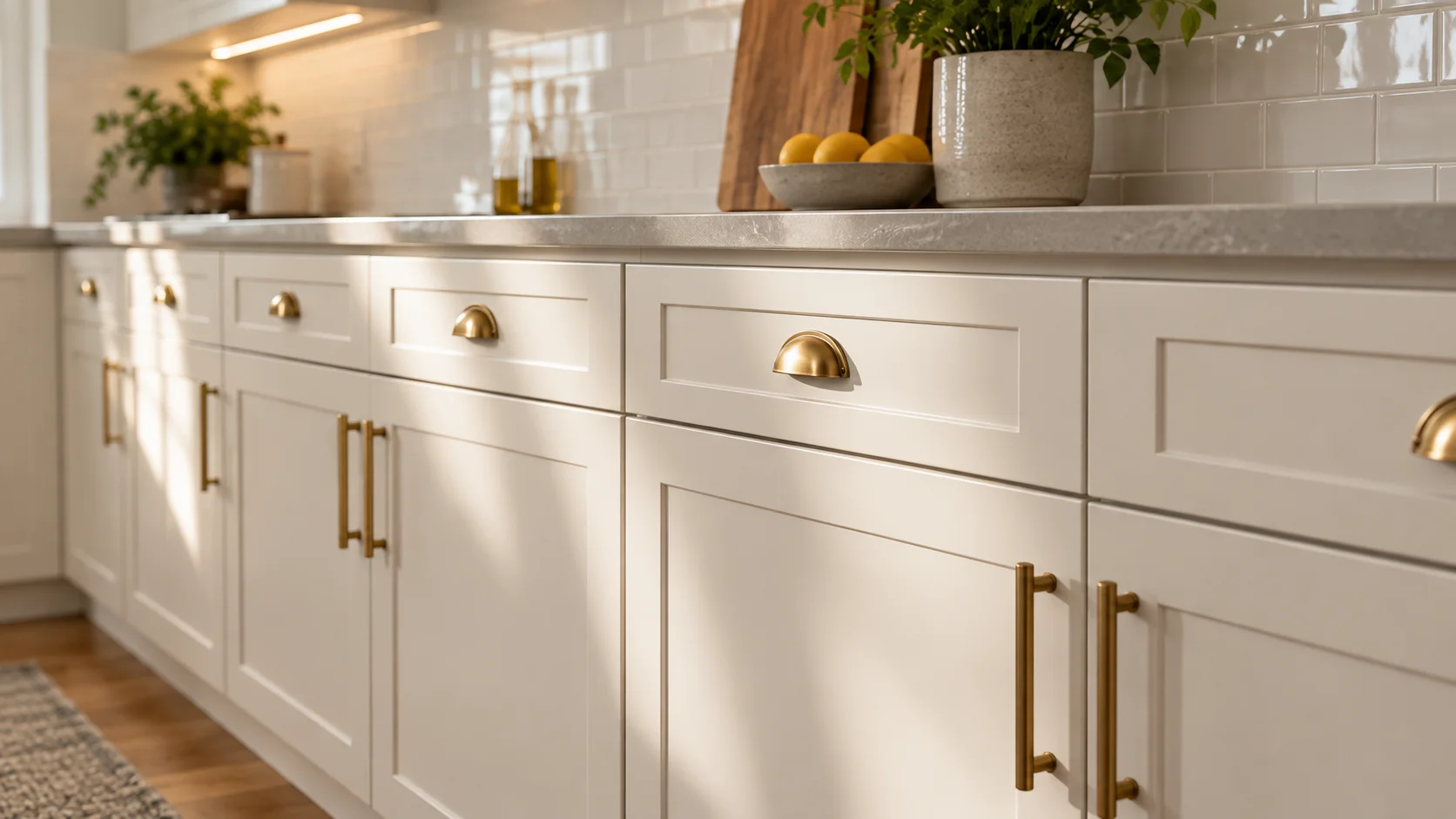
Doors and drawer fronts come off, hardware comes off, everything gets degreased, scuff-sanded, spot-repaired, and primed with a bonding primer, then sprayed with a pigmented finish coat — usually two coats, sometimes three. Boxes and face frames are done in place behind containment. The wood species underneath disappears. You get a color: warm white, greige, navy island, black lowers.
This is what most people mean when they say any of the five words. It is the right answer for a huge share of the kitchens we see, because the boxes in a 1995 or 2005 Monmouth County colonial are usually plywood or furniture-grade particleboard in fine structural shape, and only the finish has aged out.
2. Cabinet Refinishing
Refinishing keeps the wood visible. The old topcoat is stripped or heavily sanded back, the substrate is cleaned and sometimes re-stained or toned, and a new clear system goes on. It is the correct call for genuinely nice wood — quartersawn oak, cherry, walnut — where covering the grain would be a waste. It is also used loosely to describe any "keep the boxes, redo the finish" project, which is why it shows up in search results next to painting.
Refinishing costs more than painting more often than people expect. Stripping is slow, messy work, stain does not hide repairs the way paint does, and color-matching a re-stain across doors from different boards is genuinely difficult. If your goal is a lighter kitchen, refinishing rarely gets you there — you cannot stain oak white. Stain also only goes onto bare wood, so restaining cabinets that have been painted, or changing a stain color, means stripping back to raw wood first.
3. Cabinet Reglazing
Glazing is a semi-transparent tinted layer applied over an already-finished surface, then wiped back so it stays in the profiles, moldings, edges, and corners — the technique is also called antiquing, and it exists to make raised-panel detail read from across the room. Reglazing means renewing or changing that layer.
Two things worth knowing. First, glaze is almost never a standalone project in a modern kitchen; it is an add-on step inside a painting or refinishing job, and it has to be locked down under a clear topcoat or it wipes off with the first Windex. Second, heavy glaze on shaker doors is the single fastest way to date a kitchen. We talk most homeowners out of it and into a straight sprayed finish, and we talk a few into it because their raised-panel cherry genuinely needs the depth.
4. Cabinet Refacing
Refacing keeps your cabinet boxes and layout and replaces everything you touch. New doors and drawer fronts are ordered to your existing openings; the exposed face frames and end panels get covered with matching wood veneer or rigid thermofoil, glued and pinned; new hinges and slides go on. The typical process is doors and drawers off, degrease and sand the faces, veneer the frames, hang the new doors, walk the job.
The result looks like new cabinetry from the outside. Inside, it is still your 1998 boxes with the same shelf spacing and the same lazy Susan. Refacing is the right move when the boxes are sound, the layout works, and the doors are the problem — badly warped, peeling thermofoil, or a style you cannot live with regardless of color.
5. Full Replacement
Demolition, new boxes, new doors, new hardware, and — this is the part that surprises people — usually new countertops, because old tops rarely survive removal and almost never fit new boxes. Replacement is the only option on this list that changes your layout, so if you want the peninsula gone or a 36-inch range where a 30 sits, this is the conversation.
Side by Side: Cost, Time, Mess, and Lifespan
The painting, refinishing and reglazing figures below are what we quote in Monmouth and Ocean counties for an average kitchen. Refacing and replacement are not work we do, so for those two rows we show the published national figures rather than invent a local quote. For reference, Fixr's 2026 guides put cabinet painting at $2,500 to $6,500 nationally (average $4,000), refacing at $3,000 to $13,500 (average $8,250) and refinishing at $2,000 to $4,500, and new cabinet installation at $4,000 to $14,000 (average $7,000) before countertops and tear-out. New Jersey sits above those midpoints mainly because of labor: the Bureau of Labor Statistics' 2025 data, broken out by state on O*NET, puts the New Jersey median for painters at $28.49 an hour against $23.75 nationally, about 20 percent higher.
| Option | Typical NJ cost | Timeline | Disruption | Realistic lifespan | The right call when… |
|---|---|---|---|---|---|
| Painting | $3,200–$8,500 | 4–8 working days on site; 10–14 days if doors go to the shop | Moderate. Kitchen usable most evenings; doors off for the duration | 8–12 years before it looks tired, and it is touch-up-able the whole time | Boxes are solid, layout works, you want a different color |
| Refinishing (clear/stain) | $4,500–$11,000 | 6–12 working days | High if stripped on site — odor and solvent handling. Lower if doors go out | 10–15 years on a clear system | The wood is worth showing and you want to stay in the same color family |
| Reglazing | +$700–$1,800 as a step inside a paint or refinish job; $2,500–$5,500 standalone | Adds 1–3 days | Same as the job it rides on | As long as the topcoat over it lasts | Raised-panel or heavily profiled doors that read flat without shadow |
| Refacing (not a service we offer) | National: $3,000–$13,500, average $8,250; expect NJ above the midpoint | 3–5 days of install, but 2–4 weeks start to finish once door lead time is counted | Low on site, long calendar | 15–20 years on the new doors; the boxes are as old as they were | Boxes are sound but the doors are warped, peeling, or a style you hate |
| Replacement (not a service we offer) | National: $4,000–$14,000, average $7,000, for cabinets and install only; countertops, removal and any layout change are extra | 2–4 weeks on site; 6–20 weeks total depending on stock, semi-custom, or custom | Highest. Kitchen out of service, dust everywhere, counters and often flooring in scope | 20+ years | Boxes are failing, the layout is wrong, or you are remodeling anyway |
One number worth knowing before you spend: Zonda's 2025 Cost vs. Value report put a minor midrange kitchen remodel — an update that keeps the kitchen rather than gutting it — at a national job cost of $28,458 against $32,141 in resale value, about 113 percent recouped, and the only interior project in that year's top five. Read that as a warning about the big-number end of this list: the restrained kitchen project is the one that reliably pays back.
Cost by Kitchen Size and Door Count
Linear feet are how cabinet shops price. Doors and drawer fronts are how painters price, because a door is a unit of handling, spraying, flipping, and racking, and a 30-inch wide drawer front takes the same trips as a 12-inch one. When we walk a kitchen, we count openings. In our market the math works out to roughly $110–$200 per door and $45–$85 per drawer front, which sits above Fixr's national figures of $70–$125 per door and $30–$110 per drawer front, in line with New Jersey labor costs.
| Kitchen | Doors + drawer fronts | Painting (our NJ quotes) |
|---|---|---|
| Small galley or condo kitchen | 15–20 | $2,600–$4,200 |
| Standard 10×10 — the industry benchmark | 25–30 | $3,800–$6,400 |
| Large kitchen with island | 35–45 | $5,500–$9,200 |
| Open-concept with island, pantry, and butler's area | 50–70 | $8,500–$14,000 |
Refacing and replacement are priced differently, by the linear foot of cabinetry. Fixr puts refacing at about $275 per linear foot on average, from $100 to $450 depending on material, with wood veneer at $100 to $250 and thermofoil laminate at $80 to $125. New stock cabinets run $100 to $300 per linear foot installed, semi-custom $150 to $650 and custom $500 and up, again before countertops. If a refacing or remodeling company is quoting your kitchen, ask for the linear footage and the door material in writing so the numbers can be compared.
Add-ons that move a painting number: oak or ash grain filling, commonly $400–$800 on a standard kitchen and materially more on a large one; interior painting of the boxes, which roughly adds 25 to 40 percent because every shelf becomes a sprayed part; new hardware boring when you go from knobs to pulls; and crown or light rail added during the project. Our cabinet painting cost guide goes through each of these cost drivers in more detail; the broader painting cost guide lays out how pricing works across the rest of the house, and the cabinet painting service page has the scope we include as standard.
What Actually Gets Sprayed on Your Doors
This is the part that separates a cabinet job that still looks right in 2034 from one that is chipping at the sink base by next Thanksgiving. The coating is not a detail. It is the project.
Why wall paint fails on cabinets
Standard interior latex is engineered to be a wall: flexible, breathable, easy to touch up, cheap to make in volume. Those properties are exactly wrong on a door. The film stays comparatively soft, and soft films block — two painted surfaces pressed together stick to each other and tear when separated. That is why a latex-painted door leaves a witness mark on the frame the first humid week in July, and why the inside edge of a latex-painted cabinet peels in strips. Low-VOC wall formulations are particularly prone to forming soft, tacky coatings with poor block resistance. Wall paint on cabinets is not a shortcut. It is a redo.
Waterborne alkyd enamels
Waterborne alkyds are the workhorse of residential cabinet finishing right now, and for good reason. Benjamin Moore says its ADVANCE waterborne alkyd "delivers the flow and leveling characteristics of an oil-based paint" with soap-and-water cleanup, and calls it a favorite for kitchen cabinets, trim and doors. They level out sprayer texture as they flash, they cure hard, and they cure faster than latex acrylics — Benjamin Moore puts a waterborne alkyd at roughly five days to full cure against three to four weeks for a latex acrylic.
Waterborne urethane trim enamels
The urethane-modified enamels are the other mainstream choice. Sherwin-Williams positions Emerald Urethane Trim Enamel specifically for cabinets, doors, and trim, claiming "a hard durable finish that withstands the wear and tear of frequently cleaned and used areas," with "excellent blocking resistance" and less yellowing than traditional oil. That blocking-resistance claim is the one that matters most on a door that closes against a frame forty times a day. Both of these families spray beautifully and both are legitimate; which one we reach for depends on color, sheen, and how fast the household needs the kitchen back. Our guide to spray vs brush cabinet painting compares them side by side, with dry, recoat and cure times from the data sheets, and shows what a brushed and rolled finish looks like next to a sprayed one.
Catalyzed finishes: conversion varnish, pre-cat lacquer, 2K urethane
These are the factory finishes. Conversion varnish is a post-catalyzed, two-component coating, where an added catalyst cross-links the resin into a genuinely hard, chemical-resistant film; one manufacturer's clear conversion varnish, Mohawk Ultra Max, lists about 36 percent solids by volume on its technical data sheet — it is what most manufacturers of KCMA-certified cabinetry put on, where structure, drawers, doors, and finish are all tested to simulate a lifetime of use. Pre-catalyzed lacquer arrives with the catalyst already in the can, is far more forgiving to spray, has a long shelf life, and runs lower in solids, about 15 to 25 percent by volume according to Woodshop News, so it needs more coats to build the same film. Two-component urethanes sit at the top of the durability ladder for chemical and heat resistance.
The honest trade-off: catalyzed coatings have pot life measured in hours, need real ventilation and respiratory protection, and are unforgiving of contamination and of on-site conditions. They belong in a shop, with controlled temperature, filtered air, and racks. That is a large part of why we run a shop finishing option at all, and it is why a quote that includes catalyzed material and a quote that includes waterborne enamel are not the same quote.
Prep Is the Job. Everything Else Is the Last Two Days.
Degreasing beats sanding
On any other interior surface, sanding is the headline prep step. In a kitchen it is second. Twenty years of aerosolized cooking oil settles on every horizontal and vertical face, and it concentrates exactly where you would guess — the doors flanking the range, the cabinet over the cooktop, the drawer fronts at hip height. Grease is not removed by scuff-sanding; it is driven into the scratch pattern you just created, and you have now guaranteed a bond failure that will not show up for four months.
So every door and every frame gets a degreaser wash and a clean-water rinse before abrasive touches it. Then sanding. Then a tack-off. Residual degreaser is its own adhesion problem, which is why the rinse is not optional. If a painter quotes your kitchen without saying the word "degrease," ask.
What a bonding primer actually does
A bonding primer is not "paint that goes on first." It is a resin system chosen because it grips surfaces a finish coat cannot — cured factory lacquer, conversion varnish, thermofoil, melamine, glossy oil enamel. Shellac-based and specialty acrylic-urethane bonding primers also do a second job in old kitchens: they block tannin and dye migration out of oak, mahogany, and knotty pine, which is what causes those amber ghosts that keep bleeding through a white topcoat no matter how many coats you add. Primer is also where the surface gets flattened. It sands far better than finish does, and the smoothness of a sprayed door is mostly decided at the primer sand, not at the topcoat.
The oak problem
Red oak has deep open pores, and paint does not fill them. It bridges them slightly and then telegraphs every one. Sprayed white over unfilled oak reads as a textured, striated surface in raking window light — some homeowners love it as character, and plenty are disappointed the first sunny morning. Getting glass-smooth on oak means grain filling: a squeegeed filler, a full cure, a flat sand, and usually a second pass. It is slow, and it is priced accordingly, commonly $400–$800 on a standard kitchen. We show people an oak sample sprayed both ways before they choose, because this is the single most common source of "that's not what I pictured."
On Site or In the Shop
Doors can be sprayed two places, and both are legitimate.
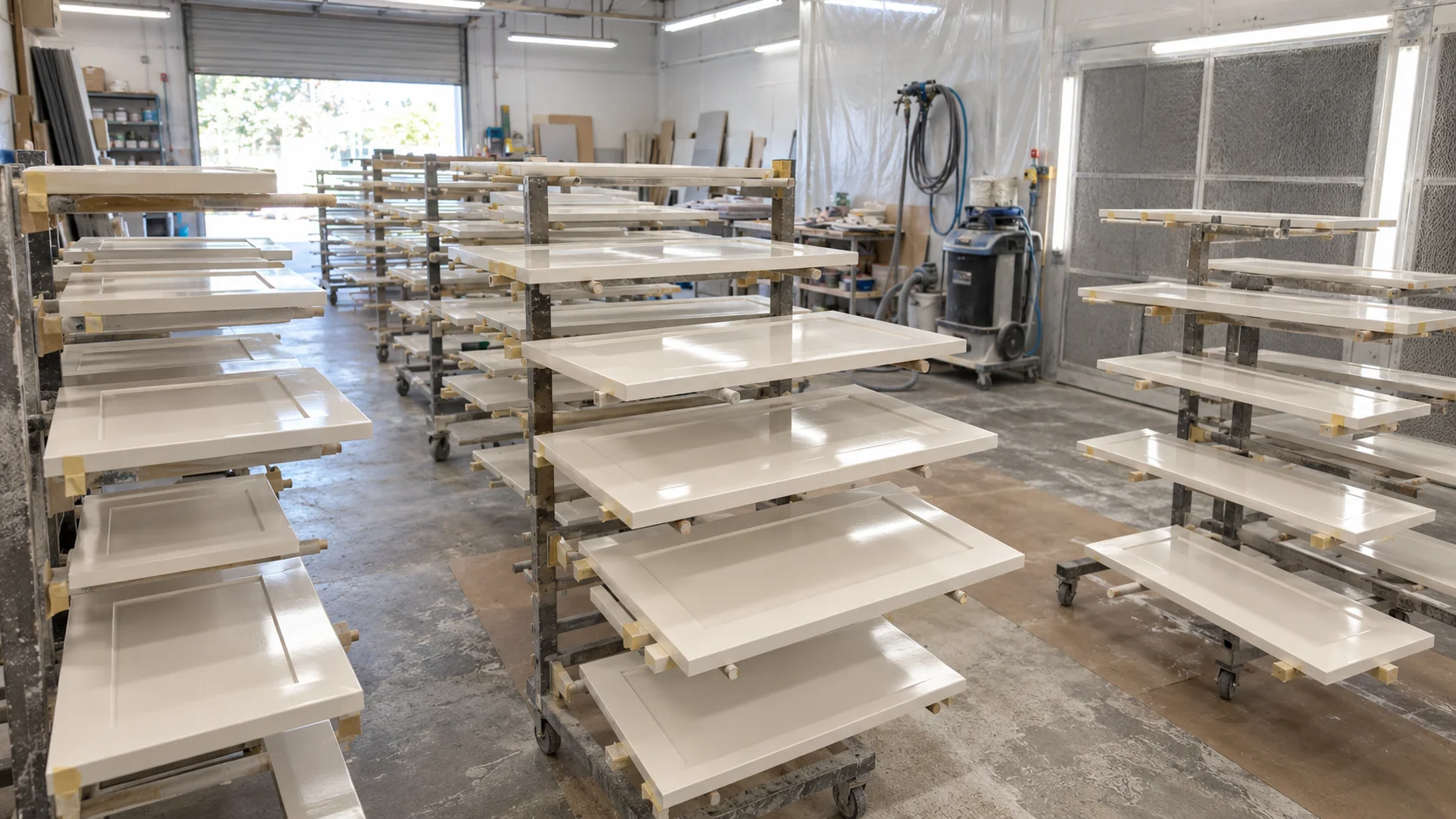
In our shop. Doors and drawer fronts come off, every one gets numbered and its opening tagged — masking tape inside the hinge mortise, a mirrored map on a clipboard — hinges and hardware bagged per door, and the whole load is wrapped and racked in the trailer so nothing rubs in transit. In the shop they go on drying racks in a filtered spray environment, get sprayed on both faces, flipped on schedule, and cured flat before they are ever stacked. Shop work is how you get a factory-flat door, and it is mandatory for catalyzed coatings. Your boxes and face frames still get done at the house.
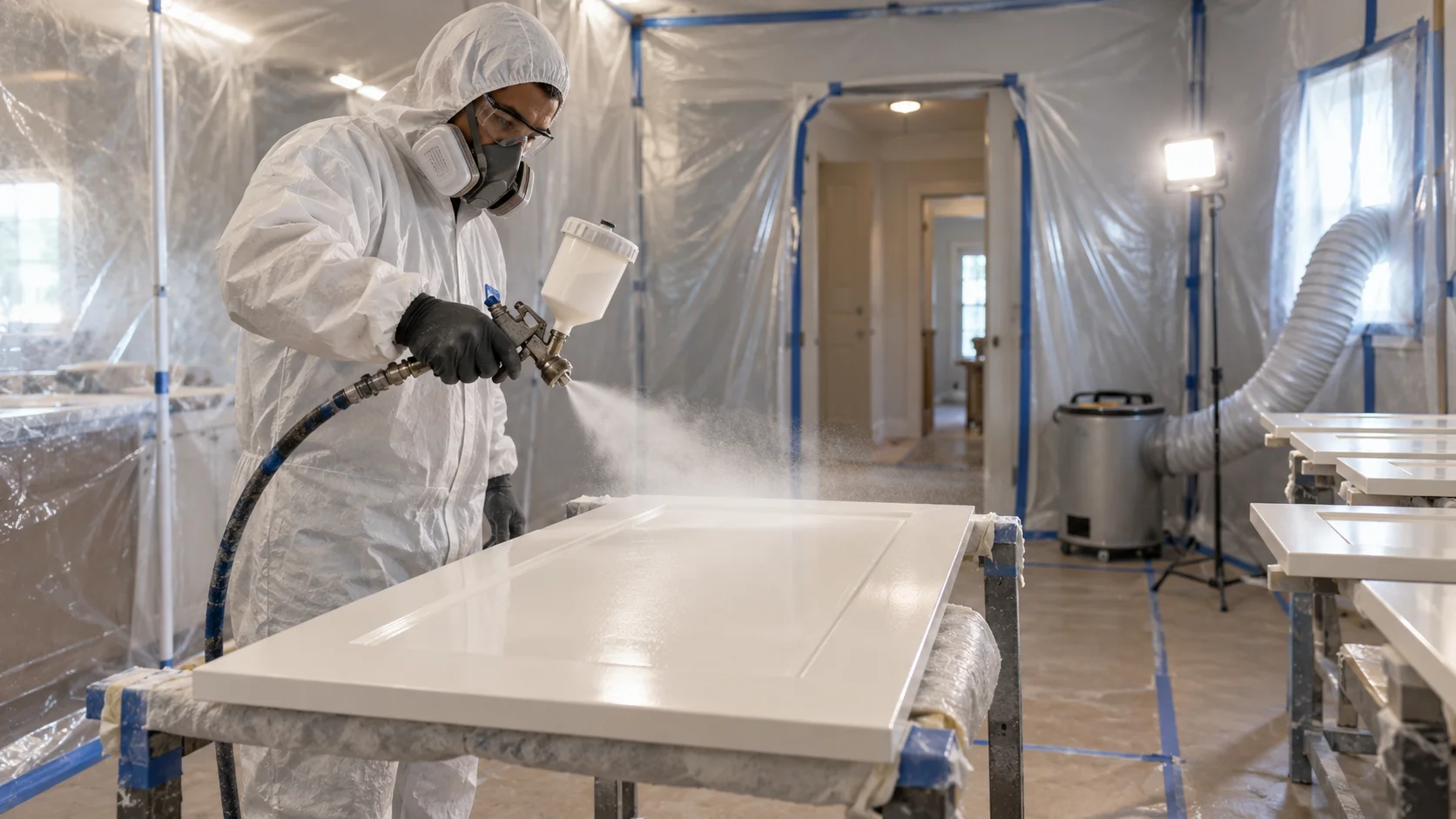
In your kitchen. Sometimes the schedule or the layout demands it. On-site spraying is not a matter of hanging a sheet of plastic across the doorway. It means full containment — poly walls floor to ceiling, doorways zipped, HVAC returns sealed and the system shut down so the blower does not distribute atomized finish through your bedrooms — plus negative air. A filtered air scrubber exhausted out a window keeps the containment at lower pressure than the rest of the house, so air moves into the work zone and overspray and odor cannot migrate. Fine finish tips at reduced pressure or an HVLP turbine keep the overspray soft and local. Floors get papered and taped, counters get boarded.
Dust is the other half of it. Sanding dust suspended in a room will land in wet finish and stay there forever, so sanding happens with vacuum extraction, the containment gets wiped and allowed to settle before any spraying, and we do not sand and spray in the same room in the same hour. You can see what the finished work looks like in our project gallery, and our interior painting page covers what to expect during any interior project.
Dry Is Not Cured. Give It the Week.
This is the advice homeowners ignore most and regret most. A cabinet finish is dry to the touch in hours and safe to handle in a day. It is not fully cured for considerably longer — roughly five days for a waterborne alkyd by Benjamin Moore's own guidance, and up to thirty days for some trim enamels depending on temperature and humidity. Cure is when the film reaches its final hardness and block resistance, and until then it is soft enough to dent, mar, and stick to itself.
What we ask of clients: leave the doors ajar with the bumpers we supply for the first few days, do not stack dishes or glassware back onto shelves for about a week, no shelf liner for two weeks, and no abrasive cleaners or degreasers on the new finish for thirty days. New Jersey humidity matters here. A July cabinet job in Brick cures slower than the same job in October, and we schedule and advise accordingly.
Substrate Decides What Is Possible
- Solid wood and plywood boxes. The easy case. Clean, sand, prime, spray. Repairs take filler and disappear under pigment.
- MDF doors and center panels. Excellent for paint — no grain, no movement, no joint lines telegraphing at the rails. Watch the bottom edges near the dishwasher; MDF that has taken on water swells and has to be replaced, not sealed.
- Thermofoil and rigid-thermofoil doors. A vinyl film heat-pressed onto MDF. It can be painted, but only if the film is one hundred percent intact. Any lifted corner means the adhesive is failing, and where one door has let go the neighbors usually follow — paint over a delaminating edge and the paint leaves with the foil. Lifted areas need re-adhering and full cure before any coating. Even done correctly, painted thermofoil is a shorter-lived finish than painted wood, and honest expectations run in the range of a handful of years. Thermofoil kitchens are often better candidates for refacing than for painting.
- Melamine and laminate. Slick, non-porous, and completely dependent on a proper bonding primer. Done right, it holds. Done with a general-purpose primer, it peels in sheets.
- Oak and ash. See above. Beautiful under clear, demanding under paint.
How to Choose, in Order
- Open a door and look at the box. Sagging shelves, blown-out particleboard at the hinge screws, water damage under the sink, doors that will not stay aligned — that is a replacement conversation, and no finish fixes it.
- Stand in the room and ask whether the layout works. If the answer is no, everything on this list except replacement is money spent on a kitchen you will still want to change.
- Look at the doors specifically. Sound boxes plus doors you dislike or that are failing points to refacing. Sound boxes plus doors you like in a color you do not points to painting.
- Decide about the wood. If the grain is the reason you like the kitchen, refinish. If the grain is the reason you do not, paint — and budget for grain fill if it is oak.
- Be honest about your timeline. A week of missing doors is not the same disruption as six weeks without a kitchen.
Once the method is settled, the color question starts — and it comes with one cabinet-specific caveat: cabinet colors read considerably darker in a kitchen than on a chip, because the doors are vertical, mostly in shadow, and surrounded by counter and backsplash. Our guide to kitchen cabinet paint colors lists the colors we see chosen most, with codes and LRVs.
Two New Jersey Specifics Worth Knowing
Pre-1978 kitchens and the lead rule
Plenty of the housing stock we work in — older Middletown, Red Bank, Point Pleasant, and the shore bungalows — predates 1978. Under the EPA's Renovation, Repair and Painting rule, anyone paid to perform work that disturbs painted surfaces in homes and child-occupied facilities built before 1978 must be certified in lead-safe work practices, and that includes sole proprietors. Cabinet work disturbs painted surfaces by definition: you are sanding. If your house is older than 1978 and a contractor does not raise the rule on the walkthrough, that tells you something about the rest of their process. Newer cabinets in an older house are covered too: the EPA says the rule applies unless the components being worked on have been determined to be free of lead-based paint, and that only a certified renovator, inspector or risk assessor can make this determination, so the installation date alone is not enough without that determination in writing. NJ Painting Co. is not an EPA Lead-Safe Certified firm, so we do not take on work covered by the rule; in a pre-1978 house, ask every bidder for their firm certificate and how they will contain and clean up the work. Our guide to lead paint in older NJ homes explains what the rule requires.
Registration, insurance, and the contract
New Jersey's Contractors' Registration Act requires home improvement contractors to register with the Division of Consumer Affairs, and the state's registration checklist requires "proof of commercial general liability insurance in a minimum amount of $500,000 per occurrence." The Division's own consumer brief on hiring home improvement contractors is worth five minutes of any homeowner's time: contracts for work over $500 must be in writing and must include the contractor's registration number, start and completion dates, a description of the work, and the total price, and the contractor must give you a copy of the liability insurance policy with the insurer's phone number. It also notes that the law prohibits demanding final payment before the work is complete. We put all of it in writing as a matter of course, and you can read what our clients say about how our projects run on our testimonials page.
What We Would Do in Your Kitchen
For most of the kitchens we walk into across Monmouth and Ocean counties — solid boxes, dated color, doors that are fine — a properly prepped, properly primed, sprayed finish is the best dollar-for-dollar result available in residential painting, full stop. It costs a fraction of replacement, it takes a week rather than a season, and done with the right coating it holds up for a decade. Refacing earns its premium when the doors themselves are the problem. Replacement earns its premium when the layout or the boxes are.
NJ Painting Co. is family-owned, based at 36 Church Rd in Morganville, and we have been doing this for over twenty years. We are licensed and fully insured, we use Benjamin Moore and Sherwin-Williams products, and our work carries a two-year workmanship warranty. Estimates are free and include an in-home color consultation, and we will tell you plainly if we think your kitchen is a refacing job or a replacement job rather than one of ours. We cover Monmouth, Middlesex, Ocean, Mercer, Somerset, and Burlington counties, plus Union, Essex, Hudson, Bergen and Passaic in North Jersey — the full list is on our service areas page. Homeowners along the shore can see how this works locally on our cabinet painting in Ocean County page, and our Monmouth County and Middlesex County pages cover the towns we serve there. Cabinets are usually part of a larger plan, so it is worth looking at our interior painting services at the same time. When you are ready, get in touch and we will come count doors.
Frequently Asked Questions
What is the difference between painting and refinishing kitchen cabinets?
Painting applies an opaque color that hides the wood. Refinishing removes or abrades the existing finish and rebuilds it, usually clear or stained, so the wood still shows. Painting is generally faster and less expensive; refinishing preserves grain but cannot lighten a kitchen the way paint can.
Which is cheaper: painting, refinishing, refacing or replacing cabinets?
Painting and refinishing are the two least expensive, refacing roughly doubles the cost, and replacement usually ends up the most expensive once countertops, removal and any layout change are added. Fixr's 2026 national figures are about $4,000 on average to paint a kitchen's cabinets, $2,000 to $4,500 to refinish them and about $8,250 to reface them, with new cabinets averaging $7,000 installed before countertops (Fixr adds about $3,000) and removal ($350 to $1,000). In New Jersey we quote painting at roughly $3,200 to $8,500 for an average kitchen, because labor here costs about 20 percent more than the national median.
Do you reface or replace cabinets?
No. We paint, spray and refinish existing cabinets. Refacing and replacement are carpentry and remodeling work, which we do not offer, and if a walkthrough shows your boxes or layout need one of them, we will say so rather than sell you a paint job that will not fix the problem.
How long do professionally painted kitchen cabinets last?
With correct degreasing, a bonding primer, and a cabinet-grade enamel, expect eight to twelve years before the finish looks tired, and longer in a low-traffic kitchen. Failures inside three years are almost always a prep problem or a wall-paint problem, not a wear problem.
Can you paint thermofoil or laminate cabinets?
Yes, with conditions. The thermofoil film has to be fully intact; any lifting edge must be re-adhered and cured first, because paint over a delaminating surface leaves with the foil. Laminate and melamine need a genuine bonding primer. Painted thermofoil also has a shorter realistic service life than painted wood, so on a kitchen with several failing doors, refacing is often the better spend.
Do you spray in my kitchen or take the doors to a shop?
Both, depending on the job. Doors and drawer fronts are numbered, hardware is bagged per door, and they are usually finished on racks in our shop where the air is filtered and they can cure flat. Boxes and face frames are sprayed in place behind full containment with negative air, HVAC sealed off, and vacuum-assisted sanding so dust does not land in wet finish.
How soon can I put everything back in my cabinets?
Doors go back on within a day or two of the final coat, but wait about a week before loading dishes and glassware onto shelves, two weeks for shelf liner, and thirty days before using any abrasive cleaner or degreaser. Dry is not cured — the film keeps hardening for days after it stops feeling wet, and humid New Jersey summers slow that down.
Is cabinet painting worth it before selling a house in Monmouth or Ocean County?
Usually yes, and it is one of the few kitchen moves where the math is not a stretch. Buyers price a dated kitchen harshly, and restrained kitchen work is the category that holds its value best — Zonda's 2025 Cost vs. Value report had a minor midrange kitchen remodel recouping roughly 113 percent nationally, the only interior project in the report's top five. A sprayed kitchen at a few thousand dollars changes the first impression of the whole house.
About the author
Written by the NJ Painting Co. team
NJ Painting Co. is a family-owned painting contractor based in Monmouth County, in business since 2004. We are licensed and fully insured, work with Benjamin Moore and Sherwin-Williams paints, and back our work with a 2-year workmanship warranty. We serve Monmouth, Middlesex, Ocean, Mercer, Somerset and Burlington counties, plus Union, Essex, Hudson, Bergen and Passaic in North Jersey.