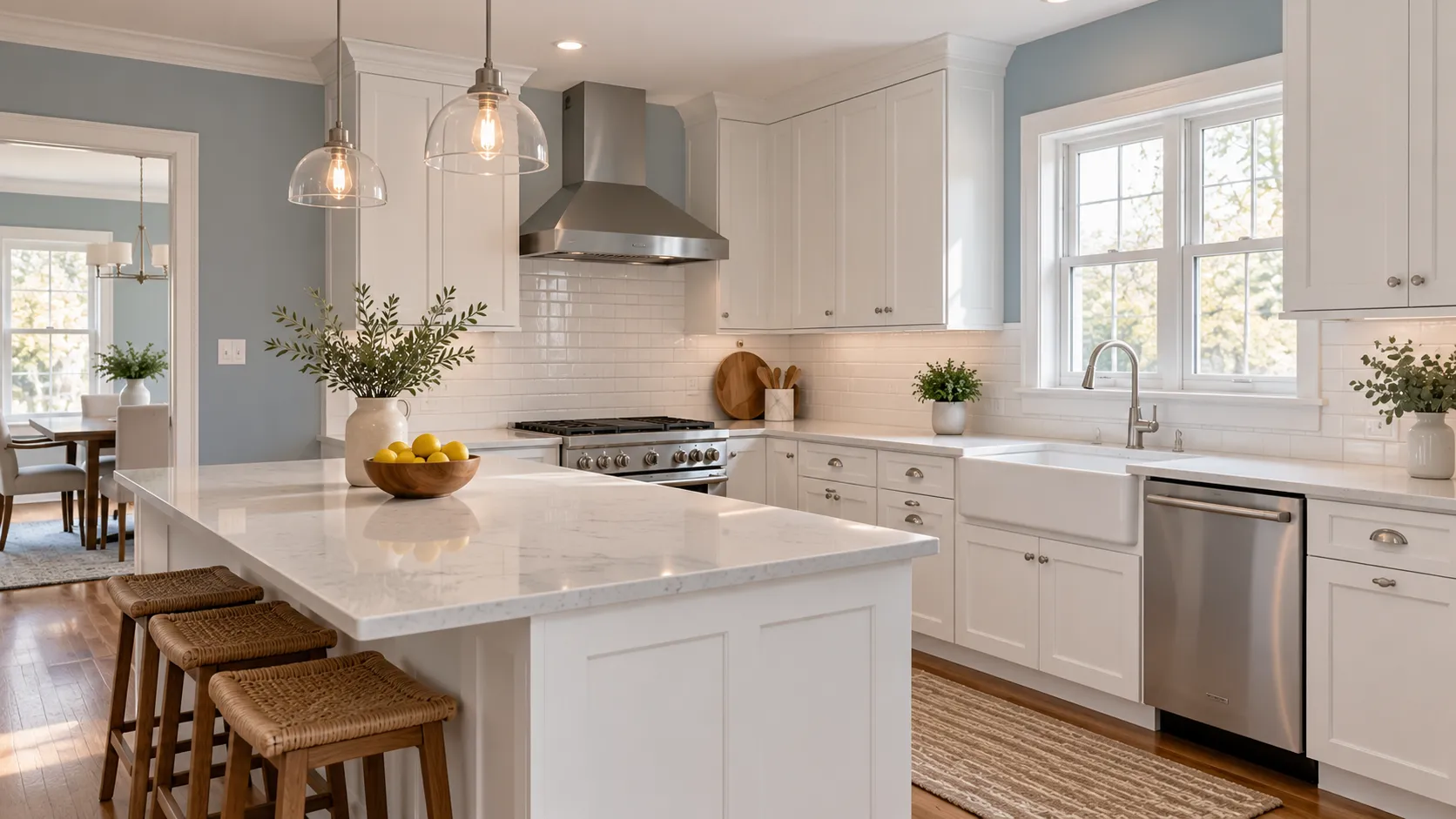
The best paint for kitchen walls is a premium acrylic interior latex in eggshell or satin, from a line whose data sheet claims washability, stain release and burnish resistance. It goes onto a wall that has been degreased, rinsed and dried, with any grease or smoke stain that has soaked in sealed first with a stain-blocking primer.
In our own work that usually means Benjamin Moore Regal Select Eggshell or Sherwin-Williams Emerald Interior Satin on the walls, a dead-flat ceiling paint overhead, and a waterborne alkyd or acrylic-alkyd enamel on the trim. The can matters less than people expect. A kitchen wall fails because of the grease that was on it before it was painted, not because the paint was the wrong brand.
We are a family-owned painting company in Morganville and have painted New Jersey interiors for more than 20 years across Monmouth, Middlesex, Ocean, Mercer, Somerset and Burlington counties, plus Union, Essex, Hudson, Bergen and Passaic in North Jersey, using Benjamin Moore and Sherwin-Williams products. Kitchens are the room where homeowners most often ask us which paint to buy, and the room where the honest answer is mostly about preparation: a kitchen wall carries a film of cooking oil that you cannot see until new paint refuses to stick to it. This guide is the long version of what we explain standing next to a range hood.
It is written to be useful whether or not you hire anyone. Every technical figure below — sheen numbers, dry and recoat times, the wait before washing, VOC content, primer stain lists and range-hood sizing — comes from a manufacturer's technical data sheet, a product label, a published standard, a trade association or a federal agency, each one fetched and quoted on 24 October 2026. Where we give our own practice rather than a published figure, we say so.
The Short Answer
- Buy a washable, stain-releasing wall paint, not just a shinier one. Benjamin Moore says its Regal Select Matte uses "a proprietary stain release technology" so that "most common household stains like dirt, grime, lipstick, catsup, and washable markers can be easily removed with mild soap and water." Sherwin-Williams sells Emerald on "premium performance in washability, stain resistance, block resistance, adhesion, burnishing and hiding."
- Eggshell or satin on the walls. Regal Select Eggshell reads "15 – 22 @ 85°"; Emerald Satin "10-20 units @ 85°." Satin where hands and splashes land; semi-gloss mostly belongs on the trim.
- Flat on the ceiling, not on the walls. A kitchen ceiling is a grease problem, not a humidity problem, and a ceiling flat such as Sherwin-Williams Eminence at "0-5 units @ 85°" hides patches best.
- Degrease, rinse, dry. Every data sheet in this article wants a surface "free of dirt, dust, grease, oil, soap, wax." Sherwin-Williams: "Remove all surface contamination by washing with an appropriate cleaner, rinse thoroughly and allow to dry."
- Grease that has soaked in needs a stain-blocking primer. Sherwin-Williams: "Stains from water, smoke, ink, pencil, grease, etc. should be sealed with the appropriate primer-sealer." Benjamin Moore's alkyd Fresh Start 024 names "grease marks"; Zinsser B-I-N "blocks grease spots."
- Do not scrub the new paint for two weeks. Benjamin Moore: "Painted surfaces can be washed after two weeks." Sherwin-Williams: "wait at least 14 days before washing Duration Home coating."
- The range hood protects the paint. The Home Ventilating Institute recommends 100 CFM per linear foot of range for a wall hood and warns that "nonducted, recirculation kitchen range hoods provide no actual ventilation."
- We paint the wall above the backsplash, not the backsplash. We do not paint tile, and cabinet painting is its own job with its own guides, linked below.
What Makes a Paint Good Enough for a Kitchen?
Every paint company sells a "kitchen and bath" paint, and every premium wall paint now claims to be washable. The useful question is which properties a kitchen wall actually needs, and which of them you can read off a data sheet rather than a can label. There are four, and only one of them is sheen.
1. Scrub resistance
A kitchen wall gets wiped more than any other wall in the house: beside the light switch, around the trash can, under the wall phone that is no longer there, behind the chairs at the table. Each wipe takes a little paint with it. The test the industry uses for this is ASTM D2486, which ASTM describes as "a procedure for determining the resistance of wall paints to erosion caused by scrubbing," and whose purpose is "the determination of the relative resistance of different paints to erosion" when they are "repeatedly scrubbed during the life of the paint."
The catch is that none of the Benjamin Moore or Sherwin-Williams data sheets we read for this article prints a scrub-cycle number. They state the property in words — Regal Select Eggshell is "highly washable," Aura Eggshell says "stains wash off easily," and Benjamin Moore's Green Promise statement on those sheets refers to "rigorous environmental and performance criteria regarding VOCs, emissions, application, washability, scrubbability and packaging" — but there is no cycle count you could compare across brands. Be suspicious of any comparison table on the internet that ranks wall paints by scrub cycles without telling you where the numbers came from.
2. Burnish resistance
Burnishing is the shiny patch a flat or matte wall develops where it is rubbed: the corner everyone brushes past on the way to the refrigerator, the wall behind the chairs, the area round a light switch. It is not dirt, so washing makes it worse. Sherwin-Williams lists the property by name on both of its premium wall paints. Emerald claims "premium performance in washability, stain resistance, block resistance, adhesion, burnishing and hiding," and Duration Home lists "resistant to stains, scuffs & burnishing." A slightly higher sheen burnishes less visibly than a lower one, which is one practical reason most kitchens end up in eggshell or satin.
3. Stain release
Stain release is how easily a splash comes off the film before it has a chance to set. Benjamin Moore puts it plainly on its Regal Select Matte sheet: "A premium quality 100% acrylic matte finish that washes clean with soap and water. It uses a proprietary stain release technology. Most common household stains like dirt, grime, lipstick, catsup, and washable markers can be easily removed with mild soap and water." Ketchup is on the list for a reason. Aura Eggshell lists "stains wash off easily" among its features, and Sherwin-Williams lists "stain resistance" for Emerald and "resistant to stains" for Duration Home.
4. Grease — which is a preparation problem, not a paint property
This is where kitchens differ from every other room, and it is the part most "best paint for kitchens" articles leave out. No paint on the market is sold as sticking to grease. Every data sheet says the opposite: Benjamin Moore's Regal Select and Aura sheets both open their preparation sections with "Surfaces to be painted must be clean, dry, and free of dirt, dust, grease, oil, soap, wax, scaling paint, water soluble materials and mildew." What a good kitchen paint does is let you wipe fresh grease off after it is painted. Getting the old grease off before it is painted is your job, or ours, and it gets its own section below.
Which Sheen Is Best for Kitchen Walls?
Eggshell or satin, in almost every New Jersey kitchen we paint. The choice between them, and the cases for flat and semi-gloss, depend on which surface you mean. A kitchen has at least five: the open walls, the short wall between the countertop and the upper cabinets, the wall behind the range, the ceiling, and the trim. Our guide to satin versus eggshell covers sheen across the whole house; this section only deals with the kitchen.
What the sheen numbers mean
Sheen is measured with a gloss meter, and data sheets give it in gloss units at a stated angle. The Gypsum Association's GA-214-2021 gives the definition used in the drywall and painting trades: flat paint is "a paint material specifically manufactured to produce 0 to 5 Gloss Units (GU) at a 60° angle and 0 to 10 Gloss Units (GU) at an 85° angle when measured using a gloss meter." By the manufacturers' own readings, Regal Select Matte is "2 – 5.5 @ 85°," Aura Eggshell "12 – 22 @ 85°," Regal Select Eggshell "15 – 22 @ 85°," Emerald Satin "10-20 units @ 85°" and Duration Home Satin "15-20 units @ 85°." Shinier finishes are measured at the steeper 60° angle: Regal Select Pearl reads "15 – 25 @ 60°" and Advance Semi-Gloss "50 – 60 @ 60°." Notice that one brand's satin and another's eggshell overlap almost completely. The names are marketing; the numbers are what to compare.
Open kitchen walls: eggshell or satin
On the walls away from the cooking and the sink, an eggshell gives you a washable film with a low enough sheen to hide drywall seams and patches. A satin gives you a little more washability and burnish resistance at the cost of showing more of the wall underneath. Our own default in a family kitchen is satin where the traffic is — around the table, the back door, the trash, the light switches — and either satin or eggshell everywhere else, usually the same product throughout so the walls read as one surface.
Why the sheen you pick depends on the lighting
GA-214 is blunt about what shine does: "In general, non-flat and dark/deep tone paints highlight minor surface differences, whereas textures conceal these minor differences." It also defines the condition that makes it worse: "Critical (Severe) Lighting Areas. Examples include wall and ceiling areas that are illuminated or flooded with artificial and/or natural light. Strong oblique light from windows or surface-mounted light fixtures may exaggerate minor surface differences." A modern kitchen is often a textbook case — under-cabinet strip lights throwing light straight down the short wall above the counter, recessed cans close to the walls, a window over the sink. If the walls have been patched a lot, as kitchen walls usually have, that is an argument for eggshell rather than satin, and for proper drywall repair before either.
The wall behind the range
In most New Jersey kitchens there is tile behind the range and the question does not arise. Where there is a painted wall — a range on an island run, a short gap between the top of the backsplash and the hood, a wall beside a range with no tile at all — it gets more grease than anywhere else in the house. Our practice there is the hardest, most washable film that will still look right next to the rest of the wall: usually the same satin as the room, and on a plain painted wall right beside the cooktop sometimes a pearl or a semi-gloss enamel. Benjamin Moore describes Regal Select Pearl as "ideal for surfaces subject to abuse and soil such as corridors, stairwells, cafeterias," and lists Advance as "ideal for interior doors, trim, cabinets, walls, and ceilings."
One thing paint will not do is protect a wall from heat. None of the wall paint data sheets we read publishes a heat rating, and they are not designed as heat shields. Clearances between a range or cooktop and the wall or cabinets above it are set by the appliance manufacturer's installation instructions, not by the paint.
Can you use flat paint in a kitchen?
On the ceiling, yes — it is usually the best choice, for reasons covered below. On the walls, a traditional flat is a poor choice in a kitchen: it marks, it burnishes, and it does not clean. The exception is the newer premium mattes sold specifically on washability. Regal Select Matte, at "2 – 5.5 @ 85°," is inside GA-214's flat band by its own reading and is sold on stain release. In a kitchen with lots of critical light and walls that are not perfectly flat, a washable matte of that kind is a legitimate choice for the walls away from the range and sink. We would not use it on the wall beside the cooktop.
Trim and doors: semi-gloss still belongs here
Window and door casings, baseboard and the kitchen door get touched with wet and greasy hands, kicked by chairs and wiped more than the walls. They are wood or MDF and broken up by profiles, so the GA-214 objection to shine hardly applies. Our usual trim enamels are hybrids: Benjamin Moore's Advance Semi-Gloss 793, "a premium quality, waterborne alkyd enamel that delivers the desired flow and leveling characteristics of conventional alkyd paint," which "provides a tough, semi-gloss finish that stands up to repeated washing," and Sherwin-Williams' ProClassic Waterbased Acrylic-Alkyd, whose listed project uses include "kitchens/baths." Our article on painting trim, doors and baseboards goes further.
The Kitchen Wall Paints We Reach For, Side by Side
The table below is taken straight from each product's technical data sheet. These are the products we specify and the alternatives we would accept in a kitchen; it is not a ranking of every paint on the market, and we have left out brands whose data sheets we could not read in full.
| Product | Where we use it in a kitchen | Sheen | Spread rate per gallon | Dry to touch | Recoat | VOC | What the sheet claims for kitchens |
|---|---|---|---|---|---|---|---|
| Benjamin Moore Regal Select Matte 548 | Walls away from range and sink, critical light | 2 – 5.5 @ 85° | 400 – 450 sq. ft. | 1 hour | 1 – 2 hours | Zero VOC | "Proprietary stain release technology" |
| Benjamin Moore Aura Eggshell 524 | Walls | 12 – 22 @ 85° | 350 – 400 sq. ft. | 1 hour | 1 hour | 0 g/L | "Stains wash off easily" |
| Benjamin Moore Regal Select Eggshell 549 | Walls | 15 – 22 @ 85° | 400 – 450 sq. ft. | 1 hour | 1 – 2 hours | 0 g/L | "Highly washable" |
| Sherwin-Williams Emerald Interior Satin K37 | Walls, hard-use areas | 10-20 units @ 85° | 350-400 sq. ft. | 1 hour | 4 hours | Less than 50 g/L | "Washability, stain resistance, block resistance, adhesion, burnishing" |
| Sherwin-Williams Duration Home Satin A97 | Walls, hard-use areas | 15-20 units @ 85° | 350-400 sq. ft. | 1 hour | 4 hours | Less than 50 g/L | "Resistant to stains, scuffs & burnishing" |
| Benjamin Moore Regal Select Pearl 550 | Painted wall beside a cooktop | 15 – 25 @ 60° | 400 – 450 sq. ft. | 1 hour | 1 – 2 hours | Zero VOC | "Surfaces subject to abuse and soil" |
| Benjamin Moore Ultra Spec Scuff-X Satin 486 | Very hard-use walls | 20 – 35 @ 60° | 350 – 400 sq. ft. | 1 hour | 2 – 3 hours | 95 g/L | "Innovative and proprietary scuff-resistance formula" |
| Sherwin-Williams Eminence Ceiling Paint Flat | Ceiling | 0-5 units @ 85° | 350-400 sq. ft. | 1 hour | 4 hours | Less than 50 g/L | "Extremely flat finish" |
| Benjamin Moore Advance Semi-Gloss 793 | Trim, doors | 50 – 60 @ 60° | 400 – 500 sq. ft. | 4 – 6 hours | 16 hours | 43.2 g/L | "Stands up to repeated washing" |
| Sherwin-Williams ProClassic Acrylic-Alkyd Semi-Gloss | Trim, doors | 41-51 units @ 60° at 24 hours | 350-400 sq. ft. | 1-2 hours | 4 hours | Less than 50 g/L | Project uses include "kitchens/baths" |
A few things in that table are worth slowing down for. The recoat column decides how long your kitchen is out of action: Benjamin Moore's wall paints take a second coat in one to two hours, Sherwin-Williams' in four, and the Advance enamel on the trim wants sixteen. Every sheet qualifies those figures. Benjamin Moore: "High humidity and cool temperatures will result in longer dry, recoat and service times." Sherwin-Williams: "Drying and recoat times are temperature, humidity, and film thickness dependent." A kitchen with pasta water boiling is a humid room for the afternoon.
The Scuff-X row is there because people ask about it. Benjamin Moore describes it as "a high-performance, one-component latex paint specifically engineered to deliver outstanding performance and protection for the toughest high-traffic areas in busy commercial spaces," listing "cafeterias" among its uses. It is a commercial product with a satin noticeably shinier than most residential satins, and at "95 Grams/Liter" it carries more VOC than the residential lines. In a house it is a specialist choice for a wall that is genuinely abused, not a default. If you want the broader brand question, our Benjamin Moore versus Sherwin-Williams article covers it.
And every wall paint in the table is a waterborne acrylic or acrylic-blend latex that cleans up with water. If you came here asking whether to use latex paint for kitchen walls: yes. Nobody we know still puts oil-based paint on kitchen walls, and the oil-based product in this article is a primer used in spots, below.
Can You Paint Over Greasy Kitchen Walls?
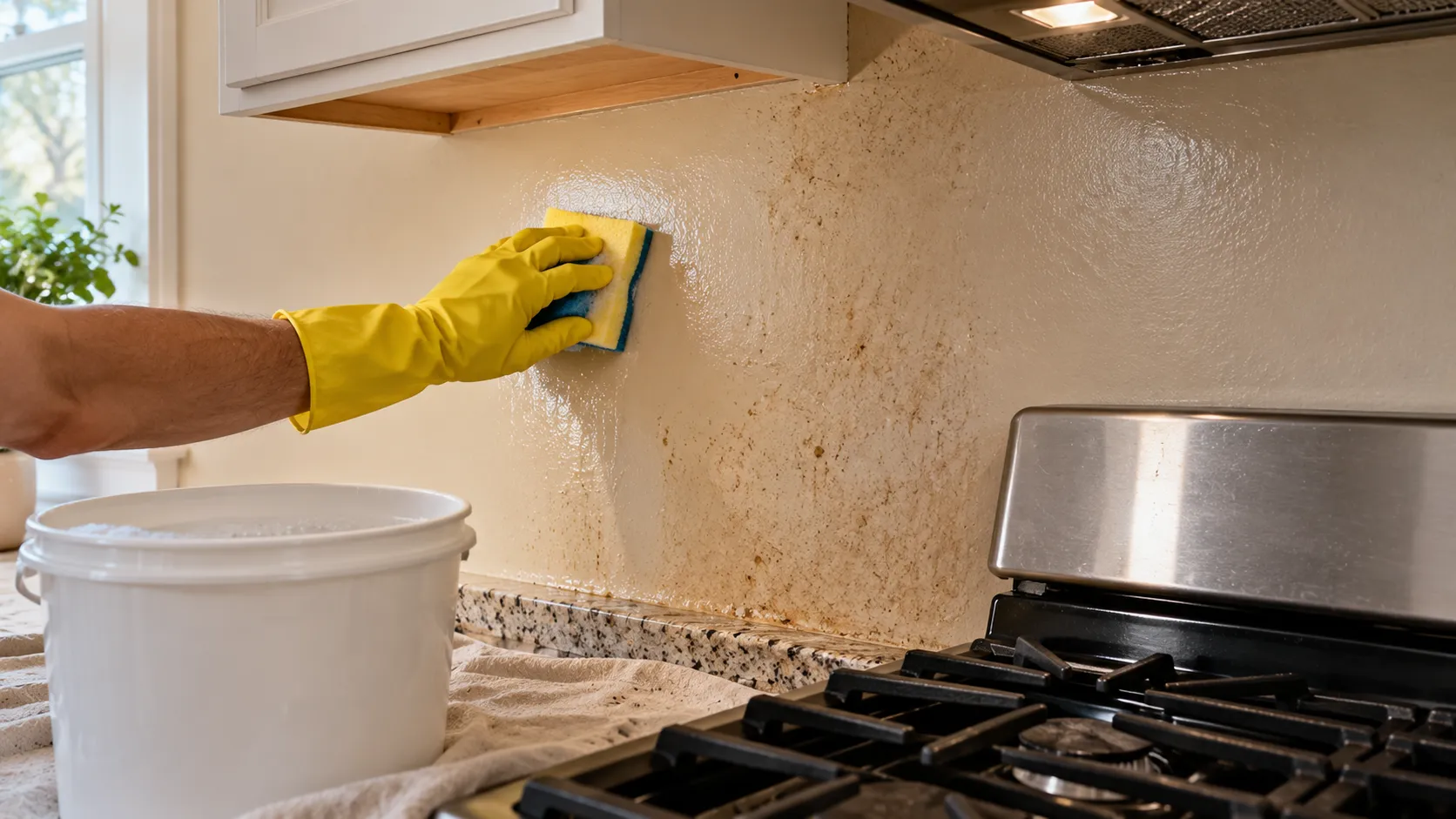
No — not without removing the grease first, and this is the single most common reason kitchen paint fails. The symptoms are familiar: paint that will not cover evenly and pulls back into little craters as it is rolled, a finish that stays soft or tacky, patches that peel off with a strip of tape, and a ghost of the old grease line above the range showing through within weeks. Every manufacturer is explicit. Benjamin Moore: surfaces "must be clean, dry, and free of dirt, dust, grease, oil, soap, wax." Sherwin-Williams: "Remove all surface contamination by washing with an appropriate cleaner, rinse thoroughly and allow to dry."
How to tell where the grease is
Kitchen grease is airborne. It rises from the cooktop as a fine mist, drifts with the warm air and settles on every surface it touches, thickest above and beside the range, along the top of the upper cabinets, on the ceiling over the cooktop and around the hood. It also collects where hands go: around light switches and outlets, along the edge of the door to the garage, on the wall beside the trash can. Our practice is to treat every kitchen wall and ceiling as greasy until it has been washed, because the film is often invisible on a light wall. A rough field check is to splash a little water on the wall: on a clean wall it wets out and runs; on a greasy one it beads.
What to wash with
The traditional answer is trisodium phosphate. Savogran's TSP label describes it as "formulated for heavy duty cleaning" and says it "removes greasy, sooty dirt and prepares painted surfaces for repainting." Its directions: "Dissolve 1/2 cup TSP in 2 gallons of hot water," and for walls, "squeeze excess cleaner from sponge or cloth and wash from bottom up to avoid streaking. A second washing may be needed. Rinse cleaned area with clean warm water." The label also carries a warning worth taking seriously in a kitchen: "HARMFUL IF SWALLOWED. EYE AND SKIN IRRITANT. MAY CAUSE BURNS." Wear gloves and eye protection, and put food, dishes and utensils away first.
Phosphate-free "TSP substitute" and pre-paint degreasers are sold beside it, and many people prefer them. They work differently from brand to brand — some need rinsing, some say they do not — so follow the label of the product you actually buy, including its dilution and its rinse instructions. Do not mix cleaners, and do not use oven cleaner or any abrasive on a wall you intend to paint.
Rinse, then let it dry
Rinsing matters as much as washing. Detergent left on the wall is another contaminant, and the paint will not tell the difference. Sherwin-Williams' instruction is three verbs long for a reason: wash, "rinse thoroughly and allow to dry." Our own practice is to wash every kitchen wall and the ceiling above the range, rinse with clean water and a second sponge, and give the surface time to dry before any primer or paint goes on. Above the range, along the top of the backsplash and around the hood we usually wash twice.
Mildew is rare on open kitchen walls but does turn up behind and under the sink and on an outside wall behind the refrigerator. Washing a surface is ours. Treating mould or mildew growth is not something we do; if a spot comes back through paint, or the drywall behind the sink is soft or stained, that is a moisture problem, and we will say so and send you to the right trade before anything is painted.
What Is the Best Primer for Kitchen Walls?
Often you do not need one. Most premium wall paints are sold as self-priming over clean, sound, previously painted surfaces. Regal Select: "Regal Select is self priming on most surfaces. On bare substrates two coats are required; previously painted surfaces can be finished with 1 or 2 coats." Emerald: "Emerald Interior Latex can be used directly over existing coatings, bare drywall," with drywall self-primed "using 2 coats." A clean kitchen wall in good condition, staying a similar colour, normally goes straight to finish coats.
Kitchens are the room where primer earns its place, though, for four reasons.
1. Grease and smoke stains that have soaked in
Washing removes grease from the surface. It does not always remove what has soaked into old flat paint or the paper face of drywall, and that bleeds back through a latex finish as a yellow or amber shadow. Both manufacturers send you to a different product for it. Sherwin-Williams, on every wall paint sheet we read: "Stains from water, smoke, ink, pencil, grease, etc. should be sealed with the appropriate primer-sealer." Benjamin Moore's Regal Select and Aura sheets point to "specialty primers for use over difficult substrates such as bleeding woods, grease stains, crayon markings, hard glossy surfaces."
Read the primer sheets carefully, because not every stain-blocker lists grease. Benjamin Moore's waterborne Fresh Start High-Hiding All-Purpose Primer 046, which we use all the time for repairs and colour changes, lists "tannin bleed, water stains, smoke damage, markers, crayons, pens, pencils, nicotine, hand & fingerprints, household stains such as coffee and many more." Grease is not on that list. The two products whose sheets do name it are solvent-based:
- Benjamin Moore Fresh Start Multi-Purpose Oil Based Primer 024, "a premium quality alkyd primer for use as an undercoater, sealer or stain blocking primer. Formulated for suppressing most bleeding type stains including crayon, graffiti, grease marks, water stains, cedar and redwood bleed, asphalt, creosote, rust stains, and smoke." It is dry to touch in "6 Hours," recoatable in "8 Hours," cleans up with mineral spirits and lists VOC at "344 Grams/Liter."
- Zinsser B-I-N Shellac-Based Primer (spray), which "blocks grease spots, fire, smoke, water stains, ink, crayon, knots and sap streak stains." It will "dry to the touch in 15 minutes and surfaces can be painted in 30 minutes," and the solvents its sheet lists include acetone and ethanol.
Both smell, and both are the reason our practice in a kitchen is to spot-prime only the stained area with a solvent primer, not the whole room, and to keep the cooktop off and the room ventilated while we do it. Benjamin Moore's sheet gives the alkyd primer a flash point of "113 °F (45 °C)." Note that even the stain-blockers want a clean surface first — the 024 sheet asks for surfaces "free of grease, wax, rust, chalk," and the B-I-N sheet for surfaces "free of dust, dirt, grime, grease, oil, wax." Primer seals in a stain that has soaked in. It does not stick to grease that is still on top.
2. Repairs
Kitchen walls get patched constantly: anchors from old shelves and phone mounts, a moved light switch, the hole where a backsplash used to end. Joint compound and spackle are far more absorbent than cured paint and flash through a finish coat. Benjamin Moore's instruction is to "spot prime before and after filling nail holes, cracks, and other surface imperfections." Drywall and sheetrock repair is work we do, and our drywall repair guide covers how it gets scoped.
3. Glossy old paint
Plenty of older New Jersey kitchens were painted in a gloss or semi-gloss, sometimes oil, on the theory that shiny meant washable. New latex will not grip it reliably. Benjamin Moore: "Glossy areas should be dulled." Sherwin-Williams: "Glossy surfaces should be sanded dull." We degrease first, then dull, then prime — in that order, because sanding a greasy wall just drives the grease into the scratches. If the old paint is lifting rather than just glossy, our article on why paint peels is the place to start.
4. A big colour change
Sherwin-Williams: "When repainting involves a drastic color change, or coating over heavily stained areas, a coat of primer will improve the hiding performance of the topcoat color." Benjamin Moore notes that "certain deep custom colors may require a Deep Base Primer tinted to a special prescription formula."
| Primer | Type | Grease named on the sheet? | Dry to touch | Recoat | VOC |
|---|---|---|---|---|---|
| Benjamin Moore Fresh Start High-Hiding All-Purpose Primer 046 | 100% acrylic, water cleanup | No — lists water, smoke, nicotine, household stains | 30 minutes | 1 hour | < 50 g/L |
| Benjamin Moore Fresh Start Multi-Purpose Oil Based Primer 024 | Alkyd, mineral spirits cleanup | Yes — "grease marks" | 6 hours | 8 hours | 344 g/L |
| Zinsser B-I-N Shellac-Based Primer, spray | Shellac, solvent cleanup | Yes — "grease spots" | 15 minutes | 30 minutes | Not stated on this sheet |
Smoke from cooking, and smoke from a fire
A ceiling yellowed by years of frying, or a sooty shadow above a range from a pan that smoked, is ordinary kitchen prep: wash, rinse, spot-prime with a stain-blocker, paint. A real kitchen fire is something else. Smoke and soot damage from a fire is insurance restoration work, with cleaning, odour sealing and often drywall replacement scoped by a restoration contractor and an adjuster, and it is not work we do. If your kitchen has had a fire, start with your insurer.
What Paint Should Go on a Kitchen Ceiling?
A dedicated ceiling flat, in most New Jersey kitchens. A kitchen ceiling is a grease problem, not a humidity problem: it does not get steamed several times a day the way a bathroom ceiling does, but the area over the cooktop collects a film of cooking oil that discolours a white ceiling over time. A flat ceiling paint hides a patched ceiling best under the recessed lights most kitchens now have. Sherwin-Williams' Eminence ceiling paint is "a bright white, high hiding, extremely flat finish" reading "0-5 units @ 85°," and its preparation section repeats the instruction that stains from "grease, etc. should be sealed with the appropriate primer/sealer."
The obvious objection is that a flat ceiling is hard to wash. True, and our answer is that you should rarely need to: a working range hood keeps most of the grease off it, and when the ceiling over the cooktop does yellow, the fix every few years is to wash it, spot-prime the stain and repaint it, which on a ceiling is quick. A higher-sheen ceiling would be easier to wipe but would show every seam and patch under the cans, which is the trade most homeowners do not want. In a kitchen where heavy frying is daily and the hood is weak, we sometimes run the wall eggshell onto the ceiling instead.
The technique for the ceiling itself — roller nap, cutting in, keeping a wet edge, why a patched ceiling flashes and how a stain gets sealed — is covered properly in our guide to painting ceilings. Two kitchen-specific points: wash the ceiling over the range as carefully as the walls, because a ceiling roller picks up grease and spreads it; and paint the ceiling first, so spatter lands on walls about to be painted anyway. Bathroom ceilings are a different problem, and our guide to the best paint for bathrooms deals with them.
The Backsplash Edge, Caulk, and the Tile We Leave Alone
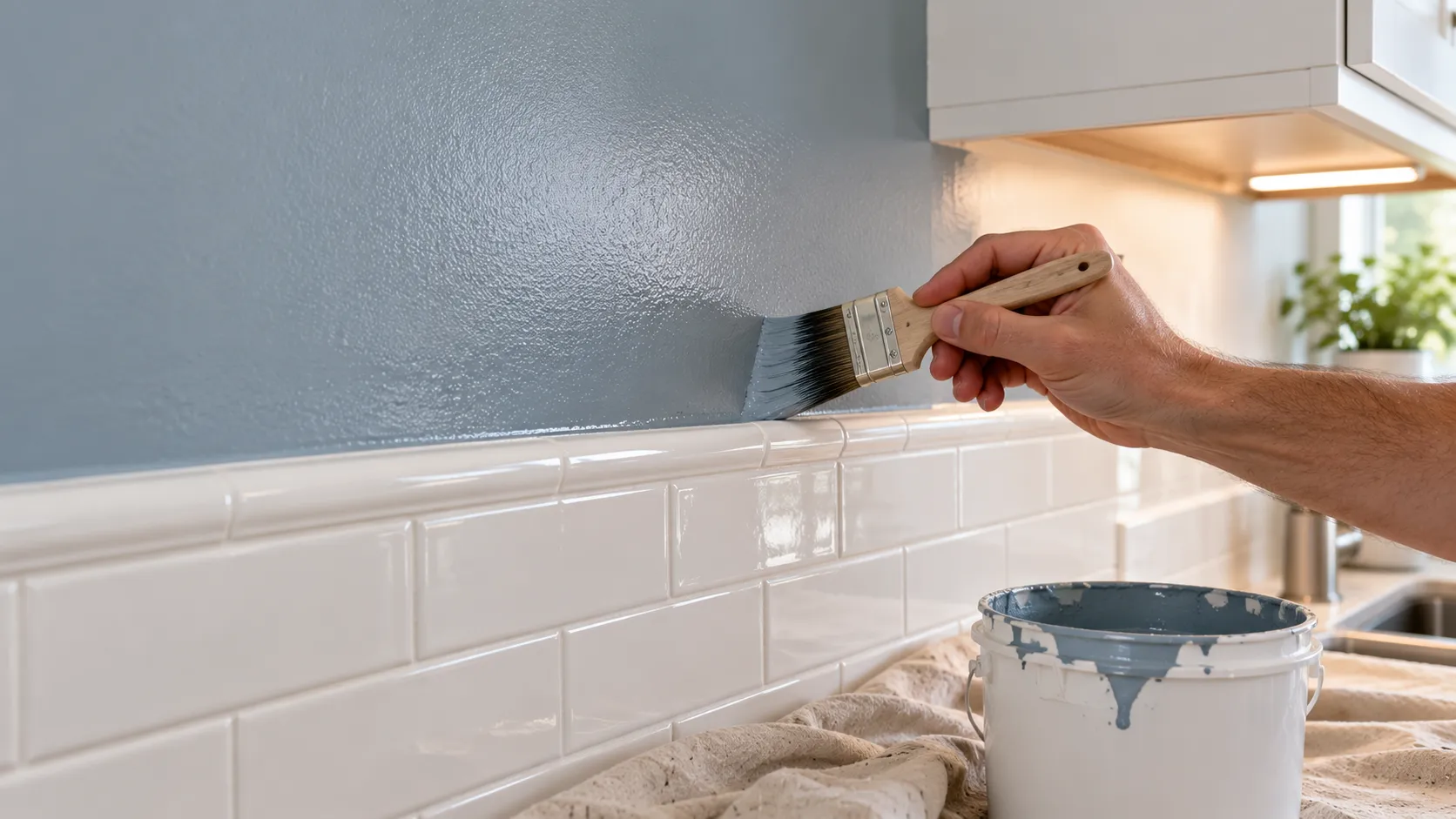
Most of the slow work in a kitchen is at edges: where the wall meets the top of the backsplash, the side of an upper cabinet, the window casing over the sink and the countertop. The paint goes on the drywall. It does not go on the tile.
We do not paint tile or backsplashes. Painted tile behind a sink or a range is a specialist coating job with its own products and its own failure modes, and our article Can You Paint Tile? explains why we stay out of it. Countertops are the same: we do not paint them. What we do is protect the top edge of the tile, cut a clean line onto the wall above it by hand, and, where the joint between the backsplash and the wall is open or cracked, recaulk it.
Caulking and sealing is work we offer, and in a kitchen it matters for the paint as well as the look. An open joint along the top of a backsplash, or between the countertop and a painted wall where there is no backsplash, lets water and grease work in behind the paint film, where it lifts the paint from the edge. The manufacturers' order is to caulk after priming: Sherwin-Williams says "gaps between walls, ceilings, crown moldings, and other interior trim can be filled with the appropriate caulk after priming the surface." Our own practice is to cut out failed caulk at the wall-to-backsplash line, clean and dry the joint, run a paintable bead where it will be painted, and paint only the paintable caulk. The wet-area seal along the countertop at the sink, between the countertop and the tile, belongs to whoever installed them and we leave it alone.
Painting Around Cabinets, Appliances and the Range Hood
Should you paint the walls behind kitchen cabinets?
Not behind installed cabinets. Nobody can see it, and the only way to reach it is to take the cabinets down, which is a carpentry and remodelling job. We paint the wall to a clean line against the cabinet boxes and along the underside of the upper cabinets, and scribe the line where an end panel meets the wall. If your kitchen is being remodelled by someone else and the walls are bare before the new cabinets go in, painting the open walls first is easy and sensible; we can paint a stripped room, though the remodel itself is not our trade.
Painting the cabinets is a different job
Cabinet painting, refinishing and spraying is work we do, but it is a separate job from the walls, with different products, different prep and a different schedule, and we have written about it at length elsewhere. For whether to paint, refinish or reface, see cabinet refinishing versus painting versus refacing; for price, what cabinet painting costs; for method, spraying versus brushing cabinets; for colours, kitchen cabinet paint colors; and for the service itself, our cabinet painting service. When a kitchen gets both, we normally paint the walls after the cabinet doors have gone back on, so the wall line is cut to the finished cabinet.
Appliances
We do not paint appliances, and we do not disconnect gas, water or electrical connections to move them. A refrigerator on rollers can usually be pulled out by the homeowner so the wall behind it can be painted; a range or a dishwasher stays where it is unless an appliance installer moves it. Behind a refrigerator is worth doing on a light colour change, because the wall is visible every time it is pulled out. Elsewhere, we paint to a clean line around the appliance. We remove switch and outlet cover plates rather than painting round them.
The range hood
We cut the wall paint to the hood; we do not paint, remove or install hoods. But the hood is the single biggest factor in how long kitchen paint stays clean, and it is worth knowing what a good one looks like. The Home Ventilating Institute says "recommended kitchen range hood ventilation rates vary greatly depending on the type of cooking performed," and gives a recommended rate of 100 CFM per linear foot for a hood against a wall, with a minimum of 40, and 150 CFM per linear foot for an island hood, with a minimum of 50. For a 30-inch range against a wall that is 250 CFM recommended and 100 minimum; for 36 inches, 300 and 120. Two more HVI lines explain most of the greasy ceilings we see: "nonducted, recirculation kitchen range hoods provide no actual ventilation," and downdraft exhausters' "performance cannot equal that of hoods that capture the rising column of air above the cooking surface." A recirculating microwave-hood combination over a busy range is why the ceiling above it yellows.
How Long Before You Can Cook, and Wash the New Paint?
Paint is dry to the touch in about an hour. It is nowhere near cured, and a kitchen tempts people to wipe the walls far too soon.
On cooking, there is no published figure, and here we give our own practice. Light cooking with the hood running is fine once the last coat is dry to the touch and the room has been aired. For the first few days we suggest keeping the heaviest frying and the biggest boiling pots to a minimum, and running the hood whenever the cooktop is on, so that the fresh film near the range does not take on grease before it has hardened. Trim painted with Advance needs longer: Benjamin Moore says "do not expose to heavy abrasion or return shelves/tabletops to service for at least 5 – 7 days," and that "it could take up to 30 days to reach optimum hardness and final sheen."
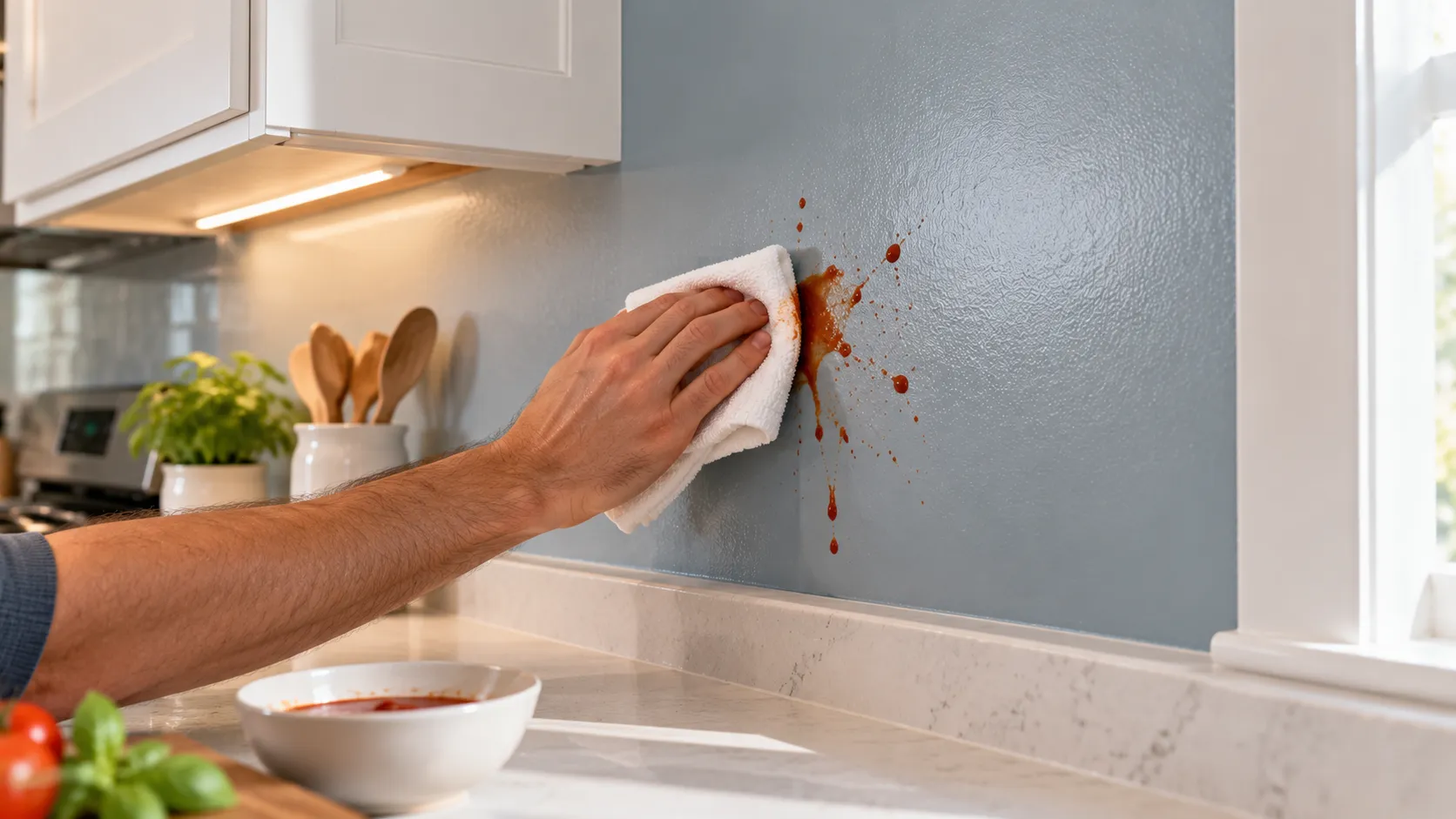
On washing, the manufacturers are specific. Every Benjamin Moore wall paint in our table says "Painted surfaces can be washed after two weeks." Sherwin-Williams says of Duration Home: "To assure maximum washability and durability, wait at least 14 days before washing Duration Home coating." If something splashes on the wall in the first two weeks, blot it with a damp cloth rather than scrubbing.
After that, clean gently. Sherwin-Williams' advice: "When removing stains, dirt, and marks, use a soft cloth or sponge with water, Stubborn stains may require the use of a general-purpose household cleaner," and "do not use an abrasive cleaner or scrub brush to remove stains." Benjamin Moore says its Regal Select Matte releases household stains with "mild soap and water." A soft cloth and warm water does more for a painted kitchen wall than any spray, and a quick wipe of the wall beside the range every so often is what keeps it from ever needing a degreaser again.
Fumes and VOC in a Kitchen You Are Still Using
Most families keep using the kitchen while it is painted, so the air in it matters. The wall paints in our table are low or zero VOC: Regal Select and Aura "Zero VOC post tint (any base and any color)," the Sherwin-Williams products "less than 50 grams per litre," Advance "43.2 g/L." The solvent primers are the exception, which is why we use them in spots rather than over whole walls.
Low VOC is not no ventilation. The EPA's guidance on VOCs notes that "paints, varnishes and wax all contain organic solvents" and that "concentrations of many VOCs are consistently higher indoors (up to ten times higher) than outdoors." Its advice is short: "Increase ventilation when using products that emit VOCs," "follow label instructions carefully," and "make sure you provide plenty of fresh air when using these products." Benjamin Moore's sheets say "use only with adequate ventilation" and "ensure fresh air entry during application and drying." In a kitchen we open a window, run the hood, and ask that food, dishes, utensils and anything on open shelves be put away or covered before we start; our own practice, not a published rule, but nobody wants primer dust in the fruit bowl. Our guide to paint fumes and VOCs covers when it is reasonable to use a freshly painted room, and our guide to living in your house while it is being painted covers sequencing a lived-in house.
Colour in a Kitchen, Briefly
Colour is its own subject. Our article on interior paint colours has the named colours, codes and LRVs, and cabinet colours are in kitchen cabinet paint colors. Three kitchen-specific points. First, deep colours are less forgiving on kitchen walls: GA-214 warns that "colors with deep or strong hues, and even flat paints, tend to magnify imperfections in the finished gypsum panel surface and increase the possibility of joint photographing," and a kitchen with under-cabinet lights is a critical-lighting room. Second, very pale colours show a grease shadow above the range sooner, and very dark ones show dried splashes as lighter marks; the soft mid-tones so many New Jersey kitchens end up in are as practical as they are fashionable. Third, deep colours are where rub-off matters; Benjamin Moore lists "Color Lock Technology, no color rub-off" as an Aura feature, which is relevant to a dark wall that gets wiped.
Older New Jersey Kitchens: Lead, and What That Means for Who Does the Prep
A large share of New Jersey kitchens are in houses built before 1978, and in those kitchens the old paint under the current paint may contain lead — most often on the window sash and casing over the sink, the door and its casing, and the baseboard, which are exactly the surfaces kitchen prep sands. Every data sheet in this article prints the same warning; Benjamin Moore's reads: "WARNING! If you scrape, sand, or remove old paint, you may release lead dust. LEAD IS TOXIC."
The federal rule is the EPA's Renovation, Repair and Painting (RRP) Program, which requires that "anyone paid to perform work that disturbs paint in housing and child-occupied facilities built before 1978 must be certified," and adds: "This includes all firms, even sole proprietorships." The exemption is narrow. 40 CFR 745.83 defines minor repair and maintenance as work "that disrupt 6 square feet or less of painted surface per room for interior activities," where no prohibited practices are used and the work "does not involve window replacement or demolition of painted surface areas," and it adds that "jobs, other than emergency renovations, performed in the same room within the same 30 days must be considered the same job." Dulling the old gloss on a kitchen's trim, window and door will usually exceed six square feet.
We are not an EPA Lead-Safe Certified firm. That is a licensing fact about our company, not a choice of wording, and it means there is prep work on pre-1978 kitchens that we will tell you to have done by someone else. Our guide to lead paint in older NJ homes explains the rule properly. Whoever you hire, ask the bidder for their firm certification number — ours included — before anybody sands or scrapes old paint in a house built before 1978. Washing walls with TSP is not a substitute for that rule, whatever a cleaner's label says about lead dust.
What We Do, and Do Not Do, in Kitchens
- We wash, rinse and dry every kitchen wall and the ceiling over the range before we paint, twice where the grease is heaviest, because grease is the commonest reason kitchen paint fails.
- We spot-prime grease and smoke stains that have soaked in with a primer whose data sheet names them, and prime repairs, glossy old paint and big colour changes.
- We specify a washable eggshell or satin on the walls, normally Regal Select or Aura from Benjamin Moore or Emerald or Duration Home from Sherwin-Williams, and write the product and number of coats on the estimate.
- We paint the ceiling first with a ceiling flat, then the walls, then the trim in a hybrid semi-gloss enamel.
- We cut the wall to a clean line above the backsplash and against the cabinets by hand, and recaulk open wall-to-backsplash joints with a paintable caulk after priming; caulking and sealing is ours.
- We do drywall and sheetrock repair and wallpaper removal, so the anchor holes, moved switches and old borders most kitchens have are in scope. Our wallpaper removal guide covers the old border along the top of the cabinets.
- We do cabinet painting, refinishing and spraying as a separate job, and schedule the walls around it when you want both.
- We tell you how long to wait before you wash the walls, and why, before we leave.
What we do not do, so there is no ambiguity: painting tile or backsplashes, painting countertops or appliances, kitchen or bathroom remodelling, finish carpentry, moving or disconnecting appliances, range-hood installation, mould or mildew treatment, insurance, fire, smoke or water-damage restoration, plaster repair, and we do not hold EPA Lead-Safe (RRP) certification. Washing a surface is ours; treating growth is not. Drywall and sheetrock repair is ours; a cracked or failing plaster wall in an older kitchen belongs to a plasterer. On a house built before 1978, ask us — and every other bidder — for a firm certification number before anyone disturbs old paint.
Get a Price for Your Kitchen Walls
Kitchen pricing depends on how much open wall there actually is between the cabinets, windows and backsplash, how greasy the walls and ceiling are, how much patching, priming and caulking they need, and how much trim there is, which is why we look at it rather than quote from a photo. NJ Painting Co. is a family-owned, licensed and fully insured painting company at 36 Church Rd, Morganville, NJ 07751, working on New Jersey homes for more than 20 years with Benjamin Moore and Sherwin-Williams products. Every estimate is free and spells out surfaces, prep, products and number of coats; our work carries a two-year workmanship warranty. For how interior pricing is built, see the interior section of our cost guide and our cost to paint a room guide, and for the work itself our interior painting service. Kitchens are often painted alongside the rooms that open onto them, so call (732) 239-0932 or request a free estimate, and ask us about the job minimum when you enquire.
Frequently Asked Questions
What is the best paint for kitchen walls?
A premium acrylic interior latex in eggshell or satin, from a line sold on washability, stain resistance and burnish resistance. In our work that is usually Benjamin Moore Regal Select or Aura, or Sherwin-Williams Emerald or Duration Home. Sherwin-Williams describes Emerald as offering premium performance in washability, stain resistance, block resistance, adhesion, burnishing and hiding. Preparation matters more than brand: the wall has to be degreased, rinsed and dry, and grease stains that have soaked in need a stain-blocking primer.
What type of paint should you use in a kitchen?
Waterborne acrylic latex for the walls and ceiling, and a waterborne alkyd or acrylic-alkyd hybrid enamel for the trim and doors. Latex wall paints are low or zero VOC and clean up with water, which matters in a room you cook in. The only solvent-based product we use in a kitchen is a stain-blocking primer, applied in spots over grease or smoke stains.
What sheen is best for kitchen walls?
Eggshell or satin. Satin is more washable and resists burnishing better where hands and splashes land; eggshell hides patched drywall better under strong light. The Gypsum Association notes that non-flat paints highlight minor surface differences, and kitchens with under-cabinet lights and recessed cans are critical-lighting rooms. Keep semi-gloss for the trim, and consider a pearl or semi-gloss only on a plain painted wall right beside the cooktop.
Is eggshell or satin better for kitchen walls?
Satin where the traffic is, eggshell where the light is harsh. Satin is a little more washable and burnishes less around the table, the trash and the light switches; eggshell hides patched drywall better under under-cabinet lights and recessed cans. The two overlap more than the names suggest: Regal Select Eggshell reads 15 to 22 at 85 degrees and Emerald Satin 10 to 20, so compare the numbers on the data sheets rather than the sheen names.
What is the most durable paint for kitchen walls?
For a house, a premium residential satin such as Sherwin-Williams Emerald or Duration Home, both sold on stain and burnish resistance, or Benjamin Moore Regal Select or Aura. For a genuinely abused wall, Benjamin Moore Ultra Spec Scuff-X is a commercial product engineered for high-traffic areas, but its satin is shinier than most residential satins and it carries 95 grams per litre of VOC. No data sheet we read prints a scrub-cycle count, so be wary of any ranking that claims one.
Can you use flat paint in a kitchen?
On the ceiling, yes, and it is usually the best choice. On the walls, a traditional flat marks, burnishes and does not wash well. The exception is a premium washable matte sold on stain release, such as Benjamin Moore Regal Select Matte, which reads 2 to 5.5 at 85 degrees and which Benjamin Moore says releases household stains like grime and ketchup with mild soap and water. We would use that on walls away from the range and sink, not beside the cooktop.
Can you paint over greasy kitchen walls?
Not without removing the grease first. Every manufacturer requires a surface free of grease and oil, and paint over grease pulls back, stays soft and peels. Wash with a heavy-duty cleaner such as TSP or a phosphate-free substitute, following its label, rinse with clean water and let the wall dry. If a stain still shows after washing, seal it with a primer whose data sheet names grease before painting.
What is the best primer for kitchen walls?
For clean, sound walls staying a similar colour, often none, because most premium wall paints are self-priming. For grease or smoke stains that have soaked in, a stain-blocking primer that names them on its data sheet, such as Benjamin Moore Fresh Start Multi-Purpose Oil Based Primer, which lists grease marks and smoke, or Zinsser B-I-N shellac primer, which lists grease spots. Benjamin Moore's waterborne Fresh Start High-Hiding primer is excellent for repairs and colour changes but does not list grease.
What is the best paint for a kitchen ceiling?
A dedicated flat ceiling paint, such as Sherwin-Williams Eminence, which reads 0 to 5 at 85 degrees and hides a patched ceiling under recessed lights. A kitchen ceiling is a grease problem rather than a humidity problem. Wash the ceiling over the range before painting, seal any yellowed area with a stain-blocking primer, and rely on a ducted range hood to keep it clean afterwards.
Should you paint the walls behind kitchen cabinets?
Not behind installed cabinets; nobody sees it and reaching it means taking the cabinets down. Paint to a clean line against the cabinet boxes and under the uppers. If the kitchen is being remodelled and the walls are bare before new cabinets go in, painting them first is easy and worth doing. Behind a refrigerator that can be rolled out is worth painting on a colour change.
How long after painting can you wash kitchen walls?
About two weeks. Benjamin Moore's wall paint sheets say painted surfaces can be washed after two weeks, and Sherwin-Williams says to wait at least 14 days before washing Duration Home. Until then, blot splashes with a damp cloth rather than scrubbing. Afterwards, use a soft cloth or sponge with water, a mild household cleaner for stubborn marks, and never an abrasive cleaner or scrub brush.
What size range hood keeps kitchen walls clean?
The Home Ventilating Institute recommends 100 CFM per linear foot of range for a hood against a wall, with a minimum of 40, and 150 CFM per linear foot for an island hood, with a minimum of 50. That makes 250 CFM recommended for a 30-inch range on a wall and 300 for a 36-inch one. It also says recirculating hoods that are not ducted outside provide no actual ventilation, which is why ceilings above them yellow.
Do you paint kitchen tile backsplashes or cabinets?
We do not paint tile, backsplashes, countertops or appliances. We paint the wall to a clean line above the backsplash and recaulk open joints between the backsplash and the wall. Cabinet painting, refinishing and spraying is work we do, but as a separate job from the walls, with its own products, preparation and schedule.
Can I paint my kitchen walls myself?
Yes, and the method in this guide is the method we use. The difference between a kitchen that lasts and one that peels is almost always the degreasing and rinsing, not the paint. The two reasons to stop and get help are a house built before 1978, where sanding old paint brings in the federal lead rule, and smoke or soot damage from an actual fire, which is a restoration job for your insurer and a restoration contractor rather than a painting one.
About the author
Written by the NJ Painting Co. team
NJ Painting Co. is a family-owned painting contractor based in Monmouth County, in business since 2004. We are licensed and fully insured, work with Benjamin Moore and Sherwin-Williams paints, and back our work with a 2-year workmanship warranty. We serve Monmouth, Middlesex, Ocean, Mercer, Somerset and Burlington counties, plus Union, Essex, Hudson, Bergen and Passaic in North Jersey.