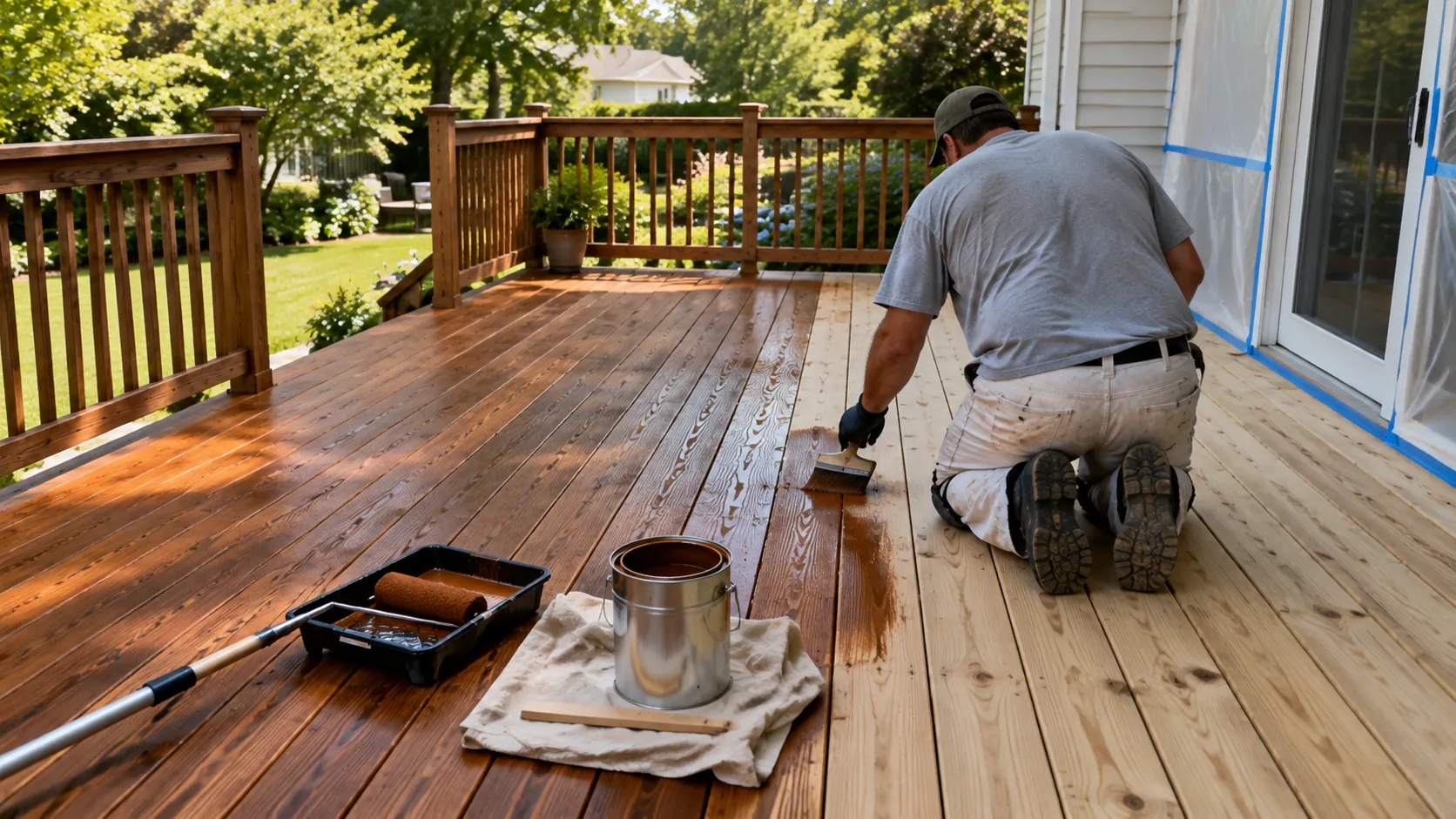
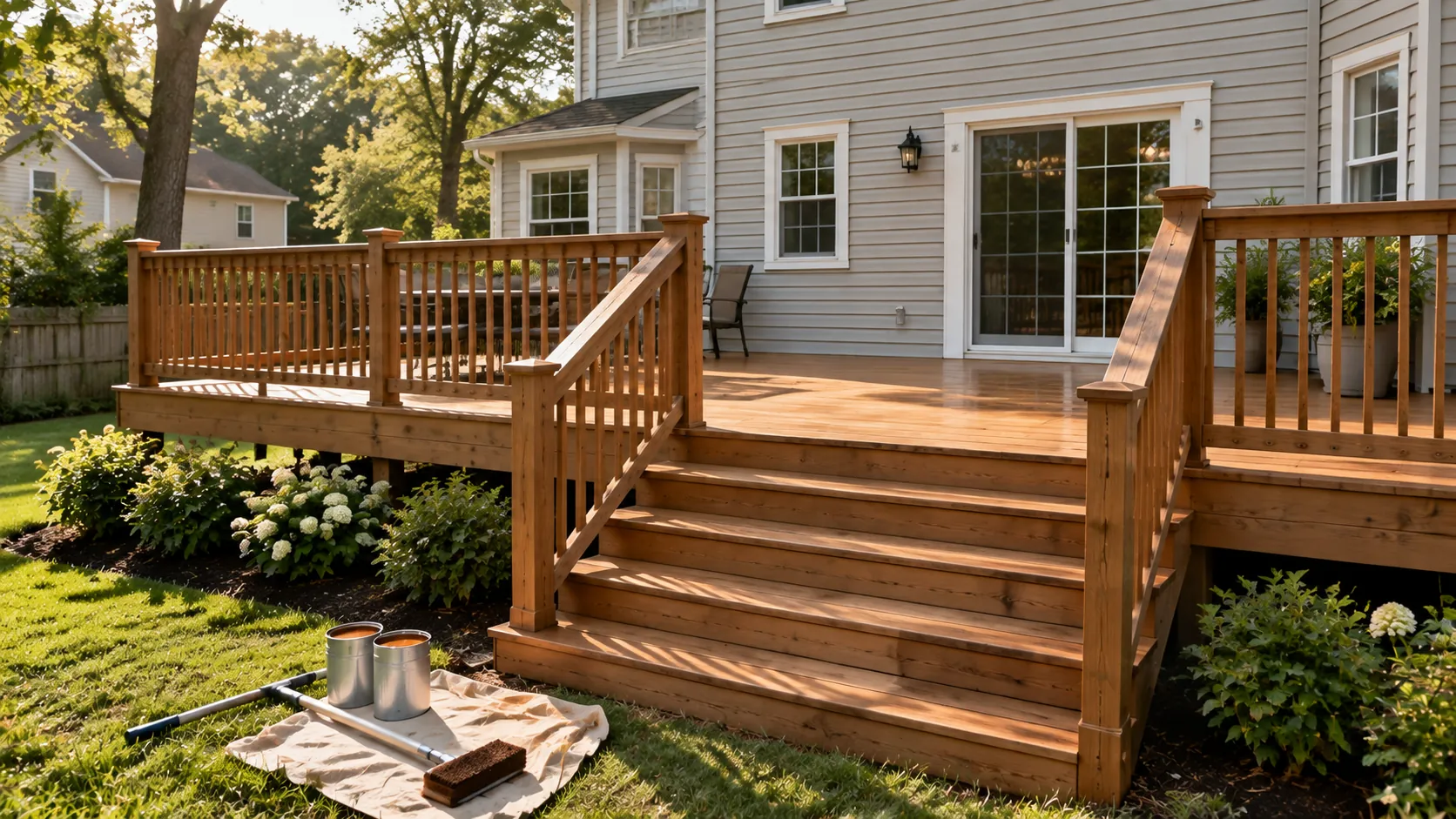
Deck Staining and Sealing, Done From the Wood Up
A deck takes more punishment than any other painted or stained surface on a house. The boards are horizontal, so rain and snow sit on them; they are walked on, dragged across and baked in the sun; and they shrink and swell with every change in the weather. Deck staining is mostly about choosing a finish that can live with that, and getting the wood into a state where the stain can soak in.
Our deck staining service covers the whole job: washing, brightening, stripping or sanding where the old finish has failed, the small fastening repairs that should happen before any stain goes on, and then a stain matched to the wood and to how the deck is used. Fences get the same treatment, and we often do the deck and the fence in the same visit.
Deck staining sits alongside our exterior painting work, so railings, trim and the house itself can be scheduled together. If you are still working out a budget, our guide to deck staining cost in NJ breaks down what moves the price.
- Deck Floors & Stairs
- Railings & Spindles
- Wood Fences & Gates
- Cleaning & Brightening
- Stripping & Sanding
- Deck Repair Before Staining
What Your Deck Is Made Of Changes the Job
The wood decides how it is cleaned, how soon it can be stained and which products will soak in.
Pressure-Treated Pine
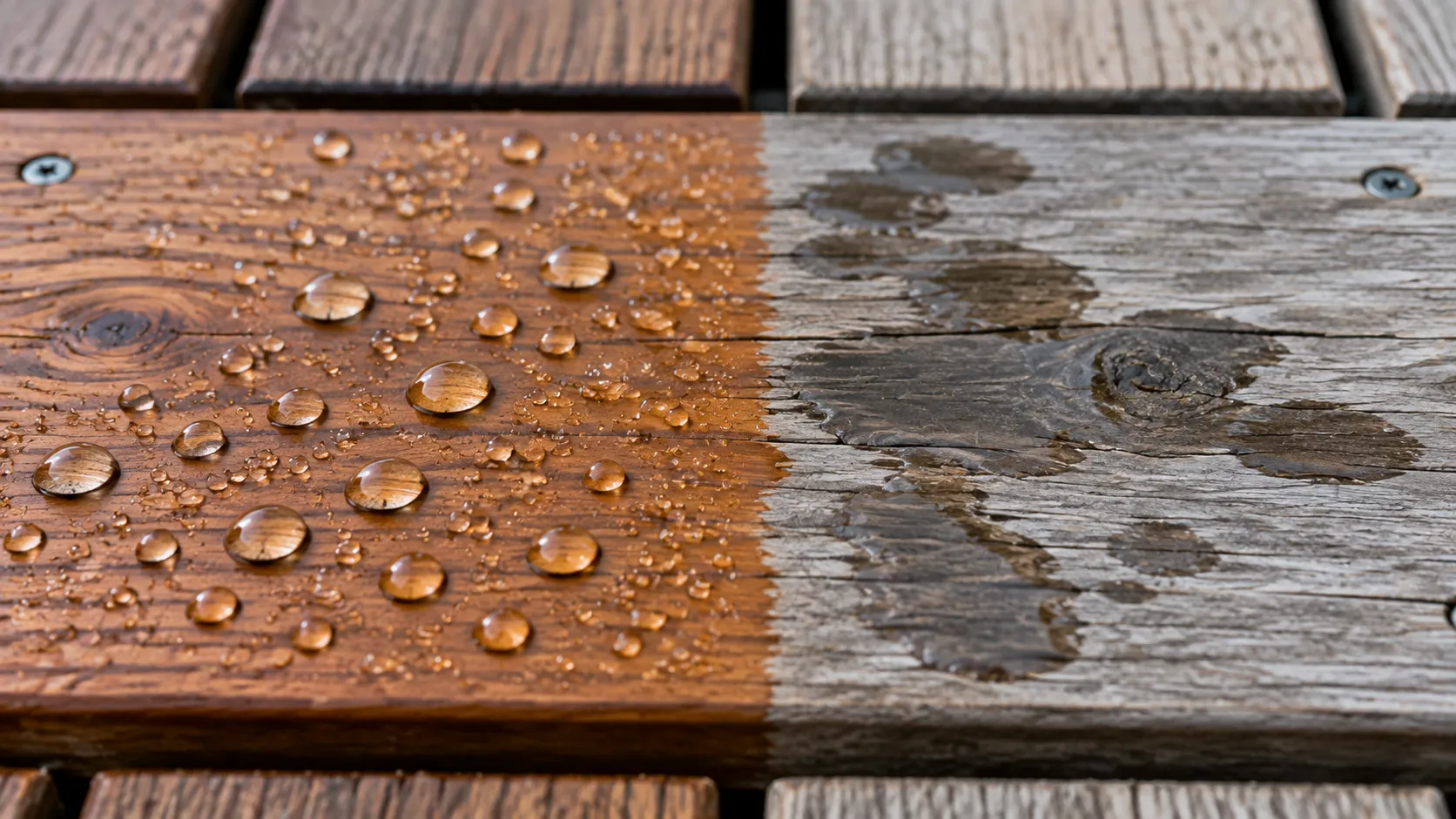
Most New Jersey decks are pressure-treated pine. It takes a penetrating stain well once it is dry enough: drops of water should soak in rather than bead up. New boards with a factory water repellent may need a couple of months of weathering before stain will absorb.
Cedar & Redwood
Softer, naturally durable woods that are easy to damage with a pressure washer. The Forest Products Laboratory warns that power washing can remove wood from softer species such as western redcedar, so cedar is cleaned at low pressure and the cleaner does the work.
Tropical Hardwoods
Ipe and other dense hardwoods absorb very little, and many deck stains are not made for them; Benjamin Moore’s Arborcoat data sheet, for one, says it is not recommended for hardwood. If your deck is a hardwood, we confirm a product made for it at the estimate.
Composite & PVC Decking
Composite boards are not stained. Trex says painting or staining its decking is not recommended and may void its fade and stain warranty. Wood posts, fascia or railings around a composite deck can still be stained as a smaller job.
Deck Refinishing: Cleaning, Brightening, Stripping and Sanding
Stain only lasts as long as the surface it soaked into, so most of a deck staining job happens before the first can is opened. Every deck is washed to take off dirt, mildew and loose gray fibers, at a pressure that suits the wood. A brightener then evens out the color the cleaner leaves behind so the stain absorbs evenly from board to board.
What happens next depends on the finish already on the deck. A worn semi-transparent stain can usually be cleaned and recoated. A solid stain or paint that is peeling in the traffic lanes has to come off: Benjamin Moore’s Arborcoat sheet says flaking or peeling stain should be removed before staining, and Sherwin-Williams’ data sheet for its oil-based SuperDeck stain says anything short of total removal of an old coating compromises the new one. Raised grain and lifted fibers are sanded, with handrail caps getting the most attention because that is what hands touch.
New, smooth-planed boards need their own step. Benjamin Moore calls for sanding or a brightener to break the mill glaze, then a few drops of water as a test: if the water soaks in, the wood is ready, and if it beads, the prep is not finished.
- Washed at Wood-Safe Pressure
- Brightener to Even the Color
- Failed Stain Stripped
- Raised Grain Sanded
- Water Test Before Staining
Deck Stain Types and Where Each One Belongs
Four families of finish, from clear to solid. The difference is how much pigment they carry and whether they soak in or sit on top.
Clear & Toner Finishes
Water repellents and toners show the wood almost untouched. They are the easiest finish to reapply, but they carry little or no pigment to block sunlight: the Forest Products Laboratory puts a clear water-repellent preservative at about one year on exposed deck boards.
Semi-Transparent Stain
Adds color while the grain still shows, and soaks in rather than forming a film, so it wears away instead of peeling. This Old House puts it at every two to three years. It is our default for deck floors and stairs.
Semi-Solid Stain
Hides more of the grain and evens out boards of different ages or colors. This Old House gives two to four years. Repeat coats build toward a film, so it is chosen deliberately on floors.
Solid Color Stain
Looks like paint and lasts longest on vertical surfaces: five to seven years per This Old House. The Forest Products Laboratory says film-forming finishes trap moisture and fail by peeling on deck floors, but may perform quite well on railings, so this is where we use it.
Choosing a Deck Stain That Will Not Peel
The Forest Products Laboratory, the U.S. Forest Service’s wood research lab, is unusually direct about decks: penetrating finishes, not film-forming ones, should be used on deck boards. Paint and solid stain look good the first season, but once they peel in the traffic lanes a penetrating stain cannot go back over them until they are stripped.
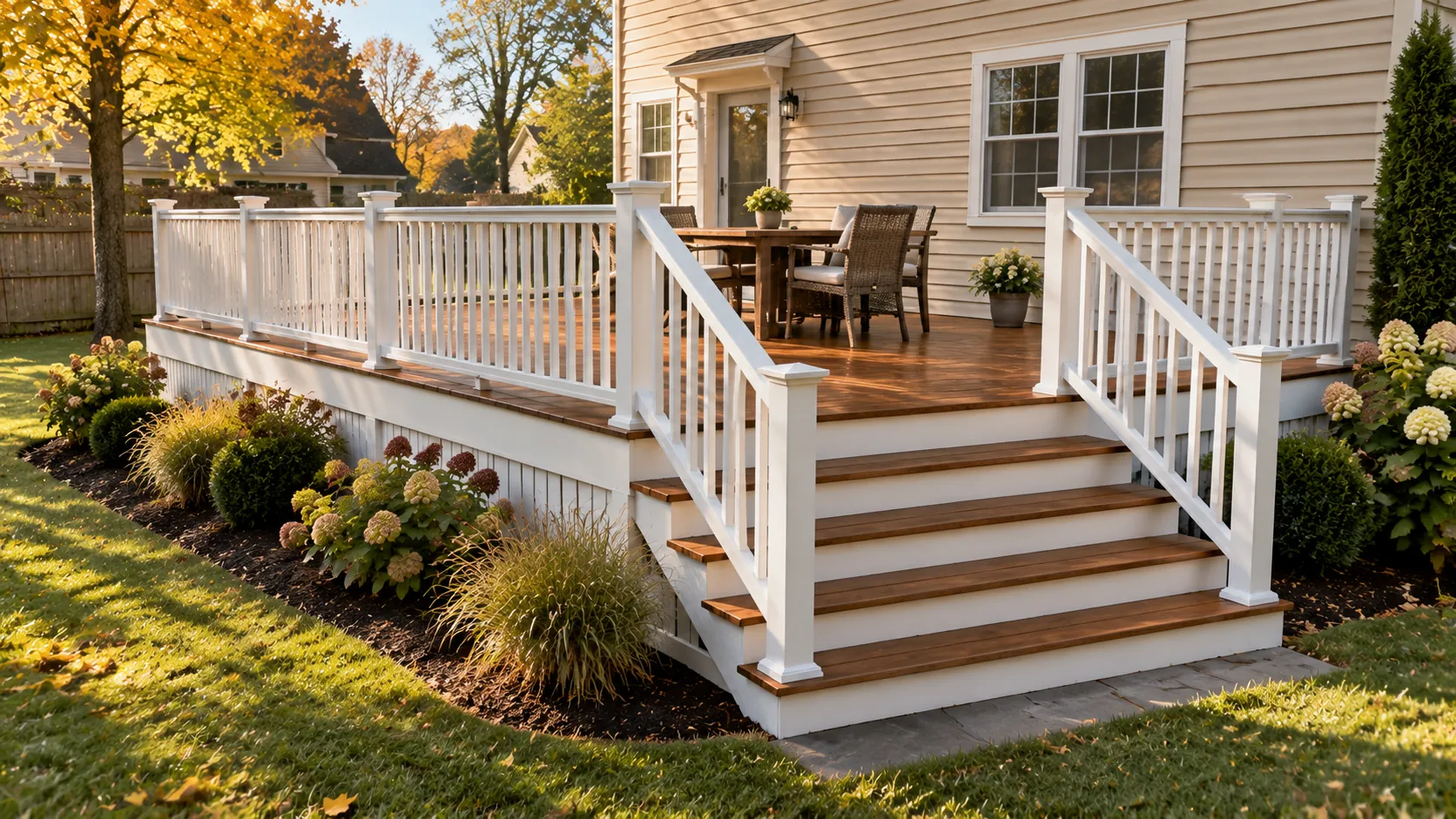
That is why the most common combination we recommend is two-tone: a semi-transparent stain on the floor and stairs, where feet and water wear it, and a solid color on railings, posts and fascia, which take no foot traffic. Oil-based and water-based stains both work. Oil-based semi-transparent stains are generally one-coat products (Sherwin-Williams’ SuperDeck oil sheet says a second coat will not penetrate and stays tacky), while a waterborne stain such as Arborcoat can take one or two coats at least four hours apart. The product and number of coats for each surface are named in your written proposal.
- Penetrating Stain on Floors
- Solid Color on Railings
- Oil or Water-Based
- Product Named in the Proposal
When to Stain a Deck in New Jersey
The stain makers’ data sheets set the limits. These are the ones that decide the schedule.
Temperature
Waterborne Arborcoat goes on between 40 and 90 degrees. Oil-based SuperDeck wants surface temperatures of 50 to 90 degrees and should not go on if it will drop below 50. Cool, humid weather stretches drying times on both.
Rain & Dry Wood
The oil sheet asks for no rain within 24 hours of application, and Arborcoat needs wood moisture below 15 percent. After a bleach cleaning the Forest Products Laboratory allows at least two warm, windy days to dry; we go by the wood, not the clock.
Shade, Not Full Sun
Both manufacturers warn against staining in direct sun or on a hot surface, which causes lap marks and poor penetration. In midsummer a deck is stained in sections as the shade moves.
Back in Use
Arborcoat asks for 48 hours before normal foot traffic, and the oil sheet gives 24 to 48 hours before use. Furniture and grills go back once that time has passed.
The NJ Staining Season and New Decks
In most of New Jersey the practical staining season runs from late spring into early fall, and the real scheduling unit is a stretch of dry days: one for washing, time for the wood to dry, then the stain and its cure. Shaded decks hold dew into mid-morning in the fall, and shore decks in Monmouth and Ocean County take more wind-driven moisture, so the start time moves with the season.
A new pressure-treated deck does not have to wait a year. YellaWood, a major treated-lumber brand, says its lumber can be stained within about six weeks of construction if the wood is dry enough, and both it and the stain makers use the same water test. The Forest Products Laboratory adds that decking with a factory-applied water repellent should weather for two to three months first, and notes that most decks are retired because of cracks and checks that timely finishing could largely have avoided.
For a deck that has been stained before, the same water test tells you when: if water soaks in and darkens the boards instead of beading, it is time. Catching it then keeps the job to a clean and recoat rather than a strip and sand. Our guide to how often to paint a house in NJ applies the same logic to siding and trim.
Fence Staining
Fence staining is the same chemistry as a deck, with one big difference: a fence is vertical and nobody walks on it. Water runs off instead of sitting, so the finish wears much more slowly, and a solid color stain that would peel on a deck floor can do well on fence boards. A semi-transparent stain keeps the grain showing if that is the look you want.
Fences are washed and brightened like a deck, and the stain is sprayed or rolled and then back-brushed into the wood, which is how Benjamin Moore says a rolled or sprayed stain should be finished. Plantings, the house siding and anything parked nearby are covered first. Most fences have two faces, so if the outside faces a neighbor, we will ask you to arrange access before the job is scheduled. Picket, board-on-board, shadowbox, privacy and split-rail fences and wooden gates are all stained the same way.
- Both Faces Stained
- Back-Brushed Into the Wood
- Plantings & Siding Covered
- Gates & Posts Included
What Is Included in Our Deck Staining Service
Everything that has to happen to the wood before and during staining, in one proposal.
Washing & Brightening
Power washing at a pressure that suits the wood, mildew and dirt washed off, and a brightener to even the color before stain.
Stripping & Sanding
Failed solid stain or paint removed from deck floors, raised grain and lifted fibers sanded, handrail caps smoothed.
Deck Repair Before Staining
Popped nails and screws reset, loose boards re-fastened, and a split board swapped so it can weather in before the stain goes on. Priced as its own line.
Deck, Stairs, Railings & Fences
Deck floors, stairs, railings, spindles, posts and fascia, plus wood fences and gates, in a semi-transparent, semi-solid or solid stain.
What We Do Not Do
Staining protects sound wood. It does not fix a deck that is failing underneath, so these go to other trades.
Structural Repair
Soft joists, beams, posts, footings, a loose ledger board or failing stair stringers are carpentry, not staining. We will point them out at the estimate, and they need a carpenter before any stain goes on.
Rot Repair
We do not repair rot. If we find it during the walkthrough or washing, we show you where it is so it can be dealt with before the deck is stained.
Composite Decking
Composite and PVC boards are not stained (Trex advises against it). Wood railings, posts or fascia around them can be.
Pool Decks & New Builds
We do not coat concrete pool decks, and we do not build or replace decks or fences. We stain and maintain the wood ones you have.
How a Deck Staining Job Runs
The same five steps for a small landing and a two-level deck with a fence. The weather sets how many days sit between steps three and four.
Walkthrough
We look at the wood type, the finish already on it, any loose boards or fasteners, and anything structural that needs a carpenter first.
Written Proposal
Clean, strip or sand; any repair before staining as its own line; and the stain and number of coats for each surface.
Wash, Brighten & Repair
Washed and brightened, failed finish removed, fasteners reset, then the wood is left to dry until the water test passes.
Stain
Applied in the shade within the product’s temperature range, back-brushed into the grain, working board by board to avoid lap marks.
Cure & Walkthrough
The deck stays clear for the cure time on the label, then we walk it with you and leave the product on file for the next recoat.
Deck & Fence Staining Questions
Have a question not listed here? Give us a call or send us a message.
Yes. Deck staining and sealing and fence staining are part of what we do, along with the washing, brightening, stripping and sanding that come before the stain. We stain deck floors, stairs, railings, spindles, posts and fascia, and wood fences and gates, often in the same visit.
A sealer or water repellent is clear or nearly clear: it slows water down but has little pigment to block the sun, and the Forest Products Laboratory puts a clear water-repellent preservative at about a year on exposed deck boards. A stain adds pigment, which protects the wood from sunlight and lasts longer. Many deck stains are both, a pigmented stain with a water repellent in it.
For most deck floors, a penetrating semi-transparent stain. The Forest Products Laboratory says penetrating finishes, not film-forming ones like paint and solid stain, should be used on deck boards, because film finishes trap moisture and peel in the traffic lanes. Solid color stain does well on railings and fascia, which take no foot traffic, so a two-tone deck is a common choice.
Yes, the small repairs that belong before a stain job: resetting popped nails and screws, re-fastening loose boards and swapping a split board. They are priced as their own line in the proposal. Structural work such as joists, posts, footings, a ledger board or stair stringers is carpentry, and rot is something we point out rather than repair.
Only if the old finish has failed. A worn semi-transparent stain can usually be cleaned and recoated. A solid stain or paint that is peeling has to come off first, which both Benjamin Moore and Sherwin-Williams say in their deck stain data sheets. Raised grain is sanded either way.
Often within weeks rather than a year. YellaWood says its lumber can be stained within about six weeks of construction if it is dry enough. The test is a few drops of water: if they soak in, the wood is ready, and if they bead up, wait and test again. Decking with a factory-applied water repellent may need two to three months of weathering first, per the Forest Products Laboratory.
Late spring through early fall. Waterborne stains such as Arborcoat go on between 40 and 90 degrees, and oil-based stains such as SuperDeck want 50 to 90 degrees with no rain expected for 24 hours. Both makers say to avoid direct sun. In practice a run of dry days is what gets a deck washed, dried and stained.
No. Trex says painting or staining its decking is not recommended and may void its fade and stain warranty, and we follow that. If your composite deck has wood posts, fascia or railings, those can still be stained.
Every deck is quoted after a visit, because the size, the railings and stairs, and whether the old finish can be cleaned or has to be stripped move the price more than anything else. Our deck staining cost guide for New Jersey walks through each of those.
Most decks are bare or stained wood, but older porches, railings and fences are sometimes painted. Paint from before 1978 may contain lead, and federal EPA rules require that paid work disturbing it in a pre-1978 home be done by an EPA-certified renovation firm. We are not certified for that work, so if old paint on a pre-1978 home needs scraping or sanding, it needs a contractor who is, and we will tell you at the estimate.
Still have questions?
Can't find the answer you're looking for? Give us a call or send a message.