- 4.973 Google Reviews
- Licensed & Insured
- Family-Owned & Local · Morganville, NJ
- 2-Year Warranty
“I can't say enough about Matthew, Mustafa, Fico et al. They were considerate, professional, and some of the greatest people I've had the pleasure of meeting. They treated my home like their own. They…”
Epoxy Garage Floor Coating in New Jersey
Professional epoxy systems for garages, basements, and commercial floors — proper surface prep and a seamless, high-performance finish in solid, metallic, or flake styles.
Every epoxy floor we install in New Jersey starts at the slab rather than at the pail. A power-troweled garage floor is far too closed and slick for resin to bite into, so the concrete is diamond-ground to an open profile, old sealers and failed coatings come off, and cracks, spalls and control joints are cut out and filled with an epoxy patching mortar before anything is rolled. Skipping that step — acid-etching or pressure-washing a slab and coating it the same day — is the most common reason a garage floor peels away in sheets the following spring.
What most people search for as epoxy flooring is really a multi-coat system, not one product. A pigmented epoxy body coat supplies the build, adhesion and chemical resistance; a urethane or polyaspartic topcoat supplies the wear layer. Standard epoxy ambers where daylight reaches it, so a garage with windows or a door that stands open all afternoon gets a UV-stable polyaspartic topcoat instead of a clear epoxy. Decorative flake is broadcast into the wet basecoat to refusal, scraped and vacuumed the next day, then locked in under the topcoat; solid colors and metallics follow the same sequence with a different middle step. Our guide to epoxy garage floor coating in NJ: costs and coating types compares the systems in detail, and finished floors are in the project gallery.
Cost follows the slab and the system, not the square footage alone. Independent cost surveys put professionally installed epoxy floor coating at roughly $3 to $12 per square foot, and a two-car garage in New Jersey usually lands somewhere inside that band once grinding, crack repair and the topcoat are accounted for — a slab that needs resurfacing before it can be coated costs more than a sound one. Our painting and flooring cost guide breaks pricing down service by service, every estimate is free, and we coat garage, basement and commercial floors across Monmouth, Middlesex, Ocean, Mercer, Somerset and Burlington counties — the full list is on the service areas page. When a coated warehouse or shop floor is part of a larger repaint, our commercial painting contractor crews handle the walls, steel and ceilings on the same schedule. If a room would be better served by hardwood, tile or luxury vinyl than by a coating, that is flooring installation and refinishing, and we do that too.
Epoxy Floor Coating Systems We Install
Every floor is a multi-coat system: a primer, a body coat that carries the color, and a clear wear layer on top. These are the finishes we install and what each one is good at.
Decorative Flake
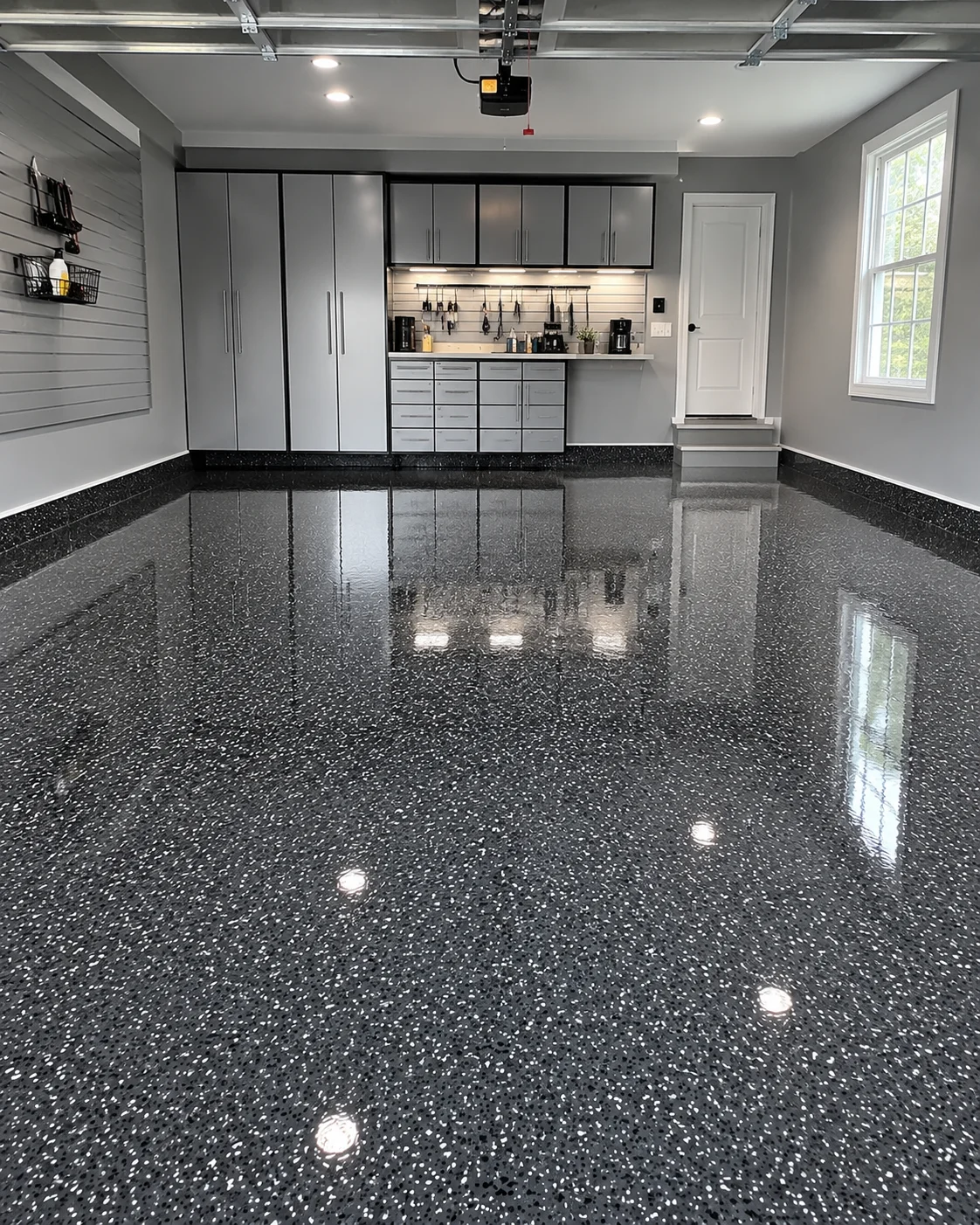
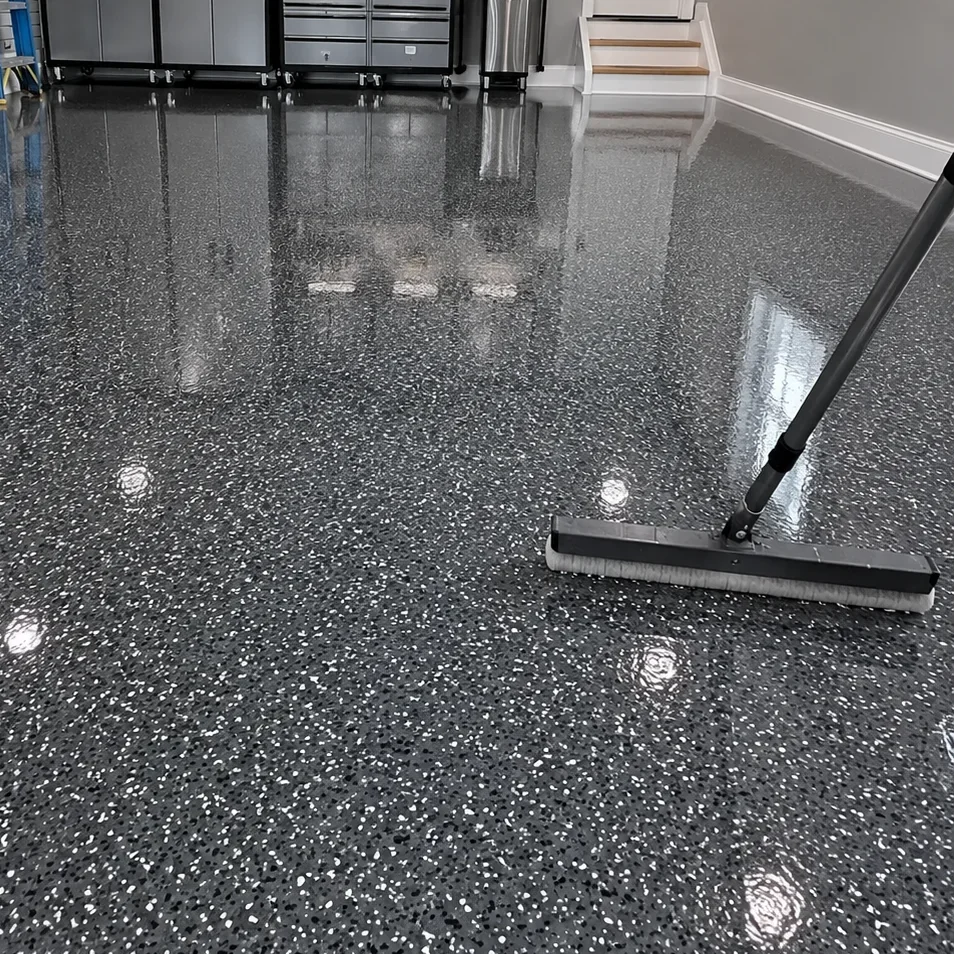
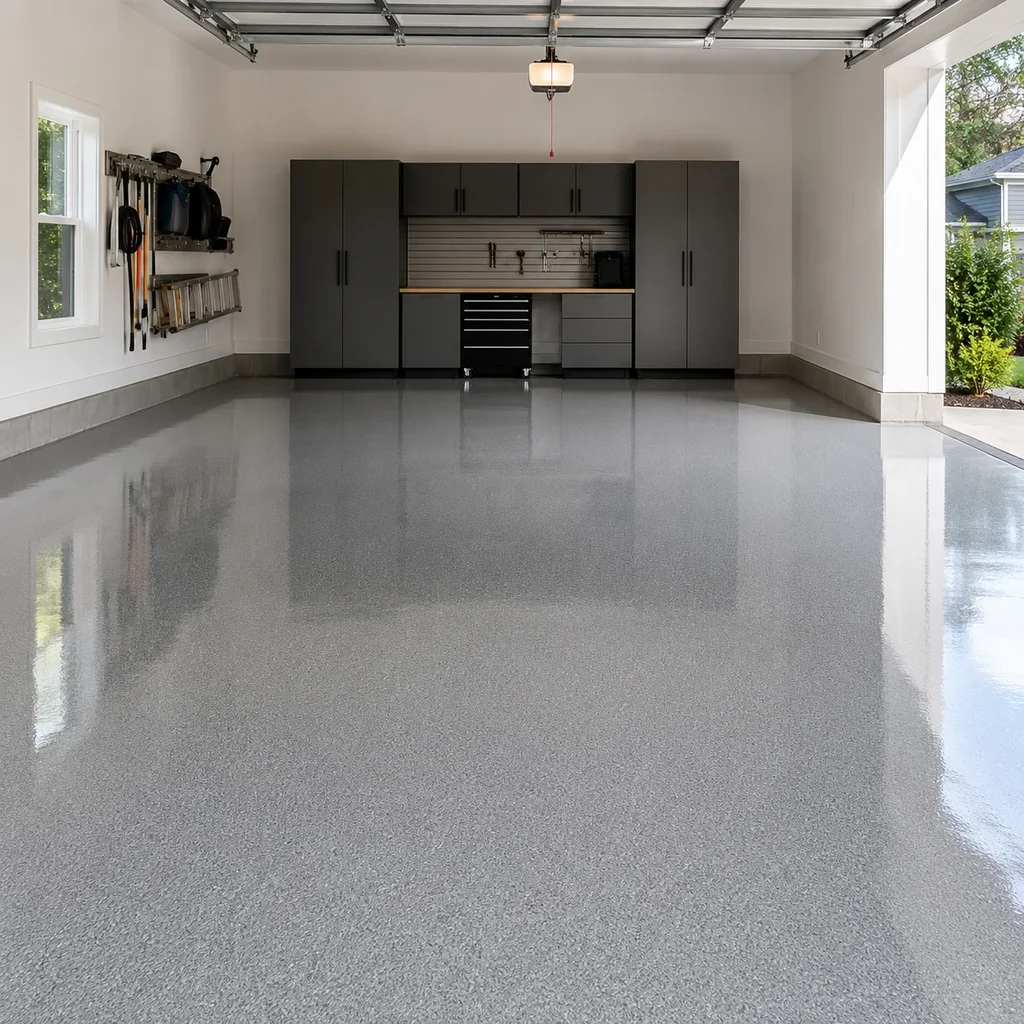
Vinyl chips broadcast into a pigmented epoxy base, scraped, and sealed under a clear topcoat. A full broadcast covers the base edge to edge and hides dust, salt and tire marks better than any other finish, which is why it is our usual recommendation for a garage. A partial broadcast lets more of the base color show.
Metallic Epoxy
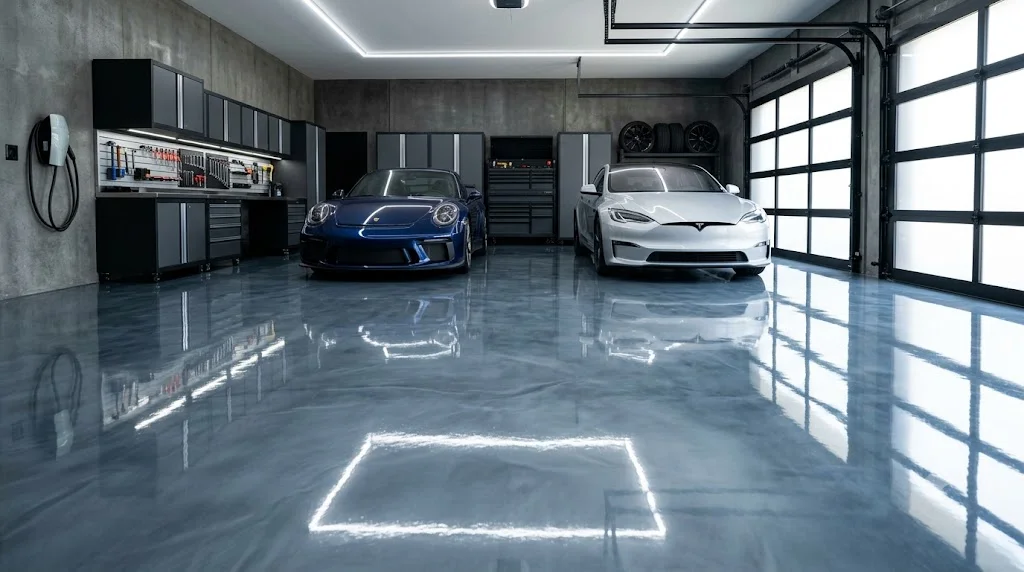
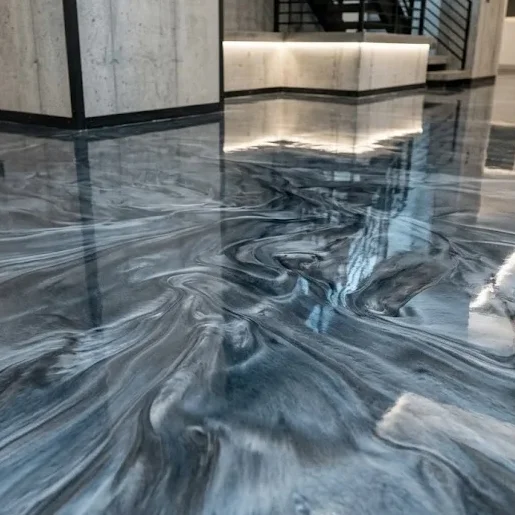
A self-leveling epoxy carrying metallic pigment that is worked while wet into a marbled, three-dimensional pattern, so no two floors match. It suits finished basements, showrooms and display garages, and it shows dust and fine scratches more than flake does.
Solid Color Epoxy
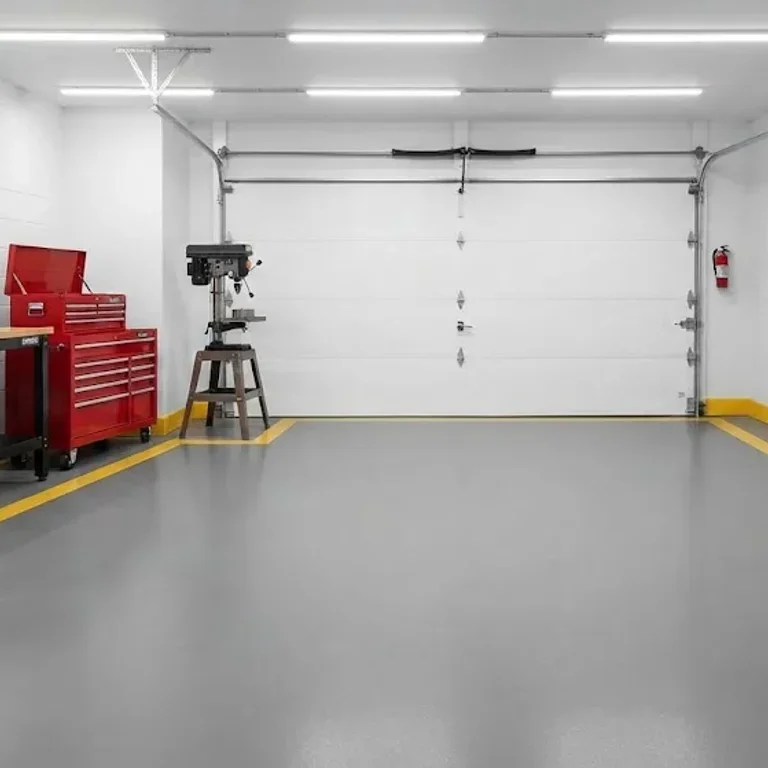
A pigmented high-build epoxy body coat with a clear or tinted topcoat, in gray, tan, white and other colors. The simplest system and usually the least expensive; a bright, easy-to-sweep floor for workshops, utility rooms, storage and warehouse floors.
Polyaspartic & Polyurea
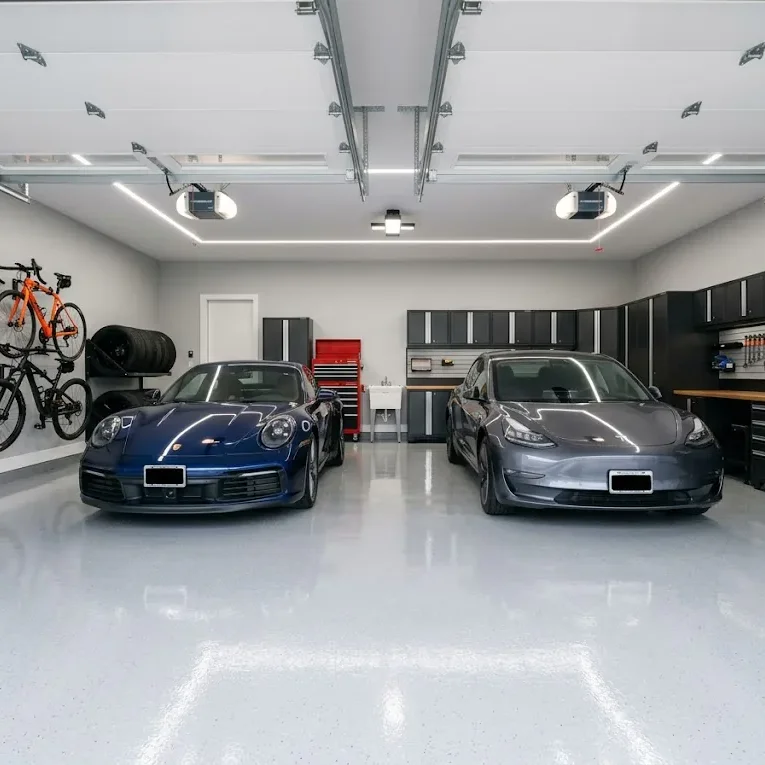
Fast-curing, light-stable coatings used as the wear layer over an epoxy or polyurea base, or as a full system when a garage has to be back in use quickly or the slab is cold. Compare all four in our guide to epoxy floor types.
Garage, Basement and Commercial Floor Coatings
The room decides the system. A garage, a basement and a warehouse each fail in a different way if the coating is wrong for them.
Garage Floors
Hot tires, road salt and snowmelt are what a New Jersey garage floor has to survive. We grind the slab, anchor the coating at the overhead door where peeling usually starts, and finish with a UV-stable topcoat if daylight reaches the floor.
Basement Floors
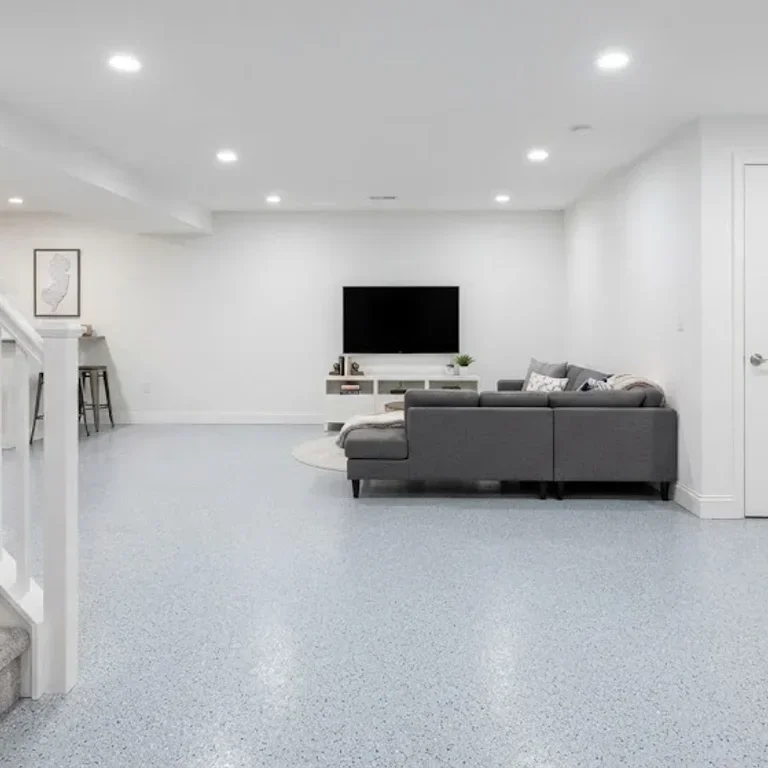
No sun and no tires, so metallic and solid colors work well, but moisture rising through the slab is the real risk. We test where moisture is likely and use a moisture-tolerant primer when the readings call for one.
Workshops & Mudrooms
Chemical resistance for oil, solvents and brake fluid in a workshop; slip-resistant grit near the door and the washer in a mudroom or laundry room. Both rooms are small, hard-working floors where a seamless coating is easy to keep clean.
Commercial & Industrial
Showrooms, retail floors, offices, warehouses, workshops and back-of-house areas, scheduled around opening hours with phasing, evening and weekend work. Aisle and safety line striping can be laid out on the same job.
The Benefits of Epoxy Flooring
Epoxy is one of the most cost-effective flooring upgrades you can make. Here is why homeowners and business owners across NJ choose it.
Built to Last
Epoxy coatings are incredibly durable and can withstand heavy foot traffic, vehicle loads, and daily wear without cracking or peeling.
Showroom Finish
Our high-gloss epoxy systems deliver a sleek, mirror-like finish that transforms any ordinary concrete floor into a stunning surface.
Custom Colors
Choose from a wide range of solid colors, metallic finishes, and decorative flake blends to perfectly match your style and space.
Easy to Maintain
Seamless epoxy surfaces resist stains, spills, and chemicals — making cleanup a breeze and keeping your floors looking great for years.
Epoxy Flooring Transformations in New Jersey
Drag across the image to reveal the before & after — this is the difference proper prep and premium materials make. Pick any project type below to see more of our results.
 After
 Before
Two-Car Garage transformation
Illustrative example
Epoxy vs Polyaspartic vs Polyurea
Most of what gets sold as an "epoxy floor" or a "polyaspartic floor" is really a combination of resins, each doing the job it is best at. The choice between them is about the room: how much sun it gets, how soon you need to use it, and how cold the slab is on the day we coat it.
Epoxy is the body coat. A 100%-solids epoxy builds real thickness in one pass, self-levels over minor slab flaws, bonds well to ground concrete and resists many chemicals. Its weaknesses are a slower cure and sunlight: epoxy yellows over time where daylight reaches it, and that discoloration does not reverse.
Polyaspartic is the usual wear layer. It is light-stable, so it does not amber, it is abrasion resistant, and it cures in hours rather than days, which is why it is the topcoat we put on sun-exposed garages and the system we quote when a garage has to be coated in cold weather. Cure schedules differ from product to product, so we give you the walk-on and park-on times for the exact product on your floor.
Polyurea is the broader family polyaspartic belongs to. Conventional polyurea cures very fast and stays flexible, which makes it a good base coat over older slabs with hairline cracks, but it needs a light-stable topcoat over it. Urethane topcoats do a similar job to polyaspartic over epoxy. Our garage floor coating cost and types guide compares the systems side by side, including big-box DIY kits.
- Epoxy: Build, Adhesion & Value
- Polyaspartic: UV-Stable & Fast Cure
- Polyurea: Flexible Base Coat
- Urethane: Clear Wear Layer
- Moisture-Tolerant Primers
- Slip-Resistant Additives
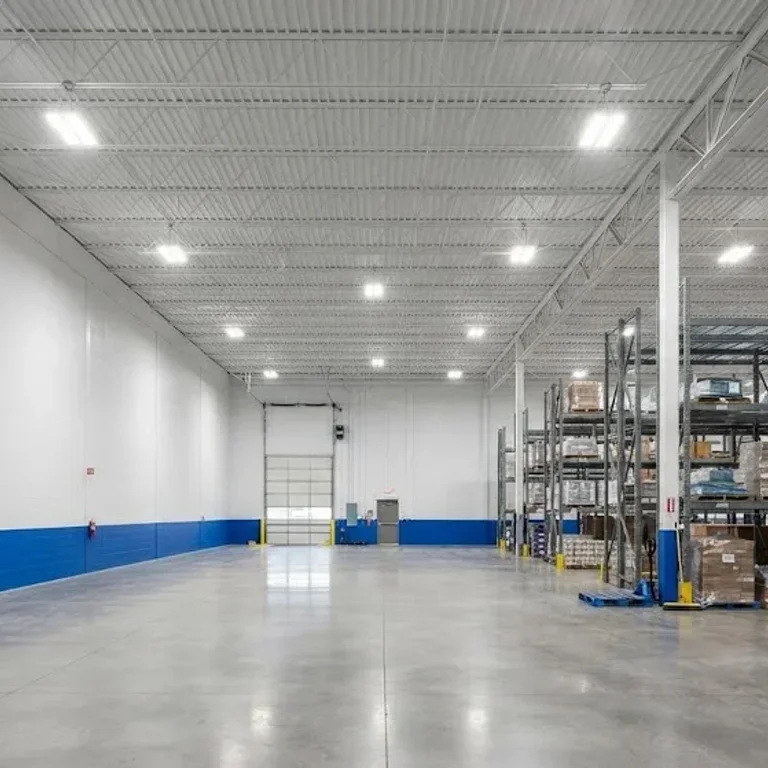
Commercial Epoxy Flooring in New Jersey
Commercial floors are specified by what they have to survive. A retail floor or showroom needs a decorative finish that is easy to clean and a closure that fits around trading hours. A warehouse needs abrasion resistance where carts and pallet jacks run, and a solid color base for aisle lines. An auto service bay needs chemical resistance and traction. Restrooms and wet rooms need a textured, slip-resistant surface.
Restaurant kitchens are the exception that matters most. Hot oil, boiling water and steam cleaning create thermal shock, and standard epoxy is not the right product next to a fryer or a dish machine. Cook lines and wash-down rooms call for urethane cement, a much thicker system that expands and contracts with the slab, finished with a textured broadcast and carried up the wall as a sealed cove where the health code requires it. The dining room is a different floor and can take a decorative system.
We plan commercial floors the same way we plan commercial repaints: phased so only part of the building is out of service, with grinding and coats pushed to evenings and weekends, and the cure times for foot traffic, equipment and vehicles agreed in writing before we start. Our guide to commercial epoxy flooring in NJ covers specifications, downtime and cost drivers in detail, and our commercial painting crews can take on the walls, steel and ceilings in the same shutdown.
- Retail & Showroom Floors
- Warehouses & Distribution
- Workshops & Commercial Garages
- Back-of-House Areas
- Moisture Testing Before We Quote
- Aisle & Safety Line Striping
- Evening & Weekend Scheduling
- Phased Work in Open Buildings
How We Install an Epoxy Floor
Nearly every coating failure traces back to preparation, so most of our time on site goes into the slab before any color is mixed.
Slab Assessment
We measure the floor, map cracks, joints and any previous coating, and check the concrete for moisture before recommending a system, a color and a schedule. Basements and ground-level commercial slabs get a quantitative moisture test where moisture is a realistic risk.
Diamond Grinding
The slab is ground with diamond tooling to an open, absorbent profile, with dust extraction running, so the coating keys into the concrete instead of sitting on it. We do not acid etch; most coating manufacturers no longer recommend it.
Repairs & Priming
Cracks, spalls and pitted areas are chased out and filled with an epoxy repair mortar, joints are treated, and the prepared slab is primed.
Basecoat & Flake
The pigmented basecoat goes down wet, and on flake systems the chips are broadcast to refusal, then scraped back and vacuumed once the coat has set.
Topcoat & Cure
A urethane or polyaspartic topcoat seals the floor, with a slip-resistant additive if you want one. We hand over the cure times for the exact products used: walking on it, moving things back in, and parking on it.
Wondering what epoxy flooring costs?
See real price ranges and what drives the cost — free, no phone call required.
Epoxy Flooring Questions from NJ Homeowners and Businesses
Have a question not listed here? Give us a call or send us a message — we are always happy to help.
Most residential epoxy projects — such as a single-car garage — can be completed in 1 to 2 days. Larger commercial floors or multi-coat systems may require 2 to 3 days to allow each layer to cure properly before the next is applied.
Decorative flake, metallic and solid color finishes, built as epoxy, polyurea and polyaspartic systems with a urethane or polyaspartic topcoat. Flake is the most forgiving finish for a garage because it hides dust, salt and tire marks; metallic suits finished basements and showrooms; solid color suits workshops, utility rooms and warehouse floors. The system underneath is chosen for the room: how much sun it gets, how soon you need it back, and whether the slab has a moisture problem.
Independent cost surveys put professionally installed epoxy floor coating at roughly $3 to $12 per square foot, and most New Jersey garage projects fall inside that range. Where a particular floor lands depends on the condition of the slab, whether crack repair or resurfacing is needed first, how many coats the system calls for, and whether the topcoat is epoxy or polyaspartic. Decorative flake and metallic finishes add material and labor on top of a solid color. Our cost guide breaks the numbers down further, and every on-site estimate is free.
In practice they are usually used together rather than chosen between. Epoxy gives film build, adhesion and chemical resistance at a lower material cost, so it makes an excellent basecoat. Polyaspartic cures far faster — foot traffic in hours and vehicles in about a day, against 24 to 72 hours for foot traffic and up to a week for parking with a full epoxy system — stays clear under UV where standard epoxy ambers, and can be applied across a much wider temperature range. Most of the garage systems we install are an epoxy basecoat under a polyaspartic or urethane topcoat.
Often yes, but the slab temperature decides it, not the calendar. Most epoxies need the floor between roughly 50°F and 90°F while they are applied and while they cure, and an unheated NJ garage slab sits below that from late autumn into spring — epoxy applied cold stays soft or never fully hardens. That leaves two options: temporary heat to bring the slab up and hold it there through the cure, or a polyaspartic system, which many manufacturers rate for application down to around 30°F. We check slab temperature and dew point on the day before starting either way.
Yes, on slabs where moisture is a realistic risk — basements, ground-level commercial floors, and anything poured without an under-slab vapor barrier. Two ASTM methods cover it: F2170, which reads relative humidity from probes set into holes drilled in the slab, and F1869, the calcium chloride test, which reports a moisture vapor emission rate in pounds per 1,000 square feet per 24 hours. Coating manufacturers commonly cap thin systems around 3 pounds. If the readings come back above the limit, a moisture-tolerant primer or a urethane cement system goes down first instead of standard epoxy.
It does, and a coated basement floor is far easier to keep clean than bare concrete — but basements need more homework than garages. Many older Monmouth and Middlesex county homes have slabs poured with no vapor barrier beneath them, and the water vapor pushing up through the concrete can build enough pressure to delaminate an otherwise sound coating. Active seepage or a hydrostatic problem has to be solved before any coating goes down. Where readings are borderline we use a moisture-tolerant primer or a more vapor-forgiving system.
Yes. We coat commercial floors across Central New Jersey, including showrooms, retail and office floors, warehouses, workshops and back-of-house areas, and we can lay out and stripe aisles, walkways and hazard zones on the same job. Commercial floors are phased so only part of the building is out of service, with grinding and coating pushed to evenings and weekends where needed, and the return-to-service times for foot traffic, equipment and vehicles agreed in writing before work starts.
Not standard epoxy. Floors near fryers, ovens and dish machines take hot oil, boiling water and steam cleaning, and that thermal shock cracks and lifts thin epoxy coatings. Cook lines and wash-down rooms call for urethane cement, a much thicker system that expands and contracts with the concrete, usually with a textured broadcast for traction and a sealed cove base where the floor meets the wall. A restaurant dining room is a different floor and can take a decorative flake or metallic system.
Not as an exposed layer. Epoxy yellows in sunlight and the discoloration is permanent, and an outdoor slab also faces rain from above, moisture from below and New Jersey freeze-thaw cycles. An outdoor coating has to be a light-stable system rated for exterior use, and it has to stay slip-resistant when wet. If you are thinking about coating a patio, porch or walkway, ask about it at your estimate and we will tell you honestly whether the slab is a good candidate.
Hot tire pickup happens when tires warm from driving soften a coating, then grip and lift it as they cool and contract. It is a failure of the coating and the prep, not something inherent to a garage floor: thin or consumer-grade kits, a slab that was never mechanically ground, and driving on a floor before it has fully cured are what cause it. A properly ground slab, correct film build, a polyaspartic or urethane topcoat, and waiting out the full cure before parking prevent it. We also suggest parking pads under the tires for the first couple of weeks while the floor reaches its final hardness.
Standard high-gloss epoxy can be slick when wet. That is why we offer slip-resistant additives — such as aluminum oxide or polymer grit — that can be broadcast into the topcoat to provide excellent traction without affecting the appearance.
Ask for the contractor's New Jersey home improvement contractor registration number and a certificate of insurance. Then ask how they prepare the slab (diamond grinding, not acid etching), whether and how they moisture test, what the total thickness of the system is, whether the topcoat is UV-stable, and how they finish the coating at the garage door, where peeling usually starts. Compare bids system for system, by product name, not just by price.
We are based in Morganville in Monmouth County and install garage, basement and commercial epoxy floors across Monmouth, Middlesex, Ocean, Mercer, Somerset and Burlington counties. Every estimate is free and includes a look at the slab before we recommend a system.
When properly installed and maintained, a professional epoxy floor can last 10 to 20 years or more. We back our installations with a 2-year warranty and use only industrial-grade coatings to ensure long-term performance.
Still have questions?
Can't find the answer you're looking for? Give us a call or send a message.