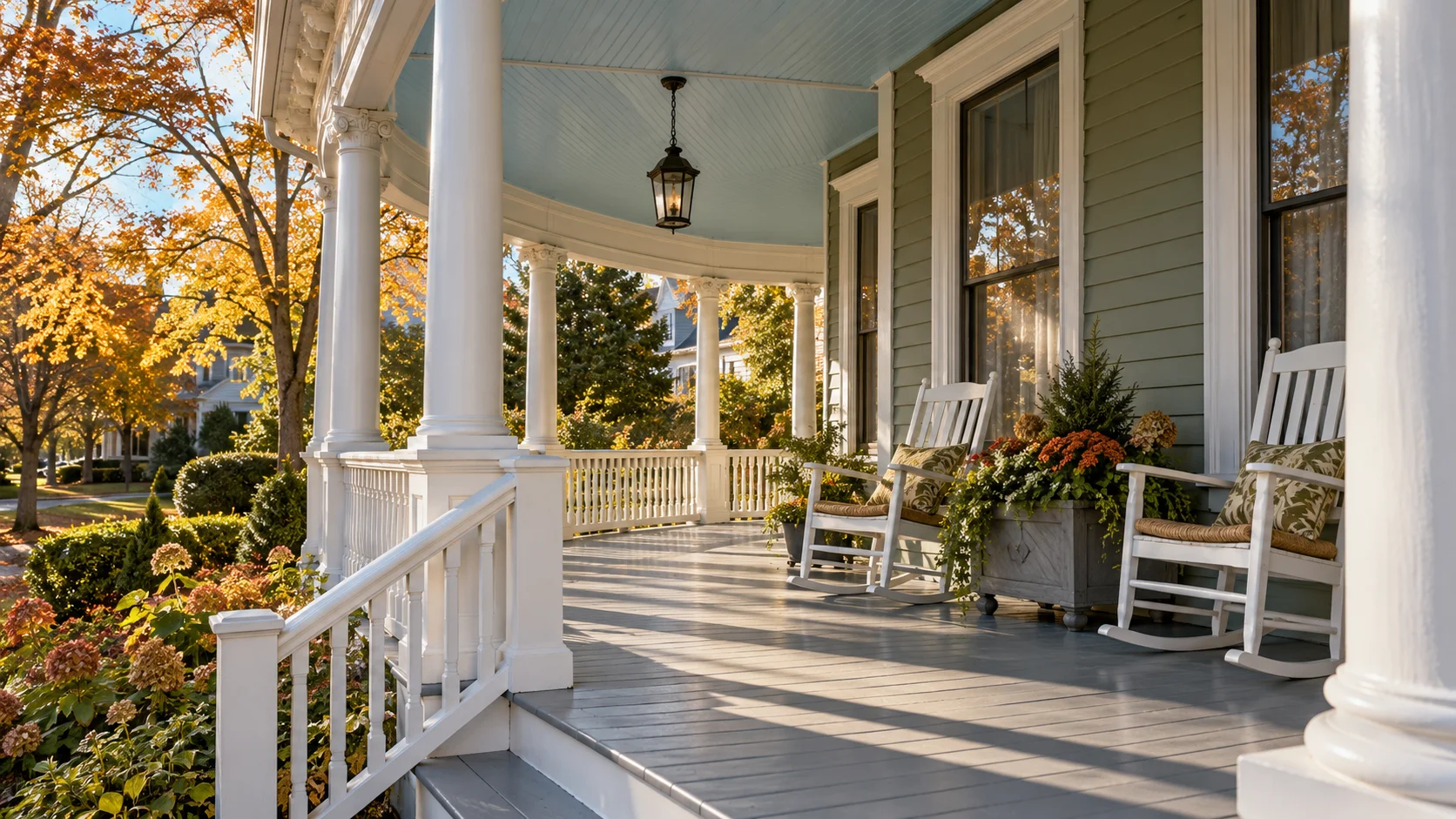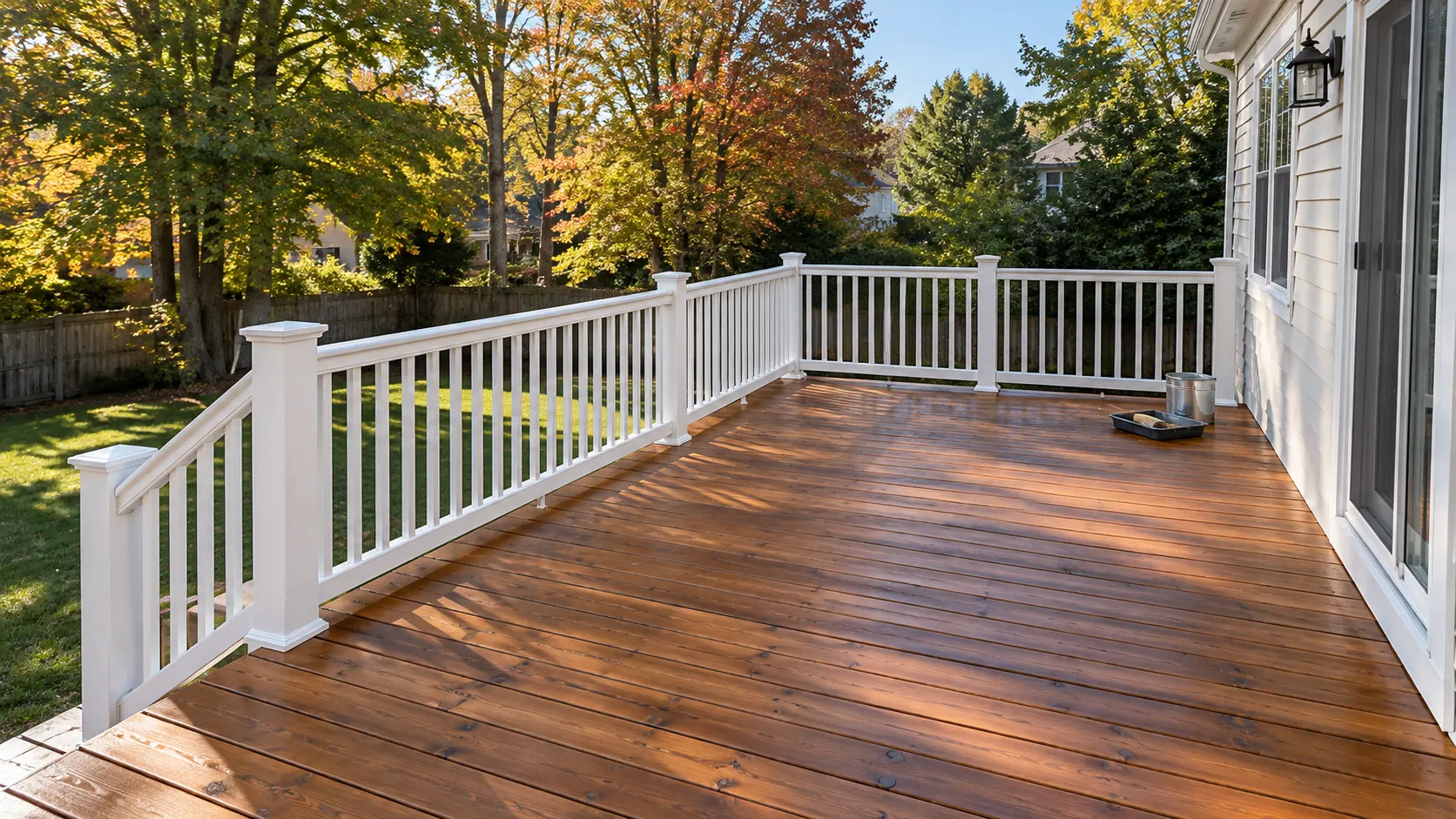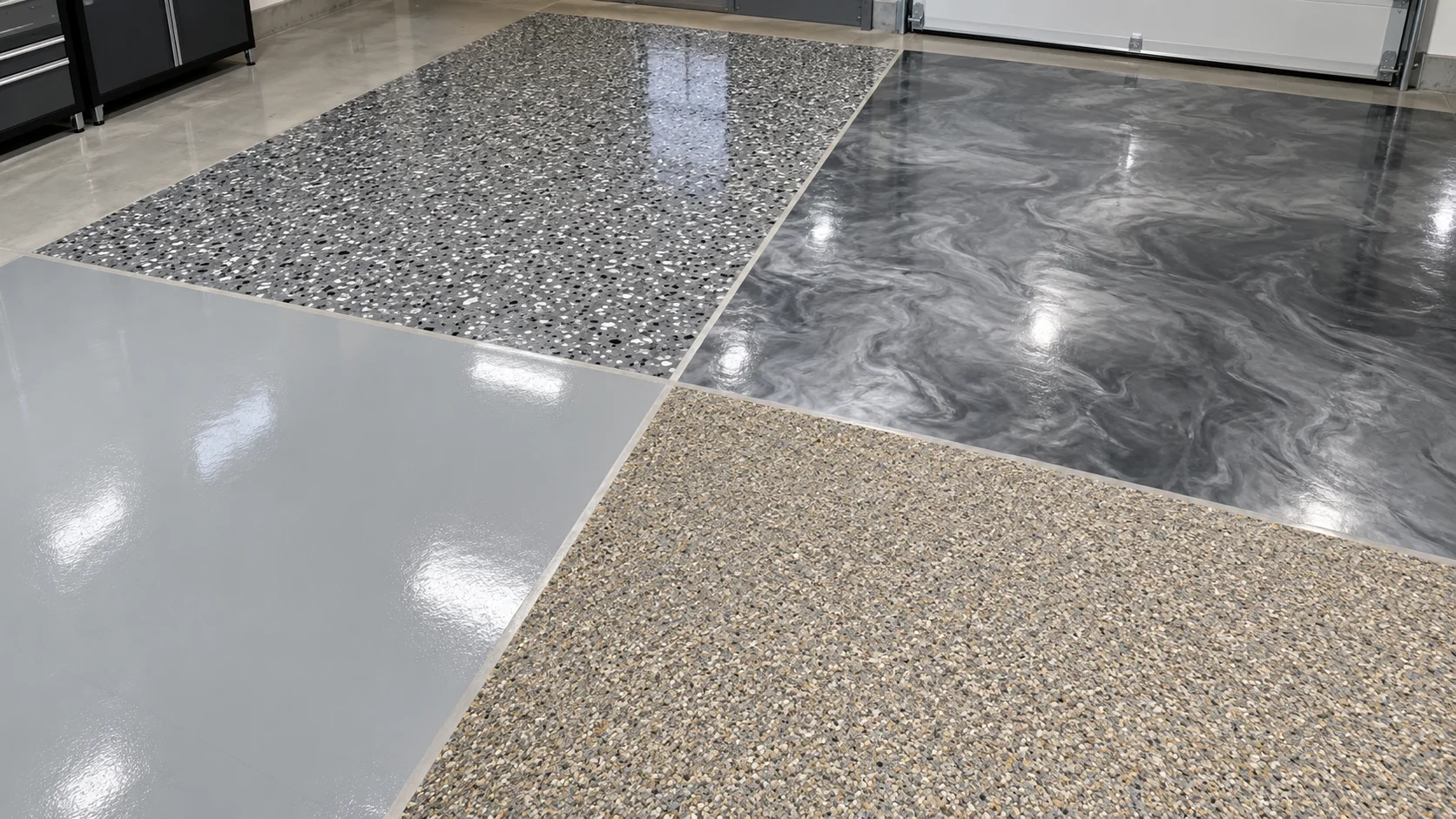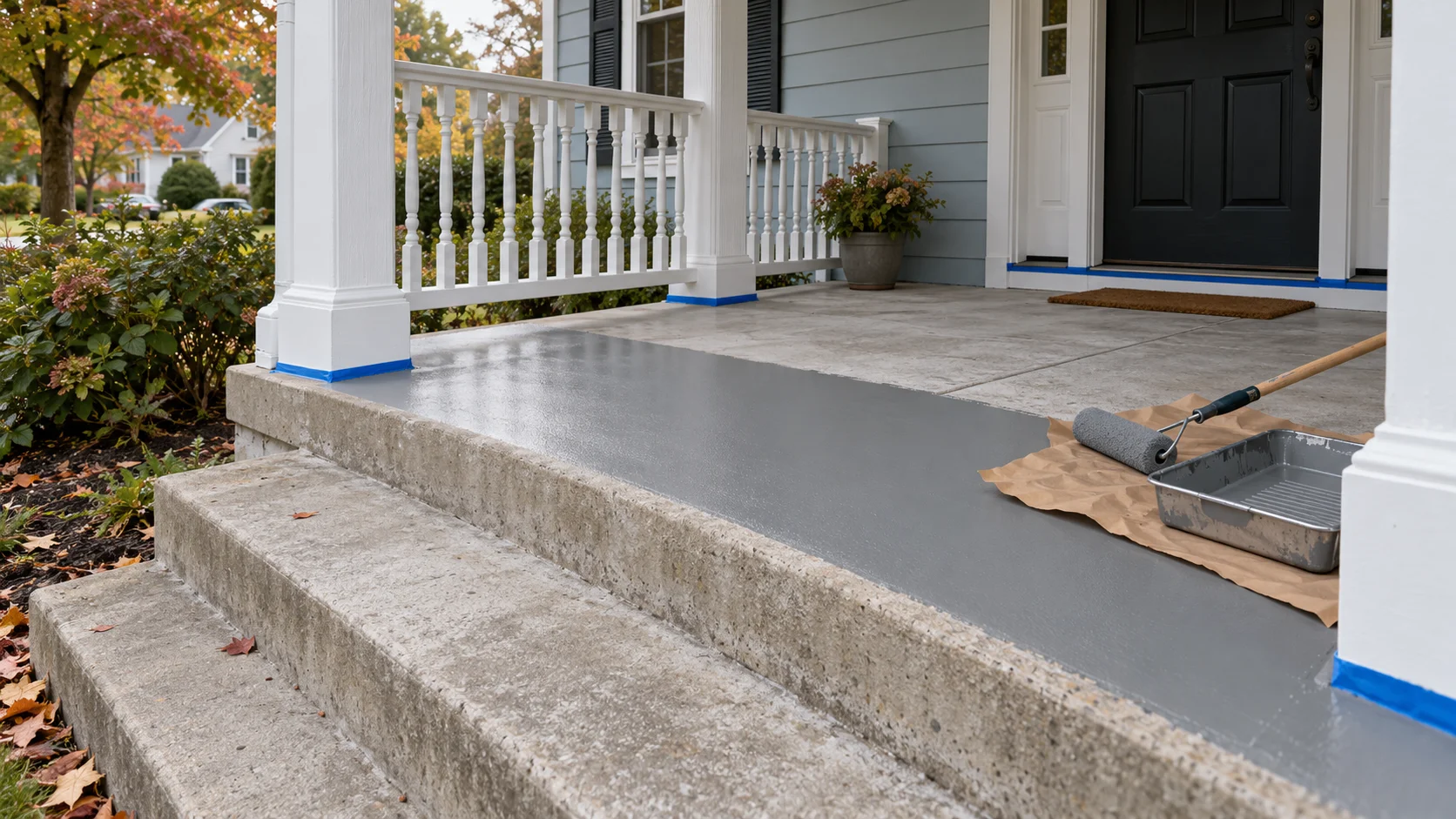
Yes, you can paint a concrete patio, porch or steps, but the slab decides whether it lasts. Concrete that has cured at least 28 days, passes a moisture test, feels like 120-grit sandpaper and is not already sealed will hold a porch and floor enamel or a solid stain. A damp, glass-smooth, sealed or scaling slab pushes it back off, often in the second winter.
We are a family-owned painting company in Morganville and we paint and stain exterior concrete — patios, front porches, steps, walkways, porch floors, railings and columns — across Monmouth, Middlesex, Ocean, Mercer, Somerset and Burlington counties, plus Union, Essex, Hudson, Bergen and Passaic in the north. This guide is the long version of the conversation we have at a patio estimate. It covers how to tell whether your slab is a candidate, when a penetrating sealer or a stain is the better answer than paint, what actually makes coatings peel off concrete, and why freeze-thaw and deicing salt make this a harder job here than it is in Virginia. Every technical figure below is quoted from a manufacturer's data sheet or an industry technical note, all of which were read on 17 October 2026 and are listed at the end of the article's source notes.
One thing we will not do is tell you a number for your patio in an article. Slab condition is the whole price, and nobody can see a slab through a web page.
The Short Answer
- Concrete has to cure before it can be coated. Sherwin-Williams' Porch & Floor Enamel sheet says "concrete and mortar must be cured at least 28 days @ 75°F (24°C)." Benjamin Moore's Floor & Patio enamel asks for more: "new masonry surfaces must be allowed to cure 30 days."
- The slab has to be dry, and you test it rather than guess. The cheap test is a taped-down plastic sheet. The quantitative one is ASTM F1869, measured "in pounds of moisture over a 1000 ft² area during a 24-h period."
- The slab has to have a profile. Both brands use the same homeowner-friendly benchmark: Sherwin-Williams says "if the concrete feels like 120-grit sandpaper, the pores are open enough for this product to bond properly with the substrate."
- A power-trowelled or already-sealed slab is the hard case. It needs etching or mechanical abrasion first, and a slab that will not absorb water will not absorb a stain either.
- Freeze-thaw plus road salt is the local problem. The ready-mix industry's own technical note says "deicing chemicals exacerbate this by increasing the saturation of concrete at the surface and the number of freezing and thawing cycles."
- Sometimes the right answer is not paint. On a slab that is already scaling, the published advice is a breathable penetrating sealer, not a film. We will say so.
- Film-forming floor paint is not driveway paint. Sherwin-Williams states flatly that Porch & Floor Enamel "is not suitable for use on garage floors or surfaces subject to automobile or truck traffic."
- Every floor coating is slippery when wet. Benjamin Moore prints it as a caution in capitals. On steps, that is the governing design decision, not an afterthought.
Can You Paint Concrete Outside? What the Products Themselves Say
The products are made for this, and they say so. Benjamin Moore's Latex Floor & Patio Low Sheen Enamel N122 is described on its own technical data sheet as being "for interior and exterior use on unpainted concrete (new or old) and previously finished wood or concrete floors," and "particularly recommended for basements, porches, patios, breezeways, showrooms, and light industrial applications." Sherwin-Williams' Porch & Floor Enamel A32 series is "a waterborne acrylic coating designed for interior and exterior, wood and concrete, porches and floors," with "steps" named in its own use list.
So the question is never really "can concrete be painted outside." It is "can this slab be painted outside, and will the result still look like a decision you are glad you made three winters from now." That is a condition question, and it breaks into four parts: age, moisture, profile and chemistry. Most coating failures on exterior slabs trace back to one of those four, and usually to moisture or profile.
Paint, Stain or Seal: the Decision Before the Decision
Homeowners usually arrive having already decided on "paint," because that is the word for what they want the patio to look like. There are three genuinely different products, though, and on a lot of New Jersey slabs the right one is not the one people came in asking for.
| Film-forming floor & patio paint | Solid-colour concrete stain | Penetrating sealer / water repellent | |
|---|---|---|---|
| What it does | Builds an opaque film on top of the slab | Colours the slab with a thinner, more breathable pigmented film | Soaks in and repels water; adds little or no colour |
| Dry film it leaves | About 1.0 to 1.5 mils per coat | Thinner still, and markedly more porous | No film to speak of |
| Coverage per gallon | 350 – 600 sq ft depending on product | 200 – 300 sq ft on concrete floors, 150 – 250 on porous concrete | Varies widely by product |
| Hides existing colour and patching | Best — fully opaque | Good, but texture still reads through | No — "patching compounds will generally be visible through clear coatings" |
| Risk on a damp slab | Highest — a vapour-tight film over a wet slab is a trap | Lower, but still a film | Lowest — a breathable sealer is what the scaling-repair guidance actually recommends |
| Right for | A sound, dry, profiled porch floor or patio you want a colour on | A sound slab where you want colour with more vapour tolerance | A slab that is scaling, damp, or simply does not need colour |
That last column is the one worth sitting with. The National Ready Mixed Concrete Association's technical note on scaling concrete surfaces — written by the people who sell the concrete, not the coating — gives this as its prevention advice for a slab facing a hard winter: "apply a commercially available silane or siloxane-based breathable concrete sealer or water repellent specifically designed for use on concrete slabs." Breathable. Not a film. It also tells you when: "the concrete should be reasonably dry prior to the application of a sealer. Late summer with a few dry days preceding application is an ideal time." That is a late-August-to-September job in central New Jersey.
Solid-colour stain sits in between, and it is a genuinely underused option here. Sherwin-Williams' published data sheet for H&C Concrete Stain Solid Color Water Based lists "patios and walkways" among its recommended uses and publishes third-party test data that is directly relevant to this state: against AASHTO T 259/T 260 for chloride ion penetration it reports a "reduction of 54% @ 0.0625"-0.5" penetration, 83% @ 0.5"-1.0" penetration," and against ASTM B117 salt spray, "no film defect after 500 hrs exposure." Published salt-resistance numbers are rare on consumer concrete products, and on a front walk that gets salted every January they matter more than the colour card does.
The Four Things That Have to Be True First
1. The concrete has to have cured — and new means new
This catches people with new patios more than anything else. Fresh concrete is still chemically busy and still giving up water, and the manufacturers will not warrant a coating applied to it. Sherwin-Williams' Porch & Floor sheet: "concrete and mortar must be cured at least 28 days @ 75°F (24°C)." Benjamin Moore's Floor & Patio sheet asks for 30: "new masonry surfaces must be allowed to cure 30 days and then be cleaned to removing all form release agents and curing compounds before applying the base coat." The H&C stain sheet uses the same 28-day figure: "newly poured concrete must be at least 28 days old."
Sherwin-Williams' industrial flooring group explains what the 28 days is buying in its technical article on preventing blistering and disbondment: the slab must cure a minimum of 28 days before a resin floor goes on because roughly 95% of the excess water will have left it by then, and environmental conditions can stretch that out further. Note the word "roughly." Twenty-eight days is a floor, not a guarantee, and a slab poured in a cool damp October in Middlesex County is not as far along at day 28 as one poured in July.
Two practical consequences. If your patio was poured this season, the honest answer is "next spring," and we will tell you that rather than take the job. And if a contractor poured it and offered to coat it the following week, that is useful information about the contractor.
2. The slab has to be dry, and "looks dry" is not a test
This is the single biggest cause of coating failure on exterior slabs, and it is the one homeowners find hardest to believe, because the surface genuinely does look dry. Concrete on grade is a wick. Water moves up through it from the soil continuously, and a cured paint film is substantially less permeable than the slab underneath it. Put a film over a slab that is still moving water and the water collects at the bond line, which is the one place it cannot go anywhere.
Sherwin-Williams' industrial group describes the mechanism in one sentence: "moisture vapor transmission occurs when water vapor moves upward through the concrete slab from the ground." It also sets the working number everyone in the trade uses: "the reading obtained from the Calcium Chloride test must be less than or equal to three pounds per 1000 square feet per day at use conditions." The H&C stain sheet gives the same threshold for its own product, citing the standard: "moisture content should not exceed 3 lbs/1000 sq. ft. of surface (ASTM F710)."
There are two tests worth knowing about, and they do different jobs.
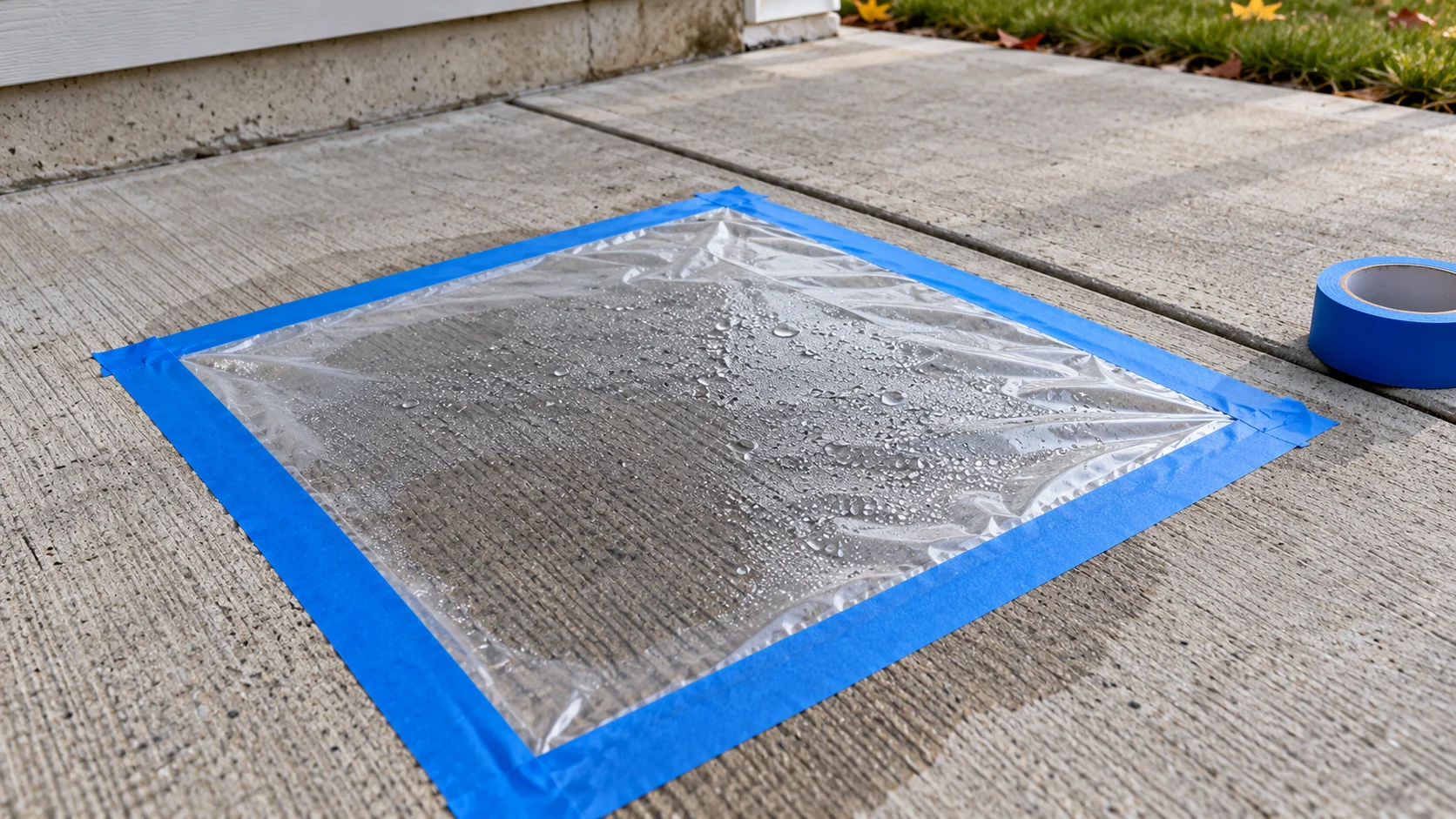
- The plastic-sheet test is the screening test, it costs nothing, and you can do it yourself this afternoon. Sherwin-Williams prints the method right on the Porch & Floor data sheet: "test for moisture or dampness by taping the edges of a 2 foot by 2 foot plastic sheet on the bare surface (an asphalt tile or other moisture impervious material will also do), sealing all of the edges. After 48 hours, inspect for moisture, discoloration, or condensation on the concrete or the underside of the plastic. If moisture is present, the source must be located and the cause corrected prior to painting." The standardised version is ASTM D4263, "Standard Test Method for Indicating Moisture in Concrete by the Plastic Sheet Method", whose own significance statement is the reason to bother: "capillary moisture in the concrete may be detrimental to the performance of certain coating systems that cannot tolerate moisture on or within the surface boundary."
- The calcium chloride test is the quantitative one. ASTM F1869, "Standard Test Method for Measuring Moisture Vapor Emission Rate of Concrete Subfloor Using Anhydrous Calcium Chloride," covers "the quantitative determination of the rate of moisture vapor emitted from below-grade, on-grade, and above-grade (suspended) bare concrete floors," reported "in pounds of moisture over a 1000 ft² area during a 24-h period." It applies to bare, uncoated concrete only, and the standard is explicit about its own limits: "results obtained reflect the condition of the concrete floor surface at the time of testing and may not indicate future conditions."
That last caveat is why a slab that passes in August can still fail a film in March. A patio read in a dry spell is not the same patio after a wet spring with the water table up. It is also why the plastic-sheet test is worth doing twice, in different weather, before committing to an opaque film on a slab you have doubts about.
Honest caveat on the whole subject, from the people who make the paint: Sherwin-Williams' own sheet says "concrete must be free of moisture as much as possible (moisture seldom drops below 15% in concrete)." Exterior concrete is never bone dry. The test is not asking for dry; it is asking whether the slab is actively pushing water at a rate that will lift a film.
And there is a case where no coating is the answer: a slab with genuine hydrostatic pressure behind it, or a porch slab taking roof runoff because a downspout dumps next to it. A coating does not fix water, it hides water for a season. Fixing grade, gutters and drainage comes first, and if the water is coming through a foundation rather than a slab, that is basement waterproofing work and it is not something we do — we will say so and tell you what we think you are looking at.
3. The slab has to have an open profile
A coating grips concrete mechanically. It needs somewhere to key into, and the data sheets agree on a test a homeowner can run with a fingertip. Sherwin-Williams: "surfaces must offer sufficient profile to achieve adequate adhesion. If the concrete feels like 120-grit sandpaper, the pores are open enough for this product to bond properly with the substrate." The H&C stain sheet says the same thing from the other direction — "after proper etching the surface should have the feel of 120-grit sandpaper, if not then a second etching is required."
Run your hand over your patio. A broom-finished slab, which is most back patios and most walkways in New Jersey, usually already has it. Sherwin-Williams confirms the easy case: "rough textured concrete does not need to be etched."
The hard case is the smooth one, and it is common on front porch floors and on steps, where a finisher wanted a clean look. Sherwin-Williams: "for very smooth surfaces (troweled surfaces with no porosity) use Concrete Etching Solution at full strength. For smooth-troweled concrete with some porosity, 1 part Concrete Etching Solution to two parts water should be used." Benjamin Moore puts it the same way: "poured or pre-cast concrete with a smooth surface should be etched with a Concrete Pretreatment & Etch or a 10% muriatic acid solution to promote adhesion."
Which raises the question of whether to etch at all.
Acid etch or mechanical profile?
For a back patio, etching is usually fine, and both manufacturers call for it on their own products. For anything bigger, denser or more consequential, we grind. Sherwin-Williams' industrial coatings group has published a direct argument that acid etching is no longer a recommended concrete prep method, and the reasons transfer to an exterior slab almost entirely:
- "Acid etching removes laitance, but cannot remove curing compounds or many of the contaminants found in industrial settings, such as oily deposits and water-insoluble materials, any of which can interfere with the adhesion of a coating." On a patio, read that as grill grease, hydraulic drips and a decade of sealer.
- "The chemical reaction that occurs when an acid solution is applied to concrete is difficult to accurately predict and control," so you end up over-etched in patches and under-etched in others.
- Over-etching makes the slab more porous, and "when the acid is finally rinsed from the surface, the water can more easily enter the porous slab, resulting in potential corrosion of metal rebar and eventual weakening of the entire slab structure."
- "Acid etching tends to produce a CSP-1 to CSP-2 profile, which is suitable for only for very thin systems." A thin porch enamel is a thin system, so that is survivable; a heavier build is not.
- "Acid etching introduces water to the concrete, which is best avoided" — and you have just read the moisture section.
There is one more reason, and it is specific to this topic. Both manufacturers are emphatic that you do not etch a slab that already has paint on it. The H&C sheet says it in capitals: "DO NOT ETCH PREVIOUSLY PAINTED SURFACES." So on a repaint — which is most of this work — the acid route is closed anyway, and mechanical abrasion is the only prep that is actually available.
4. The chemistry has to be right: pH, laitance and efflorescence
Concrete is alkaline, and some coatings care. The H&C stain sheet sets a window: "prepared concrete must have a pH level between 6 and 10." That is a strip of litmus paper and a splash of distilled water, and it takes a minute.
Then there is the list of things that have to come off the surface first, which Sherwin-Williams gives in full: "surface must be free of laitance, concrete dust, dirt, form release agents, moisture curing membranes, loose cement and hardeners." Laitance is the weak, fines-rich skin that rises to the top of a slab as it is finished. It is part of the slab to look at and a bond breaker to coat over. Curing membranes are worse, because they are invisible and they were applied deliberately.
And then there is efflorescence, which is the white bloom that appears on concrete and masonry and which homeowners almost always read as a defect. The Concrete Masonry & Hardscapes Association's technical note on the control and removal of efflorescence (TEK 08-03A) defines it and defuses it in the same breath: "efflorescence is a deposit of soluble salts and bases, usually white in color, that sometimes appear on the surfaces of masonry or concrete construction. Although it may be an aesthetic concern, efflorescence will not affect structural performance."
The chemistry is worth understanding because it explains the timing. "Hydrated cement contains some calcium hydroxide (soluble) as a product of the reaction between cement or lime and water. When this calcium hydroxide is brought to the surface by water it combines with carbon dioxide in the air to form calcium carbonate (slightly soluble), which then appears as a whitish deposit."
It takes three things at once, and this is the single most useful paragraph in the whole TEK: "first, there must be soluble compounds in the masonry. Second, moisture must be present to pick up the soluble salts and carry them to the surface. Third, some force — evaporation or hydrostatic pressure — must cause the solution to move. If any one of these conditions is eliminated, efflorescence will not occur."
Two things follow for anyone thinking about coating a slab or a porch wall that blooms. First, timing: "efflorescence is more common in the winter when a slower rate of evaporation allows migration of salts to the surface," and "in spring, condensation frozen within the masonry may be released by warm weather allowing for further solubilizing of compounds and their migration to the surface." So the bloom you see in March is normal, and a January inspection will tell you more than a July one.
Second, and this is the warning: "the application of clear coatings to a masonry wall that has the tendency to effloresce, without reducing the mechanisms for the occurrence of that efflorescence, may lead to surface spalling of masonry units or deposits on the interior and/or exterior surface of the surface treatment." Coat over an active efflorescence problem without dealing with the water and you get salt crystallising behind your new film, which is a mechanical jack. That is why we go after the water first and the bloom second.
The removal itself is undramatic: "in general, most efflorescence can be removed by dry-brushing followed by flushing with clean water." If an acid wash is needed on masonry, the TEK adds a timing rule that nobody expects — "if the surface is to be painted, it should be thoroughly flushed with water and allowed to weather for at least one month." A month. That is a scheduling fact, not a nicety. The same reasoning applies to brick and block on a porch; our guide to painting a brick house in NJ goes further into masonry coatings and the same efflorescence problem on a vertical wall.
One more efflorescence note that is specific to this state. Salts do not only come from the cement. The TEK records that "masonry in contact with soil, such as in basement and retaining walls, may absorb ground water containing soluble salts," and that "through capillary action, salts present in the soil may rise several feet above the ground, producing an accumulation of salts in the masonry." A patio at grade with planting beds on three sides is sitting in exactly that situation.
Why a Sealed or Power-Trowelled Slab Rejects a Coating
Two kinds of slab cause more coating failures than any other condition, and neither looks like a problem.
The first is the already-sealed slab. Somebody put an acrylic or solvent-based sealer on it, maybe years ago, maybe three owners ago, and it is still there as a thin glossy skin. A new coating bonds to the sealer rather than to the concrete, and the whole system is then only as good as that old sealer's grip. There is a one-minute test on the H&C sheet that is written for vertical surfaces but works on a patio just as well: "test various sections by spraying water directly onto the surface to be stained. If the water does not absorb rapidly, then the surface should be acid etched using the H&C Etching Solution following label instructions or mechanically abraded. Do not apply the stain until all surfaces are porous."
Pour a cup of water on your patio. If it beads or sits in a disc, the slab is sealed or densified and it is not ready. If it darkens the concrete within a few seconds, you are in business. We do this on every exterior-concrete estimate, in several places, because slabs are rarely uniform — the sheltered half under a roof overhang often still has sealer when the exposed half has weathered through.
The second is the power-trowelled slab, and this one is a mechanical problem rather than a chemical one. A steel trowel run hard over a slab closes the pores and burnishes the top into a dense, glass-like layer. It is a desirable finish on an interior floor and the wrong one to coat. That is the "troweled surfaces with no porosity" case Sherwin-Williams flags for full-strength etch, and it is the case where we will argue for grinding instead.
Worth knowing too: over-trowelling can make a slab fail on its own, with no coating involved at all. The ready-mix note on scaling carries an aside that explains a lot of the mysteriously flaking front steps in this state: "occasionally concrete peels or scales in the absence of freezing and thawing... often this is due to the early use of a steel trowel, over-finishing or finishing while bleed water is on the surface." If a slab's own surface was weak from the day it was finished, painting it does not strengthen it. You are putting a film on a layer that is already releasing.
Why New Jersey Is Hard on Outdoor Concrete
Freeze-thaw, and the fact that our winters do not stay frozen
The damage is not done by cold. It is done by crossing the freezing line repeatedly with water in the slab. According to the Office of the New Jersey State Climatologist at Rutgers, the state averages 163 freeze-free days in the northern highlands, 179 across the central and southern interior and 217 along the seacoast. The rest of the year is spent going back and forth over 32°F, and every crossing is another cycle.
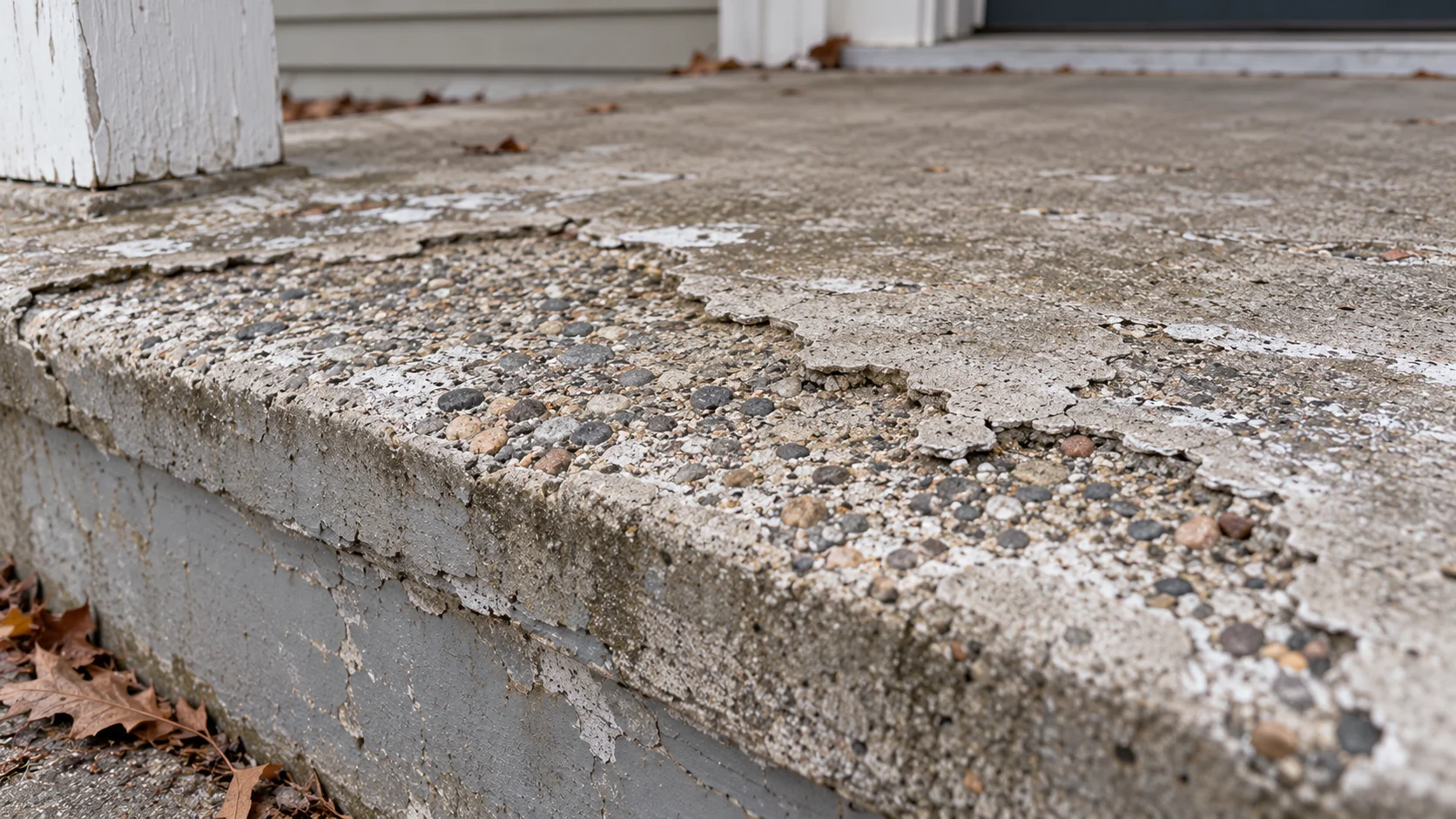
The ready-mix industry's note on scaling describes the mechanism and names the outcome. "Scaling is local flaking or peeling of a finished surface of hardened concrete as a result of exposure to cycles of freezing and thawing. Generally, it starts as localized small patches which later may merge and extend to expose large areas." The severity scale is useful to know, because it is roughly the decision tree for whether a coating is even on the table: "light scaling does not expose the coarse aggregate. Moderate scaling exposes the aggregate and may involve loss of up to 1/8 to 3/8 inch of the surface mortar. In severe scaling more surface has been lost and the aggregate is clearly exposed and stands out."
And the driver: "when concrete is saturated with water and temperature approaches freezing, water expands as it forms ice and this causes stresses within concrete. As the number of cycles of freezing and thawing increases, the potential for scaling increases."
Resistance to all of this is decided at the mixer, not at the paint store. The same note says air-entrained concrete "contains millions of small air bubbles that accommodate the expanding water and ice and prevent the stress buildup," and recommends "a total air content for concrete containing 3/4-inch or 1-inch coarse aggregate" of 6 percent, with exterior slabs ordered at 4000 psi where they will be continuously moist and salted. Nobody can retrofit that. If your slab was poured without entrained air in 1974, no coating converts it into a freeze-thaw-resistant slab; the best a coating does is keep water out of it, which is genuinely worth something but is not the same claim.
Road salt, and how much of it there actually is
Chlorides are the other half, and New Jersey applies an enormous amount of them. NJDOT's own winter operations FAQ says the department "uses sodium chloride or better known as rock salt as the solid anti-icing material that is wetted with either liquid calcium chloride solution or a salt brine/salt brine blend to enhance the melting capability of the rock salt." It maintains 68 salt storage facilities statewide holding up to 228,000 tons, plus "statewide storage capacity for just over 1,000,000 gallons of anti-icing liquids," and it has "the capability to pre-treat thousands of lane miles" with brine before precipitation even starts.
All of that is a delivery problem for your patio and your front walk, because the brine arrives on tyres, on boots and on the dog. The ready-mix note is blunt about what salt does: "deicing chemicals exacerbate this by increasing the saturation of concrete at the surface and the number of freezing and thawing cycles." Salt holds moisture in the pore structure and drops the freezing point, which means more cycles, on a wetter slab, at temperatures that would otherwise have been uneventful. It also adds: "poor drainage causing salt solutions to accumulate on concrete surfaces increases the severity of the exposure and may cause scaling."
Two pieces of homeowner advice from that same note are worth repeating verbatim because they are free and nobody follows them. "Avoid the use of deicing chemicals in the first winter and subsequently use them in moderate amounts. Use clean sand for traction." And: "when conditions permit, hose off accumulation of salt deposited by cars on driveways and garage slabs." There is also a product warning in there: "deicing chemicals composed of calcium chloride and sodium chloride (rock salt) are considered acceptable for concrete. Never use ammonium sulfate or ammonium nitrate or magnesium-based salts as a deicer; these are chemically aggressive and destroy concrete surfaces." Read the bag of ice melt in your garage. Some of them are a problem.
This is the context for our standing recommendation of a pigmented stain over a heavy film on front walks and steps specifically: published chloride-penetration and salt-spray numbers on a product we can point at, rather than a durability claim we made up. We do not sell a "coastal system" or a "salt-air system," because there is no such named product in our line and we are not going to invent one. What we will do is pick a product whose own test data covers the exposure and say which test.
Why the second winter is when a bad job shows
This is our own observation rather than a published finding, so we label it that way — but it is the pattern we see when we are asked to look at failed slab coatings, and the sourced mechanisms above explain it.
A film laid over a slab that was too damp, too smooth or too sealed usually looks perfect at the end of the first season. The film is still fresh, the bond has not been loaded, and nothing has frozen under it yet. Then the first winter puts a little water behind the film at the edges and in the control joints. Nothing visible happens. Then the slab spends a spring drying out and a summer warm, and the salts that moved to the bond line over the winter stay there. The second winter is the one that freezes water that is already behind the film, in a bond that has already been weakened, and that is when it goes — typically as coin-sized blisters near a joint or an edge, or as a sheet lifting from the lowest corner of the patio.
Which means a "one-year warranty" on an exterior concrete coating is close to meaningless, and that the question to ask a contractor is not how long the warranty is but what they tested before they coated. The same logic drives every coating failure, inside and out; our guide to why paint peels in New Jersey walks the general version, and the substrate rule is identical: coatings fail at the substrate, not in the can.
When Painting Concrete Is the Wrong Answer
This is the section that costs us work, and we would rather lose a job than do this one twice. There are five situations where we will not quote a film-forming coating on exterior concrete.
- The slab is already scaling past "light." If the coarse aggregate is exposed, the top of the slab is gone and the layer a coating would bond to is the next layer that is going to release. The ready-mix note is realistic about this: "minor scaling is a cosmetic issue and may not need to be repaired. On the other hand repairing concrete slabs with excessive and progressing scaling may not be feasible." Where it can be resurfaced, the warning still stands: "the repaired surface will only be as strong as the base surface to which it is bonded." Resurfacing and structural repair are concrete work, not painting work, and we do not do it — we will tell you what we think you are looking at and that it needs a concrete contractor.
- The slab fails the moisture test, and the cause has not been fixed. Sherwin-Williams' instruction is unambiguous: "if moisture is present, the source must be located and the cause corrected prior to painting." Grading, downspouts and drainage first. Paint later, or not at all.
- Cars park on it. This matters because "concrete driveway painting" is one of the things people search for. Sherwin-Williams states that Porch & Floor Enamel "is not suitable for use on garage floors or surfaces subject to automobile or truck traffic," and lists it twice more under cautions. Benjamin Moore explains why in one line on its own patio enamel: "many tires contain compounds which may attack latex paints, resulting in loss of adhesion and film pickup." In practice a parked car can lift a thin latex film off in the shape of its tread. A driveway or a garage slab is a different product family — see our guide to epoxy garage floor coating in NJ for what actually belongs there. H&C puts the same boundary on its own stain: "for best results on garage floors use H&C Shield-Crete Garage Floor Epoxy." Garage and basement slabs are work we do, under our epoxy flooring service. A patio enamel on a driveway is not.
- It is a pool surround. This comes up constantly with patios, because the patio often runs right up to one. We do not coat pool decks. It is a different exposure, a different product set and a different warranty conversation, and the honest answer is that it is not our trade. We will coat the patio and stop at the line, or we will pass on the whole thing — but we will not learn on your pool.
- What you actually want is a sealer. If the slab is sound and the complaint is "it gets dirty, it darkens when it rains, it is spalling slightly at the edge," a breathable penetrating sealer solves more of that than a colour does, costs less to maintain and does not fail by peeling. The ready-mix guidance above recommends exactly that for winter protection, and we will say so.
We should be equally clear about what we do not touch adjacent to this work, because patios sit next to all of it. Parking-lot line striping and interior aisle marking, pool deck coating, mould and mildew treatment (washing and power washing we do, treatment and remediation we do not), masonry and concrete repair beyond painting prep, concrete pouring or replacement, and basement waterproofing are all outside what we offer. If your patio problem turns out to be one of those, you will get told that at the estimate rather than after a deposit.
Steps and Walkways: the Slip Question Is the Design Question
A painted concrete step is a different object from a painted patio, and the difference is liability. Both manufacturers print this as a caution rather than burying it. Benjamin Moore, in capitals: "CAUTION: All floor coatings may become slippery when wet. Where non-skid characteristics are desired, use an appropriate anti-slip aggregate." Sherwin-Williams: "surfaces may be slippery when wet and proper preventative precautions are recommended. To increase slip resistance, add slip resistant floor texture additive to the coating when applying."
And then the sentence that should decide the specification: "the addition of slip resistant additives will not eliminate the possibility or risk of slipping or falling. This product should not be used in place of a non-skid finish."
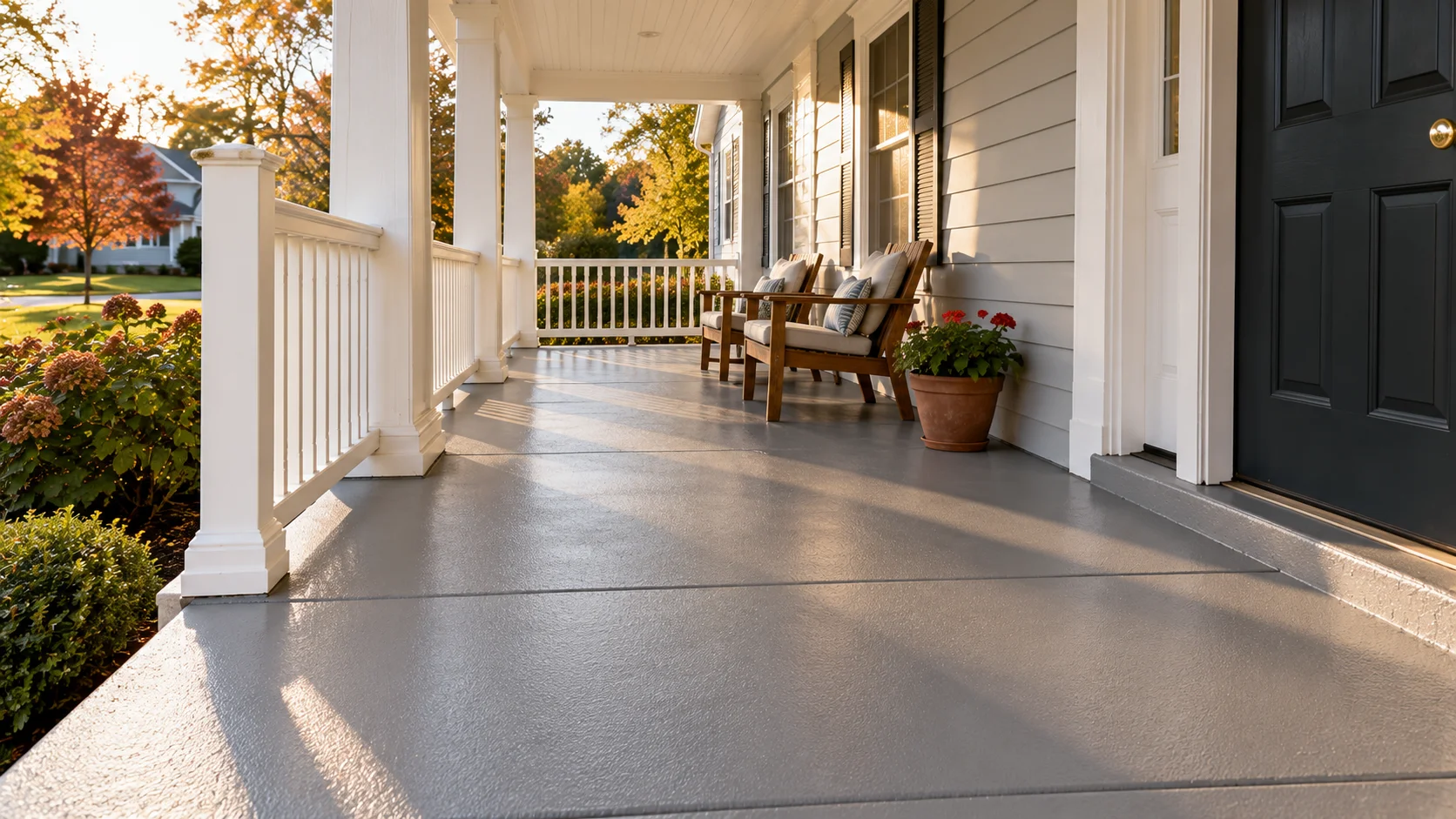
Read that honestly and the conclusions are straightforward. On front steps, on a walkway, and on any sloped porch floor in a state that ices over, we recommend a slip-resistant aggregate broadcast into the final coat, we keep the sheen down, and we tell homeowners plainly that a coated step is slicker than a bare broom-finished one in freezing rain no matter what we add to it. If the steps are the main entrance of a house with elderly residents, that is a real argument for a penetrating sealer and no film at all. The sheen choice interacts with this too — a satin floor hides more and grips marginally better than a gloss; the reasoning is the same as in our paint sheen guide, applied underfoot.
Porch railings, columns, posts and balusters are a separate and much easier job that usually happens at the same time as the floor, and they are work we do; our guide to painting a wood porch, railings and columns covers them. They are also where the next section becomes unavoidable.
Old Porches, Old Paint, and the Rule You Should Ask Every Bidder About
A great many New Jersey front porches are pre-1978 and already carry several generations of paint on the floor, the steps, the railings and the columns. Taking a coating like that back to a sound surface means sanding and scraping, and that is the moment the federal rule applies.
The EPA's Renovation, Repair and Painting Program requires "anyone paid to perform work that disturbs painted surfaces in homes, childcare facilities and preschools built before 1978 be certified," and firms "performing renovation, repair and painting projects that disturb lead-based paint in homes, child care facilities, and kindergartens built before 1978 must be EPA- or state-certified." The threshold is lower than most people assume. The main exception, defined at 40 CFR 745.83, is "minor repair and maintenance activities," meaning work "that disrupt 6 square feet or less of painted surface per room for interior activities or 20 square feet or less of painted surface for exterior activities." Twenty square feet is a very small amount of porch floor. Sanding a set of steps clears it immediately.
Both paint manufacturers carry the warning on the data sheets for these exact products. Sherwin-Williams: "removal of old paint by sanding, scraping or other means may generate dust or fumes that contain lead. Exposure to lead dust or fumes may cause brain damage or other adverse health effects, especially in children or pregnant women." Benjamin Moore's version is in capitals and says the same.
NJ Painting Co. is not an EPA Lead-Safe Certified firm. We are telling you that in the middle of an article that would be easier to write without it, because it is a licensing fact and not a wording preference, and because the rule is the reader's problem whether or not we are the ones who meet it. So: if your porch is pre-1978 and the work involves disturbing the existing paint, ask every contractor who bids it for their RRP certification and how they intend to handle the containment, and get the certificate number rather than a reassurance. On those houses we will either scope the work so it does not disturb the old coating, or tell you it needs a certified firm.
Colour: What Actually Works on an Outdoor Slab
"Best colour to paint a concrete patio" is a real search, and it has a real answer that is less about taste than people expect, because an exterior slab is a horizontal surface in full sun that collects everything.
The practical guidance, from doing this rather than from a source:
- Mid-tone greys and warm greiges are the safest choices. They read as intentional against almost any siding colour, they do not show pollen in April or road grit in February the way a pale slab does, and they do not get too hot to walk on barefoot in August the way charcoal does.
- Avoid very dark colours on anything in full sun that people stand on. A near-black patio in Ocean County in July is a genuinely unpleasant surface, and dark films also show chalking and fade more visibly as they age.
- Avoid very pale colours on anything that gets salted. White and off-white steps show every bit of brine residue and every coffee ring, and they are a maintenance commitment rather than a finish.
- Tie it to the trim, not to the siding. A porch floor usually looks right one or two steps darker than the trim and railings above it, which is also the traditional relationship on New Jersey porches with grey or green floors and white rails.
- Look at it wet. Every concrete coating is a slightly different colour wet than dry, and a patio spends a lot of its life wet. Test patches are worth the extra day.
- Test for adhesion, not just colour. Sherwin-Williams' own repaint instruction is to "apply a test area, allowing paint to dry one week before testing adhesion." A test patch on a doubtful slab is a week well spent and the cheapest insurance in this whole article.
If you are co-ordinating the patio with the rest of the exterior, our guide to popular exterior house colours in NJ has the current palettes with real codes, and deck staining in NJ covers the neighbouring surface that usually needs a decision in the same season.
How We Do a Patio, Porch or Set of Steps
None of this is exotic. It is the data sheets, in order, with nothing skipped.
- Assess and test before quoting. Water-drop absorption test in several places, a hand run over the surface for the 120-grit question, a look for scaling severity and active efflorescence, litmus for pH where it matters, and a plastic-sheet moisture test taped down and left for its 48 hours. On a slab we have doubts about, that means two visits before a number, and we would rather do that than guess.
- Look at the water before the concrete. Downspouts, grading, a patio pitched back toward the house, a planting bed holding soil against a porch slab. If the slab is wet because of something fixable, that gets sorted out — by you, or by whoever handles your gutters and grading — before we coat anything, or the job does not happen. We are not going to seal water in and call it a finish.
- Clean it properly. Power washing to get off dirt, chalk, pollen, old loose coating and salt residue, then a degreaser where grills and cars have been. Then let it dry — properly, for days, not hours. Our power washing guide covers the pressures and why too much pressure on a soft slab makes the problem worse.
- Remove failing coating rather than coat over it. H&C's instruction is "all old, peeling, flaking paint must be removed," and Sherwin-Williams' honest caveat applies to the rest: "recognize that any surface preparation short of total removal of the old coating may compromise the service length of the system." Where total removal is not realistic, we say so and we say what that costs you in service life rather than pretending it is free.
- Profile. Mechanical abrasion where the slab is dense, previously coated or large; etch where a modest patio enamel over bare broom-finished concrete genuinely calls for it, following the label dilution. Then rinse thoroughly and let it dry again, because etching put water into the slab.
- Vacuum and rinse until it is clean. Dust left in an open pore is a bond breaker, which undoes the whole previous step. H&C says to "dry-sweep the concrete with a stiff broom or shop vacuum to remove all surface latent" immediately before the first coat, and that is the right instinct.
- Watch the weather window, which is narrower than people think. The H&C sheet is the strictest and the most useful: "air, surface and material temperature must be between 50° and 90°F and at least 5°F above the dew point during and for 24 hours after application," and "do not apply if rain is expected in 12 hours following the application." Benjamin Moore: "do not apply when air and surface temperatures are below 50°F." Sherwin-Williams: "apply at temperatures above 50°F." The dew point clause is the trap in spring and autumn in New Jersey: a cold slab on a humid October morning condenses moisture you cannot see, and coating over it guarantees a bond failure. We shoot the slab with an infrared thermometer rather than trusting the air temperature, because a slab lags the air by days.
- Two coats, thin, crosswise. H&C: "apply first coat evenly, working in one direction. Allow to dry at least 2 hours before applying second coat. Apply second coat crosswise to the first coat." Benjamin Moore's bare-concrete system is self-priming — a thin first coat left at least four hours, then one to two finish coats. Film build is modest by design: Sherwin-Williams' sheet puts it at "350 - 400 sq.ft. per gallon @ 4.0 mils wet; 1.5 mils dry," Benjamin Moore's at 500 to 600 sq ft per gallon and 1.0 mil dry.
- Broadcast slip-resistant aggregate into the final coat on steps, walkways and sloped porch floors.
- Then stay off it for longer than you want to. Sherwin-Williams: "Light Foot Traffic: 24 hours. Tables, Chairs and Heavy Foot Traffic: 7 days." Benjamin Moore: "withstands light traffic after overnight dry," and it adds the caveat that matters here — "high humidity and cool temperatures will result in longer dry, recoat and service times." H&C is the most explicit for a stain: "allow 72 to 96 hours drying conditions before using the surface for heavy traffic," and "full cure should be reached in 7-14 days." Furniture back on day two is how a good job gets ruined.
One honest note on the mess. Grinding or sanding a cured concrete coating raises crystalline silica. H&C's own label caution says the product "contains CRYSTALLINE SILICA" and that "abrading or sanding of the dry film may release crystalline silica which has been shown to cause lung damage and cancer under long term exposure." That is why prep on these jobs is done with dust extraction and respiratory protection, and it is another reason we are wary of a homeowner taking a belt sander to a painted porch floor on a Saturday.
Repainting a Concrete Patio That Was Painted Before
Most of the work in this category is a repaint, not a first coat, and the rules shift.
Start by being honest about the existing film. Sherwin-Williams' sequence for a previously painted floor: "if in sound condition, clean the surface of all foreign material. Smooth, hard or glossy coatings and surfaces should be dulled by abrading the surface. Apply a test area, allowing paint to dry one week before testing adhesion. If adhesion is poor, additional abrasion of the surface and-or removal of the previous coating may be necessary." And where it has already gone: "if paint is peeling or badly weathered, clean surface to sound substrate and treat as a new surface as above."
Three things to hold on to on a repaint:
- You cannot etch it. "DO NOT ETCH PREVIOUSLY PAINTED SURFACES." Mechanical abrasion is the only prep available, which usually means the prep on a repaint is more work than the prep on a bare slab, not less.
- Partial removal has a cost you should be quoted honestly. "Recognize that any surface preparation short of total removal of the old coating may compromise the service length of the system." A patio with sixty percent sound film and forty percent bare can be feathered and recoated, and it will not last as long as a slab taken back to concrete. Both are legitimate choices; only one of them should be sold as equivalent.
- Figure out why the last one failed before repeating it. If it blistered in the middle of the slab, suspect moisture from below. If it peeled in sheets off a smooth area, suspect profile. If it came off where the table legs sat, suspect it was never cured before the furniture went back. If it went at the lowest corner, look at drainage. A repaint that does not answer that question is a repaint with a known expiry date.
Patching, while we are here: "patching compounds will generally be visible through clear coatings." They telegraph through thin pigmented films too. If a patio has been patched, an opaque film hides it better than a stain and a stain hides it better than a sealer, and that is sometimes the entire argument for paint over sealer on a slab that has had a repair.
Maintenance, and How Long It Lasts
A coated slab is low-maintenance, not no-maintenance, and the maintenance is mostly about water and salt.
- Rinse the salt off at the end of winter rather than letting brine sit and evaporate on the surface all spring. This is the ready-mix association's own advice for bare slabs and it applies at least as much to coated ones.
- Keep furniture feet padded. Point loads from metal chair legs dent and cut any thin floor film, and the marks are where the next failure starts.
- Sweep grit. It is abrasive, and on a patio it is what wears through a coating in the traffic lane from the door to the grill.
- Keep the drainage working. "Poor drainage causing salt solutions to accumulate on concrete surfaces increases the severity of the exposure." A clogged downspout is a coating problem.
- Expect to recoat. Horizontal exterior surfaces that are walked on and frozen on are the shortest-lived paint on any house. A patio or porch floor is not on the same cycle as the siding; our guide to how often to paint a house in NJ covers the vertical surfaces, and a coated slab will generally want attention well before they do.
Nobody publishes a credible service-life figure for patio enamel in a freeze-thaw climate, and we are not going to invent one. What we will tell you at the estimate is which failure mode we think your slab will show first and roughly when we would expect to be back, based on what the testing turned up — and if the answer is "sooner than you would like," you will hear that before you sign rather than after.
Hiring Someone in New Jersey
Anyone painting your patio for money is a home improvement contractor under state law. The New Jersey Division of Consumer Affairs' consumer brief on hiring home improvement contractors defines them as "individuals and companies involved in repairing, renovating, modernizing, installing, replacing, improving, restoring, painting, constructing, remodeling, moving, or demolishing residential or noncommercial properties," and the list of covered work names the exact surfaces in this article: "residential driveways, sidewalks... terraces, patios... porches." The brief also notes that unregistered contractors "will not be issued municipal construction permits and will not be permitted to perform home improvement work in New Jersey," and that a written contract "must also include the contractor's registration number," along with a copy of the commercial general liability insurance policy and the insurer's phone number.
Beyond the paperwork, five questions will separate someone who has done this from someone who owns a roller:
- How will you test the slab for moisture, and when? "Looks dry" is not an answer. A 48-hour plastic-sheet test is the minimum, and a calcium chloride reading on a slab you have doubts about.
- How will you profile it, and how will you check you got there? The 120-grit benchmark is on both manufacturers' sheets. Someone who has read them will know it.
- Is the slab sealed, and how did you find out? The water-absorption test takes a minute. Ask them to do it in front of you.
- What is your dew point rule? If they have never thought about surface temperature versus dew point, they have never lost a job to it, which means they have not done many.
- If this is a pre-1978 porch, are you RRP certified? Ask for the certificate number. Our own answer is above: NJ Painting Co. is not RRP certified.
Talk to Us About Your Slab
NJ Painting Co. is a family-owned, licensed and fully insured painting company at 36 Church Rd, Morganville, NJ 07751, working on New Jersey homes for more than 20 years with Benjamin Moore and Sherwin-Williams products. We paint and stain exterior concrete — patios, porch floors, steps, walkways, porch railings, columns and posts — alongside the rest of the outside of the house, across Monmouth, Middlesex, Ocean, Mercer, Somerset and Burlington counties and Union, Essex, Hudson, Bergen and Passaic in the north; the full list is on our service areas page.
Every estimate is free and includes an actual assessment of the slab rather than a square-foot number off a clipboard: the absorption test, the profile check, a look at the drainage and a plastic sheet left taped down if there is any doubt. If the honest answer is a breathable sealer instead of a colour, or a concrete contractor instead of a painter, that is what you will be told. For the broader work, see our exterior painting service, and for garage and basement slabs our epoxy flooring service. Call (732) 239-0932 or request a free estimate.
Frequently Asked Questions
Can you paint a concrete patio?
Yes, if the slab is a candidate. The manufacturers make products specifically for it: Benjamin Moore's Latex Floor & Patio enamel is "particularly recommended for basements, porches, patios, breezeways," and Sherwin-Williams' Porch & Floor Enamel is "designed for interior and exterior, wood and concrete, porches and floors." Four conditions have to hold first: the concrete must be cured at least 28 to 30 days, it must not be actively pushing moisture from below, it must have an open profile, and it must be clean of laitance, curing membranes, old sealer and active efflorescence. A slab that fails any of those will push the coating back off, usually in the second winter rather than the first.
Can you paint concrete outside, or is it only for indoor floors?
Outside is a listed use on both products quoted above, so the answer is yes. What changes outdoors is exposure rather than the method: an exterior slab is wetter, colder, hotter, saltier and in direct sun, which makes the moisture test and the profile test matter more rather than less, and makes a thin film's service life shorter than the same film would give on a basement floor. It also narrows the application window — both brands set a 50°F minimum, and the H&C stain sheet adds that air, surface and material temperature must be "at least 5°F above the dew point during and for 24 hours after application."
How do you paint a concrete patio?
Test the slab first: pour water on it in several places to confirm it absorbs, feel it for the 120-grit texture both manufacturers call for, and tape a two-foot square of plastic down for 48 hours to check for moisture. Then clean it — power wash, degrease where needed, and let it dry for days rather than hours. Remove all failing coating; dull or abrade sound coating, because previously painted surfaces must not be etched. Profile a dense or smooth slab mechanically, or etch bare concrete per the label if that is what the product calls for, then rinse and dry again. Apply two thin coats, the second crosswise to the first, inside the temperature and dew-point window and with no rain expected for twelve hours. Broadcast slip-resistant aggregate into the final coat on steps. Then stay off it: light foot traffic at 24 hours, furniture at seven days.
How do you repaint a concrete patio that was painted before?
Differently from a bare one, and usually with more prep rather than less. All peeling and flaking paint has to come off to a sound substrate. Sound, glossy film has to be abraded dull — and it cannot be acid etched, because both manufacturers prohibit etching previously painted surfaces. Sherwin-Williams' own instruction is to "apply a test area, allowing paint to dry one week before testing adhesion," and if adhesion is poor, to abrade further or remove the old coating entirely. Be aware of the trade-off the sheet states plainly: "any surface preparation short of total removal of the old coating may compromise the service length of the system." Before you repaint, work out why the last coating failed — blisters in the field point to moisture from below, sheet peeling on smooth areas points to profile, failure at the low corner points to drainage.
How long does concrete have to cure before you can paint it?
At least 28 days, and some products want 30. Sherwin-Williams' Porch & Floor sheet says "concrete and mortar must be cured at least 28 days @ 75°F (24°C)"; Benjamin Moore's Floor & Patio sheet says "new masonry surfaces must be allowed to cure 30 days"; the H&C stain sheet says "newly poured concrete must be at least 28 days old." Sherwin-Williams' industrial flooring guidance explains the figure: about 95% of the excess water has left the slab by 28 days, though conditions can extend that. A slab poured late in a cool, damp New Jersey autumn is not as far along at day 28 as one poured in midsummer, so the honest answer for a patio poured in October is usually next spring.
What makes paint peel off a concrete patio?
Four causes, in rough order of how often we find them. Moisture from below: a cured film is far less permeable than the slab, so water moving up collects at the bond line, and the trade threshold is three pounds per 1,000 square feet per 24 hours. No profile: a smooth, power-trowelled or sealed slab gives the coating nothing to key into, which is why both manufacturers want the surface to feel like 120-grit sandpaper. Contamination: laitance, curing membranes, form release agents, old sealer or salt left on the surface are all bond breakers. And a slab that was already failing: if the surface was weakened by over-trowelling or by freeze-thaw scaling, a coating is sitting on a layer that is itself releasing. Vehicle traffic is a fifth cause where it applies — "many tires contain compounds which may attack latex paints, resulting in loss of adhesion and film pickup."
Should I paint or stain my concrete patio?
Paint builds an opaque film, hides patching and existing colour best, and is the least forgiving of a damp slab. Solid-colour stain leaves a thinner, more porous pigmented film, tolerates vapour better, and on a salted front walk has an argument paint does not: the H&C solid stain sheet publishes chloride-penetration results against AASHTO T 259/T 260 and "no film defect after 500 hrs exposure" against ASTM B117 salt spray. A penetrating sealer is the third option and the right one more often than people expect — it is specifically what the ready-mix industry's scaling guidance recommends, "a commercially available silane or siloxane-based breathable concrete sealer or water repellent." If the slab is scaling, damp, or simply does not need colour, the breathable option beats the film.
What is the best colour to paint a concrete patio?
Mid-tone greys and warm greiges, in our experience, for reasons that are practical rather than aesthetic: they read as intentional against almost any siding colour, they hide pollen in April and road grit in February better than pale colours do, and they do not get as hot underfoot in August as charcoal and near-black do. Keep very pale colours off anything that gets salted, because brine residue shows on them all spring. Tie the floor to the trim rather than the siding — a porch floor usually looks right one or two steps darker than the rails above it, which is the traditional New Jersey arrangement. Look at your sample wet as well as dry, since a patio spends much of its life wet, and leave a test patch a week so you are testing adhesion as well as colour.
How long does a painted concrete patio last?
Nobody publishes a credible service life for patio paint in a freeze-thaw climate, so we will not give you a number of years. Expect a shorter cycle than your siding, because a slab is walked on, frozen on and salted, while siding is not. The moisture and salt tests we run usually show which way it will fail first. Rinsing salt off at the end of winter, sweeping grit and padding furniture feet all extend it, and we will tell you at the estimate when we would expect to be back.
Can I paint my concrete driveway?
Not with patio or porch paint. Sherwin-Williams states that Porch & Floor Enamel "is not suitable for use on garage floors or surfaces subject to automobile or truck traffic" and repeats it under cautions, and Benjamin Moore explains the mechanism: "many tires contain compounds which may attack latex paints, resulting in loss of adhesion and film pickup." Vehicle-traffic slabs are a different product family; H&C points its own stain customers to a garage floor epoxy for that work. Garage and basement floors are work we do as a coating system of their own; our epoxy garage floor coating guide covers them.
Can you paint a pool deck?
Some products are sold for it, but we do not do pool deck coating and we will tell you that rather than take it on. A pool surround is a different exposure with different chemistry and a different warranty conversation, and it is a trade of its own. If your patio runs up to a pool, we will quote the patio and stop at the line, or pass on the job entirely.
What is the white powder on my concrete, and can I paint over it?
It is efflorescence. The Concrete Masonry & Hardscapes Association defines it as "a deposit of soluble salts and bases, usually white in color" and is reassuring about the slab itself: "although it may be an aesthetic concern, efflorescence will not affect structural performance." It needs three things at once — soluble salts, moisture to dissolve them, and "some force — evaporation or hydrostatic pressure" to move them — and removing any one of the three stops it. Do not simply coat over an active case: the same technical note warns that coating masonry that has the tendency to effloresce "without reducing the mechanisms for the occurrence of that efflorescence, may lead to surface spalling of masonry units or deposits" on the surface of the coating. Deal with the water first. The bloom itself usually comes off with "dry-brushing followed by flushing with clean water," and if an acid wash is used on masonry that is going to be painted, the note says to flush it and let it "weather for at least one month" first.
Is a painted concrete patio slippery?
Yes, more so than bare broom-finished concrete, and the manufacturers say so in capitals. Benjamin Moore: "CAUTION: All floor coatings may become slippery when wet. Where non-skid characteristics are desired, use an appropriate anti-slip aggregate." Sherwin-Williams adds the sentence that should decide the specification on any set of steps: "the addition of slip resistant additives will not eliminate the possibility or risk of slipping or falling. This product should not be used in place of a non-skid finish." We recommend slip-resistant aggregate in the final coat on steps, walkways and sloped porch floors, keep the sheen down, and on a main entrance used by elderly residents in a state that ices over we will argue for a penetrating sealer and no film at all.
Why does road salt matter so much to a painted patio in New Jersey?
Because salt multiplies freeze-thaw cycles rather than just sitting there. The ready-mix industry's technical note says "deicing chemicals exacerbate this by increasing the saturation of concrete at the surface and the number of freezing and thawing cycles," and that poor drainage letting salt solutions pool "increases the severity of the exposure and may cause scaling." There is a lot of it about: NJDOT reports 68 salt storage facilities holding up to 228,000 tons, over a million gallons of anti-icing liquids, and the capability to pre-treat thousands of lane miles with brine before a storm — all of which arrives on your walk on tyres and boots. Rutgers' State Climatologist puts New Jersey's freeze-free days at 163 in the northern highlands, 179 in the central and southern interior and 217 along the coast, so the rest of the year is spent crossing the freezing line. The free fixes are the ones nobody does: "avoid the use of deicing chemicals in the first winter and subsequently use them in moderate amounts. Use clean sand for traction," and hose the salt off when the weather allows. Check the bag, too — the same note says never to use ammonium sulphate, ammonium nitrate or magnesium-based salts on concrete, because "these are chemically aggressive and destroy concrete surfaces."
About the author
Written by the NJ Painting Co. team
NJ Painting Co. is a family-owned painting contractor based in Monmouth County, in business since 2004. We are licensed and fully insured, work with Benjamin Moore and Sherwin-Williams paints, and back our work with a 2-year workmanship warranty. We serve Monmouth, Middlesex, Ocean, Mercer, Somerset and Burlington counties, plus Union, Essex, Hudson, Bergen and Passaic in North Jersey.