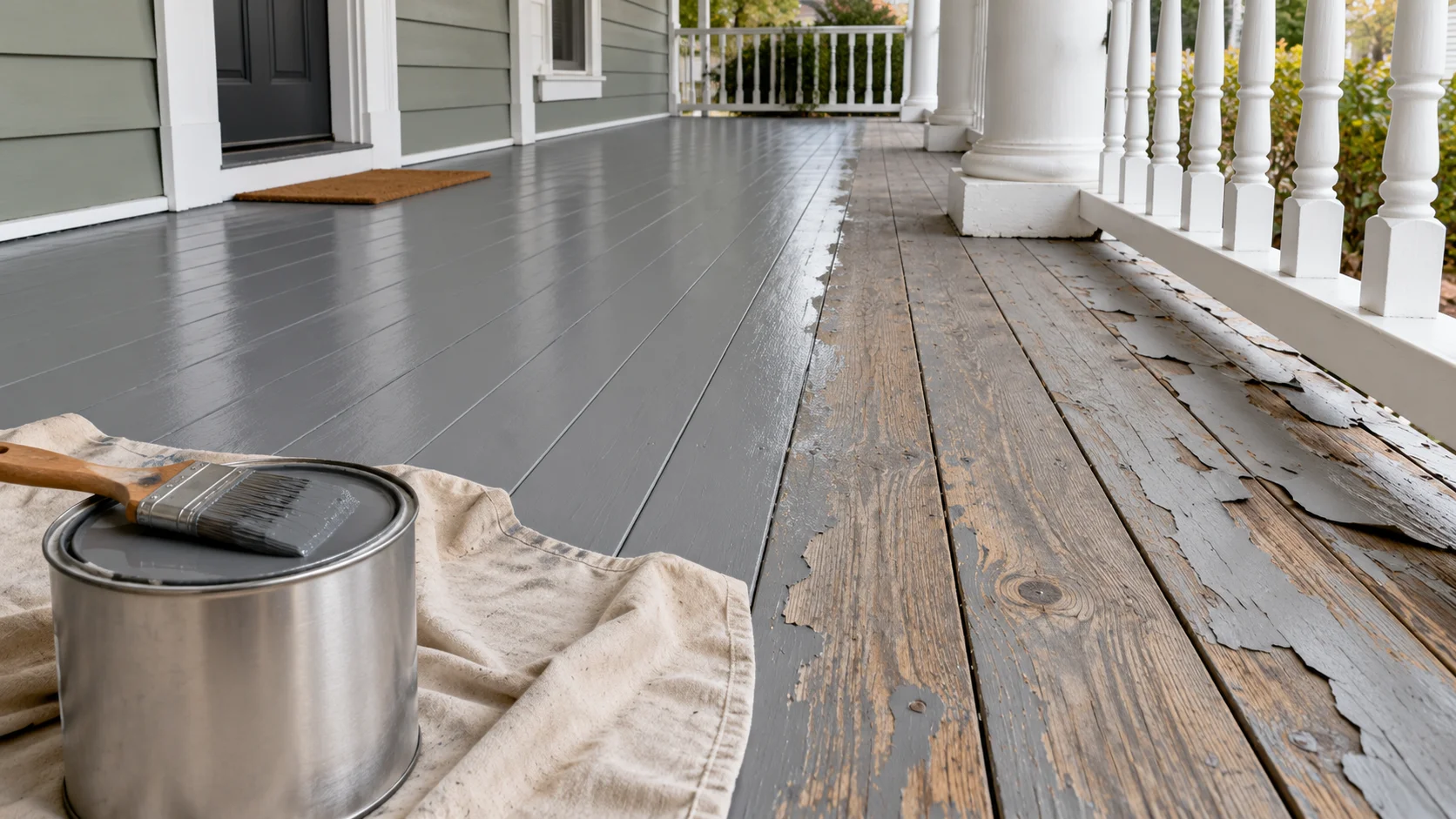
To paint a wood porch, use a porch and floor enamel on the floor and a good exterior acrylic on the railings, balusters, posts and columns, both over primed wood with cut ends and open joints sealed first. Paint is rarely why porches fail. Water is: it ponds on flat floors, soaks column bases and board ends, and gets in at open joints.
We are a family-owned painting company in Morganville and we paint front and back porches, porch floors, railings, posts, columns and porch ceilings across Monmouth, Middlesex, Ocean, Mercer, Somerset and Burlington counties and in Union, Essex, Hudson, Bergen and Passaic in North Jersey. This guide is about wood porches. If your porch floor or steps are concrete, our separate guide to painting concrete patios, porches and steps covers curing, moisture testing and stains for concrete. Most of the technical guidance below is quoted from two sources that have studied porches for decades: the National Park Service's Preservation Brief 45, "Preserving Historic Wood Porches" (Aleca Sullivan and John Leeke, 2006), and the U.S. Forest Products Laboratory's Wood Handbook chapter on finishing wood (2021). Both, and the product data sheets, were read on 20 October 2026.
The Short Answer
- Floors: a porch and floor enamel, not wall or trim paint. Prime new or bare wood first. Add an anti-slip aggregate on steps and anywhere that gets wet.
- Railings and balusters: exterior acrylic over a primer, with end grain and joints sealed. The bottom rail and the bottom of each baluster fail first.
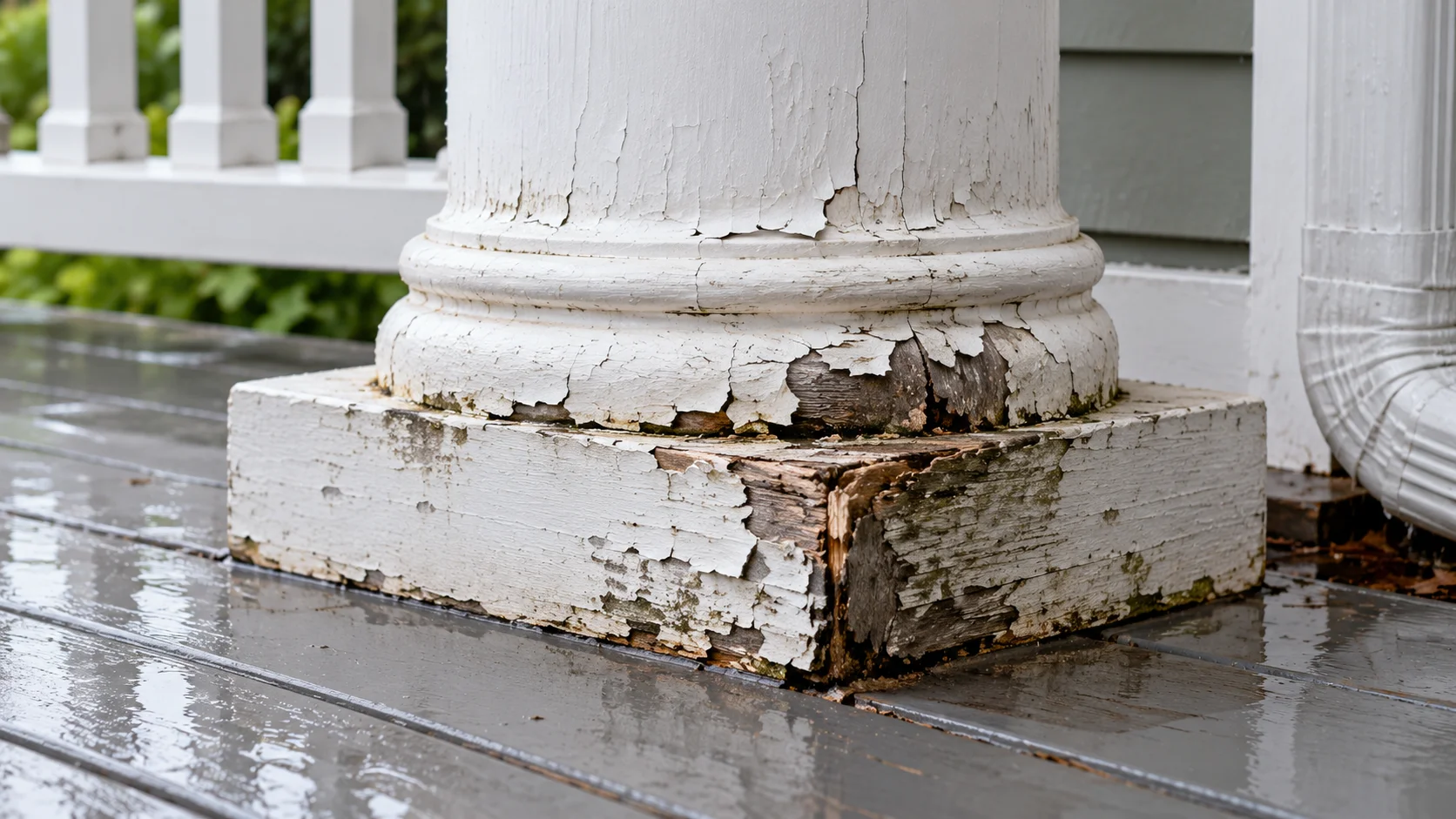
- Columns and posts: the base is where they rot. Hollow columns need air moving through them, and heavy old paint build-up traps water.
- Ceilings: wash them before painting, because rain never cleans them. Peeling in one spot usually means a leak above.
- Temperature: the floor enamel we quote below needs the air and the wood at 50°F or warmer.
- Rot and old paint: rot is carpentry and gets fixed before we paint. Old porches often carry lead paint, and NJ Painting Co. is not an EPA Lead-Safe Certified firm.
Where a Porch Fails, and Why
Brief 45 is blunt about the weak point: "The porch component most subject to decay is the flooring. Often decay starts at the exposed ends of the boards or where cracks, checks or open joints have occurred and are exposed to the weather." Columns are next: "Wood columns and posts are prone to water seeping into open joints, particularly in the base and the lower end of the shaft."
Paint is the first line of defense, and the Brief says so: "An unbroken layer of paint covering all wood surfaces is the first line of defense against moisture causing decay. Over time, even hairline paint cracks can allow water to penetrate, causing paint to peel down to bare wood." Peeling, it says, "occurs near breaks in the film, at opened joints, or where the paint has been scratched or scraped," and it singles out "inside columns that lack ventilation."
Two more conditions are common on older New Jersey porches:
- Floors that do not drain. The Brief says "a slope of ¼ inch per foot or greater, away from the house, is needed for adequate drainage," and that "inadequately sloped porch floors can result in improper drainage and promote deterioration as exhibited, for example, by cupping floorboards." Water that ponds on a porch floor will find every crack in the paint.
- Too much old paint. "If heavy paint build-up exists on columns, floors and trim, moisture can be trapped within the wood, resulting in the loss of paint adhesions and eventual wood decay." On a porch with decades of coats, another coat can make things worse.
Paint cannot fix a floor that slopes the wrong way or a gutter that dumps onto a column base. Those get fixed first, or the new paint fails in the same places as the old.
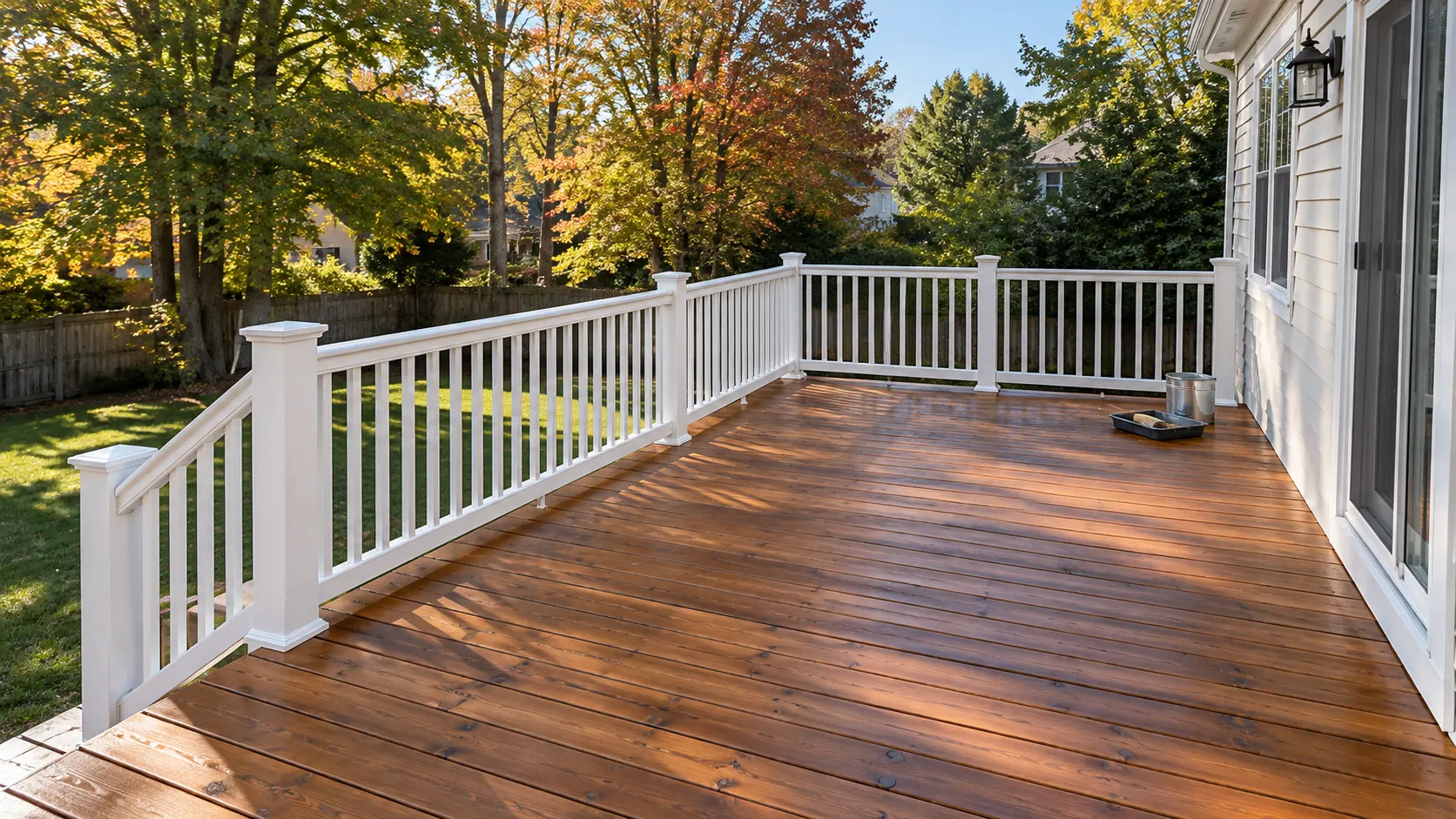
Painting a Wood Porch Floor
Paint or stain?
The Forest Products Laboratory is candid that film finishes have a hard time on horizontal wood: persistent moisture "is one reason it is so difficult to get a film-forming finish to perform on horizontal surfaces, such as decks," and "penetrating finishes often last just as long on decks, are far easier to maintain, and because they do not peel, their failures do not attract as much attention."
A covered porch is not a deck, though. A roof over it keeps off most of the rain and sun, the boards are usually tight tongue-and-groove, and a painted floor is what most older New Jersey porches were built to have. Brief 45 recommends "only top-quality exterior primers and paints," "selecting for the deck and stairs specially formulated paints." In our experience the dividing line is the roof: a covered porch floor is a paint job, and an open floor or a set of uncovered steps that get full weather are often better with a solid or semi-transparent stain. Our deck staining and sealing guide covers that side, and our deck staining service handles open decks and steps.
The product
A porch floor needs a paint made to be walked on. Benjamin Moore's Latex Floor & Patio Low Sheen Enamel data sheet describes an "epoxy-modified acrylic low sheen latex floor enamel" for "interior and exterior use on unpainted concrete (new or old) and previously finished wood or concrete floors," and lists porches by name. It comes in four standard colors, White, Light Gray, Deck Gray and Platinum Gray, and can be tinted. Sherwin-Williams makes an equivalent porch and floor enamel. Either way, the floor gets a floor product, and the railings and columns get a trim or exterior paint.
The primer depends on the wood. For new or bare "Wood and Engineered Wood Products" the Benjamin Moore system is a primer (Fresh Start High-Hiding All Purpose Primer 046) and then "1-2 coats" of the floor enamel. For cedar and redwood, which bleed tannin through paint, it specifies a stain-blocking primer instead. On a previously painted floor in fair to good condition it is self-priming, with bare spots primed.
New pressure-treated porch floors
Pressure-treated pine is common on newer porches and porch repairs, and it is often delivered soaking wet. The Forest Products Laboratory says "nothing will coat wet wood well," and that if treated lumber is "still above the saturation point when it is delivered and installed," the best you can do is "wait until the wood dries." Kiln-dried-after-treatment lumber, sold as KDAT, avoids the wait. Brief 45 adds that typical pressure-treated wood "is very susceptible to the deterioration of checks, warping and splitting, especially when left unpainted," which is a reason to finish it once it is dry rather than leave it bare for years.
Slip resistance
A painted porch floor is more slippery than bare wood, especially wet. The Benjamin Moore sheet says: "Caution: All floor coatings may become slippery when wet. Where non-skid characteristics are desired, use an appropriate anti-slip aggregate." Brief 45 says "where wood porch steps are exposed to moisture, grit added to the wet paint during application will help improve safety." We recommend an anti-slip additive in the final coat on porch steps and on any part of the floor the rain reaches, and a low sheen.
Temperature and drying
The floor enamel's limit is clear: "Do not apply when air and surface temperatures are below 50°F (10°C)." It is dry to the touch in an hour and recoatable in four at 77°F and 50% humidity, "withstands light traffic after overnight dry," and "high humidity and cool temperatures will result in longer dry, recoat and service times." On a porch that is the only way into the house, that means planning a route or a day without it.
Painting Porch Railings and Balusters
Railings look simple and take the longest, because every baluster has four faces, two ends and two joints, and every joint is a place for water to get in. The Forest Products Laboratory's handbook shows what happens when it does: a photograph of "decay and paint failure in wood railing that trapped water," with the note that "problems could have been minimized by priming all surfaces before assembly to prevent water entering the wood."
Its most striking evidence is from cedar porch railing parts removed after 25 years of service: "All the styles where end grain was primed before assembly were in perfect condition," while "all the styles without primed end grain on the bottom" were "rotten." End grain, it notes elsewhere, "is commonly 100 times more porous than the side of a piece of wood." For a porch being built or repaired, the handbook's advice is to "apply a WRP [water-repellent preservative], oil primer, or thinned enamel to all surfaces (flooring, railings, posts), especially the end grain, prior to or during construction."
On an existing railing we cannot reach the hidden end grain, so the work is in the places water gets in: the tops of the bottom rail, the joints where balusters meet the rails, and the bottoms of the posts. Loose paint is scraped and sanded back to a sound edge, bare wood is primed, open joints are sealed with a paintable sealant, and two finish coats go on, brushed rather than sprayed so the paint is worked into the joints. A top rail that is flat on top holds water; one that is shaped to shed it lasts longer, but reshaping it is carpentry.
Metal railings
Iron and steel porch railings are painted, not stained, and they need a metal primer on any bare or rusted spot. Benjamin Moore's Aura Exterior data sheet, for example, lists a separate primer for "Ferrous Metal (Steel and Iron)." The key step is getting the loose rust off before priming. We paint existing iron railings; we do not fabricate or weld them.
Vinyl and PVC railings
Vinyl and cellular PVC railings and trim do not need paint to protect them. If you want to change their color, the dark color limits apply. AZEK's painting guidance requires a 100% acrylic latex with an LRV "above 55" for lighter colors and "exterior 100% acrylic latex with solar reflective pigments" for darker ones, because the wrong paint "may cause the product to overheat, leading to undesirable product defects such as warping, oil canning, or buckling."
Painting Porch Columns and Posts
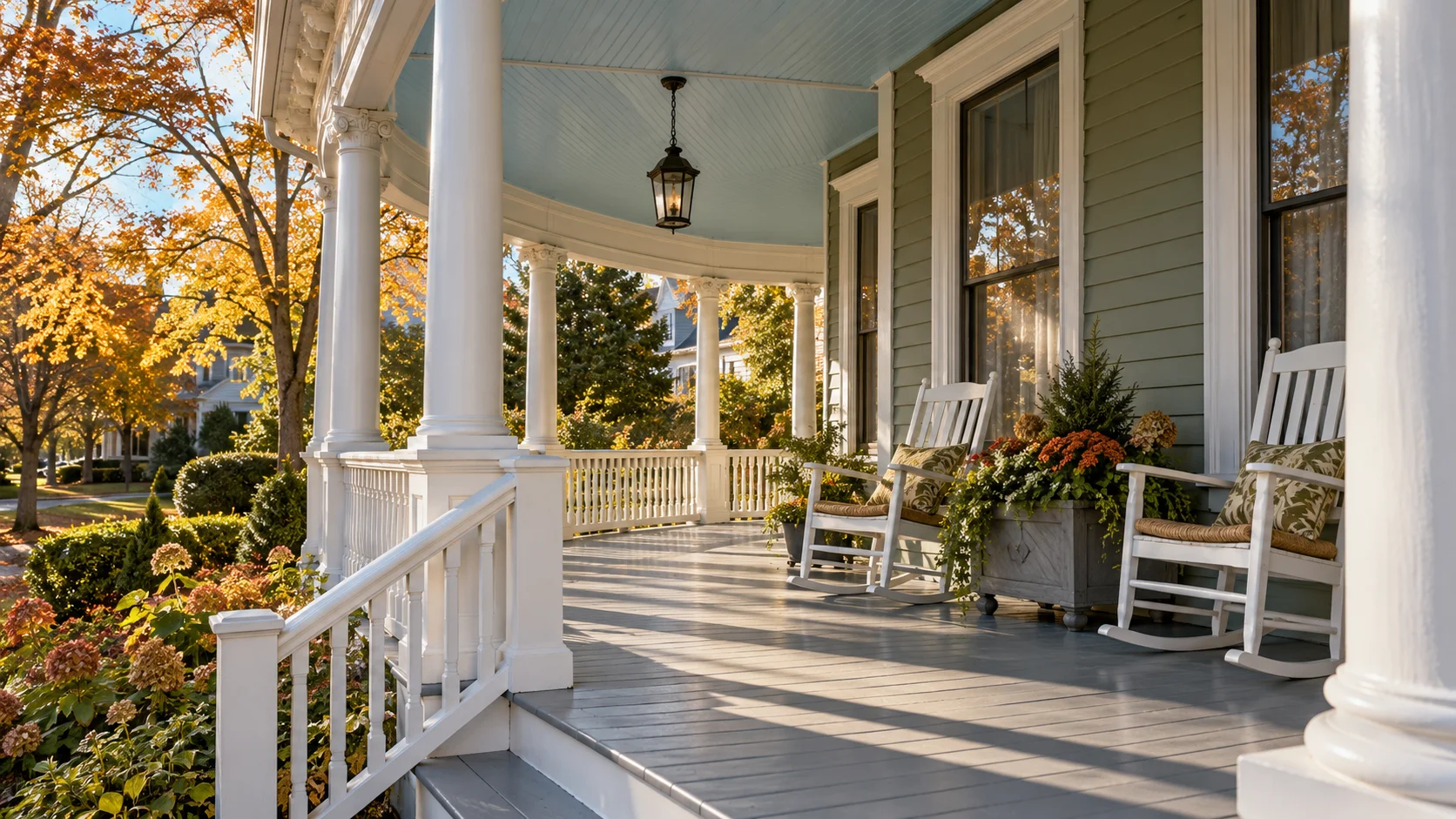
Many older porch columns are hollow. Brief 45 explains that "large round columns usually are made of wood staves similar to the way barrels are constructed," and that "column plinths and bases tend to deteriorate because of their exposed location on the outer edge of a porch." Water gets in from both ends: "Leaking gutters can result in water draining into the entablature and down into hollow columns, while clogged or capped gutters can allow water to pour down and splash back onto the column bases."
For painting, that means:
- Look at the base first. Push a screwdriver gently into the bottom few inches of the shaft and the base. If it goes in, that is rot, and it is a carpentry repair before it is a paint job. Brief 45 notes that "column repairs usually are undertaken by an experienced carpenter, since it may involve structural support of the roof above."
- Do not seal the column shut. A hollow column needs air moving through it. Paint over a vent, or caulk a base solid all the way round, and the moisture inside has nowhere to go.
- Watch the paint thickness. On a column with many layers of old paint, the right answer is sometimes to take the loose and thick paint back before adding more. On a pre-1978 house that is regulated work (see below).
- Fiberglass and PVC columns follow the manufacturer's paint rules, which for PVC usually mean the same LRV limits as vinyl.
Columns are usually painted the trim color, but there is no rule. Match the railings and the columns to each other and to the trim, and let the floor be its own color.
Porch Ceilings
Porch ceilings never get rained on, so they never get rinsed, and the dirt and pollen that build up on them stop new paint from sticking. Benjamin Moore's Aura Exterior data sheet says "un-weathered areas such as eaves, porch ceilings, overhangs and protected wall areas should be washed with an appropriate cleaner and rinsed" before painting. Brief 45 adds a diagnostic: "Peeling paint on ceiling boards in a specific location is a sign of a possible roof leak." We will tell you if the pattern of peeling points to the roof, because painting over it will not last.
What New Jersey Does to a Porch
New Jersey porches go through freeze and thaw all winter, and the season runs differently depending on where you live. Rutgers' Office of the New Jersey State Climatologist puts the average number of freeze-free days at 163 in the northern highlands, 179 in the central and southern interior and 217 along the seacoast. Water that gets into a crack in the paint in November freezes and thaws in it for months.
Salt makes it worse, and not only for concrete. Brief 45 says "salt (sodium chloride) is not recommended for ice removal on older porches as it can promote corrosion and failure of nails and other fasteners," and that "if any de-icing salt is used, be sure to scrub and rinse off the porch deck in the spring." It also recommends plastic or rubber-edged snow shovels, noting that "paint in good condition helps ice to release more easily."
Two more practical points from the same Brief: "Rubber mats, rugs or indoor/outdoor carpeting can trap moisture and condensation on their underneath side and should not be used on a wooden porch floor," and flower pots should sit on trivets "an inch or more off the wooden deck" and be moved around. On shore houses in Monmouth and Ocean counties, wind-driven rain and salt air are reasons to rinse the porch down each spring as well.
How Often to Repaint a Porch
Brief 45 recommends that "spot painting and resealing of open joints should be undertaken at least every other year," that "heavily used stair treads may require more frequent paint touchup," and calls spot painting and caulking "where needed every year or two" a cost-effective way to extend the life of existing porch paint. In our experience a porch floor needs attention well before the rest of the house, because it is walked on, and the steps go first. Our guide to how often to paint a house covers the wider schedule.
When paint does peel, the Brief's sequence is simple: "inspect to ensure it is not signaling deeper problems, such as decay. With sound wood, scrape off the loose paint, sand, prime, and repaint the area." Our guide to why paint peels explains the moisture causes in more detail.
Old Porches and the Lead Paint Rule
Many New Jersey front porches were built before 1978, and the floor, steps, railings and columns are exactly the surfaces that get sanded and scraped. The EPA's Renovation, Repair and Painting Program "requires that anyone paid to perform work that disturbs painted surfaces in homes, childcare facilities and preschools built before 1978 be certified." The minor-work exemption at 40 CFR 745.83 covers "20 square feet or less of painted surface for exterior activities," which is a few porch floorboards. The floor enamel data sheet carries the warning too: "If you scrape, sand, or remove old paint, you may release lead dust. LEAD IS TOXIC."
NJ Painting Co. is not an EPA Lead-Safe Certified firm. If your porch is on a pre-1978 house and the old paint has to be sanded or scraped, ask every contractor who bids it for their RRP certification and certificate number, unless the surfaces have been tested and found lead-free in writing. We will either scope the job so the existing paint is not disturbed, or tell you it needs a certified firm. Our guide to lead paint in older homes explains the rule, and our guide to painting historic homes covers porches in historic districts.
What We Do and What We Do Not
We wash, scrape, sand, prime, seal open joints and paint wood porch floors, steps, railings, balusters, posts, columns, porch ceilings and the trim around them, and paint existing metal railings. On concrete porch floors and steps we paint and stain the concrete, as covered in our concrete guide. Indoor stairs, spindles and handrails are covered in our guide to painting stairs and banisters.
We do not do carpentry or rot repair. That means we do not replace floorboards, rebuild column bases, replace balusters or rebuild steps. At the estimate we probe the places porches rot and tell you exactly where we find soft wood, so a carpenter can repair it before we paint. We also do not fix the slope of a floor or the gutters that are soaking a column, but we will tell you if they are why the paint keeps failing.
How We Paint a Wood Porch
- Inspect. Floor slope, board ends, column bases, rail joints, ceiling stains and the gutters above. We point out anything that needs a carpenter or a roofer first.
- Wash. Floor, rails, columns and especially the ceiling, then let the wood dry.
- Scrape and sand loose paint back to a sound edge, and feather the edges so they do not show through.
- Prime every piece of bare wood, end grain first, with a stain-blocking primer on cedar or redwood.
- Seal open joints on the railings, trim and columns with a paintable sealant, leaving column vents open.
- Paint top down: ceiling, then columns and railings, then the floor last, in floor enamel with anti-slip additive on the steps and wet areas.
- Keep off it until the floor has dried overnight, and longer before furniture and planters go back.
Talk to Us About Your Porch
NJ Painting Co. is a family-owned, fully insured painting company at 36 Church Rd, Morganville, NJ 07751, painting New Jersey homes for more than 20 years with Benjamin Moore and Sherwin-Williams products. Porches, railings and columns are part of our exterior painting service. We work across Monmouth (see exterior painting in Monmouth County), Ocean (see exterior painting in Ocean County), Middlesex, Mercer, Somerset and Burlington counties and in Union, Essex, Hudson, Bergen and Passaic. The full list is on our service areas page.
Estimates are free, and on a porch they include a probe of the board ends and column bases, not just a measurement. If the front door and shutters are due at the same time, see our guide to painting front doors and shutters. Call (732) 239-0932 or request a free estimate.
Frequently Asked Questions
What is the best paint for a wood porch floor?
A porch and floor enamel made for foot traffic, such as Benjamin Moore's Latex Floor & Patio Low Sheen Enamel or Sherwin-Williams' porch and floor enamel, over a primer on new or bare wood. Wall paint and trim paint are not made to be walked on. Add an anti-slip aggregate where the floor gets wet.
Should I paint or stain my porch floor?
For a covered porch with tight tongue-and-groove boards, paint is the traditional and usually the better choice. For an uncovered floor or steps in full weather, a stain often lasts as long and is easier to maintain, because penetrating finishes do not peel. The Forest Products Laboratory notes that film finishes struggle on horizontal surfaces exposed to the weather.
How do you paint porch railings and spindles?
Wash them, scrape and sand loose paint, prime bare wood with special attention to end grain and the bottom rail, seal open joints with a paintable sealant, and brush on two coats of exterior acrylic so the paint is worked into the joints. Spraying is quicker but does not fill the joints where water gets in.
Why is the paint peeling at the bottom of my porch columns?
Because that is where the water is. The National Park Service notes that column bases deteriorate because of their exposed position, and that leaking or clogged gutters send water into hollow columns or splash it onto the bases. Check the base for soft wood, which needs a carpenter, and check the gutter above, before repainting.
How long after installing pressure-treated wood can I paint a porch?
When it is dry, not on a set number of days. The Forest Products Laboratory says "nothing will coat wet wood well" and that soaking-wet treated lumber should be left to dry before finishing. Kiln-dried-after-treatment (KDAT) lumber can be finished much sooner.
Is a painted porch floor slippery?
It can be when wet. Benjamin Moore's floor enamel data sheet says all floor coatings "may become slippery when wet" and recommends an anti-slip aggregate where non-skid characteristics are wanted. We recommend one on steps and anywhere the rain reaches.
Can you paint a porch in the fall in New Jersey?
Yes, while the air and the wood stay at 50°F or more for the floor enamel, and the porch can dry before evening dew. Cool, damp weather slows drying, so fall porch work needs longer between coats and before the floor is walked on.
Do you repair rotted porch boards and columns?
No. Rot repair and carpentry are not services we offer. We find and point out soft wood at the estimate, a carpenter repairs it, and we paint after.
Do you paint porches, railings and columns in New Jersey?
Yes. NJ Painting Co. washes, scrapes, primes and paints wood porch floors, steps, railings, balusters, posts, columns and porch ceilings, paints existing iron railings, and paints and stains concrete porch floors and steps, as part of our exterior painting service. Estimates are free and include a probe of the board ends and column bases.
About the author
Written by the NJ Painting Co. team
NJ Painting Co. is a family-owned painting contractor based in Monmouth County, in business since 2004. We are licensed and fully insured, work with Benjamin Moore and Sherwin-Williams paints, and back our work with a 2-year workmanship warranty. We serve Monmouth, Middlesex, Ocean, Mercer, Somerset and Burlington counties, plus Union, Essex, Hudson, Bergen and Passaic in North Jersey.