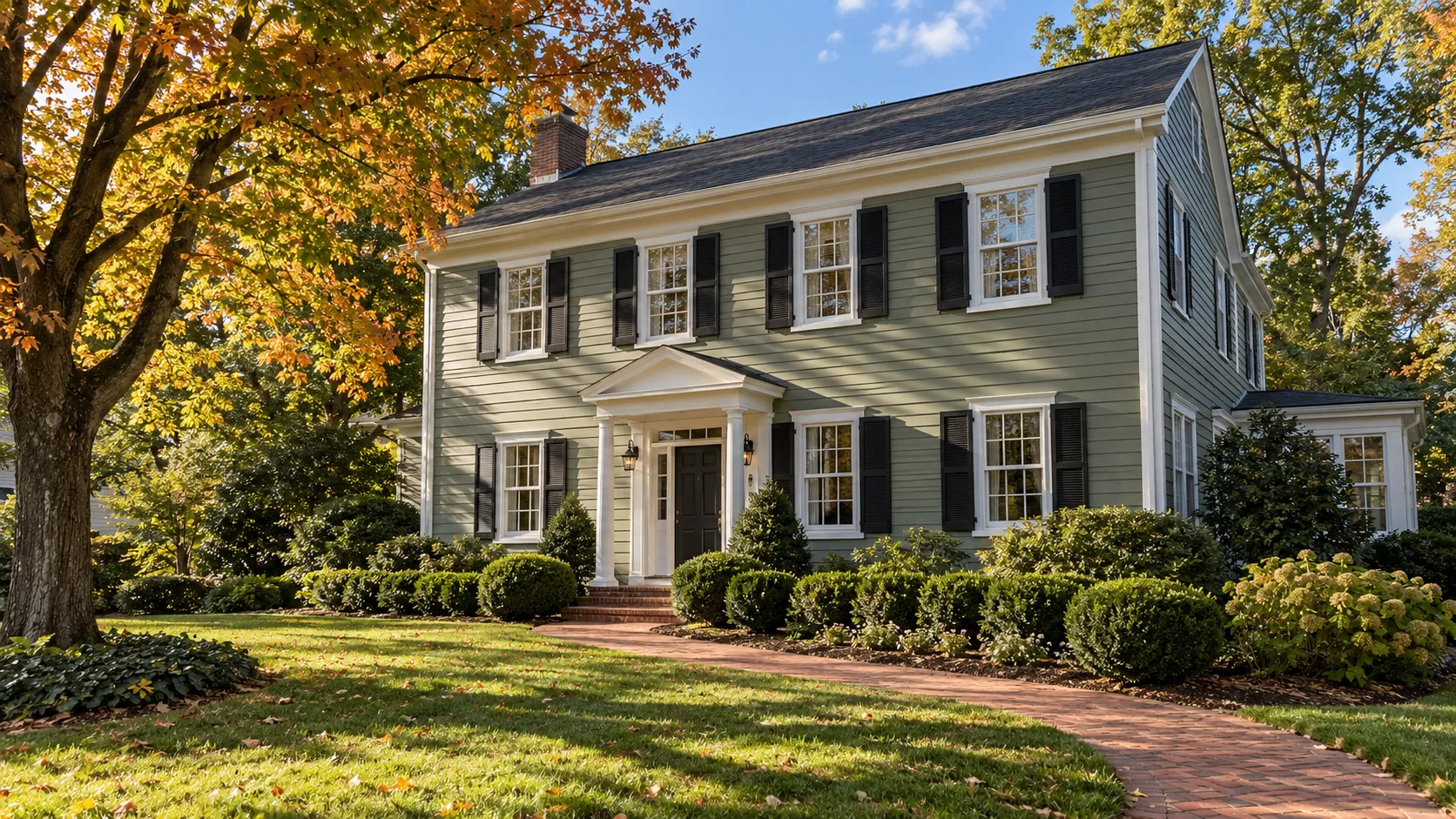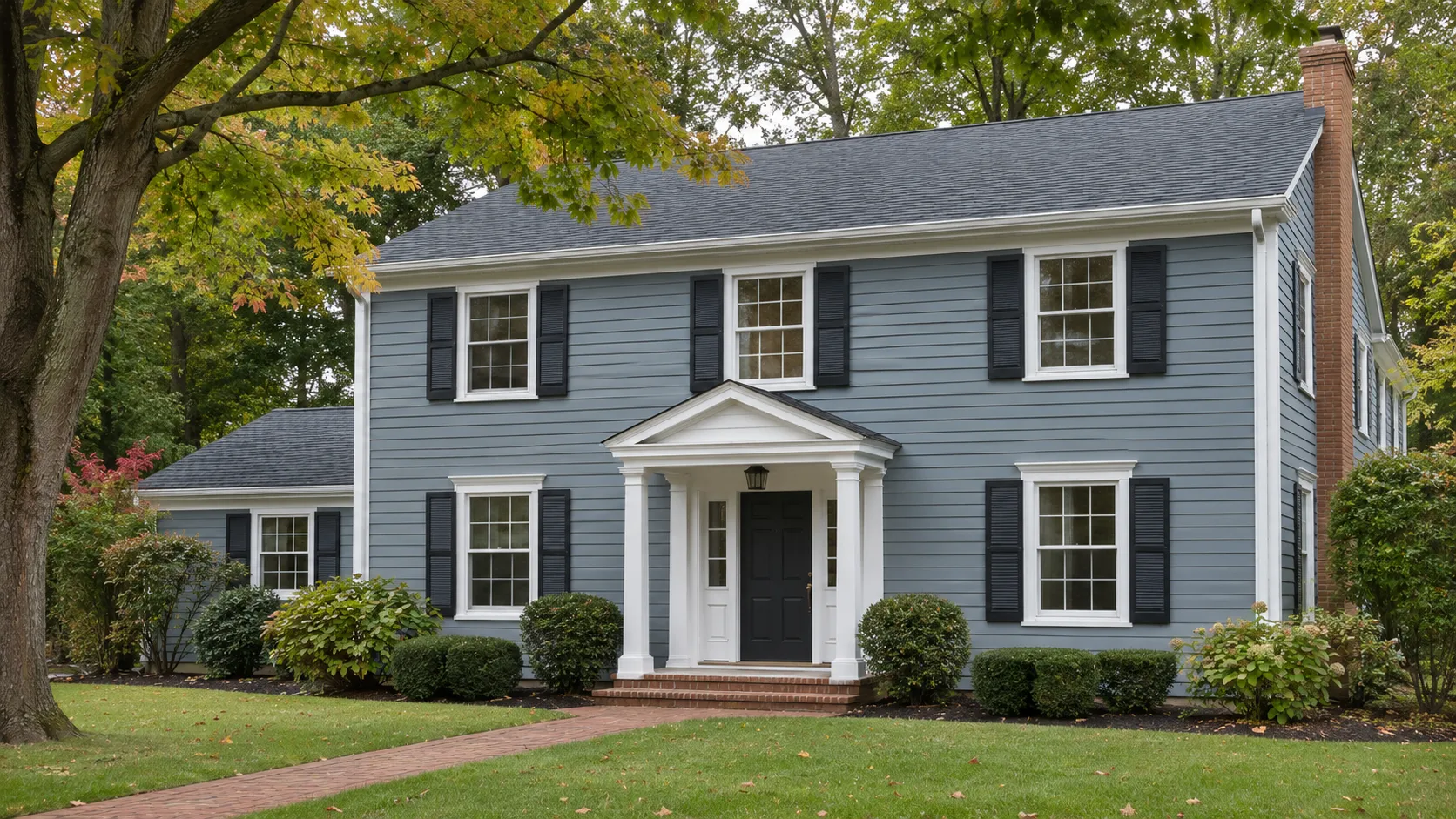
The best exterior paint for most New Jersey houses is a premium 100% acrylic house paint applied at its full film thickness. On the two brands we use, that means Benjamin Moore Aura Exterior or Sherwin-Williams Emerald Exterior at the top, with Benjamin Moore Regal Select Exterior and Sherwin-Williams Duration Exterior close behind. Which one is best for your house depends on what the walls are made of, how hard the sun and weather hit them, and the color you want.
The "best exterior house paint" lists on the first page of search results mostly rank brands against each other, often with test results nobody can check. The paint makers publish something better: a technical data sheet for every product, listing the binder, the volume solids, how thick each coat dries, the lowest temperature it can go on at, and which primer each surface needs. This guide reads them side by side, surface by surface.
We are a family-owned painting company in Morganville and have painted New Jersey homes across Monmouth, Middlesex, Ocean, Mercer, Somerset and Burlington counties, plus Union, Essex, Hudson, Bergen and Passaic in North Jersey, for more than 20 years, using Benjamin Moore and Sherwin-Williams products. "Which paint should we use?" is one of the first questions at every exterior estimate, and this is the long version of our answer.
Every figure below comes from a document we fetched and read on 15 November 2026: the Benjamin Moore and Sherwin-Williams technical data sheets, the U.S. Forest Service's Forest Products Laboratory research on house paint, the Master Painters Institute's approved-product lists, the Brick Industry Association's guidance on painting brick, New Jersey's VOC rule for architectural coatings, the Rutgers state climatologist and the EPA. We publish no Behr figures, because behr.com cannot be read by our tools, and that says nothing about the paint. We do not quote Consumer Reports, because its results sit behind a membership wall we did not get past. There are no prices here; cost questions go to our cost guide. Where something is our own practice rather than a published figure, we say so.
The Short Answer
- Buy 100% acrylic. The Forest Products Laboratory's Wood Handbook says "acrylics are especially resistant to weathering." Every line in our comparison lists an acrylic binder, and all but one say 100% acrylic. The weather resistance of the binder is the reason, but the real test of a good house paint is durability on your wall, not a claim on the can.
- Compare film build, not coverage. A coat of Aura Exterior Low Lustre dries 2.1 to 2.9 mils thick. A coat of A-100 Exterior Satin dries 1.3 mils. The thinner coat covers more square feet per gallon because there is less paint on each square foot.
- Match the paint to the surface. Cedar and redwood need a stain-blocking primer under almost any of these paints. Vinyl needs a vinyl-safe color. Fiber cement and new masonry need a primer that tolerates alkali. Trim usually wants a harder, glossier finish than the siding.
- The premium lines cluster together. Aura and Emerald sit at the top of each brand's range, Regal Select and Duration just below, SuperPaint, ben and A-100 below that. The step between neighbouring tiers is smaller than the step between good and bad prep.
- Low lustre or satin is the usual siding sheen. Flat suits rough shingles and stucco; soft gloss and semi-gloss suit trim and doors.
- The 35°F label is a floor, not a target. All seven paints in the table can go on at 35°F, but every sheet then stretches the recoat time, and the research lab that tests paint outdoors still says it does not know whether cold-weather paint lasts as well.
- Nobody has published an independent ranking you can read for free. Consumer Reports tests exterior paint but keeps its results for members. Review-site lists, many of them affiliate pages, describe their own field test panels that nobody else can check. The Master Painters Institute lists products that pass its standards, which is pass or fail, not a ranking.
- For the money question, see the cost guide. In our experience the paint and other materials are a smaller share of an exterior job than the labor, and the cheapest gallon is rarely the cheapest job.
What Makes an Exterior Paint Good?
A good exterior paint is a high-solids acrylic that goes on thick, stays flexible as the siding moves, lets water vapor out, resists mildew, sheds dirt and holds its color in the sun. Each of those shows up on a technical data sheet.
The binder: why 100% acrylic matters
The binder is the resin that glues the pigment into a film and sticks it to the house. On exterior paint the choice has largely been made for you: the oil-based house paints most people remember are now rare. The Wood Handbook, the Forest Products Laboratory's reference on finishing wood, says that before 1970 most paints were oil based, "but now these are rare," and that "most research by paint companies since 1980 has been devoted to waterborne latex." It names the two resins you will find in wood finishes, "acrylics and vinyl acrylics," and says "acrylics are especially resistant to weathering."
That is why 100% acrylic is the phrase to look for. Aura Exterior lists "Proprietary 100% Acrylic," Regal Select Exterior "100% Acrylic Latex," ben "100% Acrylic," and Emerald, SuperPaint and A-100 all list "100% Acrylic" as their vehicle type. Duration Exterior lists "Acrylic," without the percentage, and describes its own "PermaLast technology." Acrylic also keeps its looks: the Wood Handbook says modern acrylic-based latex finishes "maintain gloss much longer" than the old oil-alkyd paints did, which is the gloss retention a paint maker is advertising when it uses that phrase.
Volume solids and film build
This is the number most people skip and the one that matters most. Paint is part solid (binder and pigment) and part liquid (mostly water). The liquid evaporates; the solids stay on the wall. Volume solids is the share of the can that stays. Aura Exterior Low Lustre is 45.5 percent solids by volume, Regal Select 43 percent, Emerald 39, Duration 38, SuperPaint 36, A-100 33 and ben 33.3.
Each sheet then turns that into a film thickness. Aura's sheet says a coat goes on 4.6 to 6.4 mils wet and dries to 2.1 to 2.9 mils. A mil is a thousandth of an inch. A-100's sheet says its coat goes on 4 mils wet and dries to 1.3. The Wood Handbook says that on smooth wood "the best service life comes from a primer and two topcoats to achieve a 0.10- to 0.13-mm (4 to 5-mil) dry film thickness," and that "many three-coat paint systems in tests at FPL have lasted 30 years." So the dry film per coat tells you how many coats it takes to get into that range.
Why the coverage figure on the can misleads
Here is the arithmetic, and it is worth doing once. A US gallon is 231 cubic inches. Spread one gallon of pure solids 1 mil thick (0.001 inch) and it covers 231,000 square inches, which is about 1,604 square feet. Multiply by the volume solids and you get the film-times-area a gallon can deliver:
- Aura Exterior Low Lustre, 45.5 percent solids: about 730 square-foot-mils per gallon. At 300 square feet a gallon, that is about 2.4 mils dry, which is exactly inside the 2.1 to 2.9 the sheet prints.
- SuperPaint Exterior Satin, 36 percent: about 577. At 375 square feet a gallon, about 1.5 mils, matching its sheet.
- A-100 Exterior Satin, 33 percent: about 529. At 375 square feet a gallon, about 1.4 mils, against the 1.3 its sheet prints.
So when a cheaper paint claims 350 to 400 square feet a gallon and a premium one claims 250 to 350, the cheaper one is not more efficient. It is laying down less paint. If you stretch any paint past its printed coverage, you get a thinner coat than the one the sheet describes.
Flexibility and breathability
Siding swells and shrinks with every rain and every freeze-thaw swing, so the film has to stretch. Benjamin Moore publishes elongation: 151 percent for Aura Exterior Low Lustre and 167 percent for Regal Select Exterior, and a pass on the ASTM D522 bend test ("no cracking") for both. Sherwin-Williams does not print an elongation figure on these sheets.
A film also has to let water vapor out of the wall behind it, or the vapor pushes the paint off. Aura's sheet calls it a "breathable coating less prone to blistering." The figure is water vapor permeance, in perms: 31 for Aura Low Lustre, 38.36 for Regal Select, 42 for ben. Sherwin-Williams prints WVP perms of 19.50 for Emerald, 18.66 for Duration, 19.76 for SuperPaint and 25.84 for A-100. The Brick Industry Association classes anything over 10 perms as "vapor permeable," so all seven clear that bar, the same one it applies to paint on brick. Do not rank them against each other on this number: Benjamin Moore names its test method (ASTM D1653) and Sherwin-Williams does not, and the BIA says the test standards "are not interchangeable" and that the wet-cup method "can produce higher" readings than the dry-cup one.
Mildew and dirt resistance
New Jersey's humid summers make mildew the most common reason a sound paint job looks old early. The Sherwin-Williams sheets say Emerald, Duration and A-100 contain "agents which inhibit the growth of mildew on the surface of this coating film." The Benjamin Moore sheets report a pass, "no growth," on the ASTM D3273 and D3274 mildew tests for Aura, Regal Select and ben. Those are the makers' own reported results, not lab tested by anyone else. The Wood Handbook adds a caution worth knowing: "today's coatings typically contain less fungicide than in the past," and painting over old oil-based paint is a case where it suggests asking your supplier for extra.
Dirt is the other half. A soft film holds dirt. The Wood Handbook explains why primers and topcoats are different products: a primer is "designed to be sticky and flexible," but "a sticky, flexible topcoat would hold dirt and scratch easily," so topcoats are made "hard, easily cleanable." Aura lists "dirt pick-up resistant," Emerald "resistance to blistering, peeling, and dirt pick-up," and SuperPaint "resistance to early dirt pick up." None of these sheets is about fiber cement or wood in particular; dirt and mildew show up on every surface.
How Do the Premium Exterior Lines Compare on Their Data Sheets?
On paper, Aura Exterior has the highest solids and the thickest coat of the seven, Regal Select and Emerald follow, Duration and SuperPaint sit in the middle, and ben and A-100 lay down the thinnest film. The table compares the low lustre or satin version of each line, the sheens most often used on siding.
| Product | Binder | Volume solids | Dry film per coat | Coverage per gallon | Lowest application temperature | Vapor permeance | MPI listing |
|---|---|---|---|---|---|---|---|
| Benjamin Moore Aura Exterior Low Lustre N634 | Proprietary 100% acrylic | 45.5 ± 2% | 2.1–2.9 mils | 250–350 sq ft | 35°F | 31 perms | #315 |
| Benjamin Moore Regal Select Exterior High Build Low Lustre N401 | 100% acrylic latex | 43.0% | 2.3 mils | 250–350 sq ft | 35°F (feature list says 40°F) | 38.36 perms | #15, #315 |
| Benjamin Moore ben Exterior Low Lustre 542 | 100% acrylic | 33.3% | 1.3 mils | 350–475 sq ft | 35°F | 42 perms | Sheet claims #15 |
| Sherwin-Williams Emerald Exterior Satin K48 | 100% acrylic | 39 ± 2% | 2.1–2.5 mils | 250–300 sq ft | 35°F | 19.50 WVP perms | #15 |
| Sherwin-Williams Duration Exterior Satin K33 | Acrylic | 38 ± 2% | 2.0–2.4 mils | 250–300 sq ft | 35°F | 18.66 WVP perms | #15, #315 |
| Sherwin-Williams SuperPaint Exterior Satin A89 | 100% acrylic | 36 ± 2% | 1.5 mils | 350–400 sq ft | 35°F | 19.76 WVP perms | #15, #315 |
| Sherwin-Williams A-100 Exterior Satin A82 | 100% acrylic | 33 ± 2% | 1.3 mils | 350–400 sq ft | 35°F | 25.84 WVP perms | #15 |
Film build is the real separator. In our experience it matters most on a coastal house. One coat of Aura or Regal Select puts down roughly as much paint as two coats of A-100 or ben. On a repaint where the old paint is sound and the color is not changing, that difference decides whether one coat is enough. Aura's sheet says "previously painted surfaces can be finished with 1 or 2 coats," and Emerald's sheet says "1 coat for repaint." In our experience the coat count is where most of the film build comes from, which is why we apply two finish coats on our exterior jobs regardless of the line.
The makers describe their own lines in tiers. Sherwin-Williams calls Emerald Exterior its "'best-In-Class' exterior architectural house paint" and says it "uses a patented cross-linking 100% acrylic technology." It describes Duration as using "PermaLast technology to provide you with the most durable and longest lasting coating available," and Duration's sheet lists "Self-priming One Coat Protection," a one-coat claim that applies to repaints. Benjamin Moore calls Aura "a super premium quality, 100% acrylic exterior low lustre finish" and lists "excellent fade resistance and gloss retention," credited to its Color Lock technology. Regal Select is "a premium quality, high build, self priming, 100% acrylic latex formula." These are the makers' words, not test results.
Color holding is claimed, not measured. Aura's sheet promises "rich colors that resist fading," A-100's sell sheet says it resists "frost, fading, chalking and dirt" with "outstanding color retention," and Regal Select lists "excellent color retention." None of the sheets gives a number. The Wood Handbook is blunter: top-quality latex topcoats "have excellent resistance to weathering," but "dark colors may fade within a few years," and it advises you to "check with the paint manufacturer to ensure that the colors will last." A deep, saturated red or navy on a south wall is the hardest test any of these paints faces.
All seven are well inside New Jersey's VOC limit. Every sheet lists under 50 grams per litre, against a state limit of 100 for nonflat paint made since 18 August 2026, so these low-VOC paints give no reason to pick one over another.
The labels on review sites do not match the sheets. Some guides call Regal Select a "mid-range alkyd-acrylic." Its sheet says "100% Acrylic Latex." Some say Duration's standard version needs 50°F. Its sheet says "low temperature application down to 35° F." Read the sheet before trusting a summary.
How we would match them, which is our practical view rather than a published result:
- Deep colors, hard sun, or a house you want to leave alone the longest: Aura Exterior or Emerald Exterior. Highest solids, thickest coat, and both makers' top lines.
- A typical repaint in a light or mid color: Regal Select Exterior or Duration Exterior. Regal Select builds 2.3 mils a coat; Duration is sold on "excellent durability and hiding."
- A sound surface, a light color and a tighter budget: SuperPaint. It is 100% acrylic and MPI-listed, but plan on two full coats to get the film.
- Outbuildings, sheds or a short horizon: A-100 or ben. Both are 100% acrylic and lay down about half Aura's film per coat, so they need two coats and good prep.
For the warranties each maker prints, and how the two brands compare on price and color range, see our Benjamin Moore vs Sherwin-Williams comparison.
What Is the Best Exterior Paint for Wood Siding?
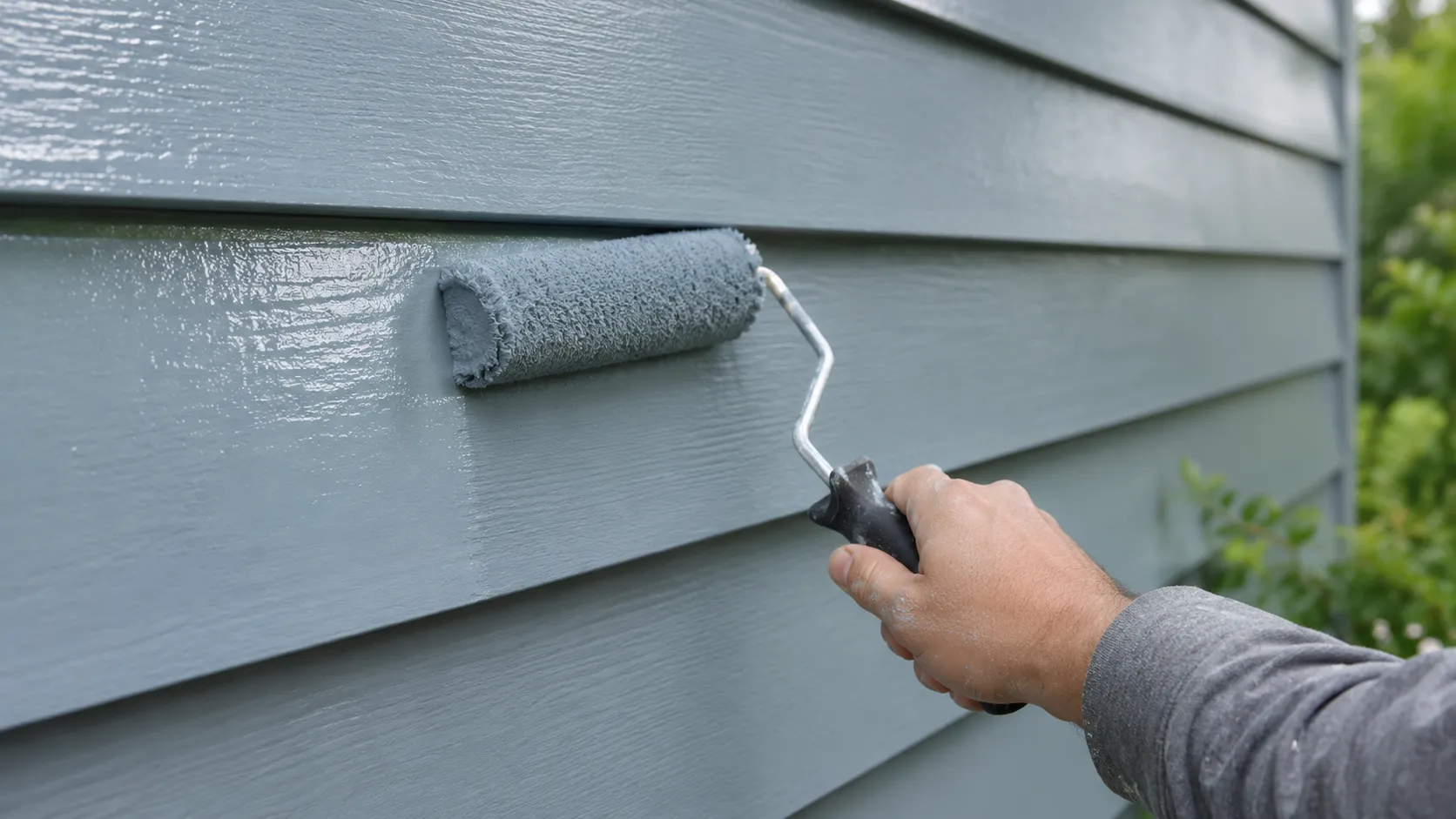
The best exterior paint for wood siding is a premium 100% acrylic topcoat over a primer that suits the wood: a stain-blocking primer on cedar, redwood and knotty pine, and either a quality acrylic primer or the paint's own first coat on other woods. Two topcoats over the primer is the system the Forest Products Laboratory tests.
Painted clapboard and other non-bleeding woods
Most painted clapboard in New Jersey is pine, spruce or fir, or old cedar that was primed long ago. On these, Aura Exterior and Regal Select Exterior call themselves self-priming. Regal Select's sheet gives the system as "Primer: No primer needed. Finish: 2 coats." Emerald's sheet says it "can be used as a self-priming coating on many bare surfaces," where "the first coat of Emerald acts like a coat of primer and the second coat provides the final appearance and performance." That is what self-priming means on these sheets: the first coat does the priming, so you still need two coats on bare wood.
The Wood Handbook prefers a separate primer. It says "a primer is strongly recommended" under paint, that latex primers "are more flexible and stay more flexible; thus, they are less likely to crack as they age," and that a uniform primer coat "of sufficient thickness distributes wood swelling stresses and thus helps prevent premature paint failure." It is also skeptical of the shortcut: though "paint and primer in one" can be bought, "the properties are not optimal for either the primer or the topcoat."
Cedar, redwood and knots: the tannin problem
Cedar and redwood carry water-soluble extractives that bleed brown through light paint. The Wood Handbook says extractive bleed "is especially common over knots and in highly colored woods such as cedar and redwood," and gives the rule that matters: "another coat of the same finish will not stop the problem; apply a stain-blocking primer, then another topcoat."
The data sheets agree, in slightly different ways:
- Aura and Regal Select call for Fresh Start Exterior Deck & Siding Primer 094 or Fresh Start High-Hiding All Purpose Primer 046 on "bleeding woods (redwood, cedar, etc.)."
- Emerald and Duration say the first coat over bare cedar "may show some staining, but it will be trapped in the first coat," and that if tannin staining persists you should "spot prime severe areas with 1 coat of Exterior Oil-Based Wood Primer."
- SuperPaint and A-100 call for a coat of Exterior Oil-Based Wood Primer on cedar and redwood from the start.
The Forest Products Laboratory's paper Why House Paint Fails says "oil-based primers usually block extractive stains better than do latex primers and may be a better choice on redwood and cedar," while latex primers give "a more flexible paint film with better durability," and that "if allowed to fully cure for 24 to 48 hours," extractives that bleed into a latex stain-blocking primer "do not bleed into topcoats." Benjamin Moore's 046 sheet adds that it is "not recommended for sealing knots or over pine sap," so knots in pine trim still want an oil primer spot coat. Watch the VOC rule on oil primers, covered in the primer section below.
Cedar shingles and shakes are their own subject, including whether to paint them at all, and our guide to painting wood siding and cedar shakes covers it in depth.
Hardboard siding
Hardboard (pressed wood fibre, common on 1970s to 1990s houses) is not fiber cement, even when a data sheet's heading makes it sound like it. Emerald's sheet says that "because of the potential for wax bleeding out of the substrate," composition board and hardboard get "1 coat of Exterior Oil-Based Wood Primer and then topcoat." The A-100 sheet gives the same instruction under the heading "Wood Composition Board - Hardiboard," which, from the wax-bleed note, reads as wood-based hardboard rather than Hardie fiber cement. Benjamin Moore lists Aura as self-priming on "hardboard siding, bare or factory primed."
Why priming fast matters on new wood
The most striking figure in the Forest Products Laboratory's work is not about paint brands at all. "Tests of wood painted, at least primed, before any exposure to sunlight show that the surface is not in need of repainting for at least 30 years. Duplicates exposed to sunlight facing south for 1 week prior to priming required repainting at 13 years. Wood exposed to 2 weeks of sun prior to priming required repainting at 10 years." New boards on a repair should be primed the day they go up, and old wood that has gone grey needs sanding back to sound fibre before it is primed.
For the same question on fences, where stain often beats paint, see paint or stain a wood fence.
What Is the Best Paint for Hardie Board and Fiber Cement?
The best paint for Hardie board and other fiber cement siding is a premium 100% acrylic exterior paint, with an alkali-resistant masonry primer on any new or bare board whose surface is still strongly alkaline. All seven lines in our table list cement composition siding or fiber cement among their surfaces.
The primer instructions differ, and the difference is the alkaline surface of fresh cement. Sherwin-Williams' sheets say that on cement composition siding, "if the surface is new, test it for pH, if the pH is higher than 9, prime with Loxon Concrete & Masonry Primer," and that "after power washing, previously painted masonry may still have a powdery surface that should be sealed with Loxon Conditioner." SuperPaint and A-100 list either Loxon primer or Loxon Conditioner under two topcoats on cement composition siding. Benjamin Moore's Regal Select sheet says "no primer needed" on fiber cement siding, with two finish coats, while Aura's primer table lists Ultra Spec Masonry Sealer 608 or Masonry High Build Primer N609 for "poured or pre-cast concrete/fiber cement siding."
Weathered factory primer, cut edges left bare and sanded-through patches need attention first. Hardie siding has its own maker's rules, including what never to put on it and which joints to leave open, and our guide to painting Hardie board and fiber cement siding goes through them.
What Is the Best Paint for Vinyl Siding?
The best paint for vinyl siding is a 100% acrylic exterior paint in a color the paint maker has approved for vinyl. The paint brand matters less than the color, because a color darker than the siding's original can make the vinyl warp.
Both makers put the rule on their exterior data sheets. Benjamin Moore: "Do not paint vinyl with any color darker than the original color or having a Light Reflective Value (LRV) of less than 55 unless it is in the Benjamin Moore approved Colors for Vinyl palette," because "otherwise, the color will absorb more heat, possibly causing the siding to warp." Sherwin-Williams sets its line one point higher: do not paint vinyl "with any color darker than the original color or having a Light Reflective Value (LRV) of less than 56 unless VinylSafe Colors are used."
LRV, light reflectance value, runs from 0 for black to 100 for pure white, and it is printed for every color on each maker's site. Sherwin-Williams' Emerald, Duration and SuperPaint sheets say VinylSafe offers "100 color options, including a limited selection of darker colors formulated to resist warping or buckling when applied to a sound, stable vinyl substrate." If a panel already ripples in summer, paint will not fix it. Sherwin-Williams adds: "Only paint properly installed vinyl siding."
On primer, Benjamin Moore says "in most cases, a primer is not necessary. Only areas of pitted and porous vinyl siding must be primed." Sherwin-Williams says to clean vinyl "by scrubbing with warm, soapy water," rinse, and "if needed prime with appropriate white primer."
If you want a darker house, the darker colors can go on the trim, shutters and front door, which do not carry the same heat limit. Our guide to painting vinyl or aluminum siding covers the tests to run first, and popular exterior house colors lists LRVs for the colors New Jersey homeowners ask about most.
What Is the Best Exterior Paint for Stucco and Masonry?
For sound, previously painted stucco, concrete and block, the best paint is a 100% acrylic exterior or masonry paint over an alkali-resistant primer where the surface is new or bare. An elastomeric coating is a separate choice for walls with widespread hairline cracking.
The data sheets set three rules that apply whichever paint you choose:
- Let new masonry cure. Benjamin Moore: "New masonry substrates must be allowed to cure for 30 days before priming or painting." Sherwin-Williams: "All new surfaces must be cured according to the supplier's recommendations—usually about 30 days," and if painting cannot wait, "allow the surface to cure 7 days and prime the surface with Loxon Concrete & Masonry Primer."
- Prime high-pH surfaces. Sherwin-Williams: "Surfaces with a pH greater than 9 must be primed with a high pH-resistant coating such as Loxon Concrete & Masonry Primer." That primer's sheet says it "is highly alkali and efflorescence resistant and can be applied to a surface with a pH of 6 to 13," and must not go on below 40°F.
- Strip the wrong old coating. Benjamin Moore's sheets say "cement based water proofing paints should be removed" before Aura or Regal Select goes on.
Cracks come first. Emerald's sheet says "cracks, voids, and other holes should be repaired with an elastomeric patch or sealant," and for block walls and their mortar joints Sherwin-Williams calls for Loxon Acrylic Block Surfacer, with air, material and surface "at least 50°F" before filling, while Benjamin Moore uses its Hi-Build Block Filler 571 on rough or pitted masonry.
Where the wall needs more than paint, Sherwin-Williams' Loxon XP is a high-build masonry coating that its sheet says goes on at 6.5 to 8.4 mils dry per coat, around three times the film of a house paint, at 85 to 110 square feet a gallon. It is also the only sheet in this whole set with a "Salt Spray" entry, which is about a masonry waterproofing coating, not about the house paints. Elastomeric coatings go further still, and trade texture and vapor flow for crack bridging; our guide to elastomeric paint explains when that trade is worth making. For stucco specifically, including repairs, primers and the three paint families, see our guide to stucco painting.
What Is the Best Paint for Brick?
The best paint for exterior brick is a breathable 100% acrylic masonry or exterior paint applied in thin, even coats over clean, dry, cured brick, with a masonry primer where the brick is new or bare. The Brick Industry Association's guidance is cautious about painting brick at all, and its reasons are worth reading before you start.
In its Technical Note 6 (August 2024), the BIA lists what acrylic latex paint does to brick: it gives an "opaque finish in a wide variety of sheens," "softens the natural texture of the brickwork," "requires reapplication over time," and it tells you to "avoid heavy application or too many coats." It sets out the order of work: "evaluate and repair all issues with brickwork, including but not limited to those in brick units, mortar, weeps, flashing and sealant joints," "identify and correct water penetration and excess moisture conditions of the brickwork as indicated by staining, soiling or efflorescence," and "allow new or repaired masonry to cure and dry completely (at least 30 days)."
A solid masonry wall dries through its face, so breathability matters most here. The BIA says "treatments that result in brick masonry with a high water vapor permeance are recommended over those that could reduce the water vapor permeance," and classes over 10 perms as vapor permeable. Every house paint in our table clears that line on its own sheet, as noted above. The BIA also says glazed brick and brick pavers are generally not candidates for any treatment.
On the paint side, Aura Exterior lists "unglazed brick" among its surfaces, and SuperPaint calls for "1 coat Loxon Concrete & Masonry Primer or Loxon Conditioner" under two topcoats on brick, stucco, cement and concrete. A breathable paint, a thin film and a sound wall are the whole recipe. Our articles on painting a brick house and painting a brick fireplace go further.
What Is the Best Paint for Aluminum Siding and Metal?
The best paint for aluminum siding is a 100% acrylic exterior paint over a clean, dull, chalk-free surface; the same premium lines that suit wood list aluminum siding as a surface. Steel and iron need a rust-inhibiting primer first.
In our experience, aluminum siding from the 1960s and 1970s usually has a factory finish that has chalked. The Forest Products Laboratory gives the test: "Old paint that wipes onto a cloth or hand (chalk) should be cleaned. If paint still wipes off, repriming is necessary. If cleaning stops chalkiness, only cleaning is necessary before top coating." A chalky surface left on the wall is the commonest reason new paint lets go of old aluminum.
The data sheets add:
- Sherwin-Williams: aluminum, aluminum siding and galvanized steel take two coats of Emerald, Duration, SuperPaint or A-100. "Wash to remove any oil, grease, or other surface contamination. All corrosion must be removed with sandpaper, wire brush, or other abrading method." And a cold-weather catch: "On large expanses of metal siding, the air, surface, and material temperatures must be 50°F (10°C) or higher," not 35°F.
- Benjamin Moore: non-ferrous metal (galvanized and aluminum) "must be thoroughly cleaned" with an oil-and-grease emulsifier, and "new shiny non-ferrous metal surfaces that will be subject to abrasion should be dulled with very fine sandpaper or a synthetic steel wool pad to promote adhesion."
- Steel and iron: Benjamin Moore lists High Performance Acrylic Metal Primer HP1100 or High Performance Alkyd Metal Primer HP1320 under Aura. Sherwin-Williams says "rust and mill scale must be removed" and bare steel "primed with a corrosion resistant primer such as All Surface Enamel Primer the same day as cleaned."
Aluminum does not soften in the sun, so the vinyl color limit does not apply. Painted metal railings and porch details are covered in our guide to painting porches, railings and columns.
What Is the Best Exterior Trim and Door Paint?
The best exterior trim paint is a harder, glossier acrylic or waterborne enamel than the siding gets, usually in soft gloss or semi-gloss, over a primer that suits the trim material. On our two brands that means Aura Exterior Soft Gloss or Sherwin-Williams Emerald Urethane Trim Enamel, or the siding line in a glossier sheen.
Trim, doors and railings take hands, ladders, hoses and weather at close range, and they are where people look. A glossier film is harder and easier to wipe clean, and the Wood Handbook says acrylic finishes hold their gloss far longer than the oil paints that used to be standard on trim. The catch is the one every painter knows: "gloss accentuates imperfections such as planer marks, hammer marks, raised grain, and joints in the wood."
Two products made for it:
- Benjamin Moore Aura Exterior Soft Gloss N632. 100% acrylic, 50 to 60 gloss units at 60°, 40.1 percent volume solids, 1.4 to 1.8 mils dry per coat at 350 to 450 square feet a gallon, and the same 35°F floor and Color Lock claim as the rest of the Aura exterior line.
- Sherwin-Williams Emerald Urethane Trim Enamel Semi-Gloss. An "interior-exterior enamel formulated with a urethane modified alkyd resin system" that "delivers the look, feel and durability of an oil based enamel with the convenience of a waterbased formula." 45 to 65 gloss units at 60°, 1.3 mils dry per coat. It must go on "at temperatures above 50°F," and on exterior wood the sheet calls for "1 coat Exterior Oil-Based Wood Primer or 1 coat Exterior Latex Wood Primer," then two coats.
On a shore house, the windward trim that faces the sea breeze is usually the first paint to wear, in our experience, and it is worth the harder finish. Trim can also take darker colors without the heat limit that makes vinyl siding buckle. That 50°F floor is the practical difference: the soft gloss Aura can go on later in the season than the urethane enamel. On a front door, which you will touch every day, give either one time to harden before the weatherstrip presses on it; the film stays soft for a while after it feels dry, which some guides call the soft-cure period. Sherwin-Williams lists its dry to the touch time at 1 hour and recoat at 4, but those are surface times, not hardness.
Our guide to painting fascia, soffits and exterior trim covers each trim material, including the color limits on vinyl and PVC trim. For doors, shutters and garage doors, see garage door, front door and shutter painting.
Which Primer Goes Under Exterior Paint?
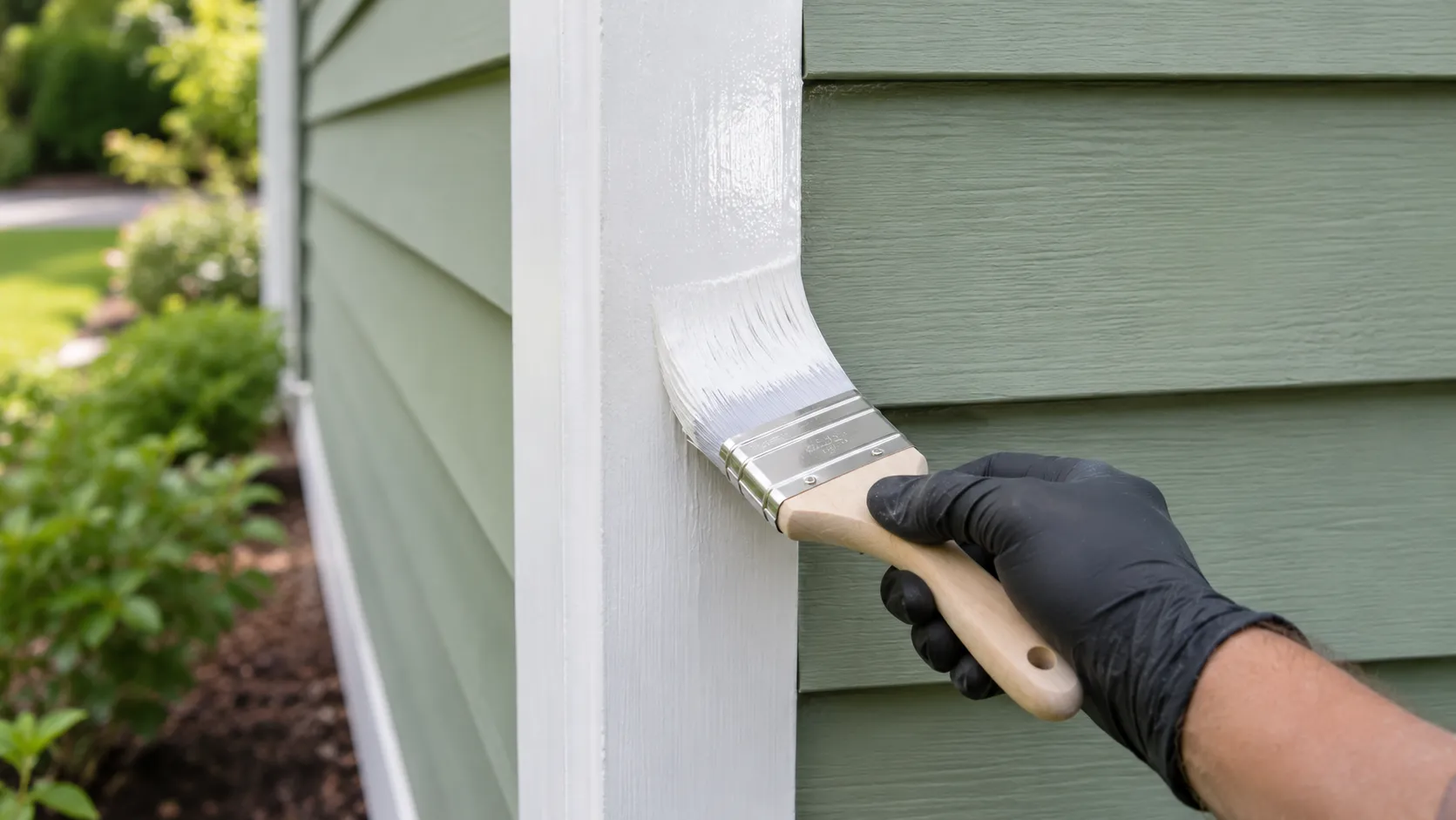
The right exterior primer depends on the surface: a stain-blocking primer on cedar, redwood and knots, an alkali-resistant masonry primer on new or bare stucco, concrete, brick and fiber cement (whose fresh surface is alkaline, and whose cut edges need sealing), a primer that stops rust on steel and one that suits galvanized metal, and on most other sound surfaces either a quality acrylic primer or the topcoat's own first coat.
| Primer | Type, per the sheet | Use, per the sheet | Lowest temperature | VOC on the sheet |
|---|---|---|---|---|
| Sherwin-Williams Exterior Oil-Based Wood Primer | Oil-based | "Blocking tannin, water, and other stains on exterior wood"; pine, fir, cedar, redwood, hardboard | 35°F | 318 g/L |
| Benjamin Moore Fresh Start Exterior Deck & Siding Primer 094 | Alkyd | "Tannin-rich woods"; "where cedar and redwood bleeding may be a problem" | 50°F | Under 350 g/L |
| Benjamin Moore Fresh Start High-Hiding All Purpose Primer 046 | 100% acrylic | Suppresses "tannin bleed, water stains"; "not recommended for sealing knots or over pine sap" | 40°F | Under 50 g/L |
| Sherwin-Williams Loxon Concrete & Masonry Primer | Acrylic | Concrete, block, brick, stucco; pH 6 to 13; "alkali and efflorescence resistant" | 40°F | Under 50 g/L |
What New Jersey's VOC rule now means for oil primers
New Jersey tightened its limits on volatile organic compounds in paint for products made on or after 18 August 2026. In the state's rule, N.J.A.C. 7:27-23, the limit for a primer, sealer or undercoater falls from 200 to 100 grams per litre, and the limit for a specialty primer from 350 to 100. The limits for nonflat paint fall from 150 to 100, and for flat paint from 100 to 50.
The two oil-based wood primers in the table print 318 and under 350 grams per litre on sheets dated 2024. Those figures are above the new 100 limit, so expect shelf stock to change as older cans sell through. The rule covers anyone who sells, supplies or applies coatings for pay in the state, but section 23.1(e) says the application limits do not apply to a paid applicator using a coating "purchased from a location within the State of New Jersey." In practice the limit bites at the store shelf. When you buy a stain-blocking primer for cedar this winter, ask for a compliant one, and check the date on its data sheet rather than trusting an older compliance list. All the topcoats in this guide are well under 100 and are low-VOC products. Zero-VOC labels, on the paints that carry them, are a marketing threshold, not a New Jersey limit.
Does a separate primer beat "self-priming" paint?
On bare wood the research says yes. The Wood Handbook gives the expected life of an ideal system as "three coats (one primer and two top-coats)" and says "applying only a two-coat paint system (primer and one top-coat) will decrease the service life to about half." It is also plain about paint and primer in one: "the properties are not optimal for either the primer or the topcoat."
Primer also buys you time. The Forest Products Laboratory found "with a limited number of primers that 6 months of primer alone over the winter had no effect on topcoat life," so wood primed in a late-fall repair can wait for spring topcoats. Sherwin-Williams' oil primer sheet is stricter for its own product: "For exterior exposure, this primer must be topcoated within 14 days." Follow the sheet for the primer you use, and allow the dry time it gives before topcoating; for an oil primer that is 24 hours at 45°F and up, and 24 to 48 hours in the cold.
The difference between oil and latex primers, and when each is the right call, is covered in our guide to oil vs latex paint and primer.
What Sheen Is Best for Exterior Paint?
Low lustre or satin is the best all-round sheen for house siding, flat is best for rough shingles and textured stucco, and soft gloss or semi-gloss is best for trim and doors. That is our own practice rather than a published rule.
Sheen names are not standard between brands. Aura Exterior Satin reads 20 to 30 gloss units at 60°, while Emerald, Duration and SuperPaint Satin read 10 to 20, and Aura Low Lustre reads 9 to 15. So a Benjamin Moore "satin" is shinier than a Sherwin-Williams "satin," and closer in look to the next step up. New Jersey's VOC rule defines a flat coating by the meter: "a gloss of 15 or less on a glossmeter held at an 85 degree angle" or "less than five" at 60°. Aura Exterior Flat reads 0 to 3 at 85°.
Why siding usually gets low lustre or satin: it sheds dirt and water better than flat, and it does not show every lap joint and patch the way a gloss would. Flat is the forgiving choice on old cedar shakes, rough-sawn siding and masonry, where texture would catch a shine unevenly. A sheen step between siding and trim gives the house edges. Touch-ups blend best in the lowest sheen, which matters on vinyl, where you cannot sand. If you are matching a satin wall you painted last year, match the product as well as the sheen name.
Colors and sheens together are covered in popular exterior house colors, and the full sheen ladder, inside and out, is in our paint sheen guide.
How Does New Jersey Weather Change the Choice?
New Jersey's weather does not call for a special paint so much as for the right premium acrylic, applied in the right conditions and kept clean. The things that shorten paint life here are humidity, freeze-thaw movement, shaded mildew, hard sun on south and west walls, and salt and wind at the shore.
Rutgers' Office of the New Jersey State Climatologist gives an average of 163 freeze-free days in the northern highlands, 179 in the central and southern interior, and 217 along the seacoast. Rutgers notes that "high humidity and moderate temperatures prevail when winds flow from the south or east," that "sea breezes play a major role in the coastal climate," and that "rarely does a winter go by without at least one significant coastal storm."
What that means for the paint:
- Humidity is the hidden enemy. The Forest Products Laboratory says that when it is too humid, water cannot evaporate from a fresh latex film, the solvents leave first, and the paint cures "while still in a water-filled state. You cannot recover from this type of disaster." On a sticky July day, paint early.
- Freeze-thaw rewards flexibility. Siding that takes on water in a November rain and freezes that week moves hard. A high-elongation acrylic film, and wood that was primed and sealed at the ends, cope best. The Wood Handbook reminds us that paint "is not a preservative. It will not prevent decay if the wood is moist."
- Shade breeds mildew. The Wood Handbook says mildew is "most common in shaded, moist, or protected areas," and that it "often punctures microscopic holes in the coating, breaking the water barrier." Sherwin-Williams: "Mildew must be removed before painting, or it will grow through any new coat of paint." A mildew-resistant paint is the second line of defence, not the first. Our guide to mildew on painted walls and siding covers cleaning it.
- Sun fades the deep colors first. South and west walls get the UV. A saturated color is the first to lose its color retention, and some review sites publish color shift readings from their own panels. Keep the deepest colors for the shadier sides, or accept that they will fade sooner; the Wood Handbook says dark colors "may fade within a few years."
- The shore needs washing, not a special label. None of the seven house-paint sheets we read contains the words salt, marine or coastal. We make no salt-air claim for any of them. In our experience the coastal difference is in the prep: we wash salt film and dirt off shore houses before painting, and we check the windward trim and railings more often than on an inland house. Sea breeze and spray carry salt onto every wall facing the water.
How the climate sets the repaint schedule, wall by wall, is in our guide to how often to paint a house exterior, and turnover work on shore rentals is in shore rental turnover painting.
Can You Apply Exterior Paint in Cold Weather?
Yes, down to about 35°F with any of the seven lines in our table, but only if the surface, the air and the next two days cooperate, and the research that tests paint outdoors is not yet convinced cold-applied paint lasts as long.
The sheets set the conditions. Sherwin-Williams: check that "the air, surface, and material temperature are above 35°F (1.7°C) and at least 5° above the dew point," avoid painting "if rain or snow is expected within 2-3 hours," and do not apply "when air or surface temperatures may drop below 35°F (1.7°C) within 48 hours." At 35 to 45°F, its recoat time stretches from 4 hours to 24 to 48. Benjamin Moore: "High humidity and cool temperatures will result in longer dry, recoat and service times." Sherwin-Williams also says "Do not paint in direct sun," which in late fall is the warm part of the wall you most want to paint. Regal Select's own sheet is not consistent, listing "low temperature application down to 40 °F" in its features and 35°F in its limitations; we would work to the higher number.
The primer often sets the real limit. Sherwin-Williams warns that "standard latex primers cannot be used below 50°F." Fresh Start 094 needs 50°F, Fresh Start 046 and Loxon primer 40°F. Emerald Urethane Trim Enamel needs 50°F, and so does metal siding under Sherwin-Williams' paints.
The Forest Products Laboratory says latex paint should go on at 50°F or above, with conditions staying there for 24 hours, and adds: "We do not know if paints formulated to be applied in even cooler temperatures perform as well as standard paints." The Wood Handbook warns against painting late in the day when heavy dew is expected, because "water absorption into partially coalesced latexes can cause wrinkling, fading, loss of gloss, and streaking." Even a full cure takes time: Benjamin Moore says painted surfaces "can be washed after two weeks," and some guides talk about a soft-cure period of a month or more.
Our practice is to treat 35°F as a floor, plan for 50°F and rising, and finish by mid-afternoon, before the dew. Our guides to how cold is too cold to paint outside and the best time of year to paint a house exterior go further.
Has Anyone Independently Tested Exterior Paint?
Yes, but the results you can read for free are pass-or-fail listings, not rankings. The Master Painters Institute lists products that pass its standards, Consumer Reports keeps its test results behind a membership wall, and most of the "tested" lists on review sites are the publishers' own unverifiable trials.
The Master Painters Institute publishes an Approved Products List. MPI says listed products "have passed MPI testing for the MPI standard indicated." Its #315 standard, "Latex, Exterior, High Performance Architectural, Low Sheen," lists Aura Waterborne Exterior Low Lustre, Regal Select Exterior High Build Low Lustre, Duration Exterior Satin and SuperPaint Exterior Satin. Its #15 standard, "Latex, Exterior, Low Sheen," lists Regal Select, Duration, Emerald Exterior Satin, SuperPaint and A-100 Satin. The ben sheet we read (2021) claims MPI #15, but we did not find ben on the current #15 page. A listing means a paint passed. It does not say which of two listed paints lasts longer.
Consumer Reports is the name most people expect here. Its exterior paint ratings were behind a membership wall when we looked, so we do not quote them, and we would not invent a summary of them.
Review sites fill the rest of the first page. One labels Aura its top pick, Duration "best for harsh climates," Regal Select a mid-range choice and a Behr line its budget pick; another names SuperPaint best overall and Duration the runner-up. Some describe their own 18-month field test panels. Those numbers cannot be checked, several pages carry affiliate links, and two of the claims we checked contradict the paint's own data sheet (see the comparison section above). Read them as opinions.
The best independent evidence on house paint we know of is the Forest Products Laboratory's, and it is about prep, not brands.
Does the Paint Matter More Than the Prep?
In our experience, prep matters more than the step between one premium line and the next, and the research agrees. The Forest Products Laboratory's results show wood painted before any sun exposure lasting 30 years, against 13 years after one week of sun and 10 after two. No brand-to-brand comparison we know of comes close to that spread.
The paint makers say it themselves. Emerald's sheet: "Most coating failures are due to inadequate surface preparation or application." And: "Recognize that any surface preparation short of total removal of the old coating may compromise the service length of the system." The Wood Handbook explains why a three-coat system matters: a primer and two topcoats reach the 4 to 5 mil film that lasts, and a primer with one topcoat gets "about half" the life. Its estimate for a well-applied three-coat system is that it "should last 20 years" before the topcoats wear thin, and "many three-coat paint systems in tests at FPL have lasted 30 years." Those figures are a long way from the "7 to 10 years" some guides quote.
The order of work that gets a premium paint to its full life:
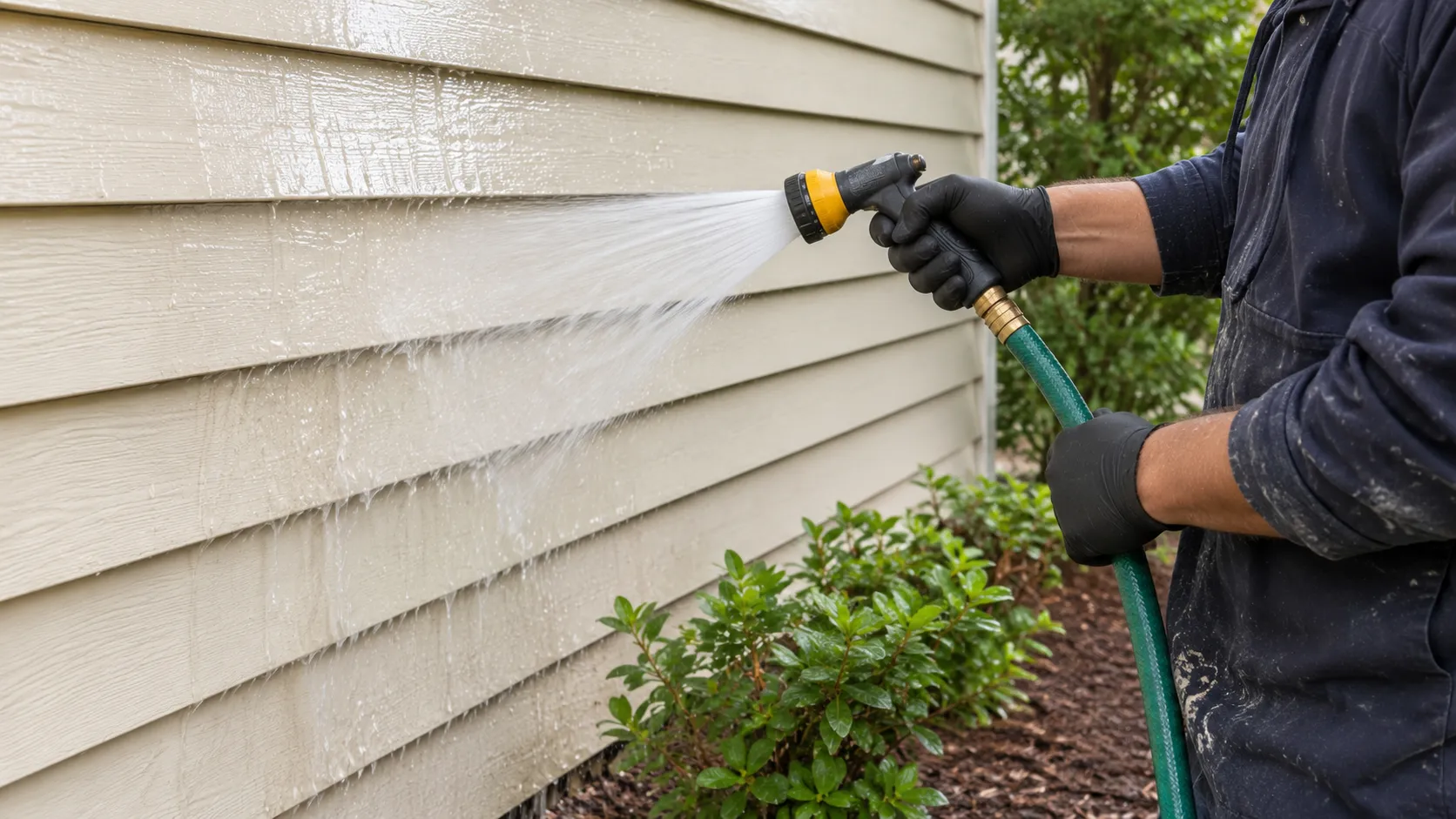
- Wash. Remove dirt, chalky old paint residue and mildew. Benjamin Moore says un-weathered areas "such as eaves, porch ceilings, overhangs" should be washed and rinsed "with a strong stream of water from a garden hose or power washer." Let it dry.
- Scrape and sand. Sherwin-Williams: "Existing peeled or checked paint should be scraped and sanded to a sound surface. Glossy surfaces should be sanded dull." Feather the edges so they do not show through.
- Fix what paint cannot. Soft wood, open joints and failed flashing are not paint problems. Hairline cracks in stucco and masonry need patching before paint, not paint thick enough to hide them. We point out soft or decayed wood at the estimate; replacing it is carpentry we do not do.
- Prime bare spots the same day. Wood, filler, masonry patches and bare metal each take the primer their sheet calls for.
- Caulk after priming. Sherwin-Williams: gaps between trim and other openings "can be filled with the appropriate caulk after priming the surface."
- Paint in the right conditions. Above the sheet's minimum, at least 5° above the dew point, out of direct sun on the wall you are painting, and with no rain due. The Forest Products Laboratory adds: "Do not paint when the temperature is greater than 90 °F."
- Apply two coats at the printed coverage. Two coats at the sheet's square feet per gallon, not one coat stretched.
Our guides to preparing a house for exterior painting, why paint peels and power washing a house cover each step in detail.
What About Lead Paint on an Older House?
Better paint does not change the lead rule. Scraping and sanding on a house built before 1978 can disturb lead paint. The EPA says "anyone paid to perform work that disturbs paint in housing and child-occupied facilities built before 1978 must be certified in lead-safe work practices." Every data sheet in this guide carries its own warning: "If you scrape, sand, or remove old paint, you may release lead dust. LEAD IS TOXIC."
We are not an EPA Lead-Safe Certified firm. If your house was built before 1978 and the job means disturbing old paint on the siding or trim, ask every contractor who bids, us included, for their firm's EPA certification number, and check how they will handle it before work starts. Our guide to lead paint in older New Jersey homes explains the rule and the questions to ask.
What We Do, and Do Not Do, on Exterior Paint Jobs
What to expect from us:
- We do: exterior house painting on wood, cedar, hardboard, fiber cement, vinyl and aluminum siding; stucco painting and repair; brick painting and staining; trim, fascia, soffits, shutters, front doors, garage doors, porches, railings and columns; power washing; general caulking and sealing; elastomeric and weatherproof coatings; and help choosing colors. We use Benjamin Moore and Sherwin-Williams products, and the estimate names the product, the primer and the number of coats.
- We do not: repair rotted wood or replace siding, windows or roofing, which we point out at the estimate for a carpenter or roofer; paint window trim or sills, or re-caulk windows and doors; treat mould (we wash mildew off before painting, which is different); or take on historic restoration.
- Lead: we are not an EPA Lead-Safe Certified firm, as above.
Get a Recommendation and a Price for Your House
The right paint for your house is the one that suits its surfaces, its exposure and how long you want the job to last, and we will tell you which one we would use and why at the estimate. In our experience the paint is a smaller part of the cost of an exterior job than the labor and prep, so the materials decision is rarely what makes a job expensive. For how exterior pricing is built, see the exterior section of our painting cost guide and our article on what it costs to paint a house in NJ. For the work itself, see our exterior painting service. Every estimate is free and spells out surfaces, prep, products and number of coats. Call (732) 239-0932 or request a free estimate, and ask us about the job minimum when you enquire.
Frequently Asked Questions
What is the best exterior house paint?
A premium 100% acrylic exterior paint applied at its full film thickness. On our two brands that means Benjamin Moore Aura Exterior or Sherwin-Williams Emerald Exterior at the top, with Regal Select Exterior and Duration Exterior close behind. The best one for your house depends on the surface, the sun and the color.
What is the best exterior paint for wood?
A premium 100% acrylic topcoat over a primer that suits the wood. Cedar, redwood and knotty pine need a stain-blocking primer, because the Wood Handbook says another coat of the same paint will not stop extractive bleed. On other woods, a quality primer or a self-priming paint's first coat works. Two topcoats over primer is the system the Forest Products Laboratory found lasts longest.
Is Aura better than Emerald for exterior painting?
On paper Aura Exterior Low Lustre has higher volume solids, 45.5 against 39 percent, and a thicker coat, 2.1 to 2.9 mils against 2.1 to 2.5. Both are 100% acrylic, both go on down to 35°F, and both makers call them their best exterior lines. We know of no independent test comparing the two that we could cite, so in practice we treat them as equals and choose by color and surface.
Is 100% acrylic paint best for exteriors?
Yes. The Forest Products Laboratory's Wood Handbook says "acrylics are especially resistant to weathering," and that acrylic finishes hold their gloss much longer than the old oil paints. Six of the seven lines we compared list 100% acrylic; Duration lists "Acrylic." The binder is not a promise on its own, though: a thin coat over poor prep fails whatever the label says.
How many coats of exterior paint do you need?
Two, in most cases. On bare wood the Wood Handbook recommends a primer and two topcoats to reach a 4 to 5 mil dry film, and says a primer with one topcoat gets about half the life. On a sound repaint in the same color, Aura and Emerald allow one coat, but the coat count is where most film thickness comes from, so we apply two.
Is the paint with the best coverage the best value?
Not necessarily. A gallon holds a fixed amount of solid paint, so more square feet per gallon means a thinner coat. SuperPaint's 350 to 400 square feet a gallon comes at 1.5 mils dry; Aura's 250 to 350 comes at 2.1 to 2.9. Compare the dry film per coat as well as the coverage, and see our cost guide for what a job costs.
What is the best paint for vinyl siding?
A 100% acrylic exterior paint in a vinyl-approved color. Benjamin Moore says not to paint vinyl darker than its original color or below an LRV of 55 unless the color is on its Colors for Vinyl palette; Sherwin-Williams sets the line at 56 unless a VinylSafe color is used. A darker color absorbs more heat and can warp the siding, whatever the paint brand.
What is the best exterior trim paint?
A harder, glossier finish than the siding, usually soft gloss or semi-gloss. Benjamin Moore Aura Exterior Soft Gloss reads 50 to 60 gloss units and goes on down to 35°F. Sherwin-Williams Emerald Urethane Trim Enamel Semi-Gloss reads 45 to 65 and needs 50°F. Gloss shows every flaw, so trim needs good sanding and filling first.
Can you paint the outside of a house in cold weather?
Down to about 35°F with the premium lines, if the surface is dry and at least 5° above the dew point, no rain is due for a few hours, and the temperature will not drop below 35°F for two days. Recoat times stretch to 24 to 48 hours below 45°F, and many primers need 40 or 50°F. The Forest Products Laboratory says it does not know whether cold-weather paint lasts as well, so we plan for 50°F and rising.
How long does exterior paint last in New Jersey?
It depends far more on prep and coats than on the brand. The Wood Handbook says a well-applied three-coat system should last 20 years, that many have lasted 30 in Forest Products Laboratory tests, and that one topcoat gets about half that. Many guides quote 7 to 10 years or a decade without a source. On a New Jersey house, south and west walls and shore exposure wear first; our guide to how often to paint a house exterior breaks it down.
About the author
Written by the NJ Painting Co. team
NJ Painting Co. is a family-owned painting contractor based in Monmouth County, in business since 2004. We are licensed and fully insured, work with Benjamin Moore and Sherwin-Williams paints, and back our work with a 2-year workmanship warranty. We serve Monmouth, Middlesex, Ocean, Mercer, Somerset and Burlington counties, plus Union, Essex, Hudson, Bergen and Passaic in North Jersey.