Yes, you can paint a brick fireplace, but treat it as permanent. Clean the soot off, let the brick dry, prime it with an alkali-resistant masonry primer, then apply two coats of a premium interior acrylic in matte, eggshell or satin. Paint the surround and the face of the hearth; never paint inside the firebox.
That is the method the Brick Industry Association and the paint manufacturers describe, and done properly it lasts for many years. The firebox is the recessed chamber where the fire actually burns, and it stays unpainted. In our own work that usually means Sherwin-Williams Loxon Concrete & Masonry Primer-Sealer or Benjamin Moore Ultra Spec Masonry Sealer 608 under a Benjamin Moore or Sherwin-Williams interior finish. The paint matters less than people think. The cleaning, the primer and the decision about where to stop matter more.
We are a family-owned painting company in Morganville and have painted New Jersey homes for more than 20 years across Monmouth, Middlesex, Ocean, Mercer, Somerset and Burlington counties, plus Union, Essex, Hudson, Bergen and Passaic in North Jersey, using Benjamin Moore and Sherwin-Williams products. Brick painting and staining is work we do, inside and out, and a fireplace is the brick most people live closest to. It is a small surface that takes a surprising amount of time: every mortar joint has to be worked by brush, the soot has to come off first, and the line where the paint stops at the firebox opening is the line everyone looks at. This guide is the long version of what we say standing in front of a red brick fireplace in a New Jersey colonial or split-level with the homeowner asking whether they will regret it.
It is written to be useful whether or not you hire anyone. Every technical figure below — dry and recoat times, cure periods, temperature limits, sheen readings, VOC content, heat ratings and vapour permeance — comes from a manufacturer's technical data sheet, a Brick Industry Association technical note, a fire-safety body or a federal or New Jersey agency, each one fetched and quoted on 24 October 2026. Where we give our own practice rather than a published figure, we say so. Where nobody publishes a figure, we say that too, rather than repeat a number that circulates without a source.
The Short Answer
- Painting brick is effectively permanent. The Brick Industry Association: "paint can be very difficult to remove from brick masonry without causing damage." Decide before you prime, not after.
- Clean it first, properly. The BIA says fireplace surrounds "often require supplemental cleaning prior to painting, to remove soot," and gives the method: dry brush, vacuum, then a grease-cutting detergent or trisodium phosphate, rinse and dry.
- Use a masonry primer. Mortar is alkaline, so the BIA recommends "an alkaline-resistant primer or a paint specifically designated for use on masonry." Loxon is "highly alkali and efflorescence resistant"; Ultra Spec 608 is "high alkali resistant – up to pH-13."
- Use a breathable interior acrylic on top, and not too much of it. The BIA: "avoid too many coats or heavy applications of paint, which will further lower the permeability of the walls."
- Paint the surround, never the firebox. The BIA says that if a fireplace "remains functional and will be exposed to open flames, treatments should not be applied to the firebox." High-heat paint is a metal paint, for screens and doors, not for brick.
- Matte, eggshell or satin. A flatter sheen hides the brick's texture; Sherwin-Williams' own fireplace guide prefers satin or glossier because "these are easier to clean than duller sheens." Gloss on rough brick shows everything.
- Do not light a fire the day you finish. No wall paint we read publishes a heat rating or a "time before first fire." We wait out the full-service period on the data sheets and keep the first fires small.
- Older house? Do not sand or scrape. A mantel and trim in a pre-1978 house may carry lead paint, and older fireplace surrounds can hide asbestos-containing materials. We are not an EPA Lead-Safe (RRP) Certified firm, and we say so below.
Should You Paint a Brick Fireplace?
Painting brick is close to irreversible
The Brick Industry Association's Technical Note 6, Changing the Appearance of Brick Masonry (March 2025), is the brick industry's own guide to painting, staining and washing brick, and it starts with this warning: "Many of the techniques described herein are irreversible, and some require ongoing maintenance or repeated application that would not be needed for untreated brick masonry. For example, paint can be very difficult to remove from brick masonry without causing damage." Its summary of recommendations opens the same way: "When contemplating whether to use a treatment, consider permanence and maintenance issues."
That is the brick industry talking, not the paint industry. Brick is porous, and a masonry primer is designed to soak into exactly the pores you would later need to clean out.
When painting a brick fireplace is a good idea
From what we see in New Jersey houses, painting tends to be the right call in a few common situations:
- The brick is a builder-grade red or orange that dominates the room. A great many New Jersey colonials, split-levels and ranches from the 1960s to the 1990s have a full-height brick fireplace wall that is the darkest, busiest surface in the house. Painting it is the single biggest visual change you can make to that room without a contractor in a hard hat.
- The brick is already patchy. Smoke staining above the opening, old repair mortar that does not match, a previous owner's half-finished whitewash, or a mix of brick colours from an old alteration.
When we would advise you not to paint it
- The brick is good-looking, old or unusual. A well-laid surround in a handsome brick, an old face brick with real colour variation, or a fireplace that is a genuine period feature of an older house. You can always paint later; you can rarely unpaint.
- The brick is wet, crumbling or efflorescing. Paint is not a fix. The BIA warns that "altering the appearance of the brickwork without first addressing underlying issues may cause further problems. In most cases, deterioration of brick masonry is due to unaddressed moisture problems. Treatments can further compromise the brickwork if they trap moisture in the wall."
- The mortar is loose or missing. That is a mason's job first. We cover where that line sits below.
- You want a look that lets the brick show through. Then you probably want a stain or a wash, not a paint, and the next section is for you.
- The brick is glazed. The BIA notes glazed brick is "hard, glossy and generally impermeable to moisture," and that even film-forming treatments on it would have "very limited durability and is therefore not recommended."
Paint, Stain, Whitewash or Limewash: Which Finish Is Right for a Brick Fireplace?
"Painting a brick fireplace" gets used for four quite different finishes. BIA Technical Note 6 describes each one, and they behave very differently on a fireplace.
Acrylic latex paint: opaque, smooth, permanent
This is what most people mean by a painted brick fireplace, and what this article is mostly about. The BIA: "Painting provides a fully opaque appearance that softens the natural texture of brickwork, smoothing the variations on the surface of the brick and between the brick and mortar profiles." It adds a caution that is easy to miss: "Due to the uniform color of paint, it can also highlight any differences in the surface texture of the brickwork, which may or may not be desirable." A single flat colour makes every chipped brick and proud mortar joint easier to see, which is one reason we steer most fireplaces away from glossy finishes.
Masonry stain: changes the colour, keeps the texture
A masonry stain soaks into the brick rather than forming a film on it. The BIA describes stains as used "to permanently change the color of the masonry while maintaining its natural texture," notes that they "do not alter the surface texture of the brick masonry and do not require maintenance," and that projects exist "where the stain has lasted 20 years or more." The catch is that a stain needs a brick that absorbs: "a water test must be performed prior to staining," "glazed brick cannot be stained," and "there are also some unglazed brick with dense surfaces that will not successfully receive masonry stains." Brick staining is work we do. On a fireplace it suits someone who wants a darker or more even brick that still reads as brick, rather than a painted surface.
Whitewash: diluted paint, a semi-opaque look
What most people call whitewashing a fireplace today is diluted latex paint. The BIA calls it "semi-opaque paint (faux limewash/whitewash)," says that "a ratio of 1 part latex paint and 1 part water is typically recommended as a baseline," and that "because this treatment is made from diluted paint, it can be removed with a damp cloth prior to drying." That last point is what makes it workable: you can wipe back while it is wet until the brick shows through the way you want. Once it is dry it is paint, with paint's permanence, and the BIA warns that it "is a faux finish with very different performance characteristics" from real limewash. Indoors on a fireplace surround, where there is no rain to weather it, a whitewash is a reasonable look. It needs the same cleaning as a full paint job.
Limewash: mineral, breathable, and not something we apply
Limewash is a mineral coating made from slaked lime and water. It soaks into the brick rather than sitting on it, and it gives the soft, chalky, slightly uneven look that is very popular on fireplaces. The BIA describes it as "a mineral- and water-based treatment" that "provides a naturally nonuniform matte finish that varies in opacity based on the amount of water used and the number of coats." Limewashing is not a service we offer. Our guide to limewashing brick in New Jersey covers how it works, what it costs and what a limewash applicator does differently on a fireplace, including keeping it out of the firebox.
So which one?
If you want the brick to disappear into a calm, single-colour wall, paint it. If you want a different brick colour that still looks like brick, stain it. If you want the brick to show through a pale veil, a whitewash or a limewash, and the limewash article will help you choose between those two. All four are permanent to some degree; only a wet whitewash can be wiped back, and only for a few minutes. Exterior brick is a different project with different products and weather limits; if the brick you are thinking about is outside, see our guide to painting a brick house in New Jersey.
What Is the Best Paint for a Brick Fireplace?
The best paint for a brick fireplace surround is a premium interior 100% acrylic paint, over a masonry primer. There is no special "fireplace paint" for the brick around the opening. What makes a brick fireplace paint job last is the primer underneath and the cleaning before it. The BIA's advice on topcoats is general but clear: "It is recommended to use products with a history of successful performance on brick masonry assemblies," and "an alkaline-resistant primer or a paint specifically designated for use on masonry is recommended."
The table below is taken straight from each product's technical data sheet. These are products we use or would accept on a fireplace surround; it is not a ranking of every paint on the market, and we have deliberately left out brands whose data sheets we could not read in full.
| Product | Role on a fireplace | Sheen | Spread rate per gallon | Dry to touch | Recoat | VOC | What the sheet says about masonry |
|---|---|---|---|---|---|---|---|
| Sherwin-Williams Loxon Concrete & Masonry Primer-Sealer | Primer on bare brick | 0-10 units @ 85° | 200-320 sq. ft. | 4 hours | 24 hours | Less than 50 g/L | "Seals and adheres to concrete, brick, stucco and plaster"; "highly alkali and efflorescence resistant"; pH "6 to 13" |
| Benjamin Moore Ultra Spec Masonry Interior/Exterior 100% Acrylic Sealer 608 | Primer on bare brick | Semi-Gloss (45 - 65 @ 60°) | 200 – 400 sq. ft. | 1 hour | 4 hours | 46 g/L | "Reduces the porosity of masonry surfaces"; "High alkali resistant – up to pH-13" |
| Benjamin Moore Fresh Start High-Hiding All-Purpose Primer 046 | Stain-blocking spot primer over sealed brick; smoke staining | 7 – 12 @ 85° | 400 – 450 sq. ft. | 30 minutes | 1 hour | < 50 g/L | Lists "concrete, masonry, brick"; seals "smoke damage" |
| Benjamin Moore Aura Matte 522 | Finish coats, flattest look | Matte (3 – 5 @ 85°) | 350 – 400 sq. ft. | 1 hour | 1 hour | 0 g/L | Recommended for "wallboard, plaster, masonry and wood" |
| Benjamin Moore Aura Eggshell 524 | Finish coats | Eggshell (12 – 22 @ 85°) | 350 – 400 sq. ft. | 1 hour | 1 hour | 0 g/L | Recommended for "wallboard, plaster, masonry and wood" |
| Benjamin Moore Regal Select Eggshell 549 | Finish coats | Eggshell (15 – 22 @ 85°) | 400 – 450 sq. ft. | 1 hour | 1 – 2 hours | 0 g/L | Recommended for "wallboard, plaster, masonry" |
| Sherwin-Williams ProClassic Interior Acrylic-Alkyd Semi-Gloss | Mantel and trim; a hard finish on brick if wanted | 41-51 units @ 60° at 24 hours | 350-400 sq. ft. | 1-2 hours | 4 hours | Less than 50 g/L | Masonry system: "1 coat Loxon Concrete and Masonry Primer" then "2 coats ProClassic Waterbased Acrylic-Alkyd" |
Three things in that table are worth slowing down for.
The primers are breathable, and the numbers say so. The BIA's scale classes a coating above 10 perms as "vapor permeable." Ultra Spec 608 lists "Water vapor permeance (breathability) ASTM D1693: 46.5 Perms," and Loxon lists "25.79 perms." The BIA also notes that "most manufacturers do not provide information on permeance" for finish paints, and that "acrylic latex paint is typically identified as vapor semi-permeable rather than fully vapor permeable." That is why the advice is to use the right primer and not to keep piling on topcoats.
The recoat times differ a lot. Ultra Spec 608 can take its finish coat in "4 Hours"; Loxon wants "24 hours." On a fireplace that is the difference between finishing in one visit and coming back the next day. Both sheets qualify every figure: Sherwin-Williams says "drying and recoat times are temperature, humidity, and film thickness dependent," and Benjamin Moore that "high humidity and cool temperatures will result in longer dry, recoat and service times."
Every one of them has a temperature floor. The Benjamin Moore products in the table all say not to apply below 50°F; Loxon's limit is lower, "Do not apply at temperatures below 40°F." A fireplace on an outside wall of an older New Jersey house, in January, with the heat turned down, can have brick colder than the room. Our guide to painting in cold weather covers that. For the broader brand comparison, see Benjamin Moore versus Sherwin-Williams.
How Do You Clean a Brick Fireplace Before Painting?
The single biggest reason a painted fireplace fails is that it was painted dirty. Soot is greasy, fine and invisible once your eyes get used to it, and paint will not grip it. The Brick Industry Association's technical note has a paragraph specifically on fireplaces, and it is the best short procedure we know of:
"Brick masonry fireplace surrounds often require supplemental cleaning prior to painting, to remove soot as well as for general cleaning. Dry brush the brickwork with a non-metallic stiff-bristled brush to remove surface debris, and then vacuum. Pre-wet the brick and use a sponge or rag to clean the fireplace surround with a grease-cutting detergent and water, or a stronger agent such as trisodium phosphate if needed. Carefully rinse and let dry. If soot or discoloration is not removed by these methods, then consult a manufacturer of specialty cleaning products for masonry."
Sherwin-Williams' how-to for painting a brick fireplace says much the same: "We recommend using a sponge with a powerful cleaner/degreaser to wash the brick and rinsing it with water," with the aim to "remove any soot or mineral residue that could affect the primer and topcoat."
What we do, and what we would not do
- We dry brush and vacuum first. Wet soot smears; dry soot lifts. A non-metallic stiff brush, as the BIA says. Several popular guides use a wire brush; on soft old brick and mortar we prefer not to, because steel can scratch the face and leave fragments that rust-stain later.
- We pre-wet, wash and rinse. Pre-wetting stops the brick drinking the dirty wash water. Rinsing is as important as washing, because detergent left in the brick is another contaminant.
- We do not use muriatic acid. The BIA is unambiguous: "Do not use diluted or undiluted muriatic (hydrochloric) acid. The use of unbuffered acids for cleaning is not recommended in general, as they can cause damage and staining that cannot be removed or repaired."
- We let it dry. The BIA: "After cleaning, wait at least 24 hours for the masonry to dry before applying treatments." It also warns that "extended drying times may be necessary in some circumstances, particularly when rain or high-humidity conditions occur," and "be aware that brick masonry does not dry at a uniform rate."
If you want to check for yourself that the brick is dry enough, the BIA describes a simple test borrowed from concrete: tape a square of 4-mil plastic sheet tightly to the brick and mortar, leave it "for a minimum of 16 hours," and "if moisture is present on the plastic sheet after the duration of the test, it indicates that additional drying time is needed."
Efflorescence: the white powder that has to come off, and stay off
A white, chalky or crystalline bloom on fireplace brick is usually efflorescence. The BIA's Technical Note 23A explains it: "efflorescence occurs when water containing dissolved salts is brought to the surface of masonry, the water evaporates and the salts are left on the surface." It is "usually not harmful to brick masonry," but it matters for paint, because paint applied over salts lets go. Technical Note 6 says: "Efflorescence present on the surface should be removed, and once removed the surface should be observed for reoccurrence prior to being treated."
The important word is reoccurrence. Efflorescence on a fireplace that is decades old means water is getting into the masonry. TN 23A notes that "efflorescence that reappears after this initial period is likely due to water entering and remaining in the wall." On a fireplace that often points to the chimney above it: a cracked crown, missing cap, failed flashing or a leak at the roof line. That is a chimney or masonry problem, not ours, and painting over it locks the moisture in. If we see fresh efflorescence on a fireplace, we will tell you before we quote, and we will not paint until the source is fixed.
Both masonry primers in our table are formulated with salts in mind: Loxon is "highly alkali and efflorescence resistant," and its sheet records an efflorescence test result of "Pass (None)." That is resistance in a sound, dry wall, not a cure for a wet one. If a painted fireplace is already blistering or peeling, our article on why paint peels walks through the causes.
Do You Need to Prime a Brick Fireplace?
On bare brick, yes. This is where most do-it-yourself fireplaces go wrong. Some guides skip it, and some say "any primer." The reason a masonry primer matters is chemistry, and the BIA explains it in one sentence: "Brick are normally pH neutral but are set in mortars that are chemically basic (high pH). As a result, an alkaline-resistant primer or a paint specifically designated for use on masonry is recommended." A fireplace has more mortar per square foot than any wall in the house, and it is precisely in the joints that an ordinary primer is most likely to fail.
The two masonry primers we use
Sherwin-Williams Loxon Concrete & Masonry Primer-Sealer. Sherwin-Williams describes it as "an acrylic coating specifically engineered for interior and exterior, above grade, masonry surfaces requiring a high-performance primer. It is highly alkali and efflorescence resistant and can be applied to a surface with a pH of 6 to 13." It "seals and adheres to concrete, brick, stucco and plaster" and "conditions porous masonry surfaces." Its listed surfaces include "Brick" and "Mortar." It is also the primer Sherwin-Williams' own brick-fireplace how-to uses, describing it as providing "adhesion with alkali and efflorescence resistance for masonry surfaces."
Benjamin Moore Ultra Spec Masonry Interior/Exterior 100% Acrylic Sealer 608. Benjamin Moore: "designed to penetrate and seal the surface of new or previously painted masonry surfaces providing the proper foundation for subsequent finish coats." Its features: "Reduces the porosity of masonry surfaces," "Provides excellent surface adhesion," and "High alkali resistant – up to pH-13." It lists "Interior/Exterior" in its name, and its finish systems allow an "Appropriate Benjamin Moore® finish coat."
How they go on
Both sheets say the same thing about technique, and it is the thing that matters most on a fireplace: get the primer into the joints. Ultra Spec 608, by brush: "Stir thoroughly and apply generously as received in the container with a good quality synthetic brush. Work into crevices to ensure adequate penetration and sealing." By roller: "apply generously as received in the container with a good quality long-nap roller. Work into crevices to ensure adequate penetration and sealing." Loxon calls for a "nylon-polyester" brush and a "½ to 1½ inch nap synthetic cover." Sherwin-Williams' fireplace guide puts the primer into the mortar lines with a one-inch stiff-bristle brush and uses a mini roller for the faces.
Our own method is to brush the primer into every mortar joint first with a stiff angled brush, then roll the brick faces with a thick nap and go back over any joint the roller bridged. Loxon's sheet also warns against spot priming for an even final colour: "When spot priming on some surfaces, a nonuniform appearance of the final coat may result, due to differences in holdout between primed and unprimed areas. To avoid this, prime the entire surface rather than spot priming." On a fireplace we always prime the whole surround.
When a stain-blocking primer goes on as well
Heavy smoke staining above the opening can bleed through a light finish even after a good wash. Benjamin Moore's Fresh Start High-Hiding All-Purpose Primer 046 "seals and suppresses most bleeding type stains such as tannin bleed, water stains, smoke damage," lists "concrete, masonry, brick" among its exterior substrates, and warns that "two coats of primer may be required on severe stains." Loxon's sheet says the same thing in general terms: "Stains from water, smoke, ink, pencil, grease, etc. should be sealed with the appropriate primer-sealer." Where the smoke shadow is heavy, we spot-prime that band with a stain blocker over the masonry primer before the finish goes on.
Going from red brick to white is the other case where more primer pays. Sherwin-Williams: "If you plan to use a lighter paint color, a second coat of primer may be necessary." Benjamin Moore's Advance data sheet adds that "for best hiding results, tint the primer to the approximate shade of the finish coat."
New brick and new mortar need to cure first
If the fireplace is new, or a mason has just repointed it, wait. The BIA: "In cases of new or repaired masonry, allow at least 30 days for the mortar to cure prior to treatment, although longer waiting periods may be necessary, especially in cooler weather." The masonry primers allow a shorter wait. Ultra Spec 608 applies to masonry "allowed to cure for a minimum of 7 days under normal drying conditions," and Loxon says "concrete and mortar must be cured at least 7 days at 75°F." Our own rule on freshly repointed fireplace brick is to wait the full 30 days.
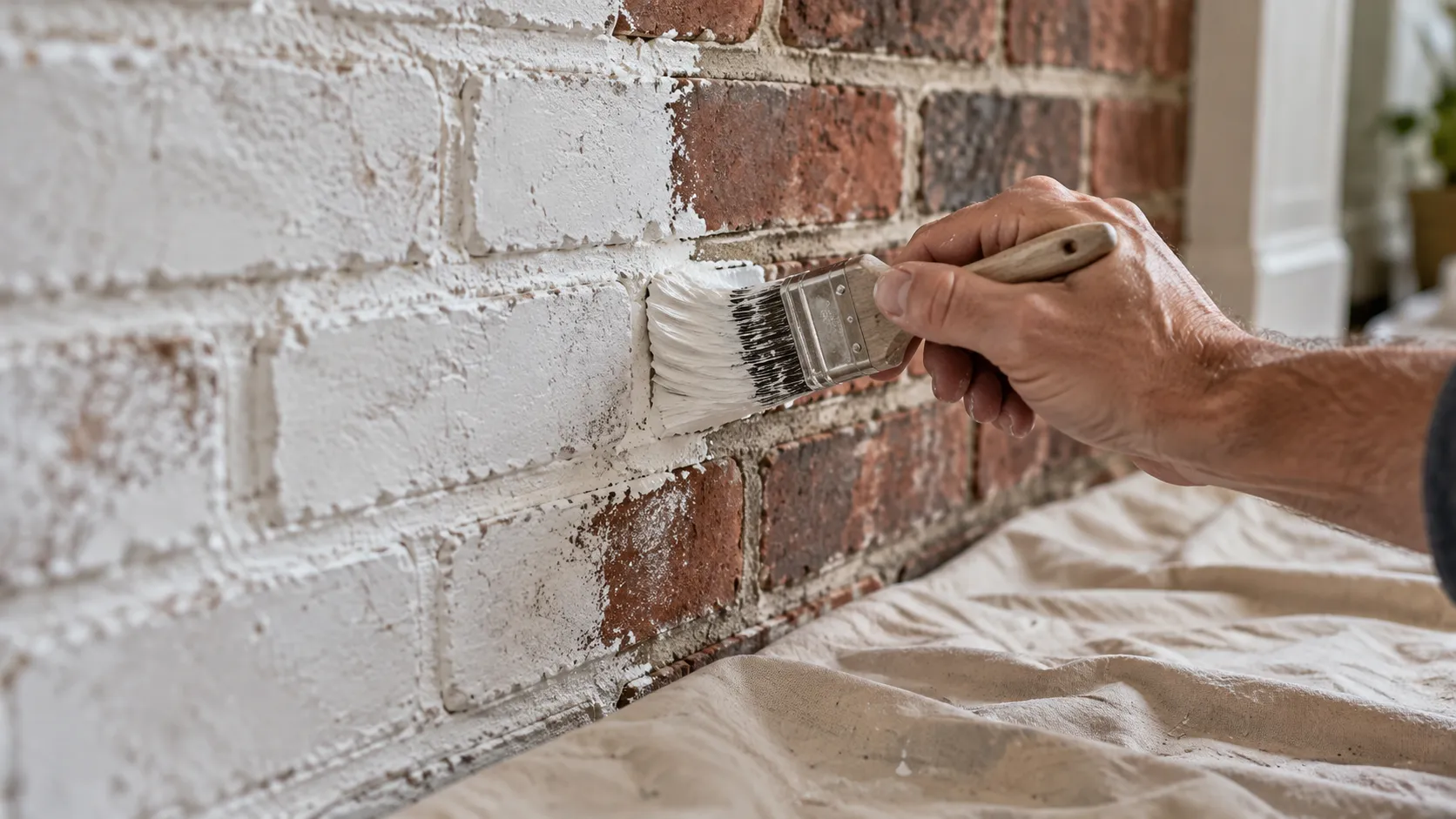
How to Paint a Brick Fireplace, Step by Step
This is the sequence we work to on a typical interior brick fireplace surround. It is also a sound method for anyone doing it themselves.
- Decide where the paint stops. Before anything else, agree on the edges: the inside edge of the opening (the firebox is not painted), the hearth floor (usually not painted, see below), the mantel (painted separately, in a trim enamel, or left as wood), and where the brick meets the wall.
- Check the fireplace is cold and the damper closed. No fire for a day beforehand, ashes cleared, the damper shut so soot does not fall onto wet paint.
- Protect the room. Drop cloths over the hearth and floor, the firebox opening masked with paper and tape, the mantel and wall edges taped, any metal doors or screen taken off or masked.
- Look at the masonry. The BIA lists the conditions to correct before any treatment, including "cracks in brick units or mortar wider than the thickness of a business card," "loose or damaged brick units," "loose, missing or deteriorated mortar," and "visible evidence of active or previous water penetration." It notes that bricks with hairline cracks "not visible from a distance of 15 to 20 ft" can stay if "securely set." Anything worse goes to a mason before we start.
- Dry brush, vacuum, wash, rinse and dry, as the BIA describes, with at least 24 hours of drying.
- Caulk the joints between brick and other materials. The gap where a brick surround meets drywall, or where a wood mantel sits against brick, is a caulk joint, and caulking and sealing is work we do. Sherwin-Williams' sequence is to caulk after priming: "Fill gaps between walls, ceilings, crown moldings, and other trim with the appropriate caulk after priming the surface." Cracked mortar between bricks is not a caulk joint. That goes to a mason.
- Prime the whole surround with a masonry primer, brushing the joints first and rolling the faces with a thick nap. Spot-prime heavy smoke staining with a stain blocker once the masonry primer is dry.
- First finish coat. Joints by brush again, then the faces. Sherwin-Williams' guide: "Start by using a 2" brush to apply fireplace paint to the mortar lines," then roll the remaining surface. Keep the coat even rather than heavy.
- Second finish coat after the recoat time on the can. Two finish coats over a primer is the standard system: Loxon's sheet specifies "1 coat Loxon Concrete & Masonry Primer" followed by "2 coats Appropriate Topcoat." A third coat is rarely needed and the BIA warns against piling them on.
- Pull the tape while the last coat is still soft, clean the edge at the firebox opening, and then leave it alone to cure.
On tools: a long-nap roller gets paint into the texture of the brick faces but bridges the joints, so the joints are always brushed. What never works is rolling one heavy coat to save time; it sags out of the joints and leaves the faces thin.
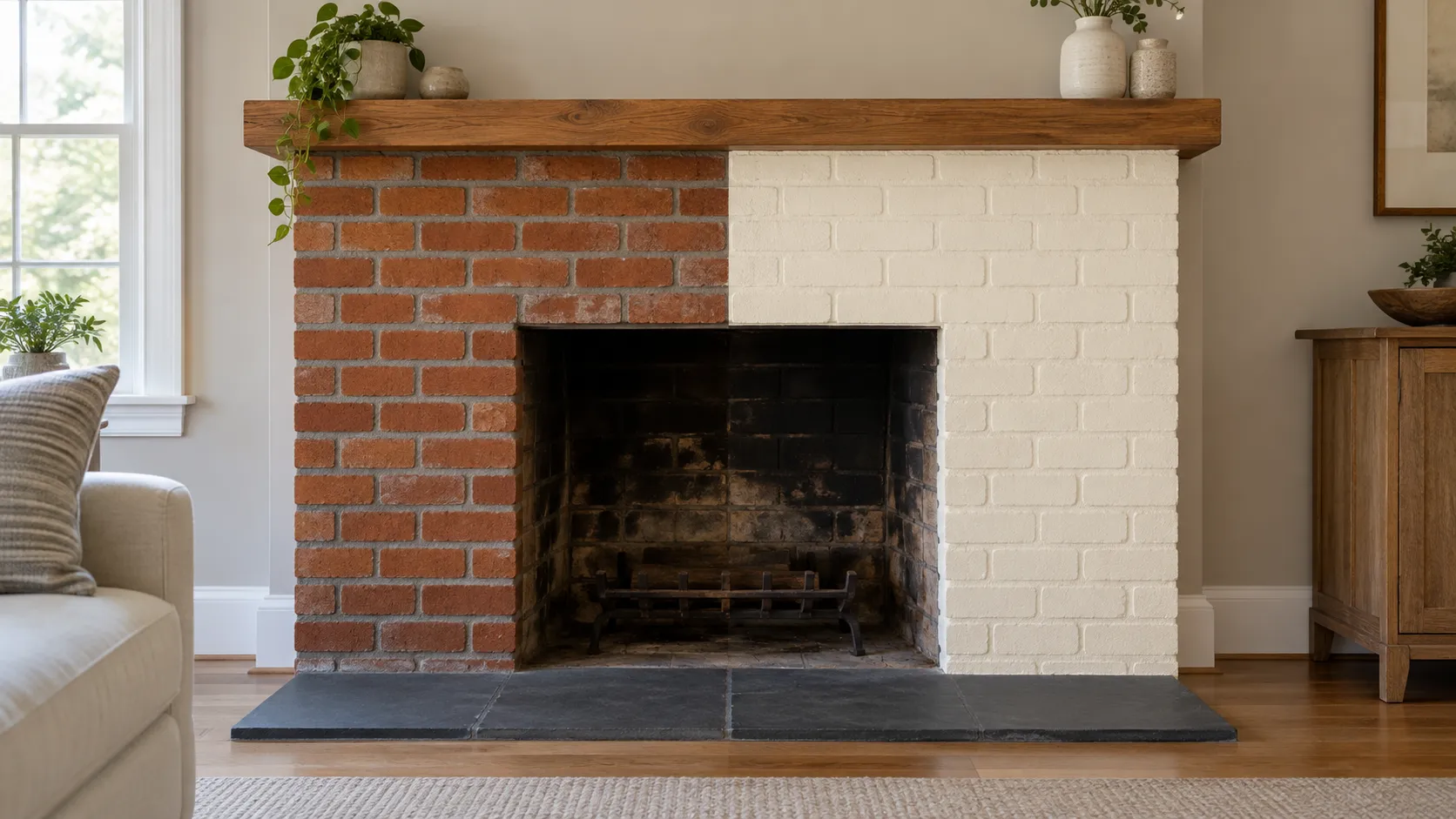
Does Fireplace Paint Need to Be Heat Resistant?
On the brick surround around the opening, you do not need a special heat-resistant paint. Inside the firebox, no paint belongs at all. Those are two different surfaces and they get two different answers.
The surround: ordinary interior acrylic, over a masonry primer
The surround is the brick face of the fireplace: the area around the opening, up to the mantel and often to the ceiling. On a working wood-burning fireplace it gets warm, especially the first course or two above the opening, but it is not exposed to flame. Sherwin-Williams' own fireplace guide recommends an ordinary interior enamel, ProClassic Waterborne Interior Acrylic Enamel, saying it "can withstand high temperatures, resist sagging, adhere well to the surface and provide excellent flow and leveling." It does not put a number on it.
Nobody else does either, and that is worth knowing. Several popular guides say that interior latex paint tolerates a particular temperature, usually somewhere around 180 to 200°F. We could not find that figure on any Benjamin Moore or Sherwin-Williams data sheet, so we do not repeat it as fact. What the data sheets do say is that they are rated for interior masonry, and our experience is that a properly primed acrylic on the face of a surround holds up to normal use of a wood or gas fireplace.
The firebox: not painted, by us or, the brick industry says, anyone
The firebox is the recessed chamber where the fire burns: the floor, the sides and the back, usually lined in firebrick. The Brick Industry Association: "The firebox is the recessed portion of a fireplace or interior surface of an oven in which the fire occurs. Typically, this includes the bottom, tapered sides and back. If the fireplace or oven remains functional and will be exposed to open flames, treatments should not be applied to the firebox or oven surfaces." Its summary is even shorter: "Avoid use of a treatment on glazed brick, pavers, floors and functioning fireboxes in fireplaces or residential brick ovens unless specifically designated otherwise by the treatment manufacturer."
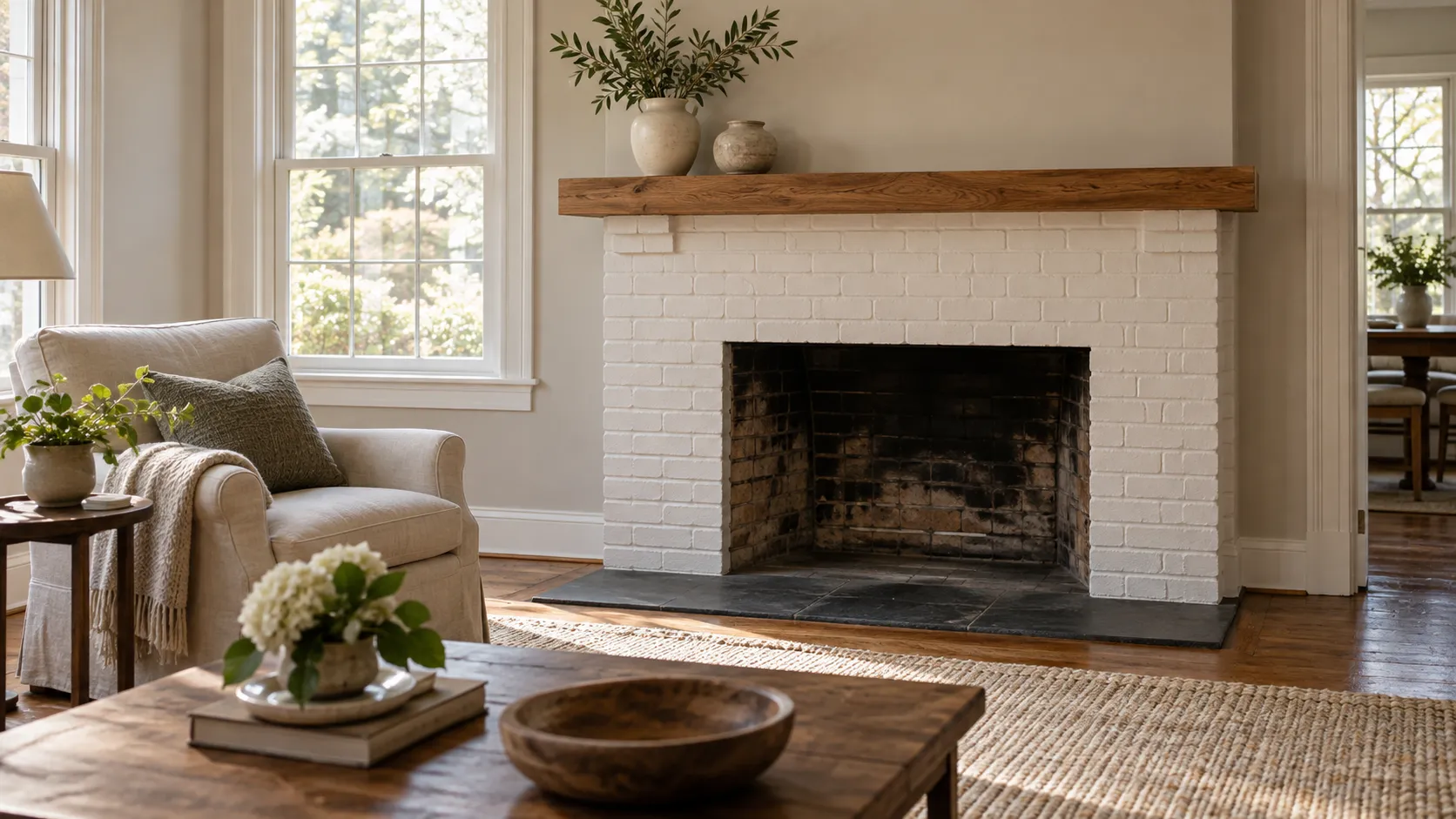
We do not paint inside the firebox of a working fireplace. We stop at the opening, on a clean line, and the firebox stays the colour fire makes it. That dark opening against a light painted surround is part of what makes a painted fireplace look right. Repairing or refacing a firebox, replacing firebrick, or re-lining it are fireplace and masonry trades, not painting, and we do not do them.
Where high-heat paint actually belongs: metal
"High heat" paints are real and useful, but they are metal paints. Rust-Oleum's Specialty High Heat technical data sheet is explicit: it "is designed to renew and protect metal surfaces subject to heat up to 1200°F (648°C)," and it is "ideal for the exterior of barbeque grills, wood stoves, radiators, fire pits, fireplace screens, automotive parts, and more." Note the words metal and exterior of. The same sheet says "Do not use on metal directly exposed to open flame." The spray version needs "1 hour before heating"; the brush version wants "24 hours before heating," and Rust-Oleum adds: "When using the subject surface for the first time, open windows and provide ventilation as the new paint finish may emit smoke."
So a high-heat paint suits a tired fireplace screen or the metal frame of a set of glass doors, taken outside and sprayed. It is the wrong product for brick and does not make a firebox safe to paint.
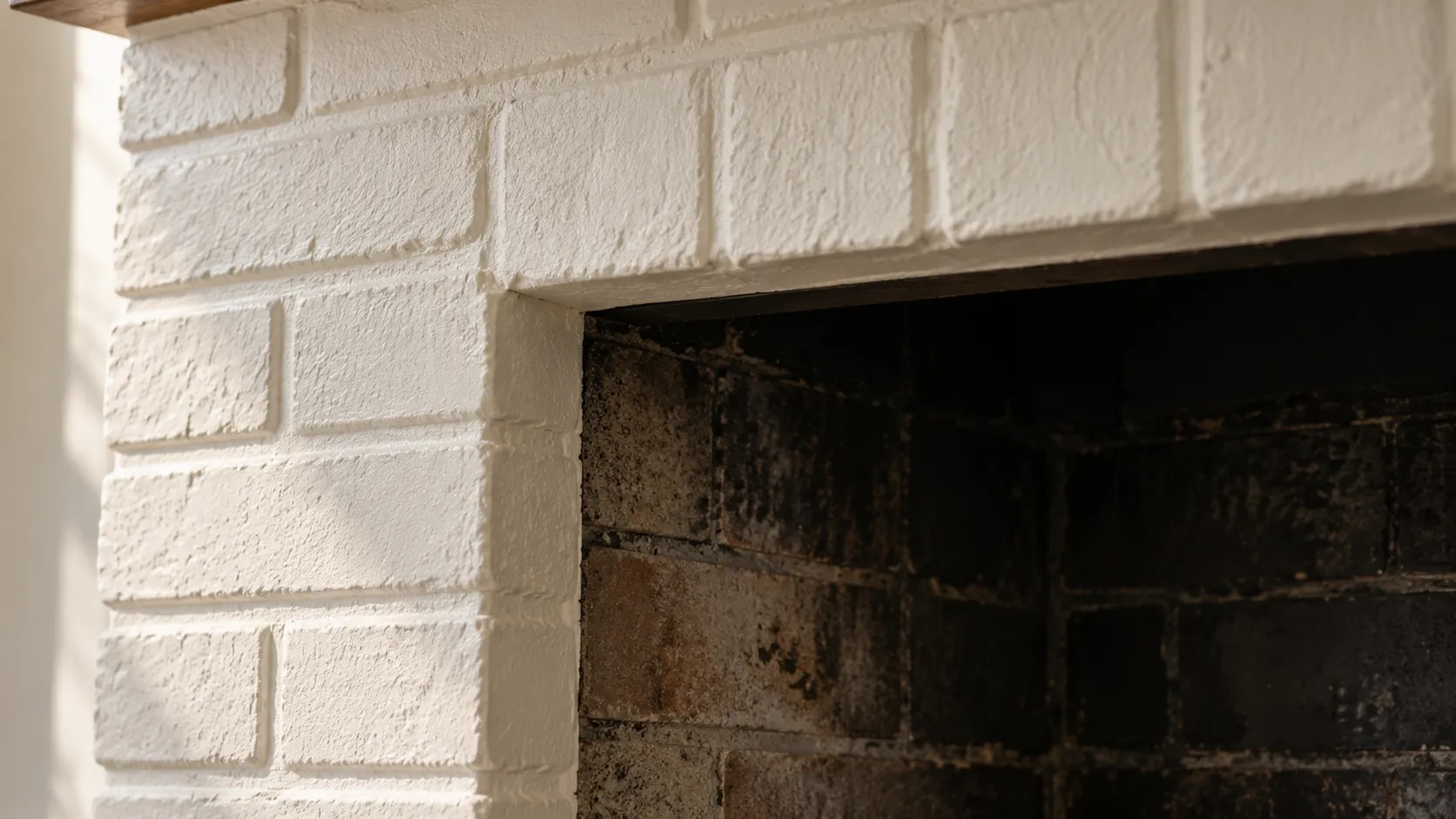
How Long After Painting a Brick Fireplace Can You Light a Fire?
This is the question almost every how-to skips, and nobody publishes a clean answer for a painted brick surround. The wall paint data sheets give dry, recoat and wash times, not a "before first fire" time. What they do say is that a paint film keeps hardening for days to weeks after it is dry to the touch. Every Benjamin Moore masonry and finish sheet in our table says "Painted surfaces can be washed after two weeks." Sherwin-Williams' ProClassic sheet gives its sheen at "24 hours" and again at "30 days," because the film is still changing over that month. Benjamin Moore's Fresh Start primer notes that "on hard, non-porous surfaces, maximum adhesion and hardness may take 3-4 days."
Our own practice, and what we tell every household:
- No fire for at least several days after the last coat, and longer in cold or damp weather, when everything dries more slowly.
- Keep the first few fires small and toward the back of the firebox, so the newly painted brick above the opening warms gradually.
- Open a window and run the fan for the first fire. Warm new paint can smell, even a zero-VOC one.
- Do not hang stockings, garlands or anything else off the freshly painted mantel for the first two weeks.
- Wait two weeks before wiping anything off it, as the data sheets say.
Gas Fireplaces, Wood-Burning Fireplaces and Inserts: What Changes
A wood-burning fireplace puts more soot and heat on the surround than gas does, and the soot shadow above the opening is usually heavier. Cleaning takes longer, a stain-blocking primer over the smoke band is more often needed, and over the years the first few courses above the opening will darken again. Many people repaint just that band every few years.
A gas fireplace or gas log set puts much less soot on the brick, which makes it the easier fireplace to paint and keep clean. The brick around it is painted the same way.
A fireplace insert, whether wood, pellet or gas, is a metal appliance set into the old firebox with its own surround panel. We paint the brick around it. We do not remove, install, adjust or service inserts or gas appliances, and we do not paint the insert's own metal surround, which carries the appliance maker's finish. If the brick right up against an insert's surround is getting hot enough to discolour paint, that is a question for the installer and the appliance manual, not the painter.
Whatever the fuel, one point matters before you invest in a new finish: get the chimney inspected. The Chimney Safety Institute of America quotes the National Fire Protection Association's Standard 211: "Chimneys, fireplaces, and vents shall be inspected at least once a year for soundness, freedom from deposits, and correct clearances. Cleaning, maintenance, and repairs shall be done if necessary." On gas, the CSIA is equally direct: "it's important that you schedule annual inspections for all your chimneys – gas furnaces included." Chimney work is a chimney sweep's or mason's job, not ours. Having it done before the fireplace is painted means any mortar or masonry repair can cure before we prime.
What Sheen Should a Painted Brick Fireplace Be?
Matte, eggshell or satin, for most fireplaces, and our default is a matte or an eggshell. The reasons pull in two directions.
The argument for a flatter sheen is the BIA's point that a uniform colour "can also highlight any differences in the surface texture of the brickwork." A shinier film throws light off every chipped edge, proud joint and uneven brick face. Benjamin Moore's Aura Matte reads "Matte (3 – 5 @ 85°)"; its Aura Eggshell "Eggshell (12 – 22 @ 85°)." On a full-height brick fireplace wall lit from the side by a window, a matte or eggshell looks like painted brick. A semi-gloss can look like plastic.
The argument for a little more sheen is cleaning. Sherwin-Williams' fireplace guide says: "We recommend using a Satin, Semi-Gloss or Gloss sheen, as these are easier to clean than duller sheens." The area just above the opening of a wood-burning fireplace does collect soot, and a satin wipes cleaner than a dead flat.
Our view is that on most surrounds a premium matte or eggshell gives the best-looking result and is washable enough for a fireplace that is used a few times a winter. On a heavily used wood-burning fireplace, a satin is a fair compromise. We would not use a full gloss on the brick. The mantel, if it is painted, is a different surface and takes a trim enamel. Our guide to satin versus eggshell explains how each sheen behaves in the rest of the house.
The Mantel and the Hearth
The mantel
A wood mantel is trim, and we paint it like trim: cleaned, dulled, primed where bare, and finished in a hard enamel. Sherwin-Williams' ProClassic lists "all trim areas and molding" among its uses; Benjamin Moore's Advance is "ideal for interior doors, trim, cabinets, walls, and ceilings," and warns that "it could take up to 30 days to reach optimum hardness." A natural wood mantel left unpainted against painted brick is one of the most popular looks, and it is the one in our hero picture. In that case we tape the mantel carefully and cut the brick paint to it.
Three limits. First, we paint mantels; we do not build, replace or alter them, because that is finish carpentry. Second, a mantel in an older house is one of the most likely places in the room to have old lead paint on it, which we cover in a moment. Third, the mantel is close to the fire, so keep anything flammable you put on it well back from the opening, whatever colour it is painted.
The hearth
The hearth is the floor in front of the fireplace, and often a raised step or platform. The BIA's advice on horizontal brick is clear: "In general, it is not recommended to apply treatments to brick pavers and floors," because "the abrasion created by foot traffic on the pavers or floor would result in limited durability of the treatment and a nonuniform appearance. Treatments can also reduce the slip resistance of the walking surface." A brick hearth floor gets stepped on, has logs dropped on it and catches embers, and paint on it wears through within a season.
Our usual approach is to paint the vertical face of a raised hearth along with the surround, and leave the top surface of the hearth unpainted and cleaned. The BIA's advice against treating brick floors covers stains and other treatments as well as paint. A stone or slate hearth we leave as it is. If you want a different look underfoot, that is a decision to make with that in mind, not one to make with a roller.
What Colour Should You Paint a Brick Fireplace?
Colour is a subject of its own, and our article on interior paint colours has the named colours, codes and light reflectance values. A few points are particular to brick fireplaces.
- White and warm white are the most common choice for good reasons. Painting a red brick fireplace white is the classic version of this project, because it turns the heaviest surface in the room into the quietest. A soft, slightly warm white usually looks better on brick than a stark blue-white, which can read as cold against wood floors and a natural mantel.
- Going from red to white takes more primer. As Sherwin-Williams says, "a second coat of primer may be necessary," and a tinted primer helps.
- White shows soot. On a wood-burning fireplace, the band just above the opening will darken. If you use the fireplace a lot, an off-white, a greige or a mid-tone hides it longer.
- Dark colours hide soot completely but show dust, chips and any missed speck in the joints, so coverage has to be perfect.
- Test it on the brick. Texture makes the same colour read darker on a fireplace than on a flat wall, so look at a sample in daylight and lamplight.
Fumes, VOC and Painting Indoors Near the Fireplace
The finish paints in our table are zero VOC — Benjamin Moore's Aura and Regal Select sheets say "Zero VOC post tint (any base and any color)" — and the masonry primers are low VOC, at "46 Grams/Liter" for Ultra Spec 608 and "less than 50 grams per litre" for Loxon. Low VOC is not no ventilation: the 608 sheet still says "Ensure fresh air entry during application and drying." Keep the damper closed while painting, and do not light the fireplace to "help the paint dry." Our guide to paint fumes and VOCs covers when a freshly painted room is reasonable to use.
Older New Jersey Homes: Lead Paint, Asbestos, and Who Does the Prep
A large share of New Jersey houses were built before 1978, and the fireplace wall in those houses is where two separate hazards can meet.
Lead paint on mantels and trim
Bare brick that has never been painted is not a lead paint concern. Everything around it might be. The mantel, the trim, a previously painted surround and the wall next to it can all carry old layers of lead paint, and preparing a mantel for paint means sanding and scraping. Every data sheet in this article prints the warning; Benjamin Moore's reads: "WARNING! If you scrape, sand or remove old paint, you may release lead dust. LEAD IS TOXIC."
The federal rule is the EPA's Renovation, Repair and Painting (RRP) Program, which requires that "anyone paid to perform work that disturbs paint in housing and child-occupied facilities built before 1978 must be certified," adding that "this includes all firms, even sole proprietorships." The exception is narrow. 40 CFR 745.83 treats as minor repair and maintenance work that disturbs "6 square feet or less of painted surface per room for interior activities," and only where none of the prohibited practices are used. Stripping and sanding a mantel and its surrounding trim can pass that limit quickly.
We are not an EPA Lead-Safe Certified firm. That is a licensing fact about our company, not a choice of wording, and it means some prep work on a pre-1978 mantel or previously painted surround is work we will tell you to have done by someone else. Our guide to lead paint in older NJ homes explains the rule properly. The EPA's advice to homeowners is to hire a certified contractor, and its program page links to a search for certified firms. Whoever you hire for a fireplace in a pre-1978 house, ask every bidder for their firm certification number — ours included — before anybody sands or scrapes old paint.
Asbestos around older fireplaces
Asbestos was used widely in older building materials, and some of them sit right next to fireplaces and stoves. The EPA's asbestos overview lists among the places it may be found "Walls and floors around wood-burning stoves protected with asbestos paper, millboard, or cement sheets," and "Textured paint and patching compounds used on walls and ceilings." The Consumer Product Safety Commission banned "artificial fireplace ash containing asbestos" and asbestos-containing patching compounds in December 1977, after the commission concluded that "certain types of cancer may result from inhaling free-form asbestos fibers released into the air." Old gas-log ember material, an old heat-shield board behind a stove, and old patching around a surround are all worth checking before anything gets sanded.
The New Jersey Department of Health's asbestos page explains why leaving it alone is usually the right call: "When intact and undisturbed, asbestos-containing materials generally do not pose a health risk. Damaged asbestos-containing materials may pose a health risk if fibers are released into the air and inhaled into the lungs." It also notes that "all asbestos abatement work must be conducted by a DOLWD-licensed asbestos abatement contractor." The EPA's homeowner advice, on its protect your family page, is plain: "If you suspect material contains asbestos, don't touch it," and "Don't saw, sand, scrape, or drill holes in asbestos-containing materials."
Painting brick does not normally disturb any of this. Cleaning, brushing and priming a sound brick surround is not sanding a board. But if there is an old board, panel, patch or hearth extension around your fireplace that is not brick, stone or tile, we will not sand, scrape or drill it, and you should have it tested by a qualified inspector before anyone does.
Can You Remove Paint From a Brick Fireplace?
Sometimes, partly, with effort, and rarely perfectly. The BIA's guidance on removing earlier treatments from masonry: "be aware that some treatments may be difficult or impossible to remove without damaging the brickwork due to the bond formed between the treatment and the brick masonry. Abrasive methods such as sandblasting are not recommended, as the process will damage the brickwork." It adds that "generally, a proprietary chemical solution specifically formulated for brickwork is required to remove most existing treatments," and recommends "a trial application of the proposed chemical solution on an inconspicuous area" first.
In practice, stripping a painted fireplace means chemical strippers applied in layers, scraped and rinsed, joint by joint, followed by cleaning. Paint stays in the pores and deep in the mortar, so the brick usually ends up looking cleaned rather than original. On a pre-1978 house the old paint may also contain lead, which brings in the federal rule above. Stripping paint off a brick fireplace is not work we take on. If you are not sure you want painted brick, a stain or a whitewash may give you most of the change with a softer commitment, or leave it unpainted for another season while you decide.
What We Do, and Do Not Do, on Brick Fireplaces
- We paint and stain brick fireplace surrounds, interior and exterior brick generally, and write the primer, finish and number of coats on the estimate.
- We clean before we prime: dry brush, vacuum, wash with a degreasing cleaner, rinse, and give the brick at least 24 hours to dry. No muriatic acid.
- We use a masonry primer on bare brick, normally Loxon or Ultra Spec 608, brushed into the joints and rolled on the faces, and spot-prime heavy smoke staining with a stain blocker.
- We stop at the firebox opening on a clean line. We do not paint inside a working firebox.
- We paint the mantel as trim in a hard enamel, or tape and cut to a natural wood mantel.
- We caulk the joints between brick and drywall or trim; caulking and sealing is ours.
- We paint the walls, ceiling and trim of the room around the fireplace as part of the same job, and do drywall and sheetrock repair beside it.
- We tell you how long to wait before the first fire and why, before we leave.
- We tell you if we think the masonry or chimney needs attention first, and we will not paint over active efflorescence or a leak.
What we do not do, so there is no ambiguity: limewashing; masonry, mortar or brick repair and repointing; chimney work of any kind; firebox repair, relining or refacing; installing, removing or servicing gas logs, inserts or other fireplace appliances; stone veneer installation; plaster repair; finish carpentry, including building, replacing or altering mantels; mould treatment; stripping paint from brick; and we do not hold EPA Lead-Safe (RRP) certification. On a house built before 1978, ask us — and every other bidder — for a firm certification number before anyone disturbs old paint.
Get a Price for Your Brick Fireplace
Fireplace pricing depends on the size of the surround, whether it runs to the ceiling, how dirty and how rough the brick is, how much primer it will drink, whether the mantel and hearth face are included and what else in the room is being painted, which is why we look at it rather than quote from a photo. NJ Painting Co. is a family-owned, licensed and fully insured painting company at 36 Church Rd, Morganville, NJ 07751, working on New Jersey homes for more than 20 years with Benjamin Moore and Sherwin-Williams products. Every estimate is free and spells out surfaces, prep, products and number of coats; our work carries a two-year workmanship warranty. For how interior pricing is built, see the interior section of our cost guide and our cost to paint a room guide, and for the work itself our interior painting service. A fireplace is often painted along with the room around it, so call (732) 239-0932 or request a free estimate, and ask us about the job minimum when you enquire.
Frequently Asked Questions
Should you paint a brick fireplace?
Often yes, but only if you are sure, because it is close to permanent. The Brick Industry Association warns that paint can be very difficult to remove from brick masonry without causing damage. Painting is a good choice for a dated or patchy red brick surround that dominates the room. It is a poor choice for handsome or historic brick, for glazed brick, or for brick that is wet, crumbling or efflorescing, which needs its moisture problem fixed first.
What is the best paint for a brick fireplace?
A premium interior 100 percent acrylic paint in a matte, eggshell or satin sheen, over a masonry primer. There is no special paint needed for the brick surround. The primer is what matters: Sherwin-Williams Loxon Concrete and Masonry Primer-Sealer or Benjamin Moore Ultra Spec Masonry Sealer 608, both alkali resistant, because the mortar in a fireplace is alkaline and an ordinary primer can fail in the joints.
Do you need to prime brick before painting a fireplace?
Yes, on bare brick. The Brick Industry Association recommends an alkaline-resistant primer or a paint designated for masonry, because brick is set in mortar that is chemically basic. Brush the primer into the mortar joints, roll the faces with a long-nap roller, and prime the whole surround rather than spots. Heavy smoke staining may need a stain-blocking primer as well, and going from red brick to white often needs a second coat of primer.
Do you need heat-resistant paint for a brick fireplace?
Not on the surround. A properly primed interior acrylic is what the manufacturers' own fireplace guidance uses on the brick face around the opening. Inside the firebox, where the fire burns, no paint should go on a working fireplace; the Brick Industry Association says treatments should not be applied to a firebox exposed to open flames. High-heat paints are metal paints for screens, doors and stoves, not for brick.
How do you clean a brick fireplace before painting?
Dry brush the brick with a stiff non-metallic brush and vacuum, then pre-wet it and wash with a grease-cutting detergent, or trisodium phosphate for heavy soot, and rinse well. That is the Brick Industry Association's method for fireplace surrounds. Do not use muriatic acid. Let the brick dry for at least 24 hours, longer in damp weather, before priming.
How long after painting a brick fireplace can you use it?
Give it at least several days, longer in cold or damp weather. No wall paint data sheet gives a specific time before the first fire, but the paint keeps hardening for weeks after it feels dry, and Benjamin Moore says painted surfaces can be washed after two weeks. Keep the first fires small and toward the back of the firebox, and ventilate the room the first time.
What sheen is best for a painted brick fireplace?
Matte or eggshell for most fireplaces, satin for a heavily used wood-burning one. A flatter sheen hides the unevenness of brick, which a uniform colour tends to highlight. Sherwin-Williams prefers satin or higher because it is easier to clean soot from. Avoid full gloss on brick. A painted wood mantel takes a harder semi-gloss trim enamel.
Can you stain a brick fireplace instead of painting it?
Yes, if the brick is bare and absorbs water. A masonry stain soaks into the brick and changes its colour while keeping its texture, and the Brick Industry Association says stains do not alter the surface texture and do not require maintenance. Glazed, sealed or previously painted brick will not take a stain, so a water test comes first. The firebox stays untreated either way. Brick staining is work we do.
Can you paint a brick fireplace white?
Yes, and it is the most common version of this project. Red brick takes more covering than most surfaces, so Sherwin-Williams says a second coat of primer may be necessary for a lighter colour, and Benjamin Moore advises tinting the primer toward the finish shade. On a wood-burning fireplace the band above the opening will darken with soot over time, so a warm off-white or greige hides it longer than a stark white.
Is it better to paint, whitewash or limewash a brick fireplace?
Paint gives a solid, smooth, single colour. Whitewash is diluted latex paint that lets some brick show through and can be wiped back while wet. Limewash is a mineral coating that soaks into the brick and gives a softer, chalky, uneven look. All three are close to permanent once dry. We paint and stain brick; limewash is not work we offer, and our limewash guide explains how it differs.
Can you remove paint from a brick fireplace?
Partly, with difficulty. The Brick Industry Association says some treatments are difficult or impossible to remove without damaging brick, that sandblasting will damage it, and that removal usually needs a chemical stripper made for brickwork, tested on a hidden area first. Paint stays in the pores and mortar, so stripped brick rarely looks original. In a house built before 1978 the old paint may contain lead, which brings in the federal RRP rule.
Is it safe to paint a fireplace in an older house?
Painting sound brick is generally fine, but sanding or scraping old paint is not something to do casually. Mantels and trim in houses built before 1978 may have lead paint, and anyone paid to disturb it must be EPA certified; we are not an EPA Lead-Safe Certified firm. Some older fireplaces and stoves have boards, panels or patching that may contain asbestos. Leave those alone and have them tested before anyone sands, scrapes or drills them.
About the author
Written by the NJ Painting Co. team
NJ Painting Co. is a family-owned painting contractor based in Monmouth County, in business since 2004. We are licensed and fully insured, work with Benjamin Moore and Sherwin-Williams paints, and back our work with a 2-year workmanship warranty. We serve Monmouth, Middlesex, Ocean, Mercer, Somerset and Burlington counties, plus Union, Essex, Hudson, Bergen and Passaic in North Jersey.