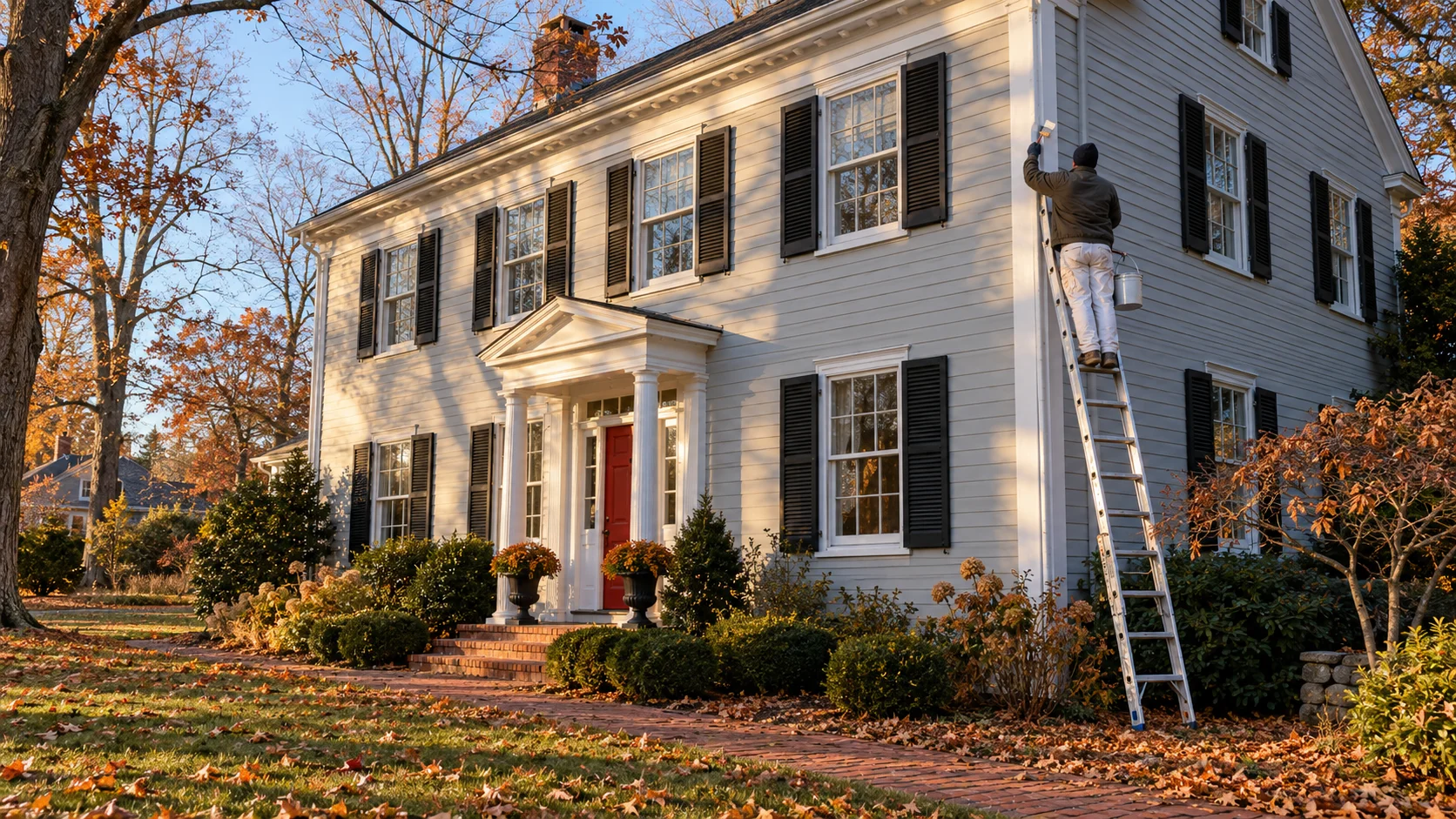
Yes, you can paint outside in cold weather, within limits. Premium exterior latex paints from Sherwin-Williams and Benjamin Moore are rated down to 35°F air and surface temperature, but Sherwin-Williams also wants the surface 5° above the dew point and no drop below 35°F for 48 hours. Primers, caulks and stains often need 40°F or 50°F.
In a New Jersey fall, that usually means the exterior season is good into mid-October, possible on selected days into November with the right products, and over for most houses by December. Interior painting works all winter.
We are a family-owned painting company in Morganville and have painted homes across Monmouth, Middlesex, Ocean, Mercer, Somerset and Burlington counties, plus Union, Essex, Hudson, Bergen and Passaic in North Jersey, for more than 20 years, using Benjamin Moore and Sherwin-Williams products. Every fall we have the same conversation with homeowners: paint now, or wait for spring? This guide gives you the numbers we use to answer it, taken from the manufacturers' technical data sheets (as of September 2026) and from NOAA's official climate normals for a station a few miles from our shop.
Painting in Cold Weather: The Short Answer
- Exterior paint: the premium lines we use are rated down to 35°F air and surface temperature. Older or economy paints and most standard latex primers need 50°F.
- The overnight rule matters more than the afternoon. Paint has to stay above its minimum, and above the dew point, while it dries. Sherwin-Williams puts that window at 48 hours.
- Cold slows everything. At 35 to 45°F, Sherwin-Williams lists 24 to 48 hours before a second coat, instead of 4 hours in milder weather.
- Dew is the hidden problem. On a clear fall evening, siding can get wet with dew long before the air reaches freezing. Wet, uncured latex can streak or stain.
- In central New Jersey, the median first freeze at the Freehold-Marlboro weather station is October 23 and the median last spring freeze is April 17.
- Interiors are a year-round job as long as the house is heated. Interior paints generally need 50°F, which any occupied home provides.
Minimum Temperature to Paint Outside: What the Data Sheets Say
Every can of paint has a technical data sheet, and the temperature limits on it are not suggestions. They are the conditions the manufacturer tested the product under and the conditions its warranty assumes. We pulled the current sheets for the exterior products we use most, plus the primers, stains and caulk that go on with them. "Recoat at low temperature" is the wait before a second coat when it is cold; where a sheet gives only a 77°F figure, we say so.
| Product | Minimum air and surface temperature | Dew point rule | Recoat when cold |
|---|---|---|---|
| SW Emerald Exterior Satin (K48) | 35°F | At least 5° above | 24–48 hours at 35–45°F (4 hours at 45°F+) |
| SW Duration Exterior Satin (K33) | 35°F | At least 5° above | 24–48 hours at 35–45°F (4 hours at 45°F+) |
| SW SuperPaint Exterior Satin (A89) | 35°F | At least 5° above | 24–48 hours at 35–45°F (4 hours at 45°F+) |
| SW Resilience Exterior Satin (K43) | 35°F | At least 5°F above | 24–48 hours at 35–45°F (4 hours at 45°F+) |
| BM Aura Exterior Low Lustre (N634) | 35°F | Not stated | 4 hours at 77°F; longer when cool |
| BM Regal Select Exterior High Build (N401) | 35°F (feature list says 40°F) | Not stated | 4 hours at 77°F; longer when cool |
| SW Exterior Oil-Based Wood Primer | Above 35°F | Not stated | 24–48 hours at 35–45°F (24 hours at 45°F+) |
| BM Fresh Start High-Hiding All Purpose Primer (046) | 40°F | Not stated | 1 hour at 77°F; longer when cool |
| Standard latex primers (per SW exterior sheets) | 50°F | n/a | See the primer's label |
| SW SuperDeck oil-based semi-transparent stain | 50°F surface | n/a | One coat; 24–48 hours to use at 77°F |
| BM Arborcoat waterborne semi-solid stain (639) | 40°F | n/a | 48 hours before foot traffic |
| SW SherMax urethanized elastomeric sealant | Above 40°F | No frozen or frosty surfaces | Paint after at least 4 hours; longer when cool |
Three details in those sheets are worth reading twice. First, the four Sherwin-Williams paints all carry the same instruction: "When the air temperature is at 35°F (1.7°C), substrates may be colder; prior to painting, check to be sure the air, surface, and material temperature are above 35°F (1.7°C) and at least 5° above the dew point." Second, they add: "Do not apply at air or surface temperatures below 35°F (1.7°C) or when air or surface temperatures may drop below 35°F (1.7°C) within 48 hours." Third, the Emerald and Duration sheets say to "avoid using if rain or snow is expected within 2-3 hours," and Resilience, which Sherwin-Williams sells on its MoistureGuard early moisture resistance, shortens that to "within 1-11/2 hours."
The Benjamin Moore sheets are shorter on this point. Aura Exterior lists a minimum surface temperature during application of 35°F and says "do not apply when air or surface temperatures are below 35 °F (1.7 °C)." Regal Select Exterior High Build is a small puzzle: its limitations box and its specifications both say 35°F, but the feature list on the same page says "low temperature application down to 40 °F." When a sheet disagrees with itself, we use the more conservative number. Both Benjamin Moore sheets also carry the same warning we see on nearly every sheet: "High humidity and cool temperatures will result in longer dry, recoat and service times."
There are stricter limits for some surfaces, too. Sherwin-Williams' Emerald and Duration sheets say that "on large expanses of metal siding, the air, surface, and material temperatures must be 50°F (10°C) or higher." If you have aluminum siding, a 35°F rating does not apply to you. Our Benjamin Moore vs Sherwin-Williams comparison covers the other differences between these lines; for cold-weather work, the gap between the brands is small.
Air Temperature Is Not Surface Temperature
The forecast on your phone is an air temperature, and it is measured higher up than you might think. The National Weather Service explains that "air temperatures are observed at a height of 2 meters (6.56 feet) above ground level," and that "at night, heat radiates away from the ground, leaving the air very close to the ground the coldest." Its frost and freeze guidance notes that frost can form "while observed air temperatures are slightly above freezing," which is why frost advisories are issued in the 33 to 36° range.
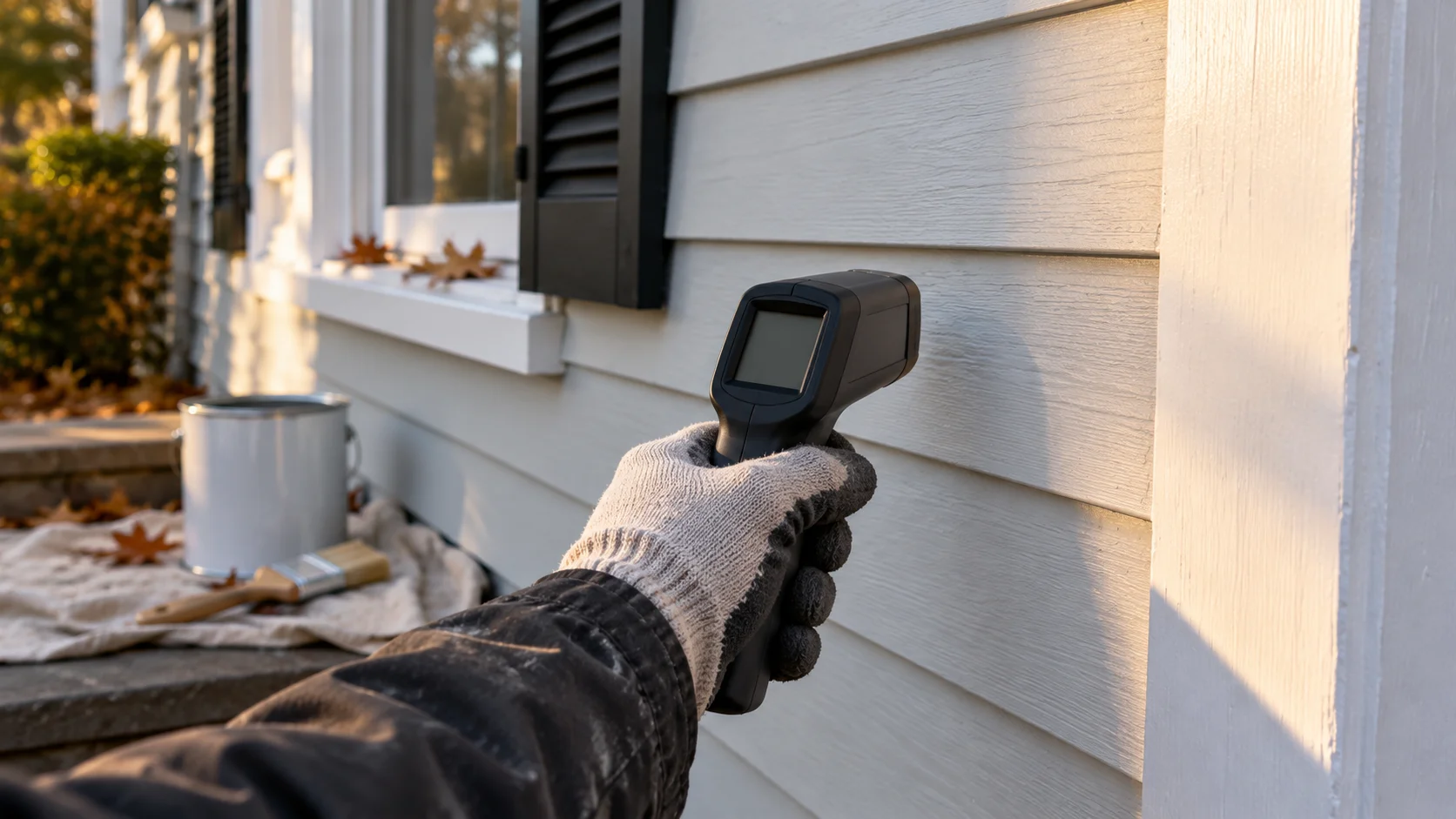
Siding behaves the same way. A north wall that has not seen sun all day, a porch ceiling, the lower courses of clapboard near damp soil, and anything metal can sit several degrees below the air. That is why the Sherwin-Williams sheets warn that "substrates may be colder." In late fall we check the surface itself with an infrared thermometer rather than trusting the forecast, and we check it on each side of the house, because the numbers are often different on each one. A south wall in full sun can be well above the air temperature by midday. The same wall can drop below it within an hour of sunset.
Dew Point: The Rule Most People Have Never Heard Of
The National Weather Service defines the dew point as "the temperature the air needs to be cooled to (at constant pressure) in order to achieve a relative humidity (RH) of 100%." Below that point, water has to come out of the air as liquid. On a house, that liquid is dew, and it forms on the coldest surfaces first.
That is why the Sherwin-Williams sheets require the surface to be at least 5° above the dew point, not just above 35°F. The margin gives you a cushion so the wall does not collect condensation while the paint is still soft. On a crisp, dry 45°F afternoon the dew point may be far below the wall temperature and there is no problem. On a damp 50°F October day with fog rolling in from the ocean, the dew point can be within a degree or two of the siding, and a perfectly "warm enough" day is not a painting day.
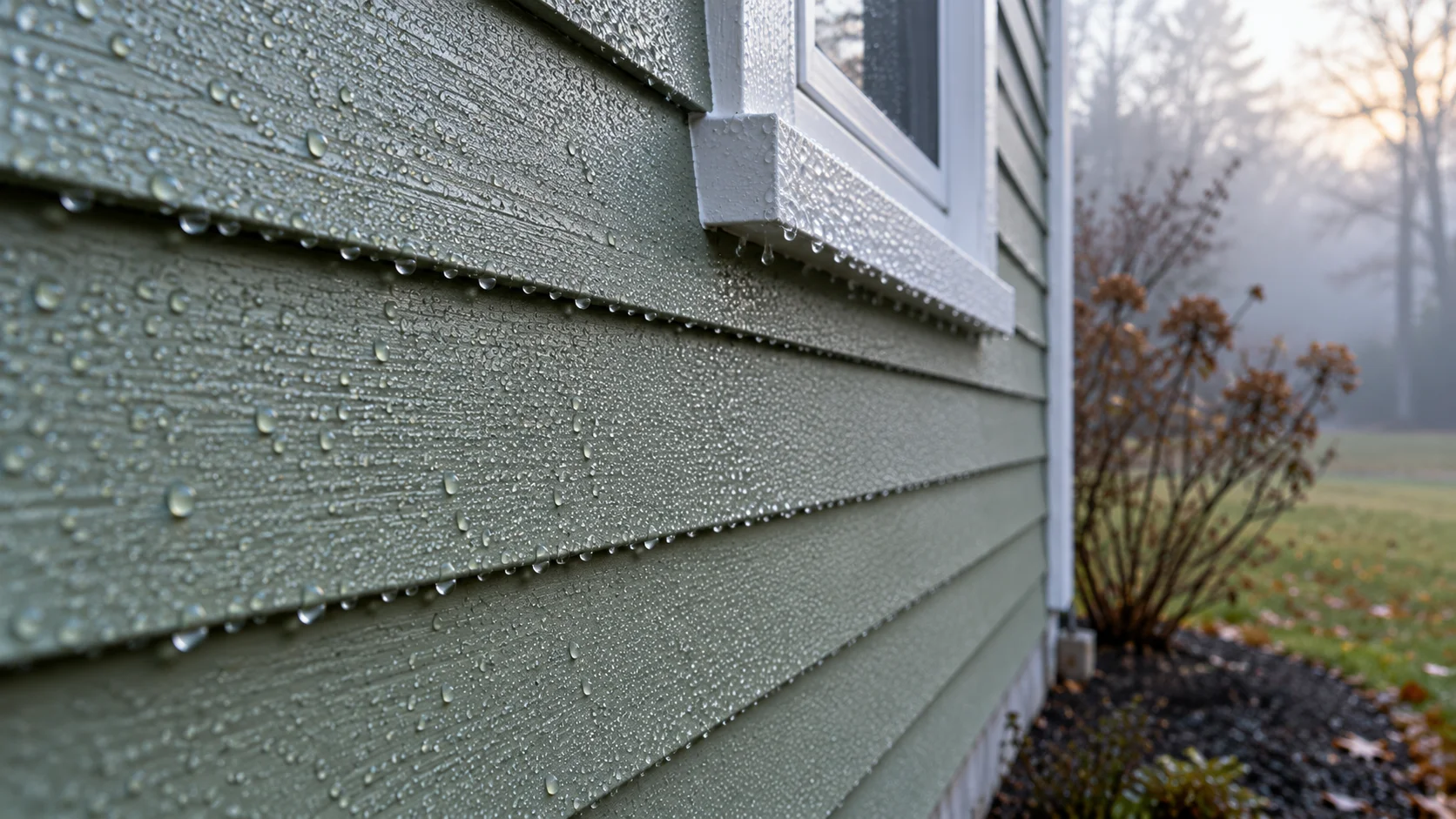
Evening dew is the classic fall failure. Sherwin-Williams' article on late-season painting puts it plainly: "A common mistake is to paint when daytime temperatures rise above 50° F and nighttime temperatures drop below 35° F," because "dew will form on almost everything as soon as the sun sets, and seep into the uncured paint." Its exterior application FAQ adds that "ideally, the temperature should be in the suggested range and above the dew point for at least 48 hours after application," and lists what can go wrong otherwise: "surfactant leaching, mildew growth, frosting, and adhesion problems."
Morning dew is the other half of the problem. In our experience, from October on, siding on the shaded sides of a house can stay wet well into the late morning. Painting over a damp surface breaks the most basic line on every data sheet: surfaces must be clean and dry. We wait for it to burn off, even when that means a later start.
Why Cold Paint Fails: Coalescence, Cure and Surfactant Leaching
Latex paint is a mixture of tiny plastic resin particles suspended in water. As the water evaporates, the particles crowd together and fuse into a continuous film. Sherwin-Williams' FAQ describes it this way: "Warmer temperatures are needed to allow the latex particles to coalesce, or melt together." Its late-season article warns that "the paint can stop coalescing, or melting together, when the temperature drops." Low-temperature paints are rated for application down to 35°F, but each one has a floor, and the manufacturer's limits are there because below it the film cannot be counted on to form properly.
When coalescence goes wrong, the paint may look fine the next morning. Sherwin-Williams' FAQ lists adhesion problems among the results of painting outside the temperature and dew point window, and in our experience that trouble shows up months later as early peeling, because the film never became the tough, continuous skin it was designed to be. It is the most expensive cold-weather mistake, because it cannot be fixed with a quick rinse or a touch-up; the only cure is to scrape and repaint.
The more visible problem is surfactant leaching. Surfactants are soap-like ingredients every latex paint needs. Sherwin-Williams describes the result as "a brown, sticky substance on painted walls" that "can also look like tan, brown or clear spots or paint streaks," and says "cooler temperatures can lead to surfactant leaching because they slow the paint's curing process, allowing surfactants to separate and float to the top." Benjamin Moore lists "paint drying in cool, humid conditions—Especially during early fall, this is common as frost can form overnight," "condensed moisture—Common on outdoor surfaces and in bathrooms," and deep colors tinted with universal colorants that "contain extra surfactants." Sherwin-Williams says outdoor leaching shows up most "under eaves, on soffits, balconies and covered patios where moisture can collect."
Leaching is usually cosmetic. Both companies say to rinse it off with water, and Sherwin-Williams says to "flush with clean water immediately" outdoors and to avoid painting over affected areas. It is still something we would rather prevent, because streaks on a freshly painted porch ceiling are not what anyone paid for. Dark colors are the ones we are most careful with late in the season.
Primers, Caulk and Stain Have Their Own Limits
A 35°F paint does not make a 35°F paint job. The products that go on first are often the ones that set the real limit.
- Primer. The Sherwin-Williams exterior sheets say "standard latex primers cannot be used below 50°F." Benjamin Moore's Fresh Start High-Hiding All Purpose Primer lists 40°F. Sherwin-Williams' Exterior Oil-Based Wood Primer can be applied "above 35°F," but its recoat time at 35 to 45°F is 24 to 48 hours. If your job includes bare wood, new trim or lots of spot-priming, the primer, not the topcoat, decides whether it can happen in November.
- Caulk. Sherwin-Williams' SherMax sealant says "apply at temperatures above 40°F," "do not apply to frozen or frost covered surfaces," and recommends "a minimum of 4 hours dry time" before painting, with "extra dry time during periods of high humidity and/or cool temperatures." Some sealants are made for colder work; DAP says its Dynaflex Ultimate gives "smooth gunning and clean tooling in temperatures ranging approximately from 20-30°F to 120°F." Caulk that can be applied in the cold still has to be dry before paint goes over it.
- Stain. Oil-based deck stains are the least forgiving. Sherwin-Williams' SuperDeck oil-based semi-transparent stain says to apply "with surface temperatures between 50°F and 90°F" and "do not apply if temperatures will fall below 50°F or if rain is expected within 24 hours." Benjamin Moore's waterborne Arborcoat allows 40°F. Our deck staining guide covers stain choice and the weather window in detail.
New Jersey's Painting Calendar, Month by Month
Rules are only useful next to real weather. NOAA's National Centers for Environmental Information publishes official 1991–2020 climate normals for each weather station. The closest to us is Freehold-Marlboro, a few miles from our Morganville shop. The table shows its average daily high and low for each month of the shoulder and winter seasons, plus the average number of nights each month when the low reaches 32°F or colder. The last column is our reading of what that means for exterior work; it is judgment, not a NOAA figure.
| Month | Average high | Average low | Nights at or below 32°F | Exterior painting outlook |
|---|---|---|---|---|
| September | 78.1°F | 56.1°F | 0 | Prime season. Heavier morning dew starts to push start times later. |
| October | 66.6°F | 44.3°F | 1.8 | Good, especially the first half. Shorter working days; watch clear, calm nights. |
| November | 56.2°F | 35.7°F | 11.5 | Selected days only, with 35°F-rated products and a clean 48-hour forecast. |
| December | 46.7°F | 28.0°F | 22.5 | Rarely workable. Small touch-ups only. |
| January | 41.7°F | 22.9°F | 25.8 | Interior season. |
| February | 44.4°F | 25.0°F | 22.9 | Interior season. Good time to book spring exterior work. |
| March | 51.4°F | 31.3°F | 17.5 | Mostly inspections, estimates and prep. Occasional warm stretches. |
| April | 63.0°F | 41.2°F | 3.8 | Season opens, but early-April nights still freeze. |
| May | 72.0°F | 50.6°F | 0.1 | Reliable. Primers, caulk and stains all work. |
The annual normals for the same station give freeze dates as probabilities. The median first 32°F night of fall is October 23; in about one year in ten it comes by October 9, and in about nine years in ten it has come by November 7. The median last 32°F night of spring is April 17, and in about one year in ten a freeze comes as late as May 6. The median freeze-free season is 190 days. The New Brunswick 3 SE station in Middlesex County is almost identical, with a median first freeze of October 26 and a last freeze of April 15.
Averages hide a lot. In November, Freehold-Marlboro averages about 23 days with a high of 50°F or more, which sounds encouraging, but it also averages 11.5 nights at or below freezing, and a 35°F product needs the whole 48 hours after painting to stay at 35°F or warmer. The practical question in November is never "is today warm enough?" It is "are today, tonight, tomorrow and tomorrow night all warm enough, and dry?"
Where you live in our area matters, too. Rutgers' Office of the New Jersey State Climatologist notes in its state climate overview that "in autumn and early winter, when the ocean is warmer than the land surface, the Coastal Zone will experience warmer temperatures than interior regions of the state," and that the average freeze-free period is 217 days along the seacoast but 179 in the central and southern interior. A house in Point Pleasant or Long Branch often gets a longer fall painting season than one in Englishtown or Hillsborough. The shore also brings more fog and salt air, so the dew point problem can be worse even when the thermometer looks better.
Should You Paint This Fall or Wait for Spring?
The honest answer depends on the size of the job and the state of the house.
Paint this fall if the job is small or moderate and can start in the next two to three weeks, the existing paint is sound, the scope is mostly repainting rather than bare wood, and the color is light or mid-tone. A one-coat refresh of a sound house, a front door, shutters or a single elevation fits comfortably into an October schedule; our guide to painting garage doors, front doors and shutters covers those smaller jobs.
Wait for spring if the house needs heavy scraping, lots of bare-wood priming, carpentry repairs that must dry before painting, or a dark color change. The same applies if the job would not start until mid-November. Latex primers need 50°F, recoats take a day or two in the cold, and every weather day lost in November pushes the rest of the job closer to the freeze. A job that takes a week in May can take several times as long in November, and the result is exposed to cold, damp conditions while it cures.
Do not let peeling wood sit all winter, though. If trim, siding or a porch rail is already bare and taking on water, it is worth spot-priming and painting the worst areas now, while there are still good days, and doing the full job in spring. In our experience a small repair in October is far cheaper than rotted wood in April. When to repaint in general, and how long a good job lasts, is covered in our guide to how often to paint a house in NJ.
Booking also matters. Winter is when we plan spring work, so homeowners who book in January or February usually get the earliest spring slots.
How We Paint Exteriors When It Gets Cold
When we do paint in October and November, we change how we work, not just which can we open. These are our standard practices on a late-season exterior painting job:
- Check the 48-hour forecast, not the day's high. We look at the overnight lows and the dew point for the day of painting and the following two nights. If the low will fall below the product's minimum, we move the work.
- Measure the surface. We use an infrared thermometer on each wall before we start, and again in the afternoon, and compare it to the dew point.
- Start later and stop earlier. We wait for dew to dry and for walls to warm up, and we stop applying paint early enough in the afternoon that it has several hours of daylight to set before the temperature drops and dew returns.
- Follow the sun. East walls in the late morning, south walls through midday, west walls in the early afternoon. North walls are saved for the warmest, driest days, or for spring.
- Choose products for the season. Late-season jobs get paints rated to 35°F, primers rated for the actual temperature, and caulk that can be applied and cured in time to be painted.
- Allow for longer recoats. When the sheet says 24 to 48 hours at 35 to 45°F, we plan for it rather than rushing the second coat.
- Keep the paint itself warm. The sheets list minimum storage temperatures (40°F for Aura Exterior and Regal Select Exterior), and paint left in a cold truck overnight goes on cold. Material temperature is part of the Sherwin-Williams rule.
- Tell you when to wait. If the numbers do not work, we reschedule for spring and write that into the estimate.
Masonry follows the same logic, and some masonry coatings are stricter: both elastomeric coatings we compared for stucco need 50°F. We covered those limits in our guide to painting stucco.
Can You Paint Inside in Winter?
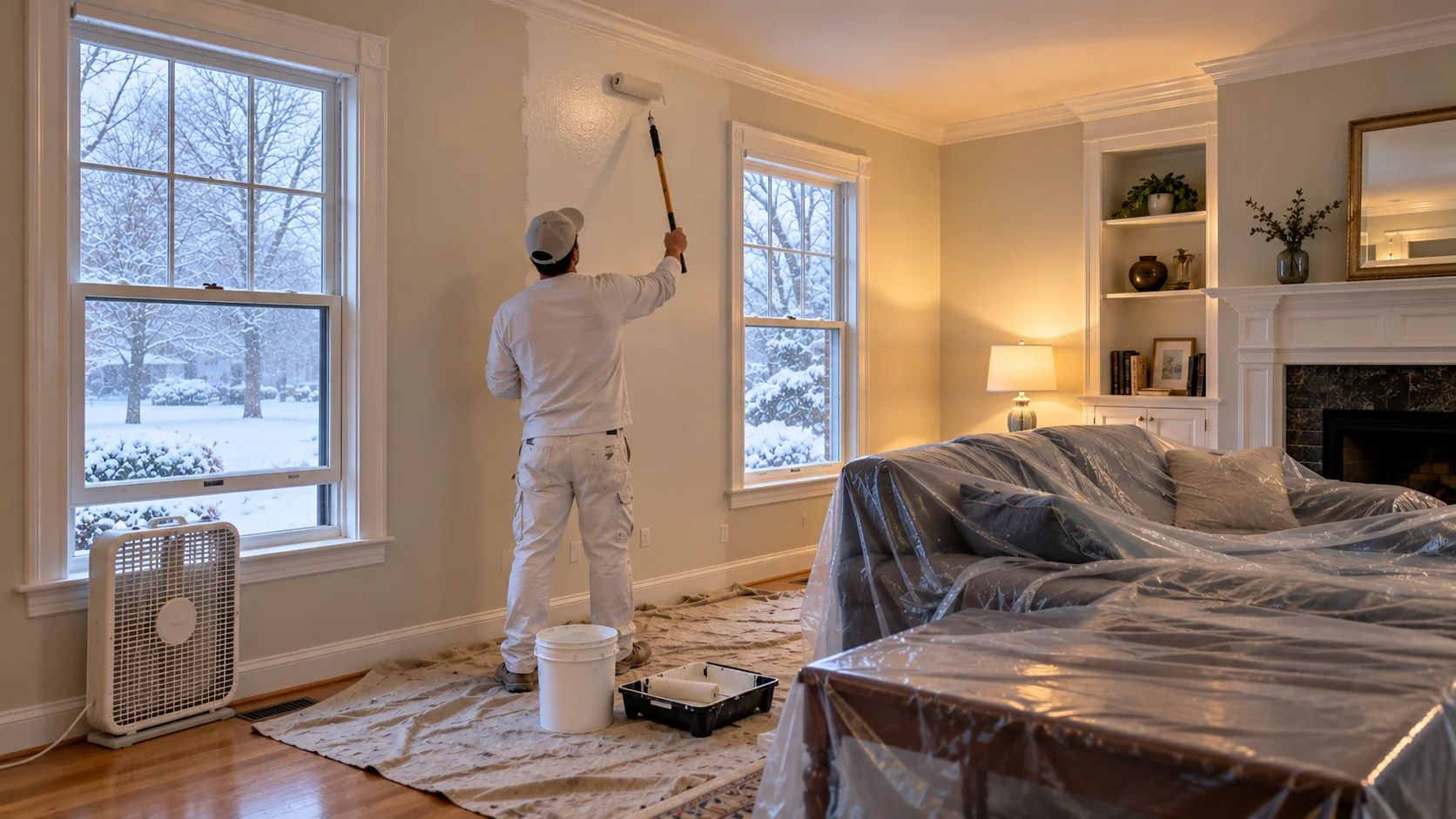
Yes. In our experience winter is one of the best times to paint interiors: the house is closed up, schedules are usually more flexible, and the rooms are ready for the holidays or for spring. The interior data sheets set the limit at room conditions, not outdoor ones. Benjamin Moore's Aura Interior sheet says "do not paint when air or surface temperature is below 50 °F (10 °C)," and Sherwin-Williams' Emerald Interior sheet says "apply at temperatures above 50°F." A heated home clears that easily.
A few winter details still matter:
- Cold rooms and exterior walls. An unheated sunroom, a garage, a basement or a room that is shut off to save heat may be below 50°F. So can the inside face of a poorly insulated exterior wall or a window sill on a cold night. We keep the heat on through the job and for a few days after.
- Ventilation. The EPA says "paints, varnishes and wax all contain organic solvents" and advises: "Increase ventilation when using products that emit VOCs." The premium lines we use are low-VOC, but in winter we still ventilate, usually with a window cracked and a fan in the room, while keeping the room above the paint's minimum. Our guide to paint fumes and VOCs covers ventilating when the windows have to stay shut.
- Bathrooms and kitchens. Steam from a shower on freshly painted walls is a common indoor cause of surfactant leaching. Benjamin Moore lists "condensed moisture" in bathrooms as a cause, so we ask homeowners to keep showers short and fans on for the first few days.
- Cure time. Benjamin Moore's sheets say painted surfaces "can be washed after two weeks." That does not change in winter, so plan on gentle treatment of new walls through the holidays.
If you are thinking about a winter project, our interior painting page describes how we protect furniture and floors, and every estimate includes an in-home color consultation.
Signs That Cold-Weather Paint Went Wrong
If you painted late last fall, or your house was painted then, these are the things we would look for as the weather warms up:
- Tan, brown or glossy streaks under eaves, on soffits and porch ceilings. That is likely surfactant leaching. Rinse it with water while it is fresh; do not paint over it.
- Mildew spots on a new coat, especially on north walls and shaded trim. Sherwin-Williams lists mildew growth among the problems that follow painting outside the temperature and dew point window.
- Peeling or blistering in the first season, particularly over areas that were primed late in the year, or where caulk was painted before it had dried.
- Uneven sheen across one elevation, where parts of a wall dried in sun and parts in cold shade.
Some of these are cosmetic and some mean the coating has to come off. If you are not sure which you are looking at, it is worth having someone look before you repaint over it; our guide to why paint peels helps tell a cold-weather failure from a moisture or adhesion problem.
Plan Your Project Around the Weather
Painting in cold weather is not a gamble when it is done by the data sheet and the forecast, and it is not worth doing when the numbers do not line up. We would rather tell you to wait until April than put paint on a wall that will not cure. If you are weighing a fall exterior job against a spring one, or want to get an interior done this winter, we will look at the house, check what it needs and give you a schedule that fits the season.
NJ Painting Co. is a family-owned, licensed and fully insured painting company at 36 Church Rd, Morganville, NJ 07751, working through the seasons across Monmouth, Middlesex and Ocean counties and the rest of our service area, and our work carries a two-year workmanship warranty. Call (732) 239-0932 or request a free estimate.
Frequently Asked Questions
Can you paint in cold weather?
Yes, within the limits on the product's data sheet. Premium exterior paints from Sherwin-Williams and Benjamin Moore, such as Emerald, Duration, SuperPaint, Resilience and Aura Exterior, can be applied down to 35°F air and surface temperature. Sherwin-Williams also requires the surface to be at least 5° above the dew point and temperatures to stay above 35°F for 48 hours after painting.
What is the minimum temperature to paint outside?
It depends on the product. Low-temperature exterior paints are rated to 35°F. Many primers and caulks need 40°F, standard latex primers need 50°F, and oil-based deck stains such as SuperDeck need a surface temperature of at least 50°F. The lowest-rated product in the job sets the minimum for the whole job.
Is 40 degrees too cold to paint outside?
Not for a paint rated to 35°F, as long as the surface is also above 35°F, the surface is at least 5° above the dew point, and it will not drop below 35°F for the next 48 hours. Expect much slower drying: Sherwin-Williams lists 24 to 48 hours before a second coat at 35 to 45°F. A standard latex primer should not be used at 40°F.
Is 50 degrees warm enough to paint outside?
Usually, yes. 50°F clears the minimum for every exterior paint, primer, caulk and stain in the table above, including standard latex primers and oil-based deck stain. The catch is the night that follows: if the low will drop below the product's minimum within 48 hours, or the siding will fall to within 5° of the dew point while the paint is still soft, a 50°F afternoon is still a risky painting day.
Can you stain a deck in cold weather?
Within a narrower window than paint. Sherwin-Williams' SuperDeck oil-based semi-transparent stain needs surface temperatures between 50°F and 90°F and says not to apply if temperatures will fall below 50°F or rain is expected within 24 hours. Benjamin Moore's waterborne Arborcoat semi-solid stain allows 40°F. In New Jersey, that usually puts deck staining before mid-October.
How long does exterior paint need before it gets cold?
Sherwin-Williams says temperatures should stay in the suggested range and above the dew point for at least 48 hours after application, and to avoid painting if rain or snow is expected within 2 to 3 hours (1 to 1.5 hours for Resilience). Paint keeps curing for weeks after that, but the first two days are the critical period.
Can you paint inside the house in winter?
Yes. Interior paints such as Benjamin Moore Aura and Sherwin-Williams Emerald need the air and surface to be above 50°F, which a heated home provides. Keep the heat on, ventilate with a slightly open window or a fan, and treat the new paint gently for about two weeks.
When is the best time to paint a house exterior in New Jersey?
Late spring through early fall. At the Freehold-Marlboro weather station, the median last spring freeze is April 17 and the median first fall freeze is October 23, based on NOAA's 1991–2020 normals. May through early October is the most reliable window, and exterior work in November should be limited to days with a good 48-hour forecast.
About the author
Written by the NJ Painting Co. team
NJ Painting Co. is a family-owned painting contractor based in Monmouth County, in business since 2004. We are licensed and fully insured, work with Benjamin Moore and Sherwin-Williams paints, and back our work with a 2-year workmanship warranty. We serve Monmouth, Middlesex, Ocean, Mercer, Somerset and Burlington counties, plus Union, Essex, Hudson, Bergen and Passaic in North Jersey.