School painting in New Jersey is planned around the district calendar: dusty and odorous work goes into the summer break, the rest is phased so classrooms and corridors are never both out of use, and the contract is awarded early enough for that window to exist. Use low-VOC washable coatings and give staff at least 24 hours' notice.
In older buildings, settle lead and asbestos questions before anyone scrapes. This guide is written for the facilities director, business administrator or head of school who has to get a building painted without losing a teaching day, and it covers the New Jersey rules that shape that plan.
We are a family-owned painting company in Morganville and work for commercial and institutional clients across Monmouth, Middlesex, Ocean, Mercer, Somerset and Burlington counties and in North Jersey, using Benjamin Moore and Sherwin-Williams products. Every rule quoted below comes from the regulation or agency page itself, read on 20 October 2026 and listed in our sources. There are no prices in this article; for what moves a commercial number up or down, see our guide to commercial painting cost in NJ and the planning ranges in the cost guide.
The Short Answer
- Summer is the work window, and it is shorter than it looks. Custodial deep cleaning, gym floor recoating, summer programs, roof and HVAC work and furniture moves all want the same weeks. Painting gets a slice of the break, not the whole thing.
- The air rule is real. New Jersey's indoor air quality standard for buildings occupied by public employees requires renovation work in occupied buildings to be isolated, requires the employer to check paint labels and safety data sheets for VOCs before selecting products, and requires staff to be notified "at least 24 hours in advance" of work that may introduce air contaminants.
- Pick paint for the hallway, not the brochure. Low-VOC or zero-VOC waterborne coatings, a washable eggshell or satin on walls, and enamel on doors, frames and railings. EPA's own school checklist warns that a low-emitting paint that has to be redone more often can create more indoor air problems over time.
- Pre-K and kindergarten rooms in pre-1978 buildings are a federal lead question. The EPA renovation rule covers "child-occupied facilities," which by definition include kindergarten classrooms and preschools in buildings constructed before 1978. Settle it before anyone scrapes.
- Public schools buy through public bidding. Above the bid threshold, a New Jersey board of education awards a contract by resolution "to the lowest responsible bidder after public advertising for bids." That process, not the painter's calendar, usually decides whether summer work is possible.
Why School Painting Is Planned Around the Calendar
An office repaint is planned around business hours. A school repaint is planned around a year. The district calendar fixes three dates that matter more than anything a contractor says: the last day students are in the building in June, the day teachers return for set-up in late August or early September, and the first day of school. Everything that produces dust, odor or noise belongs between the first two. Anything that can be done in an occupied building without displacing a class can happen around them.
EPA's guidance says the same thing in general terms. Its Indoor Air Quality Tools for Schools renovation checklist advises "conducting renovation work during hours when the school is unoccupied (for example, during summer months)," and adds, in the painting section, "Schedule painting for times when the building is unoccupied." The checklist also says that "if the area being painted shares a heating, ventilation, and air conditioning (HVAC) system with other areas, ensure those areas are also unoccupied while painting." That second sentence is the one that catches schools out: painting a single wing during summer school can still put odor into the classrooms that share its air handler.
What competes for the summer break
Most schools do not have an empty building for ten weeks. They have a building in which every trade and every department wants the same window. Before you set a painting schedule, put these on one calendar with the facilities team:
- Floor work. Gym floor recoating and resinous floor installation want an empty, closed-off room and time to cure. Painting has to finish above and around a floor before it is coated, not after.
- Custodial summer cleaning. Furniture moves, carpet extraction and floor stripping compete for the same corridors. Agree which week each wing is handed to the painters and which week it is handed back.
- Summer programs. Extended school year, camps and summer school occupy specific rooms, and the shared-HVAC point above applies to them.
- Mechanical and roofing work. HVAC shutdowns and roof work change both the ventilation available to the painters and the risk of water damage to fresh finishes.
- Teacher set-up days. Classrooms must be finished, aired and put back before teachers return, not just before students do.
Working back from the first day of school
A sensible sequence for a summer repaint runs from the end of the break backwards. Leave the final week clear for punch-list touch-ups, airing and furniture return. Before that, the occupied-impact work: classrooms, corridors, stairwells and offices in an order agreed wing by wing. Before that, the high-access work that needs a room fully empty, such as gymnasium walls, auditorium ceilings and stairwell heights. And before the break even starts, the walkthrough, the specification, the product submittals and the award, which for a public district means a bidding process that has its own lead time (see below).
Work that can happen during the school year
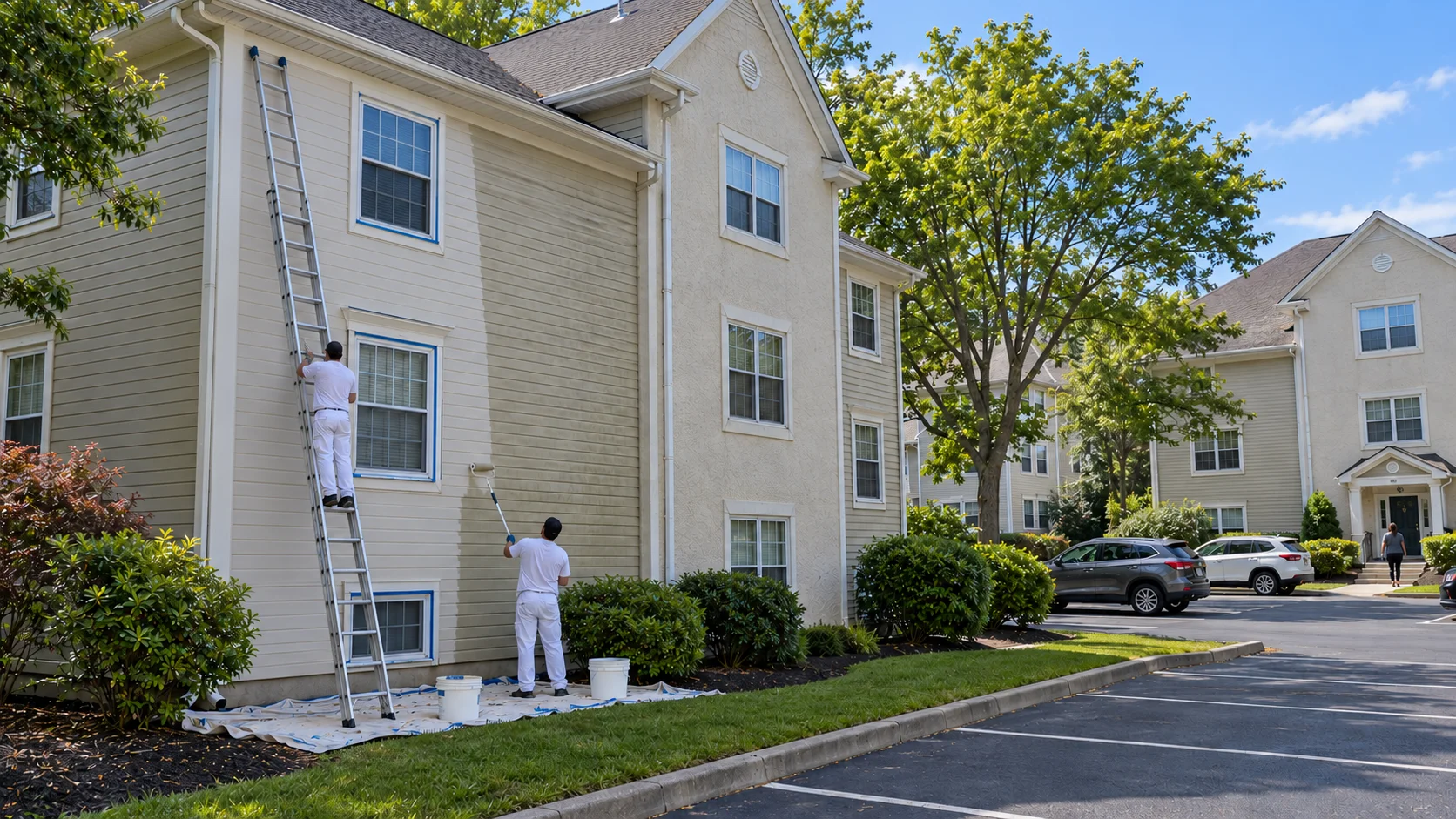
Not everything has to wait for summer. Exterior trim, railings and doors can be phased by elevation, with the entrance that is in use left alone until a scheduled closure. In our experience spring and early autumn are often kinder exterior months than midsummer, when south and west elevations sit in full sun for hours. Inside, a school-year project is limited to areas that can be fully emptied and closed off: an unused classroom, an office suite during a break week, a stairwell that is not a required route. Anything else is better left for the break.
New Jersey's Indoor Air Rule for Public Employees
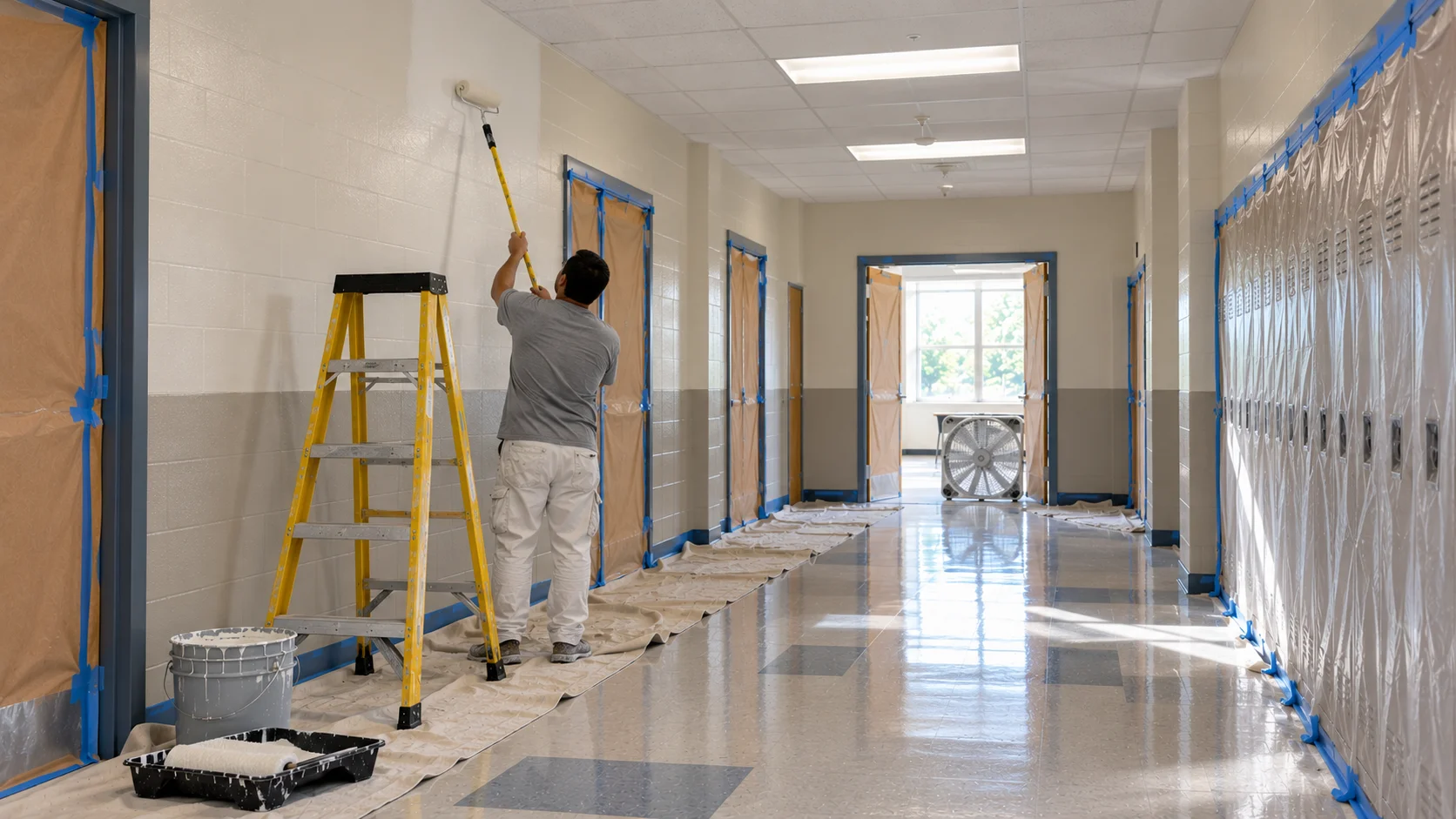
Public school staff are public employees, and New Jersey has an indoor air quality standard written for them. N.J.A.C. 12:100-13 applies "to matters relating to indoor air quality in buildings occupied by public employees during regular work hours." For a district, it turns good practice into a compliance item, and three parts of it bear directly on painting.
Isolate the work and air it out before re-occupancy
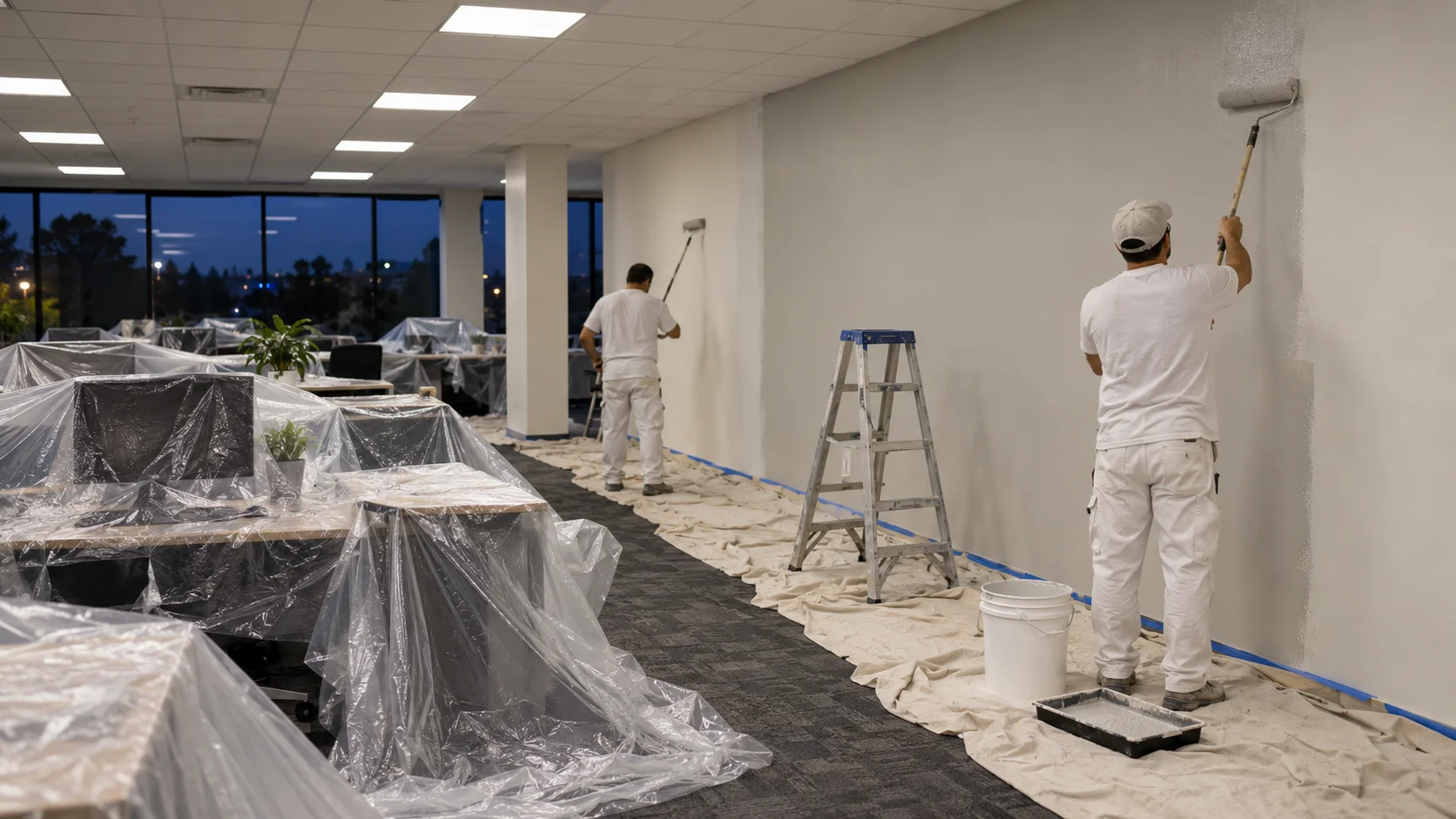
Section 12:100-13.5 says that "renovation and/or new construction work in occupied buildings shall be isolated and air contaminants, dust and debris shall be confined to the renovation or construction area by use of measures such as, but not limited to, physical barriers, pressure differentials, and/or performing the work during periods of minimal occupancy." It continues: "Before re-occupancy, work areas shall be cleaned and aired out as necessary." For a school, the summer break is the longest period of minimal occupancy in the year, which is the regulatory reason the calendar matters, not just the convenient one.
Check the paint before you choose it
The same section requires that "before selection and use of paints, adhesives, sealants, solvents" and other materials, "the employer shall check product labels and Material Safety Data Sheets or seek and obtain information from the manufacturers of those products on whether or not they contain volatile organic compounds." In practice, ask every bidder to submit the product data sheet and safety data sheet for every coating in the specification, and keep them with the job file.
Tell staff 24 hours ahead
Finally, "the employer shall notify employees at least 24 hours in advance, or promptly in emergency situations, of work to be performed on the building that may introduce air contaminants into their work area." The written compliance plan the rule requires (Section 12:100-13.3) must also include procedures for "notifying employees of work that may introduce air contaminants" and "maintaining air quality during renovations and remodeling." A painting schedule with dates per wing is what makes those notices possible; ask your contractor for one in the proposal, and update it when the weather or another trade moves it.
These obligations sit with the employer, meaning the district or school, not the painter. The rule applies to public employers; a private or parochial school is not bound by it, but the same steps are the right way to run a project in an occupied building.
Choosing Coatings for Classrooms, Corridors and Gyms
School surfaces take more abuse than almost any other interior: backpacks along corridor walls, hands on every door frame, chairs against classroom walls, balls against gymnasium block. The coating schedule has to balance two things EPA puts side by side in its checklist: "both solvent- and water-based paints give off volatile organic compounds that can lead to IAQ problems," and "a relatively low-emitting paint might create more IAQ problems in the long run if it is necessary to repaint more frequently." Durability is an air-quality decision as well as a budget one.
Walls, by area
- Classrooms and offices. A low-VOC or zero-VOC waterborne acrylic in an eggshell or low-sheen finish, washable enough for marker and fingerprints without the glare a semi-gloss gives under classroom lighting. As one example of the category, Benjamin Moore lists its Ultra Spec 500 interior eggshell with a VOC range of "Zero," a dry time of "2 Hours" and a recoat time of "2-3 Hours."
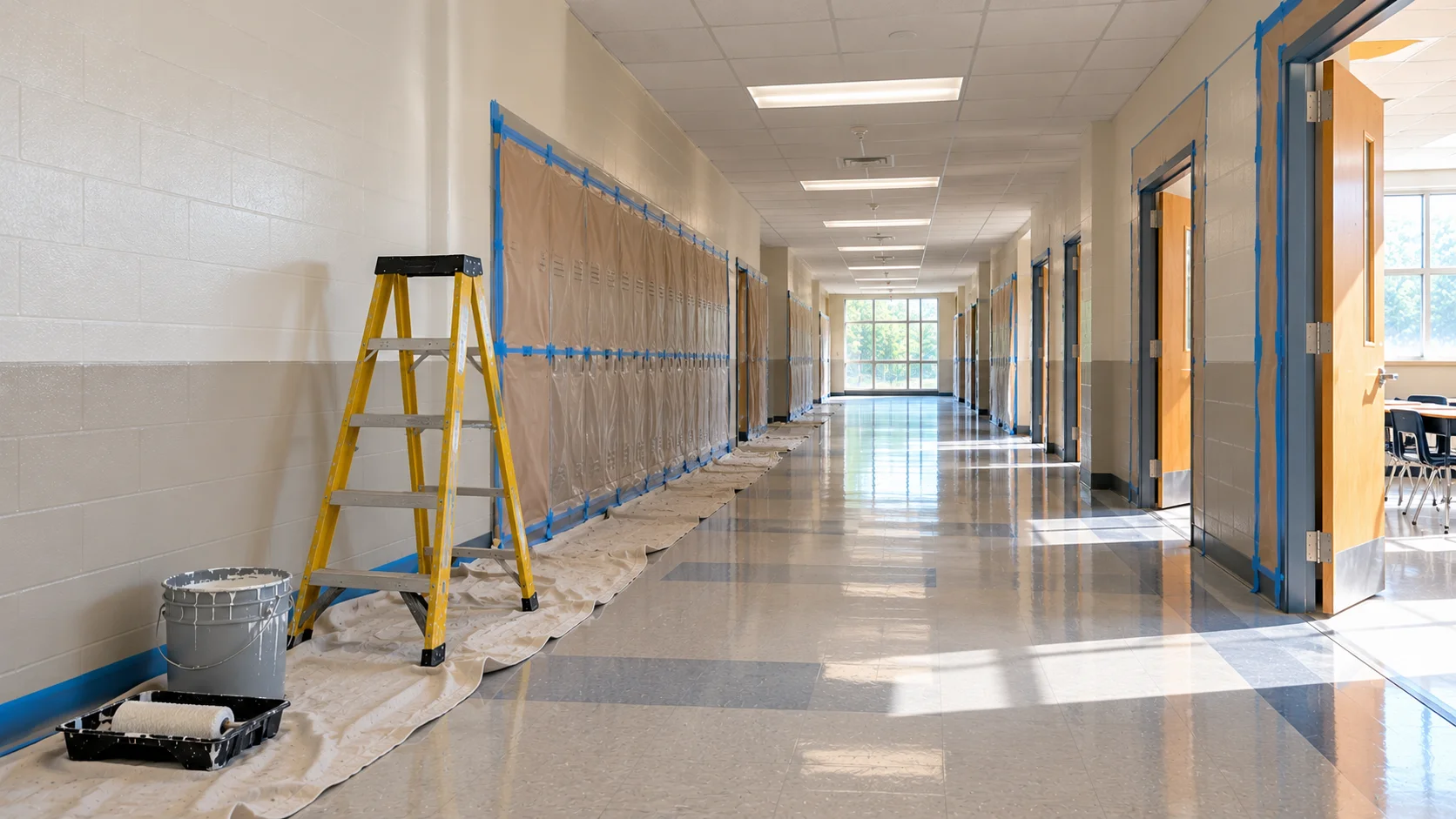
- Corridors and stairwells. The same product family in a tougher sheen, often satin or semi-gloss on the lower wall where bags and carts hit it, with a consistent color break line so touch-ups disappear. Our paint sheen guide explains why two brands' "eggshell" do not match.
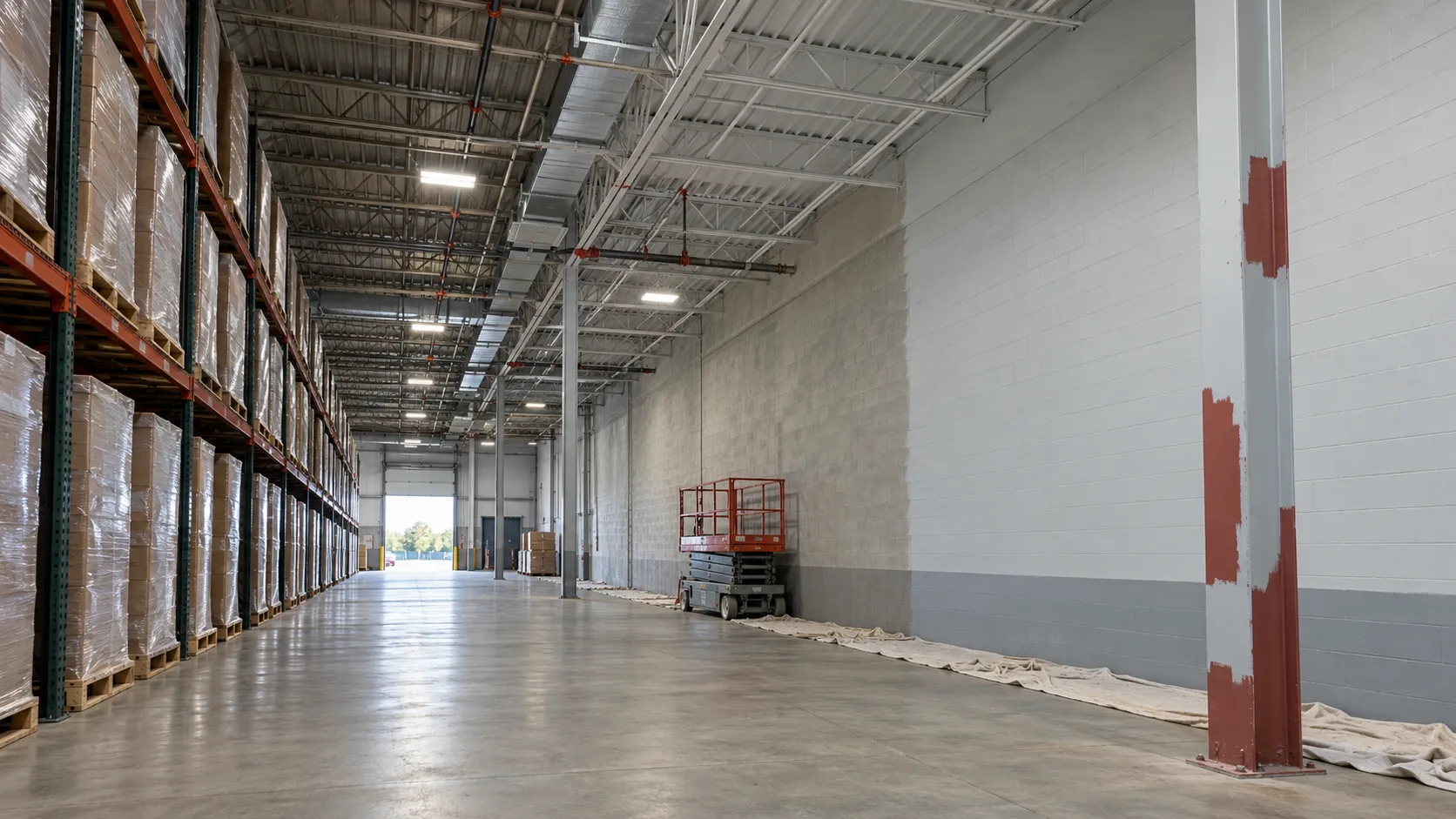
- Gymnasiums, locker rooms and pool-adjacent spaces. Block walls take a block filler first, then a coating chosen for impact and moisture. Locker room and kitchen floors are a resinous flooring question, not a paint one; see our commercial epoxy flooring guide and our epoxy flooring page.
- Doors, frames and railings. Waterborne enamel over the correct primer for the substrate, because hollow metal doors and stair railings are the most-handled painted surfaces in the building.
New Jersey limits VOC content regardless of what you specify
New Jersey regulates the VOC content of architectural coatings under N.J.A.C. 7:27-23, which applies to anyone who "applies an architectural coating for compensation within the State of New Jersey." Section 7:27-23.3 prohibits applying for compensation any coating that exceeds the limit for its category in the rule's Table 1. That sets the ceiling. A school specification should aim well below it, and the product data sheets submitted under the indoor air rule above are where you confirm what you are getting. Our guide to paint fumes and VOCs explains why "zero VOC" on a label is a formulation claim and why ventilation still matters.
Ventilate during the work and for days after
EPA's checklist recommends using "supply and exhaust fans to sweep paint fumes out of the building" and to "operate supply fans continuously (24 hours/day, 7 days/week) at the highest possible outdoor air supply setting from the beginning of the painting work until several days after completing it." That is a building operations instruction, so it belongs in the facilities plan: the painters need to know the ventilation will be running, and the district needs to know not to set the air handlers back to summer setback the moment the crew leaves.
Patch before you paint
Most of the visible difference between a tired corridor and a fresh one is not the color, it is the patching: anchors from years of bulletin boards, gouges at chair height, cracks at door heads. A specification should say how holes and damage are repaired and to what standard, room by room. Our guide to drywall repair covers what each kind of damage takes.
Lead and Asbestos in Older School Buildings
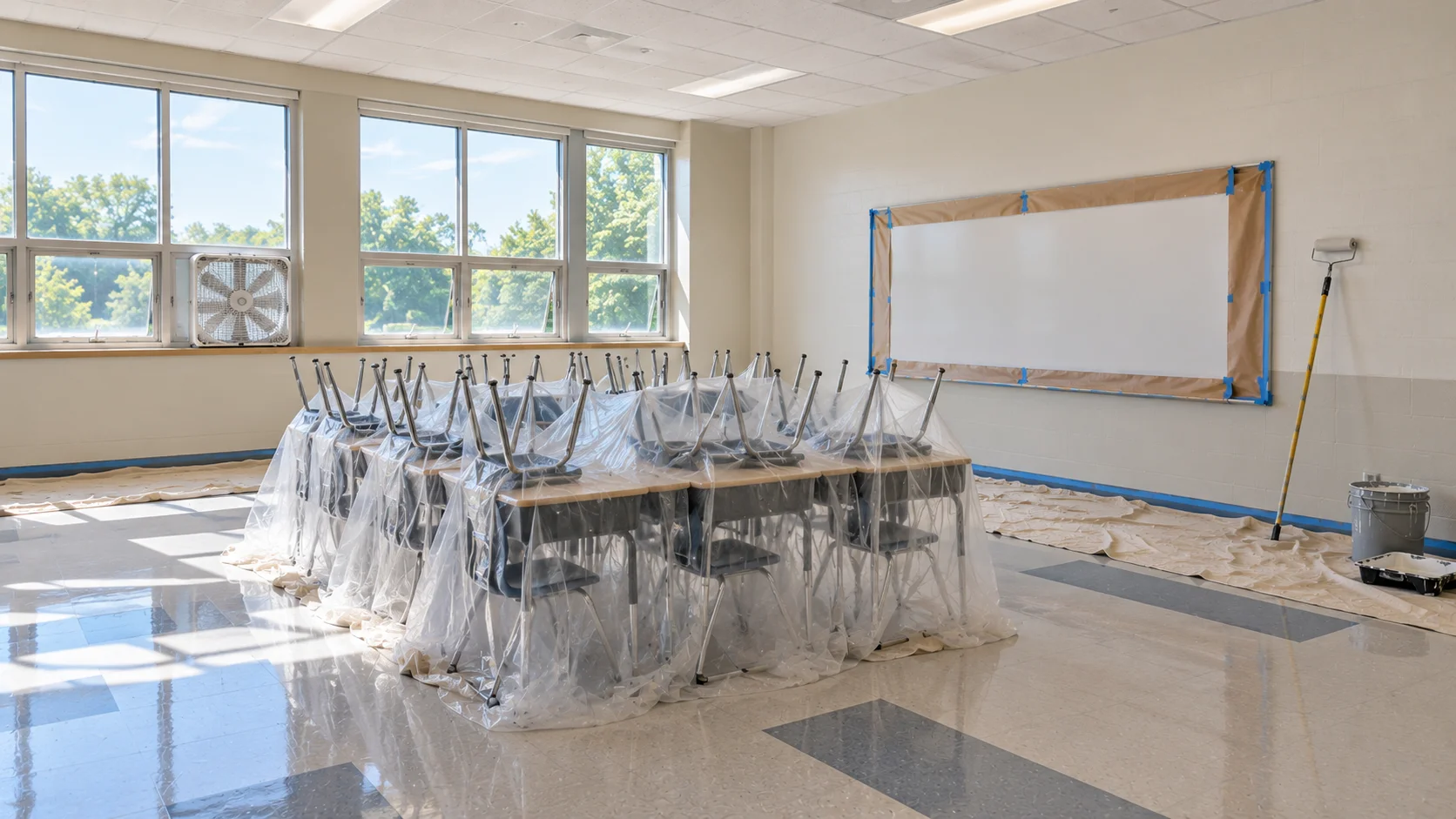
If your building, or any wing of it, was constructed before 1978, painting it is mostly preparation: scraping, sanding and patching surfaces that may carry decades of earlier coatings. Two questions have to be answered before that preparation starts.
The federal lead rule and "child-occupied facilities"
EPA's Renovation, Repair and Painting (RRP) rule requires "that anyone paid to perform work that disturbs painted surfaces in homes, childcare facilities and preschools built before 1978 be certified and their employees be trained." In a school, the rule reaches the parts of the building that meet the federal definition of a child-occupied facility: a building or portion of a building "constructed prior to 1978, visited regularly by the same child, under 6 years of age, on at least two different days within any week," where each day's visit lasts at least 3 hours, the weekly visits total at least 6 hours and the annual visits at least 60 hours. The definition says child-occupied facilities "may include, but are not limited to, day care centers, preschools and kindergarten classrooms."
The definition also draws lines inside the building. In public or commercial buildings it covers "only those common areas that are routinely used by children under age 6, such as restrooms and cafeterias," while "common areas that children under age 6 only pass through, such as hallways, stairways, and garages are not included." On the exterior it covers only "the exterior sides of the building that are immediately adjacent to the child-occupied facility" or to those common areas. And the rule does not apply to minor repair and maintenance that disturbs "6 square feet or less of painted surface per room for interior activities or 20 square feet or less of painted surface for exterior activities," subject to conditions in the regulation. A painting scope for a pre-1978 elementary school should therefore map which rooms are pre-K and kindergarten, which restrooms and cafeteria spaces those children routinely use, and which exterior walls adjoin them.
Outside the federal definition, lead is still lead. EPA's school renovation checklist says simply: "Test for lead before removing old paint." NJ Painting Co. is not an EPA Lead-Safe Certified firm, so in a pre-1978 building we do not bid paint-disturbing work in rooms that count as a child-occupied facility; ask every bidder for their firm certification and how they will handle those rooms, and see our guide to lead paint in older New Jersey buildings for what the rule requires of a contractor.
Asbestos: check the management plan first
EPA's checklist reminds schools: "Do not disturb asbestos during demolition," and notes that "most schools have identified and dealt with asbestos in the school under state or federal requirements." Schools with asbestos-containing materials identified in an Asbestos Hazard Emergency Response Act (AHERA) survey "should have a management plan on file at the school," and the checklist says to "refer to the management plan when considering whether planned renovations will require disturbing areas containing asbestos." Before a painter scrapes a textured ceiling, a pipe-chase wall or old plaster, the facilities office should check that plan. Painting is not asbestos abatement, and a painter who finds a suspect material should stop and report it, not paint over it and move on.
Public Bidding and the Paperwork Behind a School Job
For a public district, how the contractor is chosen decides when the work can start. New Jersey's Public School Contracts Law, N.J.S.A. 18A:18A, says that every contract "the cost of which in the aggregate exceeds the bid threshold, shall be awarded only by resolution of the board of education to the lowest responsible bidder after public advertising for bids and bidding therefor," except where the law provides otherwise. Advertising, a bid opening and a board meeting to award all take calendar time, and they have to fit before the break they are meant to use. Your business administrator or purchasing agent will know the current threshold and process; the painting plan should be built around it rather than the other way around.
Public work also brings labor rules. New Jersey's Public Works Contractor Registration Act regulations say that "no contractor shall bid on any contract for public work unless the contractor is registered pursuant to the Act," and that a subcontractor listed in a bid must be registered "at the time the bid is submitted to the public entity." Prevailing wage applies to covered public work as well; our guide to commercial painting cost covers how that changes a price. Check registration for every bidder and every listed subcontractor before you award.
Whatever the procurement route, ask for the same paperwork from every bidder:
- A certificate of insurance naming the district or school, issued before mobilization, and the endorsement forms your risk advisor asks for.
- Workers compensation for the contractor and every subcontractor on site.
- Product data sheets and safety data sheets for every coating in the specification, for the indoor air file.
- A wing-by-wing schedule with dates, so staff notices can go out at least 24 hours ahead.
- For pre-1978 buildings, the bidder's plan for child-occupied areas and its EPA firm certification if it will disturb paint there.
- The district's own requirements for anyone working on school grounds; follow your board policy and counsel on what those are.
- A close-out package listing the product, color and sheen used in every area, so next year's touch-ups match.
Our guide to choosing a painting contractor in NJ covers due diligence that applies equally to a school award, and our HOA and condo painting guide has a fuller treatment of specifications, allowances and change orders that a facilities director can adapt.
Colleges and Universities
Higher education follows the same logic with a different calendar. Residence halls have a short gap between spring move-out and summer conference or orientation use, and another before fall move-in. Academic buildings often stay partly occupied through summer sessions and research, so phasing by floor or wing matters more than on a K-12 campus. Dining halls and athletic facilities each have their own closures. A university project is usually several small summer windows rather than one long one, and a contractor's job is to fit the scope to each window without leaving a half-finished building when the next group arrives.
Talk to Us About Your School
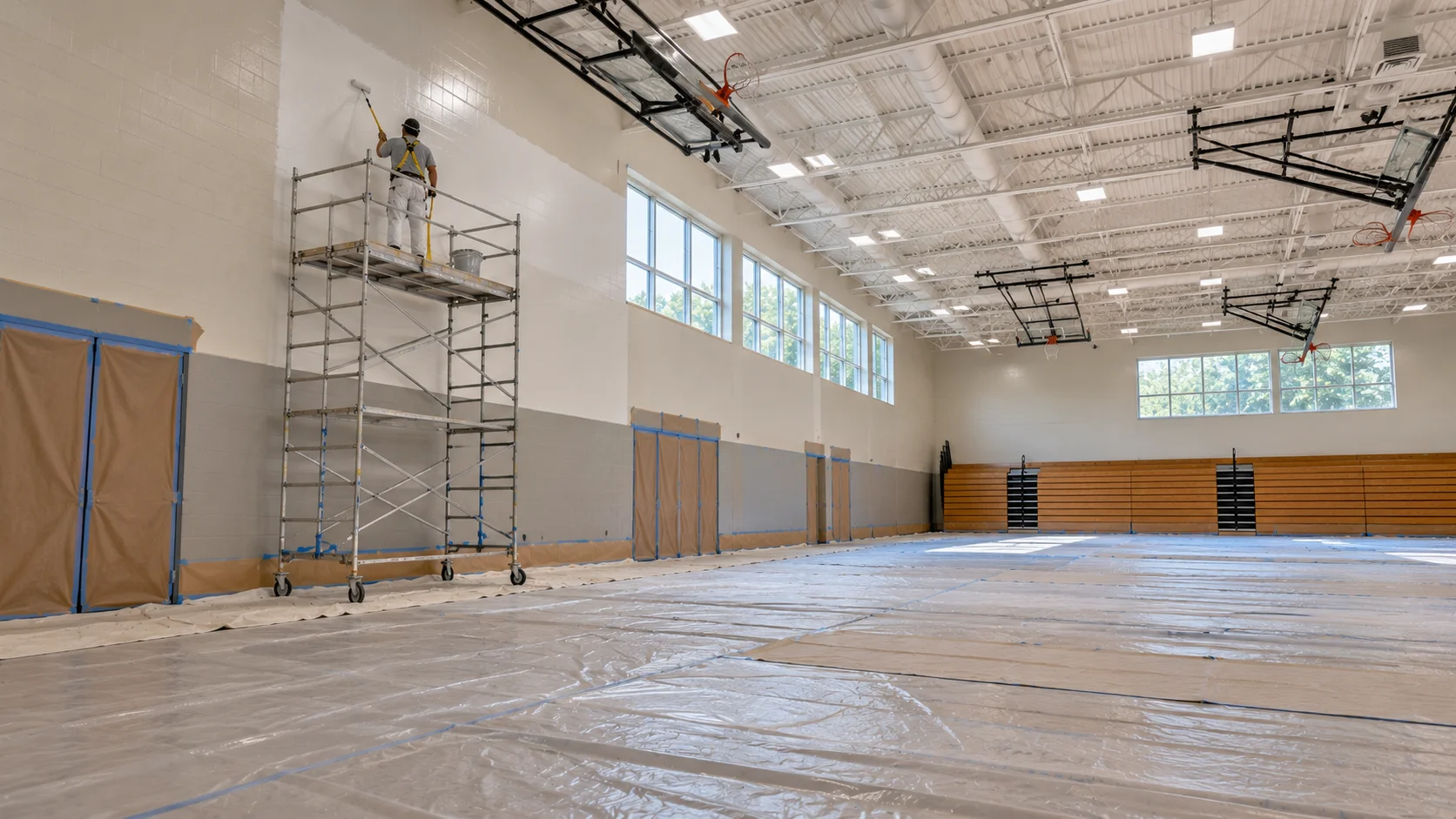
The number and the schedule for your building come from walking it with the facilities team, wing by wing, with the calendar on the table. NJ Painting Co. is a family-owned, fully insured painting company at 36 Church Rd, Morganville, NJ 07751, painting in New Jersey for more than 20 years with Benjamin Moore and Sherwin-Williams products. For schools we scope the building against your district calendar, phase the work so wings are handed over and back on agreed dates, submit product and safety data sheets with the proposal, issue certificates of insurance before we mobilize, and leave a color and product schedule on file.
See how we run occupied-building work on our commercial painting page, including its section on school and university painting, read our guides to medical and dental office painting and restaurant and retail painting for the same planning in other occupied buildings, read about coating floors in locker rooms, kitchens and corridors on our epoxy flooring page, and check the planning ranges in the cost guide. We cover Monmouth, Ocean, Middlesex, Mercer, Somerset, Burlington, Union, Essex, Hudson, Bergen and Passaic counties. Call (732) 239-0932 or send us the building, its age, the areas you want painted and your summer dates, and ask us about the job minimum when you enquire.
Frequently Asked Questions
When is the best time to paint a school in New Jersey?
The summer break, for anything that creates dust or odor in classrooms and corridors. EPA's schools checklist recommends "conducting renovation work during hours when the school is unoccupied (for example, during summer months)," and New Jersey's indoor air rule for public employees lists "performing the work during periods of minimal occupancy" as one way to confine contaminants. Exterior work and self-contained rooms that can be emptied can be phased into spring and early autumn. Plan the award early enough that the summer slot is actually available.
How far ahead should a district plan a summer painting project?
Far enough ahead to walk the building, write the specification, run the bid or quote process and get a board award before the break, which for a public district usually means starting in the winter. Contract awards above the bid threshold require public advertising and a board resolution under the Public School Contracts Law, and each step takes calendar time. A project scoped in May is usually a project that loses part of its scope.
Can classrooms be painted while school is in session?
Only rooms that can be fully emptied and closed off, and only with the ventilation and notice steps in place. New Jersey's indoor air rule requires renovation work in occupied public buildings to be isolated and confined, work areas to be cleaned and aired out before re-occupancy, and staff to be notified at least 24 hours in advance. EPA adds that if a room shares an HVAC system with others, those areas should also be unoccupied while painting. For most classrooms and corridors that points to the break.
What paint should a school use?
A low-VOC or zero-VOC waterborne acrylic in a washable eggshell or satin for classrooms and offices, a tougher sheen on lower corridor walls, block filler and an impact-resistant coating on gym block, and waterborne enamel on doors, frames and railings. EPA's school checklist points out that a low-emitting paint that has to be redone more often can create more indoor air problems over time, so durability matters as much as the VOC figure. New Jersey also caps VOC content for architectural coatings applied for compensation under N.J.A.C. 7:27-23.
Do lead paint rules apply to painting a school?
The EPA renovation rule applies to child-occupied facilities in buildings constructed before 1978, which by definition can include preschools and kindergarten classrooms, plus the restrooms and cafeterias that children under 6 routinely use and the exterior walls immediately next to those areas. Hallways and stairways they only pass through are excluded. EPA's school guidance also says to test for lead before removing old paint anywhere. NJ Painting Co. is not an EPA Lead-Safe Certified firm, so ask each bidder for their firm certification and plan for those rooms.
What does New Jersey require when a school is painted with staff in the building?
Under N.J.A.C. 12:100-13, which covers buildings occupied by public employees, the employer must isolate renovation work and confine dust and contaminants, clean and air out work areas before re-occupancy, check product labels and safety data sheets for VOCs before selecting paints, and notify employees at least 24 hours in advance of work that may introduce air contaminants into their work area. Private schools are not bound by the rule, but the same steps are good practice.
Does a painting contractor need to be registered to work for a public school in New Jersey?
For public work, yes. New Jersey's Public Works Contractor Registration Act regulations say no contractor may bid on a public works contract unless registered, and a subcontractor listed in a bid must be registered when the bid is submitted. Prevailing wage rules apply to covered public work as well. Check the registration of every bidder and listed subcontractor with the Department of Labor and Workforce Development before award.
Do you paint college and university buildings as well as K-12 schools?
Yes. The planning is the same, but the calendar is different: residence halls have short gaps between move-out, summer use and move-in, and academic buildings often stay partly occupied for summer sessions. That usually means several short windows phased by floor or building rather than one long summer job.
About the author
Written by the NJ Painting Co. team
NJ Painting Co. is a family-owned painting contractor based in Monmouth County, in business since 2004. We are licensed and fully insured, work with Benjamin Moore and Sherwin-Williams paints, and back our work with a 2-year workmanship warranty. We serve Monmouth, Middlesex, Ocean, Mercer, Somerset and Burlington counties, plus Union, Essex, Hudson, Bergen and Passaic in North Jersey.