Commercial epoxy flooring in New Jersey is chosen by what the floor must survive. Retail floors and showrooms take flake or metallic epoxy, warehouses and service bays high-build epoxy, and restaurant kitchens urethane cement, because hot oil and steam cleaning crack standard epoxy. Our cost guide puts installed systems at $3 to $15 per square foot, before slab prep.
Get the system right for the room, then plan the downtime and the budget around it. NJ Painting Co. is a family-owned painting and flooring contractor in Morganville. We install epoxy, polyurea and polyaspartic floor systems for garages, basements, workshops and commercial spaces across Monmouth, Middlesex, Ocean, Mercer, Somerset and Burlington counties, plus Union, Essex, Hudson, Bergen and Passaic in North Jersey, and our commercial and industrial painting crews handle walls, steel and ceilings for property managers and business owners, usually in buildings that stay open while we work. This article is for business owners, facility managers and general contractors. Homeowners choosing a garage or basement finish will get more from our guide to epoxy floor types or our garage floor cost guide.
The Short Answer
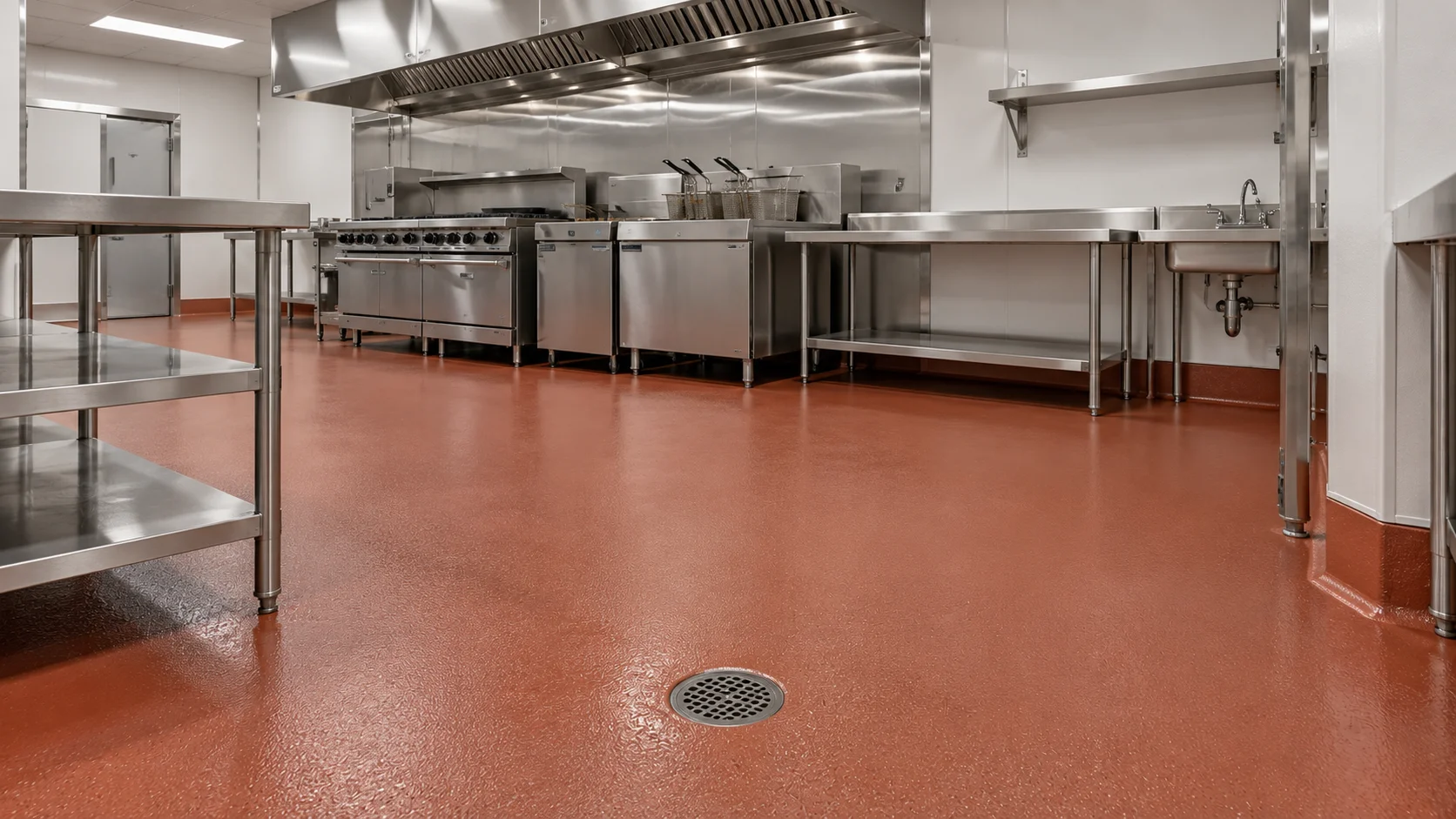
- Restaurant kitchens and wash-down rooms: urethane cement, not standard epoxy, usually with a textured broadcast for traction and an integral cove base at the walls.
- Restaurant dining rooms, retail and showrooms: decorative flake, metallic or solid color epoxy with a light-stable topcoat.
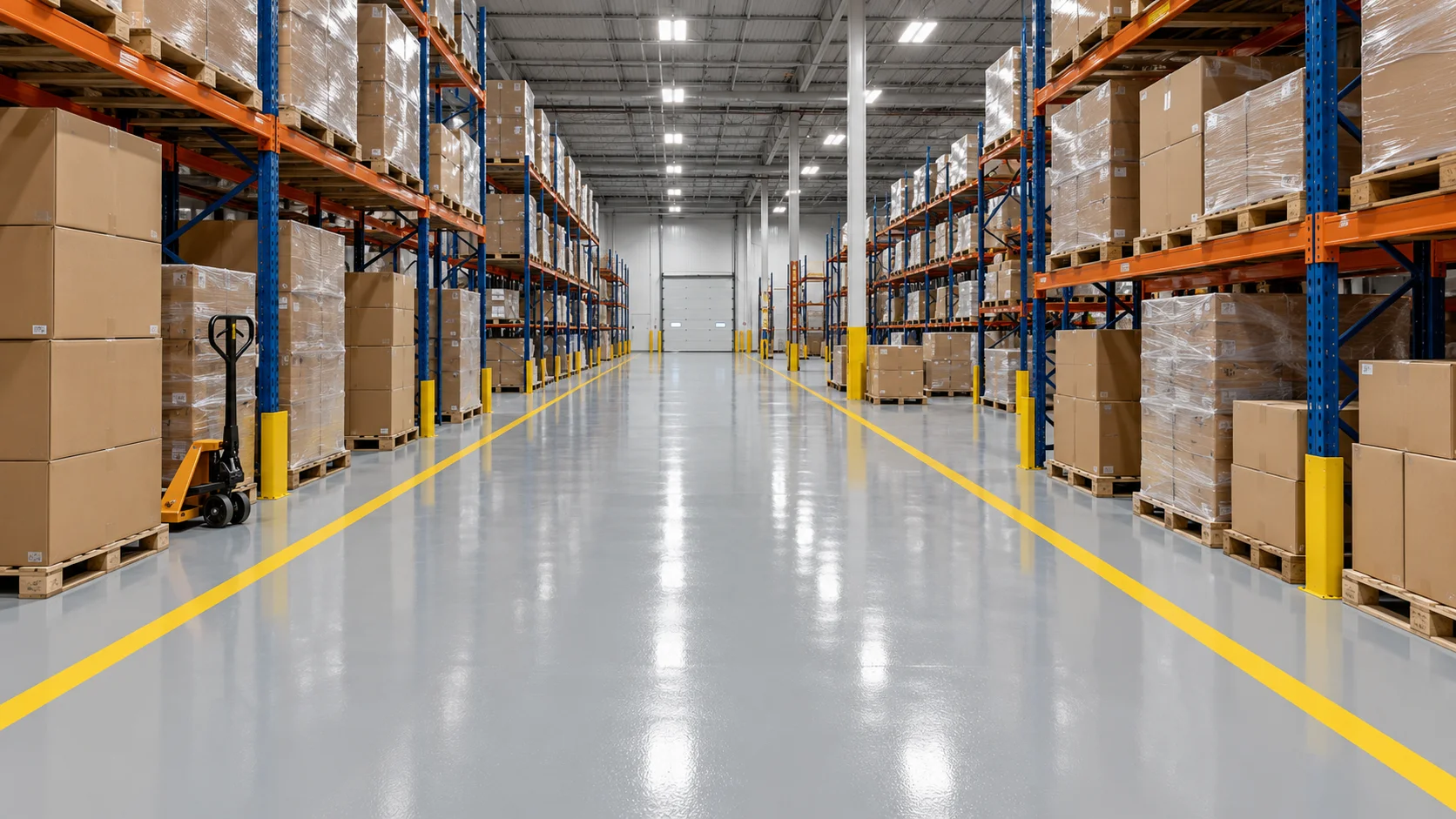
- Warehouses and distribution: high-build epoxy in a solid color, which also makes a clean base for aisle and safety lines.
- Auto service bays and shops: high-build epoxy or flake with a chemical-resistant topcoat and slip-resistant grit.
- Restrooms and locker rooms: quartz broadcast systems for wet traction.
- Downtime: anywhere from an overnight topcoat to several days of closure. The data sheet for the specific product sets it, and temperature changes it.
- Cost: our cost guide puts standard two-coat epoxy at $3 to $5 per square foot and urethane mortar for commercial kitchens at $8 to $15, before slab prep and repair.
Match the System to the Space
Restaurants and commercial kitchens
A commercial kitchen is the hardest floor in most buildings. Sherwin-Williams' technical article on thermal shock describes floors "near fryers, ovens and dishwashers" that "endure constant exposure to heat, grease and frequent high-temperature washdowns," and says plainly that epoxy "does not perform as well as other materials when exposed to thermal shock." It gives the scale of the problem: thermal shock "can occur with temperature differences as small as 50°F, but it more commonly becomes problematic when the differential exceeds 100–150°F," and in a kitchen, "the sudden 150°F temperature swing can quickly degrade an epoxy floor."
The answer the industry uses is urethane cement (also called cementitious urethane or urethane mortar). Sherwin-Williams says these systems "expand and contract in harmony with the concrete substrate" and are "designed to handle aggressive cleaning methods, including hot water washdowns and steam cleaning." They are much thicker than a coating: Westcoat's urethane cement system, for example, is built at 1/4 to 5/16 of an inch. That thickness is a large part of why the system costs more per square foot than a decorative epoxy.
The dining room is a different floor. It sees foot traffic, chair legs, spilled drinks and mopping, not boiling stock. Decorative flake or metallic epoxy under a light-stable topcoat is common there, and slip resistance near the bar, the service station and the entrance matters more than the color. For the walls and ceilings of a food business, which the state food code treats separately, see our guide to restaurant and retail painting in NJ.
Warehouses and distribution
Warehouse floors are about abrasion, dust and organization. A high-build epoxy in a solid color seals dusty concrete, brightens the space under high-bay lighting and gives a clean base for line striping. Pallet jacks and carts wear traffic lanes first, so the topcoat in those lanes is the part to inspect and refresh. Where steel wheels, dropped loads or heavy forklift turning are daily events, a thicker system or a urethane cement may be specified instead. Tell your installer the actual equipment and loads, because a coating rated for "moderate wheel traffic" is not the same as one for constant forklift use.
Marking is part of the job. OSHA's materials handling standard, 29 CFR 1910.176(a), says "permanent aisles and passageways shall be appropriately marked." Aisle and safety-line striping is not a service we offer, so plan it as a separate trade: a line-striping contractor lays out aisles, walkways and hazard zones to the facility's safety plan once the coating has fully cured. The warehouse walls, steel and ceilings, which our industrial painting crews do handle, can be scheduled with the floor; our guide to industrial and warehouse painting specifications covers surface prep and coating choices for that work.
Retail stores, showrooms and offices
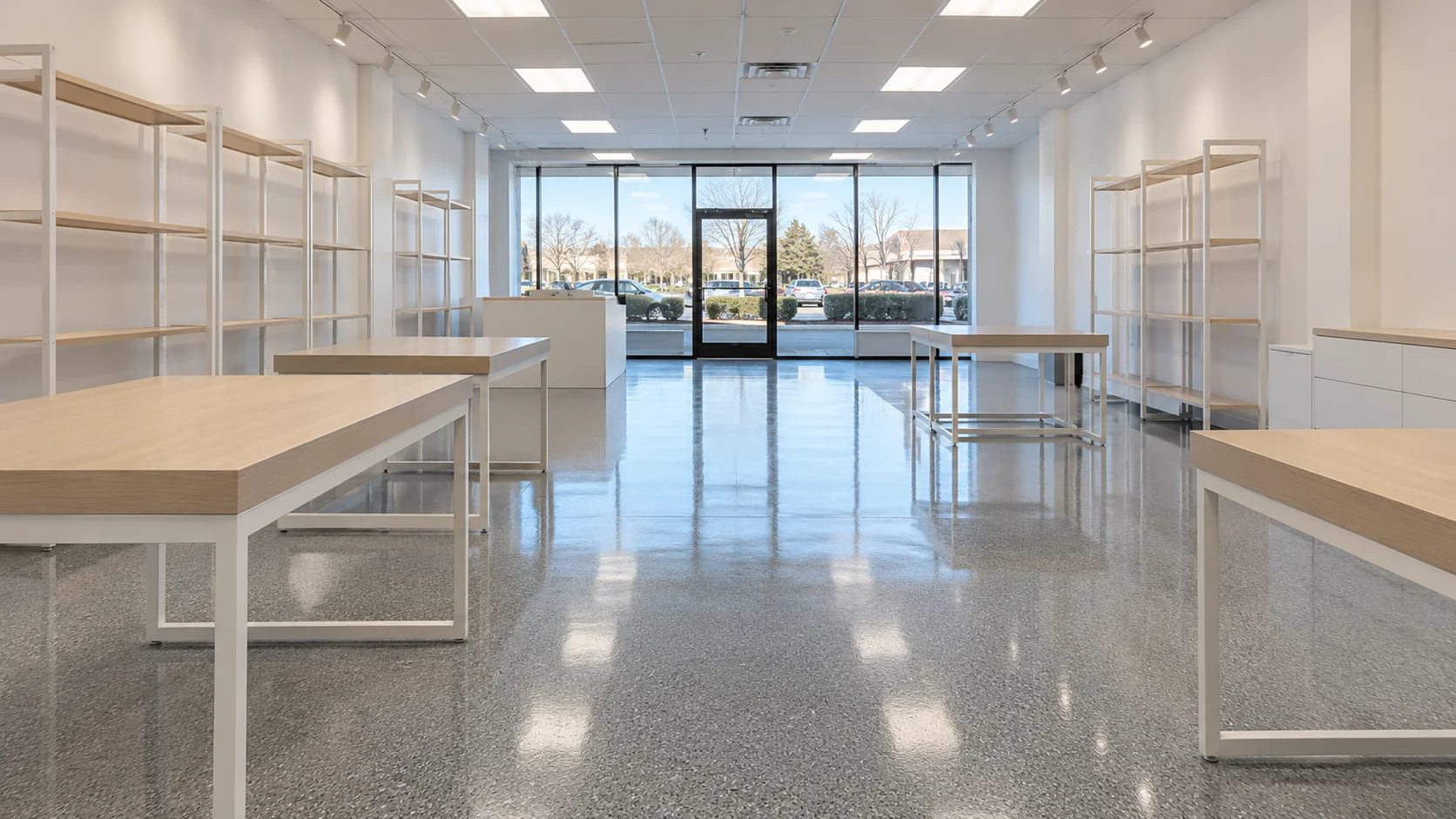
Here the floor is part of the sales environment. Metallic and solid color systems read as a finished floor rather than a coating; Westcoat, for instance, recommends its metallic system for retail stores, showrooms and garages. Flake hides wear better at entrances. The constraint is time: a store that cannot lose a Saturday needs a schedule that fits around trading hours: the floor phased zone by zone, overnight or weekend work if the contractor offers it, and a fast-curing topcoat.
Auto service bays, workshops and commercial garages
Service bays combine hot tires, oil, brake fluid, coolant, solvents and dropped tools. A high-build epoxy or flake system with a chemical-resistant topcoat and slip-resistant grit is the usual starting point. Floor drains and trench drains need careful detailing so water does not get under the coating at the edges, and jack stands and lifts need pads or plates under point loads.
Restrooms, locker rooms and wet rooms
Quartz broadcast systems are built for these. Westcoat's double broadcast system, broadcast with silica or quartz sand, has a typical thickness of 125 mils and is recommended for "Locker Rooms, Veterinarian/Animal Care, Shop Floors, Shower Rooms, Restrooms," with a "slip resistant textured design."
The Specifications That Matter
System thickness, in mils
Ask for the total dry film thickness in writing. It is the clearest single difference between a light-duty decorative floor and an industrial one. As examples from one manufacturer's specifications: a standard flake system at 25 to 35 mils, which the maker describes as "designed to be used as a light duty coating"; a double broadcast quartz system at 125 mils; and a urethane cement at 1/4 to 5/16 of an inch (about 250 to 312 mils). Two bids for "epoxy flooring" can be describing floors that differ tenfold in thickness.
Thermal shock and chemical exposure
List what will hit the floor: hot oil, boiling water, steam cleaning, degreasers, sanitizers, acids from food processing, battery acid, solvents. Each system has a chemical resistance chart on its data sheet. A floor that is fine with mopping water may soften under a daily caustic cleaner.
Slip resistance
OSHA's walking-working surfaces rule, 29 CFR 1910.22, requires that "the floor of each workroom is maintained in a clean and, to the extent feasible, in a dry condition," and that walking-working surfaces be kept free of hazards such as "leaks, spills, snow, and ice." A coating does not replace housekeeping, but a smooth high-gloss finish in a wet, greasy room makes that job harder. Texture comes from a broadcast aggregate or a grit additive in the topcoat; the more aggressive the texture, the better the traction and the harder the floor is to clean, so the profile is chosen room by room.
Cove base, drains and food code
In food businesses, the health code shapes the floor. The FDA Food Code is "a model that assists food control jurisdictions at all levels of government" in regulating retail food and food service; each state adopts its own version, and your local health department enforces it. The 2022 Food Code (section 6-101.11) requires indoor floors to be "smooth, durable, and easily cleanable" where food operations take place, and "nonabsorbent for areas subject to moisture such as food preparation areas, walk-in refrigerators, warewashing areas, toilet rooms." Section 6-201.13 adds that where floors are water-flushed they "shall be provided with drains and be graded to drain, and the floor and wall junctures shall be coved and sealed."
New Jersey's version is N.J.A.C. 8:24, "Sanitation in Retail Food Establishments" (effective January 3, 2022), and it carries the same floor rules. Section 8:24-6.1 requires floor, wall and ceiling materials to be "smooth, durable, and easily cleanable" where food operations take place and "non-absorbent" in food preparation areas, walk-in refrigerators, warewashing areas, toilet rooms and "areas subject to flushing or spray cleaning methods." Section 8:24-6.2 says floors must be smooth and easily cleanable "except that antislip floor coverings or applications may be used for safety reasons," and that where floors are water-flushed they must have drains, be graded to drain, and have floor and wall junctures "covered and sealed." Where other cleaning methods are used, the juncture has to be closed to no more than one thirty-second of an inch.
In practice that means a seamless resinous floor carried up the wall as an integral cove, sealed around drains, with no joints left open to collect water. Check with your health inspector before work starts, not at the reopening inspection.
Moisture, concrete age and the slab itself
Commercial slabs on grade can carry a lot of moisture, and a coating that traps it will blister. Sherwin-Williams sets a working limit for its floor systems of three pounds per 1,000 square feet per day on the calcium chloride test and says "the concrete must cure for a minimum of 28 days prior to the application of epoxy or urethane flooring systems." Urethane cement is far more tolerant: Westcoat rates its system for moisture vapor up to 20 lbs/1,000 sq ft (ASTM F1869) or 99% relative humidity (ASTM F2170). That tolerance is one reason urethane cement is specified on new construction with a tight opening date.
The same urethane cement specification calls for the coating to terminate into anchor grooves "cut six inches from all free edges, walls, perimeter, drains and both sides of joints," for moving expansion joints to be honored rather than buried, and says not to apply it "over existing coatings, tile, wood." Old tile and failed coatings come up first, and that removal is often the biggest line item on a renovation.
Surface preparation
Mechanical prep by diamond grinding or shot blasting, not acid etching. Sherwin-Williams notes that most coating manufacturers "no longer recommend acid etching", which leaves only a "CSP-1 to CSP-2 profile" where modern systems need "CSP-3 to CSP-9." Ask which concrete surface profile the system calls for and how the contractor will check it.
Downtime: How Long the Business Is Closed
This is usually the first question a business owner asks, and the honest answer is that the product data sheet decides it. Three examples, all at 72°F:
- A flake system with a polyaspartic topcoat: "Prohibit traffic on the floor for 48 hours after installation. Allow 72 hours minimum for vehicular traffic. Avoid heavy abrasion and chemical exposure for 5 days."
- A polyaspartic topcoat on its own: "Light foot traffic may be permitted in 8 hours, normal traffic in 24 hours and vehicle traffic in 72 hours," with full cure at 96 hours.
- A urethane cement system: light foot traffic in 12 hours, normal traffic in 24 hours, and "vehicular and heavy traffic in 72 hours," per the system specification.
Those times assume a warm building. Cold slows every one of them, and many products should not be applied below 50°F at all, so an unheated building in January needs temporary heat through the cure. Add the days before the coating: removing old flooring, grinding, repairs and, on some jobs, moisture testing, which itself takes a day or more.
Ways to shrink the closure:
- Phase the floor. Do half a kitchen or one zone of a warehouse at a time, with a temporary route around it.
- Ask about after-hours work. Grinding and repairs overnight and coats over a weekend can keep a business trading. Not every contractor offers it, so ask at the bid stage and get the schedule in writing.
- Use the shutdown you already have. Holiday closures and annual maintenance weeks are the natural window for a full kitchen or production floor.
- Plan for odor and ventilation. Some fast-curing topcoats are solvent-borne. One polyaspartic data sheet notes the "product has odor" and warns that "solvent based products are extremely flammable, extinguish all pilot lights and sources of ignition." In a kitchen full of pilot lights, that shapes the schedule.
What Drives the Cost
Our cost guide lists installed price ranges by system, which are a fair starting point for commercial floors:
| System | Price per sq ft | Typical commercial use |
|---|---|---|
| Standard two-coat epoxy | $3 to $5 | Light-duty, storage |
| High-build 100% solids | $5 to $8 | Warehouses, service bays |
| Flake or quartz broadcast | $5 to $9 | Showrooms, restrooms, dining rooms |
| Polyaspartic and polyurea | $5 to $12 | Fast turnaround, cold slabs |
| Metallic | $6 to $12 | Lobbies, retail, showrooms |
| Urethane mortar | $8 to $15 | Commercial kitchens, food plants |
On top of the system, the same guide lists diamond grinding at $0.75 to $1.50 per square foot, shot blasting at $0.50 to $1, removal of an old sealer or failed coating at $1 to $3, and concrete repair at roughly $14 to $16.65 per square foot of repaired area. Other things that move a commercial quote:
- Removing what is there. Quarry tile, VCT, mastic and old coatings all have to come off, and the slab under them is often uneven.
- Cove base and drains. Integral cove is hand-troweled linear footage, and every floor drain needs detailing.
- Thickness. A quarter-inch urethane cement uses far more material and labor than a 30-mil coating.
- After-hours and phasing. Night and weekend work, multiple mobilizations and temporary protection add labor.
- Moisture mitigation. A slab that tests wet needs a moisture-tolerant primer or a system rated for it.
- Square footage. Large open floors cost less per foot than small rooms full of equipment, edges and drains.
How to Compare Commercial Flooring Bids
- Is each bid for the same system, by product name, with the total thickness in mils?
- What surface prep is included, and what concrete surface profile does the system call for?
- Is moisture testing included, and what happens if the slab tests high?
- How are cove base, drains, joints and edges detailed?
- What is the schedule, phase by phase, and when can staff, equipment and vehicles return?
- What is the workmanship warranty, and what does the manufacturer's warranty require?
- Can the contractor supply a certificate of insurance naming your company or landlord before mobilization?
Frequently Asked Questions
How much does commercial epoxy flooring cost in New Jersey?
Our cost guide puts installed systems at $3 to $5 per square foot for standard two-coat epoxy, $5 to $8 for high-build 100% solids, $5 to $9 for flake or quartz, $6 to $12 for metallic and $8 to $15 for urethane mortar in commercial kitchens. Grinding, old-floor removal, concrete repair, cove base and, where a contractor offers it, after-hours scheduling are added on top.
What is the best flooring for a restaurant kitchen?
Urethane cement rather than standard epoxy. Sherwin-Williams notes that epoxy does not perform as well under thermal shock, while urethane cement expands and contracts with the slab and handles hot water washdowns and steam cleaning. It is usually finished with a textured broadcast for traction and an integral cove base at the walls.
How long will my business be closed for a new epoxy floor?
It depends on the product and the temperature. Published examples at 72°F range from light foot traffic in 8 to 12 hours to 48 hours with no traffic at all, with vehicles at about 72 hours. Removal, grinding and repairs come first. Phasing the floor, or night and weekend work from a contractor who offers it, can keep a business open.
What is the best epoxy for a warehouse floor?
For most warehouses, a high-build 100% solids epoxy in a solid color, which seals dusty concrete, brightens the space and gives a clean base for aisle lines. Our cost guide puts it at $5 to $8 per square foot. Where steel wheels, dropped loads or heavy forklift turning are daily events, a thicker system or urethane cement may be specified instead, so tell bidders the actual equipment and loads.
Does a commercial kitchen floor need a cove base?
In practice, yes. New Jersey's retail food code (N.J.A.C. 8:24-6.2), like the FDA Food Code it follows, requires floors cleaned by water flushing to have drains, be graded to drain, and have the floor and wall junctures sealed. Where other cleaning methods are used, the juncture still has to be closed to no more than 1/32 of an inch. An integral resinous cove is the usual way to meet both. Confirm the detail with your local health department before work starts.
Can epoxy be applied over existing tile in a restaurant?
Generally no. Resinous floors are designed to bond to prepared concrete, and one urethane cement specification says outright not to apply it over existing coatings, tile or wood. The tile and setting bed come up and the slab is ground and repaired first.
Is epoxy flooring slippery in a commercial space?
A smooth, glossy coating can be slick when wet or greasy. Commercial floors in wet areas get a broadcast aggregate such as quartz or a grit additive in the topcoat. More texture means more traction but more effort to clean, so the profile is chosen for each room.
Can you stripe warehouse aisles on an epoxy floor?
Yes. OSHA requires permanent aisles and passageways to be appropriately marked, and a fully cured coated floor gives the lines a sound base. Aisle striping is not a service we offer, so it is done by a line-striping contractor after the coating cures; we can coordinate the floor schedule around it.
Plan Your Commercial Floor With Us
NJ Painting Co. is a family-owned, licensed and fully insured contractor at 36 Church Rd in Morganville, with more than 20 years of work for New Jersey homeowners, property managers, business owners and general contractors. We walk the space, test the slab where moisture is a risk, recommend a system for each room, and build the schedule around how your business runs. Every estimate is free, and our work carries a two-year workmanship warranty. We cover Monmouth, Middlesex, Ocean, Mercer, Somerset and Burlington counties and North Jersey. See our epoxy flooring and commercial painting services, budget the walls and ceilings with our guide to commercial painting cost in NJ, compare finishes in our epoxy floor types guide, check prices in the cost guide, or call (732) 239-0932 and request a free estimate.
About the author
Written by the NJ Painting Co. team
NJ Painting Co. is a family-owned painting contractor based in Monmouth County, in business since 2004. We are licensed and fully insured, work with Benjamin Moore and Sherwin-Williams paints, and back our work with a 2-year workmanship warranty. We serve Monmouth, Middlesex, Ocean, Mercer, Somerset and Burlington counties, plus Union, Essex, Hudson, Bergen and Passaic in North Jersey.