A medical or dental office in New Jersey can be repainted without closing. The work is phased room by room, dusty prep is contained, and walls get a washable zero- or low-VOC paint. CDC guidance treats walls as low-risk housekeeping surfaces, so what protects patients is the planning and containment, not an antimicrobial label.
We are a family-owned painting company in Morganville and we paint offices, suites and clinical space for businesses across central and northern New Jersey, using Benjamin Moore and Sherwin-Williams products. This guide is written for the practice owner, office manager or facility administrator who has to keep the schedule full while the walls get done. Every regulatory or technical statement below is quoted from a source we read on 20 October 2026: the CDC and its Healthcare Infection Control Practices Advisory Committee, the EPA, the New Jersey Administrative Code and a Benjamin Moore technical data sheet. There are no prices in this article; for money, see our guide to commercial painting cost in NJ and the planning ranges in the cost guide.
The Short Answer
- You do not have to close. Work one exam room, operatory or zone at a time while the rest of the practice runs, on a schedule agreed with you before anyone arrives.
- Walls are housekeeping surfaces. CDC dental guidance says floors, walls and sinks "do not come into contact with patients" and "have a limited risk of disease transmission." The finish has to survive the cleaning, not sterilise the room.
- Dust is the real risk, not paint. Patching and sanding make dust; rolling paint does not. CDC guidance calls for a risk assessment before "any other activities expected to generate dust," and New Jersey requires one of licensed ambulatory care facilities.
- Use a zero-VOC product. Professional zero-VOC lines exist with no VOC added by tinting, which matters in rooms where patients sit for an hour.
- Read "antimicrobial" carefully. On ordinary wall paint it normally means the additive protects the paint film against mold and mildew, not that the wall kills germs.
- Wait before scrubbing. The data sheet we quote below says painted surfaces can be washed after two weeks, so plan disinfectant wiping of fresh walls around that.
What Infection-Control Guidance Actually Says About Walls and Painting
Search results for medical office painting are full of promises about "hospital-grade" paint. The guidance practices actually work to is much plainer, and more useful, because it tells you where the risk sits.
Walls are housekeeping surfaces, not clinical contact surfaces
The CDC's dental infection-control guidance, Best Practices for Environmental Infection Prevention and Control, splits a practice's surfaces into two groups. Clinical contact surfaces — light handles, chair controls, switches on equipment — "can also be contaminated by contact with contaminated gloved hands," and should ideally be barrier protected, with the barrier "changed between each patient." Housekeeping surfaces are different: "Housekeeping surfaces, such as floors, walls, and sinks, do not come into contact with patients," and "These surfaces have a limited risk of disease transmission and can be decontaminated with less rigorous methods." The same page says a housekeeping surface "can be cleaned with soap and water or cleaned and disinfected if visibly contaminated with blood," and warns that "high level disinfectants should never be used on environmental surfaces."
The broader CDC and HICPAC Guidelines for Environmental Infection Control in Health-Care Facilities say the same thing in their own terms: "Keep housekeeping surfaces (e.g., floors, walls, tabletops) visibly clean on a regular basis and clean up spills promptly," and clean walls in patient-care areas "when they are visibly dusty or soiled." So the paint does not need to be special; it needs to be washable enough to take routine cleaning without burnishing. And the parts of the room that matter most for infection control — the chair, the counters, the equipment — are exactly the parts a painting crew should keep covered and away from.
Dust-generating work starts with a risk assessment
The same CDC guideline is emphatic about construction-type work in occupied health-care buildings: "Use of an infection-control risk assessment is strongly supported before the start of these or any other activities expected to generate dust or water aerosols." Its recommendations include "Before the project gets under way, perform an ICRA to define the scope of the activity and the need for barrier measures," to "Construct barriers to prevent dust from construction areas from entering patient-care areas," to "Implement dust-control measures on surfaces and divert pedestrian traffic away from work zones," and to clean work zones and their entrances daily by "wet-wiping tools and tool carts before their removal from the work zone" and "placing mats with tacky surfaces inside the entrance." That guideline was written mainly for hospitals and for demolition and construction, and most of it — negative-pressure enclosures, HEPA air units, aspergillosis surveillance — is far beyond what repainting a suite needs. But the principle scales down cleanly: decide in advance which steps make dust, where that dust could go, and what stops it.
In a painting job the dusty steps are almost all preparation: sanding patched drywall, sanding glossy trim and doors to dull them, and scraping any failing coating. Rolling and brushing paint makes no dust. That is why a sensible plan separates the two: prep in a room happens with the door closed, the return grille covered if your building allows it, and sanding dust collected with a vacuum rather than swept, before the room is wiped down and painted.
New Jersey's rule for licensed ambulatory care facilities
If your site is licensed by the New Jersey Department of Health as an ambulatory care facility, the risk assessment is not optional. N.J.A.C. 8:43A "applies to all health care facilities that provide ambulatory care services," a list that includes primary care, ambulatory surgery, family practice, chronic dialysis, imaging and radiological services, and N.J.A.C. 8:43A-19.8 says: "Whenever construction and renovation projects are planned in and around a health care facility, a risk assessment shall be conducted to determine the impact of the project on patient areas, personnel, and mechanical systems." The facility's infection control program "shall approve control measures, if necessary." Whether a repaint counts as a renovation project for your facility is your infection control program's call, not ours. Our part is to give that program a clear description of every step — what makes dust, what makes odor, what moves, how long each room is out of service — so it can decide, and then to work to whatever it approves.
Dental practices: the Board of Dentistry points to the CDC
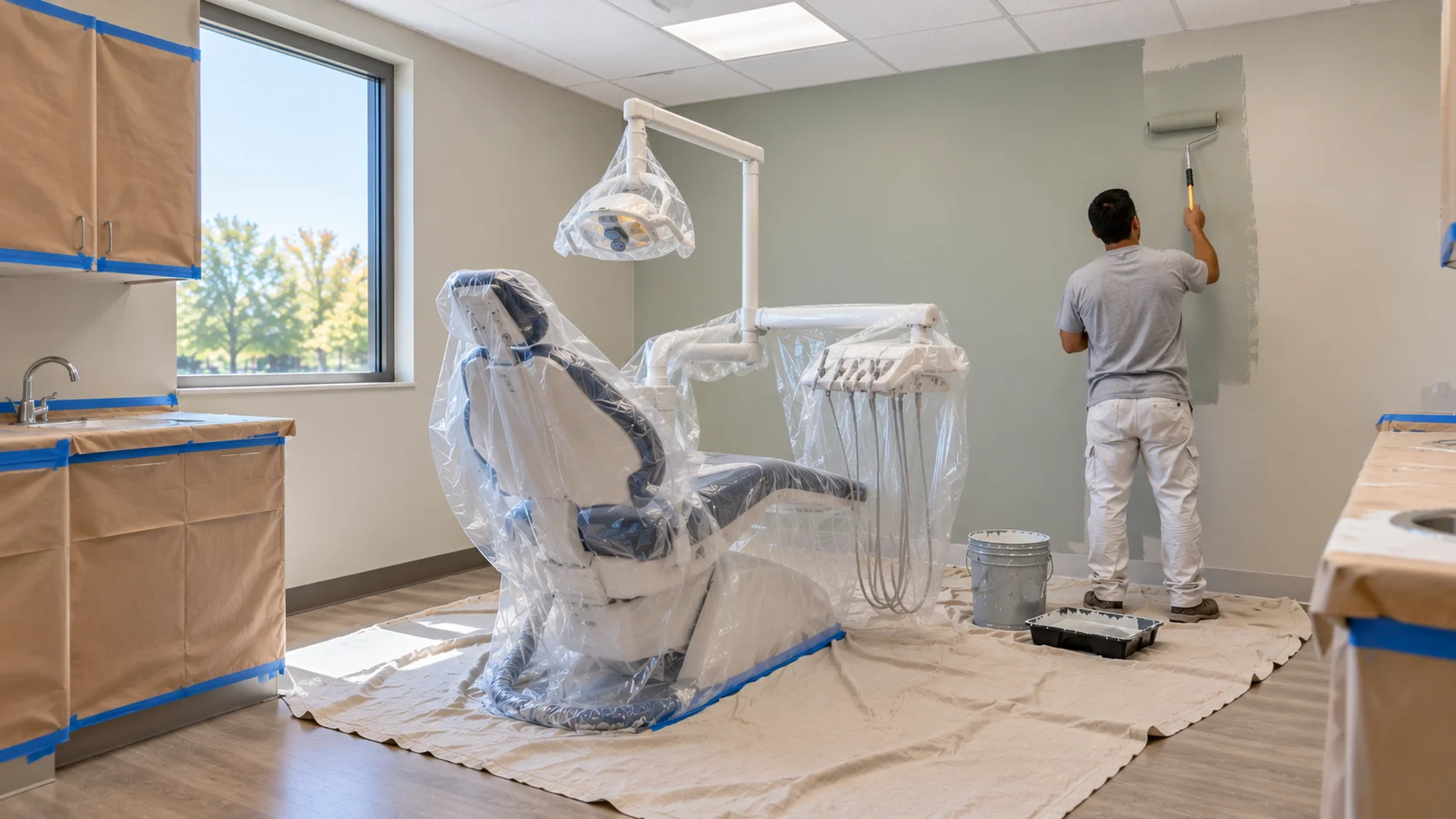
For New Jersey dentists the CDC guidance is written into the licensing rules. N.J.A.C. 13:30-8.5 requires that "When providing dental services, all licensees and registrants shall comply with" OSHA's bloodborne pathogens standard at 29 CFR 1910.1030 and the "Centers for Disease Control and Prevention (CDC) Recommended Infection Control Practices for Dentistry, incorporated herein by reference." The painting plan should fit inside that: operatories painted only when they are out of use for the day, the chair, delivery unit and cabinetry covered, and the room handed back clean enough that your staff can do their normal turnover before the next patient.
Low-VOC and Zero-VOC Paint in a Practice
The paint question that matters in a practice is not germs but air. The EPA's page on volatile organic compounds and indoor air quality says "Concentrations of many VOCs are consistently higher indoors (up to ten times higher) than outdoors," lists "paints, paint strippers and other solvents" among household sources, and notes that "elevated concentrations can persist in the air long after the activity is completed." Its first step to reduce exposure is simple: "Increase ventilation when using products that emit VOCs. Meet or exceed any label precautions."
New Jersey already caps how much VOC a wall paint may contain: N.J.A.C. 7:27-23.3 prohibits manufacturing, selling or applying architectural coatings above the limits in its Table 1, which "contains the VOC content limits for architectural coatings." So every interior paint sold in the state is already "compliant." A practice should ask for more than compliance, because a zero-VOC base tinted with an ordinary colorant can pick up VOC in the tinting. Benjamin Moore's data sheet for Ultra Spec 500 Interior Flat (N536) is a good example of what to look for: it reports "0 Grams/Liter" and "Zero VOC post tint (any base and any color)," explains that because the line tints on the company's zero-VOC colorant system "all Ultra Spec® 500 finishes are available in any color without an increase in VOC," and lists "Low odor" among its features. It is recommended for "Low abuse interior wall and ceiling surfaces in commercial and institutional environments." Sherwin-Williams makes comparable zero-VOC professional lines; our comparison of Benjamin Moore and Sherwin-Williams covers how the two brands' product lines line up.
Two cautions. Zero VOC is not zero odor: a freshly painted room still smells of paint for a while, and some people are sensitive to it, so the plan should still give each room ventilation and time before a patient sits in it. Ask about the primer and caulk too, not just the finish. Our guide to paint fumes and VOC safety covers how long rooms take to air out and what affects it.
What an "antimicrobial" paint label actually means
Plenty of commercial paints carry an antimicrobial line on the label, and it is easy to read more into it than is there. The same Ultra Spec 500 data sheet is precise about it: "Anti-microbial - This product contains antimicrobial additives that inhibit the growth of mold and mildew on the surface of the paint film." That is a claim about protecting the coating. It is the kind of claim federal pesticide law exempts from separate registration: under 40 CFR 152.25(a), an article treated with a pesticide "to protect the article or substance itself" is exempt, and the regulation's own example is "paint treated with a pesticide to protect the paint coating," provided "the pesticide is registered for such use." A paint that claims to kill germs on people's behalf is a different product making a different claim, and it needs its own EPA registration for that claim. If a bid leans on an antimicrobial paint as an infection-control feature, ask for the exact label claim and the EPA registration number behind it, and remember the CDC's position above: the wall is a housekeeping surface, and the cleaning routine is what controls it.
Planning the Work Around an Open Practice
The constraint in a practice is not the size of the job but the appointment book. An exam room or operatory that is out of service costs patient slots, so the plan starts from the schedule rather than from the crew. We agree the timing with the practice before anyone arrives — which rooms on which days, and what hours suit your building — and we do not assume the practice can close.
Phase by room type, not by floor plan
A practice is a set of rooms with very different tolerances, and a sensible sequence works from the least sensitive to the most:
- Private offices, break room, storage and corridors behind the front desk. Lowest patient contact. Good first-phase rooms, because they show the practice what a day of work looks like before any clinical room is touched.
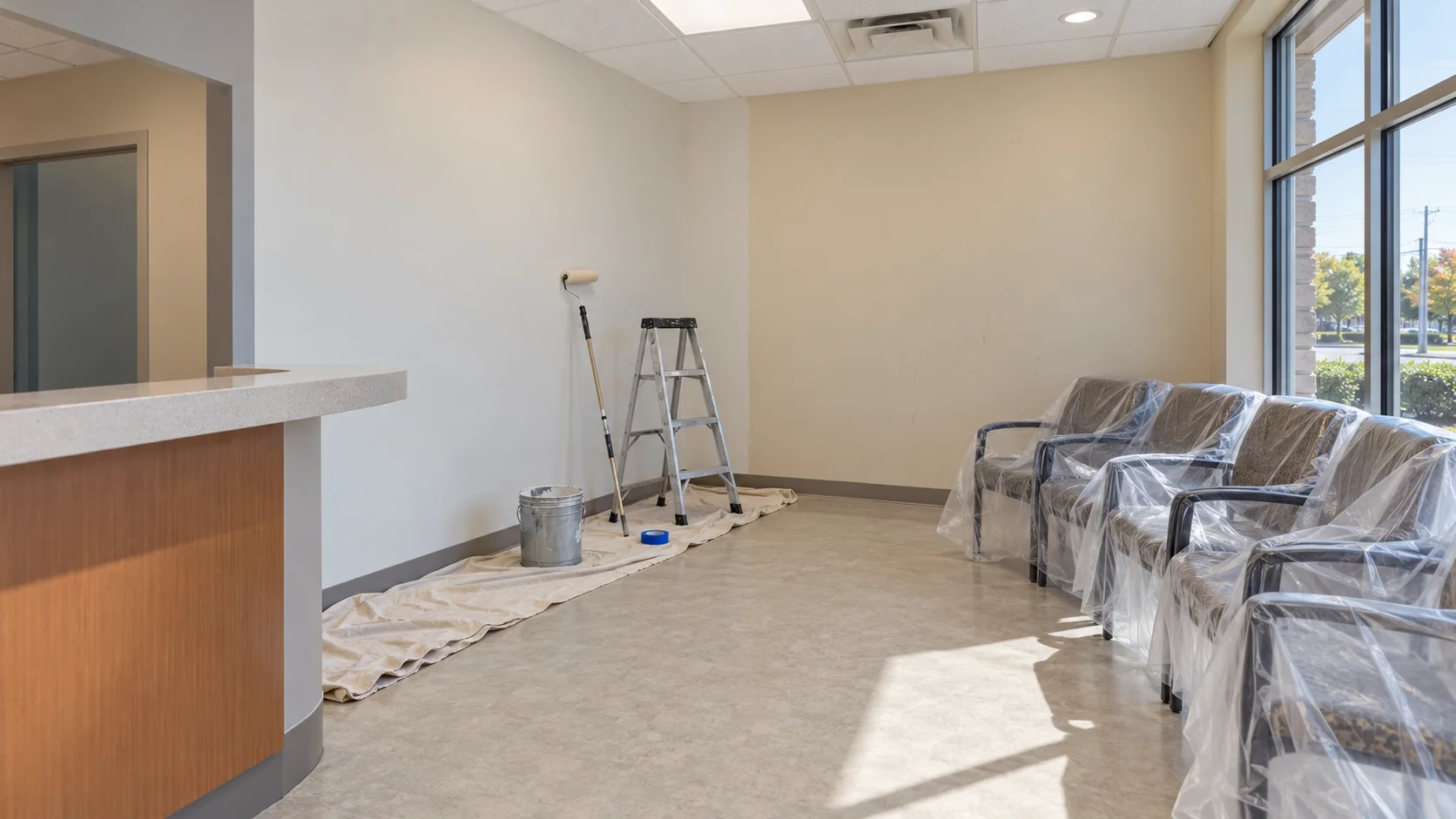
- Exam rooms and operatories. Done one or two at a time, when your schedule has blocked them out. The room is emptied of loose items by your staff, the chair, equipment and cabinetry are covered in place, and the room is handed back wiped down for your own turnover.
- Restrooms. Done one at a time where the practice has more than one, and signed.
- Sterilization and lab areas. Planned with the person who runs them, because instruments and processing equipment cannot be moved casually and the room's workflow is the practice's, not ours.
- Waiting room and front desk. Usually split into halves so patients always have somewhere to sit and a route to the desk.
Each phase is written down in the proposal with the rooms affected and how long each is out of service, so the front desk can book around it. It is the same phase-plan discipline as any commercial painting job in an open building.
Containing the dusty steps
Following the CDC's logic at the scale of a repaint: the room being prepped is closed off; floors are covered; patching is sanded with dust collection and cleaned up with a vacuum and damp wipe rather than a broom; tools are wiped before they leave the room; and nothing dusty travels through a clinical corridor while patients are in it. Where a wall needs real repair rather than a skim — water-damaged board, holes left by removed equipment mounts, dented corners — the repair is scheduled into the room's own phase so the dust stays in one place. Our guide to drywall repair covers what each kind of repair involves. If your infection control program wants more — sealed doorways, a tacky mat at the entrance, a particular cleaning product — that goes into the plan before the job is priced, not after.
Ventilation, HVAC and odor
Ask your building owner or HVAC contractor two questions before work starts: whether the suite's air returns are shared with other tenants, and whether the system can run fan-on during and after painting. The EPA's advice is to increase ventilation when using products that emit VOCs, and a suite on a shared return will carry odor to the neighbours unless the return in the work room is covered during prep. Painting a room at the end of its blocked-out period, with the system running afterwards, gives it the longest time to air out before the next patient.
Records, screens and equipment
Clinical rooms contain things a painting crew should never handle. Before a room is worked, your staff clear paper records, lock or turn screens, and remove anything loose on counters; we cover and mask what stays, and we do not move, disconnect or relocate dental units, imaging equipment, medical gas outlets or wall-mounted devices. Where a wall-mounted item has to come off for painting behind it, the practice's own vendor removes and reinstalls it on a date in the phase plan.
Choosing Finishes for Exam Rooms, Operatories and Corridors
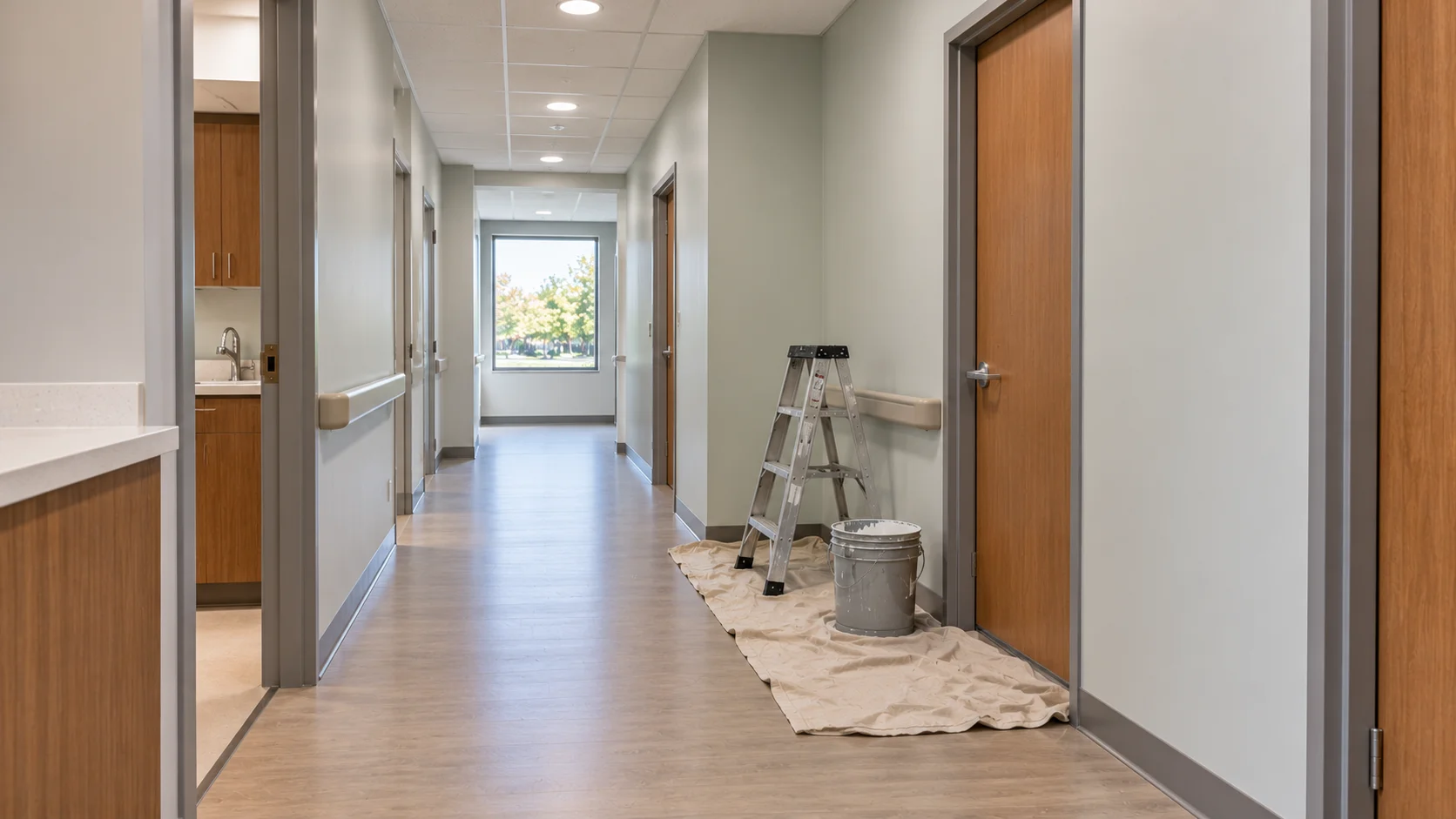
The finish follows the cleaning. Flat paint hides imperfections well but marks and burnishes when it is wiped repeatedly, which is why it belongs on ceilings and low-touch walls. Benjamin Moore's data sheet for Ultra Spec 500 Interior Low Sheen Eggshell (N537) describes it as providing "the wash ability of a semi-gloss in a softer sheen," recommended for "Interior wall and ceiling surfaces in commercial and institutional environments where a washable low sheen finish is desired," and it carries the same zero-VOC and antimicrobial-additive statements as the flat. A low-sheen eggshell is the usual answer for exam room, operatory and corridor walls: washable, without the glare that a semi-gloss gives under bright clinical lighting. Doors, frames and handrails take far more hand contact and want a harder enamel. Our paint sheen guide explains why one manufacturer's eggshell is not another's.
Plan the cure too. Both Ultra Spec 500 data sheets say "Painted surfaces can be washed after two weeks," and that "High humidity and cool temperatures will result in longer dry, recoat and service times." A freshly painted room can be used the next day, but for the first two weeks your team should spot-clean walls gently rather than scrub them with disinfectant wipes. The same sheets give a minimum application temperature: "Do not apply when air and surface temperatures are below 50 °F (10 °C)," which is worth knowing for a suite whose heat is set back when the office is empty.
Older Buildings, Lead Paint and the RRP Rule
Plenty of New Jersey practices sit in buildings put up before 1978, from converted houses on a borough's main street to older professional buildings and strip centres. The federal Renovation, Repair and Painting rule matters to a commercial building through its definition of a child-occupied facility. Under 40 CFR 745.83, that is "a building, or portion of a building, constructed prior to 1978, visited regularly by the same child, under 6 years of age, on at least two different days within any week," where "each day's visit lasts at least 3 hours and the combined weekly visits last at least 6 hours, and the combined annual visits last at least 60 hours." The rule names "day care centers, preschools and kindergarten classrooms" as examples. Read literally, ordinary patient visits — even at a busy pediatric practice — are unlikely to meet that test, but a building that also houses a child-care centre or preschool can, along with common areas "routinely used by children under age 6, such as restrooms and cafeterias." If your practice is in residential space, or shares a building with child care, ask the question before anyone sands.
We will say it plainly at the walkthrough: NJ Painting Co. is not an EPA Lead-Safe Certified firm, so pre-1978 surfaces where the RRP rule applies and paint has to be disturbed are not work we bid. If your building is old enough for this to matter, ask every bidder how they are handling it and for their certificate. Our guide to lead paint in older New Jersey homes explains what the rule requires.
Floors, Exteriors and the Rest of the Building
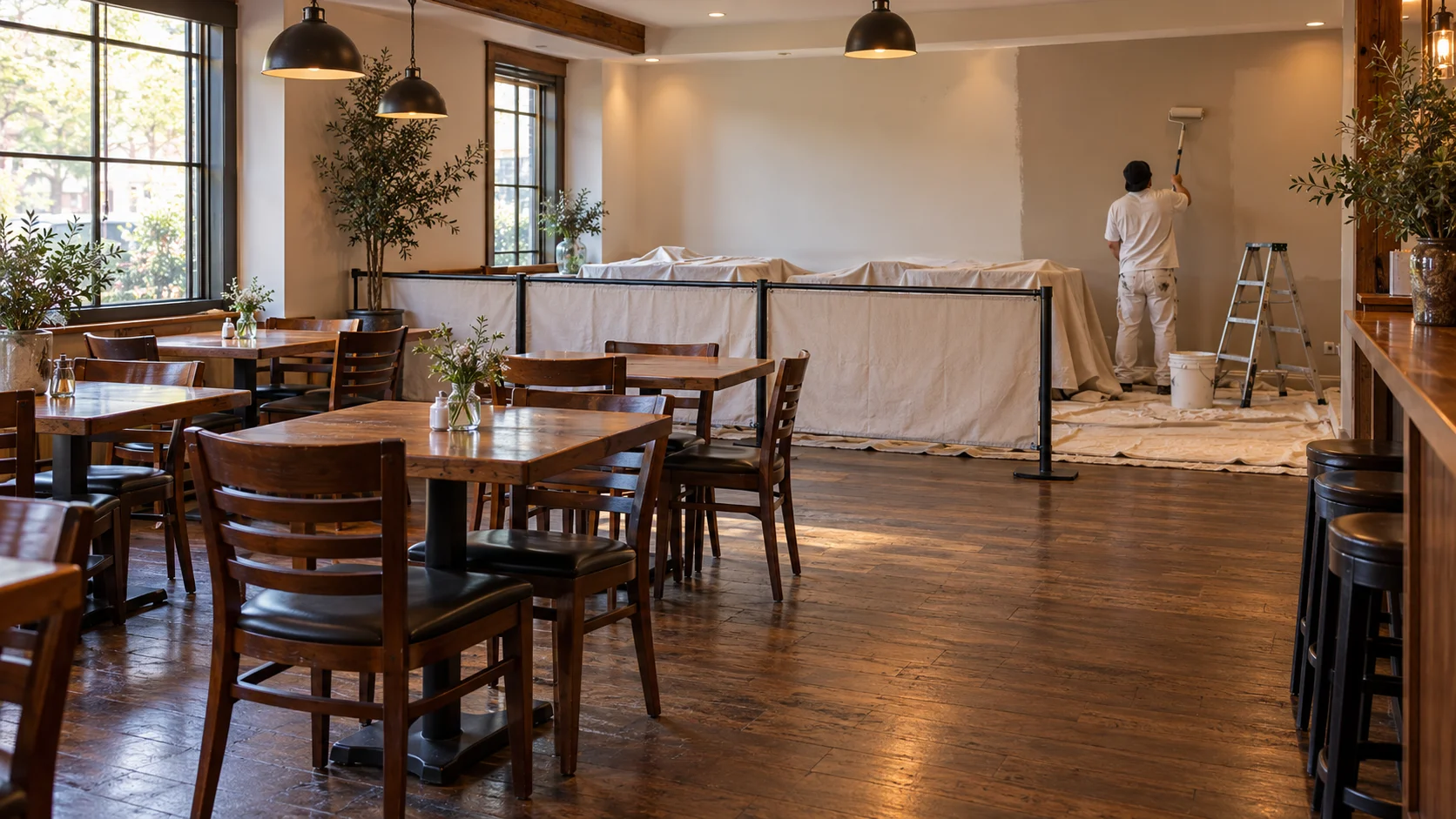
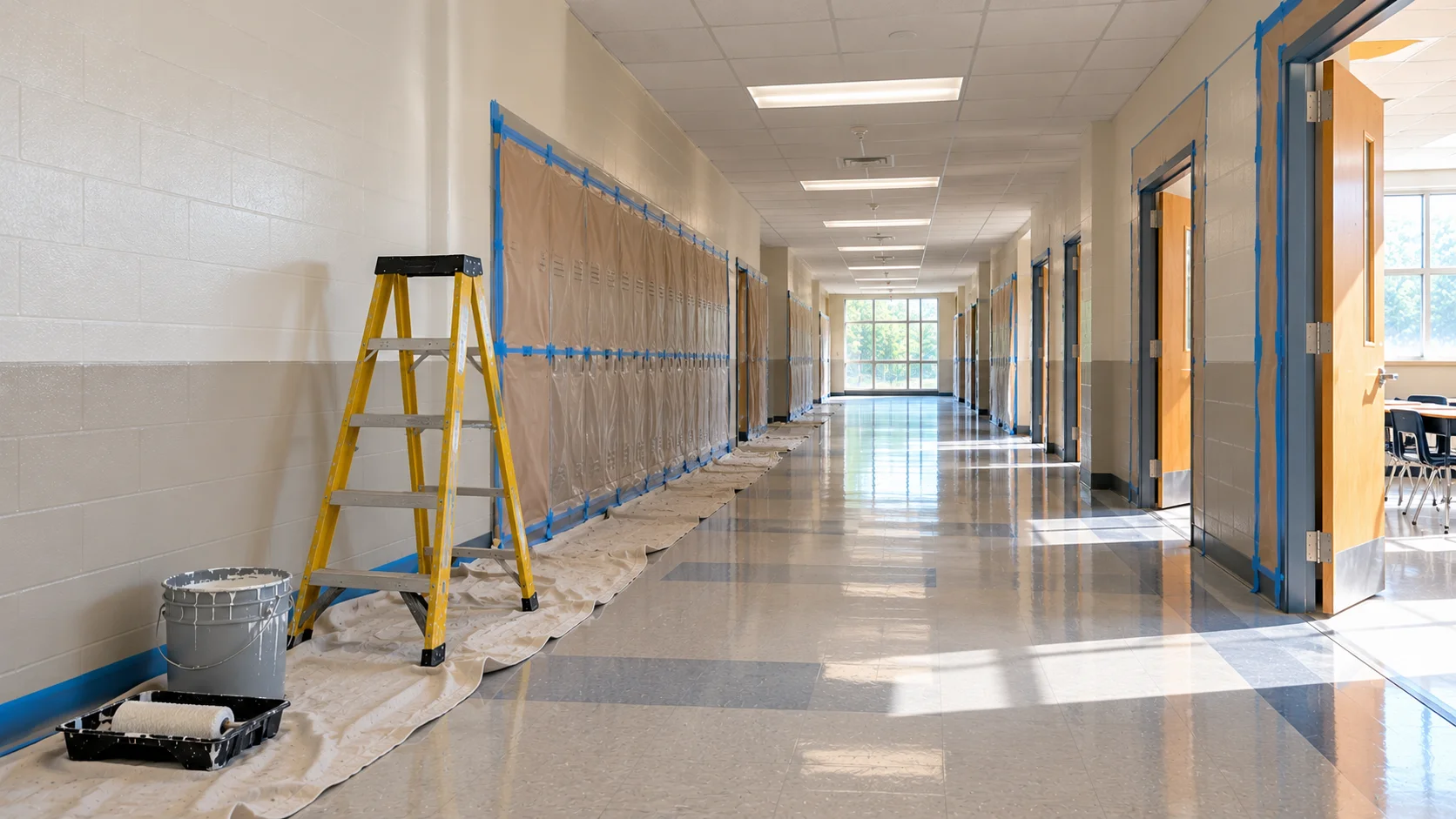
Practices that own their building often fold more into one project. Exterior work is scheduled around patient parking and the entrance; see our exterior painting page. Storage rooms, mechanical rooms and an owner-occupied building's garage or basement are candidates for a resinous floor coating; see our epoxy flooring page and our guide to commercial epoxy flooring in NJ. The same occupied-building planning applies to the other sectors we work in: our guides to school painting in NJ and restaurant and retail painting in NJ cover how it changes for a school calendar and for a business that has to stay open to customers.
Talk to Us About Your Practice
The plan for your practice starts with a walkthrough of the rooms and a look at your schedule. NJ Painting Co. is a family-owned, fully insured painting company at 36 Church Rd, Morganville, NJ 07751, painting in New Jersey for more than 20 years with Benjamin Moore and Sherwin-Williams products. For a practice we write the rooms, products, sheens and phase dates into the proposal, describe every dusty or odorous step so your infection control lead or office manager can approve it, issue certificates of insurance before we start, and leave a color and product schedule with touch-up stock when we finish. Our medical and healthcare painting service is described on the commercial painting page.
We cover Monmouth, Ocean, Middlesex, Mercer, Somerset, Burlington, Union, Essex, Hudson, Bergen and Passaic counties. Call (732) 239-0932 or send us the number of rooms, which ones are clinical, and the weeks you have in mind, and we will walk the practice and come back with a written scope and a room-by-room phase plan.
Frequently Asked Questions
Can a medical or dental office be painted without closing?
Yes, in most cases. The work is phased one room or zone at a time, with offices and back-of-house rooms first and exam rooms or operatories done when your schedule has blocked them out. Each phase is written into the proposal with the rooms affected and how long each is out of service, so the front desk can book around it. The waiting room is usually split in halves so patients always have somewhere to sit.
Does a medical office need special antimicrobial paint?
Not according to CDC guidance. The CDC classes floors, walls and sinks as housekeeping surfaces that "do not come into contact with patients" and "have a limited risk of disease transmission," cleaned with soap and water or disinfected if visibly contaminated with blood. What a wall needs is a washable finish that takes that cleaning. Many commercial paints carry an antimicrobial additive, but on a typical data sheet it inhibits mold and mildew "on the surface of the paint film" — it protects the paint, not the patient.
What is the best paint for an exam room or dental operatory?
A zero-VOC, washable low-sheen eggshell on the walls, a harder enamel on doors and frames, and a flat on the ceiling is the usual combination. Look for a product that stays zero VOC after tinting, not just in the base. Benjamin Moore's Ultra Spec 500 Low Sheen Eggshell, for example, is described on its data sheet as giving "the wash ability of a semi-gloss in a softer sheen" and reports zero VOC in any color.
How soon can patients use a freshly painted room?
With a zero-VOC paint, a room painted at the end of its blocked-out period and ventilated afterwards is normally back in use the next day, though some people are sensitive to the smell of fresh paint even at zero VOC. Hold off on scrubbing: the Ultra Spec 500 data sheets say painted surfaces can be washed after two weeks, and that humidity and cool temperatures lengthen dry and service times. Spot-clean gently until then.
Do we need an infection control risk assessment before painting?
If the site is licensed by the New Jersey Department of Health as an ambulatory care facility, N.J.A.C. 8:43A-19.8 requires a risk assessment whenever construction and renovation projects are planned, reviewed and approved by your infection control program; whether a repaint falls under it is that program's decision. For any practice, the CDC strongly supports a risk assessment before activities expected to generate dust. We give you a written description of every dusty and odorous step so the assessment is quick to do.
Will your crew move our dental chairs or medical equipment?
No. Chairs, delivery units, imaging equipment and cabinetry are covered and masked in place. Where a wall-mounted device has to come off for the wall behind it to be painted, your equipment vendor removes and reinstalls it on a date set in the phase plan. Your staff clear paper records, secure screens and remove loose items from counters before a room is worked.
Our practice is in a building from before 1978. Does the lead paint rule apply?
It depends on the building. The federal RRP rule reaches commercial buildings through its child-occupied facility definition, which requires the same child under 6 to be present at least two days a week for at least 3 hours a day; ordinary patient visits are unlikely to meet it, but a building that also houses a day care centre or preschool can, and residential space is covered separately. NJ Painting Co. is not an EPA Lead-Safe Certified firm, so pre-1978 work where the rule applies and paint has to be disturbed is not work we bid. Ask every bidder how they are handling it.
Do dental offices in New Jersey have extra rules?
Yes. N.J.A.C. 13:30-8.5 requires New Jersey dental licensees to comply with OSHA's bloodborne pathogens standard and the CDC's recommended infection control practices for dentistry, which the rule incorporates by reference. Your team already works to those, so the painting plan has to fit around them: operatories painted only when out of use, equipment covered in place, and rooms handed back clean enough for your normal turnover.
About the author
Written by the NJ Painting Co. team
NJ Painting Co. is a family-owned painting contractor based in Monmouth County, in business since 2004. We are licensed and fully insured, work with Benjamin Moore and Sherwin-Williams paints, and back our work with a 2-year workmanship warranty. We serve Monmouth, Middlesex, Ocean, Mercer, Somerset and Burlington counties, plus Union, Essex, Hudson, Bergen and Passaic in North Jersey.