Restaurant and retail painting in New Jersey is planned around two things: the kitchen, prep and warewashing surfaces the state food code requires to be smooth, durable, easily cleanable and non-absorbent, and a zone-by-zone phase plan that keeps the doors open while one area at a time is out of service.
Get the coating right for each room and the schedule right for the business, and a repaint becomes a planned event rather than a lost week of sales. This guide is for restaurant owners, retail operators and the managers who run their buildings. It covers what New Jersey's retail food code actually says about walls and ceilings, how a painter keeps food, utensils and stock protected, how a dining room or sales floor is phased, and the dry and cure times that decide when a freshly painted room can go back into service. Every regulatory and product figure is quoted from a source we read on 20 October 2026. There are no prices here; for money, see our guide to commercial painting cost in NJ and the planning ranges in the cost guide.
The Short Answer
- Kitchens, prep areas and warewashing rooms need wall and ceiling finishes that are smooth, durable, easily cleanable and non-absorbent. That points to a hard, scrubbable coating system, not the eggshell from the dining room.
- Dining rooms and sales floors have more latitude, but they take the most scuffing, so they want a commercial-grade washable finish and a recorded color schedule for touch-up.
- Food, utensils and stock are protected first: moved, covered or worked around, and painting tools are never cleaned in a food prep, handwashing or warewashing sink.
- The business stays open by phasing: one section of the dining room, one department of the sales floor or one back-of-house room at a time, on a schedule agreed with the operator before anyone mobilizes.
- Cure time sets the reopening plan, not dry time. A wall can be dry to the touch in an hour and still need days or weeks before it should face cleaning chemicals.
What New Jersey's Retail Food Code Says About Walls and Ceilings
New Jersey regulates restaurants, cafes, delis, bakeries and the food side of grocery and convenience stores through N.J.A.C. 8:24, "Sanitation in Retail Food Establishments", effective January 3, 2022, enforced by your local health department. Most of the chapter is about food handling, but Subchapter 6, "Physical Facilities," is about the building, and it is the part a painter works to.
Section 8:24-6.1 sets the baseline. Materials for indoor floor, wall and ceiling surfaces "under conditions of normal use" must be "Smooth, durable, and easily cleanable for areas where retail food establishment operations are conducted," and "Non-absorbent for areas subject to moisture such as food preparation areas, walk-in refrigerators, warewashing areas, toilet rooms, mobile retail food establishment servicing areas, and areas subject to flushing or spray cleaning methods." Section 8:24-6.2(a) adds that floors, walls, wall coverings and ceilings "shall be designed, constructed, and installed so that they are smooth and easily cleanable."
"Smooth" has a definition in the chapter, and it is useful on a walkthrough: for a floor, wall or ceiling it means "an even or level surface with no roughness or projections that render it difficult to clean." Peeling paint, flaking ceiling paint over a prep table, open nail holes, gouged drywall behind the dish machine and grease-soaked patches that never dried are exactly what that definition rules out. That is why a restaurant repaint is usually prep-heavy: the coating is the last step, and the inspector is looking at the surface under it.
Floors follow the same rules, plus specific requirements for coved, sealed floor-to-wall junctures where floors are water-flushed. We cover those, and which resin systems survive a cook line, in our guide to commercial epoxy flooring in NJ and on our epoxy flooring page; this article stays on walls, ceilings, trim and storefronts.
Kitchen, prep and warewashing walls
These are the walls the code calls non-absorbent, and they take steam, grease, splash and daily scrubbing. The practical answer is a hard, chemically resistant coating system over sound, primed substrate. One example of the category is Sherwin-Williams' Pro Industrial Water Based Catalyzed Epoxy, which its product data sheet describes as "an interior-exterior two component polyamine epoxy topcoat," lists as "Chemical resistant" and "Abrasion resistant," and states is "Suitable for use in USDA inspected facilities." The same sheet lists drywall, concrete and masonry, and previously painted surfaces among its substrates, with a primer system for each. It is also explicit about its limits: "Not suitable for floor or roofing applications."
Two lines from that data sheet matter more in a kitchen than anywhere else. On preparation: "Stains from water, smoke, ink, pencil, grease, etc. should be sealed with the appropriate primer-sealer." A kitchen wall that has been wiped with degreaser for years is not clean just because it looks clean, and paint over residual grease is paint that lets go. And on timing: the sheet gives a cure of seven days across its temperature range, which is the number to plan the kitchen's return to full wash-down around (more on that below).
Ceilings, exposed structure and attachments
Ceilings are where kitchens fail inspection quietly, because nobody looks up until a flake lands on a prep table. Section 8:24-6.2(h) says "Studs, joists, and rafters shall not be exposed in areas subject to moisture," and 8:24-6.2(g) requires attachments to walls and ceilings, "such as light fixtures, mechanical room ventilation system components, vent covers, wall mounted fans, decorative items, and other attachments," to be easily cleanable. A painter cannot fix an open ceiling, but a painter can tell you before the job that a ceiling plane is in no condition to coat, and should not hide a moisture problem behind fresh paint. Section 8:24-6.2(i) also requires light bulbs to be "shielded, coated, or otherwise shatter-resistant" where food is exposed, which means fixtures come down or are protected in place as part of the plan, and the shields go back exactly as they were.
Dry storage and block walls
Back rooms built of concrete block or brick have their own line. Section 8:24-6.2(f) refers to "concrete, porous blocks, or bricks used for indoor wall construction" in dry storage areas and says they "shall be finished and sealed to provide a smooth, nonabsorbent, easily cleanable surface." Bare or chalky block in a storeroom is a finding waiting to happen, and porous block takes a filler or surfacer before a finish will look like anything. The Sherwin-Williams data sheet above lists "1-2 coats Filler-Surfacer as required to fill voids and provide a continuous surface" ahead of the topcoat on concrete and masonry, which is the step a low bid on block usually leaves out.
Dining rooms and customer areas
The code gives customer areas one sensible exception. Under 8:24-6.2(g)2, "In a consumer area, wall and ceiling surfaces and decorative items and attachments that are provided for ambiance need not meet this requirement if they are kept clean." That leaves room for the feature wall, the exposed brick behind the bar and the textured ceiling in the dining room, provided they are kept clean. What dining rooms and retail floors need instead is resistance to scuffing from chairs, carts, bags and shoulders, which is a product question, covered below.
Painting a Restaurant Without Putting Food at Risk
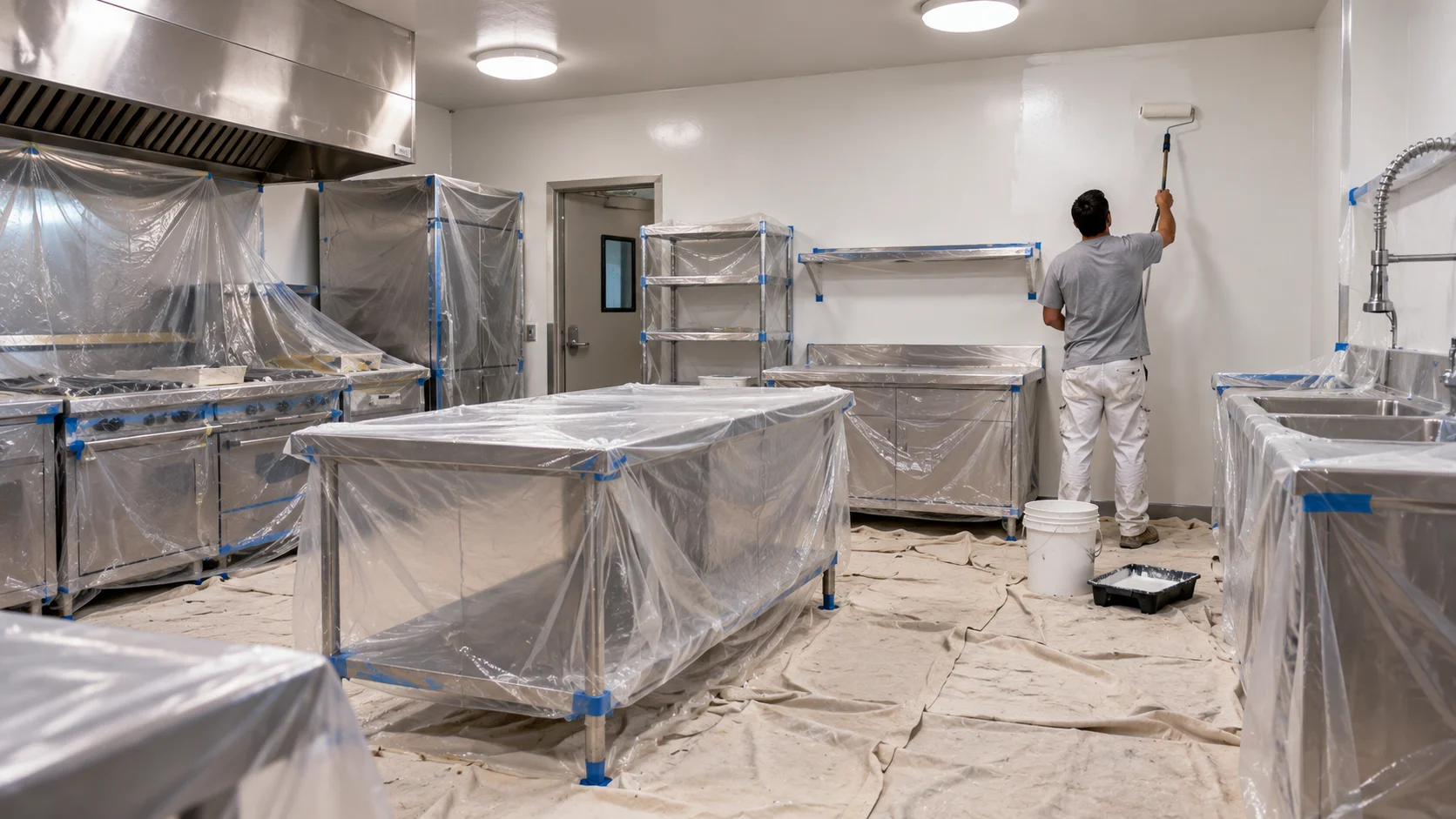
The food code does not have a chapter on painting, but it has several rules that decide how a painter has to work in a food business. Under 8:24-3.3(q), food must be stored "In a clean, dry location" and "Where it is not exposed to splash, dust, or other contamination," and 8:24-3.3(s) says that "During preparation, unpackaged food shall be protected from environmental sources of contamination." The catch-all at 8:24-3.3(z) is plain: "Food shall be protected from contamination that may result from a factor or source not specified above." Sanding dust and paint mist are exactly that kind of factor. The practical consequences:
- No food production next to an open work area. Kitchen and prep-room work is scheduled for days the kitchen is not producing, as agreed with the operator. Where a room cannot be emptied, the work area is closed off with plastic sheeting and food comes out of it first.
- Food, single-service items, linens and utensils come out or are sealed. Shelving is emptied or wrapped, prep surfaces are covered, and nothing is uncovered until the space is cleaned.
- Painting tools never go near a food sink. Section 8:24-6.5(e) says "Food preparation sinks, handwashing sinks, and warewashing equipment shall not be used for the cleaning of maintenance tools, the preparation or holding of maintenance materials, or the disposal of mop water and similar liquid wastes." Brush and roller cleanup happens away from those sinks, and the crew agrees on where with the manager before the first day.
- Materials are stored away from food. The code's rule for chemicals the business keeps, at 8:24-7.2(a), is to separate them "by spacing or partitioning" and locate them "in an area that is not above food, equipment, utensils, linens, and single-service and single-use articles." We hold paint and sundries to the same standard: one agreed staging spot, never on or over a food shelf.
- Dust is controlled at the source. Section 8:24-6.5(c) requires "dustless methods of cleaning" in the establishment. Sanding is kept to what the surface needs, dust is collected as it is made, and the area is wiped down before it is handed back.
- The space is cleaned before it goes back into use. Your staff then clean and sanitize food-contact surfaces as they normally would. The painter cleans up the work; the operator decides when a food area is ready to produce.
One more step is worth a phone call: if the job is large, or touches the kitchen, ask your local health department whether they want to know before the work starts. It costs nothing to ask, and it is better than an inspector finding a kitchen half-painted.
Keeping the Store or Restaurant Open: Zone-by-Zone Phasing
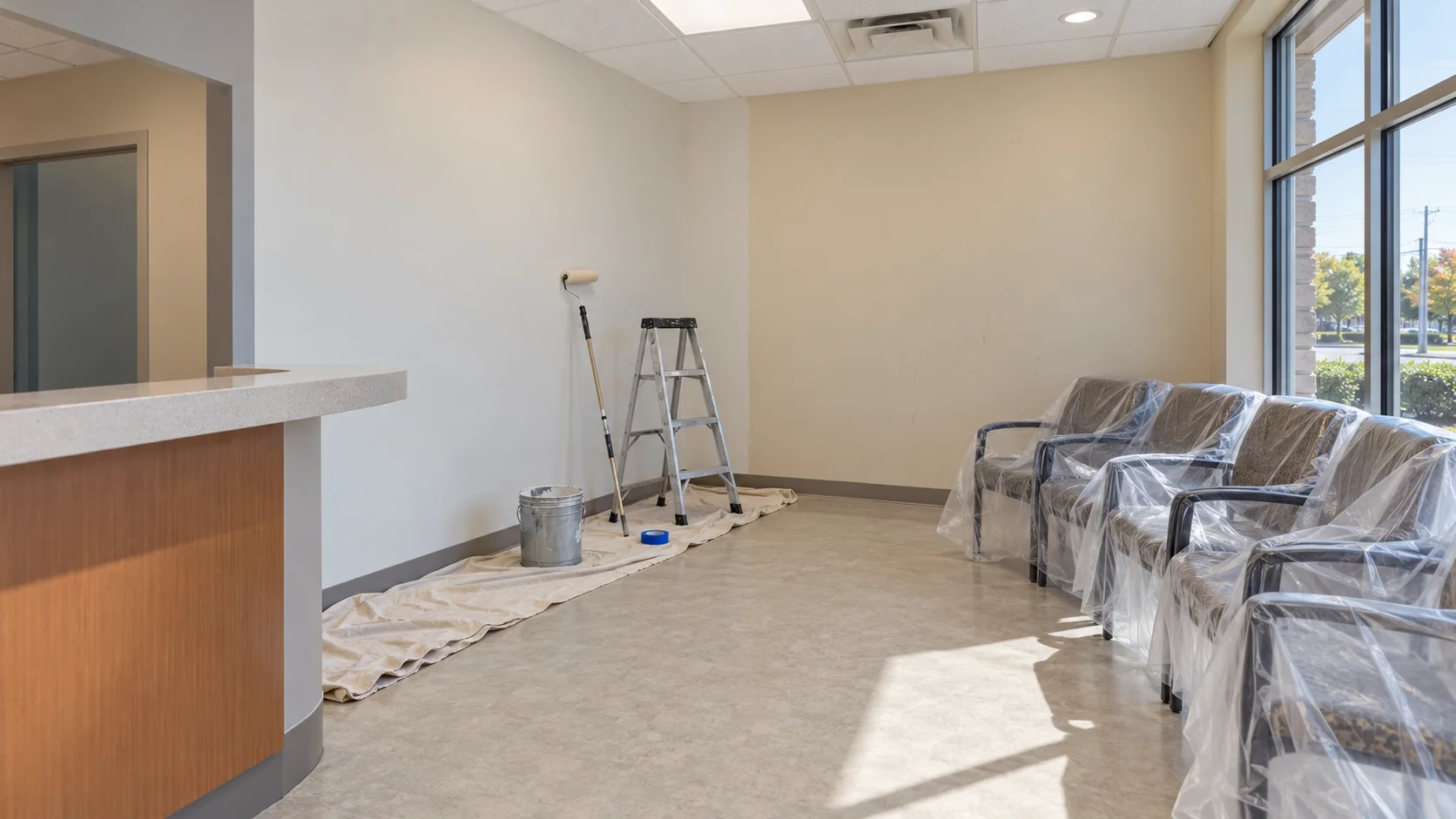
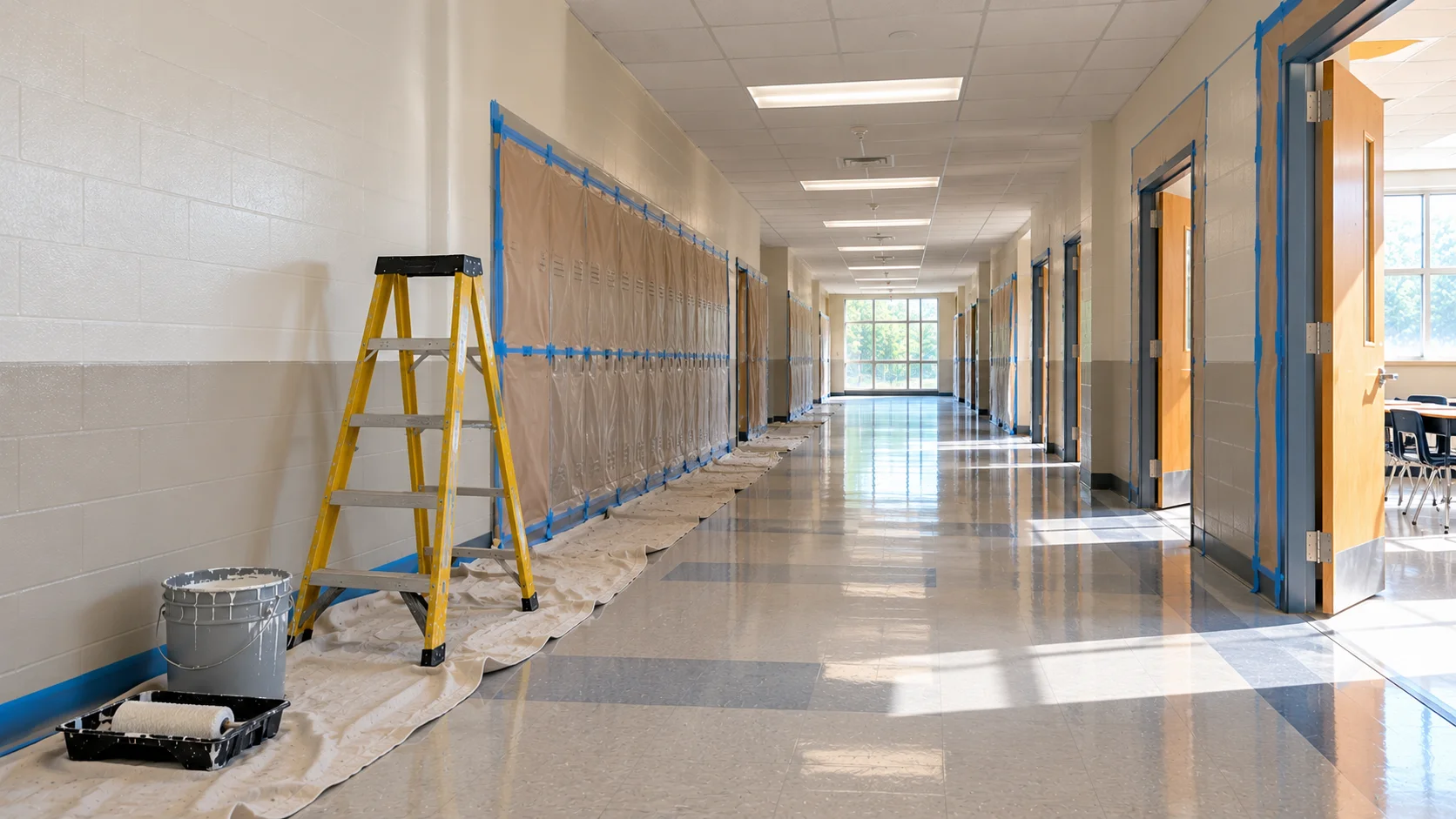
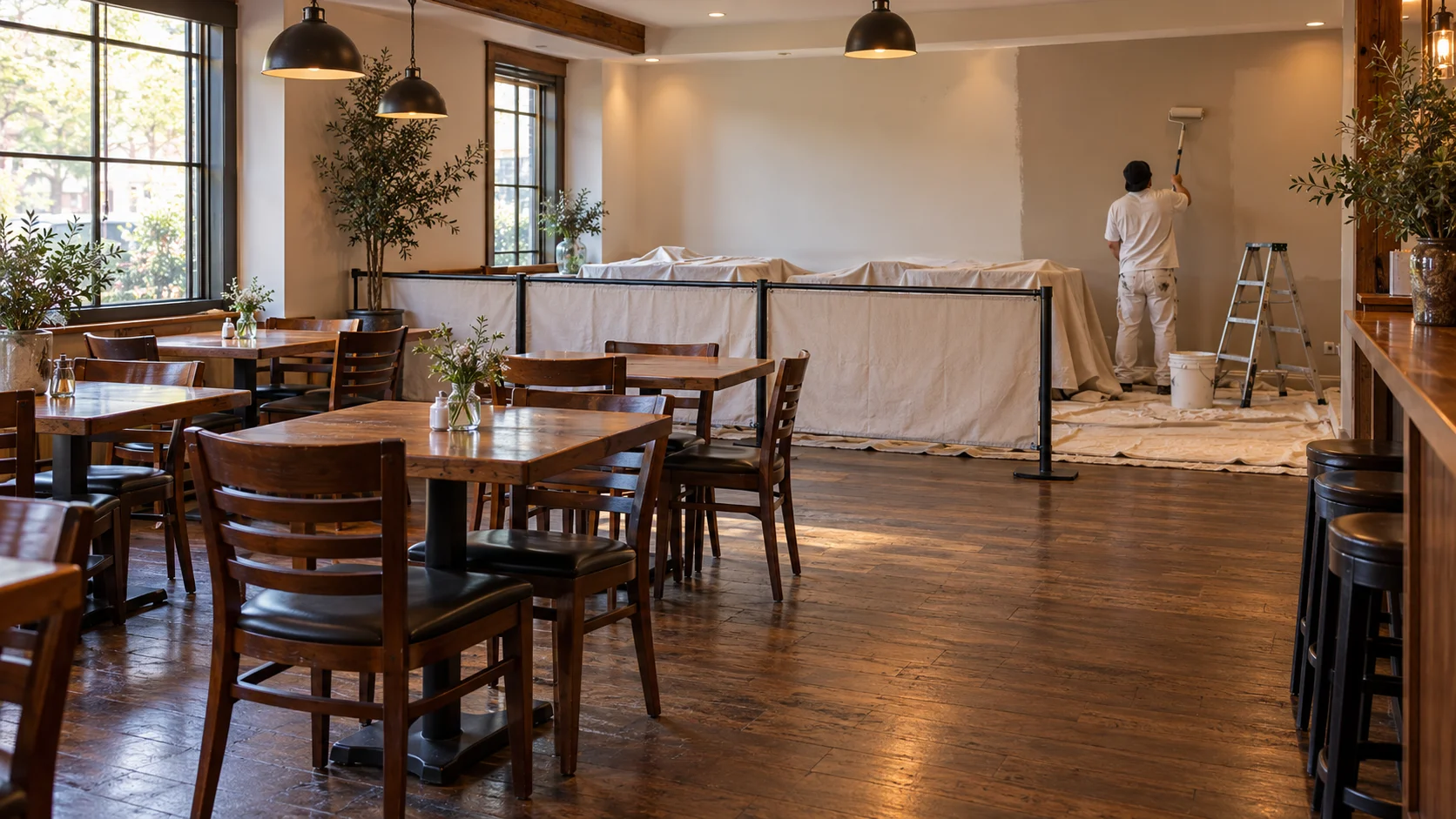
Most restaurants and stores cannot close for a repaint, and do not need to. The job is split into zones small enough that the business can trade around them, and the zones are sequenced so the customer-facing ones are out of service for the shortest time. The phase plan is written into the proposal and agreed with the operator before anyone mobilizes, including which zones are worked on which days and what the business loses access to while each one is open.
Retail sales floors
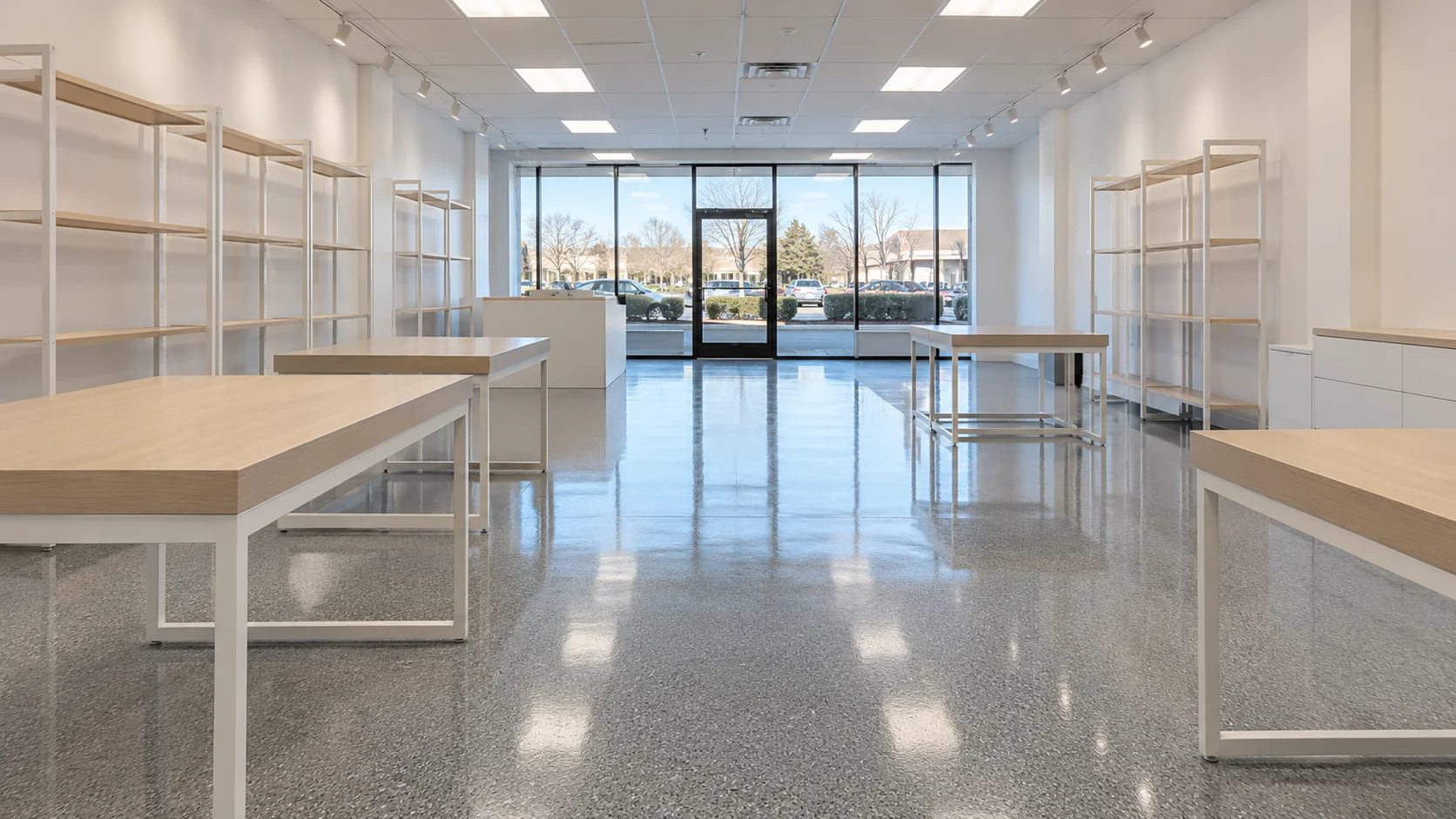
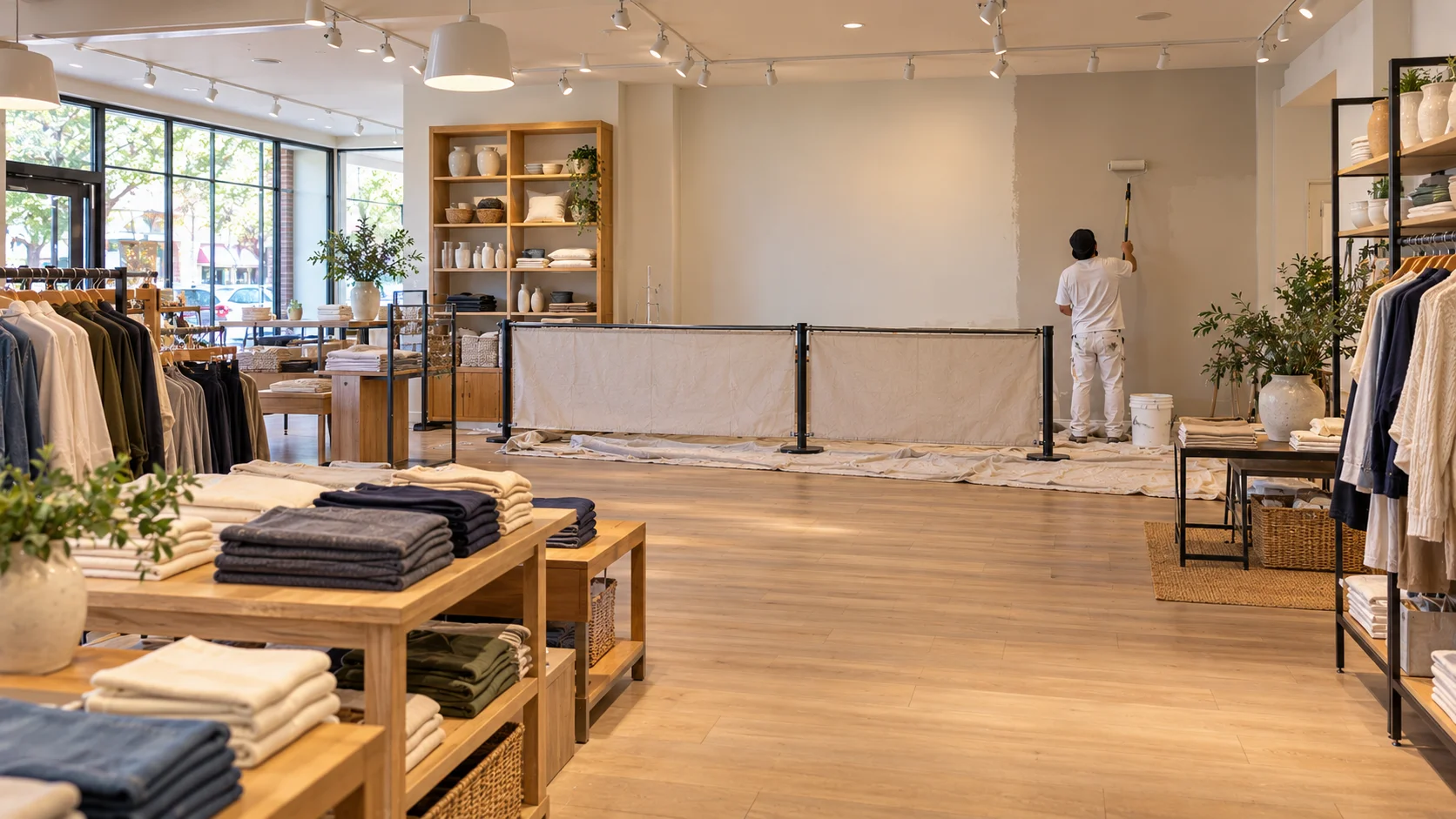
A sales floor phases by department or wall run. Fixtures and stock come off one wall, the area is closed with barriers and kept clear of the customer path, the wall is prepped and coated, and the fixtures go back before the next run opens. Fitting rooms, stockrooms, offices and restrooms are their own zones, and are often the right place to start: they are off the sales floor, and a stockroom repaint finished first gives the crew somewhere to stage. Merchandise moves are the hidden cost of a retail job, so the plan should say who moves stock and fixtures, the store's staff or the painting crew, and when.
Restaurants: front of house and back of house
A restaurant phases differently because the two halves have different rules. The dining room can usually be done in sections, closing a block of tables or one room at a time, with the bar, host stand and restrooms as separate zones. The kitchen, prep areas, walk-ins and dish room are another matter: they are worked when they are not producing food, room by room, with food and equipment protected as above. For many restaurants that means building the kitchen phases around the days the restaurant is already closed, which is a decision for the operator, not the painter.
Dry, recoat and cure: the numbers that set the reopening plan
"When can we use it?" has three different answers, and the data sheets give all three. Benjamin Moore's Ultra Spec SCUFF-X Interior Eggshell, a commercial wall finish, is dry to the touch in one hour and ready to recoat in two to three hours at 77 °F and 50% relative humidity. But the same sheet says "SCUFF-X® needs to fully cure for 2 weeks following application, before applying any cleaning chemicals and liquids." Sherwin-Williams' water-based catalyzed epoxy gives "To touch" at 45 minutes, "Minimum recoat" at six hours, and "To Cure" at seven days at 77 °F.
So a dining room section can go back into service the next day, provided staff know not to scrub the new walls with anything stronger than soap and water for a couple of weeks. A kitchen wall coated with a two-component epoxy can be dry quickly, but the operator should plan its return to full wash-down around the cure time on the data sheet, not the day the plastic comes down. Both sheets note that temperature and humidity change these times, which matters in a basement prep room or a walk-in that has only just been switched off. Our guide to paint fumes and VOCs explains why dry, recoat and cure are three different things.
Odor and VOCs in a Business That Stays Open
Smell is the complaint that ends a phased job early, so product choice matters as much as the barrier tape. New Jersey regulates the volatile organic compound content of paints sold in the state under N.J.A.C. 7:27-23, "Prevention of Air Pollution from Architectural Coatings", and commercial lines publish their figures. The SCUFF-X data sheet lists 46.8 grams per liter for its pastel base and calls the product "VOC compliant in all regulated areas." The Sherwin-Williams epoxy data sheet lists "less than 50 grams per litre" as mixed and lists it as compliant with the Ozone Transport Commission (OTC) rules. Neither figure means no odor; it means a lower solvent load, which ventilation then has to clear.
In practice we keep odor down in an open business with water-based products wherever the surface allows, the smallest practical zones, the HVAC plan agreed with the manager (sometimes the return in the work zone is closed off so the smell is not distributed through the store), and fans exhausting to the outside where the building allows it. Our guide to paint fumes and VOC safety goes deeper on what low-VOC does and does not mean.
Durable Finishes and Sheen for High-Traffic Surfaces
Restaurants and stores wear paint out in predictable places: the wall behind the host stand, chair-rail height in a dining room, the service corridor to the kitchen, end caps, fitting room partitions, door frames and the edges of every opening a cart goes through. A few rules hold up:
- Use a finish built for traffic. Benjamin Moore lists SCUFF-X for "high-traffic areas in commercial spaces such as school hallways, hospital waiting areas, hotels lobbies, gym locker rooms and bathrooms, retail fitting rooms, cafeterias, bathrooms and stairwells," and lists it as "Washable" and "Suitable for use in USDA inspected facilities."
- Pick sheen by cleaning, not by looks alone. Higher sheens clean more easily but show every dent in a long wall under store lighting. Eggshell on dining and sales-floor walls, a harder enamel on doors, frames and trim, and the hard coating system in the kitchen is a common split. Our paint sheen guide explains why two brands' "eggshell" do not match.
- Match brand colors to your spec. Chains and franchises usually issue a color and product standard; the proposal should name each color, product and sheen by surface so every location matches.
- Keep touch-up stock and a color schedule. The cheapest repaint is the one you avoid with a labelled quart and a small roller. Record every color, product and sheen by room, and keep the leftover paint labelled on site.
Storefronts and Exteriors
The food code asks little of exteriors: under 8:24-6.1(b)2, "Exterior surfaces of buildings and mobile retail food establishments shall be of weather resistant materials and shall comply with law." Your landlord, your town and, in some downtowns, a historic district or design review board may ask more, so check signage and storefront color rules before choosing a scheme.
The weather sets the calendar. Benjamin Moore's data sheet for Aura Exterior Low Lustre says "Do not apply when air and surface temperatures are below 40 °F (4.4 °C)" and that "Painted surfaces can be washed after two weeks." The Office of the New Jersey State Climatologist at Rutgers records an average of 163 freeze-free days in the northern highlands, 179 in the central and southern interior and 217 along the seacoast, and notes that "In the spring months, ocean breezes keep temperatures along the coast cooler." For a shore-town storefront that means more usable October and a later spring start; for a Bergen or Passaic strip center the window closes sooner. Our guide to painting in cold weather in NJ covers the dew point rule.
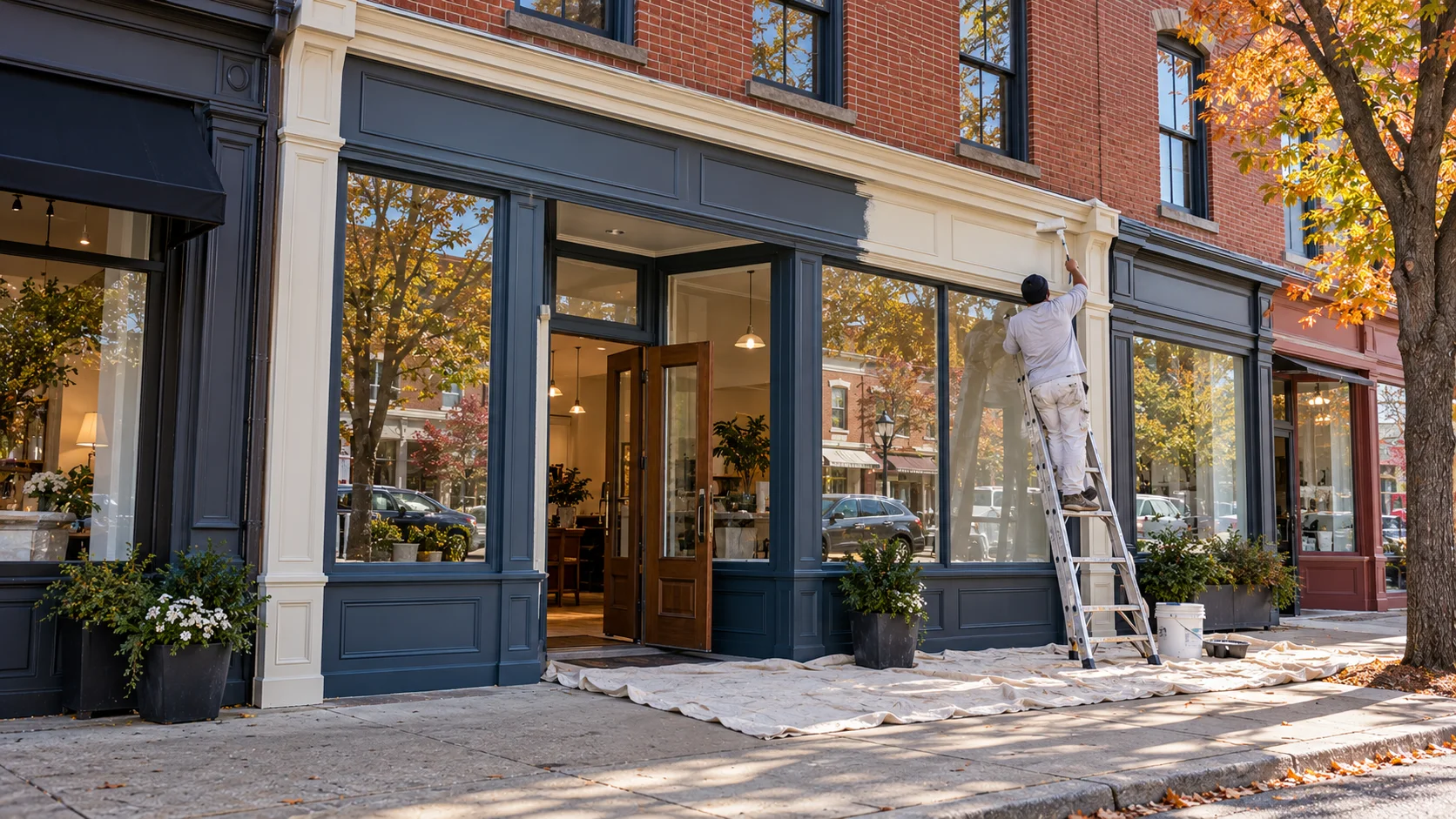
Storefront work is phased like the inside: one elevation or bay at a time, the entrance kept open and clearly signed, and the entry door coated in a short window the store agrees to. Much of New Jersey's main-street retail is brick or stucco, which brings its own prep; see our guides to painting brick and painting stucco, and to power washing before a repaint.
What to Send a Painter Before the Walkthrough
A restaurant or retail bid is only as good as the information behind it. Before the walkthrough, gather:
- A floor plan or a simple sketch with each room or zone named, front of house and back of house marked separately.
- Your trading hours, the days you are closed, and which zones can be out of service at the same time.
- Any brand or franchise color and product standard, and your landlord's rules for exterior and storefront work.
- Recent health inspection notes that mention walls, ceilings or surfaces.
- Who moves stock, fixtures and small equipment: your staff or the crew.
- Known problems: grease-soaked walls, water stains, peeling ceiling paint, damaged drywall behind equipment.
Ask every bidder to price the same scope, zone by zone, with product and sheen named for each surface. Our guide to commercial painting cost in NJ covers what moves the number, and our guide to medical and dental office painting in NJ covers the same occupied-business planning for practices.
Talk to Us About Your Restaurant or Store
NJ Painting Co. is a family-owned, fully insured painting company based at 36 Church Rd, Morganville, NJ 07751, painting in New Jersey for more than 20 years with Benjamin Moore and Sherwin-Williams products. For restaurants and stores we walk every zone with you, write the product and sheen for each surface into the proposal, set the phase plan around your trading days before we mobilize, keep food areas and stock protected, and leave a color and product schedule so touch-ups match. See how we run occupied commercial work on our commercial painting page, including its section on restaurant and hospitality painting, and our resinous floor systems on the epoxy flooring page.
We cover Monmouth, Ocean, Middlesex, Mercer, Somerset, Burlington, Union, Essex, Hudson, Bergen and Passaic counties. Call (732) 239-0932 or send us your floor plan, your trading days and the zones you want painted and we will come back with a written scope and a phase plan.
Frequently Asked Questions
What does New Jersey's food code require for restaurant kitchen walls?
N.J.A.C. 8:24-6.1 requires indoor wall, floor and ceiling surfaces where food operations are conducted to be smooth, durable and easily cleanable, and non-absorbent in areas subject to moisture, including food preparation areas, walk-in refrigerators, warewashing areas and toilet rooms. The code defines a smooth wall as an even or level surface with no roughness or projections that make it difficult to clean, so peeling paint, open holes and damaged drywall count against you. A hard, washable coating system over sound, properly primed substrate is the usual answer. Your local health department enforces the rule and has the final word.
Can a restaurant stay open while it is being painted?
Usually, yes. The dining room is painted in sections, one block of tables or one room at a time, with the bar, host area and restrooms as separate zones. The kitchen and prep areas are the exception: they are painted when they are not producing food, with food and utensils removed or sealed, which for many restaurants means the days they are already closed. The phase plan is agreed with the operator before work starts.
What paint is best for a commercial kitchen?
A hard, chemically resistant coating that stands up to steam, grease and daily scrubbing, applied over walls that have been degreased and primed. Water-based two-component epoxies are one common category; Sherwin-Williams' Pro Industrial Water Based Catalyzed Epoxy, for example, is listed by its maker as chemical and abrasion resistant and suitable for USDA-inspected facilities. Grease and smoke stains need a primer-sealer first, and the coating needs its full cure time, seven days on that product's data sheet, before heavy wash-down.
How do painters keep food from being contaminated?
By keeping paint and dust away from food entirely. Food, utensils, linens and single-service items are removed or sealed, the work area is closed off, sanding dust is collected as it is made, materials are staged away from and never above food storage, and painting tools are never cleaned in a food prep, handwashing or warewashing sink, which N.J.A.C. 8:24-6.5(e) prohibits. The area is cleaned before it is handed back, and your staff sanitize food-contact surfaces before use.
How soon can customers use a freshly painted area?
Often the next day, but cleaning has to wait longer. A commercial eggshell such as Benjamin Moore's SCUFF-X is dry to the touch in about an hour, and its data sheet says it needs two weeks to fully cure before cleaning chemicals and liquids are applied. Tell your staff to use soap and water only on new walls for that period. Kitchen coatings have their own cure times, which belong in the phase plan.
How do you paint a retail store without closing it?
By phasing the sales floor one department or wall run at a time. Fixtures and stock come off one section, the area is barricaded and kept out of the customer path, the wall is prepped and painted, and the fixtures go back before the next section opens. Fitting rooms, stockrooms and restrooms are separate zones. The plan should name who moves the merchandise, and when.
Will the paint smell bother customers and staff?
It can, which is why product choice and zone size matter. Commercial low-VOC lines publish their VOC content; Benjamin Moore lists 46.8 grams per liter for SCUFF-X's pastel base, and New Jersey regulates the VOC content of architectural coatings sold in the state under N.J.A.C. 7:27-23. Low VOC is not the same as no odor, so small zones, an agreed HVAC plan and ventilation to the outside still do most of the work.
Do restaurant dining rooms have to meet the same rules as kitchens?
Not in every respect. N.J.A.C. 8:24-6.2(g)2 says that in a consumer area, wall and ceiling surfaces and decorative items provided for ambiance need not meet the easily cleanable requirement for attachments if they are kept clean. That allows feature walls and exposed brick in a dining room. They still have to be kept clean, and dining walls take a lot of scuffing, so a washable commercial finish is still the sensible choice.
About the author
Written by the NJ Painting Co. team
NJ Painting Co. is a family-owned painting contractor based in Monmouth County, in business since 2004. We are licensed and fully insured, work with Benjamin Moore and Sherwin-Williams paints, and back our work with a 2-year workmanship warranty. We serve Monmouth, Middlesex, Ocean, Mercer, Somerset and Burlington counties, plus Union, Essex, Hudson, Bergen and Passaic in North Jersey.