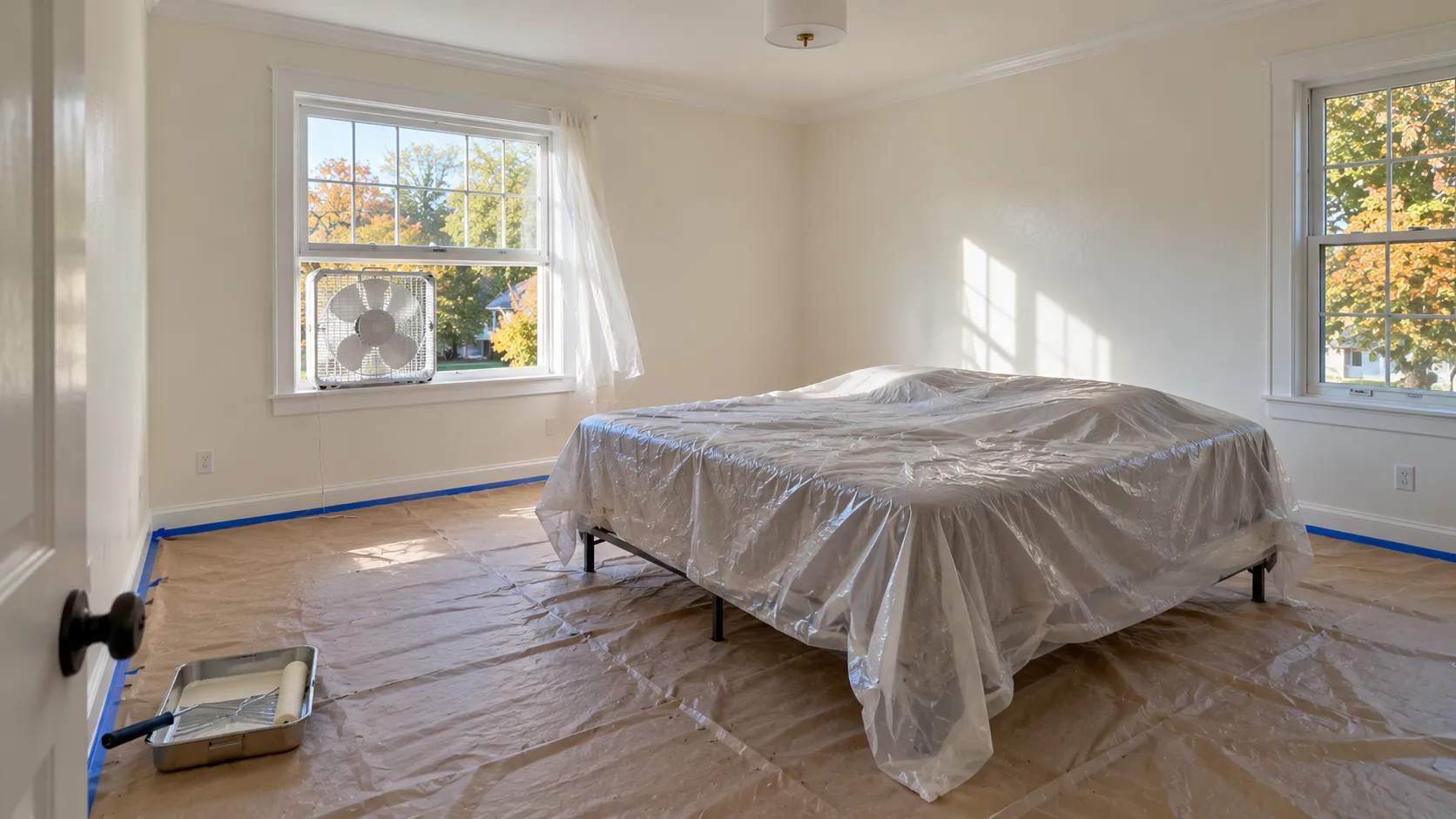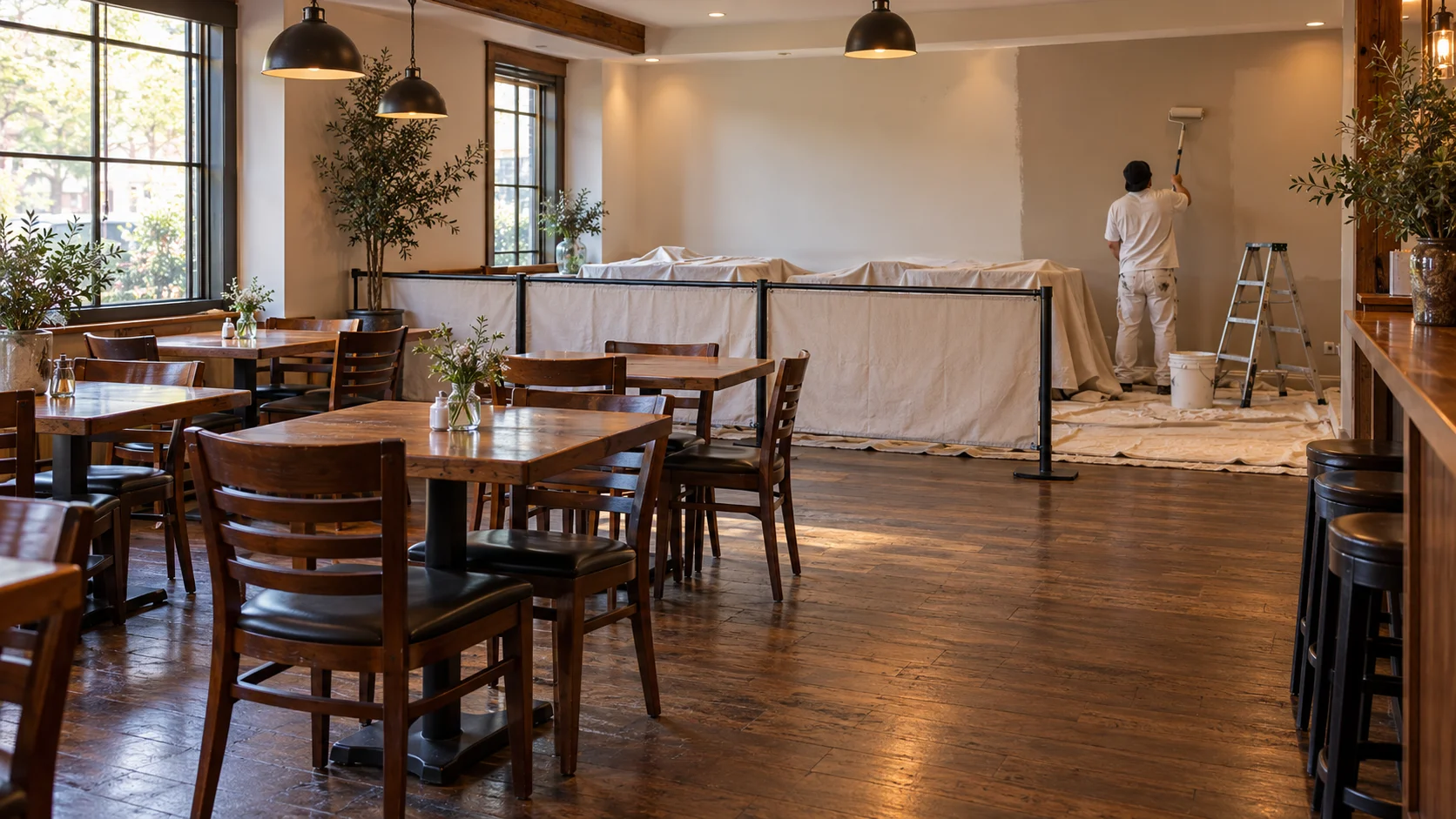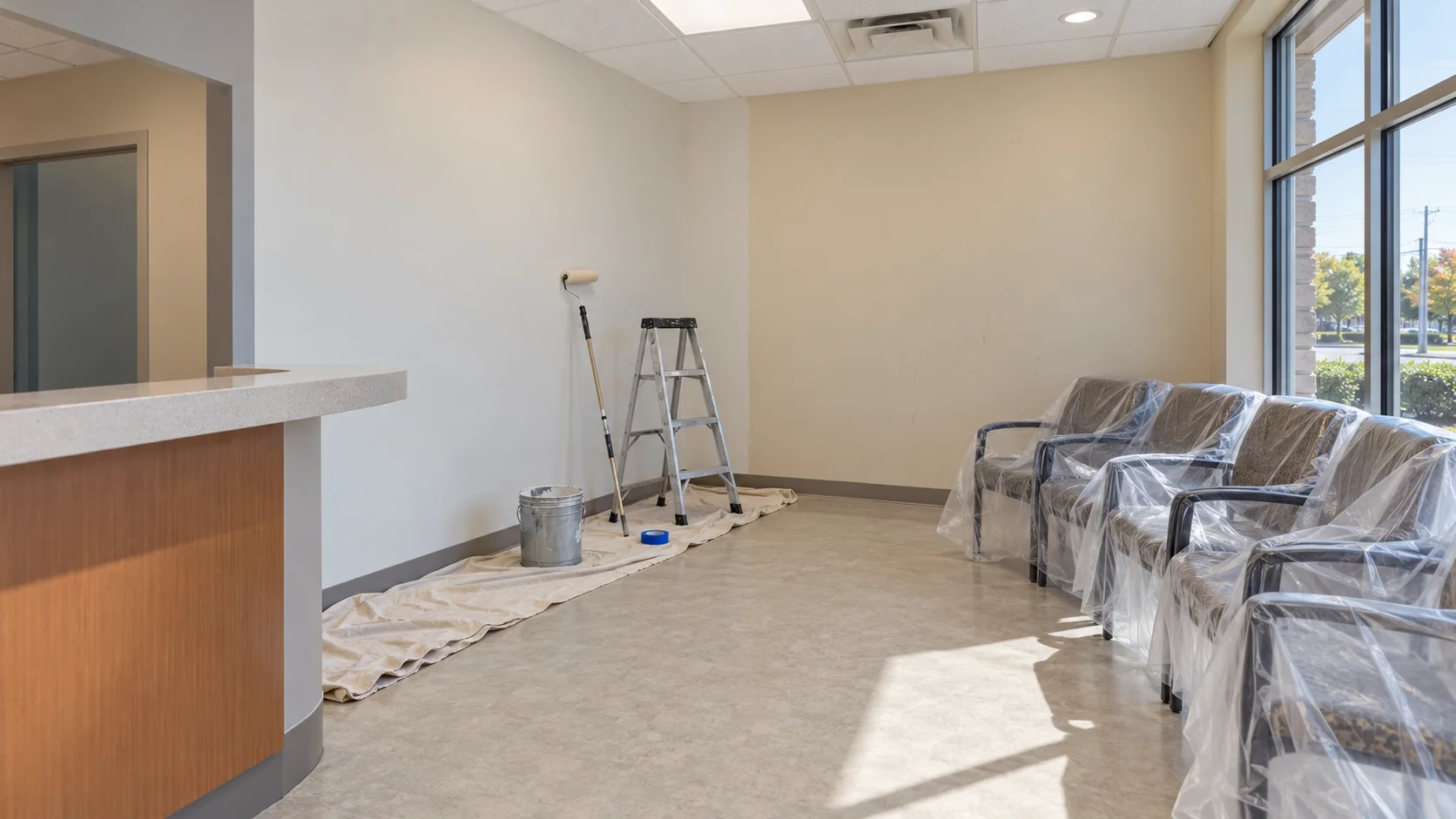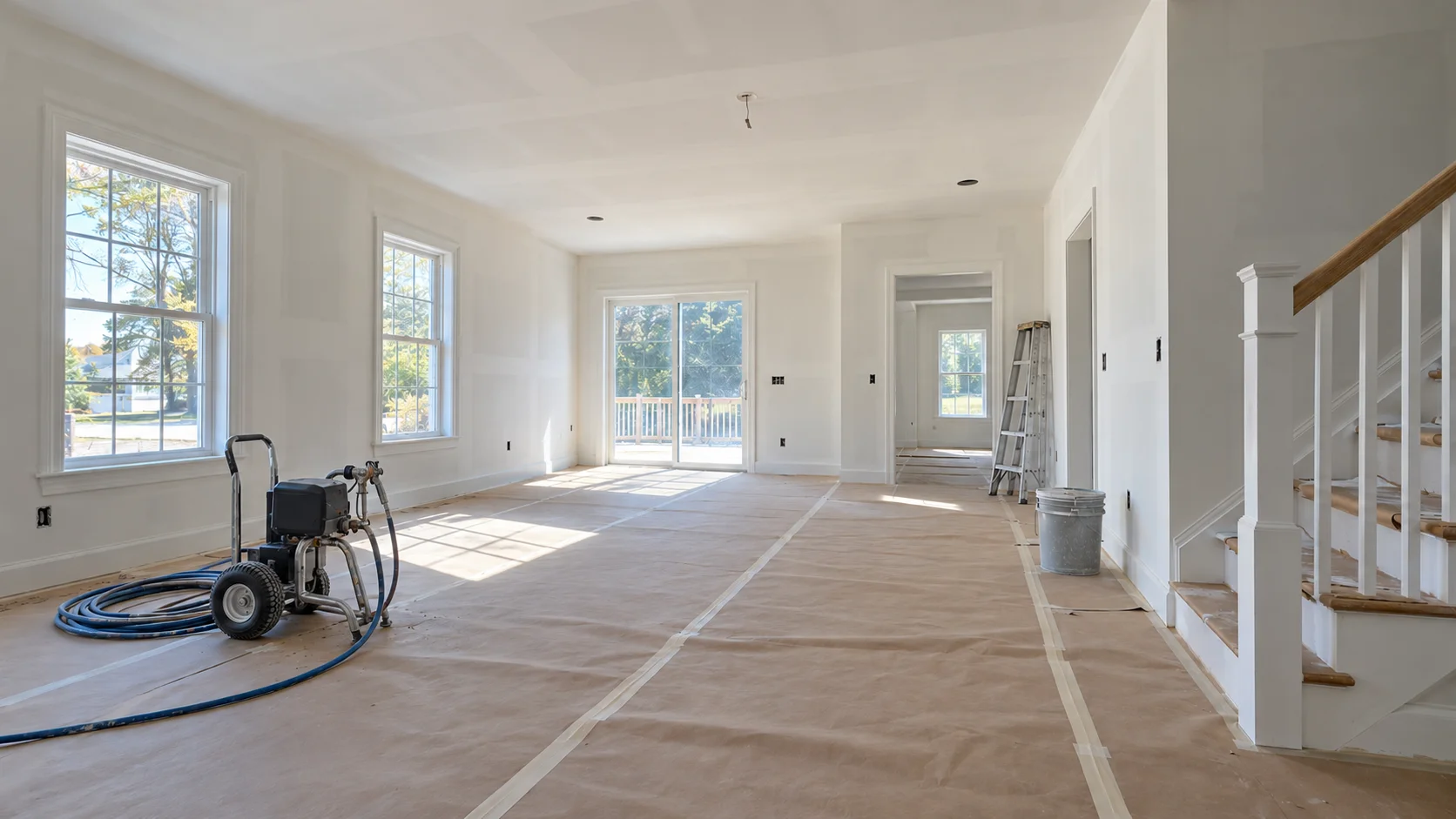
New construction painting in New Jersey happens in two passes. The first comes after the drywall is taped and sanded, before trim, cabinets and floors: ceilings and walls are primed and usually first-coated by spray in the empty shell. The second comes after the finish trades: caulking, filling, trim and door enamel, final wall coats and touch-up.
Almost everything homeowners find confusing about new construction painting follows from that. The first pass is fast because the house is empty and a sprayer can move faster than anything else ever will again. The second, after the carpenters, cabinet installers, tile setters and floor crew have finished, is the slower, fussier half, including the long punch list of touch-ups the other trades generated on their way through. Painting is not one step in a build schedule. It is a bracket around the finish trades.
We are a family-owned painting company in Morganville and we work as the painting subcontractor on new homes and on additions across Monmouth, Middlesex, Ocean, Mercer, Somerset and Burlington counties, and in Union, Essex, Hudson, Bergen and Passaic, using Benjamin Moore and Sherwin-Williams products. We are not the builder and not the general contractor; the sequence below is the one we work inside, not one we set. Every technical figure in this guide is quoted from a source we read on 17 October 2026 and listed at the end: the Gypsum Association's GA-214 standard for levels of gypsum panel finish, New Jersey's own Uniform Construction Code inspection rule at N.J.A.C. 5:23-2.18, the EPA's Indoor airPLUS construction specifications, and the current technical data sheets for the primers and paints we actually use. There are no prices in this article. For money, see our NJ painting cost guide and our guide to what it costs to paint a house in NJ.
The Short Answer
- Painting starts after the mid-point inspection, not before. New Jersey's code says the insulation inspection "shall be performed after all other subcode rough inspections and prior to the installation of any interior finish material." Drywall is interior finish material. No drywall, no paint.
- The painter's first pass is prime plus usually one coat, sprayed on bare board in an empty house. That is the only moment in the building's life when overspray costs nothing.
- The painter's second pass is after the trim, cabinets and floors. Caulk, fill, enamel the trim and doors, final wall coats, touch-up.
- Drywall finish level decides how good the walls can look, and it is specified by the builder, not the painter. GA-214 Level 4 is the normal residential standard for flat paint; Level 5 adds a skim coat over the whole surface and is what the standard calls for with sheen, dark colours or critical lighting.
- Spray and roll are not rivals. Spray the ceilings and bare board, back-roll to work it in, brush and roll everything once the house has finished surfaces in it.
- Builder-grade is usually a contractor-line flat, specified for "low abuse interior wall and ceiling surfaces" in its own manufacturer's words. It is a legitimate product, specified honestly, and it is not what most buyers want in a kitchen, bath, hallway or child's bedroom.
- Two coats over primer is the manufacturers' own system, not an upsell: Sherwin-Williams' drywall spec is one coat of primer and "2 coats Of appropriate finishes," and Benjamin Moore says "On bare substrates, two coats are recommended."
- Painting before you move in is easier, cheaper to protect and better ventilated, and the EPA's own new-homes program asks builders to ventilate "During the period between finishing and occupancy."
- Nail pops and seam cracks in the first year are normal, and touching them up is harder than painting them was. GA-214 warns that "any patching or touch-up of even minor damage subsequent to the final finish may be difficult to conceal for Levels 3, 4 and 5."
When Do You Paint When You Are Building a House?
Here is the whole sequence as we experience it on a New Jersey single-family build, with the two painting windows marked. Trades before and after us are listed so you can see what we are waiting on and who is waiting on us.
- Footings, foundation, framing, roof, windows and exterior doors. Nothing of ours happens here, although the exterior painting schedule is already being decided by when the siding and exterior trim go on.
- Rough-ins: electrical, plumbing, HVAC ductwork. The code sequences these explicitly. N.J.A.C. 5:23-2.18 says "The framing inspection shall take place after the rough electrical and plumbing inspections and after the installation of the heating, ventilation and/or air conditioning duct system."
- Insulation, then the mid-point inspection. This is the gate. The mid-point building inspection covers "All structural framing, connections, wall and roof sheathing, and insulation," and the rule is blunt about when it has to happen: "The insulation inspection shall be performed after all other subcode rough inspections and prior to the installation of any interior finish material." Walls do not get closed until an inspector has signed off, and the code adds that "The work shall not proceed in a manner which will preclude the inspection until it has been made."
- Drywall hung, taped, coated and sanded. Someone else's trade, and the most consequential one for how the finished house looks. How many coats of joint compound, and whether there is a skim coat, is the "level of finish" question in the next section.
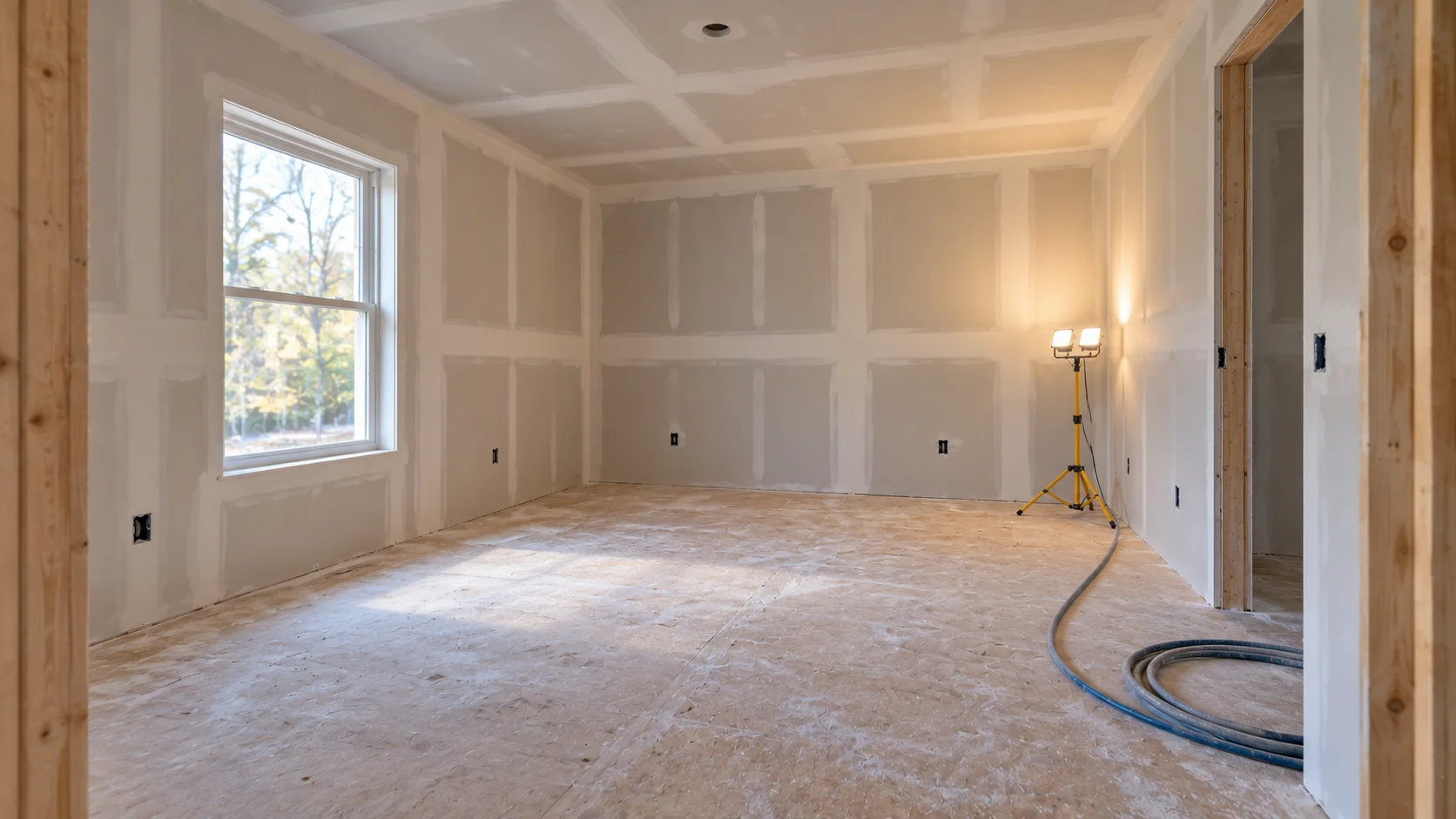
- Painting, pass one: ceilings and walls primed, usually one finish coat on the walls. An empty shell with no trim, no cabinets, no fixtures and no flooring. Masking is minimal, the sprayer is in its element, and nobody has to cut a line against anything. On a production schedule this is also when ceilings get their final coat, because getting back to a ceiling later is miserable.
- Trim, interior doors, stair parts, cabinets, tile, counters. The carpenters and installers come back into a painted shell. They will dent it, scuff it, and drill it. That is normal and it is why the next step exists.
- Painting, pass two: caulk, fill, enamel, finish coats. Nail holes filled, joints caulked, trim and doors primed and enamelled, walls given their final coat, ceilings cut back in where anything changed. This is the pass that takes the days.
- Flooring. Usually last among the installed finishes, and the reason the painter's second pass is scheduled around it rather than after it — more on the order below.
- Fixtures, appliances, hardware, final cleaning.
- Punch list, including paint touch-up. Ours and everyone else's.
- Final inspection and the certificate of occupancy. The code's final inspection includes "Installation of all interior and exterior finish materials, sealing of exterior joints," so the paint and the caulk are part of what gets looked at before a certificate of use and occupancy is issued.
Why the painter comes before and after the floors
This is the single most common question a first-time buyer asks us on a new build, and the answer is that both orders are wrong on their own, so the work gets split.
If all the painting happened before the floors, the floor crew would scuff the baseboard, mark the walls carrying material in, and leave the painter with a touch-up list that is longer than the original job. If all the painting happened after the floors, we would be masking, protecting and working above a brand-new finished floor for days, cutting every baseboard line by hand with no ability to pull the trim, and spraying would be off the table entirely.
So the ceilings and the first wall coats go on before anything is in the room, and the trim enamel and final wall coat go on around the flooring install — usually with the baseboard primed and first-coated off the wall or before the floor arrives, then set, caulked and final-coated after. We do not install or finish floors ourselves; sanding and finishing hardwood is a different trade with different equipment and a different dust problem, and we gave that work up deliberately. What we do is coordinate with whoever has it, because the order is a scheduling negotiation and not a rule.
What comes after painting when you are building a house?
After the final paint coats: flooring if it is not already in, then plumbing and lighting fixtures, appliances, door and cabinet hardware, mirrors, shelving, the final construction clean, the punch list, and the municipal final inspection before the certificate of occupancy. Paint touch-up sits inside the punch list and it is almost always the last trade activity in the house, because everything that happens after the final coat has the potential to mark it.
Drywall Finish Levels: Why a New Wall Can Look Bad in Raking Light
This is the part of new construction painting that nobody explains to buyers, and it causes more disappointment than any other single thing. A brand-new wall can be perfectly built, perfectly primed and perfectly painted, and still show a grid of faint bands where the drywall joints are the moment the late-afternoon sun comes across it. That is not a painting defect. It is a specification outcome, and it was decided before we arrived.
The governing document is GA-214, Levels of Finish for Gypsum Panel Products, published by the Gypsum Association and presented jointly with the wall and ceiling, ceilings, drywall finishing and painting contractor associations. It opens with a sentence worth framing: "It must be noted that it is not possible to achieve a perfectly flat surface when finishing gypsum panels." The whole standard exists because joint compound sits above the plane of the board, and concealment is a matter of degree.
| Level | Where GA-214 says it is used | What the finisher does |
|---|---|---|
| Level 0 | "temporary construction or whenever the final decoration has not been determined" | "No taping, finishing, or accessories required." |
| Level 1 | Smoke barriers and concealed areas: "plenum areas above ceilings, attics" | Tape embedded in compound; "Excess joint compound and tool marks are acceptable; fastener heads need not be covered." |
| Level 2 | Tile substrate, "garages, warehouse storage or other similar areas where surface appearance is not a concern" | Tape wiped down, one coat over fasteners. "Tool marks are acceptable." |
| Level 3 | Heavy or medium texture, or heavy-duty commercial wallcovering. "This is not the correct level of finish for smooth wall designs" | One separate coat over joints, two over fasteners, surface "smooth and free of tool marks" |
| Level 4 | "smooth wall designs decorated with flat paints, light textures, non-continuous textures, or wallcoverings." Note: "Non-flat or dark/deep tone paints are not recommended; refer to Level 5." | Two separate coats over flat joints, one over interior angles, three over fastener heads and accessories |
| Level 5 | "smooth wall designs decorated with non-flat paints (i.e. sheen/gloss) or other glossy decorative finishes, dark/deep tone paints are applied, or critical lighting conditions occur" | Everything in Level 4 plus "A skim coat of joint compound or a material manufactured especially for this purpose shall be applied to the entire surface." |
Read the Level 4 note and the Level 5 scope together and the whole problem falls out. Most New Jersey tract and semi-custom houses are specified and finished to Level 4, because Level 4 is correct for flat paint. But almost nobody wants flat paint in a kitchen, a bathroom, a mudroom or a hallway, and plenty of buyers want a deep saturated colour in a dining room or a bedroom. The moment you put an eggshell, satin or deep colour on a Level 4 wall, you are outside what the standard recommends, and the standard says why: "In general, non-flat and dark/deep tone paints highlight minor surface differences, whereas textures conceal these minor differences." On dark colours specifically: "Colors with deep or strong hues, and even flat paints, tend to magnify imperfections in the finished gypsum panel surface and increase the possibility of joint photographing."
"Joint photographing" is GA-214's own term — it defines it as "The shadowing of the finished joint areas through the surface decoration. syn telegraphing." And "critical lighting," the condition that triggers Level 5, is defined as "Strong side lighting from windows or surface-mounted light fixtures," with the comments section expanding it to "wall and ceiling areas that are illuminated or flooded with artificial and/or natural light. Strong oblique light from windows or surface-mounted light fixtures may exaggerate minor surface differences." If your new house has a two-storey stair window, a wall of sliders, a long upstairs hallway with ceiling cans, or any room where the sun comes in low and rakes across a wall, that is critical lighting, and GA-214 says the fix is "skim coating the entire surface" — a Level 5 — or softening the light with window treatments.
GA-214 is also realistic about what a skim coat buys you: "Skim coating will not approximate a plastered finish/surface. Once the skim coating material dries, treated joints, filled voids, and spotted fastener heads may be visible." A Level 5 is a big improvement, not a guarantee. (Plaster itself is a separate trade; plaster repair is not something we offer, and this whole section is about gypsum board. Our drywall repair guide explains how to tell the two apart, which decides whose work it is.)
Two more lines in that standard are worth knowing before you argue with anybody about a wall.
First, there is an agreed way to look at a wall. "The normal viewing position shall be at a minimum distance of five (5) feet (1.5 m) perpendicular from the surface. Blemishes should not be visible from a normal viewing distance with normal light." Nose to the drywall with a flashlight held flat against it is not the inspection standard, and no house passes it.
Second, the standard sets a temperature rule that lands squarely on New Jersey winter builds: "A minimum temperature of 50°F (10°C) shall be maintained continuously for 48 hours prior to and throughout the finishing process until the project is completed/occupied." That is for the drywall finishing, and the paints agree — Benjamin Moore's Regal Select and Ultra Spec 500 sheets both say do not apply below 50°F, and Sherwin-Williams' interior primer says "Apply at temperatures above 50°F." On an unheated January shell, nothing in this chapter of the build happens properly until there is temporary heat.
What to ask your builder, in one sentence
Ask: what level of drywall finish is specified, and does it change in the rooms with big windows? If the answer is Level 4 everywhere and you have already picked an eggshell in a sunlit great room, you now know what you are buying, and you can decide whether to pay for a Level 5 in that one room, choose a flatter sheen, or accept it. That conversation is cheap before the compound is sanded and expensive afterwards. Our satin versus eggshell guide covers the sheen half of the decision in detail.
Spray or Roll on New Construction?
Both, in that order, and the search term "spray or roll paint new construction" usually hides two different questions.
If the question is how is new construction painted, the answer is that bare board and new ceilings get sprayed. Both manufacturers spec airless spray on the products we use — Sherwin-Williams' interior primer lists 2000 p.s.i. and a .017 to .021 inch tip, Benjamin Moore's Ultra Spec 500 flat lists 1500 to 2500 psi and a 0.015 to 0.017 tip — and an empty shell with no trim and no floor is the one situation where masking costs almost nothing. Spraying also lays a more uniform film on a large ceiling than a roller does, which matters because ceilings are where sheen and stipple differences show up most.
If the question is should the walls just be sprayed and left, the answer is no. We back-roll: spray a section, then immediately roll it out while it is wet. Spraying puts the paint on the wall; rolling works it into the paper surface, evens the film and leaves a consistent stipple so that later touch-up and a later repaint both blend. That is our practice rather than a published requirement, but the reason it matters is published: Sherwin-Williams' own primer sheet warns that "When spot priming on some surfaces, a non-uniform appearance of the final coat may result, due to differences in holdout between primed and unprimed areas. To avoid this, prime the entire surface rather than spot priming." Uneven absorption shows through the topcoat, and an unrolled sprayed primer coat on new board is exactly the uneven-absorption problem waiting to happen.
Once trim, cabinets, counters and floors are in, spraying walls becomes an expensive masking exercise and we brush and roll instead. Trim and doors are the exception worth planning for: if we can get the doors and the baseboard before they are hung and set, they can be sprayed flat, which is the finish most people picture when they imagine new cabinetry or new trim. After they are installed, it is brushwork. Our guide to trim, door and baseboard painting in NJ goes through the new-versus-existing difference properly; the short version is that new trim is the predictable case because there is no old finish to fight.
What Paint Is Used in New Builds, and What the Buyer Actually Wants
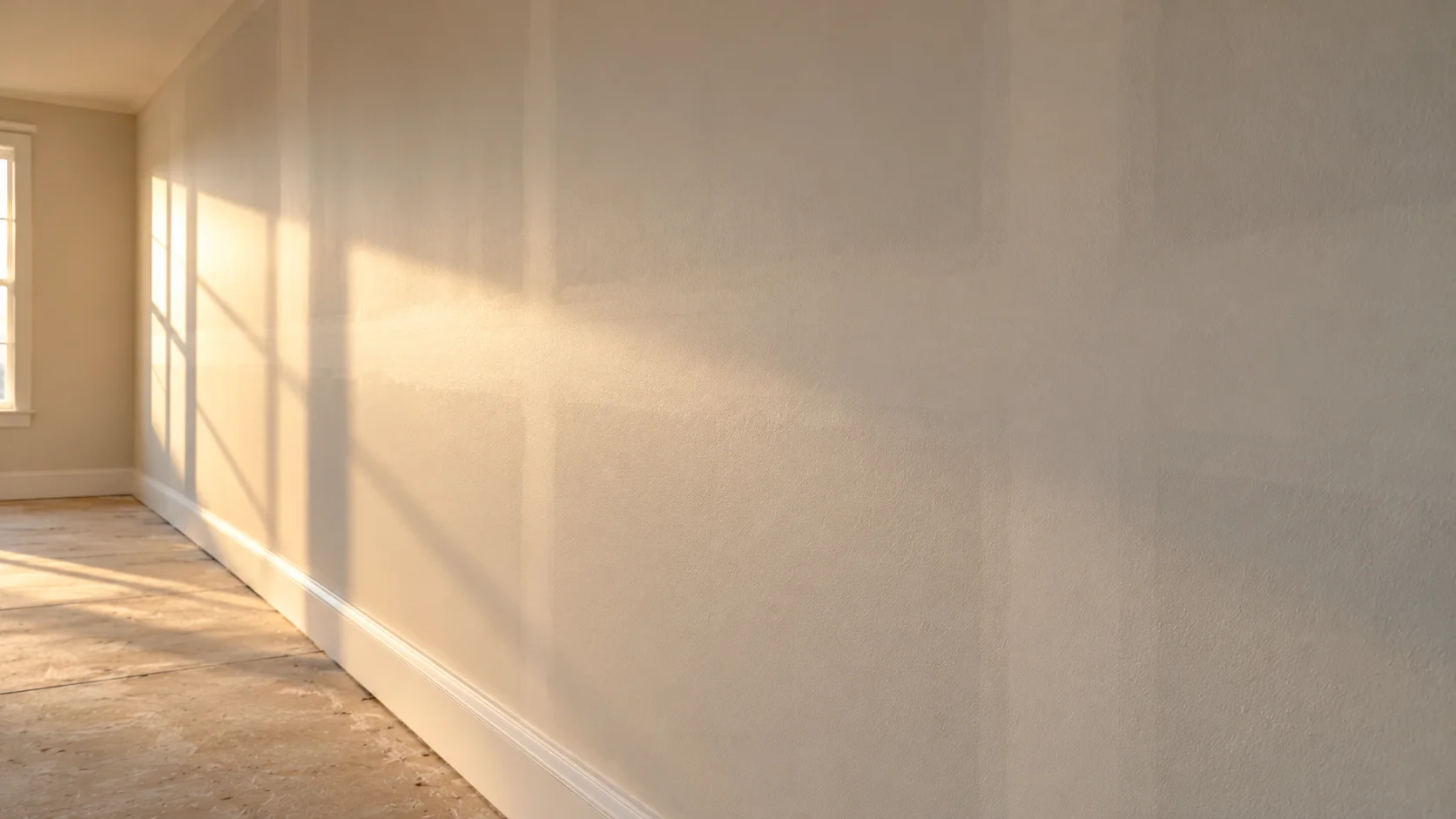
Walk into a brand-new New Jersey house and the odds are that every wall and ceiling is one colour, in flat, out of a contractor line. There is nothing dishonest about that; it is a real product, specified for a real purpose, and the manufacturers say what the purpose is. Benjamin Moore's Ultra Spec 500 Interior Flat Finish sheet recommends it for "Low abuse interior wall and ceiling surfaces in commercial and institutional environments where flat finish is desired." That is a careful sentence. Low abuse. Flat.
A new family house is not a low-abuse environment. Hallways get touched, kitchens get splashed, bathrooms get steamed, and children's rooms get everything. So the gap between what a build is specified with and what an owner eventually wants is not a scandal, it is a predictable upgrade decision, and it is cheapest to make before move-in.
| Product | What its own sheet says it is for | Dry / recoat | Useful line |
|---|---|---|---|
| SW ProMar 200 Zero V.O.C. Interior Latex Primer | "a professional quality, interior vinyl acrylic primer" | 1 hour / 4 hours | Drywall system: "1 coat ProMar 200 Zero V.O.C. Latex Primer / 2 coats Of appropriate finishes" |
| BM Ultra Spec 500 Interior Flat (N536) | "Low abuse interior wall and ceiling surfaces ... where flat finish is desired" | 1 hour / 2 – 3 hours | "Painted surfaces can be washed after two weeks"; features list includes "Great touch up" |
| BM Regal Select Eggshell (N549) | "Ideal for surfaces subject to abuse and soil ... stain release technology that allows common household stains to be easily removed with soap and water" | 1 hour / 1 – 2 hours | "On bare substrates, two coats are recommended" |
Notice what the flat's own feature list brags about: "Great touch up." Flat paint touches up almost invisibly because there is no sheen to break. That is genuinely why builders specify it — a house that is going to be marked by six more trades and then walked by a buyer with a clipboard needs to be touchable-up. The trade-off is that flat is the least washable and least scrubbable of the sheens, so the same property that makes it good for a punch list makes it poor for a family hallway.
The honest way to think about the "best interior paint for new construction" question, then, is in two layers. The primer is not optional and not the place to save: Benjamin Moore's Ultra Spec sheet states that "New surfaces should be fully primed," GA-214 recommends in a note under every one of Levels 3, 4 and 5 that "the final decoration specification (e.g. painting specification) include the application of a priming material prior to the decoration," and both primer sheets insist the board be clean — "Drywall surfaces must be free of sanding dust" on the Benjamin Moore sheet, and "Joint compounds must be cured and sanded smooth. Remove all sanding dust" on the Sherwin-Williams one. New board is thirsty and uneven in absorption; primer is what makes the topcoat read as one surface.
The topcoat is where the room should decide. Flat or matte on ceilings and in low-traffic bedrooms; a washable eggshell or matte in living areas; eggshell or satin in kitchens, baths, mudrooms, hallways and anywhere children live; and a waterborne alkyd enamel on trim and doors, which is the slowest-curing product in the house and therefore the one that sets the schedule. If you are choosing colours at the same time, our interior paint colors guide has current palettes with real codes, our kitchen cabinet paint colors guide covers the cabinetry, and our Benjamin Moore versus Sherwin-Williams comparison goes line by line through the two brands.
A note on caulk, and the order nobody expects
Both primer sheets tell you to caulk after priming, not before. Sherwin-Williams: "Gaps between walls, ceilings, crown moldings, and other interior trim can be filled with the appropriate caulk after priming the surface." That is not a detail invented to annoy anyone — sealant sticks better to a primed, sealed surface than to raw wood and paper, and priming first also means the joint you are about to caulk is visible rather than hidden by dust. On a new build this is one of the clearest tells of a carefully sequenced paint job: primer, then caulk, then finish.
What is builder-grade paint?
Builder-grade paint is a trade term, not a standard: it usually means a contractor-line flat in one colour across the walls and ceilings, chosen because it is quick to apply and easy for the other trades to touch up. We found no regulator or manufacturer that defines it. It is not defective. The trade-off is washability, because the same flat that hides a punch-list dab is the least scrubbable sheen in the house. If you want to know what you have, ask the builder for the product name, not the colour.
New Construction Exterior Painting
Exterior new construction is a different animal, and the constraints are mostly about the substrate being new rather than weathered.
New wood is not automatically ready for paint. Sherwin-Williams' Exterior Latex Wood Primer sheet gives two field tests we actually use. For absorbency: "Test the absorbency of the wood by sprinkling water on the surface. If the water penetrates into the wood quickly, the wood is ready to prime. If the water beads up or does not penetrate, allow the wood to weather and test for absorbency again." And for the glossy skin that smooth-sawn new lumber sometimes arrives with: "Mill Glaze- is a glossy finish on new, smooth sawn wood or on the peaks of some textured wood. This must be removed by sanding to allow the primer to penetrate." Paint over mill glaze and the paint is bonded to a film, not to wood.
Cedar and redwood add tannin bleed, and the test is published too: "To test for bleeding, coat a 4 foot by 4 foot section with the primer. If no bleeding is evident within 4 hours, proceed with complete priming. If bleeding occurs, use Exterior Oil-Based Wood Primer." Knots are their own problem; Benjamin Moore's Fresh Start High-Hiding All-Purpose Primer sheet is explicit in its limitations that it is "Not recommended for sealing knots or over pine sap," which is exactly why a new pine-trim exterior needs the right primer rather than the nearest one.
Four other new-construction exterior rules that come straight off the sheets:
- Primer is on a clock. "For exterior exposure, this primer must be topcoated within 14 days with architectural latex or oil finishes." A primed-and-forgotten elevation is a job that has to be prepped again.
- One coat of primer plus two coats of finish is the published system on new bare wood, not a premium option.
- Masonry, stucco and concrete have to cure first. Both brands say the same thing: "New plaster or masonry surfaces must be allowed to cure 30 days before applying base coat." Sherwin-Williams adds the shortcut and its price — "If painting cannot wait 30 days, allow the surface to cure 7 days and prime the surface with Loxon Concrete & Masonry Primer." On a build that is chasing a certificate of occupancy, that thirty days is a real scheduling constraint and it is worth knowing about in March rather than in the last week.
- Temperature has a 48-hour tail. The exterior primer can go on down to 35°F, but "Air and surface temperatures must not drop below 35°F(1.6°C) for 48 hours after application," and the recoat window stretches from 4 hours at 77°F to "24-48 Hours" at 35°F. One coat per elevation per day, at best, is what a cold-weather exterior looks like.
Stucco, siding, brick, soffit, fascia, columns, railings, porches, garage doors and front doors are all work we do, and on a new build they are usually easier than on a repaint because there is no failing coating underneath. If you are still choosing the exterior scheme, our guide to popular exterior house colors in NJ is the place to start, and our guide to how often to repaint explains what the first repaint cycle on a new exterior usually looks like in this climate.
Should You Paint a New Construction House Before You Move In?
If you have the window, yes, and the reasons are practical rather than aesthetic.
An empty house has no furniture to move, no rugs to roll, nothing to mask on the counters and no family working around the crew. Doors can come off their hinges and be sprayed flat. Baseboard can be cut in without a finished floor under it. The job runs faster per square foot than the same job will ever run again, and our guide to how long it takes to paint a house quantifies that gap: the same scope in an occupied house takes roughly a fifth to a third longer, because the room gets reset every evening and set up again every morning.
Ventilation is the other argument, and it is the one the EPA makes. Its Indoor airPLUS construction specifications — a programme "developed by the U.S. Environmental Protection Agency (EPA) to recognize new homes and other buildings equipped with a comprehensive set of indoor air quality features" — include a requirement headed Ventilation after Material Installation: "Ventilate the home with outside air at the highest rate and duration practical," both "During and shortly after installing products that are known sources of contaminants (e.g., cabinets, carpet padding and painting)" and "During the period between finishing and occupancy." It also advises that if whole-house ventilation cannot be scheduled before occupancy, the builder should "advise the buyer to operate the ventilation system at the highest rate it can provide during the first few months of occupancy."
Note what that is really telling you: a new house is a sealed, tightly built envelope full of brand-new materials that are all off-gassing at once — paint, caulk, adhesives, cabinetry, flooring, carpet padding — and the programme's answer is air, before anyone is living there. The EPA's general indoor-air guidance points the same way, noting that "Concentrations of many VOCs are consistently higher indoors (up to ten times higher) than outdoors" and advising you to increase ventilation when using products that emit them and to follow all label precautions. Our guide to paint fumes and VOCs goes through what the labels and the data sheets actually say, and our guide to living in your house while it is painted covers the occupied case if your window has already closed.
The same EPA programme is also the reason the low-VOC question has a concrete answer on a new build rather than a vague one. Indoor airPLUS requires that "At least 90 percent of the interior surface area covered by site-applied paints, finishes, and coatings shall use low-VOC or no-VOC products certified by one of the following third-party standards," and then names them: GREENGUARD or GREENGUARD GOLD, SCS Indoor Advantage Gold, a list based on CDPH Standard Method V1.2-2017, Green Seal GS-11, Green Wise, or the Master Painters Institute X-Green standards. If a builder is pursuing that certification, the paint spec is not a preference, it is a documented requirement — and the premium interior lines we use carry several of those certifications on their own sheets.
Touch-Up, the Punch List and the First Year
Two uncomfortable truths about new construction paint, both of which are easier to hear before closing than after.
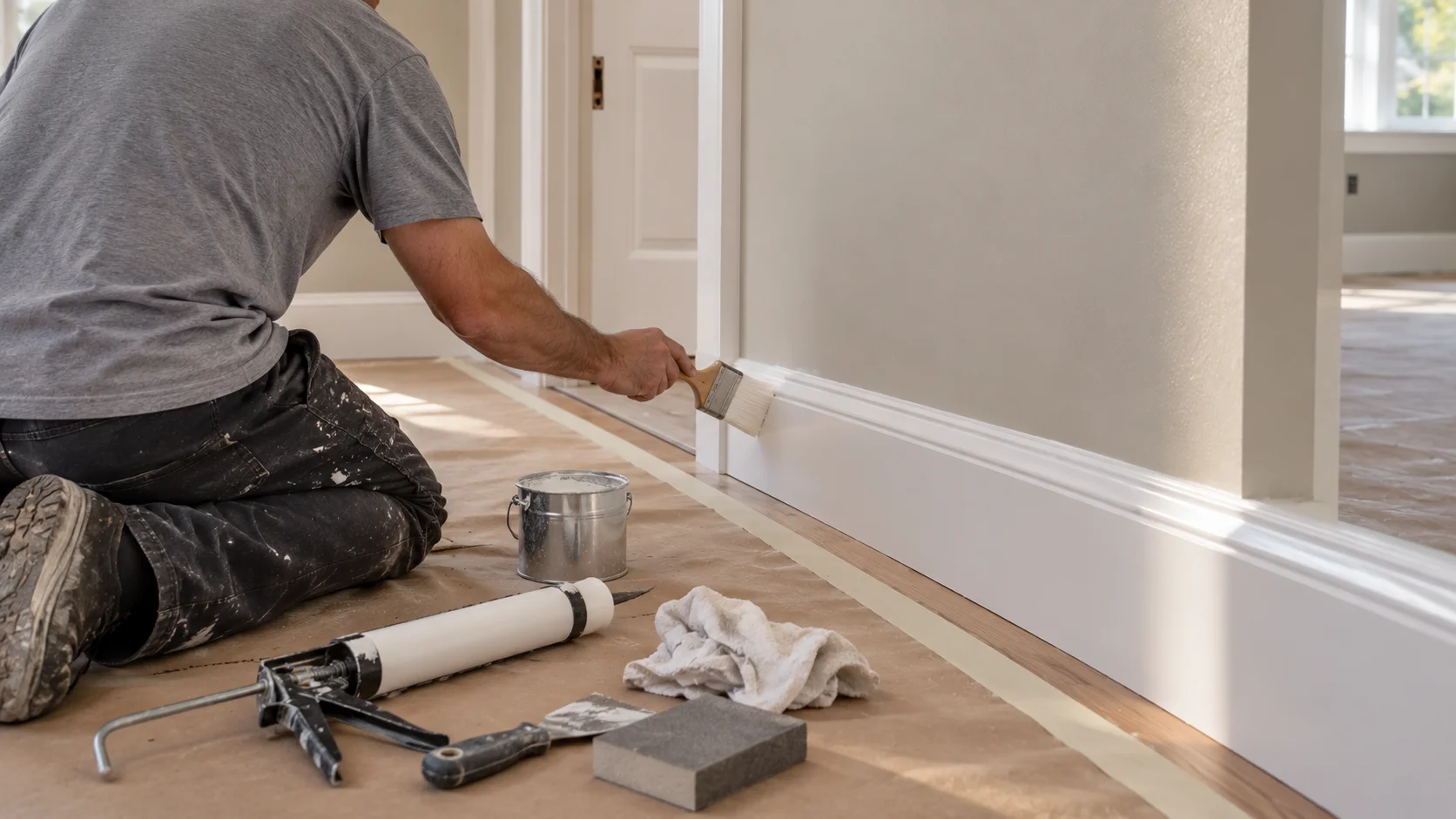
Touch-up is harder than painting. GA-214 says so in a general note that applies to every level above 2: "Special care should be taken to protect surfaces after decoration as any patching or touch-up of even minor damage subsequent to the final finish may be difficult to conceal for Levels 3, 4 and 5." The physics behind that is the same holdout problem the primer sheets warn about: a dab of paint on a cured, washed, settled film dries at a different rate, sits at a slightly different thickness and reflects light slightly differently from the field around it. On a flat paint in a bedroom, a good touch-up is genuinely invisible. On an eggshell in a hallway, under a ceiling light, a touch-up is a spot. Where it matters, the honest fix is to recoat the whole wall from corner to corner, and the fact that that is sometimes the right answer is worth agreeing with your builder in advance rather than arguing about later.
The first year will produce cracks and nail pops, and that is not a paint failure. A new frame dries and settles, and the drywall screws and joints move with it. In our experience on New Jersey builds the usual crop is hairline cracks at the corners of door and window openings, a few popped fasteners on ceilings, and occasionally a seam that telegraphs once the heating season dries the house out.
What is a first repaint over builder paint?
It is the first time a new house is repainted with what the owner actually wants, and it is usually an upgrade in sheen and washability as much as colour. Clean the walls first, because flat marks easily, and fix the settlement cracks and nail pops, spot priming every patch so it does not show through the new finish. Two coats of a washable eggshell or matte is the usual spec, and a colour change may want more. Waiting through the first heating season lets the house show its cracks before you pay to cover them. Unlike the original painting, a repaint is taxable in New Jersey.
What New Jersey's new home warranty says about drywall and paint
In New Jersey this is not left entirely to the builder's goodwill. The state's new home warranty regulations, N.J.A.C. 5:25-3.2, say that "For a period of one year from the warranty date each new home shall be free from" performance standard defects, with mechanical and electrical systems covered for two years and major structural defects for ten. The performance standards themselves, in N.J.A.C. 5:25-3.5, get specific about walls and paint:
- Some drywall movement is expected. "Slight defects such as occasional nail pops, seam lines and cracks are common gypsum wallboard installations," and "Nail pops are a defect only when there are signs of spackle compound cracking or falling away."
- Workmanship defects are not. Blistered tape, cracks over door, window and archway frames, excess joint compound, trowel marks and exposed corner beads are listed as deficiencies.
- The fix includes paint, once. The builder corrects the defects and repaints the affected areas one time only, matching the existing finish as closely as possible, and paints the entire area if the repair was extensive. The standard suggests reporting these near the end of the first year, so normal settlement has happened first.
- Coverage and peeling are covered. "Interior paint not applied in a manner sufficient to visually cover wall, ceiling and trim surfaces is a deficiency," and "Exterior paints or stains that peel or deteriorate during the first year of ownership is a deficiency."
So keep a list through the first heating season and hand it over before the first anniversary rather than calling about each crack as it appears. If your builder's own warranty book is more generous, it applies on top; if a repair falls to you instead, our drywall repair cost guide covers what the fix involves, and the same two warnings apply: cut it out properly rather than smearing compound over it, and expect to recoat the wall rather than the patch.
On washing and hanging things: the paint film is not finished when the house is. Both Benjamin Moore wall products above carry the same line — "Painted surfaces can be washed after two weeks" — and the trim enamel takes considerably longer than that to reach full hardness. So hang pictures whenever you like, since a picture hook is a mechanical question and not a paint one, but do not scrub a mark off a new wall, lean furniture hard against it or stack anything on a freshly enamelled shelf for the first couple of weeks. If you need to clean something in week one, use a barely damp cloth and no pressure.
What We Do, and Do Not Do, on a New Build
We are the painting subcontractor. Being clear about the edges of that saves everyone time.
What we do: prime and finish ceilings, walls, trim, baseboard, casing, crown, interior doors, stair parts and banisters; spray or brush and roll as the stage of the build dictates; caulk and seal; enamel new trim and doors; fill and patch drywall; paint new cabinetry or spray cabinet doors and fronts; paint basements, garages and garage doors, porches, railings and columns; coat garage and basement slabs in epoxy; and paint new exteriors — siding, stucco, brick, soffit, fascia, shutters and front doors. We paint crown moulding, wainscoting and chair rail; we do not install them. On commercial new construction we do the same work plus industrial and protective coatings and commercial floor coatings, and we work on schools, medical and healthcare fit-outs, restaurants and hospitality, and HOA and condominium projects.
What we do not do: we are not the builder or the general contractor, and we do not hang drywall, set trim, install cabinets, install or finish floors, or do plaster work. Finish carpentry is not our trade — we paint the trim, we do not run it — and plaster repair is a plasterer's job even though drywall and sheetrock repair is ours. We do not do roofing, siding or window replacement, texture or faux finishes, or remodelling. If you need a level of drywall finish changed, that is a conversation with your builder and the drywall contractor; what we can do is tell you honestly what a given level will look like once your paint is on it, which is usually the information that was missing.
Get a Scope and a Sequence in Writing
On a new build, the useful document is not a number, it is a sequence: which rooms, which surfaces, which products and sheens, how many coats, what gets sprayed and what gets brushed, which pass happens before the floors and which after, and who owns touch-up after the final clean. That is what we write down, and it is what we would tell you to ask any painter for, including the one your builder already has. If a scope does not say the number of coats and does not say what happens after the other trades come back through, it is not a scope.
NJ Painting Co. is a family-owned, licensed and fully insured painting company at 36 Church Rd, Morganville, NJ 07751, working on New Jersey homes and buildings for more than 20 years with Benjamin Moore and Sherwin-Williams products. Estimates are free, and our work carries a two-year workmanship warranty. Tell us the stage of the build and the number of rooms or units, and we will say straight away whether we can take it on. Call (732) 239-0932 or request a free estimate. You can see the work on our interior painting, exterior painting, cabinet painting and commercial painting pages, and check whether we cover your town on our service areas page.
Frequently Asked Questions
Who paints new construction homes in New Jersey?
New construction homes in New Jersey are painted by painting subcontractors hired by the builder or general contractor, or by the buyer after closing. NJ Painting Co., a family-owned company in Morganville, works as the painting subcontractor on new homes and additions across Monmouth, Middlesex, Ocean, Mercer, Somerset and Burlington counties, and in Union, Essex, Hudson, Bergen and Passaic.
What is the new construction painting process, step by step?
Rough electrical, plumbing and HVAC go in; insulation follows; the municipal mid-point inspection signs off on framing and insulation. Drywall is then hung, taped, coated and sanded. The painter's first pass primes the ceilings and walls on bare board in an empty shell, usually spraying and back-rolling, and often puts the final coat on the ceilings. Trim, interior doors, stair parts, cabinets, tile and counters go in. The painter's second pass fills nail holes, caulks, primes and enamels the trim and doors, and applies the final wall coats. Flooring, fixtures, hardware and the final clean follow, then the punch-list touch-up, then the municipal final inspection and the certificate of occupancy.
When building a house, when do you paint?
Twice: once right after the drywall is taped and sanded, and again after the trim, cabinets and most of the flooring. Nothing of the painter's can start until the municipal mid-point inspection has passed. See the full sequence above.
What comes after painting when building a house?
Flooring if it is not already down, then fixtures, appliances, hardware, the final construction clean, the punch list including paint touch-up, and the municipal final inspection before the certificate of occupancy. See the full sequence above.
Do you spray or roll paint on new construction?
Spray the bare board and the ceilings, then back-roll while the paint is still wet. Spraying is the right tool in an empty shell with no trim, no fixtures and no floor — both manufacturers spec airless spray on these products, around 1500 to 2500 psi with a 0.015 to 0.021 inch tip — and it lays a more uniform film on a big ceiling than a roller does. Back-rolling works the paint into the paper, evens the film thickness and leaves a consistent stipple so later touch-ups and the eventual repaint blend in. Once the trim, cabinets, counters and floors are in, walls get brushed and rolled, because masking costs more than the speed is worth.
Should you paint a new house before moving in, or after?
If you have the window, yes. An empty house has nothing to move or mask, doors can come off and be sprayed flat, and baseboard can be cut without a finished floor under it; the same scope in an occupied house runs roughly a fifth to a third longer. Ventilation is the other reason. The EPA's Indoor airPLUS specifications for new homes ask builders to ventilate with outside air at the highest practical rate "During the period between finishing and occupancy," and to advise buyers to run the ventilation system at its highest rate for the first few months if that is not possible. A new house is a tight envelope full of brand-new materials off-gassing at once, and air before move-in is the published answer. The one exception worth naming: if you are not sure about a colour, living with the builder's flat for a season and then painting is a legitimate choice. What is expensive is changing the trim and door colour after move-in, because trim is the slow, brush-intensive work and an occupied house makes it slower.
When can you paint a new build, and can you paint a new build straight away?
You can paint the moment the drywall is taped, sanded and dust-free, and that is exactly what happens on a new build — the first coats go on before anyone moves in. The real constraints are temperature and dust, not age. GA-214 requires "A minimum temperature of 50°F (10°C) ... maintained continuously for 48 hours prior to and throughout the finishing process," the paint sheets set the same 50°F floor for interior application, and both primer sheets insist the board be free of sanding dust and the joint compound be cured and sanded smooth. If you mean repainting a house you have just bought, there is no waiting period at all: new primed-and-painted drywall takes a fresh coat as well as it ever will.
What is the best paint for new construction, and what paint do builders use?
Think in two layers. The primer is not optional — Benjamin Moore's sheet says "New surfaces should be fully primed," and GA-214 recommends in a note under Levels 3, 4 and 5 that the painting specification include a priming material before decoration — because new board is thirsty and uneven in absorption and the primer is what makes the topcoat read as one surface. For the topcoat, choose by room rather than by house: flat or matte on ceilings and quiet bedrooms, a washable eggshell or matte in living areas, eggshell or satin in kitchens, baths, mudrooms, hallways and children's rooms, and a waterborne alkyd enamel on trim and doors. A premium eggshell like Benjamin Moore's Regal Select is described on its own sheet as "Ideal for surfaces subject to abuse and soil" with stain-release technology, which is a different brief from a contractor flat. Builder-grade is usually exactly that, a contractor-line flat in a single colour over a drywall primer: Benjamin Moore's Ultra Spec 500 Interior Flat sheet recommends it for "Low abuse interior wall and ceiling surfaces ... where flat finish is desired," and its feature list includes "Great touch up," which suits a house six more trades will mark. The trade-off is that flat is the least washable sheen, so a family house usually wants something more durable in the kitchen, baths and hallways sooner rather than later.
How many coats of paint go on new drywall?
New drywall gets one coat of primer and two finish coats. Sherwin-Williams' drywall system for ProMar 200 Zero V.O.C. primer is "1 coat ... Primer / 2 coats Of appropriate finishes," and Benjamin Moore says "On bare substrates, two coats are recommended." A new construction scope should state the number of coats in writing.
What primer should you use on new drywall?
Use a drywall or interior latex primer made for bare board, applied over the whole surface after sanding and dusting. GA-214 recommends that the painting specification include a priming material before decoration at Levels 3, 4 and 5, and Benjamin Moore's sheet says "New surfaces should be fully primed." Name the primer in the scope.
Why do my brand-new walls show lines where the drywall joints are?
Because the wall is finished to a level that is correct for flat paint and is being asked to carry a sheen or a strong colour. GA-214 calls it joint photographing — "The shadowing of the finished joint areas through the surface decoration" — and says plainly that Level 4, the normal residential standard, is for "flat paints, light textures, non-continuous textures, or wallcoverings," adding that "Non-flat or dark/deep tone paints are not recommended; refer to Level 5." Level 5 adds a skim coat of joint compound over the entire surface. The standard's remedies for critical lighting are skim coating the whole surface, a texture, or window treatments that soften the shadows. It also notes that even a skim coat "will not approximate a plastered finish/surface."
What is the difference between Level 4 and Level 5 drywall finish?
A paint-ready wall is drywall finished to a level that suits the paint going on it. Under GA-214, Level 4 suits flat paint, light textures or wallcoverings; Level 5 adds a skim coat over the whole surface and suits sheen, dark colours or critical lighting. Both embed tape, apply two separate coats of compound over flat joints and one over interior angles, and cover fastener heads and accessories with three separate coats. Level 5 then adds "A skim coat of joint compound or a material manufactured especially for this purpose ... applied to the entire surface." Critical lighting is defined as "Strong side lighting from windows or surface-mounted light fixtures." The level is specified by the builder or design professional, not by the painter, which is why it is worth asking about before the compound is sanded.
How soon can you hang pictures in a new build?
Straight away, as far as the paint is concerned — a picture hook is a fastener question, not a coating one, and on a new build the wall is already carrying trim, switch plates and fixtures. What you should wait on is washing: Benjamin Moore's wall-paint sheets say "Painted surfaces can be washed after two weeks," and the trim enamel takes considerably longer to reach full hardness. So hang what you like, but do not scrub a mark, lean furniture hard against a fresh wall or load a newly enamelled shelf in the first fortnight. The other reason to go gently in year one is settlement: new framing dries and moves, and the usual first-year crop is hairline cracks at door and window corners and a few popped fasteners, and New Jersey's new home warranty standards (N.J.A.C. 5:25-3.5) treat occasional nail pops and seam cracks as normal, with the builder correcting real defects and repainting the affected areas once, ideally near the end of the first year.
How much does new construction painting cost?
New construction painting has no single per-square-foot price in New Jersey. We do not publish one, because the number depends on things that are not knowable from a plan — the level of drywall finish, how many coats and sheens the spec calls for, how many doors and how much trim, whether the trim can be sprayed before it is hung, and how much touch-up the other trades generate. What we can tell you is what to compare: a scope that names the products, the sheens, the number of coats and who owns touch-up after the final clean is comparable, and one that does not is not. One tax point is worth knowing when you compare totals: the New Jersey Division of Taxation treats the initial painting or staining of a structure as an exempt capital improvement, documented by the property owner giving the contractor a completed Form ST-8, while repainting is taxable servicing. Confirm with your accountant for your own project. For general ranges on painting work in New Jersey, see our cost guide, our guide to what it costs to paint a house in NJ and our cost to paint a room guide.
Does new exterior wood need special preparation before painting?
Yes, and the tests are published. Sherwin-Williams' exterior wood primer sheet says to sprinkle water on the surface: "If the water penetrates into the wood quickly, the wood is ready to prime. If the water beads up or does not penetrate, allow the wood to weather and test for absorbency again." Smooth-sawn new lumber can carry mill glaze — "a glossy finish on new, smooth sawn wood" that "must be removed by sanding to allow the primer to penetrate." Cedar and redwood need a tannin test: prime a four-foot square and look for bleeding within four hours. Knots need the right primer, since Benjamin Moore's all-purpose primer sheet lists itself as "Not recommended for sealing knots or over pine sap." Once primed, there is a clock: "this primer must be topcoated within 14 days." New stucco, masonry and concrete are different again — both brands require a 30-day cure before a base coat, with a 7-day masonry-primer route if the schedule cannot wait.
Is painting a new house exempt from NJ sales tax?
Generally, yes for the first coat of paint on a newly built house. The Division of Taxation lists "initial painting of new construction" as an exempt capital improvement, and the Form ST-8 itself gives "painting a newly constructed house" as an example. The property owner gives the contractor a completed ST-8, which the contractor keeps. Paint you buy yourself is still taxable, and so is any later repaint. If you are not sure how a job is classified, the Division says to contact it with the details. This is general information, not tax advice.
Do you work directly for builders, or for the buyer?
Both. We work as the painting subcontractor on new homes and additions, and we also get called in by buyers after closing — sometimes to upgrade from the builder's flat before the furniture arrives, sometimes to paint the trim and doors properly, and sometimes to deal with a punch list that did not get finished. We are not the builder or the general contractor, and we do not hang drywall, set trim, install cabinets or install flooring. If your build is in Monmouth, Middlesex, Ocean, Mercer, Somerset or Burlington County, or in Union, Essex, Hudson, Bergen or Passaic, it is in our area.
Do builders need a painting subcontractor?
Painting on a new build is normally a separate trade from the drywall, trim and flooring crews, and painting happens twice in a build: a first pass after the drywall is sanded, and a second pass after trim, cabinets and floors. The builder or general contractor stays in charge of the schedule. NJ Painting Co. works as that painting subcontractor and is not the builder or general contractor.
Who fixes nail pops and cracks in a new house in New Jersey?
Usually the builder, within the first year. Under New Jersey's new home warranty standards, N.J.A.C. 5:25-3.5, occasional nail pops, seam lines and cracks are treated as normal, but blistered tape, cracks over door and window frames, trowel marks and nail pops with cracking or loose compound are deficiencies. The builder corrects them and repaints the affected areas one time only, matching the finish as closely as possible. Keep a list and report it near the end of the first year, after the house has settled.
About the author
Written by the NJ Painting Co. team
NJ Painting Co. is a family-owned painting contractor based in Monmouth County, in business since 2004. We are licensed and fully insured, work with Benjamin Moore and Sherwin-Williams paints, and back our work with a 2-year workmanship warranty. We serve Monmouth, Middlesex, Ocean, Mercer, Somerset and Burlington counties, plus Union, Essex, Hudson, Bergen and Passaic in North Jersey.