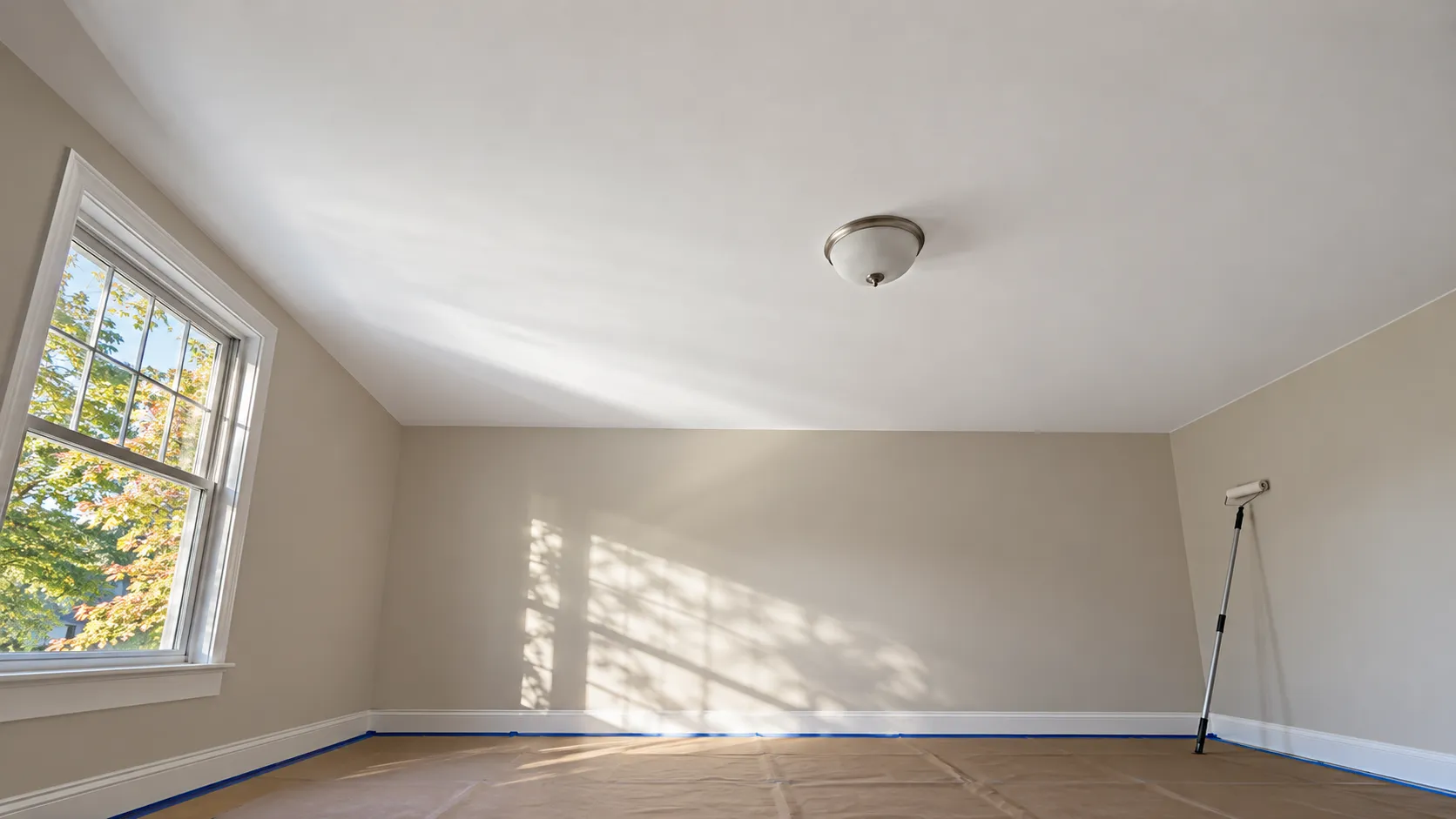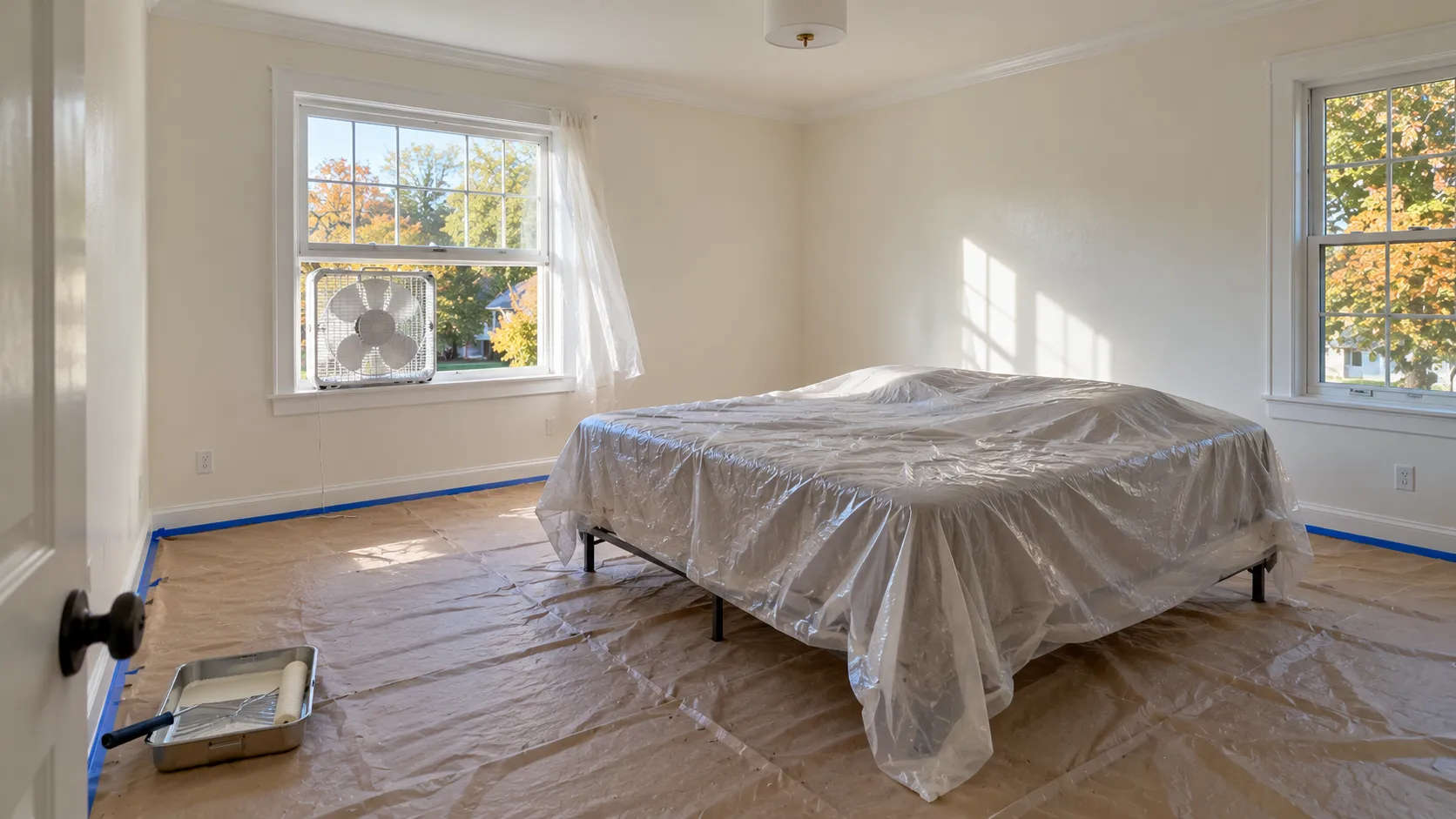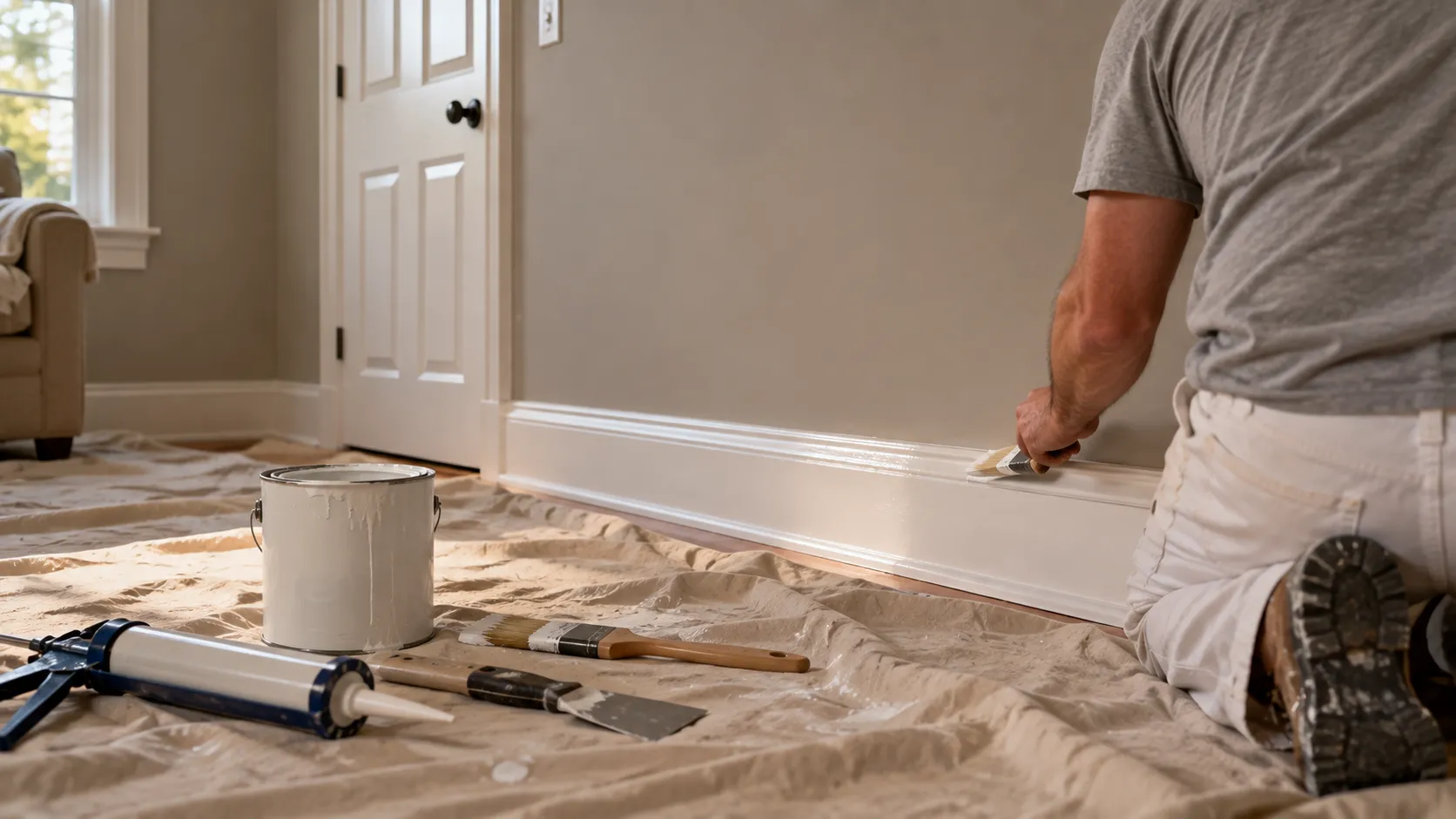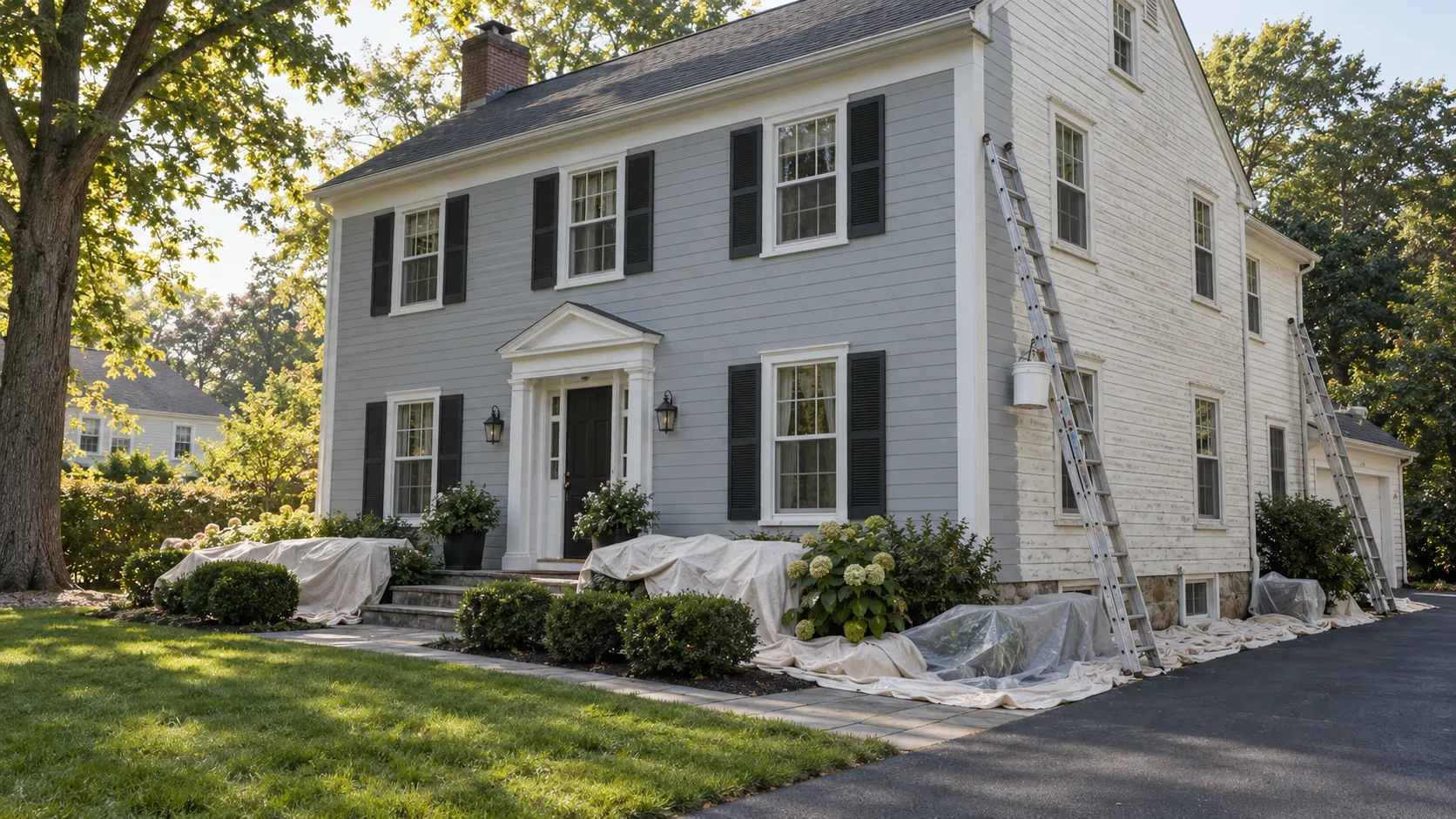
A full interior repaint of an average New Jersey house takes a crew of two or three painters three to ten working days: three to four for a 3-bedroom ranch, five to seven for a 3-bedroom colonial with ceilings and trim, and eight to twelve for a large 4-bedroom with every door and casing included. A 2,500 square foot two-story exterior takes the same crew six to nine working days, which in a New Jersey summer means a week and a half to two weeks on the calendar once rain days are counted. The spread inside those ranges is almost entirely prep, not painting. This guide gives the crew-days by house size, shows how a day actually breaks down, and separates the three waiting times — dry, recoat and cure — that homeowners usually hear as one number.
We are a family-owned painting company in Morganville and have painted homes across Monmouth, Middlesex, Ocean, Mercer, Somerset and Burlington counties, and in Essex, Hudson, Union, Bergen and Passaic, for more than 20 years, using Benjamin Moore and Sherwin-Williams products. Every crew-day number below is our own scheduling, given as a range with the conditions attached — there is no national average for this and we have not invented one. The dry, recoat and cure times are quoted from the manufacturers' current technical data sheets, checked on 13 October 2026. The New Jersey rain and temperature figures come from NOAA's 1991–2020 climate normals for the Freehold-Marlboro station, a few miles from our shop, and from the Rutgers state climatologist. There are no prices in this article; for money, see our NJ painting cost guide and our guide to what it costs to paint a house in NJ.
The Short Answer: How Long Does It Take to Paint a House?
- Whole interior, average NJ house: three to ten working days with a crew of two or three. A 3-bedroom ranch is three to four days; a 3-bedroom colonial with ceilings and trim is five to seven.
- Whole exterior, 2,500 sq ft two-story: six to nine working days of crew time, ten to fourteen if there is real scraping. Allow half again as many calendar days for weather.
- One room: most of a day for a standard bedroom's walls, a day and a half with the ceiling, trim and a closet. Our cost to paint a room guide works a single room through in detail.
- Kitchen cabinets: four to six days on site, and two to four weeks before the finish is fully hard. The enamel's recoat window is the reason, not the painting.
- Prep is the schedule. On an interior repaint, half to two thirds of our hours go into protection, patching, sanding and caulking. On an exterior it is often more than three quarters.
- An occupied house takes about a fifth to a third longer than the same house empty, because furniture moves twice a day and we work room by room instead of floor by floor.
- Dry, recoat and cure are three different numbers. Wall paint is dry to the touch in about an hour, ready for a second coat in one to four hours, and not washable for two weeks.
- The usable exterior season in central New Jersey is roughly May through October. At the Freehold-Marlboro station the median last 36°F spring night is 1 May and the median first 36°F fall night is 12 October.
How Long It Takes to Paint a House Interior
The honest unit here is not days, it is crew-days — one painter working one day. A twelve crew-day job is six days with two painters or four with three, up to the point where painters start standing in each other's way. The table below is how we schedule interiors. Read every row as a range, and read the scope column closely: adding ceilings to a whole-house repaint typically adds a day or two, and adding every door, casing and baseboard can add three or four.
| House | Scope | Working days | Crew | What moves it |
|---|---|---|---|---|
| 2-bedroom condo or apartment | Walls only | 2 to 3 | 2 | Whether it is empty, elevator and parking access |
| 3-bedroom ranch, about 1,400 sq ft | Walls and ceilings | 3 to 4 | 2 | Textured ceilings, how much patching |
| 3-bedroom colonial, 1,800 to 2,200 sq ft | Walls, ceilings, trim and doors | 5 to 7 | 2 to 3 | Trim count, two-story stairwell, colour changes |
| 4-bedroom colonial, 2,600 sq ft and up | Walls, ceilings, trim, doors and closets | 8 to 12 | 3 | Number of doors, crown molding, built-ins |
| Any of the above, empty | Same scope | Subtract roughly a fifth | Same | No furniture to move, no daily reset |
| Main floor only (living, dining, kitchen, hall) | Walls and ceilings | 2 to 3 | 2 | Open-plan height, kitchen cutting-in |
| Trim and doors only, whole house | Two coats of enamel | 3 to 5 | 2 | The 16-hour recoat window on the enamel |
Two rows in that table surprise people. The first is that trim is slower than walls, by a wide margin. A bedroom's four walls are maybe twenty minutes of rolling per coat; the same room's baseboard, casing, sill, closet shelf and door are hours of brushwork, and the enamel we use needs 16 hours between coats, so a trim-and-door package stretches across days no matter how many painters are on it. The second is that an empty house is not twice as fast — it is about a fifth faster. The painting is identical; what disappears is the furniture handling.
Ceilings get their own note. A flat white ceiling is fast; a textured or popcorn ceiling is not, and if it is being removed rather than painted, that is a different job on a different schedule — see our popcorn ceiling removal guide, including the asbestos testing that has to happen first in houses of that vintage.
How the Painting Day Actually Breaks Down
Homeowners picture a painting day as painting. It mostly is not. This is how our interior days genuinely run, and the shape is the same in a ranch in Hazlet or a colonial in Marlboro.
- Arrival and setup, 45 to 90 minutes. Drop cloths down, furniture to the middle and covered, switch plates and vent covers off, hardware off the doors being painted, fixtures masked, tape only where tape earns its place. Longer on day one, because the whole working area gets protected at once.
- Prep, two to five hours. Filling nail and screw pops, cutting out and patching cracks, sanding patches flat, caulking where casing meets wall, scuff-sanding glossy trim so the next coat grips, washing greasy kitchen walls. This is the part that varies most between two houses of identical size.
- Spot priming, 30 to 60 minutes. Patches, water stains, bare drywall, knots in trim, anything going a dramatically different colour. Primer recoats fast, so it rarely holds a day up.
- Cutting in, one to two hours a room. Brushing the wall-to-ceiling line, the corners and the edges against trim. Slow, skilled, and the clearest difference between a professional job and a weekend one.
- Rolling the first coat, 20 to 40 minutes a room. The fastest part of the whole process.
- Waiting, one to four hours. Not idle time: we move to the next room, or to the trim, while the first coat reaches its recoat window.
- Second coat. Faster than the first, because the surface is sealed and the lines are already set.
- Cleanup and reset, 45 to 60 minutes. Tape pulled while the paint still releases cleanly, plates and covers back on, furniture back if the room is done, tools washed. In an occupied house this happens every single day.
Add it up and a painter in a standard bedroom spends roughly one hour rolling and five or six doing everything else. That ratio is why "it's only a bedroom" and "it took all day" are both true, and why a crew of four does not finish a 3-bedroom ranch in a day: setup, prep and cleanup do not divide neatly, and two painters cutting in the same small room get in each other's way.
How Long It Takes to Paint a House Exterior
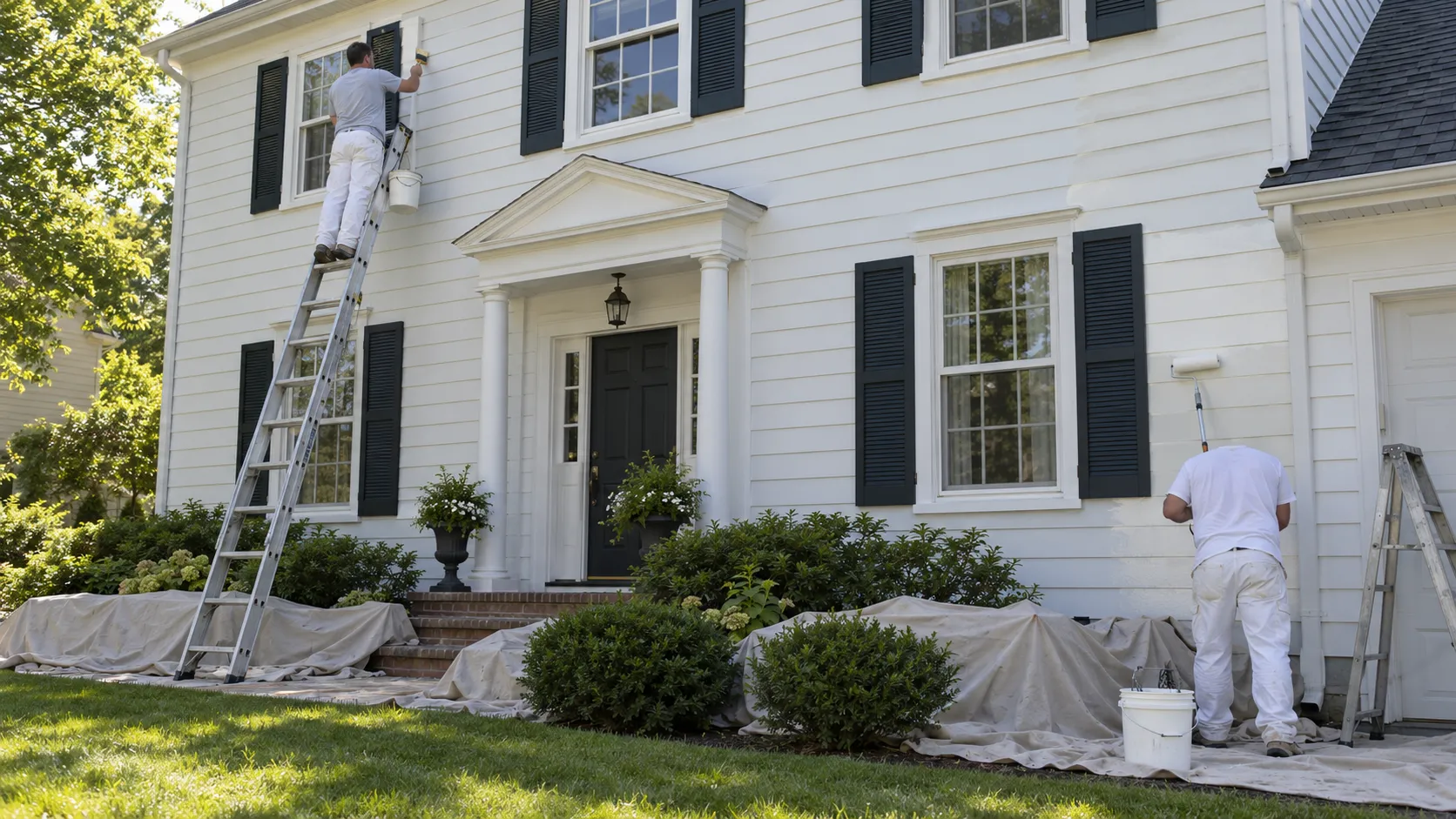
Exteriors are where this question gets genuinely hard to answer, because the amount of work hiding under the old paint is not knowable from the driveway. A 2,500 square foot two-story colonial with sound paint, intact caulk and clean siding is six to nine working days for a crew of two or three. The same house with south and west elevations that have been failing for three years can be fourteen, and almost all of the difference is scraping.
| House | Working days | Calendar days, typical | What moves it |
|---|---|---|---|
| Single-story ranch, vinyl or aluminum, 1,400 sq ft | 3 to 4 | 5 to 7 | Wash and dry time, trim count, colour choice on vinyl |
| Cape Cod, wood or cedar, 1,600 sq ft | 4 to 6 | 7 to 10 | Dormers, scraping, window count |
| Two-story colonial, 2,500 sq ft | 6 to 9 | 10 to 14 | Ladder work, shutters, failing caulk |
| Same colonial with widespread peeling | 10 to 14 | 2 to 3 weeks | Scraping and spot priming, which can double the job |
| Stucco house, 2,500 sq ft | 6 to 10 | 10 to 16 | Crack repair and cure time, coverage on rough stucco |
| Three-story or shore home on pilings | 10 to 15 and up | 3 weeks plus | Staging or a lift, wind days, salt-air washing |
| Trim, doors and shutters only | 2 to 4 | 4 to 6 | Enamel recoat windows, removing and rehanging shutters |
An exterior day starts with the sun and the dew, not the clock. We cover plantings and walkways, set ladders or staging on one elevation, then follow the shade around the house — east side in the morning, north through the middle, west in the late afternoon. Sherwin-Williams' own sheet for Duration Exterior says plainly "Do not paint in direct sun," and adds that above 80°F the paint "sets up quickly. Some adjustment in your painting approach may be required." That is not a quality nicety; it is a sequencing constraint that shapes the whole day. Vinyl and aluminum add their own rule, because colour choice is limited by heat absorption — our guide to painting vinyl and aluminum siding covers it.
Why a two-coat exterior cannot be compressed
The most common request we turn down is to halve an exterior with one coat. Two coats on bare or scraped wood is not an upsell, it is the manufacturer's own system: the Duration Exterior data sheet instructs "Apply 2 coats on new, bare substrates," and tells you to allow four hours between them. Those four hours are per elevation, in good conditions, and they are a floor rather than a target. Below 45°F the same sheet stretches the recoat window to 24 to 48 hours, which on a cool October week means each elevation gets one coat a day and a four-sided house needs eight days of coating alone.
There is also a physical limit on how much wet edge a crew can hold. One painter can keep a continuous wet edge across a run of clapboard; three on the same run cannot, and the lap marks show. So on a wide elevation we add painters by splitting them across surfaces — one on siding, one on trim, one scraping ahead — rather than stacking them on one. That is why the crew sizes above top out at three for most houses.
Prep Is the Schedule, Not the Painting
If you take one thing from this guide, take this: when two painting estimates differ by a week, they are almost never disagreeing about how long it takes to roll paint. They are disagreeing about prep. Here is what consumes the days.
- Failing caulk, one to two extra days on a typical exterior. Old caulk at window and door perimeters and trim joints has to be cut out, not caulked over, and the joint has to be clean and dry before new sealant goes in. Then the sealant has to skin before it can be painted. Sherwin-Williams' SherMax sealant sheet says it "Can be painted after 30 minutes at 75°F and 50% relative humidity," then adds "For best results, a minimum of 4 hours dry time is required before painting with latex or oil base paint," and "Allow extra dry time during periods of high humidity and/or cool temperatures." On a humid shore morning in August, four hours is the realistic number — which is why caulking is a day's work that ends the day.
- Chalked or dirty siding, half a day to wash plus most of a day to dry. Chalk is powdered binder, and paint over it bonds to powder instead of wood. We wash, and then we wait: a soaked wood or stucco wall is not a paintable wall. Our power washing guide covers the washing itself; what matters to the schedule is that the drying day is not optional, and you cannot dodge it by starting on the dry side, because the dry side is the one we washed first.
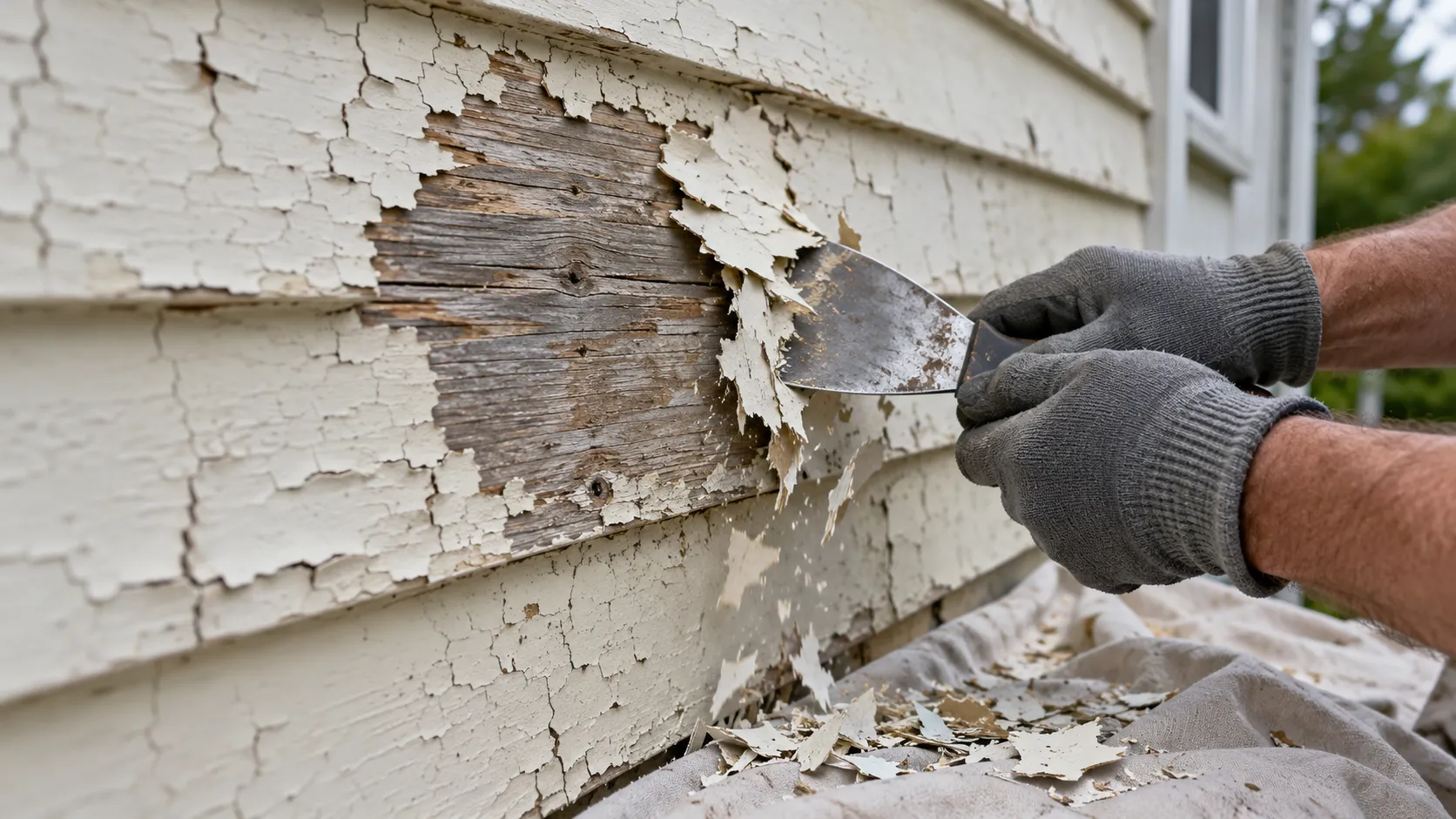
- Peeling and scraping, a day to a week. The biggest unknown on any exterior and the most common reason a job runs past its estimate. Until scraping starts, nobody knows whether the failure stops at the last coat or goes to bare wood, and the answer changes both the scraping time and the spot priming behind it. If your paint is already failing, read our guide to why paint peels before you ask anyone for a timeline: the cause determines the cure.
- Wallpaper, half a day to a day per average room. Sometimes it strips in sheets; sometimes it takes the drywall face paper with it, turning a stripping job into a skim-coating job. See our wallpaper removal guide.
- Plaster repair, a separate trade and a separate week. This one does not sit inside our schedule at all: plaster repair is not a service we list, so cracks cut out and bridged, loose keys re-anchored and skim coats left to dry are a plasterer's days, booked before ours and cured before we prime. Allow for them when you are planning, because they land on the same calendar. Our drywall repair guide covers how to tell plaster from drywall, which decides whose job it is.
- Pre-1978 homes, real added hours at both ends of every day. The EPA's Renovation, Repair and Painting program requires that "anyone paid to perform work that disturbs painted surfaces in homes, childcare facilities and preschools built before 1978 be certified," and trained "in the use of lead-safe work practices that minimize occupants' exposure to lead hazards." The EPA notes that "Approximately three-quarters of the homes in the United States built before 1978 still contain some lead-based paint." Containment, HEPA vacuuming and cleanup verification are a daily cost, not a one-off setup. The rule applies to the firm doing the work, so ask whoever you hire to show you their current certification. We are not a Lead-Safe Certified firm, so a pre-1978 repaint that disturbs paint is not a job we take on, and those added hours will be on a certified firm's timeline rather than ours; our guide to lead paint in older NJ homes explains what the testing and the work practices involve.
Across our interior repaints we would put prep at half to two thirds of the hours. On an exterior with any paint failure it is routinely more than three quarters. The painting is the short part.
New Jersey Weather: Why an Exterior Takes Longer Than the Work In It
An exterior quoted at eight working days almost never finishes eight calendar days after it starts, and the reason is rain. The table below is NOAA's 1991–2020 monthly normals for the Freehold-Marlboro station: the average number of days a month recording a tenth of an inch of rain or more, which is roughly the threshold at which a crew is not painting siding.
| Month | Days with 0.10 in or more | Average low | What it means for an exterior schedule |
|---|---|---|---|
| May | 7.7 | 50.6°F | Good working month; a few cool nights still slow the recoat window |
| June | 8.2 | 60.1°F | Wettest of the six, but warm enough that a lost morning is recoverable |
| July | 6.8 | 65.5°F | Thunderstorms arrive late; mornings are the productive hours |
| August | 6.8 | 63.4°F | Humidity is the constraint, not rain; sealant and paint both dry slower |
| September | 5.7 | 56.1°F | The best exterior month we get in central New Jersey |
| October | 7.0 | 44.3°F | Shorter days and dew; useful paint hours shrink to roughly 9 to 4 |
Those six figures add to about 42 days with measurable rain across the May-to-October window, roughly one day in four. That total is our arithmetic on NOAA's monthly numbers rather than a figure NOAA publishes, and it counts days with rain, not days a crew cannot work: a shower at 6pm costs nothing, a shower at 10am costs the elevation we were on. But it is why we add weather days to an exterior calendar instead of quoting working days as though they were consecutive. Our rough rule is one and a half calendar days per working day in summer, and more in late October. The Duration Exterior sheet also says to "Avoid using if rain or snow is expected within 2-3 hours," so the forecast decides the morning: a 40 percent chance of a 2pm storm does not stop us, it changes which elevation we start, so whatever goes on has three dry hours behind it.
Humidity, and why the shore is different
Humidity does not stop a job, it stretches it. Every sheet we quote carries some version of the same sentence — Benjamin Moore's is "High humidity and cool temperatures will result in longer dry, recoat and service times" — and in August at the shore that is the whole story of the day. The Rutgers New Jersey climate overview notes that "High humidity and moderate temperatures prevail when winds flow from the south or east," and that "Sea breezes often penetrate 5-10 miles inland, but under more favorable conditions, can affect locations 25-40 miles inland." In practice a house in Sea Bright or Point Pleasant gives us a shorter productive afternoon in high summer than one in Manalapan or Hillsborough, so we schedule shore work earlier in the day. Autumn flips it: Rutgers records that "In autumn and early winter, when the ocean is warmer than the land surface, the Coastal Zone will experience warmer temperatures than interior regions of the state," and gives the average freeze-free period as "217 along the seacoast" against "179 in the central and southern interior."
The usable exterior season
The premium exterior paints we use are rated down to 35°F, and the Sherwin-Williams sheets require the surface to be at least 5° above the dew point and tell you not to paint if temperatures may fall below 35°F within 48 hours. That 48-hour rule, not the afternoon high, is what ends the season. At Freehold-Marlboro the median date of the last spring night at or below 36°F is 1 May, and the median first fall night at or below 36°F is 12 October. The same records show 10.7 October nights at or below 40°F against 0.4 in September. So May through October is the dependable window, early October is a judgement call, and November is possible on selected products and selected days rather than schedulable. Our cold weather painting guide goes through the minimums product by product, and our guide to how often to repaint covers which season to aim for in the first place. Interiors run all twelve months: any heated house clears the 50°F minimum interior wall paints ask for.
Dry Time, Recoat Time and Cure Time Are Three Different Things
Almost every scheduling misunderstanding we have with homeowners comes down to this. Dry to the touch means it will not transfer to a finger. Recoat means the film has released enough solvent to accept another coat without lifting or wrinkling. Cure means it has reached final hardness and can be washed and used normally. Hours, hours and weeks respectively. The table is straight off the data sheets for the products we use most.
| Product | Used for | Dry to touch | Recoat | Normal use or washing |
|---|---|---|---|---|
| BM Regal Select Eggshell (N549) | Interior walls | 1 hour | 1 to 2 hours | "Painted surfaces can be washed after two weeks" |
| SW Duration Home Interior Latex (A97) | Interior walls, kitchens and baths | 1 hour | 4 hours | "wait at least 14 days before washing" |
| BM Advance Waterborne Alkyd Satin (792) | Trim, doors and cabinets | 4 to 6 hours | 16 hours | 5 to 7 days before shelves go back; "up to 30 days to reach optimum hardness and final sheen" |
| BM Aura Exterior Low Lustre (N634) | Exterior siding and trim | 1 hour | 4 hours | Washable after two weeks |
| SW Duration Exterior Satin, at 45°F and above | Exterior siding and trim | 1 hour | 4 hours | Two coats on bare substrates |
| SW Duration Exterior Satin, at 35 to 45°F | Exterior siding and trim | 2 hours | 24 to 48 hours | One elevation a day at best |
| SW SherMax sealant | Caulk joints before painting | Skins in 30 minutes at 75°F | 4 hours minimum before latex or oil paint | Longer when cool or humid |
Three consequences for your schedule. First, two coats of wall paint fit inside one day with either interior product above, which is why a room is a one-day job and a floor of rooms is a two or three-day job. Second, trim does not fit inside one day. Advance's 16-hour recoat window means a second coat on trim is tomorrow's work, always, and no number of painters changes it — that single line on that single sheet is why whole-house trim packages run three to five days. Third, the job finishes before the paint does. Benjamin Moore's Advance sheet is blunt: "Full hardness and adhesion develop over time. Do not expose to heavy abrasion or return shelves/tabletops to service for at least 5 – 7 days," and "Depending on weather and drying conditions, it could take up to 30 days to reach optimum hardness and final sheen." You can live in the room the same evening; just do not lean furniture on a wall, scrub a mark off it, or stack plates on a fresh shelf for a couple of weeks.
Every figure above is a laboratory condition, and both brands append some version of "drying and recoat times are temperature, humidity, and film thickness dependent." In a damp basement in April, or on a shore exterior in August, assume the longer end. Our Benjamin Moore vs Sherwin-Williams comparison goes deeper into how the two product lines differ, and the sheen guide explains why the trim product is the slow one.
Rooms, Walls, Bathrooms and Cabinets: The Shorter Jobs
Not everyone is painting a whole house. These are the smaller timelines, in brief — our cost to paint a room guide works a single room through surface by surface if you want the detail behind them.
| Job | How long | What drives it |
|---|---|---|
| One accent wall, two coats | Half a day | Mostly setup and cleanup; the rolling is under an hour |
| Standard bedroom, walls only | Most of one day | Cutting in, closet, window count |
| Standard bedroom, walls, ceiling and trim | A day and a half | The trim's recoat window pushes it into a second day |
| 12 by 12 room with smooth walls | Most of one day | Square footage is not the constraint; the edges are |
| Powder room or small bathroom | Half a day walls; most of a day with ceiling and trim | Almost all cutting in around tile, vanity and fixtures |
| Ceilings only, whole main floor | 1 to 2 days | Whether the ceilings are flat or textured |
| Kitchen cabinets, sprayed | 4 to 6 days on site | Degreasing, sanding, priming, then two enamel coats 16 hours apart |
Cabinets are the one short job with a long tail. The on-site week is doors and drawer fronts off and labelled, hinges and pulls off, a thorough degreasing (kitchen cabinets carry years of cooking film that nothing bonds to), scuff-sanding, a bonding primer, and two coats of enamel with a full recoat window between them. The enamel then keeps hardening for weeks — Advance asks for 5 to 7 days before shelves go back and up to 30 days for optimum hardness. So a kitchen is usable in a week and should be treated gently for a month. Our cabinet refinishing versus painting versus refacing comparison covers which route suits which kitchen, and spray versus brush on cabinets covers the finish difference.
Occupied Houses, and What Pushes a Job Past Its Estimate
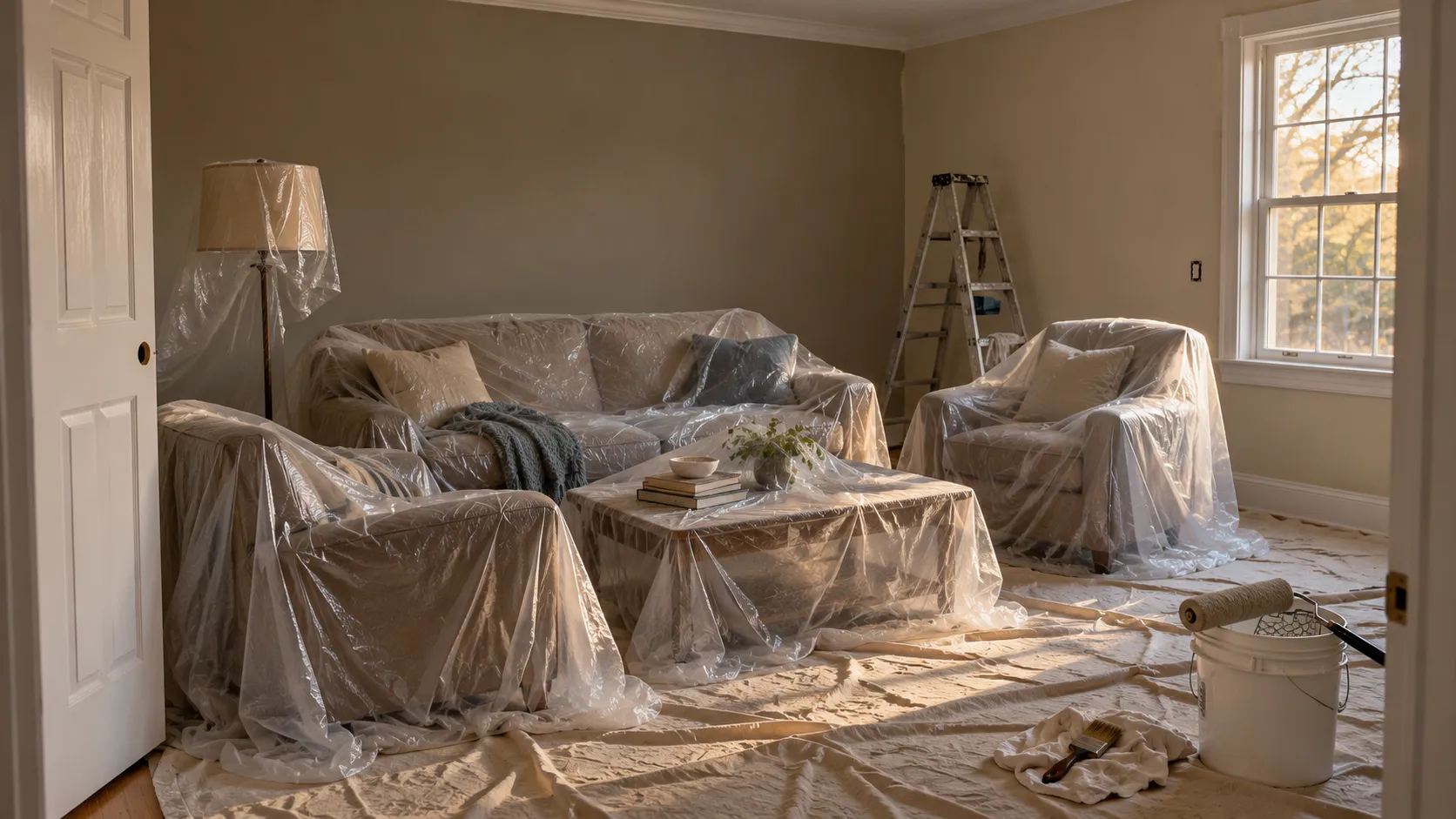
We paint far more occupied houses than empty ones, and we build the difference into the schedule rather than pretending it is not there. The same scope takes about a fifth to a third longer when people are living in the house. Furniture moves twice a day, because a bedroom has to be sleepable tonight. We work room by room instead of floor by floor, which is better for the household and worse for the clock, since each room gets its own setup and cleanup. The working day is shorter, because painting a kitchen around dinner costs hours that appear on no invoice. And everything has to stay reachable: ladders down, cords coiled, wet trim flagged, the hallway never fully blocked. If a house is empty and will stay empty — between tenants, before a move-in, after a closing — say so when you ask for an estimate. It is the one lever a homeowner controls that reliably shortens a job. If you are staying put, our guide to living in your house while it is painted covers how to plan the rooms, pets and sleeping arrangements around the crew.
Beyond that, the honest list of what pushes a job past its estimate, in the order we see it: what is under the old paint, when scraping reveals bare wood, rot or a previous latex-over-oil failure and the job changes shape on day two; weather on an exterior, including a week of dew-heavy October mornings that costs two hours a day at the front of the day; scope added mid-job, when ceilings or trim get added once the walls are up, each with its own recoat arithmetic; access, meaning a deck you cannot foot a ladder on, a hedge against the siding, or a shore house on pilings; and colour changes that need a third coat, a real risk going from a deep saturated colour to a pale one. What we do about it is write the scope and the sequence into the estimate, with the start date, the expected working days and the items that would change the schedule if we find them. If a contractor will not put that in writing, the duration they gave you on the phone is a guess.
Get a Written Timeline With Your Estimate
If you want a real number of days for your own house rather than a range, that is what an estimate is for. We walk the house, count the surfaces, look closely at the caulk lines, the south and west elevations and anything already failing, and write down the scope, the sequence, the start date and the number of working days, along with what would change them. We are a family-owned company at 36 Church Rd in Morganville, in business since 2004, fully insured, working in Benjamin Moore and Sherwin-Williams products, and we back our work with a 2-year workmanship warranty. Estimates are free and include an in-home colour consultation.
Call (732) 239-0932 or use our contact form. You can see what each service involves on our interior painting, exterior painting and cabinet painting pages, read our exterior painting pages for Monmouth County and Ocean County, check whether we cover your town on our service areas page, and find what the work costs in our NJ painting cost guide.
Frequently Asked Questions
How long does it take to paint a house?
For a whole interior, three to ten working days with a crew of two or three: three to four days for a 3-bedroom ranch doing walls and ceilings, five to seven for a 3-bedroom colonial with trim and doors, eight to twelve for a large 4-bedroom with every casing and closet. For a whole exterior, six to nine working days on an average 2,500 square foot two-story house, and ten to fourteen if there is widespread peeling to scrape. Those are our own scheduling figures and they assume average prep; the prep is what moves them.
How long does it take to paint a house exterior?
Six to nine working days for a crew of two or three on a 2,500 square foot two-story colonial, which is usually ten to fourteen calendar days once weather is allowed for. A single-story vinyl ranch is three to four working days; a three-story or piling-built shore home is ten to fifteen or more because of staging and wind. The biggest variable is scraping, and the same colonial with failing paint on the south and west elevations can take twice as long as one with sound paint — which nobody can tell you until the scraper is on the wall.
Why does an exterior take longer than the working days I was quoted?
Rain and dew. NOAA's normals for the Freehold-Marlboro station show between 5.7 and 8.2 days a month with a tenth of an inch of rain or more from May through October, about one day in four. A shower at 10am costs the elevation we were on; one at 6pm costs nothing. The Sherwin-Williams exterior sheets also tell you to avoid painting if rain is expected within two to three hours, so the morning forecast decides where we start. We plan roughly one and a half calendar days per working day in summer, and more in late October.
How long does it take to paint a bedroom?
A crew of two paints a standard bedroom's walls in most of one day, and the same room with the ceiling, trim, a closet and a couple of windows in about a day and a half. The rolling itself is under an hour per coat; the day goes into setup, patching, sanding, caulking, cutting in the ceiling line and corners, and resetting the room. If the trim is getting two coats of enamel, the 16-hour recoat window pushes the room into a second day regardless of its size.
How long does it take to paint a 12x12 room?
Most of one day for a crew of two if the walls are smooth and the ceiling and trim are not included. A 12 by 12 room is not meaningfully faster than a 12 by 14 one, because square footage is the part that rolls quickly and the time is in the fixed work at the edges. Our cost to paint a room guide works a room of that size through surface by surface.
How long does it take to paint a bathroom?
Half a day for the walls of a powder room or small bath, and most of a day with the ceiling and trim. Bathrooms are slow for their size: there is very little open wall to roll and a great deal of cutting in around tile, a vanity, a mirror, a toilet and towel bars, plus switch plates and an exhaust vent. Ventilation matters too, because a closed, damp bathroom pushes the recoat window out past the data sheet figure.
How long does it take to paint a wall?
The rolling takes well under an hour for two coats on an average 12-foot wall, with the first coat needing one to four hours to reach its recoat window depending on the product. Realistically a single-wall visit is a half-day job: protecting the floor and furniture, taping, patching and sanding, cutting in three edges, two coats, then cleanup. That is the fixed cost of opening and closing a work area and it does not shrink with the size of the wall.
How long does it take to paint kitchen cabinets?
Four to six days on site for an average kitchen, and two to four weeks before the finish is fully hard. The on-site time goes into removing and labelling doors and drawer fronts, degreasing, scuff-sanding, a bonding primer and two coats of enamel. The waiting is the enamel's: Benjamin Moore's Advance data sheet lists a 16-hour recoat window, asks for 5 to 7 days before shelves go back into service, and says it "could take up to 30 days to reach optimum hardness and final sheen." You can use the kitchen within the week; treat it gently for the month.
What is the difference between dry time, recoat time and cure time?
Dry to the touch means the paint will not transfer to your finger, about an hour for a wall paint. Recoat is when the film can accept a second coat without lifting: one to two hours for Benjamin Moore Regal Select, four hours for Sherwin-Williams Duration Home, sixteen hours for Advance trim enamel. Cure is when the film reaches final hardness, which is two weeks for wall paint and up to 30 days for a trim or cabinet enamel. All three stretch in cold or humid conditions, and both manufacturers state their figures at 50 percent relative humidity.
Can you paint a house faster with a bigger crew?
Up to a point, and then no. Setup, prep and cleanup do not divide neatly, two painters cutting in the same small room get in each other's way, and on a wide exterior run only one painter can hold a continuous wet edge. We add painters by splitting them across different surfaces — one on siding, one on trim, one scraping ahead — rather than stacking them on one, which is why most of our crews are two or three. The waiting is fixed as well: no number of painters shortens a 16-hour recoat window.
About the author
Written by the NJ Painting Co. team
NJ Painting Co. is a family-owned painting contractor based in Monmouth County, in business since 2004. We are licensed and fully insured, work with Benjamin Moore and Sherwin-Williams paints, and back our work with a 2-year workmanship warranty. We serve Monmouth, Middlesex, Ocean, Mercer, Somerset and Burlington counties, plus Union, Essex, Hudson, Bergen and Passaic in North Jersey.