Popcorn ceiling removal cost in New Jersey starts with the scraping itself, which our cost guide puts at $1 to $2 per square foot of ceiling, plus a skim coat and sanding to make the surface smooth, plus primer and paint. Ceiling painting runs $1 to $2.50 per square foot in the same guide, so a scraped and repainted ceiling lands at $2 to $4.50 per square foot before the skim coat is priced. For a 12 by 14 bedroom that is roughly $336 to $756, and for 1,000 square feet of ceiling roughly $2,000 to $4,500. Those numbers assume the texture has been tested and does not contain asbestos. If it does, removal is a different job done by a different kind of contractor.
We are a family-owned, licensed and fully insured painting company in Morganville and have worked on homes across Monmouth, Middlesex, Ocean, Mercer, Somerset and Burlington counties, plus Union, Essex, Hudson, Bergen and Passaic in North Jersey, for more than 20 years. Popcorn ceilings come up on a large share of our interior estimates. This guide covers the cost to remove popcorn ceiling texture, what moves the price, the asbestos question and New Jersey's rules, and the alternatives to scraping. Regulatory and technical points are linked to the EPA, the Consumer Product Safety Commission, the New Jersey Department of Health, the New Jersey Department of Labor and Workforce Development and Sherwin-Williams. National price figures are attributed to the cost sites that publish them.
The Short Answer: How Much Does It Cost to Remove Popcorn Ceiling?
- Scraping: $1 to $2 per square foot of ceiling in our NJ painting cost guide, plus skim coat and sand.
- Repainting the ceiling afterward: $1 to $2.50 per square foot in the same guide.
- Scrape plus paint: $2 to $4.50 per square foot before the skim coat, which we price after seeing the ceiling.
- National figures: Homewyse puts basic removal at $1.87 to $3.52 per square foot (September 2026). Fixr gives $1 to $4 per square foot and a national average of $1,700 per project (January 2025).
- Test first. Textured ceiling material applied before the late 1970s may contain asbestos, and nobody can tell by looking. A lab has to analyze a sample.
- If the test is positive, removal belongs to an asbestos abatement contractor licensed by the New Jersey Department of Labor and Workforce Development. Painters, including us, do not do that work.
- You do not have to remove it. Leaving a sound ceiling alone, painting it, skim coating over it or covering it with drywall are all real options, and we compare them below.
Popcorn Ceiling Removal Cost Per Square Foot
Our published price for scraping is the line in the interior section of our cost guide: popcorn ceiling scraping runs $1 to $2 per square foot, plus skim coat and sand. That per-square-foot number is measured on the ceiling, not the floor plan of the whole house, although in a room with a flat ceiling the two are the same.
Scraping is only the first of three costs. A scraped ceiling is not a finished ceiling. Under the texture you usually find drywall that was taped and given one rough coat of joint compound, because the installer knew the texture would hide it. That surface needs a skim coat and sanding before it can be painted, and then primer and finish paint. Our cost guide lists ceiling painting at $1 to $2.50 per square foot. The skim coat is priced on site because it depends entirely on what the scraper uncovers.
The table below multiplies those two published ranges by the ceiling area so you can redo the math for your own rooms.
| Room | Ceiling area | Scraping only | Ceiling painting | Scrape plus paint |
|---|---|---|---|---|
| Bedroom, 10 x 12 | 120 sq ft | $120 to $240 | $120 to $300 | $240 to $540 |
| Bedroom, 12 x 14 | 168 sq ft | $168 to $336 | $168 to $420 | $336 to $756 |
| Living room, 15 x 20 | 300 sq ft | $300 to $600 | $300 to $750 | $600 to $1,350 |
| Great room, 20 x 20 | 400 sq ft | $400 to $800 | $400 to $1,000 | $800 to $1,800 |
| One floor of ceilings | 1,000 sq ft | $1,000 to $2,000 | $1,000 to $2,500 | $2,000 to $4,500 |
| Most of a house | 1,500 sq ft | $1,500 to $3,000 | $1,500 to $3,750 | $3,000 to $6,750 |
Treat the table as a starting range, not a quote. A written estimate after we have seen the ceilings is free.
How national cost sources compare
National calculators land in the same neighborhood. Homewyse says that "in September 2026 the estimated national average cost to Remove a Popcorn Ceiling starts at $1.87 - $3.52 per square foot," and notes that its figure does not include "costs for testing and remediation of hazardous materials (asbestos, lead, radon, etc.)." Fixr (updated January 31, 2025) says "popcorn ceiling removal costs range from $900 to $2,500, with a national average of $1,700," and that "the average cost of removal per square foot is $1 to $4, depending on how thick the texture is and the ceiling height." Fixr's room examples run from $200 to $800 for a 200 square foot bedroom to $330 to $1,320 for a 330 square foot living room.
These are national planning numbers from the sites named, not New Jersey quotes. When you compare any two figures, check whether each one stops at scraping or carries through skim coat, primer and paint. That difference explains most of the spread.
What Drives the Cost to Remove Popcorn Ceiling Texture
Whether the texture has been painted
Unpainted popcorn softens when it is misted with water and comes off in wet ribbons. Sherwin-Williams describes the same chemistry from the other direction in its interior product application FAQ: "When latex is applied over a 'popcorn' ceiling, the water in the paint can break down the adhesive bond between the texture and the substrate, allowing the weight of the texture to pull the material off the ceiling." Water loosening the bond is a problem when you are painting and a help when you are scraping.
Once a popcorn ceiling has been painted, the paint film keeps the water out. In our experience a painted popcorn ceiling takes noticeably longer to scrape than an unpainted one, comes off in smaller pieces, and leaves a rougher surface that needs more skim coating. It is the most common reason a job lands at the top of the per-square-foot range.
What is under the texture
The condition of the drywall or plaster underneath decides how much finishing the ceiling needs. Exposed tape joints, nail or screw pops, old water stains and gouges from the scraper all have to be repaired. Our cost guide lists patching and sanding at about $0.50 to $0.75 per square foot on its own, and a full skim coat is more work than spot patching. In our experience, ceilings that were textured to hide a poor taping job are the ones that need the most compound.
Ceiling height and access
An eight-foot ceiling is scraped from the floor or a low platform. Vaulted ceilings, two-story foyers and stairwells need staging, and everything slows down. Our cost guide notes that height and reach push interior painting toward the top of its range for the same reason.
Occupied rooms and protection
Popcorn removal is the messiest thing we do indoors. Floors are covered, walls are draped in plastic, and furniture is moved out or wrapped. An empty house before move-in is faster to protect than a furnished one. If you are buying a home with popcorn ceilings, the time between closing and moving in is the cheapest window to deal with them.
Asbestos and lead
A positive asbestos test changes the job, the contractor and the price, which we cover in the next section. Paint is a separate question. If a ceiling in a home built before 1978 has been painted, that paint may contain lead, and the EPA's Renovation, Repair and Painting program requires that "anyone paid to perform work that disturbs painted surfaces in homes, childcare facilities and preschools built before 1978 be certified." Our guide to lead paint in older NJ homes explains testing and lead-safe work.
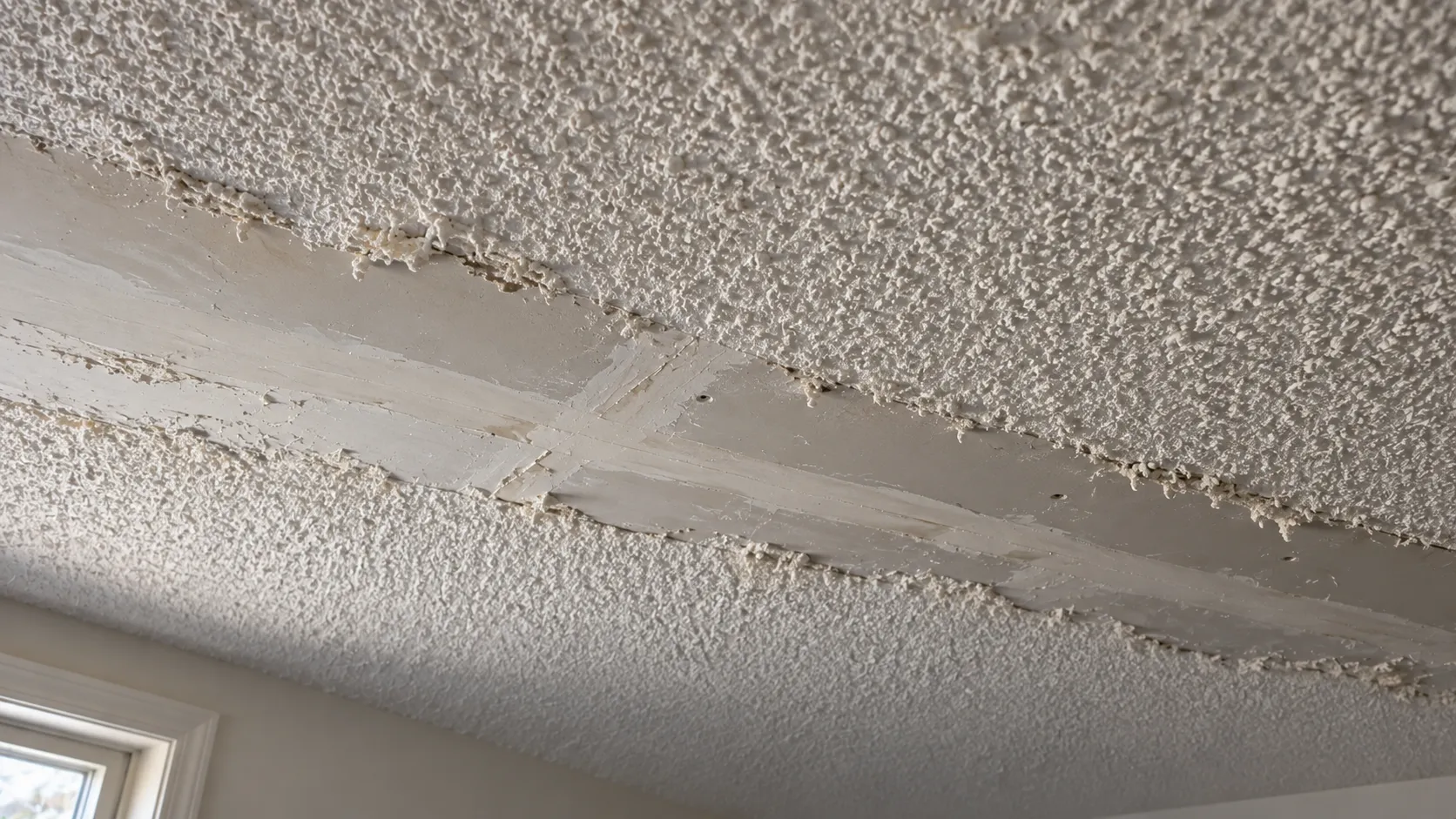
Asbestos Popcorn Ceiling: What to Know Before Anyone Scrapes
Does popcorn ceiling have asbestos?
Some does, and it depends on when and with what it was made. The New Jersey Department of Health's booklet "Asbestos: A Guide for New Jersey Residents" says under "Patching Compounds and Textured Paints" that "textured paint used for decorative purposes once contained asbestos." The Consumer Product Safety Commission's guide "Asbestos in the Home" lists soundproofing or decorative material sprayed on walls and ceilings among the places asbestos turns up, and warns: "Loose, crumbly, or water-damaged material may release fibers. So will sanding, drilling, or scraping the material."
That last sentence is the whole issue. A popcorn ceiling that contains asbestos and is left intact is one thing. Scraping it is the exact action the CPSC says releases fibers. The New Jersey booklet states that "in most cases, asbestos-related diseases develop 20 to 40 years after exposure," so a mistake made during a weekend project does not show up for decades.
When did they stop using asbestos in popcorn ceilings?
There was no single date. The EPA's summary of its actions on asbestos lists the steps: "In 1973, EPA banned spray-applied surfacing asbestos-containing material for fireproofing/insulating purposes." Then, "in 1978, EPA banned spray-applied surfacing materials for purposes not already banned." In between, "in 1977, the Consumer Product Safety Commission (CPSC) banned the use of asbestos in artificial fireplace embers and wall patching compounds."
Decorative spray texture falls under the 1978 action, which is why 1978 is the year most guidance uses, and why our cost guide says a pre-1978 popcorn ceiling has to be tested before it is scraped. The same EPA page explains why asbestos did not simply disappear afterward: the agency's broader 1989 ban on most asbestos-containing products "was overturned in 1991 by the Fifth Circuit Court of Appeals." A ban date tells you when a product could no longer be made or applied. It does not tell you what is on your ceiling. We recommend testing texture in homes built in the years just after 1978 as well, because the test is inexpensive next to the cost of being wrong.
How to tell if popcorn ceiling has asbestos
You cannot tell by looking, and neither can we. The EPA's page "Protect Your Family from Exposures to Asbestos" says: "Generally, you can't tell whether a material contains asbestos simply by looking at it, unless it is labeled." The New Jersey booklet is more blunt: "Unless the material is labeled as asbestos, no one can tell if it is asbestos-containing by examining it without the aid of a microscope. Even an expert can not give you a definite answer until a sample of the material is analyzed."
The age of the house, the look of the texture and whether it sparkles are not evidence either way. The state's advice is to "treat it as if it does until you know otherwise."
The popcorn ceiling asbestos test
A popcorn ceiling asbestos test means a small sample of the texture is collected and analyzed by an accredited laboratory. The New Jersey booklet recommends "that a sample of the material be taken to a laboratory that is accredited by either the American Industrial Hygiene Association" or "the National Voluntary Laboratory Accreditation Program." The CPSC names the same program, the NVLAP.
On who should take the sample, the EPA says "a trained and accredited asbestos professional should take samples for analysis, since a professional knows what to look for." The New Jersey Department of Health's asbestos FAQ gives the same recommendation: "hire a professional asbestos inspector certified by the U.S. Environmental Protection Agency to conduct an inspection and take samples." The state booklet notes that "New Jersey does not currently license asbestos inspectors," so ask for EPA training and certification and for the name of the accredited lab. The report should state, in the booklet's words, "the type and percentage of asbestos within the material."
The EPA also advises homeowners to "avoid a conflict of interest," explaining that a professional hired to assess the need for removal "should not be connected with an asbestos firm that does the actual repair or removal." We follow the same logic from our side: we do not take asbestos samples, and we ask for a lab report on any ceiling that might predate the bans before we price scraping it.
New Jersey rules: who can remove an asbestos popcorn ceiling
The state health department's FAQ says "NJ requires all contractors who abate asbestos-containing materials, to have a NJ Department of Labor and Workforce Development (DOLWD) license." The Department of Labor's asbestos program administers that license under the Asbestos Control and Licensing Act (N.J.S.A. 34:5A-32 et seq.) and its regulations (N.J.A.C. 12:120), which require that "asbestos abatement companies obtain New Jersey State-issued licenses and that individuals performing asbestos work obtain State-issued asbestos worker or supervisor performance identification permits." Its Asbestos Control and Licensing Section can be reached at (609) 633-3760 to check whether a contractor is licensed.
Two more points from the state are worth knowing:
- You are not required to remove it. The booklet says "there are no state or federal laws that require you to remove asbestos in your home," and "as long as materials are in good repair they can be left alone."
- Homeowners are not forbidden from doing it themselves, but the state advises against it. The FAQ says "technically, there are no regulations that forbid a homeowner from removing asbestos in their own home themselves, but we strongly advise against it for a number of reasons." The booklet says removal "is not a do-it-yourself project. You should hire an asbestos professional to do the job."
Disposal has its own rules. The FAQ notes that "the transportation and disposal of asbestos-containing waste in NJ is regulated by the Department of Environmental Protection (DEP)," and the booklet gives the DEP's number, 609-984-6985, for disposal questions.
Sealing or covering an asbestos ceiling is not a loophole for a painter. The booklet describes encapsulation as "spraying the material with a sealant approved for this purpose" and says "contractors performing this work must be a licensed asbestos contractor." For enclosure behind new drywall it says "any contractors used must be a NJ Department of Labor and Workforce Development-licensed asbestos contractor."
What we do and what we refer out
We are painters. We scrape, skim coat, prime and paint popcorn ceilings that a lab report shows do not contain asbestos. We do not hold an asbestos abatement license, and we do not scrape, sand, seal or cover a ceiling that has tested positive. When a report comes back positive, the choice is between leaving a sound ceiling undisturbed and hiring a DOLWD-licensed abatement contractor. Once that contractor has finished and the ceiling is cleared, we can come in to skim coat, prime and paint the bare surface. Lead is the other limit: we are not an EPA Lead-Safe Certified firm, so scraping a painted popcorn ceiling in a pre-1978 home is work for a certified firm, and we will tell you that at the estimate.
What asbestos popcorn ceiling removal costs
We do not publish a price for abatement because we do not perform it. As a national reference, Fixr says "the average asbestos popcorn removal cost per square foot is $3 to $7, or between $900 and $2,100 for a 10' x 30' room." Treat that as Fixr's planning figure, not a New Jersey quote. The state booklet's advice on hiring is to "obtain numerous estimates from different contractors, they can vary significantly," and the CPSC suggests that air monitoring after the work "should be done by someone not connected with the contractor."
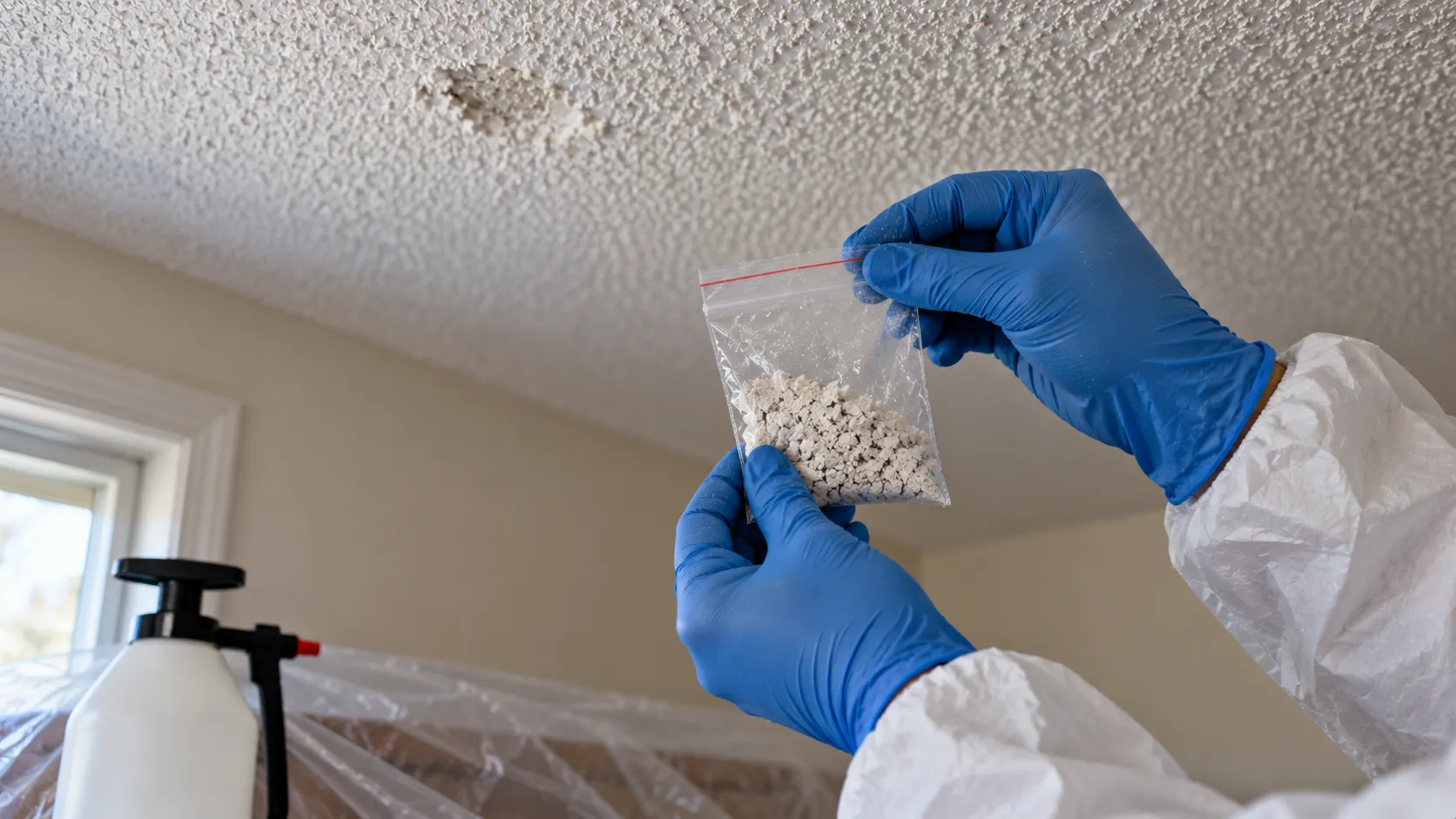
Remove, Cover, Skim Coat or Paint: Your Options Compared
Scraping is not the only route to a ceiling you like. The right choice depends on the test result, the condition of the texture and what you want the room to look like.
| Option | What it involves | Finished look | Cost reference | If the ceiling contains asbestos |
|---|---|---|---|---|
| Leave it alone | Nothing, as long as the texture is sound | Unchanged | None | Recommended by NJDOH, EPA and CPSC for material in good condition |
| Paint it | Stain-blocking or sealing primer where needed, then a flat ceiling paint | Clean and uniform, still textured | Ceilings $1 to $2.50 per sq ft in our cost guide; budget an extra $0.50 to $1.00 per sq ft for texture | Not work for a painter; see the NJ rules above |
| Scrape, skim and paint | Wet scrape, repair, skim coat, sand, prime, two coats | Smooth | Scraping $1 to $2 per sq ft plus skim coat and sand; painting $1 to $2.50 per sq ft | Licensed abatement contractor only |
| Skim coat over the texture | Knock down the high points, then build joint compound over what remains | Smooth if done well | Priced on site; Fixr lists a skim coat at $300 to $450 | Not an option for us; it disturbs the material |
| Cover with new drywall | Thin drywall screwed through to the joists, then taped, finished and painted | Smooth; ceiling drops slightly | Fixr lists drywall at $450 to $1,050 | This is enclosure; licensed asbestos contractor per NJDOH |
Can you paint popcorn ceiling?
Yes, and on a sound ceiling it is the least expensive way to make a room look cared for. Two cautions apply. First, the Sherwin-Williams answer quoted above goes on to say that "applying an alkyd primer before repainting with latex will usually alleviate the problem" of texture letting go. On unpainted popcorn we prime with a solvent-based sealing primer for that reason, and also because old ceilings often carry water stains. Sherwin-Williams' ceiling painting guide says: "We encourage you to use a quality primer for ceilings with water damage or other stains."
Second, technique matters. The same guide says to "use a higher nap, like 3/4-inch, for textured ceilings." We roll in one direction with light pressure and do not go back over wet texture, or we spray. As our guide to house painting costs in NJ puts it, a popcorn ceiling soaks up paint and cannot be rolled aggressively without shedding, and we suggest budgeting an extra $0.50 to $1.00 per square foot over a flat ceiling. Flat is the right finish; our paint sheen guide explains why sheen exaggerates every bump overhead.
The trade-off is that paint makes later removal harder and more expensive, as described above. If you think you will want smooth ceilings within a few years, skip the paint and go straight to removal.
Skim coat popcorn ceiling: when it makes sense
When a popcorn ceiling has been painted several times and will not release with water, scraping to bare drywall can do more damage than it is worth. The alternative is to knock off the loose high points and skim coat over what remains. This Old House's "How To Flatten a Textured Ceiling", with painter Mauro Henrique, takes the same approach to textured ceilings, coating them with a setting-type joint compound and troweling smooth. It explains why sanding texture flat is not the answer: "Holding a sander up against the ceiling will be very tiring, will use up a lot of sandpaper, and probably won't end up making the surface that smooth."
A skim coat over texture uses more compound and more coats than a skim over scraped drywall, and it needs a primer first so the compound bonds to the old paint. It is only an option on a ceiling that has tested negative.
How to cover popcorn ceiling
The usual way to cover a popcorn ceiling is a layer of thin drywall fastened through the texture into the joists, then taped, finished and painted like a new ceiling. Wood planks and beadboard panels are decorative versions of the same idea; Fixr lists beadboard at $1,000 to $1,500 and wood planks at $1,000 to $2,500. Covering avoids the scraping mess and gives a flat surface, at the cost of a slightly lower ceiling and reworked light fixtures, vents and crown molding. The CPSC describes covering asbestos material as "placing something over or around the material that contains asbestos to prevent release of fibers," and the New Jersey booklet calls it "a suitable action" that "is not a permanent solution." As noted above, on an asbestos ceiling in New Jersey that work is for a licensed asbestos contractor.
How to Remove Popcorn Ceiling: Our Process Step by Step
This is the sequence we follow on popcorn ceiling removal once a ceiling has been cleared for scraping.
- Confirm the test. We ask for the lab report on any ceiling that may predate the bans. No report, no scraping.
- Check the paint. We spray a small patch with water. If it darkens and softens within a few minutes, the texture is unpainted and will scrape cleanly. If the water beads, it has been painted and we plan for a slower job or a skim-over. In a home built before 1978, painted texture also means the paint itself may contain lead, which brings in the EPA rule above.
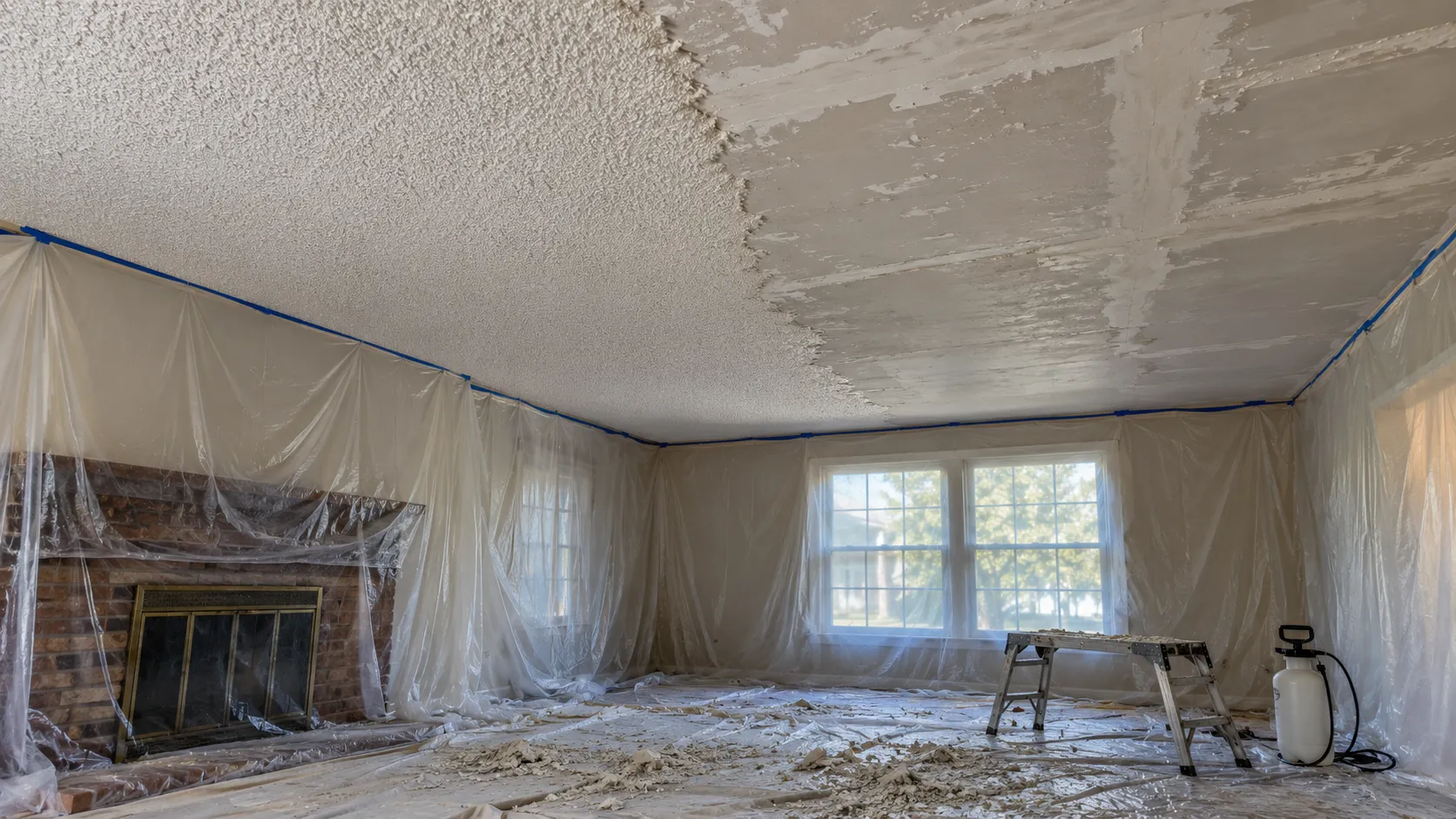
- Empty and protect the room. Furniture goes out or is wrapped. Floors are covered, walls are draped in plastic from the ceiling line down, and doorways are sealed. Heating and cooling to the room is turned off and vents are covered so debris does not travel.
- Deal with fixtures. Power to ceiling fixtures is switched off at the panel. Fixtures and fans come down or are wrapped, and boxes are covered.
- Wet the texture in sections. A pump sprayer puts on a light, even mist. Too little water and the texture comes off as dust; too much and the drywall paper underneath softens and tears.
- Scrape. A wide scraper held at a low angle takes the softened texture off in strips. We round the corners of the blade so it does not dig into the paper face.
- Repair. Loose tape is reset, fastener pops are fixed and gouges are filled.
- Skim coat and sand. One or more thin coats of joint compound go across the whole ceiling, with sanding in between, until a work light held at a low angle shows no ridges.
- Prime. Fresh joint compound is porous and must be sealed. Stains get a stain-blocking primer.
- Two coats of flat ceiling paint, using Benjamin Moore or Sherwin-Williams products. Our Benjamin Moore vs Sherwin-Williams comparison covers how the two lines differ.
- Clean up and walk through. Plastic is rolled inward and removed, the room is vacuumed, fixtures go back, and we look at the ceiling with you in daylight.
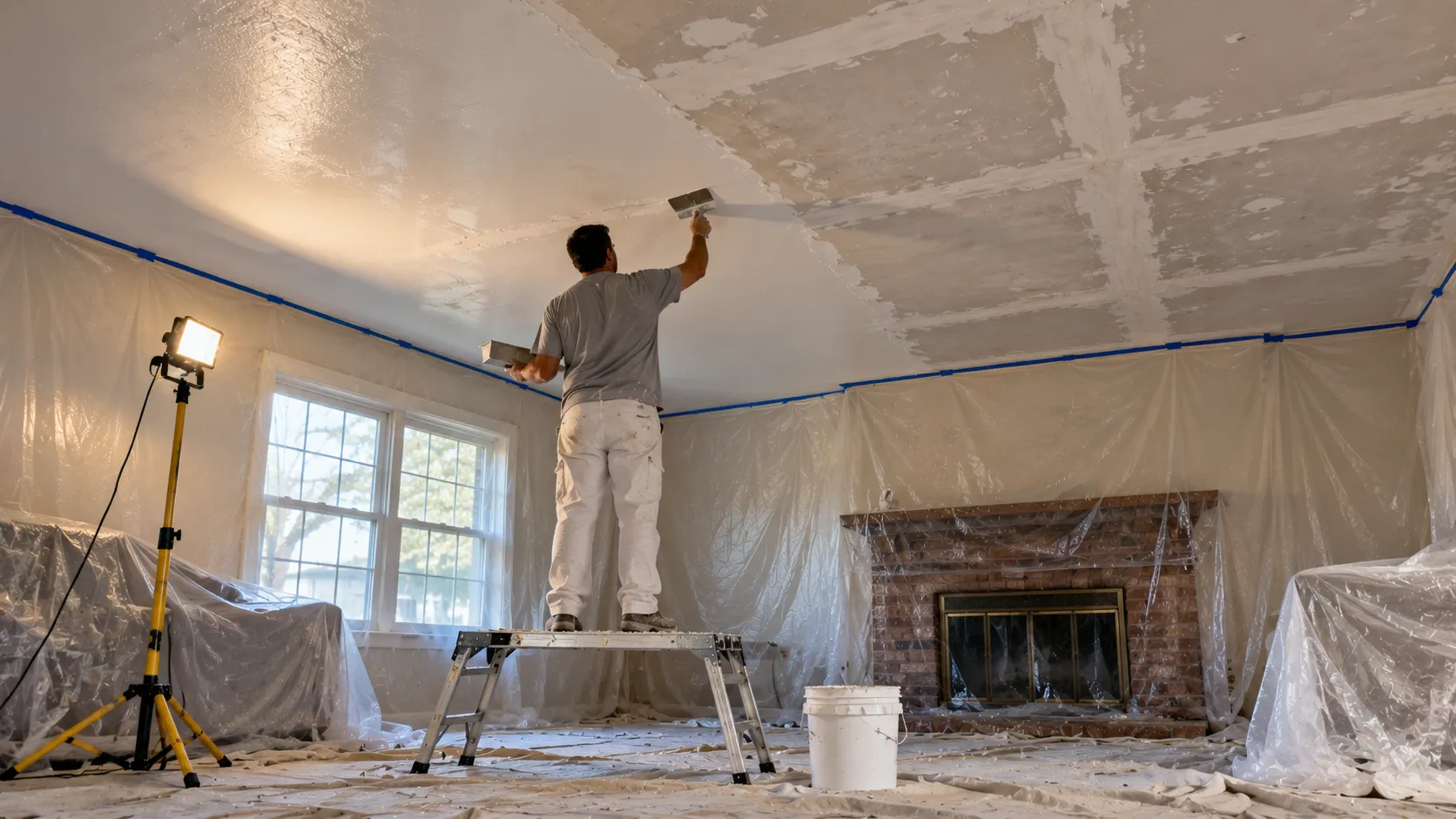
Popcorn Ceiling Removal Before and After: What Actually Changes
The before is familiar: a rough, shadowed ceiling that holds dust and cobwebs, yellows around old stains and cannot be patched invisibly after a leak. The after is a flat ceiling that reflects light evenly, which in our experience makes a room read as brighter and the ceiling as slightly higher, and which can be touched up or repainted like any other surface.
Two things to expect. A smooth ceiling is less forgiving than a textured one, so the quality of the skim coat is what you are paying for; ask any contractor how many coats of compound are in the price. And the walls rarely escape. The ceiling line gets recaulked and the tops of the walls usually need paint, so many homeowners schedule popcorn ceiling removal with a full interior painting job and do the ceilings first.
DIY vs Hiring a Pro
On a ceiling that has tested negative, scraping unpainted popcorn is within reach of a patient homeowner. The tools are inexpensive: a pump sprayer, a wide scraper, plastic and tape. The costs of doing it yourself are time, mess and the finishing. Scraping is the easy third of the job. Skim coating a ceiling overhead so that it looks flat under daylight is a skill that takes practice, and it is where most do-it-yourself ceilings fall short.
If you do it yourself, the test still comes first. The EPA notes that "federal law does not require persons who inspect, repair or remove asbestos-containing materials in detached single-family homes to be trained and accredited; however, some states and localities do require this," and New Jersey, as quoted above, strongly advises homeowners against removing asbestos themselves. The EPA's list of don'ts is short and worth reading before you pick up a scraper: "Don't saw, sand, scrape, or drill holes in asbestos-containing materials," and "don't dust, sweep, or vacuum debris that may contain asbestos."
Hiring makes sense when the texture has been painted, the ceilings are high, the house is furnished, or you want the ceiling to look right the first time. Whoever you hire, ask four questions: Has the ceiling been tested, and can I see the report? Does the price include skim coat, primer and paint, or only scraping? How will the room and the rest of the house be protected? Is the company licensed and insured? If a ceiling paint job goes wrong later, our guide to why paint peels covers the usual causes.
Get a Written Price for Your Ceilings
NJ Painting Co. is a family-owned, licensed and fully insured painting company at 36 Church Rd, Morganville, NJ 07751, working on New Jersey homes for more than 20 years with Benjamin Moore and Sherwin-Williams products. Every estimate is free, includes an in-home color consultation, and spells out scraping, skim coat, primer and number of coats; our work carries a two-year workmanship warranty. See the full price ranges in our cost guide, read about our interior painting service, check coverage on our Monmouth County, Middlesex County and Ocean County pages, or call (732) 239-0932 and request a free estimate.
Frequently Asked Questions
How much does it cost to remove popcorn ceiling in NJ?
Our cost guide lists popcorn ceiling scraping at $1 to $2 per square foot, plus skim coat and sand, and ceiling painting at $1 to $2.50 per square foot. Scraping and repainting a 12 by 14 bedroom ceiling works out to roughly $336 to $756 before the skim coat. Nationally, Homewyse puts basic removal at $1.87 to $3.52 per square foot and Fixr gives a project average of $1,700.
What is the popcorn ceiling removal cost per square foot?
$1 to $2 per square foot for scraping in our cost guide. Adding ceiling painting at $1 to $2.50 brings it to $2 to $4.50 per square foot, with the skim coat priced after we see the ceiling. Painted texture, high ceilings and furnished rooms push the price toward the top of the range.
Does popcorn ceiling have asbestos?
It may. The New Jersey Department of Health says textured paint used for decorative purposes once contained asbestos, and the CPSC lists decorative material sprayed on ceilings among household asbestos sources. Only a laboratory test of a sample can tell you whether yours does.
When did they stop using asbestos in popcorn ceilings?
The EPA banned spray-applied asbestos surfacing material for fireproofing and insulating in 1973 and for other purposes in 1978, and the CPSC banned asbestos in wall patching compounds in 1977. Ceilings textured before 1978 should be tested before they are disturbed, and we suggest testing ceilings from the years just after as well.
How to tell if popcorn ceiling has asbestos?
You cannot tell by sight. The EPA and the New Jersey Department of Health both say a sample has to be analyzed by an accredited laboratory, and both recommend that a trained asbestos professional take the sample. Until you have a result, treat the ceiling as if it contains asbestos and do not scrape, sand or drill it.
Who can remove an asbestos popcorn ceiling in New Jersey?
A contractor licensed for asbestos abatement by the New Jersey Department of Labor and Workforce Development. Painters do not do this work, and we do not either. You can confirm a contractor's license with the department's Asbestos Control and Licensing Section at (609) 633-3760.
Can you paint popcorn ceiling instead of removing it?
Yes, if the texture is sound. Sherwin-Williams warns that water in latex paint can loosen unpainted popcorn and recommends an alkyd primer first, and suggests a 3/4-inch nap roller for textured ceilings. Keep in mind that painted popcorn is harder and more expensive to remove later.
Is it better to skim coat or cover a popcorn ceiling than to scrape it?
On an unpainted ceiling that has tested negative, scraping and skim coating is usually the most direct route to a smooth finish. On heavily painted texture, a skim coat over the top or a layer of new drywall can be less destructive. On a ceiling that contains asbestos, any of these is work for a licensed asbestos contractor in New Jersey.
How long does popcorn ceiling removal take?
It depends on the area, whether the texture is painted and how much skim coating is needed. Scraping is quick; the schedule is set by the drying time between coats of joint compound, primer and paint. We give the number of working days in the written estimate after seeing the ceilings.
About the author
Written by the NJ Painting Co. team
NJ Painting Co. is a family-owned painting contractor based in Monmouth County, in business since 2004. We are licensed and fully insured, work with Benjamin Moore and Sherwin-Williams paints, and back our work with a 2-year workmanship warranty. We serve Monmouth, Middlesex, Ocean, Mercer, Somerset and Burlington counties, plus Union, Essex, Hudson, Bergen and Passaic in North Jersey.