Yes, fascia and soffits can be painted — wood, aluminum, vinyl and PVC all take paint — but each material needs a different preparation, a different primer decision and, on vinyl and PVC, a limit on how dark you are allowed to go. Get the material wrong and the paint fails in a season. Get the colour wrong on vinyl or cellular PVC and the paint can outlast the board, because a dark film absorbs enough heat to make the trim bow. And on a vented soffit there is a fourth way to fail that has nothing to do with the paint at all: close up the perforations and you have quietly choked the attic's air supply.
We are a family-owned painting company in Morganville and have painted New Jersey exteriors across Monmouth, Middlesex, Ocean, Mercer, Somerset and Burlington counties, plus Union, Essex, Hudson, Bergen and Passaic in North Jersey, for more than 20 years, using Benjamin Moore and Sherwin-Williams products. Fascia, soffit and exterior trim painting is work we quote on its own and as part of a full exterior, and the eave line is usually the first thing we look at when we walk a house, because it is almost always the first place an exterior starts to go. This guide is the long version of what we say standing in a driveway, looking up.
It is meant to be useful whether you hire anybody or not. Every technical figure below — minimum temperatures, the dew-point rule, dry and recoat times, spread rates, sheen numbers, the colour limits for vinyl and PVC trim, and the ladder and lead rules — comes from a manufacturer's technical data sheet, a trim or soffit maker's own published guidance, the National Park Service, NOAA, or federal regulation, each one fetched and quoted on 24 October 2026. Where something is our own practice rather than a published figure, we say so.
The Short Answer
- All four common fascia and soffit materials can be painted. Sherwin-Williams lists "Aluminum & Aluminum Siding," "Wood" and "Vinyl Siding" among the surfaces for its Duration Exterior, and Benjamin Moore recommends its Regal Select Exterior for "wood, hardboard, fiber cement, cedar shake, vinyl and aluminum siding."
- Eaves peel first for a known reason. The National Park Service explains that intercoat peeling "most often occurs in protected areas such as eaves and covered porches because these surfaces do not receive a regular rinsing from rainfall."
- So the soffit has to be washed even when it looks clean. Benjamin Moore's sheet says "un-weathered areas such as eaves, porch ceilings, overhangs and protected wall areas should be washed" and rinsed before painting.
- Bare wood gets sanded and primed. Sherwin-Williams: "Sand any exposed wood to a fresh surface"; "All patched areas must be primed."
- Vinyl and PVC have a colour ceiling. Sherwin-Williams says not to paint vinyl "with any color darker than the original color or having a Light Reflective Value (LRV) of less than 56" unless VinylSafe colours are used; Benjamin Moore puts its line at 55; AZEK's paint must have an LRV "above 55."
- Vented soffit is sprayed, not loaded with a roller. Gibraltar, which makes aluminum soffit and vents, warns that "perforated panels are easily painted shut (which then hinders airflow) with one or two coats of paint."
- The weather rule is about the surface, not the forecast high. Sherwin-Williams requires air, surface and material "above 35°F (1.7°C) and at least 5° above the dew point," and no drop below 35°F "within 48 hours."
- Rot is fixed before painting, by a carpenter. The Park Service: "Repair or replacement of deteriorated wood should take place before repainting." We flag it at the estimate; we do not do the repair.
- Old fascia paint is a lead question. Scraping more than 20 square feet of painted exterior surface on a pre-1978 house is regulated renovation work. We are not an EPA Lead-Safe Certified firm, so ask any bidder for a certification number.
What Are Fascia, Soffits and Eaves, and Why Do They Fail First?
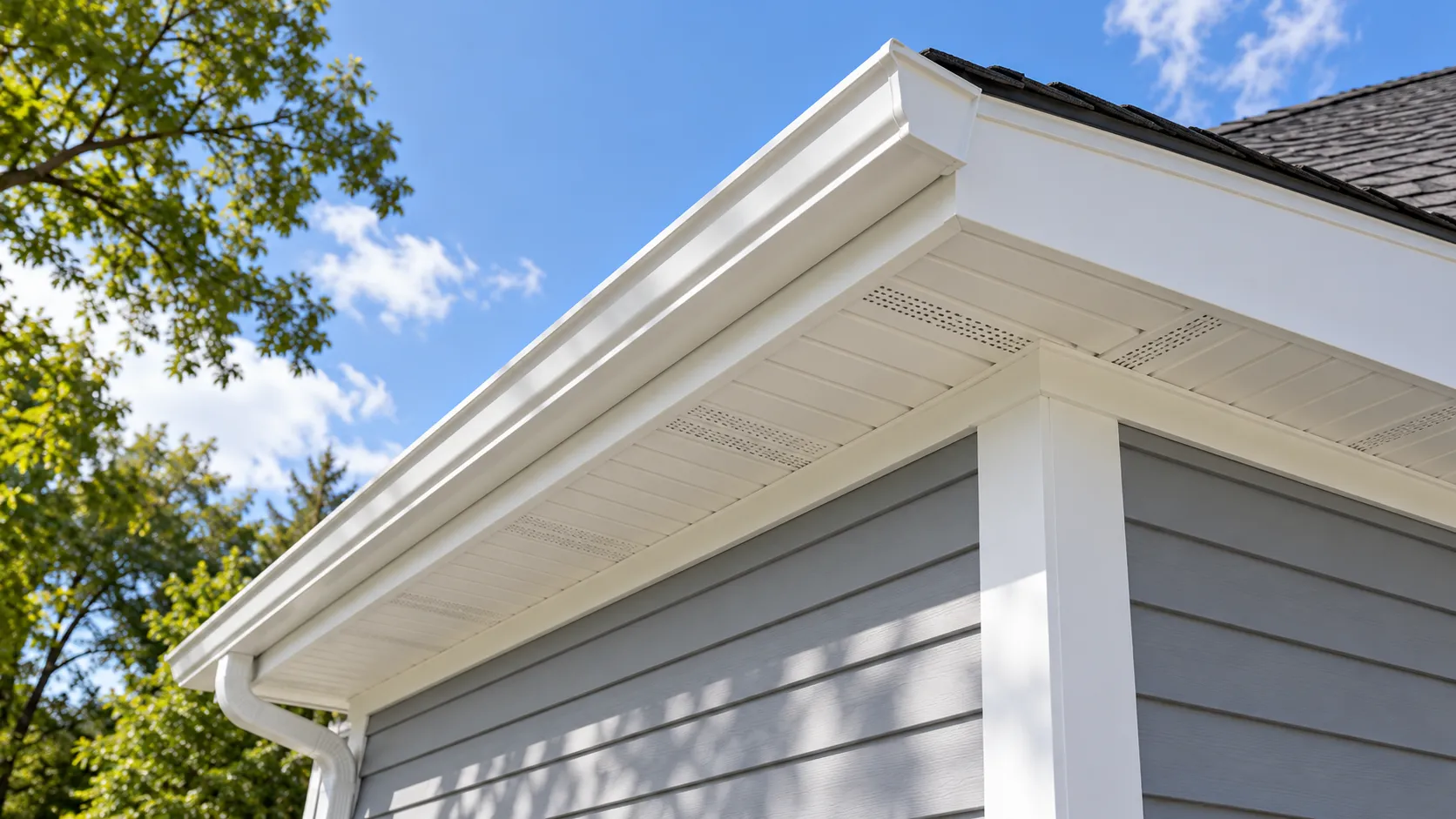
The eave is the whole overhang where the roof runs past the wall. The fascia is the vertical board across the ends of the rafters, the one the gutter hangs on. The soffit is the horizontal underside of the overhang, running from the back of the fascia to the wall, and on most New Jersey houses built or re-sided in the last few decades at least part of it is vented to feed air into the attic. Along a gable end the same job is done by the rake board, and where the soffit meets the siding there is often a frieze board or a run of crown. Together with corner boards, that is what painters mean by exterior trim.
On a typical colonial, cape or split-level that adds up to a long, narrow, mostly overhead surface, twenty feet up on a two-storey wall, that faces every kind of weather the walls face and a few they do not. The fascia carries the gutter, so any overflow, any ice backing up at the roof edge in February and any leak at a seam lands on it. Its bottom edge and its board ends are end grain, which drinks water. And the soffit sits in permanent shade, which is the part people do not expect.
Why the eave line peels before the walls
The Park Service's Preservation Brief 10, Exterior Paint Problems on Historic Woodwork, is still the clearest explanation of it, and nothing about it is specific to historic houses. On intercoat peeling — the top coat letting go of the coat beneath it — it says: "This most often occurs in protected areas such as eaves and covered porches because these surfaces do not receive a regular rinsing from rainfall, and salts from air-borne pollutants thus accumulate on the surface. If not cleaned off, the new paint coat will not adhere properly and that layer will peel."
The same shelter breeds mildew. The brief notes that because moisture is the single most important factor, mildew "tends to thrive in areas where dampness and lack of sunshine are problems such as window sills, under eaves, around gutters and downspouts, on the north side of buildings." And on grime: dirt and organic matter that "cling to painted exterior surfaces and, in particular, protected surfaces such as eaves, do not constitute a paint problem unless painted over rather than removed prior to repainting." Put those three together and you have the reason an eave line that was painted at the same time as the walls is the first thing peeling five years later: it was painted over a film nobody washed off, in a spot that never dries.
The manufacturers say the same thing in their own words. Benjamin Moore's Regal Select Exterior High Build Low Lustre data sheet singles out "un-weathered areas such as eaves, porch ceilings, overhangs and protected wall areas," which it says "should be washed with a Benjamin Moore Clean (N318) and rinsed with a strong stream of water from a garden hose or power washer to remove contaminants that can interfere with proper adhesion." That is the single most skipped step on a fascia and soffit job, and the one we would least like you to skip.
Where exterior trim stops, and the window trim we leave out
Fascia, soffits, rake and frieze boards and corner boards are ours. Window trim and sills are not: window casing and sill painting is not part of our scope, and neither is re-caulking around windows and doors. We say that up front because a lot of "exterior trim" estimates bundle the window casings in, and you should know before you compare bids that ours will not. If your windows need attention, that is a separate conversation with a separate trade.
How Do You Paint Wood Fascia and Soffits?
Wood is still the most common fascia on older New Jersey houses — pine or fir boards, sometimes cedar, often with a plywood or beadboard soffit behind. It is also the material that rewards preparation most, because a wood fascia that is properly sealed on its face, its bottom edge and its ends lasts, and one that is sealed only on its face does not.
Scrape, sand, then feather
Both manufacturers write the rule the same way. Sherwin-Williams' Duration Exterior product data sheet: "Existing peeled or checked paint should be scraped and sanded to a sound surface. Glossy surfaces should be sanded dull." For bare wood: "Sand any exposed wood to a fresh surface. Patch all holes and imperfections with a wood filler or putty and sand smooth. All patched areas must be primed." Benjamin Moore's Fresh Start High-Hiding All-Purpose Primer 046 sheet adds the step that decides whether a repaint looks patched: "Remove any peeling or scaling paint and sand these areas to feather edges smooth with adjacent surfaces."
Sherwin-Williams then adds a sentence every homeowner should read before accepting a cheap bid: "Recognize that any surface preparation short of total removal of the old coating may compromise the service length of the system." Nobody strips a whole fascia to bare wood on a sound house, and nobody should. But it explains why a fascia that has been painted over its own failures three times will not hold a fourth coat, however good the paint.
Prime bare wood, and know what self-priming means
The premium exterior paints are sold as self-priming, and the fine print matters. Duration says it "is self-priming on most surfaces. Apply 2 coats on new, bare substrates or 1 coat for repaint," and explains that when used that way "the first coat of Duration acts like a coat of primer and the second coat provides the final appearance and performance." Benjamin Moore's Aura Exterior Low Lustre N634 sheet is the same: "On bare substrates two coats are required; previously painted surfaces can be finished with 1 or 2 coats." So "self-priming" does not mean fewer coats on bare wood. It means the first of the two coats is doing the priming.
Where we use a separate primer on wood fascia, it is for one of two reasons. The first is tannin. Cedar and redwood, and knots in any softwood, bleed. Sherwin-Williams warns that on those woods "the first coat of Duration may show some staining," and that "if staining persists, spot prime severe areas" with a primer first. Benjamin Moore routes "bleeding woods (redwood, cedar, etc.)" to Fresh Start 046, which it says "seals and suppresses most bleeding type stains such as tannin bleed, water stains." The second reason is uniformity: Sherwin-Williams' own oil primer sheet warns that "when spot priming on some surfaces, a non-uniform appearance of the final coat may result, due to differences in holdout between primed and unprimed areas. To avoid this, prime the entire surface rather than spot priming." On a long, raking-lit fascia that is exactly the board where you would see it.
We reach for waterborne acrylic primers first. Fresh Start 046 lists its VOC as "< 50 g/L," the same as the topcoats; Sherwin-Williams' Exterior Oil-Based Wood Primer lists "318 grams per litre." The oil primer still has a job on difficult woods, and its own sheet says it "must be topcoated within 14 days" for exterior exposure — but before any solvent primer goes on a New Jersey house we check its compliance block against the state's current limits rather than assume.
The bottom edge and the ends
This part is our practice rather than a figure on a sheet. On wood fascia the paint fails first along the bottom edge and at the board ends and joints, because that is end grain and because that is where water from the gutter runs. We prime and paint the underside edge rather than stopping at the face, we work paint into the end joints, and we caulk open joints between trim boards after priming, which is the order both sheets give: Sherwin-Williams says gaps between trim and other openings "can be filled with the appropriate caulk after priming the surface." General caulking and sealing of trim joints is part of our work. Caulking the lap joints of siding is not something anyone should do — Sherwin-Williams warns it can trap moisture behind the siding — and a joint that is open because the board under it is soft is a rot question, covered below, not a caulk question.
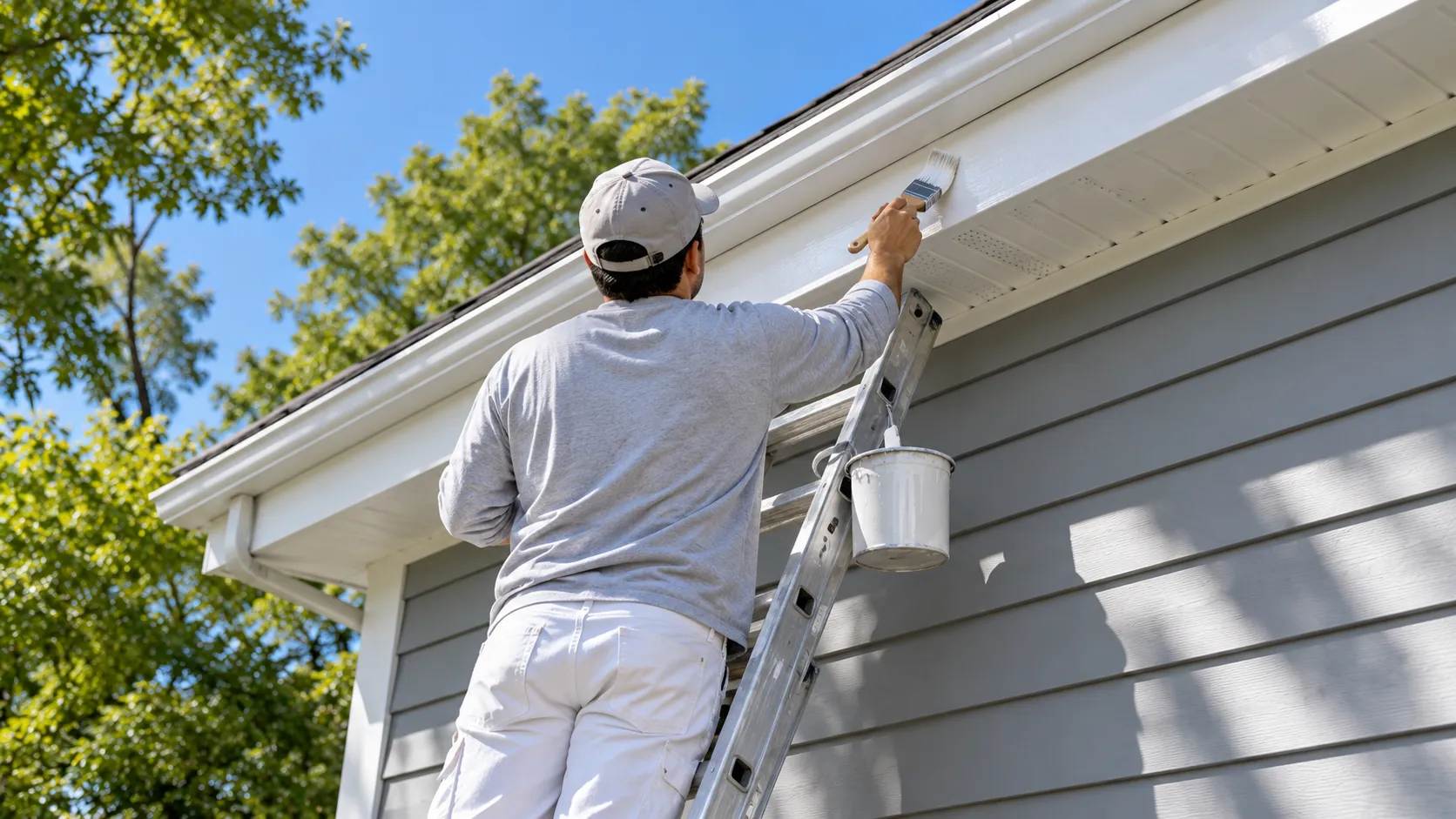
Can You Paint Aluminum Soffit and Fascia?
Yes, and on a lot of New Jersey houses that is the real question, because aluminum trim coil wrapped over the original wood fascia and aluminum soffit panels were the standard upgrade for decades. The factory finish fades and chalks, and repainting it is entirely practical.
The soffit makers say so directly. Gibraltar Building Products, which makes aluminum soffit, answers "Can I paint Aluminum Soffit?" with "Yes," adding: "if you choose to paint your soffit we recommend cleaning the soffit thoroughly with clean water prior to priming and painting. For best results, use a primer suited for aluminum exterior painting." Its pro tip is to apply "several light, quick passes throughout the product allowing the paint to completely dry in between passes."
The paint makers agree on the cleaning and differ on the primer. Sherwin-Williams' prep for aluminum: "Wash to remove any oil, grease, or other surface contamination. All corrosion must be removed with sandpaper, wire brush, or other abrading method." Its exterior FAQ is explicit about the chalk that faded aluminum always carries: "Any surface that has a chalky feel should be cleaned to remove the chalk before painting," by "pressure washing and using a chemical injection system attached for the detergent," then letting it "dry a day or so." Benjamin Moore's Regal Select sheet says new non-ferrous metal should be cleaned with an emulsifier and that "new shiny non-ferrous metal surfaces that will be subject to abrasion should be dulled with very fine sandpaper or a synthetic steel wool pad to promote adhesion," and then lists "Primer: No primer needed" for galvanized and aluminum under two coats of the finish. Fresh Start 046 lists aluminum among its exterior substrates if a primer is wanted.
Our reading: on weathered, chalky aluminum that has been properly washed and has dried, the premium acrylics bond, and the bonding problem on aluminum is almost always a cleaning problem. On new, shiny coil or anywhere we are unsure, we prime. Two more details are worth knowing. Sherwin-Williams says that "on large expanses of metal siding, the air, surface, and material temperatures must be 50°F (10°C) or higher" — a higher floor than the 35°F the same paint allows on wood. And dents and oil-canning in aluminum coil do not paint out. Paint changes colour, not shape; a buckled run of trim coil will look like a buckled run of trim coil in a fresh colour. Replacing or re-wrapping coil is not something we do.
Can You Paint Vinyl Soffit and Fascia?
Yes, with two conditions that decide everything: the colour and the warranty. Vinyl soffit and the vinyl-clad fascia that often goes with it are the same PVC as vinyl siding, and the rules are the same. Our guide to painting vinyl or aluminum siding goes through the siding side of it; here is what applies to the eave.
The colour limit
Vinyl moves with heat, and a dark paint film makes it much hotter than the colour it was made in. Sherwin-Williams' sheet puts it in one sentence: "Do not paint vinyl with any color darker than the original color or having a Light Reflective Value (LRV) of less than 56 unless VinylSafe Colors are used. If VinylSafe colors are not used the vinyl may warp." Benjamin Moore's Aura and Regal Select sheets draw the line one point lower: "Do not paint vinyl with any color darker than the original color or having a Light Reflective Value (LRV) of less than 55 unless it is in the Benjamin Moore approved Colors for Vinyl palette," warning that otherwise "the color will absorb more heat, possibly causing the siding to warp." Sherwin-Williams describes its VinylSafe palette as including "a variety of delightfully dark colors not normally available in vinyl-safe options" that "effectively resist warping or buckling your siding."
On a soffit the heat load is lower, because it is shaded. On a fascia facing south or west it is not. We apply the limit to both, because they are usually the same colour and nobody wants a fascia that has bowed between the gutter hangers.
The warranty, and the primer
Painting vinyl can void its manufacturer's warranty. Gentek, a siding and soffit maker, notes that many manufacturers "do not uphold warranties when the vinyl siding undergoes painting" and tells owners to check whether "painting renders the warranty null and void." On a fairly new vinyl soffit, look up the warranty before deciding. On a twenty-year-old one it usually no longer matters.
Primer is rarely needed. Benjamin Moore: "In most cases, a primer is not necessary. Only areas of pitted and porous vinyl siding must be primed." Sherwin-Williams' vinyl prep is to "clean the surface thoroughly by scrubbing with warm, soapy water. Rinse thoroughly," and to "follow all painting guidelines of the vinyl manufacturer when painting. Only paint properly installed vinyl siding." The last sentence matters at the eave: vinyl soffit that has dropped out of its channel or sags between supports is an installation problem, and paint will not fix it.
Can You Paint PVC and Composite Trim (AZEK, Versatex)?
Cellular PVC trim boards have largely replaced wood for new fascia and rake boards, and they come white and do not need paint to protect them. Versatex says so in its painting guidelines: "VERSATEX does not require painting for protection." People paint PVC trim for colour, and that is where the limits come in.
AZEK's painting page sets the rule for lighter colours as paint that "must have a light reflective value (LRV) of above 55," and adds a sentence we follow literally: "If you cannot find the LRV of a paint you should not use it on AZEK products." Its reasoning is the same heat argument as vinyl: paints that do not meet its guidelines "may cause the product to overheat," and "excessive heat can cause trim and siding to expand and contract," resulting "in bowing, buckling, or deforming of the product." It also says "Always make sure your paint is 100% acrylic and suitable for exterior-application," and "Never custom color match in local paint stores."
Versatex is stricter, and its own document is not consistent about the number. Its first page caps standard latex acrylics at an LRV of "50 units or greater," and warns that painting "dark colors (LRV <50) with a paint other than approved paints for such can result in poor performance and will void the warranty." Its specification page then says "only light to medium colored PPG paints with a light reflective value of 55 units or greater should be applied to VERSATEX. Using paint with a LRV below 55 units will void our product warranty." When a maker's document disagrees with itself, we work to the stricter number, which is 55. Versatex also notes that "paint can take up to 30 days to fully cure," and that sanding to remove blemishes "removes the original exterior surface, exposing the micro cell structure" — a reason to fill and clean PVC rather than sand it hard.
The practical upshot: if you want a dark fascia, the material decides whether you can have it. Wood and aluminum can take a dark colour. Vinyl and PVC can take one only from a palette the paint maker has formulated for it, or, for some PVC brands, only from the trim maker's approved product. Our guide to popular exterior house colors in NJ covers the colour side; check the LRV before you fall in love with a chip.
What Is the Best Paint for Fascia and Soffits?
A premium 100 percent acrylic exterior paint, in a low sheen, from either of the two brands we use. That is not brand loyalty for its own sake: these are the products whose data sheets publish the numbers a fascia job depends on — a low-temperature floor, a dew-point rule, recoat times at cold temperatures and an explicit list of substrates that includes aluminum and vinyl. Here is how they compare on paper.
| Product | Sheen | Spread rate per gallon | Minimum temperature | Dry to touch | Recoat | VOC |
|---|---|---|---|---|---|---|
| Sherwin-Williams Duration Exterior Acrylic Satin K33 | 10–20 units @ 60° | 250–300 sq. ft. | 35°F air, surface and material, 5° above dew point | 1 hour (2 hours at 35–45°F) | 4 hours (24–48 hours at 35–45°F) | Less than 50 g/L |
| Sherwin-Williams Emerald Exterior Acrylic Satin K48 | 10–20 units @ 60° | 250–300 sq. ft. | 35°F, 5° above dew point | 1 hour (2 hours at 35–45°F) | 4 hours (24–48 hours at 35–45°F) | Less than 50 g/L |
| Sherwin-Williams SuperPaint Exterior Latex Satin A89 | 10–20 units @ 60° | 350–400 sq. ft. | 35°F, 5° above dew point | 2 hours | 4 hours (24–48 hours at 35–45°F) | Less than 50 g/L |
| Benjamin Moore Regal Select Exterior High Build Low Lustre N401 | 10–15 @ 60° | 250–350 sq. ft. | 35°F surface (the feature list says 40°F) | 1 hour | 4 hours | 40 g/L |
| Benjamin Moore Aura Waterborne Exterior Low Lustre N634 | 9–15 @ 60° | 250–350 sq. ft. | 35°F surface | 1 hour | 4 hours | < 50 g/L |
| Benjamin Moore Fresh Start High-Hiding All-Purpose Primer 046 (primer) | 7–12 @ 85° | 400–450 sq. ft. | 40°F surface | 30 minutes | 1 hour | < 50 g/L |
Three things in that table matter more than the brand. The first is the cold-weather recoat column: every Sherwin-Williams finish that is recoatable in four hours in mild weather needs 24 to 48 hours between coats when it is 35 to 45 degrees. On a fascia that means a two-coat job in November is two separate days on the ladder, not one. The second is that the Regal Select sheet contradicts itself on its own floor — "Low temperature application down to 40 °F" in the feature list, "do not apply when air and surface temperatures are below 35 °F" under limitations — and when a sheet does that we use the higher number. The third is the primer: the waterborne primers' own floors are higher than the finishes'. Sherwin-Williams says plainly that "standard latex primers cannot be used below 50°F," and Fresh Start 046 stops at 40°F. A job that needs a lot of bare-wood priming has a shorter season than one that does not.
Spread rate is the least useful column on a fascia. It is a square-foot figure for a flat wall, and a fascia is a long, thin board with edges, so most of the paint goes on the edges and in the cut line against the gutter and the soffit. Both brands qualify the figure, Benjamin Moore saying coverage is "depending on surface texture and porosity."
Gutters
People ask whether the same paint goes on the gutters. Aluminum gutters can be painted with the same preparation as aluminum fascia — clean, de-chalk, dull, prime if new — but whether a gutter repaint makes sense depends on the gutter. Ask us about it when we come out. Installing, replacing or rehanging gutters, and anything to do with the drip edge or the roof, is not our work; it belongs to a roofer or a gutter installer.
What Sheen Should Fascia and Soffits Be?
Satin or low lustre, in almost every case. The figures above show how narrow the band is: Sherwin-Williams' exterior satins all read "10–20 units @ 60°," Benjamin Moore's low lustres "9–15" and "10–15 @ 60°." Those sit in the middle of the exterior range, shiny enough to shed dirt and rain and dull enough not to show every wave in an old board.
Waves are the reason not to go glossier. A fascia is a long horizontal line seen from below at a raking angle, which is the angle that makes a glossy film reflect every dip, nail head and joint. On a crisp new PVC board a semi-gloss looks fine; on an eighty-year-old wood fascia it looks like an eighty-year-old wood fascia under a spotlight. A flat finish has the opposite problem on a fascia: it holds dirt from the gutter and is harder to wash. For the soffit, which nobody touches and which sits in shade, we match the fascia's sheen so the eave reads as one surface. Our guide to satin versus eggshell sets out what each sheen does if you want the longer version.
How Do You Paint a Vented Soffit Without Clogging It?
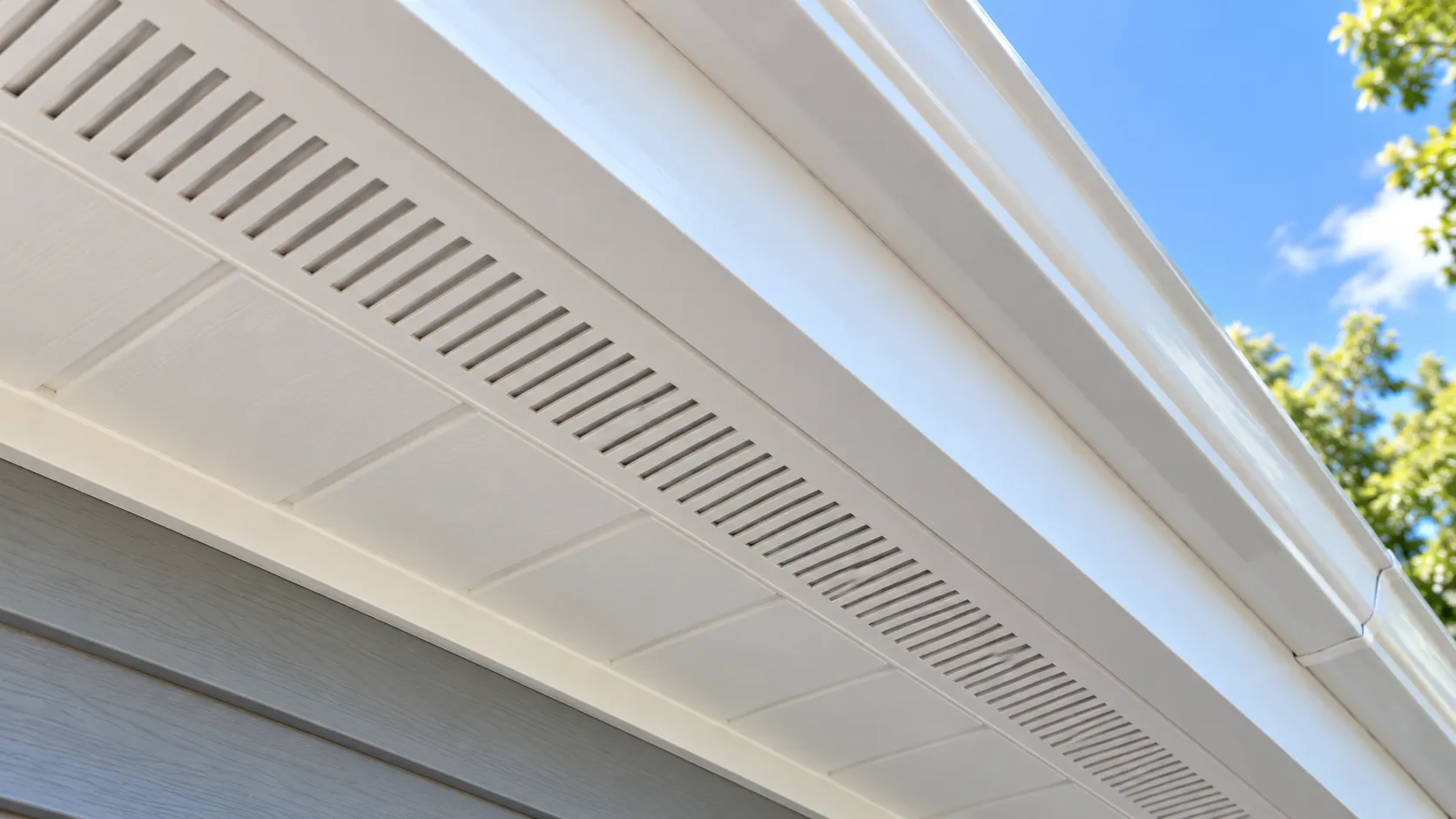
Carefully, and preferably with a sprayer. A vented soffit is the intake half of the attic's ventilation: air comes in at the eaves and leaves at the ridge or gable vents. Paint does not belong in the perforations, and it does not take much to put it there.
Gibraltar's guidance on vented soffit panels is the bluntest sentence on the subject we found from a manufacturer: "perforated panels are easily painted shut (which then hinders airflow) with one or two coats of paint." It also tells installers to check a panel's "Net Free Area" — the open area the perforations actually provide — against what the attic exhaust needs, and notes that "solid plywood behind vented soffit panels renders them useless." On painting continuous soffit vent strips its answer is short: "If painting continuous soffit vents, use spray paint," with the surface de-glossed first by washing or light sanding, so the paint goes on thin rather than bridging the openings.
Our practice follows from that. We wash and dry vented soffit like any other eave surface. Where we can, we spray the perforated panels and vent strips in light passes from an angle rather than rolling them, because a loaded roller pushes paint into small holes and a brush fills them. Where we have to brush or roll near a vent, we keep the coat thin and check the openings before the paint skins. We look up into the vents at the end of the job, which is exactly what the picture below shows. If a vent was already painted shut by an earlier job, we tell you; reopening clogged perforations is sometimes practical and sometimes means the panel or strip needs replacing, which is not our trade.
One thing we check before painting a soffit at all: whether the vents are actually open behind. Gibraltar's point about plywood behind vented panels is not hypothetical, and a soffit that looks vented and is not is worth knowing about before anyone worries about paint.
When Can You Paint Fascia in New Jersey? Temperature, Dew Point and the Season
The manufacturers set the floor, and it is lower than most people think. Every Sherwin-Williams exterior finish in the table carries the same application paragraph: "When the air temperature is at 35°F (1.7°C), substrates may be colder; prior to painting, check to be sure the air, surface, and material temperature are above 35°F (1.7°C) and at least 5° above the dew point. Avoid using if rain or snow is expected within 2-3 hours." And: "Do not apply at air or surface temperatures below 35°F (1.7°C) or when air or surface temperatures may drop below 35°F (1.7°C) within 48 hours."
Three clauses in that paragraph catch people on an eave. First, "substrates may be colder": the soffit is in shade all day, and a fascia on the north side of the house never sees the sun in the autumn, so the board can be several degrees below the air. Second, the dew point. The National Weather Service defines it as "the temperature the air needs to be cooled to (at constant pressure) in order to achieve a relative humidity (RH) of 100%." A surface at or near the dew point is collecting moisture, and paint applied to it is being applied to a wet board even when it looks dry — which is why the rule is five degrees above it, measured at the surface. Third, the 48 hours: it is not enough for the afternoon to be warm if the next two nights are not.
Here is what that means in a real New Jersey autumn. NOAA's 1991–2020 climate normals for the Freehold-Marlboro station, a few miles from our office, put the average October high at 66.6°F and the average low at 44.3°F; November averages 56.2°F and 35.7°F, with 11.5 nights a month at or below freezing. The station's annual normals put the median date of the first 32°F night at October 23, and the first 36°F night at October 12. So by late October the 35°F, 48-hour rule starts to bite on clear nights, and by November it governs the schedule. Rutgers' Office of the New Jersey State Climatologist notes the coast runs warmer into the autumn — "in autumn and early winter, when the ocean is warmer than the land surface," the coastal zone is warmer than the interior — and that "fall months are usually the driest with an average of eight days with measurable precipitation," which is why autumn is good exterior weather until the nights turn.
In practice we start the eaves later in the morning in spring and autumn, once the dew has burned off the boards, and we stop early enough for the last coat to set before the dew point catches up with the boards. Heat matters too. Sherwin-Williams says "do not paint in direct sun" and that above 80°F the paint "sets up quickly," so in July we follow the shade round the house. Our guide to painting in cold weather in NJ covers the late-season decisions in more detail.
Washing, Scraping and Caulking: the Prep That Decides How Long It Lasts
On fascia and soffits, preparation is most of the job and most of the price. In order:
Wash. Every eave gets washed, including the clean-looking ones, for the reasons the Park Service and Benjamin Moore give above. Power washing is a service we offer and it is how we do it, with the pressure kept moderate on wood and aimed so we are not driving water up behind the soffit or under the drip edge. Mildew is cleaned off before painting, not painted over: Sherwin-Williams says "mildew must be removed before painting, or it will grow through any new coat of paint," and its SuperPaint sheet gives the classic solution, "1 part liquid bleach and 3 parts clean water," left "on the surface for 10 minutes" and rinsed, with the caution that "bleach and bleaching type cleaners may damage or discolor existing paint films." Then the surface dries. Sherwin-Williams' exterior FAQ says to "allow the siding to dry a day or so"; a shaded soffit takes longer than a sunny wall.
Scrape and sand. Loose paint comes off, edges are feathered, glossy areas are dulled, bare wood is sanded to a fresh surface. If you want to know why the old paint failed — moisture behind it, intercoat peeling, or just age — our article on why paint peels in NJ is the diagnostic version.
Prime. Bare wood, patched areas and anything with tannin or water staining. On aluminum, where the surface is new or we are unsure of adhesion.
Caulk. Open joints between trim boards and where trim meets other trim, after priming. Caulk is not filler for a gap that is open because the wood behind it has gone soft.
Two finish coats on anything bare, and the manufacturers' minimum on repaint. We write the number of coats on the estimate so it cannot become a disagreement later.
Ladders, Roof Edges and Power Lines: Why the Eave Line Is an Access Job
On a single-storey ranch the fascia is a stepladder job. On a two-storey colonial it is twenty-odd feet up, at the roof edge, over shrubs and often over a sloping lawn, and it is where the electric service drop usually comes into the house. That is why fascia work is priced more on access than on square footage, and why it is the part of an exterior we would most like a homeowner not to do from a borrowed extension ladder.
OSHA's ladder standard for construction, 29 CFR 1926.1053, sets the rules a crew works to, and they read like a list of the ways people fall off eaves. A non-self-supporting ladder is set so that "the horizontal distance from the top support to the foot of the ladder is approximately one-quarter of the working length." "Ladders shall be used only on stable and level surfaces," and "shall not be used on slippery surfaces unless secured." Where a ladder is used to reach a roof, "the ladder side rails shall extend at least 3 feet (.9 m) above the upper landing surface." Where a worker or the ladder could contact exposed energized electrical equipment, "ladders shall have nonconductive siderails." And on the ladder itself: "When ascending or descending a ladder, the user shall face the ladder," "each employee shall use at least one hand to grasp the ladder," and "an employee shall not carry any object or load that could cause the employee to lose balance and fall."
Two more points from our own practice. A gutter is not a ladder support: it bends, and a ladder resting on it can slide along it, which is what a ladder standoff bearing on the wall is for. And where the service drop crosses the eave, the ladder near it should be a nonconductive one and the work should keep its distance; if the clearance looks tight, we say so before anyone climbs.
Rot: What We Flag at the Estimate, and Who Fixes It
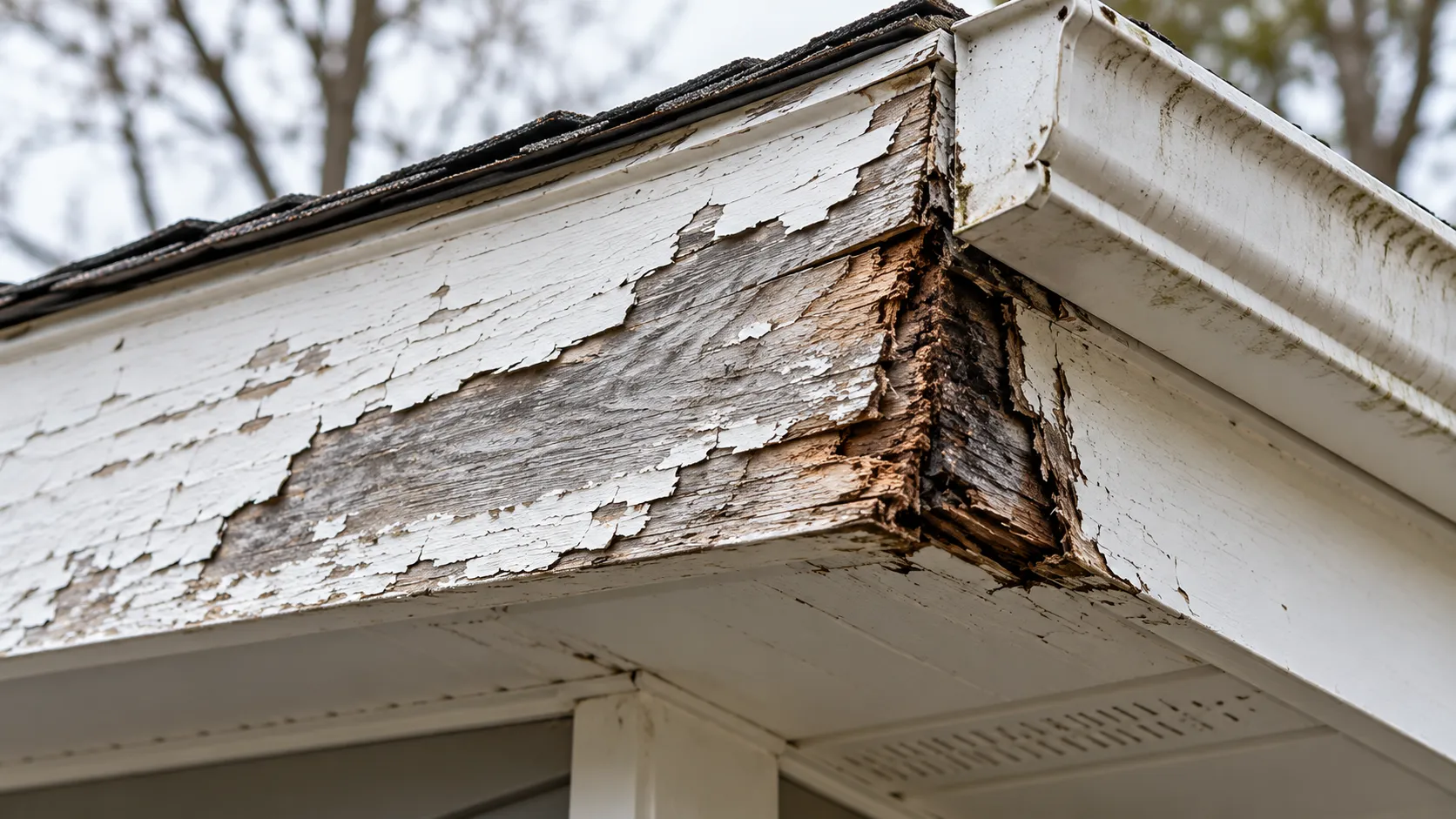
Rotted fascia is the most common thing we find on an eave walk, and the most important thing to be honest about. The Park Service is clear on the order: before choosing a paint treatment, check "that the wood has not decayed so that repainting would be superfluous," and "repair or replacement of deteriorated wood should take place before repainting." On peeling to bare wood it goes further: "There is no sense in repainting before dealing with the moisture problems because new paint will simply fail." It lists the usual culprits, including "faulty flashing; leaking gutters; defective roof shingles; cracks and holes in siding and trim; deteriorated caulking in joints and seams."
Exterior rot repair is not a service we offer, and we do not replace fascia boards. What we do is find it. At the estimate we probe the places fascia rots — the bottom edge, the corners where fascia meets rake, the joints, behind gutter downspout outlets and anywhere the paint is dark, soft or lifting in a blister — and we mark what we find and write it on the estimate. Then you hire a carpenter to repair or replace those sections, and we paint afterwards. We would rather lose a day waiting for the carpenter than paint over soft wood, because paint over rot looks fine for one season and then comes off with the wood.
Two things worth knowing before the carpenter comes. If the cause is the gutter overflowing or ice backing up at the roof edge, the new board will rot the same way unless the cause is fixed, and that is a roofer's or gutter installer's job. And if the house is old enough for the boards being removed to carry lead paint, the rule in the next section applies to the carpenter as much as to the painter.
Lead Paint on Old Fascia and Soffits
If your house was built before 1978, assume the original fascia and soffit paint contains lead until a test says otherwise. Every exterior data sheet quoted here carries the same warning: "If you scrape, sand or remove old paint, you may release lead dust. LEAD IS TOXIC." Fascia is a particular concern because the paint failing on it is usually the oldest paint on the house, and scraping it overhead drops chips straight onto beds, lawns and the soil children play in.
The federal rule is the EPA's Renovation, Repair and Painting program. The EPA says it applies to "anyone paid to perform work that disturbs paint in housing and child-occupied facilities built before 1978," and "recommends that homeowners hire a lead-safe certified contractor." The only exemption for small jobs is defined at 40 CFR 745.83: minor repair and maintenance that disrupts "20 square feet or less of painted surface for exterior activities." A two-storey run of fascia scraped and sanded exceeds that almost at once. Above it, the work rules at 40 CFR 745.85 apply, including to "cover the ground with plastic sheeting or other disposable impermeable material extending 10 feet beyond the perimeter," to "close all doors and windows within 20 feet of the renovation," and the prohibition on "open-flame burning or torching of painted surfaces."
We are not an EPA Lead-Safe Certified firm. That is a licensing fact about us, not a preference about wording, and it means there are pre-1978 fascia and soffit jobs we will tell you to take to a certified firm. The instruction for any homeowner is the same whoever you hire: before anyone scrapes paint on a house built before 1978, ask the bidder for their firm certification number — ours included — and check it. The EPA's own advice is to "browse EPA's searchable database" of certified firms, or to call the National Lead Information Center at 1-800-424-LEAD. Our guide to lead paint in older NJ homes explains the rule, testing and New Jersey's own requirements properly.
How Often Do Fascia and Soffits Need Repainting?
The Park Service's long-standing figure for painted exterior wood is that paint is "never expected to be more than a temporary physical shield requiring re-application every 5-8 years." That is a reasonable expectation for wood fascia that was properly prepared, and the soffit, out of the sun, often goes longer. Aluminum and PVC, once painted, are governed less by the paint's life than by the colour and by how well the original surface was cleaned.
The interval shrinks when water is involved. A fascia behind an overflowing gutter, on a north wall under trees, or below a roof that backs up with ice will fail first whatever the paint, and repainting it on a schedule without fixing the water is money spent on the symptom. Equally, the Park Service makes the opposite point: if the paint "shows no evidence of paint deterioration such as chalking, blistering, peeling, or cracking, then there is no physical reason to repaint." Our guide to how often to paint a house in NJ covers the whole exterior; the eaves are usually the part that sets the clock.
What We Do, and Do Not Do, on Fascia, Soffits and Exterior Trim
- We paint fascia, soffits, rake and frieze boards and corner boards, in wood, aluminum, vinyl and cellular PVC, on their own or as part of a full exterior with the siding.
- We wash every eave before we paint it, by power washing or hand washing, including the soffits that look clean, and we let it dry before anything goes on.
- We scrape, sand and feather failing paint, and prime bare wood and patches, with a stain-blocking primer where cedar, knots or water stains call for it.
- We paint the bottom edge and the joints of a wood fascia, not only its face, and we caulk open trim joints after priming as part of our general caulking and sealing work.
- We check the LRV of the colour against the vinyl or PVC maker's limit before it goes on, and we will not put an unapproved dark colour on vinyl or cellular PVC trim.
- We spray or thin-coat vented soffit and check the vents afterwards, and we tell you if they were painted shut before we arrived.
- We work to the data sheet's temperature and dew-point rules, start late and stop early in spring and autumn, and reschedule rather than paint a cold, damp eave.
- We flag rot at the estimate, with the locations written down, and paint after your carpenter has repaired it.
- We write surfaces, preparation, products and number of coats on the estimate, so you can compare bids line by line.
What we do not do, so there is no ambiguity: exterior rot repair or fascia board replacement, finish carpentry, window trim and sill painting, re-caulking windows and doors, siding replacement, re-wrapping or installing aluminum trim coil, roofing, drip edge, or gutter installation and rehanging. Ask us about gutter painting when we come out. And we do not hold EPA Lead-Safe (RRP) certification: on a house built before 1978, ask us — and every other bidder — for a firm certification number before anyone disturbs old paint.
Get a Price for Your Fascia and Soffits
Fascia and soffit pricing depends on the height and access, the material, how much of the old paint has failed, and how much priming and caulking the trim needs, which is why we measure and look up rather than quote from a photo. NJ Painting Co. is a family-owned, licensed and fully insured painting company at 36 Church Rd, Morganville, NJ 07751, working on New Jersey homes for more than 20 years with Benjamin Moore and Sherwin-Williams products. Every estimate is free and spells out surfaces, prep, products and number of coats; our work carries a two-year workmanship warranty. For how exterior pricing is built, see our exterior painting cost guide and our article on how much it costs to paint a house in NJ; for the work itself, our exterior painting service. If the porch, front door, shutters or garage door are on the same list, our guides to painting porches, railings and columns and garage door, front door and shutter painting cover them. Call (732) 239-0932 or request a free estimate, and ask us about the job minimum when you enquire.
Frequently Asked Questions
Can you paint soffits and fascia?
Yes. Wood, aluminum, vinyl and cellular PVC fascia and soffits can all be painted, but each needs its own preparation. Wood is scraped, sanded and primed where bare. Aluminum is washed, de-chalked and dulled, and primed if it is new and shiny. Vinyl is scrubbed and usually needs no primer. PVC is cleaned rather than sanded hard. On vinyl and PVC the colour has to stay light: Sherwin-Williams' limit for vinyl is an LRV of 56, Benjamin Moore's 55, and AZEK requires an LRV above 55, unless a palette formulated for vinyl is used.
What is the best paint for fascia boards?
A premium 100 percent acrylic exterior paint in a satin or low-lustre sheen. Sherwin-Williams' Duration and Emerald Exterior and Benjamin Moore's Aura and Regal Select Exterior all list wood, aluminum and vinyl among their substrates, apply down to 35 degrees Fahrenheit on the surface, and carry under 50 grams per litre of VOC. What matters more than the brand is the preparation underneath: a wash to remove the film that builds up under eaves, sound edges, and primer on bare wood.
Do you need to prime fascia before painting?
Bare wood and patched areas, yes. Previously painted, sound fascia usually does not need a separate primer, because the premium exterior paints are self-priming, though on bare wood they still need two coats, the first acting as the primer. Cedar, redwood and knots need a stain-blocking primer to stop tannin bleeding through. Vinyl rarely needs primer; Benjamin Moore says only pitted and porous areas must be primed. New, shiny aluminum is best primed with a product suited to aluminum.
Can you paint aluminum soffit and fascia?
Yes. Gibraltar, which makes aluminum soffit, says to clean it thoroughly with clean water and to use a primer suited for aluminum exterior painting, applying spray in several light passes. Faded aluminum is chalky, and the chalk has to be pressure-washed off with a detergent and the surface allowed to dry for a day or so. Sherwin-Williams raises the minimum temperature to 50 degrees Fahrenheit for large expanses of metal siding. Paint will not remove dents or oil-canning from aluminum trim coil.
Can you paint vinyl soffit a dark colour?
Only from a palette made for vinyl. Sherwin-Williams says not to paint vinyl darker than its original colour or with an LRV below 56 unless VinylSafe colours are used, and Benjamin Moore draws the line at 55 unless the colour is in its approved Colors for Vinyl palette. A darker colour absorbs more heat and can warp the vinyl. Check the vinyl maker's warranty too, because some manufacturers do not honour warranties on painted vinyl.
How do you paint a vented soffit without blocking the vents?
Spray it in light passes, or keep the coat thin and check the openings before the paint skins. Gibraltar warns that perforated soffit panels are easily painted shut with one or two coats, which hinders airflow, and recommends spray paint for continuous soffit vents after the surface has been de-glossed. A loaded roller pushes paint into small holes and a brush fills them. Look up through the vents when the job is finished.
What is the lowest temperature you can paint fascia at?
For the premium Sherwin-Williams and Benjamin Moore exterior finishes, 35 degrees Fahrenheit, measured at the surface as well as the air, and at least 5 degrees above the dew point, with no drop below 35 degrees for the next 48 hours. Latex primers have higher floors: Sherwin-Williams says standard latex primers cannot be used below 50 degrees, and Benjamin Moore's Fresh Start 046 stops at 40. In cold weather the recoat time also stretches from about 4 hours to 24 to 48 hours.
Why is the paint peeling on my fascia and soffits but not the walls?
Because eaves are sheltered. The National Park Service explains that intercoat peeling most often occurs on eaves and covered porches because rain never rinses them, so airborne salts and grime build up and the next coat cannot bond. Eaves also stay damp and shaded, which grows mildew, and the fascia catches gutter overflow and ice at the roof edge. Washing the eaves before painting and fixing any water problem first are the cures.
Should fascia and soffits be the same colour?
Usually, and usually white or the trim colour, so the eave reads as one surface against the siding. There is no rule against a contrasting soffit, but the material limits the choice: vinyl and cellular PVC fascia and soffits can only take lighter colours unless a palette formulated for them is used, while wood and aluminum can take dark colours. Keep the soffit and fascia in the same sheen even if the colours differ.
Do you repair rotted fascia boards?
No. Exterior rot repair and fascia board replacement are not services we offer. We probe the fascia at the estimate, mark any soft or rotted sections and write them down, and a carpenter repairs or replaces them before we paint. The National Park Service's guidance is that repair or replacement of deteriorated wood should take place before repainting, and that the moisture source has to be fixed first or the new paint will fail.
Is scraping old fascia paint a lead hazard?
On a house built before 1978, assume so until a test says otherwise. The EPA's renovation rule applies to anyone paid to disturb paint in pre-1978 housing, and the small-job exemption covers only 20 square feet or less of exterior painted surface, which a fascia scrape passes quickly. Above that, the work has to be done by a certified firm with ground covering extending 10 feet out and nearby windows and doors closed. We are not an EPA Lead-Safe Certified firm, so ask every bidder for their certification number.
How often should fascia and soffits be repainted?
The National Park Service's figure for painted exterior wood is every 5 to 8 years, and well-prepared fascia usually falls in that range, with shaded soffits often lasting longer. A fascia behind an overflowing gutter, under trees or on a north wall fails sooner whatever paint is used. If the existing paint shows no chalking, blistering, peeling or cracking, the Park Service's view is that there is no physical reason to repaint yet.
About the author
Written by the NJ Painting Co. team
NJ Painting Co. is a family-owned painting contractor based in Monmouth County, in business since 2004. We are licensed and fully insured, work with Benjamin Moore and Sherwin-Williams paints, and back our work with a 2-year workmanship warranty. We serve Monmouth, Middlesex, Ocean, Mercer, Somerset and Burlington counties, plus Union, Essex, Hudson, Bergen and Passaic in North Jersey.