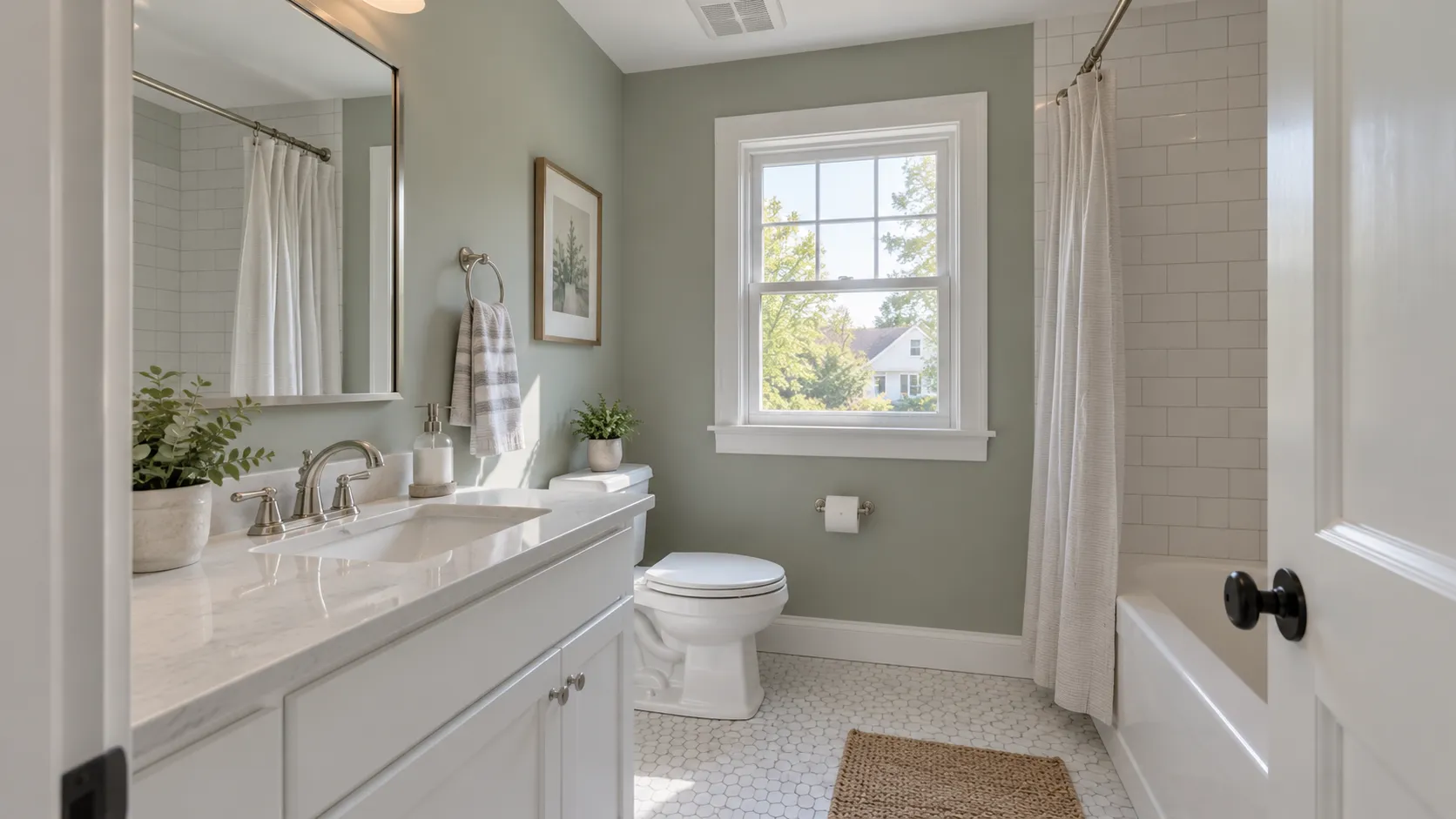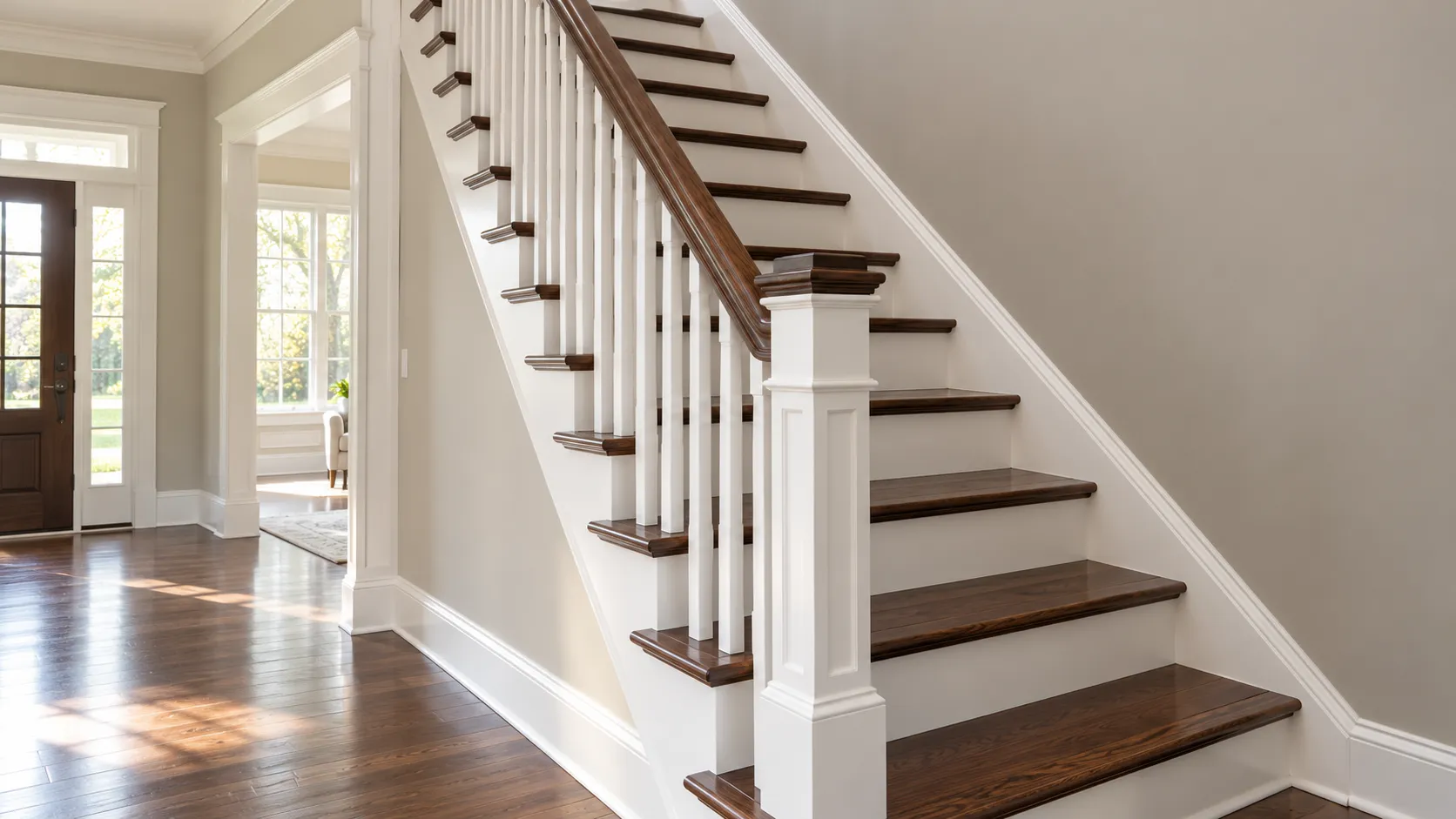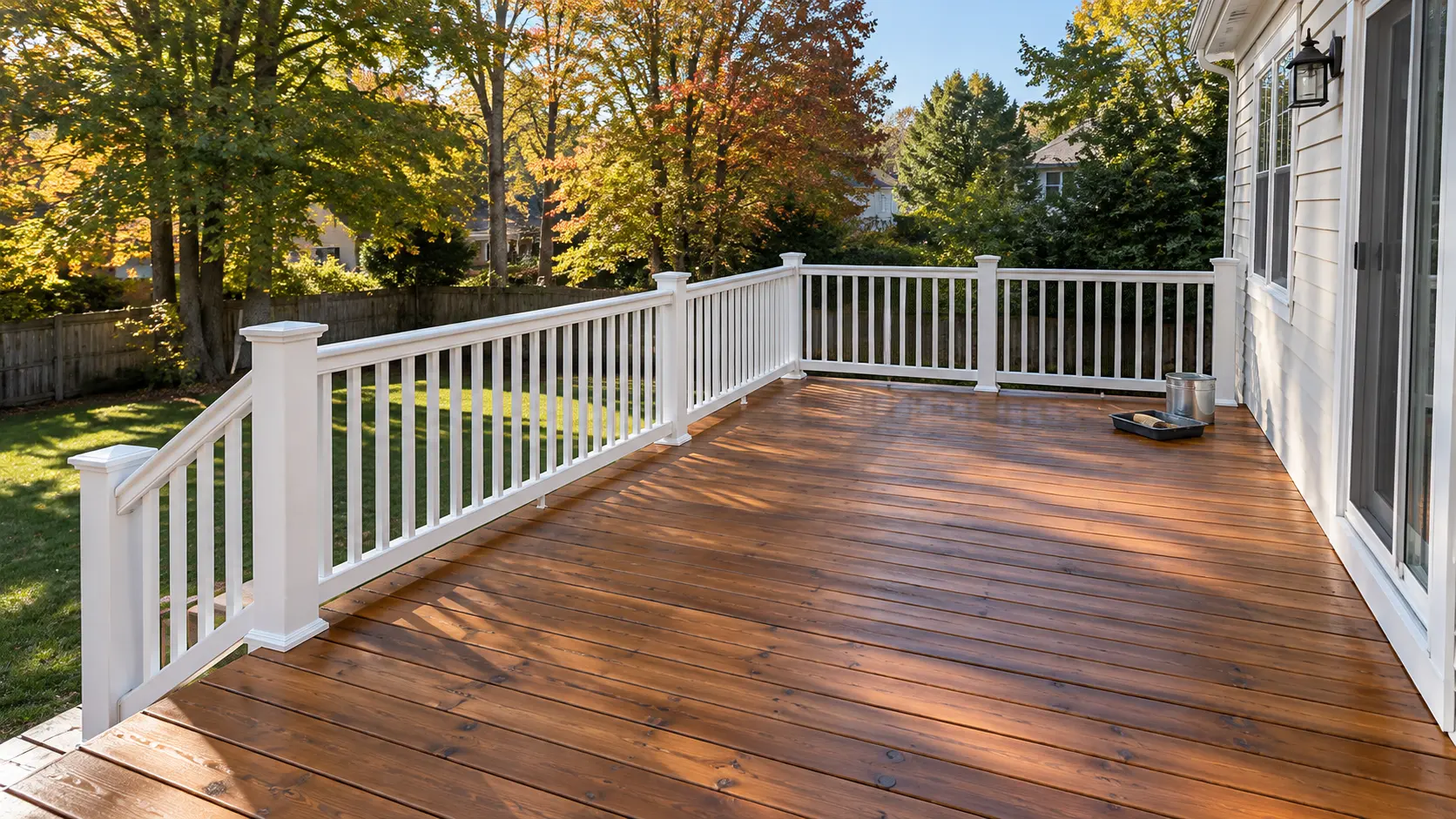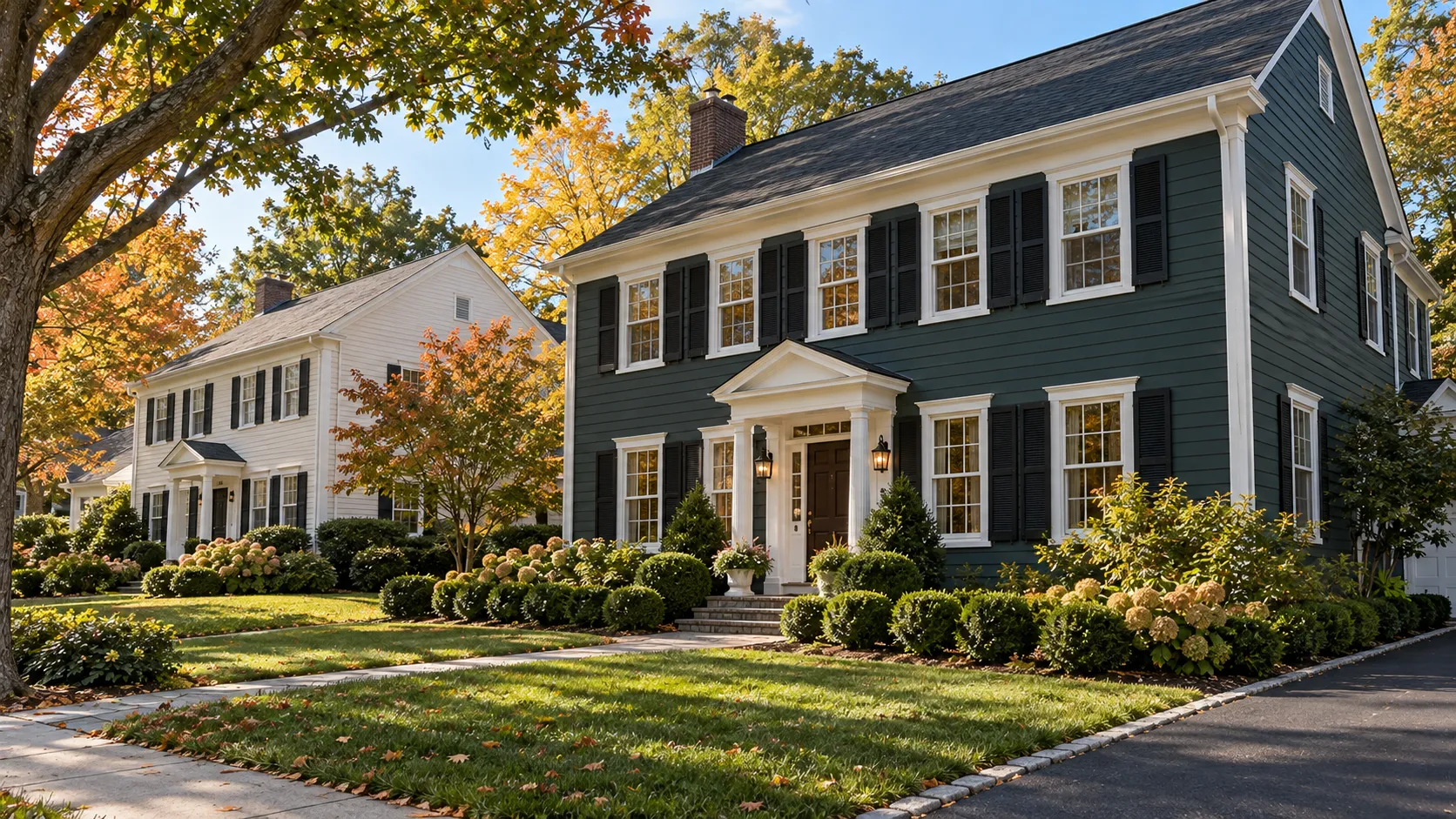
The most popular exterior house colors in 2026 are still warm whites, soft greiges and mid-grays for the body of the house, with black, charcoal, navy or deep green on the shutters, doors and trim. The newest exterior paint colors for 2026 lean warmer: Sherwin-Williams picked the khaki neutral Universal Khaki SW 6150 as its 2026 Color of the Year, and Benjamin Moore picked a deep brown, Silhouette AF-655. In New Jersey, the right choice also depends on your siding, your roof and brick, how much sun and salt the house gets, and whether a town or HOA has to approve the color.
We are a family-owned painting company in Morganville and have painted homes across Monmouth, Middlesex, Ocean, Mercer, Somerset and Burlington counties, plus Union, Essex, Hudson, Bergen and Passaic in North Jersey, for more than 20 years, using Benjamin Moore and Sherwin-Williams products. Every estimate we give includes an in-home color consultation, so we spend a lot of time standing in driveways holding sample boards against siding. This guide lists the colors we see chosen most, with the manufacturer's code and light reflectance value (LRV) for each, and explains how to narrow them down for a New Jersey house. Color codes, LRVs and the Colors of the Year are as listed on benjaminmoore.com and sherwin-williams.com as of September 2026.
What Are the Most Popular Exterior House Colors Right Now?
Key facts:
- Whites and off-whites are the most requested body colors on our jobs: Benjamin Moore White Dove OC-17, Swiss Coffee OC-45 and Chantilly Lace OC-65, and Sherwin-Williams Alabaster SW 7008 and Pure White SW 7005.
- Greige and gray remain the safe middle: Revere Pewter HC-172, Coventry Gray HC-169, Agreeable Gray SW 7029, Repose Gray SW 7015 and Accessible Beige SW 7036.
- Deep greens and blues are the color most people add when they want the house to look less like the neighbors': Narragansett Green HC-157, Louisburg Green HC-113, Evergreen Fog SW 9130, Hale Navy HC-154 and Naval SW 6244.
- Black and near-black own trim, shutters, doors and window sashes: Tricorn Black SW 6258, Iron Ore SW 7069, Urbane Bronze SW 7048, Benjamin Moore Black HC-190 and Kendall Charcoal HC-166.
- The 2026 direction is warmer. Universal Khaki SW 6150 and Silhouette AF-655 are the two brands' 2026 Colors of the Year.
- On vinyl siding, do not go darker than the original color unless the paint color comes from a vinyl-safe palette.
What Are the 2026 Exterior Paint Colors of the Year?
Sherwin-Williams picked Universal Khaki SW 6150 and Benjamin Moore picked Silhouette AF-655. Both big paint brands name a Color of the Year each fall for the coming year. They are useful signals of where color is heading, but they are chosen with interiors as much as exteriors in mind, so read them as direction, not as instructions for your siding.
Sherwin-Williams 2026: Universal Khaki SW 6150
Sherwin-Williams' 2026 Color of the Year page introduces it this way: "Find strength in simplicity with Universal Khaki SW 6150, an essential neutral selected by our color experts for its beautiful balance of livability and longevity." Its color detail page lists an LRV of about 40, which makes it a true midtone. Outside, in our experience, that reads as a warm tan-stone. It works well as a body color on a house with warm brick or tan stone, and it is a softer alternative to the gray that covered so many New Jersey colonials over the last decade.
Benjamin Moore 2026: Silhouette AF-655
Benjamin Moore's Color of the Year 2026 page calls Silhouette "a distinctive color that weaves luxurious burnt umber with delicate notes of charcoal," part of a Color Trends 2026 palette "of enchanting pales and handsome midtones." Its color page gives an LRV of 10.18, so it is a deep color. Benjamin Moore presents it with interior products, and a whole house in a color that dark raises heat and fading questions, covered below. Where we see it fitting outside is on a front door, shutters or a garage door against a white, cream or khaki body, where a warm espresso brown is a change from the usual black.
The same Color Trends 2026 palette includes Narragansett Green HC-157, Swiss Coffee OC-45 and Sherwood Tan 1054, which are all at home on a house.
Already looking at 2027
Both brands have now named their 2027 colors, and for the first time in years they agree on a family: green. Sherwin-Williams chose Celery SW 6421, which its 2027 page describes as "an airy, herbal green," with an LRV of about 71. Benjamin Moore chose Webster Green HC-130, which its Color of the Year 2027 page calls "the quintessential shade of green." Its color page gives an LRV of 20.2, so it is a deep midtone: in our experience a natural fit for shutters, doors or the body of an older colonial on a wooded lot, where Celery is light enough for a whole house. If you are painting in spring 2027, greens are worth a sample.
How the picks have moved since 2024
Looking back a few years shows the direction more clearly than any single pick. In 2024 both brands chose blues: Sherwin-Williams named Upward SW 6239, "a breezy, blissful blue," and Benjamin Moore named Blue Nova 825, a mid-tone it described as having "an enchanting duality." For 2025, Benjamin Moore moved to Cinnamon Slate 2113-40, "a delicate mix of heathered plum and velvety brown," and Sherwin-Williams skipped a single color for a nine-color Color Capsule of the Year that included Grounded SW 6089 and Malabar SW 9110. Then 2026 brought Universal Khaki and Silhouette, and 2027 brings two greens, Celery and Webster Green.
| Year | Sherwin-Williams | Benjamin Moore |
|---|---|---|
| 2024 | Upward SW 6239 (soft blue) | Blue Nova 825 (mid-tone blue) |
| 2025 | Color Capsule of the Year (nine colors) | Cinnamon Slate 2113-40 (plum-brown) |
| 2026 | Universal Khaki SW 6150 (warm neutral) | Silhouette AF-655 (deep brown) |
| 2027 | Celery SW 6421 (soft green) | Webster Green HC-130 (deep green) |
The pattern is a slow move away from cool blues and grays toward warmer browns, earthy neutrals and now greens. On the New Jersey houses we paint, it shows up mostly in body colors shifting from cool gray to greige and khaki, and in brown or green doors and shutters where black used to be automatic.
Which Exterior House Colors Are Most Popular in New Jersey?
On our jobs, warm whites lead, followed by greiges and grays, with deep greens, blues and near-blacks on doors, shutters and trim. Popularity is not something we can measure across the whole state, so this list combines what the manufacturers publish with what homeowners actually choose at our estimates. Benjamin Moore's exterior colors page says "some of Benjamin Moore's most popular exterior paint colors among homeowners include neutrals Copley Gray HC-104, Coventry Gray HC-169, and Revere Pewter HC-172, as well as Louisburg Green HC-113." Sherwin-Williams keeps a Top 50 exterior colors collection; its director of color marketing, Sue Wadden, says there that "these colors are consistent customer favorites for a reason."
Whites and off-whites
White is the color we paint most often on New Jersey houses, and the choice is almost always between a clean white and a warm one. Benjamin Moore describes White Dove OC-17 as a "clean and classic" option for curb appeal; its LRV is 83.16. Swiss Coffee OC-45 is "an essential white paint color with just the right amount of warmth." Chantilly Lace OC-65, at 90.04, is one of the brightest whites we use and is our usual pick for trim. On the Sherwin-Williams side, the brand's exterior house colors guide points to "crisp whites, such as Alabaster, creamy off-whites, and sophisticated grays, like Repose Gray." Alabaster SW 7008 and Pure White SW 7005 both sit in the low 80s for LRV.
In our experience a stark white looks bluer and harsher on a sunny south-facing wall than on the chip, and a warm white looks cleaner outside than it did inside. That is why we almost never let anyone choose a white from a fan deck alone.
Greige, beige and warm neutrals
Greige, the blend of gray and beige, is the color family that suits the widest range of New Jersey roofs and brick. Sherwin-Williams says "greige tones, such as Accessible Beige, strike the perfect balance between gray and beige." Benjamin Moore calls Revere Pewter HC-172 "an iconic neutral that provides a versatile bridge between warm and cool tones." Agreeable Gray SW 7029 is one of the colors we are asked for most, inside and out. The 2026 Colors of the Year push this family slightly warmer, toward khaki and tan.
Grays
Gray is past its peak but is still one of the most common body colors on the colonials and split-levels we repaint. Coventry Gray HC-169 is, in Benjamin Moore's words, "a steadfast medium gray with relatively neutral undertones." Copley Gray HC-104 is darker and "a versatile grayish neutral with a soft green cast." Repose Gray SW 7015 is the lighter, cooler Sherwin-Williams favorite. Kendall Charcoal HC-166 is the dark gray we use for shutters, doors and, on the right house, the whole body.
Deep greens and blues
Greens and blues are where we see the most change. Narragansett Green HC-157, a Color Trends 2026 pick, is "a blackened teal that conveys a strong sense of history and architectural relevance," and it looks right on older colonials. Louisburg Green HC-113 is a lighter, muted green with "gray undertones." Evergreen Fog SW 9130, Sherwin-Williams' 2022 Color of the Year, is a gray-green that we still sample often. For blue, Hale Navy HC-154 is "a use-anywhere shade of navy with a classic maritime feel," and Naval SW 6244 is Sherwin-Williams' deep navy. In our experience both are among the most requested front-door and shutter colors along the shore.
Black and near-black
Black trim, black window sashes and black doors are the look of the last several years, and they are not going away. Tricorn Black SW 6258 has an LRV under 3; Benjamin Moore Black HC-190 is 4.56. For a softer dark, Iron Ore SW 7069 and Urbane Bronze SW 7048 read as charcoal and bronze-brown. In our experience a slightly softened black, such as Iron Ore, looks less harsh than a pure black on a light house, especially on gutters and fascia.
Top Exterior Colors at a Glance
| Color | Brand and code | LRV | Best exterior use |
|---|---|---|---|
| Chantilly Lace | Benjamin Moore OC-65 | 90 | Crisp trim; bright white body |
| Pure White | Sherwin-Williams SW 7005 | 84 | Trim; clean white body |
| White Dove | Benjamin Moore OC-17 | 83 | Soft white body on colonials and farmhouses |
| Alabaster | Sherwin-Williams SW 7008 | 82 | Warm white body; painted brick |
| Swiss Coffee | Benjamin Moore OC-45 | 82 | Warm white body with a cream feel |
| Agreeable Gray | Sherwin-Williams SW 7029 | 60 | Light greige body; safe on vinyl |
| Repose Gray | Sherwin-Williams SW 7015 | 58 | Light cool gray body |
| Accessible Beige | Sherwin-Williams SW 7036 | 58 | Greige body with tan brick or stone |
| Revere Pewter | Benjamin Moore HC-172 | 55 | Greige body; works with most roofs |
| Coventry Gray | Benjamin Moore HC-169 | 48 | Medium gray body with white trim |
| Universal Khaki (2026 COTY) | Sherwin-Williams SW 6150 | 40 | Warm midtone body; warm brick and stone |
| Louisburg Green | Benjamin Moore HC-113 | 34 | Muted green body on wooded lots |
| Evergreen Fog | Sherwin-Williams SW 9130 | 30 | Gray-green body or shutters |
| Copley Gray | Benjamin Moore HC-104 | 26 | Deeper gray-green body |
| Webster Green (2027 COTY) | Benjamin Moore HC-130 | 20 | Shutters, doors; body on older colonials |
| Kendall Charcoal | Benjamin Moore HC-166 | 15 | Shutters, doors, modern body color |
| Silhouette (2026 COTY) | Benjamin Moore AF-655 | 10 | Front door, shutters, garage door |
| Narragansett Green | Benjamin Moore HC-157 | 9 | Doors, shutters; body on older colonials |
| Hale Navy | Benjamin Moore HC-154 | 8 | Front door, shutters, shore accents |
| Urbane Bronze | Sherwin-Williams SW 7048 | 8 | Window trim, doors, modern accents |
| Iron Ore | Sherwin-Williams SW 7069 | 6 | Soft-black trim, gutters, doors |
| Black | Benjamin Moore HC-190 | 5 | Shutters, doors, railings |
| Naval | Sherwin-Williams SW 6244 | 4 | Front door, shutters |
| Tricorn Black | Sherwin-Williams SW 6258 | 3 | Black trim, sashes, doors |
Anything in the table with an LRV in the single digits or teens is a dark color; read the vinyl section before putting one on vinyl siding.
What Is LRV, and Why Does It Matter Outside?
Light reflectance value is the number, printed on the back of the chip and listed on the manufacturer's site, that says how much light a color reflects. Sherwin-Williams' explanation of LRV puts it simply: "The scale ranges from 0-100 with zero reflecting no light and 100 reflecting all light." To find it, the same page says to "search the color number on the website and view the color's full details."
Outside, LRV matters for three practical reasons:
- Heat. Light that is not reflected is absorbed as heat. That is harmless on masonry and a real problem on vinyl siding, as explained below.
- How light the house will look. Full sun washes colors out. In our experience a color on a sunny wall looks one or two steps lighter than the chip, so a gray in the 50s can look almost white at noon, and a white in the 90s can glare.
- Contrast. The difference in LRV between body and trim is what makes trim "pop." A white trim (LRV in the 80s or 90s) against a midtone body (40s to 50s) gives the classic New Jersey colonial look; black trim against a white body is maximum contrast.
How Do You Choose Exterior Colors for Your House Style?
Sherwin-Williams' exterior guide says "there's no single 'best' exterior house color," and we agree. What works depends on the house. These are the patterns we see work on the housing stock in our service area.
Center-hall colonials
The two-story colonial is the most common house we paint in Monmouth and Middlesex counties. It suits the classic three-part scheme: a body color, a white trim and a dark accent on shutters and the front door. White or off-white with black shutters is the traditional choice; greige or gray with white trim and a navy or deep green door is the most requested alternative; Narragansett Green or another deep green body with white trim suits older colonials, especially on wooded lots.
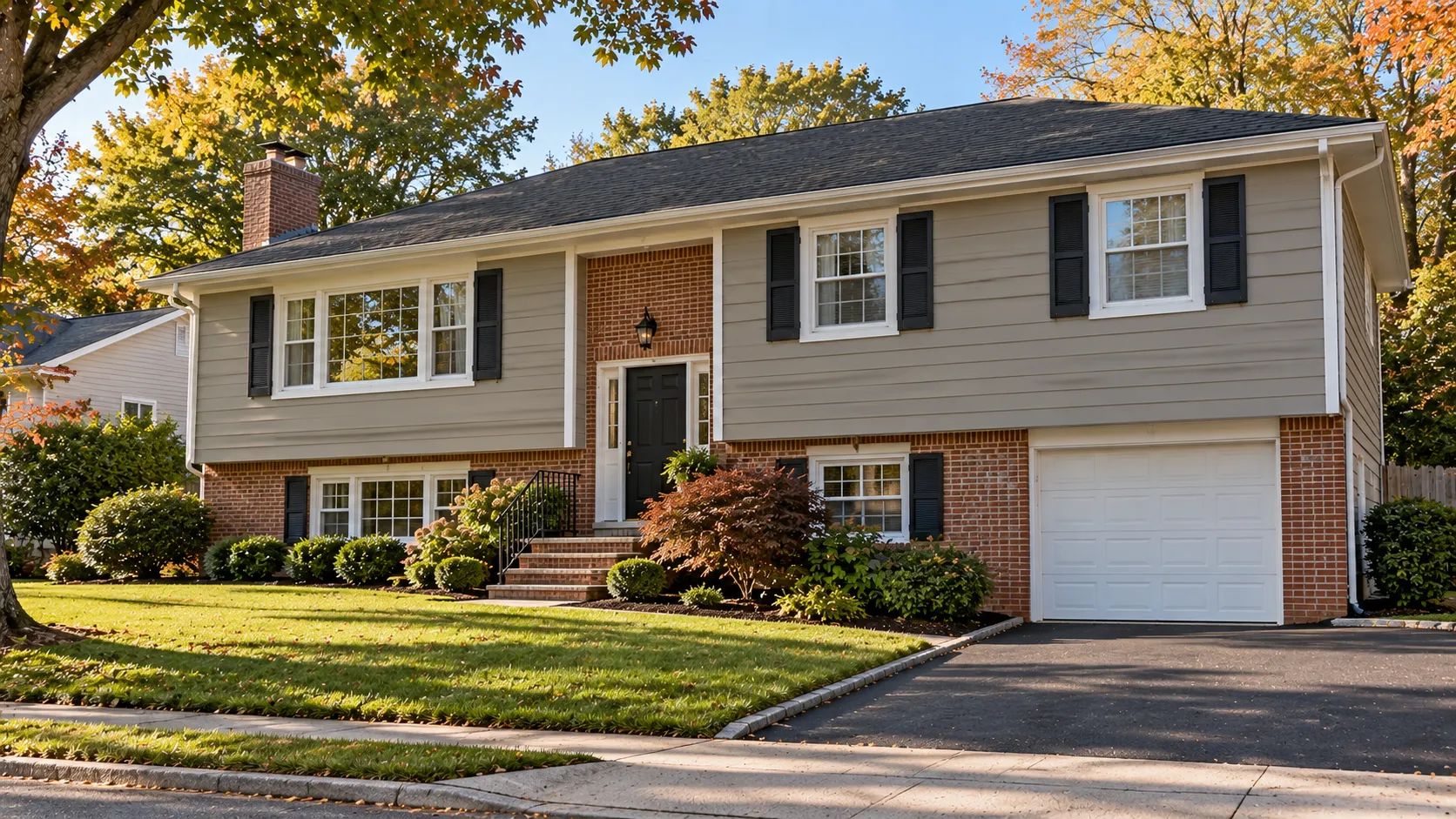
Split-levels and bi-levels
Split-levels usually mix materials: brick or stone on the lower level and siding above. The paint color has to work with the masonry, not fight it. In our experience a greige or warm neutral pulled from the mortar or the lightest tone in the brick looks better than a cool gray, and painting the upper siding and trim in two close tones helps a long, horizontal house look less busy. Our guide to painting a brick house covers when the brick itself should be painted.
Cape Cods
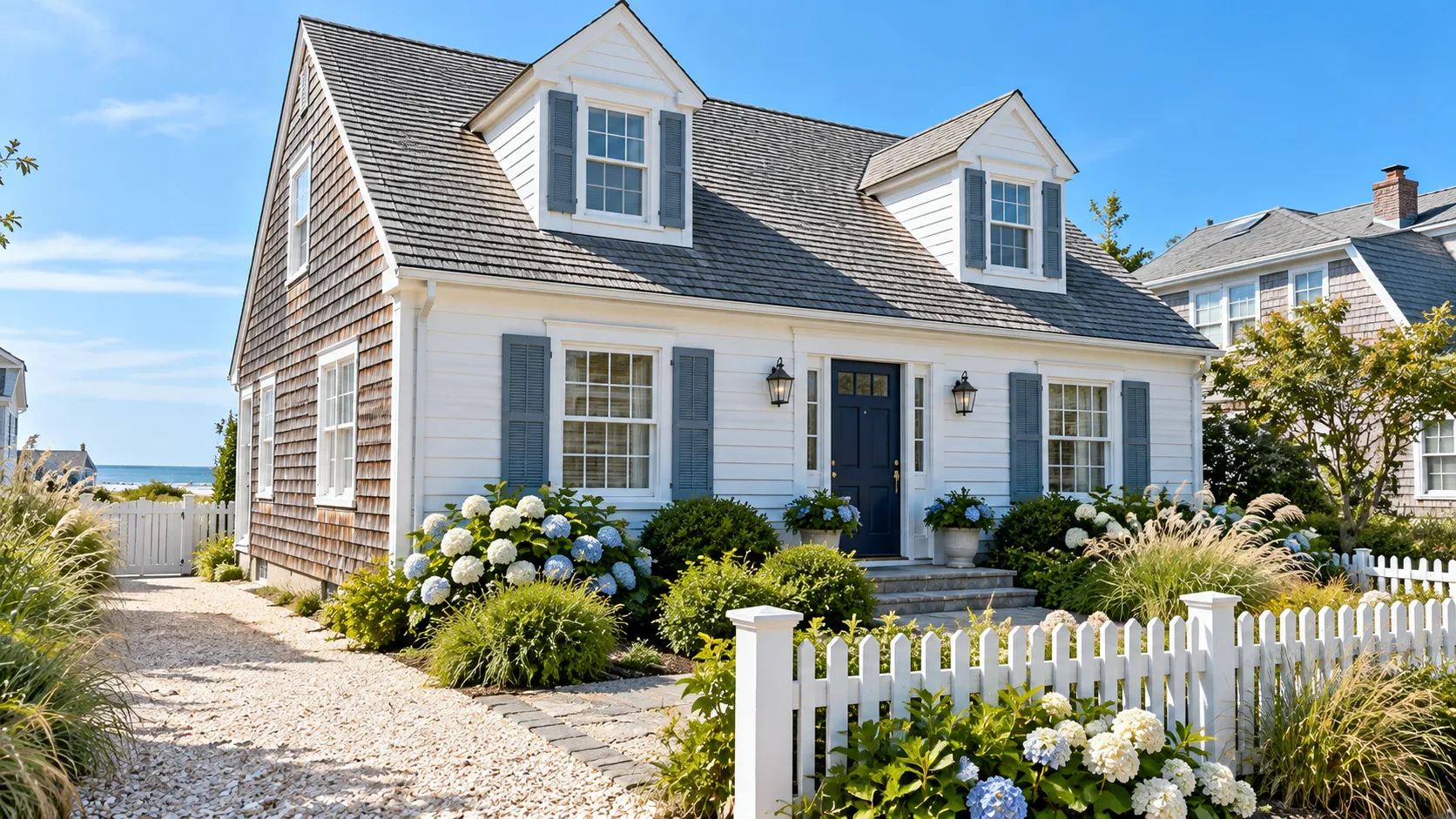
Cape Cods are small, so strong contrast can make them look busy. White, soft gray-blue or a muted green body with white trim and one dark accent on the door and shutters is the look we see most. On a Cape with dormers, painting the dormer faces the same color as the body keeps the roofline simple.
Ranches
Ranches are long and low. Mid-to-dark body colors, such as Coventry Gray, Kendall Charcoal or a deep green, make them look anchored; a very light body with high-contrast trim can make a ranch look longer and flatter. Many 1950s and 1960s New Jersey ranches have partial brick fronts, which again should drive the palette.
Shore homes
From Red Bank down through Point Pleasant, shore houses tend toward whites, soft grays, gray-blues and navy accents, often with weathered cedar shingles left natural. The practical reason to stay lighter near the water is fading and heat, covered below; the aesthetic reason is that pale colors suit the bright, reflective light at the coast.
How Do You Match Exterior Colors to the Roof, Brick and Stone?
Paint is the easiest thing on the outside of a house to change, so it should work around the things that are expensive to change. Benjamin Moore's exterior page notes that "most homeowners use three to four colors in their exterior design," and that "hues from existing materials—such as brick, stone, or roofing—enhance and complete your exterior color palette."
How we work through it on a color consultation:
- Start with the roof. A charcoal or black roof goes with almost anything. A brown or weathered-wood roof pulls toward warm whites, greige, khaki and green, and away from cool blue-grays.
- Read the brick or stone. Hold samples against the masonry and look at the mortar. Orange-red brick usually wants warm neutrals; gray or mixed stone accepts cooler colors.
- Look at the fixed trim. White vinyl windows, gutters and garage doors are hard or costly to change. If they are staying white, choose a white trim paint that matches them, not one that looks slightly off beside them.
- Pick the accent last. Door and shutter colors are cheap to change and can carry a bolder or more on-trend choice.
If you are considering changing the masonry instead of painting around it, our limewash brick guide explains that option.
Can You Paint Vinyl Siding a Dark Color?
Only with a vinyl-safe color; otherwise stay with the original siding color or lighter. This is the most important technical point in this guide, because many New Jersey houses built or re-sided since the 1980s have vinyl siding, and dark colors are fashionable.
Sherwin-Williams' article on vinyl siding warping says the likely cause of warped, painted siding is that it "was repainted with a darker color paint than the original color," because "dark paint tends to absorb the heat of the sun, transferring it to the substrate." It says siding that has warped "may have to be replaced," and that without a vinyl-safe product you should "paint vinyl siding in a shade no darker than the original color of the siding," adding "Whites, off-whites, pastels, and other very light colors are good choices."
Both manufacturers now offer a way around the old rule:
- Sherwin-Williams VinylSafe. Its VinylSafe page explains that with vinyl, "your only option was to choose the same color or lighter. No longer." It offers "100 color options, including a limited selection of darker colors formulated to resist warping or buckling when applied to a sound, stable vinyl substrate," in exterior lines including Emerald, Duration, Resilience, Latitude and SuperPaint.
- Benjamin Moore Colors for Vinyl. Benjamin Moore's professional guide to painting vinyl siding describes "a curated palette of 75+ colors that have been selected by our color and design experts," for use with select Benjamin Moore exterior paints.
Two more cautions from the siding side. First, check your siding warranty. CertainTeed's vinyl siding lifetime limited warranty (for siding installed on or after March 1, 2023) says: "This Warranty is voided for any Vinyl Siding Products which have been painted, varnished, refinished, or similarly coated over the manufacturer's original finish (unless the refinishing or coating is authorized by CertainTeed pursuant to this Warranty)." Other siding makers have their own terms, so read yours before painting newer siding. Second, not all heat damage comes from the paint. The Polymeric Exterior Products Association, the industry association for vinyl and other polymeric siding, warns in its guidance on solar reflection that "concentrated sunlight reflecting off certain surfaces — like energy efficient windows — and onto polymeric siding can create enough heat to melt the siding surface." If a neighbor's windows already reflect onto your siding, a darker color will not help.
In practice: compare the LRV of the color you want with your current siding. If the new color is lighter, any quality exterior acrylic is fine. If it is darker, it has to come from VinylSafe or Colors for Vinyl, applied to siding that is flat and sound. Our guide to painting vinyl and aluminum siding covers prep and product choice in detail. Brick, stucco, fiber cement and wood do not have this limit.
Do Exterior Colors Fade in Sun and Shore Exposure?
All exterior colors change over time. Sherwin-Williams' fading guide says "colors will fade slightly when exposed to intense sunlight. As the coating ages, the fading can become more noticeable." It lists interior-grade colorants used outside and adding more tint than recommended among the causes.
Some color families fade faster than others. In its exterior product selection FAQ, Sherwin-Williams says "organic colors (blues and greens) will tend to fade more quickly than inorganic colors (brown and yellow iron oxides)." That is worth knowing in 2026, when many of the most popular accent colors are deep greens and blues, and the Colors of the Year are a khaki and a brown. The same FAQ says "acrylic latex paints have demonstrated outstanding durability in the most rugged environments including direct sunshine, moisture from rain and snow, and at the seashore," provided salt and chalk are washed off before painting.
What we see on our own jobs:
- South and west walls fade first. On a deep green or navy house, the sunny side can look noticeably lighter than the shaded side within a few years.
- Shore exposure speeds it up. Near the ocean and the bays, strong sun and salt air are hard on deep colors and on doors that face the water.
- Deep colors are harder to touch up. Sherwin-Williams notes that "deep colors are naturally loaded with pigments that need to stay dispersed in the paint during application," which is one reason a touch-up on a dark door can show. We keep leftover paint labeled by wall and stir it thoroughly before any touch-up.
- Light colors hide it. A white or greige house fades too, but the change is much harder to see.
What Sheen Is Best for Exterior House Paint?
Flat or low sheen on siding, satin or soft gloss on trim, and satin or gloss on the front door. Sheen changes how a color looks as much as the color itself: the glossier the finish, the darker and richer a color tends to read and the more it shows surface flaws. Sherwin-Williams' exterior coatings guide gives the standard pattern: "A flat finish can soften the look of a main exterior substrate, such as siding, and hide blemishes." "Trim, including windows, shutters and fascia, often benefits from a satin finish." "A lustrous gloss finish can help key elements stand out, while making cleaning easier."
The product lines reflect that. Sherwin-Williams' Emerald Exterior comes in flat, satin and gloss, and the brand describes gloss as "great for windows, doors and trim." Benjamin Moore's Regal Select Exterior comes in flat, low lustre and soft gloss.
Our usual specification is flat or low-sheen on the siding, satin or soft gloss on trim, and satin or gloss on the front door. On older wood siding with a lot of texture or patching, we stay flat. For the full explanation of sheen names and gloss levels, see our paint sheen guide.
Do You Need Approval to Change Your House Color in New Jersey?
Not usually, but you may if the house is in a local historic district or an HOA community. Before you fall in love with a color, find out whether anyone else has to approve it.
Historic districts
Many New Jersey towns have historic districts with a historic preservation commission that reviews exterior changes. Paint color is often included. A good local example is Ocean Grove in Neptune Township. The township's Historic Preservation Commission page says that before "undertaking any work on the exterior of an Ocean Grove residence or business, owners or a representative of the owner must submit an Application for Certificate of Appropriateness," lists "Painting (new colors)" among the projects that need approval, and links to a list of "Pre-Approved Benjamin Moore & Sherwin Williams Paint Colors." It also notes that "the HPC regulates the exteriors of Ocean Grove residences and business, not interiors."
Rules differ widely from town to town, and some districts review only new colors while others also review repainting in the same color. If your house is in a historic district, call your zoning or construction office before ordering paint, and allow time for the commission's meeting schedule.
HOAs and condo associations
Planned communities, townhouse developments and many newer subdivisions in Monmouth, Middlesex and Ocean counties have architectural guidelines that limit exterior colors, sometimes to a short approved list. In our experience the association usually wants the color name and code in writing, and sometimes a physical sample, before work starts. We are happy to put the exact manufacturer, color name, code and sheen on our estimate so you can submit it.
How Do You Test Exterior Paint Colors on Your House?
Chips are too small and too close to your eye to judge an exterior color. Test at full scale, on the house, in daylight.
Benjamin Moore's guide to paint samples gives two points that matter here: "For exteriors, use white foam board since liquid samples are formulated for interior use only," and "brush out at least two coats to get the most accurate color depiction." It also recommends testing "from morning to evening, under both natural and artificial lighting conditions." Sherwin-Williams makes the same point for exteriors: "Examine how colors appear at different times of day."
Our method:
- Narrow it to three. More than three samples in the same family blur together.
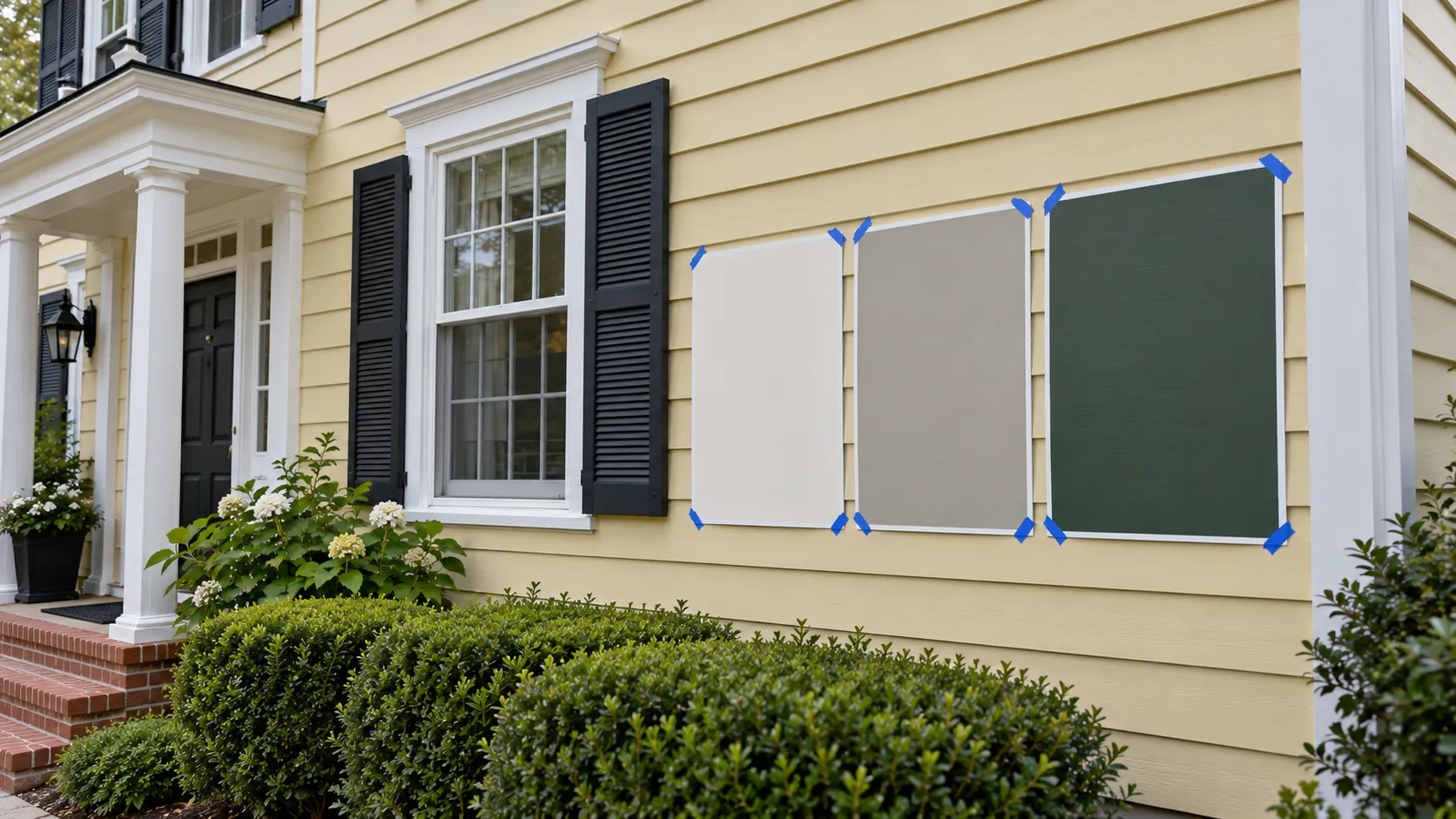
- Make big boards. Paint each color on a large white foam board, two full coats, with a white border so you can compare.
- Put them where they will be seen. Hold or tape them against the siding on the front and on the sunniest wall, next to the trim, roof line, brick or stone.
- Look from the street. Walk to the end of the driveway and across the road. A house is seen from 50 feet away, not 5.
- Look at different times. Morning, midday, late afternoon and on an overcast day. Many grays turn blue or green in shade.
- Check the trim and accent together. Put the trim white and door color next to each body sample; the combination is what you are choosing.
Does Exterior Color Change the Cost or How Long Paint Lasts?
Color by itself rarely changes the price much. What changes it is the switch: going from a dark color to a light one, or covering a strong color with a very different one, can take an extra coat, and deep colors and some whites sometimes need a tinted primer. Changing the trim from white to black means more cutting in and more coats on every window. Our NJ painting cost guide puts exterior painting at $1.50 to $4.50 per square foot of paintable surface as of September 2026, and it uses six to ten years as the general life of a properly prepared exterior. Deep colors in full sun and shore exposure tend to be at the shorter end for appearance, even when the paint is still sound.
Brand matters less than the product line. We use both Benjamin Moore and Sherwin-Williams, and both can match the other's colors; our Benjamin Moore vs Sherwin-Williams comparison explains where each line fits.
Get Help Choosing Your Exterior Colors
Picking an exterior color is easier with someone who has seen how these colors look on hundreds of New Jersey houses. NJ Painting Co. is a family-owned, licensed and fully insured painting company at 36 Church Rd, Morganville, NJ 07751, working on homes across Monmouth County and the surrounding counties for more than 20 years with Benjamin Moore and Sherwin-Williams products. Every estimate is free and includes an in-home color consultation; we bring samples, check your siding type and the vinyl-safe rules, and write the exact color, code, sheen and number of coats into the estimate. Our work carries a two-year workmanship warranty. See finished houses in our gallery, read about our exterior painting service, or call (732) 239-0932 and request a free estimate.
Frequently Asked Questions
What are the most popular exterior house colors in 2026?
Warm whites such as White Dove OC-17, Swiss Coffee OC-45 and Alabaster SW 7008; greiges and grays such as Revere Pewter HC-172, Agreeable Gray SW 7029 and Coventry Gray HC-169; and deep greens, navies and blacks on doors, shutters and trim. The 2026 Colors of the Year point warmer: Universal Khaki SW 6150 from Sherwin-Williams and Silhouette AF-655 from Benjamin Moore.
What is the 2026 exterior paint color of the year?
Sherwin-Williams chose Universal Khaki SW 6150, a warm midtone neutral with an LRV of about 40. Benjamin Moore chose Silhouette AF-655, a deep espresso brown with an LRV of 10.18. Neither is exterior-only; on a house, Universal Khaki works as a body color and Silhouette works best as an accent on doors and shutters.
What exterior house color has the best resale appeal?
No source can promise a color will raise your sale price. In our experience, buyers respond best to clean, well-maintained exteriors in neutral body colors, meaning whites, greiges and soft grays, with crisp trim and one well-chosen accent color on the front door.
What are the 2027 Colors of the Year?
Both are greens. Sherwin-Williams named Celery SW 6421, a light herbal green with an LRV of about 71, and Benjamin Moore named Webster Green HC-130, a deeper green with an LRV of 20.2. On a house, Celery can work as a whole-body color, while Webster Green suits shutters, doors and older colonials.
Can I paint my vinyl siding a dark color?
Only with a vinyl-safe color. Sherwin-Williams warns that painting vinyl darker than its original color can make it warp, and says to stay the same or lighter unless you use its VinylSafe colors. Benjamin Moore offers its Colors for Vinyl palette. The siding must be flat and sound, and painting may affect your siding warranty.
What is LRV and what LRV should an exterior color have?
LRV, light reflectance value, is a 0 to 100 scale of how much light a color reflects, listed on the chip and the manufacturer's website. There is no single right number for masonry or wood; on vinyl siding, a new color should have an LRV at or above your current siding's unless it is from a vinyl-safe palette.
What sheen is best for exterior house paint?
Flat or low-sheen on siding, which hides surface flaws, with satin or soft gloss on trim and satin or gloss on the front door. Sherwin-Williams' exterior guide gives the same pattern. Very rough or patched wood siding looks best flat.
Do I need permission to change my house color in New Jersey?
Not usually, but you may if your house is in a local historic district or a community with an HOA. In Ocean Grove, for example, Neptune Township's Historic Preservation Commission requires a Certificate of Appropriateness for painting in new colors. Check with your town and your association before you order paint.
How do I test exterior paint colors?
Paint two coats of each finalist on large white foam boards, since Benjamin Moore's liquid samples are formulated for interior use, and hold them against the house on the front and the sunniest side. View them from the street at different times of day, next to your trim, roof and any brick or stone.
About the author
Written by the NJ Painting Co. team
NJ Painting Co. is a family-owned painting contractor based in Monmouth County, in business since 2004. We are licensed and fully insured, work with Benjamin Moore and Sherwin-Williams paints, and back our work with a 2-year workmanship warranty. We serve Monmouth, Middlesex, Ocean, Mercer, Somerset and Burlington counties, plus Union, Essex, Hudson, Bergen and Passaic in North Jersey.