Yes, you can paint Hardie board, both factory-primed boards and ColorPlus. James Hardie says to use a 100% acrylic topcoat and never stain or oil paint, to seal every field-cut edge, to clean gently rather than blast it, and not to paint the boards when they are wet. Primed boards must be painted within 180 days of installation.
James Hardie's own answer is one sentence long — "Hardie® siding is paintable" — and that applies both to the factory-primed boards that were always meant to be painted and to the factory-finished ColorPlus boards that were not. What decides whether the paint lasts or peels early is not the board, which is one of the best paint substrates on a house, but four things around it: the paint has to be a 100 percent acrylic and never an oil or a stain; the board has to be cleaned without blasting its surface off; the cut edges and joints have to be sealed the way James Hardie specifies, and some gaps must be left open; and the paint has to go on a dry board above the temperature and dew-point floor printed on the can. Get those right and fiber cement is the easiest siding in New Jersey to keep looking new.
We are a family-owned painting company in Morganville and have painted New Jersey exteriors across Monmouth, Middlesex, Ocean, Mercer, Somerset and Burlington counties, plus Union, Essex, Hudson, Bergen and Passaic in North Jersey, for more than 20 years, using Benjamin Moore and Sherwin-Williams products. Fiber cement lap siding, shingles and panels are a growing share of the siding we paint, on newer houses where the primed boards were never finished properly and on ten- and fifteen-year-old ColorPlus houses whose owners want a different colour. This guide is the long version of what we explain at the estimate.
It is written to be useful whether you hire anybody or not. Every technical figure below — the 180-day rule for primed boards, the caulk standards, the cleaning pressure and distance, the paint makers' minimum temperatures and recoat times, the warranty terms — is quoted from James Hardie's own installation instructions, warranty and FAQ, from the Sherwin-Williams and Benjamin Moore technical data sheets, or from the EPA, the New Jersey Department of Health, the National Weather Service and NOAA, each fetched and read on 24 October 2026. Where something is our own practice rather than a published figure, we say so.
The Short Answer
- Yes, Hardie board can be painted, including ColorPlus. James Hardie's FAQ says primed siding "should be painted with an acrylic top coat," and that ColorPlus siding "can be repainted if you choose to change colors after installation."
- Primed boards have a deadline. James Hardie's current installation instructions say "factory primed products by James Hardie must be painted within 180 days of installation." Primer is not a finish.
- 100 percent acrylic, nothing else. The same instructions: "DO NOT use stain, oil/alkyd base paint, or powder coating on Hardie® products," and "100% acrylic topcoats are recommended."
- Every field-cut edge gets sealed. "Caulk, paint or prime all field cut edges." A raw cut edge drinks water.
- Clean gently. James Hardie's FAQ warns that "using a pressure washer can damage the surface of Hardie® siding." Its cleaning bulletin allows a washer only with "wide fan tips that are kept a minimum of 6 feet from the wall and at pressures under 1500 psi."
- Caulk the right joints, and leave some open. Use a sealant to ASTM C920 Grade NS, Class 25 or higher, or ASTM C834. James Hardie's drawings mark the gap above horizontal Z-flashing "Do not caulk."
- The ColorPlus finish warranty does not cover paint you put over it. The 15-year ColorPlus finish warranty excludes "performance of any paints and/or coatings which are not Hardie."
- Weather rules are about the board's surface. Sherwin-Williams requires air, surface and material "above 35°F (1.7°C) and at least 5° above the dew point"; James Hardie adds "Do not paint when Hardie® products are wet."
- Not every grey cement shingle is Hardie. The New Jersey Department of Health says asbestos-cement siding shingles have "been in use since 1940." Do not sand, scrape or pressure-wash old cement shingles until you know what they are.
What Is Hardie Board, and Why Does It Take Paint So Well?
"Hardie board" is the everyday name for fiber cement siding made by James Hardie: lap planks (HardiePlank), shingle and shake profiles, vertical panels, and the matching HardieTrim boards. Fiber cement is a mix of cement, sand and cellulose fibre, pressed into boards with a wood-grain or smooth face. Other makers produce it too — Allura and Nichiha among them — and most of what follows applies to fiber cement generally, but because James Hardie publishes the most detailed instructions, and because most fiber cement on New Jersey houses is theirs, we quote them throughout.
Compared with the other sidings we paint, fiber cement is forgiving. It does not rot, so the board under a peeling patch is still a board. It does not move with heat the way vinyl does, so it is not held to the colour limits that vinyl and cellular PVC are (more on that below). And it holds paint because a cement surface is porous enough to give the film something to grip. What it does not forgive is water at its edges, a hard pressure-washer tip held close, or the wrong kind of paint, and nearly every failed fiber cement paint job we are asked to look at comes down to one of those three.
The two ways it leaves the factory
Fiber cement reaches a house in one of two states, and which one you have changes everything about painting it.
Factory-primed. The boards arrive with a primer coat and nothing else, and they are meant to be painted on site. James Hardie's current instructions for its trim boards, effective September 2025, are unambiguous: "Factory primed products by James Hardie must be painted within 180 days of installation. 100% acrylic topcoats are recommended. Do not paint when Hardie® products are wet." The same wording appears in its HardiePlank lap siding instructions. The point is that the factory primer is a base, not a weather coat. We still see houses where primed boards went up and the finish coats never happened, or happened years later over a primer that had weathered and chalked. Those can be painted, but the primer's condition has to be checked first.
ColorPlus. James Hardie's factory-finished line comes painted. Its FAQ says "ColorPlus® Technology finishes are cured onto the boards during the manufacturing process," and its article on the finish describes a "baked on color process" performed "in a controlled environment," with the boards "color coated again to ensure consistent surface coverage." A ColorPlus wall needs no paint when it goes up. It needs paint later only if you want a different colour, or once the finish has weathered enough that you no longer like it.
If you do not know which you have, the paperwork from the siding job will say. Without it, the clue is usually the date and the finish: a ColorPlus board has an even, slightly satin factory colour that is the same on every board and at every cut edge that was treated with Hardie's edge coater, while a primed-and-painted wall shows brush and roller texture at the laps and corners.
Can You Paint Hardie Board? Primed Boards Versus ColorPlus
Both can be painted. They are just different jobs, with different reasons, preparation and warranty consequences.
| Question | Factory-primed boards | ColorPlus boards |
|---|---|---|
| Does it need paint? | Yes: "must be painted within 180 days of installation" | No; it "will already come finished with the color you've chosen" |
| Can it be painted later? | Yes, and repainted on the paint's own schedule | Yes: it "can be repainted if you choose to change colors after installation" |
| Prime before painting? | Not over sound factory primer; bare cut edges must be sealed | "Repriming is normally not necessary" |
| What paint? | "100% acrylic topcoats are recommended" | "100% acrylic topcoats are recommended" |
| Never use | "stain, oil/alkyd base paint, or powder coating" | "stain, oil/alkyd base paint, or powder coating" |
| Small damage | Caulk, paint or prime cut edges; patch small chips with a cementitious compound | Hardie touch-up kit only; "Touch-up should be used sparingly" |
| Finish warranty | None from James Hardie on field paint; the paint maker's and the painter's apply | 15-year limited finish warranty against peeling, cracking and chipping, prorated after year one |
| Board warranty (FAQ) | "30-year, non-prorated" | "30-year, non-prorated" |
Repainting ColorPlus
James Hardie publishes a short list for repainting its factory finish, and it is the same list in the 2019 lap siding instructions and the 2025 trim instructions: "Ensure the surface is clean, dry, and free of any dust, dirt, or mildew." "Repriming is normally not necessary." "100% acrylic topcoats are recommended." "DO NOT use stain, oil/alkyd base paint, or powder coating on Hardie® products." "Apply finish coat in accordance with paint manufacturer's written instructions regarding coverage, application methods, and application temperature." And, because nail heads on ColorPlus are touched up rather than filled: "DO NOT caulk nail heads when using Hardie® products with ColorPlus® Technology finishes."
So a ColorPlus repaint is, on paper, one of the simplest repaints there is: wash, let it dry, two coats of a quality acrylic. The two things that make it less simple in practice are cut edges that were never sealed when the siding went up, which we look for at every corner, window and door, and old touch-up work. Small ColorPlus touch-ups done with a non-Hardie paint often show as dull or mismatched spots, and they need to be sound before they are painted over.
What happens to the ColorPlus warranty if you paint it
This is the question owners of younger ColorPlus houses ask most, and the honest answer is in the warranty document itself. James Hardie's ColorPlus Limited Finish Warranty, in the version effective April 2021, warrants that for "a period of 15 years from the date of purchase" the finish "(a) will not peel (b) will not crack, and (c) will not chip." Its remedy in the first year is reimbursement of "reasonable fees for paint and labor," up to a per-square-foot cap, and then "during the 2nd through 15th year, the warranty payment shall be reduced by 6.67% such that after the 15th year no warranty shall be applicable." That is what James Hardie's own article means when it calls the coverage a "15-year prorated limited warranty."
Two exclusions matter to anyone thinking about repainting. The warranty "does not cover fading or chalking of the Finish due to normal weathering," which it defines as exposure to sun and weather "which will cause any painted surface to gradually fade, chalk or accumulate dirt over time." It does cover "excess color change," defined as a change "by greater than four (4) delta E units within the first three (3) years." And it excludes "performance of any paints and/or coatings which are not Hardie." James Hardie also states, in its installation instructions, that it "does not warrant the usage of third party touch-up or paints used as touch-up" on ColorPlus products.
Read together, our understanding is this. Painting over ColorPlus does not destroy the boards' value, and James Hardie plainly expects that some owners will repaint. But once you paint over the factory finish, the new paint is not James Hardie's, so a problem with that paint is a matter for the paint maker's warranty and the painter's workmanship warranty, not the ColorPlus finish warranty. On a ColorPlus wall that is only a few years old and has a genuine finish defect — real peeling or chipping of the factory coat — make the warranty claim before anyone paints, because the warranty requires written notice "within 30 days after discovery" and "before beginning any permanent repair." On a ColorPlus wall that is ten or more years old and has simply faded, the finish warranty is worth little by then, and fading from normal weathering was never covered. The separate 30-year board warranty is a different document that we have not reviewed for this guide; if your siding is young, read it, or ask your siding installer, before you repaint.
What Is the Best Paint for Hardie Board?
A premium 100 percent acrylic exterior latex. That is not our preference so much as James Hardie's requirement, and both paint makers we use publish fiber cement on their data sheets. Benjamin Moore describes Regal Select Exterior as "a premium exterior 100% acrylic paint recommended for wood, hardboard, fiber cement, cedar shake, vinyl and aluminum siding," and Aura Exterior as suitable for "exterior surfaces such as wood, fiber cement board, hard board, vinyl and aluminum siding." Sherwin-Williams lists "Cement Composition Siding/Panels" among the surfaces for Duration Exterior.
Why not oil, and why not stain?
James Hardie's instruction is short — "DO NOT use stain, oil/alkyd base paint, or powder coating" — and the reasoning is the chemistry of cement. A fresh cement surface is alkaline, and alkyd (oil) resins are attacked by alkali, which is why oil paints on masonry and cement products tend to lose adhesion and chalk early. The paint makers' sheets reflect the same thing: Sherwin-Williams' preparation note for cement composition siding says that "if the surface is new, test it for pH, if the pH is higher than 9, prime with Loxon Concrete & Masonry Primer," a primer built for alkaline surfaces. Acrylic films also stay flexible and let moisture vapour out, which suits a board that takes on and gives up water with the weather. Stain has no place on fiber cement at all; there is no wood fibre on the surface for it to soak into. The practical rule for a homeowner is simple: if the can does not say 100 percent acrylic, it does not go on Hardie board.
How the products compare on paper
| Product | Fiber cement primer per the sheet | Coats on bare | Minimum temperature | Dry to touch | Recoat | Sheen | VOC |
|---|---|---|---|---|---|---|---|
| Sherwin-Williams Duration Exterior Acrylic Satin K33 | Self-priming; Loxon Concrete & Masonry Primer if new surface pH is above 9 | 2 | 35°F air, surface and material, 5° above dew point | 1 hour (2 hours at 35–45°F) | 4 hours (24–48 hours at 35–45°F) | 10–20 units @ 60° | Less than 50 g/L |
| Benjamin Moore Regal Select Exterior High Build Low Lustre N401 | "No primer needed" (two finish coats) | 2 | 35°F surface (the feature list says 40°F) | 1 hour | 4 hours | 10–15 @ 60° | 40 g/L |
| Benjamin Moore Aura Waterborne Exterior Low Lustre N634 | Self-priming on fiber cement board; the primer table lists Ultra Spec Masonry Sealer 608 or N609 for fiber cement siding | 2 | 35°F surface | 1 hour | 4 hours | 9–15 @ 60° | < 50 g/L |
A few things in that table are worth reading twice. First, all three are self-priming on fiber cement in the sense their sheets define: Duration "is self-priming on most surfaces. Apply 2 coats on new, bare substrates or 1 coat for repaint," and Aura's sheet says "on bare substrates two coats are required; previously painted surfaces can be finished with 1 or 2 coats." Self-priming does not mean one coat on a new house; it means the first of two coats is doing the priming. Second, Aura's sheet is not consistent with itself on fiber cement — self-priming in its description, a masonry sealer in its primer table — and when a sheet does that we ask what is under the paint. Over sound factory primer or sound old paint, no separate primer. Over bare, weathered or powdery cement, a masonry primer or conditioner. Third, the Regal Select sheet gives two floors, "Low temperature application down to 40 °F" in its feature list and "do not apply when air and surface temperatures are below 35 °F" under limitations. We use the higher one.
And fourth, the cold-weather column. Sherwin-Williams' four-hour recoat becomes 24 to 48 hours between 35 and 45 degrees. On a two-storey wall of lap siding that is the difference between a two-coat side of the house in a day and in a week. More on the season below.
Elastomeric coatings on fiber cement?
We are sometimes asked whether a thick elastomeric coating would make fiber cement more weatherproof. Elastomeric and weatherproof coatings are something we offer, and they earn their place on stucco and masonry with hairline cracking, as our stucco painting guide explains. On sound fiber cement lap siding they are rarely the right call: James Hardie's instruction is a 100 percent acrylic topcoat, the board does not crack the way stucco does, and a heavy film can bridge the laps. If you have a specific reason to want one, ask us and we will look at the product's data sheet against James Hardie's guidance with you.
Do You Need to Prime Hardie Board? Cut Edges and Bare Spots
Over sound factory primer or sound old paint, no. James Hardie says repriming ColorPlus "is normally not necessary," and Benjamin Moore's Regal Select system for "Poured or Pre-cast Concrete and Fiber Cement Siding" is "Primer: No primer needed" under two finish coats. Where primer, or at least a seal, is non-negotiable is anywhere the bare cement is exposed.
Field-cut edges
Every time a board is cut on site to fit around a window, a door, a corner or a roof line, the cut exposes raw fiber cement. James Hardie's instruction, in capitals in its 2025 trim document, is "IMPORTANT: Caulk, paint or prime all field cut edges." For ColorPlus boards it goes further: "Terminate field-cut edges into trim where possible, and caulk," and "treat all other field-cut edges using the ColorPlus® Technology edge coaters."
Cut edges matter more than their size suggests. An unsealed edge takes up water by capillary action, and the paint along that edge is the first to blister and the board end is the first to swell. When we prepare a fiber cement wall we look at the board ends at every corner board, every trim board and every butt joint we can see, and we seal what is bare before the finish coats go on. Most of these edges are in the gap between a board end and the trim, so this work goes hand in hand with caulking, below.
Weathered primer and bare patches
Factory primer that was left unpainted far past James Hardie's 180 days, or patches where old paint has failed down to the board, need a closer look. If the surface is sound and only dusty, washing and two coats of a self-priming acrylic deal with it. If it is powdery after washing, Sherwin-Williams' note for cement composition siding applies: "After power washing, previously painted masonry may still have a powdery surface that should be sealed with Loxon Conditioner and then apply 1 coat of Duration." The way to tell the difference is the chalk test.
How Do You Clean Hardie Board Before Painting?
Gently, and more gently than most people clean a house. This is the step where fiber cement is most often damaged before a drop of paint goes on.
James Hardie gives two levels of guidance, and they are not quite the same. Its homeowner FAQ is the stricter: "Using a pressure washer can damage the surface of Hardie® siding," and it recommends instead "a low pressure water spray from your garden hose and a soft, medium bristle siding cleaning brush." Its Technical Bulletin 20, "Cleaning James Hardie Primed and ColorPlus Technology Siding," sets the limit for anyone who does use a machine: "Low pressure water spray, a soft bristle (nonmetal) brush is most suitable for cleaning fiber cement products. If using a pressure washer, care must be taken to ensure that the water stream does not damage the surface of the siding. Using wide fan tips that are kept a minimum of 6 feet from the wall and at pressures under 1500 psi will minimize the chance of damaging the siding." The bulletin also rules out two things outright: "Sand blasting can damage the fiber cement surface and is not recommended," and "Acid washing can damage the fiber cement surface and is not recommended." And it warns that "damage to siding arising from improper cleaning or maintenance may not be covered by the James Hardie warranty."
Power washing is a service we offer, and on fiber cement we work to the stricter end of that guidance. In practice that means a cleaning solution applied at low pressure, a wide fan tip held well back from the wall, the wand never pointed up under the laps where it would drive water behind the siding, and hand brushing with a soft brush where something needs scrubbing. Mildew gets a mildew cleaner rather than more pressure; the bulletin's own method is to follow the cleaner's instructions, lightly scrub and rinse with a garden hose, and its note that "moisture is the most important single factor in the growth of mildew" explains why the north wall and the side behind the shrubs always need the most attention. Our article on power washing costs in NJ covers how pressure and method change from one siding to another.
Then the wall dries. James Hardie's instruction is "Do not paint when Hardie® products are wet," and a fiber cement board holds water for longer than its face suggests, especially at the laps and on a shaded wall. We give a washed wall at least a full dry day before paint, longer after a humid spell or on a north side, and we check the laps, not just the face.
The chalk test
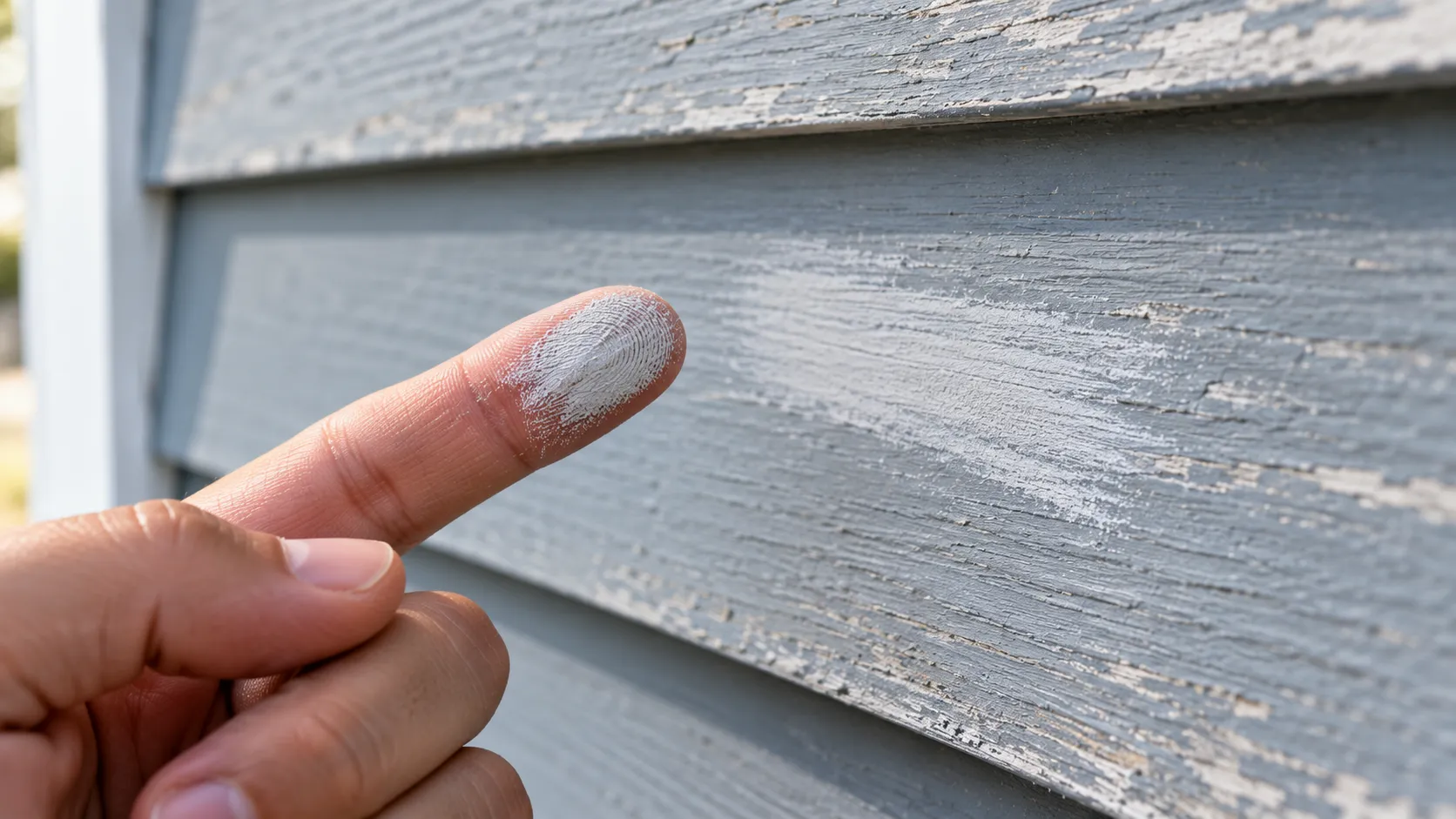
Weathered paint on fiber cement, and weathered ColorPlus, chalks: the binder at the surface breaks down in sunlight and leaves a fine powder of pigment. Paint applied over chalk is bonding to powder. The test takes ten seconds. The US Forest Service's Forest Products Laboratory puts it simply: "Old paint that wipes onto a cloth or hand (chalk) should be cleaned. If paint still wipes off, repriming is necessary. If cleaning stops chalkiness, only cleaning is necessary before top coating."
We rub every elevation before we write an estimate, because the south and west walls chalk far more than the north. A heavy chalk on the sunny sides means more washing, and if it is still powdery once dry, a conditioner or primer before the finish. A clean finger means a wash and the finish coats. That one test decides more about the cost and life of a fiber cement repaint than anything else we look at.
How Should Hardie Board Joints Be Caulked, and Which Must Be Left Open?
Caulk on fiber cement is about keeping water out of the places James Hardie expects it to be kept out, and leaving open the places it expects water to drain from. Caulk in the wrong place is as harmful as no caulk in the right one.
The sealant
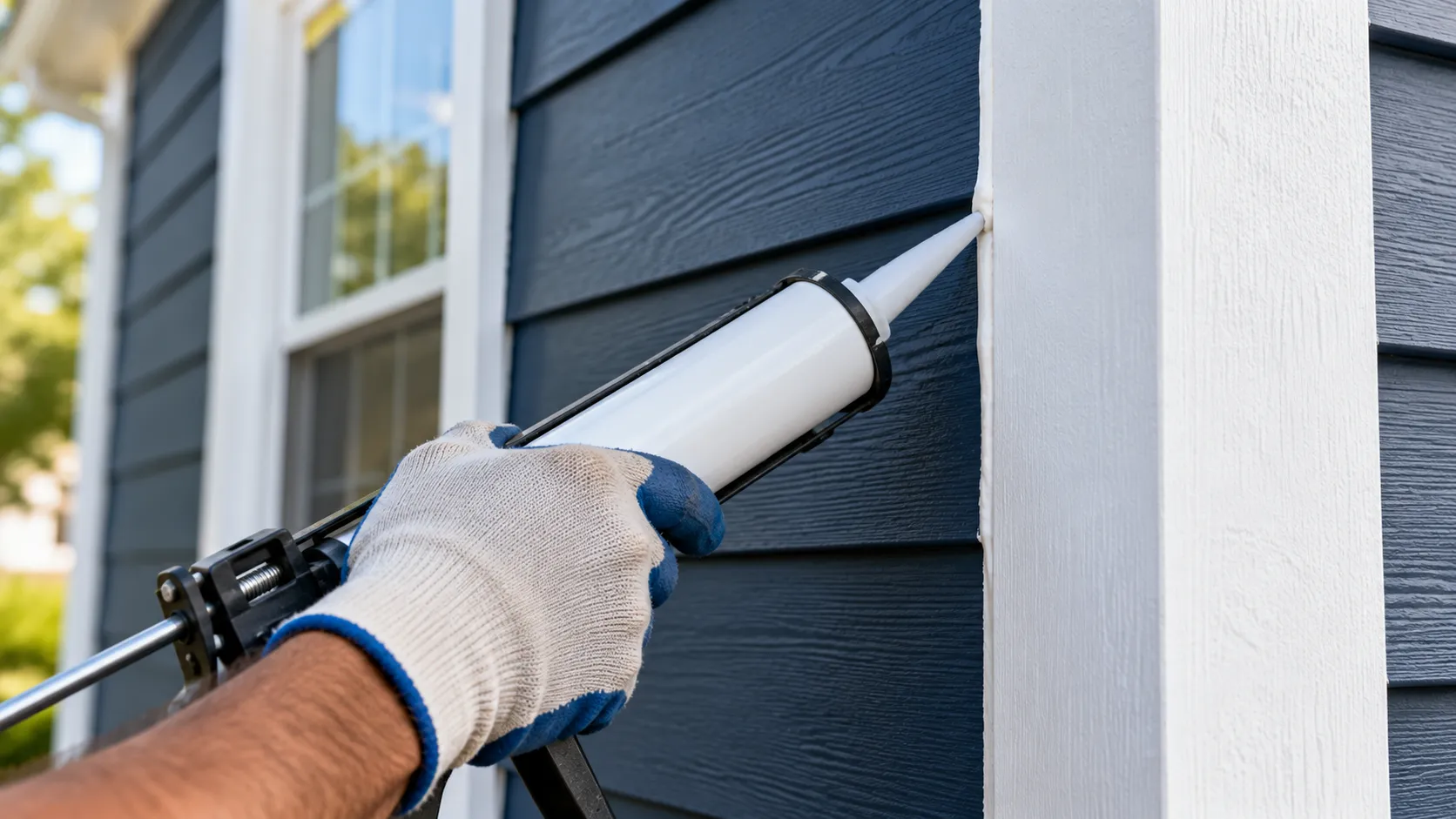
James Hardie specifies the product class: "For best results, use an Elastomeric Joint Sealant complying with ASTM C920 Grade NS, Class 25 or higher or a Latex Joint Sealant complying with ASTM C834. Caulking/Sealant must be applied in accordance with the caulking/sealant manufacturer's written instructions." For replacing old caulk, the homeowner care section of its ColorPlus warranty says: "carefully remove existing caulk and replace with a high quality, paintable latex caulk. For best results, use a latex caulk that complies with ASTM C834 or better." The standard number is printed on the tube, and it is worth looking for; a cheap painter's caulk that meets neither is the one that splits at the first cold snap.
Where caulk goes
Siding to trim. James Hardie's lap siding drawing says: "Leave appropriate gap between planks and trim, then caulk." That is the joint where plank ends meet corner boards and the trim around openings, and it is where the cut ends of the planks usually are, so the caulk is sealing the cut edge as well as the gap.
Butt joints, where the method calls for it. Where two planks meet end to end in a course, the instructions say "install planks in moderate contact at butt joints" and give three joint treatments, "required by code": "A. Joint Flashing (James Hardie recommended)," "B. Caulking" and "C. 'H' jointer cover." Caulking is not recommended on ColorPlus "for aesthetic reasons as the Caulking and ColorPlus will weather differently." So on a primed wall that was installed with caulked butt joints, those joints are re-sealed as part of a repaint; on a wall with flashing behind the joints, there may be nothing to caulk, and the flashing is doing the job.
Where caulk must not go
James Hardie's flashing drawings mark the gap between the siding and the horizontal Z-flashing above a band or trim board "Min. ¼ in." and "Do not caulk." That gap is a drainage path. Seal it and water that gets behind the siding has nowhere to leave. The same principle applies to the overlap of the laps themselves, which we never caulk: the bottom edge of each course sits over the course below so that water runs off and out, and a bead along the lap traps it. On ColorPlus the instructions also say "DO NOT caulk nail heads." And a note in the lap siding instructions is worth knowing before you choose a sheen: "Field painting over caulking may produce a sheen difference."
Windows and doors
General caulking and sealing of siding joints is part of our work. Re-caulking around windows and doors is not, and neither is painting window trim and sills. We say so at the estimate so you can compare bids on the same scope; if the seals around your windows and doors need attention, that is a separate job for a separate trade.
What About Nails, Rust Stains and Damaged Boards?
Fasteners
Rust streaks running down from nail heads are one of the more common faults we see on fiber cement, and they are a fastener problem before they are a paint problem. James Hardie's lap siding instructions say "fasteners must be corrosion resistant, galvanized, or stainless steel. Electro-galvanized are acceptable but may exhibit premature corrosion," and that "James Hardie recommends the use of quality, hot-dipped galvanized nails." They also say "fastener heads should fit snug against siding (no air space)," and show overdriven, underdriven and slanted nails as things not to do.
When we find rusting face nails we clean the head and the stain, spot-prime the head with a metal primer — Benjamin Moore's sheet lists an acrylic metal primer for ferrous metal under its exterior finishes — and then finish-coat. That stops the stain for a long time on a primed wall. It does not change the nail, so if heads are badly corroded or popped, or boards are loose, we point it out, and refastening is for the siding contractor. On ColorPlus, remember the rule: the nail head is touched up, not caulked.
Cracked, chipped or swollen boards
Small damage is part of paint preparation. James Hardie's FAQ says "small cracks, chips and dents" "can be repaired with a cementitious patching compound," and its warranty care notes say "Fill dents, chips and cracks using a good quality cement patching compound (acrylic mortar patch)." A small chip filled that way and painted disappears.
Anything larger is not ours. We do not replace or install siding, and that includes replacing individual Hardie boards. Boards that are cracked through, broken at a corner, swollen or delaminating at their bottom edge, or soft where they meet a roof line or the ground are written down at the estimate, and a siding contractor replaces them before we paint. James Hardie's own maintenance instruction is to "replace siding and trim products in accordance with James Hardie's written installation instructions," and for ColorPlus, "if large areas require touch-up, replace the damaged area with a new piece of siding." Swelling at the bottom of the wall or along a roof line usually means a clearance or flashing problem, which is also a siding or roofing question. If wood trim or sheathing behind the siding has rotted, that is carpentry, and exterior rot repair is not a service we offer either; we flag it.
Why we do not power-sand fiber cement
Fiber cement contains crystalline silica, and James Hardie's safety warning is printed on every instruction sheet: "DANGER: May cause cancer if dust from product is inhaled," with the hazard arising "from crystalline silica present in the dust generated by activities such as cutting, machining, drilling, routing, sawing, crushing, or otherwise abrading fiber cement." For cleanup it says to "use wet clean-up methods - never dry sweep." On a repaint there is rarely any reason to abrade fiber cement at all: loose paint is scraped, glossy spots are dulled lightly by hand, and the dust that results is cleaned wet. We do not grind or power-sand the boards, and if anyone proposes to, ask how they are controlling the dust.
Spray, Brush or Roll?
Any of them, if the coat is even and worked into the laps. James Hardie's instruction is "Back rolling is recommended if spray application is used," and both paint makers allow spraying; Sherwin-Williams lists airless spray for Duration at "2000 p.s.i." with a ".015-.019 inch" tip, and Benjamin Moore says Regal Select "can also be sprayed."
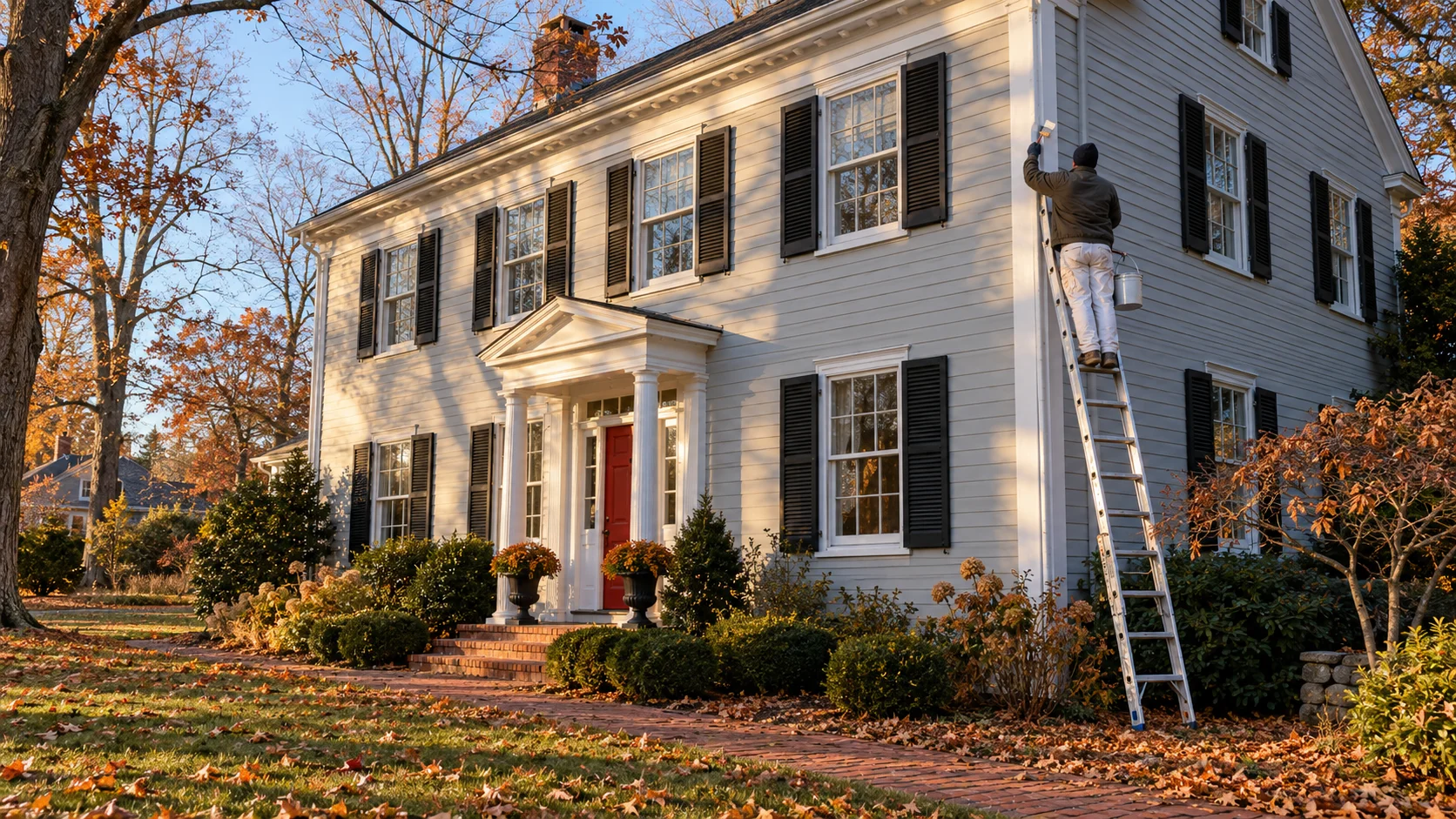
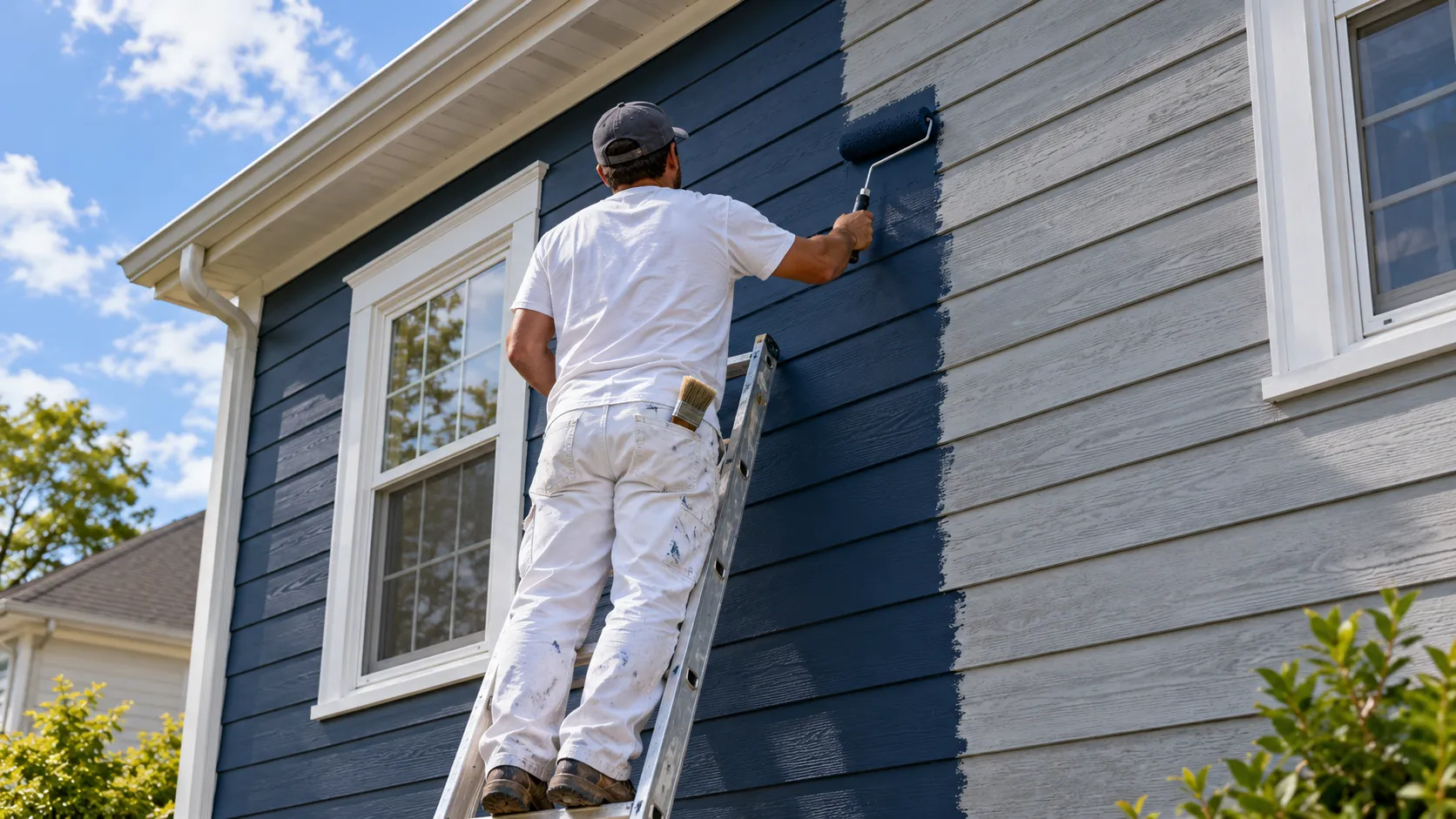
Our practice on lap siding is to spray or roll the face and work the bottom edge of every course with a brush, which is what the first picture in this guide shows. The bottom edge is the part of a lap that sheds water and the part a roller misses; a sprayed coat that is not back-rolled tends to leave it thin and sometimes misses the shadow line entirely. On shingle and shake profiles, the many edges make spray-and-back-brush the practical method. Spraying also needs masking and a calm day, which on a tight lot or near neighbours' cars is often the deciding factor. Whichever method, the coverage and film build follow the paint maker's data sheet — Duration's coverage is quoted at "250-300 sq. ft. per gallon," Regal Select's at 250 to 350, "depending on surface texture and porosity" — and a heavily textured cedar-grain board takes more paint than a smooth one.
What Sheen and Colour Work on Fiber Cement?
Sheen
Satin or low lustre, in almost every case. The products above sit in a narrow band — Duration's satin at "10–20 units @ 60°," Regal Select's low lustre at "10 – 15 @ 60°," Aura's at "9 – 15 @ 60°" — which is enough sheen to shed dirt and rain and not so much that every plank edge and nail line reads in raking light. Flat finishes hold dirt on a wall that faces the street, and gloss on siding emphasises the waviness that long lap runs always have. James Hardie's note that caulk can show "a sheen difference" under field paint is another argument for a low sheen. For trim we often go one step glossier, which our sheen guide explains.
Colour and heat
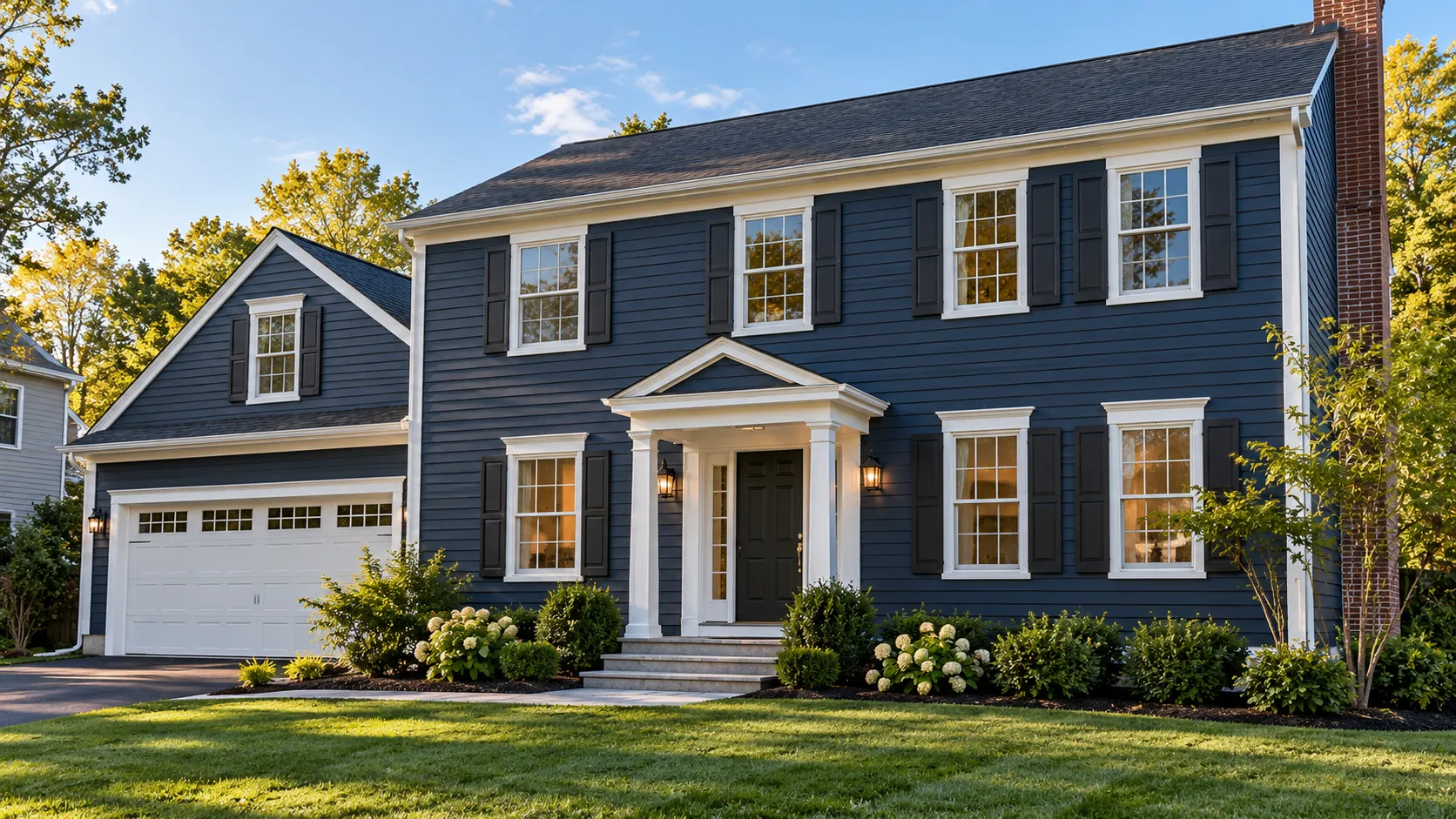
Fiber cement's great advantage over vinyl is colour freedom. Vinyl and cellular PVC carry published limits on how dark they may be painted, because a dark film heats them enough to warp; the James Hardie installation and finishing instructions we read for this guide publish no such light-reflectance limit for painting fiber cement, and the board itself does not soften in the sun. That is why a deep navy or charcoal on Hardie board is a reasonable choice in a way it is not on vinyl.
Two cautions still apply. Dark colours on a south or west wall run hot, and heat shortens any paint film's life and makes application harder — Sherwin-Williams' sheet says "do not paint in direct sun" and that above 80°F the paint "sets up quickly," so a dark wall in July is painted in the shade as the sun moves round the house. And the trim next to the siding may be the limit: if your corner boards, fascia or window surrounds are vinyl or cellular PVC rather than fiber cement, they carry their own colour ceilings, which our guide to painting fascia, soffits and exterior trim sets out. For the colours themselves, our guide to popular exterior house colors in NJ is the place to start.
When Can You Paint Hardie Siding in New Jersey? Temperature, Dew Point and the Season
The paint sets the floor, and the board's surface is what is measured. Sherwin-Williams' application paragraph is the clearest statement of it: "When the air temperature is at 35°F (1.7°C), substrates may be colder; prior to painting, check to be sure the air, surface, and material temperature are above 35°F (1.7°C) and at least 5° above the dew point. Avoid using if rain or snow is expected within 2-3 hours." And: "Do not apply at air or surface temperatures below 35°F (1.7°C) or when air or surface temperatures may drop below 35°F (1.7°C) within 48 hours." Benjamin Moore's sheets put the surface minimum for Regal Select and Aura at 35°F and warn that "high humidity and cool temperatures will result in longer dry, recoat and service times."
Fiber cement makes the dew-point clause matter more than it does on some sidings. It is a dense, heavy board that holds the cold of the small hours well into the morning, and a shaded wall can sit below the air temperature for most of the day. The National Weather Service defines the dew point as "the temperature the air needs to be cooled to (at constant pressure) in order to achieve a relative humidity (RH) of 100%." A board at or close to it is collecting a film of moisture, and James Hardie's rule is "do not paint when Hardie® products are wet," whether the wet came from a hose or from the air.
Here is what that means in a real New Jersey year. NOAA's 1991–2020 climate normals for the Freehold-Marlboro station, a few miles from our office, put the average October high at 66.6°F and low at 44.3°F, and November at 56.2°F and 35.7°F, with 11.5 days in an average November whose low is at or below freezing. The station's annual normals put the median date of the first 36°F low at October 12 and the first 32°F low at October 23; in spring, the median last 32°F low is April 17 and the last 36°F low May 1. April averages a high of 63.0°F and a low of 41.2°F.
So the comfortable season for fiber cement in central New Jersey runs from about the start of May into October, with April and late October workable on the right days, and November possible only with the 48-hour rule watched closely and the longer recoat times built in. In spring and autumn we start on each wall once the sun has burned the dew off it, and we stop early enough for the last coat to set before the dew point catches the board again. Our guide to painting in cold weather in NJ goes through the late-season decisions in more detail.
How Often Does Hardie Board Need Repainting?
Less often than wood, and the honest figure is a rule of thumb rather than a published number. James Hardie does not publish a repaint interval for field paint. Its maintenance list in the 2025 trim instructions simply includes "re-applying of exterior finishes" alongside "washing down the exterior surfaces every 6 to 12 months with a garden hose or low pressure water spray," and maintaining "joints, penetrations, flashings, and sealants (caulking) to prevent moisture entry behind the siding." Its ColorPlus warranty runs 15 years, prorated, and excludes ordinary fading and chalking.
In our experience field-painted fiber cement goes 10 to 15 years in central New Jersey when it was properly cleaned and painted with a premium acrylic, with the south and west walls setting the clock and the shaded north wall lasting longer. Shore houses and walls that take a lot of sun sit at the shorter end. ColorPlus that has faded can go a similar span before an owner decides it looks tired. The signs it is time are the ones in this guide: chalk on your fingertip, paint wearing thin on the lap edges, open joints, and peeling at cut ends. Our guide to how often to paint a house in NJ puts fiber cement alongside every other siding, and if the paint is coming off rather than fading, why paint peels in NJ is the diagnostic version.
Is It Hardie Board, or Old Asbestos-Cement Siding?
This is the most important section in this guide for anyone with an older house, because two very different products look alike from the street. Modern fiber cement uses cellulose fibre. The cement siding shingles on many older New Jersey houses — often a hard, flat shingle with a wavy bottom edge or a stippled face, in grey, white, beige or a faded green — may be asbestos-cement.
The New Jersey Department of Health's guide Asbestos: A Guide for New Jersey Residents describes them: "Asbestos-containing siding/shingles, have been in use since 1940 are hard and usually light green, beige, or a grayish-white color." It explains that "the asbestos fibers in these shingles are tightly bonded to the tile matrix and aren't considered friable. They won't readily release fibers unless they are cut, sawn, drilled, broken, or sanded." And it adds the point that matters most: "Unless a material is labeled 'Asbestos-Containing,' no one can tell for sure if it contains asbestos just by looking at it. Materials must be examined under a microscope." The EPA's guidance for homeowners says the same — "you can't tell whether a material contains asbestos simply by looking at it, unless it is labeled" — and gives the rules: "Don't saw, sand, scrape, or drill holes in asbestos-containing materials," "Don't dust, sweep, or vacuum debris that may contain asbestos," and "Do leave undamaged asbestos-containing materials alone."
James Hardie's products today are not that material. The company's own asbestos fact sheet says it "pioneered the manufacture of the world's first asbestos free fibre cement products" in 1981, and that it "ceased using asbestos in its building products in 1985 and in its pipes business in 1987. Since then, James Hardie products have been and continue to be asbestos-free." Siding installed in the last few decades under the Hardie name is not the concern. Cement shingles that were on the house when it was bought, on a house built in the middle of the last century, may be.
What that means for painting: an asbestos-cement shingle wall is not a wall to pressure-wash hard, scrape or sand. Every one of those is on the list of things that release fibres. The NJ Department of Health does note that "if siding shows signs of damage or wear, a coat of spray paint can help lock the fibers," and that is guidance about what can be done to the material, not a statement about who should do it. Whether an older shingle wall should be painted, how it can be cleaned without disturbing it, and whether it should be tested first are questions to raise at the estimate — ask us, and expect us to say when the answer is a specialist's. Asbestos testing, abatement and removal are not services we offer. If shingles are cracked, broken or being removed, that is work for people trained and licensed for it; the NJ Department of Health guide lists the state agencies to contact, and New Jersey requires asbestos waste, including siding, to be disposed of properly.
A house old enough to have asbestos-cement shingles is also old enough for lead paint on them and on the trim, which brings in the next rule.
Lead Paint, Older Trim and the EPA Rule
Fiber cement installed in recent decades will not carry lead paint. But re-sided houses often keep their original wood trim, porches and window surrounds, and any of those, or old painted cement shingles, may carry paint from before 1978. The EPA's Renovation, Repair and Painting rule requires that "anyone paid to perform work that disturbs painted surfaces in homes, childcare facilities and preschools built before 1978" be certified, and the agency says "EPA recommends that homeowners hire a lead-safe certified contractor."
We are not an EPA Lead-Safe Certified firm. That is a licensing fact about us, not a choice of wording, and it means there is pre-1978 work we will tell you to take to a certified firm. Whoever you hire, before anyone scrapes or sands paint on a house built before 1978, ask the bidder for their firm certification number — ours included — and check it with the search tool linked from the EPA's Renovation, Repair and Painting program page. Our guide to lead paint in older NJ homes explains the rule, testing and New Jersey's own requirements properly.
Hardie Board Compared With Vinyl, Wood and Aluminum
People who are deciding whether to paint their siding at all often have more than one material on the house. In short: fiber cement and wood are made to be painted; aluminum can be repainted readily once it is de-chalked; vinyl can be painted, but only within its maker's colour limits and with an eye on its warranty. Our guide to painting vinyl or aluminum siding covers those two in detail. Of the four, fiber cement is the one where the paint is least likely to be the weak point, provided the edges and joints are sealed and the board is not damaged in cleaning.
What We Do, and Do Not Do, on Fiber Cement Siding
- We paint fiber cement siding and trim, including factory-primed boards that were never finished and ColorPlus boards being changed to a new colour, on their own or as part of a full exterior.
- We clean to James Hardie's limits, by low-pressure power washing with a wide fan tip held well back, a cleaning solution and a soft brush, and we let the wall dry fully before painting.
- We chalk-test every elevation, and condition or prime surfaces that stay powdery after washing.
- We seal bare cut edges and re-caulk siding joints with a sealant meeting ASTM C920 or ASTM C834, and we leave the drainage gaps James Hardie marks "do not caulk" open.
- We spot-prime rusting nail heads and fill small chips with a cementitious patch as preparation.
- We use 100 percent acrylic paint only, from Benjamin Moore or Sherwin-Williams, never oil, alkyd or stain, and we brush the lap edges.
- We work to the data sheet's temperature and dew-point rules and reschedule rather than paint a cold or damp board.
- We write the surfaces, preparation, products and number of coats on the estimate, so you can compare bids line by line.
What we do not do, so there is no ambiguity: siding replacement or installation, including replacing individual Hardie boards; refastening loose siding; exterior rot repair; finish carpentry; window trim and sill painting; re-caulking windows and doors; roofing, flashing and gutter installation; and asbestos testing, abatement or removal. We flag damaged boards, rot and flashing problems at the estimate so the right trade can fix them before we paint. And we do not hold EPA Lead-Safe (RRP) certification: on a house built before 1978, ask us — and every other bidder — for a firm certification number before anyone disturbs old paint.
Get a Price for Painting Your Fiber Cement Siding
Fiber cement painting is priced on the size and height of the walls, whether the boards are primed or ColorPlus, how much chalk and caulk work the surface needs, and how many cut edges were left bare, which is why we look at the house rather than quote from a photo. NJ Painting Co. is a family-owned, licensed and fully insured painting company at 36 Church Rd, Morganville, NJ 07751, working on New Jersey homes for more than 20 years with Benjamin Moore and Sherwin-Williams products. Every estimate is free and spells out surfaces, prep, products and number of coats; our work carries a two-year workmanship warranty. For how exterior pricing is built, see our exterior painting cost guide and our article on how much it costs to paint a house in NJ; for the work itself, our exterior painting service. Call (732) 239-0932 or request a free estimate, and ask us about the job minimum when you enquire.
Frequently Asked Questions
Can you paint Hardie board siding?
Yes. James Hardie says its siding is paintable. Factory-primed boards are meant to be painted, and James Hardie says they must be painted within 180 days of installation. ColorPlus boards come with a factory finish but can be repainted if you want to change colour. In both cases James Hardie recommends a 100 percent acrylic topcoat and says not to use stain, oil or alkyd paint, or powder coating.
What kind of paint do you use on Hardie board?
A premium 100 percent acrylic exterior latex. Benjamin Moore lists fiber cement among the surfaces for its Regal Select and Aura exterior paints, and Sherwin-Williams lists cement composition siding among the surfaces for Duration Exterior. Oil and alkyd paints are ruled out by James Hardie, and stain has nothing to soak into on a cement surface. Satin or low lustre is the usual sheen for the siding.
Do you need to prime Hardie board before painting?
Not over sound factory primer or sound old paint. James Hardie says repriming ColorPlus is normally not necessary, and Benjamin Moore's system for fiber cement siding is two finish coats with no primer. Bare cement is different: every field-cut edge has to be caulked, painted or primed, and weathered surfaces that stay powdery after washing need a masonry conditioner or primer before the finish coats.
Can you paint over ColorPlus siding, and does it void the warranty?
You can repaint ColorPlus. The 15-year ColorPlus finish warranty covers the factory finish against peeling, cracking and chipping on a prorated basis, excludes fading and chalking from normal weathering, and excludes the performance of paints that are not James Hardie's. So once you paint over it, problems with the new paint fall under the paint maker's and painter's warranties instead. If the factory finish has a real defect, make the claim before painting. Check the separate 30-year board warranty if your siding is young.
Does Hardie board come already painted?
It depends on the product. Factory-primed boards arrive with primer only and must be painted on site, within 180 days of installation according to James Hardie. ColorPlus boards arrive with a baked-on factory colour that James Hardie says is cured onto the boards during manufacturing, so they need no paint until you want a new colour or the finish has weathered.
Can you spray paint Hardie board?
Yes. Both Sherwin-Williams and Benjamin Moore allow spraying their exterior acrylics, and James Hardie says back rolling is recommended if spray application is used. On lap siding the bottom edge of every plank needs to be worked in by brush or roller, because that is where water sits and where a sprayed coat is often thin. Spraying also needs careful masking and a calm day.
Can you pressure wash Hardie board before painting?
Only gently. James Hardie's homeowner FAQ warns that a pressure washer can damage the surface and recommends a garden hose and a soft brush. Its cleaning bulletin says that if a pressure washer is used, wide fan tips should be kept at least 6 feet from the wall at under 1500 psi, and that sand blasting and acid washing can damage fiber cement. The wall must be dry before painting.
How do you know if Hardie siding is ready to paint?
Rub the old finish with your fingertip or a cloth. If it comes away white, the surface is chalking and must be cleaned until it stops; if it is still powdery after cleaning, it needs a conditioner or primer. Check that the wall is dry, including the laps, that cut edges and joints are sealed, and that the board surface is above 35 degrees Fahrenheit and at least 5 degrees above the dew point.
Should you caulk Hardie board joints?
Some of them. James Hardie says to leave a gap between planks and trim and then caulk it, using a sealant meeting ASTM C920 Grade NS Class 25 or ASTM C834. Butt joints are treated with flashing, caulk or an H-jointer, and caulking is not recommended on ColorPlus. The gap above horizontal Z-flashing is marked do not caulk, and the overlaps of the laps should never be caulked, because water behind the siding needs a way out.
What is the lowest temperature you can paint Hardie board?
For the premium Sherwin-Williams and Benjamin Moore exterior acrylics, 35 degrees Fahrenheit at the surface, at least 5 degrees above the dew point, with no drop below 35 degrees for 48 hours afterwards. In cold weather the recoat time stretches from about 4 hours to 24 to 48 hours. Fiber cement holds the cold, so a shaded wall can be colder than the air, and James Hardie says not to paint the boards when they are wet.
How often does Hardie board need to be painted?
James Hardie does not publish a repaint interval for field paint. In our experience field-painted fiber cement lasts 10 to 15 years in central New Jersey when it was properly cleaned and painted with a premium acrylic, with sunny walls and shore houses at the shorter end. The ColorPlus finish warranty runs 15 years, prorated. Chalking, thin paint on the lap edges, open joints and peeling at cut ends are the signs it is time.
Can you paint Hardie board a dark colour?
Yes. Unlike vinyl and cellular PVC, which carry published light-reflectance limits because dark paint can make them warp, the James Hardie instructions we reviewed set no such limit for painting fiber cement. Dark colours on sunny walls do run hotter, which shortens any paint film's life, and if the trim around the siding is vinyl or PVC, that trim still has its own colour limit.
Do you replace damaged Hardie boards?
No. Siding replacement and installation are not services we offer, including replacing individual boards. Small chips and dents can be filled with a cementitious patching compound as part of paint preparation, as James Hardie suggests. Boards that are cracked through, broken, swollen or delaminating are noted at the estimate and replaced by a siding contractor before we paint.
How can I tell Hardie board from old asbestos siding?
You often cannot by looking. The New Jersey Department of Health says asbestos-containing siding shingles have been in use since 1940, are hard and usually light green, beige or greyish-white, and that only a microscope examination can confirm asbestos. James Hardie says its products have been asbestos-free since it stopped using asbestos in building products in 1985. If you have older cement shingles, do not sand, scrape or pressure-wash them, and have them assessed before any work.
About the author
Written by the NJ Painting Co. team
NJ Painting Co. is a family-owned painting contractor based in Monmouth County, in business since 2004. We are licensed and fully insured, work with Benjamin Moore and Sherwin-Williams paints, and back our work with a 2-year workmanship warranty. We serve Monmouth, Middlesex, Ocean, Mercer, Somerset and Burlington counties, plus Union, Essex, Hudson, Bergen and Passaic in North Jersey.