Elastomeric paint is a very thick, stretchy 100 percent acrylic coating made for masonry walls. It goes on at roughly three times the film of an ordinary house paint per coat, stretches by 200 to 300 percent of its own length before it breaks, bridges hairline cracks and keeps wind-driven rain out of stucco, concrete block and concrete. It is the right product for a cracked masonry wall and the wrong one for wood siding, roofs, floors and walls that are wet from behind.
That last sentence is where most of the trouble starts. Elastomeric is sold as the premium, "waterproof" choice, so people assume it must be better everywhere. It is not better everywhere. It is a specialist coating with a narrow job, and outside that job its thickness and toughness turn into problems: it holds water in a wall that needs to dry, it seals wood that needs to move, and it is hard to get off once it is on.
We are a family-owned painting company in Morganville and have painted New Jersey homes across Monmouth, Middlesex, Ocean, Mercer, Somerset and Burlington counties, plus Union, Essex, Hudson, Bergen and Passaic in North Jersey, for more than 20 years, using Benjamin Moore and Sherwin-Williams products. Elastomeric and weatherproof coatings are part of the exterior work we do, mostly on stucco and block. This guide is the long version of what we explain at the estimate when someone asks whether their house should get it.
Every technical figure below comes from a document we fetched and read on 15 November 2026: the film thickness, coverage, elongation, vapor permeance, temperature and crack-width figures from the Benjamin Moore, Sherwin-Williams and Dryvit data sheets; the stucco guidance from the Stucco Manufacturers Association and the stucco trade associations' crack bulletin; the masonry caution from the National Park Service; the vapor classes from Building Science Corporation; the roof coating definitions from the Roof Coatings Manufacturers Association and New Jersey's VOC rule; and the lead rule from the EPA. Where something is our own practice rather than a published figure, we say so. Prices are not in this article; they are in our cost guide.
The Short Answer
- It is acrylic, just a lot more of it. Benjamin Moore calls its Ultra Spec Masonry Elastomeric "a high-build, flexible 100% acrylic coating." Sherwin-Williams' ConFlex XL sheet lists the vehicle as "100% Acrylic."
- The point is stretch. The data sheets list 200 percent elongation (Benjamin Moore Flat 359), 250 percent (ConFlex XL) and 300 percent (Benjamin Moore Low Lustre 360).
- It bridges hairline cracks, not real ones. Benjamin Moore's coating "will bridge cracks up to 1/32"." Anything wider is caulked, patched or routed out first.
- It is thick. About 6 to 8 dry mils per coat, against 2.3 for a high-build house paint, and only 80 to 125 square feet per gallon.
- It is vapor permeable on paper. Tested films run 16.9 to 38 perms, above the 10-perm line Building Science Corporation calls "vapor permeable." But it will not let liquid water out of a soaked wall, and a wall that is wet from behind will blister it.
- Masonry only. Stucco, block, concrete, and in the right case EIFS. Not wood lap siding, in our practice, and not sound brick.
- Not a roof coating. ConFlex XL says it is "Not recommended for roofing applications." Roof coatings are a different product, and roofing is not work we do.
- It needs warmth and dry weather. Both elastomerics we compared need 50°F, and Benjamin Moore says no rain within 24 hours.
What Is Elastomeric Paint?
Elastomeric paint is an exterior wall coating built on an elastomer: a polymer that stretches under load and pulls back when the load goes away, the way a rubber band does. In house paint the binder is chosen to be hard and stable. In an elastomeric the binder is chosen to stay soft and rubbery for years, and the coating is applied so thick that the film itself can span a fine crack in the wall without splitting.
The elastomerics sold for house walls in New Jersey are water-based acrylics. Benjamin Moore's Ultra Spec Masonry Elastomeric Waterproofing Coating is "a high-build, flexible 100% acrylic coating" that, "when applied as directed, up to 20 mils wet film thickness, ... bridges minor surface imperfections." Sherwin-Williams' ConFlex XL Smooth "is an elastomeric coating that provides excellent flexibility, durability, and weather resistance," with a vehicle type of "100% Acrylic." Dryvit, which makes EIFS and stucco finishes, describes its Weatherlastic Smooth as "a water-based elastomeric wall coating" based on "a 100% acrylic, copolymer elastomeric resin, which provides excellent elongation and flexibility at low temperatures." The coatings we compared come from Benjamin Moore, Sherwin-Williams and Dryvit; Behr and others make them too. Some guides also list solvent-based butyl, silicone and polyurethane elastomerics. Those are mostly roof and industrial products, and we come back to them in the roof section below.
Three numbers on a data sheet tell you whether a product really behaves like an elastomeric:
- Elongation, measured with ASTM D2370 or D412: how far the cured film stretches before it breaks. Benjamin Moore lists 200 percent for its flat and 300 percent for its low-lustre version.
- Film build: how many mils of coating go on per coat. An elastomeric goes on several times thicker than house paint, which is why the guides call it a high-build coating.
- Wind-driven rain: ASTM D6904, a pass or fail test that both Benjamin Moore and Sherwin-Williams print on their sheets.
What it is not is a cure for a wet wall, a waterproofing system for a basement, or a coating for a roof, and it is not insulating. It also is not a magic finish for every crack. It covers hairline cracks and fine shrinkage cracking; anything wider gets repaired first, as we explain under cracks below. Elastomeric coatings also contain a mildewcide in the film, as most exterior paints do, but that is a surface protection, not a treatment for mould on a wall.
The honest summary is that elastomeric is a great product with a narrow job. It earns its place on cracked stucco and porous block. It is over-prescribed, in our view, on sound walls that would do just as well, and breathe better, with a good acrylic masonry paint.
Is Elastomeric Paint the Same as Acrylic Paint?
Chemically, mostly yes. Practically, no. Both the elastomerics we compared are 100 percent acrylic resin coatings, and so is a good exterior house paint. The difference is in how the acrylic is formulated and how much of it goes on the wall.
An ordinary acrylic latex house paint is designed to form a thin, hard, weather-resistant film around 2 dry mils thick. Benjamin Moore's Regal Select Exterior High Build, which is already a heavier-bodied house paint, lists a recommended film of "Wet 5.3 mils" and "Dry 2.3 mils." It is flexible enough to move with wood and fiber cement through a season, but it is rigid compared with an elastomeric, and a crack in the wall underneath it will show through as a crack in the paint.
An elastomeric is formulated around an elastomer binder, so it can stretch. The data sheets give the numbers: Benjamin Moore lists "200% elongation" for its flat 359 and "300% elongation" for its low-lustre 360, both by ASTM D2370; Sherwin-Williams lists 250 percent for ConFlex XL, also by D2370; and its Loxon XP masonry coating lists a "Tensile Strain at Break 335.4%" by ASTM D412. Some guides quote 300% elongation as though it were a property of every elastomeric. It is not. It is one figure from one family of products, and the range runs from 200 percent up.
The other difference is film build. A coat of elastomeric goes on at 16 to 20 wet mils and dries to 6 to 8. That is what lets it bridge cracks and pass wind-driven-rain testing, and it is also what makes it slower to dry, harder to apply evenly and more expensive per wall.
Here is how we explain the choice at the estimate:
- Choose a breathable acrylic masonry paint for sound stucco or block with few cracks, a wall that might ever get wet from behind, a tight budget, or a homeowner who wants a wide colour range in a low-sheen finish. The Stucco Manufacturers Association recommends "a vapor-permeable product that is made specifically for cement-based stucco," and says elastomerics should be "used after giving careful consideration."
- Choose an elastomeric for stucco or CMU with widespread hairline cracks, a wall that takes driving rain, or a job where the specification calls for a waterproofing system. Sherwin-Williams' own advice to builders is "If the job calls for waterproof protection, go with an elastomeric coating such as Sherwin-Williams ConFlex XL High Build Coating."
Neither choice changes the prep. Both need a clean, sound, dry wall, and both fail on a wall that is wet from behind. Elastomeric also asks for steadier weather while it cures, which matters in a New Jersey spring with real temperature swings between day and dark.
How Thick Is Elastomeric Paint, and How Far Does a Gallon Go?
A coat of elastomeric is about 16 to 20 mils wet and 6 to 8 mils dry, and one gallon covers roughly 80 to 125 square feet of wall per coat. A one-coat sprayed system can go on twice that thick. That is the single most important thing to understand about the product, because almost every success and failure comes back to film thickness.
A mil is a thousandth of an inch. Paint goes on wet and shrinks as the water leaves, so data sheets give two numbers. The dry film is roughly the wet film multiplied by the product's volume solids. Benjamin Moore's 359 is 39 percent solids, applied at 16.0 to 20.1 wet mils for a dry film of 6.3 to 7.8 mils, and the arithmetic checks out. There is also a simple rule for coverage: one US gallon is 231 cubic inches, so a gallon spread one mil thick covers about 1,604 square feet. Divide 1,604 by the wet mils and you get the spread rate. At 20 wet mils that is about 80 square feet per gallon, which is exactly the bottom of Benjamin Moore's "80 – 100 Sq. Ft." range.
The data sheets we read line up like this:
- Benjamin Moore 359 Flat: 80 to 100 sq ft per gallon, 16.0 to 20.1 wet, 6.3 to 7.8 dry mils; "up to 20 mils wet film thickness."
- Benjamin Moore 360 Low Lustre: same spread rate and wet film, 7.1 to 8.8 dry mils (44 percent solids).
- Sherwin-Williams ConFlex XL Smooth: two-coat system at 100 to 125 sq ft per gallon per coat, 13.0 to 16.0 wet and 6.0 to 7.5 dry; or a one-coat spray system at 50 to 60 sq ft, 26.0 to 32.0 wet and 12.0 to 15.0 dry. "Can be applied up to 40 mils wet."
- Sherwin-Williams Loxon XP: 85 to 110 sq ft per gallon, and "Coverage on porous & rough stucco 80 square feet per gallon."
- Dryvit Weatherlastic Smooth: two coats at 22.28 to 24.68 wet mils each, "a combined dry film thickness of 11-12.2 mils," about 65 to 72 square feet per gallon.
Compare that with the 2.3 dry mils of Benjamin Moore's high-build house paint and you can see why some guides say elastomeric is ten times thicker than paint. On these sheets the honest figure is about three times per coat, and five to six and a half times for a one-coat spray at full build. Ten times is the comparison with a thin, cheap coat of paint, not with a good one.
The thickness is not optional. Sherwin-Williams says that for ConFlex XL "a minimum total dry film thickness of 12 - 15 mils" and "a surface with 10 or less pinholes per square foot is required for a waterproofing system," and for Loxon XP "13 - 16.8 mils of topcoat." Dryvit sets a minimum of 11 dry mils for two coats of Weatherlastic Smooth to deliver its waterproofing performance. Benjamin Moore tells the applicator to "monitor spread rate or check wet film thickness repeatedly during application." An elastomeric spread out to house-paint coverage to save gallons is just expensive paint.
The thickness is also why the finish can look lumpy in inexperienced hands. Heavy material laid on a rough wall needs to be worked in and evened out, which is why every sheet we read calls for back-rolling behind the airless sprayer on porous or rough surfaces, and Benjamin Moore says to "strike off roller applications in a downward direction to ensure a uniformly stippled finish."
Does Elastomeric Paint Breathe, or Does It Trap Moisture?
It breathes water vapor, according to every data sheet we read, but it does not let liquid water out of a wall that is soaked, and that difference is where the "elastomeric traps moisture" warnings come from. Both halves are true, and you need both to decide whether your wall should get it.
Start with the numbers. Vapor permeability is measured in perms with ASTM D1653: the higher the number, the more water vapor passes through the film. The sheets list:
- Benjamin Moore 359: 32 perms; 360: 38 perms.
- Sherwin-Williams ConFlex XL Smooth: 16.9 US perms, one coat at 5.9 dry mils, 14-day cure.
- Sherwin-Williams Loxon XP: 18.03 perms, two coats at 8.1 dry mils each.
Building Science Corporation's Joseph Lstiburek classifies a material as "vapor permeable" at "greater than 10 perms," and puts the 1-to-10 range in Class III. By that yardstick, every one of these films, at its tested thickness, is vapor permeable. That is why Benjamin Moore can print "Breathable finish allows interior moisture to escape without damage to the film," and why Sherwin-Williams says ConFlex XL "is designed to not trap moisture vapor inside, which reduces blistering and failures."
Now the other half. The National Park Service, writing about historic masonry, puts "some elastomeric paints and coatings" in the waterproof-coating family and says "an elastomeric coating holds moisture in the masonry because it does not 'breathe' and does not allow liquid moisture to escape. If the water pressure builds up sufficiently it can cause the coating to break and pop off." In cold weather, it adds, water held in the wall "can freeze causing serious mechanical disruption, such as spalling." Building Science Corporation, which supplies the 10-perm yardstick above, says the same about elastomerics in particular: they "give up a degree of permeability to achieve the crack spanning ability," and "if water enters the stucco rendering at a joint or reveal or flashing or flaw, elastomeric paints have been known to blister." Its advice is that they "should be reserved for special conditions where substrates are severely cracked and crack spanning coatings are necessary and no other coating approaches are practical." The Stucco Manufacturers Association lists "Long-Term Vapor Drive" first among the things to consider before an elastomeric goes on stucco.
The two views fit together once you separate vapor from liquid water. A perm test measures vapor passing through a film of a stated thickness in a controlled cup. A real wall that is taking on water from a failed flashing, a gutter dumping onto it, a grade that is too high or a leaking window does not dry by vapor diffusion fast enough. The water pools behind a tough, stretchy film that is designed to keep water out, and when a sunny day heats the wall it pushes the film off the surface as a blister. Every repaint also adds film, and a thicker film of the same material passes less vapor than the thin one in the test.
That is why, in our practice, the first question on any elastomeric job is not "which product" but "is this wall wet, and why?" Benjamin Moore's own troubleshooting advice for blisters that go to the surface is that "you will need to remove the source of moisture, if possible." A coating is not a fix for a water problem, and the stucco article covers how we look for one. The same logic makes us cautious on older homes built with solid masonry or lime-based materials, which the Park Service says should almost never get a waterproof coating above grade, and on wood siding, which needs to breathe, where trapped water leads to rot, as the next sections explain. If you are already seeing bubbles and peeling on a masonry wall, our guide to why paint peels walks through the moisture causes.
What Surfaces Is Elastomeric Paint Made For?
Masonry and concrete walls above grade. The data sheets are consistent on that, and none of the wall elastomerics we read lists wood lap siding, roofs or floors as an intended surface.
Here is what each sheet names:
- Benjamin Moore 359 and 360: "exterior uncoated or new masonry and previously painted surfaces such as smooth stucco, concrete/cinder block, fiber cement siding, pre-cast concrete, poured in place concrete, and tilt-up construction."
- Sherwin-Williams ConFlex XL Smooth: "tilt-up, precast, poured-in-place concrete, CMU, brick, and stucco." Its product guide calls the whole ConFlex family "Acrylic elastomeric for exterior vertical surfaces."
- Sherwin-Williams Loxon XP: "concrete, CMU, stucco and shotcrete/gunite."
- Dryvit Weatherlastic Smooth: "properly prepared concrete, masonry, EIFS and stucco substrates."
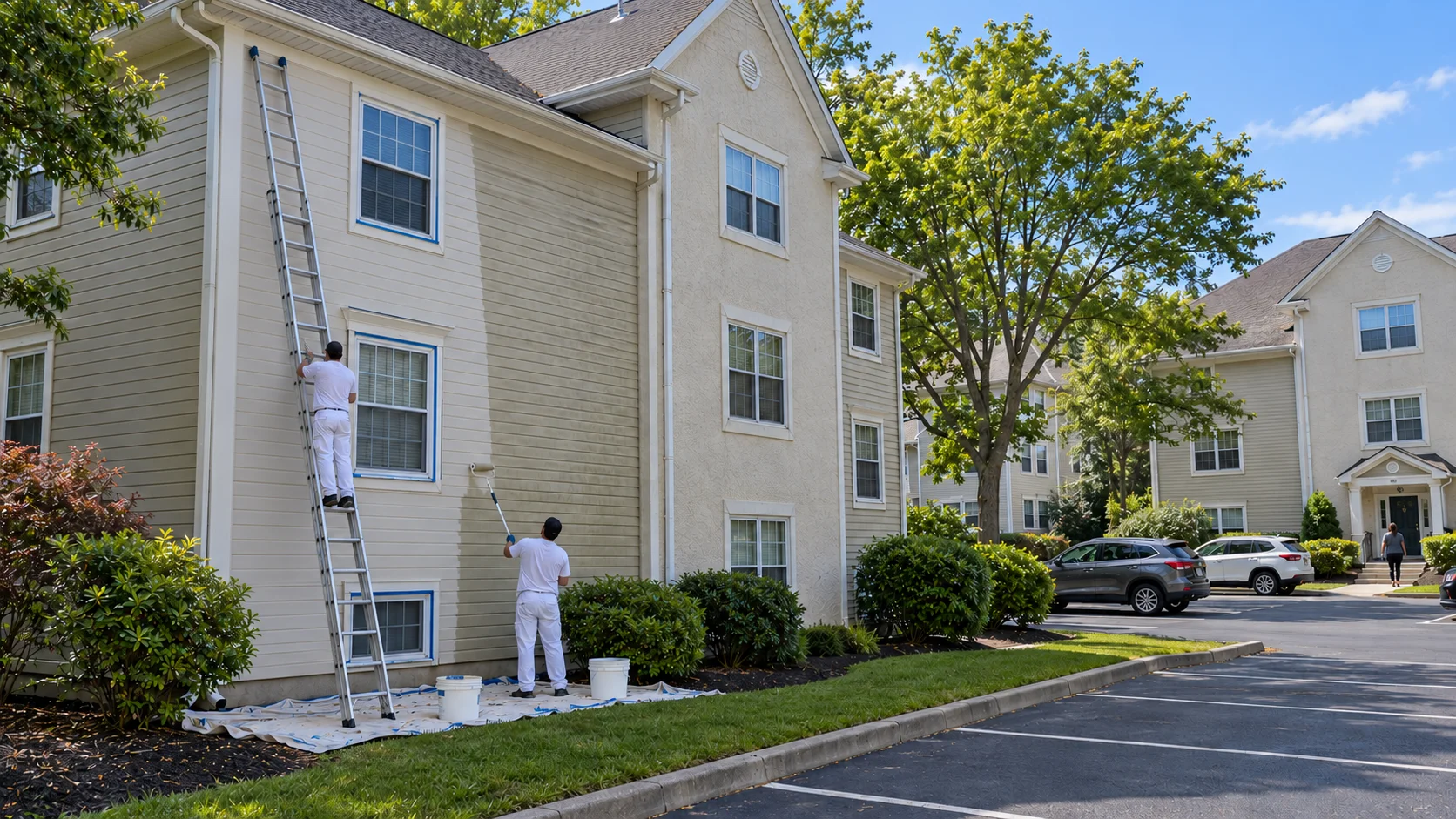
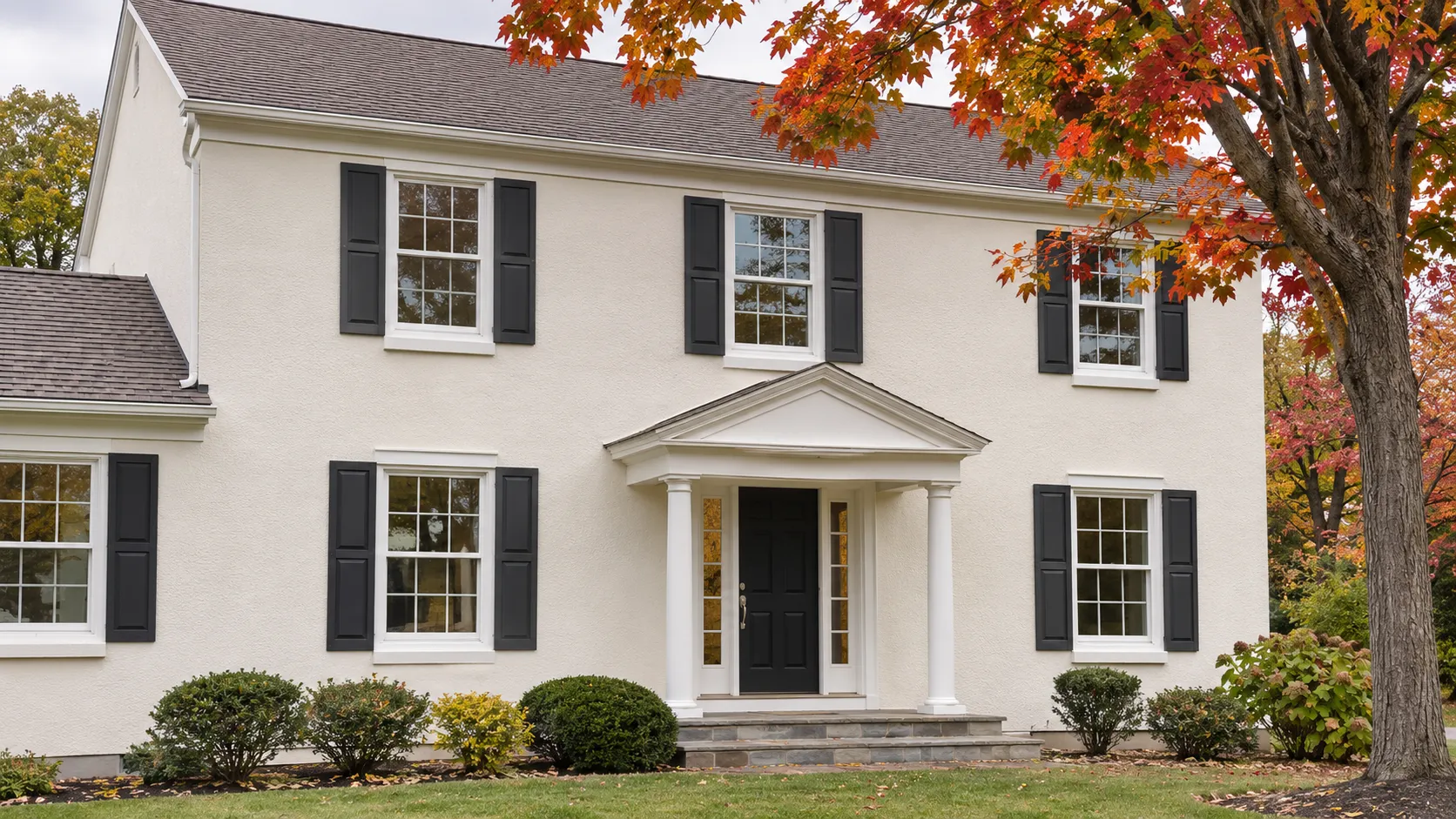
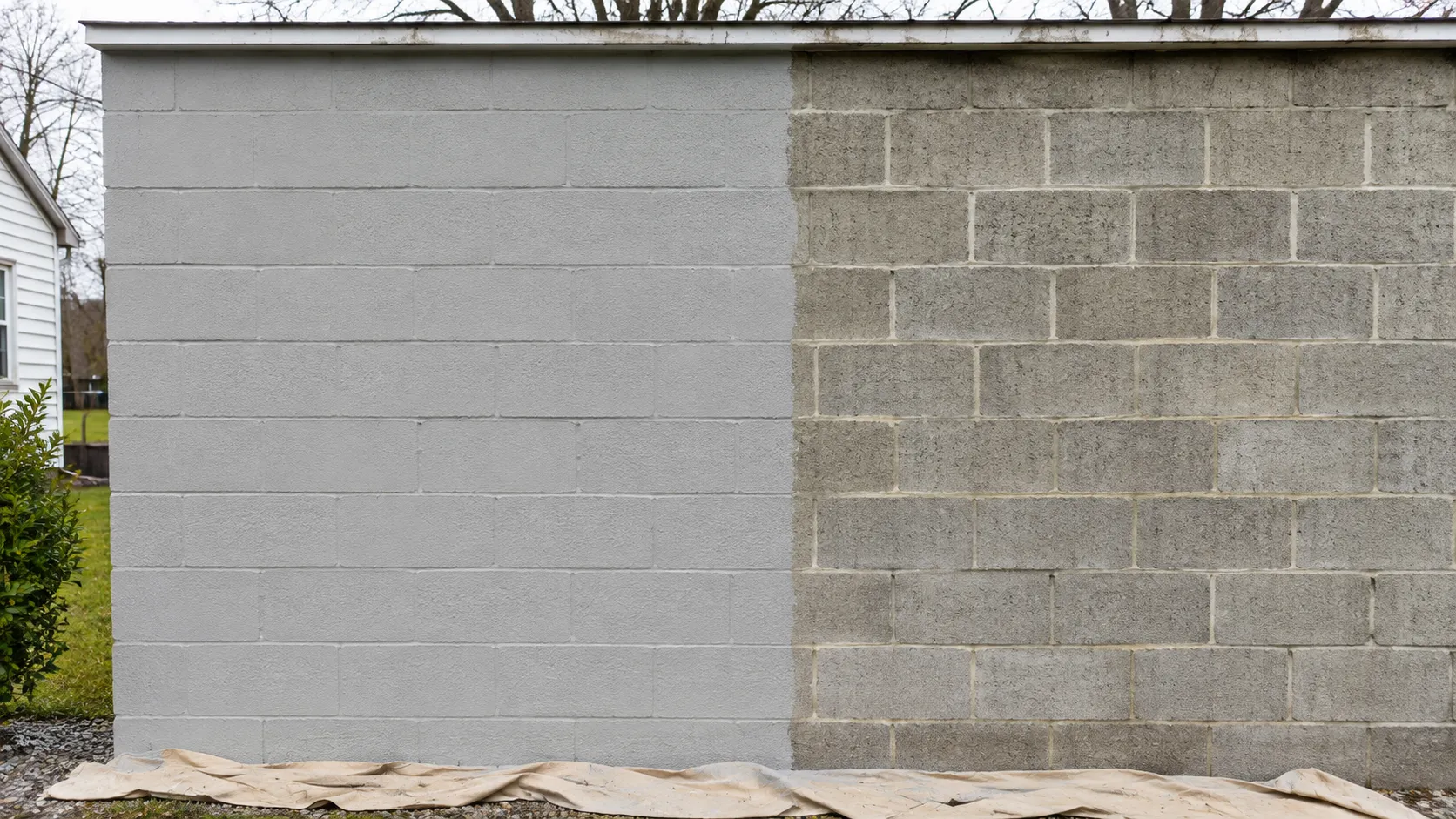
On a New Jersey house that usually means one of four places. Hard-coat cement stucco, especially the hairline-cracked kind, is the classic elastomeric wall, and our stucco painting guide covers stucco as a whole. Concrete block, or CMU, on foundations, garages, sheds and commercial buildings is porous and often cracked along the mortar joints, and an elastomeric over a block filler gives it a uniform, rain-resistant finish. Poured or precast concrete walls take it too. And EIFS, the foam-and-finish system that looks like stucco, can take an elastomeric made for it; Dryvit lists EIFS on its own coating's sheet, which is the reason to match the coating to the system's maker.
Two surfaces on that list deserve a caution. Fiber cement siding appears on Benjamin Moore's sheet, but James Hardie's own instruction is a 100 percent acrylic topcoat, and our fiber cement painting guide explains why we rarely think a heavy film over the laps is the right call. And brick appears on Sherwin-Williams' sheet, but sound brick is a different case. The Park Service's warning about waterproof coatings is written about masonry like brick, and in our practice we avoid elastomeric on sound brick walls, as our brick painting guide says.
The surfaces that are not on any wall elastomeric's list matter just as much: cedar and other wood siding, roofs, floors, decks, below-grade walls and anything indoors in wet rooms such as showers. The sections below take those one at a time.
Can You Put Elastomeric Paint on Wood Siding?
You can find a data sheet that allows it with a primer, but we do not do it on wood lap siding, and we would not recommend it. Wood moves with every change in moisture, it needs to breathe out through its finish, and a thick, tough film that keeps water out also slows the wood from drying when water gets in behind it.
The sheets are more permissive than the warnings online. Benjamin Moore's 359 lists primers for "Wood, and engineered wood products" and for "Bleeding Woods (Redwood, Cedar, etc.)." Sherwin-Williams' Loxon XP has a system for "Incidental Wood": "1 coat Exterior Latex Wood Primer, 1-2 coats Loxon XP." Those entries are there because a masonry wall has wood on it: a door frame, a fascia board, a trim band. Coating that incidental wood with the wall coating keeps the colour and sheen uniform. They are not instructions for coating a whole house of clapboard.
Wood lap siding behaves differently from stucco. Each board swells and shrinks across its width as the seasons change, the laps and butt joints open and close, and water that gets in at a joint or behind a board has to get back out through the wood and its finish. Stucco makers call that outward movement vapor drive, and wood depends on it. A conventional exterior acrylic latex for wood is designed for exactly that. A heavy elastomeric film bridges the laps, seals the joints shut and holds any water that does get in against the wood. Building Science Corporation describes the ideal coating system for wood as "hydrophobic (sheds water), vapor permeable (breathes)," and puts the optimum for a whole acrylic latex system, primer and two topcoats, at 3.5 to 5 dry mils. A single coat of elastomeric, at 6 to 8 dry mils, is thicker than that entire system.
What we do on wood siding instead is the ordinary, well-proven system: sound or scraped surface, the right primer on bare wood, and a 100 percent acrylic exterior paint, all of which is in our wood siding and cedar shake guide. Sherwin-Williams' advice for cedar is that it "is best primed with an exterior oil-based wood primer" to stop tannin bleed. If a wood wall is failing so badly that someone is reaching for an elastomeric, the wall almost always has a water or wood-condition problem, and paint will not fix either. We will point out rotted boards at the estimate; replacing them is carpentry we do not do.
Will Elastomeric Paint Fix Cracked Stucco?
It will hide and seal hairline cracks, and that is one of the best reasons to use it. It will not fix wider cracks on its own, and it will not stop a crack that is still moving.
Some cracking is normal. The stucco and lathing trade associations' crack bulletin, whose members include the Portland Cement Association, says stucco "is by nature hard and strong, but it is relatively thin and brittle and will crack when subjected to stresses that exceed its tensile strength," and that the owner "should expect hairline cracks and diagonal cracks emanating from the corners of windows and doors." The Stucco Manufacturers Association agrees that "elastomeric coatings can help hide cracks in stucco."
How much an elastomeric can bridge is printed on the sheets, and the two big brands agree closely:
| Crack width | Benjamin Moore Ultra Spec Masonry Elastomeric | Sherwin-Williams ConFlex XL Smooth |
|---|---|---|
| Up to 1/32 inch | "will bridge cracks up to 1/32"" | "Apply one coat of Loxon Acrylic Primer and follow with 1 or 2 coats of ConFlex XL" |
| 1/32 to 1/16 inch | "should be filled with caulk and over coated with a brush or knife grade elastomeric patch" | bridge "with an elastomeric patch or sealant," feathered to zero at the edges |
| 1/16 to 3/8 inch | "should be routed out to 1/4" by 1/4"" and repaired with caulk and patch | opened to a sound surface, flushed, filled with patch or sealant with "a small crest," no more than 1/4 inch deep per application |
| Moving or structural | not covered | "Not recommended for bridging joints or dynamic cracks" |
So the true crack bridging range of the coating itself is about 1/32 inch, the width of a thin pencil line. Anything up to 1/16 inch gets an elastomeric patch first, and wider cracks are opened up and filled. Some guides cite ASTM C836 for crack bridging; that is a standard for liquid waterproofing membranes, and neither wall coating sheet we read cites it. What they do print is elongation, and Sherwin-Williams lists a low-temperature flexibility test at 10°F ("Pass") for ConFlex XL, which matters on a January wall going through freeze-thaw cycles. Loxon XP lists "Crack Bridging: Class A5 ... up to 2.5 mm @ -10°C" by a European method.
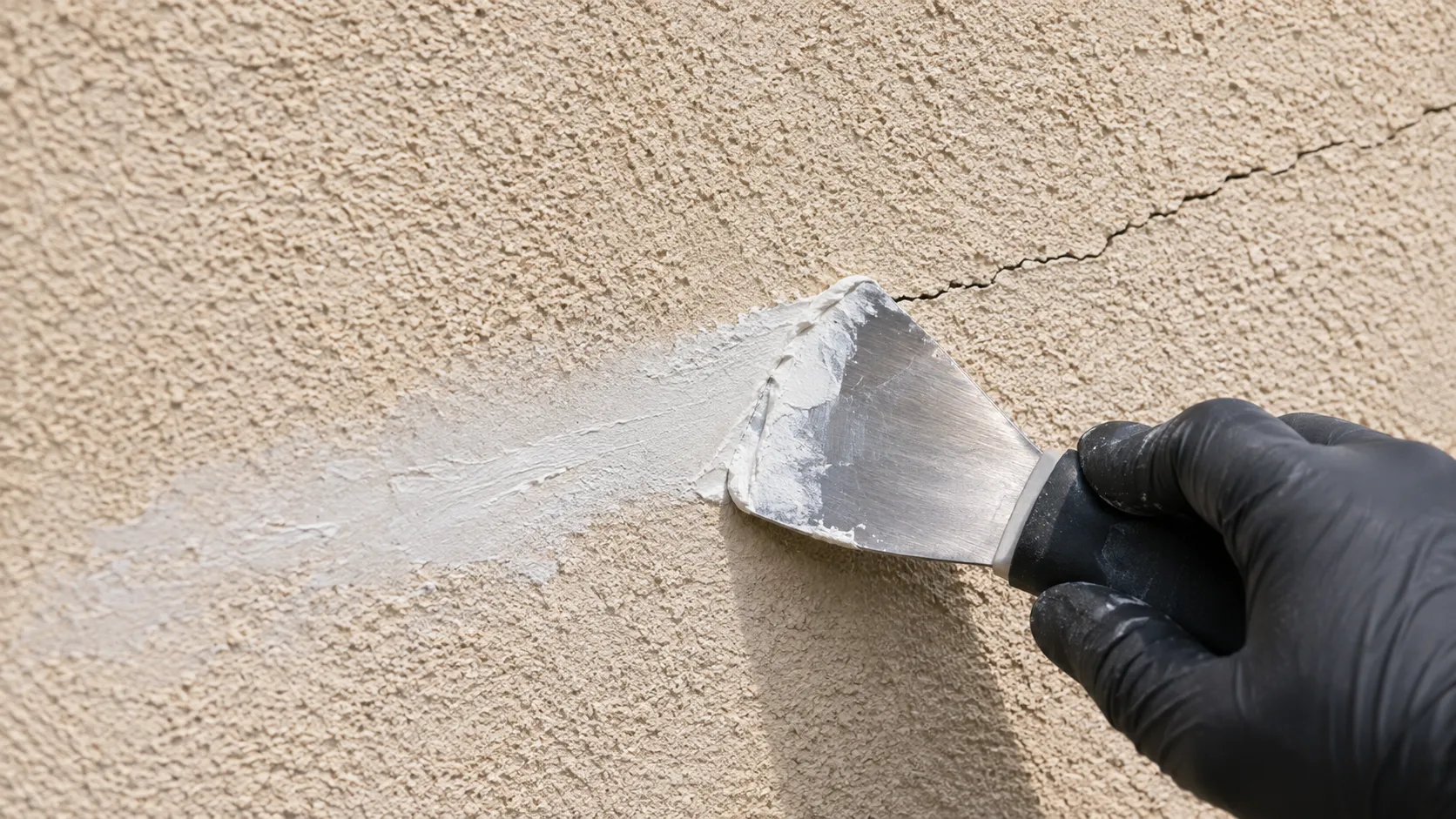
Patching is a careful job. Benjamin Moore's Moorlastic Textured Brush Grade patch "is ideal for repairing hairline cracks on masonry and stucco surfaces," and must not go on when air and surface temperatures fall below 50°F "in a 24 hour period," which rules out many March and April weeks. Sherwin-Williams says the patch "must be feathered to zero at the edges ... to prevent the repaired area from telegraphing through the subsequent finishes." A patch that is not feathered will telegraph through as a raised line, even under 15 mils of coating.
And some cracks are not paint problems. A crack that is wider than about 3/8 inch, has offset edges, keeps reopening, or comes with bulging or hollow-sounding stucco is a structural or attachment problem. We repair stucco cracks and patch stucco as part of the job, but we inspect for movement, and a crack that keeps moving needs its cause found first. Coating over it buys a season.
Do You Need a Primer or Conditioner Under Elastomeric?
On new, bare, patched or chalky masonry, yes. On sound previously painted stucco or block, often not, or only a conditioner. The data sheets say exactly when.
New cement is strongly alkaline, and alkali attacks paint binders. Benjamin Moore says "for optimal system performance new masonry should cure 30 days prior to application of the sealer / coating system and have a pH of 10 or less." If the schedule cannot wait, masonry "allowed to cure for 7 days under normal drying conditions and has a pH of 13 or less may be sealed with Ultra Spec Masonry Interior / Exterior 100% Acrylic Masonry Sealer (608) or Ultra Spec Masonry High Build Primer (N609) prior to finishing." Sherwin-Williams says much the same for ConFlex XL: concrete "must be dry and cured at least 30 days and a pH of less than 10 to apply this product directly," or cure 7 days at 75°F and prime with Loxon Concrete & Masonry Primer. That primer is "highly alkali and efflorescence resistant" and "can be applied to a surface with a pH of 6 to 13," on surfaces including "Stucco, EIFS."
Old paint that rubs off as powder is the second case. Sherwin-Williams' recommended system for previously coated walls is: "After power washing, apply 1 coat of Loxon Conditioner to tie any residual chalk to the surface," then one or two coats of ConFlex XL. Elastomeric over chalk is a coating stuck to dust.
Rough or porous block is the third. Benjamin Moore's system for "Rough or Pitted Masonry" starts with its Hi-Build Masonry Block Filler 571, and Sherwin-Williams' block system starts with ConFlex Block Filler or Loxon Acrylic Block Surfacer. Block filler is a preparatory coat only: Benjamin Moore says 571 "should not be used as a waterproofing sealer or as a finish coat." Its job is to fill the pores so the elastomeric can build a continuous film without pinholes.
There are also things that have to come off. Benjamin Moore says "cement based waterproofing paints should be removed" and "glossy surfaces must be dulled." Both brands warn about efflorescence, the white mineral bloom the Stucco Manufacturers Association describes as salts drawn out of the wall as it dries after rain. It is brushed and washed off before priming, and if it keeps coming back, the wall is still taking on water. Our basement walls guide covers the same masonry primers and efflorescence from the inside.
Which Elastomeric Coatings Do the Data Sheets Support?
These are the products whose sheets we read in full. All are 100 percent acrylic or a proprietary acrylic, all are flat or near-flat, and all come in a wide colour range.
| Product | What the sheet calls it | Dry film per coat | Coverage per gallon per coat | Elongation | Vapor permeance | Minimum temperature |
|---|---|---|---|---|---|---|
| Benjamin Moore Ultra Spec Masonry Elastomeric Flat 359 | "high-build, flexible 100% acrylic coating" | 6.3–7.8 mils | 80–100 sq ft | 200% (D2370) | 32 perms | 50°F |
| Benjamin Moore Ultra Spec Masonry Elastomeric Low Lustre 360 | same | 7.1–8.8 mils | 80–100 sq ft | 300% (D2370) | 38 perms | 50°F |
| Sherwin-Williams ConFlex XL Smooth | "an elastomeric coating" | 6.0–7.5 mils (2 coats) or 12–15 (1-coat spray) | 100–125 or 50–60 sq ft | 250% (D2370) | 16.9 perms | 50°F |
| Sherwin-Williams Loxon XP | "exterior, high build coating" | 6.5–8.4 mils | 85–110 sq ft (80 on rough stucco) | 335.4% (D412) | 18.03 perms | 35°F |
| Dryvit Weatherlastic Smooth | "water-based elastomeric wall coating" | 11–12.2 mils for two coats | about 65–72 sq ft | not on the sheet | not on the sheet | protect from rain 24 h at 70°F |
All four Benjamin Moore and Sherwin-Williams products list a pass on ASTM D6904, the wind-driven-rain test. Benjamin Moore's result is for "2 coats (20 mils WFT per coat) over CMU," and Sherwin-Williams' is for two coats of Loxon XP at 8.1 dry mils each.
A few notes on reading the table. Loxon XP is not marketed as an elastomeric, but its stretch figure is the highest on the list and it can go on at 35°F, which makes it the product we look at for a late-season masonry job. ConFlex XL is Sherwin-Williams' named elastomeric; its cheaper sibling, ConFlex SherLastic, appears in the same product guide as "Acrylic elastomeric for exterior vertical surfaces." Benjamin Moore's flat 359 hides surface imperfections best, and the low-lustre 360, with its 300% elongation, trades a little hiding for a finish that, in Benjamin Moore's words, "stays clean longer." Dryvit's coating is the one to talk about on Dryvit EIFS.
Some guides also list Behr and Rust-Oleum elastomerics. We did not read those sheets (behr.com blocks automated reading, and the Rust-Oleum product the guides name is a roof coating), so they are not in the table. Whatever brand you look at, the questions are the same: what does the sheet say about elongation (not ASTM C836, which is a membrane standard), perms, dry film per coat, coverage and the minimum temperature, and does it list your surface and a compatible primer?
How Is Elastomeric Paint Applied?
Slowly, thickly and in the right order. This is the sequence we follow on a stucco or block wall, with the data sheet requirement behind each step:
- Find and fix the water first. Gutters, downspouts, flashing, grade and anything leaking into the wall. A coating over a wet wall is the commonest elastomeric failure we are asked to look at.
- Clean the wall. Benjamin Moore says new masonry "must be power washed or brushed thoroughly with stiff fiber bristles," and that sheltered areas such as eaves and porch ceilings "should be washed with an appropriate cleaner and rinsed with a strong stream of water." We power wash at a pressure the stucco can take, then let the wall dry.
- Scrape and sand failing paint. Sherwin-Williams: "Existing peeled or checked paint should be scraped and sanded to a sound surface. Glossy surfaces should be sanded dull." On a house built before 1978, read the lead section below before anyone scrapes.
- Repair cracks by width, with caulk and elastomeric patch, feathered to zero so they do not telegraph, and let them cure.
- Prime or condition where the sheet calls for it: masonry primer on new, bare or patched areas, conditioner over chalk, block filler on rough block.
- Stripe the corners. Sherwin-Williams says to "stripe coat all inside and outside corners and edges with 1 coat of ConFlex XL."
- Apply the first coat at full build. Brush, roll or airless spray and back-roll. Benjamin Moore's spray settings are "2,500 – 3,000 PSI" with a "0.021 – 0.031" tip; Sherwin-Williams lists 2,300 psi and a .021 tip. Keep a wet edge so the finish does not go lumpy, and work the material into the surface "to fill all cracks and voids."
- Check the film as you go. A wet-film gauge or a gallons-per-wall count, against the sheet's spread rate.
- Let it dry. Benjamin Moore: dry to touch in 2 hours and ready to recoat in 12 at 77°F and 50 percent humidity; Sherwin-Williams: 4 hours and 24 hours. Some guides say 24 to 36 hours; cool, damp weather stretches every figure.
- Apply the second coat and inspect the wall in raking light for pinholes and thin spots before the scaffold or ladder moves.
Some guides say to strip old paint completely before an elastomeric goes on. That is not what the sheets say for sound paint: both brands have a system for "previously coated" walls in good condition. What has to go is paint that is peeling, scaling, chalking badly or cement-based. Some also say two coats minimum. That is right for the two-coat systems, and for porous block and stucco it is what Sherwin-Williams recommends "due to the typical porosity of these surfaces," but ConFlex XL also has a one-coat spray system at double the build.
What Weather Does Elastomeric Paint Need in New Jersey?
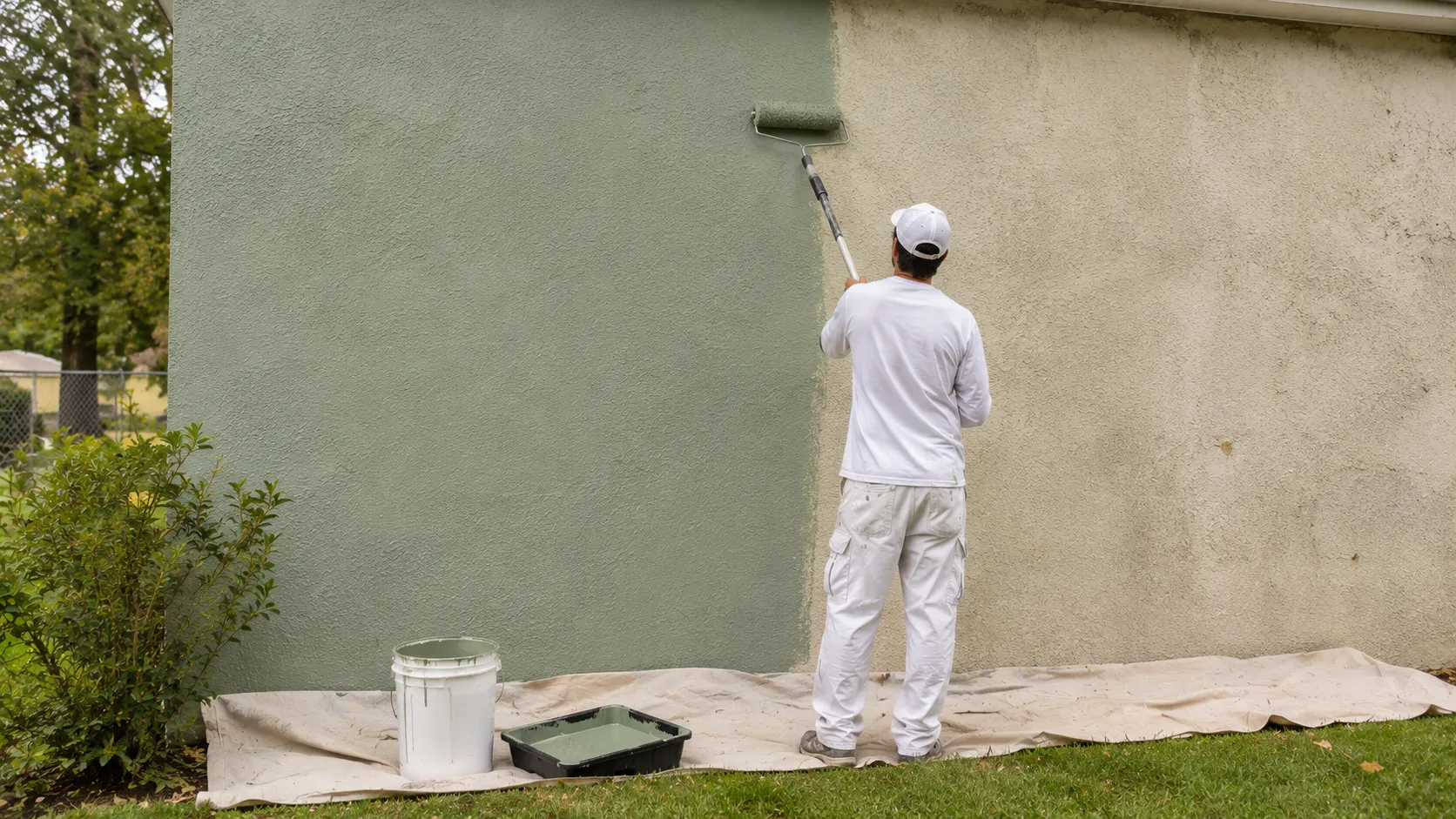
Warm, dry and settled. Elastomerics go on heavy and stay soft longer than house paint, so they are more sensitive to temperature, rain and dew while they dry.
The minimums on the sheets: both Benjamin Moore elastomerics say "Do not apply when air or surface temperatures are below 50°F" and "Do not apply if rain or threatening weather is expected within 24 hours." ConFlex XL is to be applied "between 50°F-100°F." Loxon XP can go on down to 35°F, but its sheet says the air, surface and material must be "at least 5°F above the dew point," and not to apply "when air or surface temperatures may drop below 35°F within 48 hours." Dryvit says to protect Weatherlastic Smooth "from rainfall for 24 hours at 70°F, 55% R.H., longer when temperature is cooler and when relative humidity is higher," and to "avoid applying ... in direct sunlight. Always work on the shady side of the wall."
Benjamin Moore explains why it is stricter than for normal paint: "Because it is applied in very heavy coats, Ultra Spec Masonry Elastomeric Waterproof Coating will remain sensitive to rain and moisture condensation longer than conventional coatings. Make sure to leave ample drying time between application of the coating and exposure to moisture." A heavy dew or a shower on a coat that has not dried is exactly what that warning is about, and Benjamin Moore says the finished wall should not be washed for two weeks.
New Jersey makes that a scheduling problem. Rutgers' state climate office says "coastal storms, often characterized as nor'easters, are most frequent between October and April," and that "high humidity and moderate temperatures prevail when winds flow from the south or east." The state averages 163 freeze-free days in the northern highlands and 179 in the central and southern interior, so the 50°F window is real but not long, and the freeze-thaw months that open stucco cracks are exactly the months you cannot coat them. In our experience the best elastomeric weeks are late spring and early fall, when walls have dried out, mornings are not yet cold and dew burns off early. Some guides name April as the ideal month; in much of the state, April walls are still too cold or wet in the morning for a 50°F product. Some also promise the coating dries in 24 to 36 hours. The sheets say to recoat at 12 to 24 hours at 77°F, and "high humidity and cool temperatures will result in longer dry, recoat and service times."
We also watch the sun. A sunny south wall on a hot afternoon can run far above air temperature, and Benjamin Moore's maximum is 100°F. Dryvit's advice to work on the shady side applies to any heavy-bodied coating. For the general rules on cold-weather painting, see our guide to how cold is too cold to paint outside, and for timing a whole exterior, the best time to paint a house in NJ.
Is Elastomeric Wall Paint the Same as an Elastomeric Roof Coating?
No. They share a word and some chemistry, but they are different products made for different jobs, and the wall coatings say so on their own sheets. We also do not do roofing of any kind, including roof coatings.
A roof coating, in the definition of the Roof Coatings Manufacturers Association, is "designed for protecting and extending the useful service life of roof assemblies," and "roof coatings are applied to low slope roofs on residential, commercial, and industrial buildings." The association lists "acrylic coatings, asphalt coatings, polyurethane coatings, and silicone coatings" as the common types, and says the cured resins "form an elastomeric and durable film." Many are white and reflective (the Rust-Oleum product some guides list is one), sold as a cool roof coating for energy efficiency because they bounce UV and heat. Some guides add that certain silicones do not suit some single-ply membranes such as EPDM. That is all roofing territory: membrane compatibility, ponding water, seams and drains.
New Jersey's VOC rule treats them as separate products too. N.J.A.C. 7:27-23 has its own "Roof coating" category, "a non-bituminous coating labeled and formulated for application to roofs for the primary purpose of preventing water penetration, reflecting ultraviolet light, or reflecting solar radiation."
The wall coatings rule out the roof themselves. Sherwin-Williams' ConFlex XL: "Not recommended for roofing applications." Loxon XP: "Not for use on horizonal surfaces (floors, roofs, decks, etc.) where water will collect." Dryvit's Weatherlastic Smooth "must not be used on exposed exterior horizontal surfaces." A wall coating is built to shed water running down a vertical face; a roof coating is built to sit under standing water and sun.
So if someone offers to put "the same elastomeric" on your stucco and your flat roof, ask which product, and read both sheets. For a roof, talk to a roofer. For the walls, the sections above apply, and our exterior painting service covers what we do.
Can You Use Elastomeric Paint on Basement Walls, Floors or Patios?
Not as a waterproofing system, and not on anything you walk or drive on. The data sheets are blunt about it.
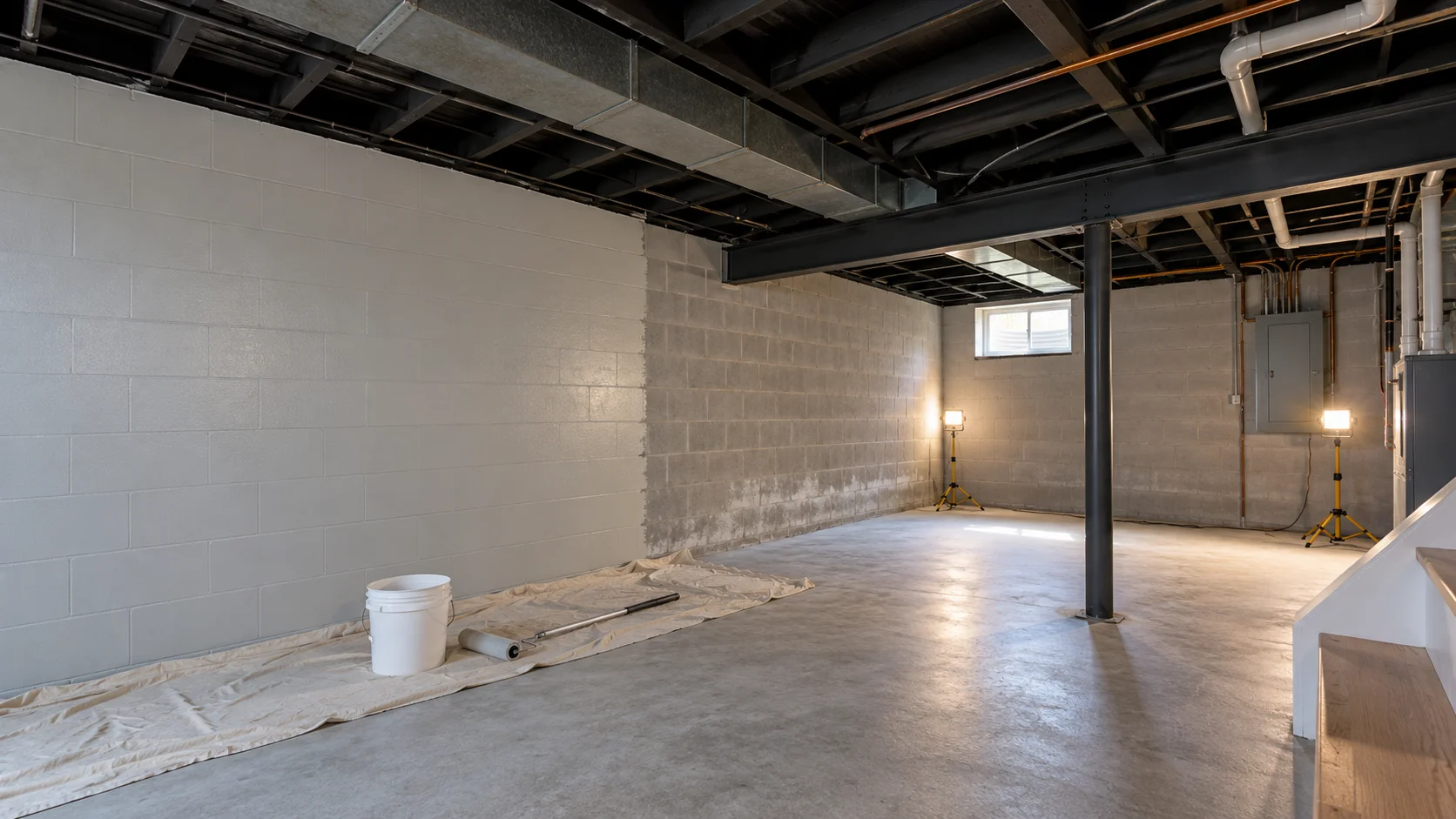
Basement walls. ConFlex XL is "Not for use below grade or underwater. Will not withstand hydrostatic pressure." Loxon XP: "Not for use below grade. Will not withstand hydrostatic pressure." Dryvit: "Not for use below grade or in immersion service." Benjamin Moore's patch is "not for use below grade or under water." A foundation wall that takes water from the soil outside pushes it through the block under pressure, and no wall paint, however stretchy, holds that back. Basement waterproofing is a separate trade and not one we offer. What we do is paint basement walls that are dry, with the right masonry primers and paints, which is all in our basement walls and ceilings guide. An elastomeric is not the product we reach for there; it does not add anything a dry basement wall needs, and on a damp one it is the wrong tool.
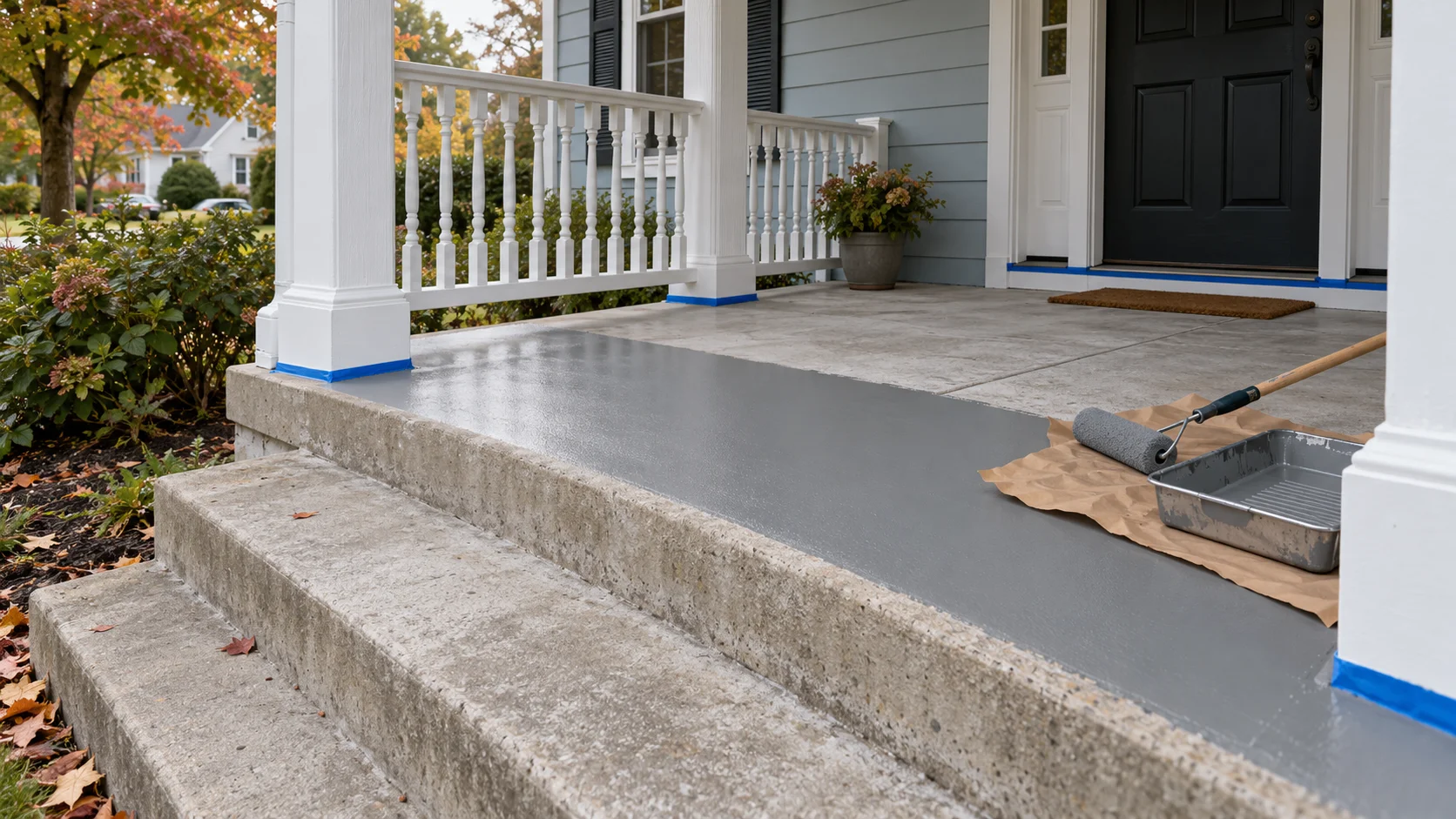
Floors, patios, steps and decks. ConFlex XL is "Not for use in areas subject to vehicle traffic," and both Sherwin-Williams and Dryvit exclude horizontal surfaces. Walking surfaces need a floor or porch coating designed for abrasion and traction. Our guide to painting concrete patios and porches covers those products, and for a garage slab, our epoxy floor coating service.
Inside the house. Benjamin Moore's and Sherwin-Williams' elastomerics are exterior products. Dryvit's Weatherlastic HB lists "exterior and interior above-grade substrates," and some guides suggest elastomeric for interior wet rooms. We do not use wall elastomerics for showers or bathrooms; a bathroom wants a good interior bath paint and an exhaust fan, and a shower wants tile.
Can You Paint Over Elastomeric Paint?
Yes, and the usual answer is to recoat it with another elastomeric or a compatible high-build masonry coating. Going back to a thin conventional house paint is where people get into trouble.
The sheets have a system for this. Sherwin-Williams' recommended system for "Previously Coated" masonry is: "After power washing, apply 1 coat of Loxon Conditioner to tie any residual chalk to the surface," then "1-2 coats ConFlex XL High Build Coating." Loxon XP's sheet says "Previously Coated in good condition: After power washing, apply 1 coat of Loxon XP over the surface." Benjamin Moore lists its elastomerics for "previously painted surfaces." All three expect the old coating to be sound, clean and dull.
The trouble case is putting a thin, more rigid paint over an old elastomeric. Some guides say the less flexible top coat will crack and peel prematurely as the soft film underneath moves. That fits how the materials behave: the elastomeric stretches and the paint on top does not. No sheet we read lists an ordinary house paint as a recoat system over elastomeric, so our practice is to recoat like with like, or with a product whose sheet names elastomeric as a compatible substrate. If the job is to change the look to a thin, low-build finish, the old film has to be evaluated first, and sometimes the honest answer is that the wall stays elastomeric.
Can you remove it? Only with a lot of work. Some guides tell you to strip old paint before recoating, but an elastomeric bonded well to stucco is tough, thick and stretchy, which is the whole point of it. Sherwin-Williams notes that "any surface preparation short of total removal of the old coating may compromise the service length of the system," which is a reason to get the first decision right, not a reason to strip every wall. In our experience the realistic path on a sound elastomeric wall is wash, repair, condition and recoat. Loose, blistered or peeling areas are scraped back to a sound edge and feathered.
There is one more rule when you paint over old paint on a house built before 1978: the lead rule. It is covered below.
How Long Does Elastomeric Paint Last?
None of the data sheets we read gives a service life in years, so any figure you see online is somebody's experience, not a published rating. What the sheets do say is that life depends on film build and prep.
The guides disagree widely. Some say elastomeric lasts over a decade. One New Jersey commercial painter puts it at 10 to 15 years when applied correctly, against 5 to 7 years for traditional paint. Others say up to ten years. None of them cites a test, and none says how thick the coating was or what the wall was like.
The sheets point to three things that decide it. First, film build. Dryvit makes 11 dry mils the minimum for its waterproofing performance, and Sherwin-Williams makes 12 to 15 the minimum for a waterproofing system; on porous walls that effectively means two coats minimum. A coating spread to 4 mils to save material is not the product on the sheet. Second, prep: Sherwin-Williams writes that "any surface preparation short of total removal of the old coating may compromise the service length of the system." Third, the wall: on a dry, sound wall with its cracks repaired, an elastomeric holds up; on a wall that is wet from behind, it can blister in the first summer.
Exposure sets the repaint cycle too. A south or west wall in full sun, a wall that takes driving rain off open ground, or a building near the shore weathers faster than a sheltered north wall, which is why we look at each elevation rather than the house as a whole. For how often the rest of an exterior usually needs repainting in this state, see our guide to how often to paint a house exterior in NJ.
Is it worth the lifecycle cost? On a cracked stucco or block wall that would otherwise show cracks through ordinary paint within a few seasons, often yes. On a sound wall, a good acrylic masonry paint usually gives most of the life for much less material, and it is easier to recoat later.
What Are the Pros and Cons of Elastomeric Paint?
The pros
- It stretches and bridges hairline cracks. 200 to over 300 percent elongation on the sheets, and up to 1/32 inch of bridging on Benjamin Moore's, with a patch first up to 1/16 inch.
- It resists wind-driven rain. Both brands pass ASTM D6904. That is as close to waterproof as a vertical wall coating gets.
- It hides a lot. A flat, thick, heavily pigmented film evens out patched and uneven masonry. Benjamin Moore says its flat "helps hide minor surface imperfections."
- It still passes vapor. The tested films run 16.9 to 38 perms, above the 10-perm vapor-permeable line.
- It resists efflorescence and mildew on the film, according to both brands' sheets.
The cons
- It costs more per wall. It is more expensive per gallon, and it also covers less: it covers 80 to 125 square feet per coat against several hundred for house paint, and it takes more time to apply properly, which matters on a tight budget.
- It takes more skill. It is harder to apply well than house paint: spray and back-roll, full build, steady wet edge, check the film thickness, and stay inside a weather window.
- It mutes texture. The Stucco Manufacturers Association lists "Impacts on the Muting of Stucco Texture" as a consideration. Each coat softens a fine sand finish.
- It does not fix water problems, and on a wall that is wet from behind it can blister and peel in sheets. That is the core of the "trap moisture" warning.
- It is hard to go back. Once a wall is elastomeric, it usually stays elastomeric, and thin paint over it can peel prematurely.
- It is limited to masonry. Not wood lap siding, roofs, floors or below grade, and in our practice not sound brick.
Two claims we leave out. Some guides call elastomeric insulating. A coating a few hundredths of an inch thick is not insulation; the energy efficiency claims belong to reflective cool roof coatings. And UV resistance is not special to elastomerics: every good exterior acrylic is built to resist sunlight. The honest case for elastomeric is crack bridging and rain resistance on masonry, and it is a strong one.
What About Old Paint, Lead and New Jersey's VOC Rules?
Two rules apply before an elastomeric goes on an older or painted wall.
Lead. Old masonry paint, especially on older homes built before 1978, may contain lead, and elastomeric prep involves scraping and sanding failed paint. Benjamin Moore's elastomeric sheet carries the warning: "If you scrape, sand, or remove old paint, you may release lead dust. LEAD IS TOXIC." The EPA's Renovation, Repair and Painting rule says "anyone paid to perform work that disturbs paint in housing and child-occupied facilities built before 1978 must be certified in lead-safe work practices," and the agency "recommends that homeowners hire a lead-safe certified contractor." We are not an EPA Lead-Safe Certified firm. That is a licensing fact, not a matter of wording. We do not scrape or sand paint on homes built before 1978. If your house was built before 1978 and old paint will be scraped or sanded by someone else, ask that contractor for their firm certification number and check it on the EPA's Renovation, Repair and Painting program page. Our guide to lead paint in older NJ homes covers testing and New Jersey's own rules.
VOC. New Jersey limits the volatile organic compounds in architectural coatings under N.J.A.C. 7:27-23. An elastomeric wall coating with a gloss of 15 or less at 85 degrees falls under the rule's "flat coating" definition, which had a limit of 100 grams per litre and drops to 50 for products manufactured on or after 18 August 2026. The sheets we read list ConFlex XL and Loxon XP at "less than 50 grams per litre" and Benjamin Moore's 359 and 360 at "< 100 g/L" on sheets dated November 2024, so for any Benjamin Moore elastomeric made after that date, check the current sheet and the can.
What We Do, and Do Not Do, With Elastomeric Coatings
- We apply elastomeric and weatherproof coatings to stucco, concrete block, concrete and tilt-up walls, in Benjamin Moore and Sherwin-Williams products, as part of exterior painting on homes, HOA and condo buildings and commercial properties.
- We tell you when you do not need one, and recommend a breathable acrylic masonry paint on sound walls.
- We look for the water first, and point out anything structural or anything that needs another trade before we coat.
- We clean, scrape, repair stucco cracks by width, patch stucco and caulk, and prime, condition or block-fill as the data sheet calls for.
- We apply at the data sheet's film build, with spray and back-roll on rough surfaces, and check the coverage as we go.
- We schedule to the product's weather limits, not to the calendar.
- We write the product, primer, number of coats and surfaces on the estimate, so you can compare bids line by line.
What we do not do: roofing of any kind, including roof coatings over shingles, metal or EPDM; basement waterproofing; floor or deck coatings with a wall elastomeric; elastomeric on wood lap siding; exterior rot repair or siding replacement (we will point out rotted wood at the estimate); historic restoration; and mould treatment, though we wash mildew off before painting. Our power washing cost guide and our mildew guide cover the washing side. And we do not hold EPA Lead-Safe (RRP) certification: on a house built before 1978, ask us, and every other bidder, for a firm certification number before anyone scrapes or sands old paint. For bigger buildings, see our commercial painting and industrial painting services and our HOA and condo painting guide.
Get a Price for an Elastomeric Coating
An elastomeric job is priced by the wall, not the gallon: the area, the height and access, how much crack repair and patching the stucco or block needs, whether it needs primer, conditioner or block filler, and how many elevations take the full system. That is why we look at the walls rather than quote from a photo. For how exterior pricing is built, see what it costs to paint a house in NJ, the stucco section of our stucco painting guide and our painting cost guide. NJ Painting Co. is a family-owned painting company in Morganville, working on New Jersey homes for more than 20 years with Benjamin Moore and Sherwin-Williams products. Every estimate is free and spells out surfaces, prep, products and number of coats, and we can help with colour too. For the work itself, see our exterior painting service. Call (732) 239-0932 or request a free estimate, and ask us about the job minimum when you enquire.
Frequently Asked Questions
What is elastomeric paint made of?
The wall elastomerics sold in New Jersey are water-based 100 percent acrylic resin coatings, with titanium dioxide pigment, a mildewcide and a lot of solids. Benjamin Moore calls its version "a high-build, flexible 100% acrylic coating," and Sherwin-Williams lists ConFlex XL's vehicle as "100% Acrylic." The acrylic polymers are formulated to stay rubbery, so the film stretches 200 to over 300 percent before it breaks. Solvent butyl, silicone and polyurethane elastomerics exist, but they are mostly roof and industrial products.
Is elastomeric paint better than acrylic paint?
Only on the right wall. On stucco or block with widespread hairline cracking, or a wall that takes driving rain, elastomeric bridges the cracks and passes wind-driven-rain testing. On a sound wall, a breathable acrylic masonry paint does the job for less material and is easier to recoat. The Stucco Manufacturers Association recommends a vapor-permeable paint made for stucco and says elastomeric is "not required" to keep water out of properly applied stucco.
Does elastomeric paint trap moisture?
Its vapor permeability is good: the sheets list 16.9 to 38 perms, above the 10-perm line for vapor permeable. It does not let liquid water out of a soaked wall. If water gets in behind it from a leak, poor drainage or a high grade, the tough film holds it, and the wall can blister. The National Park Service warns against waterproof coatings, including elastomerics, on historic masonry above grade. Fix the water first.
Is elastomeric paint waterproof?
It is rain-resistant on an above-grade wall, not a waterproofing system. Benjamin Moore and Sherwin-Williams both report a pass on ASTM D6904, a wind-driven-rain test, but only at full film build: Sherwin-Williams requires 12 to 15 dry mils in total and no more than 10 pinholes per square foot for ConFlex XL, and 13 to 16.8 mils for Loxon XP. Both sheets also say the coating will not withstand hydrostatic pressure and is not for use below grade. A wet basement or a leaking wall needs its water source fixed, and basement waterproofing is not work we do.
Can you use elastomeric paint on wood siding?
Some data sheets list primers for wood, mainly for incidental trim on a masonry wall, but we do not put elastomeric on wood lap siding or logs. Wood boards swell and shrink, the laps and joints need to stay open to drain, and wood needs to dry out through its finish. A thick elastomeric film bridges the laps and holds water against the wood, where it can lead to decay. A 100 percent acrylic exterior paint over the right primer is the proven system for wood.
How thick is elastomeric paint?
About 16 to 20 wet mils and 6 to 8 dry mils per coat on the Benjamin Moore and Sherwin-Williams sheets, against 2.3 dry mils for a high-build house paint: about three times, not the ten times thicker some guides claim. Sherwin-Williams' one-coat ConFlex XL spray system goes on at 12 to 15 dry mils. Waterproofing systems need a minimum total: 12 to 15 dry mils for ConFlex XL, 13 to 16.8 for Loxon XP and 11 for Dryvit Weatherlastic.
How much does a gallon of elastomeric paint cover?
Far less than house paint: 80 to 100 square feet per gallon per coat for Benjamin Moore's elastomeric, 100 to 125 for Sherwin-Williams ConFlex XL in a two-coat system, 50 to 60 for its one-coat spray system, and about 80 on rough stucco for Loxon XP. That works out at roughly 16 to 32 wet mils. If you are getting house-paint coverage from an elastomeric, it is going on too thin to work.
Do you need a primer for elastomeric paint?
On new, bare, patched or chalky masonry, yes. New concrete and stucco should cure about 30 days to a pH of 10 or less, or be primed with an alkali-resistant masonry primer such as Loxon Concrete & Masonry Primer, which takes a pH of 6 to 13. Chalky old paint needs a conditioner, and rough block needs a block filler. Sound, clean, previously coated masonry often goes straight to the topcoat.
How long does elastomeric paint take to dry?
Benjamin Moore's elastomeric is dry to the touch in 2 hours and ready to recoat in 12 at 77°F and 50 percent humidity; Sherwin-Williams' ConFlex XL lists 4 hours to touch and 24 to recoat. Because the film is so heavy, Benjamin Moore warns it "will remain sensitive to rain and moisture condensation longer than conventional coatings," so plan a dry night after each coat, and do not wash the wall for two weeks. Cool, humid weather stretches every figure. Our guide to how long paint takes to dry and cure explains the difference between dry and cured.
Can you apply elastomeric paint in cold weather?
Not below 50°F for most of them. Both Benjamin Moore elastomerics and Sherwin-Williams' ConFlex XL need at least 50°F, and Benjamin Moore says no rain within 24 hours. Sherwin-Williams' Loxon XP, a high-build masonry coating, can go on at 35°F if the surface is at least 5°F above the dew point and the temperature will not drop below 35°F within 48 hours. In New Jersey that usually means late spring to early fall for a true elastomeric.
Can you put elastomeric paint on a roof?
Not a wall elastomeric. Sherwin-Williams says ConFlex XL is "Not recommended for roofing applications," Loxon XP is not for horizontal surfaces "where water will collect," and Dryvit's coating must not go on exposed horizontal surfaces. Elastomeric roof coatings are separate products for low-slope roofs, and New Jersey's VOC rule classes them separately. Roof coating is roofing work, which we do not do; ask a roofer.
How long does elastomeric paint last on stucco?
No manufacturer sheet we read gives a life in years. Online guides claim over a decade, or 10 to 15 years against 5 to 7 years for ordinary paint, without tests behind them. What decides it is film build, prep and whether the wall stays dry: Dryvit and Sherwin-Williams set minimum dry films of 11 and 12 mils for waterproofing, and Sherwin-Williams says incomplete prep can shorten the system's life. Sun and rain exposure set the repaint cycle wall by wall.
Why does elastomeric paint cost more than regular paint?
Because it takes several times more material and more time. At 80 to 125 square feet per gallon per coat, a wall needs two or three times the gallons of house paint, and the crack repair, primer or conditioner, back-rolling and film checks add labor. The guides that quote it as some percentage more per gallon miss the bigger cost, which is coverage. The lifecycle cost can still favour it on a cracked wall that would otherwise need repainting sooner. For how exterior jobs are priced, see our painting cost guide.
About the author
Written by the NJ Painting Co. team
NJ Painting Co. is a family-owned painting contractor based in Monmouth County, in business since 2004. We are licensed and fully insured, work with Benjamin Moore and Sherwin-Williams paints, and back our work with a 2-year workmanship warranty. We serve Monmouth, Middlesex, Ocean, Mercer, Somerset and Burlington counties, plus Union, Essex, Hudson, Bergen and Passaic in North Jersey.