An HOA or condo repaint in New Jersey is won or lost on two documents: a specification that says what gets prepped, coated and inspected on every surface, and a phase plan that says which building is worked which week and what each resident loses access to. Get both right and three bids become genuinely comparable.
Get them right and residents stop calling the management office and the board can defend its award. Get them wrong and you are comparing a number that includes two coats and new sealant against a number that does not. This guide is the operational detail behind both documents, written for the person running the bid rather than for a homeowner picking a color.
We are a family-owned, licensed and fully insured painting company at 36 Church Rd in Morganville, and we have painted for property managers, boards and general contractors in New Jersey for more than 20 years using Benjamin Moore and Sherwin-Williams products. We paint building exteriors, hallways, stairwells, lobbies and other common areas across Monmouth, Ocean, Middlesex, Mercer, Somerset, Burlington, Union, Essex, Hudson, Bergen and Passaic counties. Apartment and tenant turnover repainting is not a service we list. No prices appear below, because an association repaint is priced from a walkthrough and a scope document, not a rate card. Where this guide cites law it quotes the New Jersey Condominium Act and the Planned Real Estate Development Full Disclosure Act regulations as published by the Department of Community Affairs; temperatures and coverage rates come from the manufacturers' data sheets, and the season from the Office of the New Jersey State Climatologist at Rutgers. All of it was checked on 13 October 2026.
The Short Answer: What an HOA Repaint Actually Takes
- A written specification, not a color. Prep standard, product and sheen per substrate, coats, film build, and acceptance criteria someone can inspect against.
- Building-at-a-time phasing. One building, usually one elevation, in work at any moment, so residents keep an entrance, their parking and their balcony on all but a handful of named days.
- Notice in layers. Community-wide letter at award, two-week notice per building, 48-hour door hanger per entry, day-of signage.
- An allowance for what nobody can see yet. Rot, soft sheathing and failed stucco are found after washing, not at the walkthrough. An allowance with agreed unit prices stops that becoming an argument.
- Documentation before mobilization. Certificates of insurance with the association as additional insured, workers compensation, lien waivers tied to payments.
- Guidelines that outlive the job. An approved color schedule by product and code, an architectural review standard for owner-controlled surfaces, and a record of what went on which surface in which year.
- A New Jersey calendar. The usable exterior window runs roughly May through October. Award in March and you paint in season; award in August and you paint in a hurry or split across two years.
What Belongs in an HOA Paint Specification
The most common reason a board gets three wildly different numbers is that it sent out three words: "repaint the buildings." Every bidder guesses at a different job and the cheapest guess wins. A specification does not need an architect or ten pages, but every line has to be checkable by someone standing in front of a wall.
Surface preparation, written as a standard rather than a promise
Prep is where the money and the service life both sit, and it is the first thing cut by a contractor who needs to hit a number. "Clean and prepare all surfaces" is not a standard. These are:
- Washing. Name the method. Siding, trim and railings are normally soft-washed rather than blasted, because high pressure drives water behind lap siding and erodes old stucco; our guide to power washing covers which substrates tolerate which.
- Scraping and feathering. How far loose coating comes off, and that edges are feathered so repairs do not telegraph. Where paint fails in sheets the cause matters more than the scraping — see why paint peels, because a board that repaints over an unaddressed cause buys the same failure twice.
- Spot priming. Every bare, scraped or repaired area, with the primer named. Bare wood, bare masonry, galvanized railings and rust-bled steel each want a different one.
- Caulking and sealant. The line most often missing. Name the joints, the sealant grade, and that failed sealant is cut out rather than caulked over.
- Rust treatment. Railings, stair stringers, lintels and hollow metal doors: loose rust and mill scale removed to a stated degree, bare spots primed with a metal primer.
- Protection. Which plantings, walkways, decks, cars, condensers and fixtures are protected, and what happens to overspray. Where cars park eight feet from the siding, this is not a formality.
Product and sheen, substrate by substrate
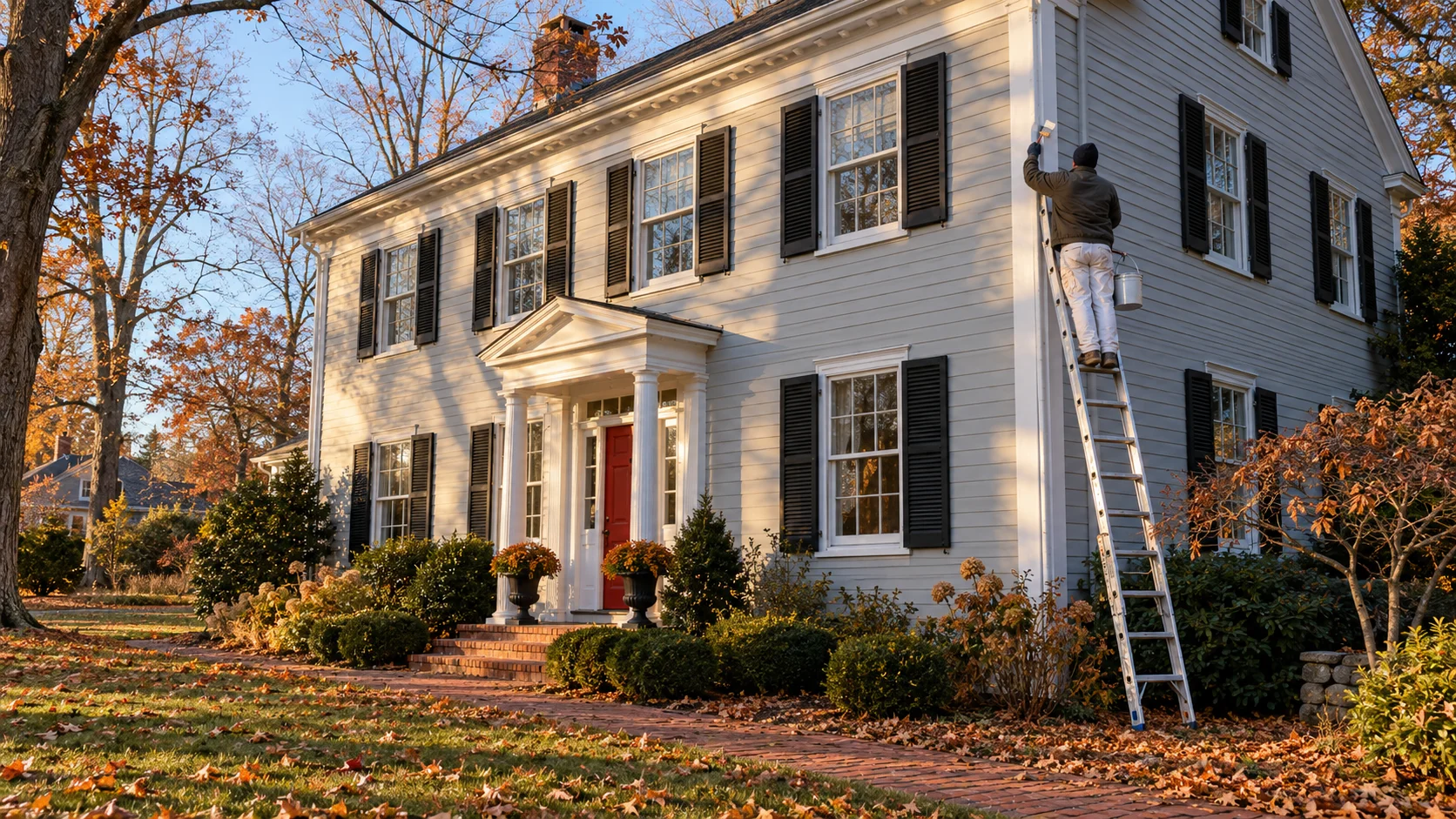
One 1980s townhome building in Monmouth County can carry vinyl siding, wood trim and fascia, a stucco or EIFS front elevation, aluminum gutters, steel railings, hollow metal entry doors and a pressure-treated deck. Naming each one is what lets a board compare bids surface by surface.
| Surface | What the spec should name | The failure it prevents |
|---|---|---|
| Vinyl and aluminum siding | Vinyl-safe color range, acrylic for the substrate, coats | Warped panels from a color darker than the siding can carry |
| Wood trim, fascia, soffit | Primer for bare and repaired wood, finish sheen, coats | Early peeling at end grain and joints |
| Stucco and EIFS | Masonry or elastomeric coating, crack treatment, coverage per coat | Pinholing and water entry through a film applied too thin |
| Steel and aluminum railings | Rust removal standard, metal primer, direct-to-metal finish | Rust bleeding through within a season |
| Hollow metal doors and frames | Enamel or direct-to-metal finish rather than wall paint | A soft film that marks and blocks against the weatherstrip |
| Unit entry doors | Who owns the surface, the approved color, the finish | Twelve different reds across one community |
| Hallways and stairwells | Washable finish, sheen, patch standard, egress rules | Scrubbed-through walls and a corridor closed at the wrong hour |
| Garage and basement floors | Moisture testing, mechanical grinding, resinous system | A coating that delaminates in sheets under tire traffic |
Coverage rates belong in the spec, because they are the only honest proxy for film build on a rough surface. Sherwin-Williams rates Loxon XP Waterproofing Masonry Coating at "85-110 sq. ft. per gallon" per coat, and notes "Coverage on porous & rough stucco 80 square feet per gallon." A bidder pricing stucco at three hundred square feet to the gallon is not pricing the same job. Our guide to painting stucco in NJ covers hard-coat versus EIFS and the coating families, and our comparison of Benjamin Moore and Sherwin-Williams covers the lines a spec might call out. Sheen needs its own line where there are long sightlines down a row of identical buildings, because two buildings finished at different sheens read as two different colors in low afternoon sun; our paint sheen guide explains why two manufacturers' names for one gloss level do not match.
Coats, film build and measurable acceptance criteria
"Two coats" is the most-disputed line in association painting. Over a dramatic color change it is a minimum, not a guarantee of coverage. The useful version reads: a stated number of coats, plus complete hide with no substrate or previous color visible, whichever is greater. On stucco and masonry write film build instead — the Loxon XP sheet specifies "6.5 to 8.4 mils dft per coat" and "13 to 16.8 mils total dry film thickness" with "10 or less pinholes per square foot" for a waterproofing system. Those are numbers an inspector can verify; coats are not.
Most association contracts have no definition of done, which is why final payment is where the relationship breaks. Write the criteria in and the punch walk becomes administrative rather than adversarial: no previous color visible at ten feet in daylight, including inside corners, under laps and behind downspouts; clean cut lines, with nothing on glass or hardware; sealant tooled, continuous and adhered on both faces; lights, numbers, mailboxes and weatherstrip free of coating and anything removed reinstalled; no chips or spatter on walkways, decks, cars or plantings; and a color and product schedule at close-out naming the exact product, color, sheen and location for every surface painted.
Without that, here is the arithmetic that catches boards. One bidder prices soft washing, full sealant replacement, spot priming and two finish coats. One prices a rinse, caulking at windows only, and two coats. One prices a rinse and one coat because the buildings "look fine." All three write "wash, prep and paint, two coats." The spread will look like a discount; it is three different jobs, and only one lasts to the next cycle. The fix is not more paperwork from bidders — it is the board issuing the specification so the only remaining variable is the number. Our guide to choosing a painting contractor in NJ covers due diligence that applies equally to an association award.
How a Multi-Building Repaint Is Actually Phased
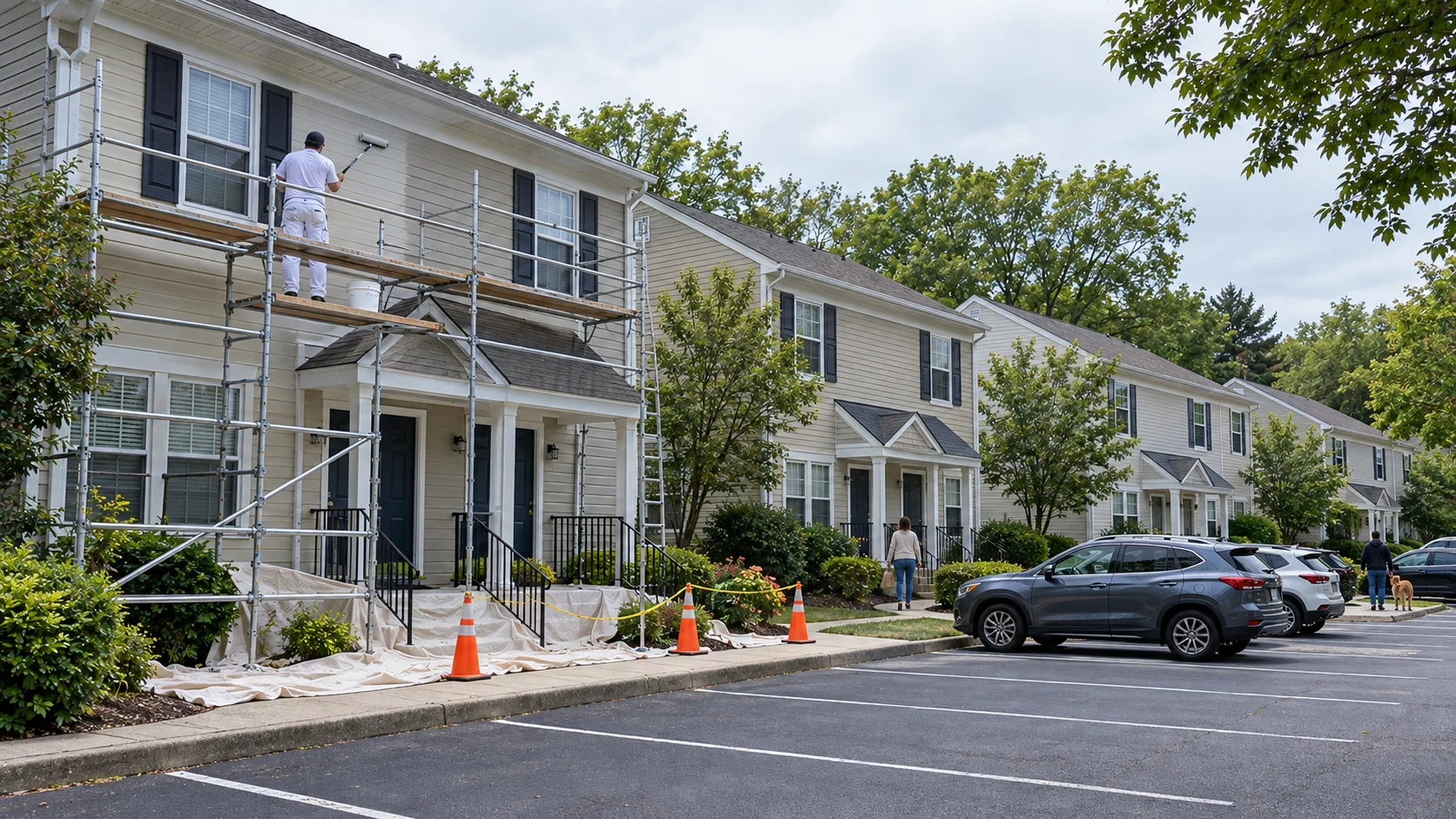
Painting an occupied building is judged on sequencing more than brushwork, and an HOA is the hardest version of the problem: every occupant is also an owner, each has a car and a front door, and several hundred of them can reach the board in one evening. The sequencing is the product.
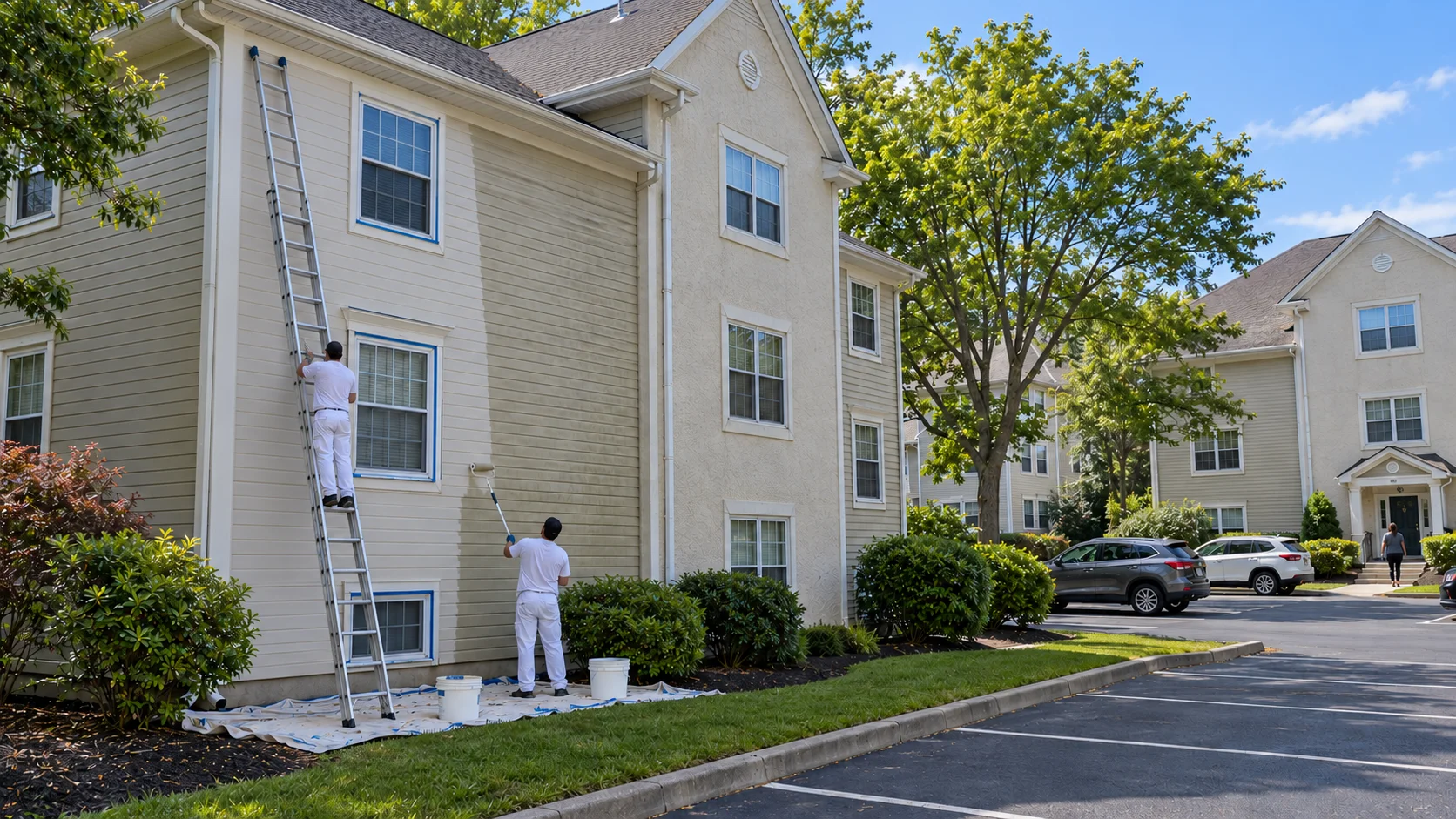
The unit of work is one elevation of one building, not one community. A crew washes building 4 on Monday, lets it dry, preps Tuesday and Wednesday, coats Thursday and Friday, then moves to building 5 while building 4 is punched out. Residents of every other building are unaffected that week. Within a building the sequence runs back-to-front: rear and side elevations first where there are no entries, then the front, then doors and railings last, so the most-touched surfaces have the shortest exposure to traffic. Shared walk-up stairs are the pinch point, because they cannot be worked while they are the only way in — those get split one side at a time, or a half-day window agreed with the units affected.
| Stage | What the resident loses | Typical window |
|---|---|---|
| Washing | Windows closed, patio furniture and grills pulled back, cars off the drip line | Half a day to a day per building |
| Dry time | Nothing; the building is fully usable | One to two days, humidity dependent |
| Prep and sealant | Ladders near some windows; balcony access restricted on the worked elevation | One to three days per building |
| Siding and trim coating | The worked elevation only; other entries stay open | Two to four days per building |
| Doors and railings | A named half-day per entry, with an alternate route marked | Half a day per entry |
| Punch and cleanup | Nothing | Half a day |
Unit entry doors deserve real attention. A door being coated cannot be closed and latched until the film has set, and a resident who comes home to a tacky door at 6pm remembers it for years. Coat entry doors on a named morning, by appointment per stack, with the resident notified individually rather than by a community-wide letter, and the door reinstalled and latchable before the crew leaves site. Never leave a door off overnight.
Resident notice, in layers
In our experience the complaints a management office receives are almost never about paint quality; they are about a resident who did not know the ladder would be at their bedroom window this morning. Four layers cover nearly all of it:
- Award letter, community-wide. The building sequence with approximate weeks, the colors, the contractor, who at the management company owns resident questions, and what residents will be asked to do.
- Two-week notice, per building. Posted at entries and emailed to those units, with firm dates and the specific preparation asked: clear balconies and patios, take down wreaths and wind chimes, secure pets, close windows on named days.
- Forty-eight-hour door hanger, per entry. Only what affects that entry: parking relocation, stair and railing work, door appointments.
- Day-of signage. A sign at every affected entry showing the route in use, changed daily and removed when the building is done.
Plan parking as carefully as the painting. Washing and coating both need the drip line clear, and towing a resident is the fastest way to turn a repaint into a board meeting. Pair each building with a named overflow area, publish it in the two-week notice, re-notice at 48 hours, and have the crew hold off rather than escalate when a car is still there. One car is a one-hour problem; an escalation is a six-month problem.
The Board and RFP Process, Step by Step
The walkthrough comes before the scope. A board cannot specify a community it has not walked with someone who knows what fails. Cover every building type, not a representative one, and produce a written condition record: which elevations are chalking, where sealant has failed, which trim is soft, which railings are rusting at the base, where downspouts discharge against siding, which stucco elevations have cracked at the control joints. That record is what the specification is written from, and it is the baseline that later keeps change orders honest. Walk it with every bidder together, on the same day if you can — a joint walkthrough means every bidder hears the same answers, and it tells the board which ones asked about water management and which only asked about square footage.
The scope document is the specification plus the conditions of work: phase sequence, hours, access, staging and water sources, who writes and posts resident notices, waste handling, and the close-out package. The RFP wraps it in commercial terms: the bid form, the allowance structure, the change-order mechanism, the payment schedule and retainage, insurance requirements, references and the due date. Require bids on the board's own form, broken down by building and by scope line, with allowances separate and unit prices for the common repair items. A single-number proposal cannot be compared with anything and cannot be audited once the job is running.
Allowances and unit prices for what nobody can see yet
No contractor can price rot through paint. Soft trim, failed sheathing, open stucco and deteriorated sealant surface when the buildings are washed and scraped, which is after the contract is signed. There are three ways to handle that and one of them is good:
- Ignore it. The scope says paint, the crew finds rot, work stops, the board convenes, and the schedule slips while the community watches.
- Ask bidders to carry it. Each prices an unknown, bids diverge for reasons nobody can see, and the board pays for the guess whether or not the rot exists.
- Set an allowance with unit prices. The board names the allowance, every bid includes it identically, and the contract carries agreed unit prices — per square foot of stucco patching, per linear foot of joint sealant replacement, and, through whichever trade carries the carpentry, per linear foot of trim replacement and per sheet of sheathing. Work is drawn as it is found, each draw documented with a photograph, a location and a quantity before the repair is covered, and whatever is unused is credited back.
Carpentry is not our trade: NJ Painting Co. does not do rot repair, trim replacement or sheathing work. We point out rot at the walkthrough and as washing exposes it, and a board that wants those repairs in the same programme carries them through its carpenter or general contractor on the same allowance and unit-price terms.
Unit prices are the part boards skip and then regret. A price negotiated with a crew already on the building, under time pressure, is never as good as one agreed at award.
Change orders, milestones and retainage
The change-order mechanism belongs in the contract, not an email thread: who may authorize one and above what value the full board votes, the form it takes, that no out-of-scope work proceeds without a signed order, and that each order states cost, schedule impact and whether it draws on the allowance. The most useful clause requires the order before the work, because a retroactive change order is just an invoice dispute with a cover sheet.
Pay against completed, inspected buildings rather than calendar time: a deposit at mobilization sized to materials and setup, progress payments as named buildings are completed and accepted, and retainage held until the final punch list is signed off. Retainage is not a penalty; it is the reason the last five percent — the chips in the mulch, the missed railing base, the door that sticks — actually gets done. Run the punch walk building by building as each one finishes. A defect found in June on building 2 is fixed by the crew still on site with that color on the truck; the same defect found in October is a return trip and a new argument about who pays.
Insurance and Documentation a Board Should Require
This is where a board protects the association rather than the paint. What follows is what a board or manager should require of any bidder as a general matter. Your association's counsel and insurance professional should set the actual limits and wording, because those depend on your governing documents, your own policy and the contract size.
- A certificate of insurance before mobilization, issued by the carrier or broker directly, naming the association and the management company, with policy numbers and dates — not a photocopy of last year's, and not after the first invoice.
- Commercial general liability, at limits your advisors set against the contract size, with confirmation of whether coverage is per project.
- An additional-insured endorsement. The item most often missing. Being the certificate holder is not the same as being an additional insured under the policy. Ask for the endorsement form itself, and have your advisor confirm it covers ongoing and completed operations.
- Workers compensation, for the contractor's employees and every subcontractor on site. Ask up front whether any of the scope will be subcontracted.
- Automobile liability. Crews, trucks and trailers are inside the community for weeks, parked beside residents' cars.
- A waiver of subrogation, where your advisor recommends one for the contract type.
- Lien waivers tied to payments — partial with each progress payment, final with the retainage release, covering the contractor and any subcontractor or supplier. This is what keeps a paid association from receiving a lien because someone further down the chain was not paid.
- A W-9 and the contractor's New Jersey business registration.
- References from comparable communities, of similar building count and construction type, with permission to call. Ask one question: what went wrong, and how was it handled? Every multi-building repaint has something go wrong, and the answer tells you what you are buying.
- A written warranty on the workmanship, with term and coverage stated plainly, plus the manufacturer's warranty where the spec relies on one.
- A close-out package: the color and product schedule, the reconciled allowance with its documentation, final lien waivers and the signed punch list, as one package the next board can find.
We issue certificates to the property manager or board before we mobilize as a matter of course, because a job held up by paperwork loses a week of good weather, and our workmanship carries a two-year warranty. One more item belongs on the list for older communities: the EPA's Renovation, Repair and Painting program requires that "anyone paid to perform work that disturbs painted surfaces in homes, childcare facilities and preschools built before 1978" be certified. If your community predates 1978, or includes a childcare facility or preschool, raise it at the walkthrough and ask each bidder for their Lead-Safe Certified firm certificate — it changes the prep method, the containment and the cleanup, not just the paperwork. We will tell you plainly at that walkthrough that NJ Painting Co. is not an EPA Lead-Safe Certified firm, so pre-1978 surfaces whose paint has to be disturbed are not work we bid. Our guide to lead paint in older New Jersey homes explains what the rule requires.
HOA Painting Guidelines: Architectural Review, Approved Colors and Who Owns Which Surface
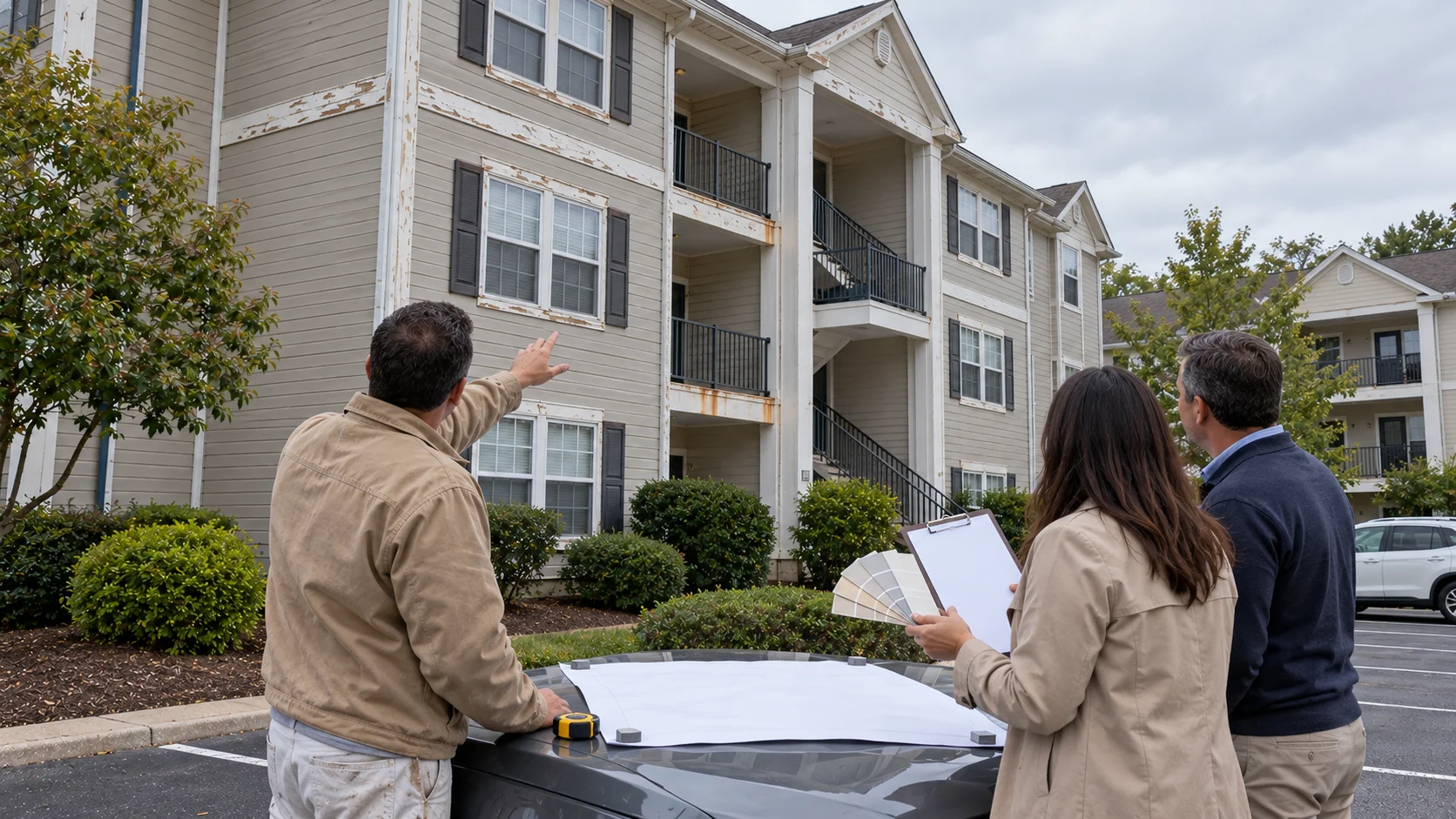
"HOA painting guidelines" is really three questions: who may paint what, which colors are permitted, and how a community stays consistent across twenty years when buildings are painted in different years by different contractors under different boards. Your governing documents answer the first two. The third is a document the board has to write.
Who owns the surface is a question of law and of your master deed
In a New Jersey condominium the division runs along the definition of common elements. The Condominium Act defines them to include, as to any improvement, "the foundations, structural and bearing parts, supports, main walls, roofs, basements, halls, corridors, lobbies, stairways, elevators, entrances, exits and other means of access, excluding any specifically reserved or limited to a particular unit or group of units." The association then carries the duty: it "shall be responsible for the performance of the following duties, the costs of which shall be common expenses," the first being "The maintenance, repair, replacement, cleaning and sanitation of the common elements." Both passages are in the Department of Community Affairs' published text of the Act.
Two consequences follow. The exterior walls, trim, corridors and stairways of a condominium are normally the association's to paint, as a common expense — which is why an exterior repaint is one association project rather than a hundred owner projects. And the exclusions matter as much as the inclusions: anything "specifically reserved or limited to a particular unit" is carved out, which is where unit entry doors, balcony interiors, patio enclosures, storm doors and screens usually live. In a fee-simple townhome community governed under the Planned Real Estate Development Full Disclosure Act rather than the Condominium Act the line can sit elsewhere, and in both cases your master deed or declaration can move it. Read your own documents, and have counsel confirm, before publishing a guideline.
| Surface | Usually the association | Usually the owner |
|---|---|---|
| Siding, stucco, masonry, trim, fascia, soffit | Yes | No |
| Hallways, stairwells, lobbies, common corridors | Yes | No |
| Shared exterior stairs and railings | Yes | No |
| Unit entry door, exterior face | Often, to an approved color | Sometimes, to an approved color |
| Unit entry door, interior face | No | Yes |
| Balcony or patio floor, walls and ceiling | Varies by document | Varies by document |
| Owner-installed storm doors, screens, shutters | No | Yes, subject to architectural review |
| Window frames and sashes | Varies by document | Varies by document |
| Interior of the unit | No | Yes |
Architectural review, approved colors and the twenty-year record
Architectural review exists so that an owner's reasonable wish to change something does not accumulate into eleven front door colors and four styles of storm door on one building. For painting, a workable standard is short and specific: the surfaces an owner may paint or alter, the approved palette for each with manufacturer names and codes, the sheen, the form an owner submits, who reviews it, how long review takes, and what happens if an owner paints without approval. A standard that takes three months to answer gets ignored, and an ignored standard is worse than none — the next board inherits both the inconsistency and the precedent. Write the palette as named products, not chips stapled into a binder: a chip fades, a binder goes missing between boards, and "the beige we used last time" is not a specification.
Consistency across a cycle is a records problem, not a taste problem, and four documents do it. The approved color schedule, by product, code and sheen. The building sequence and date record, showing which building was painted in which year, by whom, to which schedule, so a future board knows what is due and does not drift into repainting everything at once. The architectural review standard with its submission form and decision log. And labelled touch-up stock for every color on the schedule, with a rule that touch-ups come from that stock rather than a store match — a store match to a faded wall is a patch you will see from the parking lot for six years.
One structural note for boards thinking in cycles. New Jersey's Planned Real Estate Development Full Disclosure Act regulations require, during developer control of the board, that the association "prior to making an annual assessment, prepare and adopt an operating budget, which shall provide, for any and all common expenses to be incurred during the fiscal year, as well as adequate reserve funds for repair and replacement of the common elements and facilities," with the reserve amount "determined by an independent licensed engineer or architect as part of the reserve study." Those rules address the developer-control period rather than every established association, and your own obligations come from your governing documents and your counsel. But the mechanism they describe — a funded reserve driven by a professional study of useful lives — is what turns a repaint into a scheduled event rather than a special assessment. Boards that know their painting cycle and fund it get to bid in March for a May start; boards that do not, bid in August. Our guide to how often a house needs repainting in NJ covers the intervals by substrate that a reserve assumption rests on.
New Jersey Conditions That Set a Board's Schedule
The usable exterior season is shorter than the calendar
Exterior coatings have minimum application temperatures, and they apply to the surface, not the forecast. Benjamin Moore's data sheet for Aura Waterborne Exterior Low Lustre Finish 634 states "Do not apply when air and surface temperatures are below 40 °F (4.4 °C)," lists a surface temperature range at application of 40 °F to 100 °F, and warns that "High humidity and cool temperatures will result in longer dry, recoat and service times." Sherwin-Williams lists 35°F as the minimum for Loxon XP and adds the point that matters on a building: "When the air temperature is at 35°F, substrates may be colder; prior to painting, check to be sure the air, surface, and material temperature are" within specification. The Office of the New Jersey State Climatologist at Rutgers records that the state "has five distinct climate regions" and that the "Average number of freeze free days in the northern highlands is 163, 179 in the central and southern interior, and 217 along the seacoast." Put together, the working season for a large multi-building project runs roughly May through October — late enough in spring that north elevations have dried and surface temperatures hold overnight, early enough in autumn that the last coat gets its full dry before cold nights. Our guide to painting in cold weather in NJ works through the minimum temperatures and the dew point rule.
For a board that season is a budget constraint disguised as a weather fact. A twelve-building community cannot be painted in six weeks. Award in August and the project either runs into weather it should not, or splits across two seasons — two mobilizations, two sets of notices, and a real risk the second half is painted a year later from different material. The calendar that works: walkthrough and condition record in autumn, specification and RFP over winter, bids due and awarded by March, mobilization in May. That also puts the number in front of the board before the budget is adopted rather than after.
North elevations and freeze-thaw
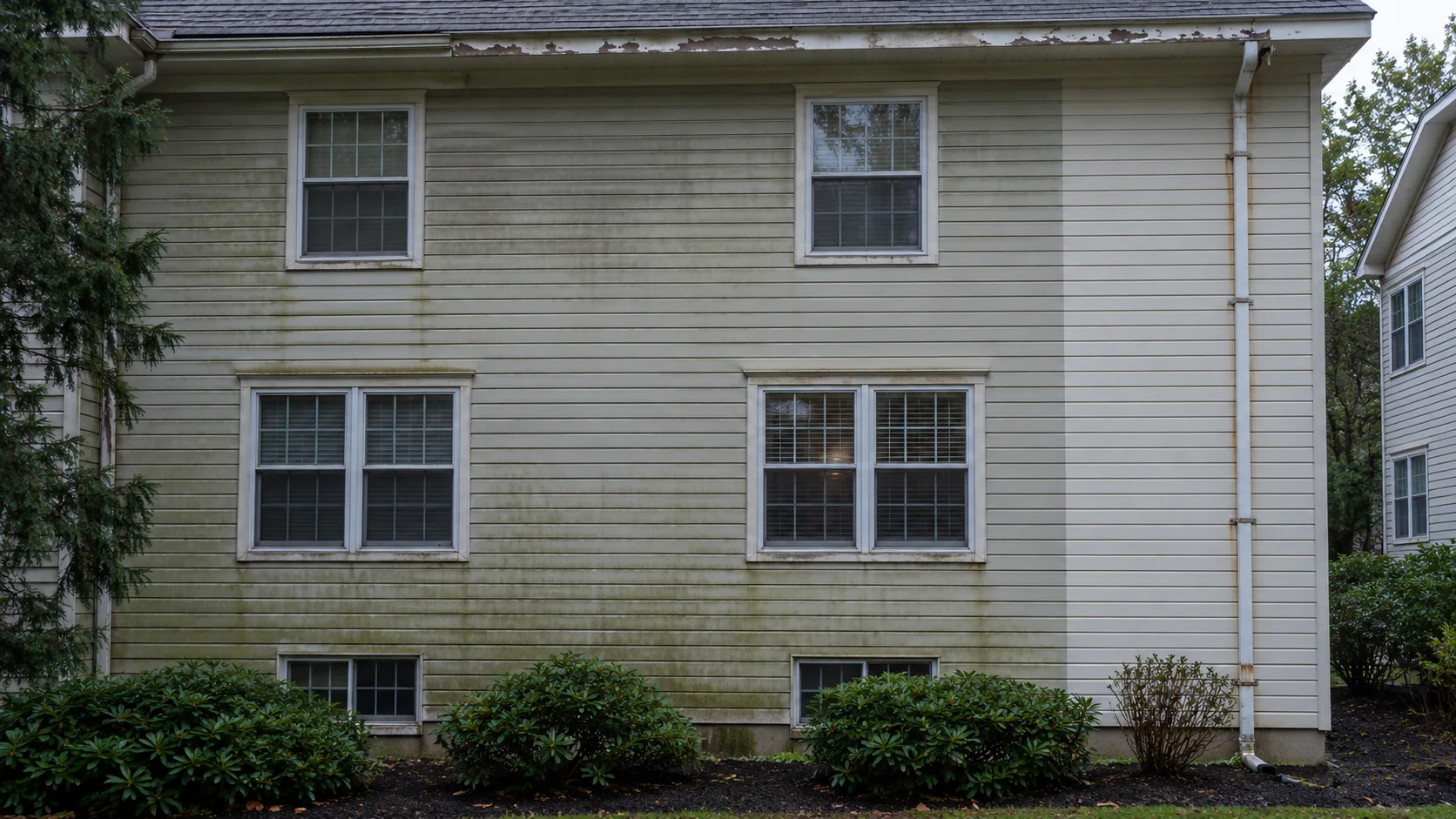
On almost every New Jersey community we walk, the north and northeast elevations are visibly worse than the south and west. They get the least sun, so they dry slowest after rain and hold dew into the morning, they grow the mildew and the green cast, and the moisture sitting in the substrate goes through a New Jersey winter's freeze and thaw cycles while south walls have already dried. Three consequences for a specification: budget more washing to remove mildew on north and northeast elevations, expect more scraping and spot priming there, and sequence those elevations later in the spring rather than first so they have dried out. It is also why a community should resist repainting only the elevations that look bad — painting the north walls of twelve buildings and leaving the south walls for three years guarantees a visible mismatch and two mobilizations. Paint whole buildings, and write the extra north-elevation prep in as its own line so it is priced rather than absorbed.
Shore salt air, from Monmouth down through Ocean County
A community within a few miles of the water in Monmouth or Ocean County — Long Branch, Asbury Park, Point Pleasant, Toms River, the barrier island communities — is painted in a different environment from one in Freehold or Hillsborough. Salt-laden air deposits on every surface and holds moisture against it, windborne sand abrades south and east elevations, and ferrous metal corrodes faster than inland. Three things change in the specification. Washing is not cosmetic: salt left on a surface sits under the new coating and holds moisture at the film-to-substrate interface, so specify a thorough rinse. Metal gets more attention than paint, because railings, stair stringers, lintels, door frames and hardware fail first at the shore — specify the rust removal standard and a corrosion-resistant primer, since the finish coat is the easy part. And the cycle is shorter: a shore-exposed elevation will not hold as long as the same elevation eight miles inland, so a reserve assumption using one interval for the whole portfolio will under-fund the buildings nearest the water.
One compensation: the coast gets the longer season. Rutgers notes that "In autumn and early winter, when the ocean is warmer than the land surface, the Coastal Zone will experience warmer temperatures than interior regions of the state," and gives the seacoast 217 freeze-free days against 179 in the central and southern interior. A shore community often has more usable October than an inland one — though the same source notes that "In the spring months, ocean breezes keep temperatures along the coast cooler," so the trade is a later start.
Stucco and EIFS in New Jersey condominium stock
A large share of New Jersey condominium and townhome buildings put up from the 1980s onward carry stucco or EIFS — synthetic stucco over foam insulation board — on front elevations, gables and entry features, with siding on the rest. For a board this is the highest-stakes substrate in the scope, for two reasons. Coating it correctly costs real money: a masonry coating applied to the manufacturer's film build on rough stucco covers far less area per gallon than paint on siding, and a bidder who has not priced that has mispriced the job. And cracks and open joints in a stucco or EIFS elevation are water paths — paint does not fix a water path. Cracks need addressing by method and width, control and expansion joints need sealant replaced rather than coated over, and anything reading as substrate failure rather than surface failure needs a look before a coating hides it. Write the stucco scope as its own section, with crack treatment, joint work and coverage rate per coat all named; our guide to painting stucco in New Jersey has the detail a spec writer needs. Where the community is vinyl or aluminum sided, our guide to painting vinyl and aluminum siding covers the vinyl-safe color constraint, which is a genuine limit on what palette a board can approve.
Common Areas, Hallways and Stairwells
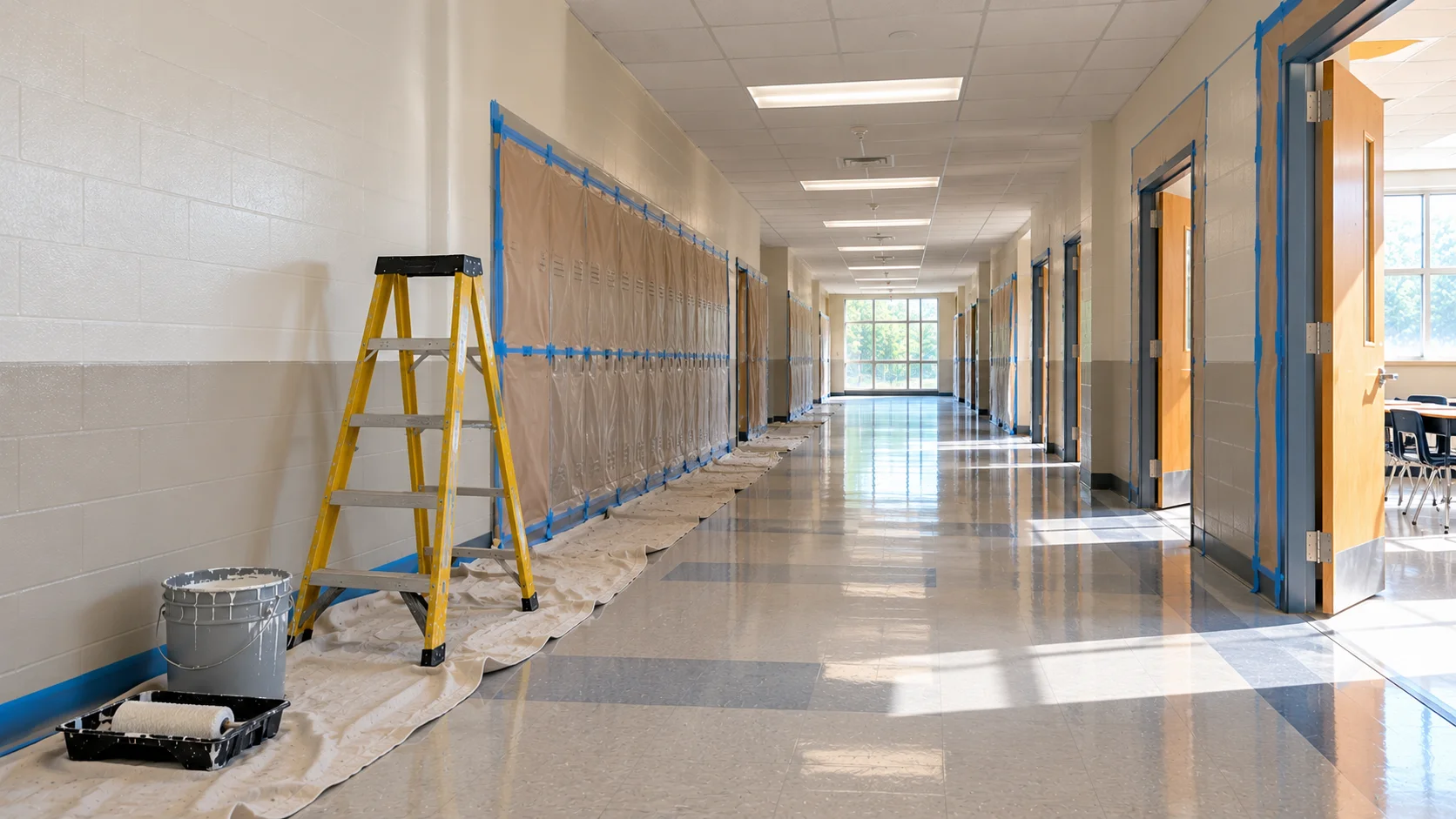
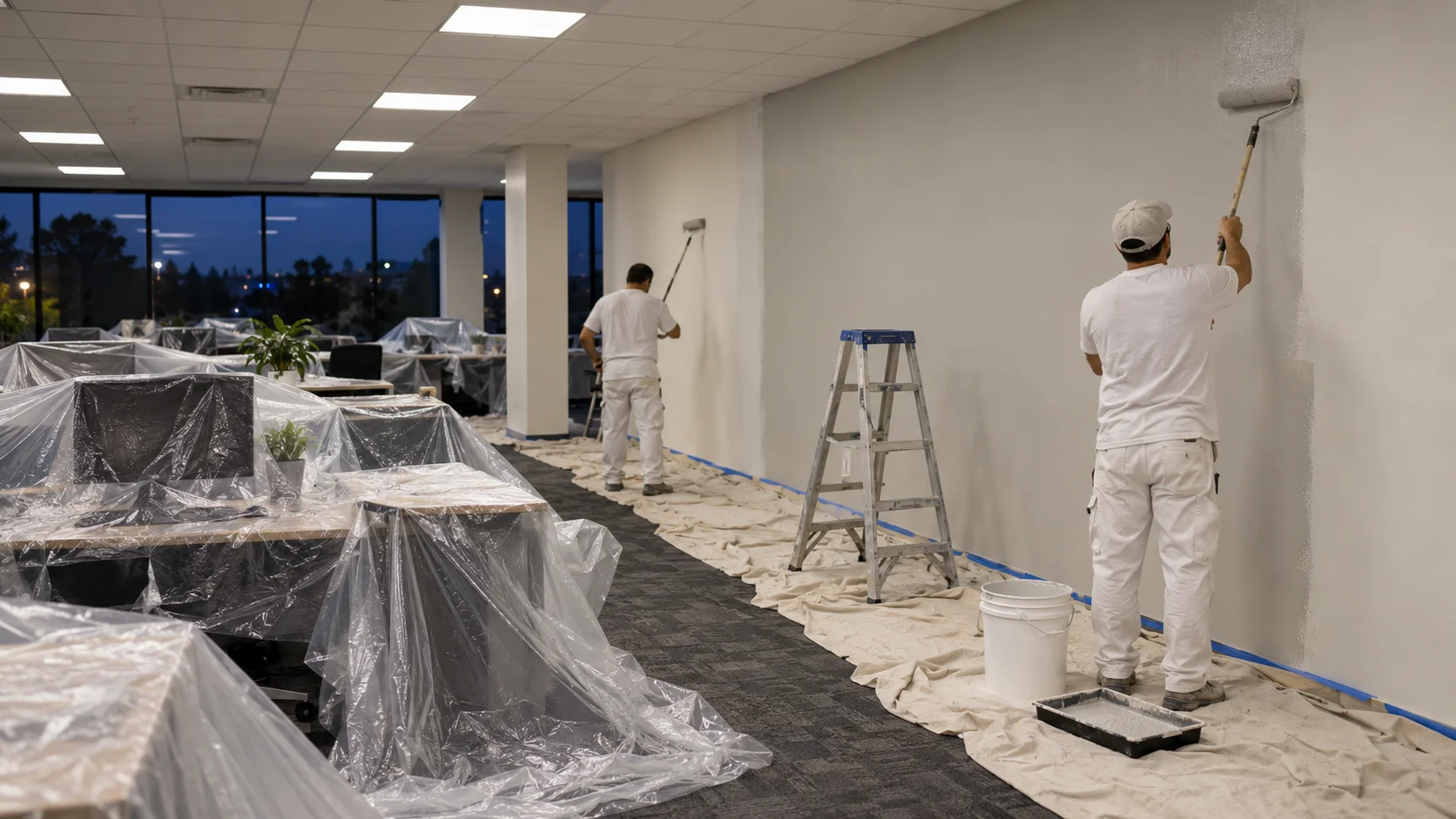
Exterior work gets the board's attention because it is the capital item, but most of the painting an association buys over a decade is interior and incremental: corridors, stairwells, lobbies, mail and trash rooms and garage interiors. The constraints are tighter, because a corridor is egress. Corridors and stairwells are worked in sections with at least one route maintained at all times, wet areas signed, floors protected, and hours set to suit the building rather than the crew — where residents are elderly or a corridor is the only route to an elevator, that means shorter sections and more of them. Walls that get wiped and bumped want a washable finish rather than a flat, and the patch standard matters more than the paint: a corridor with thirty years of anchors, handrails and moving damage needs real patching, and our guide to drywall repair covers what each kind takes. Garage and basement floors belong in a resinous scope rather than a paint one — see our epoxy flooring page and our guide to commercial epoxy flooring in NJ. Common-area paint is worth standardising to one product, color and sheen per building, so a board can hold one labelled stock, touch up rather than repaint, and avoid the drift where twenty years of piecemeal work leave twenty slightly different whites in one building.
Talk to Us About Your Community Repaint
The number for your community comes from walking it, building type by building type, with the condition of every substrate written down. NJ Painting Co. is a family-owned, licensed and fully insured painting company at 36 Church Rd, Morganville, NJ 07751, painting in New Jersey for more than 20 years with Benjamin Moore and Sherwin-Williams products. For associations we scope the whole community at once and sequence it into one calendar, write the product and sheen for every surface into the proposal, issue certificates of insurance to your property manager or board before we mobilize, phase the work building by building so residents keep safe access and their parking, hand you the notices to post ahead of each phase, walk the punch list with you building by building, and leave the color and product schedule on file so the next touch-up and the next cycle match.
See how we run occupied-building work on our commercial painting page and our siding, trim and stucco process on the exterior painting page, use our guide to how long an exterior repaint takes for the per-elevation arithmetic behind a phase plan, read our guide to commercial painting cost in NJ for what moves a number up or down, and check the planning ranges in the cost guide. We cover Monmouth, Ocean, Middlesex, Mercer, Somerset, Burlington, Union, Essex, Hudson, Bergen and Passaic counties. Call (732) 239-0932 or send us the building count, the construction types and your target season and we will walk the community and come back with a written scope and a phase plan.
Frequently Asked Questions
Who is responsible for painting a condo building, the association or the unit owner?
For the common elements, the association. New Jersey's Condominium Act makes the association responsible for "The maintenance, repair, replacement, cleaning and sanitation of the common elements" as a common expense, and defines common elements to include the main walls, roofs, halls, corridors, lobbies, stairways and entrances, "excluding any specifically reserved or limited to a particular unit or group of units." That exclusion is where unit entry doors, balcony interiors and owner-installed storm doors usually sit. In a fee-simple townhome community the line can be drawn differently, and your master deed and bylaws can move it either way, so read your own documents and have counsel confirm before publishing a guideline.
How long does an HOA exterior repaint take?
Plan it per building, not per community. A typical garden-style or townhome building runs about one to two weeks from washing to punch-out: half a day to a day of washing, one to two days of dry time, one to three days of prep and sealant work, two to four days of coating, a named half-day per entry for doors and railings, and half a day of punch and cleanup. Multiply by the building count and allow weather days. A twelve-building community is a full season rather than a month, which is why the award date matters more than the crew size.
What should an HOA paint specification include?
Six things. A prep standard naming the washing method, scraping and feathering, spot priming, sealant replacement, rust treatment and protection. The product, sheen and number of coats for every substrate individually, with a coverage rate per coat on stucco and masonry. Measurable acceptance criteria, including complete hide with no previous color visible. The phase sequence, hours of work and resident notice responsibilities. An allowance with agreed unit prices for substrate repair found after washing. And the close-out package, including a color and product schedule. A specification that cannot be checked by someone standing in front of a wall is not a specification.
Why are our three painting bids so far apart?
Almost always because they are not pricing the same work. Three contractors reading "wash, prep and paint, two coats" each decide for themselves whether that includes replacing failed sealant, priming every scraped area, soft washing rather than rinsing, and real coverage over a dramatic color change. The spread looks like a discount and is actually three different jobs. The fix is for the board to issue the specification so every bidder prices identical work, require bids broken down by building and scope line with allowances shown separately, and walk the community with all bidders on the same day.
How do you keep residents from being blocked out of their own homes?
By working one building, usually one elevation, at a time, and sequencing within the building so entries, doors and railings come last and are done to a named half-day window per entry. Residents of every other building are unaffected on any given day. Shared walk-up stairs are split so one side stays usable. Entry doors are coated by appointment per stack with the resident notified individually, and the door is always reinstalled and latchable before the crew leaves that day — never left off overnight. Parking is paired with a published overflow area per building and re-noticed at 48 hours.
What insurance and documentation should a board require from a painting contractor?
As a general matter: a certificate of insurance issued directly by the carrier or broker before mobilization, naming the association and the management company; commercial general liability; an additional-insured endorsement supplied as the endorsement form rather than a line on the certificate, covering ongoing and completed operations; workers compensation for the contractor and every subcontractor on site; automobile liability; a waiver of subrogation where your advisor recommends one; partial lien waivers with each progress payment and a final waiver with the retainage release; a W-9 and New Jersey business registration; references from comparable communities; and a written workmanship warranty. Your association's counsel and insurance professional should set the actual limits and wording.
How should a board handle rotted wood or failed stucco found during the job?
Price it before it is found. No contractor can price rot through paint, so the scope should carry a board-set allowance for substrate repair, included identically in every bid, plus agreed unit prices for the common items: per square foot of stucco patching, per linear foot of joint sealant replacement, and, through whichever trade carries the carpentry, per linear foot of trim and per sheet of sheathing. NJ Painting Co. points rot out rather than repairing it; carpentry goes to a carpenter. Work is drawn against the allowance as it is found, each draw documented with a photograph, a location and a quantity before the repair is covered, and whatever is unused is credited back.
What are HOA painting guidelines, and who sets the color scheme?
Guidelines are the board's standing rules for painting: which surfaces an owner may paint or alter, the approved palette for each with manufacturer names, codes and sheens, the architectural review form and timeline, and what happens when an owner paints without approval. The board sets them within the limits of the governing documents, and the palette should be recorded as named products rather than chips in a binder, because a chip fades and a binder goes missing between boards. Keep three records alongside it: which building was painted in which year and to which schedule, the architectural review decision log, and labelled touch-up stock for every color on the schedule.
When is the best time of year to repaint an HOA in New Jersey?
The working exterior season runs roughly May through October. Benjamin Moore's Aura Exterior data sheet says not to apply when air and surface temperatures are below 40°F and warns that high humidity and cool temperatures lengthen dry, recoat and service times; Sherwin-Williams lists 35°F as a minimum for Loxon XP and notes substrates can be colder than the air. Rutgers records 217 freeze-free days along the seacoast against 179 in the central and southern interior, so a shore community often has more usable October than an inland one, while spring sea breezes push its start later. The board calendar that works: walkthrough in autumn, specification and RFP over winter, bids awarded by March, mobilization in May.
How much does HOA or condo exterior painting cost per unit?
We do not quote a per-unit figure, and we did not find a New Jersey one worth repeating. A unit count says little about the paint: a stucco townhome with gables, a three-story walk-up and a siding-clad ranch unit are different jobs at the same count. Stucco coverage, sealant replacement, access and how the work is phased are what move the number. Issue one specification, and ask bidders to break prices down by building and scope line. You can then divide by units yourself and know what the figure means.
How often should an HOA repaint?
Plan from a walkthrough of the worst elevations, not a fixed calendar, and use surface rules of thumb for the budget. Ours are roughly 7 to 10 years for painted wood inland and 5 to 7 at the shore or on sunny walls, 7 to 10 for acrylic on stucco, and 10 to 15 for field-painted fiber cement. These are our judgement, not a published standard. Your governing documents and the association's reserve plan set the actual cycle. Our guide to how often to paint a house exterior has the full table.
Do you paint hallways and stairwells as well as building exteriors?
Yes. For associations and property managers we paint hallways, stairwells, lobbies and other common areas, and building exteriors including siding, trim, doors and railings. Apartment and tenant turnover repainting inside individual units is not a service we list. Corridors are worked in sections with at least one egress route maintained at all times, wet areas signed and floors protected, and the hours set to suit the building. Garage and basement floors are a resinous or epoxy scope rather than a paint one. Several buildings or several communities can be scoped together and sequenced into one calendar, so the same crew, colors and paperwork carry across every site and the board has one point of contact rather than a contractor per address.
About the author
Written by the NJ Painting Co. team
NJ Painting Co. is a family-owned painting contractor based in Monmouth County, in business since 2004. We are licensed and fully insured, work with Benjamin Moore and Sherwin-Williams paints, and back our work with a 2-year workmanship warranty. We serve Monmouth, Middlesex, Ocean, Mercer, Somerset and Burlington counties, plus Union, Essex, Hudson, Bergen and Passaic in North Jersey.