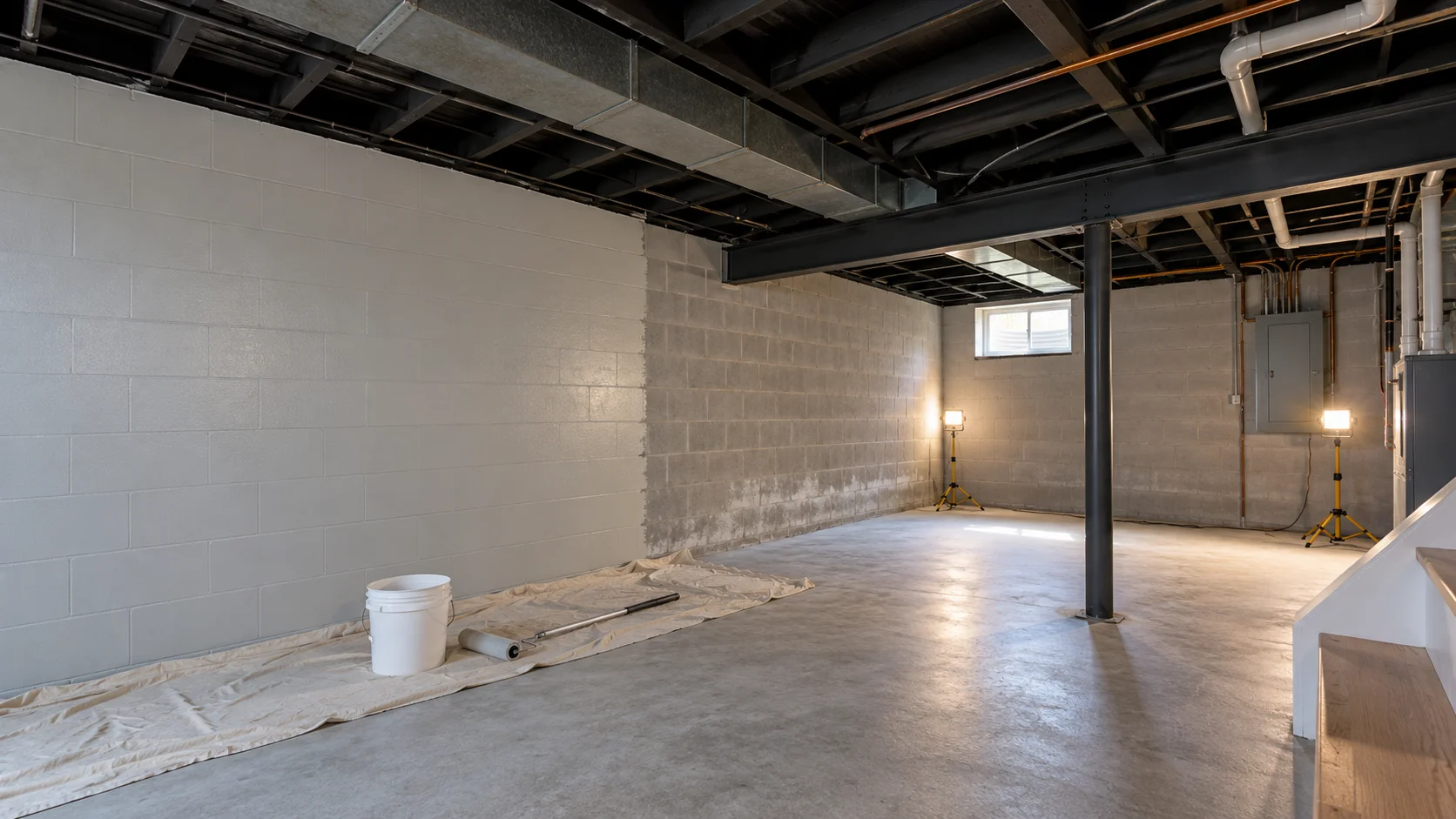
Yes, you can paint basement walls and ceilings, but only after the walls pass a moisture test. Dry concrete or block takes an alkali-resistant masonry primer (plus block filler on cinder block) and two coats of a breathable paint, and an exposed joist ceiling is usually sprayed flat black or white. Paint will not fix a wet basement.
A basement is also the paint job most likely to fail for a reason that has nothing to do with paint. A basement wall is a wall with soil on the other side of it. Water moves through it, salts come out of it, and the surface is alkaline in a way no bedroom wall ever is. Get the moisture question answered first and the rest is ordinary interior painting with heavier material and more coats. Get it wrong and the paint blisters and peels off the wall.
We are a family-owned painting company in Morganville and have painted interiors across Monmouth, Middlesex, Ocean, Mercer, Somerset and Burlington counties, plus Union, Essex, Hudson, Bergen and Passaic in North Jersey, for more than 20 years, using Benjamin Moore and Sherwin-Williams products. Basement painting — walls, ceilings, concrete and the trim and doors that come with them — is work we do and quote regularly. This guide is the long version of the conversation we have standing in somebody's basement with a flashlight: what we look at before we price anything, what goes on poured concrete versus cinder block versus drywall, how a sprayed exposed-joist ceiling really goes, and which parts of the job are not ours.
Two of those parts are worth saying up front. We are painters, not a waterproofing company, and we will not paint over an active moisture problem — if water is coming in, a waterproofing contractor has to solve that before we are of any use to you. And we do not do mould or mildew treatment. We wash surfaces and we power wash, but if there is growth on your basement walls, that is a remediation question for a specialist, and the EPA's own position on painting it is unambiguous. Every technical figure below comes from a manufacturer's data sheet, a federal agency or a published standard, each one fetched and quoted on 17 October 2026.
The Short Answer
- Is it OK to paint basement walls? Yes — if they are dry. Dry means no bulk water, no active seepage and no growth. The EPA is blunt about the last one: "Do not paint or caulk moldy surfaces," because "paint applied over moldy surfaces is likely to peel."
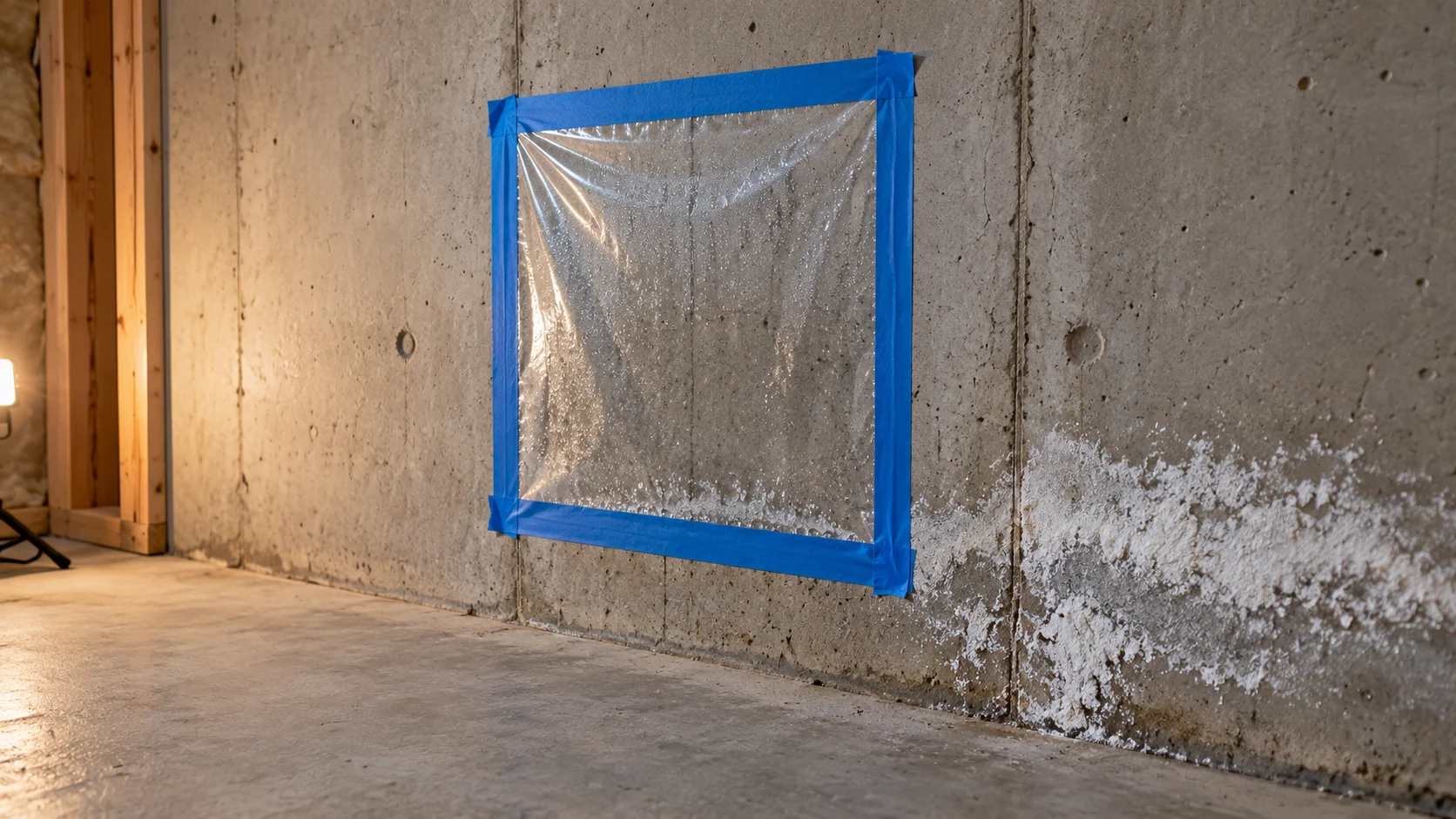
- Test before you prime. ASTM D4263, the plastic-sheet method, costs nothing: tape an 18-inch square of poly to the wall or slab, leave it most of a day, and look for condensation underneath.
- Bare concrete and block need a primer built for alkali. Sherwin-Williams' Loxon Concrete & Masonry Primer-Sealer is rated for "a surface with a pH of 6 to 13"; Benjamin Moore's Ultra Spec Masonry Sealer is "high alkali resistant – up to pH-13." Ordinary drywall primer is not.
- Cinder block needs block filler first, and it drinks. Benjamin Moore lists its Hi-Build Masonry Block Filler at 75 to 100 square feet per gallon. Wall paint covers 350 to 400. Budget material accordingly.
- Do not seal a basement wall vapor-tight. The Department of Energy's Building America program puts it plainly: foundations "can only dry to the inside." A breathable coating is the right answer; block filler "should not be used as a waterproofing sealer."
- An exposed basement ceiling sprayed black or white is a real finish, not a shortcut — and it is the cheapest way to make an unfinished basement look deliberate. It is also the part of the job with the most things in it that must not get paint on them.
- Fire sprinkler heads are never painted. NFPA 13 requires that a sprinkler with field-applied paint "shall be replaced with new listed sprinklers." Overspray on a head is a replacement, not a touch-up.
- The floor is usually a coatings job, not a paint job. A bare slab wants an epoxy or similar floor coating system, which we cover separately.
- Paint is not a radon control. The EPA "does not recommend the use of sealing alone to reduce radon."
Is It OK to Paint Basement Walls? Start With Moisture
This is the first question and it deserves more than a yes. A basement wall is wet from three directions before anybody picks up a roller. The Department of Energy's Upgrading Below Grade Spaces briefing, presented by the NorthernSTAR Building America Partnership, states it as a design fact: "Foundations get wet from three sides by all four moisture transport mechanisms" — bulk water, capillarity, diffusion and air flow — and "foundations can only dry to the inside," "generally by diffusion only." It adds that "below grade vapor flow is almost always inward."
Read that twice, because it is the whole argument. The only drying path a foundation wall has is the one you are about to paint.
What we look for before quoting a basement
None of this requires instruments. It requires looking in the right places.
- Stains and tide lines. A horizontal line of discoloration a few inches up from the slab means water has stood there. A vertical streak below a window or a pipe penetration means it came in there.
- Efflorescence. The white, chalky, slightly crystalline bloom on block and concrete is salt left behind by water that evaporated out of the wall. It is not dirt and it is not mould. It is a receipt for moisture movement, and it tells you water has been travelling through that wall recently.
- Peeling or blistering on walls that were painted before. If a previous coat has let go in sheets, the failure is almost always behind the film rather than in it. Our guide to why paint peels in New Jersey homes walks through how to read the pattern.
- Loose, sandy, powdery surfaces. Masonry that comes away on your hand is not a substrate yet.
- Growth. Fuzzy or spotted discoloration, especially on the cold bottom third of the wall, behind stored boxes, or on the paper face of drywall. This is where we stop.
- The smell. A basement that smells of basement in July is a basement with a humidity problem, and the EPA's advice is to "keep indoor humidity below 60 percent (ideally between 30 and 50 percent) relative humidity."
The plastic-sheet test, and why we actually run it
ASTM D4263 is the Standard Test Method for Indicating Moisture in Concrete by the Plastic Sheet Method, and it is the rare standard any homeowner can run with materials from the hardware store. KTA-Tator, a coatings-inspection firm, describes the procedure: "a minimum 18" x 18" (457 x 457mm) sheet of 4 mil (0.1mm) or thicker polyethylene is obtained, and the perimeter of the plastic sheet is taped to the surface," and "the plastic remains in place for a minimum of 16 hours (and ideally 22 to 26 hours, i.e., from morning to morning)." Then you pull it and look at the underside of the sheet and at the concrete for condensation or darkening.
Why bother? Because of what happens if you skip it. KTA-Tator gives the mechanism in one sentence: "As water attempts to leave the concrete it becomes trapped beneath the coating system, which in time, can cause the coating to blister and disbond." That is the failure mode for basement paint, almost every time.
The test has limits and they are worth knowing. KTA-Tator notes that "if the surface being tested is coated with a low permeance coating, it may provide a barrier to the evaporation of moisture, providing misleading results" — so a wall already covered in an old oil-based or waterproofing coating can pass while still being wet. It also warns that "loss of adhesion of the tape securing the perimeter of the plastic can void the test." We tape all four edges hard, and we run the test in more than one place: one square near the slab, one at mid-height, one on the floor if the floor is in scope.
When we say no, and what happens next
If the sheet comes up wet, if there is standing water after rain, if there is an active seep, or if there is growth on the wall, we do not prime it. We tell you what we saw and where, and we tell you who to call — because basement waterproofing is a different trade with different equipment and a different warranty, and we do not do it. Interior drainage, exterior excavation, a sump system, regrading, gutters and downspout extensions: all of that belongs to somebody else, and all of it has to come first.
Mould and mildew treatment is the same answer for a different reason. We wash surfaces as part of prep and we power wash masonry, but treatment and remediation are not services we offer. If there is growth, the EPA's Brief Guide to Mold, Moisture and Your Home is the right starting document, and it makes two points that bear directly on painting: "the key to mold control is moisture control," and "if you clean up the mold, but don't fix the water problem, then, most likely, the mold problem will come back." It then says the thing that ends the conversation for a painter: "Do not paint or caulk moldy surfaces. Clean up the mold and dry the surfaces before painting," because "paint applied over moldy surfaces is likely to peel."
We would rather lose the job than put two coats over that and come back in a year.
Good Paint for Basement Walls: Block Filler, Alkali Primer and Why Perms Matter
Once the wall is dry, the question becomes what goes on it. The honest answer depends on what the wall is made of, and in New Jersey basements it is one of three things: poured concrete, concrete or cinder block, or framed walls with drywall over them.
Poured concrete walls
Many post-war New Jersey basements are poured concrete, and the surface is smooth, hard, dense and alkaline. Smooth is a problem of its own: Benjamin Moore's data sheets note that "poured or pre-cast concrete with a very smooth surface should be etched or abraded to promote adhesion, after removing all form release agents and curing compounds." A glassy form-finish wall gives paint very little to hold.
Alkalinity is the other problem, and it is the one that eats ordinary primer. Benjamin Moore's Ultra Spec Masonry Interior/Exterior 100% Acrylic Sealer is described as "high alkali resistant – up to pH-13" and is specified to "penetrate and seal the surface of new or previously painted masonry surfaces providing the proper foundation for subsequent finish coats." Sherwin-Williams' Loxon Concrete and Masonry Primer-Sealer says the same from the other direction: it "is highly alkali and efflorescence resistant and can be applied to a surface with a pH of 6 to 13."
If the concrete is new — a recent addition, a replaced wall, a new foundation — the cure clock matters. Benjamin Moore's sealer sheet says that "for optimal system performance new masonry should cure 30 days prior to application of the sealer / coating system and have a pH of 10 or less," and adds a faster path with a caveat: "if the pH is higher after 30 days or if project timelines require an expedited system; masonry that has been allowed to cure for 7 days under normal drying conditions and has a pH of 13 or less may be sealed." Sherwin-Williams sets its own floor at seven days: "all new surfaces must cure for at least 7 days," and "concrete and mortar must be cured at least 7 days at 75°F. Moisture content must be 15% or lower."
Cinder block and CMU
Block is the surface that surprises people, because the paint disappears into it. The holes are not dirt and they will not fill with another coat of wall paint. They need block filler, which is a high-build preparatory coating and nothing like paint.
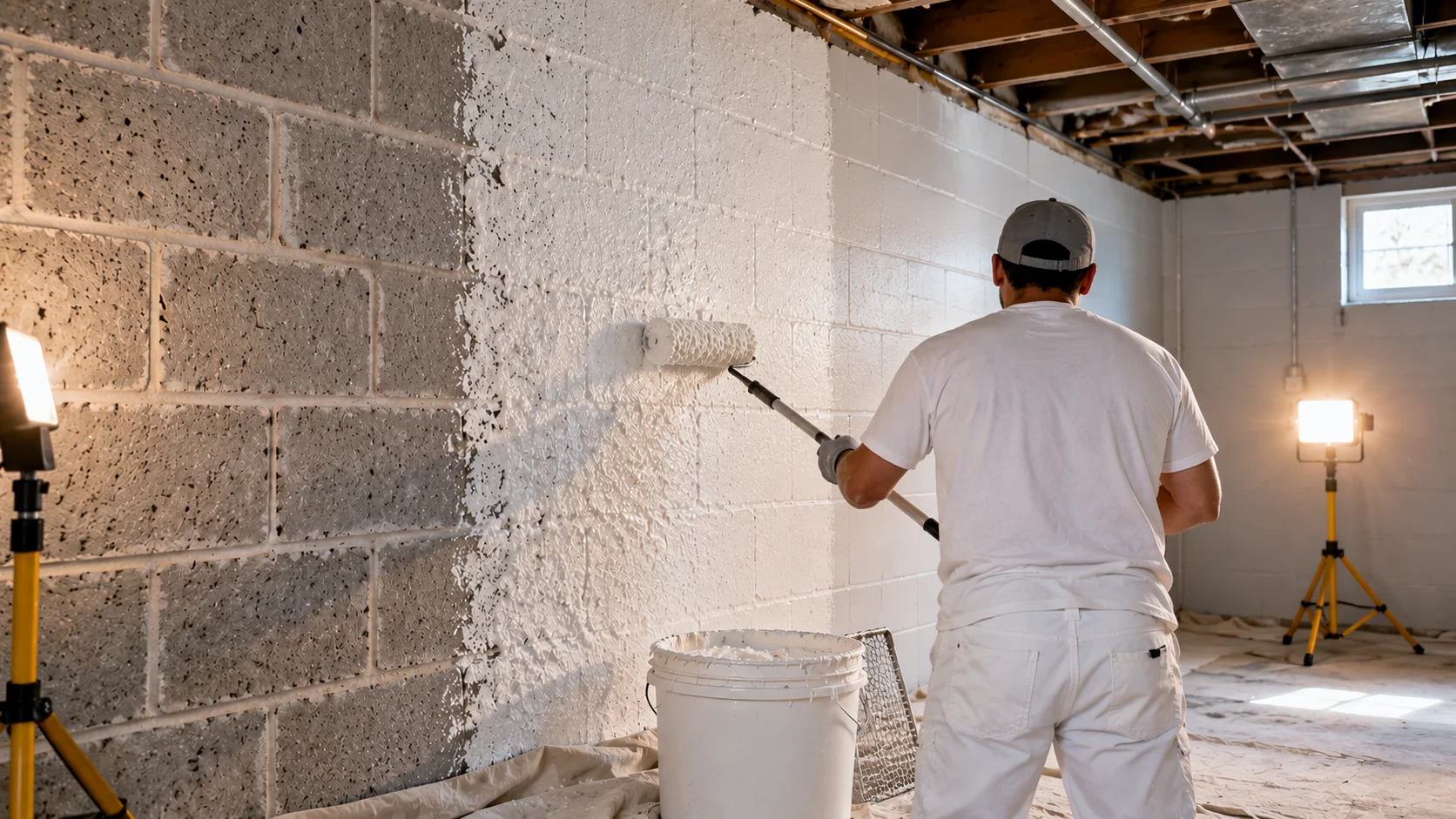
Benjamin Moore's Ultra Spec Hi-Build Masonry Block Filler 571 gives the numbers that explain the whole conversation. Coverage is "75 – 100 Sq. Ft." per gallon at a recommended film thickness of "16 – 21 mils" wet and "8.5 – 11.4 mils" dry. A gallon of Benjamin Moore's Ultra Spec 500 Interior Flat wall paint covers 350 to 400 square feet. Block filler goes on several times thicker, at roughly a quarter of the coverage, which is why a block basement takes more material than homeowners expect and why the first quote often looks high for "just paint."
It also behaves differently on the wall. The sheet's application note is the method we use: "typical block filler application is to uniformly spray out the material, then back roll or brush into the surface." Spraying alone bridges the pinholes rather than filling them; the back-roll is what pushes material into the voids. Sherwin-Williams says the same about its own system, noting that "for porous block, a coat of Loxon Acrylic Block Surfacer is required to achieve a pinhole free surface."
Two limitations on the block filler sheet deserve to be read out loud, because they answer two questions we get constantly. First: it "should not be used as a waterproofing sealer or as a finish coat." Block filler is not waterproofing and it is not a finish — it is one coat of three. Second: "new masonry must be allowed to cure for 30 days before application of the filler." And prep is specific: "remove all loose mortar, scale, efflorescence and dust. Surfaces must be clean and dry."
That efflorescence line is where power washing earns its place. Benjamin Moore's sealer sheet calls for removing "chalk, surface deposits, and loose or scaling paint by scraping, sanding, and preferably power washing," and says that "un-weathered areas must be power washed or scrubbed with a detergent solution and rinsed to remove surface salts that can interfere with adhesion." Inside a basement that usually means scrubbing and rinsing rather than a pressure washer, with the water controlled and the floor protected — but the goal is the same, and it is the same reasoning we use on exterior masonry in our power washing cost guide. Salts left on the wall are a bond breaker.
Framed walls with drywall
Where a basement already has studs and drywall, the painting is ordinary interior painting and the moisture rules still apply. Damaged board, nail pops, seam cracks and water-stained panels are drywall and sheetrock repair, which we do, and our drywall repair cost guide covers how that is priced. We do not do plaster repair; if a basement wall turns out to be plaster over masonry, that is a different trade and we will say so rather than guess.
One warning specific to basements: do not assume a stud wall that looks fine is dry behind it. The Department of Energy's building-science guidance explains the trap. Its best-practice note on vapor retarders below grade says that "when vapor retarders are installed on the interior side of air-permeable insulation on below-grade walls, the liquid water has no way to dry to the interior of the home, so it accumulates in the wall cavity." The same page is where the paint decision comes in: "if water vapor is allowed to pass through the below-grade wall and insulation, it must dry to the inside of the home," and "to enable this drying and avoid condensation in the wall cavity, the wall covering on the interior of the framing must have a relatively high vapor permeability rating."
Breathability, in actual numbers
"Relatively high vapor permeability" is a specification, and the data sheets publish it. Sherwin-Williams lists Loxon Concrete and Masonry Primer-Sealer's water vapor permeance at "25.79 perms" by ASTM D1653. Benjamin Moore lists its Ultra Spec Masonry Sealer at "46.5 Perms." Those are open, breathable films, which is exactly what you want on a wall whose only drying path is inward.
What you do not want is to turn a foundation wall into a sealed bag. A heavy, low-permeance coating on the inside face of a wall that is still taking in vapor from the soil is the blister-and-disbond mechanism KTA-Tator describes, and it is also the mechanism the DOE warns about for insulated basement walls. If somebody is selling you an interior paint on the promise that it will stop water, read what the manufacturers themselves say about their masonry products: "should not be used as a waterproofing sealer." Keeping water out of a basement is drainage, grading and waterproofing work. It is not a coating decision, and it is not our trade.
Sheen on a basement wall
Basement walls want a little more sheen than bedroom walls and a lot less than trim. Flat hides the lumps in block and concrete better than anything else, which matters on a surface that will never be smooth. But flat is also the hardest to wipe, and basement walls get leaned on, scuffed by bikes and bins, and splashed near a utility sink. Eggshell is the usual compromise on framed and drywalled basement walls; on block and concrete we lean flat or eggshell depending on how rough the surface is and how much the room is really used. Our satin versus eggshell guide has the full comparison, and the rule it gives applies with extra force down here: the shinier the finish, the more of the wall's texture you will see.
How to Paint Basement Walls, Step by Step
This is the sequence we actually run, in order, with nothing skipped.
- Diagnose, then test. Walk the perimeter with a light. Tape up plastic-sheet tests at two or three heights and leave them overnight. Do not order material before the sheets come down.
- Clear and protect. Everything comes off the walls and away from them. Basements are storage, and the real first day of a basement job is usually moving the basement.
- Remove failed coatings and loose material. Scrape, wire brush and sand back to something sound. Sherwin-Williams' line is the realistic one: "recognize that any surface preparation short of total removal of the old coating may compromise the service length of the system."
- Wash, including the salts. Detergent scrub and rinse, and let it dry. Efflorescence, chalk and dust all have to go.
- Patch. Benjamin Moore specifies patching "holes, cracks and other surface imperfections" with elastomeric patching compound "or with a mortar consisting of a 2 to 1 mixture of sand and Portland cement," and says to "allow to cure before painting." Sherwin-Williams adds "fill bugholes, air pockets and other voids."
- Let everything dry. Sherwin-Williams' masonry primer "may be applied to damp but not to wet surfaces," and its own physical-properties block says flatly: "do not paint on wet surfaces." Patches need their own cure time on top of that.
- Block filler on block, one full coat, sprayed and back-rolled. One hour to touch and two to three hours to recoat at 77°F and 50% relative humidity, per Benjamin Moore — and the sheet's standard caveat applies: "high humidity and cool temperatures will result in longer dry, recoat and service times." A basement in March is a cool, humid room by definition.
- Alkali-resistant masonry primer. On poured concrete this is the first coat; over block filler it may or may not be needed depending on the system. Sherwin-Williams' Loxon primer is four hours to touch and 24 hours to recoat, which puts a real overnight into the schedule.
- Two finish coats. Not one. Caulk comes after priming, not before: Sherwin-Williams' sheet specifies to "fill gaps between walls, ceilings, crown moldings, and other trim with the appropriate caulk after priming the surface."
- Ventilate while it dries, not just while it goes on. Both manufacturers' labels say to "ensure fresh air entry during application and drying," and a basement has the worst natural ventilation in the house. Our guide to paint fumes and VOCs covers how to move air in a room with one small window.
One safety note that belongs with block work rather than wall paint. Benjamin Moore's block filler sheet carries a plain warning: "Cancer Hazard. Contains Crystalline Silica which can cause cancer when in respirable form (spray mist or sanding dust)." Sanding masonry filler and spraying it are both respirator work, and that is our problem rather than yours — but if you are doing this yourself, do not do it in a t-shirt and a dust mask.
On the age of the house: if your basement is in a pre-1978 home and there is old paint on the walls that has to be disturbed, the federal Renovation, Repair and Painting rule applies to paid work that disturbs it. NJ Painting Co. is not an EPA Lead-Safe Certified firm. Ask every contractor bidding your basement how they are handling pre-1978 paint, and see the certificate from whoever claims it. On those basements we will either scope the work so the old paint is not disturbed, or tell you it needs a certified firm. Our guide to lead paint in older homes explains the rule.
Painting Basement Ceilings: Exposed Joists, Drop Grids and Drywall
This is the part of a basement job with the biggest visual payoff and the least published guidance, so it gets the most space here. There are three different ceilings people mean when they say "basement ceiling," and they are three different jobs. Painting a basement ceiling that is open joists, one that is a suspended grid of acoustic tile and one that is finished drywall have almost nothing in common except the ladder.
Painting an exposed basement ceiling: joists, ductwork and everything else
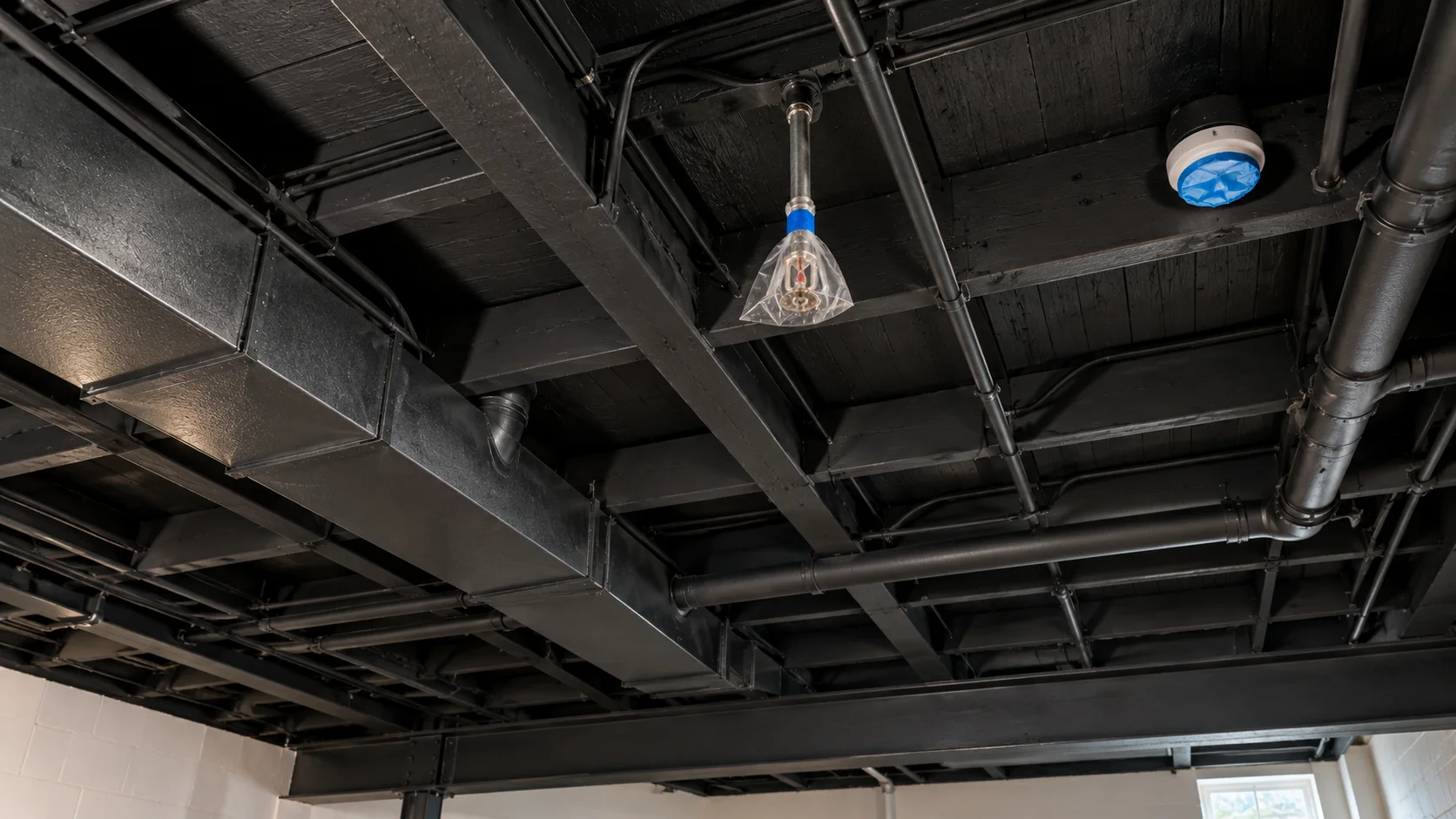
An unfinished basement ceiling is open floor framing with plumbing, ductwork, wiring and whatever else runs through it. Spraying the whole plane one color is the single most effective thing you can do to an unfinished basement, because it stops the eye from reading a dozen separate objects and lets it read one surface. Done well it looks like a choice. Done badly it looks like somebody fogged a basement.
The decision everybody asks about is black or white, and it is a light decision more than a taste decision.
- White maximizes what little light a basement has. Sherwin-Williams publishes a light reflectance value of 83.957 for Pure White SW 7005 — that ceiling is throwing most of the light back at you. Benjamin Moore markets its ceiling paint on exactly this property: it "tones down ceiling glare and provides maximum diffused light." The trade-off is that white shows every bracket, strap, wire and seam, and makes the depth of the joist bays obvious. It also shows overspray misses mercilessly.
- Black does the opposite. Tricorn Black SW 6258 has a published LRV of 2.849, and a near-zero-reflectance ceiling makes the plane recede: the mechanicals visually disappear and the eye reads a dark void rather than a low ceiling with pipes in it. That is why so many finished-looking basement gyms, home theatres and bars are dark overhead. The trade-off is light, and it is a real one — a black ceiling means you need considerably more fixtures than you think.
- A very dark grey or charcoal is the compromise we suggest most often. Iron Ore SW 7069, at an LRV of 5.55, hides mechanicals nearly as well as black while reading slightly softer under artificial light.
Either way the method is spray. Brushing and rolling an open joist ceiling is possible and we have done it, but it takes several times as long and the back sides of pipes and the top edges of joist bays never get covered properly. For spray work on a ceiling like this we use a flat, spatter-resistant interior product — Benjamin Moore's Ultra Spec 500 Interior Flat is a typical choice, rated at a flat sheen of 1.5 to 3.5 units at 85 degrees, zero VOC, 350 to 400 square feet per gallon and one hour to touch with two to three hours to recoat. Flat is not a style preference here. Any sheen on an irregular surface full of edges reads as glare and makes the mechanicals pop back out, which defeats the whole point.
Expect the coverage figure to be optimistic. A joist ceiling is not a plane: it is a plane plus the sides and undersides of every joist, every duct, every pipe and every wire. The real surface area is far larger than the floor area, and a lot of material also ends up in the air rather than on anything. Plan on substantially more paint per square foot of floor than you would for a flat drywalled ceiling.
What must not be in the spray envelope
This list is the difference between a professional basement ceiling and an expensive mistake, and the first item is not negotiable.
- Fire sprinkler heads. Never. NFPA 13, section 6.2.6.2.2, as reproduced verbatim in a fire authority's published interpretation policy, requires: "where sprinklers have had paint applied by other than the sprinkler manufacturer, they shall be replaced with new listed sprinklers of the same characteristics, including orifice size, thermal response, and water distribution." The same section adds that "ornamental finishes shall only be applied to sprinklers and, if applicable, their concealed cover plates, by the sprinkler manufacturer." Paint on a glass bulb or a fusible link insulates the thing that is supposed to sense a fire. Heads get bagged and taped before anything is sprayed, and if one gets overspray on it, it is replaced by a sprinkler contractor — it is not cleaned off.
- Smoke and carbon monoxide alarms, and their vents. Masked and, where practical, removed.
- Electrical panels, junction box covers, receptacles and light fixtures. Masked. Panel interiors and their labelling stay untouched.
- Equipment nameplates, data plates and service labels. On the furnace, air handler, water heater and boiler. These carry model and serial numbers that a technician will need in ten years' time, and painting over them is a small act of vandalism against your future HVAC contractor.
- Gas shut-off valves, water shut-offs, hose bibs and backflow devices. Paint seizes the handle you will one day need in a hurry.
- Dampers, duct access doors and filter racks. Anything that has to open has to keep opening.
- Flexible connectors, insulation jacketing and flue pipes. Single-wall flue and vent pipe runs hot; we leave those alone rather than guess at a coating's temperature rating.
- Anything galvanised or bare steel you want to last. Benjamin Moore's ceiling-paint sheet specifies that non-ferrous metal including galvanised and aluminium be cleaned of contaminants and "dulled with very fine sandpaper or a synthetic steel wool pad to promote adhesion," then primed with an acrylic metal primer; ferrous steel and iron get a metal primer too. Flat wall paint sprayed straight onto shiny galvanised duct will peel off in sheets eventually.
Access, and why we do not paint things shut
There is a code reason behind several of those items, not just a courtesy one. The International Residential Code, which New Jersey's Uniform Construction Code adopts for one- and two-family dwellings, requires at section M1305.1 that "appliances shall be located to allow for access for inspection, service, repair and replacement without removing permanent construction, other appliances, or any other piping or ducts not connected to the appliance being inspected, serviced, repaired or replaced," and that "a level working space not less than 30 inches deep and 30 inches wide (762 mm by 762 mm) shall be provided in front of the control side to service an appliance."
A painter cannot create or destroy that compliance by rolling a joist. But the spirit of it is the standard we work to overhead: if a thing opens, unscrews, reads out or shuts off, it does not get painted. The same logic applies to drop-ceiling access panels, cleanouts and valve boxes.
Drop ceilings and ceiling tile
Plenty of New Jersey basements have a suspended grid with acoustic tile, often from a 1980s or 1990s finishing job, and the usual question is whether it can be painted rather than replaced. Usually yes. Benjamin Moore lists "acoustical ceiling tile" among the substrates for its Waterborne Ceiling Paint Ultra Flat 508, which is a zero-VOC, 0-to-2-sheen product that "resists spattering when applied with a roller" and is dry to touch in an hour with a one-to-two-hour recoat.
Two practical notes. Tiles come out of the grid and get sprayed flat on a table, not in place — in place you get paint in the grid, on the wall angle, and welded into the joint between tile and grid. And a heavily painted mineral-fibre tile loses some of the acoustic absorption you were presumably paying for, which is a trade most people accept happily in a basement. The grid itself can be sprayed a different color from the tile, and black grid with white tile or black on black both look deliberate.
Drywalled basement ceilings
If the basement ceiling is finished in drywall, it is simply a ceiling and it gets treated like one: repair, prime, two coats of a dedicated flat ceiling paint. Our guide to painting ceilings covers the technique. The reason to use a basement ceiling paint rather than the leftover gallon from the walls is spatter and glare — the Benjamin Moore sheet's "resists spattering when applied with a roller" and "maximum diffused light" are both real differences you feel on the day and see afterwards.
If that ceiling is textured, read the texture before quoting. A sprayed or stippled basement ceiling can be painted. A popcorn ceiling is a separate decision with its own cost and its own pre-1978 caution, and our popcorn ceiling removal cost guide covers it.
What About the Basement Floor?
Short version: a bare basement slab is usually a floor-coating job rather than a paint job, and it is a different product family from everything above. Ordinary wall and ceiling paint has no business on a floor that takes foot traffic, rolling loads and the occasional dropped tool.
The moisture logic is identical to the walls, though, and it is the reason most failed basement floor coatings failed. Run the same plastic-sheet test on the slab, in more than one spot, before anybody opens a bucket; a slab with no vapor barrier under it is a slab that will push a coating back off. Because of that we treat the floor as its own scope with its own diagnosis, rather than as the last line on a wall quote.
We do coat basement floors — epoxy and similar systems on residential slabs, and commercial and industrial floor coatings — and that work, including how it is priced and which system suits which slab, is covered in detail in our guide to epoxy garage and basement floor coating in NJ and on our epoxy flooring service page. If the floor is in scope along with the walls and ceiling, say so at the estimate and we will scope all three together. If you are only after the floor, go straight to that guide.
Basement Paint Colors That Actually Work Down There
Color behaves differently in a basement because the light is different. There is less of it, it comes from fewer directions, and a great deal of it is artificial. Two things follow.
First, light colors do more work here than upstairs. A wall color with a mid-to-high light reflectance value bounces the little daylight a basement window gives you back into the room. Agreeable Gray SW 7029, at a published LRV of 60.386, is the kind of warm mid-light neutral that holds its color under both daylight and warm lamps rather than going green or blue the way some cool greys do below grade.
Second, test on the actual wall, under the actual lighting, at the time of day you use the room. That is good advice anywhere and close to mandatory in a basement, where a color chosen in a showroom under daylight-balanced fixtures can look like a completely different paint. Our interior paint colors guide has current palettes with real codes and LRVs, and every estimate we write includes an in-home color consultation — which in a basement means standing in the room with the lights you actually have on.
A pairing that works reliably: light warm neutral walls, a dark ceiling to make the mechanicals disappear, and white trim and doors to give the eye something crisp at eye level. Stairs, handrails, the basement door and any built-in shelving all fall into that trim-and-doors scope (our guide to painting stairs and banisters covers the stairs), and so does new wainscoting or chair rail if the basement is being brought up to the standard of the rest of the house.
Radon, Air and the Things Paint Does Not Fix
Because basements sit in soil, two subjects come up on nearly every basement estimate, and the honest answer to both is that paint is not the tool.
Radon first, because New Jersey homeowners ask about it on almost every basement walk-through. The EPA's A Citizen's Guide to Radon explains that radon "typically moves up through the ground to the air above and into your home through cracks and other holes in the foundation," and lists the routes: "cracks in solid floors," "construction joints," "cracks in walls," "gaps in suspended floors" and "gaps around service pipes." Those are the same cracks a painter patches, which is exactly why the next point matters. The EPA's action level page states that "the EPA recommends homes be fixed if the radon level is 4 pCi/L (picocuries per liter)" and that it "also recommends that Americans consider fixing their home for radon levels between 2 pCi/L and 4 pCi/L."
And on sealing, the EPA's Consumer's Guide to Radon Reduction is explicit: "EPA does not recommend the use of sealing alone to reduce radon because, by itself, sealing has not been shown to lower radon levels significantly or consistently. It is difficult to identify and permanently seal the places where radon is entering." It does say sealing helps a real mitigation system work: "sealing the cracks limits the flow of radon into your home, thereby making other radon reduction techniques more effective and cost-efficient." So patching and caulking a basement before painting is a fine thing to do and a terrible radon plan. Test, and if the number is high, call a radon mitigator. The citizen's guide also notes where to test: "the test kit should be placed in the lowest lived-in level of the home (for example, the basement if it is frequently used, otherwise the first floor)."
Humidity second. A painted basement that still smells like a basement in August has a moisture problem that paint did not cause and cannot cure. The EPA's target is "below 60 percent (ideally between 30 and 50 percent) relative humidity," and the DOE's below-grade guidance says a basement with interior insulation "should have basement dehumidification." That is a dehumidifier, air sealing and in some houses a mechanical ventilation change. Worth knowing before you spend money on paint and conclude the paint did not work.
The third thing paint does not fix is water, and it is worth repeating one last time because it is the single most common mistake in basement painting: no interior coating is a substitute for drainage, grading, gutters and waterproofing. The manufacturers say so on their own data sheets. We say so at the estimate.
How We Run a Basement Job in New Jersey
- We look before we price. A flashlight walk of the whole perimeter, the slab, the ceiling and the mechanicals, and a note of where the stains, the efflorescence and the failed paint are.
- We test, and we will wait a day for the result. Plastic-sheet tests at two or three points on the walls and on the floor if it is in scope.
- We tell you if we are the wrong contractor. Active water, seepage or growth and we hand the moisture problem back before we quote anything. That is not us being difficult; it is the only way the paint lasts.
- We scope walls, ceiling, floor, trim and doors as separate lines so you can see what each one costs and decide which you want now.
- We name the products and the number of coats in writing. Block filler, masonry primer and finish are three different materials and the estimate says which, by manufacturer and line.
- We mask the mechanicals before anything is sprayed, starting with sprinkler heads, alarms, panels, nameplates and valves.
- We ventilate during drying, not just during application, which in a basement means fans and a planned air path rather than an open window.
- We clean up at the end of every day, which in a basement full of stored belongings is most of the job's goodwill.
What we do not do, so there is no ambiguity: basement waterproofing, basement finishing or remodeling, mould or mildew treatment, plaster repair, and we do not hold EPA Lead-Safe (RRP) certification. We will tell you plainly which parts of your basement need somebody else.
Get a Price for Your Basement
Basement pricing depends on the substrate, the condition and how much of the ceiling and floor are in scope, which is why we measure rather than quote from a photo. NJ Painting Co. is a family-owned, licensed and fully insured painting company at 36 Church Rd, Morganville, NJ 07751, painting basements across Monmouth, Middlesex and Ocean counties and working on New Jersey homes for more than 20 years with Benjamin Moore and Sherwin-Williams products. Every estimate is free, includes an in-home color consultation, and spells out surfaces, prep, products and number of coats; our work carries a two-year workmanship warranty. For how single-room interior pricing is built, see our cost to paint a room guide, and for the work itself our interior painting service. Call (732) 239-0932 or request a free estimate, and ask us about the job minimum when you enquire.
Frequently Asked Questions
Is it OK to paint basement walls?
Yes, provided the wall is dry, sound and free of growth. "Dry" means no bulk water or active seepage, no condensation under an overnight plastic-sheet test, and no efflorescence left on the surface. If there is mould, the EPA's guidance is clear: "do not paint or caulk moldy surfaces. Clean up the mold and dry the surfaces before painting," because "paint applied over moldy surfaces is likely to peel." If water is actively coming in, that is a waterproofing contractor's job and it has to be solved before painting. We will not paint over an active moisture problem.
How do you paint basement walls?
Diagnose and test for moisture, clear and protect the room, remove failed coatings and loose material, wash off efflorescence and dust and rinse, patch cracks and voids and let the patches cure, then build the system: block filler on cinder block or CMU, an alkali-resistant masonry primer, and two finish coats. Caulk after priming rather than before, per Sherwin-Williams' own sequence, and ventilate during drying as well as during application. Expect the schedule to stretch: a basement is a cool, humid room, and every manufacturer's sheet says cool and humid lengthens dry and recoat times.
What is good paint for basement walls?
On bare concrete or block, the critical product is not the finish coat but the primer, and it has to be built for alkali. Sherwin-Williams' Loxon Concrete and Masonry Primer-Sealer is rated for "a surface with a pH of 6 to 13"; Benjamin Moore's Ultra Spec Masonry 100% Acrylic Sealer is "high alkali resistant – up to pH-13." Both are breathable — 25.79 and 46.5 perms respectively — which matters because the DOE's building-science guidance says a foundation can only dry inward. Porous block also needs a high-build block filler first. The finish coat is then an ordinary quality interior paint in flat or eggshell.
Can you paint basement concrete walls, and will the paint seal them?
You can paint them, and no, it will not seal them. Benjamin Moore's own block filler sheet says the product "should not be used as a waterproofing sealer," and its masonry sealer is a bonding and alkali-blocking primer rather than a water barrier. Keeping water out of a basement is drainage, grading and waterproofing work — a different trade from painting, and one we do not offer. Any interior coating sold as a cure for a wet basement is being oversold.
What is the best paint for a basement ceiling?
For a drywalled basement ceiling, a dedicated flat ceiling paint. Benjamin Moore's Waterborne Ceiling Paint Ultra Flat 508 is zero-VOC at a 0-to-2 sheen, "resists spattering when applied with a roller" and "tones down ceiling glare and provides maximum diffused light." For a sprayed exposed joist ceiling, a flat interior finish such as Ultra Spec 500 Interior Flat works well — flat, not satin, because any sheen on an irregular surface full of edges reads as glare and makes the mechanicals stand back out.
Should I paint an exposed basement ceiling black or white?
It is a light decision. White maximizes the little light a basement has — Sherwin-Williams publishes an LRV of 83.957 for Pure White SW 7005 — but shows every strap, bracket and wire. Black makes the mechanicals recede and the ceiling read as a single plane: Tricorn Black SW 6258 has a published LRV of 2.849, so plan on noticeably more light fixtures. A very dark charcoal such as Iron Ore SW 7069 at LRV 5.55 is the compromise we suggest most often. Finished-looking basement gyms, theatres and bars are often dark overhead.
Can you spray paint over pipes, ductwork and wiring in a basement ceiling?
Yes for most of it, and never for some of it. Fire sprinkler heads are the hard no: NFPA 13 section 6.2.6.2.2 requires that "where sprinklers have had paint applied by other than the sprinkler manufacturer, they shall be replaced with new listed sprinklers," so overspray on a head means a sprinkler contractor replaces it. Also masked or left alone: smoke and CO alarms, electrical panels and junction boxes, equipment nameplates and service labels, gas and water shut-off valves, dampers and filter racks, and flue pipes. Shiny galvanised duct needs dulling and a metal primer first, per Benjamin Moore's ceiling paint sheet, or flat paint will peel off it.
How do I paint an unfinished basement cheaply without finishing it?
Spray the ceiling one color, paint the walls, and leave the structure exposed. Painting unfinished basement walls and a sprayed joist ceiling is the whole trick, and it is why this is a real category rather than a half-measure — one color overhead reads as a deliberate finish, where a dozen unpainted objects read as a utility space. It is not basement finishing or remodeling, which is framing, insulation, drywall, electrical and mechanical work and is not something we offer. We paint; a finishing contractor finishes.
Can basement ceiling tiles be painted?
Usually yes. Benjamin Moore lists "acoustical ceiling tile" among the substrates for its Waterborne Ceiling Paint Ultra Flat 508. The method matters: tiles come out of the grid and get sprayed flat on a table rather than painted in place, or you get paint welded into the joint between tile and grid and overspray on the wall angle. A heavily coated mineral-fibre tile loses some acoustic absorption, which most homeowners accept in a basement. The grid can be sprayed separately, and black grid with white tile looks intentional.
What about the basement floor?
A bare basement slab is normally a floor-coating job rather than a paint job — epoxy or a similar system, not wall paint. The moisture test matters even more than on the walls, because a slab with no vapor barrier under it will push a coating back off. We do coat basement floors, and the products, systems and pricing are covered in our epoxy garage and basement floor coating guide rather than here.
Does painting a basement help with radon or humidity?
No. On radon the EPA is explicit: it "does not recommend the use of sealing alone to reduce radon because, by itself, sealing has not been shown to lower radon levels significantly or consistently," though sealing does make a proper mitigation system more effective. Test — the EPA recommends fixing a home at 4 pCi/L or above, and considering it between 2 and 4 — and call a radon mitigator if the number is high. On humidity, the target is "below 60 percent (ideally between 30 and 50 percent) relative humidity," and reaching it is a dehumidification and air-sealing question, not a coating one.
How long does paint take to dry in a basement?
Longer than the data sheet says, because the data sheet is measured at 77°F and 50% relative humidity and a basement is rarely either. Benjamin Moore's block filler is one hour to touch and two to three hours to recoat at those conditions, and the sheet adds that "high humidity and cool temperatures will result in longer dry, recoat and service times." Sherwin-Williams' Loxon masonry primer is four hours to touch and 24 hours to recoat, which puts a real overnight into any block or concrete schedule. Build the extra time into the plan rather than crowding the coats.
About the author
Written by the NJ Painting Co. team
NJ Painting Co. is a family-owned painting contractor based in Monmouth County, in business since 2004. We are licensed and fully insured, work with Benjamin Moore and Sherwin-Williams paints, and back our work with a 2-year workmanship warranty. We serve Monmouth, Middlesex, Ocean, Mercer, Somerset and Burlington counties, plus Union, Essex, Hudson, Bergen and Passaic in North Jersey.