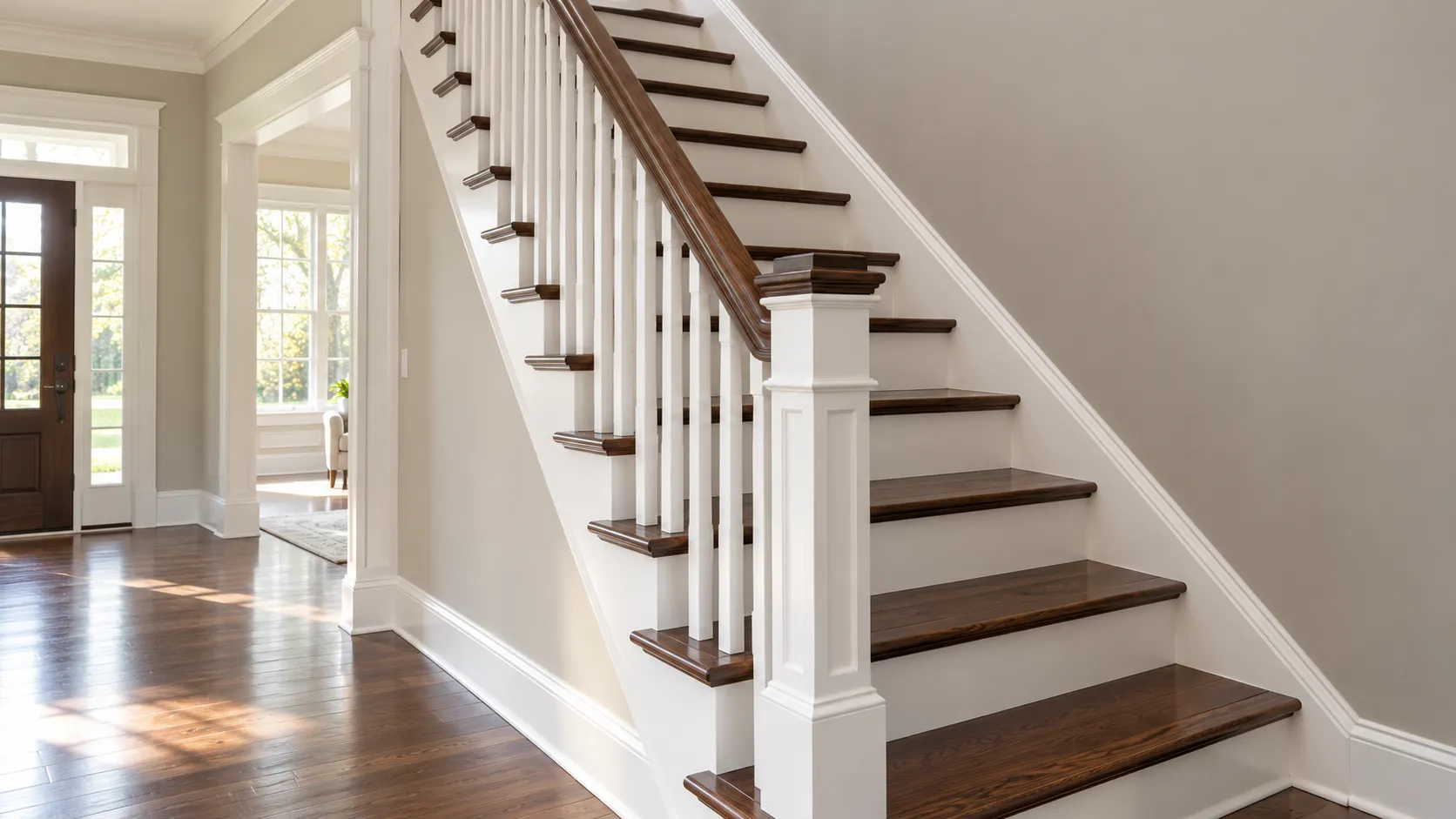
To paint stairs so the finish lasts, treat the staircase as two different surfaces. The treads are a floor: they get walked on, they get grit ground into them, and they need either a floor-rated enamel or a stain under a floor-grade clear coat. Everything else — risers, stringers, skirt boards, balusters, newels and, if it is painted, the handrail — is trim, and takes a hard trim enamel. Dull every glossy surface before you paint it, prime bare wood, work from the top down with the railing first and the treads last, and paint alternate treads if the stairs are the only way up to the bedrooms. Then stay off them for longer than the can says is “dry”. If you are deciding between paint and stain on the treads, the honest answer for most New Jersey houses is the classic combination: stained treads under a clear coat, painted risers.
We are a family-owned painting company in Morganville and have painted interiors across Monmouth, Middlesex, Ocean, Mercer, Somerset and Burlington counties, plus Union, Essex, Hudson, Bergen and Passaic in North Jersey, for more than 20 years, using Benjamin Moore and Sherwin-Williams products. Staircase and banister refinishing — painting and staining risers, treads, stringers, balusters, newels and handrails — is a service we offer, alongside trim and moulding painting, wainscoting and chair rail, and drywall repair in the stairwell. A staircase is also the surface in a house that most often goes wrong when someone paints it, because it is the one surface people cannot stop using while the paint cures.
This guide is written to be useful whether or not you hire anybody. Nothing has been held back. Every dry time, recoat time, traffic time, sheen number and VOC figure below comes from a manufacturer's technical data sheet or product page, and every safety and lead statement from a federal agency, each one fetched and quoted on 24 October 2026. Where the sources disagree with each other, we say so, because on stairs the disagreements are the useful part.
The Short Answer
- Treads are a floor; put a floor product on them. Sherwin-Williams lists its Porch & Floor Enamel “Use for” as interior, exterior, “Floors” and “Steps”. Benjamin Moore's Advance — an excellent enamel — is listed as “ideal for interior doors, trim, cabinets, walls, and ceilings,” and floors are not on that list.
- Risers, stringers, balusters and newels are trim. A hard enamel belongs there: Benjamin Moore Advance or Sherwin-Williams Emerald Urethane Trim Enamel, which describes itself as delivering “the look, feel and durability of an oil based enamel with the convenience of a waterbased formula.”
- Stain needs bare wood. Minwax is blunt about it: “If there's already a clear finish on the wood, the stain can't be absorbed.” Stained treads over old paint or old varnish mean stripping or sanding back to raw wood first.
- You cannot skip the sanding. Every sheet we read says the same thing in different words. Benjamin Moore: “Glossy areas should be dulled.” Sherwin-Williams: “Glossy surfaces should be sanded dull.”
- “Dry” is not “ready to walk on.” Sherwin-Williams' Porch & Floor is dry to touch in 1 hour but rated for “Light Foot Traffic: 24 hours” and “Tables, Chairs and Heavy Foot Traffic: 7 days.” Benjamin Moore says Advance can take “up to 30 days to reach optimum hardness and final sheen.”
- Paint every other tread if you need the stairs. Do the odd treads, wait out the traffic time, then do the even ones. It doubles the calendar, not the work.
- Painted treads can be slippery, and the manufacturers say so. Benjamin Moore: “All floor coatings may become slippery when wet. Where non-skid characteristics are desired, use an appropriate anti-slip aggregate.”
- Stairs are where people get hurt. The CPSC counts injuries related to “stairs, ramps, landings, and floors” at “more than 3.0 million (20 percent) emergency department-treated injuries” a year.
- Old painted stairs and railings are a named lead hazard. The federal lead pamphlet lists “Stairs, railings, banisters and porches” among the surfaces where lead-based paint “may also be a hazard.” In a pre-1978 house, anyone paid to disturb that paint must be EPA certified. We are not an EPA Lead-Safe Certified firm, and we will tell you so at the estimate.
Should You Paint or Stain Stair Treads?
This is the first question almost everyone asks, and the answer depends on what the treads are made of and what is on them now, not on taste alone.
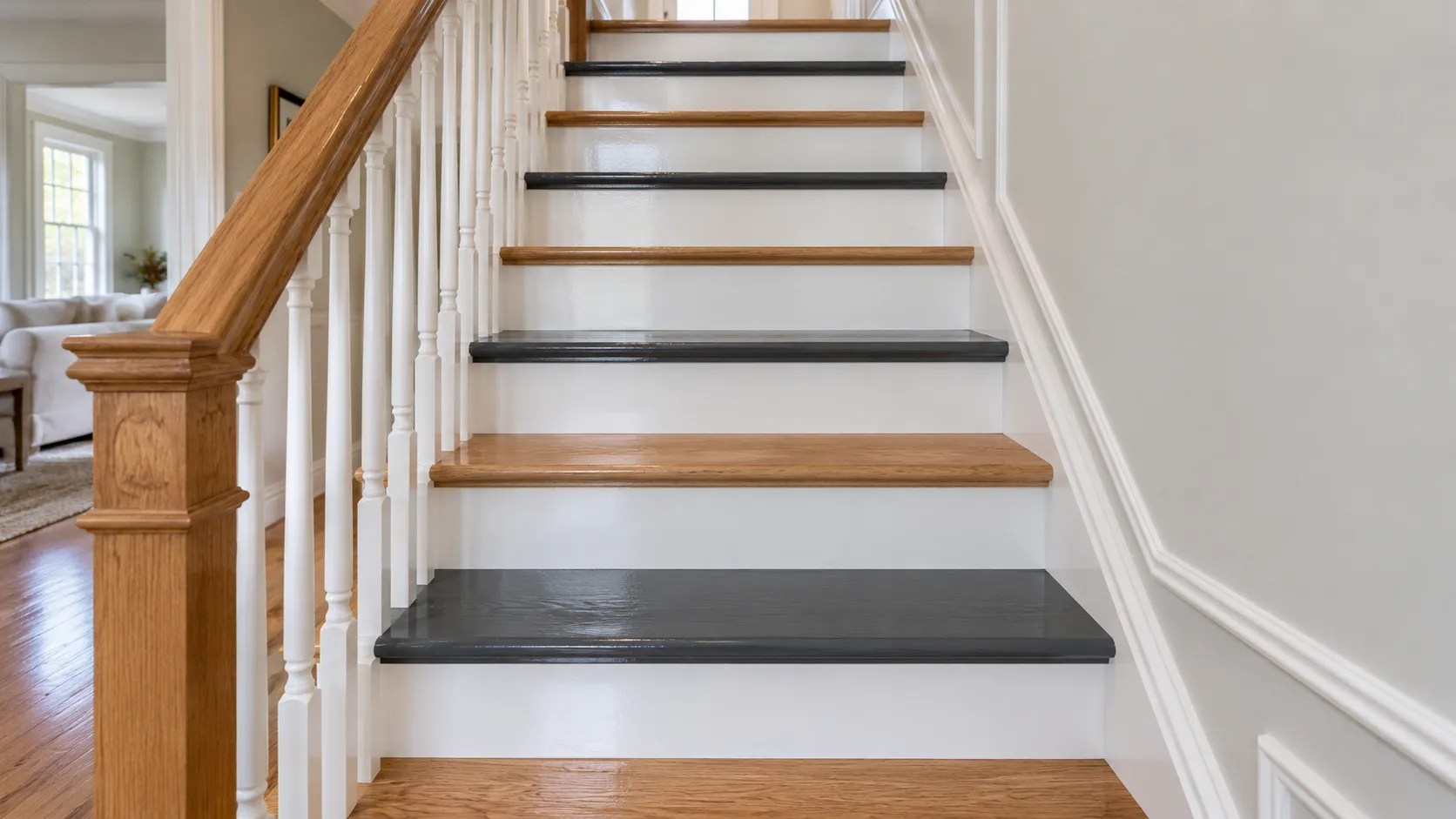
The classic combination: stained treads, painted risers
Most of the staircases we see in New Jersey colonials, capes and split-levels end up with stained treads and white or off-white painted risers, with painted balusters and a stained handrail. There are practical reasons that is the default rather than just a fashion. A riser takes the toe of every shoe on the way up, so it wants a scrubbable enamel that can be wiped and touched up. A tread takes the sole of every shoe, grit and all, and a stained tread under a clear floor finish wears gracefully: when the clear coat dulls in the walking path, the stain beneath it is still the same colour, and a fresh clear coat brings it back. A painted tread that wears through shows the primer or the wood in a pale stripe down the middle of every step.
The contrast is also forgiving. Dark treads hide the dust and grit that collects on them; light risers bounce light into what is often the darkest part of the hall. That is why the combination has lasted as long as it has.
When painted treads are the right answer
Stain is only an option when there is wood worth staining. Builders very often put construction-grade treads under carpet, sometimes with filled knots, mismatched species or patched nosings, on the assumption that nobody would ever see them. When the carpet comes up, the wood underneath may not take stain evenly enough to look like anything you want. Paint is the honest answer for those treads. It is also the answer for a deliberately painted look — a painted runner stripe, a fully painted cottage stair, a basement stair — and for stairs where the existing finish is paint already and stripping it is not justified.
Paint on treads is not a lesser choice if it is the right product. Sherwin-Williams lists “Steps” by name among the uses of its Porch & Floor Enamel, which it describes as “a waterborne acrylic coating designed for interior and exterior, wood and concrete, porches and floors.” Benjamin Moore's Latex Floor & Patio Low Sheen Enamel N122 is described as “a premium quality, quick-drying, epoxy-modified acrylic low sheen latex floor enamel,” recommended “for interior and exterior use on unpainted concrete (new or old) and previously finished wood or concrete floors.” Both are floor enamels; both have a stated wood system. Painted treads done with either, over proper prep, hold up. Painted treads done with leftover wall paint do not.
Staining needs bare wood, and that changes the job
The deciding fact is the one most how-to guides bury. Stain colours wood by soaking into it, so it has to reach the wood. Minwax's own wood-preparation FAQ says: “If there's already a clear finish on the wood, the stain can't be absorbed.” The same is true, more so, of paint. So stained treads over a staircase that is currently painted, or varnished in a colour you no longer want, means taking every tread back to raw wood first, including the nosing and the end grain at the return.
That work is staircase work, and it is part of staircase refinishing as we offer it. It is not the same job as refinishing the landing, the upstairs hall or the floor at the foot of the stairs: hardwood floor refinishing and installation are not services we offer, and we will say so if the estimate turns up a landing that needs a floor contractor. It is also worth knowing before you start that softwoods stain unevenly; Minwax's guidance is that “prior to staining, apply a liberal coat of the Pre-Stain Wood Conditioner,” and that sanding grit changes the result — “to achieve a darker stain color, use coarser grit of sandpaper (#150-#180) on the last sanding you do prior to staining.” Test the stain on the underside of a tread or the back of a skirt before committing the whole stair to it.
Once stained, the tread needs a clear coat, because stain alone has no wear layer. Minwax's instruction on timing is simple: “You should not apply your clear topcoat until the stain is no longer tacky.” On the choice of clear coat, it notes that “oil-based topcoats, such as Minwax® Fast-Drying Polyurethane, will impart some additional warmth and depth,” while water-based finishes stay clearer. On a dark walnut tread the difference is small; on a natural oak tread, an oil-based clear coat warms it noticeably.
What Is the Best Paint for Stair Treads and Risers?
There is no single best paint for a staircase, because a staircase is two surfaces. Here is how the products we use compare, quoted from their own data sheets and product pages.
| Product | Where it belongs on a stair | Sheen at 60° | Dry to touch | Recoat | Traffic and hardness | VOC |
|---|---|---|---|---|---|---|
| Sherwin-Williams Porch & Floor Enamel (A32, acrylic satin) | Painted treads; listed for “Floors” and “Steps” | 10 – 20 units | 1 hour | 4 hours | Light foot traffic 24 hours; heavy foot traffic 7 days | “less than 50 grams per litre” |
| Benjamin Moore Latex Floor & Patio Low Sheen Enamel N122 | Painted treads; previously finished wood floors | Satin, 10 – 25 | 1 hour | 4 hours | No hour figure for traffic; sheet warns longer “service times” in cool, humid conditions | 45 g/L |
| Benjamin Moore Advance Waterborne Interior Alkyd Semi-Gloss 793 | Risers, stringers, skirts, balusters, newels, painted rails | 50 – 60 | 4 – 6 hours | 16 hours | No heavy abrasion for 5 – 7 days; up to 30 days to optimum hardness | 43.2 g/L |
| Benjamin Moore Advance Waterborne Interior Alkyd Satin 792 | The same, in a lower sheen | 25 – 35 | 4 – 6 hours | 16 hours | No heavy abrasion for 5 – 7 days; up to 30 days to optimum hardness | 48.5 g/L |
| Sherwin-Williams Emerald Urethane Trim Enamel (K38, semi-gloss) | Risers, stringers, balusters, newels, painted rails | 45 – 65 units | 1 hour | 4 hours | Not stated on the sheet | “less than 50 grams per litre” |
| Benjamin Moore Fresh Start High-Hiding All Purpose Primer 046 | Primer under either enamel on bare or patched wood | 7 – 12 at 85° | 30 minutes | 1 hour | Maximum adhesion on hard, non-porous surfaces “may take 3-4 days” | < 50 g/L |
| Minwax Super Fast-Drying Polyurethane for Floors 350 VOC (oil-based clear) | Clear coat over stained treads | Gloss, semi-gloss or satin | — | 3 hours | Light foot traffic 24 hours; no heavy traffic or rugs for 7 days | Named “350 VOC”; no figure on the page |
| Minwax Ultra Fast-Drying Polyurethane for Floors (water-based clear) | Clear coat over stained treads | Gloss, semi-gloss or satin | — | At least 2 hours, less than 24 | Not stated on the page | Not stated on the page |
Three things in that table are worth reading twice. First, the floor enamels are the lowest-sheen paints on it: a satin in the 10-to-25 range at 60°, against 45 to 65 for the trim enamels. That is not an accident. Second, the drying behaviour of the two trim enamels is completely different: Emerald Urethane recoats in 4 hours, Advance in 16, and Advance's sheet adds that “full hardness and adhesion develop over time. Do not expose to heavy abrasion … for at least 5 – 7 days to prevent damage to the finish.” Advance levels beautifully and is one of the best enamels made for a handrail or a newel, but it is not the product to put on anything that will be touched the next morning. Third, “dry to touch” is the least useful number on the sheet for a staircase. The traffic column is the one that matters, and not every sheet gives one.
Treads: a floor enamel, not a trim enamel
Our own practice on painted treads is a floor enamel from one of the two brands, primed where there is bare wood, in two coats. Sherwin-Williams specifies “2 coats Porch & Floor Enamel” for both bare wood and previously painted floors in sound condition. Benjamin Moore's wood system for N122 is “Primer: Fresh Start High-Hiding All Purpose Primer (046)” then “Finish: 1-2 coats Latex Floor & Patio Low Sheen Enamel (N122)”. We put two on treads, always.
We will not put a wall paint on a tread, and we are cautious about a trim enamel there. A trim enamel is hard enough for a riser, but neither Advance nor Emerald Urethane lists floors among its uses, and they are glossier than the floor products, which matters on a surface people walk down in socks.
Risers, stringers, skirts and balusters: a trim enamel
Everything vertical on a staircase is trim and gets treated like a door or a run of casing. We use Benjamin Moore Advance or Sherwin-Williams Emerald Urethane Trim Enamel, usually in semi-gloss or satin to match the rest of the house's trim, over a primer where the wood is bare or patched. Sherwin-Williams' wood system for Emerald Urethane is “1 coat Premium Wall & Wood Primer” then “2 coats Emerald Urethane Trim Enamel”. If your trim elsewhere is semi-gloss, a satin riser will look like a different colour, because sheen reads as colour; our guide to satin versus eggshell explains why.
One note from the Advance sheet that matters on stairs in particular: “Although Advance yellows less than conventional alkyds, a slight amount of yellowing may occur. This effect is accelerated in dark or poorly ventilated areas and is more visible in lighter colors.” A white riser in a dim back stair is exactly that condition. It is not a reason to avoid the product, but it is a reason not to expect a stairwell's whites to stay identical to the brightly lit trim in the living room.
Primer, and the knots that bleed through
Bare wood gets primed; that is on every sheet. The detail people miss is knots. Pine treads and stringers are full of them, and knots bleed resin and tannin through a water-based primer as a yellow-brown ring a few weeks after the job looks finished. Benjamin Moore's Fresh Start 046 says it “seals and suppresses most bleeding type stains such as tannin bleed,” but its own limitations line reads: “Not recommended for sealing knots or over pine sap.” Sherwin-Williams' Emerald Urethane sheet explains the cause — “Knots and some woods, such as redwood and cedar, contain a high amount of tannin, a colored wood extract” — and gives the interior fix: “If staining persists, spot prime severe areas with 1 coat of Multi-Purpose Oil-Based Primer.” Our own practice is to spot-prime every visible knot on a staircase with a solvent-based or shellac-based primer before the general prime coat, because the cost of doing it is a few minutes and the cost of not doing it is repainting the stair.
How Do You Prep Stairs for Paint, and Can You Skip the Sanding?
You cannot skip the sanding, and the reason is adhesion, not smoothness. New paint on a glossy old finish sticks to the gloss, not to the wood, and a tread is the surface in the house most likely to test that bond. Every manufacturer sheet we read says the same thing. Benjamin Moore, on Advance and on Floor & Patio: “Glossy areas should be dulled.” Advance adds, specifically: “Sand glossy alkyds before applying Advance.” Sherwin-Williams, on Emerald Urethane: “Glossy surfaces should be sanded dull,” followed by the sentence that every painter should have printed on a card: “Recognize that any surface preparation short of total removal of the old coating may compromise the service length of the system.”
For painted treads, Sherwin-Williams' Porch & Floor sheet goes further and gives a test: “Smooth, hard or glossy coatings and surfaces should be dulled by abrading the surface. Apply a test area, allowing paint to dry one week before testing adhesion. If adhesion is poor, additional abrasion of the surface and-or removal of the previous coating may be necessary.” If you are unsure whether old varnish on a tread will hold paint, that one-week test patch on the bottom step will tell you more than any opinion.
Liquid deglossers are sold as a way around sanding. Our own practice is to scuff-sand regardless: a deglosser cleans and softens the surface but does not leave the mechanical tooth that sanding does, and none of the sheets above offers a chemical as a substitute for dulling.
The prep sequence we work inside
- Clean first. Stairs and handrails carry skin oil, floor polish and furniture wax. The sheets say surfaces “must be clean, dry, and free of dirt, dust, grease, oil, soap, wax”. Sand over wax and you push it into the wood.
- Fill and sand. Sherwin-Williams: “Patch all holes and imperfections with a wood filler or putty and sand smooth. All patched areas must be primed.” Nail holes on treads from old carpet tack strip are the common one.
- Dull every glossy surface, including the undersides of the nosings, which people forget and which are the first place peeling shows.
- Vacuum, then wipe, because sanding dust on a tread becomes grit in the paint.
- Spot-prime knots, then prime bare wood and patches.
- Caulk after priming, not before. Sherwin-Williams' sequence for trim applies to the joint between a skirt board and the wall and between a riser and the stringer: gaps “can be filled with the appropriate caulk after priming the surface.” Caulking and sealing are services we offer, and a clean caulk line along the skirt is a large part of what makes a painted stair look finished.
All of that assumes the old paint is not lead-based. On a stair in a house built before 1978, that assumption needs checking before anyone sands anything; the lead section below explains why stairs are singled out.
How Do You Paint Spindles and Balusters?
Balusters — spindles, in most people's vocabulary — are the slowest painted surface in a house, which is why they are priced separately on any honest estimate; our guide to what trim, doors and baseboards cost to paint in NJ covers how that is built. A turned baluster is a stack of beads, coves and fillets, every one of which catches a drip on the way down, and there are typically several per tread.
Our own order of work on a stair is top down and rails first: handrail, then balusters, then newels, then stringers and skirts, then risers, then treads last. Anything that drips from a baluster lands on a tread that has not been painted yet. That is not a manufacturer instruction; it is gravity.
On each baluster we brush rather than roll, with a good angled sash brush, and work from the top of the baluster down. Load lightly, lay the paint on around the turning, then lay it off with long vertical strokes and immediately look underneath every bead, where runs form a minute after you have moved on. Sherwin-Williams specifies “a nylon-polyester brush” for Emerald Urethane and a roller of “1/4 to 1/2 inch nap” for flat runs; Benjamin Moore specifies “nylon / polyester” for Advance and tells you to “apply paint generously from unpainted area into wet area. Avoid lap marks by maintaining a wet edge.” On a square baluster, the lap-mark rule matters more than on a turned one: do one face at a time and keep each face wet from end to end.
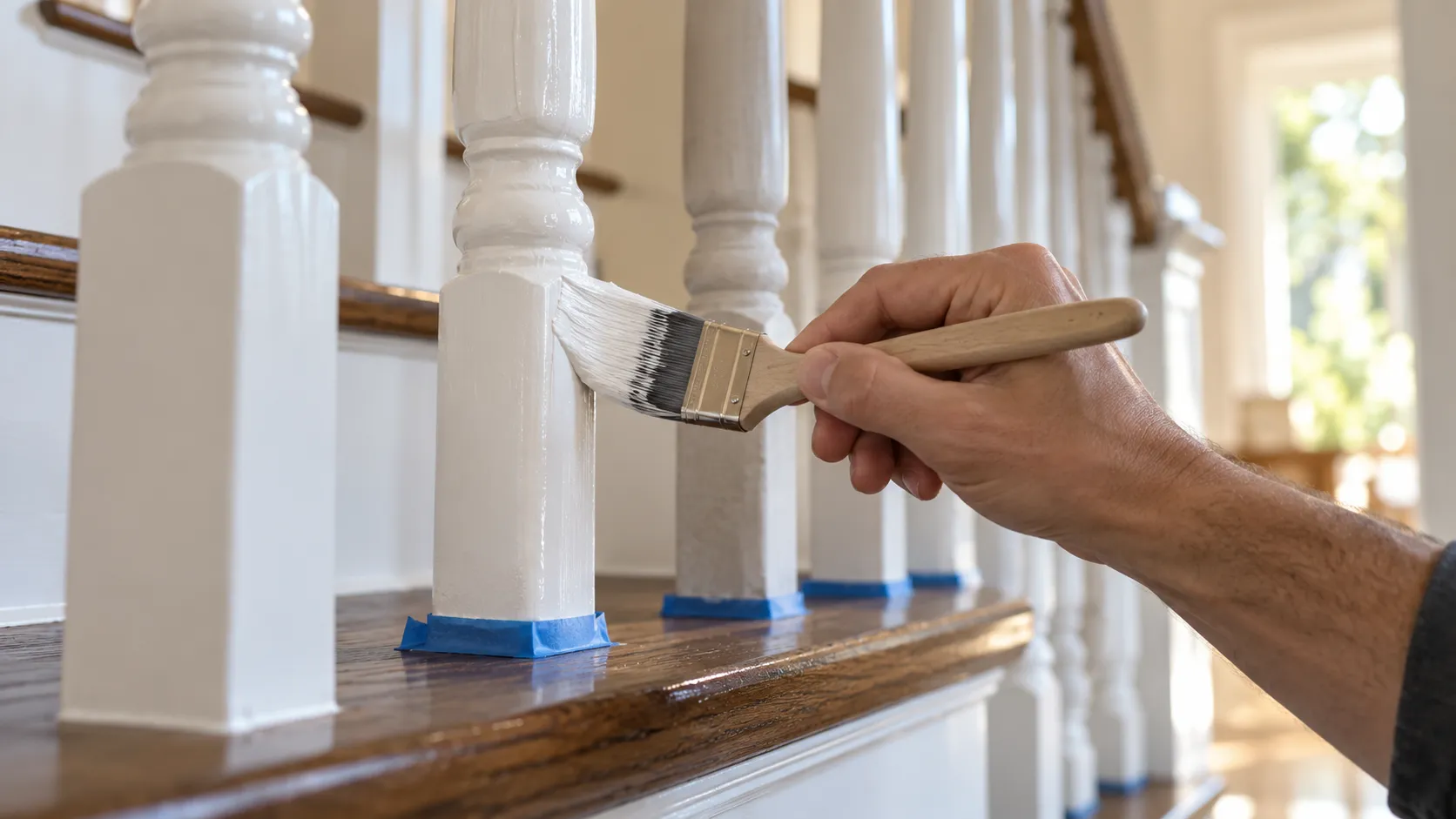
Two more things. Mask the tread where each baluster lands, with tape on the tread rather than the baluster, so the cut line sits on the trim and the tread can be finished later without lifting paint. And spray only when the house allows it. Spraying a full run of balusters is faster and produces a beautiful finish, but the overspray envelope on an open staircase reaches the treads, the walls, the hall below and anything upstairs, so we spray balusters only in an empty house where the masking makes sense, and brush them otherwise.
If balusters are loose, cracked or missing, they need a carpenter before they need a painter. Finish carpentry is not a service we offer: we do not replace balusters, newels, treads or railings, or rebuild stairs. We will point out anything that moves when we touch it at the estimate.
How Do You Paint Stairs You Still Have to Use?
Most New Jersey houses have one staircase, and the bedrooms are at the top of it. That is the single biggest practical difference between painting stairs and painting anything else, and it is the question most stair guides answer with “wait until it's dry” and nothing more.
The every-other-step method
The answer is to paint alternate treads. Paint the first, third, fifth and so on; leave the even treads bare. People going up and down step over the wet treads and use the bare ones. When the painted treads have reached their traffic time, paint the even ones and use the odd ones. The risers can usually be done in the first pass, because nobody stands on a riser, but keep shoes well back from them.
The waiting time in the middle is not the “dry to touch” figure. It is the light-traffic figure. Sherwin-Williams gives one for its Porch & Floor Enamel: “Light Foot Traffic: 24 hours”. For two coats on each set of treads with a 4-hour recoat in between, the method looks like this in practice: first coat on the odd treads, second coat four hours later, a full day before anyone steps on them, then the same on the even treads. Call it three days for the treads alone at 77°F, longer in a cold or damp house, and longer again if the treads are stained and clear-coated, which is several coats per set.
Making it work in a lived-in house
- Mark the wet treads. A strip of painter's tape across the top of each painted riser is enough to stop someone going up in the dark — and in the first hours of morning half-awake on a familiar stair is exactly how wet treads get stepped on.
- Socks off, shoes off. Socks slide on fresh floor enamel and print into it. Bare feet or clean soft-soled slippers on the bare treads only.
- Pets. A dog will not step over alternate treads. Gate the stair or plan the job around the dog's routine.
- Do not shorten the wait to save a day. A tread walked on too soon does not just mark; the film can lift at the nosing where the heel lands, and that is a sand-back and repaint.
- Ventilate. A stairwell is a chimney. Our guide to paint fumes and VOC safety covers ventilation, and our guide to living in your house while it is painted covers the rest of the logistics.
The alternative to alternate treads is to paint the whole staircase at once and not use it, which works where there is a second stair or the household can be elsewhere for the traffic time. It produces a slightly better result, because every tread is done in one continuous session, but it is rarely practical in a single-stair house.
How Should a Handrail Be Finished?
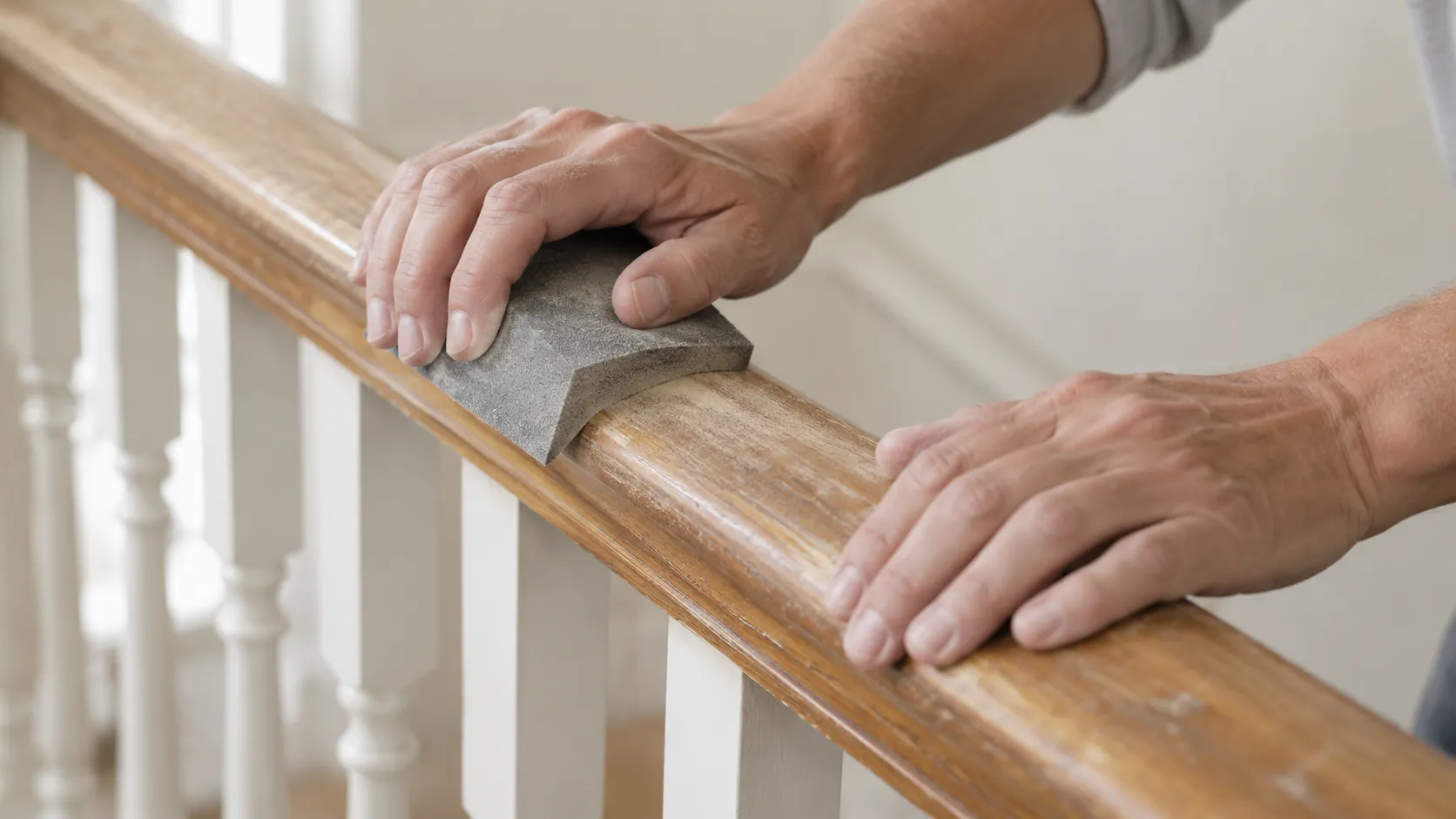
A handrail is touched by every hand that goes up or down the stairs, which makes it the dirtiest surface on a staircase and the one where a finish is most likely to fail by peeling. Skin oil and hand cream build up in the grip zone and act as a release agent under new paint. The first job on any handrail is to degrease it properly, and the second is to sand it.
A stained handrail: clean, sand, re-stain or re-coat
Most handrails in the houses we work in are stained hardwood — oak, often — under a clear finish that has gone dull and sticky in the grip zone and stayed glossy at the ends. If the colour is still right, the job is a clean, a scuff-sand with a fine sanding sponge that follows the profile of the rail, and fresh clear coats. If the colour is wrong or worn through, the rail goes back to bare wood, is re-stained and re-coated; the Minwax rule that stain “can't be absorbed” through an existing clear finish applies to a rail exactly as it does to a tread. A handrail profile cannot be sanded with a power sander without rounding over the detail, so this is sanding-sponge and hand work.
A painted handrail: hard enamel and patience
A painted handrail is common in older houses and on simple stairs, and a painted rail done well looks crisp. It needs the hardest enamel available and real cure time before heavy use. This is where the gap between dry time and hardness on the sheets matters most. Advance is dry to touch in 4 to 6 hours, but Benjamin Moore says “do not expose to heavy abrasion … for at least 5 – 7 days” and that “it could take up to 30 days to reach optimum hardness and final sheen.” A handrail gripped the morning after it was painted will feel slightly tacky and may pick up fingerprints in the film. Use it lightly for the first week.
Painting a previously stained rail white, or staining a previously painted rail, is entirely possible, and both are within staircase refinishing as we offer it. The second is much more work than the first, because all of the paint has to come off before the stain can go on.
Painting the Stairwell Walls
“How to paint walls on a staircase” is really two questions: how to reach them, and what to put on them.
The reach is the hard part. A stairwell wall runs from a ceiling that may be fifteen or eighteen feet above the lowest tread down to a skirt board that steps with the stairs. A stepladder cannot stand on stairs. The answer is staging — an adjustable stair platform, or a plank between a ladder on the landing and one stabilised on the lower flight — and that is the same problem as a stairwell ceiling, which our guide to painting ceilings covers properly, including the federal ladder and scaffold rules that apply to a crew. If you are hiring for only one part of the staircase, make it the high wall.
What goes on the walls is a scrubbable finish rather than a flat, because a stairwell wall is a hand-height wall: people steady themselves on it, carry laundry baskets and furniture past it, and children trail their fingers along it. An eggshell or satin wall paint is our usual recommendation, with the sheen guide above explaining the trade-off. Where the skirt board meets the wall, the line is a caulk line before it is a paint line.
Stairwell walls are also where drywall damage collects — dents from moving day, cracked corners at the landing, popped fasteners along the stringer. Drywall and sheetrock repair is a service we offer, and our guide to drywall repair in NJ covers it. Plaster repair is not a service we offer; a cracked or loose plaster stairwell wall in an older house belongs to a plasterer, and we will say so at the estimate. Wainscoting and chair rail painting are ours too, and a painted wainscot up a stair is one of the most hard-wearing ways to protect a stairwell wall.
Are Painted Stairs Slippery?
They can be, and nobody should paint a tread without thinking about it. Stairs are where people get hurt in houses. The CPSC's 2024 Death and Injury Report puts it plainly: “Injuries related to stairs, ramps, landings, and floors, resulting in large part from slips and falls, accounted for more than 3.0 million (20 percent) emergency department-treated injuries and over 7.7 million (20 percent) medically attended injuries per year.” It adds that “a large number of injuries and deaths are the result of falls related to stairs, floors, and household furniture.”
The manufacturers are candid that their floor coatings do not solve this on their own. Benjamin Moore's Floor & Patio sheet carries a caution: “All floor coatings may become slippery when wet. Where non-skid characteristics are desired, use an appropriate anti-slip aggregate.” Sherwin-Williams' Porch & Floor sheet says: “Some surfaces may require a slip resistant additive for safety. Surfaces may be slippery when wet and proper preventative precautions are recommended. To increase slip resistance, add slip resistant floor texture additive to the coating when applying. The addition of slip resistant additives will not eliminate the possibility or risk of slipping or falling. This product should not be used in place of a non-skid finish.”
Read together, those give a practical policy:
- Use a floor product on treads, not a trim enamel. The floor products are the lowest sheen in the table above; the trim enamels are not listed for floors.
- Consider a slip-resistant additive on painted treads, especially on a basement stair, a stair used in socks, or a household with small children or older adults. It is mixed into the final coat. It gives the tread a fine texture, and it will collect a little more dirt than a smooth tread.
- Consider a satin clear coat over stained treads rather than gloss. Minwax's floor products come in gloss, semi-gloss and satin.
- Do not let a handrail project take the handrail away for long. A stair should not be used without a handrail while its rail is being refinished; plan the rail so it is usable again as quickly as the product allows.
A carpet runner is the other common answer to slippery treads. Carpet and runner installation and removal are not services we offer, but if a runner is going down after the job, tell us at the estimate, because the part of the tread under the runner does not need the same finish as the exposed edges.
How Long Before You Can Walk on Painted Stairs?
There are four different clocks on every can, and stairs need the last two.
- Dry to touch — the film will not mark if you brush it lightly. One hour for the floor enamels and Emerald Urethane, four to six hours for Advance.
- Recoat — the film is firm enough to take another coat without being dragged. Four hours for the floor enamels and Emerald Urethane, sixteen for Advance, two to twenty-four for Minwax's water-based floor clear coat and three for its oil-based one.
- Light foot traffic — careful walking in bare feet or socks. Sherwin-Williams' Porch & Floor: 24 hours. Minwax's oil-based floor polyurethane: “Floor will bear light foot traffic in 24 hours.”
- Full use — shoes, furniture being carried, rugs and runners. Sherwin-Williams: “Tables, Chairs and Heavy Foot Traffic: 7 days.” Minwax: “Avoid heavy traffic, and do not install rugs or clean floors for 7 days.” Benjamin Moore's Advance: no heavy abrasion for 5 to 7 days, and up to 30 days to optimum hardness.
Every one of those is a laboratory figure at 77°F and 50% relative humidity, and every sheet qualifies it. Benjamin Moore: “High humidity and cool temperatures will result in longer dry, recoat and service times.” Sherwin-Williams: “Drying and recoat times are temperature, humidity, and film thickness dependent.” A stair in a New Jersey house with the heat off in March, or in a humid July week with the windows shut, will be slower than the can. Both brands also give a minimum application temperature of 50°F for their floor enamels and Advance; a basement stair in winter can be below that.
Practically: plan on a full day before anyone walks on freshly painted treads, a week before shoes and furniture, and the first month with some care. If a runner is going down, wait the full week at least.
Old Stairs, Old Paint: The Pre-1978 Lead Rule
This section matters more on a staircase than almost anywhere else in a house, because stairs and railings are named in the federal lead guidance as wear surfaces.
The EPA, CPSC and HUD pamphlet Protect Your Family From Lead in Your Home (January 2026) says: “Many homes and childcare facilities built before 1978 may have lead-based paint. In 1978, the federal government banned consumer uses of lead-containing paint.” It goes on: “Deteriorated lead-based paint (peeling, chipping, chalking, cracking or damaged paint) is a hazard and needs immediate attention. Lead-based paint may also be a hazard when found on surfaces that children can chew or that get a lot of wear and tear, such as” windows and sills, doors and frames, and “Stairs, railings, banisters and porches.” And it explains why: “Lead dust can form when lead-based paint is scraped, sanded or heated. Lead dust also forms when painted surfaces containing lead bump or rub together.”
The regulations use the same vocabulary. Under 40 CFR 745.63, a “friction surface means an interior or exterior surface that is subject to abrasion or friction” and an “impact surface means an interior or exterior surface that is subject to damage by repeated sudden force.” A painted tread is both. A painted handrail and the baluster tops beneath it are friction surfaces. And every step of the prep described above — dulling, sanding, scraping — is the kind of disturbance that turns old paint into dust. Even the manufacturers' sheets carry it: “If you scrape, sand, or remove old paint, you may release lead dust. LEAD IS TOXIC.”
The rule for anyone paid to do the work is federal. The EPA's Renovation, Repair and Painting program applies to “anyone paid to perform work that disturbs paint in housing and child-occupied facilities built before 1978,” who “must be certified in lead-safe work practices.” “This includes all firms, even sole proprietorships.” The pamphlet's advice to homeowners is: “Hire only EPA-, Tribal- or state-approved Lead-Safe Certified renovation firms when renovating, repairing or painting.”
We are not an EPA Lead-Safe (RRP) Certified firm. We say that plainly because a great deal of New Jersey housing predates 1978 and a staircase in it is very likely to carry old paint. On a pre-1978 house, ask every bidder — us included — for the firm's certification number before anyone sands a tread or scrapes a railing, check it against the EPA's search tool, and take the honest answer over the comfortable one. Our guide to lead paint in older NJ homes explains testing and the rule in more detail, and our guide to painting historic homes in NJ covers what belongs to a painter in an old house and what does not.
White Risers, Black Risers and Two-Tone Stairs
The common combinations each have a practical side as well as a look. White or off-white risers are the classic, and they brighten a dark stair, but they show every toe scuff; a scrubbable semi-gloss or satin enamel is what makes them liveable. Black or very dark risers hide scuffs far better and look sharp under stained treads, but they show dust and pet hair, and a deep colour needs the right tint base and often a tinted primer to cover in two coats. A painted runner stripe down the centre of painted treads, with the edges in the trim colour, is a good way to give a painted stair the look of a runner without a carpet. And treads and risers in the same colour make a stair recede into the wall, which suits a narrow back stair.
Whatever the combination, match the riser and stringer colour and sheen to the trim elsewhere in the hall, and the stair will look as if it belongs to the house rather than to a separate project. If you are choosing colours for the whole hall, our interior paint colors guide has current palettes with real codes.
What We Do, and Do Not Do, on Stairs and Banisters
- Staircase and banister refinishing is a service we offer: painting and staining risers, treads, stringers, skirt boards, balusters, newels and handrails, including stripping or sanding treads and rails back to bare wood where a stain is wanted.
- We use a floor-rated product on treads — a floor enamel for painted treads, or stain under a floor-grade clear coat — and a hard trim enamel on everything vertical.
- We dull every glossy surface and prime bare wood, and spot-prime knots with a primer made to block them, because the sheets say to and because skipping it is what makes painted stairs peel.
- We work top down, rails first and treads last, and use the every-other-step method when the staircase is the only way upstairs.
- We tell you the traffic time, not the dry time, for the products on your stair, in writing, so nobody walks on a tread a day too early.
- We offer a slip-resistant additive on painted treads and will tell you when we think a stair needs it.
- We paint the stairwell walls and ceiling from proper staging, and we do drywall and sheetrock repair, caulking and sealing, trim and moulding painting, and wainscoting and chair rail in the stairwell.
What we do not do, so there is no ambiguity: finish carpentry, so we do not replace treads, balusters, newels or handrails, tighten or rebuild a stair, or install new railings; hardwood floor refinishing or installation, so landings, hallways and the floors at the top and foot of the stairs go to a floor contractor; carpet or runner removal or installation; plaster repair; and we do not hold EPA Lead-Safe (RRP) certification. On a house built before 1978, ask us and every other bidder for a firm certification number before anyone disturbs old paint on the stairs. For exterior steps, porch stairs and outdoor railings, which are a different set of products and problems, see our guide to painting porches, railings and columns.
Get a Price for Your Stairs
Staircase pricing depends on the number of treads and balusters, whether the treads are being painted or taken back to bare wood and stained, the condition of the existing finish, the handrail, and how high the stairwell walls go, which is why we measure rather than quote from a photo. NJ Painting Co. is a family-owned, licensed and fully insured painting company at 36 Church Rd, Morganville, NJ 07751, working on New Jersey homes for more than 20 years with Benjamin Moore and Sherwin-Williams products. Every estimate is free and spells out surfaces, prep, products and number of coats; our work carries a two-year workmanship warranty. For how trim, baluster and handrail pricing is built, see our cost to paint trim, doors and baseboards guide and the interior section of our cost guide, and for the work itself our interior painting service. Call (732) 239-0932 or request a free estimate, and ask us about the job minimum when you enquire.
Frequently Asked Questions
Is it better to paint or stain stair treads?
For most houses, stain the treads and paint the risers. A stained tread under a clear floor finish wears gracefully, because when the clear coat dulls in the walking path the colour underneath is unchanged, and a fresh clear coat restores it. A painted tread that wears through shows a pale stripe. Paint is the right answer when the treads are construction-grade wood that will not stain evenly, when the stair is already painted and stripping it is not justified, or when you want a deliberately painted look. Staining needs bare wood: Minwax notes that if there is already a clear finish on the wood, the stain cannot be absorbed.
What is the best paint for stair treads?
A floor enamel, not a wall paint and ideally not a trim enamel. Sherwin-Williams' Porch and Floor Enamel lists floors and steps by name among its uses, and Benjamin Moore's Latex Floor and Patio Low Sheen Enamel is recommended for previously finished wood floors. Both are low-sheen satins, around 10 to 25 at 60 degrees, and both specify two coats over a primed or sound surface. Trim enamels such as Benjamin Moore Advance and Sherwin-Williams Emerald Urethane Trim Enamel belong on the risers, stringers and balusters; neither lists floors among its uses, and both are glossier.
Can you paint stairs without sanding?
Not if you want the paint to stay on. Every manufacturer sheet we read requires glossy surfaces to be dulled before painting: Benjamin Moore says glossy areas should be dulled and glossy alkyds sanded before Advance, and Sherwin-Williams says glossy surfaces should be sanded dull. Its Porch and Floor sheet suggests a test patch left for one week before checking adhesion, with more abrasion or removal of the old coating if adhesion is poor. Liquid deglossers clean the surface but do not leave the mechanical tooth sanding does. On a house built before 1978, find out whether the old paint contains lead before anyone sands it.
How long after painting stairs can you walk on them?
Plan on a full day for light traffic and a week for full use. Sherwin-Williams rates its Porch and Floor Enamel for light foot traffic at 24 hours and for tables, chairs and heavy foot traffic at 7 days. Minwax says its oil-based floor polyurethane will bear light foot traffic in 24 hours, and to avoid heavy traffic and rugs for 7 days. Benjamin Moore says Advance should not see heavy abrasion for 5 to 7 days and can take up to 30 days to reach optimum hardness. All of those are measured at 77 degrees Fahrenheit and 50 percent humidity; a cold or damp house is slower.
How do you paint stairs if you still need to use them?
Paint every other tread. Do the odd treads first and leave the even ones bare to walk on, wait out the light-traffic time for the product, then paint the even treads and use the odd ones. Mark the wet treads with a strip of tape on the riser above, keep shoes and socks off the fresh paint, and gate the stairs if there is a dog. With a floor enamel that recoats in four hours and takes light traffic at 24, the treads alone take around three days by this method, longer for stained treads with several clear coats.
Are painted stairs slippery?
They can be, and the manufacturers say so. Benjamin Moore cautions that all floor coatings may become slippery when wet and recommends an anti-slip aggregate where non-skid characteristics are wanted. Sherwin-Williams says some surfaces may require a slip-resistant additive, that the additive will not eliminate the risk of slipping or falling, and that the product should not be used in place of a non-skid finish. Use a low-sheen floor enamel on treads rather than a glossy trim enamel, consider an additive in the final coat, and choose a satin clear coat over stained treads. Stairs, ramps, landings and floors account for more than three million emergency department-treated injuries a year, according to the CPSC.
Do painted stairs hold up?
Painted treads hold up well when they are prepped properly, primed where bare, coated twice with a floor enamel and left alone for the full traffic time. They fail early when a wall paint or a single coat goes over unsanded gloss, or when they are walked on the day after painting. Expect the walking path to show wear before the edges, and expect to touch up a painted tread sooner than you would recoat a stained one. Risers and balusters in a hard trim enamel last for years with occasional washing.
What paint should you use on stair spindles and balusters?
A hard trim enamel in the same sheen as the rest of the house's trim, usually semi-gloss or satin, over a primer where the wood is bare or patched. Benjamin Moore Advance and Sherwin-Williams Emerald Urethane Trim Enamel are both designed for trim and both specify a nylon-polyester brush. Brush each baluster from the top down, lay off with long vertical strokes, and check under every bead for runs a minute later. Paint the handrail and balusters before the treads, so any drips land on surfaces that have not been finished yet.
Can you paint a stained handrail?
Yes. Clean it thoroughly first, because skin oil and hand cream build up in the grip zone and stop paint sticking. Then sand it dull with a fine sanding sponge that follows the profile, prime it with a bonding primer, and finish with two coats of a hard trim enamel. Use the rail lightly for the first week: Benjamin Moore says Advance should not see heavy abrasion for five to seven days and can take up to thirty days to reach full hardness. Going the other way, from a painted rail to a stained one, is much more work, because all of the paint has to come off first.
Is the old paint on my stairs a lead hazard?
It may be if the house was built before 1978. The federal lead pamphlet from the EPA, CPSC and HUD lists stairs, railings, banisters and porches among the surfaces where lead-based paint may be a hazard because they get a lot of wear and tear, and explains that lead dust forms when lead paint is scraped, sanded or heated, or when painted surfaces bump or rub together. Anyone paid to disturb paint in a pre-1978 home must be EPA certified in lead-safe work practices. We are not an EPA Lead-Safe Certified firm; ask every bidder for the firm's certification number before anyone sands or scrapes old paint on the stairs.
Should stairwell walls be flat or eggshell?
Eggshell or satin rather than flat, in most houses. A stairwell wall is a hand-height wall that people lean on, carry things past and trail their fingers along, so it needs a finish that can be washed. Flat paint is better at hiding imperfections, which matters on a tall, raking-lit stairwell wall, but it marks and burnishes when it is cleaned. The high parts of a stairwell wall also need staging rather than a ladder, because a stepladder cannot stand level on stairs.
About the author
Written by the NJ Painting Co. team
NJ Painting Co. is a family-owned painting contractor based in Monmouth County, in business since 2004. We are licensed and fully insured, work with Benjamin Moore and Sherwin-Williams paints, and back our work with a 2-year workmanship warranty. We serve Monmouth, Middlesex, Ocean, Mercer, Somerset and Burlington counties, plus Union, Essex, Hudson, Bergen and Passaic in North Jersey.