Painting interior trim in New Jersey costs about $1 to $3 per linear foot for baseboard, casing and crown molding and $40 to $150 per interior door, according to our published NJ painting cost guide. Trim is almost never priced the same way as the walls: it is measured in linear feet, doors are counted one at a time, and our whole-house article puts a trim-and-doors-only job — every baseboard, every casing and every door in the house, walls left alone — at $1,200 to $3,500. National guides sit in the same band on the per-foot rate: This Old House (updated 20 April 2026) gives $1 to $3 per linear foot for trim and $40 to $100 for an interior door, and Fixr (updated 31 January 2025) gives $1 to $6 per linear foot and a typical interior trim project of $1,000 to $3,000. Homewyse's calculators run higher than both.
We are a family-owned painting company at 36 Church Rd in Morganville, and we have been quoting interior work in Monmouth, Middlesex, Ocean, Somerset, Mercer, Burlington, Union, Essex, Hudson, Bergen and Passaic counties for more than twenty years, using Benjamin Moore and Sherwin-Williams products. This guide explains how trim and door pricing is actually built: what gets measured, what gets counted, which prep steps move the number the most, and why the same baseboard can be a dollar a foot in one house and three in the next. Every New Jersey figure comes from our own published cost guide or our whole-house price table. Every national figure is attributed to the guide it came from, and the technical details come from the manufacturers' own data sheets. For the walls side of the job, see our cost to paint a room in NJ and cost to paint a house in NJ guides.
The Short Answer
- Trim and baseboard, our pricing: $1 to $3 per linear foot, from our cost guide.
- Interior doors, our pricing: $40 to $150 each, from our cost guide.
- Whole-house trim and doors only: $1,200 to $3,500 in our whole-house price table, covering baseboard, casing and doors throughout.
- Adding trim to a walls-only quote typically adds 50 to 80 percent, per our whole-house article. It is the single biggest line-item decision in an interior quote.
- Nationally, per linear foot: This Old House $1 to $3; Fixr $1 to $6 including labor and materials, with crown molding, baseboard and casing each at $1 to $4 and chair rail and picture rail at $1 to $6.
- Nationally, per door: This Old House $40 to $100; Fixr's room guide $35 to $50; Fixr's painter guide $70 to $200; Homewyse $163 to $332.
- Nationally, a whole trim job: Fixr gives a national average of $1,500 and a range of $1,000 to $3,000, and describes a typical project as "about $1,500 for painting 500 linear feet of interior trim with oil-based paint in a 1,500 sq.ft. home, including prep work, sanding, and caulking."
- What moves it: the condition of the existing finish, whether the old trim is oil-based, the number of doors, crown molding, stairwell and two-story foyer access, and whether the color is changing.
Why Trim Is Priced Per Linear Foot and Doors Per Door
Walls are priced by area because a roller covers area. Trim is priced by length because nothing about painting a baseboard scales with its square footage — it scales with how far you have to travel on your knees with a brush, how many inside and outside corners you cut, how many gaps you caulk and how many times you stop to re-tape. A 3 1/4-inch colonial baseboard and a 7-inch Victorian base take roughly the same time per foot. Pricing them by the square foot would say the Victorian base costs twice as much, and it does not.
Doors are the opposite case. A door is a fixed object with a fixed amount of work in it, so it is counted, not measured. That is also why door prices vary so widely between guides: a "door" can mean very different jobs, which the next section unpacks.
What counts as trim, and where the tape measure goes
Measuring trim for an estimate means counting the running feet of the painted wood profiles in the room:
- Baseboard — the perimeter of the room, less door openings and less any run where cabinetry or built-ins sit on the floor.
- Window casing, stool and apron — the full way around each window opening, plus the sill. A standard 3 by 5 window is about 16 linear feet of casing before the stool. Window trim and sills are not a service we list, so they stay off our estimates and the example below; if yours need paint, get that line quoted separately.
- Door casing — about 17 linear feet per side of a 3 by 7 opening. A door that is cased on both sides has about 34 feet of casing even though it is one door.
- Crown molding — the perimeter again, at the ceiling. In most central New Jersey colonials crown appears in the living room, dining room and entry rather than throughout.
- Chair rail, picture rail and wainscoting cap — another perimeter run, and the reason dining rooms carry more trim per square foot of floor than any other room.
- Stair skirt boards, handrails, newels and balusters — priced separately, because balusters are the slowest painted surface in a house.
This Old House groups baseboards, wainscoting and crown molding together and says of trim that "the cost to paint it is measured in linear feet, and the price can range from $1–$3 per linear foot." Fixr prices the same way and adds a surcharge for access: "when painting difficult to reach areas, such as second floors, dormers, or soffits, this number may increase by $1 to $2 per linear foot. This accounts for the need to move up and down a ladder, refill a sprayer or tray, reposition a ladder, increase working hours, and risk a spill or fall."
What makes a door a two-side job or a six-panel job
Four things turn one door into two doors' worth of work, and an estimate that just says "doors" does not tell you which you are buying.
- One side or two. A bedroom door painted only on the bedroom side is half a door. If the hall side is changing color too, it is a full door — and the hall side has to be cut to a different wall color.
- Flat or panelled. A flush hollow-core slab is a roller job. A six-panel door has six panels, six panel edges, five rails and stiles and a mitered profile around every panel, each of which has to be brushed out before it sets. The usable brushing time on a waterborne alkyd is short, which is why a six-panel door is commonly quoted at close to twice a flat door.
- Edges and jamb. The latch edge, hinge edge, top and bottom of the slab, plus the jamb and stop, are a surface nobody counts until the door is off its hinges.
- Hardware. Pulling the knob, strike and hinges and putting them back adds real minutes per door, and it is the difference between a crisp door and one with paint-locked hinges.
Those differences explain the spread in published per-door prices. This Old House's $40 to $100 and Fixr's $35 to $50 read as one side of a simple door painted in place. Fixr's painter guide gives $70 to $200 for interior doors, and Homewyse's door calculator (fetched 14 October 2026, page dated May 2026) gives $163 to $332 per door for an estimate that it says covers prep work of up to an hour per door, removing and masking hardware, scuff sanding, spot priming, two coats on both sides and replacing the hardware. That is a two-side, hardware-off door, and it is a different product from a $40 door.
What Trim, Baseboards, Crown and Doors Cost
Here are our published figures first, then the national guides for comparison. Read all of them as ranges, not quotes: the number that counts is the one that follows a tape measure and a look at the condition of the existing finish.
| Line | Our range | Notes |
|---|---|---|
| Trim and baseboard | $1 to $3 per linear foot | Covers baseboard, casing and crown as measured runs |
| Interior doors | $40 to $150 each | The spread is one side vs two, flat vs panelled, hardware on vs off |
| Trim and doors only, whole house | $1,200 to $3,500 | Baseboard, casing and doors throughout, walls not included |
| Adding trim to a walls-only quote | 50 to 80 percent more | From our whole-house article |
| Walls alone | $1 to $2 per square foot | For comparison, from the same cost guide |
| Whole interior | $2 to $6 per square foot of floor | Walls, ceilings, trim and doors together |
Our cost guide also notes the gap between a wall-only repaint and a full one, crediting Angi's 2026 figures: "roughly $4.70 per square foot for walls, trim and ceilings together versus about $2.75 for a plain wall repaint." That single comparison is the clearest way to see what trim is worth on a bid sheet.
| Item | This Old House | Fixr | Homewyse |
|---|---|---|---|
| Trim, general | $1 to $3 per linear foot | $1 to $6 per linear foot, labor included | Trim molding $1.60 to $3.39 per linear foot |
| Baseboard | Included in trim | $1 to $4 per linear foot | $2.30 to $4.88 per linear foot |
| Crown molding | Included in trim | $1 to $4 per linear foot | $2.10 to $4.45 per linear foot |
| Casing | Not given separately | $1 to $4 per linear foot | Door frame $2.37 to $5.02 per linear foot |
| Chair rail and picture rail | Not given separately | $1 to $6 per linear foot | Molding $1.61 to $3.40 per linear foot |
| Interior door | $40 to $100 each | $35 to $50 (room guide); $70 to $200 (painter guide) | $163 to $332 each |
| Stairway | $15 to $30 per linear foot | Not given | Not fetched |
| Whole trim job | Not given | $1,000 to $3,000; national average $1,500 | Not given |
Two things are worth saying plainly about that table. The first is that the guides disagree by a factor of four on what a door costs, and almost all of that is scope rather than market. The second is that Homewyse's figures sit above everybody else's across the board, because its estimates are built around a specified prep and two-coat scope rather than a market survey. Neither is wrong; they are answering different questions.
Baseboard
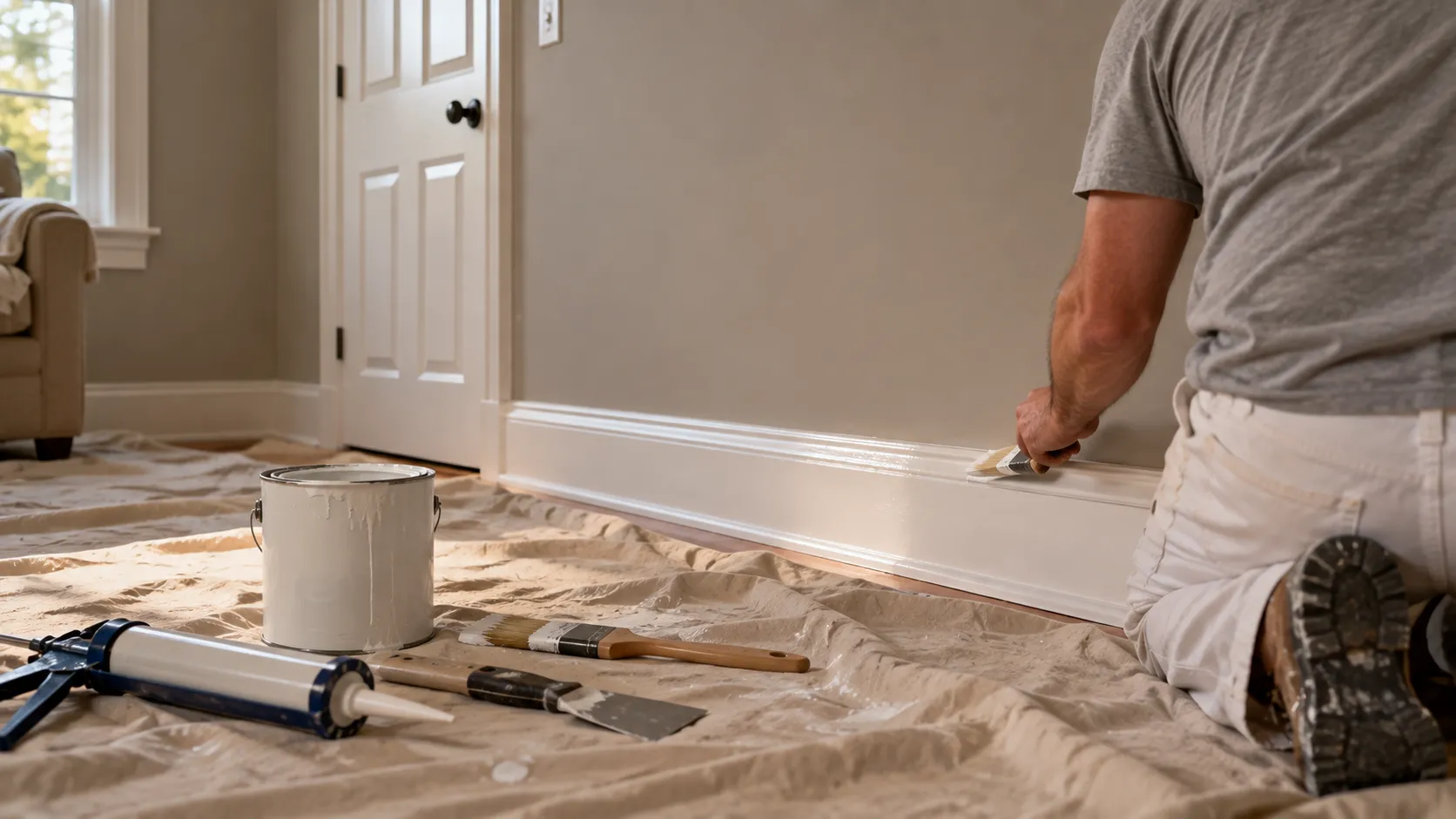
Baseboard is the longest single run of trim in a house and the one most likely to be beaten up. Vacuum-cleaner strikes, shoe scuffs, pet damage, split caulk lines where the wall has settled and a layer of dust bonded into a decade-old film all have to be dealt with before paint. The cost difference between a baseboard in good condition and one that needs filling, sanding and re-caulking along its whole length is larger than the cost difference between any two paint products you could choose.
Crown molding
Crown is priced at or slightly above baseboard per foot even though there is less of it, because every foot is painted overhead from a ladder or bench with two cut lines to hold — one against the ceiling, one against the wall — and no room to rest a hand. Homewyse puts crown at $2.10 to $4.45 per linear foot against $2.30 to $4.88 for baseboard; Fixr puts both at $1 to $4. In practice the deciding factor is the ceiling height it sits at.
Casing, chair rail and wainscoting
Casing is quick per foot on its own and slow in aggregate, because it is all corners. Wainscoting and chair rail are the most expensive trim per foot in most houses: Fixr prices chair rail and picture rail at $1 to $6 per linear foot, the top of its interior range, because panel moldings mean dozens of small inside corners and a cap that has to be brushed in two directions.
Interior doors
Doors are usually the second-largest number on a trim quote after baseboard, and the one homeowners most often forget to count. Walk the house and count every slab, including closet doors and the basement door. A colonial with four bedrooms commonly has fifteen to twenty interior doors once closets are in.
Stair rails, balusters and newel posts
This Old House prices stairways by the foot rather than the area — "approximately $15–$30 per linear foot" — and explains why: "the job includes painting spindles, baseboards, handrails, and other unique features." A run of thirteen balusters is thirteen separate four-sided objects, each with a top and bottom joint, and no part of it can be rolled. If your stair has painted balusters, make sure they are named in the estimate rather than folded into "trim."
A Whole-House Trim and Door Job, Measured and Priced
Here is the arithmetic for a two-story, roughly 2,000-square-foot colonial of the kind we quote constantly in Monmouth and Middlesex counties. The room sizes and door count below are stated assumptions for the example, not a real address.
First floor: living room 15x20 (70-foot perimeter), dining room 12x14 (52), kitchen 12x16 (56), family room 14x18 (64), powder room 5x6 (22), entry and hall 8x20 (56). That is 320 feet of perimeter.
Second floor: primary bedroom 14x16 (60), bedroom 11x12 (46), bedroom 10x12 (44), bedroom 10x11 (42), hall 4x18 (44), hall bath 8x10 (36), primary bath 8x12 (40). That is 312 feet.
- Baseboard: 632 feet of total perimeter, less about 48 feet of door openings (16 doors at three feet) and about 20 feet where kitchen cabinetry meets the floor, gives roughly 560 linear feet.
- Crown molding: living room and dining room only, 70 + 52 = 122 linear feet.
- Total measured trim: 560 + 122 = 682 linear feet, with window casing left out as noted above.
- Doors: 16, counting closets and the basement door, with their casing priced as part of the door.
| Line | Quantity | Unit price | Low | High |
|---|---|---|---|---|
| Baseboard | 560 linear ft | $1 to $3 per linear ft | $560 | $1,680 |
| Crown molding | 122 linear ft | $1 to $3 per linear ft | $122 | $366 |
| Interior doors | 16 | $40 to $150 each | $640 | $2,400 |
| Total | $1,322 | $4,446 |
Our published whole-house trim-and-doors line is $1,200 to $3,500, and the arithmetic above overlaps it rather than matching it. That is not a contradiction, and it is worth understanding before you compare bids. The $1,322 low end describes trim in sound condition, staying the same white, getting one coat, with the doors painted in place on one side. The $4,446 high end describes old oil-based trim that has to be de-glossed and primed throughout, a color change, two finish coats, doors off their hinges and painted on both sides, and crown worked from a bench. Most houses are neither. A house with less crown, fewer doors and trim in reasonable shape lands squarely inside the published range.
For a sanity check against national data: Fixr describes a typical project as about $1,500 for 500 linear feet of interior trim in a 1,500-square-foot home. Our example has 682 feet of trim plus 16 doors in a 2,000-square-foot home, so a figure well above $1,500 is what you would expect.
How much paint a trim job takes
Trim paint is bought by the gallon and goes further than people assume, because the painted width is narrow. Using a painted width of about four inches for baseboard and three and a half for crown — stated assumptions for this example — the example house works out at roughly 185 square feet of baseboard and 35 of crown, or about 440 square feet of trim surface for two coats. Sixteen doors at about 42 square feet for two sides is another 1,344 square feet for two coats.
Coverage comes off the data sheets. Benjamin Moore lists Advance Waterborne Interior Alkyd at 400 to 500 square feet per gallon, and Sherwin-Williams lists ProClassic Interior Waterbased Acrylic-Alkyd Semi-Gloss at 350 to 400 square feet per gallon. At 350 to 500 square feet per gallon, roughly 1,780 square feet of two-coat trim and door surface needs about three and a half to five gallons. Buy five and expect to have some left for touch-ups, which you will want. Which brand is a separate question, covered in our Benjamin Moore vs Sherwin-Williams comparison.
The Prep That Actually Drives the Number
On an interior job labor is 75 to 95 percent of the bill, as our cost guide says, and on trim specifically almost all of that labor is prep. Here is what the hours go into, in the order they happen.
Filling nail holes and dents
Finish nails are set below the surface and filled when the trim is installed, but the filler shrinks, pops or was never sanded flush. On a repaint every hole gets filled again, and every ding from twenty years of furniture gets filled with a hard filler rather than caulk, because caulk in a nail hole telegraphs through the paint as a dimple within a season. Sherwin-Williams' ProClassic data sheet says of wood: "Sand any exposed wood to a fresh surface. Patch all holes and imperfections with a wood filler or putty and sand smooth."
Caulking
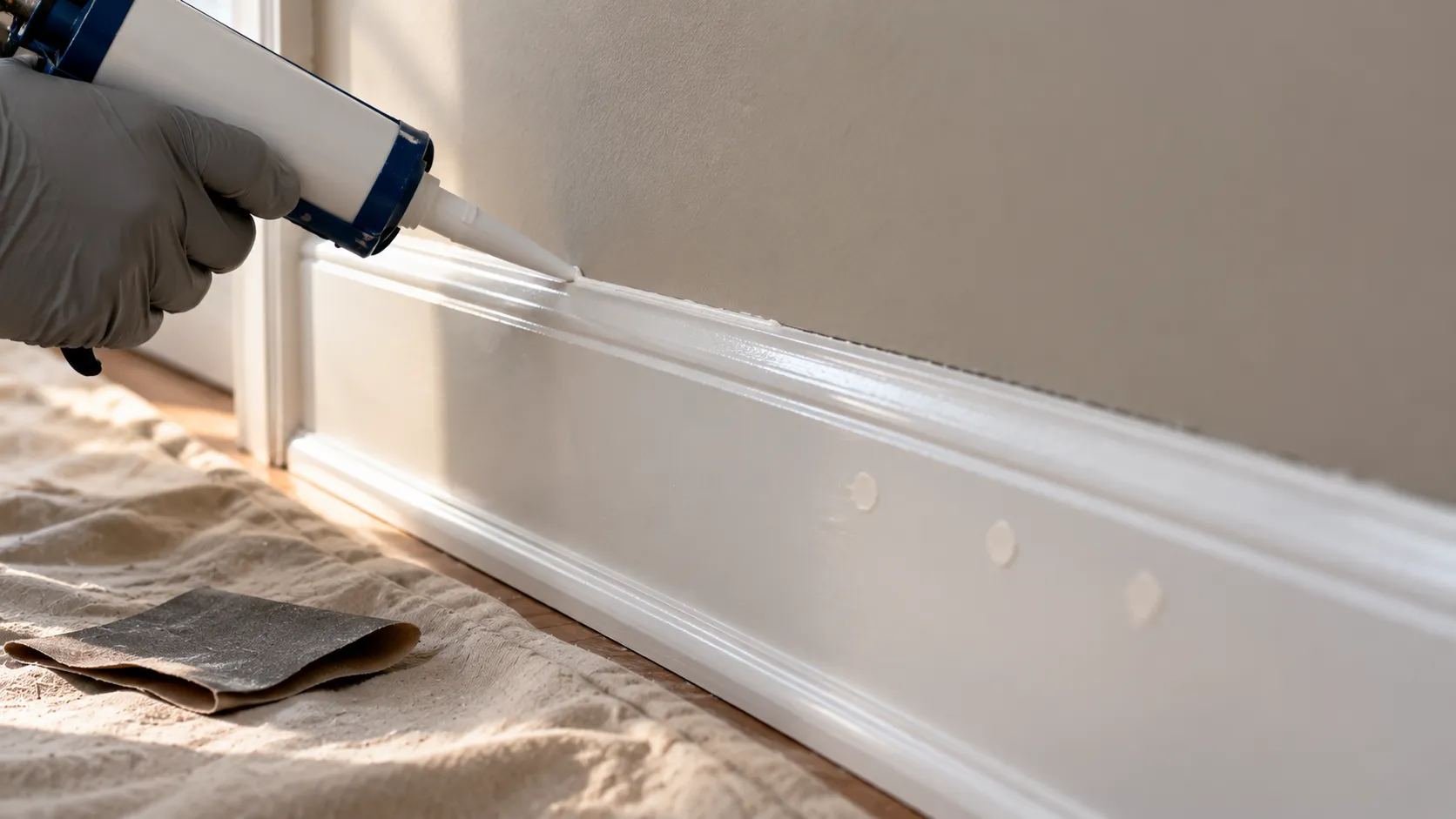
Caulk is what makes a trim line read as straight. Every joint where trim meets wall, every inside corner, every mitre that has opened and every gap at the top of a baseboard gets a bead run and tooled. The ProClassic sheet is specific about the order: "Gaps between walls, ceilings, crown moldings, and other interior trim can be filled with the appropriate caulk after priming the surface." Caulk over bare wood or over a chalky old finish releases; caulk over primer does not. In an older Jersey colonial where the framing has moved, caulking can be half the trim labor on its own.
De-glossing and sanding
This is the step that gets cut on cheap bids and the step that decides whether the finish is still attached in three years. Old trim enamel is hard and slick, and nothing bonds to it reliably until it is dulled. Both manufacturers say so flatly. Benjamin Moore's Advance sheet lists under its limitations: "Sand glossy alkyds before applying Advance," and under surface preparation, "Glossy areas should be dulled." Sherwin-Williams says "Glossy surfaces should be sanded dull" and adds the sentence every homeowner comparing bids should read twice: "Recognize that any surface preparation short of total removal of the old coating may compromise the service length of the system."
Scuff-sanding 682 linear feet of trim and 16 doors by hand is a day of work on its own, and it is invisible in the finished product. It is also the first thing to disappear when a bid comes in thirty percent under everyone else's.
Old oil-based trim, and why coating choices fail
Most New Jersey houses built before the mid-1990s have oil-based (alkyd) enamel on the trim, often under two or three later coats. It matters for two reasons.
First, latex over oil. A conventional acrylic latex applied straight onto a cured, glossy alkyd has very little to grip. It will look fine for months and then peel off in sheets at the first knock, or come away in a strip with the masking tape. The fix is mechanical and chemical together: dull the surface by sanding, then prime with a product rated for the job. Benjamin Moore's Fresh Start High-Hiding All Purpose Primer is specified for "new, previously painted and properly prepared wood," and its sheet notes that "on hard, non-porous surfaces, maximum adhesion and hardness may take 3-4 days to develop" — which is why we do not stack a finish coat onto a bonding primer the same afternoon and then hang the door.
Second, oil over latex. The other direction fails differently. A hard, brittle alkyd film applied over a softer, more flexible latex cracks as the substrate moves seasonally, and you get hairline checking along the length of the baseboard. This is why modern waterborne alkyd enamels have largely replaced true oil on trim: they level like oil, clean up with water, and move with the substrate. Benjamin Moore's Advance is described on its own sheet as "a premium quality, waterborne alkyd enamel that delivers the desired flow and leveling characteristics of conventional alkyd paint," and as "ideal for interior doors, trim, cabinets, walls, and ceilings."
If you are not sure what is on your trim, a painter will usually test an inconspicuous spot with denatured alcohol on a rag: a latex film softens and transfers color, a cured alkyd does not. A good estimate says which it found and what primer follows.
Pre-1978 homes
Sanding and scraping trim is exactly the activity the federal lead rules exist for, and trim is where lead paint most often survives in a house that has otherwise been redecorated. The EPA's Renovation, Repair and Painting program requires that "anyone paid to perform work that disturbs painted surfaces in homes, childcare facilities and preschools built before 1978 be certified." Both manufacturers carry the same warning on their data sheets; Sherwin-Williams' reads: "Removal of old paint by sanding, scraping or other means may generate dust or fumes that contain lead."
Practically, this means containment, HEPA vacuums and a verified cleanup on a pre-1978 trim job, and it changes the price. It is also common here: the Census Bureau's American Community Survey (2024) counts about 61 percent of New Jersey's housing units as built before 1980, against 48 percent nationally. NJ Painting Co. is not an EPA Lead-Safe Certified firm, so if trim in a pre-1978 house has to be sanded or scraped, ask any contractor you are considering for their EPA certification details in writing before work starts, and see our guide to lead paint in older NJ homes for what the process looks like.
Spraying Trim vs Brushing It
Sprayed trim looks better than brushed trim. There is no serious argument about that: an atomized film levels into a surface with no brush marks at all, which is why doors and cabinet work are sprayed in a shop wherever possible. Both manufacturers publish spray settings for their trim enamels — Sherwin-Williams lists airless spray at 2,000 psi through a fine-finish tip of 0.010 to 0.014 inch for ProClassic, and notes "a fine finish tip is the preferred method of spray application due to the characteristics of this product."
The reason spraying is not automatically cheaper is masking. To spray baseboard in an occupied room, every square foot of wall, floor, ceiling, window and piece of furniture within reach of the overspray has to be covered and sealed first. On a trim-only job in a furnished house, the masking can easily cost more hours than brushing the same trim would have taken, and that is before anyone considers the smell and the drying time in a house people are sleeping in. Our guide to living in your house while it is painted covers the occupied-home side of that decision, and paint fumes and VOC safety covers the air quality side.
How this usually shakes out in practice:
- Empty house or new construction: spray everything. Nothing to mask, nothing to protect, and the finish is the best it will ever be.
- Occupied repaint, walls and trim together: brush and roll. The walls are being painted anyway, so the trim cut lines are being held either way, and masking for spray buys little.
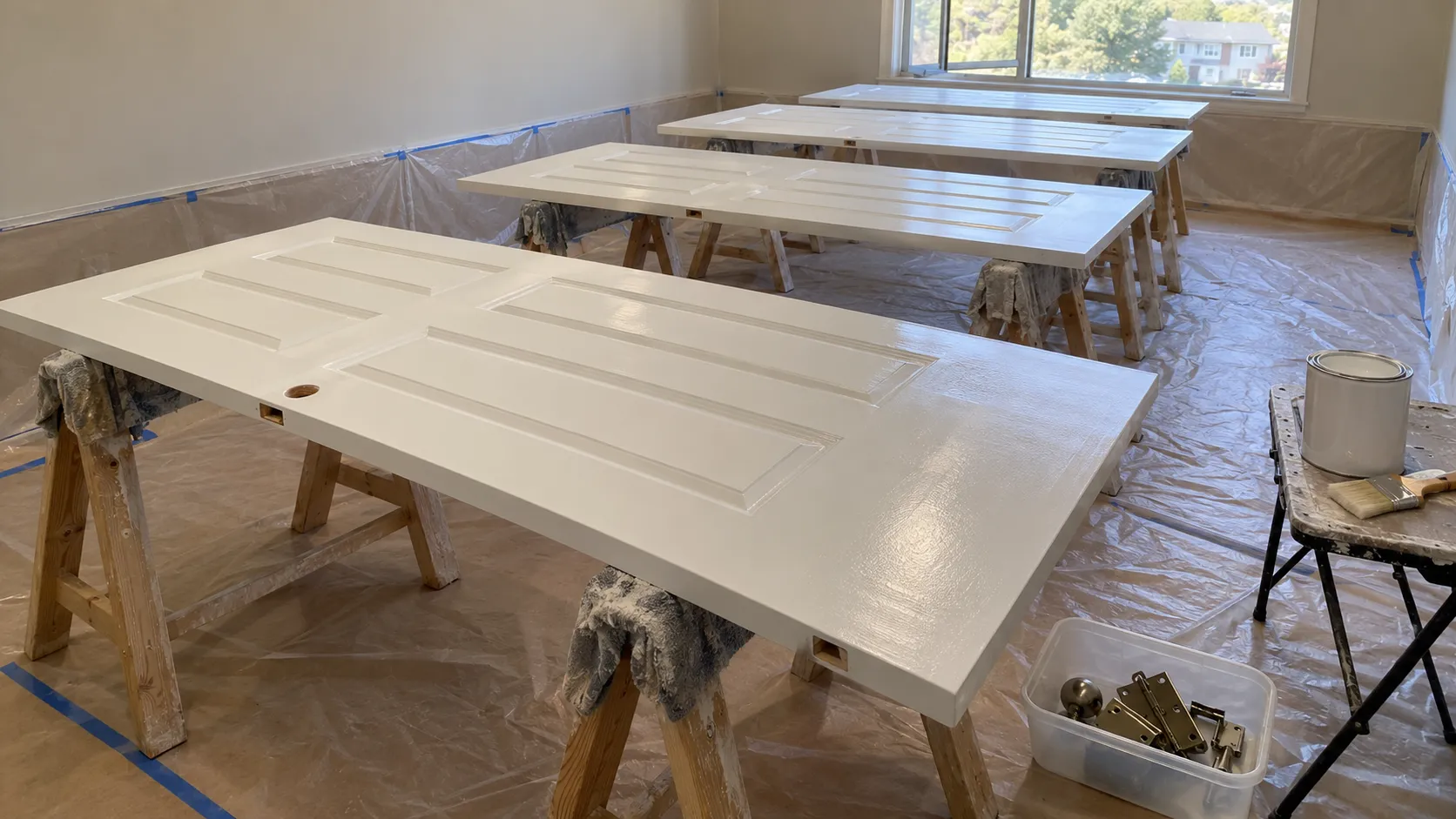
- Doors, in any house: take them off, lay them flat on horses in a garage or an empty room, and spray or brush them there. Flat is the key variable, not the gun — enamel levels on a horizontal surface and sags on a vertical one.
- Trim-only job in a furnished house: brush, almost always.
The same trade-off, worked through in much more detail for cabinets, is in our spray vs brush cabinet painting guide. A quote that does not say which method it assumes is not a complete quote.
What Else Moves the Price
- Stairwells and two-story foyers. Crown, casing and the stair skirt in a two-story foyer are worked from staging over a stair rail, and our cost guide prices height at closer to $6 per square foot for exactly this reason. Fixr adds $1 to $2 per linear foot for hard-to-reach trim. This is the single biggest access variable in a house.
- Color change. Trim staying the same white is the cheapest trim job there is and can sometimes be spot-recoated. Going from a stained or dark trim to white, or from white to a color, means a primer coat plus two finish coats over every foot. Benjamin Moore's Fresh Start sheet calls itself "the go-to for significant color change."
- Number of coats. Two is the standard and one is sometimes defensible on sound trim in the same color. A bid offering one coat on a color change is offering you a job that will need redoing.
- Trim condition and rot. Water-damaged window stools, split mitres and soft sill noses are carpentry, not painting; we point them out at the estimate so a carpenter can fix them before anyone paints. Paint over rot is a two-year job.
- Wall repairs. Trim work usually exposes wall damage behind and above it. Patching beyond ordinary nail holes runs about $0.50 to $0.75 per square foot in our cost guide; see our drywall repair cost guide.
- Sheen. Trim is normally finished in satin or semi-gloss, both of which show every imperfection the prep left behind. That is a prep cost, not a paint cost. Our paint sheen guide covers the choice.
- Occupied vs empty. Furniture that has to be moved away from every baseboard and back again each day is real time, and a house that has to be livable each evening constrains how much can be in progress at once.
New Construction vs Repaint
These are genuinely different jobs, and it is worth knowing which one you are buying.
On new or newly installed trim, there is no old finish to fight. The work is filling nail holes, caulking, priming bare wood and applying two coats, usually sprayed before anything is in the room. Benjamin Moore's Advance sheet specifies Fresh Start primer for "wood, and engineered wood products" and says new surfaces "must be fully primed." The per-foot rate is at the bottom of the range because the prep is predictable. Our guide to new construction painting in NJ covers that side of the work.
On a repaint, the existing finish decides everything: what it is made of, how glossy it is, how many coats are already on, how much of it is chipped and whether any of it is lead. A repaint can be cheaper than new work when the existing trim is sound and the color is not changing, and considerably more expensive when it is not. This is why two bids on the same trim can differ by a factor of two without either painter being unreasonable — and why our guide to choosing a painting contractor in NJ stresses getting the prep written down.
Should the Trim Be Painted at the Same Time as the Walls?
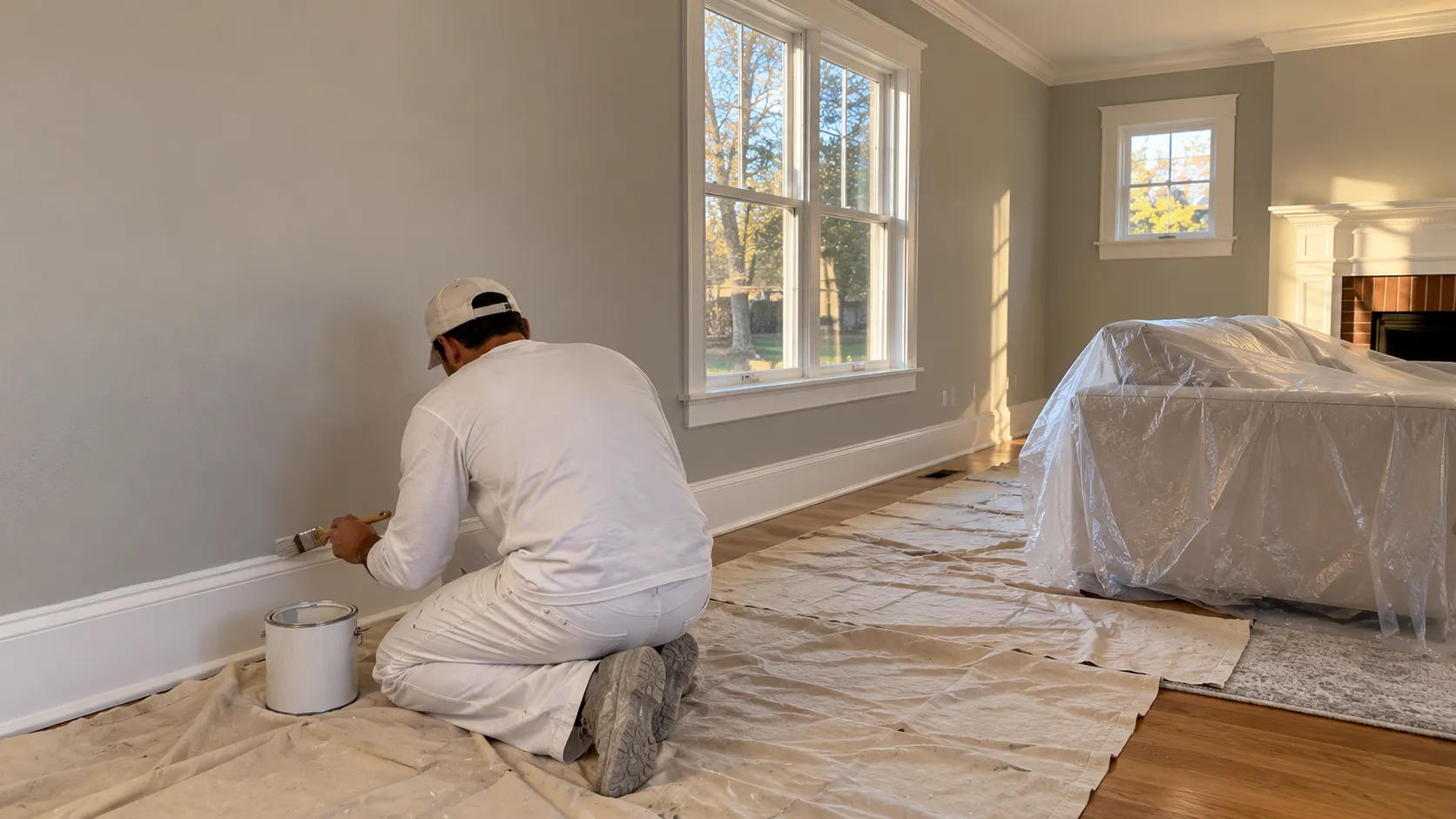
Usually yes, and the reason is arithmetic rather than aesthetics. Setup, floor protection, furniture moving and cleanup are paid for once whether you paint one surface or three. Doing trim as its own visit later means paying for all of that twice, and it also means cutting a fresh trim line against walls that are already finished, which is slower and riskier than cutting both while the room is open.
There are two honest exceptions. If the budget only stretches to one, walls give the bigger visual change for the money. And if the trim is sound, the same color and simply dirty, washing it may be all it needs this year — our whole-house guide lists keeping the trim color as one of the most effective ways to bring an interior quote down.
Ways to Spend Less on Trim and Doors
- Do it with the walls. One setup, one protection, one cleanup.
- Keep the trim color. Same-white recoats are the fastest trim work there is, and sound sections can sometimes be touched rather than fully recoated.
- Prioritize by room. Trim in the rooms people see — entry, living room, dining room, stair — and leave bedroom closets for later.
- Count your doors honestly and decide on sides. One-side door painting is a legitimate choice when the hall color is not changing, and it is a big number on a house with eighteen doors.
- Clear the baseboards before the crew arrives. Furniture pulled off the walls, rugs rolled, cords moved. It is time you are otherwise paying for.
- Paint before you move in, if you have that window. Empty rooms mean the doors can come off and the trim can be sprayed.
What we would not cut: the de-glossing, the primer on bare and patched wood, and the second coat. Those three are the difference between trim that lasts a decade and trim that chips at the first vacuum strike.
What a Trim and Door Estimate Should Itemize
- The measured quantities. Linear feet of baseboard, casing and crown, and the door count. If a quote says "trim" with no number behind it, ask for the number.
- Doors: how many, which sides, hardware on or off, and whether they come off the hinges.
- Prep, step by step. Filling, sanding, de-glossing, caulking, and what is primed with what. "Prep as needed" is not a scope.
- What happens if oil-based paint is found, and what happens if the house is pre-1978.
- Product and sheen, by line. The manufacturer and the actual enamel, not "premium trim paint."
- Number of coats on trim and on doors, counted separately from the walls.
- Method. Brushed in place, or doors removed and sprayed, and where the spraying happens.
- Schedule and cure time, including when doors go back on and when you can lean things against the baseboard.
- Price, payment terms and warranty, in writing.
Give every painter the same list. Most of the gap between trim bids is scope, not margin, and this list makes the scope visible.
How Long It Takes, and When You Can Use the Room
Trim enamels cure slowly on purpose — the long open time is what lets them level — and that governs the schedule more than the painting does. Sherwin-Williams gives ProClassic a tack-free time of 20 to 40 minutes, dry to touch in one to two hours and a recoat at four hours, measured at 77 degrees F and 50 percent relative humidity. Benjamin Moore's Advance is slower still: four to six hours to touch and 16 hours to recoat, which is why a two-coat Advance door is a two-day item however fast the crew is. Both products set a minimum application temperature of 50 degrees F.
Cure is a longer story than dry. Advance's sheet says "full hardness and adhesion develop over time" and asks you not to "return shelves/tabletops to service for at least 5 – 7 days," and its limitations note that "depending on weather and drying conditions, it could take up to 30 days to reach optimum hardness and final sheen." ProClassic's data sheet shows the same effect numerically: its measured sheen at 24 hours is 41 to 51 units at 60 degrees and at 30 days is 34 to 44. In plain terms: doors can be rehung and used within a day or so, but go easy on them, do not stack anything against fresh baseboard, and expect the final look to settle over a month. For how this fits into a whole-house schedule, see how long it takes to paint a house in NJ.
Get a Price for Your Trim and Doors
Every range on this page is for planning. The real number comes from measuring your baseboard, counting your doors and finding out what is already on the wood. NJ Painting Co. is a family-owned, licensed and fully insured painting company at 36 Church Rd, Morganville, NJ 07751, working on New Jersey homes for more than twenty years with Benjamin Moore and Sherwin-Williams products. Every estimate is free, includes an in-home color consultation, and spells out the surfaces, the prep, the product and the number of coats; our work carries a two-year workmanship warranty.
See our interior painting service, read the interior section of the cost guide, check we cover your town on the Monmouth County, Middlesex County, Ocean County and Somerset County pages, or call (732) 239-0932 and request a free estimate.
Frequently Asked Questions
How much does it cost to paint trim and baseboards in NJ?
Our published cost guide prices trim and baseboard at $1 to $3 per linear foot, and a whole-house trim-and-doors job at $1,200 to $3,500 with the walls left alone. Nationally, This Old House (April 2026) gives $1 to $3 per linear foot and Fixr (January 2025) gives $1 to $6 per linear foot including labor and materials, with a typical interior trim project at $1,000 to $3,000.
How much does it cost to paint the baseboards in one room?
A 12 by 12 bedroom has about 45 linear feet of baseboard once a three-foot door opening is deducted, so at our cost guide's $1 to $3 per linear foot the baseboard line is roughly $45 to $135. Baseboard is normally priced as part of a larger interior job rather than as a separate visit, because the setup, furniture moving and floor protection cost the same either way.
How much does it cost to paint interior doors?
Our cost guide prices interior doors at $40 to $150 each. The published national figures range from $35 to $50 (Fixr's room guide) and $40 to $100 (This Old House) up to $70 to $200 (Fixr's painter guide) and $163 to $332 (Homewyse). Almost all of that spread is scope: one side or two, flat or six-panel, hardware left on or removed, and painted hanging or laid flat.
Why is trim priced per linear foot instead of per square foot?
Because the work scales with length, not area. A tall baseboard and a short one take about the same time per foot, since the time goes into traveling the run, cutting corners, filling, caulking and holding a line. Doors are counted instead of measured for the same reason: each one is a fixed amount of work.
Does painting trim cost more than painting walls?
Per square foot of surface, yes, by a wide margin. Our whole-house article puts the effect plainly: adding trim to a walls-only quote typically adds 50 to 80 percent. Our cost guide quotes Angi's 2026 figures at roughly $4.70 per square foot for walls, trim and ceilings together against about $2.75 for a plain wall repaint.
How much does it cost to paint crown molding?
We price crown within the same $1 to $3 per linear foot as other trim. Nationally, Fixr gives $1 to $4 per linear foot and Homewyse's calculator gives $2.10 to $4.45 per linear foot. The real variable is the height it sits at: crown in a two-story foyer is a staging job and prices well above crown in an eight-foot room.
Can you paint latex over oil-based trim?
Not directly. A latex finish on a cured, glossy alkyd has little to grip and can peel in sheets, sometimes lifting with the masking tape. The trim has to be sanded dull and primed with a product rated for the surface. Benjamin Moore's Advance sheet says to "sand glossy alkyds before applying Advance," and Sherwin-Williams says "glossy surfaces should be sanded dull."
Is spraying trim cheaper than brushing it?
Not in a furnished house. Spraying gives the better finish, but everything within reach of the overspray has to be masked first, and in an occupied room that masking often costs more hours than brushing would have taken. Spraying wins on empty rooms, new construction, and doors taken off and laid flat.
Should I paint the trim and the walls at the same time?
Usually yes. Setup, floor protection, furniture moving and cleanup are paid for once rather than twice, and both cut lines get held while the room is already open. If only one fits the budget, the walls give the larger visual change.
Do I need to paint both sides of an interior door?
Only if both sides are changing. A bedroom door whose hall side already matches the hall trim can be painted on the bedroom side alone, and on a house with fifteen or more doors that choice is a meaningful number. Make sure the estimate says which you are getting.
How long before I can use the doors and lean things on the baseboard?
Dry and cured are not the same. Sherwin-Williams' ProClassic is dry to touch in one to two hours and recoatable at four; Benjamin Moore's Advance is four to six hours to touch and 16 hours to recoat. Advance's sheet asks that surfaces not be returned to heavy service for five to seven days and notes it "could take up to 30 days to reach optimum hardness and final sheen." Rehang the doors the next day, but treat fresh trim gently for the first few weeks.
Does my house being built before 1978 change the price?
Yes. Sanding or scraping trim in a pre-1978 home falls under the EPA's Renovation, Repair and Painting rule, which requires that "anyone paid to perform work that disturbs painted surfaces in homes, childcare facilities and preschools built before 1978 be certified," and that means containment, HEPA vacuums and a verified cleanup. NJ Painting Co. is not an EPA Lead-Safe Certified firm, so ask any contractor you are considering for their EPA certification details in writing before work starts.
About the author
Written by the NJ Painting Co. team
NJ Painting Co. is a family-owned painting contractor based in Monmouth County, in business since 2004. We are licensed and fully insured, work with Benjamin Moore and Sherwin-Williams paints, and back our work with a 2-year workmanship warranty. We serve Monmouth, Middlesex, Ocean, Mercer, Somerset and Burlington counties, plus Union, Essex, Hudson, Bergen and Passaic in North Jersey.