To work out how much paint you need, multiply the room's perimeter by its ceiling height, subtract the doors and windows, multiply by the number of coats, and divide by the coverage printed on the paint's data sheet. That is 400 to 450 square feet per gallon for Benjamin Moore Regal Select, 350 to 400 for Sherwin-Williams Emerald, Duration Home and SuperPaint, and 250 to 350 for most exterior house paints. A 12x12 bedroom with an eight-foot ceiling takes two gallons for two coats on the walls and one gallon for the ceiling.
Every online paint calculator runs some version of that method. The trouble is the inputs: most quietly assume 350 or 400 square feet per gallon, when the real figure depends on the product, the surface and how thick the paint goes on, and few cover primer, cabinets, a deck or the outside of a house. This guide does the arithmetic by hand, in tables, so you can change any number that does not fit your house.
We are a family-owned painting company in Morganville and have painted New Jersey homes across Monmouth, Middlesex, Ocean, Mercer, Somerset and Burlington counties, plus Union, Essex, Hudson, Bergen and Passaic in North Jersey, for more than 20 years, using Benjamin Moore and Sherwin-Williams products. Measuring a house and working out the paint is the first thing we do at every estimate, and the worked examples below are the way we do it.
Every coverage figure, film thickness, coat recommendation and storage instruction below comes from a document we fetched and read on 15 November 2026: the Benjamin Moore and Sherwin-Williams technical data sheets for each product named, PaintCare's buying guide, the National Institute of Standards and Technology's unit tables, the U.S. Forest Products Laboratory's Wood Handbook, Benjamin Moore's storage guidance and the EPA's lead rule. Where something is our own practice rather than a published figure, we say so. This article deliberately carries no prices. For what paint and labor cost, see our cost guide, what it costs to paint a room in NJ and what it costs to paint a house in NJ.
The Short Answer
- The formula: net wall area (perimeter × ceiling height, minus doors and windows) × number of coats ÷ the coverage rate per gallon, then round up to a container you can buy.
- Interior wall paint covers 350 to 450 square feet per gallon on the data sheets. Regal Select and ben list 400 to 450, Aura 350 to 400, and Emerald, Duration Home and SuperPaint 350 to 400.
- Exterior paint covers less: 250 to 350 square feet per gallon for Aura Exterior and Regal Select Exterior High Build, and 250 to 300 for Emerald Exterior and Duration Exterior. SuperPaint Exterior lists 350 to 400.
- Plan on two coats. Benjamin Moore "recommends two coats to achieve full color development and to optimize performance." Sherwin-Williams' exterior sheets say one coat for a repaint and two on bare surfaces.
- A 12x12 room: with an eight-foot ceiling, one door and two windows has 333 square feet of wall. Two coats is 666 square feet: about 1.5 to 1.9 gallons, so buy two. The ceiling takes one gallon of ceiling paint, and the trim a quart or two.
- A 2,000-square-foot two-storey house: our worked example has about 2,230 square feet of siding after openings. One coat of a 250-to-300 product is 7.4 to 8.9 gallons; two coats is 14.9 to 17.8.
- Rough and porous surfaces drink paint. PaintCare says "You may need up to 50 percent more paint for rough textures," and deck stain runs from 150 to 400 square feet per gallon "depending on porosity and texture."
- Buy so that you can mix. Sherwin-Williams' deck stain sheet says "For uniformity, mix all cans together before use." Mixing the gallons for one colour into a larger pail before you start is called boxing.
How Do You Calculate How Much Paint You Need?
Find the area you are painting, multiply it by the number of coats, and divide by the paint's coverage rate. PaintCare, the paint industry's stewardship organisation, puts the last step in one line: "To determine how much paint you will need, divide the total project area by the coverage rate." Everything else in this article is about getting those three numbers right.
The table below is the whole method, with a 12 by 12 foot bedroom carried through each step. The room has an eight-foot ceiling, one door opening of 3 by 7 feet and two windows of 3 by 5 feet. Those are the same assumptions our room cost article uses, so the two articles agree.
| Step | What you do | Formula | 12x12 example |
|---|---|---|---|
| 1 | Add up the wall lengths | Perimeter = sum of the walls | 12 + 12 + 12 + 12 = 48 ft |
| 2 | Find the gross wall area | Perimeter × ceiling height | 48 × 8 = 384 sq ft |
| 3 | Add up the openings | Width × height of each door and window | 21 + 15 + 15 = 51 sq ft |
| 4 | Find the net wall area | Gross area − openings | 384 − 51 = 333 sq ft |
| 5 | Allow for coats | Net area × coats | 333 × 2 = 666 sq ft |
| 6 | Convert to gallons | Total ÷ coverage per gallon | 666 ÷ 450 = 1.5; 666 ÷ 350 = 1.9 |
| 7 | Buy | Round up to containers | 2 gallons |
Three rules keep the answer honest:
- Use the product's own coverage rate. It is on the technical data sheet as "Spread Rate Per Gallon" (Benjamin Moore) or "Coverage" (Sherwin-Williams). PaintCare's fallback, "If you don't know the coverage rate, use 350 to get a rough estimate," is a sensible default for interior wall paint.
- Count coats, not cans. The coverage figure is per coat. Two coats double the paint. A primer coat is a separate calculation with its own spread rate.
- Round up at the end, not along the way. Work the square footage for each surface, add them, and only then convert to containers. Rounding every wall up to a whole gallon is how people end up with four half-full cans in the basement.
The same arithmetic works for every surface in the house. Ceilings use length times width. Trim is linear feet times the height of the board. Siding adds the triangles under the roof. A deck is the floor area plus the railings. The sections below take each one in turn, with the data sheet figures for the products we actually use.
How Do You Measure a Room's Walls for Paint?
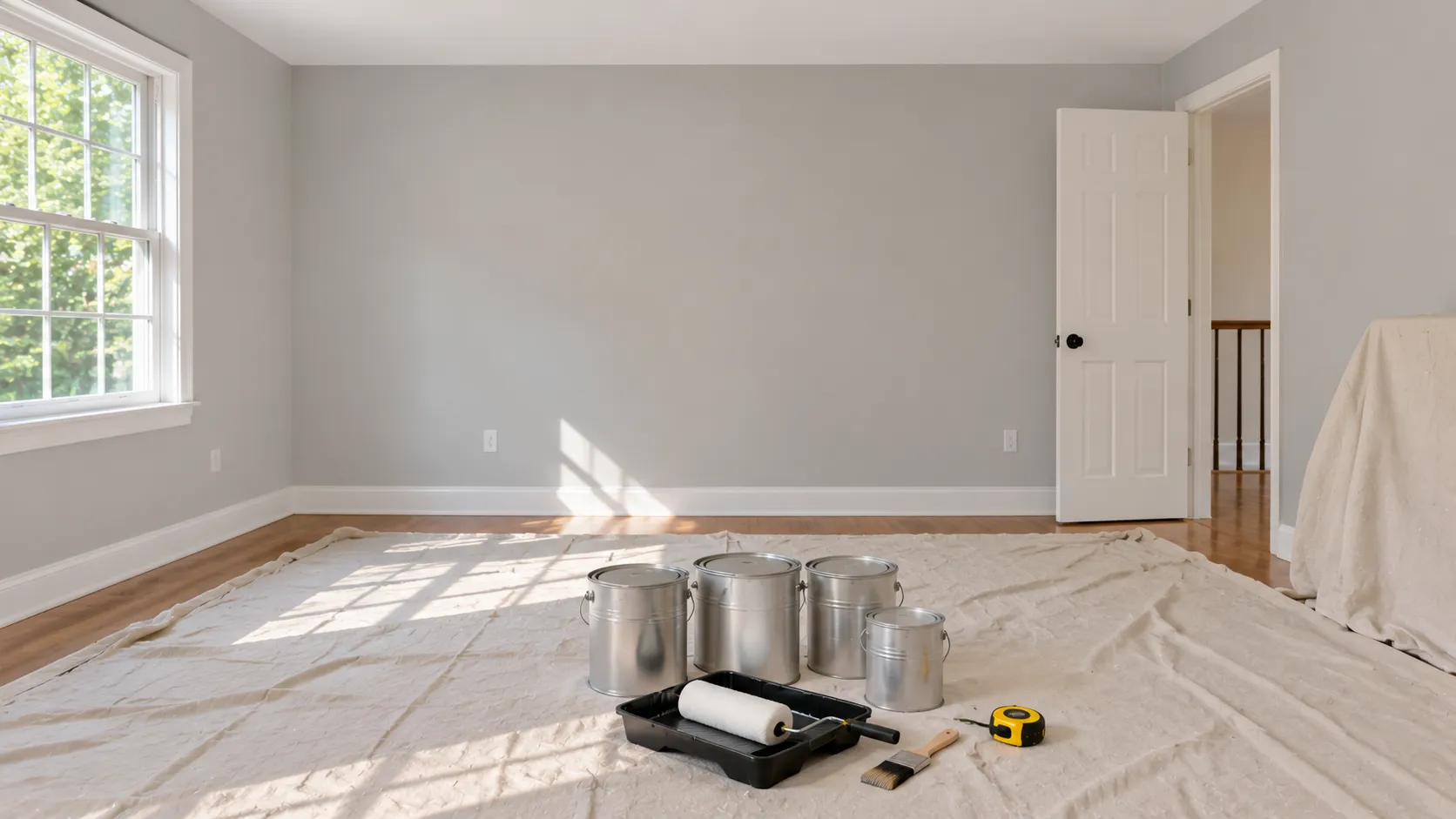
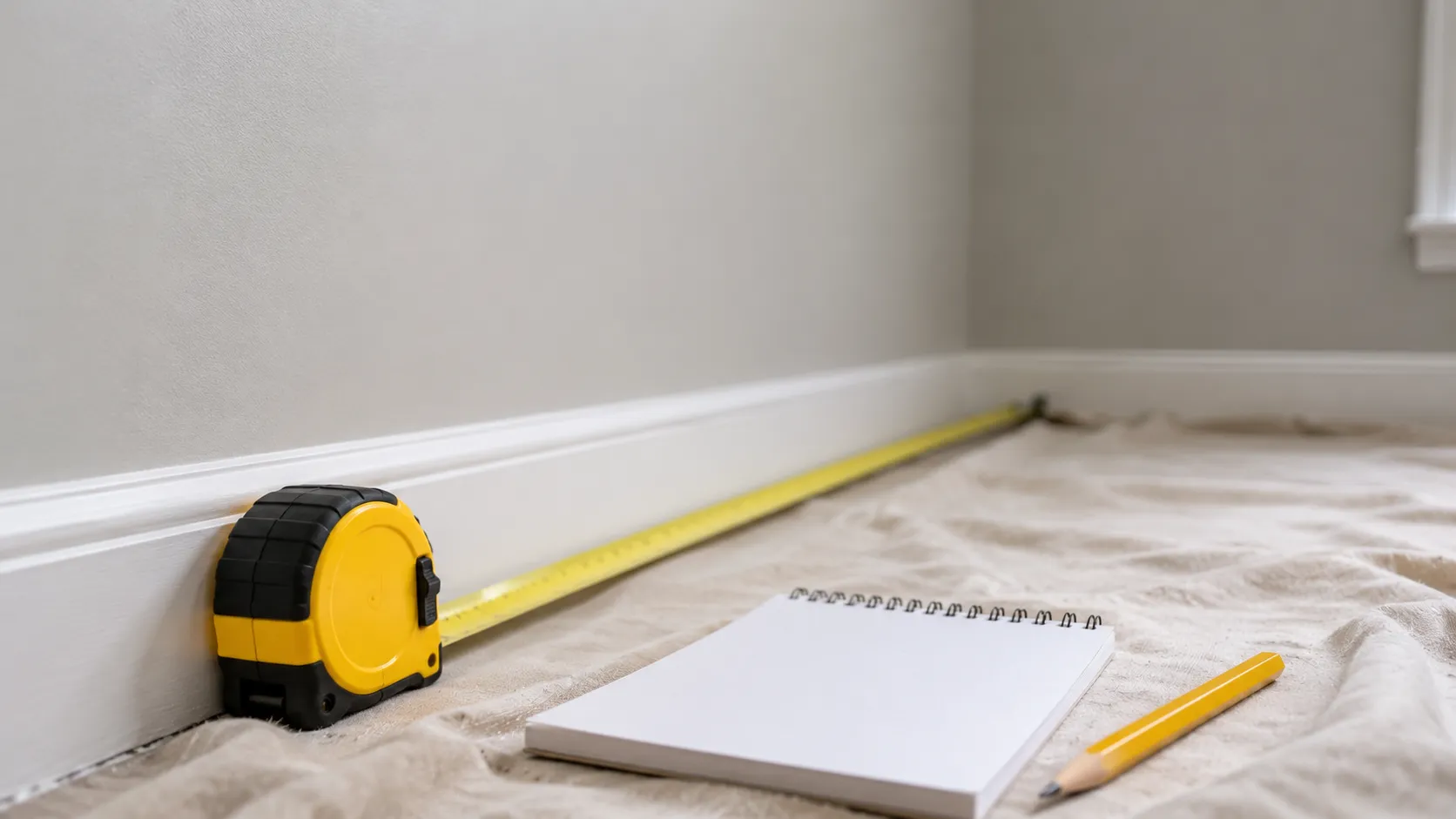
Measure the length of each wall at floor level with a tape, add the lengths to get the room's perimeter, and multiply by the height from floor to ceiling. That gives the gross wall area in one multiplication, and it is faster and less error-prone than working wall by wall. Then measure each door and window and subtract them.
PaintCare describes the wall-by-wall version: "measure the width and height of each wall," multiply, add them together, and "measure any windows, doors, or other breaks in the wall and subtract their square footage." Both give the same number in a rectangular room. The perimeter method is easier when a room has jogs, bump-outs and closets, because you can walk the room with the tape and write down each run.
Doors and windows
Measure the opening, not the door frame or window casing around it, and multiply width by height. A typical interior door in the houses we paint is about 3 feet by 6 feet 8 inches, which is 20 square feet; with its casing it is closer to the 3 by 7 (21 square feet) that we use in our examples. Many online calculators use a flat 21 square feet for a door and 15 for a window, and some guides add about 40 square feet for a sliding glass door. Those allowances are fine for an average room. They go wrong in rooms with big picture windows, French doors or a wall of glass, so measure those.
In our experience small openings, such as a basement hopper window, are not worth deducting, because cutting in around them uses about as much paint as they save. Large ones matter: three big windows and a pair of French doors can take 100 square feet or more off a living room.
Irregular walls
Break any odd shape into rectangles and triangles, measure each, and add them. A triangle is half the base times the height. That covers:
- Stairwell walls, which are often a tall rectangle with a triangle on top following the stair.
- Rooms under a roof slope, such as Cape Cod bedrooms and finished attics, where a knee wall, a sloped section and a flat ceiling may all be painted the wall colour.
- Cathedral and vaulted ceilings, where the end walls run up into a gable shape. Measure the sloped ceiling along the slope, not across the floor.
- Closets, which are easy to forget. A reach-in closet adds its own three walls.
A nine-foot ceiling adds 12.5 percent to the wall area of an eight-foot room, and many New Jersey two-storey houses have nine-foot first floors and eight-foot bedrooms, so measure each floor. Keep a running list, room by room, of perimeter, height, openings and ceiling. That list is your project area, the same list a painter builds at an estimate. It is also the only honest way to answer "how much paint for the inside of a house": floor area alone is a poor guide, because ceiling heights, open plans and the number of doors change the wall area more than the square footage does. Keep walls, ceilings and trim in separate totals and round each one up once, at the end.
How Much Paint Do I Need for a 12x12 Bedroom?
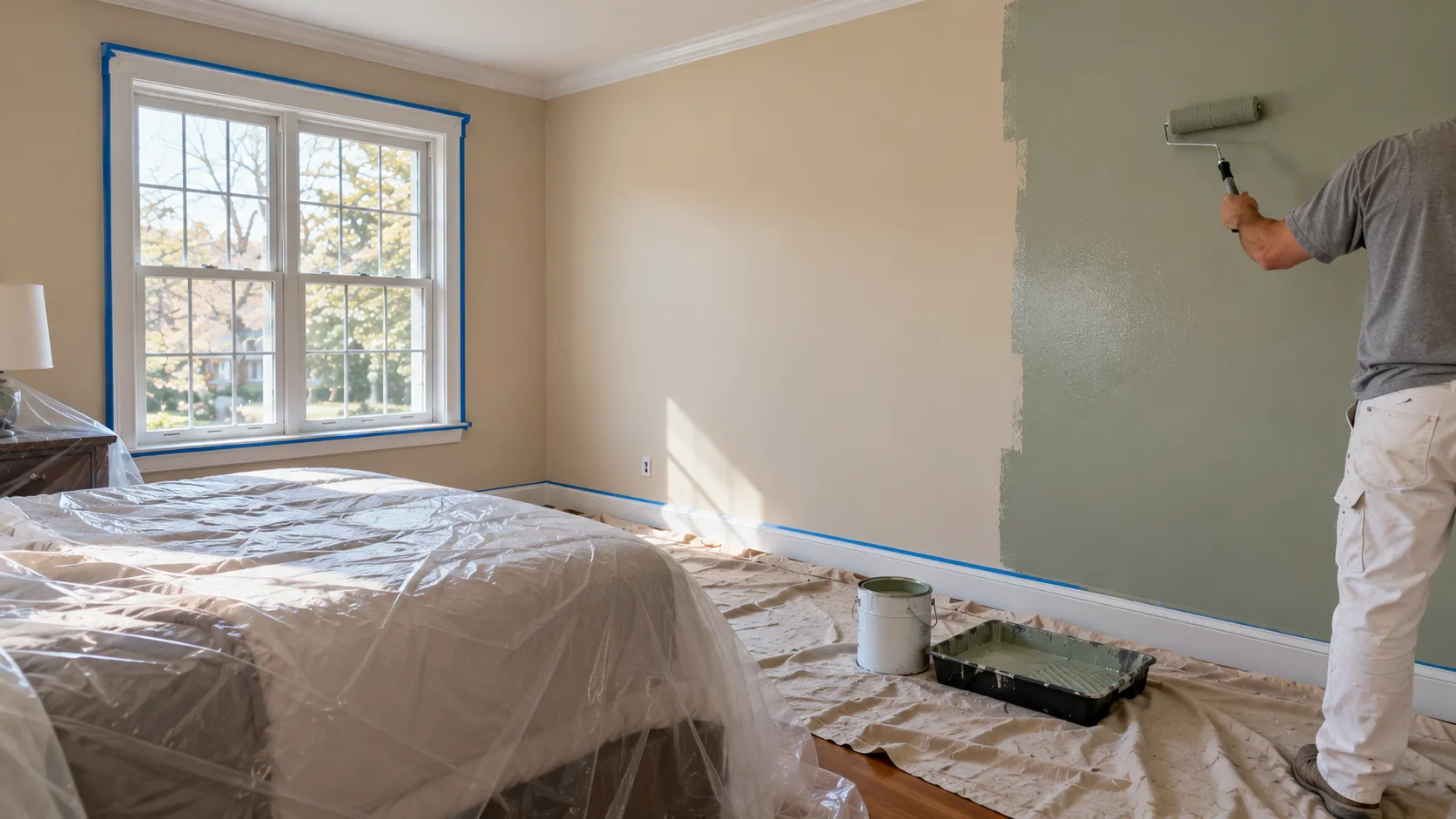
Two gallons for two coats on the walls, one gallon for the ceiling, and a quart or two of trim enamel. The 12 by 12 bedroom in the formula table has 333 square feet of wall after one door and two windows come off. Two coats is 666 square feet. At the 350 to 400 square feet per gallon of Sherwin-Williams Emerald, Duration Home or SuperPaint, or Benjamin Moore Aura, that is 1.7 to 1.9 gallons. At the 400 to 450 of Regal Select or ben, it is 1.5 to 1.7. Either way you buy two gallons, and you have a little left for touch-ups.
That matches our room cost article, which works the same room at 350 to 400 square feet per gallon and also lands on 1.7 to 1.9 gallons. Its room-size table uses gross wall area before doors and windows are taken off, so its ranges run a little higher than the table below. The table here deducts one door and two windows from every room. If your room has more openings, such as a sliding glass door, it needs a little less. Trim is a separate figure, worked out from length times trim height in the trim section below.
| Room | Perimeter | Gross wall | Net wall | Two coats | Gallons at 350–400 sq ft | Gallons at 400–450 sq ft | Usually buy |
|---|---|---|---|---|---|---|---|
| 10x10 | 40 ft | 320 sq ft | 269 sq ft | 538 sq ft | 1.3–1.5 | 1.2–1.3 | 1 gallon + 2 quarts, or 2 gallons |
| 10x12 | 44 ft | 352 sq ft | 301 sq ft | 602 sq ft | 1.5–1.7 | 1.3–1.5 | 2 gallons |
| 12x12 | 48 ft | 384 sq ft | 333 sq ft | 666 sq ft | 1.7–1.9 | 1.5–1.7 | 2 gallons |
| 12x14 | 52 ft | 416 sq ft | 365 sq ft | 730 sq ft | 1.8–2.1 | 1.6–1.8 | 2 gallons, plus a quart at the low rate |
| 14x16 | 60 ft | 480 sq ft | 429 sq ft | 858 sq ft | 2.1–2.5 | 1.9–2.1 | 2 gallons + 2 quarts, or 3 gallons |
| 15x20 | 70 ft | 560 sq ft | 509 sq ft | 1,018 sq ft | 2.5–2.9 | 2.3–2.5 | 3 gallons |
With a nine-foot ceiling height, add one-eighth to the gross wall area. A 12 by 12 room at nine feet has 432 square feet gross, 381 net, and needs 1.7 to 2.2 gallons for two coats. That is still two gallons at the better spread rates and a tight two gallons at 350, so add a quart if your product sheet says 350 to 400.
A small bathroom is the exception. A 5 by 8 bathroom has about 187 square feet of wall after the door, less once the tub surround, vanity and mirror are left out, and much of what remains is cut in around fixtures. In our experience one gallon does it in two coats with some to spare, and a quart is not enough. Our guide to the best paint for bathroom walls covers which products to buy.
PaintCare's rule of thumb is that "you'd probably only need one gallon for a typical 10'x10' room" after doors and windows. That holds for one coat; for two, a 10x10 room takes about a gallon and a half.
How Much Paint Do I Need for a Ceiling?
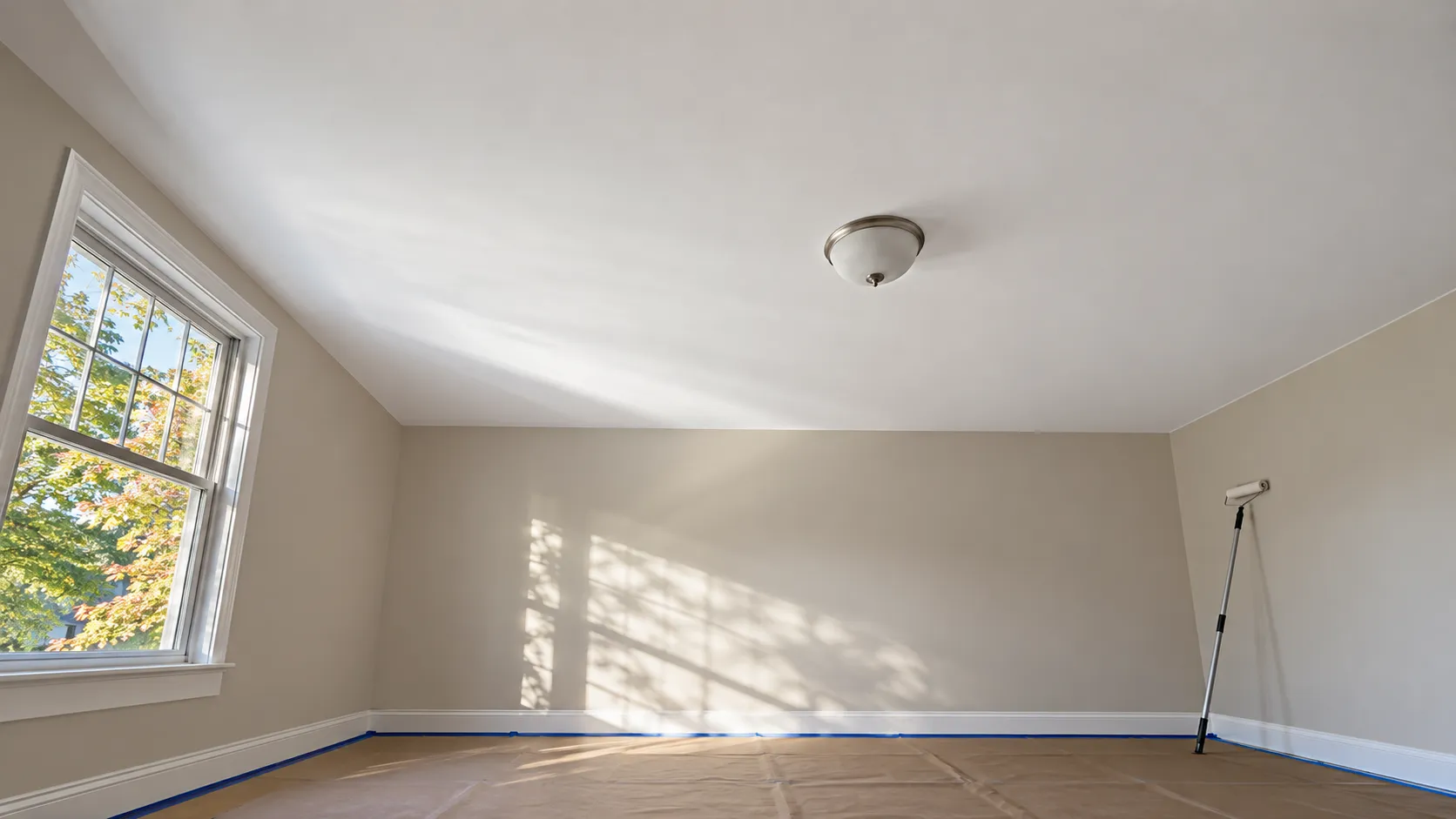
Multiply the room's length by its width for the ceiling area, double it for two coats, and divide by the ceiling paint's coverage. Benjamin Moore's Waterborne Ceiling Paint Ultra Flat 508, which its sheet describes as made "specifically for ceilings" and says "Tones down ceiling glare," lists 400 to 450 square feet per gallon. A 12 by 12 bedroom ceiling is 144 square feet; two coats is 288; that is 0.64 to 0.72 of a gallon. Buy one gallon.
Ceilings are almost always a flat sheen, and that helps the arithmetic. PaintCare notes that "As sheen decreases, coverage increases," and a dead-flat ceiling paint also hides the small dents, tape joints and roller marks that raking light from a window picks out. Our guide to how to paint a ceiling covers the technique.
| Room | Ceiling area | Two coats | Gallons, smooth | Gallons, heavily textured (+50%) | Usually buy |
|---|---|---|---|---|---|
| 10x10 | 100 sq ft | 200 sq ft | 0.44–0.50 | 0.67–0.75 | 2 quarts smooth, 1 gallon textured |
| 12x12 | 144 sq ft | 288 sq ft | 0.64–0.72 | 0.96–1.08 | 1 gallon |
| 14x16 | 224 sq ft | 448 sq ft | 1.00–1.12 | 1.49–1.68 | 1 gallon + 1 quart smooth, 2 gallons textured |
| 15x20 | 300 sq ft | 600 sq ft | 1.33–1.50 | 2.00–2.25 | 1 gallon + 2 quarts smooth, 2 to 3 gallons textured |
Textured ceilings are where the estimates go wrong. A sprayed acoustic or "popcorn" ceiling, a knockdown texture or a heavy stipple has far more surface than its length times width, and it soaks in paint. PaintCare's guidance is that "Textured walls require more paint than smooth walls because they have more surface area," and "You may need up to 50 percent more paint for rough textures." We use that as the top of the range for popcorn, and it is the column on the right of the table. If you are thinking of removing the texture instead, our popcorn ceiling removal guide explains what is involved. In a house built before 1978, find out what is in the old texture and paint before anyone scrapes it.
For a sloped or vaulted ceiling, measure along the slope, because it has more area than the floor below it. If you cannot reach, treat it like irregular walls: sketch the triangles from the floor and wall heights and work out each sloped plane.
How Many Square Feet Does a Gallon of Paint Cover?
On the data sheets we use, a gallon of interior wall paint covers 350 to 450 square feet per coat, a gallon of trim enamel 350 to 500, and a gallon of exterior house paint 250 to 400. The exact figure is printed on each product's technical data sheet. The table below lists the interior products we use most, with the figures quoted from each sheet. Exterior paints, primers and deck stains have their own tables further down.
| Product | Type, per the sheet | Spread rate per gallon | Wet film the rate assumes | Volume solids |
|---|---|---|---|---|
| Benjamin Moore Regal Select Eggshell N549 | Interior paint and primer, 100% acrylic | 400–450 sq ft | 3.6–4.0 mils | 45% |
| Benjamin Moore Regal Select Matte N548 | Interior paint and primer | 400–450 sq ft | 3.6–4.0 mils | 43% |
| Benjamin Moore Aura Eggshell N524 | Waterborne interior paint and primer | 350–400 sq ft | 4.0–4.6 mils | 46% |
| Benjamin Moore ben Eggshell N626 | Interior acrylic paint and primer | 400–450 sq ft | 3.6–4.0 mils | 39% |
| Benjamin Moore Advance Satin 792 | Waterborne alkyd trim enamel | 400–500 sq ft | 3.2–4.0 mils | 38.4% |
| Benjamin Moore Advance Semi-Gloss 793 | Waterborne alkyd trim enamel | 400–500 sq ft | 3.2–4.0 mils | 35.2% |
| Benjamin Moore Waterborne Ceiling Paint 508 | Ultra flat ceiling paint | 400–450 sq ft | 3.6–4.0 mils | 40.3% |
| Sherwin-Williams Emerald Interior Satin K37 | Interior latex | 350–400 sq ft | 4 mils | 40% |
| Sherwin-Williams Duration Home Satin A97 | Interior latex | 350–400 sq ft | 4 mils | 37% |
| Sherwin-Williams SuperPaint Interior Satin A87 | Interior latex | 350–400 sq ft | 4 mils | 40% |
| Sherwin-Williams ProClassic Semi-Gloss B34 | Waterbased acrylic-alkyd trim enamel | 350–400 sq ft | 4 mils | 39% |
| Sherwin-Williams Emerald Urethane Trim Enamel Satin | Urethane-modified alkyd trim enamel | 350–400 sq ft | not stated on the coverage line | 30% |
Three things stand out. First, the figures are ranges, and every Benjamin Moore sheet qualifies its range for surface texture and porosity the same way: "Depending on surface texture and porosity. Be sure to estimate the right amount of paint for the job. This will ensure color uniformity and minimize the disposal of excess paint." The top of the range is for smooth surfaces such as previously painted or primed drywall. Use the low end for anything else.
Second, the brands are closer than the internet suggests. One widely read guide says Sherwin-Williams claims about 400 square feet per gallon and Benjamin Moore about 350. The sheets do not bear that out: Benjamin Moore's Regal Select and ben list 400 to 450, Aura lists 350 to 400, and the Sherwin-Williams lines we use list 350 to 400. Read the sheet for the product you are buying, not a brand average.
Third, a lower spread rate is not a worse paint. Aura lists fewer square feet than Regal Select because it is designed to go on thicker, with a little more volume solids; the fourth column is the wet film each rate is based on. Our guide to the best interior paint for NJ homes and our Benjamin Moore vs Sherwin-Williams comparison cover which line suits which room. Sheen does not change the spread rate much on these sheets: Regal Select's matte and eggshell both list 400 to 450, and so does the flat finish ceiling paint, 508. Our paint sheen guide covers what it does change.
Why Do the Data Sheets Say 350 to 400 Square Feet?
Because a gallon of paint is a fixed volume, and the spread rate is simply that volume laid out at the wet thickness the manufacturer wants on the wall. Once you see the arithmetic, the coverage rate stops being a marketing number and becomes something you can check.
A U.S. gallon is 231 cubic inches; NIST's unit tables give "4 quarts = 1 gallon (gal) = 231 cubic inches." A mil is a thousandth of an inch. Spread 231 cubic inches of paint one mil thick and it covers 231,000 square inches, which is 1,604 square feet. So a gallon spread one mil thick covers about 1,604 square feet, and a gallon spread four mils thick covers about 401, which is where the 400 square feet on so many labels comes from. The spread rate on a data sheet is just 1,604 divided by the wet film thickness it is based on.
| Product | Wet film on the sheet | 1,604 ÷ wet mils | Spread rate on the sheet | Dry film = wet × volume solids | Dry film on the sheet |
|---|---|---|---|---|---|
| Regal Select Eggshell N549 | 3.6–4.0 mils | 401–446 sq ft | 400–450 sq ft | 1.6–1.8 mils | 1.6–1.8 mils |
| Aura Eggshell N524 | 4.0–4.6 mils | 349–401 sq ft | 350–400 sq ft | 1.8–2.1 mils | 1.9–2.1 mils |
| Advance Satin 792 | 3.2–4.0 mils | 401–501 sq ft | 400–500 sq ft | 1.2–1.5 mils | 1.2–1.5 mils |
| Emerald Interior K37 | 4 mils | 401 sq ft | 350–400 sq ft | 1.6 mils | 1.6 mils |
| Duration Home A97 | 4 mils | 401 sq ft | 350–400 sq ft | 1.5 mils | 1.5 mils |
| Emerald Exterior K48 | 5.3–6.4 mils | 251–303 sq ft | 250–300 sq ft | 2.1–2.5 mils | 2.1–2.5 mils |
| SuperPaint Exterior A89 | 4 mils | 401 sq ft | 350–400 sq ft | 1.4 mils | 1.5 mils |
The arithmetic matches the sheets almost exactly. None of this is a measure of paint quality; it is geometry. That tells you what the coverage rate really is: the area a gallon covers when it goes on at the wet film thickness that gives the dry film the product was designed for. The dry film is what protects the wall and hides the colour underneath. It is the wet film multiplied by the volume solids, the share of the can that stays on the wall once the water evaporates.
This has a practical consequence. If you stretch a gallon of Regal Select over 600 square feet instead of 400, you have not found a bargain; you have laid it on at about 2.7 mils wet instead of 4, and the dry film is about a third thinner than Benjamin Moore designed it to be. It will hide less, which is usually why people end up needing three coats after "saving" paint on the first two. Aura's lower spread rate is the same idea in reverse: it is laid on at 4.0 to 4.6 mils wet so that a coat dries to about 2 mils.
You can check your own work: divide the area you painted by the paint you used. If the answer is well above the sheet's top figure, your coats are too thin.
What Makes Paint Coverage Drop?
Coverage drops whenever there is more surface than the tape measure shows, the surface absorbs paint, or paint is lost before it reaches the wall. These are the causes we allow for at an estimate:
- Texture. A rough surface has more real area than its outline. PaintCare: "The greater the texture, the more paint is needed. You may need up to 50 percent more paint for rough textures." Popcorn ceilings, knockdown walls, stucco, split-face block and rough-sawn wood all sit at that end. The Forest Products Laboratory's Wood Handbook says of saw-textured wood that its "rough surface takes more finish."
- Porosity. New drywall, joint compound, bare wood and unsealed masonry soak up the first coat. PaintCare: "New, unprimed drywall, plaster, and bare wood absorb more paint and require more coats." The Wood Handbook says "The end grain of wood is commonly 100 times more porous than the side of a piece of wood, so it will absorb much more stain or other finish." Old, chalky exterior paint, weathered wood and older wood siding behave the same way, because the end grain and checks in saw-textured or worn boards are open.
- Colour change. A big jump in colour needs more coats to hide, and more coats means more paint. See the section on coats below.
- Sheen. PaintCare says "As sheen decreases, coverage increases," and that a job that takes two coats of flat "typically takes three or more coats of semi-gloss or glossy paint." That is PaintCare's general statement. The trim enamel sheets we use list the same spread rate for satin and semi-gloss, but glossier finishes show imperfections and are less forgiving of a thin, uneven coat, so plan for the extra coat on a big colour change.
- Application method. Benjamin Moore's calculator page says "Precise paint needs will vary according to many factors, including application method." A brush and roller put nearly all the paint on the wall; a sprayer loses some to overspray, more outdoors and in wind. The loss varies too much with tip, pressure, surface and weather for us to publish a figure, but in our experience a sprayed job always uses noticeably more, and we order for it.
- Smooth, non-porous surfaces. Factory-finished vinyl and aluminum siding and sound previously painted walls sit at the top of the range.
For smooth, previously painted walls in a similar colour, the top of the data sheet's range is realistic. For new drywall, a strong colour change or any texture, plan on the low end, and on rough exterior surfaces below it.
How Many Coats Should You Plan For?
Plan on two finish coats for walls and ceilings, and work the paint out for two. The data sheets are clear about it. Benjamin Moore's Regal Select, Aura and ben sheets each say: "While the high quality of our products sometimes makes one‐coat coverage achievable, Benjamin Moore® recommends two coats to achieve full color development and to optimize performance. On bare substrates, two coats are recommended; previously painted surfaces can be finished with 1 or 2 coats." Benjamin Moore's paint calculator says its "calculations assume 2 coats of paint." The full question of how many coats a surface needs, and when to prime, has its own guide. This section is about what the coats mean for how much paint you buy.
| Situation | Plan | Paint, as a multiple of one coat |
|---|---|---|
| Repaint in the same or a similar colour, sound surface | Two finish coats (one only where the sheet allows it and the colour truly matches) | 2× |
| Moderate colour change | Two finish coats over a tinted primer, or three finish coats | Primer + 2×, or 3× |
| Light to very dark, or dark to light | Tinted primer plus two finish coats | Primer + 2× |
| Vibrant reds, oranges and purples | Tinted primer, often a grey primer, plus two or more finish coats | Primer + 2× or more |
| New drywall or bare wood | Primer plus two finish coats | Primer + 2× |
| Exterior repaint, Sherwin-Williams Emerald, Duration or SuperPaint | One coat on sound repaint, two on bare surfaces, per the sheets | 1× to 2× |
PaintCare's guidance on colour is blunt: "If the new paint color is similar to the old paint color, you will need fewer coats," but going from a very light colour to a very dark one "you may need three or even four coats," and "Some vibrant and dark colors—especially red, orange and purple—may take even more coats to get an even finish." That is why a tinted primer is usually the better route on a big change: one coat of primer does the hiding work that a second coat and a third would otherwise do.
Sherwin-Williams' Emerald Interior sheet agrees: "When repainting involves a drastic color change, or coating over heavily stained areas, a coat of primer will improve the hiding performance of the topcoat color," and "Priming and application of two coats at the recommended film thickness can help where hiding of a previous coating or application to new drywall is a factor." Note the phrase about film thickness: two thin coats are not two coats, because they do not build the dry film the product was designed for.
On exteriors, Sherwin-Williams' Emerald, Duration and SuperPaint Exterior sheets describe one coat on repaint work and two on bare surfaces, and the Emerald and Duration sheets add that on bare surfaces the first coat "acts like a coat of primer and the second coat provides the final appearance and performance." Benjamin Moore's exterior sheets say two coats on bare substrates and one or two on previously painted surfaces. In our experience a New Jersey exterior that has gone eight or ten years usually wants two coats on the sunny sides, and we order for two.
How Much Primer Do I Need?
Work primer out exactly like paint, at the primer's own spread rate, for one coat, over only the surfaces that need it. Primers generally spread a little further than finish paint, so a room that takes two gallons of finish for two coats usually takes about a gallon of primer for one.
| Primer | Use, per the sheet | Spread rate per gallon | Note on the sheet |
|---|---|---|---|
| Fresh Start High-Hiding All-Purpose Primer 046 | Interior and exterior, all-purpose | 400–450 sq ft | "Two coats of primer may be required on severe stains." |
| Fresh Start Multi-Purpose Latex Primer N023 | Interior and exterior, 100% acrylic | 400–450 sq ft | "2 coats of primer may be required in severe cases" |
| Fresh Start Multi-Purpose Oil Based Primer 024 | Undercoater, sealer, stain-blocking | 450–550 sq ft | Tint it, "especially when a significant color change is desired" |
| Fresh Start Exterior Wood Primer 094 | Exterior wood | 450–550 sq ft | Bleeding woods such as cedar and redwood |
Each of these sheets carries the same "Depending on surface texture and porosity" qualifier as the paints, and primer goes onto exactly the surfaces that absorb the most: new drywall, joint compound, bare wood, unsealed concrete, stucco, brick and other masonry. Use the low end of the range. Once primed, new walls behave like primed drywall anywhere else, and the finish coats go back to the normal spread rate.
For the 12 by 12 bedroom, with new drywall on the walls and ceiling, one coat of primer covers the 333 square feet of paintable area on the walls plus a 144-square-foot ceiling, 477 square feet in all. At 400 to 450 square feet per gallon that is 1.1 to 1.2 gallons. Buy a gallon and a quart, or two gallons if the drywall is very fresh and thirsty.
Two other primer jobs are smaller and usually a quart:
- Spot priming patches, sanded-through spots and filled nail holes before the finish coats. Unprimed patches flash, showing as dull spots through the finish.
- Stain blocking over water stains, smoke, marker and knots. That calls for a stain-blocking primer such as the oil-based Fresh Start 024 on the stains themselves, not a whole wall.
PaintCare points out two economies. You can "ask your paint retailer to tint primer so that the color of the primer is closer to the final color," which "will reduce the number of top coats you'll need," and you can "use up paint leftover from a previous project by applying it as a base coat." Its specific tip for red, the most vibrant of the problem colours, is to "use gray primer when changing the wall color to red." The same applies when going to any dark colour. Benjamin Moore's oil primer sheet makes the same point: a properly tinted deep base is "essential for achieving best hiding results and minimizing the extra coats resulting from drastic color changes."
"Paint and primer" products such as Regal Select, Aura and ben are self-priming, but their sheets still say "On bare substrates, two coats are recommended." The first coat does the priming: you save a product, not a coat.
How Much Paint for Trim, Baseboards and Doors?
Trim is measured in linear feet, so multiply the length by the height of the board to get square feet. A 5½-inch baseboard is 0.46 feet tall, so 45 linear feet of it is about 21 square feet. Add door casing, door slabs and any other trim, double it for two coats, and divide by the trim enamel's spread rate. A quart is a quarter of a gallon, so a quart of Advance, at 400 to 500 square feet per gallon, covers 100 to 125 square feet per coat.
If you measure the trim profile in inches, as some calculators ask, multiply the length in inches by the height in inches to get square inches and divide by 144 for square feet. The answer is the same.
| Item | Measurement | Area per coat | Two coats |
|---|---|---|---|
| Baseboard, 5½ in tall | 45 linear ft (48 ft less the door opening) | 21 sq ft | 41 sq ft |
| Door casing, 3½ in wide, room side | 17 linear ft (7 + 7 + 3) | 5 sq ft | 10 sq ft |
| Door slab, room side only | 3 × 7 ft | 21 sq ft | 42 sq ft |
| Total, one face of the door | 47 sq ft | 93 sq ft: one quart | |
| Total, both faces of the door | 68 sq ft | 135 sq ft: two quarts |
A flat slab door is width times height for each face, plus the edges. A raised-panel door, like raised-panel cabinet doors, has more surface than its outline, and in our experience takes noticeably more enamel than a flush door. For a house full of doors, count them: a six-panel door painted both sides with its jambs and casing is about the area of a small wall.
Crown molding is linear feet times the face of the profile, and the curves add surface, so use the low end of the spread rate. Our guide to painting crown molding covers products and order of work, and what it costs to paint trim, doors and baseboards in NJ covers the price side. Stairs are their own case: risers, stringers, skirt boards, balusters and a stair railing add up to more surface than people expect.
One scope note, because it affects what we measure. We paint baseboards, door casings, interior doors and crown molding, and we do not paint window trim or sills or re-caulk windows and doors. If your window casings need paint, measure them separately: each 3 by 5 window has about 16 linear feet of casing, and the sill and apron add more.
How Much Paint Do I Need for Kitchen Cabinets?
Most kitchens need about a gallon of primer and a gallon of cabinet enamel for two coats, and larger kitchens a little more. Cabinet painting is a surface-area count, and it is bigger than it looks, because both faces of every door get painted.
Here is a worked example for a medium kitchen with 20 doors averaging 15 by 30 inches and 8 drawer fronts of 15 by 6 inches.
| Item | Count and size | Area per coat |
|---|---|---|
| Doors, both faces | 20 × 2 × (15 × 30 in) ÷ 144 | 125 sq ft |
| Drawer fronts, face only | 8 × (15 × 6 in) ÷ 144 | 5 sq ft |
| Face frames, exposed end panels, toe kick and valance | measured, this kitchen | about 40 sq ft |
| Total per coat | about 170 sq ft | |
| Primer, one coat, at 400–450 sq ft per gallon (Fresh Start 046) | 0.4 gallon: 2 quarts or a gallon | |
| Enamel, two coats, at 400–500 sq ft per gallon (Advance) | 340 sq ft | 0.7–0.85 gallon: 1 gallon |
| Enamel, two coats, at 350–400 sq ft per gallon (ProClassic or Emerald Urethane) | 340 sq ft | 0.85–0.97 gallon: 1 gallon, tight |
Count the door backs; they get the same coats. Decide early whether the interiors and shelves are being painted, because they can add as much again. The toe kick under the base cabinets and the undersides of the upper cabinets are small but easy to forget. Raised-panel cabinet doors, like raised-panel passage doors, take more than their outline.
Cabinet enamel goes on in thin coats, and if a sprayer is used there is overspray to allow for, whatever the application method the arithmetic assumed. Measure each door in inches, multiply for square inches and divide by 144, as in the table. In our experience a sprayed kitchen needs a good margin above the arithmetic, and we never order cabinet enamel tight, because a second tint of the same colour mixed partway through a kitchen is a risk on surfaces this close together, especially with custom colours. Our cabinet painting service, kitchen cabinet painting cost guide and spray vs brush cabinet painting cover the rest.
How Much Paint Do I Need for a House Exterior?
Measure the walls the same way as a room, with a tape measure and a sketch: the perimeter of the house times the height of the siding, plus the gable triangles, minus the windows and doors. Then divide by the exterior paint's spread rate, which is lower than interior paint because exterior coats go on thicker, at 5.3 to 6.4 mils wet on the Emerald and Duration Exterior sheets.
Exterior coverage on the data sheets
| Product | Spread rate per gallon | Wet film the rate assumes | Coats, per the sheet |
|---|---|---|---|
| Benjamin Moore Aura Exterior N629 | 250–350 sq ft (high-build system 160–265 sq ft) | 4.6–6.4 mils (high-build 6–10) | Two on bare substrates; one or two on previously painted |
| Benjamin Moore Regal Select Exterior High Build N401 | 250–350 sq ft | 5.3 mils | Two on bare substrates; one or two on previously painted |
| Sherwin-Williams Emerald Exterior Satin K48 | 250–300 sq ft | 5.3–6.4 mils | One on repaint, two on bare |
| Sherwin-Williams Duration Exterior Satin K33 | 250–300 sq ft | 5.3–6.4 mils | One on repaint, two on bare |
| Sherwin-Williams SuperPaint Exterior Satin A89 | 350–400 sq ft | 4 mils | Two coats over the listed primers |
A 2,000-square-foot two-storey house, worked out
Our example is a simple two-storey colonial: a 25 by 40 foot footprint (1,000 square feet a floor, 2,000 in all), about 18 feet of siding from the foundation to the eaves, two gable ends 25 feet wide rising 8 feet to the ridge, 18 windows and 2 entry doors. Real houses have porches, bump-outs and garages, but the method is the same.
| Step | Formula | Result |
|---|---|---|
| Perimeter | 25 + 40 + 25 + 40 | 130 ft |
| Wall area | 130 × 18 | 2,340 sq ft |
| Gables | 2 × (½ × 25 × 8) | 200 sq ft |
| Openings | 18 windows × 15 + 2 doors × 21 | 312 sq ft |
| Net siding area | 2,340 + 200 − 312 | 2,228 sq ft |
| One coat at 250–300 sq ft per gallon (Emerald or Duration Exterior) | 2,228 ÷ 300 to ÷ 250 | 7.4–8.9 gallons |
| Two coats at 250–300 | 4,456 ÷ 300 to ÷ 250 | 14.9–17.8 gallons |
| Two coats at 250–350 (Aura Exterior, Regal Select Exterior) | 4,456 ÷ 350 to ÷ 250 | 12.7–17.8 gallons |
| Two coats at 350–400 (SuperPaint Exterior) | 4,456 ÷ 400 to ÷ 350 | 11.1–12.7 gallons |
So this house needs roughly 8 or 9 gallons for one coat of a premium exterior paint and 15 to 18 for two. The floor area is only a starting point: the same 2,000 square feet as a long ranch, or with dormers and extra gables, has a different wall area. Measure the walls, not the floor plan.
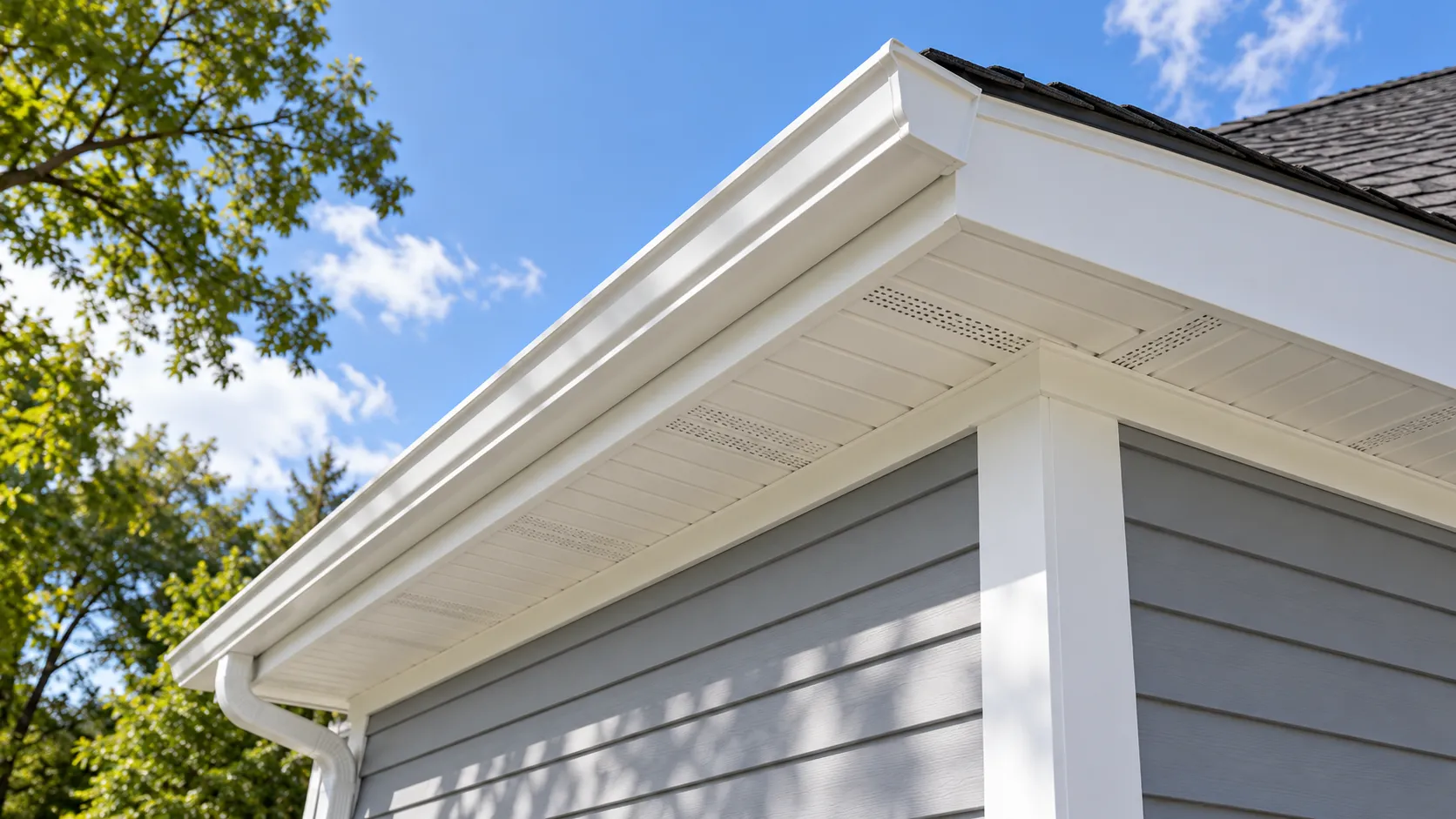
Trim is a separate calculation. Here the fascia (about 140 linear feet of 8-inch board), the soffits under an 18-inch overhang (about 120 square feet) and the corner boards (about 54) come to roughly 270 square feet a coat: 2 gallons of trim paint for two coats at 250 to 300 square feet per gallon. Our guide to painting fascia, soffits and exterior trim covers that work. Window trim and sills are not part of our scope, as noted above, so measure them separately if you are doing them.
What moves the exterior number
- Surface. Smooth, previously painted wood or fiber cement siding in good condition sits at the top of the range. Rough cedar shakes, weathered clapboard and older wood that has gone chalky sit at the bottom. Textured stucco, brick and split-face block can fall below it; Benjamin Moore's high-build masonry system on the Aura Exterior sheet is rated at 160 to 265 square feet per gallon, at 6 to 10 mils wet. A dedicated masonry coating goes on thicker again: Sherwin-Williams' Loxon XP lists 85 to 110 square feet per gallon at 14.5 to 18.5 mils wet, and 80 on porous, rough stucco, because "Coverage will vary with the substrate and the texture." Two coats of it on the same 2,228 square feet would be about 41 to 52 gallons, against 15 to 18 of siding paint. That is the film-thickness rule working as designed, not a calculator error. Our guides to painting stucco and painting a brick house go into those surfaces.
- Vinyl and aluminum siding are smooth and non-porous, so coverage is good, but colour choice is restricted on vinyl: the Aura Exterior sheet says "Do not paint vinyl with any color darker than the original" unless the colour is on its approved vinyl list. Our guide to painting vinyl or aluminum siding explains the limits.
- Colour change and condition decide whether one coat is enough, as above.
On a house built before 1978, assume the old paint may contain lead until it is tested. Federal law requires that anyone paid to disturb painted surfaces in a pre-1978 home be EPA-certified. We are not an EPA Lead-Safe Certified firm, and we do not scrape or sand paint on pre-1978 homes. Ask any bidder who will for their firm certification number before work starts, and see our guide to painting over lead paint. For the full picture of exterior work, see our exterior painting service and the best exterior paint for NJ homes.
How Much Deck Stain Do I Need?
Measure the deck floor (length times width), add the stairs and railings, and divide by the stain's coverage, which varies more than paint because wood absorbs stain unevenly. The sheets we use run from 150 to 400 square feet per gallon. A new or freshly cleaned smooth deck sits at the top; old, weathered or rough boards sit at the bottom.
| Product | Opacity | Coverage per gallon | Coats, per the sheet |
|---|---|---|---|
| Sherwin-Williams SuperDeck Oil-Based Semi-Transparent | Semi-transparent | 150–400 sq ft, "Depending on porosity and texture" | One coat only: a second "will not penetrate or adhere properly" |
| Benjamin Moore Arborcoat Translucent N623 | Translucent | 200–400 sq ft | "Generally, one coat of stain is sufficient" |
| Benjamin Moore Arborcoat Semi Solid 639 | Semi-solid | 300–400 sq ft | 1 or 2; "A second coat provides optimal performance and uniformity" |
| Benjamin Moore Arborcoat Solid Color 640 | Solid | 300–400 sq ft | 1 on a repaint; "Two coats provide optimal performance on bare wood surfaces" |
For a 12 by 16 foot deck floor (192 square feet):
- One coat of SuperDeck Oil Semi-Transparent at 150 to 400 square feet per gallon is 0.5 to 1.3 gallons. On a weathered deck, plan on the low end: buy two gallons and mix all cans of the colour together before you start.
- One coat of Arborcoat Translucent at 200 to 400 is 0.5 to 1.0 gallon.
- Two coats of Arborcoat Semi Solid (384 square feet) at 300 to 400 is 1.0 to 1.3 gallons.
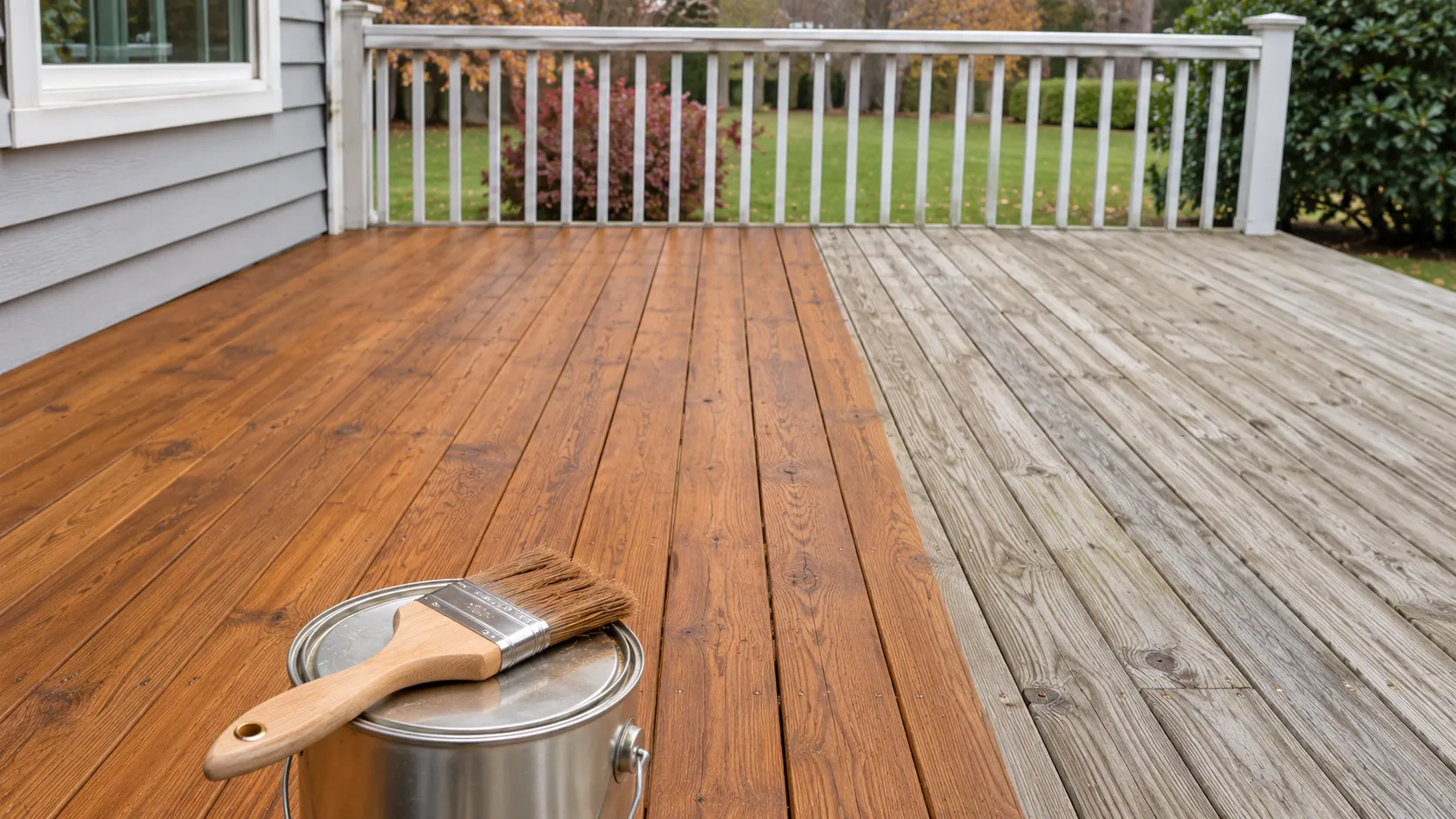
Railings and stairs are where deck estimates come up short. A railing has posts, top and bottom rails and dozens of balusters, each with four faces, and every cut end is end grain, which the Wood Handbook says absorbs far more finish than the face of the board. In our experience a railing takes more stain than its length suggests, and a long run of balusters can take as much as a small deck floor. Measure the faces, or count balusters and work out one, then multiply.
Two data sheet rules affect how much you buy. Do not plan a second coat of a one-coat stain to use up the can: SuperDeck's sheet says a second coat "will not penetrate or adhere properly. The surface will appear glossy and remain tacky." And buy enough to finish in one go, so that every can can be mixed together as the sheet asks. Our guides to what it costs to stain a deck in NJ, deck stain vs sealer and whether to paint or stain a deck cover the rest, and our deck staining service does the work.
Should You Buy Quarts, Gallons or Five-Gallon Pails?
Buy the container that matches the area, with enough over for touch-ups and no more. NIST's tables give the relationship: 4 quarts make a gallon, and a gallon is 231 cubic inches. A quart is simply a quarter of a gallon's coverage.
| Container | At 350–400 sq ft per gallon | At 400–450 sq ft per gallon | Good for |
|---|---|---|---|
| Quart | 88–100 sq ft | 100–113 sq ft | A room's trim, a door or two, spot priming, touch-ups, an accent wall's second coat |
| Gallon | 350–400 sq ft | 400–450 sq ft | A ceiling, one coat on a bedroom's walls, a small bathroom |
| Five-gallon pail | 1,750–2,000 sq ft | 2,000–2,250 sq ft | Whole floors of a house, a house exterior, boxing several gallons |
Some practical rules from our own buying:
- Use quarts to top up, not to start. If the arithmetic says 2.2 gallons, two gallons and a quart is sensible, with no extra gallon sitting in the basement.
- Five-gallon pails make sense above about 4 gallons of one colour. They are what we use on exterior walls and whole-house interiors, and a pail is where you mix several gallons together.
Our 2,000-square-foot exterior, at 15 to 18 gallons for two coats, is three to four pails. Leftover paint in a pail is still leftover, so do the arithmetic first.
What Is Boxing Paint, and Why Does It Keep the Colour Even?
Boxing is pouring every can of one colour into a single larger container and mixing it before you start, so the whole wall or house is painted from one uniform batch. In our experience tinted paint can vary very slightly from can to can, and on a large wall in raking light a seam between two cans can show. Boxing removes the seam.
The manufacturers' sheets point the same way. Sherwin-Williams' SuperDeck Oil Semi-Transparent sheet says "For uniformity, mix all cans together before use." Its Emerald Interior sheet says "Using the same method of application and batch to touch up with as that originally used will help improve touch up," and Benjamin Moore's sheets tie estimating to colour: estimate the right amount "This will ensure color uniformity." One guide advises using the same brand and batch number for colour consistency, and that is sound as far as it goes, but boxing does better, because it removes the can-to-can difference altogether.
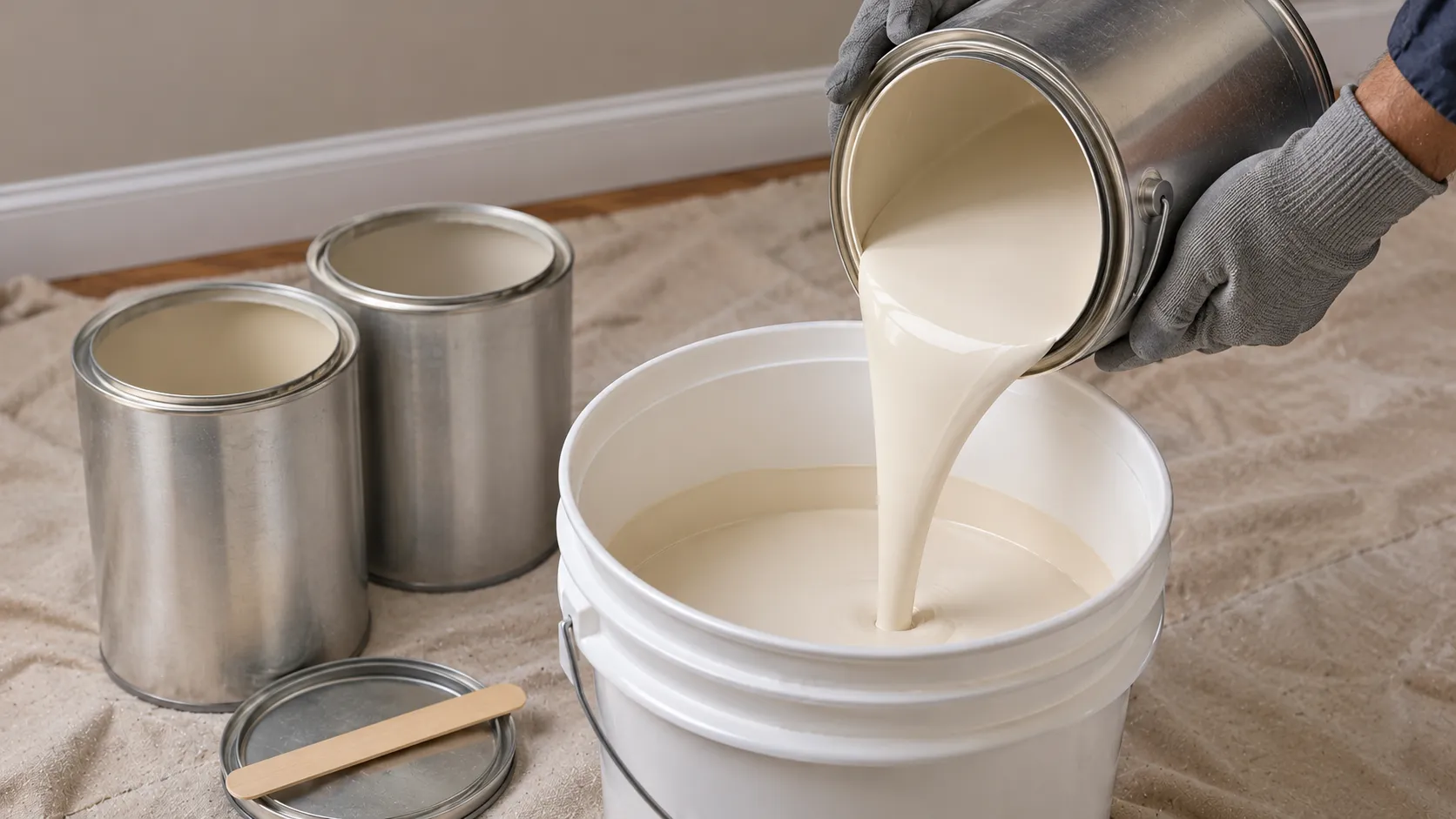
How we box paint:
- Work out the total first, so that every gallon of the colour is bought and tinted in one order.
- Check the cans for the same product, sheen and colour formula before opening any.
- Pour every can into a clean five-gallon pail, or two pails for a larger job, scraping each can out.
- Mix thoroughly with a drill mixer or a stir stick until the colour is uniform top to bottom.
- Pour back into a can or two for cutting in, and roll from the pail with a bucket grid.
- Keep a labelled quart of the boxed batch for touch-ups.
Boxing matters most with custom colours and deep tints, on large walls and on exteriors where a whole elevation is seen at once. It is also why running short is worse than it looks: a gallon tinted to the same formula a week later is a different batch. If you must add paint midway, finish at a corner, not mid-wall.
How Much Extra Should You Buy, and How Do You Store What Is Left?
Buy enough to finish the job and keep a quart or so for touch-ups, and no more. One guide suggests buying about 10 percent more than the calculation, and that is a reasonable cushion on a big or textured job. One guide suggests buying 3 gallons and 1 quart rather than four gallons when the need is just over three, and that is the right instinct. In our experience, if you round up to the next sensible container you will usually have a quart or two left, which is exactly what you want to keep.
Leftover paint has to be stored or disposed of, and both are easier in small quantities; Benjamin Moore's sheets tie estimating to minimising "the disposal of excess paint."
Storing leftover paint
Benjamin Moore's storage guidance, and its data sheets, give the rules:
- Seal it straight away. "The number one rule in resealing a paint can is that the lid should always be put back on immediately." Clean the rim, lay plastic wrap over the opening, and tap the lid down around the edge with a rubber mallet.
- Keep it at room temperature. "The temperature for storing paint should be between 60 and 80 degrees Fahrenheit (15-27 Celsius)," dry and out of direct sunlight. Benjamin Moore's sheets print "PROTECT FROM FREEZING." In New Jersey an unheated garage or shed freezes most winters, so store paint inside.
- Label the can. Benjamin Moore suggests writing the brand, colour, product, sheen and what was painted on the can, and on the back of a light switch plate in the room.
- Use it within two years. "Once opened, most paint products, including Benjamin Moore, have a shelf life of two years." Paint that smells sour or stays lumpy or jelly-like after stirring has gone off.
Getting rid of what you cannot use
New Jersey is not one of the 13 jurisdictions where PaintCare runs paint drop-off sites, so there is no statewide take-back here. Disposal is handled by each county. As one example, Long Branch's page on Monmouth County's household hazardous waste programme says latex paint "is no longer a hazardous waste," and to "Dry out the paint. Once dried, it can be disposed of as regular trash with the lids removed." It also warns that latex "should not be poured down the drain or on the ground." Keeping one batch together until it is used up also helps colour consistency at touch-up time. Oil-based paints, stains and solvents are a different matter, so check your own county's household hazardous waste rules for those. Better still, buy close to what you need and use the rest as a base coat under the next project, as PaintCare suggests.
What We Do, and Do Not Do, When We Work Out Paint
- We measure every room and every elevation, perimeter, heights, openings and ceilings, before we write an estimate.
- We use the data sheet's spread rate for the product on the estimate, at the low end for new, textured, porous or weathered surfaces.
- We plan two finish coats on walls and ceilings, and write the number of coats on the estimate.
- We work primer out separately for new drywall, bare wood, patches and stains, with tinted primer for big colour changes.
- We box paint for any colour that runs to more than a couple of gallons.
- We leave you labelled touch-up paint for each colour.
- We write the surfaces, prep, products, sheen and number of coats on the estimate, so two bids can be compared line by line.
We paint interiors, ceilings, trim, baseboards, interior doors, crown molding, cabinets, siding, fascia and soffits, and we stain decks and fences. We do not paint window trim or sills, re-caulk windows and doors, repair plaster, or apply faux, Venetian plaster or texture finishes. We are not an EPA Lead-Safe Certified firm, and we do not scrape or sand paint on houses built before 1978. If another bidder will, ask for their firm certification number before anyone sands or scrapes old paint.
Get a Measured Estimate
This is the arithmetic we do at an estimate, with one difference: we look at the surfaces. Where a wall sits in the data sheet's range, whether the old colour needs primer, and whether the siding is sound or chalky are easier to judge in person. NJ Painting Co. is a family-owned painting company in Morganville, working on New Jersey homes for more than 20 years with Benjamin Moore and Sherwin-Williams products. Every estimate is free and spells out surfaces, prep, products and number of coats. See our interior painting and exterior painting services, and our cost guide for how the price is built. Call (732) 239-0932 or request a free estimate, and ask us about the job minimum when you enquire.
Frequently Asked Questions
How much paint do I need for a 12x12 room?
Two gallons for two coats on the walls, one gallon for the ceiling and a quart or two for the trim. A 12x12 room with an eight-foot ceiling has 384 square feet of wall, or 333 after one door and two windows. Two coats is 666 square feet, which is 1.5 to 1.9 gallons at the 350 to 450 square feet per gallon on the data sheets.
How many square feet does a gallon of paint cover?
On the data sheets we use, 350 to 450 square feet per coat for interior wall paint (Regal Select and ben 400 to 450; Aura, Emerald, Duration Home and SuperPaint 350 to 400) and 250 to 350 for most exterior paint. The figure is for smooth surfaces that are sealed, at the recommended film thickness. Texture, porosity and colour change reduce it, so use the low end for anything rough or new.
How much does a quart of paint cover?
A quart is a quarter of a gallon, so it covers a quarter of the data sheet figure: about 88 to 100 square feet per coat at 350 to 400 square feet per gallon, 100 to 113 at 400 to 450, and 100 to 125 for a trim enamel such as Advance at 400 to 500. This Old House and the Old Farmer's Almanac both work with about 100 square feet. Quarts suit a room's trim, a door or two, spot priming and topping up a part-gallon.
How much paint do I need for the interior of a house?
Add up the rooms you are painting, keeping walls, ceilings and trim in separate totals, and round each total up once at the end. Floor area alone is a poor guide, because ceiling heights, open plans and the number of doors change the wall area. On the room table above, most bedrooms take about two gallons for two coats on the walls and a 15 by 20 living room about three.
How many gallons of paint do I need for a 2,000 square foot house exterior?
About 8 to 9 gallons for one coat and 15 to 18 for two, in our worked example: a 25 by 40 foot two-storey house with 18-foot walls, two gables, 18 windows and two doors has about 2,230 square feet of siding. At 250 to 300 square feet per gallon that is three to four five-gallon pails for two coats. Trim is extra, about 2 gallons here.
How much paint do I need for a ceiling?
Multiply length times width, double it for two coats and divide by the ceiling paint's coverage. Benjamin Moore's Waterborne Ceiling Paint lists 400 to 450 square feet per gallon, so a 12 by 12 ceiling (288 square feet for two coats) takes under a gallon. Textured or popcorn ceilings can need up to 50 percent more, per PaintCare.
Do darker colours need more paint?
Usually, because they need more coats to hide what is underneath. PaintCare says going from very light to very dark can take "three or even four coats," and that reds, oranges and purples may take more. A tinted primer, often grey under reds, does the hiding work of an extra finish coat, so plan for primer plus two finish coats on a big colour change.
Does primer reduce how much paint I need?
It reduces the number of finish coats, not the total area. Primer seals porous new drywall and bare wood so the finish coats are not soaked in, a tinted primer hides a colour change, and a stain blocking primer covers water marks. Benjamin Moore's Fresh Start primers list 400 to 550 square feet per gallon. Self-priming paint-and-primer products still recommend two coats on bare surfaces, so the first coat does the priming.
How much paint do I need for an interior door?
A flat slab door is about 21 square feet a side, so both faces with two coats is about 84 square feet, plus edges: most of a quart of trim enamel at 400 to 500 square feet per gallon. Raised-panel doors take noticeably more. If you are painting several doors, add them up and buy gallons rather than a quart per door.
How much paint do I need for kitchen cabinets?
For a medium kitchen of about 20 doors and 8 drawer fronts, about 170 square feet a coat with the door backs counted, plus face frames and the toe kick under the base cabinets: a gallon of cabinet enamel for two coats and up to a gallon of primer. Painting the interiors, the undersides of the upper cabinets and the shelves can double it. If the cabinets are sprayed, allow extra for overspray and do not order tight.
How much deck stain do I need?
Measure the floor, stairs and railings and divide by the stain's coverage. Data sheets range from 150 to 400 square feet per gallon, depending on the wood's porosity and texture, so a weathered deck needs far more than a new one. A 12 by 16 deck floor takes 0.5 to 1.3 gallons of one-coat semi-transparent stain; buy two gallons and mix them for an old deck.
Should I buy extra paint?
Buy enough to finish without a second trip, plus a quart or so for touch-ups. Round up to the next sensible container and you will usually have that much left. One guide suggests about 10 percent extra, which is a fair cushion for large or textured jobs. Running short is worse than it sounds, because a gallon tinted later is a different batch and can show. Use what is left as a base coat under the next project.
Are online paint calculators accurate?
They get the arithmetic right, but they assume a coverage rate, a smooth surface and a standard door and window. Benjamin Moore says of its own calculator that its "calculations are not intended to give more than a rough estimate." Treat the answer as a minimum and adjust it for texture, new or bare surfaces, a big colour change and spraying, all of which use more paint, or redo the sum with the spread rate from your product's data sheet.
How long does leftover paint last?
Benjamin Moore says that once opened, most paint has a shelf life of two years if it is sealed with plastic wrap under a lid tapped down with a rubber mallet and kept between 60 and 80 degrees Fahrenheit. The data sheets say to protect it from freezing, so keep it out of an unheated garage. Discard paint that smells sour or stays lumpy. Label the can; dried latex can go in the trash in Monmouth County, and oil-based paint follows your county's hazardous waste rules.
About the author
Written by the NJ Painting Co. team
NJ Painting Co. is a family-owned painting contractor based in Monmouth County, in business since 2004. We are licensed and fully insured, work with Benjamin Moore and Sherwin-Williams paints, and back our work with a 2-year workmanship warranty. We serve Monmouth, Middlesex, Ocean, Mercer, Somerset and Burlington counties, plus Union, Essex, Hudson, Bergen and Passaic in North Jersey.