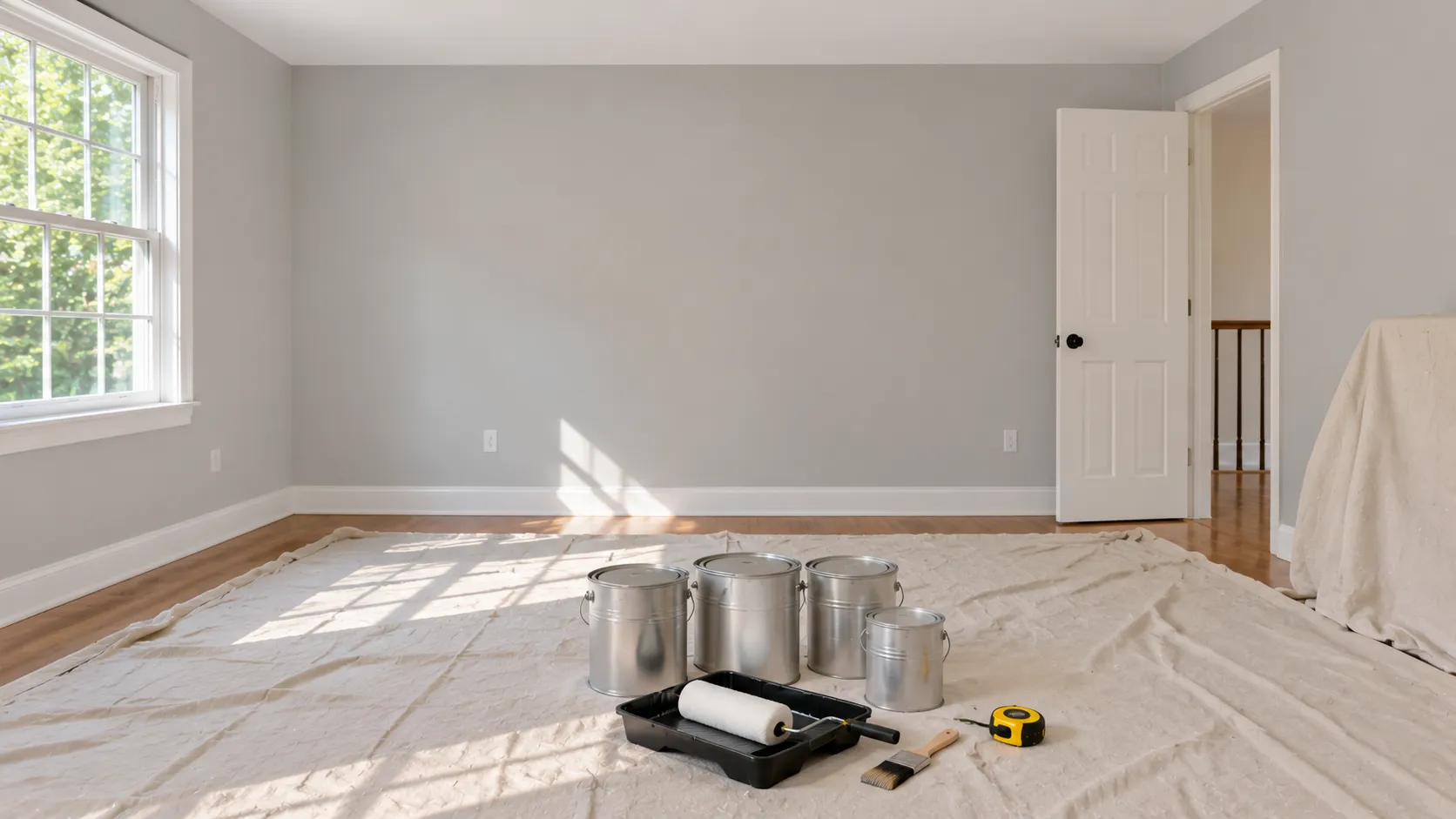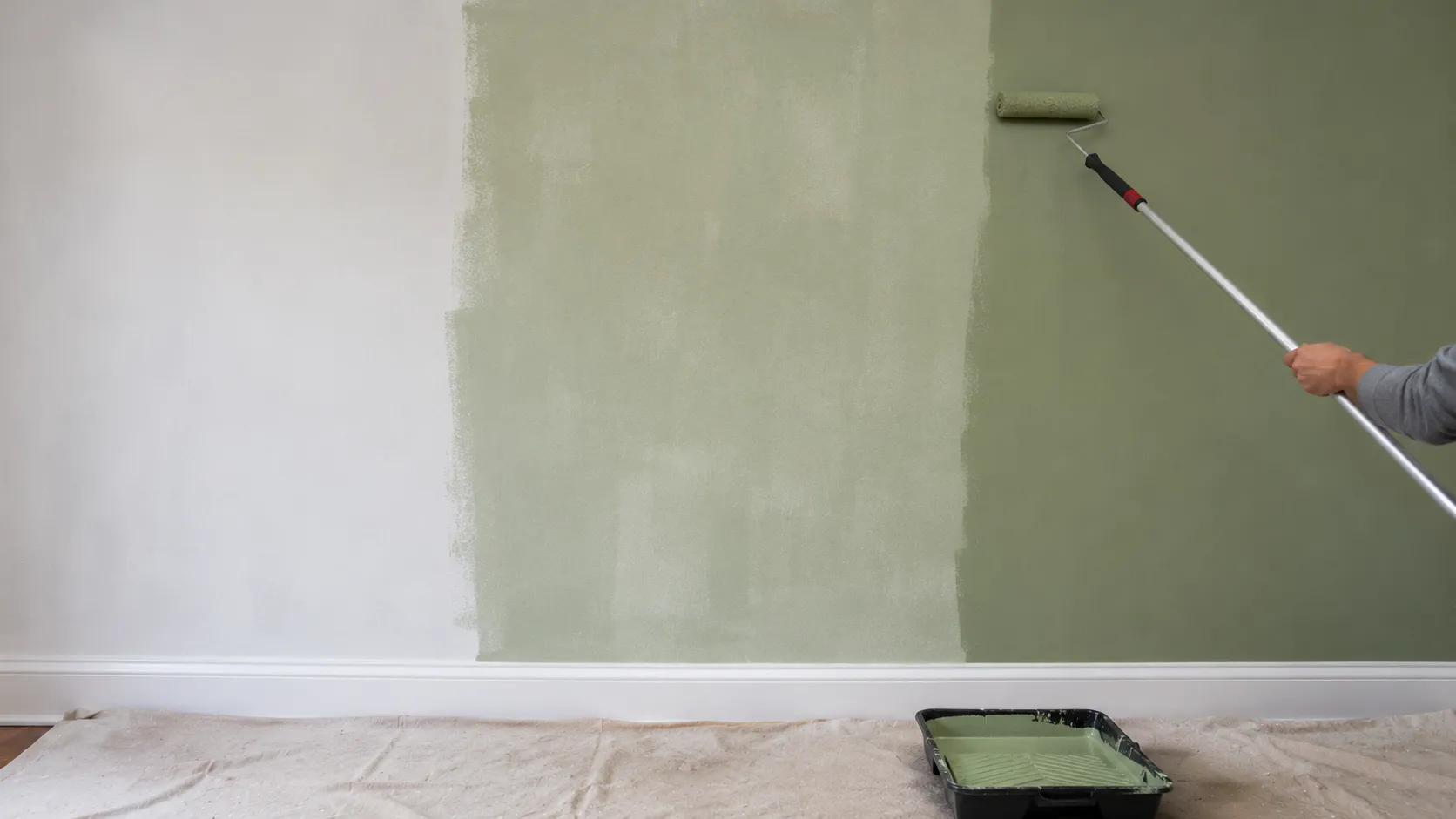
Most painted surfaces need two coats of finish paint, and they need a coat of primer first if they are bare, patched, stained, glossy or changing color a lot. A sound, clean, previously painted wall staying close to its current color usually needs no primer at all, and sometimes only one coat.
That is the whole rule, and it is also where most of the confusion starts. "Two coats" is not a superstition. The paint makers write it into their own data sheets, and the U.S. Forest Service measured what happens to exterior paint when you stop at one. But "primer" covers half a dozen different products that do different jobs, and the cans in the store all say "paint and primer" now, which makes it sound as if the question has gone away.
We are a family-owned painting company in Morganville and have painted New Jersey homes across Monmouth, Middlesex, Ocean, Mercer, Somerset and Burlington counties, plus Union, Essex, Hudson, Bergen and Passaic in North Jersey, for more than 20 years, using Benjamin Moore and Sherwin-Williams products. How many coats, and whether to prime, is a line on every estimate we write.
Every figure below is from a document we fetched and read on 15 November 2026: coat counts, recoat times, shelf lives and VOC content from the Benjamin Moore, Sherwin-Williams, Insl-x and Zinsser data sheets; paint-life research from the U.S. Forest Service; New Jersey's primer limits from the state's own copy of the rule; and disposal rules from the counties that publish them. Where something is our own practice rather than a published figure, we say so.
The Short Answer
- Two coats of finish paint is the normal answer. Benjamin Moore "recommends two coats to achieve full color development and to optimize performance," and Sherwin-Williams' exterior guide says, "For best results, apply two coats of paint."
- Primer is a separate product, not an extra coat. It does not count as a coat of finish paint. Sherwin-Williams' bonding primer sheet spells out the system as "1 coat Extreme Bond Primer" followed by "2 coats Appropriate topcoat."
- Skip primer on sound paint. Benjamin Moore: "If you're working with a previously painted surface that is in good condition, you most likely do NOT need to prime."
- Prime anything bare. That means new drywall, bare wood, patches and anything sanded through. Primer seals the surface and gives the topcoat adhesion.
- Paint and primer in one still means two coats. The built-in primer is self-priming "on most properly prepared surfaces," not on stains, slick finishes or bare outdoor wood.
- Use a tinted primer for big color changes. Benjamin Moore's oil primer sheet says to "tint primer to the approximate shade of the finish coat, especially when a significant color change is desired."
- Stains need a stain-blocking primer. Another coat of paint will not stop water stains, smoke damage or tannin bleed. The Forest Service says so in as many words.
- On the outside, it is primer plus two topcoats. The Wood Handbook says stopping at a primer and one topcoat "will decrease the service life to about half."
- Opened latex paint keeps about two years. Both Benjamin Moore and Sherwin-Williams publish that figure. Dried latex goes out with the trash in most New Jersey towns; oil paint goes to a county collection.
How Many Coats of Paint Do You Need?
You need two coats of finish paint in most cases, plus one coat of primer when the surface calls for it. That is the rule of thumb in nearly every guide online, and for once the guides and the manufacturers agree. Benjamin Moore's page on its paint-and-primer products says: "While the high quality of our products sometimes makes one-coat coverage achievable, Benjamin Moore recommends two coats to achieve full color development and to optimize performance. On bare substrates, two coats are recommended; previously painted surfaces can be finished with 1 or 2 coats."
On new or bare work, that means two coats, always. On a repaint, two, unless the old paint is sound and the new color is the same color or very close. Some guides add a third coat as routine. In our experience a third coat is a sign that something was skipped: a primer under a big color change, a tinted primer under a deep red, or a better paint. Budget paint with less pigment does need more coats to hide, which is why the cheapest gallon is rarely the cheapest job.
Here is how that works out surface by surface. This table is our summary of the data sheets quoted in this article, and the sheet for the product you buy overrides it.
| The surface | Primer first? | Finish coats | What the sheets say |
|---|---|---|---|
| Sound painted wall, similar color | Usually not | 1 or 2 | Benjamin Moore: previously painted surfaces "1 or 2 coats" |
| Sound painted wall, big color change | A tinted primer | 2 | Benjamin Moore: tint primer to the finish shade |
| Light over dark, such as white over black | A high-hiding primer, sometimes two | 2 | Benjamin Moore 046: "the go-to for significant color change" |
| New drywall | Yes, the whole surface | 2 | Sherwin-Williams: "Self-prime using 2 coats," or 1 primer and 2 coats |
| Patched wall | Prime the patches, or the whole wall | 2 | Sherwin-Williams: "Prime all bare areas" |
| Bare interior wood or woodwork | Yes | 2 | Sherwin-Williams: 1 coat primer, 2 coats finish |
| Water, smoke or tannin stains | A stain-blocking primer | 2 | Sherwin-Williams: seal stains "with the appropriate primer-sealer" |
| Glossy or oil-based trim | Degloss, then a bonding primer | 2 | Extreme Bond: 1 coat primer, 2 coats topcoat |
| Ceiling, white over white | Usually not | 1 or 2 | Benjamin Moore 508: "Apply one or two coats" |
| New masonry or stucco | Yes, once cured | 2 | Benjamin Moore 046: let it "cure (30 days)" first |
| Bare exterior wood | Yes, as soon as possible | 2 | Wood Handbook: primer and two topcoats |
| Sound exterior repaint | Spot-prime bare areas | 1 or 2 | Wood Handbook: "One coat may be adequate" |
Two coats also means twice the paint, and the spread rate on the sheet tells you how much. Benjamin Moore Regal Select is rated at 400 to 450 square feet per gallon and Sherwin-Williams Duration Home at 350 to 400. So 400 square feet of wall takes about two gallons for two coats, more on textured walls. Coverage outdoors is lower: Aura Exterior is rated at 250 to 350 square feet per gallon, and Sherwin-Williams' exterior guide says "generally, a gallon covers 250–400 square feet." For quantities by room, see our guide to what it costs to paint a room.
Two thin coats go further and look better than one heavy one. A heavy coat sags and still leaves thin spots. And if you want the coat count in writing, ask for it: every estimate we give lists the surfaces, the primer and the number of coats, so two bids can be compared line by line.
How Many Coats on Walls, Ceilings, Trim and the Outside of a House?
The answer barely changes from surface to surface: two finish coats nearly everywhere, with the exceptions below. What changes is the primer, and how much the second coat matters.
Walls. Two coats on any new color, any new drywall and any wall with repairs. One coat is a fair choice on a sound wall getting the same color again, in a flat paint or matte finish that hides lap marks.
Ceilings. A white ceiling repainted white often looks done after one coat, and Benjamin Moore's ceiling paint sheet allows for that: "Apply one or two coats." Two coats are still the safer call over patches, over a stain that has been sealed, or over a ceiling that has yellowed. Our ceiling painting guide covers flat paint, wet edges and why a patched ceiling flashes.
Trim, doors and cabinets. Two coats of enamel. Benjamin Moore's Advance sheet says "new surfaces should be fully primed, and previously painted surfaces may be primed or spot primed as necessary," and that glossy alkyd trim has to be sanded first. Kitchen cabinets and painted furniture follow the same logic with more prep.
The outside of the house. The Forest Service's Wood Handbook says that on smooth-planed wood "the best service life comes from a primer and two topcoats to achieve a 0.10- to 0.13-mm (4 to 5-mil) dry film thickness," and that "many three-coat paint systems in tests at FPL have lasted 30 years." It also gives a practical compromise: "If applying two topcoats to the entire structure is not practical, consider two topcoats for fully exposed areas on the south and west sides and a single topcoat on other areas." In New Jersey the south and west walls take the afternoon sun. Benjamin Moore's Aura Exterior sheet says the same thing about bare surfaces: "On bare substrates two coats are required; previously painted surfaces can be finished with 1 or 2 coats." Our exterior painting service works to two finish coats.
Are Two Coats Always Better Than One?
Two coats are better than one nearly every time on a new color, a new surface or an exterior, but not automatically on a sound wall staying the same color. More paint is not always more protection.
The Wood Handbook is the clearest source on this, because it looks at decades rather than the first week. For a repaint it says: "When the topcoats begin to wear thin, exposing the primer, reapply one or two new topcoats. One coat may be adequate if the old paint surface is in good condition." Then it warns the other way: "Do not paint too often. If paint is sound, but discolored with mildew, wash it. It does not need repainting. Too many coats of latex paint can eventually lead to adhesion failure of the primer."
Every coat adds film, and over many repaints a thick, stiff film can pull away from the wood, taking the original primer with it. Our article on why paint peels covers that failure.
So the decision is about what the second coat is for. On a new color it is there for hiding and full color. On new work it is there for film thickness, which is what gives paint its durability and its washability. On a same-color refresh of a wall in good condition, it may be there for nothing at all. In our experience a well-painted white hallway repainted white is a fair one-coat job; beige to green is not.
What Happens If You Only Paint One Coat?
If you paint only one coat where two were needed, you usually get a thinner film that looks uneven and wears out sooner. How soon depends on where it is.
Outside, the Forest Service has measured it. The Wood Handbook's table of paint life gives figures for an "ideal paint system: three coats (one primer and two top-coats)," and its footnote reads: "Applying only a two-coat paint system (primer and one top-coat) will decrease the service life to about half the values shown in the table." The same footnote warns that "dark colors may fade within a few years," and fading shows first on a thin film.
Inside, a single coat usually fails on looks before it fails on wear. A roller lays paint on thick, then thin, then thick as it unloads, so the first coat has gaps and light patches that the second coat fills. A brushed cut-in line that dried before the wall was rolled leaves a visible band around the edge of the wall. Sherwin-Williams calls it hatbanding and gives the fix: "Hatbanding is corrected by applying another coat of paint, keeping a wet edge of cut-in areas." A second coat evens out sheen as well as color.
How Long Should You Wait Between Coats?
Wait as long as the data sheet for your product says, which runs from under an hour to 16 hours for the products below. These are the published recoat times at 77°F and 50% relative humidity:
| Product | Type | Published recoat time |
|---|---|---|
| Zinsser B-I-N | Shellac primer | 45 minutes (at 70 to 80°F) |
| Benjamin Moore Fresh Start 046 | Acrylic primer | 1 hour |
| Benjamin Moore Regal Select Eggshell N549 | Acrylic paint and primer | 1 to 2 hours |
| Benjamin Moore Drywall Primer 380 | Acrylic primer | 2 hours |
| Sherwin-Williams Duration Home | Latex interior paint | 4 hours |
| Benjamin Moore Aura Exterior Flat N629 | Acrylic exterior paint | 4 hours |
| Benjamin Moore Fresh Start 024 | Oil-based primer | 8 hours |
| Benjamin Moore Advance Satin 792 | Waterborne alkyd enamel | 16 hours |
Those are minimums in good conditions, and dry to the touch is not the same thing as ready to recoat. Every Benjamin Moore sheet above carries the same caution: "High humidity and cool temperatures will result in longer dry, recoat and service times." A New Jersey basement in August or an unheated sunroom in November is nowhere near 77°F at 50%, and in our experience those are the rooms where a second coat goes on too soon, drags the first one and leaves patchy marks. Outside, Sherwin-Williams' guide says that "depending on the climate," you should "generally, allow 4–6 hours between coats," and that "the first coat should be fully dry before applying the second."
Dry, recoat and cure are three different clocks, and the third one is the one that catches people out with furniture and washing. Our separate guide to how long paint takes to dry and cure covers all three in detail.
Do You Need Primer Before Painting?
You do not always need primer before painting, but you do on bare, patched, stained, slick or dramatically changing surfaces. Benjamin Moore's guide to choosing a primer lists the cases where it "highly" recommends one:
- Bare substrates that have not been previously painted or coated
- Any bare PVC or composite material
- Surfaces that have been sanded down to the bare substrate due to damage
- Surfaces where rust or stains are present
- Dramatic color changes
- Any hard-to-coat substrates like plastic, laminate, glass, high-gloss or non-porous surfaces
Primer is a different product from paint, not just a first coat of it. Sherwin-Williams answers the question "Why do I need to use a primer instead of just using two coats of the finish paint?" directly: a primer "helps provide a uniform surface that promotes good adhesion of the topcoat," and "can also serve a special purpose by sealing a porous surface, blocking out stains, preventing rust formation on iron and steel, and preventing tannin bleed on wood." It adds that most finish paints "do not provide the features of a primer, so it is always important to follow the manufacturer's recommended coating system."
The Forest Service explains why the two products have to be different. On wood, "a primer is designed to be sticky and flexible, to adhere well to the wood, and move with wood as moisture content changes. A sticky, flexible topcoat would hold dirt and scratch easily, however. Therefore, topcoats are designed to be hard, easily cleanable (not soft or sticky), and resistant to scratching and wear." A primer's binder and pigment are tuned to grip and seal. A topcoat's are tuned to look good and wash. One can does not do both perfectly.
So treat primer as a separate step with its own job, chosen for the surface. The rest of this article goes through those jobs one at a time: new drywall and patches, bare wood, color changes, stains, and glossy or oil-painted trim.
When Can You Skip Primer?
You can skip primer when the existing paint is sound, clean, not glossy, and the new color is close to the old one. Benjamin Moore's words are: "If you're working with a previously painted surface that is in good condition, you most likely do NOT need to prime."
Sound means it is not peeling, flaking, chalking or cracking. Clean means no grease or smoke film; our guide to cleaning and prepping walls before painting covers that part. And close in color means a shift you could almost miss: one soft white to another, or a greige a shade darker. Anything more than that is a color change, covered below.
Can you paint straight over old paint?
Yes, if it is sound, but there are four exceptions to watch for:
- Bare spots from repairs. Spackle, joint compound and sanded-through spots soak up paint differently and show as dull patches. Sherwin-Williams says to "prime all bare areas prior to applying topcoat," because "spot priming" alone "can result in a non-uniform appearance between primed and non-primed areas."
- Glossy paint. Semi-gloss, gloss and varnished paneling need dulling or a bonding primer, or the new coat has nothing to grip.
- Old oil-based paint. Benjamin Moore says it generally does "not recommend putting an acrylic finish over a previously painted oil-based top coat without added surface preparation." That is the most common cause of trim paint peeling off in sheets.
- Stains. Water marks, smoke and crayon bleed straight through paint. They need a stain-blocking primer.
Do touch-ups need primer?
Only where the wall was damaged. Benjamin Moore's touch-up guide: "If you're just fixing a color imperfection, there's no need to prime. If you're touching up an area with actual damage to the sheet rock, be sure to prime before applying your first coat of paint." In our experience one coat of touch-up on an eggshell wall almost always shows from an angle, and repainting the wall corner to corner is the cleaner fix.
Does Paint and Primer in One Really Work?
Paint and primer in one works on most sound, properly prepared surfaces, but it still takes two coats, and it does not replace a dedicated primer on stains, slick finishes or bare exterior wood.
Look at what the manufacturers actually claim. Benjamin Moore says its paint-and-primer products are "self-priming on most properly prepared surfaces," recommends two coats anyway, and adds: "Ask your retailer about our special purpose primers if the surface to be painted is water stained, smoke damaged, grease stained or very slick." Sherwin-Williams' Duration Home sheet is precise about what self-priming means. On new drywall: "Self-prime using 2 coats of Duration Home Interior Latex." On bare wood, the same sheet calls for "1 coat Premium Wall & Wood Primer" and then "2 coats Duration Home Interior Latex," and on wood that bleeds, "prime with ProBlock Premium All-Purpose Primer."
So "paint and primer" mostly means that two coats of the same product can do the priming on ordinary drywall and sound paint. It is not a one-coat shortcut, and on the surfaces that really need a primer it does not claim to be one. It is useful: it saves a separate step and a third product on a straightforward job. A budget paint labelled paint-and-primer is still a budget paint.
On exterior wood, the Forest Service is blunter: "Though 'paint and primer in one' can be purchased, the properties are not optimal for either the primer or the topcoat."
Do You Need Primer When Changing Color?
You need primer for a dramatic color change, and a tinted one works best. For a small shift, such as one set of light walls to another, two coats of paint are usually enough on their own.
Benjamin Moore lists "dramatic color changes" among its reasons to prime, and Sherwin-Williams' Duration Home sheet says: "When repainting involves a drastic color change, or coating over heavily stained areas, a coat of primer will improve the hiding performance of the topcoat color." The trick is to make the primer do some of the color work. Benjamin Moore's oil primer sheet says: "For best hiding results, tint primer to the approximate shade of the finish coat, especially when a significant color change is desired. A properly tinted Deep Color Base (024 04) is essential for achieving best hiding results and minimizing the extra coats resulting from drastic color changes." Its Drywall Primer sheet says the same: "For best hiding results use Drywall Primer tinted to the approximate finish coat color." Zinsser's Cover Stain sheet says "tinting the primer towards the topcoat improves the hiding power of the topcoat," and its B-I-N sheet says tinting toward the topcoat color "helps hide in one coat."
A tinted primer close to the final color can save a full coat of finish paint, which is often the more expensive gallon. Before committing the room, roll a test patch of the new color over a primed section and look at it in daylight. Even a plain white primer tinted a little toward the new color makes a visible difference. Sherwin-Williams' sheets tell you to "use the recommended 'P'-shade primer" for best color development, which is a primer shade matched to the finish color. Some guides recommend a gray primer under deep colors as a general rule. The sheets we read do not say gray specifically; they say to tint toward the finish, so ask the store which shade it suggests for your topcoat color.
Primer tint has a limit. Benjamin Moore's 024 allows "up to 2.0 fl. oz." of colorant per gallon and Zinsser 2 ounces, enough for a mid-tone, not navy. For very deep colors, Benjamin Moore says "certain custom colors may require a Deep Base Primer tinted to a special prescription formula."
How Do You Paint Over Black or Dark Walls?
Paint over black or dark walls with a high-hiding primer, tinted toward the new color, then two coats of the new color, and check the primer in daylight before deciding whether it needs a second coat. Here is the order we use:
- Repair and clean. Fill holes and wash the wall. If the dark paint is satin or shinier, dull it with light sanding. Sherwin-Williams' Duration Home sheet says "glossy surfaces should be sanded dull."
- Prime with a high-hiding primer. Benjamin Moore calls Fresh Start 046 "the go-to for significant color change" and says to "apply one or two coats." Zinsser's B-I-N sheet lists "seals stains from dark colors" among its uses. Glidden's own advice for dark walls is to "choose a high-quality white primer." Tinting it toward the topcoat color, within the 2-ounce limit, helps.
- Check it in daylight. Look at it the next day, once its recoat time has passed. If the dark color still reads strongly through the primer, a second coat of primer is cheaper than a third coat of finish. Glidden says a second primer coat is "essential" if the old color still shows.
- Two coats of the new color. Glidden: "It is advisable to apply at least two coats of paint." Benjamin Moore recommends two for full color development.
We could not find a data sheet that gives a fixed number of coats for black to white, because it depends on the two colors and the products, so we will not invent one. Some guides say two coats of primer are a baseline for black walls, and that a gray primer hides better than white under a light color. In our experience one good coat of tinted high-hide primer plus two finish coats covers most dark walls, and the very saturated colors, such as deep red or near-black navy, are the ones that take the extra primer coat. Do a test patch on one section before committing the whole room, and let it dry fully: wet paint over dark always looks better than it will.
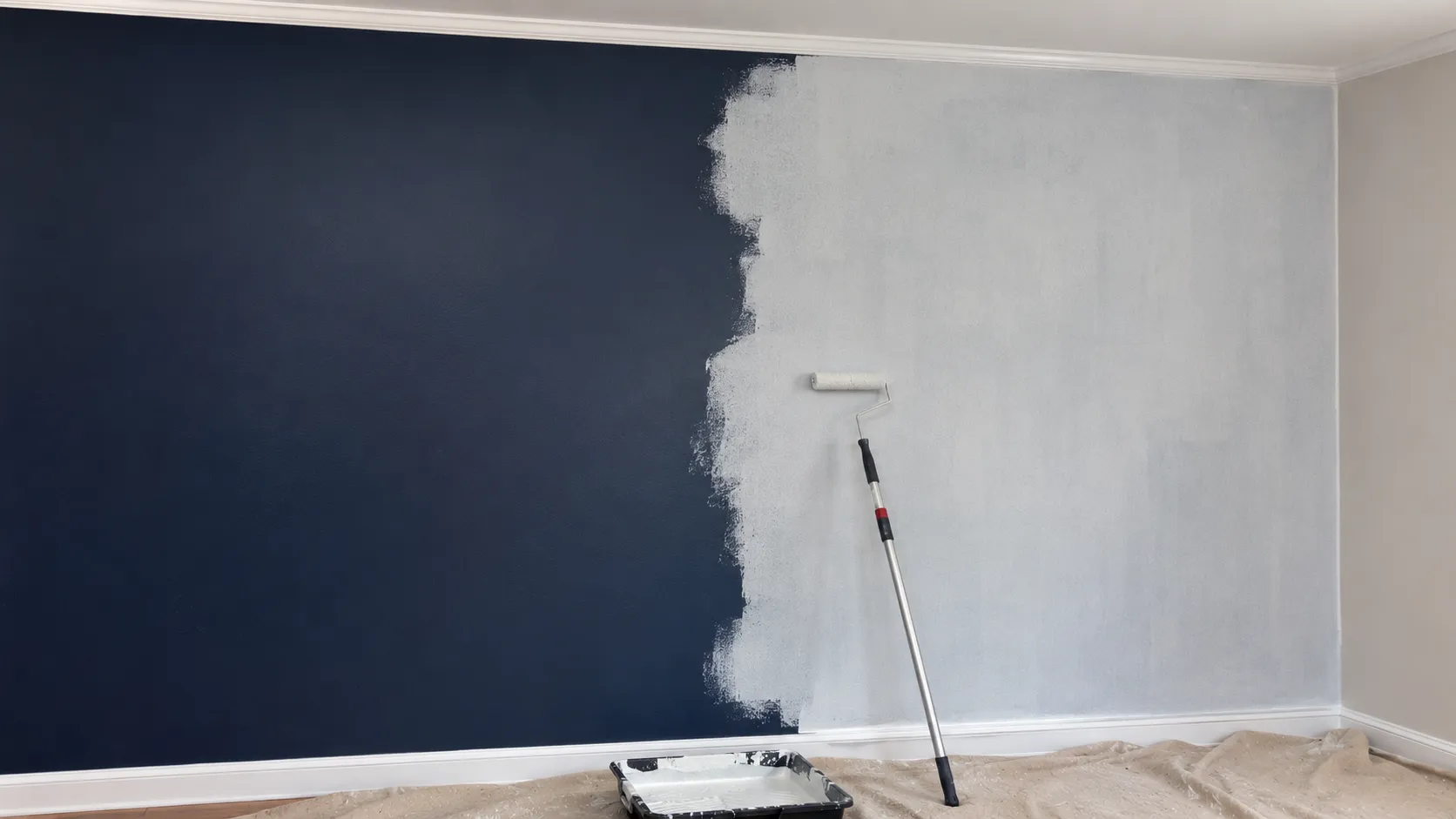
Going the other way, dark over light, has its own traps. A very dark new color needs the right base and may need a deep base primer. And dark paint shows the wall. The Gypsum Association's GA-214 standard says "colors with deep or strong hues, and even flat paints, tend to magnify imperfections in the finished gypsum panel surface," and that its normal Level 4 finish is not meant for dark paint: "non-flat or dark/deep tone paints are not recommended; refer to Level 5." Repairs that were invisible under white can show under charcoal. A dark wall is also one where fading at the cut-in and gaps in the roller pattern are easiest to see, so it is the wrong place to try to get away with one coat.
Do You Need Primer on New Drywall, Patches and Bare Wood?
Yes. New drywall, patched areas and bare wood all need a primer, because they absorb paint unevenly and, in wood's case, move and bleed.
New drywall
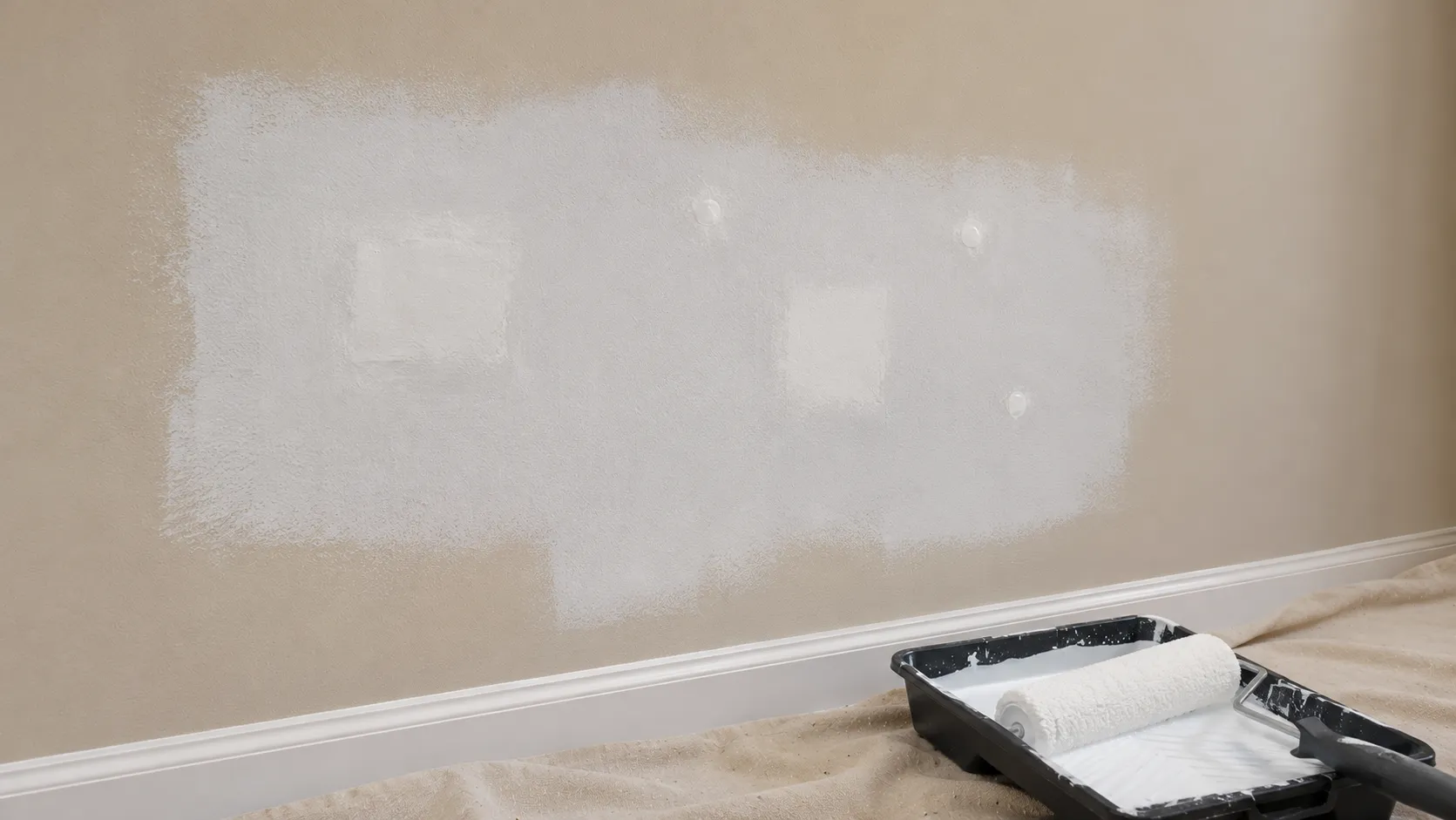
Prime all of it, not just the seams. The Gypsum Association defines primer as "a material specifically formulated for the intended final finish application to be applied over the entire prepared gypsum panel surface prior to decoration." Paper face and joint compound absorb paint at different rates; a primer's binder evens that out, and without it the taped joints show through as dull stripes. Benjamin Moore's Drywall Primer sheet says "new surfaces should be fully primed," and its 046 sheet says "drywall surfaces must be free of sanding dust." A dedicated drywall primer is fine here, or, per Sherwin-Williams, two coats of a self-priming paint.
Patches and repairs
Prime every patch. A patch is a small area of porous new compound in the middle of a sealed, painted wall, and paint dries duller over it. Sherwin-Williams' advice to prime all bare areas, not spot-prime, exists because the primed spots show too. In our experience, where a wall has many repairs it is better to prime the whole wall than twenty separate spots. Our drywall repair guide explains why patches flash and when a wall needs a skim coat instead. After wallpaper removal, Benjamin Moore notes that alkyd primers are worth considering "if you have removed wallpaper because it seals the residual adhesive"; see our guide to wallpaper removal.
Bare wood, inside and out
Bare wood needs primer. The Wood Handbook says that for paint, "a primer is strongly recommended," and that even for species that do not bleed, "a quality primer is still necessary to give a good base for topcoats." Outside, speed matters. Sunlight damages a bare board's surface within days: "Research has shown that surface degradation of wood facing south for as little as one week prior to painting significantly shortened the service life of paint." In the Forest Service's test, "for boards exposed 16 weeks, the paint peeled and needed refinishing within 3 years; for boards exposed only 1 week, the paint started peeling after 13 years, whereas the panels that were not exposed were in good condition after 20 years." For cedar, it says to "prime it before installation" if you can.
Cedar and redwood bleed water-soluble extractives, which come through paint as brown stains, so they need a stain-blocking primer. Knots in pine trim are a separate problem. The Wood Handbook says "knots of almost all species contain sufficient oils and resins to discolor light-colored paint." Benjamin Moore's 046 sheet is blunt: "Not recommended for sealing knots or over pine sap." Zinsser's Cover Stain sheet tells you to "spot prime knots and sap streaks with B-I-N Primer-Sealer before whole surface priming," and B-I-N's own sheet lists "seals bleeding knots and sap streaks." Our practice on new pine trim is the same: shellac on every knot, then the general primer, then two finish coats. The Forest Service adds one honest limit: many pines contain pitch that "must be hardened or set—no coating that we are aware of will block its flow."
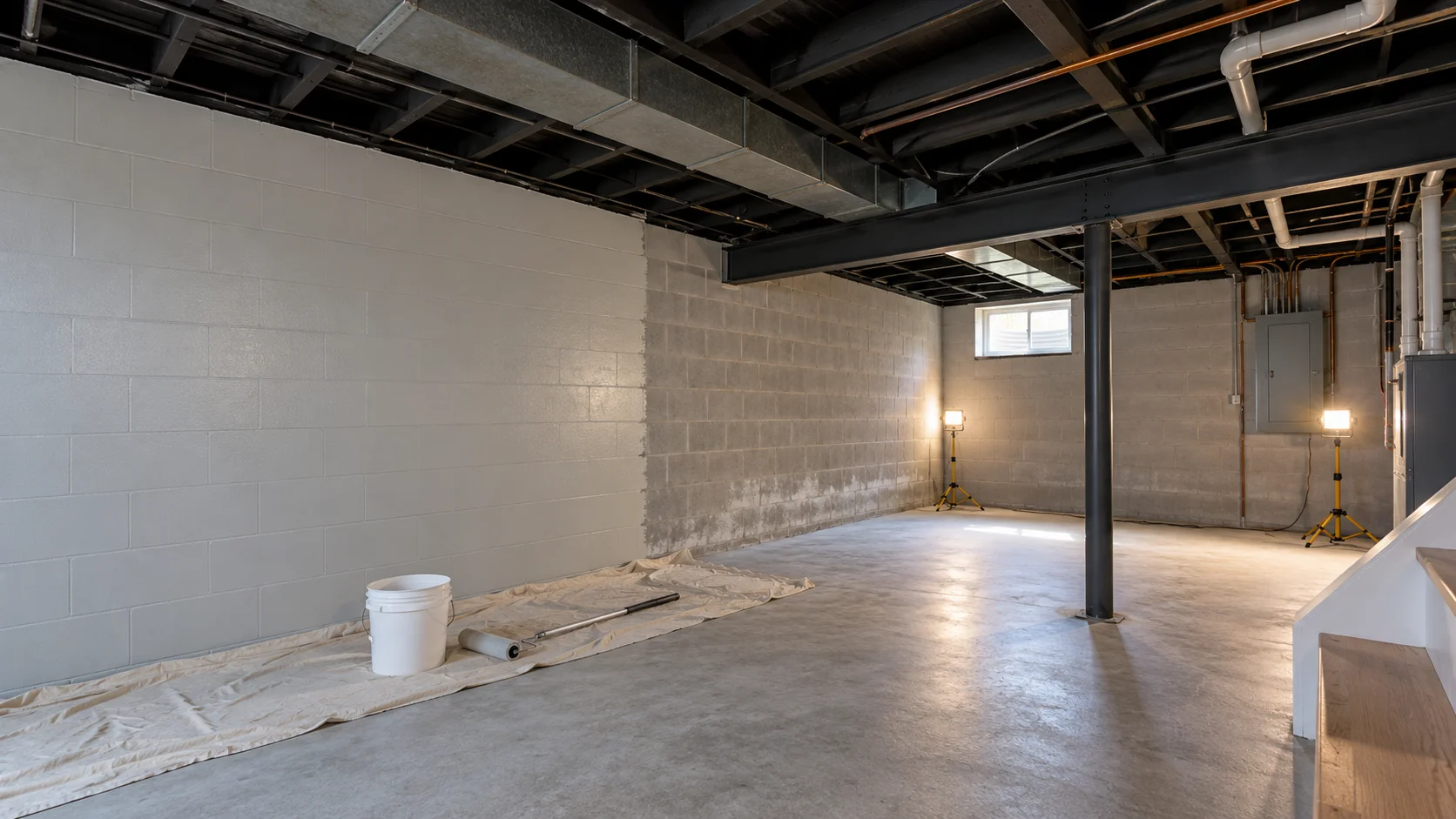
Masonry, stucco, brick and fiber cement each have their own primer rules, and new plaster or masonry has to cure first: Benjamin Moore's 046 sheet says "new plaster or masonry surfaces must be allowed to cure (30 days) before applying base coat." See our guides to wood siding and cedar shakes and basement walls.
What Is a Stain-Blocking Primer, and Which One Fits Which Stain?
A stain-blocking primer is a primer formulated to seal a stain in so it cannot bleed up into the topcoat. It is what you need when ordinary paint keeps showing the mark underneath, and no amount of finish paint will do the same thing. The Wood Handbook is direct: "another coat of the same finish will not stop the problem; apply a stain-blocking primer, then another topcoat." Without that layer, it says, "extractives can bleed through as many top coatings as you apply."
Stain blockers come in three bases, and the base matters more than the brand:
| Primer | Base | What its sheet says it blocks | Recoat | VOC on the sheet |
|---|---|---|---|---|
| Benjamin Moore Fresh Start 046 | Acrylic | "tannin bleed, water stains, smoke damage, markers, crayons, pens, pencils, nicotine" | 1 hour | under 50 g/L |
| Insl-x Aqua Lock Plus | Acrylic | "water stains, wood tannin, fingerprints, smoke, crayons and more" | 1 hour | 45 g/L |
| Zinsser Bulls Eye 1-2-3 | Styrenated acrylic | "grease, handprints, asphalt, crayon, graffiti, rust stains, light water stains and cedar or redwood bleed" | 1 hour; 2 hours as a stain sealer | under 100 g/L |
| Benjamin Moore Fresh Start 024 | Alkyd (oil) | "crayon, graffiti, grease marks, water stains, cedar and redwood bleed, asphalt, creosote, rust stains, and smoke" | 8 hours | 344 g/L |
| Zinsser Cover Stain | Alkyd (oil) | "stains from nicotine, fire, smoke and water damage" | 1 hour (at 70 to 80°F) | 450 g/L |
| Zinsser B-I-N | Shellac | "water, grease, rust, smoke, asphalt, graffiti"; knots and sap; fire and water odors | 45 minutes (at 70 to 80°F) | up to 550 g/L |
The waterborne ones are easy to use, low in odor and fine for most light stains indoors. The oil and shellac ones are the heavy hitters, with far more VOCs, and there is a reason. Sherwin-Williams explains it for water-stained ceilings: alkyd and latex stain blockers both work, but "the alkyd stain blocker will usually seal water stains better because it doesn't contain water that could re-wet the stain." Bulls Eye 1-2-3's sheet draws the same line within one brand: it is for "light water stains," and it says to "prime severe water and smoke stains and block associated odors with Zinsser B-I-N." B-I-N's sheet adds that "some stains require a second coat," and 046's says "two coats of primer may be required on severe stains." In our experience two thin coats of primer dry faster and more evenly than one heavy one.
In our experience a waterborne blocker handles most ordinary ceiling water marks once the leak is fixed and the ceiling is dry, and where a stain comes back through it, or there is a smell to seal, oil or shellac is the next step. B-I-N is dry to the touch in 20 minutes and Cover Stain in 30. Keep the humidity and temperature in mind with the solvent primers too: Cover Stain's sheet says "lower temperatures, higher humidity and the addition of tint will prolong the dry and cure time." You can also spot-prime a small stain rather than the whole ceiling, but Cover Stain's sheet says "spot priming is recommended only under high-hiding topcoat paints." Under a thin topcoat the primed spot can show.
A blocker hides a stain; it does nothing about the cause. Sherwin-Williams says to correct "the cause of the water staining" first, and notes that you may still see the stain through the blocker, since it is designed to "lock-in" the stain rather than remove it. The EPA's mold guidance says "fix plumbing leaks and other water problems as soon as possible" and "do not paint or caulk moldy surfaces." We wash walls and exteriors, but we do not offer mold or mildew treatment, and a ceiling stain under a bathroom is a plumbing job first. Our ceiling guide covers water stains, smoke and nicotine in detail. Smoke damage from an actual fire is a restoration job, not one we do.
What Is a Bonding Primer, and When Do You Need One Over Glossy or Oil Paint?
A bonding primer is a primer made to stick to hard, slick surfaces that ordinary paint cannot grip: glossy enamel, old oil trim, laminate, PVC, glass and glazed tile. You need one, or a lot of sanding, whenever a water-based paint is going over glossy or oil-based paint.
First find out what is on the surface. Benjamin Moore's test: "Rub a cotton ball dipped in 70% isopropyl alcohol on the surface. If the paint does NOT come off, it's an alkyd-based paint. If it does come off with the alcohol, it's an acrylic-based paint." Old trim, doors and kitchen cabinets in New Jersey houses built before the 1990s are very often oil. Our guide to oil vs latex paint and primer covers the test and the products in detail.
If it is oil, Sherwin-Williams gives two routes for latex over oil: "First would be to wash the surface, sand and then clean the sanding dust off. You may then apply your latex paint over the oil base paint." Or: "wash the surface and then apply a coat of a adhesion primer and then topcoat." For glossy alkyd it adds that "glossy surfaces must first be washed clean and then sanded to allow the paint to 'grip' the surface." In other words, wash and de-gloss either way; the bonding primer is the insurance.
The bonding primers we see most often:
- Insl-x Stix is "a premium quality, waterborne, acrylic urethane primer/sealer" with "unparalleled adhesion to the most challenging surfaces, including PVC, Vinyl, Most Plastics, Glass, Tile, Glazed Block, Glossy Paints." It recoats in 3 to 4 hours and reaches full cure in 3 to 4 days.
- Sherwin-Williams Extreme Bond is "designed for coating hard, slick, glossy surfaces with minimal surface preparation," and its listed uses include "Kitchen Cabinets" and "Varnished Woodwork." The same sheet still says to "sand glossy surfaces dull," and to prime the whole surface rather than spot-prime, since spot priming can leave "a non-uniform appearance of the final coat."
- Zinsser Cover Stain and Bulls Eye 1-2-3 are primers first and bonders second, but both sheets claim adhesion to dense, glossy surfaces. Cover Stain's says "enamel paints and varnishes, paneling, laminates, and ceramic tile without the need for sanding or de-glossing."
Two warnings from the sheets themselves. Bonding primers are not whole-house exterior wood primers: Stix is "not recommended as a whole house exterior primer over wood," and Extreme Bond says "do not use on large surfaces of exterior wood," pointing instead to an exterior wood primer. And a latex primer marketed for everything still has limits; Bulls Eye 1-2-3 is "not recommended for application to floors or decks."
Several of these sheets list ceramic tile. That is information, not a recommendation: painting tile and bathtubs is not work we do, and our article on whether you can paint tile and bathtubs explains why. On woodwork and cabinets, a good bonding primer plus two coats of a trim enamel is our standard system for durability. Any sanding of old paint raises the lead question, covered further down.
Which Primers Can You Still Buy in New Jersey?
Waterborne primers, almost all of them. New Jersey tightened its limit on the solvent content of primers this year, and several well-known oil primers print figures above the new limit on their own data sheets.
The rule is N.J.A.C. 7:27-23, which caps the volatile organic compounds, or VOCs, in architectural coatings. The state's courtesy copy of the rule, last amended 18 August 2025, sets the limit for the category "Primer, Sealer, and Undercoater" at 350 grams per liter from 1990, 200 from 2005, and 100 grams per liter for products manufactured on or after 18 August 2026. "Specialty primer, sealer, and undercoater," the stain-blocking category, drops from 350 to 100 on the same date, and for those newer products it is defined as a coating "formulated for application to a substrate to block water-soluble stains resulting from: fire damage, smoke damage, or water damage." Opaque shellac is its own category, listed at 550 grams per liter.
Now compare the sheets. Benjamin Moore's Fresh Start 024 oil primer prints 344 grams per liter and marks itself "NO" for the OTC II regional standard. Zinsser Cover Stain prints 450. B-I-N, a shellac, prints a maximum of 550. The waterborne latex primer options sit far below: Fresh Start 046 and Drywall Primer 380 under 50, Aqua Lock 45, Stix 87.6, Bulls Eye 1-2-3 under 100. A sheet is not a shelf, and a store may hold older stock or a reformulated version, so read the label of the can you buy. But this is why the oil primer aisle in New Jersey has been shrinking, and why the waterborne stain blockers have become the everyday choice indoors.
The rule has exemptions that matter to a homeowner. It does not apply to "an aerosol coating product" or to "an architectural coating that is sold in a container with a volume of one liter (1.057 quart) or less." So the spray cans and quart cans used to spot-prime a knot or a stain are outside it. The rule binds anyone who "applies an architectural coating for compensation within the State of New Jersey," which includes painters, with an exemption for coatings bought in New Jersey.
Does Paint Go Bad, and How Long Does Leftover Paint Last?
Yes, paint goes bad eventually. Opened latex paint keeps about two years when it is stored properly, unopened paint longer, and oil-based paint longer still.
The manufacturers publish shorter figures than most guides. Benjamin Moore: "Once opened, most paint products, including Benjamin Moore, have a shelf life of two years. Considerations include environment, temperature fluctuations and other variables." Sherwin-Williams: "When stored properly, opened latex paint will keep for about two years," and "oil-based paints are less susceptible to going bad and can last up to 15 years so long as it's been properly stored." Several data sheets print a figure for unopened product: Sherwin-Williams gives "36 months, unopened" for both Duration Home and Extreme Bond, Zinsser gives a shelf life of 5 years for Cover Stain and Bulls Eye 1-2-3 and 3 years for B-I-N. Some guides say unopened latex lasts up to 10 years. We would treat the published figures as the guide and anything older as something to test.
How to tell if paint has gone off:
- Smell. Benjamin Moore: "Paint that is beyond its shelf life can smell sour and strong." Sherwin-Williams: "Some people even describe it as a rotten eggs smell." A rancid smell means it is finished.
- Texture. Benjamin Moore: "Even after stirring, there should not be any chunks in or jelly-like texture to the paint." Sherwin-Williams: old paint "will contain jelly-like clumps even after stirring."
- A brush-out. Stir it well and brush some on a piece of cardboard. If it goes on smooth and even, it is usable. Grit and lumps that will not stir out mean the paint is done, even if you strain the worst of it.
- The top. A skin on an opened can is normal; lift it out before stirring, and use plastic wrap under the lid next time. Sherwin-Williams says oil paint that shows "a visible separation of liquids that will not mix easily" is finished.
Freezing and other extreme temperatures are the other killer. Benjamin Moore's 046 sheet and Sherwin-Williams' Duration Home and Extreme Bond sheets all say "protect from freezing," and Benjamin Moore's storage page says to "make sure it doesn't freeze" if you keep paint in a garage. Sherwin-Williams says plainly that old paint is not worth rescuing: "the coverage and performance of the paint won't be the same so you're better off recycling the paint rather than trying to salvage it." Poor coverage is the first sign. If a gallon is still good but you do not need it, donate it; the disposal section below has where.
How Do You Store Leftover Paint So It Keeps?
Store leftover paint sealed tight, indoors, between 60 and 80°F, off the floor, and labelled. Both Benjamin Moore and Sherwin-Williams give nearly the same steps:
- Clean the rim and reseal it at once. Benjamin Moore: "The number one rule in resealing a paint can is that the lid should always be put back on immediately. Be sure to clean the edge or rim of both the can and the lid to get the best seal possible."
- Use plastic wrap and a mallet. "To achieve an air-tight seal, place a piece of plastic wrap between the lid and the opening of the paint can," then close it "by using a rubber mallet to tap around the edges of the lid." Union County adds one more step: "store the paint can upside down," which presses the paint against the seal.
- Keep it between 60 and 80°F. Benjamin Moore: "The temperature for storing paint should be between 60 and 80 degrees Fahrenheit." Sherwin-Williams calls the garage "one of the worst places to store paint because of the temperature fluctuations": it freezes in winter and cooks in summer. Benjamin Moore puts it as: "Consider the climate you live in when storing paint in the garage."
- Use a shelf, not the floor. Sherwin-Williams lists "a closet, utility room or basement" as the best places, and says basement paint should be "stored on a shelf since moisture from the basement can cause paint cans to rust." In a damp New Jersey basement that is good advice.
- Label it. Sherwin-Williams: "write the month and year you opened your paint on the lid." Benjamin Moore suggests the brand, product, color, sheen and the room you used it in, and even writing it on the back of a light switch plate in that room. A clear label is what makes a touch-up match three years later.
- Downsize a nearly empty can. Benjamin Moore: if you move paint to another container, it "should not be much bigger than the amount of paint that is left to limit air exposure," and latex should go in "a lined metal can to prevent rust, or a glass or plastic container."
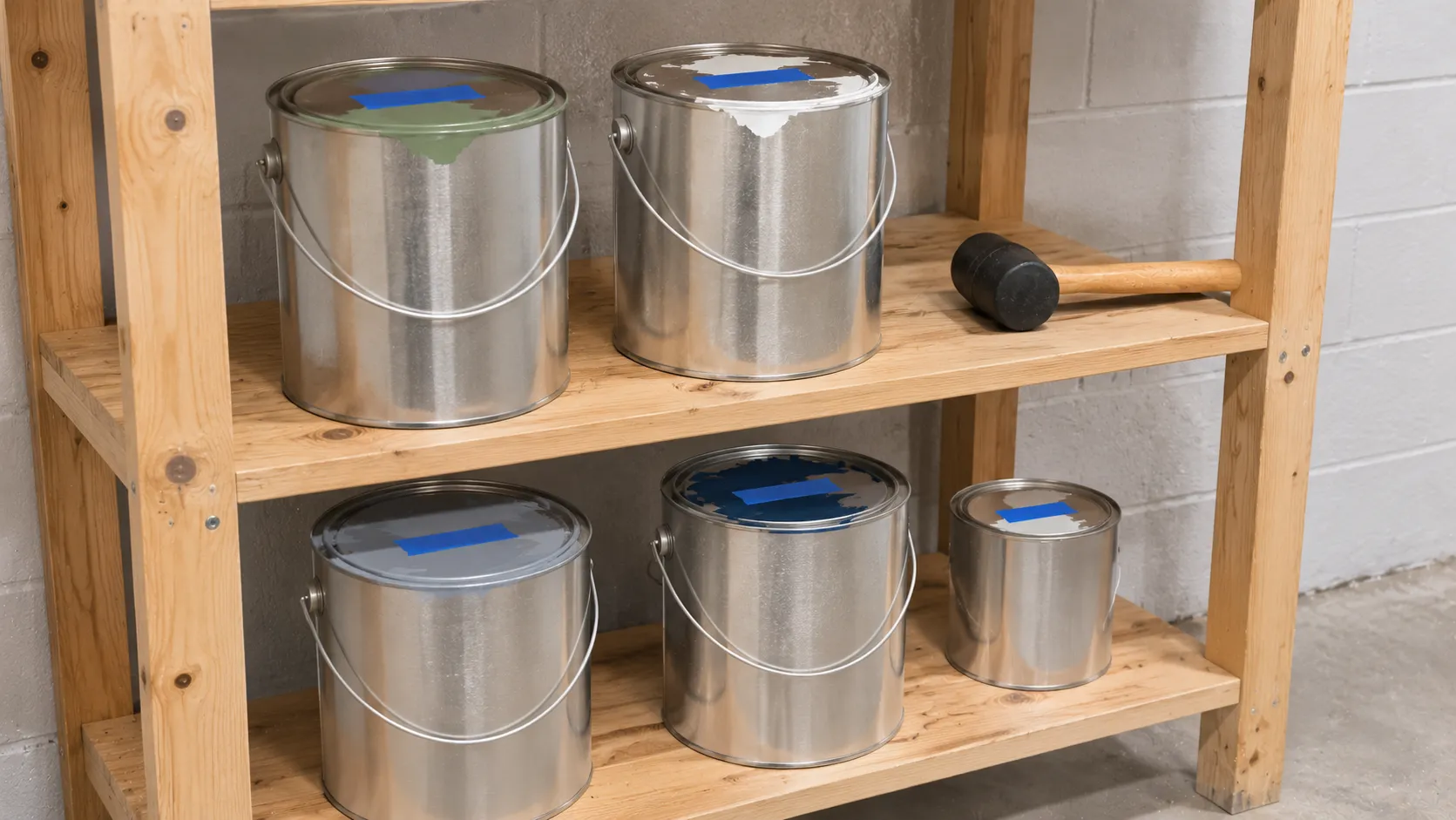
An unopened gallon keeps longer than an opened one, and a full gallon of the wall color is worth keeping for at least a year or two after a paint job. A half-inch in the bottom of a can is not; it is mostly air and skin, and it will not be usable when you need it. When it does go off, test it the way the previous section says before throwing it out: a rancid smell is the giveaway.
How Do You Dispose of Leftover Paint in New Jersey?
In New Jersey, dried-out latex paint generally goes in the household trash, and oil-based paint goes to a county household hazardous waste collection. The details are set by each county and town, and they differ, so check yours first. Never pour paint down a drain, onto the ground or into a septic system.
For latex, the method is the same everywhere: let it dry solid. Union County says "let the paint dry thoroughly in the can with lid open" and that "kitty litter or commercial paint hardener can be used to speed the drying process." The Monmouth County program's notice, published by Long Branch, says "commercial paint hardeners are available from paint stores but only work with water-based paints."
Then the rules diverge. Here is what four of the counties we work in publish:
| County | Latex paint | Oil-based paint | Source and notes |
|---|---|---|---|
| Monmouth | Dry it out; "disposed of as regular trash with the lids removed," so collectors can "see there is no liquid paint" | County HHW Facility, 3211 Shafto Road, Tinton Falls; "open to Monmouth County residents only"; no business waste | Long Branch's page on the county program; it dates from the 2016 change of operator. The county's own site would not load for us, so call 732-683-8686, ext. 5210 first |
| Middlesex | Dried-out latex goes "with your regular trash"; liquid latex accepted at the paint drop-off | Accepted at the county Paint Drop-Off Program, "for Middlesex County residents only," with original labels attached | Plainsboro Township's page on the county program, South Brunswick Recycling Center |
| Ocean | "Dried up paint can be discarded with regular trash"; liquid latex accepted at the county recycling centers | "Latex, Oil, Boat, & Spray Paint" accepted Monday to Saturday at the Northern and Southern Recycling Centers; 20 gallons a day; "No businesses or contractors" | Ocean County 2026 Recycling Guide. Stains, polyurethanes and varnishes go to HHW events instead |
| Union | Dry it with the lid open, then "replace the lid tightly" and put it out with household trash | Not covered on that page; ask the county Bureau of Recycling, 908-654-9890 | Union County's latex page: "there are no local or countywide latex paint recycling programs in the Union County area" |
Notice that Union County says to put the lid back on and Monmouth says to take it off. Follow your own town's rule. If you live in Mercer, Somerset, Burlington, Essex, Hudson, Bergen or Passaic, check your own county's recycling or household hazardous waste page; we did not read those pages for this article, so we do not quote them.
PaintCare, the paint industry's recycling program that runs paint take-back at stores, does not operate in New Jersey. Its own states page says "PaintCare currently operates programs in twelve states and the District of Columbia," and New Jersey is not among them as of 15 November 2026.
Paint that is still inside its shelf life has a better home than the landfill. Monmouth's notice suggests leftover paint "can be donated to Habitat for Humanity, schools or theater groups," and Union County suggests community groups, schools, churches and neighbors. Empty, dry cans are a different question: Union County's scrap metal program "does NOT accept paint cans," so ask your town.
Finally, oil-soaked rags are a fire risk, not just a disposal question. Benjamin Moore's oil primer sheet warns that "rags, steel wool or waste soaked with the product may spontaneously catch fire if improperly discarded," and says to "place rags, steel wool or waste in a sealed water-filled metal container" immediately after use.
Is It Safe to Sand Old Paint Before You Prime?
Not without knowing what it is, if the house was built before 1978. Dulling glossy paint, feathering a chip and sanding a patch all disturb old paint, and paint in a pre-1978 house may contain lead. The Benjamin Moore, Sherwin-Williams and Zinsser data sheets we read all carry the same warning: "If you scrape, sand, or remove old paint, you may release lead dust. LEAD IS TOXIC."
Federal rules apply to anyone paid to do it. The EPA's Renovation, Repair and Painting rule "requires that anyone paid to perform work that disturbs painted surfaces in homes, childcare facilities and preschools built before 1978 be certified." The EPA also notes that "approximately three-quarters of the homes in the United States built before 1978 still contain some lead-based paint," and New Jersey has a great many of them.
We are not an EPA Lead-Safe Certified firm. On a house built before 1978, ask every painter who bids, us included, for their firm's EPA certification number before anyone sands, scrapes or de-glosses old paint. Where a job needs a certified firm, we say so at the estimate. Our guide to lead paint in older NJ homes explains testing, what a certified firm does differently, and what a homeowner can safely do.
What We Do, and Do Not Do, on Primer and Coats
- We paint interiors and exteriors in Benjamin Moore and Sherwin-Williams products, with two finish coats as our standard on every new color and every new surface.
- We prime what needs priming: new drywall, patches, bare wood, stains that are dry and dead, glossy and oil-painted trim, and big color changes, with a tinted primer where it saves a coat.
- We repair drywall and sheetrock and prime the repairs before paint. We do not offer plaster repair.
- We remove wallpaper and seal the wall before painting. We do not hang wallpaper.
- We power wash and wash surfaces before painting. We do not offer mold or mildew treatment.
- We spot-prime knots and seal stains with the right stain blocker, after the leak or source has been dealt with by someone else. We do not do plumbing, roofing, or fire and water damage restoration.
- We test old trim for oil and degloss and bond-prime it before waterborne enamel goes on.
- We write the primer, the products and the number of coats on every estimate, so the coat count is in writing and the primer does not count as a coat of finish paint.
What we do not do, beyond the above: tile and bathtub painting, faux and texture finishes, window trim and sill painting, re-caulking windows and doors, exterior rot repair (we point rot out at the estimate), and EPA lead-safe (RRP) work, because we are not a certified firm.
Get a Price for Your Painting Job
How many coats and how much primer a job needs is a big part of what it costs, which is why we look at the walls before we price them. For how painting prices are built, see our painting cost guide, and for the work itself, our interior painting and exterior painting pages. If you are weighing the products themselves, our guide to the best interior paint compares the data sheets. NJ Painting Co. is a family-owned painting company in Morganville, painting New Jersey homes for more than 20 years with Benjamin Moore and Sherwin-Williams products, and every estimate is free. Call (732) 239-0932 or request a free estimate, and ask us about the job minimum when you enquire.
Frequently Asked Questions
How many coats of paint do I need?
Two is the normal answer, and the rule of thumb the manufacturers use themselves. Benjamin Moore recommends two coats for full color development, and Sherwin-Williams says the same for exteriors. Add a primer first on bare, patched, stained or glossy surfaces. A previously painted wall in good condition that keeps the same or a very similar color can sometimes be finished in one coat. Check the next day in daylight before deciding.
Does primer count as a coat of paint?
No. Primer is a separate product with a different job: it seals the surface and gives the topcoat something to grip. The manufacturers write their systems as primer plus finish coats. Sherwin-Williams' Extreme Bond sheet, for example, specifies one coat of primer followed by two coats of topcoat. If a bid says "two coats," ask whether that includes the primer, and get the answer in writing.
How many coats of paint does a ceiling need?
A white ceiling repainted white often needs only one coat, and Benjamin Moore's ceiling paint sheet allows "one or two coats." Use two over patches, over a stain that has been sealed with a stain-blocking primer, over a yellowed ceiling, or for any color change. Flat ceiling paint hides lap marks best, which is why one coat is more often enough on a ceiling than on a wall.
How many coats of exterior paint does a house need?
A primer and two topcoats on bare wood, and one or two topcoats on a sound repaint. The Forest Service's Wood Handbook says a primer plus one topcoat lasts about half as long as a primer plus two, and suggests two topcoats at least on the sunny south and west sides. Spot-prime any bare wood first, and prime new wood as soon as it is installed.
Can you paint over existing paint without primer?
Yes, if it is sound, clean and dull. Benjamin Moore says a previously painted surface in good condition most likely does not need priming. Prime first if there are bare patches, glossy areas, stains or old oil-based paint under a new waterborne finish. On a house built before 1978, do not sand old paint without dealing with the lead question, and ask any paid painter for an EPA firm certification number.
Is paint and primer in one as good as a separate primer?
On a sound wall in a similar color, a self-priming paint in two coats is usually enough. It is not as good where a primer has a specific job: water and smoke stains, knots, bare exterior wood, glossy oil trim and big color changes. Benjamin Moore points customers to special purpose primers for those surfaces, and the Forest Service says a combined product is not optimal as either primer or topcoat on wood.
What primer should I use to cover dark paint?
A high-hiding primer such as Benjamin Moore Fresh Start 046, which its maker calls the go-to for significant color change, tinted toward the new color. Let it dry and look at it in daylight; if the dark color still shows strongly, add a second coat of primer before two coats of the new color. Very deep finish colors may need a deep base primer instead.
Do you need to prime new drywall?
Yes, the whole surface. The Gypsum Association defines primer as applied over the entire prepared panel surface, and Benjamin Moore says new surfaces should be fully primed. Use a drywall primer, or two coats of a self-priming paint where its data sheet allows it. Unprimed drywall shows the taped seams and patches through the paint as dull stripes and spots.
What primer covers water stains?
A stain-blocking primer, after the leak is fixed and the area is dry. Waterborne blockers such as Fresh Start 046 or Aqua Lock handle many light stains. Sherwin-Williams says an alkyd blocker usually seals water stains better because it has no water to re-wet the stain, and Zinsser sends severe water and smoke stains to its shellac B-I-N. Never paint over mold; deal with the moisture first.
How long is leftover paint good for?
Benjamin Moore and Sherwin-Williams both say opened latex paint keeps about two years if it is sealed well and stored between 60 and 80°F. Sherwin-Williams says oil-based paint can last up to 15 years. Unopened, Sherwin-Williams prints 36 months on several sheets. Test old paint by stirring and brushing it on cardboard: lumps, a jelly texture or a sour smell mean it is finished.
How do I get rid of old paint in NJ?
Dry out latex with kitty litter or a paint hardener and put it in the household trash, following your town's rule on the lid. Take oil-based paint, stains and thinners to your county's household hazardous waste collection; Monmouth, Middlesex and Ocean all take it from residents. Donate usable paint. PaintCare's store take-back program does not operate in New Jersey, and paint never goes down a drain.
About the author
Written by the NJ Painting Co. team
NJ Painting Co. is a family-owned painting contractor based in Monmouth County, in business since 2004. We are licensed and fully insured, work with Benjamin Moore and Sherwin-Williams paints, and back our work with a 2-year workmanship warranty. We serve Monmouth, Middlesex, Ocean, Mercer, Somerset and Burlington counties, plus Union, Essex, Hudson, Bergen and Passaic in North Jersey.