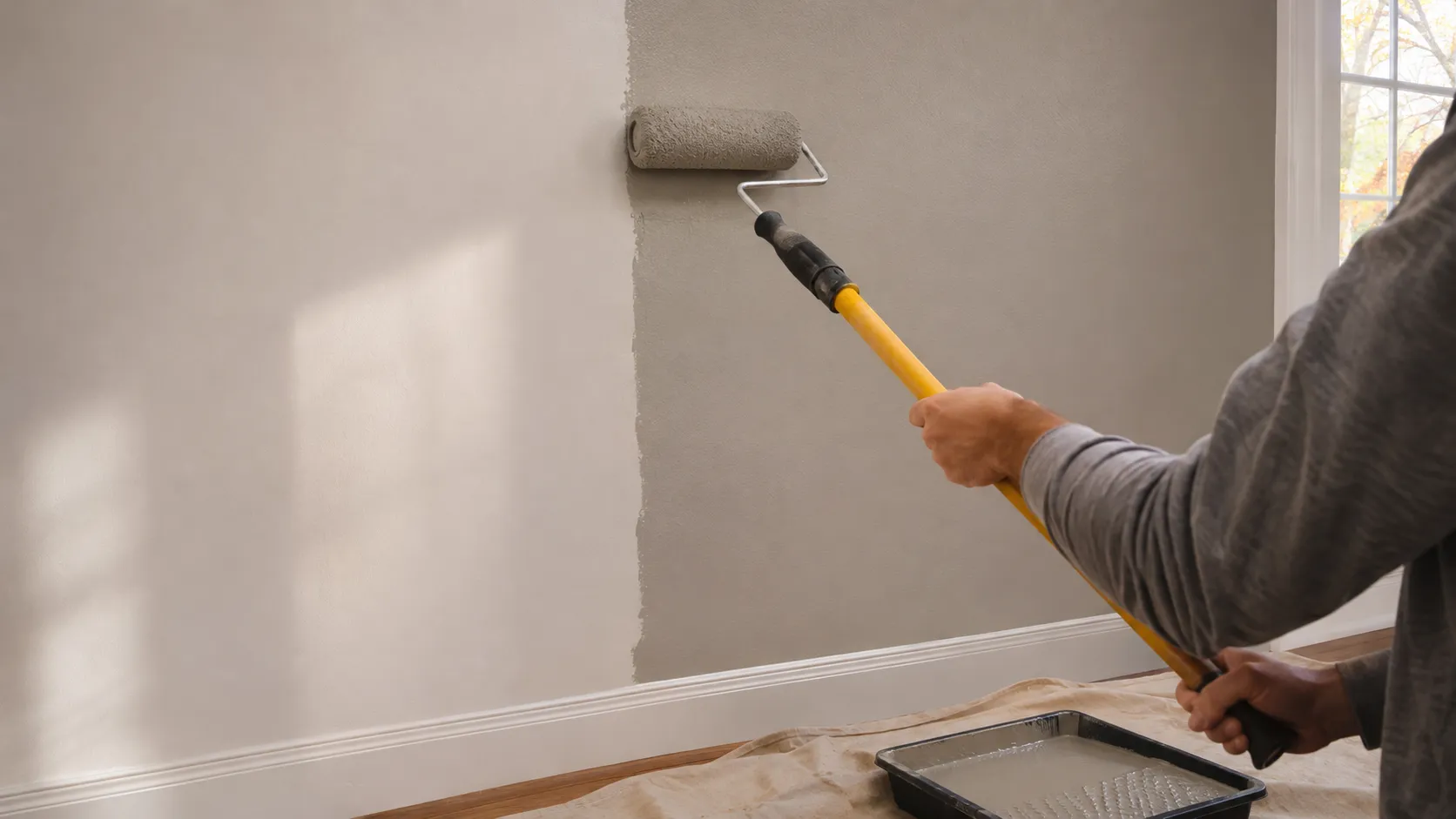
The best interior paint for walls in most New Jersey homes is a premium acrylic paint in an eggshell or satin finish: Benjamin Moore Regal Select or Aura, or Sherwin-Williams Duration Home or Emerald. Their data sheets show more solids and a thicker coat than the cheaper lines, and the Master Painters Institute lists them in its high-performance category for scrub resistance, burnish resistance and stain removal.
That is the short version, and it is the honest one. There is no single best paint for every wall. A dining room that gets used twice a month, a hallway that three kids and a dog run down every morning, and a bathroom that fills with steam twice a day want different things from a can, and the right answer for each is usually a different product from the same premium family, in a different sheen. A cheaper line is also the right call for some walls. The trick is knowing which.
We are a family-owned painting company in Morganville and have painted New Jersey homes across Monmouth, Middlesex, Ocean, Mercer, Somerset and Burlington counties, plus Union, Essex, Hudson, Bergen and Passaic in North Jersey, for more than 20 years, using Benjamin Moore and Sherwin-Williams products. "Which paint should I buy?" is the question we are asked most at interior estimates. This guide is the long version of the answer: what actually separates a good wall paint from an ordinary one, which line we would put in each room, what "contractor grade" really means, and whether paying more buys you a wall that lasts longer.
It is written to be useful whether you hire anybody or not. Every product figure below comes from a document we fetched and read on 15 November 2026: the binders, solids, film thickness, coverage, dry times, gloss readings and VOC content from each manufacturer's technical data sheet; the performance categories from the Master Painters Institute's Approved Products List; the test methods from ASTM; the VOC limits from the New Jersey Department of Environmental Protection's copy of N.J.A.C. 7:27-23; and the lead rule from the EPA. We have run no lab test of our own, and we do not quote anybody else's as fact. Where something is our own practice rather than a published figure, we say so. If your question is really Benjamin Moore against Sherwin-Williams, that has its own comparison.
The Short Answer
- Buy a premium acrylic line for walls you live with. Regal Select, Aura, Duration Home and Emerald are all acrylic-based, low or zero VOC, and listed by MPI as high-performance architectural latex. That is the category that was tested for scrub, burnish and stain removal.
- Eggshell or satin for most walls. Matte and flat hide flaws best but mark more easily. Satin cleans most easily and shows every bump. Our sheen guide goes deeper.
- High-traffic walls want a scuff-rated paint. Duration Home's sheet lists "resistant to stains, scuffs & burnishing." Regal Select is "ideal for surfaces subject to abuse and soil." Commercial corridors have their own product, Ultra Spec Scuff-X.
- "Contractor grade" is not "low grade." ProMar 200 Zero V.O.C. lists more volume solids than Duration Home. The real differences are the primer coat it expects, the binder and the job it was designed for.
- Better paint can last longer, but nobody publishes a number of years. What the sheets do show is a thicker coat, more hide and better stain resistance, which are what make a wall look tired or not.
- Let it cure before you wash it. Benjamin Moore says "painted surfaces can be washed after two weeks." Sherwin-Williams says to wait at least 14 days before washing Duration Home.
- The paint is not the whole job. Clean, sound walls, the right primer where it is needed and two full coats matter more than the step between two premium lines. Nothing below is a lab verdict on brands: these are a painter's choices, read from the makers' own data sheets.
What Is the Best Interior Paint for Walls?
For a typical lived-in room, we would choose Benjamin Moore Regal Select or Sherwin-Williams Duration Home, and step up to Aura or Emerald for deep colours, hard colour changes, and walls where the finish matters most. For rooms that are repainted often or rarely touched, a mid-grade or contractor line is a fair choice. That is our practical view as a company that uses these paints, not the result of an independent test.
The table sets out what each data sheet publishes. It is not a ranking of every paint on the market. The sheens are not identical, and gloss is measured at different angles by different makers, so read the sheen column before you compare one row with another.
| Product (sheet date or code) | Binder, per the sheet | Volume solids | Dry film per coat | Spread per gallon | Recoat | Sheen | VOC | MPI listing |
|---|---|---|---|---|---|---|---|---|
| BM Aura Eggshell N524 (031825) | Proprietary 100% acrylic | 46 ± 2% | 1.9–2.1 mils | 350–400 sq ft | 1 hour | 10–22 @ 85° | < 50 g/L | #138 |
| BM Regal Select Eggshell N549 (040125) | Proprietary 100% acrylic | 45 ± 2% | 1.6–1.8 mils | 400–450 sq ft | 1–2 hours | 15–22 @ 85° | < 50 g/L | #138 |
| BM ben Eggshell N626 (091824) | Proprietary acrylic | 39 ± 2% | 1.4–1.6 mils | 400–450 sq ft | 2 hours | 15–22 @ 85° | Zero g/L | #44 |
| BM Ultra Spec 500 Eggshell T538 (012725) | Acrylic copolymer | 42 ± 2% | 1.5–1.7 mils | 400–450 sq ft | 2–3 hours | 20–25 @ 85° | Zero g/L | #52, #139 |
| BM Ultra Spec Scuff-X Satin 486 (101620) | Proprietary acrylic copolymer | 39 ± 2% | 1.6–1.8 mils | 350–400 sq ft | 2–3 hours | 20–35 @ 60° | 95 g/L (pastel base) | not stated |
| SW Emerald Interior Satin K37 (11/2023) | Styrene acrylic | 40 ± 2% | 1.6 mils | 350–400 sq ft | 4 hours | 10–20 @ 85° | < 50 g/L | #52, #139 |
| SW Emerald Interior Matte K36 (08/2020) | Styrene acrylic | 41 ± 2% | 1.6 mils | 350–400 sq ft | 4 hours | 0–5 @ 85° | < 50 g/L | "Yes" on sheet |
| SW Duration Home Satin A97 (09/2026) | Styrene acrylic | 37 ± 2% | 1.5 mils | 350–400 sq ft | 4 hours | 15–20 @ 85° | < 50 g/L | #44, #138 |
| SW SuperPaint Interior Satin A87 (10/2019) | Vinyl acrylic | 40 ± 2% | 1.6 mils | 350–400 sq ft | 4 hours | 10 @ 60° | < 50 g/L | #44 |
| SW Cashmere Low Lustre D17 (12/2024) | Acrylic | 41 ± 2% | 1.6 mils | 350–400 sq ft | 4 hours | 5–15 @ 60° | < 50 g/L | "No" on sheet |
| SW ProMar 200 Zero V.O.C. Eg-Shel B20 (03/2025) | Vinyl acrylic | 42 ± 2% | 1.7 mils | 350–400 sq ft | 4 hours | 15–20 @ 85° | "Less than 50" as printed | #52 |
Our reasons for the picks are practical. Regal Select is described as "ideal for surfaces subject to abuse and soil," with a stain release technology that lets "common household stains" come off "with soap and water." Duration Home lists "resistant to stains, scuffs & burnishing," and its September 2026 sheet now leads with "Moisture Resistant Technology" for "durability in moist environments like bathrooms." Aura lays down the thickest coat in the table, recoats in an hour and claims "extreme hide across all colors," which is why we save it for difficult colour changes and deep tones: a thicker coat carries more of the white pigment, titanium dioxide, onto the wall. On a drastic color change the Sherwin-Williams sheets still recommend a primer first, which is covered below. Emerald, which Sherwin-Williams calls its "Best-In-Class" interior architectural coating, lists "premium performance in washability, stain resistance, block resistance, adhesion, burnishing and hiding."
What none of these sheets promises is one coat. Benjamin Moore says on the Aura, Regal Select and ben sheets that one-coat coverage is "sometimes" achievable, but that it "recommends two coats to achieve full color development and to optimize performance." Most of the Sherwin-Williams sheets say much the same in their own words: "priming and application of two coats at the recommended film thickness can help where hiding of a previous coating or application to new drywall is a factor." Any roundup that crowns a paint on its one-coat hide is judging something the makers themselves do not rely on.
Coverage is close across the board: the spread rate on every sheet in the table is 350 to 450 square feet per gallon for one coat. Where would we not spend on Aura or Emerald? Closets, a utility room, a rental you will repaint in two years, a basement storage area. On those, ben, SuperPaint or a contractor line does the job. And where would we not save? Any room you will look at for a decade, any deep colour, any wall that gets touched. That is where Regal Select and Duration Home earn their place.
What Actually Makes One Wall Paint Better Than Another?
A good wall paint is mostly a matter of three things: the binder that holds the film together, how much of the can is solid material that stays on the wall, and how well the pigment hides what is underneath. Everything printed on the front of a can, from "scuff resistant" to "paint and primer," comes back to those.
The binder. Latex wall paint is pigment held in a plastic binder, carried in water. When the water leaves, the binder particles fuse into a film. The data sheets name the binder as the "vehicle." In the table you can see three families: 100% acrylic (Aura, Regal Select), styrene acrylic (Emerald, Duration Home) and vinyl acrylic (SuperPaint, ProMar 200). In our experience painters treat 100% acrylic as the top of that range for adhesion and toughness, with vinyl acrylic as the economy end, but the sheets themselves do not rank binders, and a well-formulated styrene acrylic such as Emerald is listed by MPI alongside the 100% acrylics. Read the binder as a clue, not a verdict.
Volume solids. This is the share of what is in the can, by volume, that is still on the wall when the paint has dried. Aura lists 46%, Duration Home 37%. The rest is mostly water, and it leaves. More solids means more paint on the wall from the same wet coat.
Dry film thickness. This is the figure that matters on the wall, and every sheet prints it. Aura goes on at 4.0 to 4.6 mils wet and dries to 1.9 to 2.1 mils. Ben goes on at 3.6 to 4.0 mils wet and dries to 1.4 to 1.6. A mil is a thousandth of an inch, so the difference sounds tiny, but it is a third more paint per coat, and two coats of Aura put on nearly as much dry film as three of ben. That is a large part of why premium paint hides better.
Pigment and hide. Every wall paint in the table uses titanium dioxide as its white pigment, and it is the expensive ingredient that scatters light and does the hiding. A paint's ability to hide the old colour depends on how much of it is in the film and how thick the film is. Deep colours are made from a clear-ish deep base with more colorant and less titanium dioxide, which is why they hide worst, and why Benjamin Moore notes that some custom colours need a tinted primer first.
Viscosity and flow. The sheets also list viscosity in Krebs units: Aura 107, Regal Select 100, ben 97. A thicker paint holds more on the roller and sags less, but it also levels differently. Regal Select advertises "exceptional flow and leveling"; ben advertises "extended open time" to even out an area before it dries. Neither is better in the abstract; they suit different hands.
So when two cans claim the same things, compare the volume solids and the film thickness first. Those two numbers are printed, they are measured the same way on every sheet, and they say more about the wall you will end up with than any adjective on the label.
Which Interior Paint Is the Most Durable and Scrubbable?
The most durable and scrubbable interior paints are the premium lines MPI lists as "high performance architectural" latex: on our list that is Aura, Regal Select and Duration Home (MPI #138) and Ultra Spec 500 Eggshell and Emerald Satin (MPI #139). MPI says these are "designed to provide a significantly higher level of performance than conventional latex paints in the areas of scrub resistance, burnish resistance, and ease of stain removal."
That is the most useful independent line we could find, and it needs some explaining, because "durable" on a can means three different things.
Scrub resistance is how well the film survives being scrubbed without wearing through. ASTM D2486 measures it by running a brush and an abrasive medium back and forth over a painted panel and counting the cycles-to-failure. ASTM D4213 measures it by weight loss instead, and is blunt about the older method: "the precision of scrub resistance measurements in absolute physical values ... is poor." That is why we treat any single scrub number in a roundup with caution.
Stain resistance and washability are not the same thing as scrub resistance. ASTM says so in D4213: its results "do not necessarily relate to ease of soil or stain removal," and there are separate methods (D4828 and D3450) for that. A paint can survive a thousand scrub cycles and still hold a coffee stain.
Burnish resistance is the shiny patch that appears where a chair back, a hip or a shoulder rubs the same spot. ASTM D6736 describes it: "interior flat paints may become burnished in areas where clothing or upholstered furniture rub against a wall." Flat and matte paints are the most prone to burnish, which is why the high-traffic advice below leans to eggshell and satin.
None of the eleven data sheets we read prints a scrub cycle count, and we would not trust a comparison of counts from different labs if they did. What the sheets do print are claims, and they line up with the MPI listing: Emerald claims "premium performance in washability, stain resistance, block resistance, adhesion, burnishing"; Duration Home claims resistance "to stains, scuffs & burnishing"; Ultra Spec 500 calls itself a "decorative scrubbable finish"; Cashmere says "scrubbable for easy cleaning and maintenance." For the plain question of durability on a family wall, the MPI high-performance rating is the closest thing to an independent check.
How Should You Clean a Painted Wall Without Ruining It?
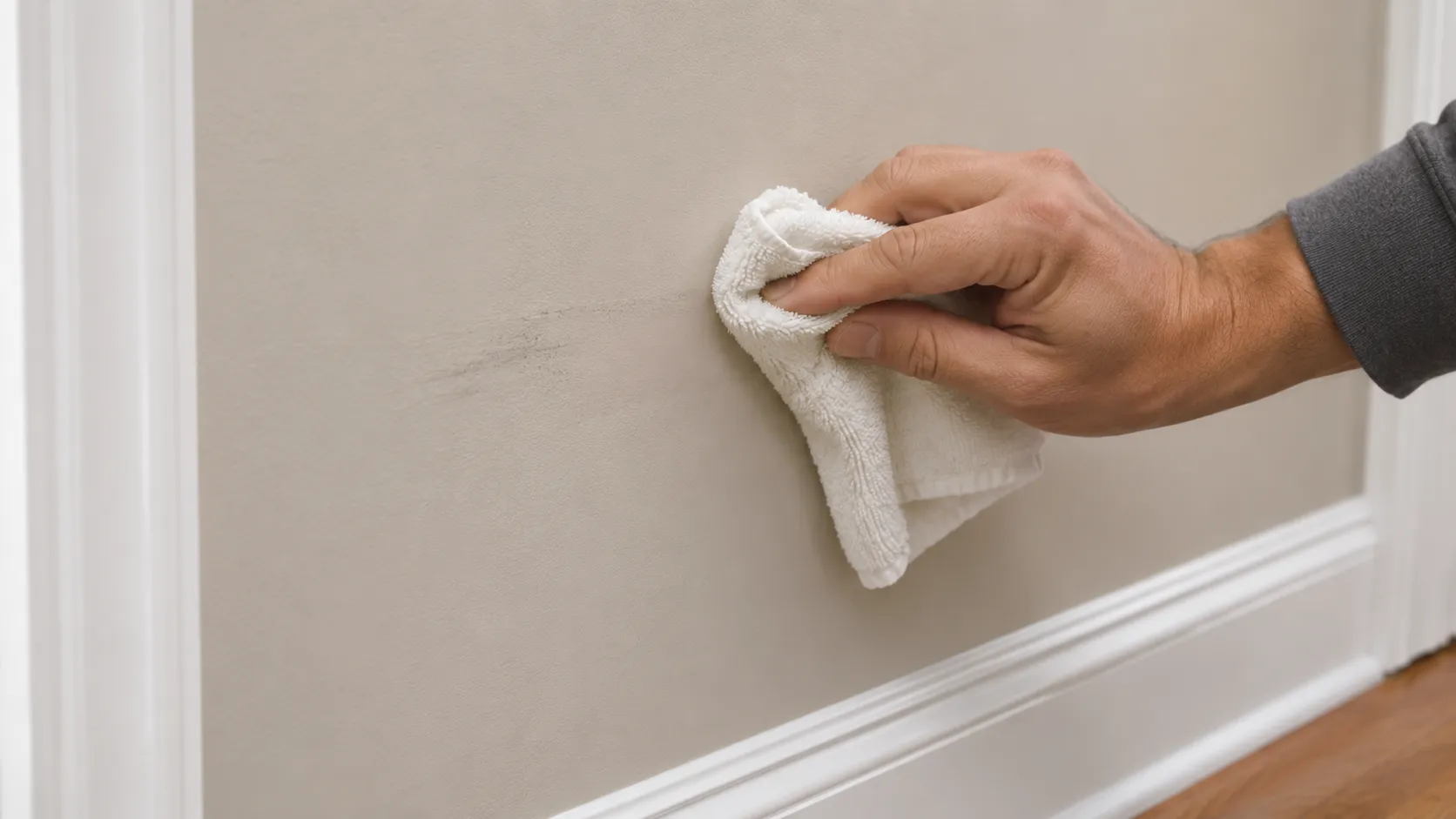
Wait two weeks, then use water and a soft cloth before anything stronger. The Benjamin Moore sheets say "painted surfaces can be washed after two weeks," and the Duration Home sheet says "wait at least 14 days before washing" and spells out the method: "use a soft cloth or sponge with water," and "stubborn stains may require the use of a general-purpose household cleaner." Then it adds the line most people skip: "Do not use an abrasive cleaner or scrub brush to remove stains."
That instruction is about the sheen as much as the paint. A scouring powder or a stiff brush polishes the film, and on an eggshell or satin wall that leaves a shiny patch exactly where the mark was, which looks worse than the mark. ASTM's washability method D3450 notes the same split from the other side: "semigloss finishes generally require only the nonabrasive type cleaner for good soilant removal, whereas flat paints may require the abrasive type." In other words, the flatter the paint, the harder it is to clean gently.
In our experience the order that works on a marker line, a ketchup splash or a scuff from a sneaker is: plain water first, then a drop of mild dish soap, then a general-purpose cleaner tested somewhere hidden, and only then a melamine sponge with very light pressure. If the stain is still there after that, it needs a spot of stain-blocking primer and a touch-up, not more scrubbing. Grease in a kitchen is its own problem, covered in our kitchen wall paint guide.
Which Wall Paint Touches Up Best?
The paints that touch-up best are the flatter ones, applied from the same can by the same method as the original coat. Two of the Benjamin Moore sheets say so in their feature lists: ben is "great for touch-ups" and Ultra Spec 500 lists "great touch up." Sherwin-Williams puts the method on its sheets: "using the same method of application and batch to touch up with as that originally used will help improve touch up."
Touch-up fails in two ways. The colour can be slightly off, because a new can, even of the same formula, is a new batch. Or the colour is right but the patch shows as a dull or shiny square, which painters call flashing. Flashing is mostly about sheen and texture. A roller leaves a stipple; a brush does not; a fresh dab of satin reads glossier than the aged satin around it. That is why the ProMar 200 and Cashmere sheets add: "When original application was by spray, preconditioning of touch up paint by running it through the spray tip will help touch up appearance." The texture has to match, not just the colour.
What helps in practice, from our own work:
- Do not thin touch-up paint. Changing its viscosity changes how it lays down and how the patch reads.
- Keep a labelled quart of the actual paint from the job, sealed tight. A paint store can tint new paint to a formula, but not to a batch.
- Feather the touch-up with the same tool that did the wall, usually a small roller of the same nap, and keep it small.
- Expect eggshell and matte to blend better than satin. Our sheen guide covers touch-up by sheen in detail.
- When a patch still flashes, repaint the wall from corner to corner. That is often quicker than chasing it.
What Is the Best Paint for High-Traffic Areas?
For hallways, stairs, entryways and kids' rooms in a home, we would use Duration Home or Emerald in satin, or Regal Select in eggshell. Duration Home lists resistance "to stains, scuffs & burnishing," Regal Select is "ideal for surfaces subject to abuse and soil," and both are on MPI's high-performance list. A slightly higher sheen than you would use in a bedroom makes them easier to wipe.
A high-traffic wall takes three kinds of punishment: scuffs from shoes, bags and toys; burnishing from hands and shoulders sliding along the same spot; and stains that need washing. Pets add a fourth: a dog that leans against the wall at the same corner every day. The paint that copes is one that resists all three without going shiny when cleaned, which is why we avoid flat and dead-flat matte in these spaces even though they hide wall flaws best. Once a satin wall has cured, a marker line or a ketchup handprint usually comes off with a soft cloth or sponge and water, with no abrasive cleaner needed.
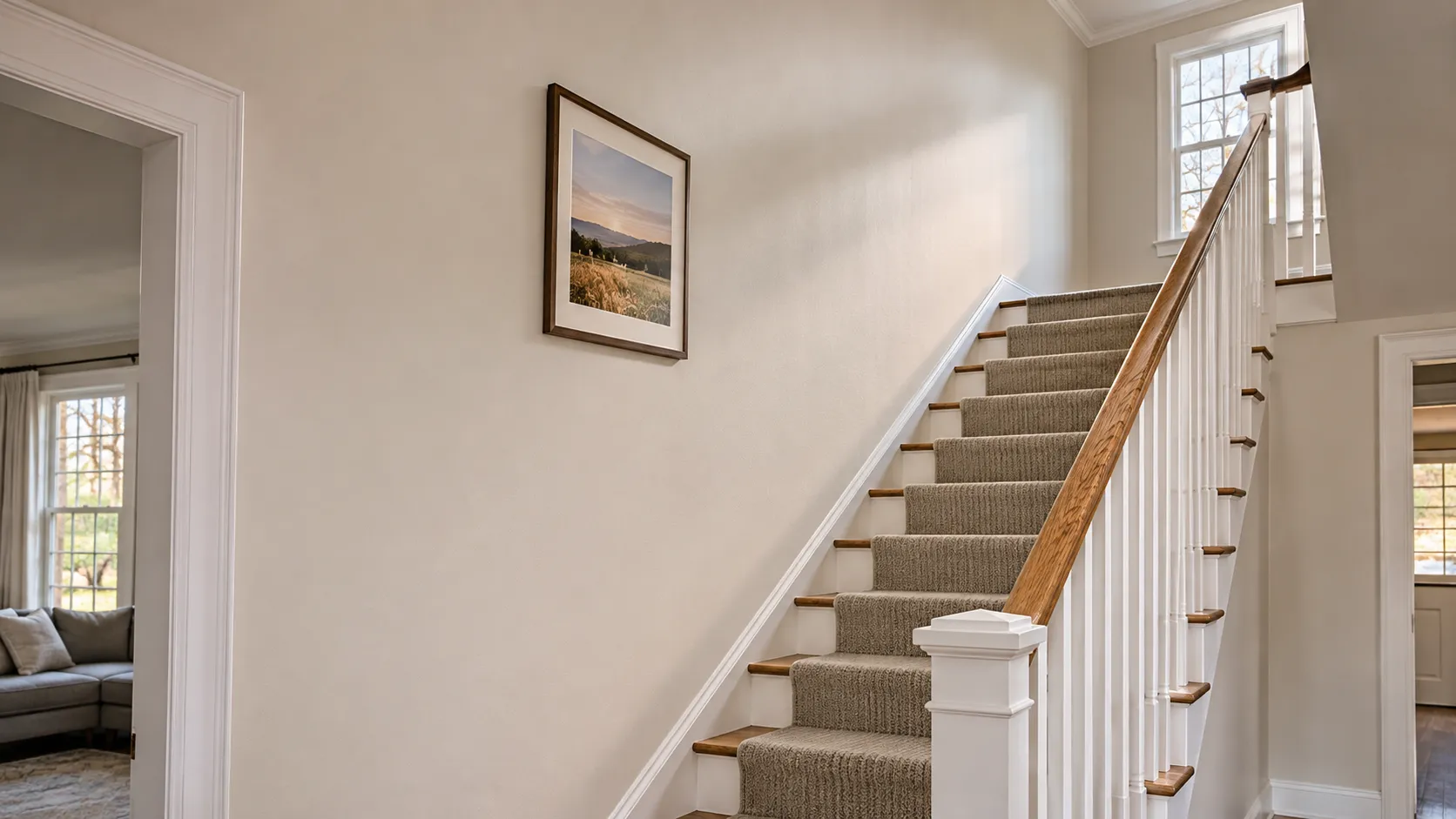
Stairwells are the hardest wall in most New Jersey houses: tall, hard to reach, scuffed along a diagonal at hand and shoulder height, and lit from one window. On a two-storey colonial the stair wall is usually where we would spend on the best paint in the house. The stair treads and banister are a different job with different products, covered in our guide to painting stairs and banisters.
The mudroom and the back hall to the garage take wet boots, hockey bags and a lot of hands. Satin earns its place there. If the wall is masonry, or the room is a finished basement entrance, the basement painting guide covers what changes.
For commercial corridors there is a purpose-made product. Benjamin Moore's Ultra Spec Scuff-X is "ideal for high-traffic areas in commercial spaces such as school hallways, hospital waiting areas, hotels lobbies, gym locker rooms," and it names stairwells and cafeterias too. Its sheet claims "superior durability and scuff-resistance than traditional high-performance two-component coatings." It is a satin, it is "not recommended for floors," and at 95 grams per litre (pastel base) its VOC is far above the other wall paints in the table, so we would not make it the default in a home. Commercial work has its own considerations; see our commercial painting service.
Which Sheen Should Interior Walls Be?
Eggshell for most living spaces, satin where walls get touched or washed, matte where you want the softest look and the best disguise for a wavy wall, and flat on ceilings. That is the short version. The full comparison, with each brand's gloss readings, is in our guide to eggshell versus satin, and we will not repeat it here.
Two things are worth knowing for this article. First, sheen names are not a standard. The table above shows Aura eggshell at 10 to 22 gloss units at 85 degrees and Ultra Spec 500 eggshell at 20 to 25, so one maker's eggshell can look like another's low satin. Compare the numbers, not the words, when you match a sheen across brands.
Second, New Jersey's VOC rule defines sheen in exactly those numbers. N.J.A.C. 7:27-23 says a flat coating "registers a gloss of 15 or less on a glossmeter held at an 85 degree angle ... or less than five on a glossmeter held at a 60 degree angle." Anything above that is a non-flat coating, and a "non-flat high gloss" coating is one that reads 70 or more at 60 degrees. The rule uses those lines to set different VOC limits, which comes up in the VOC section below.
In practice, matte hides flaws but marks and burnishes; eggshell is the compromise; satin cleans best but shows every patch and roller line in raking light from a window; semi-gloss belongs on trim and doors, not on walls, except in a few hard-used spaces.
What Is the Best Paint for Each Room?
The best paint for each room is usually the same premium family in a different sheen, with a dedicated product only where the room has a special problem: steam in a bathroom, grease in a kitchen, overhead light on a ceiling. Here is how we would choose, with links to the articles that cover each room in depth.
| Room | Sheen we usually use | Product family we usually reach for | Full guide |
|---|---|---|---|
| Living and dining rooms | Eggshell (matte for a softer look) | Regal Select, Aura, Emerald, Cashmere | this article |
| Bedrooms | Matte or eggshell | Regal Select, ben, Cashmere, Emerald Matte | safe to sleep in a painted room |
| Kitchen | Eggshell or satin | Regal Select Eggshell, Emerald Satin | kitchen walls |
| Bathroom | Matte or satin (bath-rated) | Aura Bath & Spa, Duration Home | bathroom walls |
| Hallways, stairs, kids' rooms | Satin or eggshell | Duration Home, Emerald, Regal Select | this article |
| Ceilings | Flat | A dedicated ceiling paint | painting a ceiling |
| Trim and doors | Semi-gloss or satin | Advance, Emerald Urethane, ProClassic | crown molding |
| Garage walls | Eggshell or satin | Depends on the surface | garage walls |
Living Rooms and Dining Rooms
A living room is where you look at the walls most and touch them least, so finish and colour matter more than toughness. We lean to Regal Select or Aura in eggshell, or Emerald, and to Cashmere Low Lustre when a client wants the smoothest look. Sherwin-Williams describes Cashmere's "silky, low-stipple appearance that looks good from all angles" and calls it "ideal for residential spaces." Deep colours, which are common on dining room walls, are where Aura's hide pays off, and its sheet claims Color Lock technology against colour fade. For colour ideas, see our popular interior paint colours.
Bedrooms
Bedrooms get the least wear in the house, so this is the room where a mid-grade paint is easiest to defend. Matte or eggshell, Regal Select or ben, is what we usually use. Odour matters more here than durability, because people want to sleep in the room the same day; ben is zero VOC by its sheet, but zero VOC is not zero smell: low-VOC and zero-VOC paints both have an odor while they dry. Our article on when it is safe to sleep in a painted room covers drying, curing and ventilation.
Kitchens
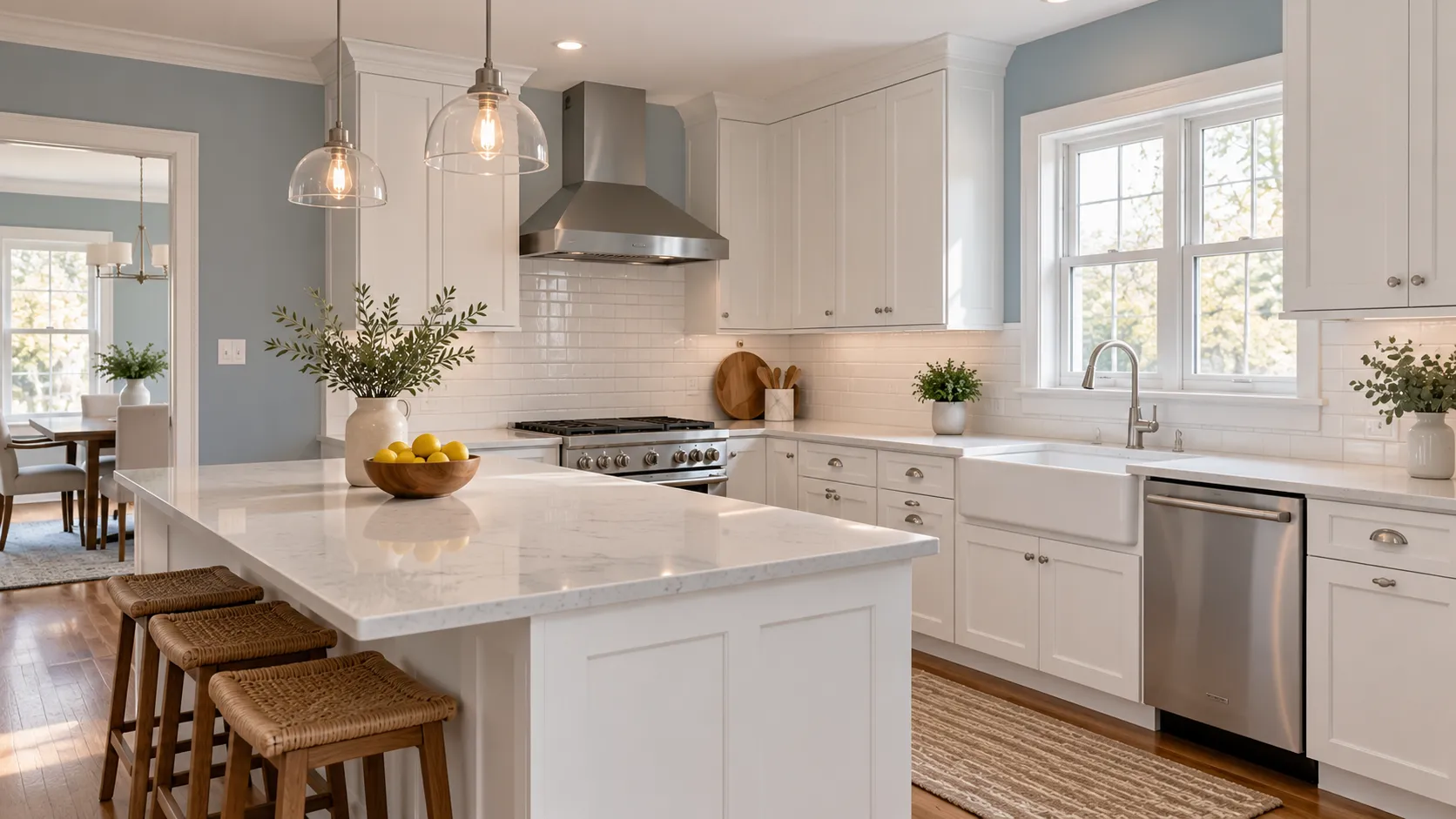
A kitchen wall fails because of the grease that was on it before it was painted, far more often than because of the paint. Eggshell or satin in a washable premium line, over a wall that has been degreased and rinsed, is the answer. Our kitchen wall paint guide covers the products, primers and the backsplash edge. Painted kitchen cabinets are a different job with different coatings; see our cabinet painting service.
Bathrooms
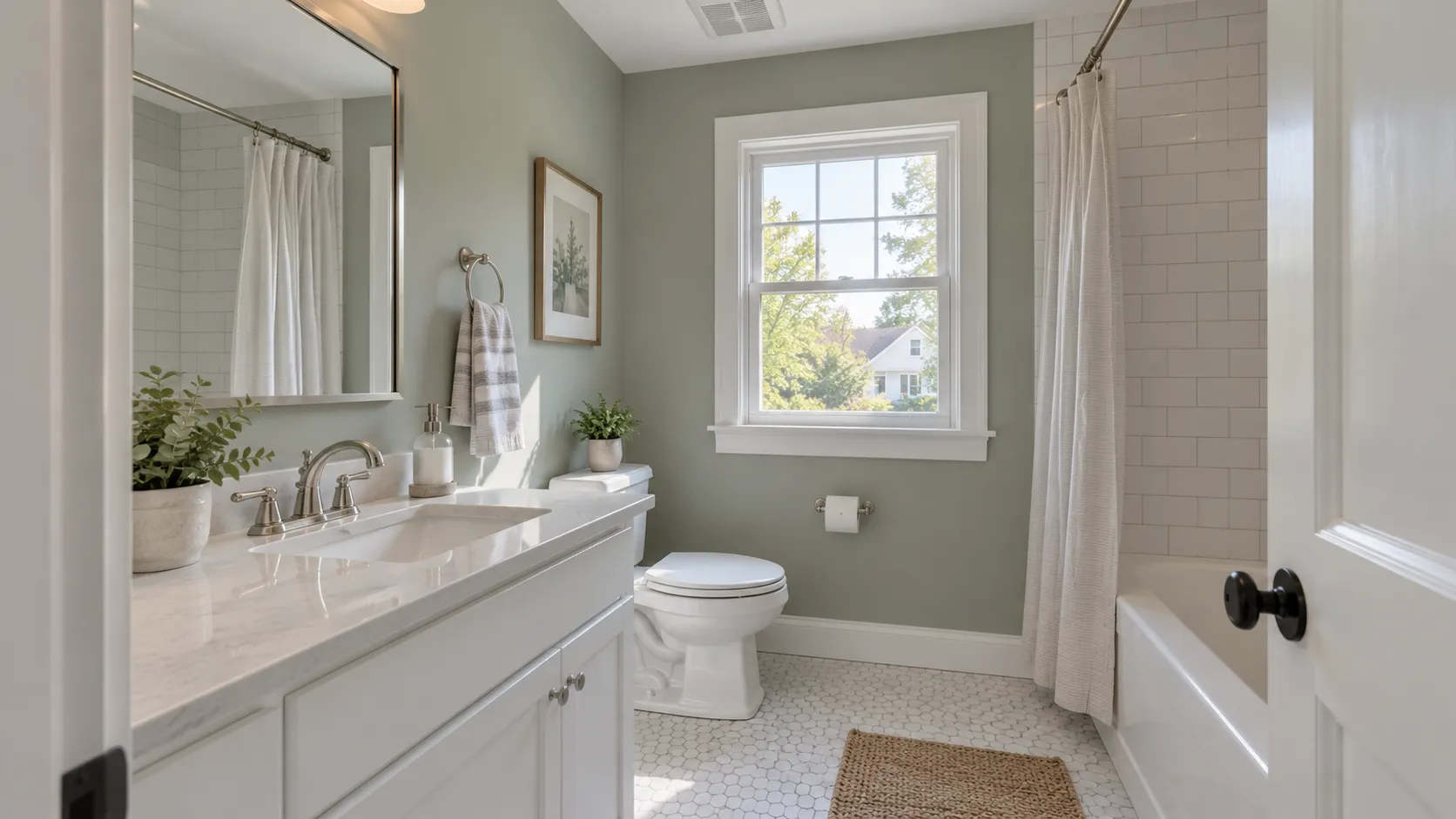
A bathroom needs a paint labelled for humid rooms, with an anti-microbial additive and resistance to surfactant leaching, plus a fan that actually clears the steam. We use Aura Bath & Spa or Duration Home, and Duration Home's latest sheet now says it is built for "durability in moist environments like bathrooms." The full answer, including when you can shower, is in our bathroom wall paint guide.
Hallways, Stairs and Kids' Rooms
These are the high-traffic walls covered above: Duration Home or Emerald in satin, or Regal Select in eggshell, and never dead-flat. A child's bedroom is a hallway with a bed in it, as far as the walls are concerned. Pets, a mudroom door or the stairwells of a two-storey house push the same rooms further toward satin.
Ceilings
Ceilings want a dedicated flat ceiling paint, not leftover wall paint. A ceiling is lit from the side by every window and light fitting, and a flat, slow-drying ceiling paint hides lap marks that an eggshell would show. Aura's sheet does list "new or coated acoustic ceilings" among its uses, but a ceiling paint is designed for the job. If the ceiling was sprayed, run touch-up paint through the spray tip as well, as the Sherwin-Williams sheets advise for any sprayed surface. The method, the roller nap and what to do about water stains are in our guide to painting a ceiling.
Trim and Doors
Trim and doors take a hard enamel, not wall paint. Benjamin Moore's Advance, for example, is a "waterborne alkyd" whose sheet says it is "ideal for interior doors, trim, cabinets, walls, and ceilings," but it is dry to touch in 4 to 6 hours, recoats in 16 and can take "up to 30 days to reach optimum hardness." Its sheet also warns that a slight amount of yellowing may occur in dark rooms. Our crown molding guide compares the trim enamels we use, and the trim and door cost article covers how that work is priced.
Basements and Garages
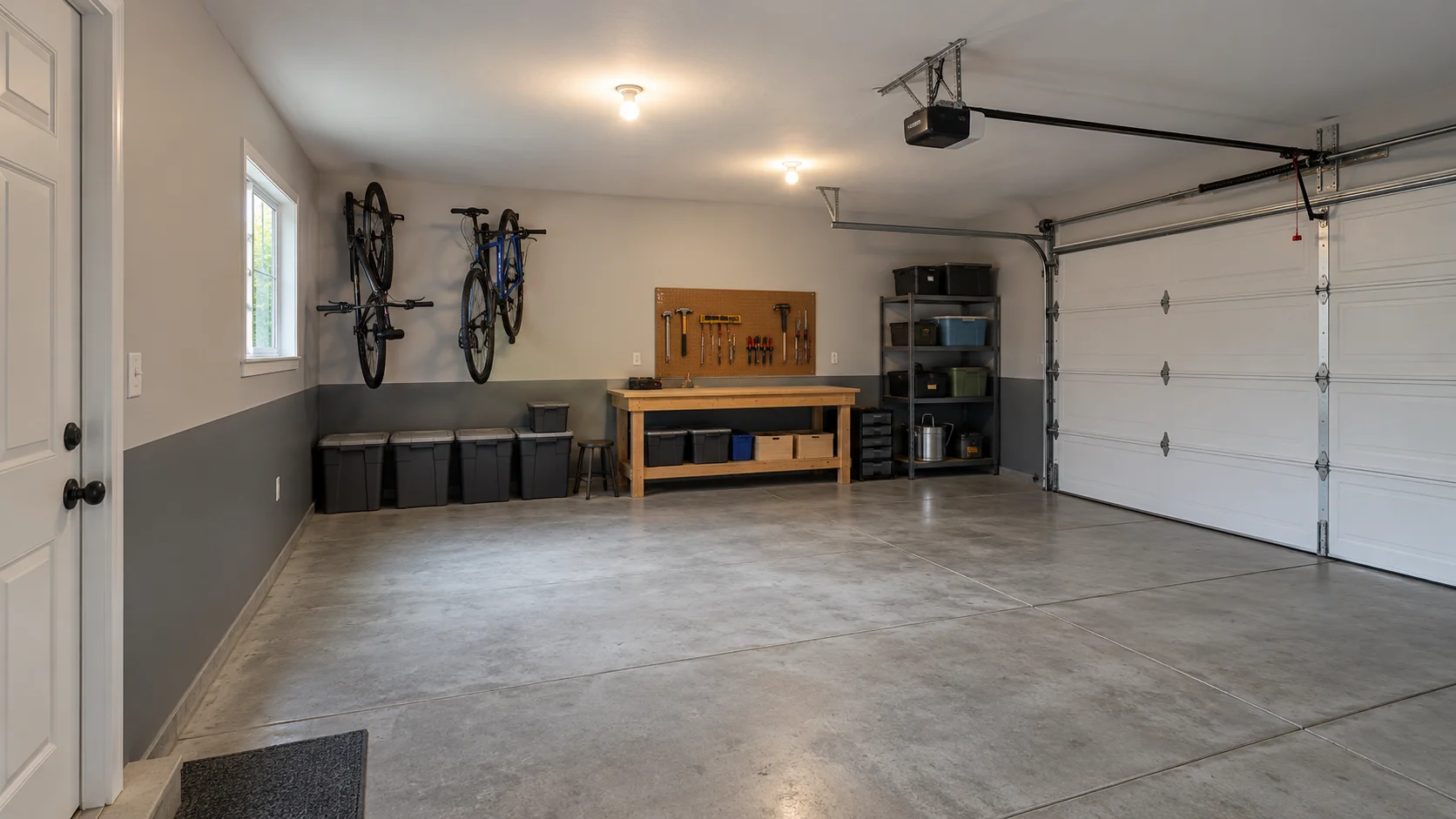
A finished basement on drywall is painted like any other room, but masonry walls and damp change the answer, which our basement painting guide explains. Garage walls are a mix of drywall, block and concrete, and our garage wall paint guide goes surface by surface.
What Is the Difference Between Contractor-Grade and Premium Paint?
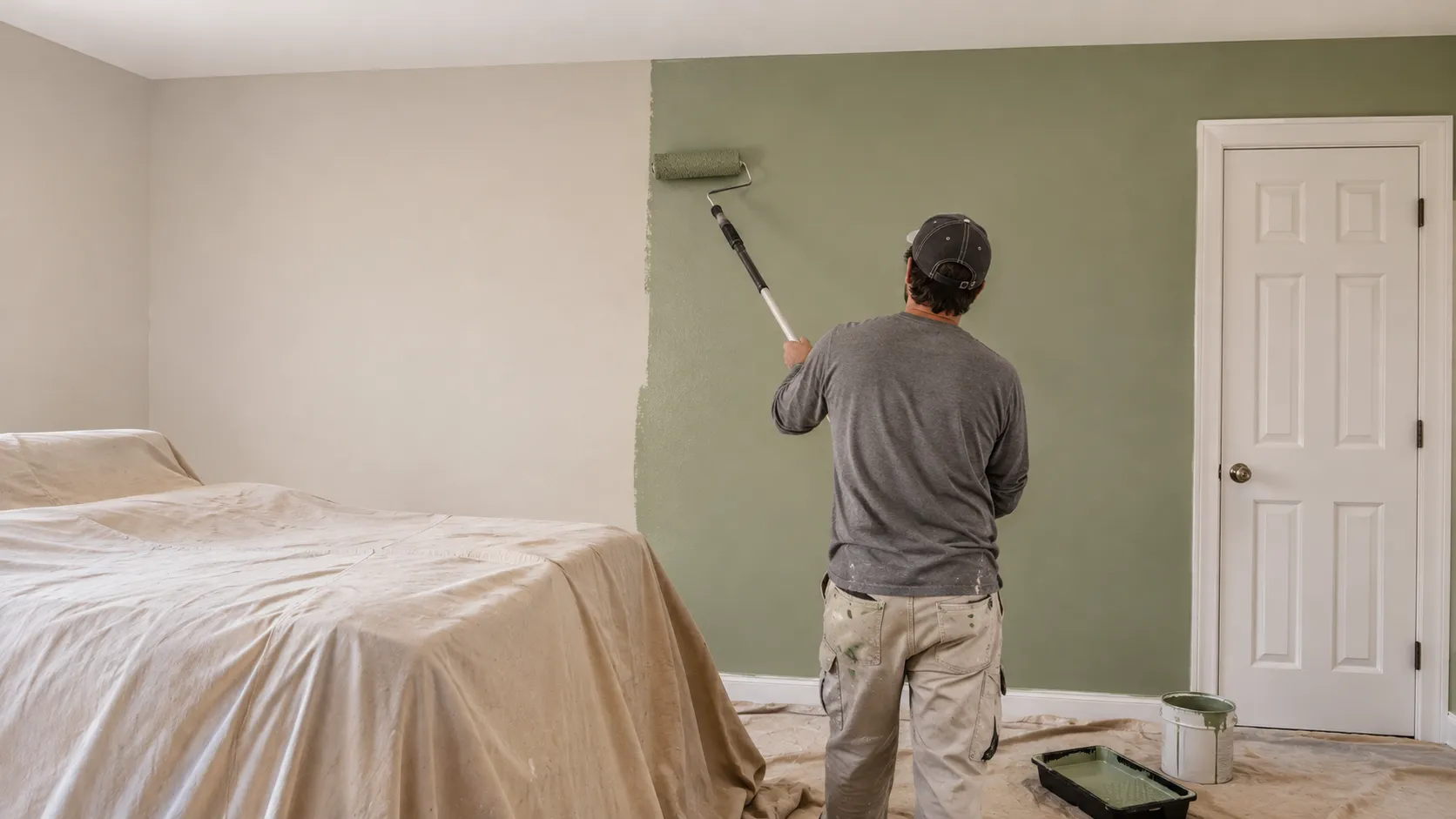
Contractor grade usually means a line sold for commercial and new-construction work that expects a separate primer coat and goes on fast and flat, while premium usually means a line made to self-prime, hide, wash and look good in a lived-in home. That is our working definition. Neither term is defined on any data sheet we read, and none of the roundups we read defines it either.
The line is less clean than people assume. "Contractor grade" does not mean low solids: ProMar 200 Zero V.O.C. lists 42% volume solids and Ultra Spec 500 lists 42%, against 40% for Emerald and 37% for Duration Home. The differences show up elsewhere:
- Priming. Aura and Regal Select are listed as "self-priming" on drywall. ProMar 200 Zero V.O.C.'s drywall system is "1 coat ProMar 200 Zero V.O.C. Latex Primer" then "2 coats" of finish. Ultra Spec 500 says "new surfaces should be fully primed." On new drywall, that is a whole extra coat.
- Binder. Regal Select and Aura list a proprietary 100% acrylic. ProMar 200 Zero V.O.C. lists a vinyl acrylic. Ultra Spec 500 uses a "proprietary cross-linking acrylic resin."
- Intended use. Benjamin Moore describes Ultra Spec 500 as for "commercial and institutional environments," and Sherwin-Williams describes ProMar 200 Zero V.O.C. as "professional quality." Regal Select is "ideal for surfaces where maximum durability is required."
- What it is rated for. MPI's list sorts the lines in a way the labels do not. Aura, Regal Select and Duration Home sit under #138, "Latex, Interior, High Performance Architectural." Ultra Spec 500 Eggshell and Emerald Satin sit under #139, the same high-performance standard at an eggshell-like gloss level. ProMar 200 Zero VOC sits under #52, plain "Latex, Interior," and so do Ultra Spec 500 and Emerald Satin as well. ben and SuperPaint Satin sit under #44, plain interior latex at a lower gloss level.
So one "contractor" line, Ultra Spec 500, carries the high-performance rating, and one popular mid-grade line does not. That is why we read the sheet rather than the label. Contractor paints are good at what they were built for: big wall areas, a primer coat underneath, fast recoats, easy touch-up in an office or a new-build. In an occupied home where the walls get washed, a 100% acrylic or high-performance styrene acrylic paint is usually worth the step up. Self-priming matters less than it sounds on an already painted wall, and a lot more on new drywall. A vinyl acrylic is fine on a closet.
Does More Expensive Paint Last Longer?
Better paint can last longer on the wall, but no manufacturer we read publishes a number of years for interior paint, and we have found no independent figure to quote. We will not invent one. What the sheets do show is a thicker film per coat, more hide and more stain and burnish resistance on the top lines, and those are the things that decide when a wall starts to look tired.
Interior walls are rarely repainted because the paint has failed. In our experience people repaint because the walls look scuffed, a wash has left shiny patches, a repair shows through as flashing, or the colour has dated. A paint that resists scuffs, survives a wash without going shiny and touches up well simply delays all of those. That is "lasting longer" in the way that matters inside a house.
Colour fade is a smaller issue indoors than out, but it is real on deep colours in sunny rooms. Aura's sheet claims "Color Lock® Technology for long-lasting color." We have no measurement to put beside that claim. Whites and pale colours yellowing in dark rooms is a trait of oil and alkyd enamels rather than acrylic wall paint; Benjamin Moore's Advance sheet, for example, warns that "a slight amount of yellowing may occur" and that the effect is "accelerated in dark or poorly ventilated areas."
What we can say for certain is how the arithmetic looks on a job. In our experience the gallon is a small part of the cost of painting a room, because preparation and labour are most of it. If a premium paint saves a coat on a colour change, it can cost less overall than a cheaper paint that needs three. If it does not, you are paying for washability and hide you may or may not need. For how interior work is priced, see what it costs to paint a room and the interior section of our cost guide. If paint is actually coming off a wall, the cause is usually underneath it; our article on why paint peels covers that.
Does Paint-and-Primer-in-One Mean You Never Need Primer?
No. Paint and primer in one means the paint will seal and cover an ordinary sound surface, such as previously painted walls or properly finished drywall, without a separate primer coat. It does not mean the paint can block stains, bond to glossy oil paint, or hide a dramatic colour change in two coats.
The sheets say so themselves. Aura and Regal Select are "self-priming on most properly prepared surfaces," which leaves room for the surfaces that are not. Benjamin Moore adds: "Ask your retailer about our special purpose primers if the surface to be painted is water stained, smoke damaged, grease stained or very slick." The Emerald and Duration Home sheets say: "When repainting involves a drastic color change, or coating over heavily stained areas, a coat of primer will improve the hiding performance of the topcoat color," and recommends a tinted "P-Shade primer" to "optimize hide and color development."
In our own work, a separate primer goes on new drywall when the finish line expects one, on patches and repairs so they do not flash, on water and smoke stains (a stain-blocking primer, or the stain comes back through), on glossy old oil paint (a bonding primer after sanding), and under most deep colours. Our article on oil versus latex paint and primer covers how to tell whether the old paint is oil and what goes over it.
How Do New Jersey's VOC Rules Affect Interior Paint?
New Jersey caps the VOC content of paint sold and applied in the state, and the caps tightened for paint manufactured on or after 18 August 2026. Under N.J.A.C. 7:27-23, Table 1, the limit for a flat coating is now 50 grams per litre, down from 100; for a non-flat coating (which covers eggshell, satin and semi-gloss) it is 100, down from 150; and for primers, sealers and undercoaters it is 100, down from 200.
For the wall paints in this article, that changes very little. Every one of them prints a VOC below 50 grams per litre, or zero. Benjamin Moore's ben and Ultra Spec 500 are zero by their sheets. Scuff-X, at 95 grams per litre for its pastel base, is a non-flat satin, which sits under the new 100 limit for that base; its sheet says to contact Benjamin Moore for other bases. The rule bites harder on primers and specialty products than on premium wall paint.
Two details in the rule are worth knowing. Paint made before the operative date that met the old limits can still be sold and applied, so the date on the can matters more than the date you buy it. And the limits apply to anyone who sells a coating or applies one for pay in New Jersey, with an exemption at 7:27-23.1(e) for a paid painter using paint "purchased from a location within the State of New Jersey."
Low-VOC does not mean no fumes, and zero-VOC does not mean no smell. The EPA notes that indoor concentrations of many VOCs are "consistently higher indoors (up to ten times higher) than outdoors," lists paints among the sources, and says to "increase ventilation when using products that emit VOCs." Paint keeps releasing a little as it dries and goes on to cure, and the odor of a freshly painted room is mostly that. Our article on when it is safe to sleep in a painted room covers the timing and what we do to keep the smell down.
Why Are Behr and Harmony Not in the Comparison?
Behr is left out because we could not read its data sheets, not because of any finding about its paint. Behr's website could not be fetched when we checked, and we do not publish a product figure we have not read on the maker's own document. Several roundups rank Behr highly: one summary of Consumer Reports' 2026 ratings puts Behr's Dynasty line at the top for hiding and stain resistance, with Marquee and Ultra in its top five and Valspar Reserve second. We have not seen Consumer Reports' own data, which is behind a paywall, and we pass that on only as what those guides say.
Sherwin-Williams Harmony, a zero-VOC line that has been sold for odour reduction, is left out for a different reason: every Sherwin-Williams product page we tried for it on 15 November 2026 returned "404 Page Not Found," so we could not read a current data sheet. If you want it, ask at a Sherwin-Williams store whether it is still made and ask to see its sheet.
How Much Paint Does a Room Take?
The data sheets give a spread rate of 350 to 450 square feet per gallon per coat for the paints in the table, at the recommended film thickness. Aura, Emerald, Duration Home, SuperPaint, Cashmere and ProMar 200 say 350 to 400; Regal Select, ben and Ultra Spec 500 say 400 to 450.
That spread rate is the figure to plan from, and it is for one coat on a smooth wall. Plan on two coats, which every maker recommends for full colour, and use the lower end of the range for textured or porous walls. Benjamin Moore puts it plainly: coverage depends "on surface texture and porosity," and buying the right amount the first time "will ensure color uniformity," because a second batch tinted later is the first source of a colour mismatch. Buy it all at once, from the same batch where the store can manage it, and keep a quart back.
As a rough illustration: the walls of a 12-by-14-foot bedroom with 8-foot ceilings come to about 416 square feet, less about 40 for a door and a window. Two coats is about 750 square feet of painting, or around two gallons at the sheets' rates, with a little left over for touch-up. Ceilings and trim are separate products and separate quantities.
What About Older New Jersey Homes and Lead Paint?
Choosing a better paint has no effect on the federal lead rule. Much of New Jersey's housing was built before 1978, and the EPA says "anyone paid to perform work that disturbs paint in housing and child-occupied facilities built before 1978 must be certified," adding: "This includes all firms, even sole proprietorships." Sanding, scraping and patching old walls disturb paint; rolling a new coat over sound paint does not.
We are not an EPA Lead-Safe Certified firm. On a pre-1978 house, ask every painter who bids on the job, us included, for their firm's EPA certification number before any work that disturbs old paint begins. Our guide to lead paint in older NJ homes explains the rule and the questions to ask.
What We Do, and Do Not Do, on Interior Walls
We paint interior walls, ceilings, trim, baseboards, doors, stairs and banisters in New Jersey homes, using Benjamin Moore and Sherwin-Williams products, and we help clients choose colours and products for each room. Around that we do the preparation the paint depends on:
- We do: wall washing and degreasing, drywall and sheetrock repair, wallpaper removal, popcorn ceiling removal, general caulking and sealing, priming, and painting walls, ceilings, trim, doors, stairs and banisters.
- We also paint wainscoting and chair rail that someone else has installed, kitchen cabinets, basements and garages.
- We do not: repair plaster, hang wallpaper, apply faux, Venetian plaster or texture finishes, treat mould (we wash mildew off a wall; we do not remediate), paint window trim or sills, or re-caulk windows and doors.
- We are not an EPA Lead-Safe Certified firm. On a pre-1978 house, ask every bidder, us included, for a firm certification number before any work that disturbs old paint.
Our interior painting service page has the full picture, and the drywall repair cost guide covers the patching that usually comes first.
Get a Price for Your Interior Painting
Every estimate is free and names the surfaces, the preparation, the product and sheen for each room and the number of coats, so you can see exactly which paint is going on your walls. If you want a particular line from this article, ask for it by name and we will write it on the estimate. For the work itself, see our interior painting service. Call (732) 239-0932 or request a free estimate, and ask us about the job minimum when you enquire.
Frequently Asked Questions
What is the best interior paint for walls?
In our practical view, a premium acrylic paint in eggshell or satin: Benjamin Moore Regal Select or Sherwin-Williams Duration Home for most rooms, and Aura or Emerald for deep colours, hard colour changes and the walls you look at most. All four are low VOC and listed by MPI as high-performance architectural latex for scrub, burnish and stain removal. This is a painter's recommendation from the data sheets, not a lab ranking.
What is the most durable interior wall paint?
On our list, the lines MPI rates as high-performance architectural latex: Aura, Regal Select and Duration Home under #138, and Ultra Spec 500 Eggshell and Emerald Satin under #139. MPI says that category is designed for significantly higher scrub resistance, burnish resistance and ease of stain removal than conventional latex. No sheet we read prints a scrub cycles-to-failure count, so we would not rank them against each other.
What is the best paint for high-traffic areas?
In a home, Duration Home or Emerald in satin, or Regal Select in eggshell. Duration Home lists resistance to stains, scuffs and burnishing, and Regal Select is made for surfaces subject to abuse and soil. Avoid flat and dead-flat matte on hallways and stair walls, because they burnish where hands and shoulders rub. For commercial corridors, Benjamin Moore makes Ultra Spec Scuff-X.
Is eggshell or satin better for walls?
Eggshell for most living spaces and bedrooms, satin for hallways, kitchens, kids' rooms and walls that get washed. Satin cleans more easily but shows patches, roller marks and wall flaws more in side light. Sheen names are not standard between brands: one maker's eggshell can read like another's satin on a gloss meter, so compare the numbers on the data sheets when you match.
What is the difference between contractor-grade and premium paint?
Mainly priming, binder and intended use, not solids. Contractor lines such as ProMar 200 Zero V.O.C. expect a primer coat on new drywall and use a vinyl acrylic binder, while premium lines such as Regal Select self-prime on most surfaces and use a 100% acrylic. Ultra Spec 500, sold for commercial work, carries MPI's high-performance rating, so read the sheet rather than the label.
Does more expensive paint last longer?
It can, through a thicker coat and better scuff, stain and burnish resistance, but no manufacturer publishes a lifespan in years for interior paint and we will not invent one. Interior walls are usually repainted because they look tired or dated, not because the paint failed. A premium paint delays the tired look; good preparation and two full coats matter as much as the can.
Is Benjamin Moore or Sherwin-Williams better for interior walls?
Neither brand wins outright. Benjamin Moore Aura and Regal Select and Sherwin-Williams Emerald and Duration Home are all premium acrylic-based paints, and the product line matters far more than the brand. Our Benjamin Moore vs Sherwin-Williams article compares them line by line, including where to buy each and how cross-brand colour matches differ.
How long should new paint cure before I wash the walls?
About two weeks. Benjamin Moore's sheets say painted surfaces can be washed after two weeks, and Sherwin-Williams says to wait at least 14 days before washing Duration Home. Paint is dry to the touch in an hour or two, but the film keeps hardening for days, and scrubbing too early can mark it or change the sheen. Humidity and cool rooms slow both drying and curing.
Do I need primer if my paint says paint and primer in one?
Not on sound, previously painted walls of a similar colour. You still need a separate primer on water, smoke and grease stains, on glossy oil paint, on patches and repairs, and usually under a drastic colour change or a deep colour. The manufacturers' own sheets say a primer improves hide on a drastic colour change, and Benjamin Moore recommends special-purpose primers for stained or very slick surfaces.
Is zero-VOC paint worth it?
It is worth it for bedrooms, nurseries and rooms you need back quickly, as long as you understand that zero VOC is not zero smell and still needs ventilation. In New Jersey, every premium wall paint in our table is already under 50 grams per litre, and the state's flat-paint limit for paint made from 18 August 2026 is 50, so the gap between low and zero VOC on wall paint is now small.
Is Behr paint as good as Benjamin Moore or Sherwin-Williams?
We cannot say from data sheets, because we could not read Behr's. Several roundups rank it highly: a summary of Consumer Reports' 2026 ratings puts Behr Dynasty first for hiding and stain resistance, with Marquee in the top five and Valspar Reserve second. Roundups' top picks rest on their own tests, which we have not seen. We use Benjamin Moore and Sherwin-Williams, so that is what this guide compares.
About the author
Written by the NJ Painting Co. team
NJ Painting Co. is a family-owned painting contractor based in Monmouth County, in business since 2004. We are licensed and fully insured, work with Benjamin Moore and Sherwin-Williams paints, and back our work with a 2-year workmanship warranty. We serve Monmouth, Middlesex, Ocean, Mercer, Somerset and Burlington counties, plus Union, Essex, Hudson, Bergen and Passaic in North Jersey.