The best paint for garage walls is a washable 100% acrylic or acrylic latex wall paint in an eggshell or satin finish, over the primer that suits the surface: drywall primer on bare drywall, block filler on concrete block, and masonry sealer on smooth poured concrete. Put it on when the air and the wall are at least 50°F.
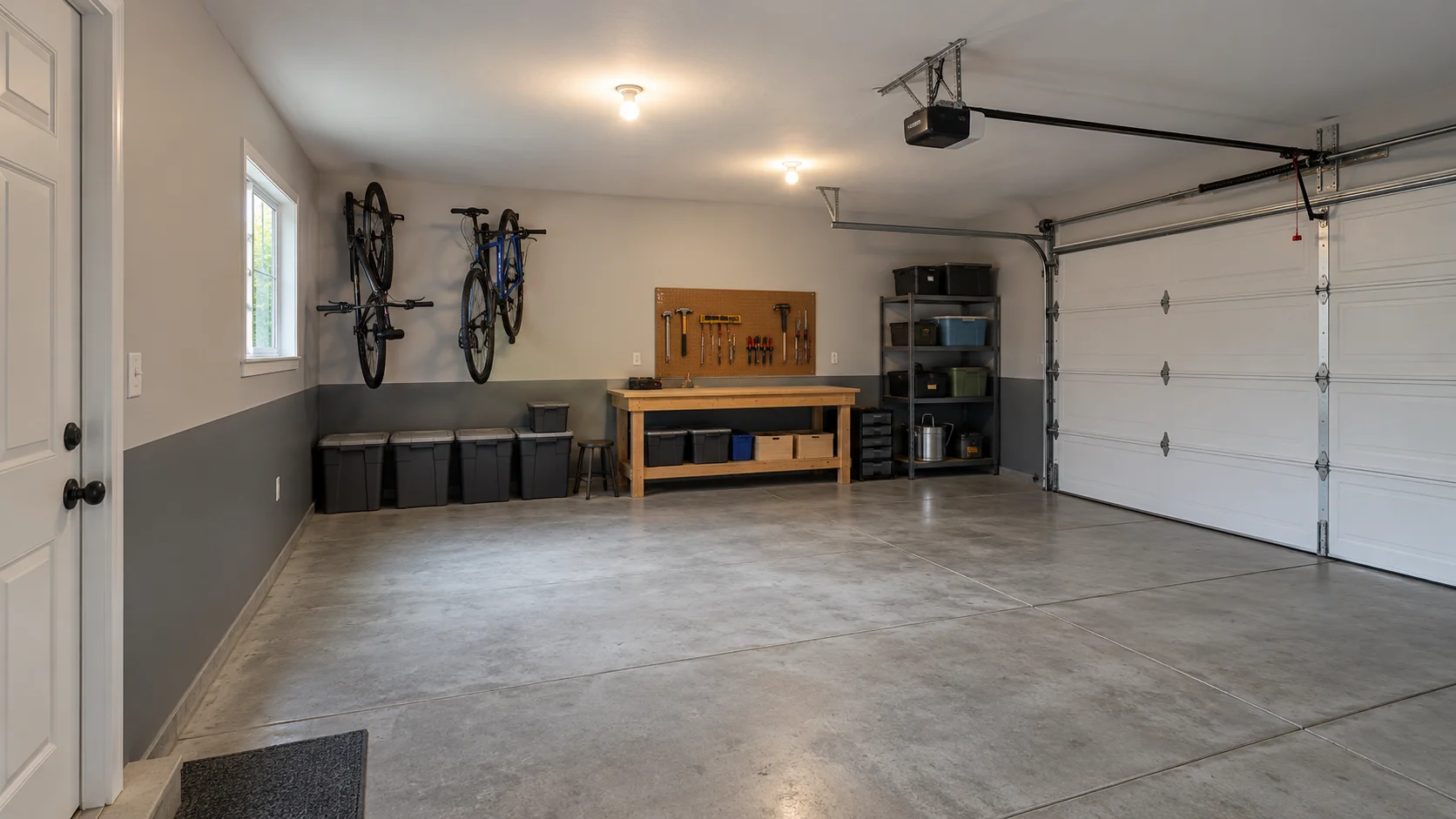
The best color for garage walls is usually a light neutral with an LRV (light reflectance value) of roughly 55 to 85, which bounces the light from a couple of ceiling fixtures around the whole space, with a darker band along the bottom of the walls if you want to hide scuffs from bins, bikes and car doors.
The paint is the easy part. What actually decides whether a garage paint job lasts is the surface underneath, the temperature on the day, and keeping wall paint off the floor. We are a family-owned painting company in Morganville and we paint garages, inside and out, across Monmouth, Middlesex, Ocean, Mercer, Somerset and Burlington counties and in Union, Essex, Hudson, Bergen and Passaic in North Jersey. This guide covers what we put on garage walls and ceilings and why, the colors that work, and the New Jersey problem nobody mentions: an unheated garage spends a large part of the year too cold for most latex paint. Every product figure below is quoted from the manufacturer's own data sheet or color page, read on 20 October 2026.
The Short Answer
- Paint: a washable acrylic wall paint in eggshell or satin. Satin is the easier one to scrub. Flat paint is the wrong choice for a garage wall.
- Primer: it depends on the wall. Bare drywall needs a drywall primer, rough concrete block needs a block filler, smooth poured concrete needs a masonry sealer, and new masonry has to cure for 30 days before any of it.
- Temperature: most wall paints need the air and the wall at 50°F or warmer. In an unheated New Jersey garage that rules out a lot of the calendar unless you heat the space.
- Color: a light neutral or white on the walls and ceiling, with a darker color low down if you like. Colors with an LRV above about 55 keep a garage bright with ordinary lighting.
- Floor: wall paint, and even ordinary floor paint, is not a garage floor coating. Car tires lift it. The floor is an epoxy job.
Why a Garage Is Not Just Another Room
Bob Vila's widely read guide to garage wall paint makes the sensible point that "there are no specialty garage wall paints"; you choose among ordinary interior paints. We agree. What changes is the room the paint has to live in.
An attached garage in New Jersey is usually unheated, or heated only by whatever leaks through the house wall. It is dusty. It gets hit by bikes, bins, ladders, car doors and the occasional hockey puck. Summer air comes in damp every time the door goes up, and it meets walls that are still cool from the slab. Most garages have one or two ceiling fixtures and a single window, if that. And a lot of the walls are not finished drywall at all: block on the foundation side, raw fire-taped drywall on the house side, poured concrete at the bottom.
So the questions that matter are the ones a living room never raises. Will this paint wash? Will it stick to block? Will it cure in a garage that is 42°F at seven in the morning? And will it make the space bright enough to find a socket wrench without a headlamp?
Best Paint for Garage Walls by Surface
Benjamin Moore's Ultra Spec 500 Interior Eggshell data sheet is a useful map, because it spells out a primer for every surface you meet in a garage. It is a commercial-grade wall paint we use, and it describes itself as "a decorative scrubbable finish." Sherwin-Williams has equivalents for each step. Whichever brand you use, the system is what matters.
Bare drywall, including fire-taped garage walls
Most new garages are delivered with the house-side wall and ceiling taped but never painted, and sometimes only the first coat of compound is on. Paint straight onto bare paper and mud and the paper and the compound soak it up differently, so the joints show through and the paint does not wash well. Benjamin Moore's system for drywall is a primer first (Ultra Spec 500 Interior Latex Primer N534, or Fresh Start Multi-Purpose Latex Primer N023) and then "1 or 2 coats" of the finish. Its surface prep line is short and worth following: "Drywall surfaces must be free of sanding dust."
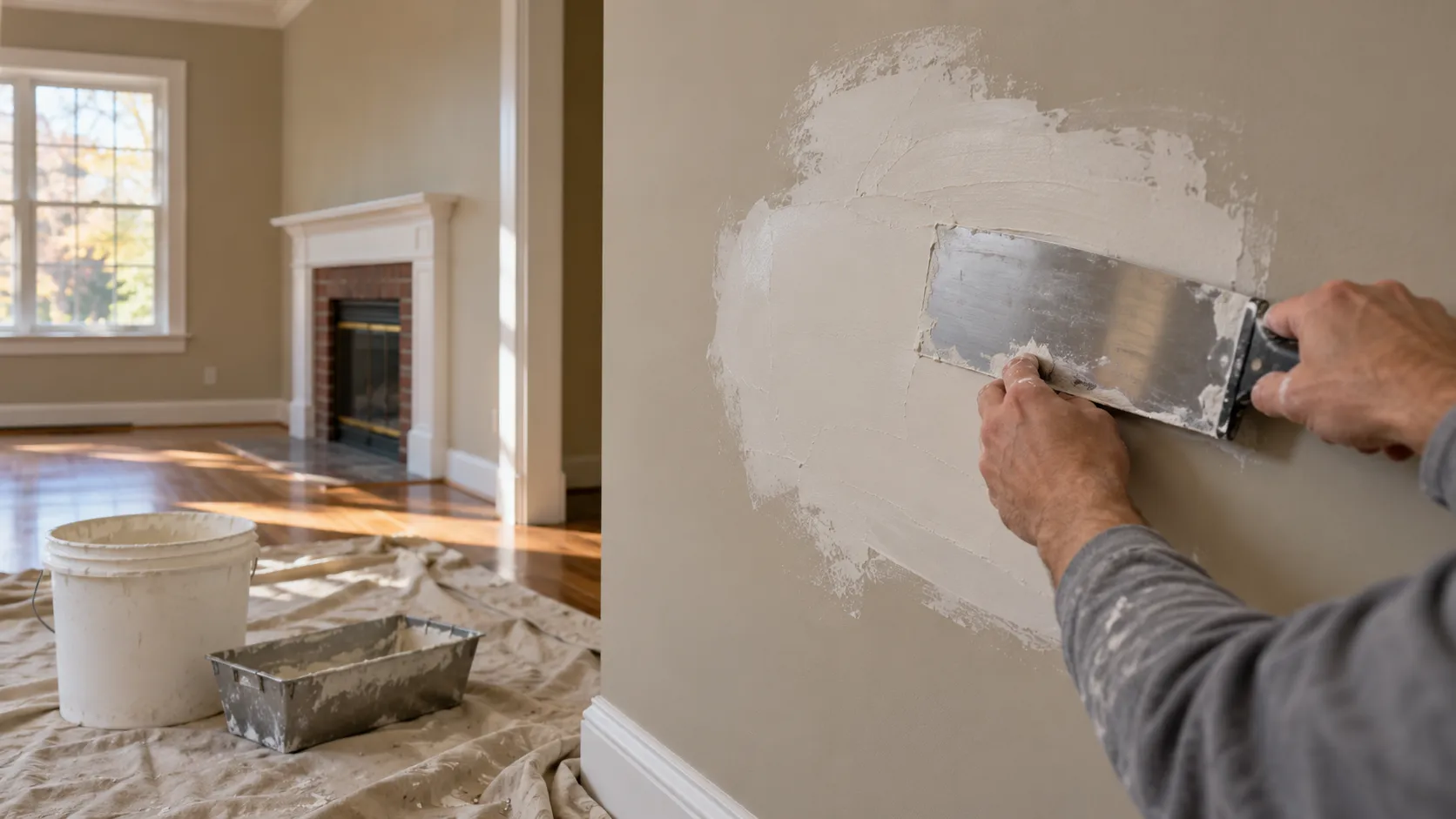
If the taping is rough, the gaps and dents will show through any sheen. Patching dents, holes and cracked joints before painting is part of the job; our drywall repair guide explains what that involves. Leave the wall itself in place, though. The drywall between a garage and the house is usually there as a fire separation, so painting it is fine but cutting it open is not a paint decision.
Concrete block walls
Block is open and porous, and a coat of wall paint on bare block soaks into the pores and leaves pinholes you can see across the garage. The fix is a block filler, a thick primer that fills the pores. Benjamin Moore's system for "Rough or Pitted Masonry" is "Ultra Spec Masonry Interior/Exterior Hi-Build Block Filler (571)" followed by one or two finish coats. Sherwin-Williams' equivalent is Loxon Acrylic Block Surfacer.
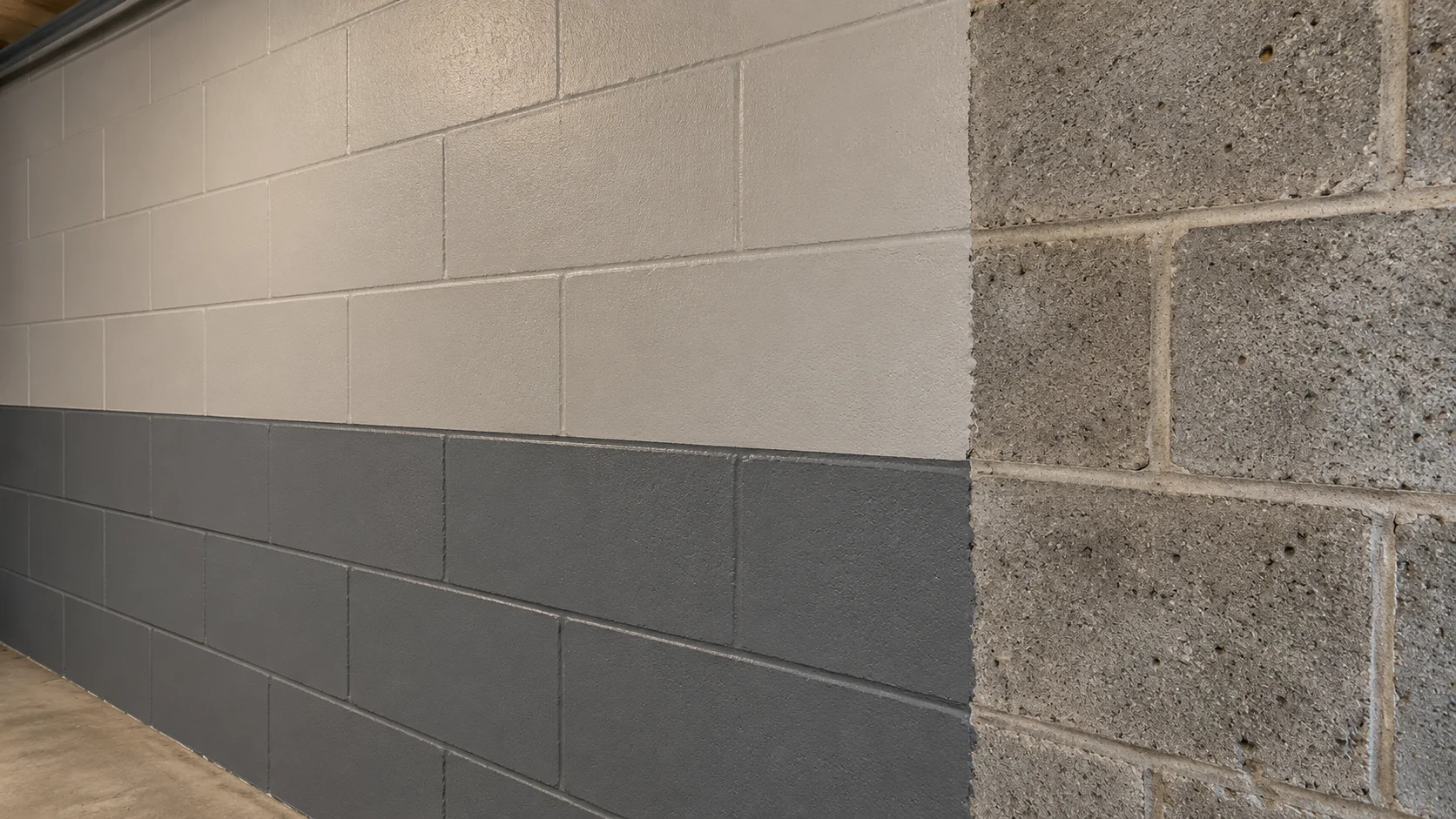
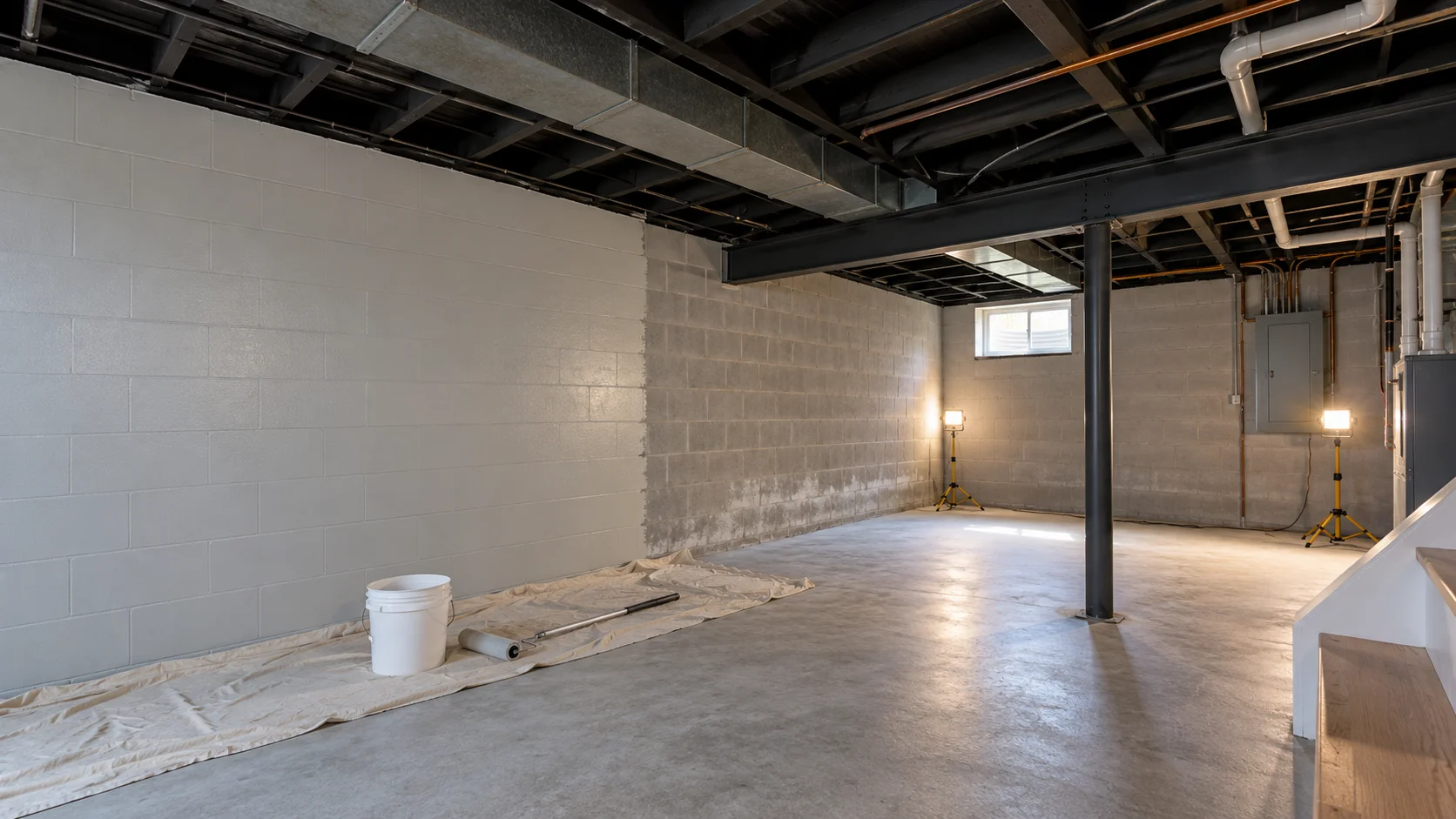
Before you fill anything, look at the bottom courses. If the block is damp, stained white or shedding a fine powder, that is water and salt coming through the wall, and paint will not hold it back. Our guide to painting basement walls covers the moisture tests that apply to block foundation walls in exactly the same way, and our concrete article explains what that white powder is and why you deal with the water before the paint.
Smooth poured concrete
Poured walls and the concrete stem wall along the bottom of many garages are the opposite problem: too smooth and too dense for paint to bite. The data sheet says "poured or pre-cast concrete with a very smooth surface should be etched or abraded to promote adhesion, after removing all form release agents and curing compounds," and specifies a masonry sealer (Ultra Spec Masonry 100% Acrylic Masonry Sealer 608) as the primer. New concrete and block have to wait: "New plaster or masonry surfaces must be allowed to cure 30 days before applying base coat."
Previously painted walls
Most repaints need only cleaning, a light sanding of glossy or patched areas and one or two coats. The data sheet asks for surfaces "clean, dry, and free of dirt, dust, grease, oil, soap, wax, scaling paint, water soluble materials, and mildew," and garage walls usually carry the full set. A wash with a degreasing cleaner, a rinse and a dry day is the single step that most improves a garage repaint.
Metal and wood in a garage
Steel lally columns, steel doors and metal shelving brackets need a metal primer before any wall paint goes on them, or rust bleeds straight through. Benjamin Moore lists an acrylic or alkyd metal primer for "Ferrous Metal (Steel and Iron)." Plywood walls and wood trim take an ordinary wood primer. The garage door is a different product and a different set of rules; see our guide to painting garage doors, front doors and shutters.
Which Sheen: Eggshell, Satin or Semi-Gloss?
Bob Vila's guide calls satin "generally the best option" for garage walls, and we would mostly agree. The trade-off is the same as anywhere else: the shinier the finish, the easier it is to wipe, and the more it shows every dent, trowel mark and wave in the wall. In a garage, where the walls are rarely smooth and the light is often a bare bulb raking across them, that trade-off matters.
- Eggshell: our usual choice for walls in decent shape. Washable, forgiving of rough taping.
- Satin: the better choice for a workshop, a garage that doubles as a gym, or the lower part of the wall where bins and bikes hit.
- Semi-gloss: for doors, trim and a wainscot band. Too shiny for a whole wall unless the drywall is very good.
- Flat: ceilings only.
Patience matters with any sheen. The Ultra Spec 500 sheet says "painted surfaces can be washed after two weeks." Our paint sheen guide goes into the difference in more detail.
Mildew, Damp and Ventilation
Garages are not conditioned, and in a humid New Jersey summer the cool lower walls and the back corners behind stored boxes are where mildew starts. Two things help. The first is paint that resists it: Benjamin Moore says Ultra Spec 500 "contains antimicrobial additives that inhibit the growth of mold and mildew on the surface of the paint film," and most commercial wall paints carry a similar additive. The second is not painting over mildew that is already there. Wash it off, let the wall dry, and then paint; all three data sheets we quote here list mildew among the things the surface must be free of.
Paint will not fix a garage that is damp because water is coming through the wall or up through the slab. If the mildew keeps coming back in the same spot, look for the source first.
Can You Paint Garage Walls in Winter in New Jersey?
Usually not without heat. The Ultra Spec 500 data sheet says "do not apply when air and surface temperatures are below 50 °F (10 °C)," and the U.S. Forest Products Laboratory's Wood Handbook chapter on finishing wood explains why: "most latex paints do not coalesce properly if the temperature drops below 10 °C (50 °F)." Some exterior paints are rated lower (Benjamin Moore's Aura Exterior, for example, to 35°F), but the paint going on most garage walls is an interior wall paint with the 50°F limit.
That is a real constraint here. The Office of the New Jersey State Climatologist at Rutgers puts the average number of freeze-free days at 163 in the northern highlands, 179 in the central and southern interior and 217 along the seacoast. An unheated garage follows the outside temperature closely, and a block wall or a slab takes even longer to warm up than the air. In practice we paint unheated garages from late spring into the fall, and in the cold months only where the owner can keep the space at 50°F or more for the painting and the days after. Our article on painting in cold weather explains what goes wrong when paint is put on too cold.
One more winter note: do not store the leftover paint in the garage. The same data sheets give a minimum storage temperature of 40°F and say "PROTECT FROM FREEZING." A can that has frozen and thawed is often ruined.
The Best Colors for Garage Walls
The color question in a garage is mostly a light question. Sherwin-Williams' guide to choosing color by light defines LRV as "the amount of light a color reflects," on a scale where "zero reflecting no light and 100 reflecting all light," and notes that in a room with little or no natural light, "you'll have to rely on lighting" and "knowing the LRV in paint can really come in handy." That describes most garages. A wall at LRV 85 hands back most of the light from the ceiling fixtures. A wall at LRV 25 swallows it.
The LRVs below were read from each color's page on sherwin-williams.com on 20 October 2026.
| Color | LRV | Where it works in a garage |
|---|---|---|
| Extra White SW 7006 | 85.9 | Ceilings, and walls in a workshop where light matters most |
| Pure White SW 7005 | 84.0 | A slightly softer white for walls and ceilings |
| Agreeable Gray SW 7029 | 60.4 | Our default wall color: light, warm and forgiving of dust |
| Repose Gray SW 7015 | 58.2 | A cooler light gray with the same practical range |
| Mindful Gray SW 7016 | 47.7 | A mid gray for a lower band or a brighter garage |
| Dovetail SW 7018 | 25.8 | A darker lower band that hides scuffs and tire splash |
| Iron Ore SW 7069 | 5.6 | Accent wall, cabinets or a workbench wall |
| Naval SW 6244 | 4.5 | Accent only; it will darken the space |
| Tricorn Black SW 6258 | 2.8 | Accent only, or trim and doors inside the garage |
How we usually put that together:
- Light neutral walls, white ceiling. A gray or greige between about 55 and 65, with a flat white ceiling, is bright without showing every speck of dust the way a pure white wall does.
- A darker band low down. A mid or dark gray up to about four feet, often finished with a chair rail or a painted line, takes the hits from bins and car doors and hides them. Lighter above keeps the space bright.
- Match the floor if you are doing one. If the garage is getting an epoxy flake floor, pull the wall color from one of the flake colors so the room reads as one job.
- Keep dark colors for small areas. Black and navy look sharp on a workbench wall or on cabinets. Across a whole garage with one light fixture they make the space feel like a cave.
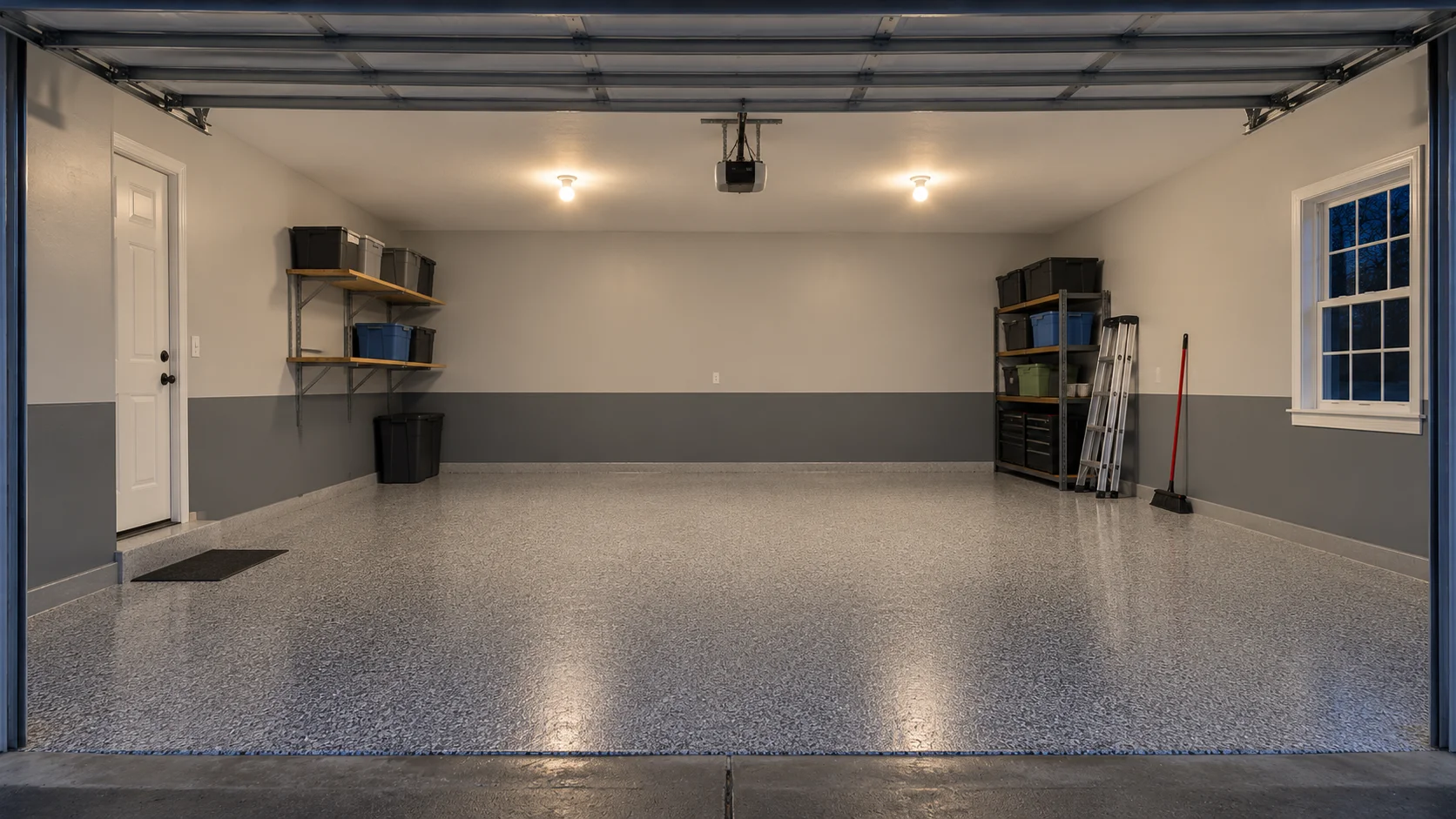
Paint a sample on the actual wall and look at it under the garage's own lights at night, not in daylight with the door open. Our guide to interior paint colors covers the neutrals in more depth.
Do Not Put Wall Paint on the Garage Floor
This is the most common garage painting mistake. Even a paint made for floors has a limit with cars. Benjamin Moore's Latex Floor & Patio Low Sheen Enamel data sheet warns: "Many tires contain compounds which may attack latex paints, resulting in loss of adhesion and film pickup." In plain English, warm tires lift the paint off the slab in the shape of your tread.
A garage floor that cars park on wants a proper floor coating, ground and prepared, not a paint. That is our epoxy flooring service, and our guide to epoxy garage floor coating explains the options and costs. If you are doing both, paint the walls first and coat the floor last.
Older Garages and the Lead Paint Rule
A garage, especially a detached one, is often older than the paint on its walls suggests, and many New Jersey garages were built before 1978. If the job involves sanding or scraping old paint in a pre-1978 home, the federal rule applies. The EPA's Renovation, Repair and Painting Program "requires that anyone paid to perform work that disturbs painted surfaces in homes, childcare facilities and preschools built before 1978 be certified." The exemption for minor work at 40 CFR 745.83 covers only "6 square feet or less of painted surface per room for interior activities" and 20 square feet for exterior work, unless the surfaces have been tested and found lead-free in writing.
NJ Painting Co. is not an EPA Lead-Safe Certified firm. If your garage is pre-1978 and the existing paint has to be sanded or scraped, ask every bidder for their RRP certification and certificate number. On those garages we will either limit the work to cleaning and painting over sound paint without disturbing it, or tell you it needs a certified firm. Our guide to lead paint in older homes explains the rule in full.
How We Paint a Garage
- Clear the walls. We need about three feet of working room along each wall being painted. Shelving that is screwed to the wall either comes down or gets painted around, which we agree before we start.
- Wash. Degreaser on the walls, especially around the car bays, workbench and door; rinse; let it dry.
- Check the wall. We look for damp block, mildew, failed paint and drywall damage, and tell you about anything paint will not fix.
- Repair and prime. Patch drywall, fill block, spot-prime metal and stains, and fully prime bare drywall.
- Two coats. Ceiling first, then walls, then any lower band or accent. Doors and trim in semi-gloss last.
- Stay off it. Keep heavy contact off the walls until the paint has had time to harden, and do not scrub them for two weeks.
Talk to Us About Your Garage
NJ Painting Co. is a family-owned, fully insured painting company at 36 Church Rd, Morganville, NJ 07751, painting New Jersey homes for more than 20 years with Benjamin Moore and Sherwin-Williams products. We paint garage walls, ceilings, doors and trim as part of our interior painting work, garage doors and the outside of the garage as part of our exterior painting, and garage floors with our epoxy coating service, across Monmouth, Middlesex, Ocean, Mercer, Somerset and Burlington counties and in Union, Essex, Hudson, Bergen and Passaic. The full list is on our service areas page.
Every estimate is free, and on a garage it includes a look at the block and the slab, not just a square-foot number. For a sense of how pricing works, see our painting prices by service. Call (732) 239-0932 or request a free estimate.
Frequently Asked Questions
What is the best paint for garage walls?
A washable acrylic wall paint in eggshell or satin, over the right primer for the surface: a drywall primer on bare drywall, a block filler on concrete block and a masonry sealer on smooth poured concrete. Most wall paints need the air and the wall at 50°F or more when they go on, which is the bigger issue in an unheated New Jersey garage.
Should I use interior or exterior paint on garage walls?
Interior paint is the normal choice for the inside of a garage, and it is what the walls are designed for. Exterior paint is not needed on dry interior walls. What matters more than the label is washability, mildew resistance and the right primer underneath.
What sheen is best for garage walls?
Eggshell for walls in reasonable shape, satin for workshops and the lower part of the wall where things get bumped, semi-gloss for doors and trim, and flat for the ceiling. The shinier the sheen, the easier it is to wipe and the more it shows dents and rough taping.
What is the best color for garage walls?
A light neutral with an LRV of roughly 55 to 85, such as Agreeable Gray SW 7029 (LRV 60.4) or Repose Gray SW 7015 (LRV 58.2), with a white ceiling. Garages rely on artificial light, and higher-LRV colors reflect more of it. A darker gray band along the bottom of the walls hides scuffs without darkening the room.
Do I need to prime garage drywall before painting?
Yes, if it is bare. Builder-taped garage drywall soaks paint unevenly between the paper and the joint compound, so the seams show through without a primer. Previously painted drywall in good condition needs only spot-priming over patches and stains.
How do you paint concrete block garage walls?
Clean the block, check that it is dry and not shedding white powder, fill the pores with a block filler such as Benjamin Moore's Ultra Spec Masonry Hi-Build Block Filler 571 or Sherwin-Williams' Loxon Acrylic Block Surfacer, then apply one or two finish coats. New block has to cure for 30 days first.
Can you paint a garage in winter?
Only if the garage can be kept at 50°F or more during painting and for the drying time after, because most latex wall paints do not form a proper film below that. In an unheated New Jersey garage, late spring through the fall is the realistic window.
Can I use wall paint or porch paint on my garage floor?
Not where a car parks. Benjamin Moore's own floor enamel data sheet warns that "many tires contain compounds which may attack latex paints, resulting in loss of adhesion and film pickup." A garage floor needs a prepared floor coating such as epoxy.
About the author
Written by the NJ Painting Co. team
NJ Painting Co. is a family-owned painting contractor based in Monmouth County, in business since 2004. We are licensed and fully insured, work with Benjamin Moore and Sherwin-Williams paints, and back our work with a 2-year workmanship warranty. We serve Monmouth, Middlesex, Ocean, Mercer, Somerset and Burlington counties, plus Union, Essex, Hudson, Bergen and Passaic in North Jersey.