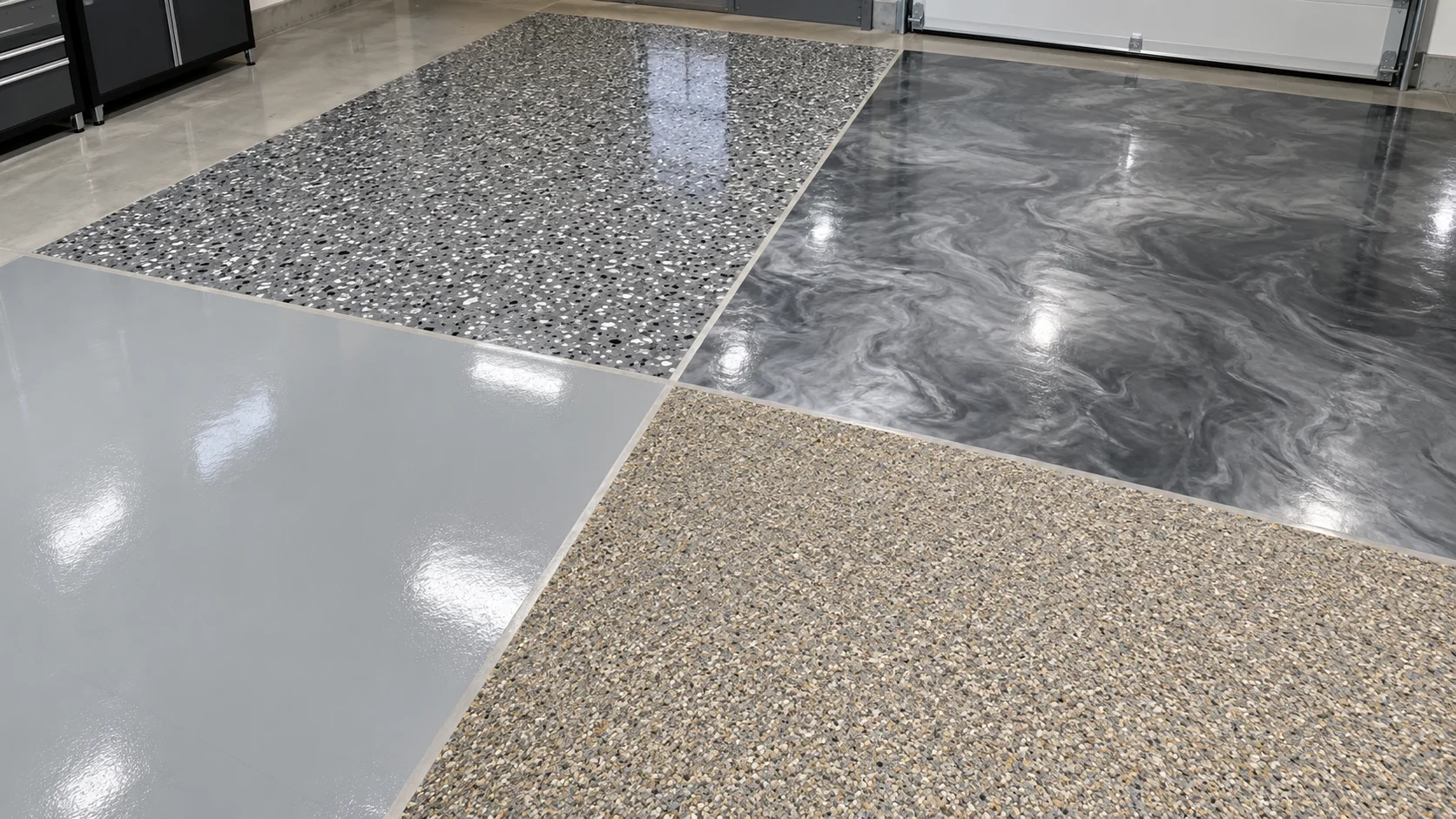
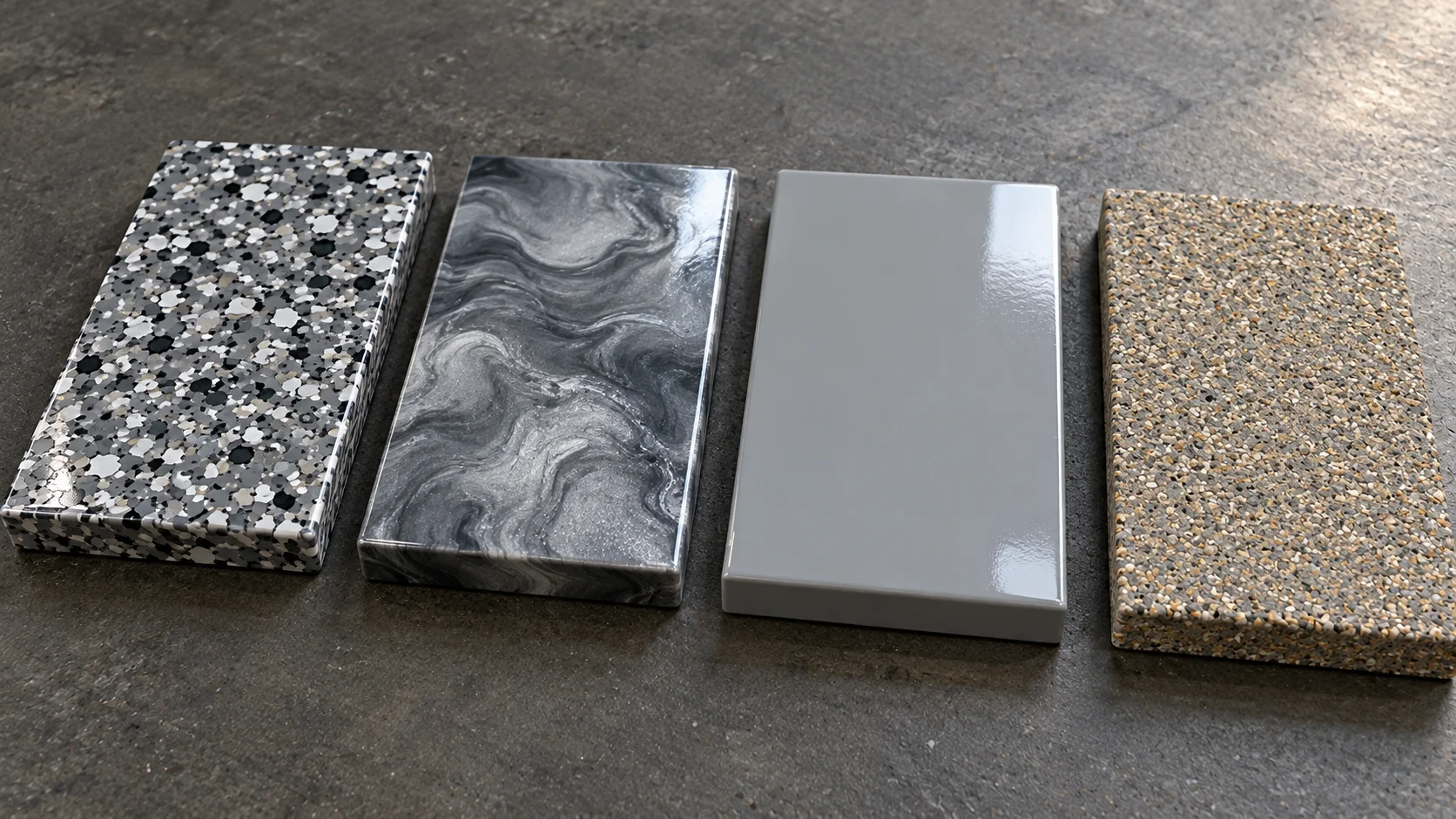
The four common epoxy floor types are decorative flake (vinyl chips broadcast into the base coat), metallic (reflective pigment worked into a marbled look), solid color (a pigmented coat under a clear topcoat) and quartz (colored sand for a textured, slip-resistant surface). Flake suits most garages, metallic suits basements and showrooms, solid color suits workshops, and quartz suits wet floors.
The finish is what you see. Underneath it, every one of them is a stack of layers, and the resin chosen for each layer (epoxy, polyaspartic, polyurea, urethane or urethane cement) decides how the floor handles sunlight, hot tires, water, chemicals and cold weather.
We are a family-owned painting company in Morganville, and we install epoxy, polyurea and polyaspartic floor systems for garages, basements, workshops and commercial spaces across Monmouth, Middlesex, Ocean, Mercer, Somerset and Burlington counties, plus Union, Essex, Hudson, Bergen and Passaic in North Jersey. This guide is about choosing the finish and the system. If your question is what it costs, our separate guide to epoxy garage floor coating costs in NJ covers prices, prep and winter, and the cost guide lists per-square-foot ranges by system.
The Short Answer
- Flake is the most forgiving finish for a garage. The chips hide dust, tire marks and small slab flaws, and the texture is easy to make slip-resistant.
- Metallic is the showpiece. It suits a finished basement, a showroom or a garage that is more display space than parking, and it shows scratches and dust more than flake does.
- Solid color is the plainest and usually the least expensive look. It is a good fit for workshops, utility rooms and anywhere you want a clean, bright floor that is easy to sweep.
- Quartz is built for wet floors and traction: restrooms, locker rooms, shop floors and commercial wet areas.
- Resins: epoxy is usually the body coat but yellows in sunlight; polyaspartic and urethane are the light-stable wear layer on top; polyurea is often a flexible base coat; urethane cement is a much thicker commercial kitchen floor.
Finish vs System: Why the Look Is Only Half the Choice
"An epoxy floor" usually means a look someone has seen. What gets installed is a system of three or four coats:
- Primer soaks into the ground concrete and gives everything above it something to hold.
- Body or base coat carries the color and the thickness. Flake, quartz and the metallic effect all live in or on this layer.
- Topcoat is the clear or tinted wear layer that takes the foot traffic, tires, salt and sun.
Two floors that look identical on day one can age very differently depending on the topcoat. Westcoat, a resinous flooring manufacturer, says its standard flake system "should be resealed with the appropriate Westcoat topcoat every 3 to 5 years depending upon traffic and UV exposure." The topcoat is the part that wears.
Decorative Flake (Chip) Floors
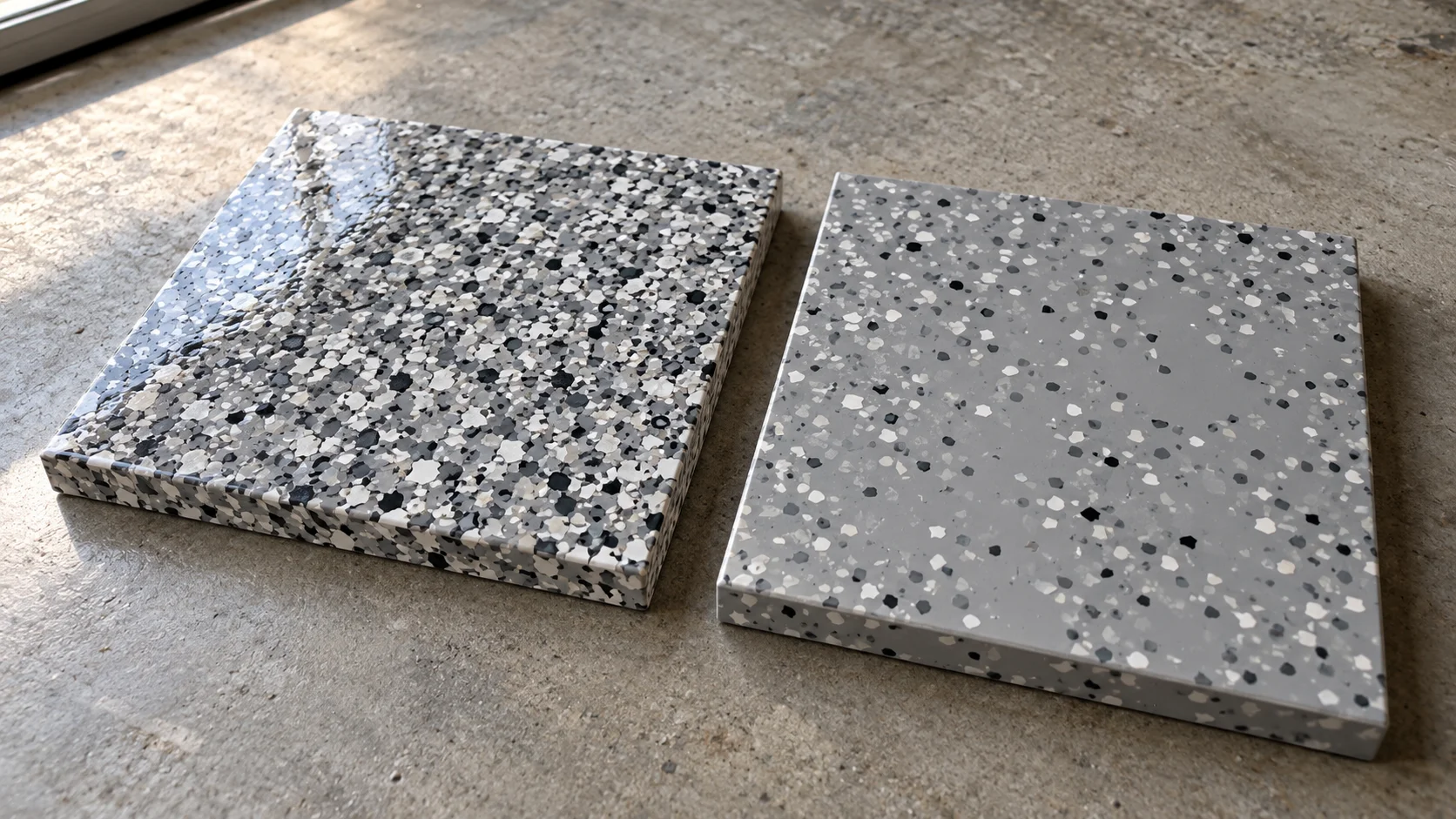
A flake floor is a pigmented base coat with vinyl chips thrown into it while it is still wet, then scraped, vacuumed and sealed under a clear topcoat. Westcoat's flake system describes it plainly: "Color Chips broadcast into a 100% Solids pigmented epoxy and sealed with a clear Polyaspartic topcoat", with a total system thickness of 25 to 35 mils.
Full broadcast vs partial broadcast
The same specification offers two versions. In its words, the "Liquid Granite" version "is a full broadcast color system" and the "Liquid Terrazzo" version "is a light broadcast color system." A full broadcast means chips are thrown until the wet coat will not take any more, so the floor is covered edge to edge and the base color barely shows. A partial broadcast scatters chips over a visible base color.
- Full broadcast hides more, feels more uniform underfoot, and puts more material between the tires and the base coat. It is what we would steer most garages toward.
- Partial broadcast shows more of the base color, which some people prefer in a basement or a laundry room. It hides less dirt and fewer slab blemishes.
Chip size and blend change the look more than most people expect: small chips in a tight gray blend read as speckled granite from standing height, while large contrasting chips read as a pattern. Judge samples on the floor of the actual room, under its own lights.
Where flake works
Garages first, because the pattern hides dust, salt film and tire marks; flake also suits mudrooms, basements and workshops. Westcoat lists its flake system for "showrooms, restaurants, garages, recreation rooms, washrooms and kitchens" while also calling it a "light duty coating." That last part matters for commercial buyers, which we cover in our guide to commercial epoxy flooring in NJ.
Metallic Epoxy Floors
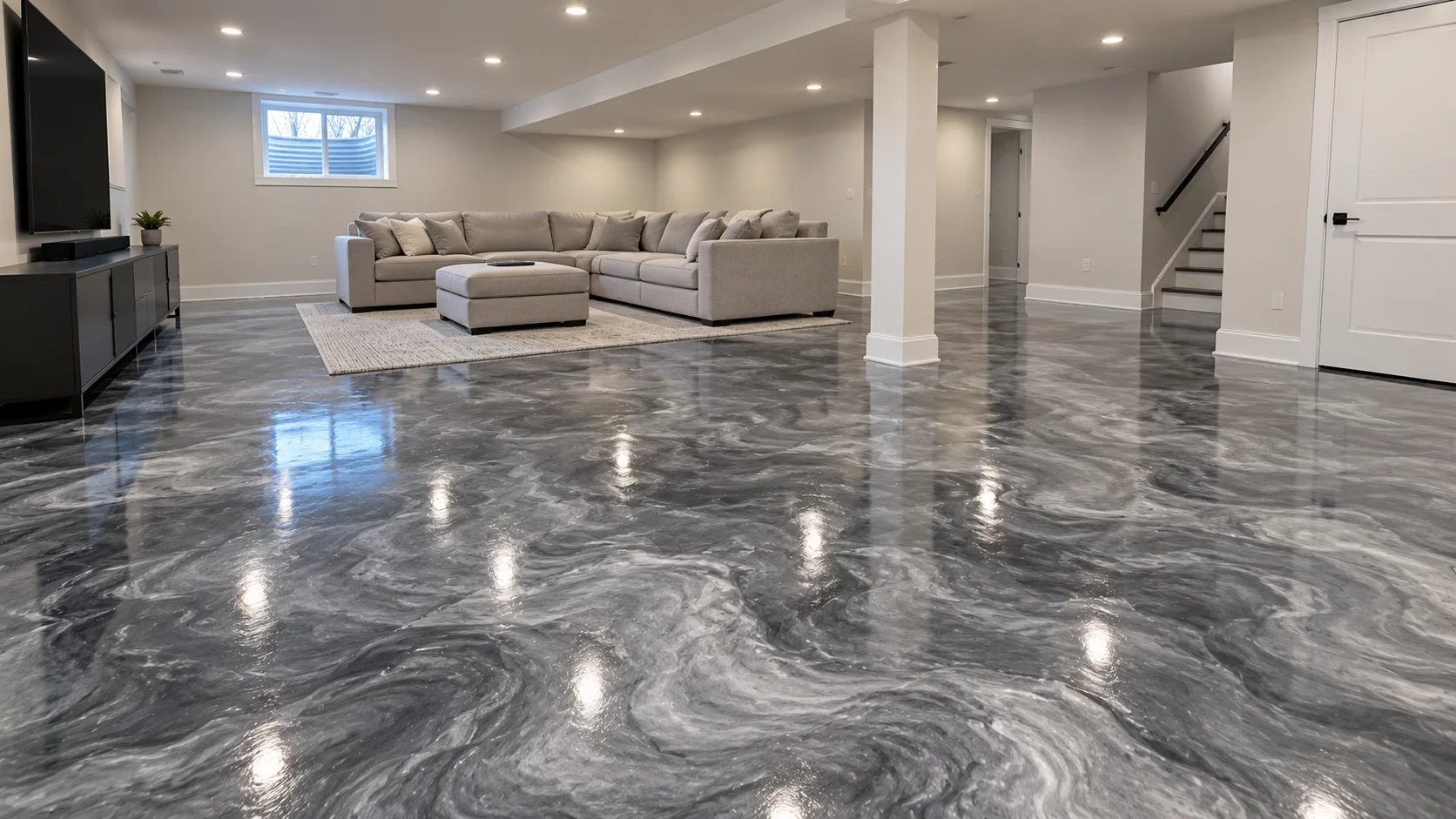
A metallic floor is a self-leveling epoxy carrying reflective pigment that is worked while wet so it swirls and settles into a pattern. Westcoat describes its metallic product as "engineered with proprietary metallic additives that uniquely flow when applied", lists it as self-leveling, and recommends it for retail stores, showrooms and garages, sealed in "a high gloss or satin finish."
What to know before choosing metallic
- No two are alike. You choose a color family and a technique, not an exact pattern.
- It shows more. Smooth, glossy floors show dust, footprints, tire marks and fine scratches more readily than a busy flake pattern. A satin topcoat helps.
- It is slick when wet. Grit added to the topcoat improves traction but dulls the depth that makes metallic worth choosing. For a garage that sees snow and rain off the car, that trade-off is real.
- It needs a flat slab. Because the material self-levels and reflects light, low spots and grinder marks can show. Slab repair matters even more than usual.
- It needs a light-stable topcoat where daylight reaches it. The metallic layer is epoxy, and epoxy yellows in sunlight (see the resin section below).
Metallic is at its best in finished basements, showrooms, offices and garages that are partly display space. The illustrated before-and-after examples on our epoxy flooring page include a metallic garage if you want a sense of the look.
Solid Color Floors
A solid color floor is a pigmented epoxy body coat, usually gray, tan or white, with a clear or matching topcoat. It is the simplest system to build, which is why it sits at the bottom of most price ranges, including the "standard two-coat epoxy" line in our cost guide.
Solid colors look clean and make a room brighter, and a light gray or white floor bounces a lot of light around a workshop or basement. The downside is that they hide nothing: every chip of dropped paint, every tire mark and every dull traffic lane shows. A light flake broadcast over a solid color keeps most of the clean look and hides more. Solid color suits workshops, utility rooms and back-of-house spaces where the floor is a tool rather than a feature.
Quartz Broadcast Floors
Quartz systems broadcast colored sand into the resin instead of vinyl chips, often in two layers, and seal it so the texture stays. The result is thicker, harder and grittier than a flake floor. Westcoat's double broadcast system, for example, broadcasts silica sand or quartz sand into 100%-solids epoxy, has a typical dry film thickness of 125 mils, and is recommended for locker rooms, animal care, shop floors, shower rooms and restrooms, with a "slip resistant textured design."
That is several times the 25 to 35 mils of the flake system quoted above. In a house, quartz can suit a mudroom or a dog-washing area; for a garage most people prefer flake, because quartz texture is harder to sweep.
The Resins: What Each One Does in the System
Sellers often name a whole floor after one of its layers: a "polyaspartic floor" may have an epoxy base, and an "epoxy floor" usually has a urethane or polyaspartic topcoat.
Epoxy
Two-component epoxy is the workhorse body coat. A 100%-solids epoxy builds thickness in one coat, self-levels over minor slab flaws, bonds well to properly ground concrete and resists many chemicals. Its weakness is light. A study in the journal Polymers traced epoxy yellowing to "carbonyl formation in the epoxy backbone due to thermo-oxidation" and found that "the change in color was irreversible." In practice: an epoxy floor that sees daylight will drift toward amber unless it is protected by a light-stable topcoat.
Polyaspartic
Polyaspartics are a family of fast-curing, light-stable coatings. Concrete Decor's technical overview calls them "high-performance resins used to make two-component light-stable coatings" and notes that their "UV stability prevents yellowing and material degradation in outdoor applications." The same article warns that they "aren't self-leveling like epoxies" and that mixed material thickens within 20 to 30 minutes, which is why application speed and crew experience matter.
One point worth knowing: "polyaspartic" does not mean one cure schedule. Concrete Decor describes topcoats walkable in three to four hours and ready for vehicles at 24 hours. Westcoat's EC-102 polyaspartic topcoat data sheet, by contrast, says "Light foot traffic may be permitted in 8 hours, normal traffic in 24 hours and vehicle traffic in 72 hours" at 72°F, and says not to apply it below 50°F. Both are polyaspartics. Ask which product is going down and read its data sheet, rather than relying on "one-day floor" marketing.
Polyurea
Polyurea is the broader chemical family polyaspartics belong to; as one coatings supplier puts it, "all polyaspartic is polyurea." Conventional polyurea cures very quickly and stays flexible, which makes it useful as a base coat on older slabs with hairline cracks. The same source cautions that polyurea "is vulnerable to UV rays," with "discoloration over time," so it is normally covered with a polyaspartic or urethane topcoat rather than left exposed.
Urethane (polyurethane) topcoats
Aliphatic urethane topcoats are thin, tough, light-stable wear layers used over epoxy, often as the clear coat on solid color and metallic floors, in gloss or satin. They are the sacrificial layer: when traffic lanes dull, a scuff-and-recoat restores them.
Urethane cement
Urethane cement (also called cementitious urethane or urethane mortar) is not a coating in the same sense. It is a troweled or poured layer measured in fractions of an inch. Westcoat's urethane cement system, for example, is built at 1/4 to 5/16 of an inch, several times the thickness of a residential flake floor. Sherwin-Williams' technical article on thermal shock says these systems "expand and contract in harmony with the concrete substrate" and handle "hot water washdowns and steam cleaning." It belongs in commercial kitchens and wash-down rooms, not in a home garage.
| Resin | Usual role | Strength | Watch out for |
|---|---|---|---|
| Epoxy | Primer, body coat, metallic layer | Thickness per coat, adhesion, self-leveling | Yellows in sunlight; slower cure |
| Polyaspartic | Clear topcoat; sometimes a full system | Light-stable, fast cure, abrasion resistant | Short working time; cure schedules vary by product |
| Polyurea | Flexible base coat | Very fast cure, flexibility over hairline cracks | Discolors under UV unless topcoated |
| Urethane | Clear or tinted topcoat | Light-stable wear layer, gloss or satin | Thin; recoat as it wears |
| Urethane cement | Heavy commercial floor, 1/4 inch or more | Thermal shock, wash-downs, moisture tolerance | Overkill and costly for a home |
Which Finish and System for Which Room
Garage
A garage floor takes hot tires, road salt, snowmelt and, if the door stands open on summer afternoons, direct sun. Full broadcast flake under a light-stable polyaspartic or urethane topcoat is the most forgiving choice. Whatever the finish, waiting out the vehicle cure on the data sheet is what prevents hot tire pickup. Our garage floor cost guide covers the threshold at the overhead door and other New Jersey specifics.
Basement
Basements get no sun and no tires, so metallic and solid color finishes come into their own. The risk in a basement is moisture coming up through the slab. Sherwin-Williams sets a working limit of three pounds per 1,000 square feet per day on the calcium chloride test for its floor systems. A basement that reads above that needs a moisture-tolerant primer under any finish, so the moisture test comes before the color choice, not after.
Mudrooms, workshops and showrooms
Mudrooms and laundry rooms suit flake or a solid color with slip-resistant grit near the door and the washer. Workshops need chemical resistance above all, and the feet of jack stands should be padded because point loads from steel dent any coating. Showrooms, retail floors and offices lean toward metallic and solid color because they read as finished floors; the traffic lanes at doors and registers wear the topcoat first. Our commercial epoxy flooring guide covers downtime and specifications for business spaces.
Patio, porch or pool deck
Outdoor slabs are the hardest place to coat. The sun rules out epoxy as an exposed layer, moisture can come up from below while rain and snow come down from above, and New Jersey winters cross the freezing line many times: the Office of the New Jersey State Climatologist at Rutgers puts the average freeze-free season at 179 days in the central and southern interior and 217 along the coast, leaving months of freeze-thaw cycling. An outdoor coating has to be light-stable and slip-resistant when wet. Ask any installer which product is rated for exterior use and what happens at the edges where water gets under. Pool deck coating in particular is specialist work and not a service we offer; for porches and patios, our guide to painting concrete patios and porches covers the paint and stain options.
Commercial kitchen
Not a decorative choice at all. Hot oil, boiling water and steam cleaning create thermal shock, and Sherwin-Williams says epoxy "does not perform as well as other materials when exposed to thermal shock." Urethane cement, often with a quartz broadcast for traction, is the usual answer.
| Space | Flake | Metallic | Solid color | Quartz |
|---|---|---|---|---|
| Garage | Best all-round | Display garages | Good, shows more dirt | Works, harder to sweep |
| Basement | Good | Very good | Good | Rarely needed |
| Mudroom / laundry | Very good | Slick when wet | Good with grit | Good |
| Workshop | Very good | Shows scratches | Very good | Good |
| Patio / outdoor | Only with an exterior-rated, UV-stable system | Not recommended | Only with an exterior-rated system | Only with an exterior-rated system |
| Showroom / retail | Good | Very good | Very good | Wet areas |
| Commercial kitchen | Urethane cement, usually with a textured broadcast | |||
Prep Is the Same Whatever You Choose
Every one of these systems fails the same way if the concrete under it is wrong. Sherwin-Williams notes that most coating manufacturers "no longer recommend acid etching," because it leaves only a "CSP-1 to CSP-2 profile" where modern systems want "CSP-3 to CSP-9." We diamond grind with dust extraction, repair cracks and spalls, and moisture test slabs where moisture is a realistic risk before we recommend a system. The steps are laid out on our epoxy flooring service page.
Frequently Asked Questions
What is the difference between flake, metallic and solid color epoxy floors?
Flake floors have vinyl chips broadcast into a pigmented base coat under a clear topcoat. Metallic floors use epoxy carrying reflective pigment worked into a marbled pattern while wet. Solid color floors are a pigmented coat with a clear or matching topcoat. All three are multi-coat systems; the difference is the middle layer.
Which epoxy floor finish is best for a garage?
For most garages, a full broadcast flake floor under a light-stable polyaspartic or urethane topcoat. It hides dust, salt and tire marks and takes slip-resistant grit without changing the look much.
What is a quartz epoxy floor?
Colored quartz or silica sand broadcast into resin, often in two layers, and sealed so the texture remains. It is much thicker than a flake floor and is used where traction on wet floors matters, such as restrooms, locker rooms and shop floors.
What is the difference between epoxy, polyaspartic and polyurea?
Epoxy is usually the body coat: thick, self-leveling and well-bonded, but it yellows in sunlight. Polyaspartic is a fast-curing, light-stable resin used mostly as the clear topcoat. Polyurea is the broader family polyaspartics belong to; conventional polyurea is used as a flexible, fast-curing base coat and needs a UV-stable topcoat over it.
Can you put epoxy on a patio?
Not as an exposed layer. Epoxy yellows irreversibly in sunlight, and outdoor slabs also face moisture and freeze-thaw cycling. An outdoor coating needs a light-stable, exterior-rated system that stays slip-resistant when wet.
Do epoxy floors need to be resealed?
The topcoat wears over time. One manufacturer's flake system specification calls for inspection every 2 to 4 years and resealing every 3 to 5 years depending on traffic and UV exposure. A reseal is a scuff and a fresh topcoat, not a new floor.
Is metallic epoxy more expensive than flake?
Usually, yes. Our cost guide lists flake or quartz broadcast systems at $5 to $9 per square foot and metallic at $6 to $12, and This Old House's 2026 cost guide prices a metallic finish at $5 to $12 per square foot. Metallic also needs a flatter slab and more skilled application, because the pattern is worked by hand while the epoxy is wet.
Talk to Us About Your Floor
NJ Painting Co. is a family-owned, licensed and fully insured company at 36 Church Rd in Morganville, working in New Jersey homes and businesses for more than 20 years. We look at the slab, moisture test where it is warranted, and recommend a system for the room rather than a color off a chart. Every estimate is free and our work carries a two-year workmanship warranty. See our epoxy flooring service, compare prices in the cost guide, check that we cover your town in Monmouth, Middlesex, Ocean or our other service areas, or call (732) 239-0932 and request a free estimate.
About the author
Written by the NJ Painting Co. team
NJ Painting Co. is a family-owned painting contractor based in Monmouth County, in business since 2004. We are licensed and fully insured, work with Benjamin Moore and Sherwin-Williams paints, and back our work with a 2-year workmanship warranty. We serve Monmouth, Middlesex, Ocean, Mercer, Somerset and Burlington counties, plus Union, Essex, Hudson, Bergen and Passaic in North Jersey.