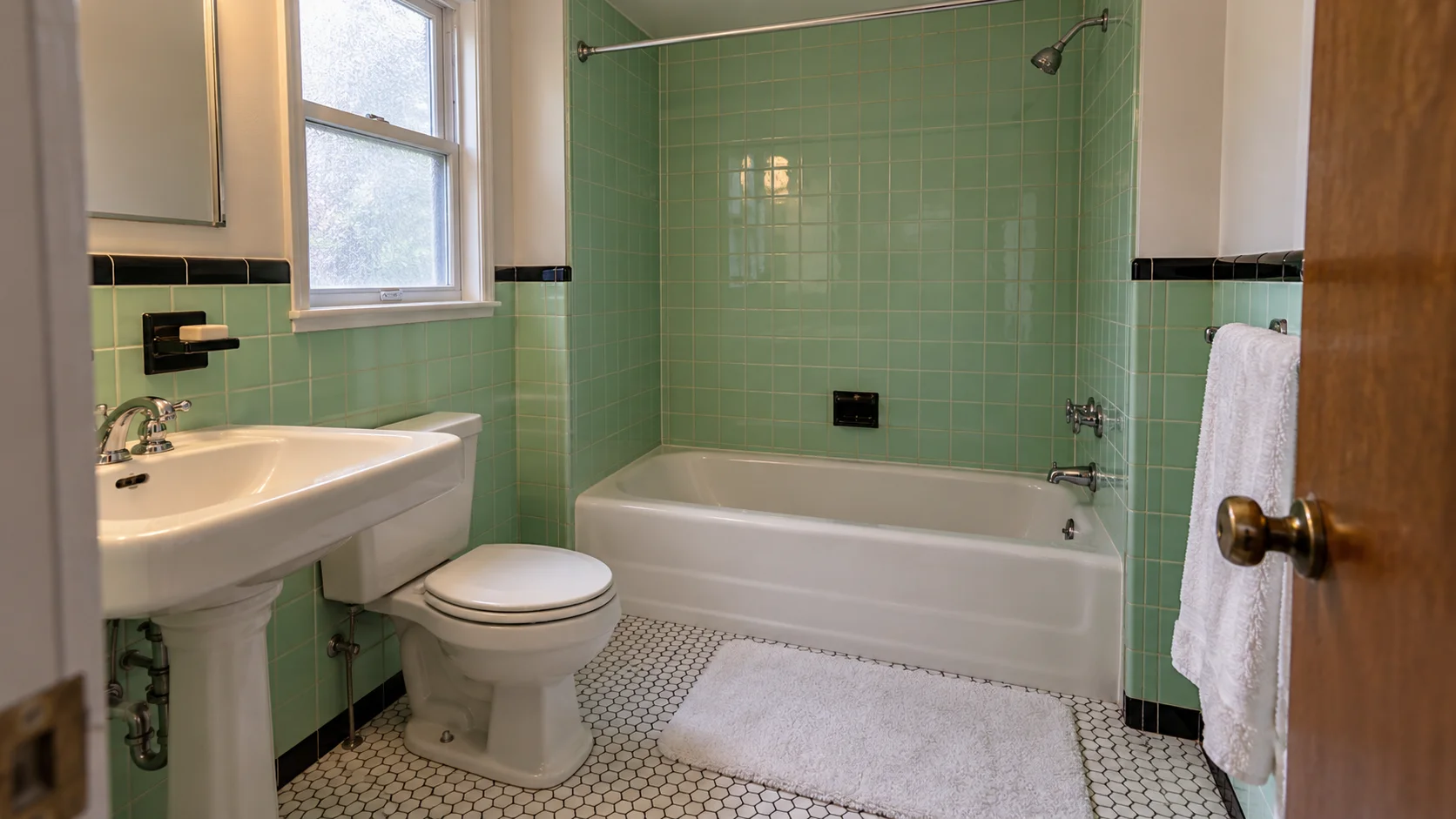
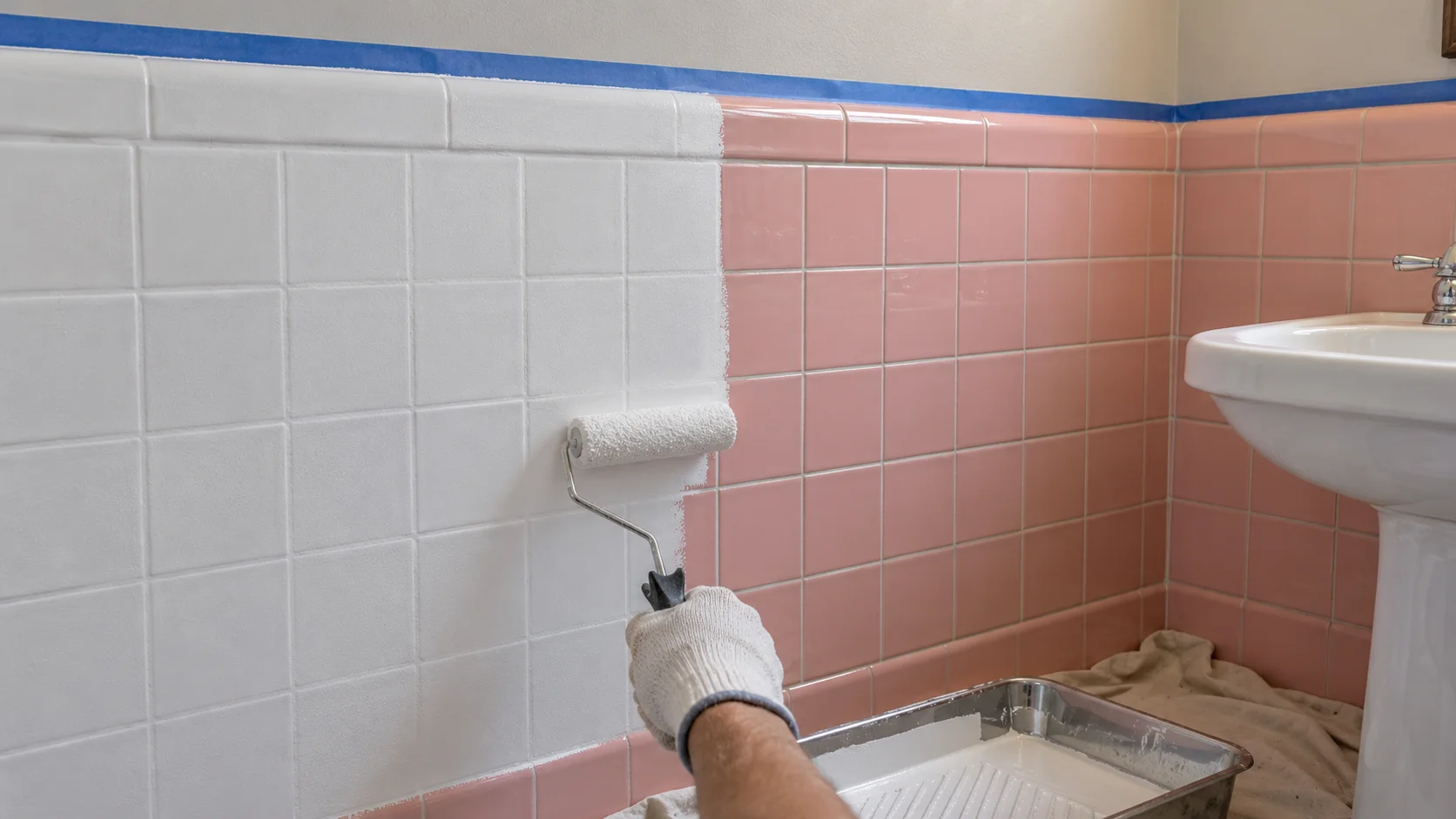
You can paint tile, but only glazed wall tile in a dry spot, such as a powder-room wainscot, after deglossing and a bonding primer. Shower walls, tub surrounds and floors peel under ordinary paint. A bathtub cannot take wall paint at all: it needs a two-part epoxy kit or professional tub reglazing.
Tile that gets wet every day is where painted tile fails, and the paint makers say so in their own instructions. A kitchen wall away from the sink is a reasonable candidate if nobody scrubs it hard; a shower wall is not.
We are a family-owned painting company in Morganville, painting homes across central and North Jersey for more than 20 years. To be clear up front: NJ Painting Co. does not paint tile, reglaze tubs or refinish bathtubs. This is a painter's honest read of what the product data sheets say, when to call a reglazing company, and what a painter can do in the same room, with sources linked throughout.
The Short Answer: Painting Tile and Bathtubs
- Wall tile in a dry area: paintable with cleaning, deglossing, a bonding primer and a quality topcoat.
- Shower walls and tub surrounds: regular primer and paint will not hold. Only wet-area coatings, such as a two-part epoxy kit or professional reglazing, are made for it.
- Floor tile: only with a floor coating system built for it, after an adhesion test, and never inside a shower.
- Bathtubs: Fixr puts professional refinishing at $350 to $650, against $5,000 to $7,000 to replace a tub. Most reglazed tubs last 8 to 10 years.
- Safety: methylene chloride strippers have killed bathtub refinishers, and early porcelain tub glazes contained lead. Ask before anyone strips or sands an old tub.
Can You Paint Tile? It Depends on Where the Tile Is
Glazed tile is made to shed water and dirt, which is why paint struggles to stick to it. A coating holds only through a primer made for slick surfaces, and where water, steam, scrubbing or foot traffic test that bond, it fails first.
| Tile location | Paintable? | What the makers say |
|---|---|---|
| Wall tile in a dry room | Yes | Sherwin-Williams names decorative wall tile and dry tiled areas |
| Kitchen backsplash | Yes, with limits | Fine in dry areas; Rust-Oleum's tub and tile kit is not for surfaces near extreme heat such as stovetops |
| Tile around a sink or lining a tub | Not with ordinary paint | Sherwin-Williams advises against it |
| Shower walls | Only with a wet-area coating | Bonding primer is "not intended for immersion service or continuous water contact" |
| Floor tile | Only with a floor coating system | Rust-Oleum HOME Floor Coating lists ceramic and porcelain tile |
| Shower floor | No | Rust-Oleum HOME Floor Coating is "not for use inside showers" |
Painting wall tile and backsplashes in dry areas
This is the job that works. Sherwin-Williams' how-to guide for painting tile names decorative wall tile and dry tiled areas as the right candidates: clean with soap and water, sand to "create a rough texture and remove the shine," wipe off the dust, prime with Extreme Bond and finish with Emerald Interior Acrylic Latex. The same guide steers you away from "high-traffic areas, floors or locations that come in frequent contact with moisture."
Benjamin Moore's INSL-X Stix is the other bonding primer painters reach for. Its technical data sheet lists ceramic tiles, but says "ceramic tile and glossy painted surfaces should be properly deglossed," and that the primer needs "approximately 3 to 4 days to achieve maximum resistance to scrape off," even though it can be topcoated in 3 to 4 hours. It is "not intended for immersion service or continuous water contact."
Those lines explain most painted tile failures: the deglossing gets skipped, or the room goes back into use the next day and the paint lifts at the first scrape. On a backsplash, the trouble spots are behind the sink, where water sits, and behind the range. Use a finish that wipes clean (our sheen guide explains why satin and semi-gloss clean better than flat), treat it gently for the first week, and clean it with a soft cloth, not a scouring pad.
Can you paint shower tile or a tub surround?
Not with wall paint, and not with a bonding primer alone. A shower wall gets wet daily, sits in steam and gets scrubbed for soap scum. The products made for wet tile are two-part epoxy tub and tile kits and the coatings reglazing companies spray. Rust-Oleum's Specialty Tub & Tile Refinishing Kit data sheet describes "a 2-part epoxy acrylic designed to provide excellent adhesion, durability and color retention in high moisture areas," for "ceramic tile and porcelain, fiberglass, acrylic, cast iron and steel tubs and sinks." Even that product says: "Do not use on areas exposed to extreme heat such as stovetops, or constant high humidity environments."
In our view, a coated surround is a reasonable stopgap only if the tile is sound, the grout intact and the bathroom fan works. Loose tiles, crumbling grout or a soft wall behind the tile mean water damage, and that needs a tile contractor, not a coating.
Can you paint floor tile?
Ordinary paint wears off floor tile where people walk. The product built for this is a floor coating system such as Rust-Oleum's HOME Floor Coating, a base coat and top coat that its data sheet lists for "ceramic tile, porcelain tile, concrete, hard wood, laminate, vinyl and linoleum." It asks for an adhesion test first: coat a 3 by 3 inch patch, wait 12 hours, cut an X, press duct tape over it and pull. "If more than 10% of the coating comes off, the floor will need to be sanded with 60-80 grit sandpaper." Allow 24 hours before light foot traffic and 72 before furniture, and "full cure is 7 days." It is "not for use inside showers" and not for garages or exteriors. A garage floor needs a concrete coating, which our epoxy garage floor guide covers.
Grout is the weak point on any coated tile. It is porous and holds moisture and soap residue, so it must be clean, sound and fully dry, and cracked grout repaired first. If the grout is all that looks bad, regrouting may fix the room without coating the tile at all.
Can You Paint a Bathtub?
Not with wall paint. What people usually mean by "painting a tub" is one of two things.
DIY tub and tile kits. The Rust-Oleum data sheet lists the work: remove drains and hardware, repair chips, kill mildew, scrub with an abrasive cleaner, remove all caulk, treat with a lime-scale remover, then "sand entire surface with #400/#600 grit wet/dry sandpaper." Apply between 50 and 90°F with humidity below 85%, two coats an hour apart, and wait three days before the tub gets wet. One kit covers "2 coats on a standard bathtub," brushed or rolled. Fixr's bathtub refinishing cost guide warns that DIY materials "aren't as high-quality as those professionals use, and mistakes during the process can lead to a less appealing finish."
Professional reglazing. The OSHA and NIOSH hazard alert on bathtub refinishing describes "removing the bathtub's existing finish before applying a new coating, usually a synthetic finish such as polyurethane or epoxy," and notes the process "often involves the use of hazardous chemicals including methylene chloride, acids and isocyanates." Fixr says the sprayed work "typically takes two to five hours to complete, and the tub will be ready to use within 24 to 48 hours." Fixr also prices a tub and shower surround together, which is how a dated tile surround usually gets the same treatment.
Prep, Cure Times and Ventilation
These coatings fail on a surface that was not clean, dull and dry. Soap film and hard water scale are invisible on glazed tile, and paint will not bond through them. Cure time is the part people rush: dry to the touch is not ready for a shower. Allow three days for the tub kit, seven before the floor system is washed, and three to four for Stix to reach full adhesion.
Ventilation matters because bathrooms are small. The Rust-Oleum kit says to "properly ventilate the area by opening windows or using fans," and lists 540 grams per liter of volatile organic compounds, against 87.6 for the waterborne Stix primer. Keep children and pets out and follow the label on respiratory protection.
How Long Does It Last?
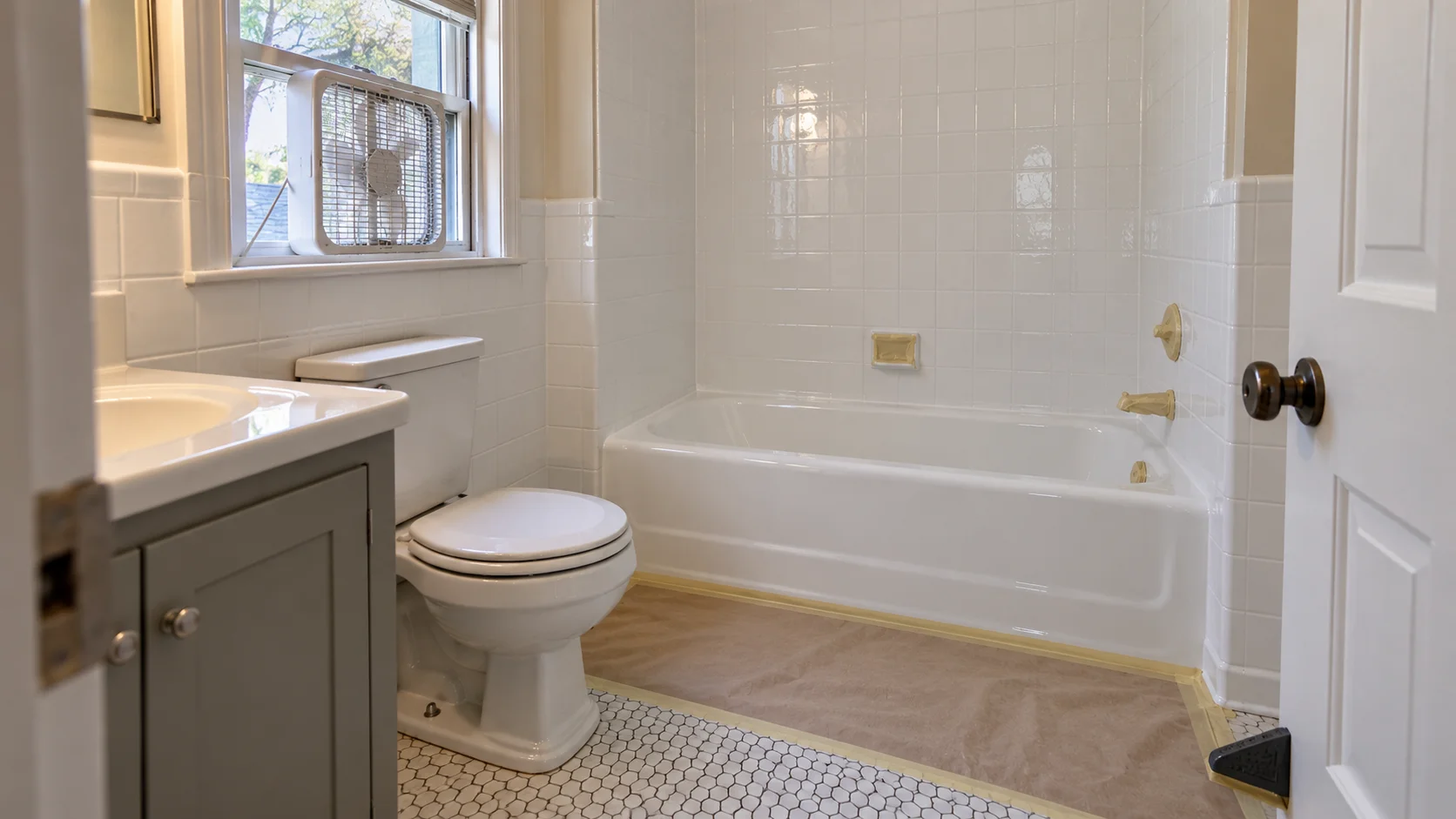
For tubs there is a published figure. Fixr says "a reglazed tub can last 10 to 15 years, but most will last somewhere between 8 and 10 years," and "you can reasonably expect to reglaze a tub two times." We found no reliable source that puts a number on painted tile or a DIY kit, so we will not invent one. Any coating lasts longest with mild, non-abrasive cleaners and a fan run after every shower.
Paint, Reglaze or Replace? Rough Costs
We do not price tile or tub work, so these are national figures from published cost sites, not New Jersey quotes from us.
| Option | Typical price | Source |
|---|---|---|
| Refinish a bathtub | $350 to $650, average $480 | Fixr |
| Refinish tub and shower together | $500 to $1,200 | Fixr |
| Refinish a bathtub | $740 to $1,501 per tub | Homewyse |
| Replace a bathtub | $5,000 to $7,000 | Fixr |
Homewyse's calculator includes delivery, site protection and small-job setup, and excludes hazardous material testing, plumbing repairs, permits and sales tax. Compare what each written quote includes. We found no reliable published figure for painting or reglazing tile alone.
- Paint dry wall tile that is sound when you just want a different color.
- Reglaze a tub or surround that is sound but stained, dull, chipped or an unwanted color.
- Replace when tiles are loose, the wall is soft, the tub is cracked or rusting through, or, in Fixr's words, "the damage is too extensive." A coating over a leak only hides it.
Safety: Methylene Chloride Strippers and Bathtub Refinishing
Read this before anyone strips an old tub. A 2012 CDC report, Fatal Exposure to Methylene Chloride Among Bathtub Refinishers, found that since 2000, "13 (75%) of the methylene chloride deaths investigated by OSHA occurred during bathtub refinishing." In the Michigan case it describes, the bathroom was about 5 by 8 feet with a small fan that was off, and the worker "did not wear respiratory protection." The report recommends that "alternative methods of bathtub stripping, such as sanding, should be used."
The OSHA and NIOSH hazard alert counted "at least 14 worker deaths since 2000" and explains that the vapor "can collect in the bottom of a bathtub and in the worker's breathing zone," that "exposure to as little as six ounces of methylene chloride-based material has been enough to cause death," and that "bathroom fans or open windows do NOT provide adequate ventilation."
The EPA's 2019 rule ended consumer sales of methylene chloride paint removers, and in April 2024 the agency finalized a ban on most uses, "including its use in home renovations," noting that "since 1980, at least 88 people have died from acute exposure to methylene chloride." When you hire a refinisher:
- Ask what they strip and etch with, and ask for the safety data sheet. If it lists methylene chloride or dichloromethane, find someone else.
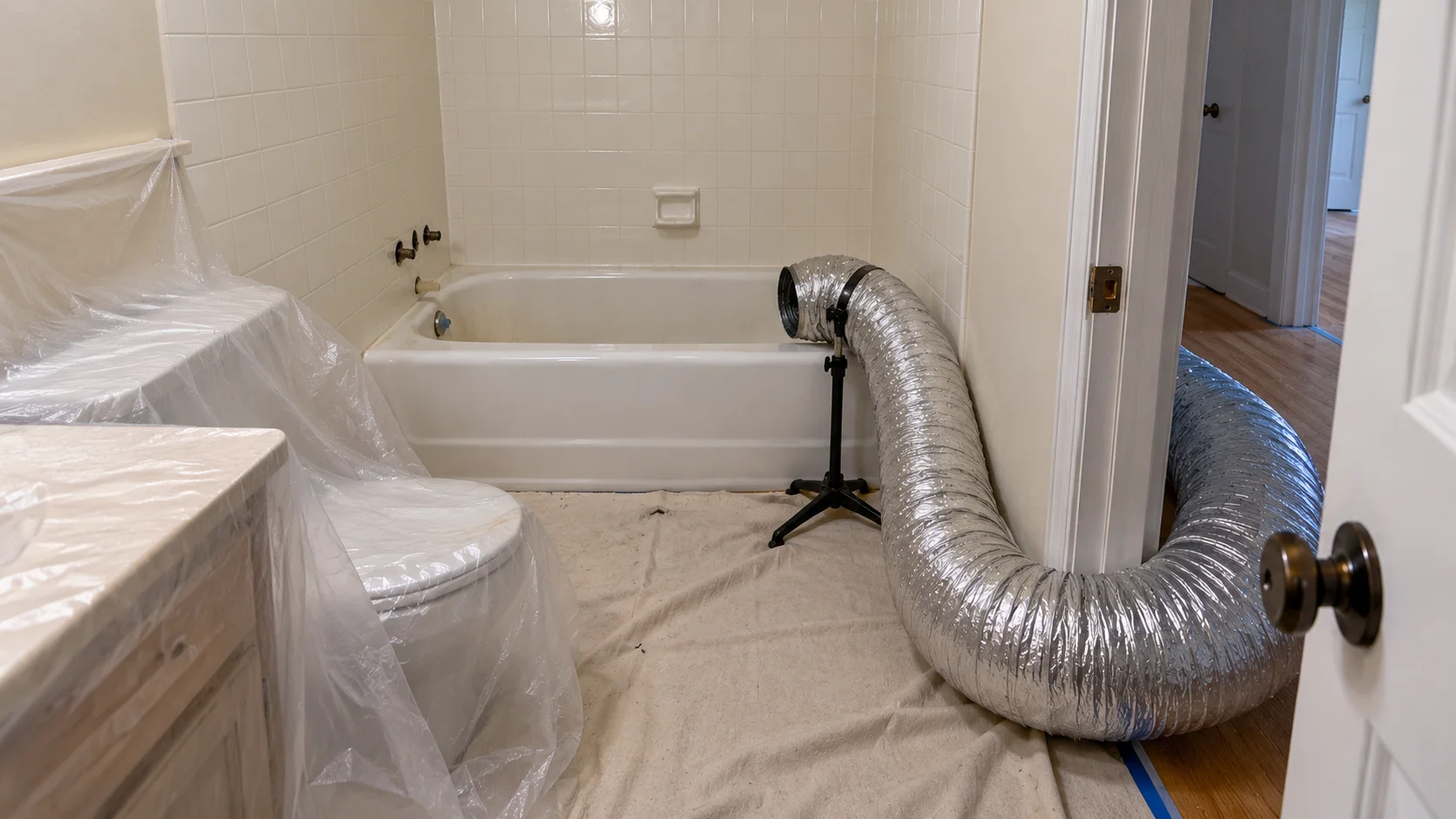
- Ask how they exhaust the room. The hazard alert describes portable units with a hood near the tub venting outdoors.
- Stay out of the bathroom while they strip and spray, and keep children and pets away.
Lead in Old Tub Glazes
A 2008 study by M.A. Hart, indexed in the EPA's HERO database, states that "porcelain enameled bathtubs produced in the early twentieth century contained lead" and that "bathtubs have been identified as the lead source during elevated blood lead level investigations." In its small sample of six tubs, the XRF readings analyzed were all positive for lead and the dust wipes were all above the detection limit, though bath water samples were not. The author concluded the likely source of surface lead "is porcelain deterioration."
Every data sheet in this guide also warns that sanding old coatings may release lead dust. If your tub or tile is from before 1978, have worn or chipped glaze tested before anyone sands it. Our guide to lead paint in older NJ homes explains testing and lead-safe work.
What a Painting Contractor Does, and Does Not, Take On
We are painters. We do not paint tile, reglaze tubs or refinish bathtubs. Whether you are in Bridgewater or elsewhere in Somerset County, our honest advice for a tub or shower surround is a dedicated reglazing company, with the safety questions above and the warranty in writing. For loose tile or a soft wall, call a tile contractor. What we do take on in the same room:
- Bathroom walls and ceilings in moisture-resistant paint, with stain-blocking primer over old water stains. See our interior painting service and our guide to the best paint for bathrooms.
- Trim and doors in a durable, wipeable sheen.
- Vanities, built-ins and kitchen cabinets, degreased, sanded, primed and sprayed. See our cabinet painting service, our cabinet painting cost guide and our comparison of refinishing vs painting vs refacing.
A sensible order is to have the tub and surround reglazed first, then the walls, ceiling, trim and vanity painted, so new paint is not exposed to the reglazer's prep and overspray.
Get Help With the Rest of the Room
NJ Painting Co. is a family-owned, licensed and fully insured painting company at 36 Church Rd, Morganville, NJ 07751, working on New Jersey homes for more than 20 years with Benjamin Moore and Sherwin-Williams products. Every estimate is free and includes an in-home color consultation, and our work carries a two-year workmanship warranty. Check coverage in Somerset County, Monmouth County and Middlesex County, call (732) 239-0932 or request a free estimate.
Frequently Asked Questions
Can you paint ceramic tile?
Yes, on walls in dry areas. Clean it, sand or degloss the glaze, apply a bonding primer made for tile such as Sherwin-Williams Extreme Bond or INSL-X Stix, then a quality interior paint. Tile in a shower, around a tub or sink, or on a floor will not hold ordinary primer and paint.
Can you paint shower tile?
Not with regular paint; bonding primers are not intended for continuous water contact. Two-part epoxy tub and tile kits are made for wet areas and need about three days before water, and reglazing companies spray coatings designed for showers. Loose tile or failing grout needs a tile contractor first.
Can you paint floor tile?
Only with a floor coating system made for it, such as Rust-Oleum HOME Floor Coating. Do the adhesion test on its data sheet, allow 24 hours before light foot traffic and 7 days for full cure, and do not use it inside a shower or on a garage floor.
Can you paint a bathtub?
Not with wall paint. A two-part epoxy kit can be brushed or rolled on after thorough cleaning and sanding and needs three days before water. A professional reglazer sprays a polyurethane or epoxy finish, and Fixr says the tub is usually ready within 24 to 48 hours.
How much does bathtub painting or refinishing cost?
Fixr puts bathtub refinishing at $350 to $650, average $480, and $500 to $1,200 for a tub and shower together. Homewyse's September 2026 estimate is $740 to $1,501 per tub. Replacement runs $5,000 to $7,000 according to Fixr, and Fixr says most reglazed tubs last 8 to 10 years. These are national figures.
Is bathtub refinishing safe?
It can be, with the right products and ventilation. OSHA and NIOSH counted at least 14 refinisher deaths from methylene chloride strippers since 2000, and the EPA has since banned most uses of the chemical. Ask what the refinisher strips with and how they exhaust the room.
Does NJ Painting Co. paint tile or refinish bathtubs in Somerset County or Bridgewater?
No. NJ Painting Co. does not paint tile or refinish tubs; for a tub or surround, call a dedicated tub reglazing company. We paint bathroom and kitchen walls, ceilings, trim, vanities and cabinets in Bridgewater and throughout Somerset, Monmouth, Middlesex, Ocean, Mercer and Burlington counties, plus Union, Essex, Hudson, Bergen and Passaic in North Jersey.
About the author
Written by the NJ Painting Co. team
NJ Painting Co. is a family-owned painting contractor based in Monmouth County, in business since 2004. We are licensed and fully insured, work with Benjamin Moore and Sherwin-Williams paints, and back our work with a 2-year workmanship warranty. We serve Monmouth, Middlesex, Ocean, Mercer, Somerset and Burlington counties, plus Union, Essex, Hudson, Bergen and Passaic in North Jersey.