Spraying gives kitchen cabinets the smoother, more factory-like finish, with no brush strokes and no roller texture. Brushing and rolling a self-leveling cabinet enamel can still look good, but some texture usually remains. Neither method rescues a bad job: degreasing, sanding, the right primer and a cabinet-grade enamel decide how long the finish lasts.
That is why the method matters less than the prep and the paint. A sprayed coat of wall paint over a greasy door will fail sooner than a brushed coat of cabinet enamel over a clean, sanded, primed one.
We are a family-owned painting company in Morganville, painting homes across Monmouth, Middlesex, Ocean, Mercer, Somerset and Burlington counties, plus Union, Essex, Hudson, Bergen and Passaic in North Jersey, for more than 20 years with Benjamin Moore and Sherwin-Williams products, and we spray the cabinets we paint. This guide explains why, what the alternatives look like, which paints are made for the job, and how long the finish takes to harden and lasts. The product details are taken from Benjamin Moore's and Sherwin-Williams' own data sheets. If you are looking for prices, see our separate guide to cabinet painting cost in NJ.
The Short Answer
- Finish: spraying gives the flattest, most even surface. Brushing leaves strokes; rolling leaves a fine orange-peel stipple.
- Both are approved methods. Benjamin Moore's ADVANCE and Sherwin-Williams' Emerald Urethane Trim Enamel, two common cabinet enamels, list brush, roller and spray application on their data sheets.
- Spraying needs more prep: doors come off, and everything that is not being painted has to be masked.
- Paint type matters more than method. Use a cabinet enamel such as a waterborne alkyd or urethane-modified alkyd, not wall paint.
- Prep matters most: degrease, scuff-sand, prime with a primer suited to the cabinet material.
- Cure takes weeks. Benjamin Moore says ADVANCE can take up to 30 days to reach full hardness.
- Lifespan: about 8 to 10 years for professionally painted cabinets with proper care, according to Fixr.
What Sprayed, Brushed and Rolled Cabinets Look Like
Sprayed
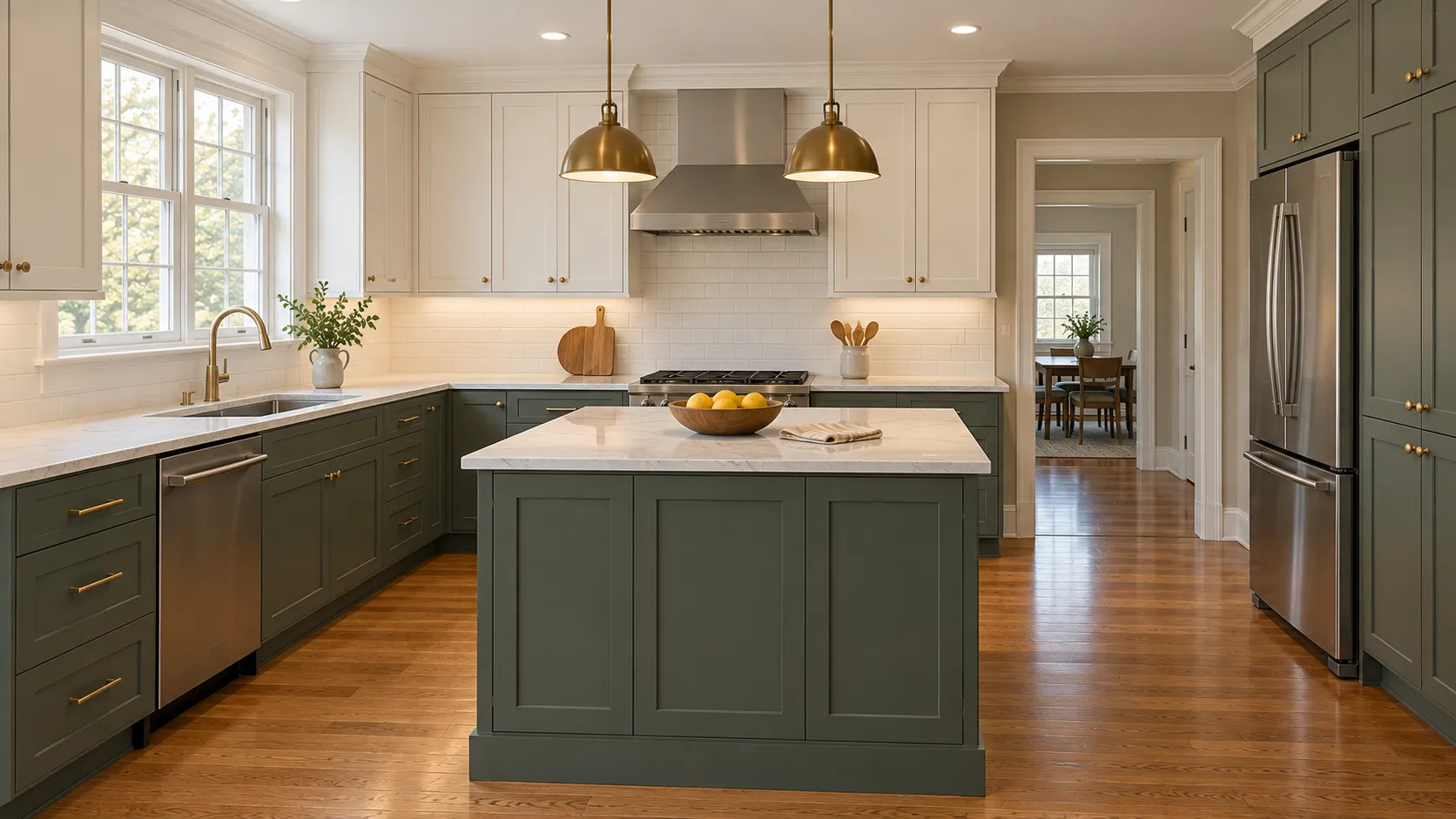
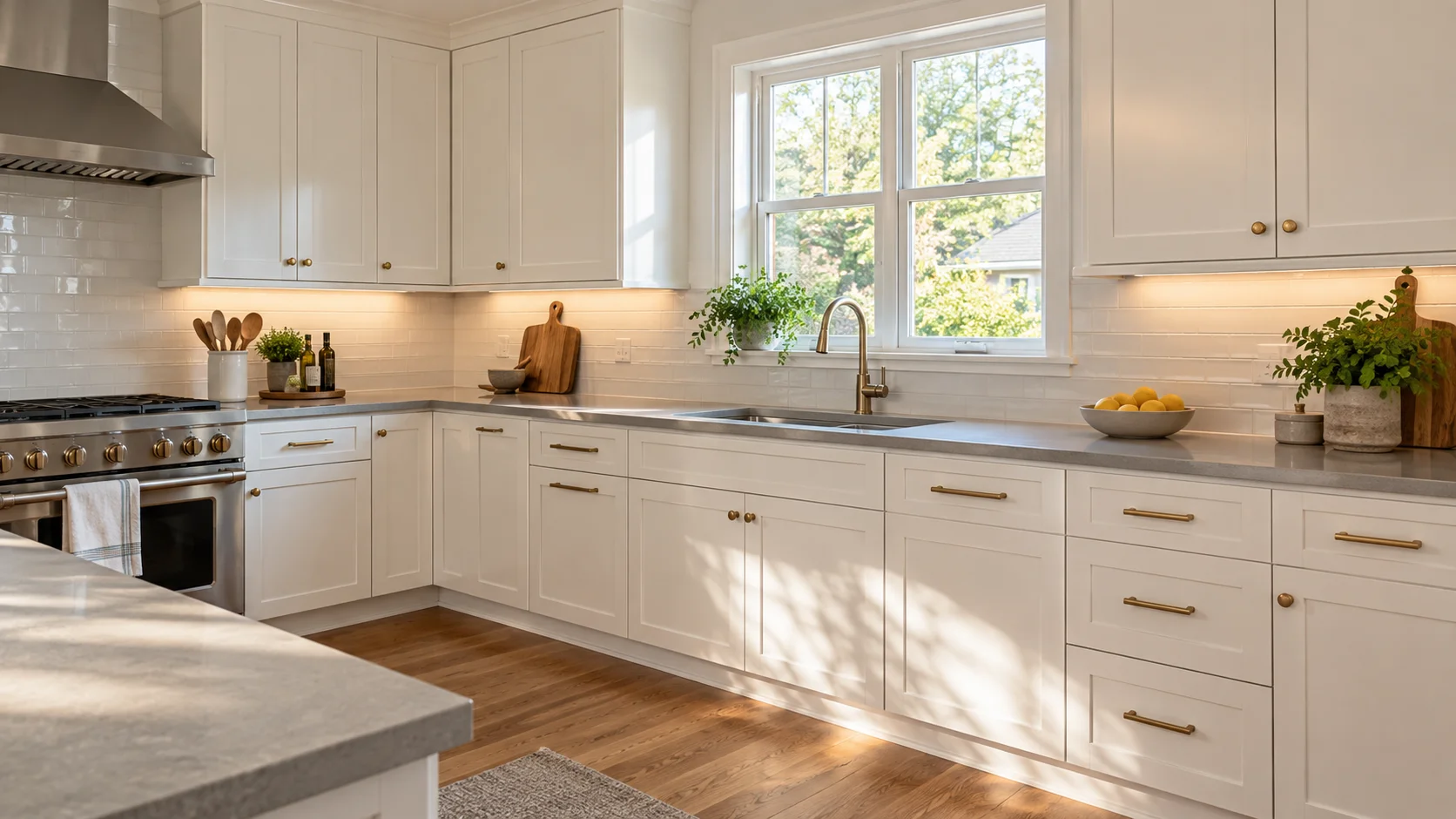
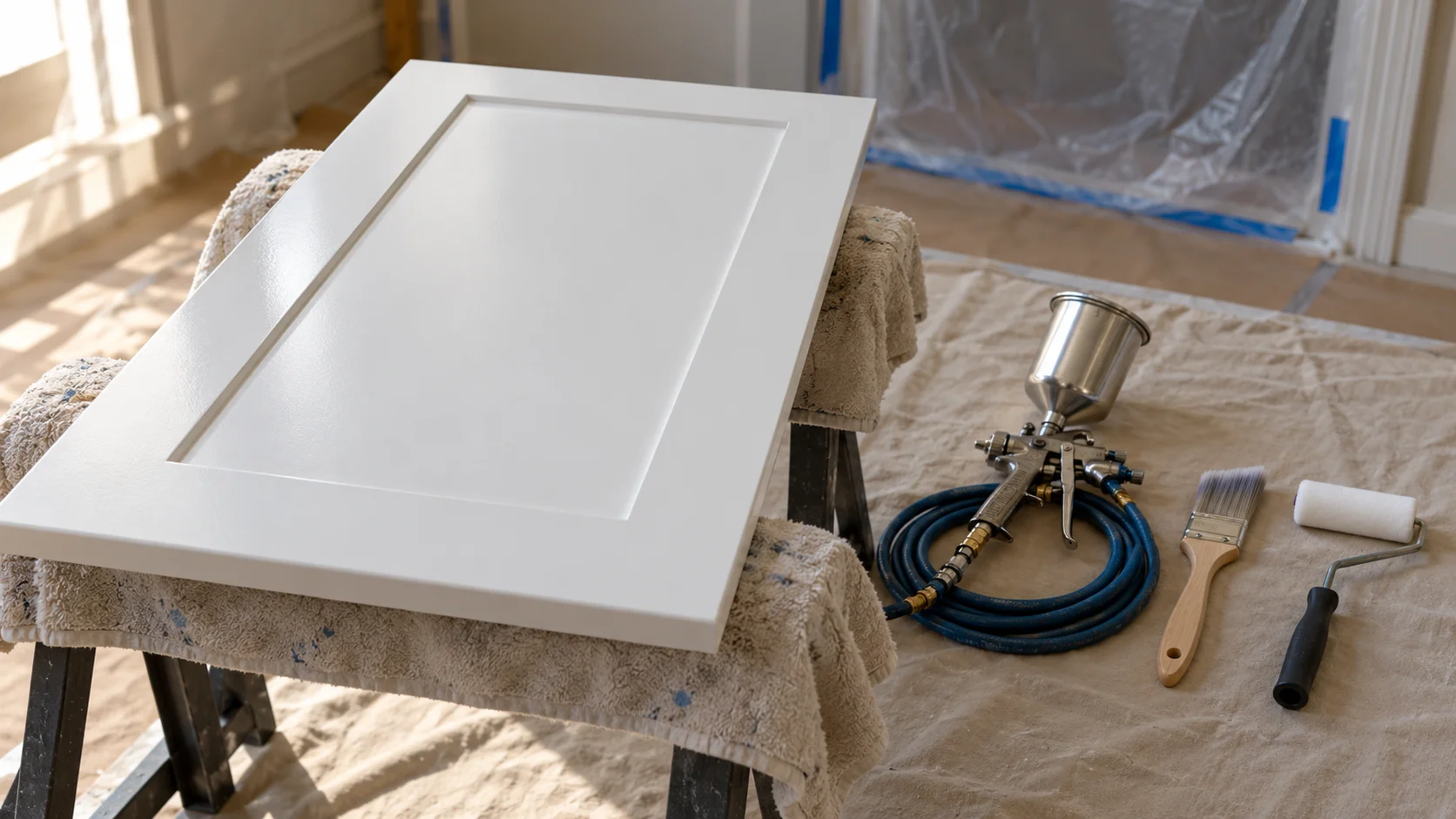
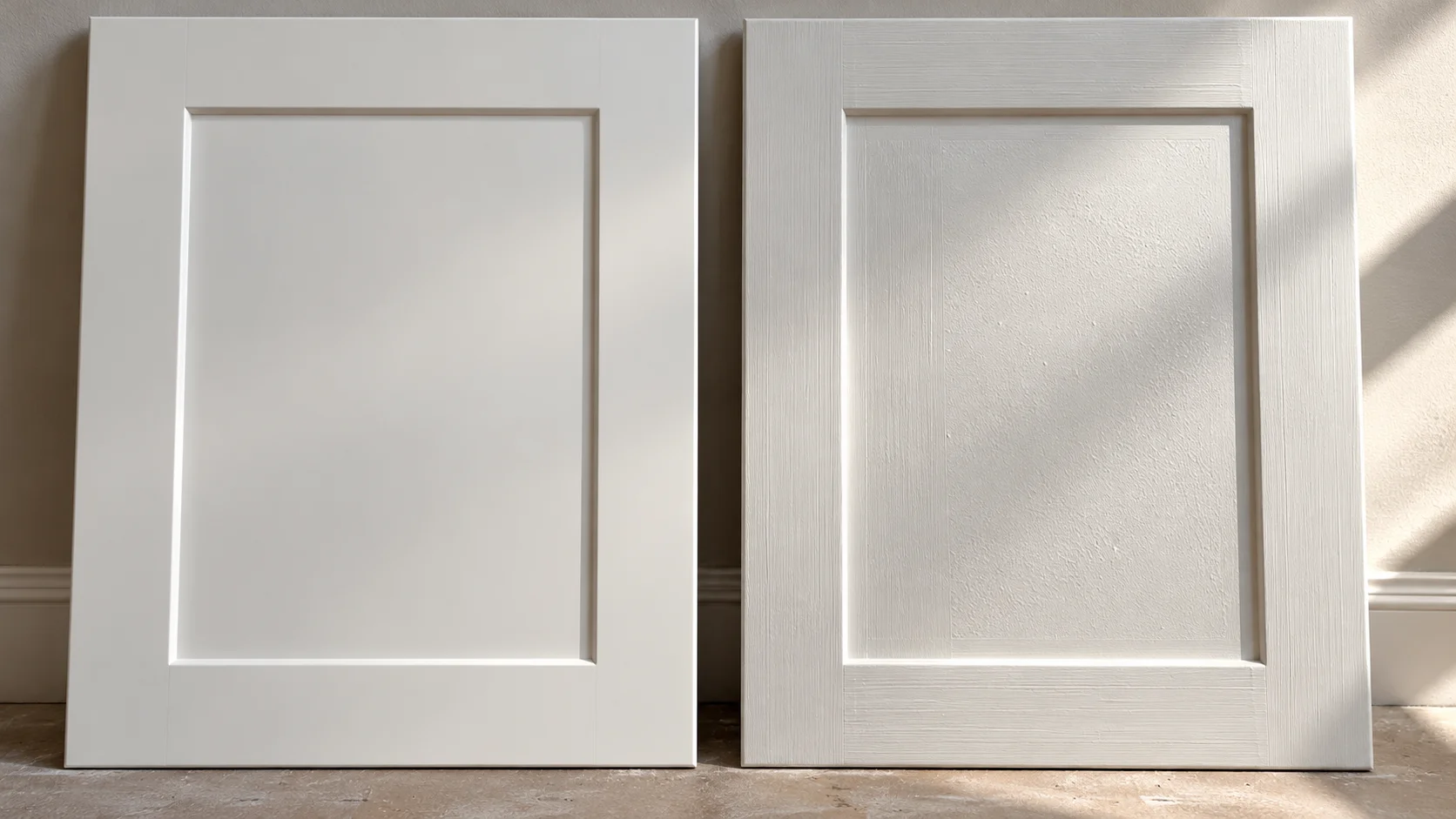
A spray gun breaks the paint into fine droplets and lays them down as a thin, even film. There are no bristle marks to level out and no roller nap to leave a pattern, so a sprayed door looks closest to the finish a cabinet factory puts on. It shows most clearly on flat shaker panels and slab doors, where raking light from a window picks up any texture.
Painters use two main kinds of sprayer on cabinets. An airless sprayer pumps paint at high pressure through a small tip. An HVLP (high volume, low pressure) sprayer uses a turbine to atomize paint with a large volume of air at low pressure, which puts more of the paint on the door and less in the air. The manufacturers give settings for both: Benjamin Moore's ADVANCE satin data sheet lists airless at 1,500 to 2,500 psi with a .011 to .015 tip, and HVLP at 20 psi; Sherwin-Williams' Emerald Urethane Trim Enamel data sheet lists airless at 2,000 psi with a .013 to .017 tip and an HVLP setup with no thinning.
Brushed and rolled
Sherwin-Williams' homeowner guide to painting kitchen cabinets uses a brush and roller, not a sprayer. Its technique is to "first apply paint to the recessed or detailed areas of the cabinet door" with a 1-inch or 1½-inch angled brush, then "immediately paint the remaining flat areas of the door using a mini roller." That combination works because modern cabinet enamels are made to flow out: Benjamin Moore describes ADVANCE as having "excellent flow and leveling properties" and "extended open time," and Sherwin-Williams says Emerald Urethane Trim Enamel has "excellent flow and leveling."
Done carefully with a good enamel, a brushed and rolled door looks clean from across the room. Up close in side light, you will usually still see some stroke lines in the profiles and a faint stipple on the flats. Some homeowners like that; it reads as hand-painted woodwork. Others want the smooth look of a factory door, and for that, spraying is the way to get it.
Spray vs Brush Cabinet Painting Compared
| Sprayed | Brushed and rolled | |
|---|---|---|
| Finish | Smooth and even, closest to a factory finish | Can be very good with a leveling enamel; some brush and roller texture usually remains |
| Prep and masking | Doors off; counters, walls, floors, appliances and openings fully masked against overspray | Less masking; doors can be painted on or off |
| Application speed | Fast once set up | Slower per door, especially on raised panels |
| Cost | Fixr describes spraying as "generally lower cost than brushing" | More labor time on each piece |
| Film build | Thin, even coats | Thicker in corners and profiles, where drips and sags can form |
| Touch-ups | Best done with the same paint, run through the spray tip first (Sherwin-Williams) | Easy with a brush |
| Best suited to | Whole kitchens, flat or shaker doors, a factory look | Small jobs, a vanity, touch-ups, a hand-painted look, DIY |
The touch-up point is easy to overlook. Sherwin-Williams' data sheet advises that "using the same method of application and batch to touch up with as that originally used will help improve touch up," and that "when original application was by spray, preconditioning of touch up paint by running it through the spray tip will help touch up appearance." In plain terms, keep the leftover paint, and expect a brushed touch-up on a sprayed door to look slightly different up close.
On cost, Fixr's cabinet painting cost guide lists spray painting as "generally lower cost than brushing," noting easier application but longer prep. That fits our experience: the time saved spraying goes into masking, setup and taking the doors down.
On Site or Off Site
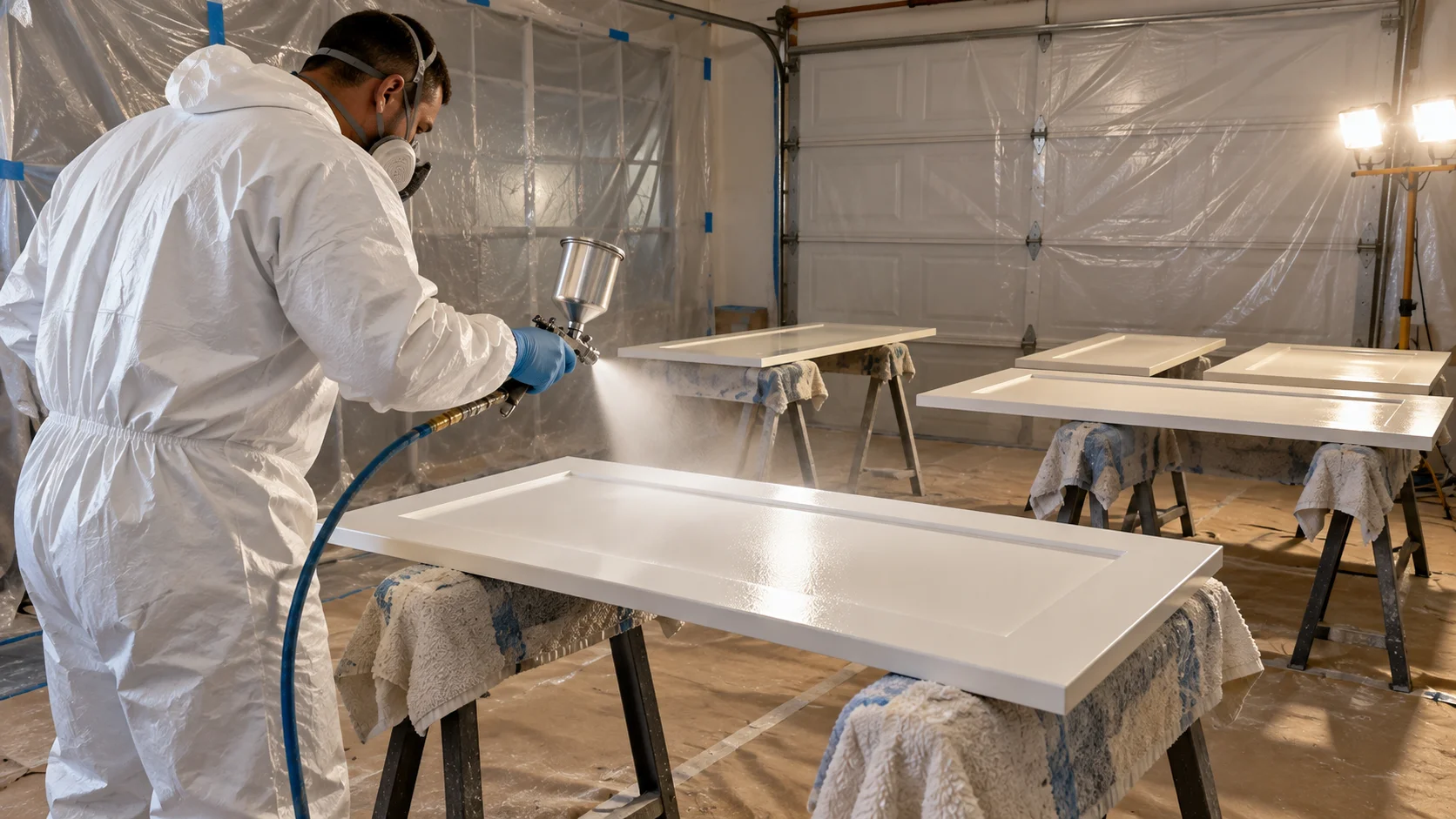
A sprayed cabinet job happens in two places. The doors and drawer fronts are removed, numbered to their openings and sprayed lying flat, where they can be coated on both faces and every edge. The boxes, face frames and end panels stay on the wall and are sprayed in place, with the counters, backsplash, walls, appliances and floor masked off. Some companies take doors away to a separate shop to finish them; others finish them in a masked spray area at the house. Ask any contractor where your doors will be and for how long.
Either way, ask about overspray control: masking has to cover everything within reach of the mist, and sanding dust has to be cleaned up before spraying, because dust that lands in wet finish stays there.
Which Paint to Use on Cabinets
Cabinet doors are handled every day, closed against a frame dozens of times, wiped with cleaners and splashed with cooking grease. Wall paint is not made for that. The products below are.
Waterborne alkyd enamels
A waterborne alkyd gives much of the flow and hardness of a traditional oil-based paint with soap-and-water cleanup. Benjamin Moore's ADVANCE is the best-known example; its data sheet describes it as "a premium quality, waterborne alkyd enamel that delivers the desired flow and leveling characteristics of conventional alkyd paint" and lists it as "ideal for interior doors, trim, cabinets, walls, and ceilings." It is listed as block resistant, which matters on doors that close against frames. It is also slow: 4 to 6 hours to touch and 16 hours before recoating at 77°F and 50 percent humidity.
Urethane-modified alkyd enamels
Sherwin-Williams' Emerald Urethane Trim Enamel is a waterbased enamel "formulated with a urethane modified alkyd resin system," which the company says "delivers the look, feel and durability of an oil based enamel with the convenience of a waterbased formula." Its product page is aimed directly at cabinets, doors and trim, and claims "excellent blocking resistance" and less yellowing than traditional oil-based paints. It dries faster than ADVANCE: 1 hour to touch and 4 hours to recoat under the same conditions. Sherwin-Williams' cabinet refinishing guide for contractors calls it "the best choice for most durable results."
Acrylic-alkyd enamels
The same Sherwin-Williams guide lists ProClassic Interior Waterbased Acrylic-Alkyd as another cabinet option, citing "excellent flow, leveling and sag resistance."
Traditional oil-based paint
Solvent-borne alkyd ("oil") enamel cures very hard, which is why it was the cabinet standard for decades. Its drawbacks are strong odor, solvent cleanup and yellowing, especially in whites and in rooms with little daylight. Benjamin Moore notes that even ADVANCE "yellows less than conventional alkyds" but that "a slight amount of yellowing may occur," most visibly in lighter colors and dark, poorly ventilated areas. The waterborne enamels above exist largely to get oil-like results without these problems. Our guide to paint fumes and VOCs explains why enamel work smells longer than wall paint and how to ventilate while it cures.
Wall paint: why not
Standard interior latex wall paint stays relatively soft and can stick to itself when two painted surfaces are pressed together, which is exactly what a door against a face frame does. Fixr notes that latex on cabinets may need touch-ups within one to two years, against 8 to 10 years for a properly done cabinet finish. Factory-style catalyzed finishes such as conversion varnish sit at the other end of the scale; our cabinet refinishing vs painting vs refacing guide explains where those fit.
Sheen matters too. Emerald Urethane Trim Enamel, for example, comes in satin, semi-gloss and gloss; the lower the sheen, the better it hides small dents, and the higher, the easier it wipes clean. Our paint sheen guide explains the difference, and our Benjamin Moore vs Sherwin-Williams comparison covers the two brands more broadly. For the color itself, see our list of kitchen cabinet paint colors.
Prep Decides Whether It Lasts
Whether the paint is sprayed or brushed, the same four steps come first.
- Degrease. Kitchen cabinets carry a film of cooking oil, heaviest near the range. Sherwin-Williams says cabinets should be "thoroughly cleaned with a good cleaner degreaser to remove all grease and oils that normally buildup on kitchen cabinetry over time." Rinse afterward, because degreaser residue is also an adhesion problem.
- Scuff-sand. Benjamin Moore's ADVANCE data sheet says cabinetry surfaces should be "roughened by sanding (220 grit or coarser) before priming." Sanding gives the primer something to grip on a factory finish. Fill dings and open joints at this stage, and grain-fill oak if you want the pores gone.
- Prime for the material. Benjamin Moore lists its waterborne alkyd primer for wood, MDF and thermofoil cabinets, a different high-hiding primer for laminate, and specialty primers for "bleeding woods, grease stains" and "hard glossy surfaces." Sherwin-Williams recommends Extreme Bond Primer for cabinets "because of its excellent adhesion," and for knots and tannin-rich wood indoors, spot-priming with an oil-based primer if staining shows through. Sand the primer smooth: it sands far more easily than the topcoat, and most of a door's final smoothness is decided here.
- Finish in thin coats with light sanding between. Benjamin Moore notes that "light sanding between coats allows for a smoother finish; all dust must be cleaned." Two finish coats is the norm on both data sheets.
Skipping any of these is the usual reason painted cabinets peel at the sink base or chip at the edges within a year or two. It is also why the spray-versus-brush question comes second: a perfect spray coat cannot hold on to grease.
Dry Time, Recoat Time and Cure Time
Three different clocks run on a painted cabinet, and confusing them causes most of the damage done to new finishes.
| Benjamin Moore ADVANCE (waterborne alkyd) | Sherwin-Williams Emerald Urethane Trim Enamel | |
|---|---|---|
| Dry to touch | 4 to 6 hours | 1 hour |
| Recoat | 16 hours | 4 hours |
| Return to use | Do not expose to heavy abrasion or return shelves to service for at least 5 to 7 days | Not stated; drying and recoat times depend on temperature, humidity and film thickness |
| Full hardness | Up to 30 days, depending on conditions | Not stated |
| Minimum application temperature | 50°F surface | Above 50°F |
Humidity slows everything. Benjamin Moore's data sheet says ADVANCE "will dry slower than normal" above 50 percent relative humidity or between 50°F and 70°F unless the room is ventilated with a fan or air conditioning, and should not be applied at all above 85 percent humidity or below 50°F. On a humid New Jersey summer day, that is a real constraint, and it is one reason a cabinet job can take longer in July than in October.
What this means for you after the job: the doors can go back up within a day or two, but treat them gently for the first few weeks. Close doors softly, do not overload shelves for the first week, hold off on shelf liner, and clean with a soft cloth and mild soap rather than abrasive pads or strong degreasers until the finish has had a month.
How Long Does a Painted Cabinet Finish Last?
Fixr puts the lifespan of professionally painted cabinets at about 8 to 10 years with proper care, with alkyd and oil-based finishes lasting longest. The first wear usually appears where hands and feet meet the cabinets: the sink base, the trash pull-out, the edges of the drawers you use most, and the toe kick. A well-prepped finish can be touched up along the way, which is one advantage painted cabinets have over thermofoil or laminate that cannot be repaired once they fail.
Spraying does not by itself make the finish last longer. What makes it last is clean surfaces, the right primer, a cabinet-grade enamel at the right film thickness, and enough cure time before heavy use. Spraying is what makes it look smooth.
Which Should You Choose?
Spray a whole kitchen, flat or shaker doors where texture shows, or anything where you want a factory look. Brushing and rolling is reasonable for a single vanity, touch-ups, a deliberately hand-painted look, or a DIY job where masking a room for a sprayer is not practical. Either way, do not compromise on degreasing, sanding, primer or paint type.
How We Paint Cabinets
We spray. Doors and drawer fronts are removed, numbered to their openings and sprayed flat; boxes, face frames and end panels are masked off and sprayed in place. Every surface is degreased, sanded and primed with a primer chosen for the cabinet material, and finished with Benjamin Moore and Sherwin-Williams cabinet enamels in the color and sheen you choose. One limit: in a house built before 1978, sanding the cabinets is work covered by the EPA's Renovation, Repair and Painting rule, which requires anyone paid to do that work to be certified. That holds even for a kitchen installed after 1978, unless a certified inspector, risk assessor or renovator has determined in writing that the surfaces being disturbed are lead-free; the EPA says only a certified renovator, inspector or risk assessor can make this determination. NJ Painting Co. is not an EPA Lead-Safe Certified firm, so tell us the age of the house at the estimate, and ask any bidder on a pre-1978 kitchen for its firm certificate. Our guide to lead paint in older NJ homes explains the rule. You can see the full process on our kitchen cabinet painting page and what it costs in the cabinet section of our cost guide.
NJ Painting Co. is a family-owned, licensed and fully insured painting company at 36 Church Rd, Morganville, NJ 07751. Every estimate is free and includes an in-home color consultation, and our work carries a two-year workmanship warranty. We paint cabinets across Monmouth County, Ocean County and Middlesex County, as well as Mercer, Somerset and Burlington counties, plus Union, Essex, Hudson, Bergen and Passaic in North Jersey. Call (732) 239-0932 or request a free estimate.
Frequently Asked Questions
Is it better to spray or brush kitchen cabinets?
Spraying gives the smoothest, most factory-like finish because there are no brush strokes or roller texture. Brushing and rolling with a self-leveling cabinet enamel can still look good, and both methods are approved on the manufacturers' data sheets. Prep and paint type matter more to how long the finish lasts than the method does.
Is spraying cabinets more expensive than brushing?
Not necessarily. Fixr describes spray painting as generally lower cost than brushing because application is faster, though prep and masking take longer. Brushing takes more labor time on each door.
What is the best paint for kitchen cabinets?
A cabinet-grade enamel, not wall paint. Common choices are waterborne alkyds such as Benjamin Moore ADVANCE and urethane-modified alkyds such as Sherwin-Williams Emerald Urethane Trim Enamel, both made for cabinets, doors and trim. Acrylic-alkyd hybrids are another option. Traditional oil-based enamel cures hard but yellows more.
Can you paint cabinets without sanding?
The manufacturers say to sand. Benjamin Moore's ADVANCE data sheet says cabinetry surfaces should be roughened by sanding with 220 grit or coarser before priming. Some bonding primers are made for hard-to-stick surfaces, but sanding a factory finish is still the safer way to get the primer to hold.
How long should cabinet paint dry before rehanging doors?
Follow the recoat time between coats, which is 16 hours for ADVANCE and 4 hours for Emerald Urethane Trim Enamel in good conditions, and longer in humidity or cold. Doors can usually be rehung within a day or two of the final coat, but Benjamin Moore says to wait at least 5 to 7 days before heavy use and up to 30 days for full hardness.
Can I paint kitchen cabinets myself?
Yes, and the result depends far more on your patience than on the tool. Degrease every surface, sand to 220 grit or coarser as Benjamin Moore's ADVANCE sheet says, prime for the material, and use thin coats of a cabinet enamel rather than wall paint. Brushing and rolling is the practical route in a home kitchen, because a sprayer means masking the room. The real costs are days without a kitchen and waiting for the enamel to harden: 16 hours between coats, and 5 to 7 days before shelves go back. In a pre-1978 house, read about the lead rule before you sand.
How long do painted kitchen cabinets last?
About 8 to 10 years with proper care, according to Fixr. The finish lasts when the cabinets were degreased, sanded and primed properly and painted with a cabinet enamel. Wall paint on cabinets often needs touch-ups within a year or two.
Can I touch up sprayed cabinets with a brush?
Yes, for small chips, though a brushed touch-up can look slightly different up close. Sherwin-Williams recommends touching up with the same paint batch and method as the original, and running touch-up paint through the spray tip first where the original was sprayed. Keep your leftover paint.
About the author
Written by the NJ Painting Co. team
NJ Painting Co. is a family-owned painting contractor based in Monmouth County, in business since 2004. We are licensed and fully insured, work with Benjamin Moore and Sherwin-Williams paints, and back our work with a 2-year workmanship warranty. We serve Monmouth, Middlesex, Ocean, Mercer, Somerset and Burlington counties, plus Union, Essex, Hudson, Bergen and Passaic in North Jersey.