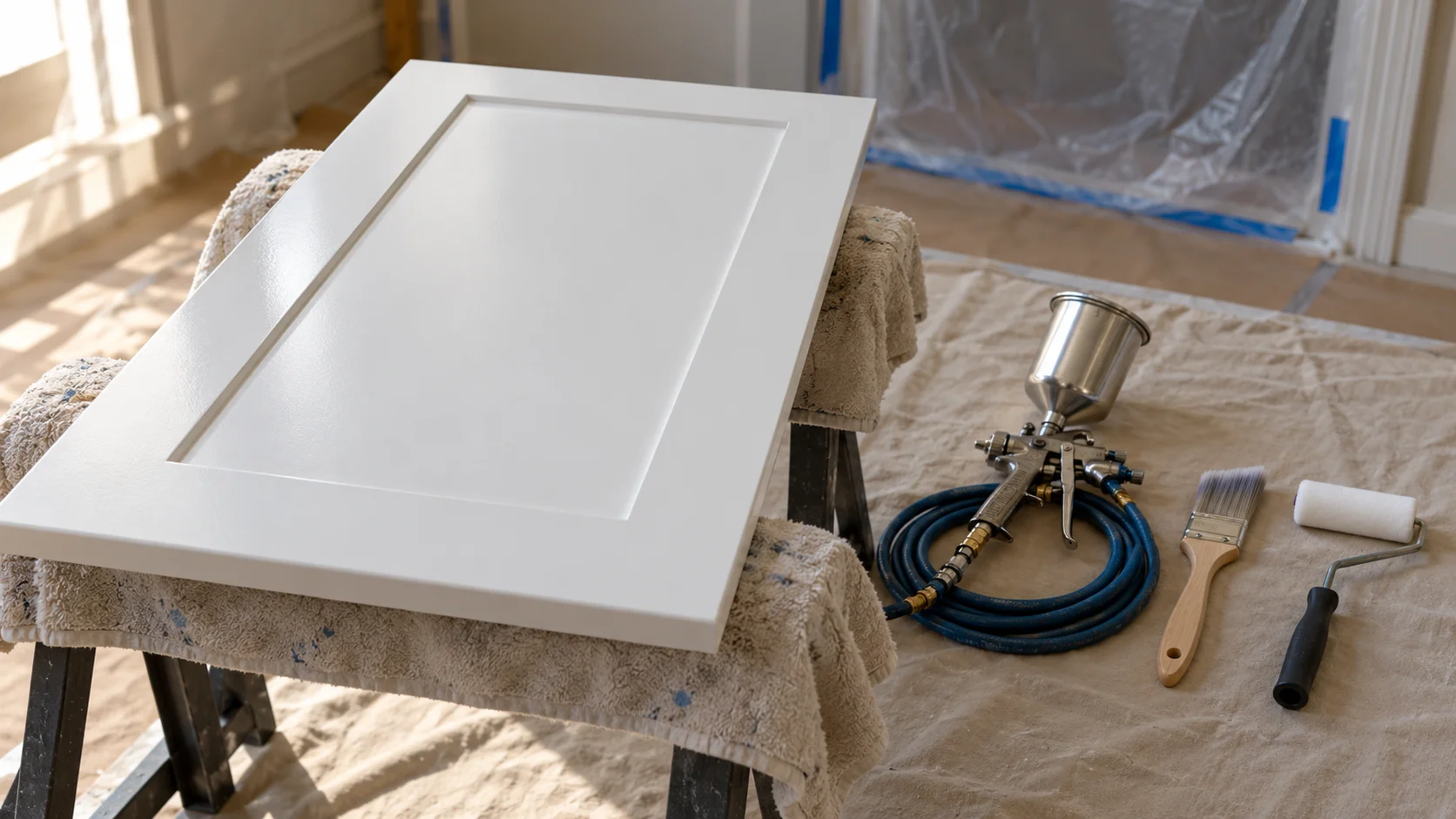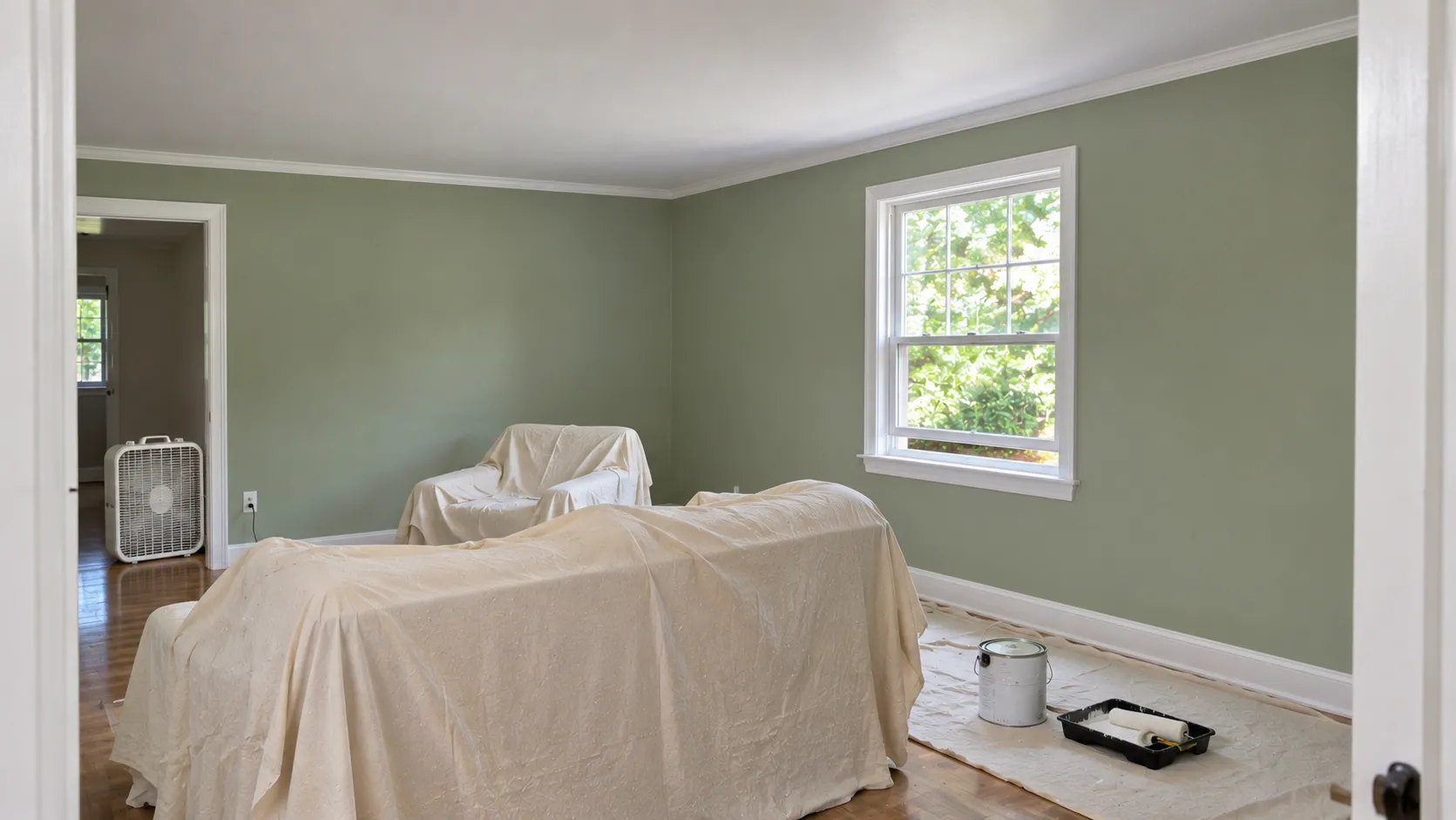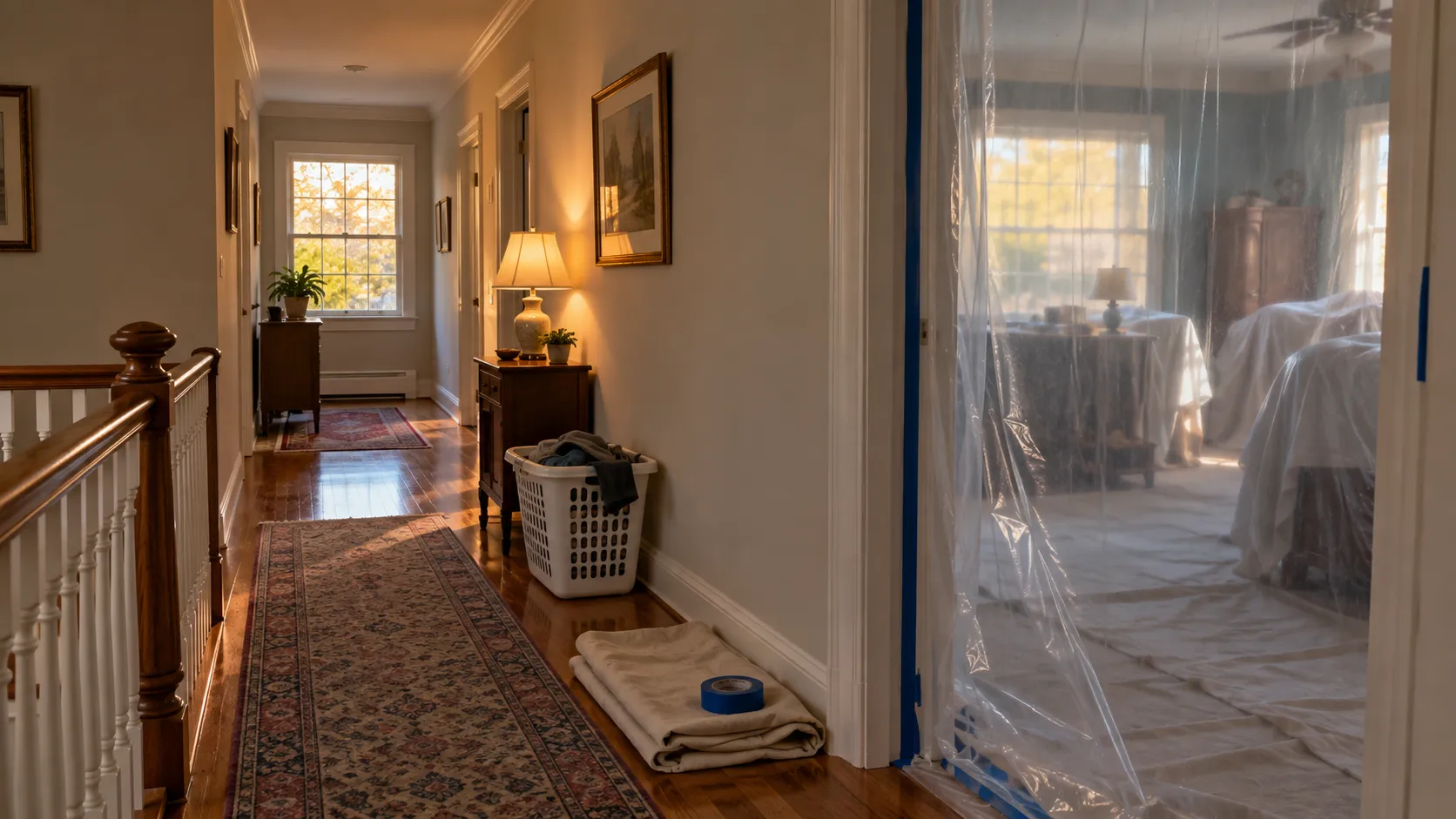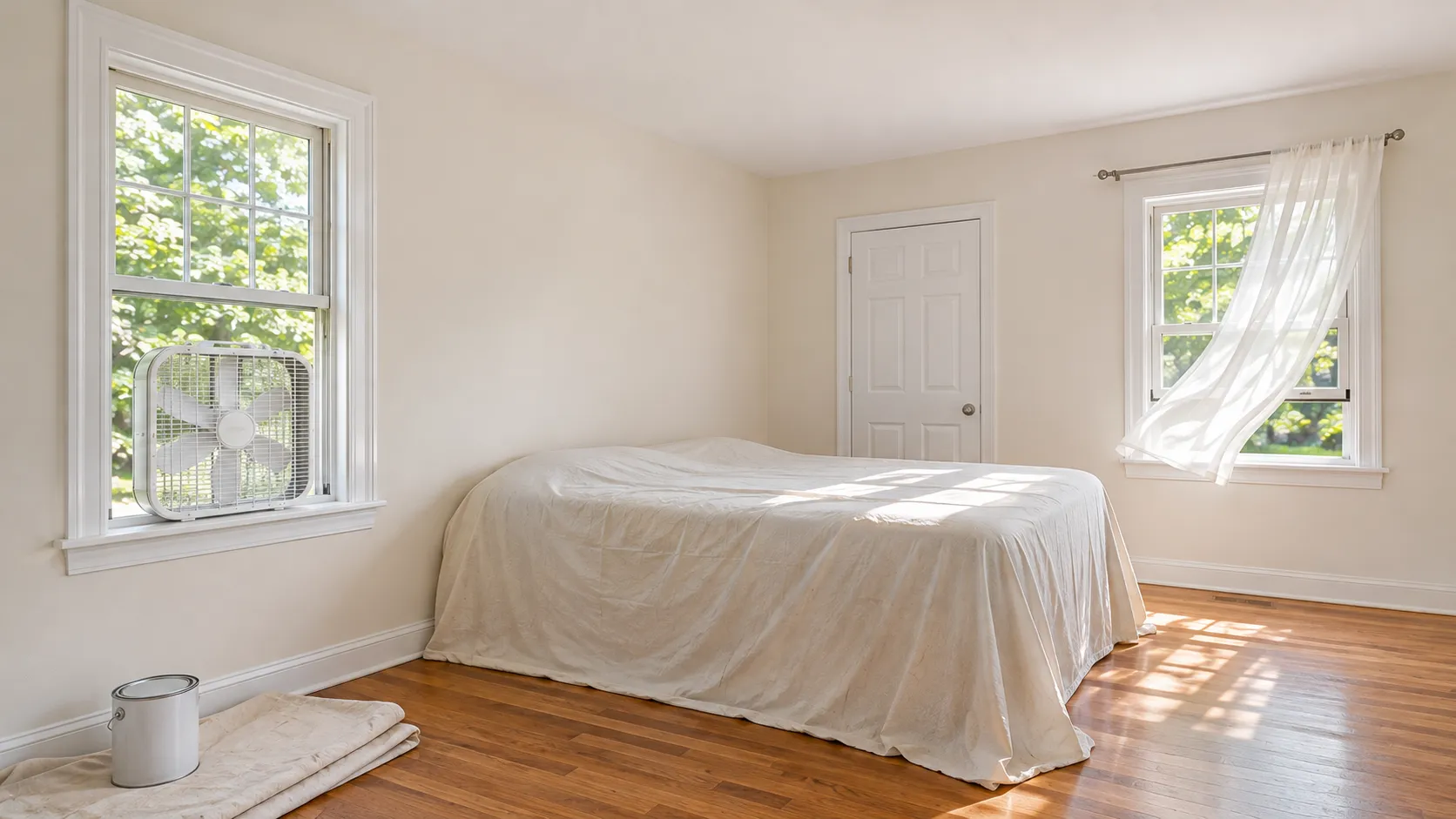
The way to get rid of paint smell is to replace the air in the room with outdoor air, and keep doing it until the paint has finished giving off vapor: a box fan in a window blowing out, a second opening on the far side of the room or house to let fresh air in, interior doors to the rest of the house kept shut, and the arrangement left running for two or three days. Almost everything else people try, from bowls of baking soda to halved onions, either does very little or only covers the smell with another one.
We are a family-owned painting company in Morganville, founded in 2004, and we paint the insides of New Jersey houses across Monmouth, Middlesex, Ocean, Mercer, Somerset and Burlington counties, plus Union, Essex, Hudson, Bergen and Passaic in North Jersey, using Benjamin Moore and Sherwin-Williams products. "How do we get the smell out?" is one of the questions we hear most on the last day of an interior job. This guide is the long answer: what removes it, what is folklore, how long it lasts for each kind of paint, which smells mean something has gone wrong, and what to do in a closed-up house in January.
Every product figure below was read from the manufacturer's own technical data sheet or safety data sheet, and every health and ventilation statement from the EPA, the Consumer Product Safety Commission, the CDC or the American Lung Association, on 26 November 2026. Where something is our own experience rather than a published fact, we say so.
The Short Answer
To get rid of paint smell, exhaust the room to the outdoors: put a box fan in the painted room's window facing out, open a window or door elsewhere so fresh air can come in, close the room off from the rest of the house, and run it for the two to three days the EPA and CPSC's painting guide recommends. Keep the room warm. A purifier helps only if it has a large activated-carbon filter; HEPA alone does not catch gases. Baking soda, onions, coffee and candles mostly mask or barely touch it.
What Is the Smell of Paint, Actually?
The smell of paint is the vapor of the liquids that make paint flow, leaving the film as it dries and hardens. The carrier liquid and some additives are meant to leave the film, and when they do, they go into your air.
What is leaving depends on the paint. In a modern waterborne latex, most of the carrier is water, which has no smell. What you notice is the small amount of slower organic liquids that help the latex particles fuse into a continuous film, plus traces of ammonia and other additives used to stabilise the can. A study of long-term emissions from building products by Peder Wolkoff, published in Atmospheric Environment in 1998, tested a waterborne wall paint on gypsum board and named its main compounds of concern as 1,2-propanediol (propylene glycol) and Texanol, a coalescing solvent. Coalescents evaporate slowly by design, which is why a latex room smells for a day rather than an hour.
In an oil-based (alkyd) paint or primer the carrier is a petroleum solvent. Benjamin Moore's data sheet for its Fresh Start Multi-Purpose Oil Based Primer 024 lists the clean-up thinner as mineral spirits, says the product "contains: petroleum distillates" and gives the way it dries as "evaporation, oxidation." That second word matters: an alkyd film goes on reacting with oxygen in the air after the solvent has gone, and that slow chemistry has a smell of its own.
Two things about smell itself are worth knowing before you start judging progress with your nose. First, smell and harm are not the same measurement. Some compounds smell strongly at harmless levels, and some can be present without much smell at all. Second, your nose gets used to things. Researchers define olfactory adaptation as a "mechanism resulting from repeated or prolonged odorous exposure that can induce a perceptual decrease," in the words of a 2022 paper in the European Archives of Oto-Rhino-Laryngology. If you have been in the house all day, you are the worst judge of whether the smell has gone: step outside for ten minutes and walk back in.
For the chemistry of VOCs, what "low-VOC" and "zero-VOC" mean, the New Jersey and federal VOC limits, and when a painted bedroom, nursery or pet's room can be used again, our guide on paint fumes, VOCs and when it is safe to sleep in a painted room covers it in depth. The short version: paint is one of the household VOC sources the EPA lists, a zero-VOC label is not a promise of no smell, and ventilation during drying, not just during painting, is what the labels require. This article deals with getting the smell out.
How Do You Get Rid of Paint Smell? Every Method, Ranked
There are two ways to remove a gas from a room. You can dilute it, by swapping the room air for outdoor air, or you can capture it, by passing the air through something that holds onto the gas. A third family of methods does neither: it adds a stronger smell on top, or does nothing measurable while making you feel you have acted. Here is how the methods people actually try fall into those three groups, with our verdict.
| Method | What it actually does | Evidence | Our verdict |
|---|---|---|---|
| Box fan in a window, blowing out, with a fresh-air opening elsewhere | Dilutes: replaces room air with outdoor air many times an hour | EPA/CPSC Healthy Indoor Painting Practices; American Lung Association; both brands' labels | The method. Everything else is a supplement. |
| Windows open without a fan (cross-ventilation) | Dilutes, more slowly and depending on wind | EPA/CPSC: "if fans cannot be used, make sure that rooms being painted have adequate cross-ventilation" | Good when there is a breeze; a fan makes it predictable |
| Bathroom or kitchen exhaust fan | Dilutes, if it truly vents outdoors | EPA says these "remove contaminants directly from the room"; the EPA/CPSC guide warns they "do not always vent out-of-doors" | Useful in winter; check where the duct goes |
| Keeping the room warm | Speeds release, so the smell finishes sooner | EPA's Inside Story; Wolkoff 1998; data sheets on cool temperatures | Helpful, if you ventilate at the same time |
| Air purifier with a large activated-carbon filter | Captures some gas by adsorption | EPA Guide to Air Cleaners in the Home | Helps a little; thick carbon only; not instead of fresh air |
| HEPA-only air purifier | Catches particles; does not capture gases | EPA: "most filters are designed to filter either particles or gases" | Useful for sanding dust, not for paint smell |
| Ozone generator "air purifier" | Adds a lung irritant to the room | EPA: "Ozone is a lung irritant"; no federal agency has approved them for occupied spaces | Do not use |
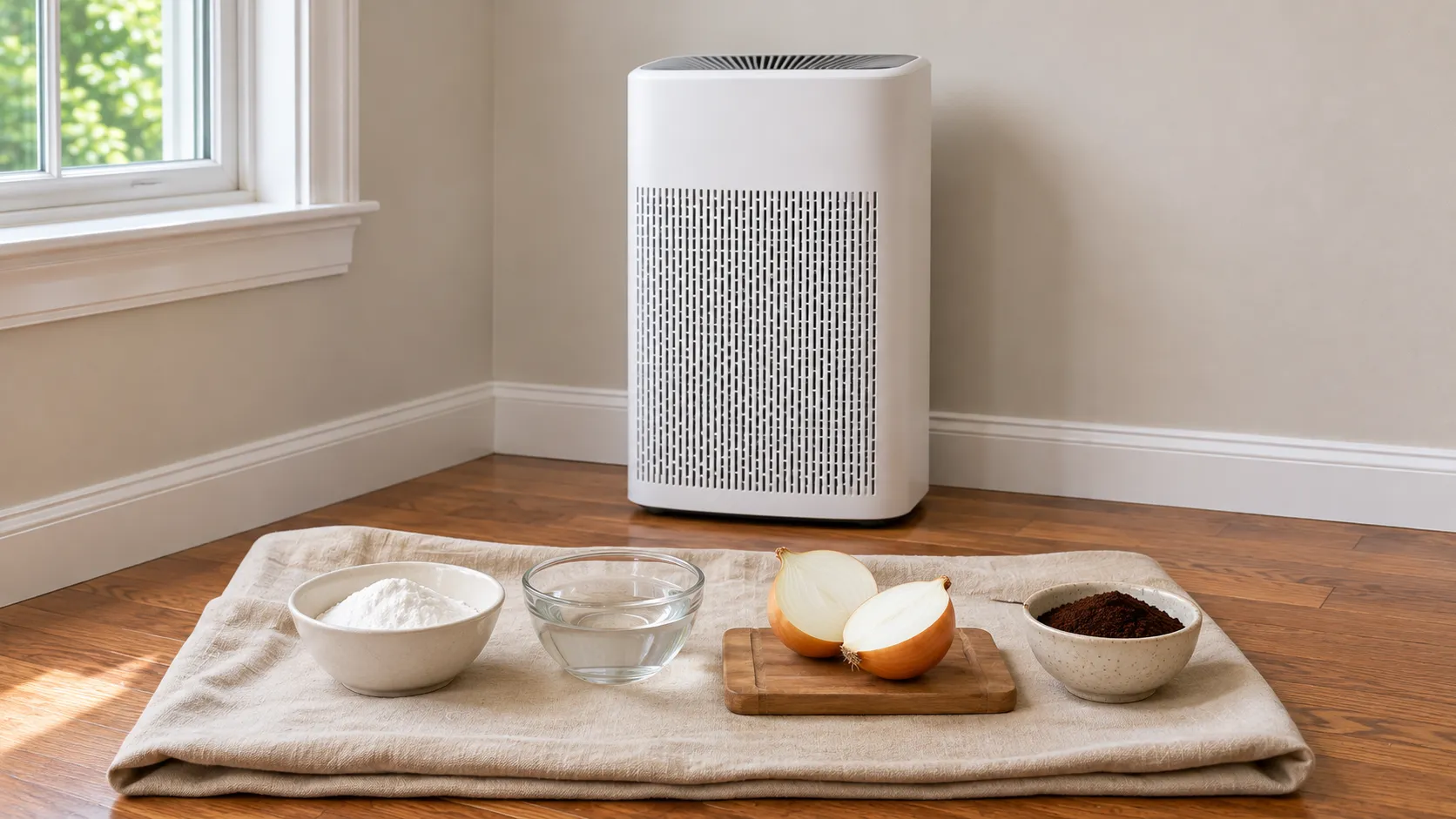
| Bowls of baking soda | Reacts with acidic or alkaline odor molecules on its surface | Arm & Hammer's own explanation; no paint-specific evidence found | Very little effect on paint solvents |
| Charcoal bags | Small amount of carbon adsorbs a small amount of gas | EPA: carbon works with "a large amount of material" | Too little carbon to matter in a room |
| Vinegar, onions, coffee grounds, lemon | Add their own smell; no meaningful capture | None found | Masking at best |
| Scented candles, air fresheners | Add more smell and, for candles, an open flame | Labels on solvent products: keep away from flame | Do not, especially with oil, shellac or spray paint |
What Is the Fastest Way to Get Paint Smell Out of a Room?
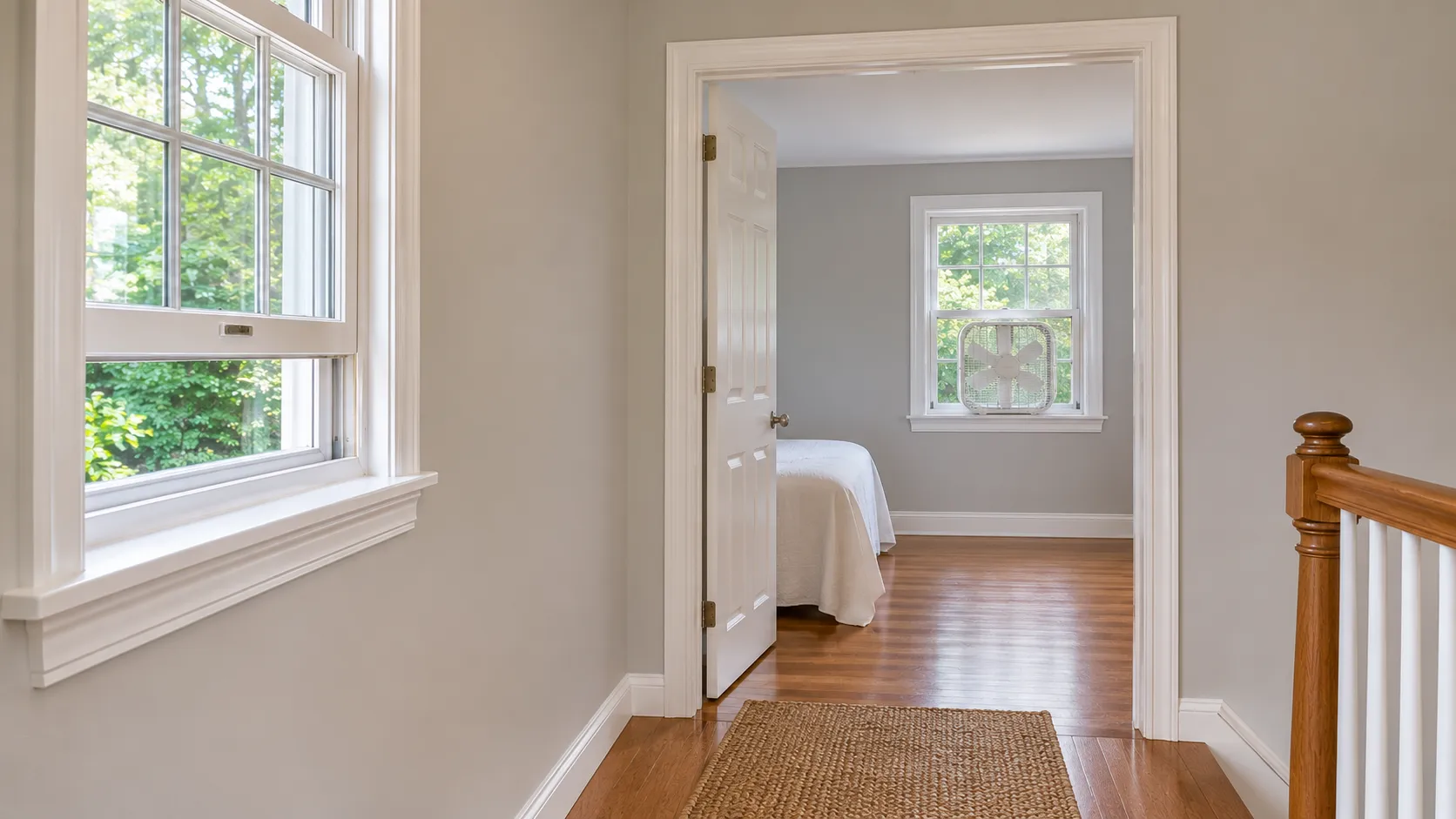
The fastest way to get paint smell out of a room is to exhaust that room directly to the outside with a fan, while letting fresh air in from somewhere else. That is not our invention; it is what the EPA and CPSC's painting guide says to do: "Use window-mounted box fans to exhaust vapors from the work area. Make sure they cannot fall out of the window." And elsewhere in the same guide: "Place a box fan securely in the window blowing out to ensure air movement. Do not point the fan directly at someone else's space." The American Lung Association gives the same instruction in one line: "open windows and add a fan to pull the indoor air outside."
Here is how we set it up at the end of a day on an interior job, and how we suggest homeowners keep it running after we leave:
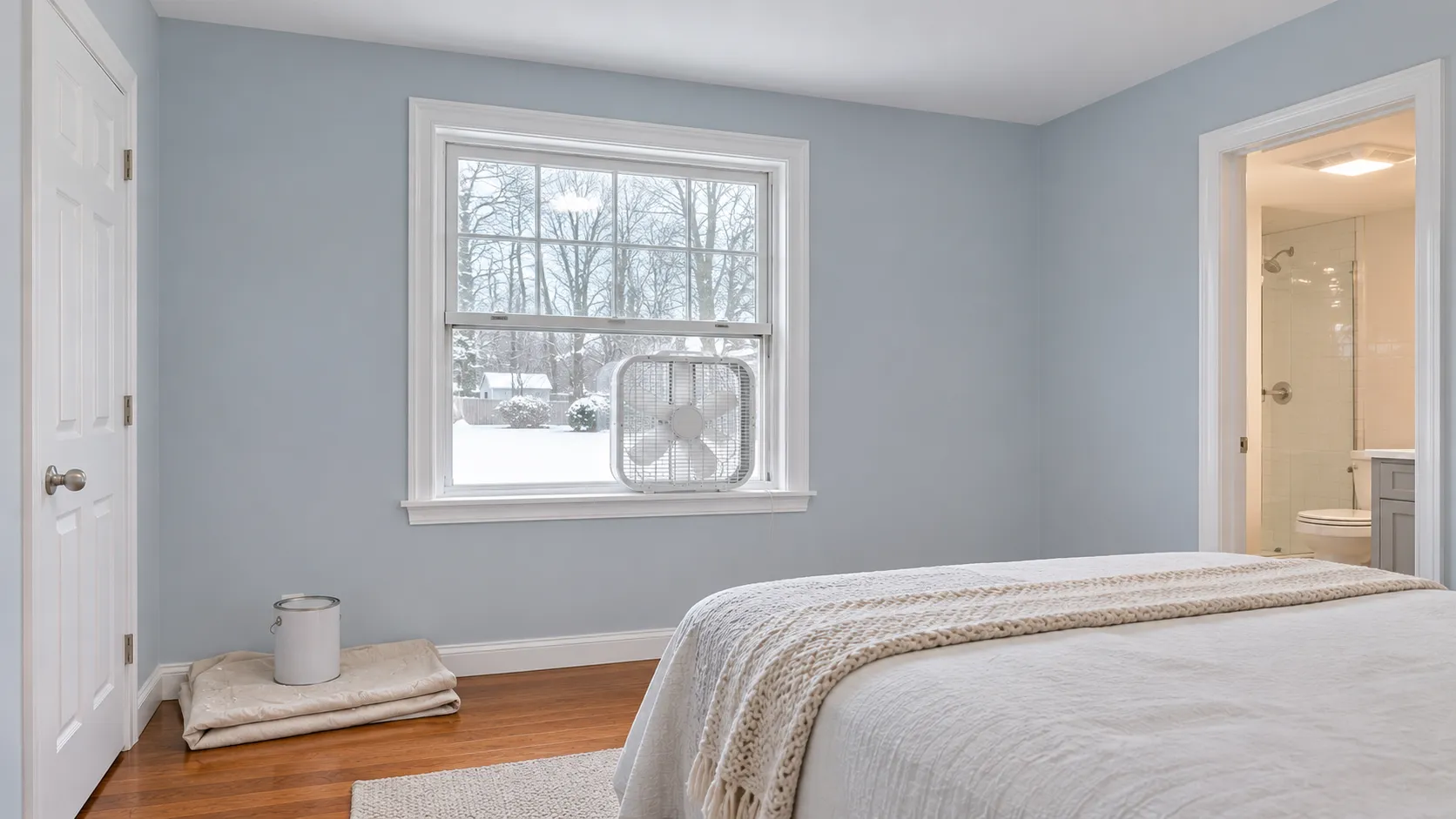
- One fan, in the painted room's window, blowing out. A plain 20-inch box fan in the lower sash suits most bedrooms. Close the sash onto the fan or fill the gap beside it with cardboard, so it pulls air from the room rather than recirculating outdoor air around its edges. The EPA/CPSC guide also says that if it rains or snows, "turn the fan off and remove it from the window to avoid an electrical shock hazard."
- A fresh-air opening at the other end of the path. If the room has a second window, open it a few inches. If it does not, leave the room's door open and open a window or a door at the far side of the house, so the fan is pulling outdoor air through the house and across the room.
- Close the rest of the house off from the painted room where you can. The path should run from outdoors, through as little of the house as possible, across the paint and straight back out.
- Do not point a fan at the wet wall. A fan blowing across fresh paint speeds the surface skinning over, can blow dust into it, and pushes vapor into the rest of the house. Wolkoff's study found "primary source emissions were not affected by the air velocity after a few days to any great extent": a breeze across the wall does not make it give up solvent much faster. Removing the vapor from the air does the work.
- Leave it running for the two to three days the EPA/CPSC guide recommends. With a zero-VOC latex in a warm room, in our experience, the first day does most of the work; enamels and oil-based primers need the full time and sometimes longer.
A whole-house attic fan, if you have one, does the same job for the whole house: open the windows in the painted rooms and run it. Central air does the opposite; it recirculates, and spreads the smell to every room on the system. The EPA/CPSC guide is blunt: "An air conditioning unit should not be substituted for the use of a fan."
Why Does Ventilation Beat Every Other Method? Air Changes per Hour, Explained
Ventilation engineers measure fresh air in air changes per hour, usually written ACH: the number of times in an hour that a volume of air equal to the room is replaced with outdoor air. The EPA's guide The Inside Story puts it this way: "The rate at which outdoor air replaces indoor air is described as the air exchange rate." It also gives a benchmark for a closed-up house: ASHRAE, the engineering body that writes ventilation standards, "recommends a ventilation rate of 0.35 ach (air changes per hour) for new homes." That is roughly one complete change of air every three hours, with the windows shut.
An air change does not remove everything in one go, because the incoming air mixes with the old air rather than pushing it out like a piston. The CDC publishes a table, in its guidelines for environmental infection control, showing how long it takes to remove an airborne contaminant from a room at different air-change rates. It is written for hospital rooms, but the physics is the same for any room with a cloud of something in the air and no new source:
| Air changes per hour | Minutes to remove 99% | Minutes to remove 99.9% |
|---|---|---|
| 2 | 138 | 207 |
| 4 | 69 | 104 |
| 6 | 46 | 69 |
| 8 | 35 | 52 |
| 10 | 28 | 41 |
| 12 | 23 | 35 |
| 20 | 14 | 21 |
The CDC's table comes with two caveats that matter for paint. It assumes "perfect mixing of the air within the space," which real rooms never quite achieve, so real times are longer. And it applies to a room with no source still releasing anything. A painted wall is a source. It keeps giving off vapor for days.
Both caveats point the same way. Using the same formula the CDC's table is built on, we worked out that a room at the 0.35 ACH benchmark for a closed house would take about 13 hours to clear 99% of a cloud of vapor even if the walls stopped emitting the moment you finished; at 2 ACH it is a little over two hours, at 10 ACH under half an hour. That is our arithmetic, not a CDC figure.
Because the wall keeps emitting, the more useful way to think about it is as a balance. While paint is still releasing vapor, the concentration in the room settles at roughly the rate the walls give it off divided by the rate fresh air carries it away. Double the fresh air and you roughly halve the concentration; multiply it by ten and the room smells a tenth as strongly. That is basic mass balance, not a published paint figure, and it is why a fan in a window changes a room so dramatically while a bowl on the floor does not register.
It also explains the mistake we see most: ventilating hard for an hour, then shutting everything up because "the smell is gone." It was gone from the air, not from the walls, and in a closed room the concentration climbs back. A tight house is the worst case; The Inside Story warns that "if too little outdoor air enters a home, pollutants can accumulate to levels that can pose health and comfort problems."
Does Heat Help Paint Smell Go Away Faster?
Yes: warmth makes paint give off its vapor faster, which means the smell is stronger for a while and finishes sooner. The catch is that you have to ventilate while you heat, or you simply make the room smell worse.
The evidence points one way, with caveats. The EPA's Inside Story notes that "high temperature and humidity levels can also increase concentrations of some pollutants." Wolkoff's chamber study tested building products, including a waterborne wall paint, at 23, 35 and 60 degrees Celsius and at 0% and 50% relative humidity, and found that "both the temperature and relative humidity affected the emission rates," though the effects "depended strongly on the type of BP [building product] and type of VOC." The paint manufacturers make the same point from the other side: Benjamin Moore's Regal Select, Natura and Fresh Start sheets all say "high humidity and cool temperatures will result in longer dry, recoat and service times," and the Advance enamel sheet says "high humidity or cooler temperatures will prolong dry, recoat and cure times."
Some guides, including at least one paint maker's consumer advice page, say the opposite: keep the house cool. A cool room does smell less strongly at any given moment, because the paint releases its vapor more slowly, but it goes on smelling for longer, and below the data sheets' application minimum it dries poorly too. We would rather have a stronger smell for a shorter time, with the window open. So warm and dry is best, cold and damp worst. In practice:
- Keep the painted room at normal living temperature or a little above, around the high 60s to low 70s Fahrenheit, while you ventilate. Benjamin Moore's Regal Select, Natura and Advance sheets set a 50°F minimum surface temperature for application; a room that is barely above that dries and releases slowly.
- Keep the humidity down. On a sticky August day, in our experience, a dehumidifier in the closed room alternating with fan ventilation beats open windows letting in wet air.
- Heat with the house's own system. Never use an unvented kerosene or propane heater to warm a painted room. The EPA names heating with kerosene heaters, alongside painting, among short-term activities that "can generate high levels of pollutants," the vapors from oil-based and shellac primers and spray paints are flammable, and every solvent label we read for this guide says to keep the product away from heat and flame.
- Do not "bake" a closed room. Heat in a sealed room raises the emission rate with nowhere for the vapor to go.
Do Air Purifiers Remove Paint Smell?
An air purifier for paint smell works only if it has a substantial activated-carbon filter, and even then it is a supplement to fresh air, not a replacement. A HEPA-only purifier, which is what most people own, does almost nothing for paint smell, because paint smell is a gas and HEPA filters catch particles.
The EPA's Guide to Air Cleaners in the Home is clear on the distinction. "Note that most filters are designed to filter either particles or gases," it says. "To filter gases, choose a portable air cleaner with an activated carbon filter or other filter designed to remove gases." And the qualifier that matters most: "Activated carbon filters can be effective, provided that there is a large amount of material used in the filter," or, as the guide puts it elsewhere, "the thicker the better."
That is where most purifiers fall down. In our experience many units sold for odors have only a thin carbon-dusted pre-filter around the HEPA cartridge. One that genuinely helps with solvent vapor has a separate, thick bed of granular carbon, and its maker says how much. If the spec sheet does not, assume it is not much.
The number on the box will not tell you either. "The CADR rating system is for particles only," the EPA says of the clean air delivery rate that most purifiers are sold on, and "there are no widely used performance rating systems" for removing gases.
Three more points from the same guide:
- Avoid anything that makes ozone. "Avoid portable air cleaners and furnace/HVAC filters that intentionally produce ozone. Ozone is a lung irritant," the EPA says, and of ozone generators sold as air cleaners, "no federal government agency has approved these devices for use in occupied spaces." Some are marketed for paint and smoke odor; do not use one.
- Be skeptical of other technologies. The EPA notes that research "has not yet shown that other technologies such as plasma, photocatalytic oxidation" (and ultraviolet light) can remove gases effectively in portable residential units.
- Filtration does not replace ventilation. "Filtration does not replace the need to control pollutants and ventilate."
Where a carbon purifier earns its place is a room you cannot ventilate well: an interior bathroom, a basement with small windows, a bedroom in January. Run it on high with the door closed, alongside whatever fresh air you can manage, and change the carbon if the unit starts to smell of paint itself.
Does Baking Soda Get Rid of Paint Smell?
Baking soda does very little for paint smell. It is a useful deodorizer for a specific kind of smell, and paint is mostly not that kind.
Arm & Hammer, which sells more baking soda than anyone, explains the mechanism on its own site: baking soda "absorbs and neutralizes odors in the fridge and freezer, rather than simply masking them." It describes baking soda as "a weak base that is amphoteric," able to "react with acidic (like spoiled milk) and sour-smelling alkaline (like fish) molecules" and "turn them into neutral-smelling sodium salts." That is genuinely clever chemistry, and it is why an open box works in a refrigerator. Note the conditions: a small, closed space, odor molecules that are acidic or alkaline, and plenty of time. Arm & Hammer itself suggests replacing the fridge box every 30 days.
Now look at what comes off a fresh latex wall. Propylene glycol and Texanol, the two compounds Wolkoff named for waterborne wall paint, are an alcohol and an ester-alcohol: neither acidic nor alkaline in any useful sense, so there is nothing for baking soda to react with. The mineral spirits in an oil primer are hydrocarbons, which react with nothing at room temperature. The acetone in spray paint is a neutral solvent. That is our reading of the chemistry rather than a published test; we found no study measuring baking soda against paint vapor, and the manufacturer's own explanation does not mention paint.
The other problem is scale. A bowl of baking soda has a few square inches of surface. The air in a 12-by-14-foot bedroom with an 8-foot ceiling is more than 1,300 cubic feet, and the painted walls, which are the source, are a few hundred square feet. Very little of the room's air would ever touch the powder.
Do Vinegar, Onions, Coffee, Charcoal or Candles Get Rid of Paint Smell?
Mostly no. Each of these has a reason it sounds plausible, and each fails for one of the same two reasons as baking soda: it does not capture the compounds paint gives off, or it is far too small to matter in a room. Here is our honest view of each, because these are the questions we are asked most.
Vinegar. A dish of white vinegar adds acetic acid vapor, which you can smell, to a room that already smells of paint. It does not react with paint solvents. Some people prefer that smell, which is fair, but it is masking. We found no evidence it removes anything.
Onions. The half-onion-in-a-bowl trick is the oldest one in the trade and the one with the least behind it. An onion releases its own sulfur compounds; whatever it "absorbs" is unmeasured. In our experience a room with onions and no ventilation smells of paint and onions.
Coffee grounds. Dry grounds have a strong smell of their own, and that is what you notice. Masking.
Activated charcoal bags. These deserve more credit than the others, because activated carbon really does capture organic vapors; it is exactly what the EPA recommends in a purifier. The problem is the EPA's own qualifier: carbon is effective "provided that there is a large amount of material used in the filter." A charcoal bag holds a small amount of carbon and relies on still air drifting past it. A purifier forces the whole room's air through a thick bed. A few bags in a closet or a car help; a few bags in a freshly painted living room will not be noticeable against the size of the source. Barbecue briquettes are not activated carbon at all.
Scented candles, incense and plug-in air fresheners. These add more volatile compounds to the air on top of the paint; the EPA lists air fresheners among household VOC sources. Candles add an open flame, which with oil-based primer, shellac primer or spray paint is a fire problem: Benjamin Moore's oil primer sheet reads "combustible liquid and vapor" and "keep away from heat and flame," and the Rust-Oleum spray paint safety data sheet we read says its vapors "can travel to a source of ignition and flash back." No candles in a room with solvent paint drying in it.
How Long Does Paint Smell Last?
How long paint smell lasts depends mostly on what kind of paint it is, then on ventilation, temperature and how much was put on. With a zero-VOC or low-VOC latex wall paint in a warm, fan-ventilated room, in our experience the smell is strong for the first few hours and faint by the next day. With an oil-based primer, an alkyd enamel or a solvent spray paint it can take several days, and longer in a cold, closed house.
The one published rule of thumb comes from the EPA and CPSC's Healthy Indoor Painting Practices, issued in May 2000: keep windows open "for about 2 to 3 days after painting," "avoid freshly painted rooms for 2 to 3 days, whenever possible," and continue ventilation "for 2 or 3 days." The guide explains the reason: "While some paints may have only a small quantity of volatile materials that evaporate quickly, other paints may have a significant amount of organic solvents or drying oils that take several days to go away." It was written when oil-based interior paints and higher-solvent latexes were far more common than they are now, which is why we treat it as the outside figure for a modern latex and the right figure for oil and enamel.
How long it takes paint smell to go away is a different question from how long the paint takes to dry or cure, though they are related. A wall can be dry to the touch in an hour and still be releasing its slower solvents for a day or more; an alkyd or waterborne-alkyd enamel goes on hardening for weeks. Our guide to how long paint takes to dry and cure sets out the published dry, recoat and cure times for walls, trim, cabinets and floors.
Here is what we expect on our own jobs, in a room kept at normal living temperature with a fan exhausting it. These are our observations, not published figures, and a cold or poorly ventilated room will be slower:
| Product | Strong smell | Faint smell | What drags it out |
|---|---|---|---|
| Zero-VOC or low-VOC latex wall and ceiling paint | A few hours | Into the next day | Cold, damp, closed rooms; three coats instead of two |
| Waterborne alkyd or urethane-modified enamel on trim, doors and cabinets | Most of a day | Several days | Lots of surface (a kitchen of cabinet doors); cold |
| Oil-based (alkyd) primer or paint | A day or two | Several days to a week or more | Closed winter house; the oxidation smell continues after the solvent has gone |
| Shellac-based primer | An hour or two | The rest of the day | Large areas primed at once |
| Solvent spray paint (aerosol) | During and just after spraying | A day or more from the sprayed object | Spraying indoors; bringing a freshly sprayed piece inside too soon |
| Two-part epoxy and other reactive coatings | Through application and early cure | Per the product's data sheet | Cold slabs; poor garage ventilation |
If a latex room still smells strongly after two or three days of real ventilation, something other than ordinary drying is usually going on: the room is too cold, the paint was put on very heavily, an oil-based primer went on under it, or the paint itself has gone off. The next sections deal with each.
How Does Paint Smell Differ by Type: Latex, Oil, Shellac, Spray and Two-Part?
The single best predictor of how strong and how long a paint will smell is how much volatile material it contains, which the manufacturer prints as the VOC figure in grams per liter on the data sheet. The products below, with figures read from their own sheets, range from zero to more than 550 grams per liter.
| Product (type) | VOC on the sheet | How it dries | Clean-up |
|---|---|---|---|
| Benjamin Moore Regal Select Eggshell 549 (latex wall paint) | 0 g/L, "Zero VOC post tint (any base and any color)" | "Evaporation, Coalescence" | Water |
| Benjamin Moore Natura Flat 512 (latex wall paint) | 0 g/L, "for all bases/colors" | "Evaporation, Coalescence" | Water |
| Benjamin Moore Fresh Start High-Hiding All-Purpose Primer 046 (acrylic primer) | under 50 g/L | Evaporation (water) | Water |
| Benjamin Moore Advance Interior Satin 792 (waterborne alkyd enamel) | 48.5 g/L | Evaporation, then hardening for "up to 30 days" | Water |
| Benjamin Moore Fresh Start Multi-Purpose Oil Based Primer 024 (alkyd primer) | 344 g/L (white) | "Evaporation, Oxidation" | Mineral spirits |
| Zinsser B-I-N Shellac-Base Primer (shellac primer) | max. 550 g/L | Fast evaporation of alcohol | Denatured alcohol or ammoniated detergent |
| Rust-Oleum Painter's Touch Ultra Cover 2X (aerosol spray paint) | 551 g/L | Solvent evaporation, "faster than ether" | Solvent |
Latex. Modern premium latex wall paints smell mild and fade fast because there is very little in them to leave besides water. Benjamin Moore describes Regal Select as "Zero VOC, low odor," and says the figure holds after tinting. Zero-VOC still is not zero-odor, for the reasons in our VOC guide.
Waterborne alkyd enamels. Trim and cabinet enamels such as Advance are low in VOC too, but they smell longer than wall paint in our experience, because they are put on in fuller coats over a lot of surface and keep hardening for weeks. The Advance sheet notes that slight yellowing "is accelerated in dark or poorly ventilated areas," which tells you ventilation matters to the film, not just to your nose. Plan for a kitchen of cabinets to smell longer than a bedroom; see our guides to spraying versus brushing cabinets and the best paint for kitchen cabinets.
Oil-based primer and paint. This is the classic "paint smell" older homeowners remember. At 344 g/L, the Fresh Start oil primer carries roughly seven times the volatile content of a 50 g/L latex primer, and its sheet carries the warning "VAPOR HARMFUL." Its film then keeps oxidizing, so the smell has a second, slower phase after the solvent has gone. We use it sparingly inside, for specific stains, with the room exhausted hard; our comparison of oil-based versus latex paint explains when it earns its place.
Shellac primer. B-I-N smells sharply of alcohol while it goes on, and the sheet lists its solvents as "Denatured Alcohol, Water." Alcohol evaporates very fast, which is why the sheet says it "dries to the touch in 15 minutes, can be recoated in 30 minutes." The smell is intense and short. It is also flammable: ventilate hard and keep every flame and pilot light away from the room while you use it.
Spray paint. The Rust-Oleum safety data sheet we read lists acetone at 15 to 40%, propane at 10 to 30%, n-butane at 5 to 10% and xylenes at 3 to 7%, with a VOC content of 551 g/L. It gets its own section next.
Two-part coatings. Epoxy floor coatings and other two-component products cure by chemical reaction between the parts, and each product's smell and ventilation instructions are on its own safety data sheet. For garage floors, see our guide to epoxy garage floor coatings, and keep the door to the house closed while it cures.
How Do You Get Rid of Spray Paint Smell?
To get rid of spray paint smell, get the sprayed object and the vapor outside: spray outdoors or in an open garage, leave the piece there until it stops smelling, and if you did spray indoors, exhaust the room at floor level and keep every flame and spark away.
Spray paint behaves differently from brushed paint for three reasons, all visible on its safety data sheet. First, the solvent load is very high: the Rust-Oleum Painter's Touch sheet gives 551 g/L. Second, those solvents are fast. The sheet rates the evaporation rate as "faster than ether," which is why the strong phase is intense and relatively short. Third, the vapor is heavy. The same sheet lists the vapor density as "heavier than air," so it sinks and pools near the floor and in basements rather than rising to an open upper sash.
That third point changes how you ventilate. For spray paint, put the fan low, on the floor of an open doorway to the outside or in the lower sash of a window, and open another low opening if you can. The manufacturer's own sheet says to "prevent build-up of vapors by opening all doors and windows to achieve cross-ventilation" and to use the product "only outdoors or in a well-ventilated area."
The other trap is the object itself. A freshly sprayed chair or set of hinges keeps giving off solvent for hours after it looks dry. In our experience the fastest fix is not to bring the source inside until you cannot smell it from a foot away.
And the fire point again, because it matters most here. The sheet calls it an "extremely flammable aerosol" and warns that vapors "can travel to a source of ignition and flash back." A gas water heater or furnace in a basement is exactly that source, so do not spray in a basement.
How Do You Get Paint Smell Out of a House in Winter, When the Windows Stay Shut?
In a New Jersey winter you get paint smell out of the house the same way as in summer, by replacing indoor air with outdoor air, but in short, hard bursts instead of all day, with the painted rooms closed off and the house's exhaust fans running. The EPA/CPSC guide's first piece of advice is to "try to schedule painting for dry periods in the fall or spring, when windows are more easily left open for ventilation." Sensible, and not always possible: a lot of New Jersey interior work happens between Thanksgiving and March.
What works in a closed winter house, in our experience:
- Burst ventilation. Fifteen minutes with the painted room's window wide open and the box fan in it blowing out, three or four times a day, moves far more air than a window cracked an inch for eight hours. The room recovers its heat quickly; keep the heat on throughout.
- Use exhaust fans that genuinely vent outdoors. The EPA says bathroom and kitchen fans "that exhaust outdoors remove contaminants directly from the room where the fan is located." Its painting guide adds the warning that these fans "do not always vent out-of-doors and should not be relied upon to increase ventilation." Check by finding the exhaust hood outside with the fan running; a fan that dumps into the attic moves the smell upstairs, not out.
- Close the painted room off. Door shut, and that room's supply and return registers closed so a forced-air system does not spread the vapor.
- A carbon purifier earns its keep here. Between bursts, a purifier with a large activated-carbon filter running in the closed room helps, as long as you understand it is a supplement.
- Use the system you already have. If the house has a heat-recovery or energy-recovery ventilator, run it on its highest setting for the few days after painting.
- Never use combustion heat to speed things up. No kerosene or propane heaters, no open gas oven. The EPA names heating with kerosene heaters, alongside painting, among short-term activities that can generate high levels of pollutants.
Product choice matters more in winter than at any other time of year. A zero-VOC latex on the walls and a waterborne enamel on the trim, rather than an oil primer, is the difference between a house that smells of paint for a day and one that smells for a week with the windows shut. For living in the house while the work goes on, see our guide to living in your house while it is being painted.
What Does It Mean When Paint Smells Sour, Like Ammonia or Like Cat Urine?
A latex paint that smells sour, like rotten eggs, or like cat urine has usually been spoiled by bacteria growing in the can. That paint should not go on a wall, because the smell goes on with it.
Waterborne paint can grow bacteria if its preservative is overwhelmed, the can is contaminated by a dirty brush or water, or it sits open or in the heat. The microbiologist quoted in a 2017 Bath Chronicle report on a batch of spoiled Valspar paint sold in the UK described exactly what happens: "the bacteria grow in the can and release hydrogen sulphide gas," which is the bad-egg smell, and "ammonia which is the urine smell." Customers in that case described "a rotting animal smell," some compared it to cat urine, and Valspar attributed the odor to a preservative that had been removed from the formula and was later reinstated.
That is a manufacturing case; most spoiled paint we meet is a homeowner's leftover can. How to tell, in our experience:
- Smell the can before you stir it. Fresh latex smells faintly sweet or of ammonia, mildly. Spoiled latex hits you with rotten egg, sewage, sour milk or cat urine as the lid comes off.
- If in doubt, brush out a sample on scrap drywall and smell it after an hour. Good paint fades. Spoiled paint stays foul.
- Do not use it, and do not try to rescue it. Dispose of it under your municipality's rules for latex paint.
If spoiled paint has already gone on a wall and the smell will not fade with ventilation, the remedy in our experience is to seal it and repaint: a coat of shellac-based primer, which Zinsser says "permanently blocks most every kind of odour," then fresh paint from a fresh can. There is a second, separate reason a room smells of cat urine after painting, and it is not the paint at all: old pet urine soaked into drywall, baseboards or a subfloor that the fresh paint has not sealed, released when the room is warm or damp. Zinsser's own data sheet says B-I-N "seals in urine and other animal odours" as well as smoke and tobacco. A urine smell from a subfloor is not something paint fixes, and it is not work we do.
One more caution about sensitivity rather than spoilage. Benjamin Moore's Natura sheet notes the product contains isothiazolinone compounds "at levels of <0.1%," biocides "commonly found in most paints," and that "certain individuals may be sensitive or allergic to these substances, even at low levels." A reaction beyond the smell is a question for a doctor; take the product's safety data sheet.
Why Does the Paint Smell Come Back on Humid or Hot Days?
A paint smell that seems to come back weeks after painting, usually on a hot or muggy day, almost always means one of three things in our experience: the room was never ventilated long enough for the slower solvents to finish, an odor that was in the wall before the paint has been released by heat and humidity, or the paint itself was spoiled. The fix depends on which.
Slow solvents, finishing late. Heat raises emission rates, as Wolkoff's chamber study and the EPA's Inside Story both note. A room painted in a cold snap and closed up may still hold slow coalescents that the first warm spell brings out. Ventilate that day and it will not keep happening.
An old smell under new paint. Smoke, grease and pet odors soak into a wall over years, and latex alone does not seal them. Heat and humidity push them back out through the new film. In the Valspar case above, the company said the odor showed up mainly on porous walls exposed to heat or direct sun. Our practice when we know a house has a smoke or pet history is to prime with a shellac-based or other odor-blocking primer before the finish coats. If a house has a fire, smoke or water-damage history, the restoration comes first, and that is not our trade.
Damp. A musty smell that comes back with humidity is not paint. It is usually moisture in the wall or the basement, and it can mean mildew. Painting over it does not solve it; find the moisture first. See our guides to mildew on painted walls and paint problems.
What Is the Best Low-Odor Paint?
The best low-odor paint is a premium zero-VOC interior latex with third-party emissions certification, and "zero-VOC" on its own is not enough to guarantee it. For walls, the Benjamin Moore products we use most when odor is a priority are Regal Select, whose data sheet describes it as "Zero VOC, low odor" and lists 0 g/L post tint in any base and color, and Natura, listed at 0 g/L "for all bases/colors" and "Certified asthma & allergy friendly." For product choice in general, see our guide to the best interior paint and our Benjamin Moore versus Sherwin-Williams comparison.
Three labels matter when you shop for low smell paint.
VOC content. The grams-per-liter figure on the data sheet measures what is in the can, not what comes off the wall, and the EPA notes that it regulates VOCs outdoors "mainly because of their ability to create photochemical smog," so "VOC labels and certification programs may not properly assess all of the VOCs emitted from the product." Look for the words "post tint" or "all bases/colors"; without them the figure may apply only to the untinted base.
Emissions certification. This is the better test of what you will actually breathe, because it measures what the dried paint gives off into the air of a test chamber. UL describes its GREENGUARD Gold certification as "limiting emissions of more than 360 VOCs and total chemical emissions," intended for "nurseries, schools, healthcare facilities, and homes," and says Gold products "must also comply with the requirements of the California Department of Public Health (CDPH) Standard Method," also known as California Section 01350. Benjamin Moore's Regal Select sheet lists it as "CDPH v1 Emission Certified." An emissions certification still does not mean no smell, but it is evidence about the air, not just the can.
Odor-reducing claims. Some paints go further and claim to reduce other household odors after they dry. Sherwin-Williams' 2020 brochure for Harmony Interior Acrylic Latex claims "Odor Eliminating Technology" that "helps reduce common indoor odors like cooking, smoke and pets,", with a footnote that how long it works "depends on the concentration, the frequency of exposure and the amount of painted surface area." We could not confirm that Harmony is still sold under that name; ask your Sherwin-Williams store. Treat any odor-reducing paint as a modest help, not a cure for a smoke-damaged room.
Whatever you buy, every interior data sheet we read for this guide, zero-VOC latex included, says to use the product "only with adequate ventilation."
When Is Paint Smell a Health Problem, and Who Should Stay Away?
Paint smell becomes a health concern when it comes with symptoms, and the published advice for that moment is the same in every source we read: get fresh air or leave. The EPA/CPSC guide says to "leave painted areas if you experience eye watering, headaches, dizziness, or breathing problems." The spray paint SDS says, "IF INHALED: Remove person to fresh air and keep comfortable for breathing."
The agencies describe what VOCs can do. The EPA lists "eye, nose and throat irritation," "headaches, loss of coordination and nausea" and, for some compounds and exposures, "damage to liver, kidney and central nervous system." The American Lung Association says breathing VOCs "can irritate the eyes, nose and throat, can cause difficulty breathing and nausea," and that VOCs "may worsen symptoms for people with asthma and COPD." The CDC's NIOSH lists "painters and artists" among the workers exposed to solvents and recommends to "increase ventilation as much as possible." Those effects depend on dose, duration and the person, and occupational guidance is written for people around solvents every working day.
The EPA/CPSC guide singles out who should stay clear: "Keep young children and individuals with breathing problems from freshly painted rooms," and pregnant women "should avoid undertaking painting projects and should limit their time in freshly painted rooms, especially when oil-based paints are being used." Our guide on when it is safe to sleep in a painted room deals with nurseries, pregnancy, asthma and pets in detail. For anyone pregnant, very young, elderly, asthmatic or chemically sensitive, ask a doctor and take the product's safety data sheet.
If someone has swallowed paint, has paint in their eyes, or has symptoms you are not sure about, call Poison Help at 1-800-222-1222. America's Poison Centers describes it as "free, confidential, expert medical advice 24 hours a day, seven days a week, 365 days a year." If someone is unconscious, having trouble breathing or having a seizure, call 911. And if a carbon monoxide alarm goes off while you are painting, do not assume it is the paint: get everyone out and call 911.
What We Do on Our Jobs to Keep Paint Smell Down
None of this is a health claim. It is how we run an interior repaint, and most of it exists because of the smell question:
- Low- and zero-VOC products by default. On walls and ceilings we specify zero-VOC or low-VOC Benjamin Moore and Sherwin-Williams lines, and waterborne enamels on trim and doors. Oil-based and shellac primers are spot tools for specific stains, not general primers inside the house.
- Exhaust ventilation from the first coat. A box fan in the work room's window blowing out, a fresh-air opening elsewhere, and doors to the rest of the house closed. In winter, bursts and the house's own exhaust fans, as above.
- Odor-producing work sequenced early. Enamel trim and doors, and any oil or shellac spot priming, go at the front of the job so the longest-smelling work has the most days to air out.
- Lids on, trays emptied, rags out. Nothing open is left in the house at the end of the day, and solvent rags leave the house in a sealed metal container.
- We tell you which rooms will smell, and for how long, before we start, so you can plan around it rather than discover it.
- We prime known odors. If we see or smell smoke staining or pet damage at the estimate, we include an odor-blocking primer in the scope rather than painting over it and hoping.
The same approach runs through our interior painting and cabinet painting work.
When Should You DIY a Low-Odor Paint Job, and When Should You Hire?
Most readers can handle the smell side of a paint job themselves, and many should do the painting too: a bedroom or two in zero-VOC latex, in spring or fall, with a box fan in the window, is about as low-risk as home improvement gets. Our step-by-step guide to how to paint a room covers the rest, and our DIY versus hiring a painter guide helps you decide honestly.
Hire if the job involves a whole kitchen of cabinets, lots of trim and doors in enamel, or stain-blocking with oil or shellac primers; if you are painting in winter and want the work sequenced and ventilated properly; or if someone in the house is sensitive. Hire, too, if the house was built before 1978 and any sanding or scraping of old paint is involved, and check the firm's EPA certification before anyone starts. For what a room costs, see our guide to the cost to paint a room in NJ and the cost guide.
What We Do, and Do Not Do, on Interior Painting Jobs
We do: interior painting of walls, ceilings, trim, doors, stairs and banisters, and basements; drywall and sheetrock repair before painting; wallpaper removal; popcorn ceiling work; stain-blocking and odor-blocking priming as part of a repaint; cabinet painting, refinishing and spraying; epoxy floor coatings; and colour consultation, which is included with our estimates.
We do not do: fire, smoke or water-damage restoration or odor remediation; mold or mildew treatment (washing a painted surface is fine); plaster repair; wallpaper hanging; faux, Venetian plaster or texture finishes; electrostatic painting; window trim and sill painting; re-caulking windows and doors; finish carpentry (we do not install crown moulding or wainscoting); cabinet refacing; hardwood floor refinishing; or after-hours work.
If your home was built before 1978, the EPA's Renovation, Repair and Painting rule applies to anyone paid to do work that disturbs painted surfaces, and that work must be done by a certified firm. We are not an EPA Lead-Safe Certified firm. Ask every painter who bids on a pre-1978 house, us included, for their firm certification number before any sanding or scraping is agreed, and read our guide to painting over lead paint in NJ.
About This Guide
This guide was written by the NJ Painting Co. crew. We are a family-owned painting company in Morganville, founded in 2004, licensed and fully insured, and we have painted New Jersey homes for more than 20 years with Benjamin Moore and Sherwin-Williams products. Every product figure was read from the manufacturer's technical or safety data sheet, and every health, ventilation and air-cleaner statement from the EPA, the CPSC, the CDC, the American Lung Association, UL, America's Poison Centers or the research and press sources named in the text, on 26 November 2026; the full list of sources, with quotations, is kept with the article. The air-change arithmetic, the ranking of methods and the smell-duration table are our own, and we say so where they appear. We are painters; nothing here is medical advice. We will review this guide by June 2027, sooner if any of the products or guidance changes.
Get a Low-Odor Repaint Planned Properly
If the smell is what is holding up a repaint, bring it up at the estimate. We will tell you which products we would use in your rooms, how we would ventilate in the weather you actually have, and which rooms will smell and for how long. Call us on (732) 239-0932 or request a free estimate. Colour consultation is included, and our work carries a two-year workmanship warranty. Tell us which rooms, roughly how big, and whether anyone in the house is sensitive to smells, and ask us about the job minimum when you enquire.
Frequently Asked Questions
How do you get rid of paint smell fast?
Exhaust the room to the outdoors. Put a box fan in the painted room's window blowing out, open a window or door elsewhere so fresh air can come in, close the room off from the rest of the house, and keep the room warm. The EPA and CPSC's painting guide recommends window-mounted box fans to "exhaust vapors from the work area" for 2 to 3 days.
Does an air purifier get rid of paint smell?
Only one with a large activated-carbon filter, and only as a supplement to fresh air. The EPA says most filters are designed for either particles or gases, that you need an activated carbon filter to remove gases, and that it works "provided that there is a large amount of material used in the filter." A HEPA-only purifier catches particles, not paint vapor. Never use an ozone generator; the EPA calls ozone a lung irritant.
Does baking soda absorb paint smell?
Not in any way you would notice. Arm & Hammer explains that baking soda reacts with acidic and alkaline odor molecules, such as spoiled milk and fish, in a small closed space like a refrigerator. The main compounds paint gives off are neither acidic nor alkaline, and a bowl has far too little surface for a whole room. Ventilation does the work.
Do onions or vinegar really absorb paint fumes?
We found no evidence that they do. Both add their own smell to the room, which some people find more tolerable, so they mask rather than remove.
How long does paint smell last?
In our experience, a zero-VOC or low-VOC latex wall paint in a warm, ventilated room smells strongly for a few hours and faintly into the next day. Waterborne enamels last several days, oil-based primers and paints several days to a week or more, and spray paint is strongest during and just after spraying. The EPA/CPSC guide's rule of thumb is to keep ventilating for 2 to 3 days.
How do you get rid of spray paint smell in a house?
Spray outside if you can and leave the piece outside until it stops smelling. If you sprayed indoors, ventilate at floor level as well as at the window: the Rust-Oleum safety data sheet lists the vapor as heavier than air, so it pools low. Keep every flame, pilot light and spark away, because the vapors are flammable and can flash back.
Why does my new paint smell like cat urine or rotten eggs?
Usually because bacteria grew in the can. A microbiologist quoted on a 2017 spoiled-paint case explained that the bacteria release hydrogen sulphide, the bad-egg smell, and ammonia, the urine smell. Do not use paint that smells like that. If it is already on the wall and the smell will not fade, seal it with a shellac-based primer and repaint from a fresh can.
Is zero-VOC paint odorless?
No. Zero-VOC paints smell much less than older paints, but the EPA warns VOC labels "may not properly assess all of the VOCs emitted," and some compounds can still be smelled. For the least smell, choose a zero-VOC paint whose sheet says the figure holds after tinting and that carries an emissions certification such as GREENGUARD Gold or CDPH Standard Method.
How do you get paint smell out of a house in winter?
Ventilate in short, hard bursts with a fan in the window blowing out, keep the heat on, close the painted room off, and run bathroom and kitchen exhaust fans that genuinely vent outdoors. A carbon-filter purifier in the closed room helps between bursts. Expect the smell to last a little longer than in spring or fall.
About the author
Written by the NJ Painting Co. team
NJ Painting Co. is a family-owned painting contractor based in Monmouth County, in business since 2004. We are licensed and fully insured, work with Benjamin Moore and Sherwin-Williams paints, and back our work with a 2-year workmanship warranty. We serve Monmouth, Middlesex, Ocean, Mercer, Somerset and Burlington counties, plus Union, Essex, Hudson, Bergen and Passaic in North Jersey.