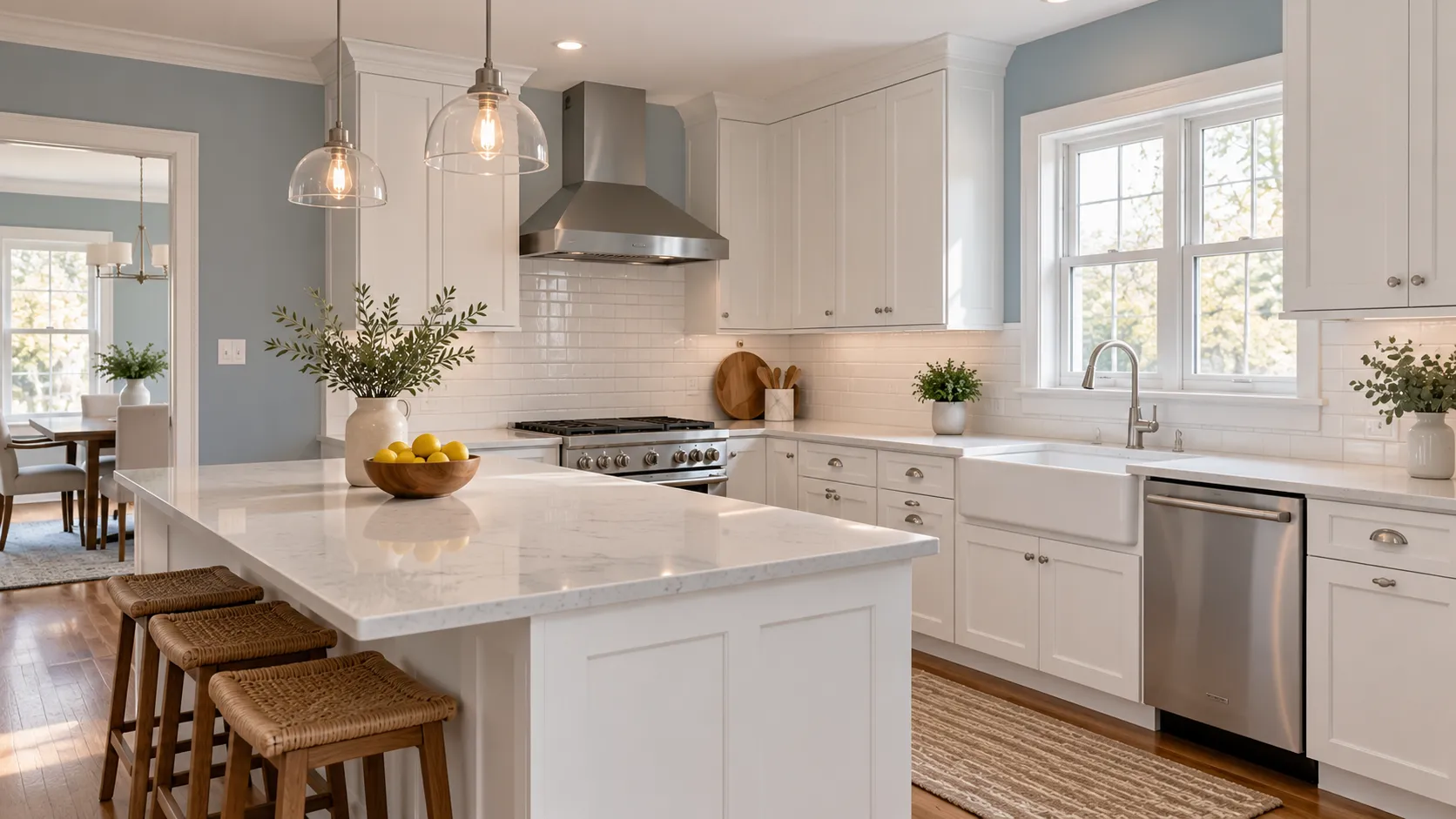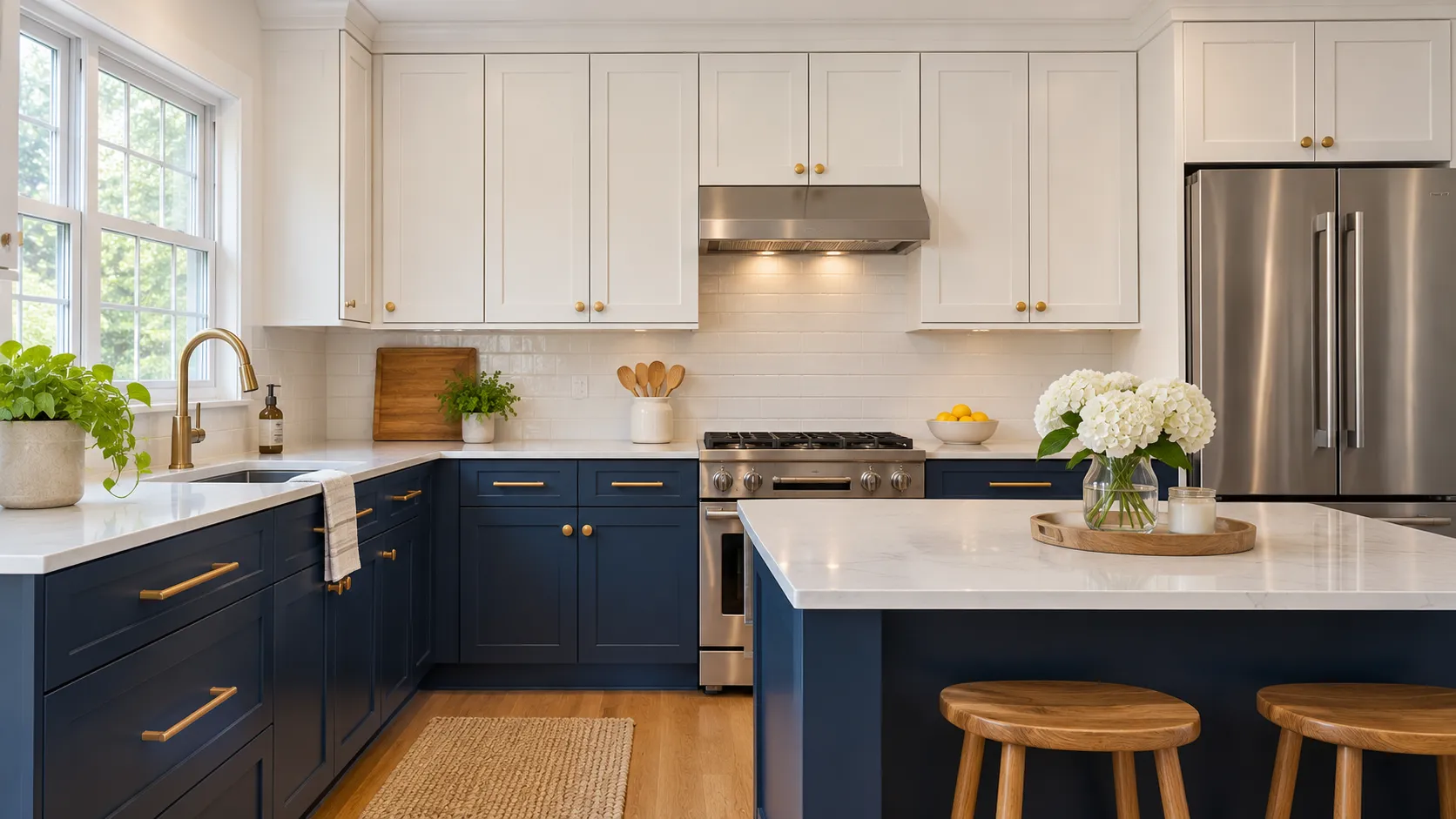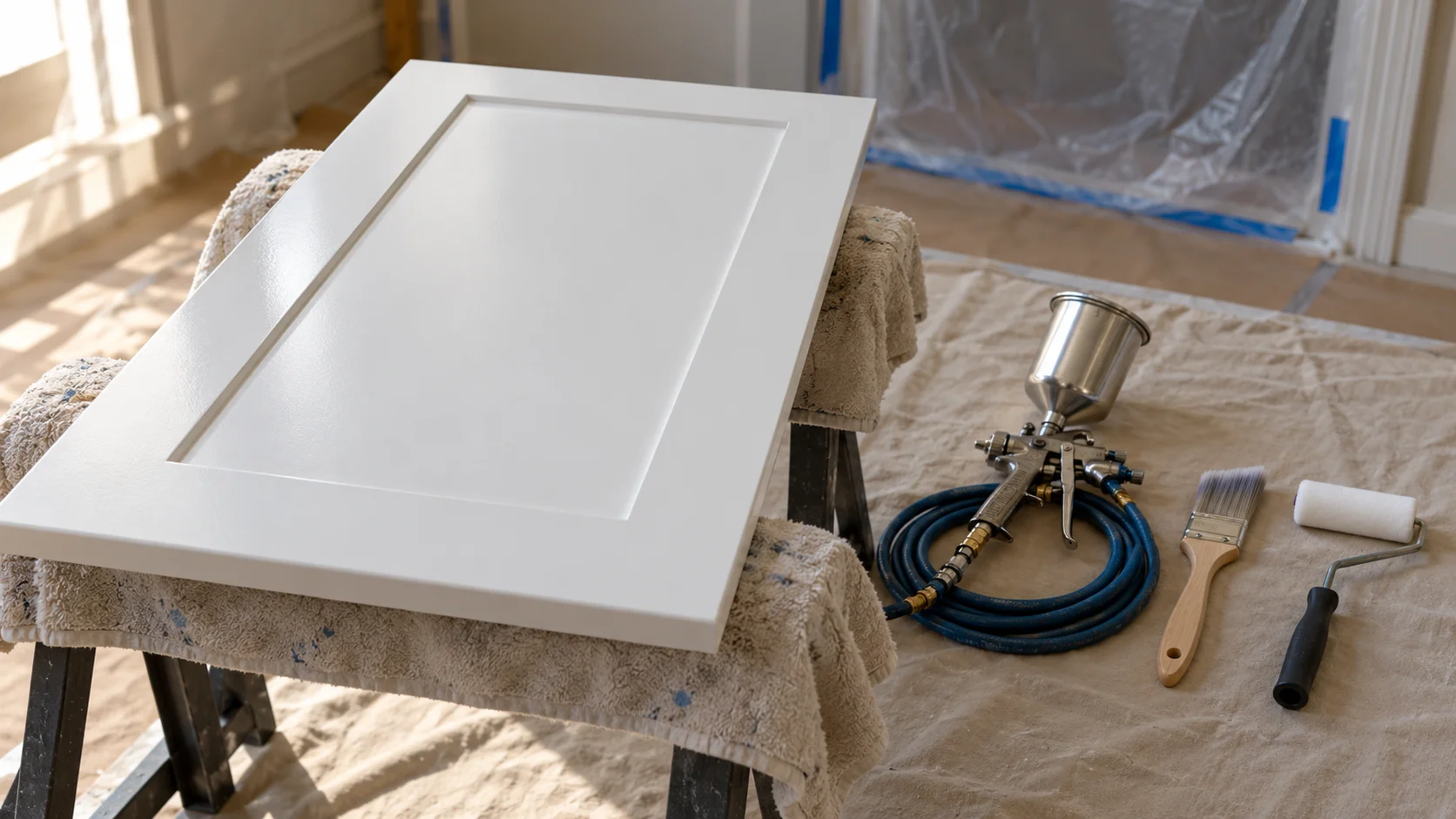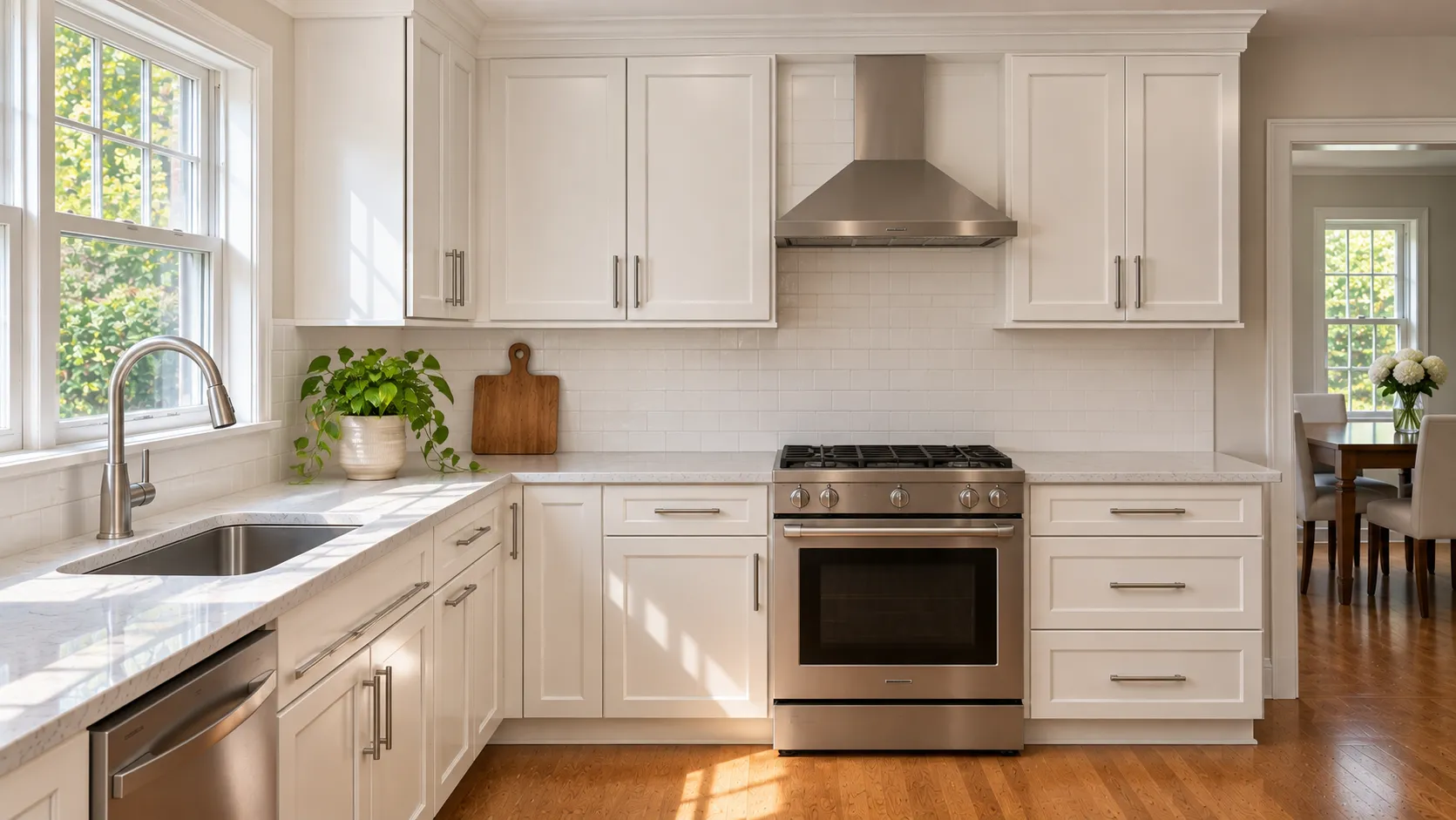
The best paint for kitchen cabinets is a waterborne enamel built for cabinets, doors and trim, not a wall paint. The three we trust most are Sherwin-Williams Emerald Urethane Trim Enamel, Benjamin Moore ADVANCE and Insl-x Cabinet Coat (an Insl-x product made by Benjamin Moore), each over a primer chosen for what the cabinets are made of and what is on them now. The paint gets the attention, but in our experience the primer, the prep and the curing time decide whether a painted kitchen still looks good in five years.
That matters because most "best cabinet paint" lists never open the manufacturer's data sheet, which is where the useful information lives: the resin, the recoat and cure times, what the paint will stick to, and what the maker really says about sanding. Read a few side by side and some popular claims fall apart. Several paints sold as needing no sanding say, in their own technical literature, that glossy surfaces should still be dulled.
We are a family-owned painting company in Morganville and have painted New Jersey homes across Monmouth, Middlesex, Ocean, Mercer, Somerset and Burlington counties, plus Union, Essex, Hudson, Bergen and Passaic in North Jersey, since 2004, using Benjamin Moore and Sherwin-Williams products. Cabinet painting and refinishing, including spraying, is a regular part of our work, so this guide is written from the point of view of a crew that has to live with the result: it sets out what the manufacturers publish, and separately what we have learned on our own jobs about which systems hold up. Where something is our opinion, we say so.
This page is about the product question: which paint, which primer, which sheen. If you want the method step by step, see our companion guide on how to paint kitchen cabinets. If you are choosing a color, start with our list of popular kitchen cabinet paint colors.
The Short Answer
For most painted wood kitchen cabinets in New Jersey, use a waterborne urethane-modified alkyd or waterborne alkyd enamel in satin or semi-gloss: Sherwin-Williams Emerald Urethane Trim Enamel, Benjamin Moore ADVANCE, or Insl-x Cabinet Coat. Prime first with a primer matched to the surface: a bonding primer for glossy or previously finished cabinets, a stain-blocking primer for oak, shellac for knots and stubborn stains. Scuff-sand even when the label says you need not, and treat cure time, not dry time, as the real finish line before doors take hard use.
- Best all-round cabinet paint (our view): Sherwin-Williams Emerald Urethane Trim Enamel. Fast recoat (4 hours on the data sheet), urethane-modified alkyd resin, satin, semi-gloss or gloss.
- Best for the smoothest brushed or rolled finish: Benjamin Moore ADVANCE. Long open time and excellent leveling, but a 16-hour recoat.
- Best for a fast semi-gloss on a tight schedule: Insl-x Cabinet Coat, a urethane reinforced acrylic with a 6-hour recoat.
- Best bonding primers: Insl-x Stix and Sherwin-Williams Extreme Bond for slick and previously finished surfaces.
- Best stain-blocking primers: Zinsser B-I-N shellac for knots and severe stains; Benjamin Moore Fresh Start High-Hiding All-Purpose Primer for general tannin bleed under waterborne systems.
- Best sheen: satin for most kitchens; semi-gloss if you want more shine and your doors are in excellent condition.
What Is the Best Paint for Kitchen Cabinets?
The honest answer is that there is a small group of products that all do the job well, and the right one depends more on how the paint will be applied, how fast the kitchen needs to be back in service, and what is under the old finish than on the label. Here is how the cabinet enamels we use compare on their makers' own published figures.
| Product | Resin (maker's description) | Touch / recoat at 77°F, 50% RH | Sheen on the sheet | VOC on the sheet |
|---|---|---|---|---|
| Sherwin-Williams Emerald Urethane Trim Enamel (satin) | Urethane modified alkyd, waterbased | 1 hour / 4 hours | Satin 35 to 45 units at 60°; also semi-gloss and gloss | Less than 50 g/L |
| Benjamin Moore ADVANCE Satin 792 | Waterborne alkyd | 4 to 6 hours / 16 hours | 25 to 35 at 60° | 48.5 g/L |
| Benjamin Moore ADVANCE Semi-Gloss 793 | Waterborne alkyd | 4 to 6 hours / 16 hours | 50 to 60 at 60° | 43.2 g/L |
| Insl-x Cabinet Coat CC-46XX (semi-gloss) | Urethane reinforced acrylic | Tack free 1 hour / 6 hours; full cure 5 to 7 days | 45 to 55 at 60° | 44.7 g/L |
| Sherwin-Williams ProClassic Interior Alkyd Semi-Gloss | Alkyd (solvent-borne) | 4 to 6 hours / 24 hours | 70 to 80 at 60° | 360 g/L; listed as not OTC compliant |
The three waterborne enamels all sit under 50 grams of VOC per liter, which matters in New Jersey (see below), and they differ hugely in recoat time: four hours, six and sixteen. They also come from different chemistry. A "urethane modified alkyd" and a "urethane reinforced acrylic" sound alike but are not the same thing, and one well-known cost site describes Cabinet Coat as a urethane-modified alkyd when its own data sheet lists the vehicle as "Urethane Reinforced Acrylic." It is a small error, but it shows how few of these comparisons are built on the data sheets.
Which do we reach for? In our experience, Emerald Urethane Trim Enamel is the best all-round choice for a working kitchen, because it combines a hard, block-resistant film with a recoat window that lets a door get two finish coats in one working day. ADVANCE gives the most forgiving, furniture-like finish when it is brushed or rolled, because it stays wet long enough to level out, but that same slow drying means more days before the kitchen is back together. Cabinet Coat is a good choice for a fast, bright semi-gloss, with the trade-off its own sheet admits: it "dries quickly," and overworking it "can lead to brush marks or roller marks."
What Type of Paint Is Best for Kitchen Cabinets?
The best type of paint for kitchen cabinets is a hard-drying, block-resistant enamel. Under the brand names there are really five families, and knowing which family a can belongs to tells you most of what you need.
Waterborne urethane-modified alkyd enamels
These are alkyd resins (the same family as traditional oil paint) that have been modified with urethane and made to carry water instead of solvent. Sherwin-Williams' data sheet for Emerald Urethane Trim Enamel describes it as "formulated with a urethane modified alkyd resin system" that "delivers the look, feel and durability of an oil based enamel with the convenience of a waterbased formula." Sherwin-Williams' industrial-coatings site lists a closely related product, Pro Industrial Waterbased Alkyd Urethane, described as "formulated with a urethane-modified alkyd resin system"; it is a protective-coatings product rather than a retail cabinet paint. The appeal of the family is a film that cures hard like oil, levels well, yellows less than oil and cleans up with water.
Waterborne alkyd enamels
Benjamin Moore's ADVANCE is the best-known example: "a premium quality, waterborne alkyd enamel that delivers the desired flow and leveling characteristics of conventional alkyd paint." Its data sheet lists it as "ideal for interior doors, trim, cabinets, walls, and ceilings" and as block-resistant. It is slow to harden: Benjamin Moore says "it could take up to 30 days to reach optimum hardness and final sheen."
Urethane reinforced acrylic and hybrid acrylic-alkyd enamels
Insl-x Cabinet Coat is a urethane reinforced acrylic: it dries by coalescence like latex, but the urethane makes it harder than a plain acrylic. Sherwin-Williams' ProClassic Interior Waterbased Acrylic-Alkyd sits between the families; Sherwin-Williams' own product literature describes it as offering "the application and finish of an alkyd, the non-yellowing properties of an acrylic." In Sherwin-Williams' contractor guide to cabinet refinishing, the hybrid "offers alkyd performance characteristics with acrylic properties."
Plain waterborne acrylic enamels
The same Sherwin-Williams guide is frank about these: its waterborne acrylic is "a good choice for cabinetry in an area with low traffic." In our view that rules out most kitchens but suits a laundry room or guest-bath vanity.
Solvent-borne alkyd ("oil") enamels
Traditional oil enamel cures hard and levels beautifully, but yellows, smells and, in New Jersey, is increasingly hard to buy. Sherwin-Williams' brochure says ProClassic "is also available in an alkyd formula for use in non-restricted areas," and the June 2026 data sheet for ProClassic Interior Alkyd Semi-Gloss marks it "No" against every OTC (Ozone Transport Commission) compliance line. We come back to oil in its own section.
Catalyzed and two-component (2K) finishes, including the conversion varnishes used in cabinet factories, sit outside these families: they cure by chemical reaction and get a section of their own below.
Can You Use Regular Wall Paint on Kitchen Cabinets?
You can, and it will look fine for a while, but we do not recommend it and do not do it. Two properties separate a cabinet enamel from a wall paint.
Block resistance. Blocking is the tendency of two painted surfaces to stick together when pressed. A cabinet door closes against a painted face frame many times a day and stays pressed there for hours. A soft wall paint can glue itself to the frame and tear when the door is opened, leaving a rough patch on both faces. Cabinet enamels are formulated against this: the ADVANCE sheet lists "block-resistant," and Sherwin-Williams' product page for Emerald Urethane Trim Enamel says it has "excellent blocking resistance."
Hardness and leveling. Wall paints are designed to hide, touch up and look even at a flat or eggshell sheen. Cabinet enamels are designed to flow out into a smooth, hard film at a higher sheen, so that brush and roller marks disappear and fingernails, rings and pans do not mark them. Sherwin-Williams describes Emerald Urethane Trim Enamel as "ideal for kitchens and other areas that are frequently cleaned."
For the walls themselves, our guide to the best paint and sheen for kitchen walls covers the right wall products.
Is Sherwin-Williams Emerald Urethane Trim Enamel the Best Paint for Kitchen Cabinets?
If you want one name from Sherwin-Williams, this is it, and it is one of the most searched-for cabinet paints by name. Sherwin-Williams' own cabinet refinishing guide for contractors calls it "the best choice for the most durable results," and lists "excellent blocking and scratch resistance" and "dries quickly for a fast recoat" among its strengths. Those are a manufacturer's claims about its own product, so here is what the data sheet actually commits to.
- Resin: "Urethane modified alkyd," waterbased, for interior and exterior use.
- Drying at 77°F and 50% relative humidity: touch in 1 hour, recoat in 4 hours, "temperature, humidity, and film thickness dependent."
- Sheen: the satin sheet gives 35 to 45 units at 60°. The product page lists satin, semi-gloss and gloss.
- Coverage and film: 350 to 400 square feet per gallon at 4 mils wet, 1.2 mils dry. Volume solids are 30 percent, which is lower than ADVANCE's 38.4, so each coat leaves a little less film behind.
- Application: "No reduction needed"; brush, roller with a 1/4- to 1/2-inch nap, airless or HVLP.
- VOC: less than 50 grams per liter.
- Prep: "Glossy surfaces should be sanded dull."
Why it is our usual first choice: the four-hour recoat means both finish coats can go on in one day, the kitchen is in pieces for fewer days, and dust has less time to settle into a wet film. Its weaknesses are worth knowing. It sets up faster than ADVANCE, so it is less forgiving with a brush on a large flat panel. Its lower volume solids mean that on a dark-to-light color change, a properly tinted primer matters; the sheet says a primer "will improve the hiding performance" on a drastic color change.
The other Sherwin-Williams cabinet options are ProClassic Interior Waterbased Acrylic-Alkyd, a good enamel with an alkyd-like finish, and the ProClassic waterborne acrylic for lighter-duty spaces. For a fuller brand comparison, see Benjamin Moore vs Sherwin-Williams.
Benjamin Moore ADVANCE vs Insl-x Cabinet Coat: Which Is Better for Cabinets?
Benjamin Moore makes both. ADVANCE is sold under the Benjamin Moore name and Cabinet Coat under its Insl-x brand. They suit different jobs.
| ADVANCE (792 satin / 793 semi-gloss) | Insl-x Cabinet Coat (CC-46XX semi-gloss) | |
|---|---|---|
| Vehicle | Waterborne alkyd | Urethane reinforced acrylic |
| Dry and recoat | Touch 4 to 6 hours; recoat 16 hours | Tack free 1 hour; recoat 6 hours |
| Back in service | "At least 5 to 7 days" before heavy abrasion or returning shelves to service; "up to 30 days" for optimum hardness | Full cure 5 to 7 days |
| Sheens | Satin, semi-gloss and high gloss (N794) | Semi-gloss on the sheet we read |
| Primer | New surfaces "should be fully primed"; cabinets sanded at 220 grit or coarser first | Claims it can paint "difficult surfaces, even polyurethane and varnish, without using a primer," while still recommending prep |
| Yellowing | "Minimal yellowing"; "a slight amount of yellowing may occur," worse in dark areas | No yellowing note on the sheet |
| Spray guidance | HVLP at 20 PSI, 1.8 tip; airless 0.011 to 0.015 | "The preferred method is HVLP"; thin up to 8 oz per gallon |
The ADVANCE data sheet sets out those figures, and Benjamin Moore's page on choosing a finish says ADVANCE Semi-Gloss "cures to a smooth, furniture-like finish" and calls it "one of the best paint finishes for kitchen cabinets." That matches our experience of the product. Its long open time gives brush and roller marks time to flow out, which makes it the friendliest of the three for a careful homeowner with a brush. The price is time. A sixteen-hour recoat turns two coats into two days, and the 30-day hardness note is real: in our experience ADVANCE doors that are rehung and used hard in the first week are the ones that pick up marks.
Cabinet Coat is the opposite trade. It dries fast, gives a bright semi-gloss, and its data sheet is unusually ambitious about adhesion. Notice, though, that the same sheet says that "although Cabinet Coat is formulated to be applied to hard to coat surfaces without the need for sanding, it is recommended that proper surface preparation still be completed to enhance adhesion properties," and that laminate, ceramic tile "and glossy painted surfaces should be properly deglossed." It also says Cabinet Coat is not for surfaces "immersed in liquids (sinks or tubs) or the surface of stoves or ovens." The Cabinet Coat sheet we found is dated 2017, so check the current one.
What about Benjamin Moore Scuff-X? It is an excellent product, but Benjamin Moore markets it for "high-traffic areas" and as a paint that "protects walls from the toughest scuff marks," with a Chip-Tech semi-gloss for "trim, baseboards, columns." It is built around scuffing on walls and chipping on trim in demanding spaces, not around block resistance and leveling on cabinet doors. On cabinets in a home, we use ADVANCE or Cabinet Coat instead.
Oil-Based or Water-Based Paint for Kitchen Cabinets?
Water-based, for almost every kitchen we paint. The waterborne alkyds and urethane-modified enamels were created to give oil's hardness and leveling without its drawbacks, and in our experience they now come close enough that the drawbacks of oil decide the question.
Yellowing. Sherwin-Williams' own troubleshooting page says that "alkyd/oil based paints, because of their curing mechanism, tend to yellow," especially "in areas that are not exposed to sunlight," and lists "lack of light, for example, behind pictures or appliances and inside closets" and "heat from stoves" as causes. A kitchen has all of those. A white oil enamel next to a white waterborne enamel on the same cabinet box will drift apart in color over a few years, and the yellowing is fastest exactly where the cabinets are darkest: under the uppers and inside the doors. Even waterborne alkyds are not completely immune: the ADVANCE sheet notes that "a slight amount of yellowing may occur," accelerated "in dark or poorly ventilated areas" and "more visible in lighter colors." The urethane-modified and acrylic enamels are where to go for a white that has to stay white.
Smell and cleanup. Oil enamels and oil primers clean up with mineral spirits and carry strong solvent odor while they dry. The EPA notes that "paints, varnishes and wax all contain organic solvents" and that indoor concentrations of many volatile organic compounds are "consistently higher indoors (up to ten times higher) than outdoors." In an occupied home where the kitchen is the center of the house, that matters. For practical help, see our guide on how to get rid of paint smell.
Availability in New Jersey. The ProClassic Interior Alkyd data sheet lists 360 grams of VOC per liter and "No" against OTC compliance. New Jersey's own VOC rule tightened for products made from August 2026, as the VOC section below explains, and an alkyd enamel at that level made after the operative date cannot be sold in New Jersey except in containers of one liter or less.
Where oil still earns a place: as a primer. An oil-based stain-blocking primer under a waterborne topcoat is a well-established system on bleeding woods and over some old finishes, and several are discussed in the primer section. Our article on oil vs latex paint and primer goes deeper on the chemistry, including how to tell which you have on your cabinets now. The short version of that test: rub an inconspicuous spot with a cotton ball and rubbing alcohol; if paint comes off, it is latex. If it does not, assume oil or a factory finish and prime accordingly.
What Is the Best Primer for Painting Kitchen Cabinets?
The best primer for painting kitchen cabinets is the one that matches the surface you are covering, and on cabinets that is a real decision rather than a formality. A primer has three possible jobs: to stick to something slick that the finish coat would not stick to, to stop something in the substrate (tannin, knots, grease stains, smoke) from bleeding into the finish, and to give a uniform, sandable base so the finish coat looks even. No single primer is best at all three.
| Primer | Type | Best at | Dry / recoat on the sheet | VOC on the sheet |
|---|---|---|---|---|
| Insl-x Stix Waterborne Bonding Primer SXA-110 | Waterborne acrylic urethane | Adhesion to glossy paint, tile, PVC, most plastics | Recoat 3 to 4 hours; full cure 3 to 4 days | 87.6 g/L |
| Sherwin-Williams Extreme Bond | Waterborne urethane modified acrylic | Adhesion to slick, glossy surfaces; lists kitchen cabinets and wall laminates | Touch 30 minutes; recoat as a primer 1 hour | Less than 50 g/L |
| Zinsser B-I-N Shellac-Base Primer | Shellac, alcohol | Knots, sap streaks, severe stains; glossy surfaces | Touch 15 minutes; recoat 30 minutes; full adhesion and hardness in 1 to 3 days | Max. 550 g/L |
| Zinsser Cover Stain | Oil-based | Tannin blocking, adhesion to enamels and varnishes | Touch 30 minutes; recoat 2 hours; full adhesion in 4 to 7 days | 350 g/L |
| Benjamin Moore Fresh Start High-Hiding All-Purpose Primer 046 | 100% acrylic | Tannin bleed and household stains; general priming | Touch 30 minutes; recoat 1 hour | Less than 50 g/L |
| Benjamin Moore ADVANCE Waterborne Interior Alkyd Primer 790 | Waterborne alkyd | A sandable, sealed base under ADVANCE | Touch 4 to 6 hours; recoat 8 hours | 44 g/L |
Bonding primers for slick and previously finished cabinets
Most kitchen cabinets we see were finished at the factory with a hard, clear or pigmented coating, often a catalyzed lacquer or conversion varnish, or were painted later in oil. Those surfaces are hard and smooth, which is exactly what a finish coat struggles to grip. This is where Stix and Extreme Bond earn their place. Stix is "a premium quality, waterborne, acrylic urethane primer/sealer with unparalleled adhesion" to glossy paints, tile, PVC and most plastics. Extreme Bond is "designed for coating hard, slick, glossy surfaces with minimal surface preparation" and names kitchen cabinets among its uses; Sherwin-Williams' cabinet guide recommends it "for laminate or previously painted wood cabinets." Both need time before they are fully bonded: Stix asks you to "allow Stix® to cure for approximately 3 to 4 days to achieve maximum resistance to scrape off," which is a reason not to rush the first finish coat into hard handling.
The ADVANCE primer is not a bonding primer, and its data sheet says so plainly: "Proper adhesion to existing enamel, catalyzed lacquers or synthetic surfaces will require sanding and may require a specialty primer." We use it as a sandable base on bare or previously primed wood under ADVANCE, not as an adhesion primer over a factory finish.
Shellac primers for knots, bleed and stubborn stains
Zinsser B-I-N is a pigmented shellac in alcohol, and in our experience it is the strongest stain blocker in this list. Its data sheet says it "seals bleeding knots and sap streaks," blocks "tannin bleed," and offers "excellent adhesion to glossy surfaces without scuff sanding." It dries in minutes, which makes it ideal for spot-priming knots, water rings and grease stains that have soaked into wood. Its drawbacks, in our experience: it dries so fast that it levels less than a waterborne primer, it smells strongly of alcohol while it dries, needs denatured alcohol or ammoniated detergent to clean up, and is high in VOC (the sheet says a maximum of 550 g/L). We use it as a spot primer far more often than as a full-coat primer on cabinets.
Oil-based primers
Oil primers such as Zinsser Cover Stain and Benjamin Moore Fresh Start Multi-Purpose Oil Based Primer 024 are slower but excellent at two things that matter on cabinets: blocking tannin and sticking to old enamels and varnishes. The Cover Stain sheet claims "excellent adhesion to dense, glossy surfaces such as enamel paints and varnishes, panelling, laminates, and ceramic tile without the need for sanding or de-glossing" and calls it "an excellent tannin blocker." Benjamin Moore's 024 lists "tannin bleed / tannin-rich woods" among the stains it handles. Both are solvent-borne, which brings the New Jersey rule into play.
Acrylic stain-blocking primers
Benjamin Moore Fresh Start High-Hiding All-Purpose Primer 046 is the primer Benjamin Moore itself pairs with ADVANCE on cabinets, both in its how-to guide and on the ADVANCE data sheet for "Wood, and engineered wood products." Its sheet says it "seals and suppresses most bleeding type stains such as tannin bleed, water stains, smoke damage" and that "on hard, non-porous surfaces, maximum adhesion and hardness may take 3-4 days to develop." It is easy to use and low in odor. On a severely bleeding oak or over an unknown factory finish we would put a bonding or shellac primer underneath instead, or spot-prime with shellac first.
Tint the primer. Benjamin Moore advises, on the ADVANCE sheet, "for best hiding results, tint the primer to the approximate shade of the finish coat, especially when a significant color change is desired," and Sherwin-Williams says the same with its "P-Shade" primer recommendation. On a dark cabinet going white, or a white cabinet going navy, a tinted primer can save a coat of finish.
What Primer Stops Oak Tannin Bleed and Grain Showing Through?
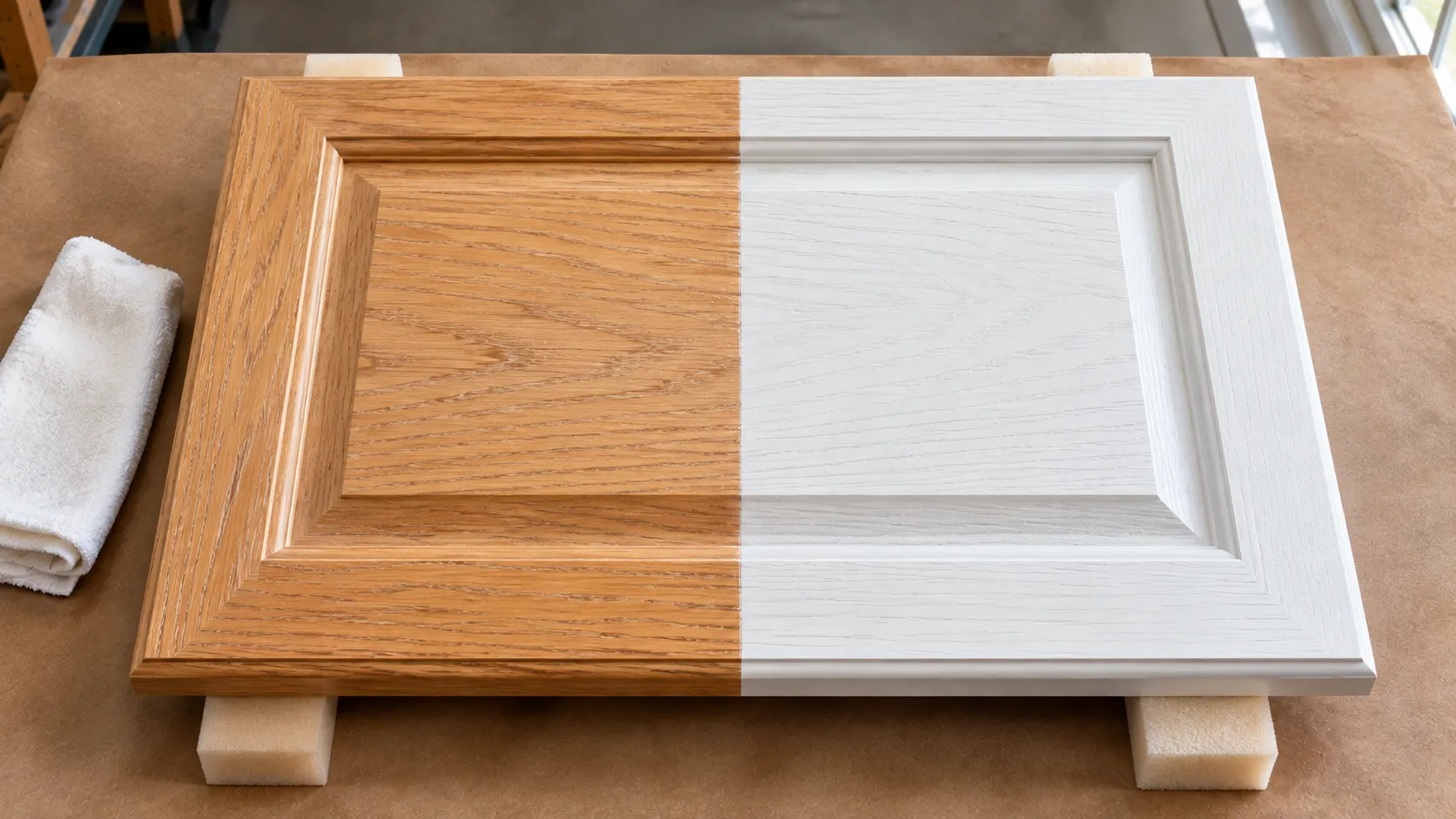
Golden oak is the cabinet we are asked to paint most often in New Jersey, and it brings two problems the primer has to solve.
Tannin bleed. Oak, like cedar and redwood, contains water-soluble extractives (tannins) that can migrate into a waterborne coating and show as tan or brownish blotches, often along the grain or around old water damage near the sink. Sherwin-Williams' Emerald Urethane Trim Enamel sheet warns that for "knots and some woods, such as redwood and cedar," which "contain a high amount of tannin, a colored wood extract," a finish applied over bare wood "may show some staining." The ADVANCE primer's sheet says outright that it is "not recommended for blocking tannin." On our jobs the order of choice for oak is: spot-prime any dark stains, knots or water marks with shellac; then a full coat of a stain-blocking primer (Fresh Start 046 or an oil primer where the bleed is heavy); then check for bleed before the first finish coat. If bleed shows through the first coat of primer, a second coat of primer, not more paint, is the fix. The Fresh Start 046 sheet notes that "two coats of primer may be required on severe stains."
Grain telegraphing. Oak has open, deep pores. A paint film follows them, so painted oak looks like painted oak: the grain texture shows through, more so in a higher sheen. Some homeowners like that; many expect a smooth, Shaker-style finish and are disappointed. If you want the grain gone, it has to be filled before priming, with a grain filler or several coats of a high-build primer sanded back between coats. That is extra labor and extra days, and it is a choice to make at the estimate, not halfway through the job. Our view is that a satin sheen with the grain left visible is the most honest result on oak, and a gloss over open-grain oak is the least forgiving.
MDF and maple doors are different again: they are close-grained and do not bleed tannin the way oak does, though the cut edges of MDF are thirsty and need to be sealed so they do not go fuzzy. Laminate, thermofoil and melamine have their own rules; see our guide to painting laminate cabinets.
What Is the Best Paint and Primer for Kitchen Cabinets?
Think in systems, not products. A primer and a finish have to be compatible, and the makers publish the systems they test. Here are the pairings we consider sound, built from what each manufacturer recommends.
| Existing cabinet surface | Primer | Finish | Why |
|---|---|---|---|
| Factory-finished wood (lacquer or varnish), in good condition | Scuff-sand, then Stix or Extreme Bond | Emerald Urethane Trim Enamel or ADVANCE | A hard, slick factory film needs a bonding primer; the ADVANCE primer sheet says catalyzed lacquers "may require a specialty primer" |
| Golden oak, stained and clear-coated | Scuff-sand; spot-prime stains with B-I-N; full coat of Fresh Start 046 or an oil primer; bonding primer if the clear coat is very hard | Emerald Urethane Trim Enamel or ADVANCE in satin | Tannin bleed and adhesion both need solving |
| Previously painted in oil | Clean, sand dull, then a bonding or oil primer | Any of the waterborne enamels | Benjamin Moore: "Sand glossy alkyds before applying Advance" |
| Previously painted in latex, sound | Clean, scuff-sand, spot-prime bare spots | Any of the waterborne enamels | Cabinet Coat's sheet: "No primer is needed if surface is in good condition" |
| Bare or new wood (non-bleeding) | ADVANCE primer 790, Fresh Start 046, or Sherwin-Williams Premium Wall & Wood Primer | The matching enamel | Sherwin-Williams' cabinet guide: "For unfinished wood, use our Premium Wall & Wood Primer" |
| Laminate, melamine, thermofoil | Degloss, then Stix or Extreme Bond | Emerald Urethane Trim Enamel or Cabinet Coat | See our laminate guide for when not to paint at all |
What about "paint and primer in one"? A self-priming enamel can be fine over sound, previously painted latex, exactly where Cabinet Coat's sheet says no primer is needed. It does not change what is underneath: in our experience no finish paint blocks oak tannin like a stain-blocking primer or bonds to a factory finish like a bonding primer.
Do not mix systems casually. Stix's sheet says to "always test questionable substrates," and each primer has its own wait before topcoating. When in doubt, stay inside one manufacturer's published system.
What Is the Best Paint for Kitchen Cabinets Without Sanding?
The truthful answer is that no paint makes sanding unnecessary on every cabinet. What exists are primers designed to stick to slick surfaces with less or no sanding, and enamels that stick well over those primers. Read the "no sanding" products' own data sheets and every one of them hedges.
- Insl-x Stix: "Use over most glossy surfaces without sanding," but "it is recommended that proper surface preparation still be completed to enhance adhesion properties," and glossy painted surfaces "should be properly deglossed."
- Sherwin-Williams Extreme Bond: "sanding may not be necessary for most clean, paintable surfaces," but "sanding or dulling with an abrasive cleaner is recommended on glossy, extremely hard surfaces for maximum adhesion," and you should "apply a test area of this primer, allow to dry properly and test for adhesion."
- Insl-x Cabinet Coat: "formulated to be applied to hard to coat surfaces without the need for sanding," with the same recommendation that prep "still be completed."
- Zinsser B-I-N: "excellent adhesion to glossy surfaces without scuff sanding."
- Zinsser Cover Stain: adhesion "without the need for sanding or de-glossing."
- Sherwin-Williams Emerald Urethane Trim Enamel, which some guides recommend as the no-sanding pick: its own data sheet says "glossy surfaces should be sanded dull."
- Benjamin Moore ADVANCE: for cabinetry, "all surfaces to be roughened by sanding (220 grit or coarser) before priming."
Sherwin-Williams' cabinet refinishing guide is the most practical on the point: after washing, "test a small area with your primer of choice. If it adheres well, sanding may not be necessary." That is a test, not a promise.
We scuff-sand every cabinet we paint, even under a bonding primer, and here is our reasoning. Sanding does more than create "tooth." It cuts through the invisible film of cooking grease, silicone polish and hand oils that cleaning alone can leave behind, which is the most common reason we see cabinet paint peel. It knocks down old drips, chips and raised grain that a new film would otherwise magnify. And it gives a mechanical key to the primer as well as a chemical one, so the bond does not depend on a single product doing everything perfectly. A scuff is not stripping: on our jobs it is a light, even dulling with a fine abrasive pad or paper, done after degreasing and followed by careful dust removal. Benjamin Moore's how-to suggests 100- to 150-grit to scuff before priming and 220-grit between coats.
If you are a homeowner who wants to minimize sanding, the lowest-risk path is: degrease thoroughly, degloss with a liquid deglosser or an abrasive pad, rinse, apply a bonding primer (Stix or Extreme Bond), let it cure the days its sheet asks for, and do a tape test on a hidden spot before you paint the doors. Press a strip of masking tape firmly onto the cured primer, pull it off sharply, and if primer comes away with it, stop and sand. And one rule overrides all of this: if your home was built before 1978 and the cabinets have old paint on them, sanding them is regulated work, explained at the end of this guide.
What Paint Finish Is Best for Kitchen Cabinets?
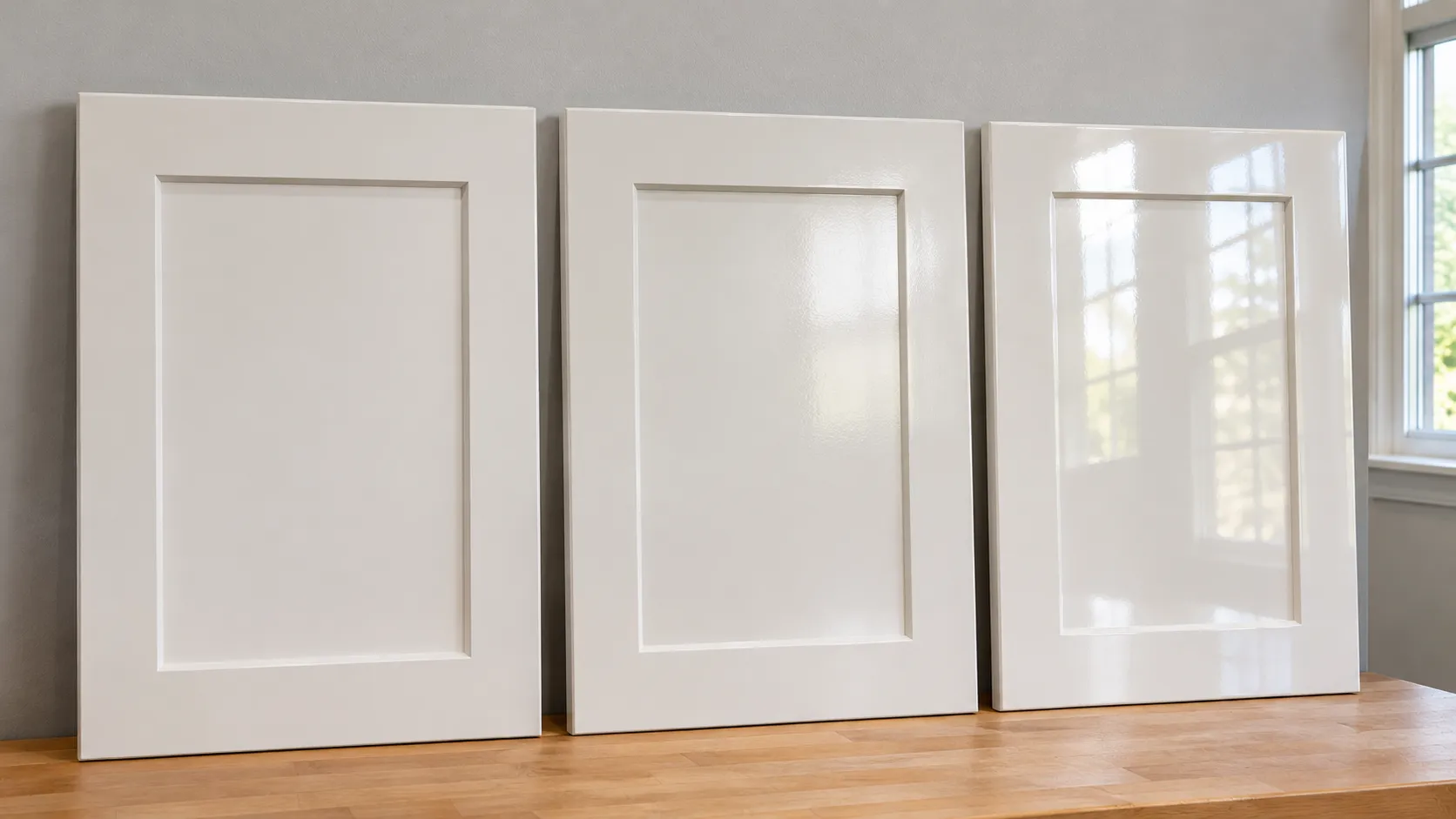
Satin is the best paint finish for most kitchen cabinets, with semi-gloss a close second. Gloss is a choice for doors in excellent condition and for owners who accept that it shows everything.
Sheen is measured as gloss units at a 60° angle, and the data sheets give a range for each product. On the sheets we read: ADVANCE Satin is 25 to 35, Emerald Urethane Trim Enamel Satin 35 to 45, Cabinet Coat semi-gloss 45 to 55, ADVANCE Semi-Gloss 50 to 60, and ProClassic Interior Alkyd "Semi-Gloss" 70 to 80. That last number is a useful warning. Sheen names are not standardized between brands or even between products from the same brand, and one company's semi-gloss can be shinier than another's gloss. Under New Jersey's VOC rule, a coating that reads 70 or more at 60° is classed as "non-flat high gloss," so an alkyd "semi-gloss" at 70 to 80 units is, legally, a high gloss.
The trade-offs are physical. A higher sheen is a smoother, tighter film that resists stains and wipes clean more easily; Benjamin Moore says satin "delivers a higher gloss, while offering better stain resistance and durability than lower sheens, including eggshell." But a higher sheen also reflects more light, and every flaw in the surface underneath (dents, filled holes, open oak grain, brush marks, dust nibs) shows more. On our jobs satin is the default because it wipes well and hides the small imperfections that every older cabinet has. We move up to semi-gloss on a newer, flat-panel or Shaker door in very good condition, or when an owner wants a more lacquered look, and we only recommend gloss when the doors can be filled and sanded to a near-perfect surface first. A matte finish on kitchen doors, in our view, marks with fingerprints and burnishes where it is wiped.
Sheen can differ slightly between sprayed doors and rolled boxes from the same can, which is why Sherwin-Williams advises touching up with "the same method of application and batch." Our paint sheen guide explains the full range.
What Is the Best White Paint for Kitchen Cabinets?
The white is a color decision and the paint is a product decision, and the two get mixed up. For painting kitchen cabinets white, use one of the enamels above in a white that suits your light, and choose the enamel partly for how well it stays white. In our experience the urethane-modified and acrylic enamels hold a white better over the years than any alkyd, for the yellowing reasons above.
The cabinet whites we are asked for most, with the light reflectance values (LRVs) each brand publishes on the color's own page:
- Benjamin Moore White Dove OC-17, LRV 83.16: a soft, slightly warm white that suits oak floors and stone counters.
- Benjamin Moore Simply White OC-117, LRV 89.52: brighter, with what Benjamin Moore calls "the slightest hint of warmth."
- Benjamin Moore Chantilly Lace OC-65, LRV 90.04: a clean, crisp white for modern kitchens and white quartz.
- Sherwin-Williams Alabaster SW 7008, LRV 82.215: a warm, creamy white.
- Sherwin-Williams Pure White SW 7005, LRV 83.957: a balanced, soft white.
- Sherwin-Williams Extra White SW 7006, LRV 85.861: a cooler, brighter white.
From our jobs: pick the cabinet white and the trim white together, because a very bright cabinet white can make an off-white wall look dingy. And a white over golden oak needs the stain-blocking primer described above more than any other color, because white shows tannin bleed first. For the full color picture, see our guides to the best white paint colors, kitchen cabinet paint colors and two-tone kitchen cabinets. We include color consultation with our estimates, so we are happy to hold samples up against your counters.
What About 2K, Catalyzed and Conversion Varnish Finishes?
These are the finishes most factory cabinets leave the plant with, and they are a different category from everything above.
A single-component enamel like ADVANCE or Emerald Urethane Trim Enamel dries by the water evaporating and the resin coalescing or oxidizing. A two-component (2K) or catalyzed coating is mixed with a hardener just before use and cures by chemical reaction into a cross-linked film that is generally harder and more resistant to solvents and chemicals. Conversion varnish is the factory version: Sherwin-Williams describes its Sher-Wood Water White Conversion Varnish as a "catalyzed wood finishing system" for industries including "Kitchen Cabinetry," which "meets test requirements of the Kitchen Cabinet Manufacturers Association (KCMA) for finishes." That product is solvent-borne, with a listed maximum VOC of 449.31 to 614.91 g/L, and it is sold to manufacturers, not homeowners.
Waterborne 2K paints aimed at cabinet refinishing also exist. General Finishes' Enduro Tintable 2K White Poly, for example, is described as a "2-Component, Water-based Urethane/Acrylic Blend" for cabinets, trim and doors. Its data sheet shows what a 2K system asks of the user: "Application: Spray only"; a catalyst added at 10 percent by volume; a pot life of "about 4 hours once combined before hardening"; a cure time of 5 days at 70°F and 50 percent humidity; and "3-4 total coats of finish are recommended."
So are they better? A properly applied catalyzed finish is generally tougher, which is why factories use them. In a lived-in house the picture is less simple. They are spray-only, they demand controlled conditions, they are less forgiving of the dust and temperature swings of a real kitchen, touch-ups are harder, and many are solvent-borne with VOC levels that collide with New Jersey's limits. A good single-component urethane-modified enamel over the right primer is, in our view, the better-balanced choice for most homes. If a catalyzed or 2K finish is what you want, ask any contractor directly whether they apply one, which product, where it will be sprayed, and how they will handle touch-ups; and ask us at the estimate.
If your cabinets have a factory catalyzed finish now, that hard film is what your primer has to stick to, which is why the bonding primer and the scuff-sand matter. Our guide to cabinet refinishing vs painting vs refacing covers when painting is the right answer at all.
How Long Does Cabinet Paint Take to Dry, and How Long to Cure?
Dry and cure are different things, and confusing them is behind more failed cabinet jobs than any choice of paint. "Dry to touch" means the surface is no longer wet. "Recoat" means another coat can go on without lifting or wrinkling the first. "Cure" means the film has reached its working hardness and adhesion, and it takes days to weeks.
| Product | Recoat | Back into service / cure (maker's words) |
|---|---|---|
| Emerald Urethane Trim Enamel | 4 hours | Sherwin-Williams' cabinet guide: "Allow at least 24 hours of dry time—the longer the better" before reattaching doors |
| ADVANCE | 16 hours | "At least 5 – 7 days" before heavy abrasion or returning shelves to service; "up to 30 days" to reach optimum hardness and final sheen |
| Cabinet Coat | 6 hours | "Full Cure 5 – 7 Days" |
| Stix primer | 3 to 4 hours | "Full Cure 3 – 4 Days" |
| B-I-N shellac primer | 30 minutes | Full adhesion and hardness "after it cures in 1 to 3 days" |
| Cover Stain oil primer | 2 hours | "Full adhesion in 4-7 days" |
All of those figures are at about 77°F and 50 percent relative humidity, and every sheet warns that cooler or damper conditions slow them down. A New Jersey kitchen in a humid August or a garage shop on a cold day does not hit those numbers. The three cabinet enamels in this guide all set a minimum application temperature of 50°F.
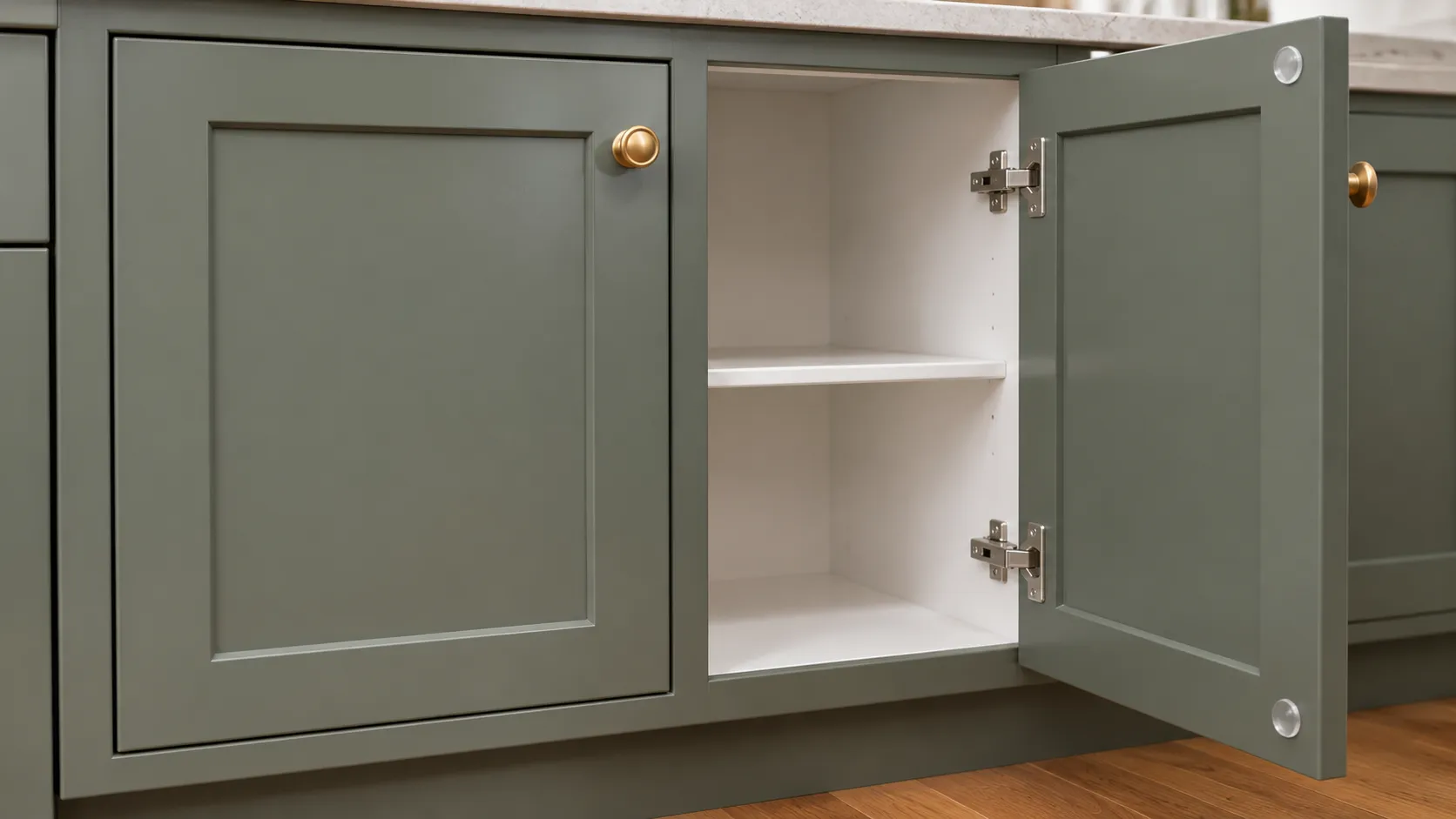
Block resistance and the first weeks. A door that has dried but not cured is still soft enough to stick to a frame that is also freshly painted. That is blocking, and it is why we rehang doors only when the finish has hardened enough to be handled, why we add small clear bumper pads to the inside corners of doors and drawer fronts, and why we ask owners to go gently for the first week or two: no taping notes to doors, no heavy cleaning, no slamming, and dish towels not draped over freshly painted doors. Benjamin Moore's how-to makes the same point: "The longer the paint dries, the more durable its finish will be and the less likely it will stick during reinstallation."
Recoat windows. A recoat time is a minimum, and coating too soon is the bigger risk: a second coat over a soft first coat traps solvent or water, stays soft longer and can wrinkle. Thin coats, two finish coats, and patience are what the data sheets ask for; Cabinet Coat's sheet puts it simply: "Multiple thin coats will provide better results than one heavy application."
For how long a properly cured finish then lasts, see our guide to how long painted cabinets last.
What Does New Jersey's 2026 VOC Rule Change for Cabinet Paint?
New Jersey limits the volatile organic compounds in architectural coatings under N.J.A.C. 7:27-23, and the rule was amended in August 2025 with a new column of tighter limits that applies to products manufactured on or after 18 August 2026. If you are buying cabinet paint and primer in New Jersey now, this is the context most national "best paint" lists do not have.
The limits that matter for cabinets, from NJDEP's own copy of Table 1 (grams of VOC per liter):
- Non-flat coatings (most satin and semi-gloss enamels): 150 before, 100 for products made on or after 18 August 2026.
- Non-flat high gloss (70 or more gloss units at 60°): 250 before, 150 after.
- Primers, sealers and undercoaters: 200 before, 100 after.
- Specialty primers: 350 before, 100 after, and the category was narrowed to primers that block water-soluble stains from fire, smoke or water damage.
- Quick-dry enamel and quick-dry primer categories: discontinued for products made after the operative date.
What this means in practice:
- The waterborne cabinet enamels are comfortably inside the new limits on their current sheets: Emerald Urethane Trim Enamel under 50 g/L, ADVANCE 48.5 and 43.2, Cabinet Coat 44.7. So are Extreme Bond (under 50), Fresh Start 046 (under 50), the ADVANCE primer (44) and Stix (87.6, under the new 100 primer limit).
- Solvent-borne products are where the change bites. The oil primer sheets we read list 344 g/L (Fresh Start 024, sheet dated 2020) and 350 g/L (Cover Stain), well above the new 100 g/L primer limit, and ProClassic Interior Alkyd lists 360 g/L. Expect reformulations, different category claims, or older stock. We have not confirmed which Table 1 category New Jersey assigns to a pigmented shellac primer like B-I-N (550 g/L maximum on its sheet), so check the can and ask the store.
- Older stock is still legal. The rule lets coatings made before the operative date, which complied with the limits in force when they were made, be sold and applied afterward, except for coatings without a date of manufacture or date code on the label. A compliance badge printed before 2026 tells you nothing about the new limits; the date code on the can does.
- There are exemptions, including containers of one liter or less and aerosol coatings, and a paid applicator who buys the coating in New Jersey. They do not change our choices: the waterborne systems we prefer are inside the limits anyway.
Low VOC does not mean no smell, and it does not mean nothing to ventilate. The EPA's advice is to "increase ventilation when using products that emit VOCs" and "follow label instructions carefully," and the ADVANCE, Cabinet Coat and Emerald Urethane Trim Enamel sheets all ask for fresh air entry during application and drying.
Why Do Painted Cabinets Fail, Whatever the Paint?
When a painted kitchen peels, chips or stays sticky, the paint is rarely the cause. In our experience the failures fall into a handful of patterns, and each points back to a choice made before the first coat.
- Grease left on the surface. Cabinets near the range and around the pulls carry years of cooking grease and hand oils. Sherwin-Williams calls washing "the most important step" in its cabinet guide. Paint over grease peels in sheets, often first around the handles.
- No bonding primer on a factory or oil finish. A waterborne enamel or ordinary primer on a hard, slick finish can look fine for weeks, then scratch off with a fingernail. Benjamin Moore's ADVANCE primer sheet says adhesion to "catalyzed lacquers or synthetic surfaces will require sanding and may require a specialty primer."
- Tannin bleed on oak. Tan blotches appear through white paint days after it is applied. The fix is a stain-blocking primer, not another coat of paint.
- Coats too heavy or too close together. Thick coats sag, stay soft and block. Recoating before the recoat time wrinkles or softens the coat below.
- Rehung and used before cure. Doors stuck to frames, dented edges, and marks from hardware are almost always a curing problem.
- Wrong paint. Wall paint, or a chalk paint without a durable topcoat, on doors that are wiped every day.
Notice how little of that list is about the brand.
How Do We Choose the Paint for a Kitchen on Our Jobs?
This is how our crew works through the decision on an estimate. It is our practice, not a manufacturer's instruction.
- Identify the existing finish. Factory clear coat, factory paint, oil, latex, laminate, thermofoil. A rubbing-alcohol test, a look at the edges and inside the doors, and the age of the kitchen tell us most of it. If the house was built before 1978 and the cabinets are painted, we raise the EPA rule at this point.
- Look for bleed and damage. Oak, knots, water damage near the sink, smoke or grease staining near the range. That decides whether shellac or a stain-blocking primer is needed, and where.
- Agree the look. Color, sheen, and whether the oak grain should show or be filled.
- Choose the primer for adhesion and blocking, then the finish enamel that the primer's maker or the enamel's maker publishes as compatible.
- Plan the schedule around recoat and cure. Where practical, doors and drawer fronts go to our shop to be finished, and the boxes, face frames and end panels are painted on site with the kitchen masked. A fast-recoat enamel such as Emerald Urethane Trim Enamel often suits this best, because it keeps the number of days the kitchen is out of action down. ADVANCE suits an owner who wants the softest finish and can wait.
- Test adhesion on a hidden spot before committing the whole kitchen.
Where the doors are finished and how they are sprayed is covered in more depth in our spray vs brush cabinet painting guide. Bathroom vanities follow the same logic with more moisture; see painting a bathroom vanity and cabinets. The same enamels are our choice for doors and trim elsewhere in the house; see our guide to the best paint for trim.
If you are wondering about cost, we deliberately keep prices out of this guide. Our article on kitchen cabinet painting cost in NJ and the cost guide explain what drives the number.
One more rule applies to older houses. If your home was built before 1978, the EPA's Renovation, Repair and Painting rule applies to "anyone paid to perform work that disturbs painted surfaces in homes, childcare facilities and preschools built before 1978," and the EPA says certification covers "all firms, even sole proprietorships." Sanding painted cabinets disturbs paint. We are not an EPA Lead-Safe Certified firm. Ask every painter who bids on a pre-1978 house, us included, for their firm certification number before any sanding or scraping is agreed. The Benjamin Moore and Sherwin-Williams data sheets quoted in this guide all carry a lead-dust warning.
When Should You DIY Your Kitchen Cabinets, and When Should You Hire?
Painting cabinets is within reach of a patient, careful homeowner, and plenty of readers should do it themselves. It is also the painting job where cutting corners shows fastest.
DIY makes sense if the cabinets are sound wood or previously painted latex, the kitchen is modest in size, you can give up the kitchen for a week or more, and you are willing to remove, label and lay out every door. Choose a forgiving system: a bonding primer, then ADVANCE or Emerald Urethane Trim Enamel with a quality synthetic brush and a fine foam or microfiber roller, in satin. Work in thin coats, keep to the recoat times, and leave the doors to harden before rehanging. Our step-by-step guide to how to paint kitchen cabinets walks through it.
Hiring makes sense when you want a sprayed, factory-like finish, the kitchen is large or has a lot of doors and drawers, the cabinets have a factory finish or golden oak with tannin and grain to manage, you need the kitchen back quickly, or the house was built before 1978 and sanding is involved (in which case check the painter's EPA firm certification). Our cabinet painting service page explains how we work.
What We Do, and Do Not Do, on Kitchen Cabinets
We do: paint, refinish and spray kitchen cabinets and bathroom vanities in Benjamin Moore and Sherwin-Williams cabinet enamels, including degreasing, scuff-sanding, priming for the material, and two finish coats; remove, label and rehang doors, drawer fronts and hardware; finish doors off site in our shop where practical and paint the boxes on site; and help with color and sheen through the color consultation included with our estimates. We also paint the rest of the kitchen: walls, ceilings, trim and interior doors, and repair drywall before painting.
We do not: reface cabinets or install new cabinets; do finish carpentry such as building doors or altering boxes (we do not install crown moulding or trim on cabinets, either); paint countertops, tile or backsplashes; repair peeling thermofoil; or offer electrostatic painting. Our standard systems are the single-component enamels described in this guide; if you want a catalyzed or two-component finish, raise it at the estimate. We are not an EPA Lead-Safe Certified firm.
About This Guide
This guide was written by the NJ Painting Co. crew. We are a family-owned painting company in Morganville, founded in 2004, licensed and fully insured, and we have painted New Jersey homes across Monmouth, Middlesex, Ocean, Mercer, Somerset and Burlington counties, plus Union, Essex, Hudson, Bergen and Passaic in North Jersey, using Benjamin Moore and Sherwin-Williams products. Every product figure and quotation (resin type, dry, recoat and cure times, sheen, VOC, and prep instructions) was read from the manufacturer's own data sheet or product page on 26 November 2026, and each color's LRV from that color's own Benjamin Moore or Sherwin-Williams page the same day. The New Jersey VOC limits are from NJDEP's copy of N.J.A.C. 7:27-23 as read on 27 October 2026. Several data sheets carry older dates (one from 2017, others from 2019 to 2024), and we say so where it matters; check the current sheet before you buy. Rankings and recommendations, and everything we describe as happening on our jobs, are our own experience and opinion, not a manufacturer's claim. Products named here are ones we have used or evaluated; we have no affiliate arrangement with any of them. We will review this guide by June 2027, sooner if a manufacturer reformulates a product or New Jersey's VOC rule changes again.
Get a Price for Painting Your Kitchen Cabinets
If you would like a straight answer about which paint and primer your cabinets need, or a price to paint them, call us on (732) 239-0932 or request a free estimate. Our estimates include color consultation, and our work carries a two-year workmanship warranty. Tell us roughly how many doors and drawers you have, what the cabinets are made of and what finish is on them now, and ask us about the job minimum when you enquire.
Frequently Asked Questions
What is the best paint for kitchen cabinets?
A waterborne cabinet enamel: Sherwin-Williams Emerald Urethane Trim Enamel, Benjamin Moore ADVANCE or Insl-x Cabinet Coat, over a primer matched to the surface. In our experience Emerald Urethane Trim Enamel is the best all-round choice because it combines a hard, block-resistant urethane-modified alkyd film with a 4-hour recoat. ADVANCE gives the smoothest brushed finish but needs 16 hours between coats.
What is the best primer for painting kitchen cabinets?
It depends on the surface. For factory-finished, glossy or previously oil-painted cabinets, a bonding primer such as Insl-x Stix or Sherwin-Williams Extreme Bond. For oak and other tannin-rich wood, a stain-blocking primer such as Benjamin Moore Fresh Start 046 or an oil primer, with Zinsser B-I-N shellac to spot-prime knots and stains. Benjamin Moore's ADVANCE primer is a good sandable base but its sheet says it is "not recommended for blocking tannin."
Can you paint kitchen cabinets without sanding?
Sometimes, with a bonding primer, but no data sheet promises it for every cabinet. Stix, Extreme Bond and Cabinet Coat all say they can be used with little or no sanding and still recommend deglossing glossy surfaces or testing adhesion first. Emerald Urethane Trim Enamel's sheet says glossy surfaces "should be sanded dull." We scuff-sand every cabinet regardless.
What paint finish is best for kitchen cabinets?
Satin for most kitchens: it wipes clean and hides small dents and wiping marks. Semi-gloss gives more shine and slightly easier cleaning but shows every flaw in the surface. Gloss suits doors that have been filled and sanded nearly perfect. Compare the gloss units on the data sheets, not the word on the label.
Is oil-based or water-based paint better for kitchen cabinets?
Water-based, for nearly every kitchen. Modern waterborne alkyd and urethane-modified enamels level and harden much like oil, yellow less, smell less and clean up with water. Sherwin-Williams says oil paints "tend to yellow," especially in areas without sunlight. Solvent alkyd enamels are also high in VOC.
How long should cabinet paint cure before using the cabinets?
Longer than it takes to dry. Sherwin-Williams' cabinet guide says to allow "at least 24 hours of dry time—the longer the better" before rehanging doors; Benjamin Moore says ADVANCE should not face heavy abrasion for "at least 5 – 7 days," and Cabinet Coat lists full cure at 5 to 7 days. Go gently for the first week or two.
What is the best white paint for kitchen cabinets?
Popular cabinet whites include Benjamin Moore White Dove OC-17 (LRV 83.16), Simply White OC-117 (89.52) and Chantilly Lace OC-65 (90.04), and Sherwin-Williams Alabaster SW 7008 (82.215), Pure White SW 7005 (83.957) and Extra White SW 7006 (85.861). Apply them in a urethane-modified or acrylic cabinet enamel, which holds white better than oil, over a stain-blocking primer if the cabinets are oak.
Are 2K or catalyzed paints better for kitchen cabinets?
They are generally harder, which is why cabinet factories use catalyzed finishes such as conversion varnish. But they are mixed with a hardener, have a limited pot life, are usually spray-only, need controlled conditions and are harder to touch up, and many are solvent-borne. For most painted kitchens in occupied homes, a single-component urethane-modified enamel over the right primer is the better-balanced choice in our view.
Does New Jersey's 2026 VOC rule affect cabinet paint?
Yes, for products manufactured on or after 18 August 2026: the limit for non-flat coatings fell from 150 to 100 g/L and for primers from 200 to 100 g/L. The main waterborne cabinet enamels and primers are already well under those limits. Solvent-borne oil primers and alkyd enamels are the products affected. Older stock with a date code that complied when it was made can still be sold and used.
About the author
Written by the NJ Painting Co. team
NJ Painting Co. is a family-owned painting contractor based in Monmouth County, in business since 2004. We are licensed and fully insured, work with Benjamin Moore and Sherwin-Williams paints, and back our work with a 2-year workmanship warranty. We serve Monmouth, Middlesex, Ocean, Mercer, Somerset and Burlington counties, plus Union, Essex, Hudson, Bergen and Passaic in North Jersey.