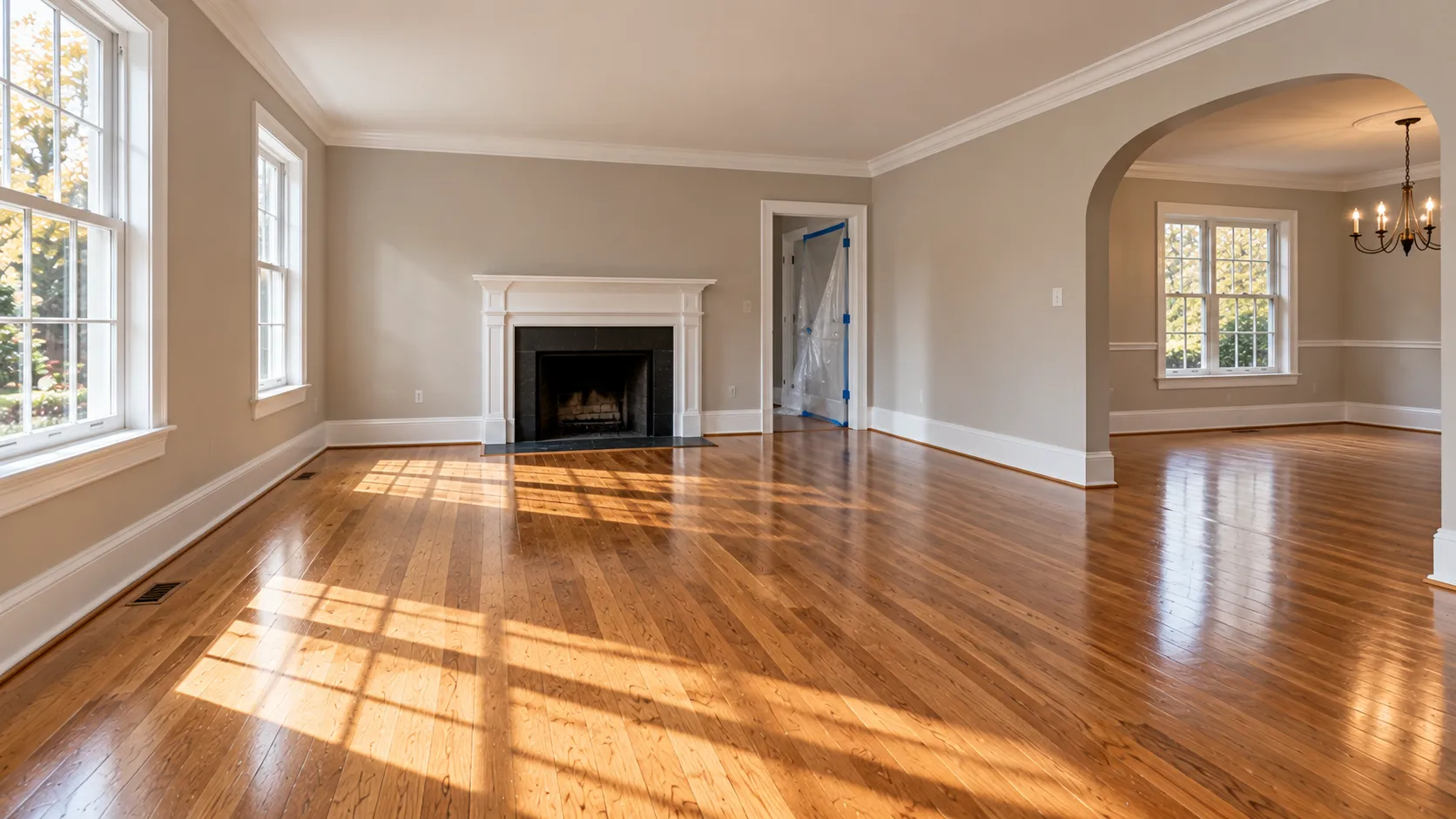
Hardwood floor refinishing costs $3 to $8 per square foot nationally for a full sand and refinish, according to 2025 and 2026 cost data. New Jersey prices run about 9 percent above the national level on federal figures, which puts a New Jersey planning range at roughly $3.26 to $8.70 per square foot — about $3,260 to $8,700 for a typical 1,000 square foot first floor. A single small room costs more per square foot than that, for reasons covered below. A screen and recoat, when the floor qualifies, costs a fraction of a full sanding.
To be clear up front: floor sanding and refinishing is not a service we list. NJ Painting Co. is a painting company, and refinishing hardwood was retired as an offer in October 2026. Every figure in this guide is a published national number or arithmetic on one, never a quote of ours, and the point of it is to let you read a floor refinisher's estimate properly before you sign it.
The spread between those numbers comes down to what is actually being done to the floor: how many sanding passes, stain or natural, which finish and how many coats, stairs, repairs and dust control. This guide walks through each of those. It also covers the options that cost less than a full sanding, and when they are the right call.
How Much Does Hardwood Floor Refinishing Cost?
Nationally, a full sand and refinish costs $3 to $8 per square foot. The most-cited cost guides land in the same band, with differences that come from what each one counts as included.
- Fixr's hardwood floor refinishing cost guide (updated January 2025) puts the typical range at $3 to $8 per square foot. For a 200 square foot floor it gives a national average range of $800 to $1,600, with most people paying around $1,200 to sand, stain and finish a 200 square foot oak floor. It says around 80 percent of the cost is labor, and it breaks out sand-and-refinish at $3 to $5.50 per square foot and dustless refinishing at $6 to $8.
- NerdWallet's 2026 refinishing cost article (updated February 2026) also uses $3 to $8 per square foot and splits the work into sanding at $0.50 to $3, staining at $1 to $3 and recoating at $1 to $2 per square foot.
- Homewyse's refinishing calculator (May 2026) gives $6.49 to $7.92 per square foot for a basic job with two-pass machine sanding and two coats of a two-component waterborne finish, before sales tax, structural repairs or general contractor markup.
The low ends describe an open, easy room with a natural (unstained) finish. The high ends describe stain, a premium finish, dust extraction or a lot of edge and hand work. Homewyse is the useful outlier: once you spec a professional-grade finish, even the "basic" job sits in the upper half of the national range.
Why Does Floor Refinishing Cost More in New Jersey?
Refinishing is a labor job. The finish, sandpaper and machines are a small part of the bill. Fixr says around 80 percent of the cost is labor, although its own worked example puts labor at $700 of a $1,200 project, so read that as "most of the bill" rather than an exact share. Anything that raises labor and overhead raises the price per square foot.
- Prices in general. The Bureau of Economic Analysis 2024 regional price parities put New Jersey at 108.8, meaning prices here run about 9 percent above the national level. Among the states, only California (110.7) and Hawaii (110.0) were higher.
- Trade wages. O*NET's New Jersey wage page, which reports Bureau of Labor Statistics 2025 wage data, puts the median for floor layers (the category covering resilient and other non-wood floors) at $28.77 an hour in New Jersey against $27.15 nationally. O*NET has no New Jersey figure for floor sanders and finishers, so this is the closest state comparison we could find.
- Insurance and registration. A legitimate New Jersey outfit carries liability insurance and a state home improvement registration, and those costs sit in the price.
To be clear about where the New Jersey number in the opening paragraph comes from, it is arithmetic and nothing more: the 108.8 price parity applied to the national $3 to $8 band gives about $3.26 to $8.70 per square foot. That is a planning range for reading quotes, not a price list. Nobody publishes a New Jersey market survey for floor refinishing, and we are not going to invent one for a service we do not sell. What the parity figure does tell you is which half of the national band to expect: plan from the upper half, and treat a quote at or below the national low end as a question to ask rather than a bargain to accept.
What Does Refinishing Cost by Room and for a Whole Floor?
Both columns below are arithmetic on published national figures, not quotes. The national column multiplies the $3 to $8 per square foot range from Fixr and NerdWallet by the floor area; the New Jersey column does the same with the price-parity-adjusted $3.26 to $8.70. Stairs, stain, repairs and dust extraction are extra in both, and neither column is a price of ours.
| Floor area | Typical space | National ($3 - $8/sq ft) | New Jersey ($3.26 - $8.70/sq ft) |
|---|---|---|---|
| 200 sq ft | One bedroom on its own | $600 - $1,600 | $650 - $1,740 |
| 500 sq ft | Living and dining room | $1,500 - $4,000 | $1,630 - $4,350 |
| 1,000 sq ft | Typical first floor | $3,000 - $8,000 | $3,260 - $8,700 |
| 1,500 sq ft | Large first floor | $4,500 - $12,000 | $4,890 - $13,050 |
| 2,000+ sq ft | Whole house | $6,000 - $16,000 | $6,520 - $17,400 |
One warning about reading that table at the small end. Multiplying a per-square-foot rate by 200 square feet understates a one-room job, and Fixr's own published figures prove it: its national range for a 200 square foot floor is $800 to $1,600, well above the $600 the arithmetic gives. A small room carries nearly the same fixed work as a large one — hauling in and setting up the drum sander, edger and dust extraction, sealing doorways and covering vents, edging the full perimeter, and coming back for each coat of finish. Spread over 200 square feet those costs are brutal per square foot; spread over a whole first floor they almost disappear. Expect a single bedroom to be quoted nearer $7 to $9 per square foot than $4, and do not read that as overcharging.
That also means a per-foot rate is a planning tool for medium and large areas only. If you are refinishing one room, ask whether adding a hallway or a second room to the same visit changes the price much. Often it does not change it by as much as the extra square footage would suggest, and that question is worth more than haggling over the rate.
For a sanity check on the national column, NerdWallet puts 400 square feet at $1,200 to $3,200 and 1,000 square feet at $3,000 to $8,000.
What Are the Ways to Refinish a Hardwood Floor?
There are three: a full sand and refinish, a screen and recoat, or chemical abrasion. Not every tired floor needs to go back to bare wood. The three options below cost very different amounts, and picking the right one is most of the value a good contractor brings.
| Method | What it does | Typical cost | Works when | Does not work when |
|---|---|---|---|---|
| Full sand and refinish | Sands through the old finish to bare wood, optional stain, new finish coats | $3 - $8/sq ft | Finish is worn through, deep scratches, gray or stained wood, color change | Engineered floor with too thin a wear layer |
| Screen (buff) and recoat | Abrades the existing finish without cutting into the wood, then adds a fresh topcoat | $1 - $2.50/sq ft | Finish is dull and scuffed but intact, no wax, no damage to the wood | Wax or polish on the floor, bare wood showing, you want a new color |
| Chemical abrasion (no-sand recoat) | A chemical adhesion system and conditioning pads prepare the old finish for a new coat | Priced by the contractor; ask for it as a separate line | Polyurethane floors with surface wear only | Same limits as screen and recoat |
Full sand and refinish
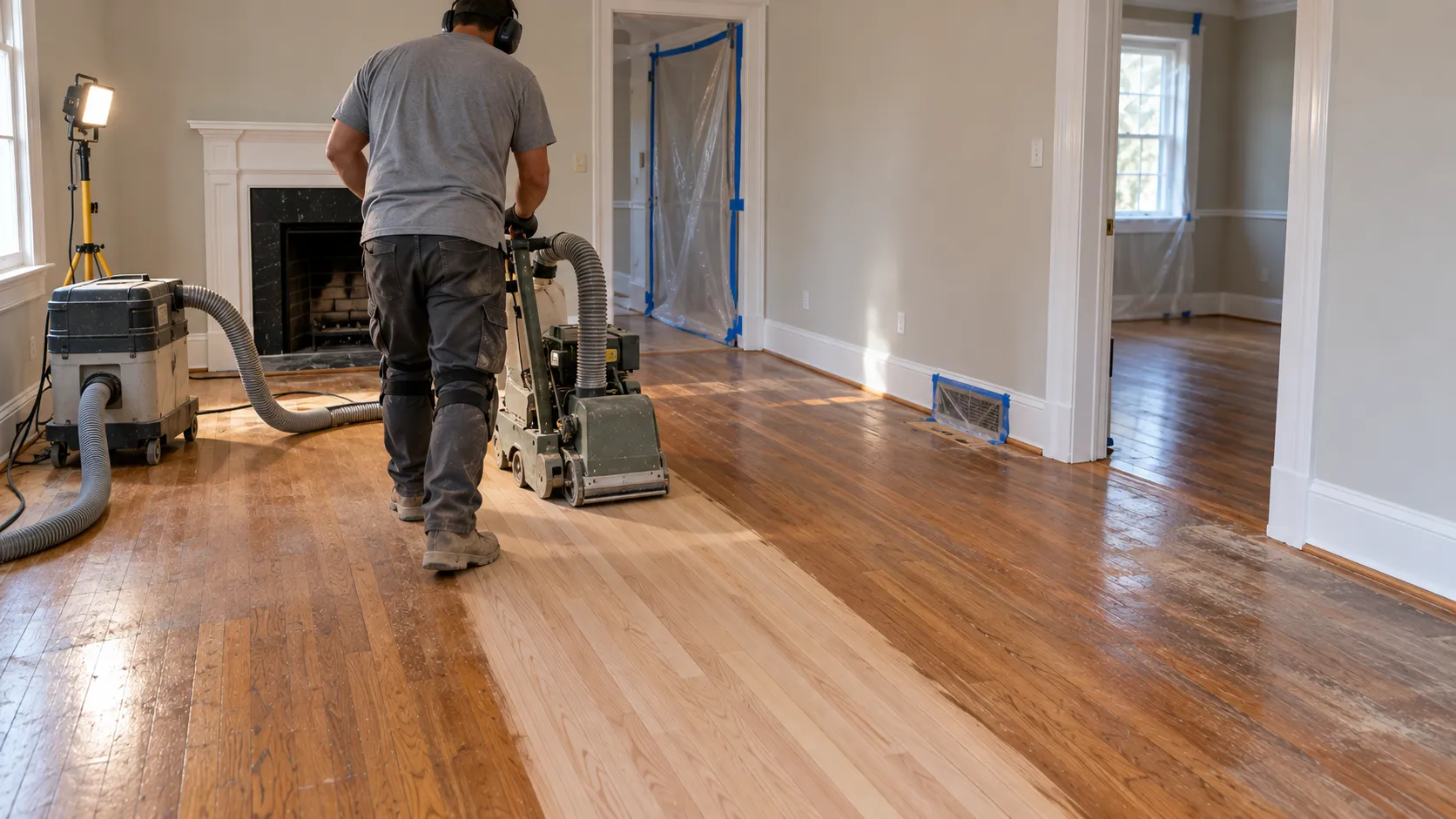
This is the only option that removes damage in the wood itself: gray traffic lanes, deep scratches, water marks, old stain you no longer like. It also removes wood. Brett Miller, the National Wood Flooring Association's vice president of technical standards, training and certification, writing in Hardwood Floors Magazine, says a traditional sand job removes 1/32 to 1/16 inch of material, and that most solid wood floors can be sanded six to eight times over their service life. That sounds like plenty. It stops being plenty when every refinish is a heavy one.
Screen and recoat
Fixr describes buffing as using clog-resistant sanding discs to remove the floor finish without cutting into the wood, and says it only works on non-waxed polyurethane floors where the wood underneath is not damaged or stained. It is the maintenance move. Done every few years on a floor that is still sealed, it can push the next full sanding far down the road.
The catch is adhesion. NWFA's Brett Miller, in a Hardwood Floors Magazine article on recoating, notes that dents, gouges and scratches can be recoated but will still be in the surface afterward. He describes a simple wax check: a little mineral spirits on a clean cloth, rubbed on a suspect area, and a yellow or brown color on the cloth means paste wax may be present. He also describes an X-cut tape test on the existing finish to check adhesion before a floor is recoated. A floor that has been treated for years with "shine" or "restore" products may fail those tests, and then the only honest answer is a full sanding.
Refinishing without sanding (chemical abrasion)
This is a recoat with a different prep. Instead of relying only on a buffer screen, a chemical adhesion system is used with abrasive conditioning pads. Bona's Traffic HD technical data sheet says the floor must be free of wax, polish and oily residues before recoating, that contaminated floors need Bona's full Recoat System, and that adhesion failure can occur if those recoating steps are skipped. The appeal is lower dust and no loss of wood. The limits are the same as any recoat: it will not fix bare spots, deep scratches or color.
What Makes Floor Refinishing Cost More or Less?
Stain versus natural
A natural floor gets sealer and finish. A stained floor adds a finer final sanding, the stain coat, dry time and more risk of visible sander marks, which is why Fixr and NerdWallet both price staining at $1 to $3 per square foot on top. Bona's data sheet even specifies a different final sanding sequence for stained floors. Insist on stain samples put down on your actual boards before a color is chosen; red oak, white oak and maple take the same stain very differently.
Number of coats and the finish itself
Each coat is another visit or another few hours on site. Manufacturers set the minimum: Minwax recommends three coats of its Super Fast-Drying Polyurethane for Floors on bare wood, and Bona specifies a sealer or stain plus two coats of Traffic HD, with a third coat recommended in heavy-traffic areas. A quote that lists one or two coats of finish total, with no sealer or stain coat under them, is not the same job. Professional two-component finishes also cost more per gallon than consumer poly.
Stairs
Fixr prices stair refinishing at $25 to $45 per step. Every tread, riser, nosing and baluster base is hand-sanded or detail-sanded, so a staircase is a meaningful line of its own: 12 steps at those rates is $300 to $540.
Repairs and board replacement
Pet urine stains that have soaked into the wood, black water marks around a radiator or refrigerator, and cupped boards next to an old leak usually do not sand out. Fixr puts board replacement at $14 to $32 per square foot. Weaving in new boards before sanding is the right order, because the whole floor is then sanded and finished together.
Furniture, access and prep
Someone has to empty the rooms, pull or protect shoe molding, seal doorways and cover vents. Some contractors include moving furniture and some price it separately, and Fixr notes you may do it yourself or hire a separate service. Ask. It is the same logic as prepping for a paint job: the less the crew has to clear, the more of the day goes into the floor.
Dust extraction
Fixr puts dustless refinishing at $6 to $8 per square foot against $3 to $5.50 for traditional sanding. More on what "dustless" really means below.
Engineered floors
Fixr prices engineered refinishing at $3 to $5 per square foot and describes it as light sanding that removes around 2 millimeters or less. The real question with engineered wood is whether it can be sanded at all, which has its own section below.
A worked example
Say you have 600 square feet of red oak across a living room, dining room and hall, you want it stained, there are 12 stair treads, and about 10 square feet of boards by the back door are pet-stained.
- Floor, sand and refinish: 600 sq ft at $3.26 to $8.70 = $1,960 to $5,220
- Stain: 600 sq ft at $1 to $3 = $600 to $1,800
- Stairs: 12 steps at $25 to $45 = $300 to $540
- Board replacement: 10 sq ft at $14 to $32 = $140 to $320
That is roughly $3,000 to $7,900 before dust extraction or a premium finish upgrade. Every line is published national data or arithmetic on it — the floor line uses the price-parity-adjusted range, the stain, stair and board figures are Fixr's and NerdWallet's — so treat the total as a planning estimate and nothing closer. The stain line is the one people forget. It is a real step with its own dry time, and it is priced that way.
Finish Types: Oil-Based, Water-Based, Two-Component and Oil
The finish is the part of the job you live with. It controls how the floor looks on day one, how it changes color over the years, how long you wait before moving back in, and how it wears. The figures below come straight from each manufacturer's current technical sheets.
| Finish type (example) | Dry and walk times | Full cure / rugs | VOC | Color over time |
|---|---|---|---|---|
| Oil-based (oil-modified) polyurethane (Minwax Super Fast-Drying Polyurethane for Floors) | Light foot traffic in 24 hours | No rugs or cleaning for 7 days | 350 VOC formula | Amber tone (Minwax's own finish chart) |
| One-component waterborne (Bona Mega) | Dries in 2 - 3 hours per coat | 70% cured at 24 hours, 100% at 7 days | 200 g/L | Clear and colorless when dry |
| Two-component waterborne (Bona Traffic HD) | Dries in 2 - 3 hours per coat; walk on after 24 hours | 80% cured at 1 day, 100% at 3 days; no rugs until fully cured | 150 g/L (155 gloss) | Clear and colorless when dry |
| Hardwax / penetrating oil (Loba 2K ImpactOil) | Walk on after 12 hours; light use after 24 hours | Fully stressable after 10 days; no rugs before final cure | 100% solids, zero VOC | Natural matte look |
| Hardwax / penetrating oil (Rubio Monocoat Oil Plus 2C) | Light use after 24 - 36 hours | About 80% cured at 48 hours, full cure in about 5 days | Not stated on the cure-time page | Natural matte look |
Sources: Minwax product page and Minwax clear finish comparison chart; Bona Mega technical data sheet; Bona Traffic HD technical data sheet; Loba 2K ImpactOil Color technical data sheet; Rubio Monocoat Oil Plus 2C cure times.
Oil-based versus water-based polyurethane
The biggest visible difference is color. Minwax's own comparison chart rates its oil-based Super Fast-Drying Polyurethane for Floors as "amber" and its water-based Ultimate Floor Finish as "crystal clear." Water-based is not an automatic guarantee of clear, though: the same chart rates Minwax's Water Based Oil-Modified Polyurethane as amber too. Bona describes both of its waterborne floor finishes as milky when wet and clear and colorless when dry. On red oak that amber reads as warm and traditional. On white oak, maple, or a gray or whitewashed stain, it pulls the color toward yellow, which is why most light and cool-toned floors get a clear waterborne finish.
The second difference is time. Bona's waterborne finishes dry in 2 to 3 hours per coat under recommended conditions, so a sealer and two coats can often go down in a single day. Oil-based finishes need longer: Minwax's chart lists 3 to 4 hours to recoat its oil-based Super Fast-Drying Polyurethane for Floors (4 to 6 hours for the 350 VOC formula) against 2 hours for its water-based Ultimate Floor Finish. Bona also describes both of its waterborne finishes as having a non-offending odor.
Two-component waterborne
A two-component finish is a waterborne finish with a hardener mixed in on site. Bona says Traffic HD gives unsurpassed scuff, scratch and chemical resistance at full cure, says it reaches full cure in 3 days, and lists it as for professional use only. Because the mixed product must be used within 4 hours, it costs more to apply as well as to buy. This is the finish Homewyse's price is built on, and it is a big part of why its "basic" figure runs higher than the national averages.
Hardwax and penetrating oils
Oils soak into the wood rather than building a film on top, which gives a low-sheen, natural look. Loba's 2K ImpactOil is 100 percent solids and zero VOC. Loba warns its curing times assume 68°F and 50 percent relative humidity, and that poor ventilation, high humidity or low temperatures can stretch them considerably.
Floor Staining: Choosing a Color, Stain vs Natural, and the Finish Over It
Staining is the step that decides what color your floor is, and it is the one that is hardest to undo. Once the finish is on, changing the color means sanding back to bare wood. So it is worth understanding what stain does before you choose one, and worth insisting that whoever refinishes your floor spends time on samples.
Stain or natural?
A natural floor gets no stain: the sanded wood goes straight under sealer and finish, so you see the species' own color. It costs less and saves a day. A stained floor adds the stain itself, which Fixr and NerdWallet both price at $1 to $3 per square foot nationally, plus its dry time. Natural suits white oak and maple, and anyone who likes the wood as it is. Stain is the way to change the color entirely, quiet the contrast between light and dark boards, or match rooms that were stained years ago.
Why the same stain looks different on every floor
Stain is not paint. Minwax's wood preparation FAQ puts it plainly: "the color of a stain, unlike paint, is influenced by the wood it is applied to." Red oak, white oak and maple take the same can differently, and the same species takes it differently depending on how it was sanded. Minwax notes that many soft or porous woods, naming pine, fir, spruce, maple, alder and aspen, "have a tendency to absorb stain unevenly," and it tells you to test on an inconspicuous area or a sample first. Bona's Australian DriFast Stain data sheet says the same for professionals: "determine the required colour by trial applications prior to starting the floor," and adds that extra applications of stain make minimal difference to the final color, so the color has to be right before the floor is stained.
That is why a color picked from a brochure or a phone photo so often disappoints. Ask for several samples down on your own boards after the final sanding, with the chosen finish over them where possible, and choose in the room, in daylight and in lamplight. Maple and pine are the species where a dark stain is most likely to look blotchy, so on those floors test harder and consider lighter tones or a natural finish.
Stain colors
Professional floor stains come in a wide range and can be blended. Bona's US DriFast Stain technical data sheet lists 26 colors, from Natural, Golden Oak, Provincial and Special Walnut through Jacobean, Ebony and Graphite to grays such as Grey, Driftwood and Aged Pewter, and describes the colors as "blendable to achieve unlimited custom colors." Most floors fall into four families:
- Natural and light: no stain, or a very light tone. Shows the grain and the natural variation between boards.
- Mid browns: the golden and walnut tones that suit traditional red oak floors and hide everyday dust and wear well.
- Dark: Jacobean, Ebony and similar. Dramatic, but they show dust, pet hair and scratches more than mid tones.
- Gray and whitewashed: cool tones that need a clear finish over them, because an amber finish pulls them toward yellow.
Water popping for darker, more even color
For a deep, solid color, especially on oak, the floor can be "water popped" before staining. Bona's Australian data sheet describes the process: after the final sanding, the wood is dampened evenly with a lightly damp mop or a fine mist of clean water, which "lifts the grain and brings a slightly rough but even surface which 'holds' more stain, thus giving a darker colour." It must be even, because missed areas show up lighter once the stain goes on, and the floor has to dry, which that data sheet puts at 12 hours, before staining. It adds a step and a wait, so it belongs in the quote if your color calls for it.
How long floor stain takes to dry
Bona's US data sheet gives a minimum dry time of 2 hours for its wood-tone stains, 6 hours for white, and 12 to 18 hours for its darkest colors (Ebony, Spice Brown, Bark and Cocoa), under conditions of 60 to 80°F and 35 to 75 percent relative humidity. It notes that high humidity or low temperatures extend those times, and says to apply sealer or finish after the dry time but within 48 hours. In practice that is why a stained floor usually adds a day to the schedule, and why a dark stain on a humid August day may add more.
Water-based or oil-based finish over stain
The finish changes the color you see. As covered above, oil-based polyurethane carries an amber tone and most waterborne floor finishes dry clear. Over a red oak floor with a brown stain, the amber reads as warmth and many people like it. Over a gray, white or very light stain, it is usually the wrong choice, because it shifts the color toward yellow as soon as it goes on. Bona's DriFast stain is oil-modified, and its data sheet says it is compatible with all Bona finish systems, including waterborne, so an oil-modified stain under a clear water-based finish is a normal combination. Whatever the pairing, the stain and the finish have to be tested together, because a stain sample without its topcoat is not the color you will live with.
Dust Containment: What "Dustless" Really Means
Sanding hardwood makes a lot of fine dust. Dust containment connects the sanders to a high-powered vacuum that pulls dust off at the source. It works, and on an occupied house with open kitchens and closets it is worth paying for. It is not magic. Fixr says a vacuum attachment collects most of the dust and significantly reduces it, but won't eliminate all of it.
So the honest word is dust-minimized, not dust-free. Expect doorways to be sealed with plastic, HVAC returns covered in the work area, and a light wipe-down of nearby surfaces afterward. Any contractor promising zero dust is overselling, and it is the easiest claim to catch a floor refinisher out on.
How Long Does It Take to Refinish Hardwood Floors?
For a typical room or two, plan on 2 to 4 days on site, plus cure time before rugs go back. NerdWallet puts 1,000 square feet at 3 to 5 days on average, and says smaller crews or more complicated projects can take up to 7 days or longer. Here is what the days look like with a waterborne system:
- Day 1: prep and sanding. Rooms emptied, doorways sealed, vents covered, shoe molding pulled or protected. Coarse cut to bare wood, then finer passes with the big machine and the edger, then corners and hand scraping. Vacuum and tack.
- Day 2: final sanding and stain (if stained). A final pass tuned to the stain, stain samples approved, stain applied. Fixr notes stain needs about a day to dry completely, so a stained floor usually adds a day.
- Day 2 or 3: sealer and finish coats. With a waterborne system at 2 to 3 hours per coat, sealer and two coats can often go down in one day. Oil-based finishes stretch this over more days.
- 24 hours after the last coat: socks only. Bona says Traffic HD can be walked on after 24 hours but is susceptible to scuffing until fully cured. Minwax says the same 24-hour mark for light traffic on its oil-based floor poly.
- About day 3 after the last coat: furniture. Bona Traffic HD reaches full cure at 3 days. Minwax's water-based oil-modified poly says to avoid heavy traffic and replacing furniture for 72 hours. Lift, do not drag, and use felt pads.
- About 7 days: rugs and wet cleaning. Minwax says no rugs or cleaning for 7 days, Bona Mega reaches 100 percent cure at 7 days, and Bona says not to put area rugs back until the finish has fully cured.
Those are the manufacturers' minimums at ideal temperature and humidity, and a cautious schedule beats a minimum one: hold off on area rugs for at least two weeks whatever the data sheet allows. A rug over soft finish can leave a pattern in it, and rug pads can react with a finish that has not fully cured.
New Jersey Humidity, Seasonal Gaps and Winter Heat
New Jersey wood floors live through humid summers and dry heating seasons, and they move with both. The NWFA's installation guidelines say that, as a general rule for solid wood flooring and with geographic exceptions, the interior should stay between 30 and 50 percent relative humidity and 60 to 80°F, and that the HVAC system should not be shut down for long periods. Those guidelines are the reference point for installation and refinishing work.
What that means on a refinishing job:
- Winter gaps. In a dry, heated house, boards give up moisture and shrink, and thin gaps open between them. They usually close again in the humid months. Filling seasonal gaps with putty during a winter refinish often backfires: the filler gets squeezed out or cracks when the boards swell in summer. True damage should be filled; a normal seasonal gap should not, and a good refinisher will tell you which is which.
- Keep the heat and AC on. Bona's recommended application conditions are 65 to 80°F and 40 to 60 percent relative humidity, and it notes that high humidity or low temperatures extend dry time. Loba says not to apply its oil below 55°F. A shore house in Ocean County with the heat turned down for the winter is not ready for finish until it has been brought back up to living conditions.
- Summer humidity. Muggy July days slow drying, especially for oil-based finishes and oils. Running the air conditioning during and after the work helps.
- Acclimation for repairs. Replacement boards should sit in the house long enough to match the existing floor before they go in. The NWFA guidelines treat this as aligning the wood and the environment, not a fixed number of days.
Older Homes: A Note on Lead
Lead paint is not usually a floor issue, but it is not always irrelevant. The NWFA guidelines tell flooring contractors working in homes built before 1978 to test for lead if more than 6 square feet of painted surface will be disturbed, including baseboards, and to test when they are unsure what finish is on the floor, because some wood floor finishes made before 1978 contained lead. Loba's technical sheet carries a similar warning about lead dust when scraping, sanding or removing old paint from wood floors.
The EPA's Renovation, Repair and Painting program requires anyone paid to disturb paint in pre-1978 homes to be an EPA Lead-Safe Certified firm and follow lead-safe work practices. If you have painted floors in an attic or porch, painted stair risers, or a finish nobody can identify, raise it with your refinisher at the estimate and ask to see that certificate. We are not a Lead-Safe Certified firm either, which is a second reason pre-1978 floor work is not something to bring to us.
Can Engineered Hardwood Be Refinished?
Often yes, sometimes once, and sometimes not at all. It depends on the thickness of the real-wood wear layer on top.
- The NWFA says that where the wear layer is less than 3/32 inch (about 2.4 mm), sanding is not recommended (Hardwood Floors Magazine).
- The NWFA's Engineered Wood Flooring Refinishable Program sets minimum wear layers of 2.5 mm (3/32 inch) for factory-finished smooth flooring, 2.5 mm at the lowest point for sculpted or distressed flooring, and 3.2 mm (4/32 inch) for unfinished flooring that will be sanded and finished on site.
- A traditional sanding removes 1/32 to 1/16 inch. Do the math on a 2 mm wear layer and there is not much margin.
If you have the original box or product name, look up the wear layer. If not, it can usually be seen at a floor vent or a threshold. When the wear layer is thin, a screen and recoat or chemical-abrasion recoat is the way to refresh the finish without risking sanding through to the plywood core.
Should You DIY With a Rental Sander?
Sometimes, yes. A screen and recoat on a sound polyurethane floor, with a rented buffer and a good waterborne finish, is a reasonable weekend project for a careful homeowner who has tested for wax first.
A full sanding is different. A drum sander that pauses for a second in one spot digs a dip you will see under raking light forever. Every pass removes wood you cannot get back, and 1/32 to 1/16 inch per sanding adds up fast on an older floor that has already been sanded a few times. Fixr recommends hiring a professional for this reason: a DIY mistake can mean replacing boards, which costs much more than refinishing. If your floor is engineered, has a thin wear layer, or has been sanded before, it is not the place to learn.
How Do You Know If Your Floors Need Refinishing?
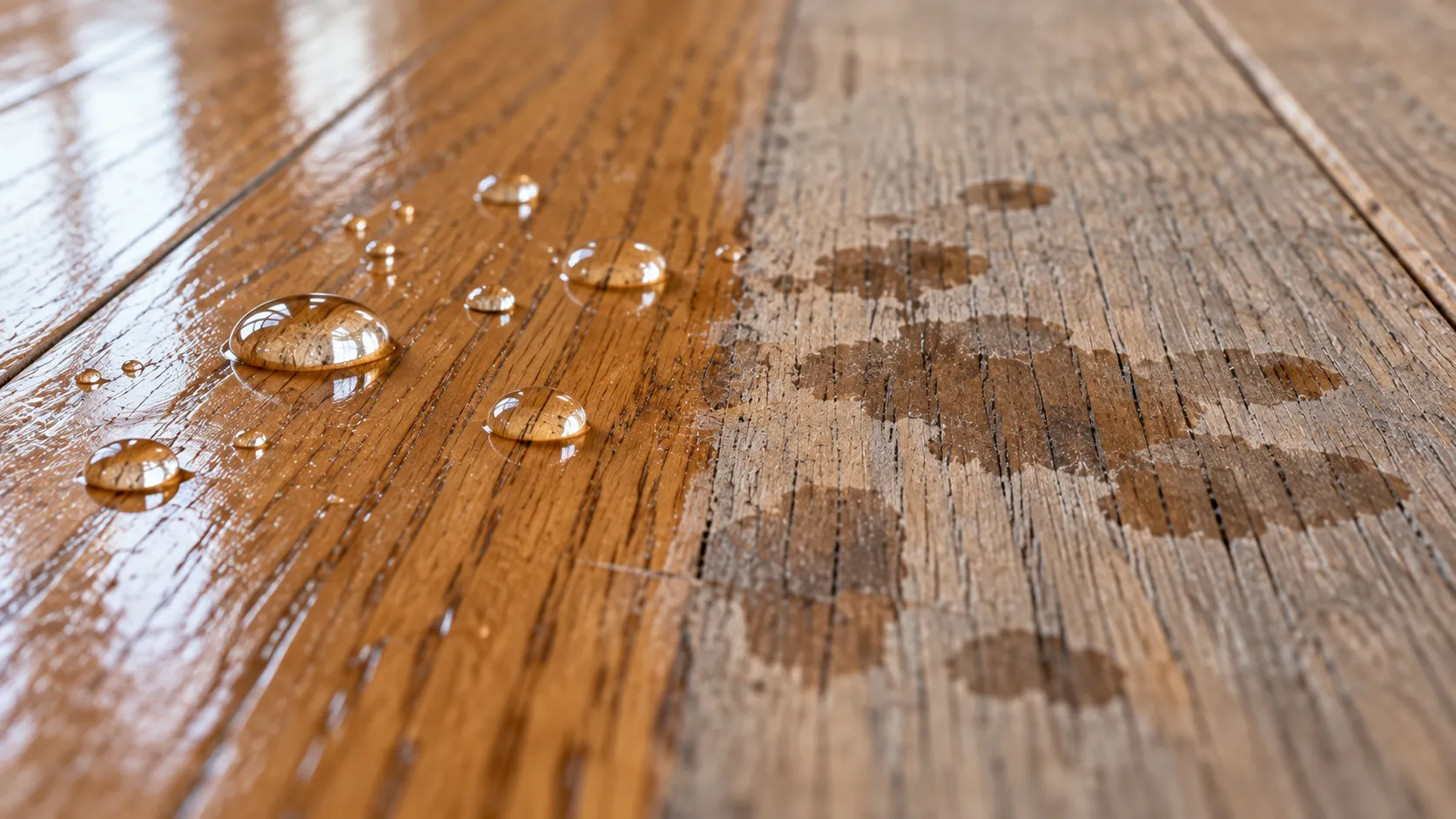
Look for gray or dark traffic lanes where the finish is gone, scratches that catch a fingernail, dark water marks, and boards that look dry and raw. Then try the water drop test that wood-care product maker Wood Wellness describes: put a few drops of water on a worn area and watch. Wood Wellness gives the three readings; the "what to do" part of each line below is the practical reading of them.
- Water beads up: the finish is still doing its job. Clean the floor and consider a screen and recoat if it looks dull.
- The wood darkens: the finish is partly compromised and worth keeping an eye on. A recoat may still work if the wood itself is not damaged.
- Water soaks in right away and the wood darkens: the finish is no longer doing its job and the wood is open to water damage. That area needs sanding and refinishing.
Do the test in a couple of places, including a high-traffic spot and a protected spot such as a closet. If the closet beads and the hallway soaks in, you have your answer for the hallway.
What Should a Floor Refinishing Quote Include?
Two quotes for "refinish the floors" can be very different jobs. A complete quote should say:
- Full sand to bare wood, or screen and recoat, in writing.
- The finish product by name, sealer or not, and the number of coats.
- Stain or natural, and whether samples are included.
- Stairs, board replacement and furniture moving as separate lines or clearly included.
- Dust control, and what "dustless" means on this job.
- When you can walk, move furniture and put rugs down.
In New Jersey the paperwork matters too. The Division of Consumer Affairs' guide to hiring home improvement contractors says contractors must register with the state, that any home improvement contract over $500 must be in writing with the contractor's registration number, start and completion dates, a description of the work and the total price, and that the contractor must give you a copy of its liability insurance policy. You can cancel a signed contract for any reason before midnight of the third business day after you receive a copy.
Frequently Asked Questions
How much does it cost to refinish hardwood floors in NJ?
National cost guides put a full sand and refinish at $3 to $8 per square foot. New Jersey runs about 9 percent above the national price level on Bureau of Economic Analysis figures, which gives a planning range of roughly $3.26 to $8.70 per square foot, or about $3,260 to $8,700 for a 1,000 square foot first floor. A single 200 square foot bedroom runs higher per square foot, nearer $7 to $9, because setup, edging and return visits for each coat cost nearly the same on a small room; Fixr puts that size at $800 to $1,600 nationally. Stairs, stain, repairs and dust extraction are usually extra. Those are published figures and arithmetic on them, not our prices: refinishing floors is not a service we list.
Is screen and recoat cheaper than sanding?
Yes, substantially. Fixr puts buffing (screening) at $1 to $2.50 per square foot and a recoat at $1 to $2 nationally, against $3 to $5.50 for traditional sanding. It only works when the existing polyurethane finish is intact and free of wax, and it will not remove deep scratches, gray wood or an old stain color. A contractor offering a recoat on a floor with bare patches is a red flag rather than a saving.
How long does it take to refinish hardwood floors?
Plan on 2 to 4 days on site for a typical room or two, and 3 to 5 days for about 1,000 square feet. A stained floor usually adds a day. Most finishes allow sock traffic after about 24 hours, furniture after about 3 days, and rugs after about 7 days or full cure, depending on the product.
Is oil-based or water-based polyurethane better for floors?
Both can be durable when applied correctly. Oil-based polyurethane adds an amber tone that deepens the look of red oak. Most water-based floor finishes dry clear and recoat faster, and the ones compared above list lower VOC levels (150 to 200 g/L for the Bona finishes against Minwax's 350 VOC oil-based formula), which is why they suit white oak, maple and light or gray stains. Check the product, though: some water-based polys, such as Minwax's oil-modified one, are rated amber. Two-component waterborne finishes are the professional high-durability option.
Should I stain my hardwood floors or leave them natural?
Natural costs less, saves a day and suits white oak and maple. Stain changes the color, evens out board-to-board contrast and lets you match other rooms; national cost guides price it at $1 to $3 per square foot extra. Maple and pine absorb stain unevenly, so test samples on your own boards before committing, and choose a clear water-based finish over gray or light stains.
How long does floor stain take to dry before the finish goes on?
Bona's DriFast Stain data sheet lists a minimum of 2 hours for wood tones, 6 hours for white and 12 to 18 hours for its darkest colors at 60 to 80°F and 35 to 75 percent relative humidity, with the finish applied within 48 hours. Humid or cold conditions stretch those times, which is why a stained floor usually adds a day.
Can engineered hardwood be refinished?
If the wear layer is thick enough. The NWFA says sanding is not recommended where the wear layer is under 3/32 inch (about 2.4 mm). Thicker wear layers can be sanded, but each sanding removes 1/32 to 1/16 inch, so the number of refinishes is limited. Thin engineered floors can still be screened and recoated.
Can I stay in the house while floors are refinished?
Often, if the work is limited to part of the house and you can reach the kitchen and a bathroom without crossing the floor. You will need to stay off the floor during sanding and coating and for about 24 hours after the last coat. Dust extraction reduces dust but does not eliminate it, so families with young children or pets often plan a night or two away.
Are gaps between floorboards in winter a problem?
No. Thin gaps that open between boards in a dry, heated New Jersey house are normal seasonal movement and usually close in the humid months. The NWFA recommends keeping indoor relative humidity between 30 and 50 percent year-round; a humidifier in winter narrows the gaps.
Who to Call, and What We Do Instead
Floor sanding and refinishing is not a service we list, so this guide ends with a reading list rather than a sales pitch. The honest price for your floors depends on what is under the old finish, and that takes someone on their knees with a light. Get two or three written estimates from floor refinishers, hold each one against the quote checklist above, and check the state home improvement registration before you sign anything.
What we do is paint. If new walls, ceilings or trim are part of the same project, book the painting before the floors, so drips and ladders never touch a new finish — see interior painting. For garages, basements and workshops where wood is the wrong material altogether, a coating is the better buy: see epoxy flooring and our epoxy garage floor cost guide. NJ Painting Co. is a family-owned, licensed and fully insured painting company at 36 Church Rd, Morganville, NJ 07751, with more than 20 years of work in central New Jersey homes, and our workmanship is backed by a 2-year warranty. We work across Monmouth, Middlesex, Ocean, Mercer, Somerset and Burlington counties, plus Union, Essex, Hudson, Bergen and Passaic in North Jersey, from Monmouth County towns to Toms River. Call (732) 239-0932 or request a free estimate for painting work.
About the author
Written by the NJ Painting Co. team
NJ Painting Co. is a family-owned painting contractor based in Monmouth County, in business since 2004. We are licensed and fully insured, work with Benjamin Moore and Sherwin-Williams paints, and back our work with a 2-year workmanship warranty. We serve Monmouth, Middlesex, Ocean, Mercer, Somerset and Burlington counties, plus Union, Essex, Hudson, Bergen and Passaic in North Jersey.