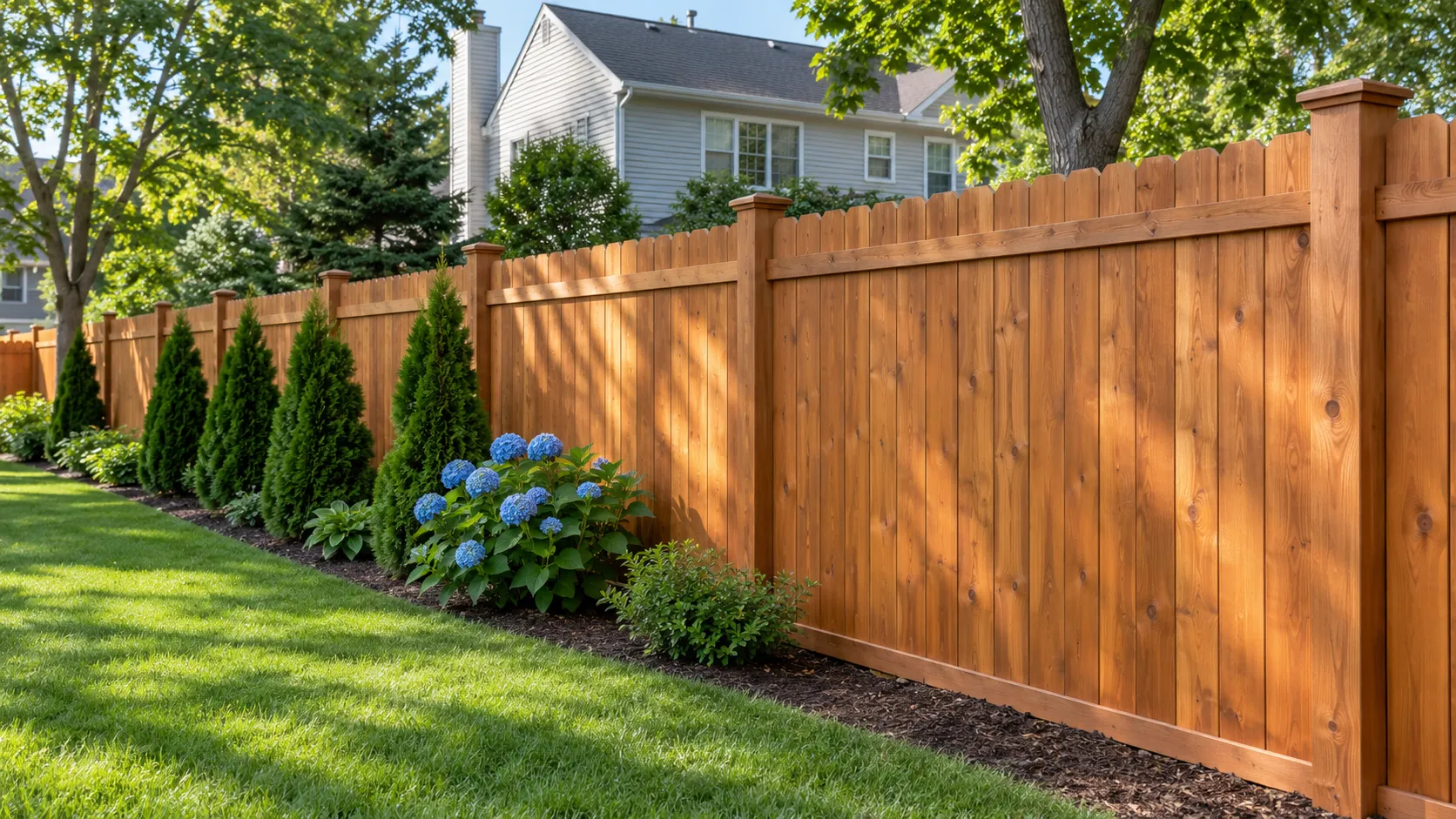
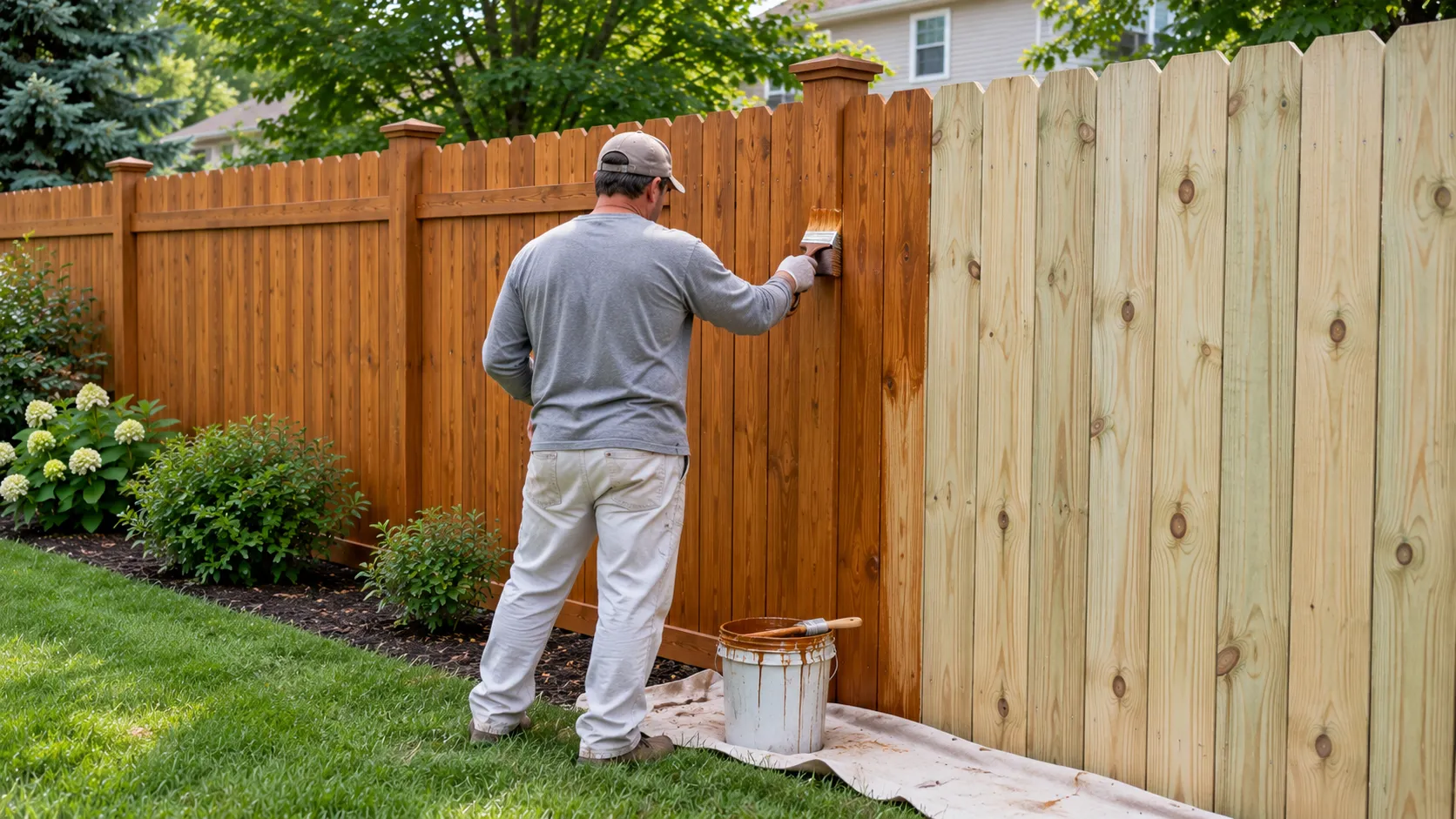
For most New Jersey wood fences, stain beats paint. A semi-transparent or solid stain soaks in or forms a thin film, fades slowly and is recoated without scraping. Paint lasts longer between coats and is the only way to a bright white, but when it fails it peels and has to be scraped. Choose by the look you want and the upkeep you will do.
That is the whole decision in four sentences, and the research behind it is old and settled. The U.S. Forest Service's Forest Products Laboratory, which has been testing wood finishes outdoors for about a century, sorts every exterior finish into two families: penetrating finishes that "flow into the pores of wood and do not form a film," and film-forming finishes — paint and solid-colour stain — that sit on top. The first family wears away. The second family peels. Everything else in this guide, from which product to buy to when a new fence is ready, follows from which of those two failures you would rather live with.
We are a family-owned painting company in Morganville and have painted and stained New Jersey exteriors across Monmouth, Middlesex, Ocean, Mercer, Somerset and Burlington counties, plus Union, Essex, Hudson, Bergen and Passaic in North Jersey, for more than 20 years, using Benjamin Moore and Sherwin-Williams products. Fences are a large part of that work: pressure-treated privacy fences around new houses, cedar board-on-board fences that have gone silver, and white picket fences that are peeling at every picket tip. This guide is the long version of the conversation we have at the estimate, usually standing in the yard flicking water onto a board to see whether it soaks in.
It is written to be useful whether you hire anybody or not, and it is deliberately not about money: what fence and deck work costs is answered in our deck and fence staining cost guide and the painting cost guide. Every coverage rate, temperature limit, dry time and moisture rule below is quoted from a manufacturer's technical data sheet — Benjamin Moore's Arborcoat stains and Regal Select exterior paint, Sherwin-Williams' WoodScapes stain — or from the Forest Products Laboratory's Wood Handbook and its finishing guidance, YellaWood, the Western Red Cedar Lumber Association, the EPA or NOAA, each fetched and read on 27 October 2026. Where something is our own practice rather than a published figure, we say so.
The Short Answer
- Stain and paint fail differently. The Wood Handbook says oil-based semi-transparent stains "will not blister or peel even in the presence of excessive water," while "solid-color stains form films and so will be prone to peeling just like paint."
- Paint protects the most, and costs the most effort when it goes. The same chapter calls paint the finish that gives "the most protection against UV radiation, water, and abrasion," and the only one that "can give a bright white appearance."
- A fence is easier on a finish than a deck. Fences are vertical. The Forest Products Laboratory warns against films on deck floors, but says paints and solid-colour stains "may perform quite well on the railings" — and a fence board is built like a railing, not a floor.
- The end grain decides whether paint lasts. Water enters end grain "100 times faster than from the sides is not unusual," and "film-forming finishes on fences and railings trap moisture if the end grain is not sealed during construction."
- New pressure-treated fences do not need a year. YellaWood says "ideally, you'll want to stain pressure treated wood within six weeks after construction," once a few drops of water soak in rather than bead.
- The water-drop test is the readiness test. Benjamin Moore's Arborcoat sheets: "test for penetration by applying a few drops of water to the dry substrate. If the water does not quickly penetrate, repeat prep."
- Stain floors are higher than paint floors. Arborcoat stains: "do not apply when air and surface temperatures are below 40°F." Regal Select exterior paint and WoodScapes stain go down to 35°F, with WoodScapes adding "at least 5°F above the dew point."
- You cannot stain over paint. "Nothing will penetrate areas having a film." Once a fence is painted or solid-stained, it stays a film finish unless it is stripped.
Paint vs Stain on a Wood Fence: What Is Actually Different
The words on the cans blur together, so it is worth being precise. There are four kinds of finish you will be offered for a wood fence, and they run along a line from "soaks in completely" to "sits on top completely."
Transparent and toner finishes
Clear and lightly tinted water repellents. They keep water out and slow greying, and they show every bit of the grain. The Wood Handbook is candid about their life: "unfortunately, most penetrating finishes do not last very long," and clear repellents are good for only a year or two on fully exposed wood, though "reapplication is easy, particularly on decks and fences." Benjamin Moore's Arborcoat Translucent sheet says surfaces finished with it "may be cleaned and touched up or recoated annually." On a fence you see every day, that is a lot of recoating for a modest look.
Semi-transparent stain
Enough pigment to colour the wood and block sunlight, not enough to hide the grain. The pigment is what makes it last: the Forest Products Laboratory notes that pigment protects "the wood surface and the mildewcide from sunlight, thus increasing service life." Oil-based versions soak in fully; the Wood Handbook warns that many waterborne semi-transparents "often form films" and "tend to crack and flake" if they are built up in too many coats. A semi-transparent stain fails by fading and wearing thin, unevenly, with the sunny side going first. It is recoated after a wash, without scraping.
Semi-solid and solid stain
Semi-solid shows a little grain through a mostly opaque colour; Benjamin Moore describes its Arborcoat Semi Solid as "ideal for reducing color variations in wood," and warns that extra coats "obscure more of the natural color of the wood" and may leave "a slight sheen." Solid stain hides the grain completely but keeps the texture, and it is a film. The Wood Handbook says plainly that "solid-color stains (latex or alkyd) will perform like paints," and that they lack abrasion resistance, which is why makers keep them off deck floors but are happy with them on vertical wood.
Exterior paint
The thickest film, the most pigment, any colour and any sheen. The Wood Handbook: "paints are highly pigmented film-forming coatings and give the most protection against UV radiation, water, and abrasion," and they "retard penetration of moisture," "decrease discoloration by wood extractives, and retard checking and warping." It adds a caution worth remembering on a fence whose posts sit in wet ground: "paint is not a preservative. It will not prevent decay if the wood is moist." It also notes that paint gives "slightly better performance" than solid stain "because the solids content of paint is higher," so it builds a thicker film per coat.
| Question | Semi-transparent stain | Solid stain | Exterior paint |
|---|---|---|---|
| Grain visible? | Yes; colour plus grain | No grain; wood texture shows | No; the most uniform look |
| Forms a film? | Oil-based: no. Waterborne: can, if over-applied | Yes: "will perform like paints" | Yes, the thickest |
| How it fails | Fades and wears thin | Erodes, or peels if water gets behind it | Erodes, or peels if water gets behind it |
| Primer on bare wood | None | Self-priming per the Arborcoat sheet; cedar and redwood primed | "A primer is strongly recommended" (Wood Handbook) |
| Recoat prep | Wash, let dry, recoat | Wash; scrape and spot-prime any peeling | Wash; scrape, sand edges, spot-prime |
| Can it change later? | Yes: to solid stain or paint | Only to solid stain or paint | Only to solid stain or paint |
| Life | FPL: one coat on new smooth wood "only 2 to 4 years"; two coats on rough wood "may last 10 years" | Like paint, slightly less per coat | FPL: a three-coat system on siding "should last 20 years"; fences shorter in our experience |
So which should you choose?
In our experience the choice is mostly made by three questions. Do you want to see the wood? Then it is a semi-transparent stain, and you accept recoating every few years. Do you want white, or a strong colour that matches the house trim? Then it is paint or solid stain, and you accept that one day it will need scraping. And how much of the fence can you actually reach? A fence with one face against a neighbour's garden, or buried in shrubs, is a fence where a low-maintenance, fade-don't-peel finish has real value, because the face you cannot reach easily is the one that will go unmaintained.
Solid stain sits in the middle and is the finish we suggest most often on fences that already have an old film on them or whose boards no longer match. It covers like paint, it is thinner and flatter than paint so it shows the wood's texture, and when it erodes it tends to erode rather than sheet off — provided the end grain and the bottoms of the boards are not soaking up water. That proviso is the subject of the next sections.
Which Finish for Which Fence? Pressure-Treated, Cedar, Spruce and Pine
The wood matters nearly as much as the finish. The Wood Handbook explains why some species hold paint well and others do not: woods with "wide, prominent bands" of dense latewood — it names "the southern yellow pines, Douglas-fir, and to some extent radiata pine" — make "getting good paint performance" "more difficult," while "white pine, western redcedar, and redwood" are lower density, "do not have wide LW bands," and "give excellent paint performance."
| Fence | What the sources say | Usual best finish (our practice) | Watch for |
|---|---|---|---|
| New pressure-treated southern pine | Stain "within six weeks after construction" once dry (YellaWood); wet wood: "use a penetrating, rather than film-forming, finish" (Wood Handbook) | Semi-transparent or semi-solid stain | Wet lumber; the green tone shifting the stain colour |
| Weathered pressure-treated pine | Weathered wood must be cleaned "until a sound surface is obtained" (Arborcoat) | Semi-solid or solid stain, or paint after sanding | Loose grey fibres, checking, raised latewood |
| Western red cedar | "Excellent paint performance"; tannin-rich, so prime under solid colour (Arborcoat 640) | Semi-transparent to show it off; solid stain or paint over a stain-blocking primer | Tannin bleed; softness under hard washing |
| Spruce, fir or white pine pickets | Smooth planed boards must be sanded or brightened to break "mill glaze" (Arborcoat) | Paint or solid stain over primer; picket fences are usually painted | Bare picket tips and bottoms; knots |
| Any fence already painted or solid-stained | "Nothing will penetrate areas having a film" (Wood Handbook) | Solid stain or paint again | Peeling at board bottoms and post tops |
Pressure-treated pine
Most new fences in New Jersey are pressure-treated southern pine, and the Wood Handbook is reassuring about the treatment itself: "wood treated with waterborne preservatives, such as copper-based systems, can be painted or stained if the wood is clean and dry," and "species and grain orientation affect finishing more than preservative treatment does." The two problems are the wood's dense latewood bands, which films struggle to stick to, and the fact that treated lumber is often delivered wet. That combination is why a penetrating or semi-transparent stain is our usual first finish on a new pressure-treated fence. Benjamin Moore's Arborcoat Semi Transparent sheet names it directly: "ideal for pressure treated lumber and softwoods like cedar and pine."
Colour is the other surprise. Sherwin-Williams' WoodScapes sheet warns that "due to the green tone of many brands of pressure treated lumber, the color of the stain may look different from the color selected. Check the color on a test area prior to staining the entire project." A cedar-tone semi-transparent over fresh green lumber can come out browner or more olive than the chip, so we always put a sample on an actual board.
Cedar
Cedar is the best fence wood to finish and the easiest to damage while preparing it. It holds paint and stain beautifully, but it is soft: the Forest Products Laboratory notes that "aggressive scrubbing with a caustic cleaner or power washing can remove wood from the surface, particularly on softer wood such as western redcedar," and the Western Red Cedar Lumber Association says that "steel wool and wire brushes should never be used to clean Western Red Cedar." Cedar is also tannin-rich. If you want an opaque colour on it, Benjamin Moore's Arborcoat Solid Color sheet says "tannin rich woods such as redwood or cedar should be primed" with an oil primer or a stain-blocking primer, and its Regal Select exterior paint sheet lists a primer for "Bleeding Type Woods, (Redwood and Cedar)." Skip that primer and brown tannin stains can come through a light colour.
Spruce, fir and pine pickets
Budget fence panels and picket sections are often spruce, fir or pine, smooth planed and sometimes kiln-dried. Smooth planed boards are the case the Arborcoat sheets address under "New Wood": they "must be sanded thoroughly or treated with Benjamin Moore Brighten, Brightener & Neutralizer (317) to break the 'mill glaze' and allow proper penetration and adhesion." (The Wood Handbook adds that its scientists found the real culprits behind most "mill glaze" failures were raised grain, sun exposure before painting and moisture; either way, the cure is a light sanding or brightening.) Picket fences are traditionally painted, and that works well on these lighter woods — if every cut end is sealed.
When Is a New Fence Ready to Paint or Stain?
This is the question we are asked most about new fences, and the old advice — "let it weather for a year" — is the one we hear most often. Every source we read for this guide has moved away from it.
The water-drop test
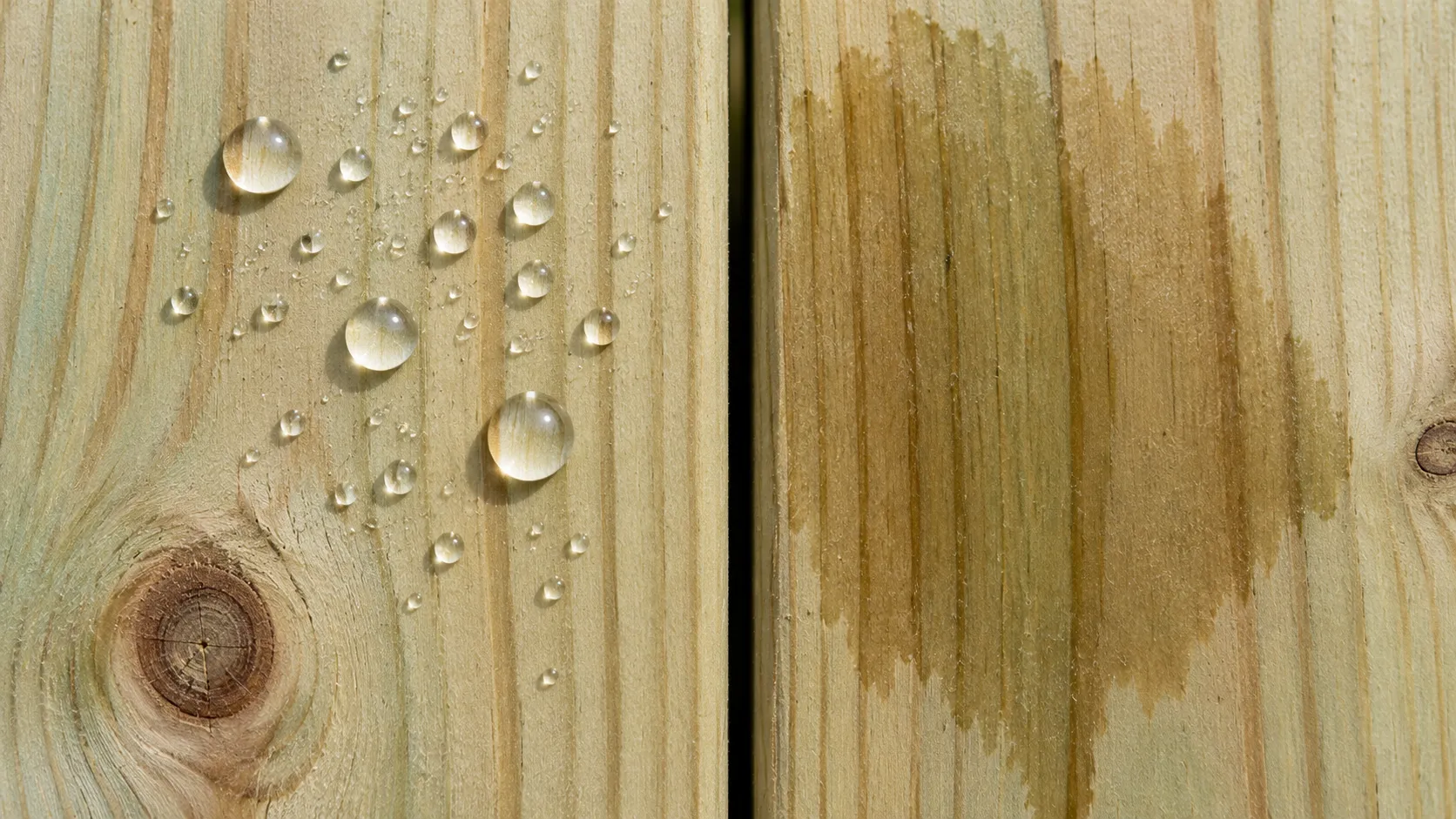
YellaWood, one of the largest pressure-treated lumber brands, says "in the past, many used a rule of thumb to wait six months or even a year to stain projects that used treated wood. But that's no longer the case." Its guidance: "ideally, you'll want to stain pressure treated wood within six weeks after construction," and to check readiness "by dropping a few beads of water onto the boards. If it beads up, you'll need to wait several days to test again. However, if the water absorbs into the wood, it's ready for staining."
The paint makers use the same test. Sherwin-Williams' WoodScapes sheet, under "Pressure Treated Wood": "Test the absorbency of the wood by sprinkling water on the surface. If the water penetrates into the wood quickly, the wood is ready to finish. If the water beads up or does not penetrate, remove existing finish or contaminant. Then test for absorbency again. Do not apply coating over wet or damp surfaces." Benjamin Moore's Arborcoat Semi Transparent sheet gives the number behind it: "new pressure treated lumber must be allowed to dry out or have a moisture content below 15%."
Why does water bead on a new board? Either the wood is still full of water from treatment, or the board carries a factory water repellent, or the surface is glazed from planing. The Wood Handbook describes the wet case and how to recognise it: treated lumber that is "still above the saturation point when it is delivered" is "exceptionally heavy," or shows "water coming out when a small piece is squeezed by vice or hammer blow." Its advice is blunt: "Nothing will coat wet wood well. If you encounter this situation, the best you can do is wait until the wood dries and use a penetrating, rather than film-forming, finish. Alternatively, you can purchase wood kiln dried after treatment, known as KDAT."
How the different sources fit together
The published waiting periods differ, and it helps to see why. The Wood Handbook says that once treated wood has dried, "one week should be sufficient to allow wood surfaces to dry enough to finish." YellaWood says within six weeks. The Forest Products Laboratory's deck-finish sheet says that if boards carry a factory water repellent, "a semitransparent stain may not absorb properly," and "the wood should be allowed to weather for 2 to 3 months before finishing." Those are not contradictions; they describe different lumber. The water test tells you which one you have.
Do not wait too long either, especially for paint
Waiting has its own cost. The Wood Handbook calls exposure to sunlight before a film finish "a major cause of coating failures," and reports research in which "surface degradation of wood facing south for as little as one week prior to painting significantly shortened the service life of paint." Denser woods are more tolerant: on Douglas-fir and southern yellow pine "little loss of paint adhesion occurred until boards had been preweathered for 3 to 4 weeks." For cedar the advice is to "finish the wood as soon as possible after installation, or better yet, prime it before installation," and the Western Red Cedar Lumber Association says surface preparation stays simple "providing the wood has not weathered for more than two weeks."
Our practice follows from that. On a new fence that is going to be painted or solid-stained, we want it primed or coated within weeks of passing the water test, not after a year of sun. If a fence has sat for a summer or two and gone grey, that grey layer has to be cleaned off before a film goes on, because the Wood Handbook says "badly weathered wood having loosely attached fibers on the surface cannot hold paint." A semi-transparent stain is more forgiving; the Forest Products Laboratory notes that "a penetrating finish lasts longer on sunburned wood than on fresh wood."
The Best Paint and Stain for a Wood Fence
There is no single best product, because the best fence finish depends on which of the four kinds you have chosen. What we can do is show you what a premium product in each category actually says on its data sheet, so you can compare it with whatever is on the shelf. These are products we use; we have no arrangement with either maker.
| Product | Type | Sheet says it is for | Coverage per gallon | Minimum temperature | Dry / recoat | Coats |
|---|---|---|---|---|---|---|
| Benjamin Moore Arborcoat Waterborne Semi Transparent N638 | Semi-transparent stain | "wood decking, fencing, siding, shakes, and furniture" | 200–400 sq. ft.; "do not apply less than 200" | 40°F air and surface | Touch ½ hour; recoat 4 hours | "Generally, one coat"; a second if needed |
| Sherwin-Williams WoodScapes Exterior Polyurethane Semi-Transparent Wood Stain | Semi-transparent stain | "most vertical exterior wood surfaces"; "not for use on horizontal surfaces" | 100–350 sq. ft. | 35°F air, surface and material, 5°F above dew point | Touch 2 hours; recoat 5 hours above 45°F, 24–48 hours at 35–45°F | Two; second "within 30 days of the first" |
| Benjamin Moore Arborcoat Waterborne Semi Solid 639 | Semi-solid stain | "wood decking, fencing, siding, shakes, and furniture" | 300–400 sq. ft. | 40°F air and surface | Touch ½ hour; topcoat 4 hours | 1 or 2 |
| Benjamin Moore Arborcoat Waterborne Solid Color 640 | Solid stain, 100% acrylic | "Ideal for pressure treated, cedar, and redwood" | 300–400 sq. ft. | 40°F air and surface | Touch 1 hour; recoat 3–4 hours | 1 or 2; prime cedar and redwood |
| Benjamin Moore Regal Select Exterior High Build Low Lustre N401 | Exterior paint, 100% acrylic | "wood, hardboard, fiber cement, cedar shake, vinyl and aluminum siding" | 250–350 sq. ft. | 35°F air and surface (the feature list says 40°F) | Touch 1 hour; recoat 4 hours | 2 on bare wood; prime cedar and redwood |
A few things in that table are worth reading twice.
WoodScapes is made for fences, not decks. Its sheet describes it as protecting "most vertical exterior wood surfaces" and says outright that it is "not for use on horizontal surfaces, such as a roof, or floor, where water may collect." That is exactly a fence's situation, and it is the clearest sign in either catalogue that a vertical-surface stain and a deck stain are not the same product. It is also a two-coat system: "Two coats are necessary to achieve the selected color," and the second "must be applied within 30 days of the first coat."
Coverage on a fence is lower than you expect. Rough-sawn fence boards and weathered wood drink stain. Sherwin-Williams' note: "new wood normally requires less product than old, weathered wood. This is due to older wood being more porous than newer wood." Benjamin Moore's semi-transparent sheet sets a floor — "do not apply less than 200 Sq. Ft. per Gallon" — to stop people stretching it too thin, and its solid and semi-solid sheets give 300 to 400. Budget on the low end of every range for a weathered fence.
"Self-priming" means different things. Arborcoat Solid Color is "self-priming on most surfaces" but makes an exception for "tannin rich woods such as redwood or cedar." Regal Select paint is self-priming on wood in the sense that "on bare substrates two coats are required." The Wood Handbook takes the stricter line: "when applying paint or solid-color stain, a primer is strongly recommended," because a primer is designed "to be sticky and flexible" and a topcoat "to be hard," and "though 'paint and primer in one' can be purchased, the properties are not optimal for either the primer or the topcoat." Our practice on bare fence wood that is going to be painted is to prime it, and on cedar always with a stain-blocking primer.
Oil versus water-based. Both Benjamin Moore products here are waterborne, and so is WoodScapes. The Wood Handbook says traditional oil-based semi-transparents penetrate best, and that waterborne semi-transparents can form a film if piled on, so the rule with any waterborne stain is to apply what the wood absorbs and no more. For repainting, the Western Red Cedar Lumber Association's rule applies to any fence: "old latex coatings should always be refinished with latex coatings and never with oil-based coatings." For the wider question, our guide to oil versus latex paint and primer goes into it properly.
Preparing a Fence: Cleaning, Mildew, Brightening and Sanding
Preparation is where a fence finish lasts or fails, and it is mostly washing.
Cleaning without tearing up the wood
Every data sheet we quote starts in the same place. Arborcoat: "optimal performance is achieved when the product is applied to a clean, dry and absorbent wood substrate." WoodScapes: "remove all surface contamination by washing with an appropriate cleaner to remove all dirt, air pollution, chalk, etc." YellaWood's version for new treated wood: "deck cleaner or a mixture of water and soap can be used for cleaning," scrub "with a brush while wet or using a pressure washer," then "allow the wood to dry for about 24 hours before applying any stain."
The danger is pressure. The Wood Handbook explains that power washing "erodes less dense EW more than dense LW, leaving behind ridges of LW, which are difficult to repaint" — the furry, ridged surface you see on fences that were blasted. It also says power washing "is less damaging to wood than is wet or dry sandblasting, particularly if low-pressure power washing is used." The Western Red Cedar Lumber Association goes further for its wood: "power washing should never be used for removing coatings from Western Red Cedar."
Power washing is a service we offer, and on fences we use it as a rinse, not a stripper: a cleaner applied at low pressure, a wide fan tip held back from the boards, a soft brush where something needs scrubbing, and a thorough rinse. Our guide to power washing in NJ explains how the method changes from one surface to another. Then the fence dries, and we check it with the same water-drop test before any stain goes on.
Mildew and green growth
Fences in New Jersey grow mildew and algae on the shaded side and along the bottom, where grass and shrubs keep them damp. The Wood Handbook notes that mildew "is most common where moisture stays longest — out of the sun and where air does not move, such as near tall plants," and gives a simple way to tell mildew from dirt: apply a drop or two of household bleach, and "the dark color of mildew will usually bleach out in a few seconds. Surface discoloration that does not bleach is probably dirt, extractives bleed, or iron stain." Both paint makers say it has to come off before coating; Benjamin Moore's Arborcoat sheets say "stains from mildew must be removed by cleaning" before staining.
Where our scope sits matters here. Washing a fence, including washing off mildew staining, is our work; treating mould or mildew as a remediation service is not. If growth keeps coming back because the fence is permanently wet — buried in a hedge, sitting in soil, or downhill of a downspout — we will point that out, because no finish outlasts a board that never dries.
Brighteners
Cleaners that remove grey and mildew can darken tannin-rich wood. Benjamin Moore's Brighten 317 sheet says it "counteracts the darkening effect" of its cleaner and stripper "on tannin-bearing woods," "removes tannin and rust stains," and "removes the factory 'mill glaze' which can interfere with the adhesion of paints and stains." Two cautions from the same sheet: "do not apply when air and surface temperatures are below 50°F," and the "product does not control mold, mildew, fungus or algae, only removes stains." A brightener is a cosmetic step for semi-transparent stain on cedar and weathered pine; it is rarely needed under paint.
Sanding the fuzz, and the old finish
After a wash, softwood fences often show raised, fuzzy grain. A light sanding knocks it down so a stain goes on evenly and a film has something solid to bond to. Old peeling paint or solid stain has to come off where it is loose: Arborcoat Solid Color "can be used over previously painted and stained wood that is in good condition. If general peeling is present all previous coatings should be removed." Sherwin-Williams puts the stakes plainly: "any surface preparation short of total removal of the old coating may compromise the service length of the system."
End grain: the tops, the bottoms and the posts
If one thing in this guide changes how long your fence finish lasts, it is this. The Wood Handbook calls sealing end grain "probably the single most valuable improvement that can be made in standard construction practice to improve the performance of wood exposed to water," because "liquid water can enter wood through the end grain so quickly — 100 times faster than from the sides is not unusual." And on fences specifically: "film-forming finishes on fences and railings trap moisture if the end grain is not sealed during construction." It describes a railing eight years old where "water flowed down the railing and absorbed into the end grain, and the paint kept the wood from drying."
On a fence that end grain is the top of every picket and every board, the bottom of every board, the cut tops of the posts and the cut ends of the rails. Water runs down a painted picket, soaks in at the bottom, and the paint peels upward from there. Our practice is to load the bottom and top edges of every board with stain or primer, work it into the post tops, and keep the bottom edge free of soil and mulch where we can reach it. Grass and mulch piled against a fence keep the bottom wet, and that is where nearly every fence finish fails first.
Rot, loose boards and what we do not do
Preparation turns up damage. A board that is soft at the bottom, a post that moves at grade, a rail that has split — we point these out at the estimate, but we do not build, repair or replace fences, and that includes replacing individual boards, pickets or posts. Exterior rot repair and carpentry are not services we offer. The Wood Handbook notes that fence posts are "in contact with the ground; therefore, wood decay and termite attack are potential problems," and a post that is rotten at the ground is a fence contractor's job before it is a painter's. Paint does not fix it: "paint is not a preservative. It will not prevent decay if the wood is moist."
Spray, Brush or Roller?
All three, usually together, and the brush has the last word. Arborcoat Semi Transparent: "stain can be applied by brush, roller, pad applicator or by spray. If the product is applied using a roller or sprayer, it is recommended to back-brush the stain into the wood with the direction of the natural grain." Arborcoat Solid Color: "back-brushing is recommended with roller or spray application." The Western Red Cedar Lumber Association: "brushing will usually give the best penetration and performance." Both makers give airless settings — Arborcoat Solid Color "2000 – 2500 psi" with a "0.013 – 0.017"" tip, WoodScapes "2000 p.s.i." with a ".015-.017 inch" tip — so spraying is allowed; it is just not the whole job.
Back-brushing matters more on fences than on most surfaces, because fences are full of edges, gaps and rough-sawn faces that a spray fan coats on one side and misses on the other. Spray gets material into the gaps between boards and onto the edges of pickets quickly; the brush that follows works it into the grain and evens it out. On a smooth picket fence being painted, a roller and brush can do the whole job without a sprayer at all.
Lap marks
Stains lap. Sherwin-Williams describes it — "dark lines where two freshly coated areas overlap" — and gives the fixes: "do not stain in direct sun or on a hot surface," "stain from a dry area into the adjoining wet stain area," "keep the leading edge wet," and "stain a board from end to end." Benjamin Moore's version: "never stop staining in the middle of the board; continue until a natural break is reached." On a fence the natural break is the post: we stain a bay at a time, top to bottom, every board end to end, and we follow the shade around the yard.
Both sides, and the neighbours
Every fence has two faces, and the one facing the neighbour is usually the forgotten one. Finishing one side only is common, and it is a choice with a cost: the unfinished side keeps taking up and giving off water, the boards move more, and the finished side has more to cope with. We would rather finish both. That needs access to the far side, which means asking the neighbour well before the job is scheduled, not on the morning. If you share the fence, talk to them about colour, too; the face they look at is theirs to live with.
Spraying near a property line is the other neighbour question. A light breeze carries stain mist further than people believe, and cars, siding, patio furniture and plants on the far side are all within reach. Our practice is to mask, to spray only in still conditions, and to brush and roll the bays nearest anything that cannot be moved. The Forest Products Laboratory also warns that "fungicides in WRPs and semitransparent stains are toxic and may be herbicides," so shrubs and flower beds along the fence line get covered or rinsed.
When Can You Paint or Stain a Fence in New Jersey?
The product sets the floor, and it is the wood's surface that is measured, not the air in the shade. Arborcoat stains: "do not apply when air and surface temperatures are below 40°F," and "apply when air and surface temperatures are between 40°F (4.4°C) and 90°F (32°C)," with "moisture content of wood substrate" "below 15%." WoodScapes: "check to be sure the air, surface, and material temperature are above 35°F and at least 5°F above the dew point. Avoid using if rain or snow is expected within 2-3 hours," and "air and surface temperatures must not drop below 35°F for 48 hours after application." Regal Select paint: not below 35°F air and surface, and "high humidity and cool temperatures will result in longer dry, recoat and service times."
The Wood Handbook gives a more conservative general rule for latex: apply it "when the temperature is at least 10°C (50°F) and expected to remain above this temperature for 24 h," because "most latex paints do not coalesce properly if the temperature drops below 10°C (50°F)," while telling readers to "check with paint manufacturers on the temperature requirements because some paints can be applied at lower temperatures." It also notes that the dew point is a good estimate of the coming low temperature, and advises against "painting late in the afternoon if heavy dew is expected." Our practice in spring and autumn is to treat the can's figure as the legal minimum and the handbook's 50°F as the comfortable one, and to start each run of fence only after the sun has dried the dew off it.
Here is what that means in an actual New Jersey year. NOAA's 1991–2020 climate normals for the Freehold-Marlboro station, a few miles from our office, put the average April high at 63.0°F and low at 41.2°F, May at 72.0°F and 50.6°F, October at 66.6°F and 44.3°F, and November at 56.2°F and 35.7°F. The station's annual normals put the median last 36°F low on May 1 and the median first 36°F low on October 12. Every month from April to November averages between about 3.5 and 4.7 inches of precipitation, so a dry spell long enough for wash, dry and stain has to be watched for in any season.
So the comfortable fence season in central New Jersey runs from about May into early October, with late April and mid-October workable on the right days, and November possible only with a product rated for 35°F, the 48-hour rule watched closely and longer recoat times built in. High summer has its own limit: both makers say not to stain in direct sun, and a south-facing fence in July is stained in the morning shade or not at all. Our guide to how cold is too cold to paint outside in NJ goes through the late-season decisions in more detail.
How Long Does Fence Paint or Stain Last in New Jersey?
The honest answer comes in two parts: what the research and the makers publish, and what we see. They are labelled separately here.
What the published sources say
- Clear water repellents: short-lived when fully exposed; the Wood Handbook says reapplication "is easy, particularly on decks and fences." Arborcoat Translucent "may be cleaned and touched up or recoated annually."
- Semi-transparent stain: "two coats of semitransparent penetrating stain may last 10 years on rough or saw-textured wood. By comparison, the life expectancy of one coat of stain on new smooth wood is only 2 to 4 years; however, as the stained wood ages, it becomes more porous and subsequent staining lasts longer" (Wood Handbook). The Western Red Cedar Lumber Association agrees that "the second coat of penetrating stain often lasts longer than the first coat."
- Paint: on siding, "a three-coat finish system (0.10 to 0.13 mm thick) should last 20 years," and "paint on the shaded side often lasts twice as long as that on a fully exposed, sunny side" (Wood Handbook).
What we see on fences
Fences do not get the shelter siding gets — no overhang, no gutter, wet ground at the bottom and both faces in the weather — so in our experience they run shorter than those siding figures. As a rule of thumb, not a published figure: a semi-transparent stain on a sunny pressure-treated fence in central New Jersey starts to look tired in about three to five years, faster on the south and west faces and on rough-sawn boards that took only one coat; solid stain and paint usually go longer before they look worn, but when they do fail it is by peeling at the board bottoms and picket tips, and that repaint involves scraping. The shaded, north-facing side of the same fence often looks fine when the sunny side needs work, and the Wood Handbook's point that different sides "do not need to be painted on the same schedule" applies: it is fine to recoat the face that needs it.
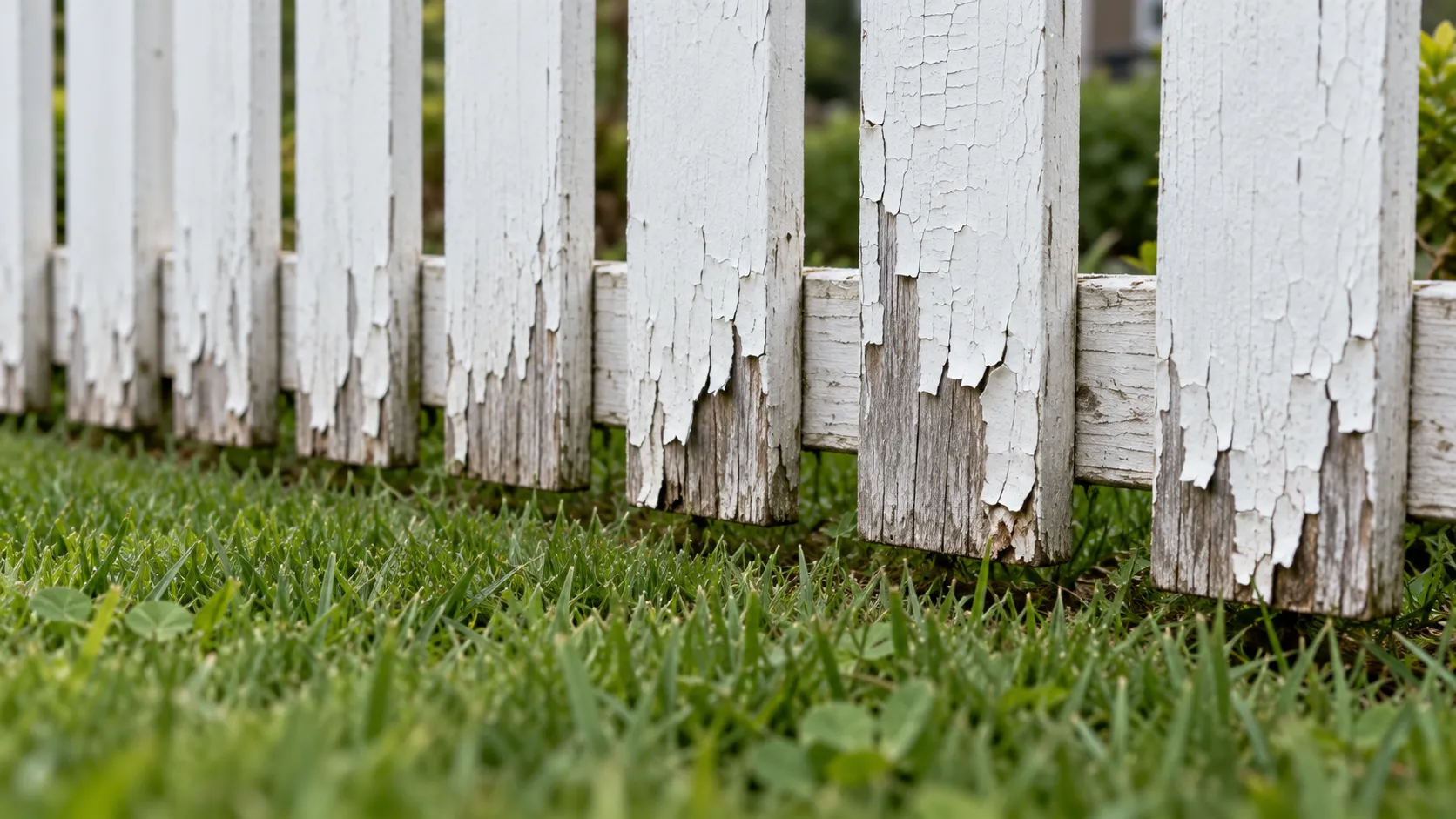
Our guide to how often to paint a house exterior in NJ puts these intervals alongside the rest of the house, and if paint on your fence is coming off in sheets rather than wearing away, why paint peels is the diagnostic version.
Painting Over Stain, and Staining Over Paint
The rule is one-directional: you can always move toward more opacity, and you can only move back by stripping.
Paint or solid stain over semi-transparent stain
Yes, once the old stain has weathered and the fence is cleaned. A semi-transparent stain leaves no thick film to peel, so a primer and paint, or a solid stain, can go over a clean, dry, absorbent fence. The Western Red Cedar Lumber Association adds a caution for oil finishes: "old oil-based finishes can be refinished with latex finishes only when the old oil-based finish has been properly cleaned and a primer coat applied first."
Solid stain over paint
Usually yes. The Wood Handbook: "solid-color stains can usually be applied over paint." Arborcoat Solid Color says it "can be used over previously painted and stained wood that is in good condition." Loose paint comes off first.
Semi-transparent stain over paint or solid stain
No. "Nothing will penetrate areas having a film; film-forming finishes (paint or solid-color stain) do not bond to weathered areas" (Wood Handbook), and "do not apply oil-based semitransparent stains over filmforming finishes." Benjamin Moore's semi-transparent may go over a previous transparent stain "that is weathered but is not flaking or peeling," and "if the existing stain is flaking or peeling it should be removed prior to staining." If you have a painted fence and want wood grain back, the choice is a full strip — with the time and wood damage that involves — or a solid stain that keeps a wood texture without the grain.
Old Painted Fences and the EPA Lead Rule
Most wood fences are younger than the houses behind them. But some older New Jersey properties still have painted picket fences, gates, arbours or garden walls from decades ago, and paint applied before 1978 may contain lead. Every Benjamin Moore sheet quoted here carries the warning: "if you scrape, sand or remove old paint, you may release lead dust. LEAD IS TOXIC." The Wood Handbook adds that "power washing and wet and dry sandblasting are not suitable for paint containing lead."
The EPA's Renovation, Repair and Painting rule says "anyone paid to perform work that disturbs paint in housing and child-occupied facilities built before 1978 must be certified," and "EPA recommends that homeowners hire a lead-safe certified contractor." We are not an EPA Lead-Safe Certified firm. That is a licensing fact about us, not a choice of wording. Whoever you hire, before anyone scrapes, sands or pressure-washes old paint on a pre-1978 property, ask the bidder for their firm certification number and check it through the search tool linked from the EPA's Renovation, Repair and Painting program page. Our guide to lead paint in older NJ homes explains testing and New Jersey's own requirements.
Vinyl and Metal Fences
This guide is about wood, but the question comes up at every estimate, so briefly.
Vinyl fences are sold as never needing paint, and we have not found a vinyl fence maker's published painting guidance that we would quote here. Before anyone paints one, read the fence's warranty, because painting may affect it. Vinyl also softens with heat, which is why vinyl siding makers publish limits on how dark it may be painted; our guide to painting vinyl or aluminum siding explains those limits. Most of the time a dull vinyl fence wants washing, not paint.
Metal fences — aluminium, steel, chain link, wrought iron — are a different set of products: metal primers and direct-to-metal coatings, with rust removed first. Benjamin Moore's Regal Select sheet lists "nonferrous metals" among the surfaces it is self-priming on, and aluminium siding among its uses, but bare steel and rusted iron need a metal primer under any topcoat. Ask us about a metal fence at the estimate. What we do not do is fabricate, weld or repair metal fences, and we do not do wrought iron work.
Colour Pointers for Fences
A few things we have learned about choosing a fence colour, offered as practice.
- Test on a real board. Sherwin-Williams: "A sample brushout is recommended to ensure color satisfaction," and Benjamin Moore: "in can color may differ from the final dried finish." On green pressure-treated lumber the difference can be large.
- Semi-transparent colours shift with the wood. The same cedar tone looks different on new pine, weathered pine and cedar. It also darkens with a second coat, which the Arborcoat Semi Solid sheet warns "will affect the opacity of the final finish."
- A fence is part of the yard, not the house. Natural wood tones, greys and deep greens and browns recede into planting; bright white draws the eye to the fence line and shows every bit of mildew and soil splash at the bottom.
- White is a paint job. The Wood Handbook says "paint is the only finish that can give a bright white appearance." If you want a crisp white picket fence, plan on paint and on its upkeep.
- Coordinate with the trim, not the siding. A fence that picks up the trim or door colour usually looks deliberate. Our guide to popular exterior house colors in NJ is a good place to start, and if the fence finish is the same sheen question as the house, our sheen guide helps.
A Fence Is Not a Deck
People often ask why we will happily paint or solid-stain a fence but steer them away from paint on a deck floor. The Forest Products Laboratory's deck guidance is explicit — "penetrating finishes, not film-forming finishes, should be used on wood decks," because films "are prone to trap moisture and fail by peeling" and are worn by foot traffic — and in the same breath it says paints and solid-colour stains "may perform quite well on the railings." A fence board is a railing turned into a wall: vertical, unwalked, shedding water rather than holding it. If you are doing a deck and fence together, our guide to deck stain versus sealer covers the deck floor's side of that decision, and the two are often done in the same visit with matching or complementary colours.
What We Do, and Do Not Do, on Fences
- We stain and paint wood fences, new and old, pressure-treated, cedar and pine, along with gates, arbours, sheds and outbuildings, and we schedule them with deck staining and exterior painting where that helps.
- We wash fences with low-pressure power washing, a cleaner and a soft brush, brighten cedar where a semi-transparent stain calls for it, and let the wood dry fully before finishing.
- We water-test the wood before staining and wait if the water beads.
- We sand raised grain and scrape loose finish, and we prime bare wood that is being painted, cedar with a stain-blocking primer.
- We seal the end grain at board tops and bottoms, picket tips and post tops, and caulk and seal where a joint calls for it.
- We back-brush anything we spray or roll, finish both faces where there is access, and mask and protect the neighbour's side and your planting.
- We work to the data sheet's temperature, moisture and dew-point rules and reschedule rather than stain a cold or damp fence.
- We write the surfaces, preparation, products and number of coats on the estimate, so you can compare bids line by line.
What we do not do, so there is no ambiguity: building, installing or repairing fences, including replacing boards, pickets, rails or posts; exterior rot repair and carpentry; mould or mildew treatment as a remediation service (washing is ours, treating growth is not); metal fence fabrication or wrought iron work; and pool deck coating. We point out rot, loose posts and failing boards at the estimate so the right trade can deal with them before we finish the fence. And we do not hold EPA Lead-Safe (RRP) certification: on a pre-1978 property with old painted surfaces, ask us — and every other bidder — for a firm certification number before anyone disturbs old paint.
Get a Price for Painting or Staining Your Fence
Fence work is priced on the length and height of the fence, whether one face or both are being done, the style (a solid privacy fence, a shadowbox or a picket fence take very different time), the condition of any finish already on it and the finish you choose, which is why we look at the fence rather than quote from a photo. NJ Painting Co. is a family-owned, licensed and fully insured painting company at 36 Church Rd, Morganville, NJ 07751, working on New Jersey homes for more than 20 years with Benjamin Moore and Sherwin-Williams products. Every estimate is free and spells out surfaces, prep, products and number of coats; our work carries a two-year workmanship warranty. For how pricing is built, see our deck and fence staining cost guide and the cost guide; for the work itself, our deck and fence staining service, and for the house behind the fence, our exterior painting service. Call (732) 239-0932 or request a free estimate, and ask us about the job minimum when you enquire.
Frequently Asked Questions
Is it better to paint or stain a wood fence?
For most wood fences, stain. A semi-transparent or semi-solid stain fades and wears thin rather than peeling, and it is recoated after a wash with no scraping. Paint gives the most protection, any colour and the only true white, and it lasts longer between coats, but when it fails it peels, usually from the bottom of each board, and has to be scraped. Solid stain sits between the two: it covers like paint with a thinner, flatter film.
What is the best paint for a wood fence?
A premium 100 percent acrylic exterior paint over a primer. Benjamin Moore lists wood first among the surfaces for Regal Select Exterior, and the USDA Forest Products Laboratory's Wood Handbook says a primer is strongly recommended under paint or solid stain. On cedar or redwood, use a stain-blocking primer so tannins do not bleed through a light colour. Seal every cut end, especially the board bottoms and picket tips.
What is the best stain for a wood fence?
One made for vertical wood and matched to the look you want. Benjamin Moore's Arborcoat semi-transparent, semi-solid and solid stains all list fencing among their uses, and Sherwin-Williams' WoodScapes semi-transparent stain is made for vertical exterior wood and says it is not for horizontal surfaces. Semi-transparent shows the grain and needs recoating more often; solid stain hides the grain and lasts longer between coats.
How long should I wait to stain a new pressure-treated fence?
Until a few drops of water soak in rather than bead up. YellaWood says to stain pressure-treated wood ideally within six weeks after construction once it is dry enough, and Benjamin Moore says new pressure-treated lumber must dry out or be below 15 percent moisture. If the lumber is still soaking wet, wait and use a penetrating stain rather than paint. Waiting a year is old advice and lets the sun damage the surface.
Can you paint a pressure-treated fence?
Yes, once it is clean and dry. The Wood Handbook says wood treated with copper-based preservatives can be painted or stained if the wood is clean and dry, and warns that preservative can bleed through latex paint and solid stain if the wood is still wet. Pressure-treated southern pine has dense grain bands that make paint harder to keep, so prime it, seal the end grain, and paint it within weeks of it passing the water test rather than after it has weathered.
Should I stain both sides of my fence?
Ideally, yes. A fence finished on one side only keeps taking up and releasing water through the bare side, so the boards move more and the finish on the good side has more to cope with. Finishing both sides needs access to the neighbour's side, which should be arranged before the job is booked, and spraying near a property line needs masking and still air.
Can you put stain over a painted fence?
Not a semi-transparent stain. The Wood Handbook says nothing will penetrate areas that have a film, and paint and solid stain are films. You can put a solid stain over sound paint, or primer and paint over a weathered semi-transparent stain. Getting back to visible grain on a painted fence means stripping it.
Do I need to power wash a fence before staining?
It needs cleaning, and low-pressure washing is one way to do it. High pressure tears up the soft wood between the grain bands and leaves a fuzzy, ridged surface that is hard to finish; the Western Red Cedar Lumber Association says power washing should never be used to strip coatings from cedar. A cleaner, a soft brush and a gentle rinse, followed by full drying, is the safer approach.
What temperature do you need to stain a fence?
It depends on the product. Benjamin Moore's Arborcoat stains need air and surface temperatures between 40 and 90 degrees Fahrenheit. Sherwin-Williams' WoodScapes can go on at 35 degrees if the surface is at least 5 degrees above the dew point, no rain is expected for 2 to 3 hours and temperatures stay above 35 degrees for 48 hours. The Wood Handbook's general rule for latex is at least 50 degrees for 24 hours.
How long does fence stain last in New Jersey?
The Wood Handbook says one coat of semi-transparent stain on new smooth wood lasts only 2 to 4 years, two coats on rough-sawn wood may last 10, and later coats last longer than the first. In our experience a semi-transparent stain on a sunny pressure-treated fence in central New Jersey starts to look tired in three to five years, with the south and west faces going first. Paint and solid stain go longer but peel when they fail.
Can you paint a vinyl fence?
Check the fence's warranty first; we have not found a vinyl fence maker's painting guidance we would quote. Vinyl softens in heat, which is why vinyl siding makers limit how dark it can be painted. Most dull vinyl fences need washing rather than paint. Metal fences take metal primers and coatings; fabrication and wrought iron repair are not services we offer.
Do you repair or replace fence boards before staining?
No. Building, repairing and replacing fences, including individual boards and posts, is carpentry, and exterior rot repair is not a service we offer. We point out soft boards, loose posts and rot at the estimate so a fence contractor can fix them first, then we clean and finish the fence.
About the author
Written by the NJ Painting Co. team
NJ Painting Co. is a family-owned painting contractor based in Monmouth County, in business since 2004. We are licensed and fully insured, work with Benjamin Moore and Sherwin-Williams paints, and back our work with a 2-year workmanship warranty. We serve Monmouth, Middlesex, Ocean, Mercer, Somerset and Burlington counties, plus Union, Essex, Hudson, Bergen and Passaic in North Jersey.