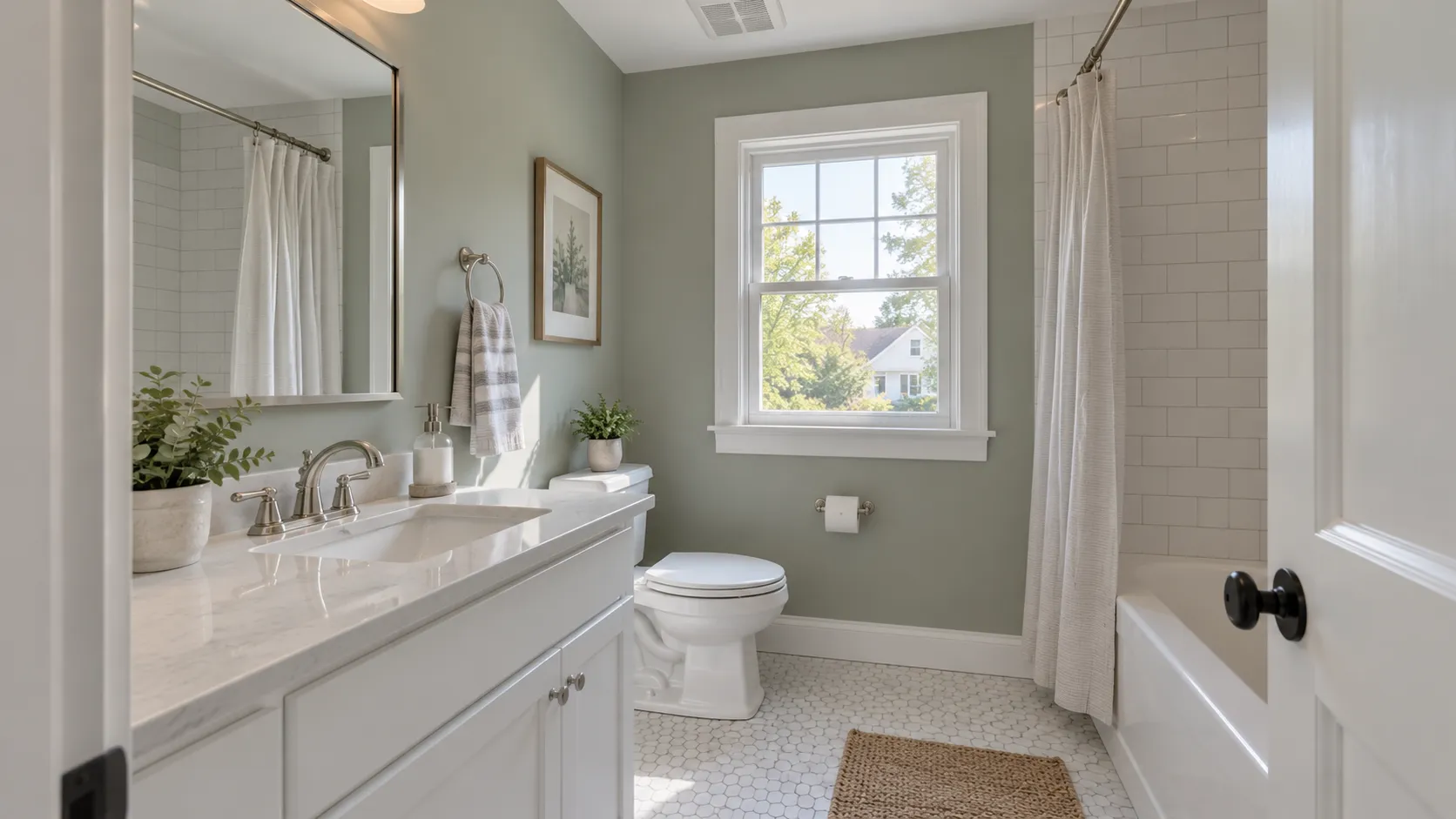
The best paint for a bathroom is a premium, 100% acrylic or styrene-acrylic interior paint that the manufacturer has formulated and labelled for humid rooms, carries an anti-microbial additive, and resists surfactant leaching — in a matte or satin sheen on the walls, a bath-rated matte or a ceiling flat overhead, and a waterborne alkyd or acrylic-alkyd semi-gloss on the trim and door. In our own work that means Benjamin Moore Aura Bath & Spa Matte 532 or Sherwin-Williams Duration Home on the walls, almost every time. The product matters. The prep, the cure time and the exhaust fan matter more, and most bathroom paint failures we are called to look at are failures of those three, not of the can.
We are a family-owned painting company in Morganville and have painted New Jersey interiors for more than 20 years across Monmouth, Middlesex, Ocean, Mercer, Somerset and Burlington counties, plus Union, Essex, Hudson, Bergen and Passaic in North Jersey, using Benjamin Moore and Sherwin-Williams products. Bathrooms are the smallest rooms we paint and, square foot for square foot, the slowest: more cutting in, more caulk lines, more edges against tile and glass, and a room that is going to be filled with steam within a day of us leaving. This guide is the long version of what we tell people standing in a bathroom doorway with a fan that hums but does not pull.
It is written to be useful whether or not you hire anyone. Every technical figure below — sheen numbers, dry and recoat times, temperature limits, VOC content, fan sizing and humidity targets — comes from a manufacturer's technical data sheet, a published industry standard, a trade association or a federal agency, each one fetched and quoted on 24 October 2026. Where we give our own practice rather than a published figure, we say so.
The Short Answer
- Buy a paint made for the room, not just a shinier one. Benjamin Moore describes Aura Bath & Spa as "specially formulated for optimal performance in high humidity environments such as baths and spas"; Sherwin-Williams describes Duration Home as offering "quick return to service & durability in moist environments like bathrooms."
- Matte or satin on the walls is fine now. Aura Bath & Spa is a matte at "3 – 4.5 @ 85°." Semi-gloss on bathroom walls mostly succeeds at showing every drywall seam.
- The best bathroom ceiling paint is a bath-rated matte, or a dedicated ceiling flat over a well-ventilated room. Not semi-gloss.
- Trim and the door take a harder enamel. Benjamin Moore Advance Semi-Gloss reads "50 – 60 @ 60°" and Sherwin-Williams ProClassic lists "kitchens/baths" among its project uses.
- "Mildew resistant" means the new film, nothing else. The anti-microbial agents "inhibit the growth of mold and mildew on the surface of this paint film." The EPA's instruction is "do not paint or caulk moldy surfaces."
- Wait before the first shower. Benjamin Moore: "allow a minimum of 24 hours before returning to full service. Painted surfaces can be washed after two weeks." Sherwin-Williams: "wait at least 14 days before washing Duration Home coating."
- Paint does not fix a bathroom; ventilation does. HVI recommends a fan providing "1 CFM per square foot" for bathrooms up to 100 square feet, left on "for 20 minutes after use of the bathroom." The EPA wants indoor humidity "ideally between 30 and 50 percent."
- Do not paint the tile or the tub. We don't, and our article on painting tile and bathtubs explains why.
What Actually Makes a Paint a "Bathroom Paint"?
Every interior paint aisle has a bath paint on it, and the obvious suspicion is that it is the same paint with a different label. It isn't, quite, and the data sheets show what is different. There are three properties that matter in a bathroom, and only one of them is sheen.
1. A film that tolerates repeated condensation
A bathroom wall gets wet from the inside of the room several times a day, dries, and gets wet again. An ordinary wall paint survives this for a while, then starts to soften, stain or streak. The bath-rated products are sold on doing better, and both manufacturers say so on the sheet rather than only in the advertising. Benjamin Moore's first listed feature for Aura Bath & Spa is "optimized for humid environments," and its usage line is narrow on purpose: "bathroom and sauna applications." Sherwin-Williams' Duration Home sheet calls the feature "Moisture Resistant Technology" and names the room: "durability in moist environments like bathrooms."
Neither sheet publishes a laboratory humidity test result in a form you could compare, so we will not pretend one is measurably better than the other. What we can say from the sheets is what they are made of. Aura Bath & Spa lists its vehicle as "Proprietary 100% Acrylic," with volume solids of "45 ± 2%." Duration Home lists "Styrene Acrylic" and volume solids of "37 ±2%." Volume solids is the share of what you roll on that is still there when the water has gone, so it tells you, roughly, how much film you are building per coat.
2. Resistance to surfactant leaching
This is the property almost nobody shopping for bathroom paint has heard of, and it explains a complaint we hear constantly: brown, tan or glossy drips running down a freshly painted bathroom wall a few days after the first shower. Sherwin-Williams' sheet defines it precisely: "Surfactant leaching is a term used when a concentration of water-soluble paint ingredients called 'surfactants' are noticed on the surface of a latex paint film. Surfactant leaching is most commonly seen as a streak or stain of tan, brown, or clear spots that sometimes can be glossy, soapy, oily or even sticky."
Benjamin Moore names the room in which it happens: "Surfactant leaching is a common problem in areas where moisture concentrates on walls like bathrooms & showers." Both bath products claim resistance to it — Aura Bath & Spa "has excellent resistance to surfactant leaching," Duration Home "has excellent resistance to surfactant leaching when applied on new or existing substrates" — and that resistance is the single best practical reason to pay for a bath-rated paint over a general wall paint. We cover what to do about it in its own section below, because the cure is not more paint.
3. An anti-microbial additive in the film
Most premium interior paints now carry one, including several that are not marketed for bathrooms. Benjamin Moore's Aura Bath & Spa sheet: "This product contains antimicrobial additives that inhibit the growth of mold and mildew on the surface of the paint film." Its ordinary Regal Select Eggshell 549 carries almost identical wording, and Sherwin-Williams prints "This product contains agents which inhibit the growth of mold and mildew on the surface of this paint film" on both Duration Home and Emerald Interior Satin.
Read the phrase literally: on the surface of the paint film. The additive protects the new paint from growth starting on it. It does nothing about anything already in the wall, behind the tile, or in the drywall paper, and it is not a treatment. We come back to that line, because it is where a bathroom paint job turns into something that is not a painting job.
Which Sheen Is Best for Bathroom Walls: Matte, Satin or Semi-Gloss?
The old rule was semi-gloss in every bathroom, on the theory that a shinier film is tighter and sheds water. The theory was reasonable when flat paints were chalky and porous. It is much weaker now that manufacturers sell a matte specifically for bathrooms, and it ignores what semi-gloss does to a wall.
What the sheen numbers mean
Sheen is measured with a gloss meter, and the readings on the data sheets are in gloss units at a stated angle. The Gypsum Association's GA-214-2021 draws the line used across the drywall and painting trades: flat paint is "a paint material specifically manufactured to produce 0 to 5 Gloss Units (GU) at a 60° angle and 0 to 10 Gloss Units (GU) at an 85° angle when measured using a gloss meter," and anything above that is non-flat. On that definition Aura Bath & Spa Matte, at "3 – 4.5 @ 85°," is technically a flat. Sherwin-Williams' Duration Home Matte reads "2-7 units @ 85°." Duration Home Satin reads "15-20 units @ 85°," Emerald Satin "10-20 units @ 85°," and Benjamin Moore's Regal Select Eggshell "15 – 22 @ 85°." Semi-gloss enamels are measured at the steeper 60° angle because they are too shiny to separate at 85°, which is why their numbers are not directly comparable with the rest.
Why semi-gloss on bathroom walls is usually a mistake
GA-214 says it plainly: "In general, non-flat and dark/deep tone paints highlight minor surface differences, whereas textures conceal these minor differences." It also defines the lighting that makes this worse: "Critical (Severe) Lighting Areas. Examples include wall and ceiling areas that are illuminated or flooded with artificial and/or natural light. Strong oblique light from windows or surface-mounted light fixtures may exaggerate minor surface differences."
A bathroom is almost a textbook critical-lighting room. There is a vanity light bar mounted flat on the wall and throwing light straight along it, a mirror bouncing that light back, often a small window on the side wall, and white tile reflecting everything. Every patched nail pop, every taped seam and every place a towel bar was moved shows up in a semi-gloss under that light. Bathrooms also get patched more than other rooms — fixtures and accessories move, plumbing gets opened — so the walls are rarely as flat as the hallway outside.
Our own practice in a full bathroom is a bath-rated matte or a satin on the walls. In a bathroom with a working fan and walls in decent shape we often use the matte; where the walls take real abuse — a kids' bathroom, a shore rental, a wall beside the toilet that gets scrubbed — we lean to satin for the extra washability. Our guide to satin versus eggshell sets out what each sheen does in every room of the house; this article only deals with the bathroom.
Powder rooms are a different room
A half bath with no shower is not a humid room. It is a high-touch one: hands, soap, the edge of the vanity, a door that gets pushed open all day. The moisture argument for a bath-rated product mostly falls away and the washability argument stays. Any premium satin or eggshell will do here, and the best paint for a powder room is usually whatever is on the hallway walls outside it, in a sheen one step up.
The Bathroom Products We Reach For, Side by Side
The table below is taken straight from each product's technical data sheet. These are the products we specify and the alternatives we would accept; it is not a ranking of every paint on the market, and we have deliberately left out brands whose data sheets we could not read in full.
| Product | Where we use it | Sheen | Spread rate per gallon | Dry to touch | Recoat | VOC | Mould and mildew agent on the film |
|---|---|---|---|---|---|---|---|
| Benjamin Moore Aura Bath & Spa Matte 532 | Walls and ceiling, full baths | 3 – 4.5 @ 85° | 350 – 400 sq. ft. | 1 hour | 1 hour | Zero g/L | Yes |
| Sherwin-Williams Duration Home Matte A96 | Walls and ceiling, full baths | 2-7 units @ 85° | 350-400 sq. ft. | 1 hour | 4 hours | Less than 50 g/L | Yes |
| Sherwin-Williams Duration Home Satin A97 | Walls, hard-use baths | 15-20 units @ 85° | 350-400 sq. ft. | 1 hour | 4 hours | Less than 50 g/L | Yes |
| Sherwin-Williams Emerald Interior Satin K37 | Walls, powder rooms | 10-20 units @ 85° | 350-400 sq. ft. | 1 hour | 4 hours | Less than 50 g/L | Yes |
| Benjamin Moore Regal Select Eggshell 549 | Walls, powder rooms | 15 – 22 @ 85° | 400 – 450 sq. ft. | 1 hour | 1 – 2 hours | 0 g/L | Yes |
| Sherwin-Williams Eminence Ceiling Paint Flat | Ceilings with a strong fan | 0-5 units @ 85° | 350-400 sq. ft. | 1 hour | 4 hours | Less than 50 g/L | Yes |
| Benjamin Moore Advance Semi-Gloss 793 | Trim, doors, vanity | 50 – 60 @ 60° | 400 – 500 sq. ft. | 4 – 6 hours | 16 hours | 43.2 g/L | Not stated on the sheet |
| Sherwin-Williams ProClassic Acrylic-Alkyd Semi-Gloss | Trim, doors, vanity | 41-51 units @ 60° at 24 hours | 350-400 sq. ft. | 1-2 hours | 4 hours | Less than 50 g/L | Not stated on the sheet |
| Benjamin Moore Fresh Start High-Hiding All-Purpose Primer 046 | Stains, repairs, leaching, colour change | 7 – 12 @ 85° | 400 – 450 sq. ft. | 30 minutes | 1 hour | < 50 g/L | "Provides a mildew-resistant coating" |
Three things in that table are worth slowing down for. The first is the recoat column. Aura Bath & Spa can take its second coat in an hour and Duration Home wants four, which matters if you are trying to finish a bathroom in a day: with Benjamin Moore you can, with Sherwin-Williams you have a long lunch. Both sheets qualify every figure: Benjamin Moore says "high humidity and cool temperatures will result in longer dry, recoat and service times," and Sherwin-Williams that "drying and recoat times are temperature, humidity, and film thickness dependent." A bathroom with the door shut and no fan running is a high-humidity room by definition, so expect slower than the sheet.
The second is the trim rows. Neither of the trim enamels we use states an anti-microbial agent on its data sheet. That is not a reason to put wall paint on trim — it would not survive the abrasion — but it is a reason not to assume a semi-gloss is a mildew paint because it is shiny. And Benjamin Moore's Advance sheet carries a warning that is directly relevant to bathrooms: "Although Advance yellows less than conventional alkyds, a slight amount of yellowing may occur. This effect is accelerated in dark or poorly ventilated areas and is more visible in lighter colors." A white door in a windowless bathroom is exactly that case.
The third is temperature. Aura Bath & Spa says "do not paint when air or surface temperature is below 50 °F (10 °C)," and every Sherwin-Williams product in the table says "apply at temperatures above 50°F." A bathroom over an unheated garage, or an outside-wall bathroom in a February cold snap with the heat turned down, can have walls colder than the air. Our guide to painting in cold weather covers that in detail. If you want the broader brand comparison, our Benjamin Moore versus Sherwin-Williams article has it.
What Is the Best Bathroom Ceiling Paint?
A bath-rated matte, in most New Jersey bathrooms. Specifically, our first choice is the same Aura Bath & Spa Matte that goes on the walls, rolled onto the ceiling in white or a ceiling tint. It reads "3 – 4.5 @ 85°," which keeps it inside the Gypsum Association's flat band, so it hides a patched ceiling about as well as a ceiling flat, and it is made for exactly the conditions a bathroom ceiling sees. The ceiling is where the steam goes first and where it condenses last, because warm wet air rises and the ceiling under an attic is often the coldest surface in the room.
Why not semi-gloss on the ceiling?
The same reason as the walls, only worse. A bathroom ceiling is lit at a grazing angle by a vanity bar and a window, and is frequently patched around a fan housing or a light box. GA-214's sentence about non-flat paints highlighting minor surface differences applies with full force to a ceiling, and the payoff is weak: what protects a bathroom ceiling is a moisture-tolerant film and a fan that removes the steam, not extra gloss. A semi-gloss ceiling over a shower with no working fan peels just as readily as a matte one, because the problem was never the sheen.
When a regular ceiling flat is fine
In a bathroom with a correctly sized fan ducted outdoors, and a household that actually runs it, a dedicated ceiling flat works. Sherwin-Williams' Eminence ceiling paint is "a bright white, high hiding, extremely flat finish" reading "0-5 units @ 85°," and its sheet also says "this coating contains agents which inhibit the growth of mold & mildew on the surface of this coating film." What it does not claim is surfactant-leaching resistance or a humid-room formulation. Over a shower in a small room with a weak fan we would not use it. In a large primary bath with a strong fan and a separate water closet we might.
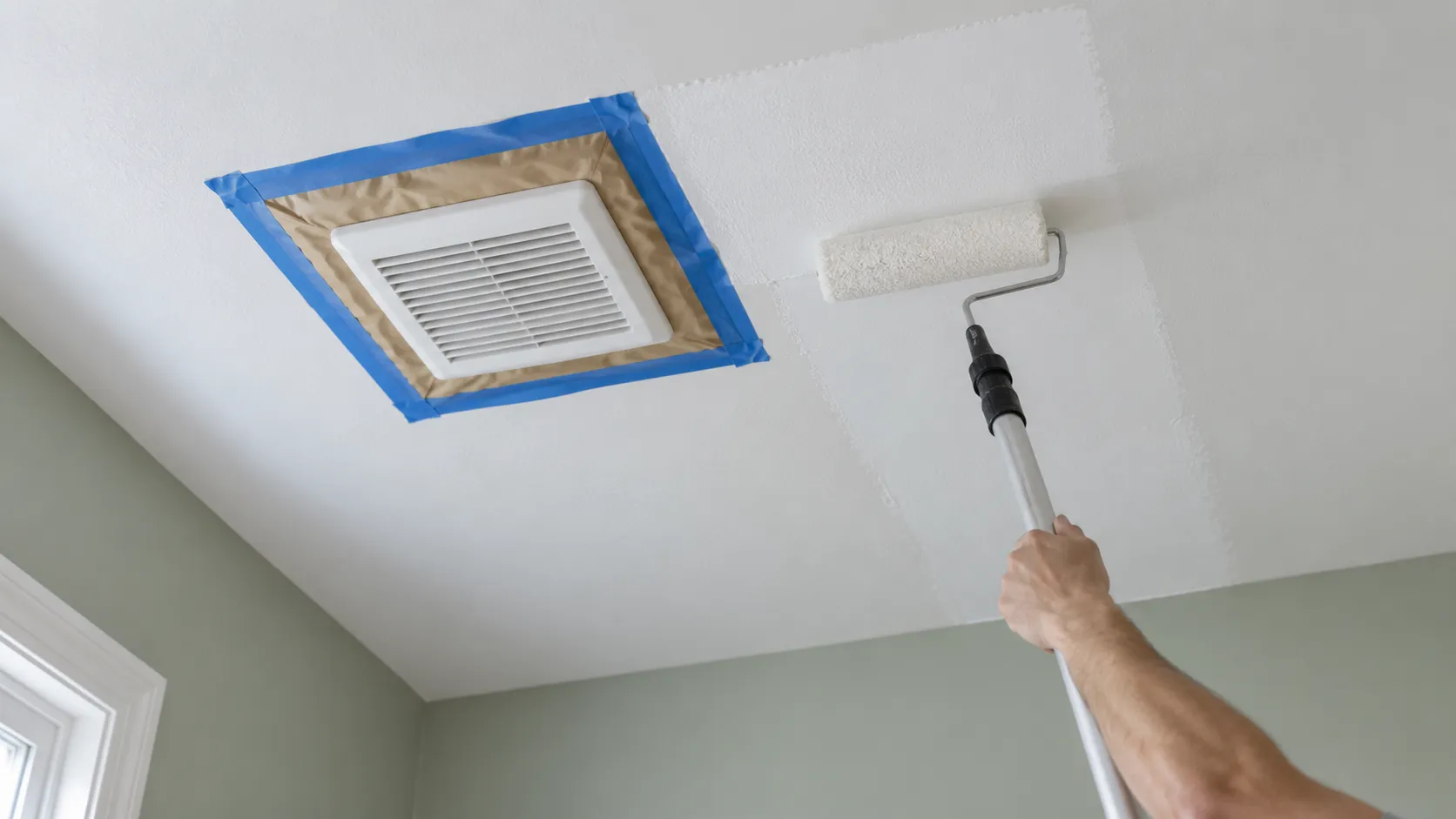
The technique for the ceiling itself — roller nap, cutting in, keeping a wet edge, why a patched ceiling flashes and how a water stain gets sealed — is the same as any other ceiling and is covered properly in our guide to painting ceilings. Two bathroom-specific points. Mask the fan grille or take it down rather than painting it in place, because paint on a grille louvre restricts the airflow you are relying on. And paint the ceiling first, before the walls, so any spatter lands on surfaces about to be painted anyway.
Trim, Doors and the Vanity: Where Semi-Gloss Still Belongs
Semi-gloss earns its place on the surfaces that get touched, wiped and bumped: the door and its casing, the window casing, baseboard behind the toilet, and a painted vanity. Those are wood or MDF, narrow, and broken up by profiles, so the GA-214 objection to sheen hardly applies; what matters is hardness and how well the enamel levels out brush marks.
Our two usual trim enamels are both hybrids that behave somewhat like the oil paints they replaced. Benjamin Moore describes Advance Semi-Gloss 793 as "a premium quality, waterborne alkyd enamel that delivers the desired flow and leveling characteristics of conventional alkyd paint," providing "a tough, semi-gloss finish that stands up to repeated washing," and lists it as "ideal for interior doors, trim, cabinets, walls, and ceilings." Sherwin-Williams' ProClassic Waterbased Acrylic-Alkyd is "a quality high performance product, with excellent flow and leveling characteristics for a smooth and durable finish," and its listed project uses include "all trim areas and molding," "cabinets/doors/windows" and "kitchens/baths."
They are very different to live with. Advance is dry to touch in "4 – 6 hours" and recoatable in "16 hours," and Benjamin Moore warns that "it could take up to 30 days to reach optimum hardness and final sheen." ProClassic is "tack free" in "20-40 minutes," dry to touch in "1-2 hours" and recoatable in "4 hours." In a family's only bathroom, that difference decides whether the door is off its hinges for one day or two. Our cost and scope article on painting trim, doors and baseboards goes further into trim.
A painted vanity is a cabinet job in miniature, and Benjamin Moore's Advance sheet is specific about it: "All surfaces to be roughened by sanding (220 grit or coarser) before priming; light sanding between coats allows for a smoother finish; all dust must be cleaned." Painting a vanity box is something we do. Replacing one is not; that is bathroom remodelling, which is not our trade.
Do You Need a Primer in a Bathroom?
Often not, and when you do it is for a specific reason. Both of the bath paints in the table are sold as self-priming over most sound surfaces. Aura Bath & Spa's sheet: "Aura® is self-priming on most properly prepared surfaces," with drywall and cured plaster both listed as "Self-priming," and "on bare substrates, two coats are recommended; previously painted surfaces can be finished with 1 or 2 coats." Duration Home: "Duration Home Interior Latex can be used directly over existing coatings, bare drywall, or plaster (cured with a pH of less than 9)," with drywall self-primed "using 2 coats" or primed with one coat of Premium Wall & Wood Primer first.
There are four bathroom situations where we always prime:
- Stains. Water rings, rust bleeding from old fasteners, the ghost of a towel hook. Sherwin-Williams: "Stains from water, smoke, ink, pencil, grease, etc. should be sealed with the appropriate primer-sealer." Benjamin Moore's Fresh Start 046 is sold on sealing "most bleeding type stains such as tannin bleed, water stains, smoke damage," and warns that "two coats of primer may be required on severe stains."
- Old surfactant leaching. Benjamin Moore's Aura Bath & Spa sheet: "Areas with heavy surfactant leaching, should also be primed with Fresh Start® High-Hiding All Purpose Primer (046) before applying Aura® Bath & Spa."
- Repairs. Joint compound and spackle are far more absorbent than cured paint and will flash through a finish coat. GA-214's note: "It is recommended that the final decoration specification (e.g. painting specification) include the application of a priming material prior to the decoration." Drywall and sheetrock repair is work we do, and our drywall repair guide covers how it gets scoped.
- Glossy old paint. A bathroom painted in oil or a hard semi-gloss decades ago will not grip a new latex without help. Every sheet says the same thing in different words — Benjamin Moore: "glossy areas should be dulled"; Sherwin-Williams: "glossy surfaces should be sanded dull." We dull it and prime it. If the old paint is lifting rather than just glossy, our article on why paint peels is the place to start.
Fresh Start 046 is the primer we reach for in a bathroom. It is "100% acrylic," "low VOC" at "< 50 g/L," dry to touch in "30 minutes" and recoatable in "1 hour," and it "provides a mildew-resistant coating." Benjamin Moore also notes that "for best hiding results, tint the primer to the approximate shade of the finish coat," and Aura's sheet warns that "certain custom colors may require a Deep Base Primer tinted to a special prescription formula."
Prep: Washing, Mildew, and the Line We Do Not Cross
The single biggest cause of a bathroom paint job failing early is painting over a dirty wall. A bathroom wall carries a film of soap residue, hairspray, skin oils and body products that you cannot see and that new paint will not grip. Every data sheet in this article opens its preparation section with the same requirement. Aura Bath & Spa: "Surfaces to be painted must be clean, dry, and free of dirt, dust, grease, oil, soap, wax, scaling paint, water soluble materials, and mildew." Soap is on that list for a reason. Sherwin-Williams: "Remove all surface contamination by washing with an appropriate cleaner, rinse thoroughly and allow to dry."
Our own practice is to wash every bathroom wall and ceiling before painting, rinse it, and give it time to dry with the fan running and the door open. Rinsing matters as much as washing; detergent left on the wall is another contaminant.
Mildew: what the manufacturers say, and what we do and do not do
The manufacturers are blunt. Sherwin-Williams' Duration Home sheet: "Mildew is a fungus that looks like dirt but won't wash off. Mildew must be removed before painting, or it will grow through any new coat of paint." The EPA agrees, in its Brief Guide to Mold, Moisture, and Your Home: "Do not paint or caulk moldy surfaces." Its mold cleanup page gives the reason: "Paint applied over moldy surfaces is likely to peel."
Sherwin-Williams publishes a surface-washing procedure inside its painting specification: "Mildew may be removed before painting by washing with a solution of 1 part liquid bleach and 3 parts clean water. Apply the solution and scrub the mildewed area. Allow the solution to remain on the surface for 10 minutes. Rinse thoroughly with clean water and allow the surface to dry before painting." It adds cautions worth repeating in a small enclosed room: wear "protective eyewear, waterproof gloves, and protective clothing," and "do not add detergents or ammonia to the bleach-water solution." It also warns that "bleach and bleaching type cleaners may damage or discolor existing paint films."
We do not do mould or mildew treatment or remediation. Washing a surface is ours; treating growth is not. Light surface spotting on a sound painted wall that washes off is ordinary bathroom prep. Growth that comes back through paint, growth on the drywall paper, a soft or stained wall behind a shower, or a musty smell that will not leave the room is a moisture and remediation problem, and we will say so and send you to the right trade before any paint goes on. The EPA's own threshold is a useful guide: its cleanup guidance distinguishes a mouldy area "less than about 10 square feet" from cases where "mold growth covers more than 10 square feet," and for the larger cases it points to its remediation guidance and, if hiring, says to "make sure the contractor has experience cleaning up mold." A painter is not that contractor.
Surfactant Leaching: the Brown Drips That Are Not Mould
Because this is the most common "my new bathroom paint has failed" call, it gets its own section. The symptom is drips or spots — tan, brown, clear, sometimes glossy or sticky — running down the wall or ceiling in the first days or weeks after painting, usually over the shower and after the first few hot showers. It looks alarming. It is not mould, and it is not the paint coming apart.
The cause is in Sherwin-Williams' definition: surfactants are "soap-like materials that help in the dispersion of the paint's pigment and latex binders." In a film that has not fully cured, condensation draws some of those water-soluble ingredients to the surface, where they dry as streaks. That is why the bath-rated products advertise resistance to it, and why time before steam matters (see the next section).
What to do about it is also on the sheets. Benjamin Moore: "surfactant leaching stains on existing coatings must be removed prior to painting. Thoroughly wash surfaces to be painted, removing any surfactants that may be on the substrate then allow to dry." Sherwin-Williams: "surfactants can remain on existing painted surfaces if not removed prior to coating. Existing painted surfaces must be thoroughly washed clean and allowed to dry prior to apply any finish." In plain terms: wash the residue off with warm water, let the wall dry, and keep the room ventilated. On a new film it often stops by itself once the paint has cured. If you are repainting over a wall that leached badly in the past, prime it first, as Benjamin Moore specifies above.
How Long After Painting a Bathroom Can You Shower?
This is the question the competing guides skip, and it is the one that most often decides whether a new bathroom paint job looks good in a month. Paint is dry to the touch in about an hour. It is nowhere near cured.
Benjamin Moore puts its figure for Aura Bath & Spa in two places on the data sheet: "For best results, allow a minimum of 24 hours before returning to full service." On the same sheet: "Painted surfaces can be washed after two weeks." Sherwin-Williams says of Duration Home: "To assure maximum washability and durability, wait at least 14 days before washing Duration Home coating." Its trim and wall sheets also carry the reminder that "drying and recoat times are temperature, humidity, and film thickness dependent." For Advance on the trim, Benjamin Moore says "full hardness and adhesion develop over time" and that it can take "up to 30 days to reach optimum hardness and final sheen."
Our own practice, and what we tell every household: no shower in that room for at least 24 hours after the last coat; for the first two weeks keep showers short and warm rather than hot, run the fan through the shower and for a good while after, and leave the door open; do not wipe or scrub the walls for two weeks; and do not hang wet towels on freshly painted trim. If you have only one bathroom, plan the job around it. Our guide to living in your house while it is being painted covers sequencing a lived-in house more generally.
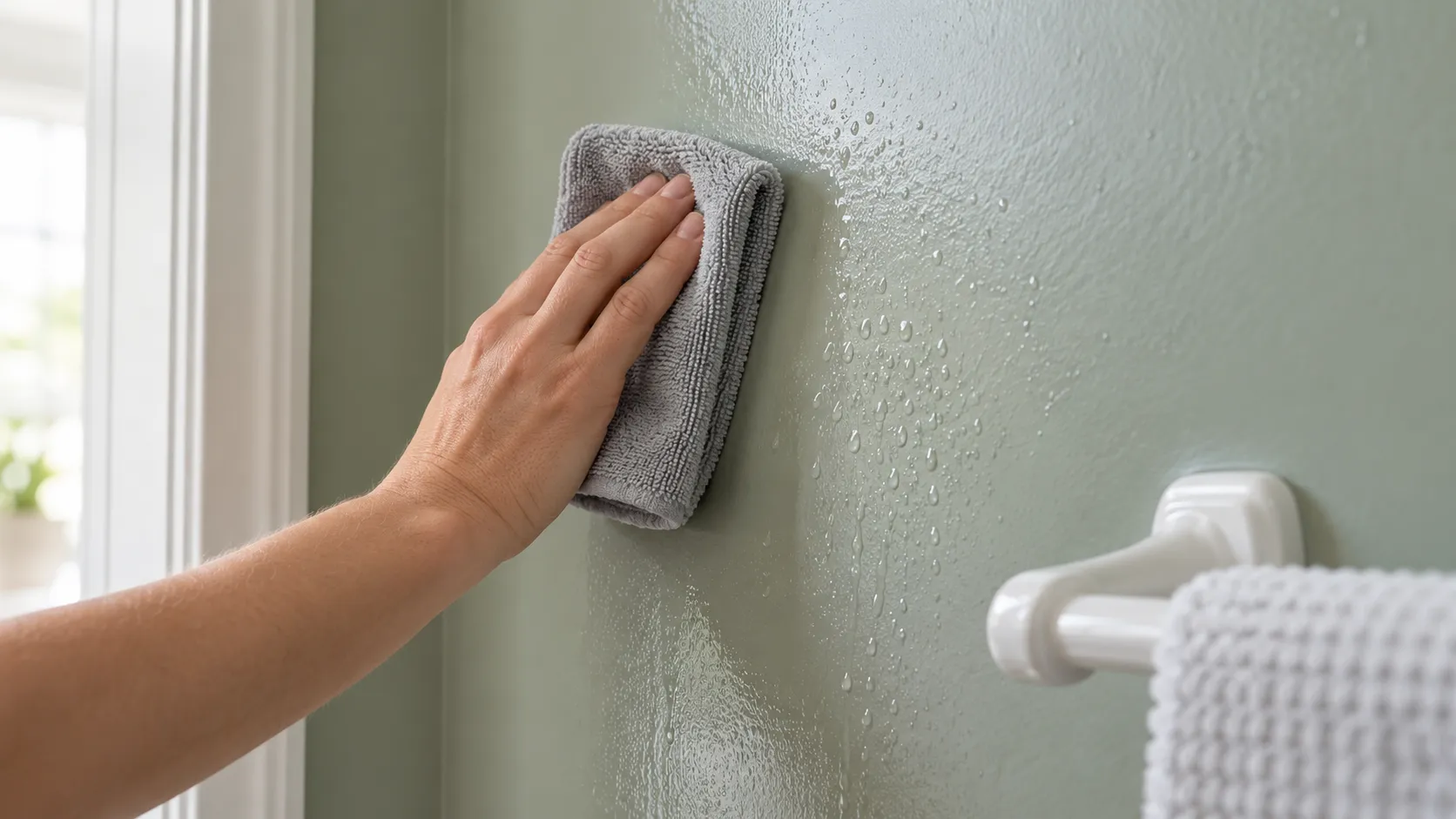
After the two weeks, clean gently. Sherwin-Williams' advice on Duration Home: "When removing stains, dirt, and marks, use a soft cloth or sponge with water, Stubborn stains may require the use of a general-purpose household cleaner." And: "Do not use an abrasive cleaner or scrub brush to remove stains." A microfibre cloth and plain water does more for a painted bathroom wall than any spray.
The Exhaust Fan Matters More Than the Paint
We say this to almost everyone: the best bathroom paint on the market will fail over a shower if the steam has nowhere to go, and an ordinary premium paint will last for years in a bathroom with a fan that works. If a bathroom has peeled, stained or leached before, the paint is rarely the root cause.
The EPA gives the target and the habit: "If possible, keep indoor humidity below 60 percent (ideally between 30 and 50 percent) relative humidity," and "run the bathroom fan or open the window when showering." It also names condensation on cold surfaces as a cause of moisture problems and advises to "cover cold surfaces, such as cold water pipes, with insulation," and that "it is important to dry water-damaged areas and items within 24-48 hours to prevent mold growth."
The Home Ventilating Institute publishes the sizing rule most of the fan industry works to. From HVI's bathroom ventilation guidance: "For bathrooms up to 100 square feet in area, HVI recommends that an exhaust fan provide 1 CFM per square foot (approximately eight air changes per hour) to properly ventilate the bathroom." Its worked example: a bathroom "8'x5' (with 8' ceilings)" is 40 square feet, so "the minimum recommendation is a fan rated at 40 cfm." For larger rooms, "for bathrooms above 100 square feet in area, HVI recommends a ventilation rate based on the number and type of fixtures," listing a toilet, shower and bathtub at 50 CFM each and a jetted tub at 100 CFM. On run time: "HVI recommends that the fan be left on for 20 minutes after use of the bathroom," and "a timer is a good solution, allowing the fan to turn off automatically at the proper time."
Two more HVI points from its bath fan page explain why many fans in older New Jersey houses do not get used. "A 50 CFM rating is recommended as a minimum for bathrooms 50 sq. ft. and smaller," and "for quiet bathroom ventilation the fan should be rated at 1.0 sones or less." A loud fan is a fan people switch off. HVI also describes a working fan as one that, "when ducted to the exterior of the house, draws out stale, impure and very humid air." Exterior is the key word. A fan that dumps into the attic just moves the moisture above the ceiling you have painted. If you are replacing one, ENERGY STAR says certified ventilation fans "use about 48% less energy than standard models."
Installing or re-ducting a fan is electrical and carpentry work, not painting, and we do not do it. What we do is look. If we see condensation streaks, staining above the shower, or a fan grille with no draw on a tissue held to it, we will tell you before we quote, because painting a bathroom that cannot dry out is quoting for a callback.
Around Tile, Tubs, Glass and Caulk
Most of the time in a bathroom paint job is spent at edges: where the wall meets the tile, the tub surround, the vanity backsplash, the mirror and the shower glass. The paint goes on the drywall. It does not go on the tile.
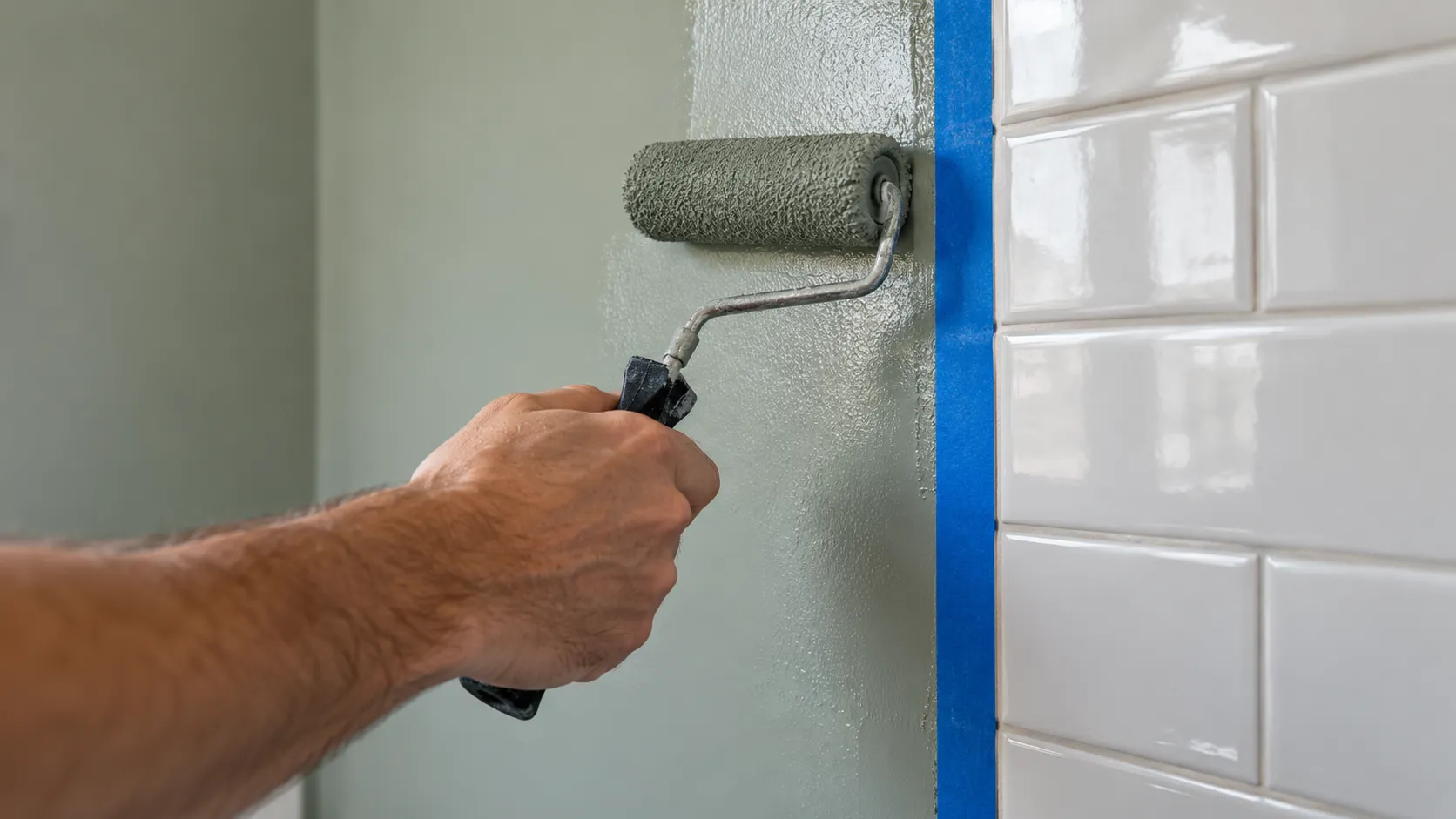
We do not paint tile, tubs or shower surrounds, and we do not reglaze them. Painted tile and refinished tubs are a specialist coating trade with their own products and their own failure modes, and our article Can You Paint Tile? Can You Paint a Bathtub? explains why we stay out of it. What we do is tape the tile edge, cut a clean line onto the wall above it, and, where the joint between tile and wall is open or cracked, recaulk it.
Caulking and sealing is work we offer, and in a bathroom it matters for the paint as much as for the look. An open joint along the top of a tub surround or a backsplash lets water run behind the paint film, which is how bathroom paint blisters and peels from the bottom up. The manufacturers' order is to caulk after priming: Sherwin-Williams' sheets say "gaps between walls, ceilings, crown moldings, and other interior trim can be filled with the appropriate caulk after priming the surface." Our own practice is to cut out failed caulk at the wall-to-tile line, let the joint dry, re-run a paintable bead where it will be painted and a bathroom silicone where it sits in the splash zone, and paint only the paintable caulk. The caulk inside a shower or tub enclosure, between tile and tub, is a wet-area seal that belongs to the tile and plumbing trades, and we leave it alone.
Colour in a Small, Steamy Room, Briefly
Colour is its own subject and our article on interior paint colours has the named colours, codes and LRVs. Two bathroom-specific points. First, deep colours are less forgiving on bathroom walls: GA-214 warns that "colors with deep or strong hues, and even flat paints, tend to magnify imperfections in the finished gypsum panel surface and increase the possibility of joint photographing," and a bathroom is a critical-lighting room. Second, deep colours are where colorant and rub-off matter. Benjamin Moore lists "Color Lock® Technology, no color rub-off" as an Aura Bath & Spa feature, which is relevant to a dark wall that gets brushed by towels. A deep colour also usually needs a tinted primer, as noted above. Light, soft colours are the easy case in a bathroom, and the reason so many New Jersey bathrooms end up in pale greens, greys and warm whites is as practical as it is fashionable.
Fumes and VOC in a Small Room
A bathroom is small and often windowless, so the air in it matters more than in a living room. All of the wall and ceiling paints in our table are low or zero VOC: Aura Bath & Spa "Zero g/L" and "Zero VOC, Low odor," Regal Select "Zero VOC post tint (any base and any color)," and the Sherwin-Williams products "less than 50 grams per litre." Low VOC is not no ventilation. Benjamin Moore's bath paint sheet still says "use only with adequate ventilation" and "ensure fresh air entry during application and drying," and Sherwin-Williams says "open windows and doors or use other means to ensure fresh air entry during application and drying. If you experience eye watering, headaches, or dizziness, increase fresh air, or wear respiratory protection (NIOSH approved) or leave the area." Run the fan the whole time. Our guide to paint fumes and VOCs covers when it is reasonable to use a freshly painted room.
Older New Jersey Bathrooms: Lead, and What That Means for Who Does the Prep
A large share of New Jersey bathrooms are in houses built before 1978, and in those bathrooms the old paint under the current paint may contain lead — particularly on the trim, the door and the window, which is exactly where bathroom prep involves sanding. Every data sheet in this article prints the same warning; Benjamin Moore's reads: "WARNING! If you scrape, sand, or remove old paint, you may release lead dust. LEAD IS TOXIC."
The federal rule is the EPA's Renovation, Repair and Painting (RRP) Program, which requires that "anyone paid to perform work that disturbs paint in housing and child-occupied facilities built before 1978 must be certified," and adds: "This includes all firms, even sole proprietorships." The carve-out is narrow. 40 CFR 745.83 defines minor repair and maintenance as work "that disrupt 6 square feet or less of painted surface per room for interior activities," where no prohibited practices are used and the work "does not involve window replacement or demolition of painted surface areas." Sanding the trim and door in a bathroom can easily exceed six square feet.
We are not an EPA Lead-Safe Certified firm. That is a licensing fact about our company, not a choice of wording, and it means there is prep work on pre-1978 bathrooms that we will tell you to have done by someone else. Our guide to lead paint in older NJ homes explains the rule properly. Whoever you hire, ask the bidder for their firm certification number — ours included — before anybody sands or scrapes old paint in a house built before 1978.
What We Do, and Do Not Do, in Bathrooms
- We specify a bath-rated paint on the walls and ceiling of every full bathroom, normally Aura Bath & Spa Matte or Duration Home, and write the product and number of coats on the estimate.
- We wash, rinse and dry every bathroom surface before we paint it, because soap film is the commonest reason bathroom paint fails early.
- We prime stains, repairs, old surfactant streaks and glossy old paint rather than hoping the finish coat covers them.
- We paint the ceiling first, mask or remove the fan grille, and paint the walls and then the trim, in that order.
- We tape and cut tile edges by hand and recaulk open wall-to-tile joints with a paintable caulk after priming; caulking and sealing is ours.
- We use a hybrid semi-gloss enamel on trim, doors and painted vanities, and tell you which one, because their dry times are very different.
- We do drywall and sheetrock repair, wallpaper removal and popcorn ceiling work, so most of what a bathroom needs before paint is in scope. Our wallpaper removal guide covers the old border above the tile that so many New Jersey bathrooms still have.
- We tell you how long to stay out of the shower, and why, before we leave.
- We tell you if we think the fan is the problem, and we will not paint over growth or a live leak.
What we do not do, so there is no ambiguity: mould or mildew treatment or remediation, plaster repair, painting or reglazing tile, tubs or shower surrounds, kitchen or bathroom remodelling, finish carpentry, plumbing, fan installation or electrical work, insurance or water-damage restoration, and we do not hold EPA Lead-Safe (RRP) certification. Washing a surface is ours; treating growth is not. Drywall and sheetrock repair is ours; a cracked or failing plaster bathroom wall in an older house belongs to a plasterer. On a house built before 1978, ask us — and every other bidder — for a firm certification number before anyone disturbs old paint.
Get a Price for Your Bathroom
Bathroom pricing depends on the size of the room, how much of it is tile, the condition of the walls and ceiling, how much caulking and priming it needs and how much trim there is, which is why we look at it rather than quote from a photo. NJ Painting Co. is a family-owned, licensed and fully insured painting company at 36 Church Rd, Morganville, NJ 07751, working on New Jersey homes for more than 20 years with Benjamin Moore and Sherwin-Williams products. Every estimate is free and spells out surfaces, prep, products and number of coats; our work carries a two-year workmanship warranty. For how interior pricing is built, see the interior section of our cost guide and our cost to paint a room guide, and for the work itself our interior painting service. Bathrooms are often painted alongside other rooms, so call (732) 239-0932 or request a free estimate, and ask us about the job minimum when you enquire.
Frequently Asked Questions
What is the best paint for a bathroom?
A premium acrylic interior paint that the manufacturer formulates and labels for humid rooms, with an anti-microbial additive and resistance to surfactant leaching. In our work that is usually Benjamin Moore Aura Bath and Spa Matte, which Benjamin Moore describes as specially formulated for optimal performance in high humidity environments such as baths and spas, or Sherwin-Williams Duration Home, which Sherwin-Williams describes as offering quick return to service and durability in moist environments like bathrooms. Use a hybrid semi-gloss enamel on the trim and door. Prep and ventilation matter as much as the product.
What type of paint should you use in a bathroom: latex or oil?
A waterborne paint for the walls and ceiling. The bath-rated products are acrylic or styrene-acrylic latex, low or zero VOC, and clean up with water. Oil-based paint is no longer what we use on bathroom walls. On trim, the modern answer is a waterborne alkyd or acrylic-alkyd hybrid such as Benjamin Moore Advance or Sherwin-Williams ProClassic, which level out like an oil enamel but are water-cleanup. Benjamin Moore notes that Advance can yellow slightly, faster in dark or poorly ventilated areas.
What sheen is best for bathroom walls?
Matte or satin in most full bathrooms, satin where walls take heavy wear. The bath-rated matte paints now do the job semi-gloss used to, and semi-gloss on walls shows every seam and patch. The Gypsum Association notes that non-flat paints highlight minor surface differences, and a bathroom, with a vanity light along the wall and a mirror reflecting it, is a critical-lighting room. Keep semi-gloss for the trim and the door.
What is the best paint for a bathroom ceiling?
A bath-rated matte, usually the same product as the walls. Benjamin Moore Aura Bath and Spa Matte reads 3 to 4.5 at 85 degrees, inside the Gypsum Association's flat band, so it hides a patched ceiling while being formulated for humidity. A dedicated ceiling flat such as Sherwin-Williams Eminence is fine in a bathroom with a strong, outside-vented fan, but it is not formulated for a humid room. Semi-gloss on a bathroom ceiling mostly shows imperfections and still peels if the steam has nowhere to go.
Is mold-resistant paint worth it?
The anti-microbial additive is worth having, and most premium paints now include one. But understand what it does. Both manufacturers say the agents inhibit growth on the surface of the paint film. It protects the new paint. It does not treat anything already present, and the EPA says not to paint or caulk mouldy surfaces because paint over mould is likely to peel. Growth has to be dealt with, and the moisture source fixed, before any paint goes on.
Do you need to prime bathroom walls before painting?
Not always. Aura Bath and Spa and Duration Home are both self-priming over most sound, clean surfaces. Prime when there are stains, repairs in joint compound, old surfactant streaks, glossy old paint or a big colour change. Benjamin Moore specifies its Fresh Start High-Hiding All Purpose Primer over heavy surfactant leaching, and Sherwin-Williams says stains from water, smoke, ink, pencil and grease should be sealed with the appropriate primer-sealer.
How long after painting a bathroom can I take a shower?
At least 24 hours. Benjamin Moore's Aura Bath and Spa sheet says to allow a minimum of 24 hours before returning to full service and that painted surfaces can be washed after two weeks. Sherwin-Williams says to wait at least 14 days before washing Duration Home. For those two weeks keep showers short and not too hot, run the exhaust fan, leave the door open afterwards and do not scrub the walls. High humidity and cool temperatures slow all of it down.
Why are there brown drips on my newly painted bathroom wall?
Almost certainly surfactant leaching, not mould and not paint failure. Surfactants are soap-like ingredients in latex paint, and steam on a film that has not fully cured draws them to the surface, where they dry as tan, brown, clear or sticky streaks. Wash them off with warm water, let the wall dry, and keep the room ventilated; on new paint it usually stops once the film has cured. When repainting over a wall that leached badly, wash it thoroughly and prime it first.
What size exhaust fan does a bathroom need?
The Home Ventilating Institute recommends 1 CFM per square foot of floor area for bathrooms up to 100 square feet, about eight air changes per hour, so an 8 by 5 foot bathroom needs at least a 40 CFM fan, and it recommends 50 CFM as the minimum for bathrooms of 50 square feet and smaller. Above 100 square feet it sizes by fixture, 50 CFM each for a toilet, shower or tub and 100 CFM for a jetted tub. Run it for 20 minutes after each use, ducted to the outside, and choose 1.0 sones or less so people actually turn it on.
Can you paint over bathroom tile or a bathtub?
We do not, and we do not recommend relying on paint for wet-area surfaces. Painted tile and tub refinishing are a specialist coating trade, separate from wall painting. In a bathroom repaint we tape the tile edge, paint the drywall above it and recaulk open wall-to-tile joints, but the tile, the tub and the shower surround are left alone.
Can I paint my bathroom myself?
Yes, and the method in this guide is the method we use. The practical difficulties are the edges against tile and fixtures, the dry time between coats in a small humid room, and keeping the family out of the shower for a day afterwards. The two reasons to stop and get help are a house built before 1978, where sanding old paint brings in the federal lead rule, and any sign of growth that comes back through paint or a soft or stained wall, which is a moisture problem and not a painting one.
About the author
Written by the NJ Painting Co. team
NJ Painting Co. is a family-owned painting contractor based in Monmouth County, in business since 2004. We are licensed and fully insured, work with Benjamin Moore and Sherwin-Williams paints, and back our work with a 2-year workmanship warranty. We serve Monmouth, Middlesex, Ocean, Mercer, Somerset and Burlington counties, plus Union, Essex, Hudson, Bergen and Passaic in North Jersey.