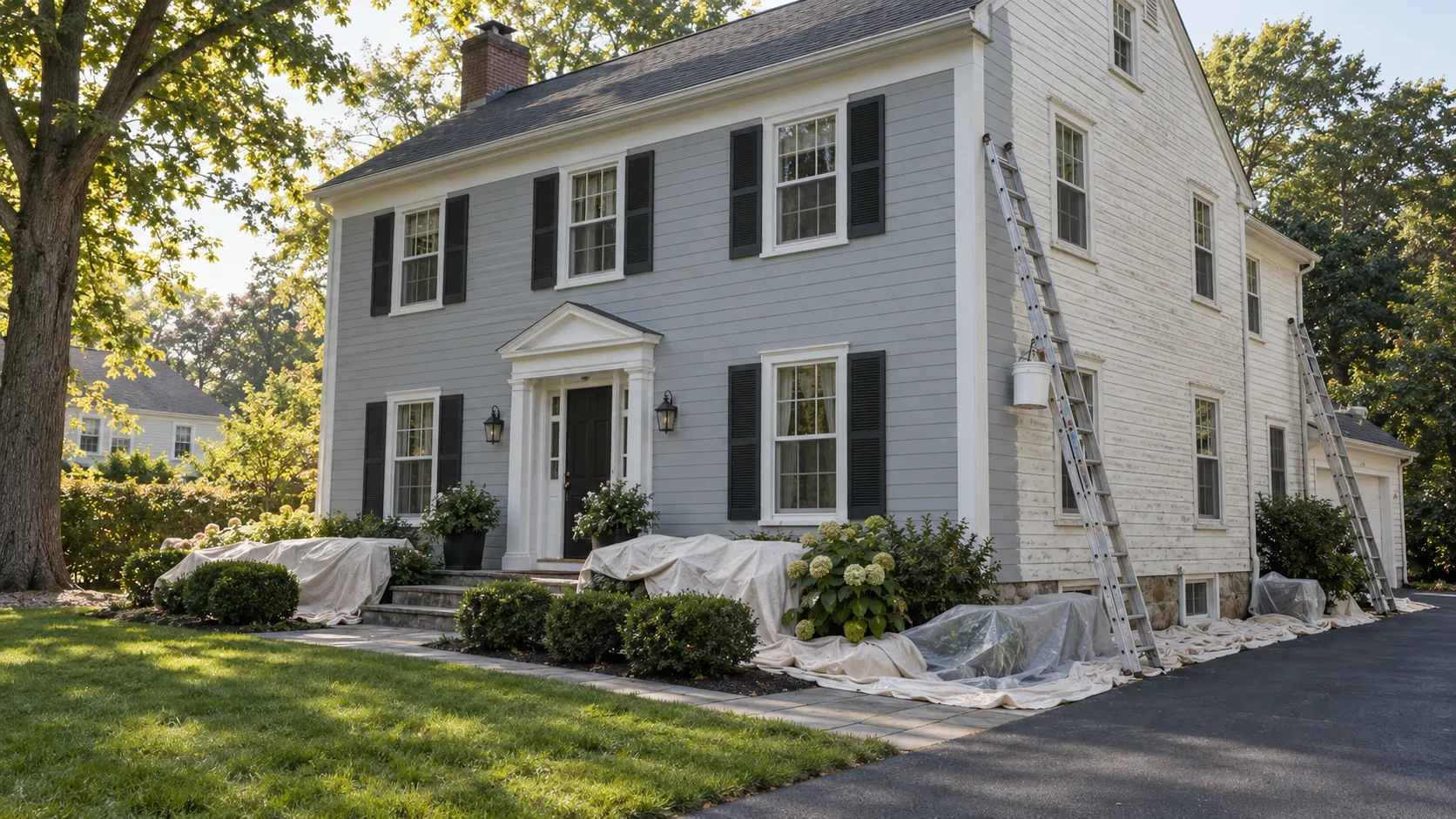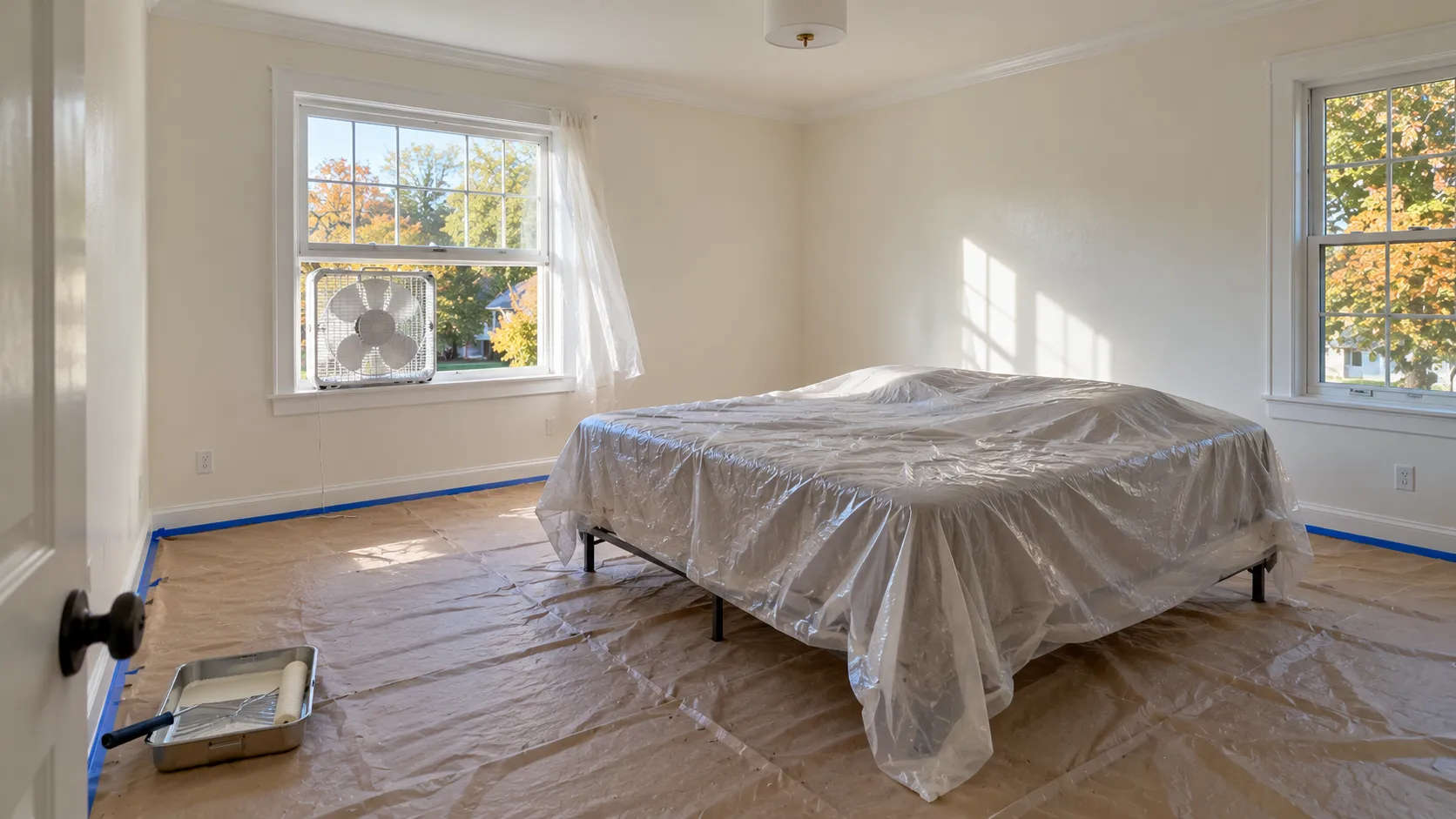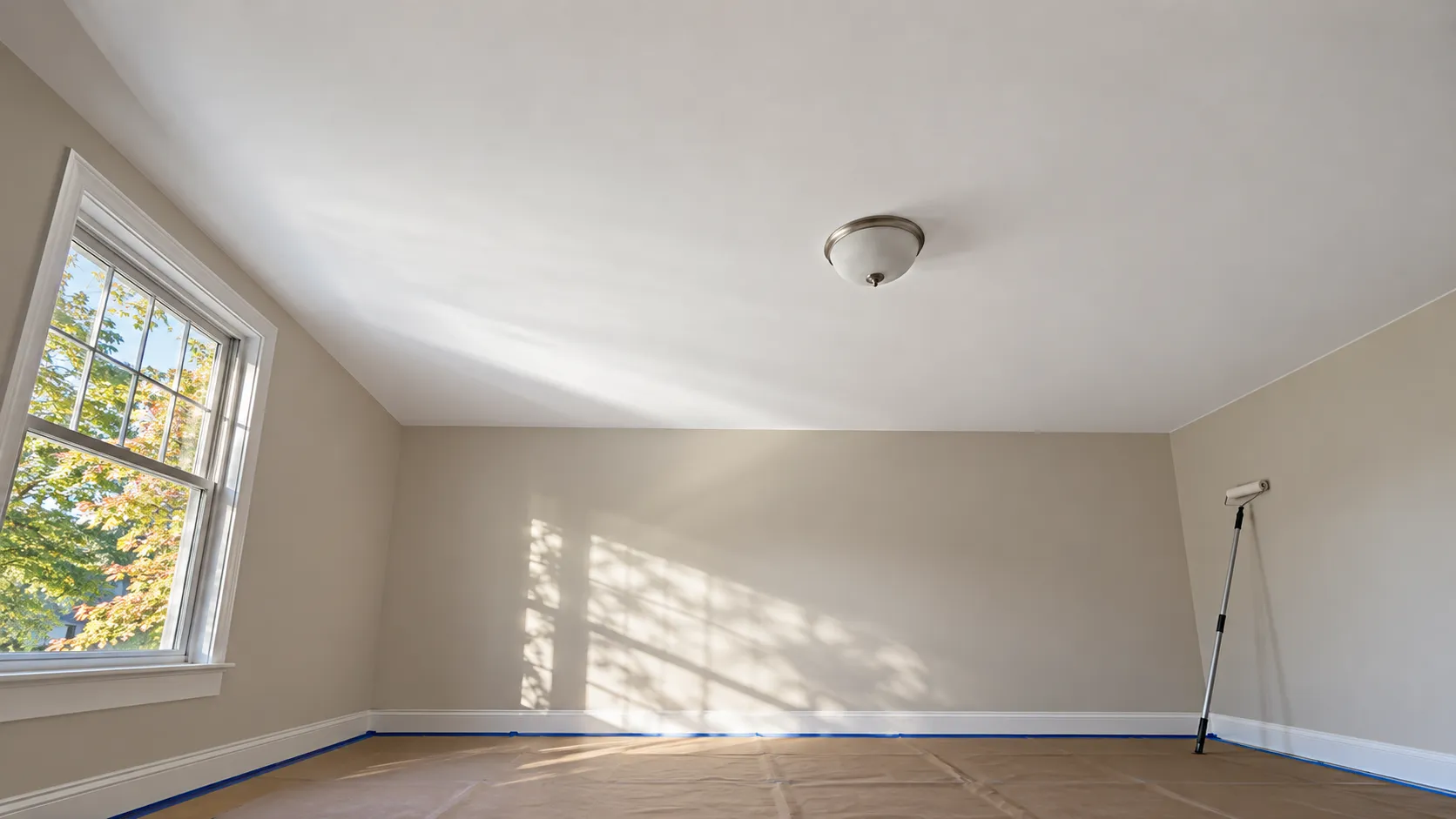
A ceiling is the largest unbroken surface in almost every room of a New Jersey house, it is lit worse than any wall, and it is the one surface people stare at from a bed at seven in the morning. It also punishes a careless job hardest. Walls get broken up by furniture, pictures, outlets and door casings, so an uneven second coat disappears. A ceiling has nothing to hide behind. Lap marks run the length of it, a patch flashes like a thumbprint, and a water stain that was invisible while the paint was wet comes back through two days later looking exactly as it did before you started.
We are a family-owned painting company in Morganville and have painted interiors across Monmouth, Middlesex, Ocean, Mercer, Somerset and Burlington counties, plus Union, Essex, Hudson, Bergen and Passaic in North Jersey, for more than 20 years, using Benjamin Moore and Sherwin-Williams products. Ceiling painting is work we do and quote, on its own and as part of a room, and it is the line homeowners most often try to take off an interior estimate to save money and most often regret. This guide is the long version of the conversation we have standing in a hallway with a work light held flat against the plane, pointing at things you cannot see from the doorway.
It is written to be useful whether or not you hire anybody. The method below is the method, including the parts a weekend painter can do perfectly well with a nine-inch roller and an extension pole; nothing has been held back to steer you into the sections about cathedral ceilings and stairwells. Every technical figure, dry time, spread rate, sheen number and regulation below comes from a manufacturer's technical data sheet, a published standard or a federal or state agency, each one fetched and quoted on 22 October 2026.
The Short Answer
- A ceiling is a flat-paint job, and "flat" is a measured number. The Gypsum Association defines flat paint as "a paint material specifically manufactured to produce 0 to 5 Gloss Units (GU) at a 60° angle and 0 to 10 Gloss Units (GU) at an 85° angle when measured using a gloss meter."
- Dedicated ceiling paint is a real product. Benjamin Moore describes its Waterborne Ceiling Paint as "a premium quality, acrylic paint formulated specifically for ceilings" that "resists spattering when applied with a roller" and "tones down ceiling glare and provides maximum diffused light."
- Roller nap is the decision most people get wrong. Sherwin-Williams specifies "a 3/8 to 1/2 inch nap" cover for its Eminence ceiling flat, and tells you to go to "a higher nap, like 3/4-inch, for textured ceilings."
- Keep a wet edge or you will see every stop. Benjamin Moore's own instruction is to "apply paint generously from unpainted area into wet area," and it sells an extender for the days when that is hard.
- The two brands disagree about recoat by a factor of four. Benjamin Moore's ceiling flat recoats in "1 – 2 hours"; Sherwin-Williams' Eminence says "Recoat: 4 Hours." Read the can you actually bought.
- Paint will not seal a water stain. Sherwin-Williams' own preparation instructions say "stains from water, smoke, ink, pencil, grease, etc. should be sealed with the appropriate primer/sealer" — and the stain is only the symptom. The EPA's instruction is "fix plumbing leaks and other water problems as soon as possible."
- A patch flashes because of joint photographing, and the cure is a whole-ceiling prime. The Gypsum Association defines it as "the shadowing of the finished joint areas through the surface decoration" and recommends "the application of a priming material prior to the decoration."
- Do not scrape or sand a pre-1980 textured ceiling to find out what it is. New Jersey's Department of Health is blunt: "To prevent the release of fibers, do not sand, scrape, drill, or cut any surface which contains asbestos."
- Height is where a ceiling stops being a DIY job. Not because the painting is harder but because the access is: OSHA requires that "each employee on a scaffold more than 10 feet (3.1 m) above a lower level shall be protected from falling to that lower level."
Why a Ceiling Is a Flat-Paint Job, and the Two Cases Where It Is Not
Ask ten painters why ceilings are flat and nine will say "it hides imperfections." True, but the full version tells you when to break the rule. Sheen is measured, not described. The test method is ASTM D523, the "Standard Test Method for Specular Gloss," which "covers the measurement of the specular gloss of nonmetallic specimens for glossmeter geometries of 60, 20, and 85°." On very low-gloss surfaces the 85° reading is the meaningful one, because at a grazing angle you can separate two finishes that both read zero at 60°.
The Gypsum Association's GA-214-2021, Recommended Levels of Finish for Gypsum Panel Products — presented jointly by the drywall trades and the Painting Contractors Association — puts the line in exactly those terms, and then explains why it matters. Under "Critical (Severe) Lighting Areas" it says: "Examples include wall and ceiling areas that are illuminated or flooded with artificial and/or natural light. Strong oblique light from windows or surface-mounted light fixtures may exaggerate minor surface differences." And the sentence that decides the sheen: "In general, non-flat and dark/deep tone paints highlight minor surface differences, whereas textures conceal these minor differences."
A ceiling is by definition the surface in the room most often lit obliquely. Every window throws light along it, every surface-mounted fixture sits on it and washes outward at a grazing angle, every recessed can puts a cone down the plane. A ceiling is permanently a critical-lighting surface, and the sheen that survives critical lighting is the flattest one available.
Ceiling paint versus a flat wall paint
Both work. They are not the same product, and the differences are on the data sheets. Benjamin Moore's Waterborne Ceiling Paint Ultra Flat 508 calls itself "a premium quality, acrylic paint formulated specifically for ceilings," and its listed features are the tell: it "resists spattering when applied with a roller," it "provides a beautiful uniform flat finish," and it "tones down ceiling glare and provides maximum diffused light." Its sheen reads "0 – 2 @ 85°," the bottom of the flat range, and its VOC is "0 g/L." Sherwin-Williams' Eminence High Performance Interior Latex Ceiling Paint Flat comes at it from the other side: "a bright white, high hiding, extremely flat finish," with a listed Light Reflectance Value of 92 and a finish of "0-5 units @ 85°."
A premium flat wall paint is close. Benjamin Moore's Regal Select Flat 547 is explicitly recommended for them — its own description calls it "an elegant flat finish for ceilings and low traffic areas" — but it reads "Flat (1 – 3.5 @ 85°)," a touch shinier, and it is sold on being "highly washable," which is a wall problem rather than a ceiling one.
| Product | Sheen at 85° | Spread rate per gallon | Dry to touch | Recoat | VOC |
|---|---|---|---|---|---|
| Benjamin Moore Waterborne Ceiling Paint Ultra Flat 508 | 0 – 2 | 400 – 450 sq. ft. | 1 hour | 1 – 2 hours | 0 g/L |
| Sherwin-Williams Eminence High Performance Ceiling Paint Flat A27W03815 | 0 – 5 units | 350 – 400 sq. ft. | 1 hour | 4 hours | "less than 50 grams per litre" |
| Benjamin Moore Regal Select Flat 547 (wall flat, also listed for ceilings) | 1 – 3.5 | 400 – 450 sq. ft. | 1 hour | 1 – 2 hours | "Zero VOC post tint (any base and any color)" |
| Benjamin Moore Aura Bath & Spa Matte 532 (bath and spa) | 3 – 4.5 | 350 – 400 sq. ft. | 1 hour | 1 hour | Zero g/L |
Two things jump out. The recoat column: Benjamin Moore's ceiling flat is ready for a second coat in one to two hours and Sherwin-Williams' wants four. Plan a one-day ceiling around the wrong brand's number and you will either sit around for three hours or, worse, not wait and drag the first coat. Both sheets qualify their figures as laboratory conditions — Benjamin Moore says "high humidity and cool temperatures will result in longer dry, recoat and service times," Sherwin-Williams says "drying and recoat times are temperature, humidity, and film thickness dependent" — so a closed-up house in a damp July week is slower than the sheet, and so is a 55-degree February one. The spread-rate column is the second: both brands qualify coverage as depending "on surface texture and porosity," which is the polite way of saying a knockdown ceiling drinks noticeably more than a smooth one.
There are two cases where a ceiling should not be flat. First, a bathroom or laundry ceiling, where the sheen is doing a job beyond looks — and even there the answer is not automatically semi-gloss, as the section below explains. Second, a ceiling you have deliberately decided to treat as a feature: a coffered ceiling, a beadboard porch ceiling, painted tongue-and-groove. Those are joinery surfaces, they get touched and cleaned, and satin or eggshell is defensible; our guide to satin versus eggshell sets out what each sheen does. What you should not do is put a non-flat paint on plain drywall because you liked the sample card.
The Method: How a Ceiling Actually Gets Painted
This is the sequence we work inside, not one we set. Nothing in it is proprietary and nothing in it is difficult. It is just unforgiving of being done out of order.
The ceiling goes first, and the reason is not neatness
Our own practice is to paint the ceiling before anything else in the room — before the walls, before the trim, before the doors. The reason is spatter. Rolling overhead throws a fine mist no matter how good the cover is, which is why Benjamin Moore lists spatter resistance as a headline feature of the ceiling product rather than a footnote. Spatter that lands on an unpainted wall gets covered by the wall coats that follow; spatter on a finished wall has to be cut out by hand.
It also lets you cut the ceiling in carelessly on purpose. Sherwin-Williams' own ceiling how-to says it outright: if you are painting walls afterwards, "you can skip the taping and paint down the wall a few inches instead. When it's time to paint the walls, you can tape off the ceiling instead." Running a few inches of ceiling paint down the wall is faster, straighter and far less likely to leave a holiday in the corner than fighting for a line you are about to cover.
Cutting in without tape
Most professional painters do not tape the ceiling line, because tape does not produce a better line on a ceiling. It produces a line that follows the tape, and the tape follows whatever the drywall and the framing do, which on a 1960s New Jersey cape is not straight. A freehand line cut with a good two-and-a-half-inch angled sash brush follows the eye instead, which is what anyone standing in the room is using.
The technique is ordinary. Load about a third of the bristle length, tap off rather than scrape, and set the first stroke roughly half an inch out from the corner, then come back into it with the second stroke so the bristles splay into the angle instead of skidding along it. Work in runs of three or four feet and do not stop mid-wall. Cut the whole perimeter before you pick up the roller, then roll into the cut band while it is still wet so the two films flow together; Sherwin-Williams says the same, a "2″ to 3″" border with an angled brush, rolled into "while the paint is still wet around the edges."
Where the ceiling meets crown moulding rather than plain drywall, tape can earn its place, because a crown profile gives it something to seat against. Crown moulding installation and caulking are both work we do, and a crisp ceiling line is often really a caulk line — a bead between the crown and the ceiling, tooled and painted over, does more for the look of a ceiling edge than any brushwork. Sherwin-Williams makes the sequence explicit: "gaps between walls, ceilings, crown moldings, and other interior trim can be filled with the appropriate caulk after priming the surface." After priming, not before.
Roller nap: the decision most people get wrong
Nap is the pile height of the cover, and it controls how much paint the roller carries and how deep into a texture it pushes that paint. Too short on a textured ceiling and the roller skates over the high spots, leaving the valleys bare. Too long on a smooth ceiling and it lays down a stippled orange peel of its own that you will see forever in raking light.
The manufacturers are specific. For Eminence on a smooth ceiling, Sherwin-Williams says to "use a 3/8 to 1/2 inch nap Purdy White Dove or Soft Woven cover." In its general ceiling instructions it adds the other half: "Use a low-nap roller cover if your ceiling is smooth and untextured. Otherwise, use a higher nap, like 3/4-inch, for textured ceilings," because the thicker cover "will help the paint reach deeper pockets in your textured ceiling, promoting a more uniform finish." Our own practice follows that with one refinement: on a smooth ceiling we would rather err to the half-inch than the 3/8, because the extra carrying capacity is what lets you keep moving without returning to the tray every six feet. Going back to the tray is what breaks a wet edge, and a broken wet edge is what makes lap marks.
The wet edge, and why ceilings lap worse than walls
A lap mark is a visible line where fresh paint was rolled onto paint that had already begun to set. It happens on walls too, but far more on ceilings, for four reasons that stack. The runs are longer: a wall is broken into sections by windows, doors and corners, each a natural stopping point, while a ceiling is one continuous rectangle twenty feet across with no honest place to stop. Warm air collects at the ceiling, so it is the hottest plane in a stratified room and skins faster. The film is uneven at the ends of a pass, because rolling overhead against gravity most people press harder at the end of a stroke. And nothing hides the result: a lap mark on a wall sits behind a sofa, a lap mark on a ceiling runs the room.
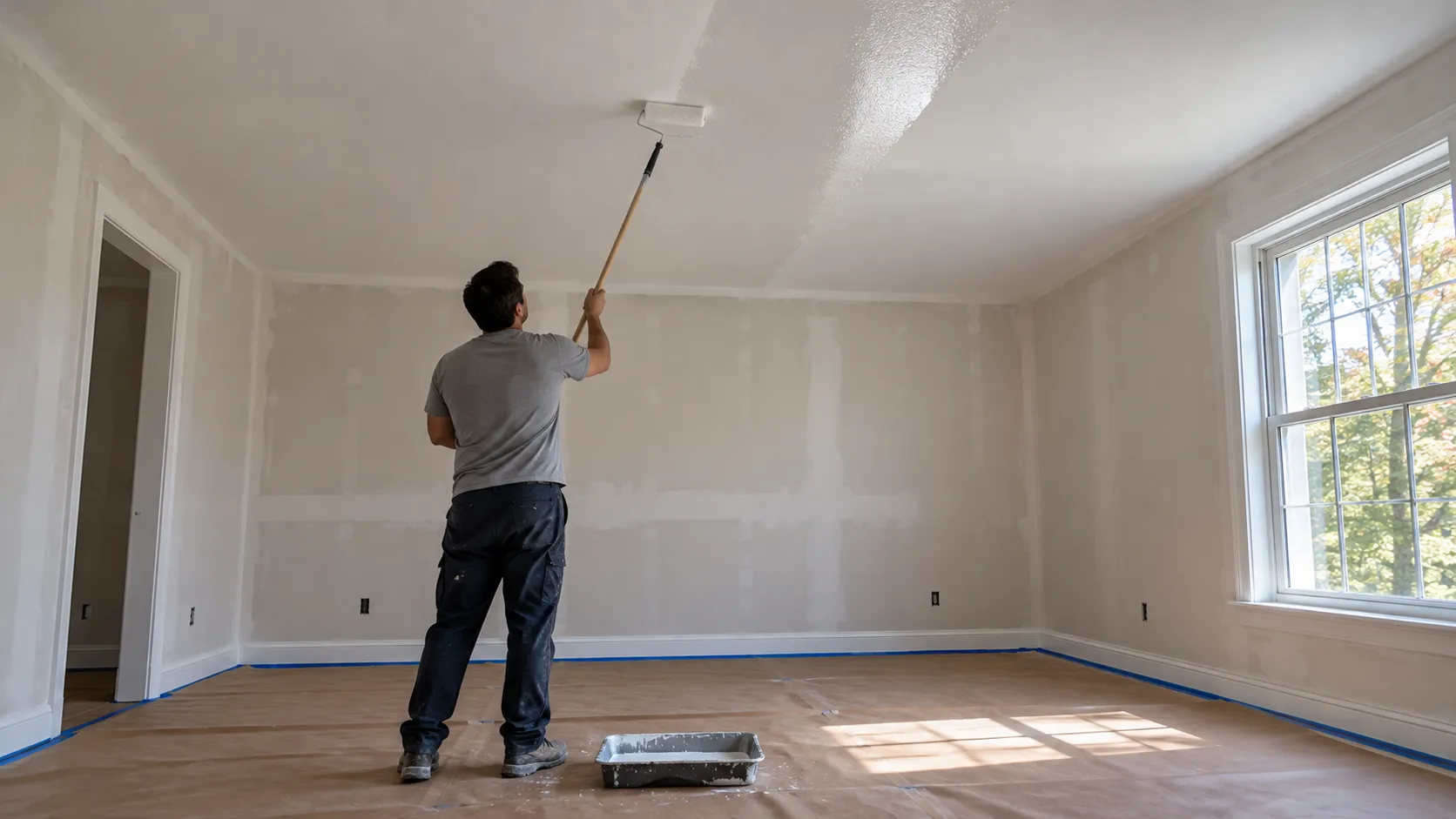
The published instruction is on Benjamin Moore's sheet and is worth reading literally: "apply paint generously from unpainted area into wet area." Generously, not thinly. Into the wet area, not away from it. In practice: load the cover, lay paint onto fresh ceiling, then back-roll into the previous pass while it is still wet, overlapping by about a third of the roller's width. Work in a strip roughly three feet wide running the full width of the room, and finish that whole strip before starting the next. An extension pole is not optional here — it keeps your body out from under the work so you can see the plane at an angle — and three feet is about the width you can reach without stepping, which is where the strip width comes from.
Our own practice is to roll the first coat in strips running parallel to the main window wall and the second coat perpendicular to the first. Neither manufacturer specifies a direction — Sherwin-Williams only says to "start in a corner and paint straight, overlapping rows until the entire ceiling is covered" — so treat it as a working habit, but the logic holds: the faint directional stipple a roller leaves is most visible running across the light. Then lay off. After each strip is filled, go back over it with the roller nearly unloaded, one long unbroken pass per lane, without lifting. That is what levels the film, it takes thirty seconds a strip, and it is the difference between a ceiling that looks rolled and one that looks sprayed. If the day is fighting you, Benjamin Moore's sheet gives the sanctioned fix: "Conditioning with Benjamin Moore 518 Extender may be necessary under certain conditions to adjust open time or spray characteristics," up to a "max of 8 fl. oz. to a gallon paint" — while warning, in capitals, to "never add other paints or solvents."
Two coats, almost always. Benjamin Moore's ceiling sheet says to "apply one or two coats," which is honest — a repaint of a clean white ceiling in the same white occasionally covers in one. Sherwin-Williams is firmer: "For optimum hide and performance on non-painted surfaces, it is recommended that you prime the surface and use two coats of finish," and its system specifications for drywall, plaster and wood all read "2 coats Eminence Ceiling Paint." Our own practice is two coats on every ceiling we are paid for, written that way on the estimate. The reason is porosity rather than generosity: ceilings get patched more often than walls, and a single coat over a patched ceiling flashes at every repair no matter how well the compound was sanded.
Lighting the Work, or Why a Ceiling Looks Fine Wet and Blotchy Dry
This is the most common surprise on a ceiling, and it is simple once you have seen it. A wet film is glossy, and gloss is uniform: every square foot of a freshly rolled ceiling reflects the same way, so the eye reads the plane as even. As the film dries flat the gloss falls to nearly nothing, and the only thing left to distinguish one patch from another is how much paint is actually there and what is underneath it. Differences invisible at four in the afternoon are obvious at nine the next morning.
Ambient room light is the worst way to inspect a ceiling, because it comes from everywhere and fills in exactly the shadows you are hunting. The test is a single bright source held close to the plane and shining almost along it — a work light on the floor aimed up at a shallow angle, a flashlight held flat against the drywall, or simply standing at the far end of the room and looking across the ceiling toward a window. All three do the same thing: they convert a thickness difference into a shadow. Our own practice is to check that way after the first coat rather than only at the end, because a thin area found after coat one is fixed by coat two rather than by a third visit, and to check again from at least two positions, since a lap mark is directional and can be invisible from one end of a room and obvious from the other.
Before anyone takes a flashlight to a ceiling and declares war, though, it is worth knowing what the trades consider a fair inspection. GA-214 sets it out: "The normal viewing position shall be at a minimum distance of five (5) feet (1.5 m) perpendicular from the surface. Blemishes should not be visible from a normal viewing distance with normal light," and "inspection lighting conditions are described as those in place when the project is finished." That is a drywall-finishing convention rather than a painting one, but it is the only published inspection standard in the room and it is a reasonable one. A ceiling should look right standing in the room under the lights that will be in the room. It is not expected to look right under a raking work light three inches off the surface. We use raking light as a diagnostic during the job, not as the acceptance test at the end of it, and neither should anybody else. Kitchens are where this bites hardest — recessed cans set close to the plane, under-cabinet light bouncing upward, often a window in a corner, which is both halves of GA-214's definition of critical lighting at once.
Spray or Roll, in a House Somebody Lives In
Both manufacturers publish spray settings for their ceiling flats. Benjamin Moore lists airless spraying at "1,000 – 2,000 PSI" with a "0.013 – 0.017" tip; Sherwin-Williams lists "2000 p.s.i." and a ".017-.021 inch" tip for Eminence. So the question is not whether a ceiling can be sprayed. It is whether it should be, in your house, this week.
Spraying wins decisively on an empty room. It is faster, it lays a more uniform film, and on a heavy texture it is the only method that fills consistently, because a roller physically cannot reach every pocket of a knockdown without flattening the high points. On new construction and on a whole-house repaint of an empty property we spray ceilings as a matter of course.
Rolling wins on an occupied house, and it is not close. Spraying means masking everything below the ceiling: walls, floor, trim, cabinets, lights, registers. The masking takes longer than the spraying, and in a furnished room it takes longer than rolling the whole ceiling would have. Overspray also travels — it does not respect a doorway — and a fine mist of ceiling white on a stair runner two rooms away costs more to fix than the time it saved. Our rule of thumb: empty room or empty floor, spray and back-roll; one ceiling in a lived-in house, roll it.
If you are planning around being home for the work, our guide to living in your house while it is being painted covers the sequencing and our guide to paint fumes and VOCs covers the air. Both brands carry the same caution on the ceiling products: Benjamin Moore says "use only with adequate ventilation. Do not breathe spray mist or sanding dust. Ensure fresh air entry during application and drying," and Sherwin-Williams' Eminence sheet says "if you experience eye watering, headaches, or dizziness, increase fresh air, or wear respiratory protection (NIOSH approved) or leave the area."
Textured, Knockdown and Popcorn Ceilings
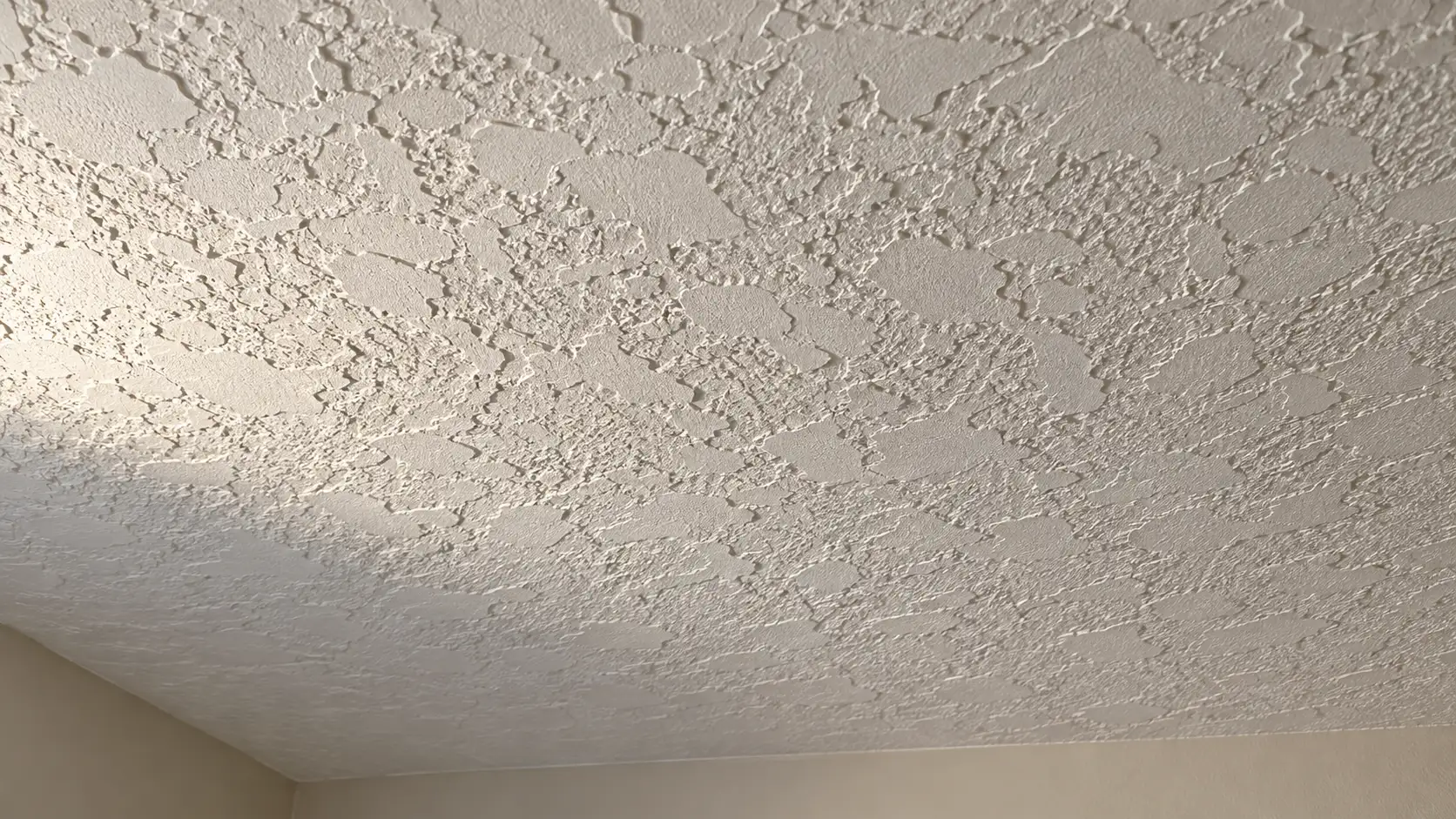
New Jersey's housing stock is full of textured ceilings — sprayed acoustic in the ranches and split-levels, knockdown and orange peel in the eighties and nineties builds, hand-trowelled swirl in some of the older capes. All of them can be painted, and all of them change the job.
What a roller does to a texture
Three things, and only one is intended. It fills: every coat softens a texture slightly, because the film is thickest in the valleys and thinnest on the peaks, so two heavy coats on a fine orange peel visibly reduce it. That is usually fine and sometimes desirable.
It pulls, and this is the one that ruins ceilings. A sprayed acoustic or popcorn texture is held on by a thin skim of adhesive, and a wet roller is perfectly capable of lifting chunks of it onto the cover. Once a patch comes off you are no longer painting a ceiling, you are repairing one mid-job with the rest of the ceiling wet. That is why popcorn is the one texture we price with a caveat, and why a test patch in a closet is worth ten minutes of anyone's time.
And it reveals: a texture glued to drywall for forty years does not always enjoy getting wet, so if the ceiling has an old leak in it, rolling is when you find out. The defence against the first two is to go slower and wetter — heavy nap, heavy load, one pass, no back-rolling over popcorn — and to spray if you can, because spraying applies no mechanical shear at all.
Pre-1980 texture: stop before you scrape, and the lead question too
This is not a precaution we can soften. The New Jersey Department of Health's asbestos guide for New Jersey residents says that "millions of homes built prior to 1978 contain asbestos materials" and that "unless the material is labeled as asbestos, no one can tell if it is asbestos-containing by examining it without the aid of a microscope." On ceilings it adds that "homes built between 1930 and 1950 may have wall and ceiling materials that contain asbestos. Builders sprayed or trowelled this material on," and in its section on patching compounds and textured paints: "Drywall patching compounds, commonly known as spackle, which was manufactured before 1978, usually contained asbestos. Textured paint used for decorative purposes once contained asbestos."
Its instruction has two halves and both matter. "If it's in good condition, leave it alone." And: "To prevent the release of fibers, do not sand, scrape, drill, or cut any surface which contains asbestos." Painting an intact textured ceiling does not disturb it. Scraping one does. If you have an older house and want the texture gone rather than painted, testing comes first, and our article on popcorn ceiling removal cost in NJ goes through the testing, the licensed-abatement question and what removal involves. Popcorn ceiling work is something we do; removal of an asbestos-containing material is not, and no painter should be doing it.
There is a second pre-1978 problem, separate from asbestos. Benjamin Moore prints it on the ceiling-paint data sheet itself: "WARNING! If you scrape, sand, or remove old paint, you may release lead dust. LEAD IS TOXIC." The governing rule is the EPA's Renovation, Repair and Painting (RRP) Program, which requires that "anyone paid to perform work that disturbs painted surfaces in homes, childcare facilities and preschools built before 1978 be certified." The carve-out is narrow: 40 CFR 745.83 defines minor repair and maintenance as work "that disrupt 6 square feet or less of painted surface per room for interior activities," with prohibited practices excluded and no "window replacement or demolition of painted surface areas." Six square feet is a small patch; a ceiling being sanded out is not.
We are not an EPA Lead-Safe Certified firm. That is a licensing fact about us, not a preference about wording, and it means there is work on pre-1978 ceilings we will tell you to take elsewhere. Our guide to lead paint in older NJ homes explains the rule properly. The instruction for any homeowner is the same regardless of who they hire: ask the bidder for their firm certification number, ours included, before anybody sands anything in a house built before 1978. A contractor who waves the question away is telling you something.
Water Stains, Smoke and Nicotine: Why Paint Alone Does Not Work
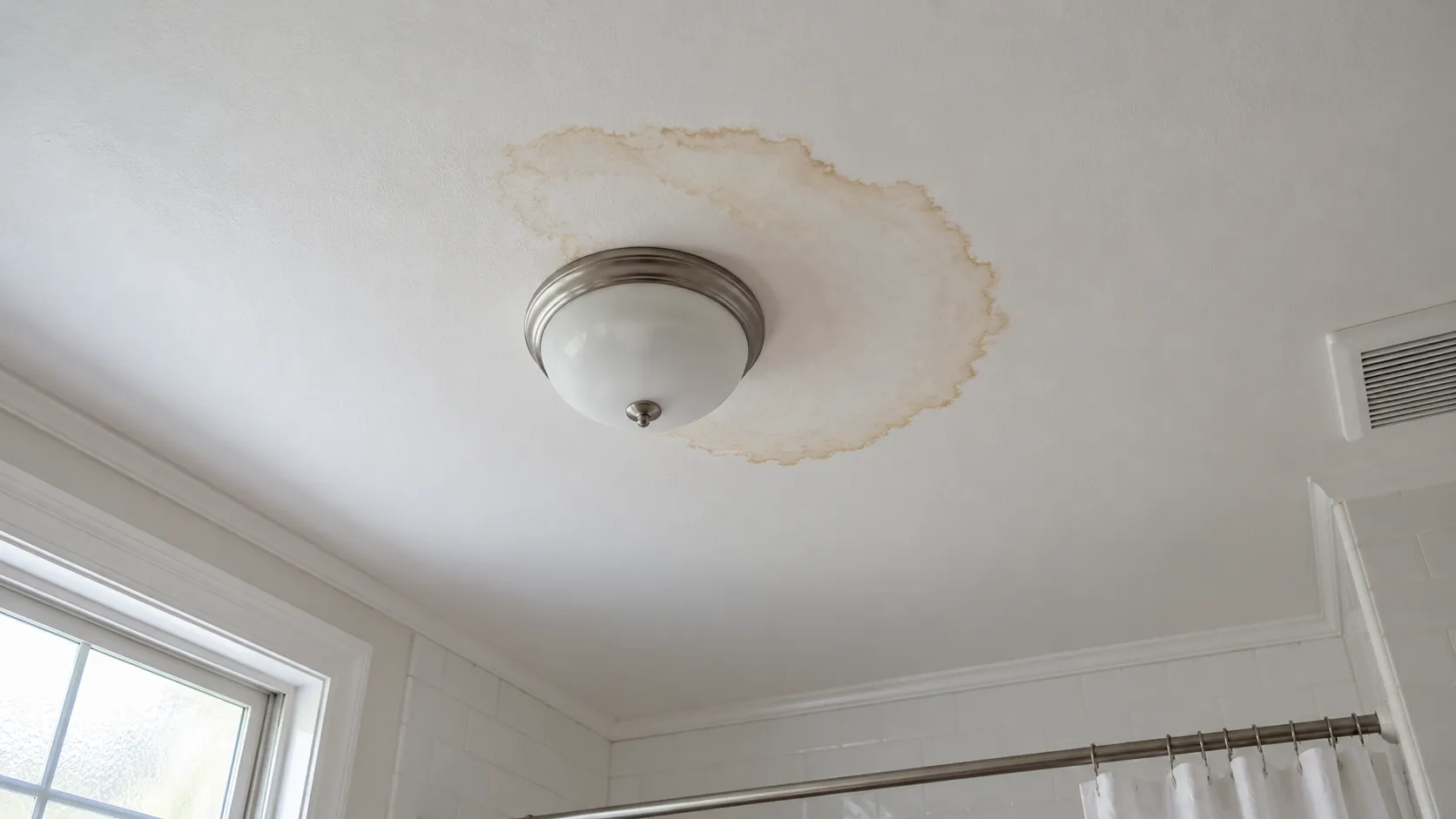
A ceiling stain is a pigment or a tar dissolved in something still capable of dissolving into your new paint. Roll flat white over it and the stain migrates up through the wet film and reappears, usually within forty-eight hours and often blurrier, which is worse. Three coats do not fix it. Three coats give the stain three chances.
The leak comes first, and it is not a painting question
The EPA's mould cleanup guidance states the order of operations plainly: "Fix plumbing leaks and other water problems as soon as possible. Dry all items completely." It is equally clear about skipping to the paint: "Do not paint or caulk moldy surfaces. Clean up the mold and dry the surfaces before painting," because "paint applied over moldy surfaces is likely to peel." Its Brief Guide to Mold, Moisture and Your Home adds the clock: "It is important to dry water-damaged areas and items within 24-48 hours to prevent mold growth."
So a stained ceiling under a bathroom is a plumbing job before it is a painting job, and one under a roof valley is a roofing job first. A brown ring that reappears after heavy rain is still live. We will happily paint a ceiling that has been stained and is now dry, and we will tell you when we think it is not dry — but we are painters. We do not do roofing, plumbing, basement waterproofing, or insurance, fire and water damage restoration, and we are not a mould or mildew remediation company. Washing a surface is ours; treating growth is not. If the smoke damage is from an actual fire, stop reading painting advice: that is a restoration job with insurance implications and the order things happen in matters legally as well as technically.
The stain-blocking primer decision
Once the source is dead and the ceiling is dry, the stain is a straightforward problem with a specific answer. Sherwin-Williams' preparation instruction for Eminence says "stains from water, smoke, ink, pencil, grease, etc. should be sealed with the appropriate primer/sealer," and Benjamin Moore's ceiling sheet tells you to "ask your retailer about our special purpose primers if the surface to be painted is water stained, smoke damaged, grease stained or very slick." Note that both send you to a different product. Neither claims its ceiling paint will do it.
| Primer | What its sheet says it blocks | Dry to touch | Recoat | Coverage | VOC |
|---|---|---|---|---|---|
| Benjamin Moore Fresh Start Multi-Purpose Oil Based Primer 024 (alkyd) | "crayon, graffiti, grease marks, water stains, cedar and redwood bleed, asphalt, creosote, rust stains, and smoke"; its stain list also names "nicotine" | 6 hours | 8 hours | 450 – 550 sq. ft./gal | 344 g/L |
| Zinsser B-I-N Shellac-Based Primer, 13-ounce spray | "grease spots, fire, smoke, water stains, ink, crayon, knots and sap streak stains and seals odors resulting from water and fire damage" | 15 minutes | 30 minutes | 10 – 12 sq. ft. per can | not stated on this sheet |
The practical difference is scale and smell. The shellac aerosol is the right tool for one brown ring over a shower: dry in fifteen minutes, recoatable in thirty, and because it comes out of a can you are not loading a brush with a stain that then lives in the brush. At ten to twelve square feet a can it is a spot-priming product and nothing else. The alkyd primer is the right tool for a ceiling stained all over, which in practice means a nicotine ceiling or a smoke-damaged one. It takes six hours to touch and eight to recoat, so it costs you a day, and at 344 grams per litre of VOC against the ceiling paint's zero it genuinely smells; our guide to paint fumes and VOCs is worth reading before committing a bedroom ceiling to it. On a nicotine ceiling the sequence is wash, prime the whole plane, then finish — skipping the wash is what makes one come back yellow in patches, because the primer is adhering to tar rather than to the ceiling.
One mistake turns a solved stain into a visible one: spot-priming, then rolling two finish coats over the whole ceiling, and ending up with a dull or shiny ghost exactly where the primer was. The primer is a different porosity from the surrounding old paint; the topcoat sinks into the old paint and sits up on the primer, and in raking light you can read the shape of the patch like a map. Our own practice is to spot-prime the stain, prime the whole ceiling, then apply two finish coats.
Bathroom and Kitchen Ceilings: the Moisture and Sheen Question
This is where the flat rule gets argued with most, usually by somebody who has been told a bathroom ceiling must be semi-gloss. It does not have to be, and on a large flat bathroom ceiling a semi-gloss is often a poor choice for the GA-214 reason: non-flat paints highlight minor surface differences, and a bathroom ceiling in a New Jersey house is frequently a patched one.
Sheen does less about moisture than people think. The traditional reasoning is that a glossier film is tighter and more washable — true — and therefore resists moisture, which is a far weaker claim on a ceiling than on a wall. What you actually want is a product formulated for the environment, and both manufacturers make one. Benjamin Moore's Aura Bath & Spa Matte 532 is described as "a premium interior coating specially formulated for optimal performance in high humidity environments such as baths and spas," listing "optimized for humid environments" and "provides a mildew resistant coating" among its features, with a usage line reading "bathroom and sauna applications." Its sheen is "3 – 4.5 @ 85°" — still inside the Gypsum Association's flat band, nowhere near a semi-gloss. The point of the product is that you do not have to choose between a bathroom-rated film and a low sheen. Our own practice is a bath-rated matte on the ceiling and the same or a satin on the walls; on a kitchen ceiling we normally stay with an ordinary ceiling flat, because a kitchen ceiling is a grease problem rather than a humidity problem.
"Mildew resistant" is a coating claim, not a treatment
The manufacturers draw this distinction themselves, and precisely. Benjamin Moore: "Anti-microbial — This product contains agents which inhibit the growth of microbes on the surface of this paint film. This product contains antimicrobial additives that inhibit the growth of mold and mildew on the surface of the paint film." Sherwin-Williams on Eminence: "This coating contains agents which inhibit the growth of mold & mildew on the surface of this coating film."
Read it twice. On the surface of the paint film. Those additives stop something growing on the new paint. They do nothing about something growing behind it, under it, or in the drywall, and they are not a treatment for anything already present. The EPA's position has not changed: "Do not paint or caulk moldy surfaces," because "paint applied over moldy surfaces is likely to peel."
We do not do mould or mildew treatment. Washing surfaces and power washing are services we offer; remediation is not, and growth on a bathroom ceiling is a specialist's job before it is ours. Sherwin-Williams does publish a washing procedure on its data sheet — "mildew may be removed before painting by washing with a solution of 1 part liquid bleach and 3 parts water," left on ten minutes and rinsed thoroughly, wearing "protective eyewear, waterproof gloves, and protective clothing." That is a surface-cleaning step inside a painting specification. It is not remediation and nobody should mistake it for one.
A bathroom ceiling that keeps staining or keeps growing something has a ventilation problem, not a paint problem. The EPA's moisture guide gives the targets: "Keep indoor humidity below 60 percent (ideally between 30 and 50 percent) relative humidity," "run the bathroom fan or open the window when showering," and "vent appliances that produce moisture, such as clothes dryers, stoves, and kerosene heaters to the outside where possible." It also names the mechanism behind a spotted bathroom ceiling in winter — condensation on cold surfaces, which is why it advises covering "cold surfaces, such as cold water pipes, with insulation." In a New Jersey house the two usual culprits are a bath fan venting into the attic instead of through the roof, and a ceiling under a cold, under-insulated attic, which makes the ceiling plane itself the cold surface. Neither is a painting problem and we are not the trade that fixes either, but we will tell you if that is what we think we are looking at.
Why a Patched Ceiling Flashes
Flashing is the dull or shiny ghost of a repair showing through a finished coat. On ceilings it is near-universal, and it has two separate causes that people constantly confuse.
The first is the substrate. GA-214 has a term for it: "Joint Photographing — The shadowing of the finished joint areas through the surface decoration. syn telegraphing." Its comments section explains when it gets worse: "Dark Paints. Colors with deep or strong hues, and even flat paints, tend to magnify imperfections in the finished gypsum panel surface and increase the possibility of joint photographing. A skim coat over the gypsum panel surface will minimize these conditions." Its levels of finish are the formal answer. Level 5 applies where "non-flat paints (i.e. sheen/gloss) or other glossy decorative finishes, dark/deep tone paints are applied, or critical lighting conditions occur," and requires that "a skim coat of joint compound or a material manufactured especially for this purpose shall be applied to the entire surface" — which GA-214 calls "the most effective method to provide a uniform surface and minimize the possibility of joint photographing." Translated into a New Jersey kitchen: if a ceiling is flooded with light from cans and a window and you want it perfect, the honest answer is sometimes a skim coat rather than another gallon of paint. That is a drywall decision made before painting starts and it changes the price and the schedule. Drywall and sheetrock repair is work we do, and our drywall repair guide sets out how repairs get scoped.
The second cause is simpler and is the one most people actually mean. Joint compound is far more absorbent than cured paint, so a finish coat rolled over a ceiling that is half old paint and half fresh compound gets drunk by the compound, leaving a thinner, duller film exactly where the repair was. It does not matter how flat you sanded it. The fix is in everyone's instructions and it is just "prime." GA-214's note after every level reads: "It is recommended that the final decoration specification (e.g. painting specification) include the application of a priming material prior to the decoration." Benjamin Moore adds a hiding refinement: "For best hiding results, tint the primer to the approximate shade of the finish coat, especially when a significant color change is desired." Our own practice on any ceiling with more than a couple of small repairs is to prime the whole plane rather than spot-prime, because a gallon of primer costs less than coming back. If you are seeing paint lifting rather than just flashing, that is a different problem and our guide to why paint peels is the right starting point.
Plaster ceilings, which are not ours
A great many older New Jersey houses — the pre-war capes and colonials in Monmouth and Middlesex, the city housing in Essex and Hudson — have plaster and lath ceilings rather than drywall, and they fail differently. They crack along the lath lines, they sag when the keys break off the back of the lath, and they come down in sheets if you push your luck.
Painting a sound plaster ceiling is ordinary work and the manufacturers support it. Benjamin Moore specifies its Drywall Primer or Fresh Start High-Hiding All Purpose Primer on cured plaster and warns to "never sand a plaster surface; knife off any protrusions and prime plaster before and after applying patching compound." Sherwin-Williams lists plaster "cured with a pH of less than 9" as self-priming under two coats of Eminence. Both sheets say new plaster needs roughly 30 days to cure before it is painted.
Plaster repair is not a service we offer. Drywall and sheetrock repair is — a lot of contractors weld the two into one phrase and they are different trades. A cracked, keyed-off or sagging plaster ceiling goes to a plasterer, and we will say so at the estimate rather than skim-coating over a structural problem. If the house is old enough for this conversation, our guide to painting historic homes in NJ covers the wider question of what belongs to a painter.
Cathedral, Vaulted, Two-Storey and Stairwell Ceilings
Everything above this point is the same whether the ceiling is eight feet up or twenty-four. What changes with height is not the painting. It is the access, and the access is where a ceiling stops being a Saturday and becomes a quote.
An extension pole and a six-foot stepladder handle a standard eight- or nine-foot ceiling comfortably, and a ten-foot one with a longer pole. Above that — particularly on a vault, where the plane is raked and the high side is over a drop — the setup becomes staging: planks between ladders, a baker's scaffold, or in a real two-storey entry a proper rolling tower.
The rules that govern this for a crew are federal and they are not advisory. 29 CFR 1926.1053 requires that "non-self-supporting ladders shall be used at an angle such that the horizontal distance from the top support to the foot of the ladder is approximately one-quarter of the working length of the ladder," that "when portable ladders are used for access to an upper landing surface, the ladder side rails shall extend at least 3 feet (.9 m) above the upper landing surface," and that "the top or top step of a stepladder shall not be used as a step." The scaffold standard, 29 CFR 1926.451, sets the threshold that most often applies in a two-storey foyer: "Each employee on a scaffold more than 10 feet (3.1 m) above a lower level shall be protected from falling to that lower level." It also requires that scaffolds "be designed by a qualified person" and be "capable of supporting, without failure, its own weight and at least 4 times the maximum intended load."
We quote those not to be dramatic but because they explain the price. A twenty-foot entry ceiling is not four times the paint of an eight-foot one; it is roughly the same paint and several times the setup, and the setup is the regulated part. It is also the one category of ceiling we would tell a homeowner not to attempt. The painting is easy. Falling twenty feet onto a tile floor is not recoverable.
Stairwell ceilings, the worst of them
A stairwell ceiling is the hardest ordinary ceiling in a house, and not because of the height. It is because there is no level floor underneath it. A stepladder cannot sit on stairs; the legs end up on different treads at different elevations, which is precisely the condition the OSHA language above is written about, and the plane you are painting is often fifteen or eighteen feet above the lowest tread. The answer is staging — an adjustable stair platform, or a plank spanning from a ladder on the landing to a ladder stabilised on the lower flight, levelled and secured. That takes a crew twenty minutes to build and a homeowner an afternoon and a bad idea. If you are hiring for one ceiling in the house, make it this one.
Two more things worth knowing before you plan around a high ceiling. A vaulted or cathedral plane is usually a bigger surface than the room's floor area, sometimes much bigger, because a raked plane is longer than its horizontal projection. And cutting in at height is slow: a brush line twenty feet up, worked from staging that has to be moved every eight or ten feet, takes several times as long per foot as the same line at eight feet. When a ceiling quote looks high relative to the square footage, that is usually what it is paying for. The interior section of our cost guide and our guide to what it costs to paint a room in NJ explain how interior pricing is built.
Ceiling Colour: White on White, Tinted Ceilings, and Ceilings That Match the Walls
Colour is the part of a ceiling people think about least and notice most. Every brand's default ceiling white is a specific white with a specific reflectance: Sherwin-Williams lists Eminence in "Bright White" with a Light Reflectance Value of 92, Benjamin Moore lists its ceiling product in "Ceiling White (09)." Those are not the same white, and neither is the same white as the Decorators White or Chantilly Lace on your trim. That is fine when the ceiling is the only white in view, and stops being fine the moment it meets white crown, white trim or a white wall, because two whites that are close but not identical read as a mistake rather than as two colours. The reliable moves are to make them obviously different, or to make them genuinely the same.
The classic designer move is to tint the ceiling to a percentage of the wall colour — often half or quarter strength — so the ceiling relates to the room rather than floating above it. Both brands will do it: Benjamin Moore lists its ceiling paint in "Gennex Bases 1X – 4X," and Sherwin-Williams lists Eminence as tintable, though with a tight limit of "0-2" ounces per gallon in Bright White, which tells you that deeper ceiling colours need a different base or a different product. Two cautions from the sheets. Benjamin Moore notes that "certain custom colors may require a Deep Base Primer tinted to a special prescription formula to achieve the desired color," and both brands recommend tinting the primer toward the finish colour when the change is significant. And GA-214's warning applies with force: deep and strong hues "tend to magnify imperfections in the finished gypsum panel surface." A charcoal ceiling in a room with cans in it is a Level 5 conversation, not a paint conversation. If you are choosing for the whole room, our interior paint colors guide has current palettes with real codes and reflectance values.
Walls and ceiling in the same colour and sheen
This has become genuinely common, and done deliberately it is one of the better-looking things you can do to a small or awkward room: a low-ceilinged bedroom, a study, a room with dormers or a sloped ceiling where the wall-to-ceiling line is arbitrary anyway. One colour in one flat sheen erases the line and the room reads as a single volume.
Three practical notes. It only works in a flat or a matte — the same colour in satin on the walls and flat on the ceiling reads as two colours, because sheen is a colour cue. It is less forgiving of ceiling defects than white, because colour magnifies what white hides. And it changes how the room gets painted, because there is no cut line between wall and ceiling, which sounds easier and is, as long as nobody expects a crisp edge at a corner that no longer has one. Where it goes wrong is on an exposed-joist basement ceiling, which is a completely different proposition — sprayed, usually black or white, with a great deal in the spray envelope that must not get paint on it. We treat that as its own job, and our guide to painting basement walls and ceilings in NJ covers it properly.
What We Do, and Do Not Do, on Ceilings
- We paint the ceiling before the walls and the trim, in every room, so spatter lands on surfaces that are about to be painted anyway.
- We specify two finish coats on every ceiling, written on the estimate as two coats so there is no argument later about what was quoted.
- We prime the whole ceiling rather than just the patches wherever a ceiling has had more than minor repair, because a spot-primed ceiling flashes at the edges of the primer.
- We spot-prime every stain with a stain-blocking primer first, and we tell you which stains we think are still live rather than painting over them and hoping.
- We cut in by hand rather than taping the ceiling line, except where crown or another profile gives tape something to seat against, and we caulk the ceiling-to-crown gap after priming, as the manufacturers specify.
- We check the work under a raking light after the first coat, not only at the end, because a thin area found after coat one is fixed by coat two rather than by a third visit.
- We roll rather than spray in an occupied house, and spray only where a room or a floor is genuinely empty and the masking makes sense.
- We do drywall and sheetrock repair, caulking and sealing, popcorn ceiling work and crown moulding installation, so most of what a ceiling needs before paint is in scope — and we will say when a ceiling needs a skim coat rather than another coat of paint.
- We build proper staging for stairwells, vaults and two-storey entries, and we price the setup honestly rather than pretending a twenty-foot ceiling is an eight-foot one with a longer pole.
- We will not paint over a live leak or over growth, and we will say which trade you need instead. For HOA and condo work, where a ceiling is often shared with somebody else's plumbing, our HOA and condo painting guide explains how that gets coordinated.
What we do not do, so there is no ambiguity: plaster repair, mould or mildew treatment, insurance, fire or water damage restoration, roofing, plumbing, basement waterproofing, and we do not hold EPA Lead-Safe (RRP) certification. Drywall and sheetrock repair is ours; a cracked, sagging or keyed-off plaster ceiling in an older New Jersey house belongs to a plasterer. Washing a surface is ours; treating growth is not. On a house built before 1978, ask us — and every other bidder — for a firm certification number before anyone disturbs old paint, and take the honest answer over the comfortable one.
Get a Price for Your Ceilings
Ceiling pricing depends on the height, the texture, the condition and how much patching and stain blocking the ceiling needs, which is why we measure rather than quote from a photo. NJ Painting Co. is a family-owned, licensed and fully insured painting company at 36 Church Rd, Morganville, NJ 07751, working on New Jersey homes for more than 20 years with Benjamin Moore and Sherwin-Williams products. Every estimate is free, includes an in-home color consultation, and spells out surfaces, prep, products and number of coats; our work carries a two-year workmanship warranty. For how single-room interior pricing is built, see our cost to paint a room guide, for the work itself our interior painting service, and for offices, schools and medical buildings our commercial painting service. Call (732) 239-0932 or request a free estimate, and ask us about the job minimum when you enquire.
Frequently Asked Questions
What kind of paint should you use on a ceiling?
A flat, in almost every case. The Gypsum Association defines flat paint as producing 0 to 5 gloss units at 60 degrees and 0 to 10 at 85 degrees on a gloss meter, and notes that non-flat and dark or deep-tone paints highlight minor surface differences while textures conceal them. A ceiling is the surface most often lit at a grazing angle by windows and surface-mounted fixtures, so it is permanently in what the standard calls critical lighting. Dedicated ceiling paints sit at the bottom of the flat range: Benjamin Moore's Waterborne Ceiling Paint reads 0 to 2 at 85 degrees, Sherwin-Williams' Eminence 0 to 5 units.
Do you have to use ceiling paint, or will a flat wall paint do?
A premium flat wall paint will do, and some are sold for it — Benjamin Moore's Regal Select Flat calls itself an elegant flat finish for ceilings and low traffic areas. The differences are real but modest: it reads 1 to 3.5 at 85 degrees against the ceiling product's 0 to 2, and the dedicated ceiling paints are formulated around spatter resistance and glare, Benjamin Moore listing that its ceiling paint resists spattering when applied with a roller and tones down ceiling glare to provide maximum diffused light. Leftover wall flat and a small ceiling, use it. Buying anyway, buy the ceiling product.
What roller nap should you use on a ceiling?
For a smooth ceiling, Sherwin-Williams specifies a 3/8 to 1/2 inch nap cover for its Eminence ceiling flat and advises a low-nap cover generally for smooth, untextured ceilings. For a textured ceiling it advises a higher nap, around 3/4 inch, because the thicker cover helps the paint reach deeper pockets in the texture and promotes a more uniform finish. On a smooth ceiling worked overhead from a pole the half-inch is usually the better of the two, because it carries more paint between loads, which is what keeps a wet edge alive.
How do you paint a ceiling without lap marks?
Keep a wet edge and never stop in the middle of the room. Benjamin Moore's own instruction is to apply paint generously from unpainted area into wet area: load the cover, lay paint onto fresh ceiling, then roll back into the previous pass while it is still wet. Work in strips about three feet wide running the full width of the room and finish each strip before starting the next. Cut the whole perimeter in first and roll into the cut band while it is wet. On a difficult day Benjamin Moore sanctions conditioning the paint with its 518 Extender, a maximum of eight fluid ounces to the gallon, and warns never to add other paints or solvents.
Should the ceiling be painted before or after the walls?
Before, and not only for neatness. Rolling overhead throws a fine spatter regardless of how good the cover is, and anything landing on an unpainted wall is covered by the wall coats that follow. It also lets you cut the ceiling in roughly and run a few inches of ceiling paint down onto the wall, which Sherwin-Williams itself recommends: if you are painting the walls afterwards you can skip the taping and paint down the wall a few inches, then tape off the ceiling when it is the walls' turn.
How many coats does a ceiling need, and how long between them?
Two coats in practice. Benjamin Moore's ceiling sheet says to apply one or two; Sherwin-Williams is firmer, saying that for optimum hide and performance on non-painted surfaces it is recommended that you prime the surface and use two coats of finish. The wait between them depends on the brand, which surprises people: Benjamin Moore's ceiling paint is dry to touch in 1 hour and recoatable in 1 to 2 hours, while Eminence is dry to touch in 1 hour but lists recoat at 4 hours. Both figures are measured at 77 degrees Fahrenheit and 50 percent relative humidity, and both brands warn that cool or humid conditions lengthen everything.
Why does my ceiling look blotchy now that it has dried?
Because a wet film is glossy and a dry flat film is not. While the paint is wet every part of the ceiling reflects light the same way and the plane reads as even; as it dries flat the gloss falls away and the only thing distinguishing one area from another is film thickness and what is underneath. Thin areas, lap marks and porosity differences over patches all become visible then. The diagnostic is raking light: a work light or flashlight held almost parallel to the surface turns a thickness difference into a shadow. The usual cures are a generous second coat, or a whole-ceiling primer where the blotchiness is porosity over repairs.
How do you get rid of a water stain on a ceiling?
Fix the leak, let it dry, then seal the stain with a stain-blocking primer before any finish coat. Paint alone will not do it; the stain migrates up through the wet film and reappears within a couple of days. Sherwin-Williams' preparation instructions say stains from water, smoke, ink, pencil and grease should be sealed with the appropriate primer or sealer, and Benjamin Moore's ceiling sheet points to its special-purpose primers for water-stained or smoke-damaged surfaces. For one ring a shellac-based aerosol primer is the right tool, dry to touch in 15 minutes and recoatable in 30. For a whole ceiling an alkyd stain-blocking primer is the answer, but it takes 6 hours to touch and 8 to recoat and it genuinely smells. Prime the whole plane afterwards, or the primer patch itself will show.
Can you paint over a popcorn or textured ceiling?
Usually yes, with care. Use a heavy nap, load it well, make one pass and do not back-roll, because a wet roller can lift a sprayed acoustic texture straight off the ceiling. Spraying is gentler still if the room is empty. The serious caveat is age: the New Jersey Department of Health says textured paint used for decorative purposes once contained asbestos, that pre-1978 patching compounds usually did, and that nobody can tell by looking because it takes a laboratory. Its guidance is that if the material is in good condition you leave it alone, and that to prevent the release of fibres you do not sand, scrape, drill or cut any surface that contains asbestos. Painting an intact texture does not disturb it. Scraping one does.
What sheen should a bathroom ceiling be?
Not necessarily semi-gloss. What a bathroom ceiling wants is a product formulated for humidity, and the sheen can still be very low. Benjamin Moore's Aura Bath and Spa Matte is described as specially formulated for optimal performance in high humidity environments such as baths and spas, and as providing a mildew resistant coating, and its sheen reads 3 to 4.5 at 85 degrees, still inside the Gypsum Association's flat band. A glossier film on a large flat bathroom ceiling mainly succeeds at showing every patch. Note too that the anti-microbial additives in these products inhibit growth on the surface of the paint film only; they are not a treatment for anything already there.
Should the ceiling be the same colour as the walls?
It can be, and in a low-ceilinged or awkwardly shaped room it often looks better than a white ceiling, because one colour erases the wall-to-ceiling line and the room reads as a single volume. Three conditions make it work. It has to be the same sheen as well as the same colour, because sheen is a colour cue and a satin wall against a flat ceiling reads as two colours. It should be a flat or a matte. And it is less forgiving of ceiling defects than white; the Gypsum Association warns that deep or strong hues tend to magnify imperfections and increase the possibility of joints shadowing through.
How do painters reach a cathedral or two-storey ceiling?
With staging rather than a taller ladder — a baker's scaffold, planks between ladders, or a rolling tower in a real two-storey entry. The rules for a crew are federal: OSHA requires that anyone on a scaffold more than 10 feet above a lower level be protected from falling, that scaffolds be designed by a qualified person and support at least four times the maximum intended load, that non-self-supporting ladders be set at roughly a quarter of their working length out from the wall, and that the top or top step of a stepladder not be used as a step. That setup is most of the cost of a high ceiling, because the paint and the technique do not change with height but the access does. A stairwell ceiling is the hardest of all, because there is no level floor to stand a ladder on.
About the author
Written by the NJ Painting Co. team
NJ Painting Co. is a family-owned painting contractor based in Monmouth County, in business since 2004. We are licensed and fully insured, work with Benjamin Moore and Sherwin-Williams paints, and back our work with a 2-year workmanship warranty. We serve Monmouth, Middlesex, Ocean, Mercer, Somerset and Burlington counties, plus Union, Essex, Hudson, Bergen and Passaic in North Jersey.