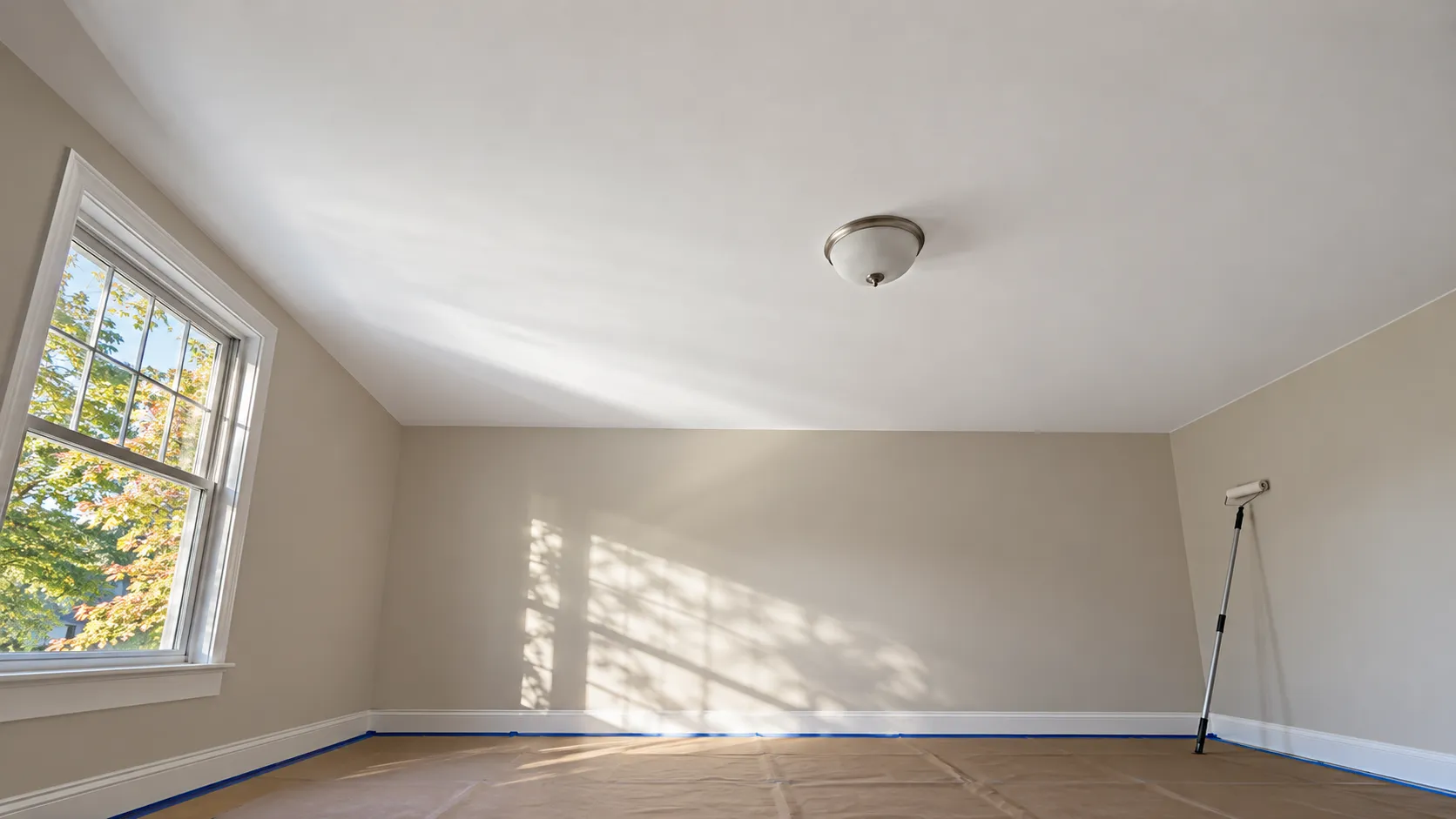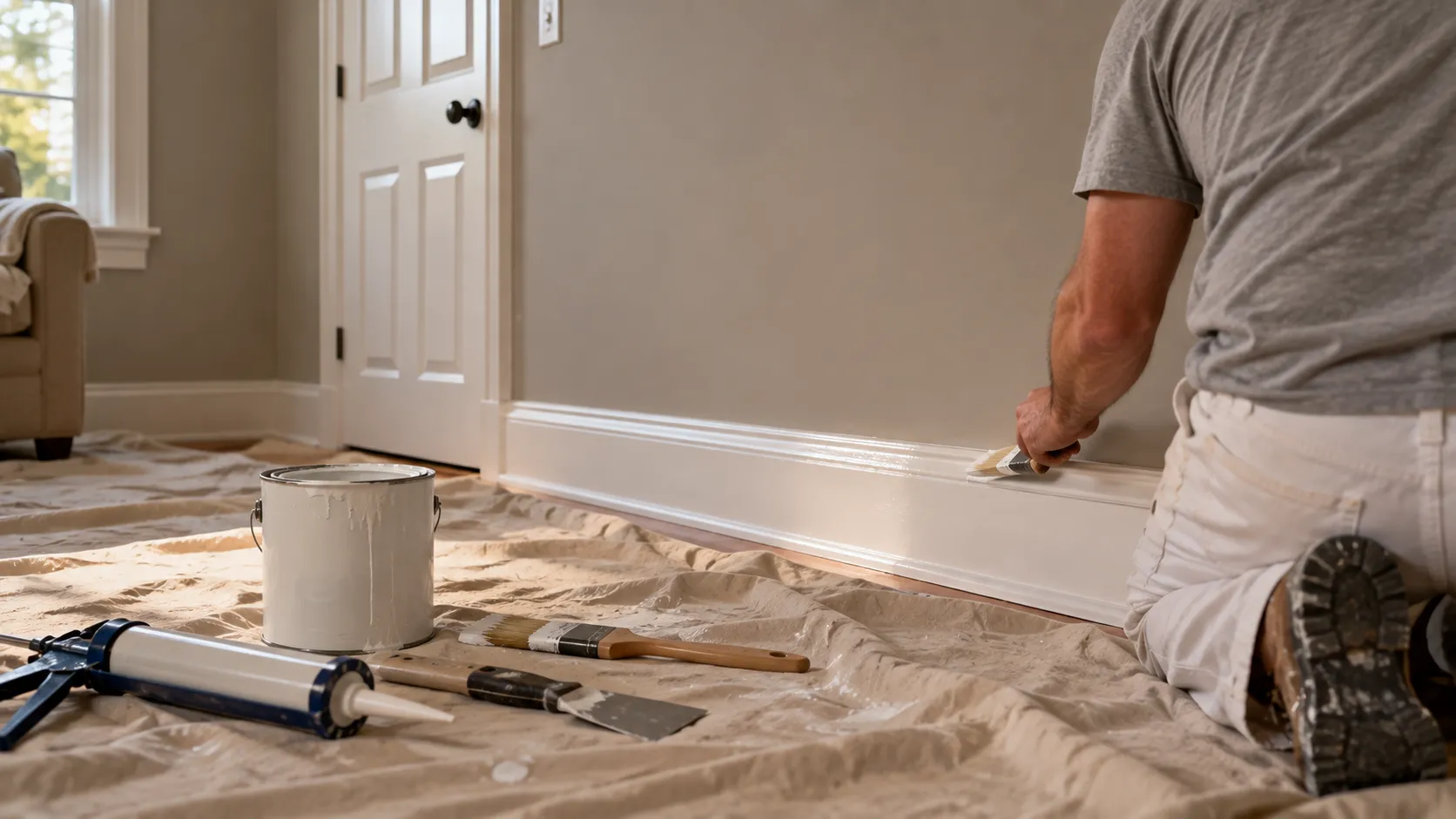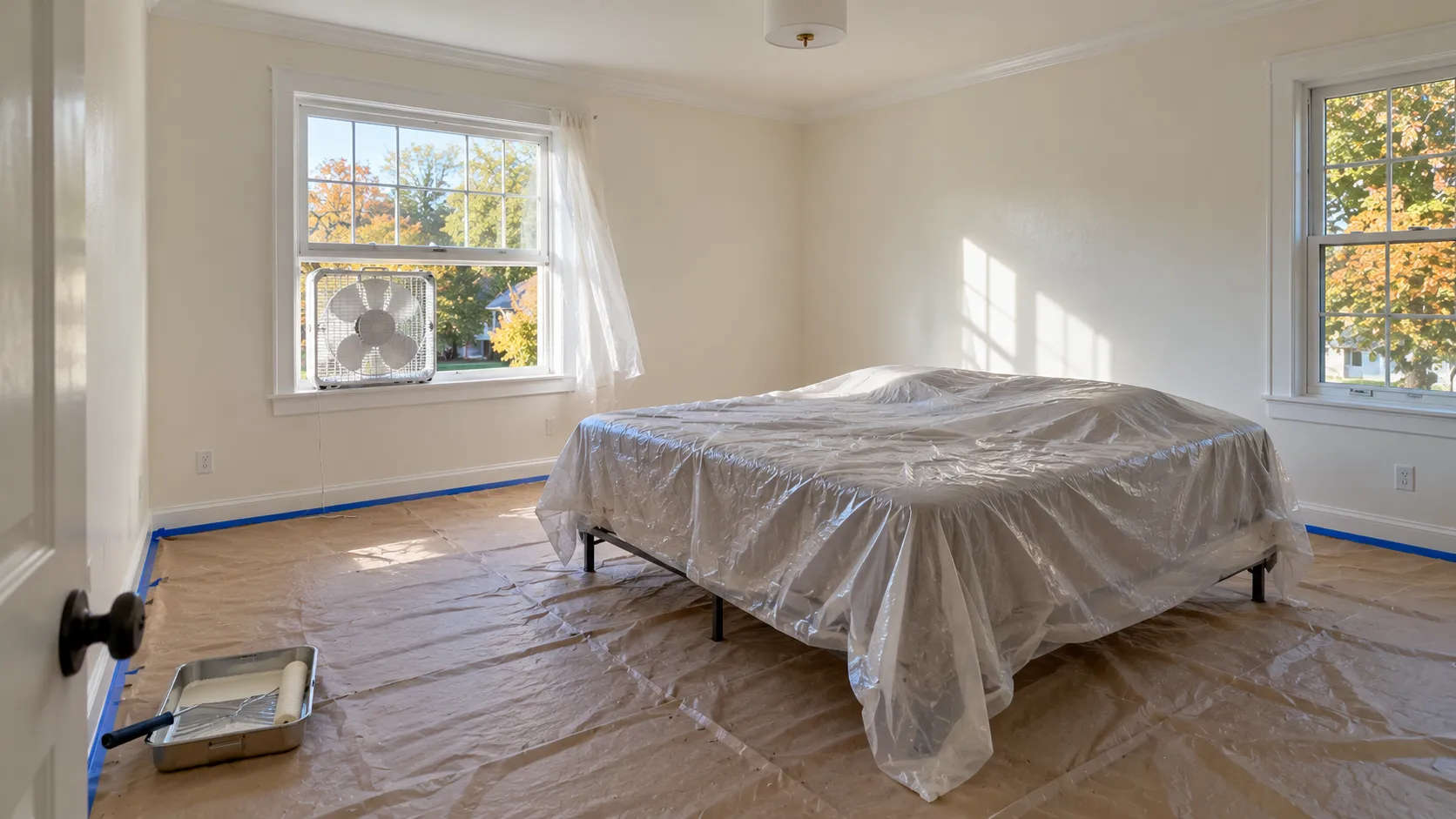
With today's low-VOC waterborne wall paints, most people can sleep in a freshly painted room the next night, provided the room has been ventilated with a window open and a fan blowing out. That is a painter's practice, not a standard: no government agency publishes a number of hours after which a painted room is "safe" to sleep in. What the authorities do say is narrower and more useful: ventilate while you paint and while the paint dries, follow the label, and leave the area if it makes your eyes water or your head ache. With the low-VOC waterborne paints we use on interiors, the wall is dry to the touch in about an hour and the room usually smells like nothing much by the next morning with a window open and a fan running. Our own practice is to give a bedroom a night with the window open before anyone sleeps in it, and longer if the room is small, the coats are heavy, the paint is an alkyd enamel, or anyone in the house is pregnant, asthmatic or an infant.
We are a family-owned painting company in Morganville and have painted interiors across Monmouth, Middlesex, Ocean, Mercer, Somerset and Burlington counties, plus Union, Essex, Hudson, Bergen and Passaic in North Jersey, for more than 20 years, using Benjamin Moore and Sherwin-Williams products. "How long until the smell goes away?" and "can the baby sleep in there?" are two of the most common questions we get before a job is booked, and they deserve a careful answer rather than a reassuring one. This guide separates what the EPA, the American Lung Association and CDC/NIOSH actually publish from what the paint manufacturers' own data sheets say, and keeps the two apart from what we do on a job. Every health statement and every dry-time number below is linked to its source and was read on 14 October 2026.
One thing we will not do here is tell you what is safe for your particular family. We are painters. Questions about pregnancy, asthma, a newborn or a medication belong with your doctor, and the sources below say the same thing.
The Short Answer
- Dry, recoat and cure are three different times. Benjamin Moore's Regal Select interior paint is dry to the touch in 1 hour and can be recoated in 1 to 2 hours, but its data sheet says "painted surfaces can be washed after two weeks."
- The smell outlasts the dry surface. Both brands' labels tell you to "ensure fresh air entry during application and drying" — drying, not just application.
- Ventilation is the whole game. The EPA's advice for products that emit VOCs is to "increase ventilation when using products that emit VOCs" and to "meet or exceed any label precautions."
- Nobody publishes a re-occupancy hour. There is no EPA, CDC or manufacturer wait time for sleeping in a painted room. What exists is the label instruction and the symptom rule: if your eyes water or you get a headache, add fresh air or leave.
- "Zero VOC" is a formulation claim, not a chemistry claim. The federal VOC figure on a data sheet is measured on the untinted base, and the EPA itself warns that "VOC labels and certification programs may not properly assess all of the VOCs emitted from the product."
- Cold weather changes the method, not the goal. When the windows have to stay shut, you ventilate with bathroom and kitchen exhaust fans, short bursts of cross-ventilation and a slower schedule instead of an open house.
- Nurseries, pregnancy, asthma and pets all have real published guidance behind them, and all of it ends in "talk to your doctor" — or your vet.
What Paint Fumes Actually Are
The smell of fresh paint is mostly volatile organic compounds. The EPA's page on VOCs and indoor air quality defines them simply: "volatile organic compounds (VOCs) are emitted as gases from certain solids or liquids." Paint is on its list of sources — "paints, varnishes and wax all contain organic solvents, as do many cleaning, disinfecting, cosmetic, degreasing and hobby products" — and the EPA notes that "concentrations of many VOCs are consistently higher indoors (up to ten times higher) than outdoors," before you open a can of anything.
The health effects the EPA lists for VOCs generally are "eye, nose and throat irritation; headaches, loss of coordination and nausea; damage to liver, kidney and central nervous system," and it adds that "some organics can cause cancer in animals." The American Lung Association splits the same list by timescale: "breathing VOCs can irritate the eyes, nose and throat, can cause difficulty breathing and nausea," while "long-term exposure can damage the liver, kidneys, and central nervous system, and some VOCs are linked to cancer." The Lung Association also notes that VOCs may worsen symptoms for people with asthma and COPD.
Two honest caveats belong next to that list, and both come from the agencies themselves. First, those effects are tied to exposure — how much, how concentrated, for how long — not to the mere presence of a smell. The EPA's own example of a genuinely high-exposure moment is not rolling a wall: it is stripping. "During and for several hours immediately after certain activities, such as paint stripping, levels may be 1,000 times background outdoor levels." Second, people differ. The EPA's introduction to indoor air quality says that "whether a person reacts to a pollutant depends on individual sensitivity, which varies tremendously from person to person," that immediate effects "are usually short-term and treatable," and that "some people can become sensitized to biological or chemical pollutants after repeated or high level exposures."
So the useful question is not "are paint fumes dangerous." It is "how do I keep the exposure low and short." That is a ventilation and scheduling question, and it has concrete answers.
Dry Time, Recoat Time and Cure Time Are Three Different Things
Almost every argument about paint smell is really a confusion between these three. The manufacturers publish all three, and the numbers are not close to each other.
- Dry to touch is when the surface no longer transfers to a finger. The solvent at the very top of the film has left.
- Recoat is when the film is solid enough to accept another coat without lifting or wrinkling. It is always longer than dry-to-touch.
- Cure is when the film has reached its final hardness, block resistance and sheen. It is longer than both, sometimes by weeks.
Here is what three of the products we actually use list on their own data sheets, all measured at 77°F and 50% relative humidity:
| Product | Dry to touch | Recoat | What the sheet says about full cure | VOC |
|---|---|---|---|---|
| Benjamin Moore Regal Select Satin/Pearl N550 (wall paint) | 1 hour | 1 – 2 hours | "Painted surfaces can be washed after two weeks." | < 50 g/L |
| Sherwin-Williams Emerald Interior Latex Satin K37 (wall paint) | 1 hour | 4 hours | No cure figure given; "drying and recoat times are temperature, humidity, and film thickness dependent." | "less than 50 grams per litre; 0.42 lbs. per gallon" |
| Benjamin Moore ADVANCE Waterborne Interior Alkyd Satin 792 (trim, doors, cabinets) | 4 – 6 hours | 16 hours | "Depending on weather and drying conditions, it could take up to 30 days to reach optimum hardness and final sheen." | 48.5 g/L |
Read the ADVANCE line twice. That is a waterborne alkyd enamel — the product that makes trim and doors look sprayed even when they are brushed — and its own manufacturer says it can take up to 30 days to reach optimum hardness. The same sheet tells you not to "expose to heavy abrasion or return shelves/tabletops to service for at least 5 – 7 days." If you are having trim, doors and baseboards done, the schedule is genuinely different from a wall repaint, which is one reason we price that work separately; our guide to what it costs to paint trim, doors and baseboards in NJ walks through why.
Both brands also warn that the published figures are best-case lab conditions. Benjamin Moore's Regal Select sheet says "high humidity and cool temperatures will result in longer dry, recoat and service times," and the ADVANCE sheet puts it as "high humidity or cooler temperatures will prolong dry, recoat and cure times." Sherwin-Williams says the same thing from the other direction: "drying and recoat times are temperature, humidity, and film thickness dependent." A damp August afternoon in Monmouth County and a 55-degree closed-up house in February are both slower than the sheet.
Why the Smell Lingers After the Surface Is Dry
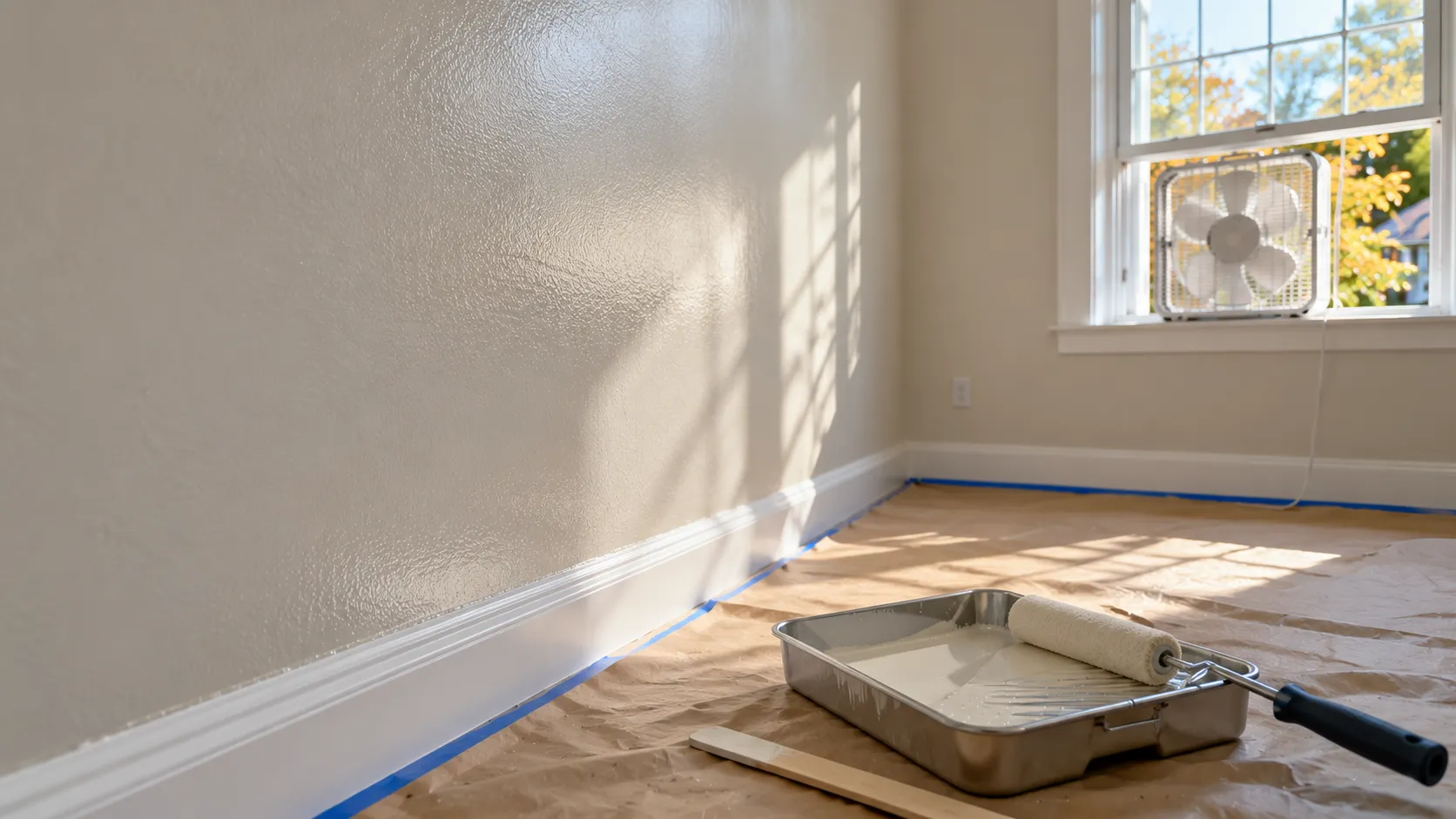
Because "dry" describes the top of the film, not the inside of it. A coat of wall paint is roughly 1.5 mils thick when dry — about the thickness of a sheet of kitchen plastic wrap — and the water and the small amount of solvent in the lower part of that film have to make their way out through a skin that has already formed. The surface stops being tacky long before the film has finished releasing anything.
You do not have to take our word for it, because both manufacturers' safety wording is explicit about the drying phase. Benjamin Moore's sheet says: "use only with adequate ventilation... ensure fresh air entry during application and drying." Sherwin-Williams' label caution is longer and clearer still: "use only with adequate ventilation. To avoid overexposure, open windows and doors or use other means to ensure fresh air entry during application and drying. If you experience eye watering, headaches, or dizziness, increase fresh air, or wear respiratory protection (NIOSH approved) or leave the area."
That last sentence is the closest thing to a re-occupancy rule anybody publishes, and it is a symptom rule rather than a clock. It is also the rule we use on site.
There is a second, slower process in alkyd and waterborne-alkyd enamels: the film keeps reacting with oxygen for weeks, which is how it gets so hard. Benjamin Moore's ADVANCE sheet notes that a slight amount of yellowing "is accelerated in dark or poorly ventilated areas and is more visible in lighter colors." A film that yellows differently depending on ventilation is a film that is still chemically busy — which is exactly why a trim-heavy job smells for longer than a wall job, and why air movement in the room matters for weeks and not hours.
Oil and alkyd enamels smell stronger and longer than waterborne wall paints, and that difference is real, not psychological. It is one of the trade-offs in our spray vs brush comparison for cabinets and part of why most interior walls in New Jersey houses are now painted with waterborne acrylics.
So When Can You Sleep in a Freshly Painted Room?
We want to be straight with you about the state of the evidence here, because the internet is full of confident numbers with nothing behind them.
What is published: the label instruction to ensure fresh air entry during application and drying; the EPA's instruction to "increase ventilation when using products that emit VOCs" and to "meet or exceed any label precautions"; and the symptom rule above. What is not published: any agency or manufacturer figure for how many hours must pass before a painted bedroom may be slept in. We looked. There isn't one.
What we do, offered as our practice and not as a safety standard: with the low-VOC waterborne paints we use, a bedroom painted in the morning with a window open and a fan drawing air out is usually unremarkable by the following morning, and we tell homeowners to give it that night. For a trim-and-door job in enamel, we suggest a couple of nights elsewhere in the house if that is easy to arrange, because the enamel smell is stronger and the cure is longer. For a nursery, we suggest painting well ahead of a due date rather than the week of it — a fortnight is not an excessive margin and it costs nothing but scheduling.
The things that make us say "give it longer" are specific and worth checking against your own job:
- Alkyd or oil enamel anywhere in the room, including trim and doors.
- A small room with one window, or a windowless interior room such as a hall bath or a walk-in closet.
- Heavy coats or three coats, which is more film to release.
- Cold or humid weather, which the data sheets say lengthens everything.
- Anyone in the house who is pregnant, asthmatic, an infant, elderly or chemically sensitive — and for them the decision is a medical one, not ours.
- A smell that is still obvious. Your nose is not a measuring instrument, but a room that still smells strongly of paint is a room that has not finished ventilating.
If a family would rather sleep at home throughout the job, say so when we scope it. Sequencing a repaint so bedrooms are done early in the week and finished before the weekend is normally free; we cover the whole logistics question in living in your house while it's being painted.
What Low-VOC and Zero-VOC Actually Mean
This is where labels get genuinely misleading, and the EPA says so itself.
Start with the legal baseline. Under the federal architectural coatings rule, 40 CFR 59.402 says "each manufacturer and importer of any architectural coating subject to this subpart shall ensure that the VOC content of the coating does not exceed the applicable limit in table 1." The limits in that table are 250 g/L for flat coatings, 380 g/L for nonflats, 350 g/L for primers and undercoaters, 400 g/L for floor coatings and 450 g/L for varnishes.
Now compare: Regal Select lists under 50 g/L, Emerald lists "less than 50 grams per litre," and ADVANCE lists 48.5 g/L. The premium interior paints sold today are not scraping under the federal ceiling, they are a fraction of it. That is a genuine improvement, and it is why low-VOC products are the standard spec on our interior work rather than an upgrade. It is also why we spend less time arguing about fumes than painters did twenty years ago.
Then read the small print, which is where three things hide.
1. The number is measured on the untinted base
Look at where the VOC figure sits on a Sherwin-Williams data sheet. On the Emerald satin sheet it is printed directly under the line "Extra White K37W01051 (may vary by color)." That is not a disclaimer about shade; it is telling you the figure belongs to one specific base. The regulation agrees: 40 CFR 59.406 states that "the VOC content of a tint base shall be determined without colorant that is added after the tint base is manufactured or imported." A deep accent color can take 18 to 20 ounces of colorant per gallon, and none of that colorant is in the printed number.
Some colorant systems are built for exactly this. Sherwin-Williams' Harmony data sheet describes a "zero V.O.C. formula tinted with ColorCast Ecotoner Colorants that do not add V.O.C.s when tinted," and Benjamin Moore tints its premium lines with its own Gennex colorant system. If the VOC number matters to you, that distinction — whether the colorant adds VOCs — is the thing to ask the paint store about, not the number on the shelf tag.
2. "Zero VOC" and "low VOC" are measured against an outdoor rule
The EPA's technical overview of VOCs is unusually blunt about this. The regulatory definition of a VOC covers compounds that "participate in atmospheric photochemical reactions, except those designated by EPA as having negligible photochemical reactivity" — in other words, it is a smog rule. For indoor air, the EPA says, the useful definition is different: "all organic chemical compounds that can volatize under normal indoor atmospheric conditions of temperature and pressure are VOCs." And on labels specifically: "some are based on the content of VOCs that are regulated to control the formation of photochemical smog outdoors. Therefore VOC labels and certification programs may not properly assess all of the VOCs emitted from the product."
The EPA's own example of the gap is a paint product: "methylene chloride (paint stripper), and perchloroethylene (dry cleaning fluid), are exempted compounds for outdoor regulation, but they could pose serious health risks to exposed individuals if present indoors." Note where the exempt compounds live in the Sherwin-Williams figure too — it reads "V.O.C. (less exempt solvents)."
3. Zero VOC does not mean zero odor
A low-VOC or zero-VOC paint still smells, because odor and regulated VOC content are not the same measurement. Harmony's sheet advertises "odor eliminating technology" as a separate feature from its VOC claim, which tells you the manufacturer treats them as two different problems. Plenty of homeowners are surprised by this, and it is not a sign that the store sold them the wrong paint.
None of this makes low-VOC paint a marketing trick. The American Lung Association's own advice is still to "use products that are low in VOCs, including some sources like paints and building supplies. Look for 'Low VOCs' information on the label." Choosing a low-VOC product is source control, which the EPA calls the most effective step available. It just is not a substitute for opening a window. For how the premium lines compare on everything else, see our Benjamin Moore vs Sherwin-Williams comparison, and for the sheen decision that goes with it, our satin vs eggshell guide.
Ventilation: the Part That Actually Works
The EPA's guidance on improving indoor air quality puts the steps in order. Source control first: "usually the most effective way to improve indoor air quality is to eliminate individual sources of pollution or to reduce their emissions." Then ventilation: "opening windows and doors, operating window or attic fans, when the weather permits, or running a window air conditioner with the vent control open increases the outdoor ventilation rate," and "local bathroom or kitchen fans that exhaust outdoors remove contaminants directly from the room where the fan is located and also increase the outdoor air ventilation rate."
And it names painting specifically: "it is particularly important to take as many of these steps as possible while you are involved in short-term activities that can generate high levels of pollutants — for example, painting, paint stripping, heating with kerosene heaters, cooking, or engaging in maintenance and hobby activities such as welding, soldering, or sanding."
The EPA and CPSC booklet The Inside Story adds the practical version: "follow label instructions carefully," "if a label says to use the product in a well-ventilated area, go outdoors or in areas equipped with an exhaust fan to use it," otherwise "open up windows to provide the maximum amount of outdoor air possible," and "buy limited quantities" of products such as paints and paint strippers. The American Lung Association's phrasing is the one we quote to homeowners most often because it describes the mechanism: "open windows and add a fan to pull the indoor air outside."
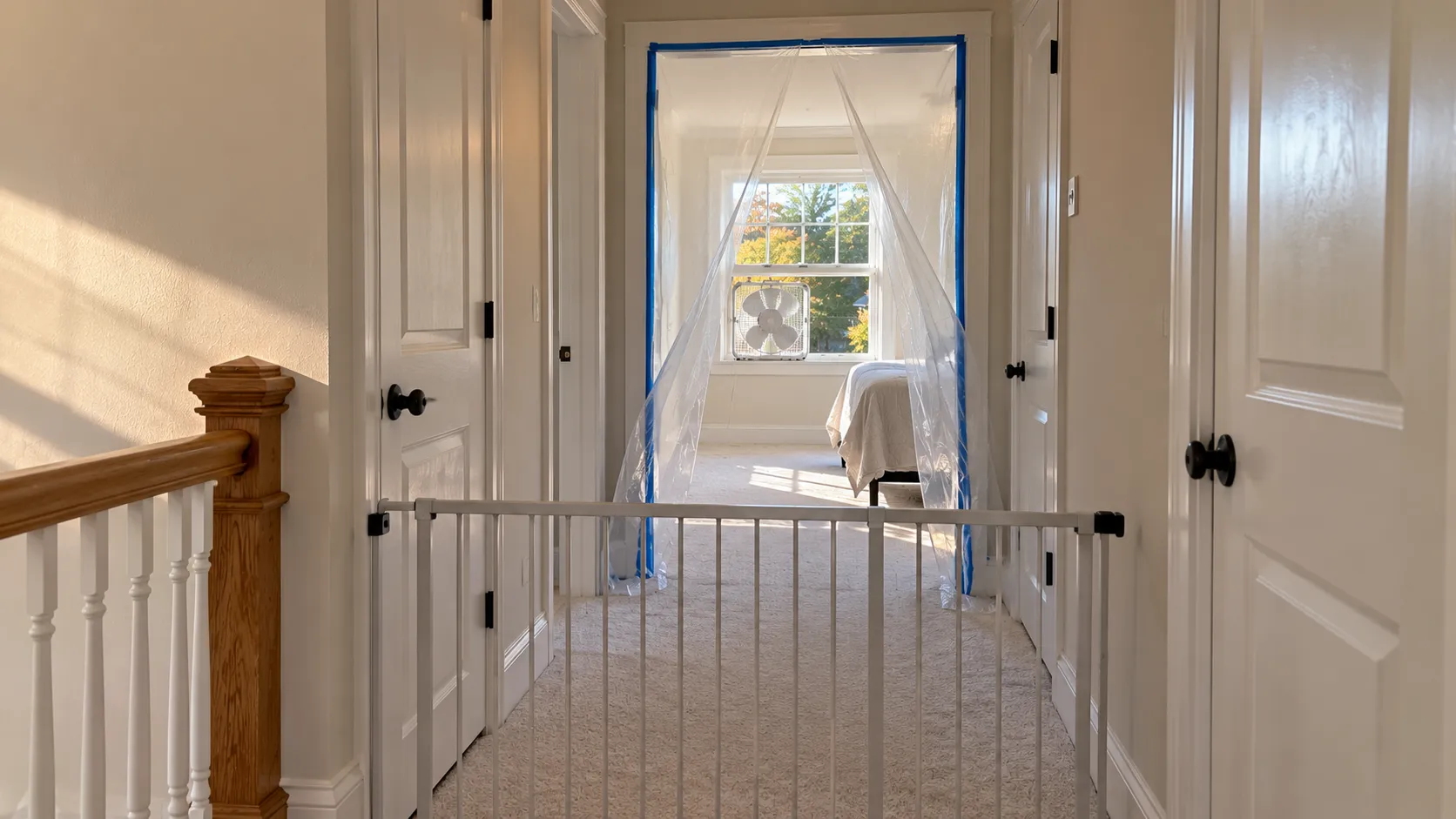
That direction matters. A fan pointed at a wet wall speeds drying and pushes the smell deeper into the house. A fan in a window pointed out, with a second window or a door cracked at the far end of the room, pulls fresh air across the work and sends the rest outside. That is the setup we leave running on a job, and it is the single most effective thing a homeowner can do after we leave.
Ventilating in cold weather, when the windows stay shut
New Jersey interiors get painted all winter, and the EPA's qualifier "when the weather permits" is doing real work in a January house. Opening every window at 25 degrees is not a plan. What we do instead:
- Use the exhaust fans you already have. Bathroom and kitchen fans that vent outdoors pull air out of the house continuously and cost nothing. Run them during the job and overnight after it.
- Short, hard bursts instead of all-day drafts. Ten or fifteen minutes of a wide-open window with a fan in it, a few times a day, moves far more air than a sash cracked two inches for eight hours, and the house recovers its heat quickly.
- Keep the work room closed off from the rest of the house. Door closed, a fan exhausting from that room, and the smell stays where the painting is. This is the same containment logic we use for dust.
- Accept the slower schedule. Both brands say cool temperatures lengthen dry, recoat and cure times, and Sherwin-Williams' sheets say to "apply at temperatures above 50°F" while Benjamin Moore lists a 50°F minimum surface temperature. A cold room is a room that stays smelling of paint for longer. Our guide to painting in cold weather in NJ has the temperature numbers in full.
- Do not use a kerosene or propane salamander to warm a room you are painting in. Unvented combustion heaters are themselves on the EPA's list of indoor pollution sources, and a sealed room with a heater in it is the opposite of ventilation.
Air purifiers, and the onion-in-a-bowl theories
Homeowners ask about air purifiers constantly. The EPA's Guide to Air Cleaners in the Home is measured about them: "portable air cleaners and HVAC filters can reduce indoor air pollution; however, they cannot remove all pollutants from the air," and "no air cleaner or filter will eliminate all of the air pollutants in your home." For fumes specifically, "to filter gases, choose a portable air cleaner with an activated carbon filter or other filter designed to remove gases," and "activated carbon filters can be effective, provided that there is a large amount of material used in the filter." The EPA also notes that "research has not yet shown that other technologies such as plasma, photocatalytic oxidation, or ultraviolet (UV) light can remove gases effectively in portable residential air cleaners."
The sentence we would underline is this one: "it is always important to reduce or remove the sources of indoor air pollutants and to ventilate with clean outdoor air. Filtration does not replace the need to control pollutants and ventilate." A carbon filter is a supplement to an open window, not a replacement for one. And a straight HEPA unit — the kind most people own — is built for particles, not gases.
One purifier to avoid outright: anything that works by generating ozone. The EPA's position is plain — "ozone is a lung irritant" and "no federal government agency has approved these devices for use in occupied spaces."
As for the folk remedies — a bowl of onions, a dish of coffee grounds, a bucket of water, a lit candle in the room — we have no evidence any of them reduce VOCs, and the ones involving an open flame in a room full of solvent vapor are a bad idea for an entirely different reason. Masking a smell is not the same as removing what causes it.
Nurseries, Pregnancy, Asthma and Pets
These four questions come up on nearly every interior estimate. Each has real published guidance behind it, and in every case the published guidance ends by pointing you at a professional who is not a painter.
Nurseries and small children
The EPA explains why children are considered separately rather than as small adults on its page on children's unique vulnerabilities to environmental hazards: "children eat more food, drink more water, and breathe more air in proportion to their body weight than adults," and "their organs, and systems – including the brain, lungs, liver, kidneys, nervous system, and immune system – are still developing." It also points out behaviour that matters in a freshly painted room: infants "engage in hand-to-mouth and object-to-mouth activities" and "they spend extended time sitting and crawling on the floor or ground."
Practically, that argues for scheduling rather than for anything exotic: paint a nursery weeks ahead of when it will be occupied, not days, ventilate it hard while it is empty, and keep a crawling child out of the room until the paint is well past dry-to-touch and the dust from sanding is gone. If the house was built before 1978, the more pressing question is not fumes but what is under the old paint — see our guide to lead paint in older NJ homes. And if you are picking the color while you are at it, our interior paint colors guide has the current palettes with real codes.
Pregnancy
This one we will not advise on at all, and the reason is in the source. CDC/NIOSH's page on solvents and reproductive health defines solvents as "chemicals, usually liquids, used to dissolve other substances" and says that "studies show that some solvents might cause birth defects, miscarriages, stillbirth, low birth weight, and preterm birth." Painters are on its list of potentially exposed occupations. Its recommended steps are to "increase ventilation as much as possible," "avoid breathing solvent vapors, skin contact, or splashing liquids," "wear appropriate personal protective equipment (PPE)" — and, last on the list, "talk to your doctor about potential hazards at work."
Note that NIOSH is writing about occupational exposure: a painter spraying enamel in a closed room for forty hours a week is not the same exposure as a homeowner walking through a freshly rolled hallway. That difference is important and it cuts in the homeowner's favour. It is still not a reason for us to tell a pregnant woman what is safe for her. Ask your obstetrician, and if it helps, bring the product's Safety Data Sheet with you — every paint has one, and the manufacturers publish them alongside the technical data sheets quoted above.
Asthma, COPD and chemical sensitivity
The American Lung Association notes that VOCs may worsen symptoms for people with asthma and COPD, and the EPA's advice on tracing symptoms is a useful test: "if the symptoms fade or go away when a person is away from the area, for example, an effort should be made to identify indoor air sources." The Sherwin-Williams label's own instruction — "if you experience eye watering, headaches, or dizziness, increase fresh air, or wear respiratory protection (NIOSH approved) or leave the area" — is written for a painter, but it is good advice for anyone in the house.
For a household with a well-controlled asthmatic in it, the practical moves are ordinary: a low-VOC product, hard ventilation, the work room closed off, and somewhere else to be for the day. Anything beyond that is a conversation with the person's physician, not with us.
Pets
Dogs and cats are closer to the floor, breathe faster, and cannot leave a room on their own. The veterinary reference from VCA Animal Hospitals says "all paints and varnishes can release fumes that can cause respiratory and eye irritation when present in poorly ventilated areas." It distinguishes the two families of product much as the data sheets do: "in most cases, water-based paints are unlikely to cause more than gastrointestinal upset or skin irritation," while "oil-based paints and varnishes contain solvents that can be inhaled into the lungs and cause difficulty breathing."
Its instruction for re-entry is the clearest one anybody gives for any occupant, and it is worth borrowing: "ensure the area where the paint or varnish was used is well ventilated and odor-free before allowing pets back into the area." It also says not to leave open paint, or anything freshly coated, where an unattended pet can reach it — which, with a cat and a wet windowsill, is the real risk on most of our jobs. If a pet does get into paint, VCA points owners to the Pet Poison Helpline at 1-800-213-6680; the ASPCA Animal Poison Control Center is at 1-888-426-4435. Either way, call your own vet first.
How We Keep the Smell Down on a New Jersey Job
None of what follows is a health claim. It is how we run an interior, and most of it exists because of the fume question rather than in spite of it.
- Low-VOC premium lines as the default. The Benjamin Moore and Sherwin-Williams interior products we use list under 50 g/L against a federal ceiling of 250 to 380. That is source control, which the EPA ranks first.
- Room by room, not house at once. We work in one area, close it off, and keep the rest of the house usable. It means the family has somewhere to be, and it means the smell is contained.
- Cross-ventilation while we work and after we leave. A window open, a fan exhausting outward, and interior doors to the rest of the house shut. In winter we do it in bursts and lean on the bathroom and kitchen exhaust fans.
- Fresh air during drying, not just application — because that is what both manufacturers' sheets actually say.
- Enamel work sequenced early. If trim, doors or cabinets are in enamel, we try to get them done at the front of the job so the longest-smelling work has the most days to air out.
- Bedrooms early in the week. So nobody is choosing between a wet bedroom and a Saturday night.
- Clean up at the end of every day. Lids on, rags out of the house, nothing left open overnight. The EPA's advice to "throw away unused or little-used containers safely" applies to the half-gallon in the basement too.
- We tell you the schedule up front, including which rooms will smell and for how long, so you can plan around it instead of discovering it.
Two things we deliberately do not do. NJ Painting Co. is not an EPA Lead-Safe Certified firm; on a pre-1978 house, read our lead paint guide and ask any contractor how they are handling the EPA's RRP rule before old paint gets disturbed. And we do not tell families what is medically safe for them. We tell them what the label says, what we will do, and who to ask.
Get a Straight Answer About Your Own Job
If the fume question is what is holding up a repaint, bring it up at the estimate. We will tell you which products we would use on your rooms, what their data sheets say about dry, recoat and cure, how we would ventilate the work in the weather you are actually in, and which nights, if any, we would plan around. NJ Painting Co. is a family-owned, licensed and fully insured painting company at 36 Church Rd, Morganville, NJ 07751, working on New Jersey homes for more than 20 years with Benjamin Moore and Sherwin-Williams products. Every estimate is free, includes an in-home color consultation, and spells out prep, products and number of coats; our work carries a two-year workmanship warranty. For the work itself, see our interior painting service. Call (732) 239-0932 or request a free estimate.
Frequently Asked Questions
How long should you wait before sleeping in a freshly painted room?
No agency or manufacturer publishes a wait time. What the labels require is fresh air entry during application and drying, and the Sherwin-Williams label adds that if you experience eye watering, headaches or dizziness you should increase fresh air, wear NIOSH-approved respiratory protection or leave the area. Our own practice with low-VOC waterborne wall paint is to give a bedroom a night with a window open and a fan exhausting outward, and longer for enamel work, small windowless rooms, cold or humid weather, or anyone pregnant, asthmatic or an infant. For a nursery we suggest painting weeks ahead. If anyone in the house is pregnant, asthmatic or very young, ask your doctor rather than a painter.
Are paint fumes dangerous?
The EPA lists the health effects of VOCs generally as eye, nose and throat irritation, headaches, loss of coordination and nausea, damage to liver, kidney and central nervous system, and says some organics can cause cancer in animals. The American Lung Association says breathing VOCs can irritate the eyes, nose and throat and cause difficulty breathing and nausea, and that long-term exposure can damage the liver, kidneys and central nervous system. Those effects depend on how much, how concentrated and for how long — the EPA's example of a very high-exposure activity is paint stripping, where levels may reach 1,000 times background outdoor levels. The EPA also notes that individual sensitivity varies tremendously from person to person.
What is the difference between dry time and cure time?
Dry to touch is when the surface no longer transfers; recoat is when the film will accept another coat; cure is when the film reaches its final hardness and sheen. Benjamin Moore's Regal Select is dry to touch in 1 hour and recoatable in 1 to 2 hours, but its sheet says painted surfaces can be washed after two weeks. Benjamin Moore's ADVANCE waterborne alkyd is dry to touch in 4 to 6 hours, recoatable in 16, and its sheet says it could take up to 30 days to reach optimum hardness and final sheen. All three times get longer in cool or humid conditions.
Why does paint still smell after it is dry?
Because "dry" describes the top of the film. Water and solvent from the lower part of the coating have to work out through a surface that has already skinned over, which is why both Benjamin Moore and Sherwin-Williams tell you to ensure fresh air entry during application and drying rather than only during application. In alkyd and waterborne alkyd enamels the film also keeps reacting for weeks as it hardens, which is why enamel trim smells longer than wall paint.
Does zero-VOC paint have no smell?
No. Odor and regulated VOC content are different measurements, which is why Sherwin-Williams markets odor-eliminating technology as a separate feature from its zero-VOC formulation. The EPA also warns that VOC labels are often based on compounds regulated to control outdoor smog, so "VOC labels and certification programs may not properly assess all of the VOCs emitted from the product." Low-VOC paint is still worth choosing — the American Lung Association recommends looking for low-VOC information on the label — it just does not remove the need to ventilate.
Does tinting add VOCs to low-VOC paint?
It can, and the printed figure does not include it. Federal rules at 40 CFR 59.406 say the VOC content of a tint base is determined without colorant added after the base is manufactured, and Sherwin-Williams prints its VOC figure under the base name with the note "may vary by color." A deep accent base can take 18 to 20 ounces of colorant per gallon. Some systems are formulated around this: Sherwin-Williams' Harmony sheet describes colorants that do not add VOCs when tinted, and Benjamin Moore tints its premium lines with its Gennex system. Ask the paint store about the colorant, not just the base.
How should I ventilate a room I am painting in winter?
Use the exhaust fans you have — bathroom and kitchen fans that vent outdoors pull air out of the house continuously. Ventilate in short, hard bursts with a window wide open and a fan in it rather than leaving a sash cracked all day. Keep the work room closed off from the rest of the house with a fan exhausting from it. Expect everything to take longer: both brands say cool temperatures lengthen dry, recoat and cure times, and both set a 50°F minimum for application. Do not warm the room with an unvented kerosene or propane heater.
Do air purifiers remove paint fumes?
Partly, and only the right kind. The EPA says that to filter gases you need an activated carbon filter or another filter designed for gases, that carbon filters work only when a large amount of material is used, and that technologies such as plasma, photocatalytic oxidation and UV light have not been shown to remove gases effectively in portable residential units. A standard HEPA purifier is built for particles, not gases. The EPA is explicit that "filtration does not replace the need to control pollutants and ventilate." Avoid ozone generators entirely: the EPA says ozone is a lung irritant and that no federal agency has approved these devices for use in occupied spaces.
Is it safe for my dog or cat to be in a freshly painted room?
VCA Animal Hospitals says all paints and varnishes can release fumes that cause respiratory and eye irritation in poorly ventilated areas, and advises ensuring the area is "well ventilated and odor-free before allowing pets back into the area." It notes that water-based paints are unlikely to cause more than gastrointestinal upset or skin irritation in most cases, while oil-based paints and varnishes contain solvents that can be inhaled and cause difficulty breathing. Do not leave open paint or freshly coated items where an unattended pet can reach them. Ask your veterinarian about your own animal; for an exposure, VCA points to the Pet Poison Helpline at 1-800-213-6680 and the ASPCA Animal Poison Control Center is at 1-888-426-4435.
About the author
Written by the NJ Painting Co. team
NJ Painting Co. is a family-owned painting contractor based in Monmouth County, in business since 2004. We are licensed and fully insured, work with Benjamin Moore and Sherwin-Williams paints, and back our work with a 2-year workmanship warranty. We serve Monmouth, Middlesex, Ocean, Mercer, Somerset and Burlington counties, plus Union, Essex, Hudson, Bergen and Passaic in North Jersey.