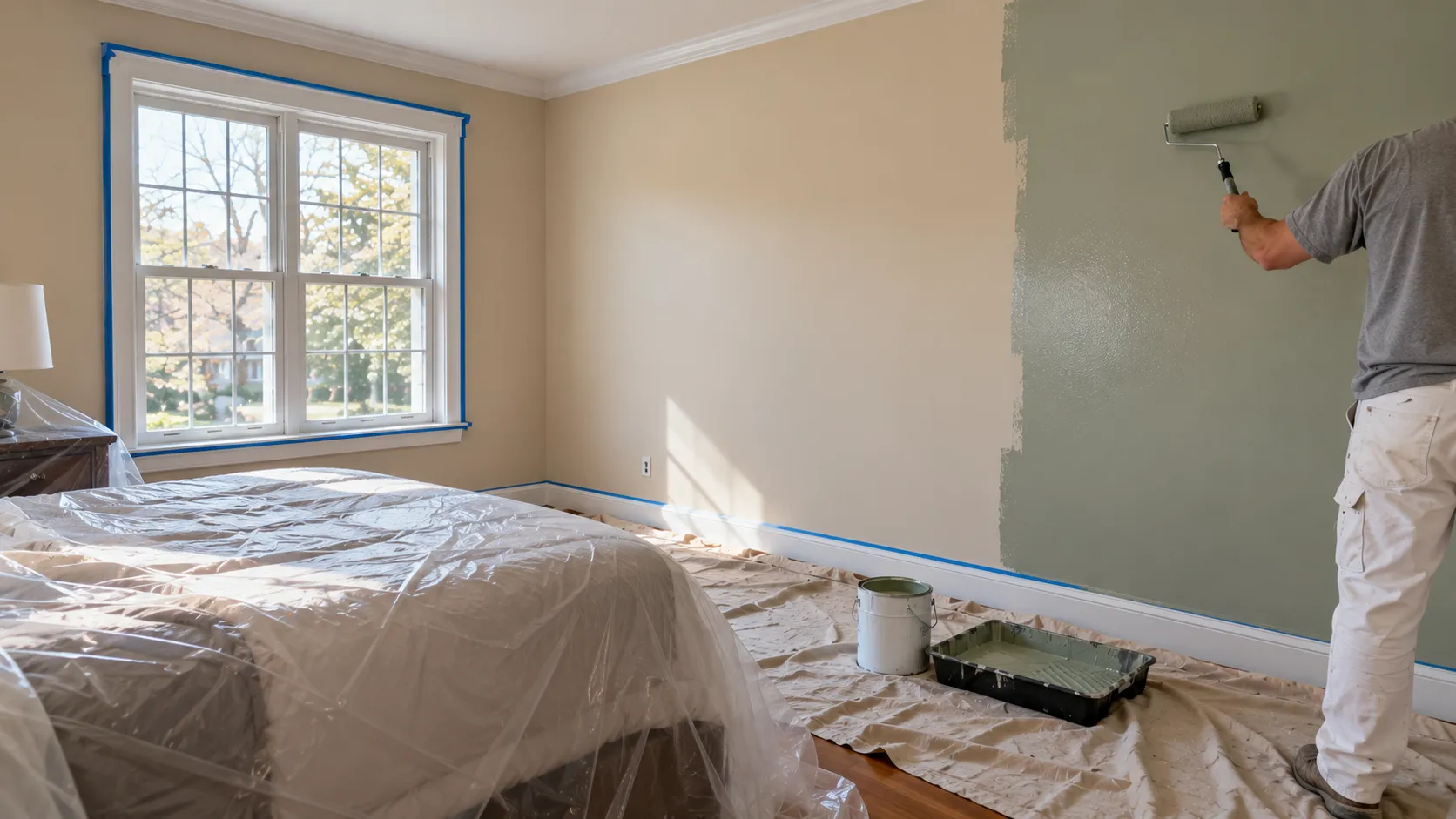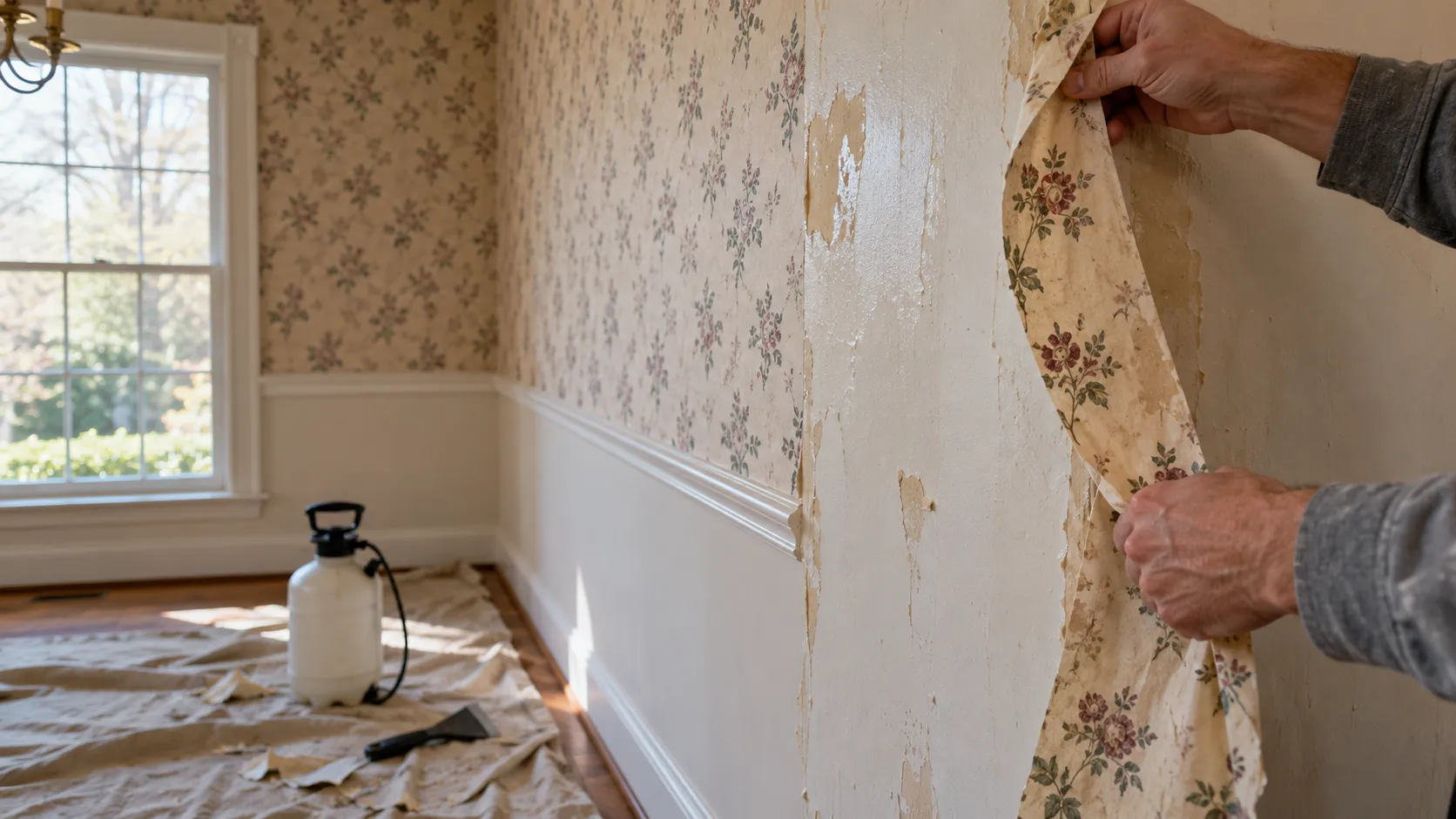
Wallpaper removal cost depends less on the size of the room than on what the paper is, how many layers there are and what the wall underneath was like before it was papered. National cost guides disagree widely: Fixr puts professional removal at $0.75 to $2 or more per square foot with a national average of $740 (January 2025), while Homewyse's calculator starts at $3.05 to $6.19 per square foot (September 2026). Our own NJ painting cost guide says wallpaper removal runs near $3 per square foot, roughly $535 to strip a 12 x 12 bedroom. The paper coming off is only half the job. The other half is the paste, the wall repair and the primer that have to follow before any paint goes on.
We are a family-owned painting company in Morganville and have painted homes across Monmouth, Middlesex, Ocean, Mercer, Somerset and Burlington counties for more than 20 years, using Benjamin Moore and Sherwin-Williams products. We remove wallpaper as preparation for painting, so this guide is written from that side of the job: what it costs, what drives the price, which removal method fits which paper, what the wall needs afterwards, and which problems behind the paper are not ours to fix. The technical points are linked to Benjamin Moore, Sherwin-Williams, This Old House and the EPA, and every national price is attributed to the cost guide it came from.
The Short Answer: What Wallpaper Removal Costs
- Per square foot: $0.75 to $2 or more according to Fixr, and $3.05 to $6.19 according to Homewyse. In New Jersey, our cost guide puts it near $3 per square foot.
- Per room: Fixr's examples run from $90 to $235 for a small foyer to $340 to $900 for a living room. Our cost guide gives roughly $535 for a 12 x 12 bedroom.
- Per hour: Fixr says "an hourly rate is generally between $40 to $55."
- Whole job: Fixr gives a typical range of $650 to $950 and a national average of $740.
- Removal plus painting: $2.75 to $6 per square foot combined, according to Fixr.
- Doing it yourself: This Old House, citing Angi, puts the tools and supplies at $65 to $100.
- What the low numbers leave out: washing off the paste, repairing torn drywall, sealing the wall and, where needed, a skim coat. Those decide whether the paint lasts.
Wallpaper Removal Cost per Square Foot, per Room and per Hour
Wallpaper removal services are quoted three ways. The table below puts the published figures side by side. We have named the source of each range because the guides do not agree with each other, and because none of them is a New Jersey quote. The only New Jersey numbers in this article are the ones from our own cost guide.
| Pricing basis | Published range | Source of the range | What moves it |
|---|---|---|---|
| Per square foot of wall | $0.75 to $2 or more | Fixr (January 2025) | Paper type, removal method, wall type |
| Per square foot of wall | $3.05 to $6.19 | Homewyse (September 2026) | Includes delivery, site protection and a two-hour minimum labor charge |
| Per square foot in NJ | Near $3 | Our cost guide | Layers, wall condition, how much repair follows |
| Foyer (117 sq ft) | $90 to $235 | Fixr | Small rooms carry a minimum charge in practice |
| Bathroom (170 sq ft) | $130 to $340 | Fixr | Fixtures to work around, moisture behind the paper |
| Bedroom (303 sq ft) | $230 to $610 | Fixr | Open walls, usually the simplest room |
| 12 x 12 bedroom in NJ | Roughly $535 | Our cost guide | Same factors as above |
| Kitchen (385 sq ft) | $290 to $770 | Fixr | Cabinets, backsplashes and appliances to cut around |
| Living room (451 sq ft) | $340 to $900 | Fixr | Wall area, height |
| Per hour | $40 to $55 | Fixr | How well the paper releases |
| Typical whole job | $650 to $950, average $740 | Fixr | Number of rooms |
| Removal and painting together | $2.75 to $6 per square foot | Fixr | Repair and primer between the two |
| Skim coat after removal | $0.75 to $1.50 per square foot; $0.96 to $1.36 | Fixr; Homewyse (September 2026) | How badly the wall surface was damaged |
| DIY tools and supplies | $65 to $100 | This Old House, citing Angi (August 2024) | Whether you rent a steamer |
Two things stand out. First, the gap between Fixr and Homewyse is large. Fixr's low end of $0.75 per square foot is for paper that strips cleanly. Homewyse's figure covers delivery and transportation, worksite preparation and protection, and setup time for small jobs with a two-hour minimum labor charge, and it leaves out general contractor overhead, sales tax and any testing or remediation of hazardous materials. Neither one is wrong. They describe different jobs.
Second, the square footage in these figures is wall area, not floor area. Fixr notes that "doorways, windows, tub surrounds, and closet openings can be subtracted to get actual wall square footage." Measure the walls that are actually papered. One accent wall or a papered border is a much smaller job than the room size suggests.
Professional wallpaper removal cost vs the cost of the whole job
Professional wallpaper removal cost is easy to underestimate because the price to get the paper off is not the price to get the wall ready for paint. Fixr's combined figure for removal and painting, $2.75 to $6 per square foot, is a better guide to the whole project than the removal number alone. In our own cost guide, an interior repaint runs $2 to $6 per square foot of floor area, walls alone are $1 to $2 per square foot, patching and sanding runs about $0.50 to $0.75 per square foot on its own, and wallpaper removal near $3 per square foot is listed among the things that raise an interior budget. Our guide to what it costs to paint a house in NJ and our room painting cost guide show how those lines add up on a full estimate.
Wallpaper removal near me: why quotes vary so much
If you search for wallpaper removal near me and collect three quotes, expect them to differ. No one can see through the paper. A contractor who prices by the square foot is betting on how the paper will release. One who prices by the hour is passing that risk to you. In our experience the fairest way to price a papered room is to lift a corner in an out-of-the-way spot during the estimate, see what the paper and the wall do, and write down what the price assumes. Ask each contractor whether the quote includes washing off the paste, wall repair and primer, or only the stripping.
What Drives the Price of Wallpaper Removal
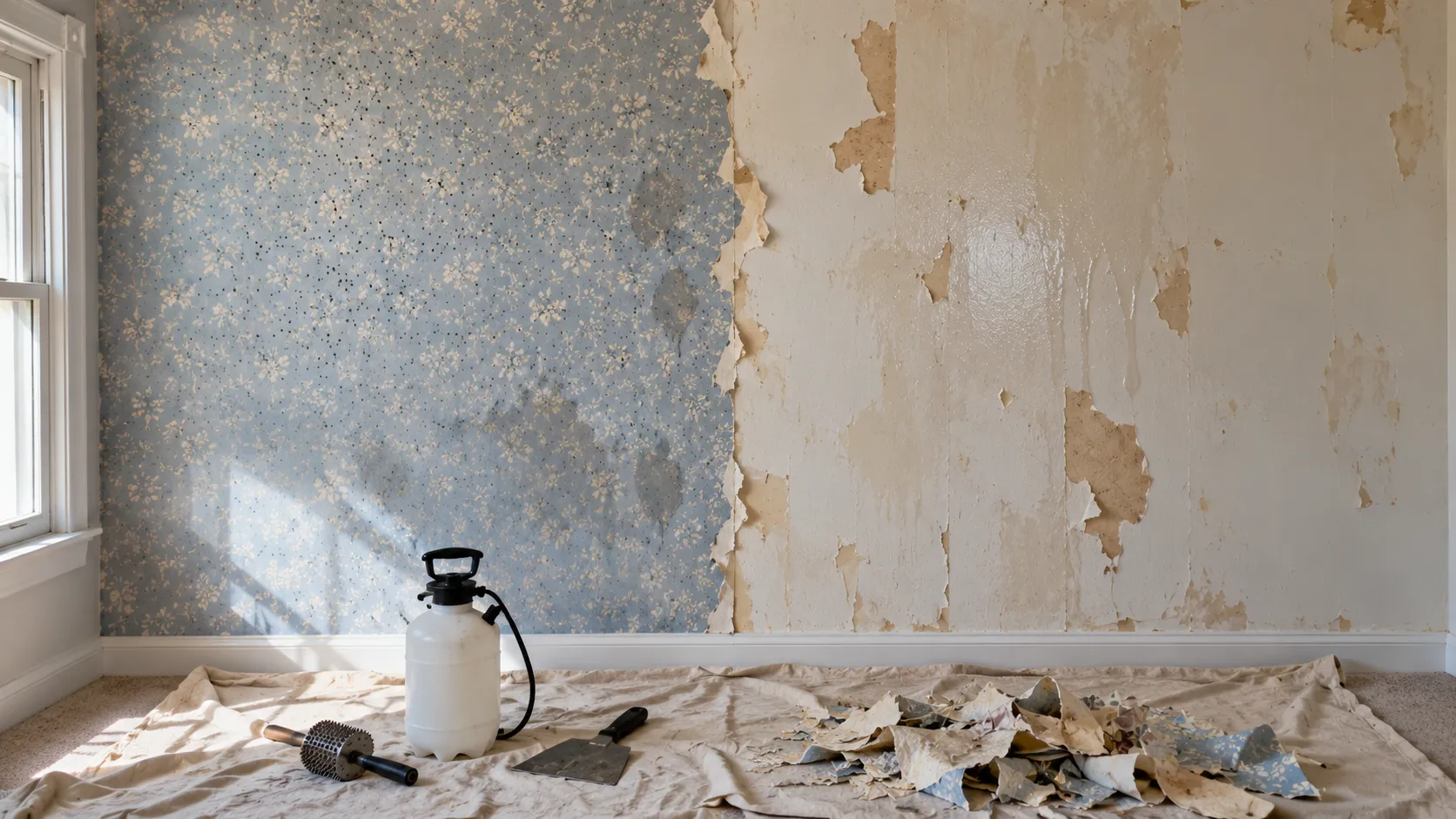
- The type of paper. Fixr prices strippable paper at $0.75 to $1.50 per square foot, porous traditional paper at $1 to $2, and nonporous paper at $1.50 to $2.50, because nonporous paper "needs to be scored to allow the moisture to penetrate the wallpaper."
- Vinyl. This Old House explains that "vinyl paper is often more difficult because of its vinyl seal that blocks out moisture." The face has to be perforated or peeled off before the backing and paste can be soaked.
- Painted-over wallpaper. Paint seals the paper the same way vinyl does. Fixr says "wallpaper that has been painted over will need to be scored, treated with wallpaper stripper, and then preferably steamed."
- The number of layers. Fixr puts it simply: "If there are several layers of wallpaper present, it will take more work to remove." Each layer has its own paste and has to be soaked through.
- Drywall or plaster underneath. This Old House advises checking "whether the paper was applied to plaster or drywall" and warns that "with drywall, some of the backing paper can come right off with the wallpaper, which means significantly more patching and prep work." Plaster tolerates water and scraping far better.
- Whether the wall was primed before papering. In our experience this is the biggest single unknown. Paper hung straight onto bare, unprimed drywall bonds to the drywall's own paper face, and the two tend to come off together.
- Grasscloth and other natural or fabric papers. We did not find a published price for these that we could verify. In our experience they tend to come off in two stages, the face first and the backing after, which adds time.
- Height and access. Fixr notes that "vaulted ceilings and working in stairwells will add an extra cost" because ladders or scaffolding are needed. Our cost guide prices two-story foyers, cathedral ceilings and open stairwells closer to $6 per square foot for painting for the same reason.
- Bathrooms and kitchens. Small rooms with a lot to cut around: vanities, toilets, tile edges, cabinets. Bathrooms are also where moisture problems behind the paper are most likely.
- The age of the house. In a pre-1978 home, the paint under or over the paper may contain lead, which changes how scraping and sanding have to be set up.
How Wallpaper Is Removed: Dry Strip, Solution and Steamer
How to remove wallpaper comes down to getting water to the paste without wrecking the wall. One expert quoted by This Old House sums it up in three sentences: "Wet it. Wet it more. And keep it wet." There are three methods, and most rooms need more than one.
Dry stripping
Some papers are made to pull off dry. This Old House's test is to lift a corner at a seam with a putty knife: if "the corner peels back relatively easily, this is peelable wallpaper, and removal should be straightforward." Bob Vila's guide describes the same test for temporary paper: "Locate a corner of the paper, and give it a tug." Fixr prices stripping at $0.75 to $1.50 per square foot, the cheapest method. Often only the face peels and a paper backing stays on the wall. That backing still has to be soaked off, and the paste under it still has to be washed away.
Scoring and wallpaper removal solution
Most traditional and vinyl papers need to be perforated and soaked. Benjamin Moore's guide to removing wallpaper in six steps says to "use a wallpaper scoring tool in a circular motion," so that the tool's teeth make shallow cuts for the liquid to get through. Bob Vila calls scoring "the best way to penetrate water-resistant vinyl."
The wallpaper removal solution can be a commercial stripper or a homemade mix. Benjamin Moore lists commercial strippers, fabric softener or vinegar with water, or warm soapy water, and adds that "if your solution requires warm water, the hotter the water, the better." Bob Vila's recipe is "1/4 cup liquid fabric softener per gallon of hot water in a spray bottle or pump sprayer." This Old House uses white vinegar and warm water at "a one-to-one ratio." All three sources give the same dwell time. In Benjamin Moore's words: "Allow the solution to sit on the surface for 10 to 15 minutes, making sure to keep the wall damp."
Fixr prices this scrape-and-soak method at $1 to $2 per square foot. The risk is the scoring itself. In our experience a scoring tool pressed too hard leaves hundreds of small cuts in the drywall face that all have to be filled afterwards, so light pressure matters more than speed.
Wallpaper removal steamer
A wallpaper removal steamer is the tool for the stubborn cases: old paste, several layers, painted-over paper. Sherwin-Williams' guide on how to remove wallpaper gives the working rule: "Hold the steam plate over the wallpaper no longer than 30 seconds at a time." It also says to "work from the top down, allowing any excess condensation to drip down the wallpaper and help speed up the removal process." Scoring still matters with steam, especially "for removing vinyl wallpaper where the vinyl coating is acting as a barrier."
Steamers are not always easy to come by. Benjamin Moore notes that you can rent a commercial one, "just know that these can be costly and difficult to find." Fixr prices steaming at $1 to $2 per square foot. The time limit is there for a reason: in our experience steam held too long on drywall softens the drywall's paper face as well as the paste, and the scraper then takes both.
Wallpaper removal tools
The wallpaper removal tools are simple, which is why the DIY cost is low: a scoring tool, a pump sprayer or spray bottle, a wide putty knife or scraper, sponges, buckets, drop cloths and plastic to protect floors and outlets, and a steamer if the paper calls for one. This Old House puts the tools and supplies at $65 to $100, citing Angi, and its separate guide to removing different types of wallpaper lists an estimated cost of under $50. The cost of the job is labor and patience, not equipment.
Wall Repair After Wallpaper Removal
This is the part that separates a stripped wall from a paintable one, and it is where most of the difference between a cheap quote and a complete one sits.
Washing off the paste
When the paper is off, the wall is still coated in adhesive. It is hard to see and easy to feel. This Old House says to "wipe the walls with a water-soaked rag, rinsing often, and repeat until the surface no longer feels slimy." Sherwin-Williams' removal guide says to "mix warm water and dish soap and apply the mixture to the wall," then "wipe the wall down with clean water and allow it to dry." Bob Vila's version is stricter: "Clear the adhesive until not a speck remains, because even one lump can mar the appearance of a fresh paint job."
Why paint fails over leftover paste
Wallpaper paste is water-soluble, and most wall paint is water-based. Wet paint over dry paste wets the paste again. This Old House states the result: "Leftover glue can discolor and peel new paint." Sherwin-Williams' guide to painting walls after removing wallpaper says the same: "Avoid painting over wallpaper glue, as it can cause adhesion issues and lead to an uneven finish." In our experience paint over paste residue dries with a crackled or rough texture, and by then the only fix is to sand it back and start the prep again. Our article on why paint peels covers other cases of new paint over a surface that was not ready for it.
Drying, torn drywall paper and patching
A wall that has been soaked needs to dry before anything else is done. Sherwin-Williams advises: "Allow the walls to dry thoroughly before moving on to the next steps," and adds that "generally, 24 hours should suffice to ensure no moisture remains." That waiting day is one reason removal and painting cannot be done in a single visit.
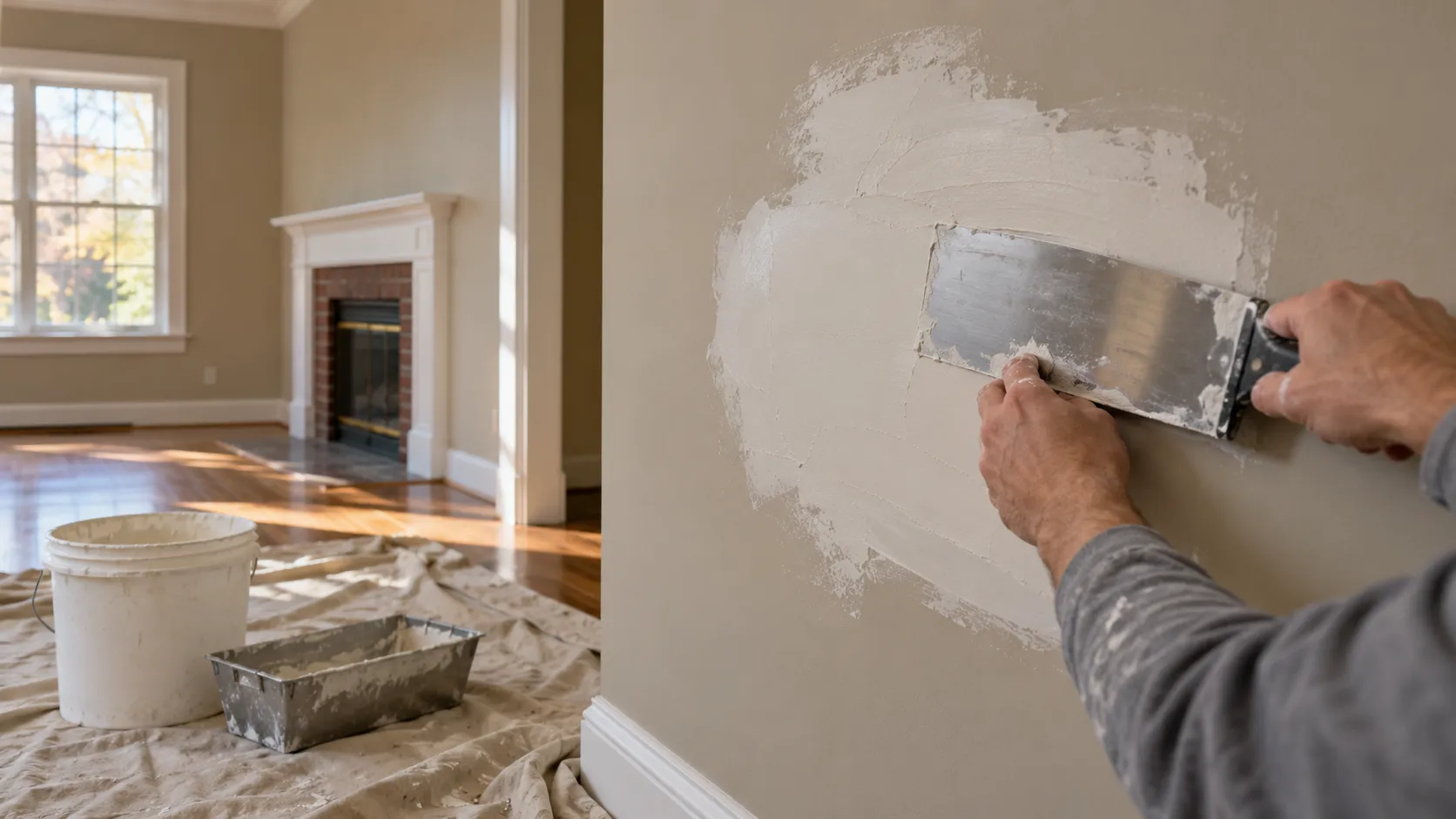
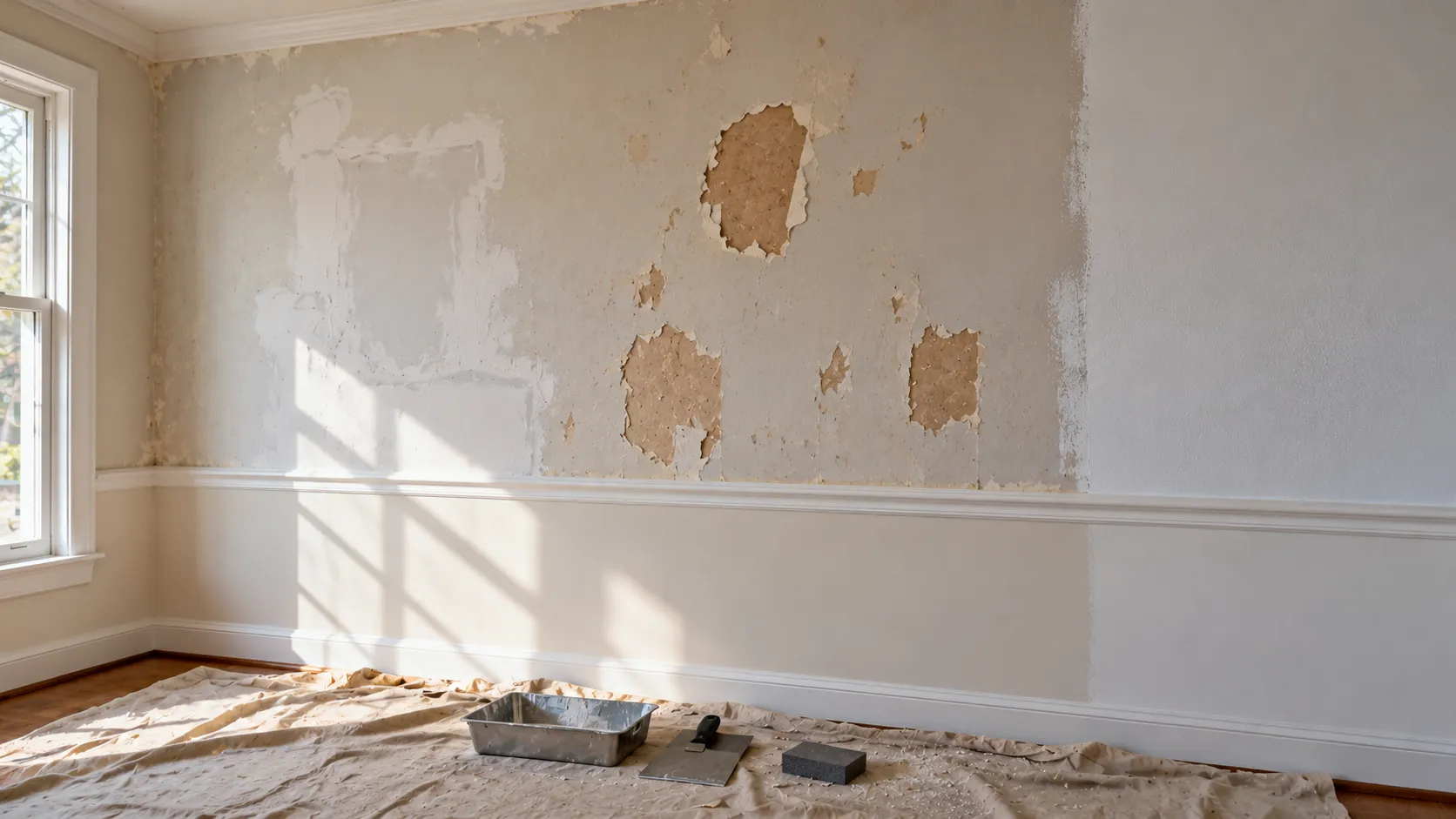
Then comes the damage. Gouges from the scraper and nicks from the scoring tool are filled; Sherwin-Williams says to "patch any holes or gouges with joint compound, and sand smooth once it's dry." Benjamin Moore specifies "fine-grit sandpaper (220-grit) and a sanding sponge" for rough spots. Where the drywall's paper face has torn away and the brown layer underneath is showing, the torn area has to be sealed before any joint compound goes over it. In our experience compound applied straight onto torn drywall paper blisters as it dries, and the blisters show through the paint. Our drywall repair cost guide covers patches, cracks and the rest of the repair work in more detail.
Sealing primer
A previously papered wall is primed before paint, always. The manufacturers and guides agree on that and differ on the product. Benjamin Moore's guide calls for "an oil-based primer like INSL-X Prime Lock Plus" once the wall is completely dry. Sherwin-Williams recommends "a high-adhesion primer if you're concerned about residual wallpaper glue." The reasoning behind an oil-based primer is the one This Old House gives for painting over paper: a water-based primer can loosen the adhesive. An oil-based or sealing primer puts a barrier between any trace of paste and the water in the finish coats. We choose the primer after we have seen the bare wall, not before.
Skim coat
Some walls come out of removal too rough to patch one spot at a time. Sherwin-Williams' advice for that case: "If the wall surface is uneven or has minor imperfections after wallpaper removal, consider applying a thin skim coat of joint compound." A skim coat is a thin layer of compound troweled over the whole wall and sanded smooth. Fixr puts it at $0.75 to $1.50 per square foot including labor and materials, and Homewyse at $0.96 to $1.36 per square foot (September 2026) with priming and painting as a separate line. A skim coat can cost as much as the removal did, which is why the test corner at the estimate matters. Smooth walls matter most under shinier paints; our paint sheen guide explains why eggshell and satin are less forgiving than flat.
Can You Paint Over Wallpaper?
You can, and sometimes it is the right call, but it is not the first choice. Benjamin Moore's position is direct: "Benjamin Moore does not recommend it—especially if your wallpaper is high sheen or heavily textured." Its guide adds that seams will still show and that the paint itself can pull the paper loose.
This Old House's guide to painting over wallpaper sets out when it works: "You can paint your wallpaper if it's smooth and in good condition—meaning it isn't scratched, peeling, or ripped." It also explains the case for leaving paper in place, where it was hung over unfinished drywall or plaster and "removing the wallpaper can actually harm the wall beneath." Its suggested test is the one we use: "choose a small corner and try to remove it."
The same guide lists what you accept if you paint over it. "Wallpaper seams may show through the paint no matter how many coats you apply." Anyone who wants the paper off later will find that "removing wallpaper that has been painted over is an even more difficult" job. And the primer has to be oil-based: "No matter which type of topcoat you will be using—oil-based or water-based—you want to use an oil-based primer."
Our view: if the paper comes off without destroying the wall, take it off. If a test corner shows the drywall face coming away with the paper, sealing the paper with an oil-based primer, filling the seams and painting over it can be the less damaging option. That is a decision to make with the test corner in front of you.
DIY or Professional Wallpaper Removal?
Wallpaper removal is one of the more reasonable jobs to do yourself. The tools cost $65 to $100 according to This Old House, citing Angi, and Fixr notes that "this project can be done DIY at the cost of materials only." This Old House lists two to four hours for its project, and Fixr says "it normally takes one to two days to remove wallpaper." A bedroom with one layer of strippable paper over a primed wall is a weekend job with little risk.
Professional wallpaper removal earns its price in the harder cases: several layers, painted-over paper, paper on unprimed drywall, stairwells and two-story foyers, and any room that is going to be painted right after. Benjamin Moore's guide says of stubborn jobs, "you may want to consider hiring a professional." In our experience homeowners rarely have trouble getting the paper down. The trouble is the paste left behind and the torn spots that get painted over, which show up as soon as the first coat dries.
Pre-1978 homes and lead
Wallpaper itself is not paint, but in an older house it often sits on painted plaster, or has been painted over, and scraping and sanding disturb those layers. The EPA's Renovation, Repair and Painting program requires that "anyone paid to perform work that disturbs painted surfaces in homes, childcare facilities and preschools built before 1978 be certified," and warns that "any renovation, repair or painting project in a pre-1978 home or building that has lead-based paint can easily create dangerous lead dust." As our cost guide notes, the federal lead-safe rules apply to paid work that disturbs more than six square feet of painted surface in a room. The dust is a hazard to you as well if you do the work yourself. See our guide to lead paint in older NJ homes.
Wallpaper Removal and Painting: How We Handle It
We take on wallpaper removal and painting as one job, as part of our interior painting work. This is the sequence we follow.
- Test a corner at the estimate. We lift a seam in a low-visibility spot to see what type of paper it is, how many layers there are, and whether the wall under it is plaster, primed drywall or bare drywall.
- Check the age of the house. In a pre-1978 home we treat painted surfaces as possibly containing lead until testing shows otherwise, and plan the dust control around that.
- Protect the room. Furniture is moved and covered, floors are protected, and outlets and switches are covered, because this is wet work.
- Dry strip what will dry strip. Faces and peelable papers come off first.
- Score lightly, soak and scrape. We wet the wall in sections, keep it wet for the dwell time, and scrape with a wide blade held flat.
- Steam the stubborn areas. Short passes only, working from the top down.
- Wash off the paste. Warm water, rinsed often, until the wall no longer feels slick.
- Let the wall dry. Usually overnight before any repair.
- Seal and repair. Torn drywall paper is sealed, gouges are filled and sanded, and badly damaged walls are skim coated.
- Prime the whole wall. A sealing primer chosen for what the wall showed us.
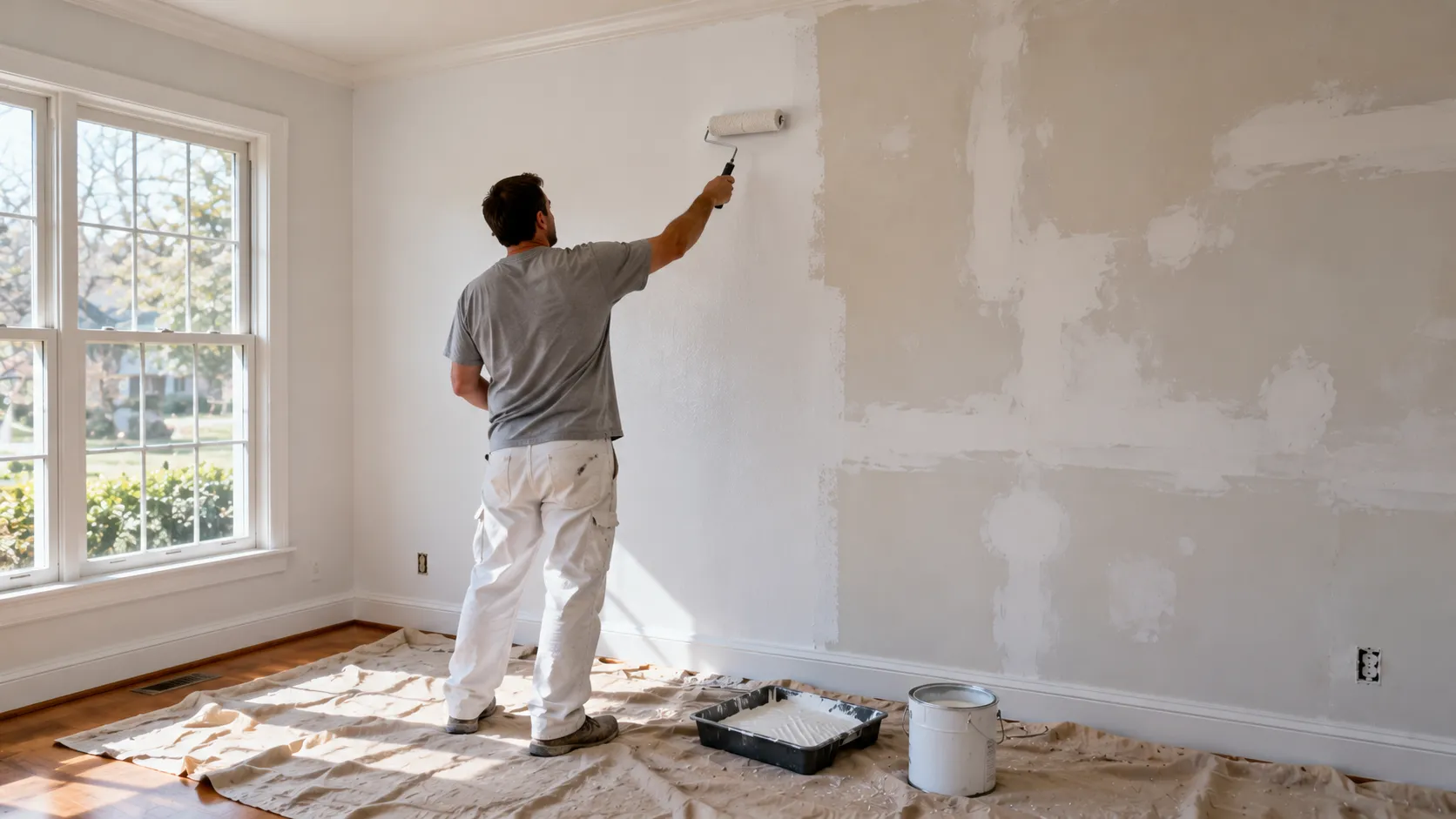
- Paint. Two finish coats of Benjamin Moore or Sherwin-Williams, wall to wall.
If the same project includes textured ceilings, our popcorn ceiling removal cost guide covers that side of the prep.
When It Is Not a Painter's Job
We remove wallpaper as preparation for paint. We want to be clear about where that stops.
- Mold behind the paper. The EPA's Brief Guide to Mold, Moisture and Your Home lists the back side of wallpaper among the places mold hides, and warns that "removal of wallpaper can lead to a massive release of spores if there is mold growing on the underside of the paper." Its advice: "If you believe that you may have a hidden mold problem, consider hiring an experienced professional." We do not do mold remediation. If we lift a corner and find mold, we stop and tell you.
- Wet walls. Paper that is bubbling, stained or falling off on its own usually means water is getting into the wall. The EPA says "it is important to dry water-damaged areas and items within 24-48 hours to prevent mold growth." A plumber or roofer comes first. Stripping and painting a wall that is still getting wet wastes your money.
- Painting over mold. The EPA is direct: "Do not paint or caulk moldy surfaces. Clean up the mold and dry the surfaces before painting."
- Walls that need replacing. If the board behind the paper is soft or crumbling, hanging new drywall across a room is a drywall contractor's job. We prime and paint it afterwards.
- Lead abatement. Testing and abatement are separate, licensed work.
Get the Removal and the Paint Quoted Together
If you are pricing wallpaper removal ahead of a repaint, have both looked at in one visit, so the quote covers the stripping, the paste, the repair, the primer and the paint as one job. NJ Painting Co. is a family-owned, licensed and fully insured painting company at 36 Church Rd, Morganville, NJ 07751, working on New Jersey homes for more than 20 years with Benjamin Moore and Sherwin-Williams products. Every estimate is free, includes an in-home color consultation, and spells out the repairs, primer and number of coats; our work carries a two-year workmanship warranty. See our interior painting service and the full cost guide, check coverage on our Monmouth County, Middlesex County and Ocean County pages, or call (732) 239-0932 and request a free estimate.
Frequently Asked Questions
How much does wallpaper removal cost?
Fixr puts professional wallpaper removal at $0.75 to $2 or more per square foot, with a typical job at $650 to $950 and a national average of $740 (January 2025). Homewyse's calculator starts at $3.05 to $6.19 per square foot (September 2026). Our own cost guide puts wallpaper removal in New Jersey near $3 per square foot, roughly $535 for a 12 x 12 bedroom.
What does professional wallpaper removal cost per room?
Fixr's examples are $90 to $235 for a foyer, $130 to $340 for a bathroom, $230 to $610 for a bedroom, $290 to $770 for a kitchen and $340 to $900 for a living room. By the hour, Fixr gives $40 to $55. Wall repair, primer and paint are on top of those figures.
What is the easiest way to remove wallpaper?
Lift a corner first. If the paper peels off dry, pull it and then wash off the paste. If not, score it lightly, soak it with hot water and a removal solution for 10 to 15 minutes, keep it wet, and scrape with a wide knife. A steamer handles old paste, several layers and painted-over paper. Sherwin-Williams says to hold the steam plate on the wall no longer than 30 seconds at a time.
Is a wallpaper removal steamer better than a wallpaper removal solution?
Neither is better for every wall. Solution is enough for most porous paper and for backing left behind after the face peels. A steamer is for the stubborn cases. Fixr prices both scraping with solution and steaming at $1 to $2 per square foot. On drywall, use either one with care, because too much water or steam damages the drywall's paper face.
Can you paint over wallpaper instead of removing it?
Benjamin Moore does not recommend it, especially over high-sheen or heavily textured paper. This Old House says it can work if the paper is smooth and in good condition, and that an oil-based primer is needed first. Seams may still show, and painted paper is harder to remove later. It is mainly worth considering when removal would damage the wall underneath.
Do walls need primer after wallpaper removal?
Yes. Wash off all the paste, let the wall dry for about 24 hours, repair the damage, then prime. Benjamin Moore calls for an oil-based primer after removal, and Sherwin-Williams recommends a high-adhesion primer where glue residue is a concern. Leftover glue can discolor and peel new paint, according to This Old House.
How long does wallpaper removal take?
Fixr says it normally takes one to two days to remove wallpaper. The wall then needs drying time, repair and primer before paint, so wallpaper removal and painting together take longer than a repaint alone. Several layers, painted-over paper or unprimed drywall add time.
Do wallpaper removal services include wall repair and painting?
Not always, so ask. Some wallpaper removal services price only the stripping. Fixr puts removal and painting together at $2.75 to $6 per square foot. We quote the removal, paste washing, repair, primer and paint as one job, so the price covers the wall through to the finish coat.
About the author
Written by the NJ Painting Co. team
NJ Painting Co. is a family-owned painting contractor based in Monmouth County, in business since 2004. We are licensed and fully insured, work with Benjamin Moore and Sherwin-Williams paints, and back our work with a 2-year workmanship warranty. We serve Monmouth, Middlesex, Ocean, Mercer, Somerset and Burlington counties.