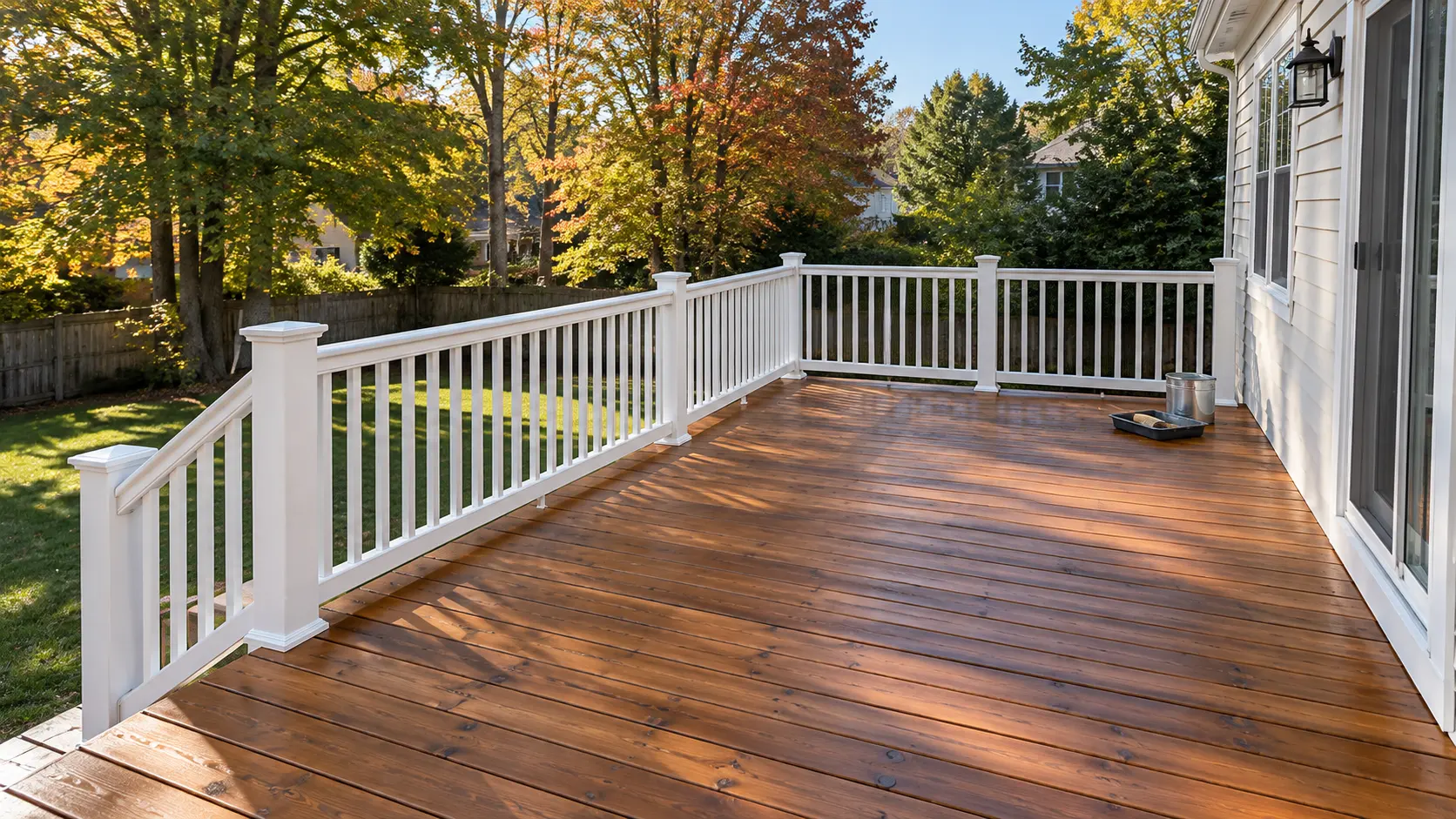
For almost every wood deck floor in New Jersey the right answer is a penetrating semi-transparent stain, applied when the boards are dry enough to drink it, in the shade, on a run of days warm enough that the product can finish drying before the dew comes back. That is not a house preference. The U.S. Forest Service's Forest Products Laboratory, which has run outdoor exposure tests on wood finishes for a century, puts it in one sentence: "penetrating finishes, not film-forming finishes, should be used on wood decks." Paint and solid-colour stain are film-forming finishes. On a deck floor they look superb for one season and then begin a maintenance problem that gets more expensive every time you postpone it.
We are a family-owned painting company in Morganville and have painted and stained exteriors across Monmouth, Middlesex, Ocean, Mercer, Somerset and Burlington counties, plus Union, Essex, Hudson, Bergen and Passaic in North Jersey, for more than 20 years, using Benjamin Moore and Sherwin-Williams products. Deck and fence staining is work we do and quote, and it is the one exterior job where the decision a homeowner makes about the finish — not the crew, not the brand — sets how much work that deck will need for the rest of its life. This guide is the long version of the conversation we have standing on somebody's boards with a water bottle, flicking a few drops onto the wood and watching what happens to them.
It is written to be useful whether or not you hire anybody, and it is deliberately not about money: what a deck job costs is answered in our deck staining cost guide for New Jersey and across the painting cost guide. What follows is method and decision. Every moisture limit, temperature window, dry time, spread rate, service-life figure and regulation below comes from a manufacturer's published technical data sheet, a federal research publication or a federal or state rule, each one fetched and quoted on 22 October 2026.
The Short Answer
- A penetrating finish belongs on a deck floor; a film does not. The Forest Products Laboratory's guidance on deck finishes says that "penetrating finishes, not film-forming finishes, should be used on wood decks," because film-forming finishes "are prone to trap moisture and fail by peeling."
- "Sealing" is not the cheap version of staining. A clear water repellent is the shortest-lived finish in the category: the same publication puts its service life at "about 1 year on the exposed surfaces of wood decks."
- Pigment is the sunscreen. The Forest Products Laboratory notes that "pigments impart color, protecting the wood as well as the mildewcide from UV damage," and that finely ground pigment raises service life "from less than a year to many years."
- The finish you pick is the finish you are stuck with. A worn penetrating stain is cleaned and recoated. A peeling film has to come off first, and Sherwin-Williams' deck stain sheet says "any surface preparation short of total removal of the old coating will compromise the service length of the system."
- Dry enough is a number, not a feeling. Benjamin Moore's Arborcoat deck stains require substrate moisture "below 15%"; Sherwin-Williams' waterborne SuperDeck may go on damp wood but "not to exceed 25% moisture content." The Wood Handbook is blunter: "Nothing will coat wet wood well."
- The temperature rule is about tonight, not this afternoon. Sherwin-Williams' waterborne deck stain carries the note that "air and surface temperature must not drop below 50°F for 24 hours after application" — which is what closes the New Jersey deck season, not the reading at two o'clock.
- A power wash is not preparation. The Forest Products Laboratory warns that "aggressive scrubbing with a caustic cleaner or power washing can remove wood from the surface, particularly on softer wood such as western redcedar," and that the silvery fibres on weathered boards "should not be removed because they absorb stain well."
- New pressure-treated lumber does not need a year. YellaWood says its lumber can be stained "within six weeks after construction so long as the wood is sufficiently dry," and the Wood Handbook calls the old advice to let a deck weather first "the source of much pain."
- Composite does not get stained at all. Trex states that "painting or staining Trex decking is not recommended and may void the limited residential fade and stain warranty."
Stain, Sealer, Clear Water Repellent or Paint: Four Choices, and Why Paint Is Usually the Worst
Most arguments about deck finishes are really a vocabulary problem. Four different products are sold under three overlapping words, so a homeowner comparing two quotes that both say "stain and seal" is often comparing two different trades. The honest taxonomy is simple: a finish either soaks into the wood or sits on top of it, and everything else is a question of how much pigment is suspended in it.
Clear water repellents and water-repellent preservatives
These are the products people mean when they say "just seal it": a carrier loaded with wax or oil that makes water bead rather than soak in. The Forest Products Laboratory's guidance on finishes for wood decks describes the traditional formulation as "organic solvents such as mineral spirits or turpentine, a sealer such as linseed oil or varnish, and a water repellent such as paraffin wax," and draws one distinction worth knowing: "the only difference between a water repellent (WR) and a water-repellent preservative (WRP) is the addition of a mildewcide or preservative to the formulation." It adds that "WRPs give much better performance than WRs" and that "use of WRs without the mildewcide often leads to blotchy staining of the wood."
The catch is the clock. "The service life of a WRP finish is about 1 year on the exposed surfaces of wood decks," the same document says, "however, a WRP is the easiest finish to reapply." Chapter 16 of the USDA Wood Handbook (Christopher G. Hunt, 2021, FPL-GTR-282) gives "only 1 to 2 years, depending upon the wood and exposure," and explains why: no pigment, so nothing blocks the ultraviolet light that is chemically dismantling the surface underneath. There is one case where a clear repellent is exactly right, and the Wood Handbook describes it well: "there are cases where there is sufficient pigment remaining on the wood, but the water repellency has been lost (a water drop soaks in relatively quickly). In this case, adding a clear water repellent may be all that is needed to provide another year of protection."
Penetrating stains
A penetrating stain is the same chemistry with pigment ground into it, and that one change does most of the work. "The addition of pigment greatly increases the durability of the finish compared with that of the WRP," the deck publication says, and the reason sits in a parenthesis: "pigments impart color, protecting the wood as well as the mildewcide from UV damage." Mechanically it never forms a continuous layer, which is why it cannot peel: "the semitransparent stains penetrate the wood without forming a continuous layer; consequently, this type of stain will not blister or peel even if excessive moisture enters the wood." At the end of its life it fades rather than fails. The Wood Handbook describes it wearing out "one pigment particle at a time," which "makes refinishing a simple matter of cleaning the surface and applying another coat."
Paint, solid-colour stain, and the one place a film does belong
Paint and solid-colour stain are the same category as far as a deck is concerned: "solid-color stains form films and so will be prone to peeling just like paint." The Forest Products Laboratory does not soften it: "horizontal surfaces exposed to the rain and sun, such as decks, are prone to peeling. Therefore, decks are very difficult to maintain — and many people are disappointed — using a film-forming finish." Elsewhere in the same chapter: "it is extremely challenging to get film-forming finishes to adhere to decks — peeling is very common."
The mechanism is ordinary. Boards shrink and swell with every change in the weather, a film cannot move with them, and water that gets in cannot get back out through a coating that has skinned over. The Wood Handbook's account of the internal stress is worth reading next to your own deck: differential moisture within boards results "in roughened wood, raises grain, and causes checks, cracks, warping, and cupping," and "horizontal surfaces, such as decks, are often the worst affected." The failure matters more than the look, because it sets the price of the next job: a worn penetrating stain is a wash and a coat, while a peeling solid stain has to be stripped or sanded before anything can go on it. Our guide to why paint peels covers the same mechanics on siding and trim.
None of that makes solid stain a bad product. It makes it a bad product in one place. The deck publication is explicit about the exception: "railings around decks can be finished in the same way as the deck. However, the railing does not require the abrasion resistance of the finish used on the deck… Paints and solid-color stains may perform quite well on the railings." That is the two-tone deck, and the combination we recommend more than any other: a penetrating semi-transparent stain on the floor and stairs, a solid colour on the railings, posts and fascia. The same logic runs through our guide to painting porches, railings and columns, where almost everything is vertical and the calculation flips.
Transparent, Semi-Transparent, Semi-Solid and Solid: What Each Opacity Costs You Later
Inside the stain family the only variable that really matters is how much pigment is in the can. Manufacturers sell it as a look — how much grain shows — and it is a look, but it is also the UV protection, the service life and the shape of every re-coat you will ever do on that deck.
New Jersey puts a legal definition on the word, which matters because it reaches your contractor. N.J.A.C. 7:27-23, the state's architectural coatings rule, defines a stain as "a clear, semi-transparent, or opaque coating formulated to change the color of a surface, but not conceal the grain pattern or texture," and caps a stain and a waterproofing sealer alike at 250 grams of volatile organic compounds per litre. Nobody may "apply for compensation within the State of New Jersey" an architectural coating over that limit, which is why we read the compliance block on a data sheet before the colour card.
Transparent and semi-transparent
Lightly pigmented finishes keep the wood looking almost bare. Benjamin Moore's Arborcoat Waterborne Exterior Stain Translucent N623 is typical: finely ground "trans oxide" pigment, coverage of 200 to 400 square feet per gallon, and an instruction that reads oddly until you understand penetration — "do not apply at a rate less that 200 sq ft per Gallon," a manufacturer telling you not to put more on than the wood can take. The Wood Handbook puts this class at "a service life of 2 to 3 years, but they lack sufficient pigment to inhibit UV degradation of the wood."
Semi-transparent is the default, and for good reason: it is the most pigment you can carry without beginning to build a film. The grain still reads, the colour evens out board-to-board variation, and the finish fades rather than flakes. Note that two semi-transparent stains can want opposite things. Sherwin-Williams' SuperDeck Exterior Semi-Transparent Wood Stain-250 (09/2020) is a modified-oil product at 150 to 350 square feet per gallon and is deliberately one coat: "only one coat is needed. If a second coat is applied, it may not penetrate or adhere properly. The surface will appear glossy and remain tacky." Its waterborne cousin, SuperDeck Exterior Waterborne Semi-Transparent Stain (12/2019), goes the other way: "two coats are required for proper color development, the second coat MUST be applied within 7 days of the first coat." Which is exactly why a quote reading only "stain" is not a scope.
Semi-solid and solid colour
Semi-solid hides more grain and is useful on a deck whose boards no longer match — an older deck with replacement boards in it, or pressure-treated pine against a cedar skirt. Benjamin Moore's Arborcoat Semi Solid 639 is a 100 percent acrylic product at 300 to 400 square feet per gallon, one or two coats at least four hours apart, and its sheet is honest about the trade: "multiple coats will affect the opacity of the final finish and obscure more of the natural color of the wood. Multiple coats may also result with the finish having a slight sheen." A sheen on a deck floor is a film starting, which is the thing you were avoiding. The same sheet carries a limitation that catches people out on ipe and mahogany: "not recommended for hardwood."
Solid colour is paint in all but name. Arborcoat Solid Color 640 is matte, self-priming on most surfaces, one or two coats, and asks for "48 hours before putting furniture back on decks and returning to service" plus 30 days before the deck is washed. It is a well-made product and the right answer on a railing, a fence, a shed or a porch. On a deck floor its category is the problem, not its quality — and the sheet flags what nobody mentions about a film on a walking surface: "the stained deck may become slippery when wet."
The table below is the Forest Products Laboratory's own, from Table 16–2 of the Wood Handbook, restricted to the two decking rows. Read the paint column first: decking is the only surface in that whole table where paint is rated "Low" and given no expected service life at all.
| Decking surface | Tinted finishes such as deck finishes | Semi-transparent stain | Paint and solid-colour stain |
|---|---|---|---|
| New, smooth-sawn | Suitability high; 1–2 years | Suitability moderate; 2–3 years | Suitability low; no service life given |
| Weathered or saw-textured | Suitability high; 2–3 years | Suitability high; 3–6 years | Suitability low; no service life given |
Two things fall out of that table that most deck articles get backwards. A weathered deck holds stain longer than a brand-new one, because the surface is more porous and takes more finish; the handbook says the same in prose, noting that "the subsequent application of penetrating stain often lasts longer than the first because it penetrates the porous weathered surface." And texture beats smoothness: "semitransparent stains perform well on saw-textured surfaces. If used on smooth wood, expect approximately half the service life compared with saw-textured surfaces, simply because more finish gets applied to textured wood." Most New Jersey deck boards are smooth-planed pressure-treated pine, which is the shorter half of that sentence.
Preparation: Cleaning, Brightening, and Whether the Old Finish Has to Come Off
Stain lasts as long as the surface it soaked into, so most of a deck job happens before a can is opened. There are really only three questions: is the wood clean, is the wood open, and does anything have to be removed first.
A power wash alone is not preparation
Washing removes dirt, pollen, mildew staining and loose fibre. It does not by itself get a deck ready for stain, and done badly it makes the deck worse. The Forest Products Laboratory's warning is specific: "aggressive scrubbing with a caustic cleaner or power washing can remove wood from the surface, particularly on softer wood such as western redcedar." The Wood Handbook explains the mechanism — power washing "erodes less dense" earlywood faster than the dense latewood, "leaving behind ridges" — and adds that "the pressure needed to debond tightly bound paint from wood can easily cause deep erosion of wood." The Western Red Cedar Lumber Association's decking guidance goes furthest: "never power-wash a deck because it damages the wood fibres." We do offer power washing and we use it on decks, which means the pressure is a judgement rather than a setting: the chemistry does the cleaning and the water does the rinsing. One counter-intuitive point is worth knowing before anyone sells you a full sanding: "the silver color comes from empty wood fibers that should not be removed because they absorb stain well." Grey is not automatically damage. Grey plus fibres you can rub off with a thumb is damage.
Cleaner and brightener are two chemistries doing two jobs, and the second exists because of what the first does. The Wood Handbook explains the first: "the active ingredient in many of these products is sodium percarbonate… Sodium percarbonate is bleach, but it is oxygen based rather than chlorine based," and oxygen bleaches are "less likely to damage wood surfaces than chlorine-based bleaches, particularly with low-density woods like western redcedar, Alaska yellow-cedar, and redwood." At the other end sit the sodium hydroxide cleaners: "sodium hydroxide is a strongly alkaline chemical that pulps wood and is used in some paint strippers… they should be used only as a last resort."
Follow that through the product sheets and the sequence is obvious. Benjamin Moore's Restore, Wood Restorer N316, for severely weathered grey wood, lists sodium hydroxide and sodium metasilicate and is classed corrosive; step four of its own instructions is not optional: "neutralize surface with Brighten, Brightener & Neutralizer (317) following label directions." And Brighten 317 is an oxalic and citric acid product that "counteracts the darkening effect caused by the Restore (316) and Remove (315) products on tannin-bearing woods" — precisely the Wood Handbook's instruction to "neutralize the surface with mild acid." A brightener is not a cosmetic extra; skipping it after a strong cleaner leaves alkali in the wood and a dark cast the stain will not even out. Its limits matter too: oxalic acid "removes extractives bleed and iron stains, but it is not effective for removing mildew," and on tannin-rich wood, "do not use steel wool or steel wire brushes… because they contaminate the wood with iron," which reacts with tannins to leave blue-black stains.
Mildew, mould and where our scope stops
Mildew on a shaded deck board is a New Jersey constant, and the honest answer involves a limit. Washing a deck is ours. Power washing is ours. Treating mould or mildew is not a service we offer, and we say so at the estimate rather than blur it. The distinction is not ours to invent: Benjamin Moore's own Restore sheet states it in one line — "product does not control mold, mildew, fungus or algae, only removes stains."
Where it stops being cosmetic, it stops being a coatings question. The EPA's guidance on mould cleanup in the home gives the rule we work to on any surface: "do not paint or caulk moldy surfaces. Clean up the mold and dry the surfaces before painting." On a deck that usually means a wash, a rinse and dry time. Where growth is coming out of a surface rather than sitting on it, or where the deck is wet because something above it is leaking, the finish is not the problem and we will say so instead of coating it. Both manufacturers publish the same household procedure for mildew staining and the same warning with it: Sherwin-Williams says mildew "may be removed before painting by washing with a solution of 1 part liquid bleach and 3 parts water… Do not add detergents or ammonia to the bleach/water solution," and the Forest Products Laboratory gives the reason — "ammonia reacts with bleach to form a toxic gas."
How to tell whether the old finish must come off
This is the judgement that changes the size of the job, and two published tests settle it between them. The first is the water test, which every manufacturer describes in some form. Sherwin-Williams: "to determine if the surface is sealed, test the absorbency of the wood by sprinkling water on the surface. If the water penetrates into the wood quickly, the wood is ready to finish. If the water beads up or does not penetrate, remove existing finish or contaminant. Then test for absorbency again." Benjamin Moore applies the same test after prep on new wood: "test for penetration by applying a few drops of water to the dry substrate. If the water does not quickly penetrate, repeat prep."
The second is for wood that has been bare in the sun, and almost nobody does it. The Wood Handbook: "you know that wood is sunburned, and peeling will be a problem, if you can remove wood fibers from the surface by taking a very strongly adhering tape, sticking it well to the wood, and snapping it off quickly. The cells that stayed with the tape were not well adhered to the board; the paint film will tear them off the board just like the tape did." If the tape comes away furry, a film-forming finish will peel off that deck no matter who applies it; the handbook's remedy is mechanical, sanding about four thousandths of an inch and testing again.
Where a deck already carries a failed film, the data sheets agree and they are direct. Benjamin Moore: "if the existing stain is flaking or peeling it should be removed prior to staining," and on the solid-colour product, "if general peeling is present all previous coatings should be removed." Sherwin-Williams gives the sentence that should settle any argument about a half-measure: "recognize that any surface preparation short of total removal of the old coating will compromise the service length of the system." The Wood Handbook adds the step people skip afterwards: "regardless of the method used to strip paint, sand the wood prior to applying new finish."

New Wood: Mill Glaze, Factory Water Repellent and the Wait Before the First Coat
New decks are where the most confident bad advice lives, because three separate things get confused: the glaze a planer leaves on a smooth board, a water repellent the treater may have put into the wood, and how wet the lumber was the day it was delivered.
Mill glaze, factory repellent and wet lumber
A planer knife crushes and burnishes the surface cells of a board, and stain cannot get through that. Both manufacturers treat it as required prep rather than a nicety. Benjamin Moore: "smooth planed wood siding, trim, or deck boards must be sanded thoroughly or treated with Benjamin Moore Brighten, Brightener & Neutralizer (317) to break the 'mill glaze' and allow proper penetration and adhesion." The Brighten sheet says the same from its own side: it "removes the factory 'mill glaze' which can interfere with the adhesion of paints and stains to smooth planed lumber." Then the water test again, on the dry board.
Some pressure-treated decking is sold with a water repellent already in the treatment. It is a selling point, and for the first couple of months it is also why your stain will not take. The Forest Products Laboratory: "if the decking material was given a factory-applied WR finish or if recently finished with a WRP, a semitransparent stain may not absorb properly. In these situations, the wood should be allowed to weather for 2 to 3 months before finishing."
And the lumber itself may simply be soaking. The Wood Handbook describes the giveaway: "sometimes preservative treated lumber is still above the saturation point when it is delivered and installed. You can tell because it is exceptionally heavy or by observing water coming out when a small piece is squeezed by vice or hammer blow." Its verdict on finishing it anyway is four words long: "Nothing will coat wet wood well." Its advice is to wait, then use a penetrating rather than a film-forming finish — or to buy lumber kiln-dried after treatment.
Do not "let it weather for a year"
The old rule was six months, or a year, or until it looked grey. That rule is now wrong, and the Wood Handbook says so in as many words, listing practices that used to help and are now counterproductive: "a classic example of this is the advice to let your deck weather before painting it. This was good advice at the time but is now the source of much pain." The research behind it is striking: "surface degradation of wood facing south for as little as one week prior to painting significantly shortened the service life of paint," and in the exposure trial, "for boards exposed 16 weeks, the paint peeled and needed refinishing within 3 years; for boards exposed only 1 week, the paint started peeling after 13 years, whereas the panels that were not exposed were in good condition after 20 years." The deck publication states the trade-off plainly — "waiting up to a year will further open the wood so that it can absorb more finish (good), however you may also get significant checking (bad)" — and then gives the line we quote to more homeowners than any other: "most decks are retired because of cracks and checks that mostly could have been avoided by timely finishing."
So what do you do with a deck built in June? YellaWood, a major pressure-treated lumber brand, answers directly: "ideally, you'll want to stain pressure treated wood within six weeks after construction so long as the wood is sufficiently dry," with the test you already know — "if it beads up, you'll need to wait several days to test again. However, if the water absorbs into the wood, it's ready for staining." After cleaning, YellaWood says to "allow the wood to dry for about 24 hours before applying any stain." Sherwin-Williams gives a longer version of the same loop for a surface that is still beading: "allow the wood to weather 1 to 2 weeks and test for absorbency again."
When the Deck Is Dry Enough, and the New Jersey Season
Everything above comes down to two measurable things: how much water is in the wood, and what the air and the surface are going to do for the next day or two. Both are published, and both are stricter than most people expect.
Moisture content
Three numbers are in circulation and they do not conflict; they describe different products. Benjamin Moore's Arborcoat deck stains — translucent, semi-solid and solid alike — all carry the same limitation: "moisture content of substrate must be below 15%." Sherwin-Williams' waterborne SuperDeck is formulated for wetter wood and says so: "can be applied to surfaces that are damp from weathering or cleaning, not to exceed 25% moisture content," which is the feature that lets a deck be washed and stained in one day. Its oil-based sibling refuses outright: "do not apply over wet or damp surfaces." And the Western Red Cedar Lumber Association's finishing guidance gives the species-level ceiling: "the moisture content cannot be above 20%."
Behind all of those sits the Wood Handbook's general rule, which is about the wood rather than the coating: "keeping wood at or below ~20% low moisture content in service by preventing liquid water from entering wood and providing a way for trapped water to evaporate is the single most important step in ensuring good performance." A pin-type moisture meter settles it in ten seconds; the water test settles it almost as well for nothing.
Temperature, dew point and the next 48 hours
The temperature limit everybody quotes is the application limit. The one that decides whether a job can run is the hold-down limit afterwards.
| Product | Temperature at application | Moisture and coats | After application |
|---|---|---|---|
| Benjamin Moore Arborcoat Translucent N623 (waterborne) | Air and surface 40°F to 90°F | Substrate below 15%; not thinner than 200 sq ft per gallon | 24 hours before normal foot traffic |
| Benjamin Moore Arborcoat Semi Solid 639 (waterborne) | Air and surface 40°F to 90°F; not in direct sunlight | Substrate below 15%; 1 or 2 coats, minimum 4 hours apart | 48 hours before normal foot traffic |
| Benjamin Moore Arborcoat Solid Color 640 (waterborne) | Air and surface 40°F to 90°F | Substrate below 15%; 1 or 2 coats, recoat 3–4 hours | 48 hours before furniture returns; 30 days before washing |
| Sherwin-Williams SuperDeck Waterborne Semi-Transparent | Surface 50°F to 90°F, in shade | Damp allowed, not above 25% moisture; 2 coats required, second within 7 days | Air and surface must not drop below 50°F for 24 hours |
| Sherwin-Williams SuperDeck Semi-Transparent-250 (modified oil) | Surface 50°F to 90°F, in shade; no rain expected within 24 hours | No wet or damp surfaces; one coat only | Dry to touch 8 hours; 24–48 hours before use |
| Sherwin-Williams WoodScapes Polyurethane Semi-Transparent (vertical surfaces) | Air, surface and material above 35°F and at least 5°F above the dew point | 2 coats necessary; second within 30 days | Must not drop below 35°F for 48 hours; avoid if rain or snow expected within 2–3 hours |
Read the right-hand column again. "Air and surface temperature must not drop below 50°F for 24 hours after application" is a very different constraint from "apply above 50°F." In the third week of October in central New Jersey, two in the afternoon is comfortably above fifty and four in the morning is not. That sentence, not the daytime high, is what closes the deck season.
The cleanest statement of the dew rule in any sheet we read is Sherwin-Williams' on WoodScapes Exterior Polyurethane Semi-Transparent Wood Stain: "prior to painting, check to be sure the air, surface, and material temperature are above 35°F and at least 5°F above the dew point." That product is for vertical surfaces, but the physics does not care about the product. If the surface is within five degrees of the dew point, moisture is condensing onto it, and a finish applied onto condensation is a finish applied onto water. The Wood Handbook lists dew alongside the dramatic sources for exactly that reason: "wood can get wet many ways, such as windblown rain, leaks, condensation, dew, and melting ice and snow. The result is always the same — poor performance of wood and finish."
Which is why a deck is started in the morning and finished by mid-afternoon rather than begun after lunch: a deck stained at four o'clock in late September has perhaps three hours of useful drying before the surface cools back toward the dew point. The other half of the same rule is the opposite problem, because both manufacturers say not to stain in the sun. Benjamin Moore: "do not apply in direct sunlight as this will prevent the product from penetrating properly, causing lap marks." Sherwin-Williams: "for best results apply in shade." In July a deck gets worked in sections as the shade moves across it; in October it gets worked in the single window between the dew burning off and the afternoon cooling down.
The New Jersey season, inland and at the shore
Put the published windows together and the practical deck season in most of this state runs from late spring into early autumn, with real but narrower shoulders either side. The scheduling unit is not a day. It is a run of dry days: one to wash, as many as the wood needs to dry, one to stain, and one or two more before furniture goes back. NOAA's State Climate Summary for New Jersey (NOAA Technical Report NESDIS 150-NJ) describes the state as having "warm, humid summers," puts "the statewide annual average precipitation" at "47.6 inches," and notes the geography that matters for scheduling: "there is a west-to-east contrast of temperatures, with cooler temperatures in the higher elevations of the northwest and warmer temperatures in the east near the coast." Humid summers are why dry times stretch; forty-seven inches of rain a year is why three consecutive dry days is a genuine constraint and not a fussy one.
In our experience the differences inside the state are smaller than people assume and show up at the edges of the season rather than the middle. A deck in Freehold or Hillsborough sits inland and cools faster at night in October, so the hold-down temperature usually ends its season. A deck in Toms River or a shore town stays warmer later but holds dew longer in the morning and takes more wind-driven moisture off the water all year. Neither is a product difference — we are not selling a coastal or salt-air system, and no such thing appears on our estimates — it is a start-time and dry-time difference. Two more timing facts belong here, both from the Forest Products Laboratory: after a bleach cleaning, "allow at least 2 warm, windy days to dry" before finishing; and a dark colour is not neutral on a horizontal surface, because "darker color finishes result in more solar heating, and so result in more warping and checking of wood than light color finishes." The same seasonal logic runs through our exterior painting service, our guide to popular exterior house colours in NJ and, at the cold end, painting in cold weather in NJ.

Cedar, Pine, Pressure-Treated and Tropical Hardwood
Species changes the cleaning pressure, the waiting time and sometimes the product itself.
Pressure-treated southern pine
This is the default New Jersey deck. It takes penetrating stain well once it is dry enough, and the Wood Handbook's note on the treatment is reassuring: "the treatment has little effect on finishing once the wood has dried; species and grain orientation affect finishing more than preservative treatment does." Two cautions apply. Most of it is smooth-planed, which is the half-service-life side of the texture rule, and most of it is flat-grain, the less stable orientation. Expect the shorter end of the published intervals, and expect the handrail cap and the stair treads to go first.
Western red cedar and redwood
Soft, naturally durable, rich in extractives and easy to wreck with a pressure washer. The Forest Products Laboratory names cedar specifically in its power-washing warning, and the cedar association's own position is never to power-wash a deck at all. Extractives are the second issue: Benjamin Moore's solid-colour sheet notes that "tannin rich woods such as redwood or cedar should be primed," and the semi-solid sheet asks you to "test light colors over a small area for tannin bleed before proceeding." The cedar association recommends the step almost nobody takes — "apply the stain to all 6 sides of each board prior to construction," with "liberal amounts of water-repellent… applied to the end grain of deck boards" — and names what it wants on a cedar deck: for transparent stains and water-repellent preservatives, "solvent borne, oil-based formulas that contain mildicides are preferred," and "quality products should contain UV filters." Its warning about over-application is the same as everyone else's: "do not apply more stain than the cedar will absorb because the excess stain will appear as a shiny area on the surface."
Tropical hardwoods
Ipe, cumaru, mahogany and teak are extremely dense and absorb almost nothing, and this is the one case where the product has to be chosen before anything else. Benjamin Moore's Arborcoat Semi Solid sheet is plain: "not recommended for hardwood." The translucent product in the same line is the opposite, listing itself as "ideal for hardwoods like mahogany, teak, ipe." If your deck is a tropical hardwood, confirming a product made for it is the first conversation rather than the last, and a thin translucent finish on a short cycle is a more realistic plan than a pigmented stain that will sit on the surface.
Railings, Stairs, Fences, Sheds and Composite Decking
A deck is not one surface. It is a horizontal surface people walk on, vertical surfaces nobody touches, a staircase that is both, and a great deal of end grain. They wear at completely different rates, and the finish should follow that rather than fight it.
Horizontal fails first, and end grain fails before that
Films peel on decks and often survive on railings. Penetrating stain wears fastest where feet and water are. The deck floor and the stair treads are the clock on the whole job, and the handrail cap — the one piece people actually touch — looks worst soonest. End grain is the quieter problem. The Wood Handbook: "film-forming finishes on fences and railings trap moisture if the end grain is not sealed during construction," and it describes a railing eight years old where "water flowed down the railing and absorbed into the end grain, and the paint kept the wood from drying." Its conclusion: "sealing the end grain helps prevent paint peeling and helps stop checking, splitting, and warping." On an existing deck little can be done about end grain that was never sealed at build, which is one more argument for a penetrating finish that lets the board dry out again.
Labour follows the same geometry. A deck floor takes a roller and a back-brush and moves quickly; a railing has four faces on every baluster plus rails, posts and caps, almost all brush work; stairs are treads, risers, stringers and a handrail, cut in by hand. That is why two decks of identical square footage can be completely different jobs, and why a deck quote should be itemised by floor, railings and stairs rather than given as one number — the arithmetic is in the deck staining cost guide. Method matters here too: "limit the application of stain to what the surface can absorb. The best application method is by brush; roller and spray application may put too much stain on horizontal surfaces." Where stain is rolled or sprayed, Benjamin Moore says to "back-brush the stain into the wood with the direction of the natural grain." The reason is the shiny patch: "if the coating does not soak in, you have applied too much," and "if the finish appears shiny an hour after application, the finish has not penetrated the wood."
Fences, sheds and outbuildings
A fence is the same chemistry on completely different physics. It is vertical, nobody walks on it, and water runs off instead of standing, so a finish lasts far longer there than the same product on a deck floor — and a solid colour that would peel on a floor can do very well on fence boards. Fence staining, and shed and outbuilding work, are both things we do and quote. Two things catch people out. Most fences have two faces, so if the far face points into a neighbour's yard, access has to be arranged before the job is scheduled rather than on the morning. And the Wood Handbook's caution applies to every fence here: "like decks, fences are fully exposed to the weather, and some parts (such as posts) are in contact with the ground; therefore, wood decay and termite attack are potential problems." A post that is soft at grade is not a staining problem.
Composite and PVC decking: do not stain it
If your deck is composite, the correct maintenance is cleaning, not coating. Trex's own FAQ is unambiguous: "painting or staining Trex decking is not recommended and may void the limited residential fade and stain warranty." Sherwin-Williams' deck stain sheets say the same from the product side: "do not use on composition board or composite decking materials."
There is one honest complication, and we would rather name it than pretend otherwise. Benjamin Moore's Arborcoat Solid Color 640 does market itself as "an ideal choice for staining older weathered composite decks," with its own cleaning and two-coat system for them. So a solid-colour product for weathered composite does exist. What does not exist is a way to use it without making a decision about your decking manufacturer's warranty, and that decision is yours and theirs rather than a painter's. Our position is simple: we do not stain composite or PVC decking. Where a composite deck has wood posts, fascia, railings or a pergola around it, those can be stained, and that is a smaller job worth quoting on its own.

Deck Repair Before Staining, and Exactly Where It Stops
Deck repair before staining is on our list of services, and it is worth being exact about what the phrase covers, because the gap between a staining contractor's repair and a carpenter's repair is where most disappointment on a deck job lives.
For us it means the small fastening and board work that has to happen before any finish goes on. Popped nails and screws reset. Loose boards re-fastened. A split or cupped board swapped out so it can weather in a little before the stain goes down, because one bright new board in the middle of a finished deck looks worse than the split did. These are priced as their own line in the proposal, so you can see them.
What it does not mean is structure. Soft joists, beams or posts, footings, a loose ledger board where the deck meets the house, failing stair stringers: those are carpentry, they are safety items, and they go to a carpenter before any stain goes on. And we do not repair rot. What we do is point it out. Finding rot at the estimate or during the wash and showing you where it is, is genuinely useful — a wash is the most thorough look anybody has taken at that deck in years — but repairing it is somebody else's trade.
Both the research and the condition of most New Jersey decks say the same thing about why this matters. The Wood Handbook: "wood weathering can be as much a factor in long-term service life of decks and fences as decay. The most common reason for removal of preservative treated wooden decks is splitting and checking, not decay or structural problems." And the preventive version, which is the case for finishing a deck at all: "the best way to prevent checking and get 40 or more years of service life from wood is to ensure water beads up on the wood surface rather than soaking in immediately. Water repellents, penetrating stains, or other coatings can greatly extend the life of a deck."
Three more things are not ours, and you should read them here rather than discover them at the estimate. We do not coat concrete pool decks. A pool surround is a different trade with different products, different slip requirements and a different warranty, and it is the most common thing a deck enquiry turns out to be. (Concrete patios and porches are a separate question, covered in our guide to painting concrete patios and porches.) We do not build or replace decks or fences. We stain and maintain the wood ones you have. And as above, treating mould or mildew is not a service we offer, though washing and power washing are — see our power washing guide for what a wash on its own involves.
Old Painted Decks and Railings on a Pre-1978 House
Most decks in New Jersey are bare or stained wood and this will not apply to them. But older porches, porch floors, railings, balusters and fences are quite often painted, and some of that paint is old.
The federal rule is worth understanding before you take a single quote. The EPA's Renovation, Repair and Painting programme requires that "anyone paid to perform work that disturbs painted surfaces in homes, childcare facilities and preschools built before 1978 be certified," and notes that "approximately three-quarters of the homes in the United States built before 1978 still contain some lead-based paint." The threshold that decides whether a given job is covered is in the regulation: 40 CFR 745.83 exempts "minor repair and maintenance activities," defined as work disrupting "6 square feet or less of painted surface per room for interior activities or 20 square feet or less of painted surface for exterior activities." Twenty square feet of exterior surface is nothing on a deck; a set of painted railings and balusters exceeds it immediately.
NJ Painting Co. is not an EPA Lead-Safe Certified firm. That is a licensing fact, not a wording preference, and it means that if old paint on a pre-1978 home needs scraping, sanding or stripping, the work needs a firm that holds the certification. Ask us for a certificate number, ask every other bidder for one, and take the honest answer over the comfortable one. The Wood Handbook's own prohibitions show how seriously to treat it: "do not sand if the old paint contains lead," and "power washing and wet and dry sandblasting are not suitable for paint containing lead." Our guide to lead paint in older NJ homes goes through the rule properly, and painting historic homes in NJ covers the broader question of old houses.
How Long a Deck Finish Lasts, and What Re-Coating Involves
Three sources give service-life figures for deck finishes, and they are consistent once you line up what each one describes.
- Clear water repellents and preservatives: "about 1 year on the exposed surfaces of wood decks" (Forest Products Laboratory), or "only 1 to 2 years, depending upon the wood and exposure" (Wood Handbook), which adds the consolation that "reapplication is easy, particularly on decks and fences."
- Lightly pigmented and toner finishes: "a service life of 2 to 3 years, but they lack sufficient pigment to inhibit UV degradation of the wood." Table 16–2 gives 1 to 2 years on new smooth-sawn decking and 2 to 3 on weathered or saw-textured.
- Semi-transparent stain: 2 to 3 years on new smooth-sawn decking and 3 to 6 on weathered or saw-textured, with the prose version that "the life expectancy of one coat of stain on new smooth wood is only 2 to 4 years; however, as the stained wood ages, it becomes more porous and subsequent staining lasts longer."
- Paint and solid-colour stain on a deck floor: rated "Low" suitability with no service life published at all. That absence is the finding.
Our own practice, offered as practice and not as a standard, is to tell homeowners to think in terms of two to three years for a semi-transparent stain on a floor that gets real use and real sun, with a wash and a look in the years between, and longer for railings and fences. Shore decks and south-facing stair treads run shorter; a shaded north-side deck under a tree runs longer and grows more mildew.
But the calendar is the wrong instrument and the right one is free. Flick water on the boards. If it beads and runs off, the finish is still working. If it soaks in and darkens the wood, it is time. Catching it at that moment is the whole economy of deck maintenance, because a penetrating stain caught on time is a clean-and-coat job: the Wood Handbook's description of re-coating is almost dismissive — "when refinishing, simply use a dry stiff-bristle brush to remove surface dirt, dust, and loose wood fibers and re-stain" — with the caveat that mildew has to be washed off first. Leave it until the deck has gone grey and patchy and the same deck becomes a restoration with sanding or stripping in it. The same "test, do not guess" logic applies to the house in our guide to how often to paint a house in NJ.
One warning belongs in any article that mentions oil-based deck stain, because it is a real fire risk and not a formality. Sherwin-Williams: "rags, steel wool, other waste soaked with this product, and sanding residue may spontaneously catch fire if improperly discarded. Immediately place rags… in a sealed, water-filled, metal container." The Wood Handbook says the same about "sponges, cloths, and paper towels that are wet with oil-based stain." That is why our rags go into a sealed, water-filled metal can at the end of every day, and we would say the same to anyone doing their own deck. For the indoor-air version of the question, see our guide to paint fumes and VOCs.
What We Do, and Do Not Do, on Decks and Fences
- We walk the deck before we quote, looking at the wood species, the finish already on it, the fasteners, the boards and anything structural that needs a carpenter first — and we flick water on the boards while we are standing there.
- We name the product and the opacity in the written proposal, per surface and with the number of coats, so you can look up the data sheet yourself and so the floor and the railings are not assumed to be the same thing.
- We itemise the floor, the stairs, the railings and the prep separately, because a railing is brush work and a floor is not, and one number hides which of the two you are paying for.
- We wash at a pressure that suits the wood, letting the cleaner do the work rather than the water — especially on cedar and redwood, where the Forest Products Laboratory warns that power washing removes wood from the surface.
- We brighten after any strong cleaner, because the manufacturers' own sequence calls for the alkali to be neutralised, and skipping it leaves a cast the stain cannot even out.
- We strip or sand only where the old finish has actually failed, and we show you why, rather than selling a strip on every deck or coating over peeling stain on any of them.
- We go by the wood rather than the clock on dry time, and will move a day rather than stain boards that are still beading water or a surface within a few degrees of the dew point.
- We back-brush whatever is rolled or sprayed, work two or three boards at a time to keep a wet edge, and stop at natural breaks rather than in the middle of a run.
- We do the small repairs that belong before stain — popped fasteners reset, loose boards re-fastened, a split board swapped — as their own line, and we point out rot and structural problems rather than repairing them.
- We stain fences, gates, sheds, outbuildings, porch railings, columns and garage and front doors too, so a deck and the rest of the exterior can be scheduled together; our guide to garage doors, front doors and shutters covers that side of it.
What we do not do, so there is no ambiguity: pool deck coating, building or replacing decks and fences, exterior rot repair, structural or finish carpentry, mould or mildew treatment, staining composite or PVC decking, and we do not hold EPA Lead-Safe (RRP) certification. Washing a surface is ours; treating growth is not. Pointing out rot at the estimate is ours; cutting it out is a carpenter's. On a house built before 1978, ask us — and every other bidder — for a firm certification number before anyone disturbs old paint.
Get a Price for Your Deck
Deck pricing depends on the size, the wood, the condition of the finish already on it and how many feet of railing and how many stairs there are, which is why we measure rather than quote from a photo. NJ Painting Co. is a family-owned, licensed and fully insured painting company at 36 Church Rd, Morganville, NJ 07751, working on New Jersey homes for more than 20 years with Benjamin Moore and Sherwin-Williams products. Every estimate is free, includes an in-home color consultation, and spells out surfaces, prep, products and number of coats; our work carries a two-year workmanship warranty. For how deck pricing is built, see our deck staining cost guide; for the work itself, our deck and fence staining service, and for the rest of the outside of the house our exterior painting service. You can see finished exterior work in our project gallery, or check your town on our service areas page. Call (732) 239-0932 or request a free estimate, and ask us about the job minimum when you enquire.
Frequently Asked Questions
What is the difference between deck staining and deck sealing?
A sealer, properly a water repellent or water-repellent preservative, is clear or nearly clear. It makes water bead instead of soak in, but it carries little or no pigment, so nothing in it blocks ultraviolet light. The Forest Products Laboratory puts its service life at about one year on the exposed surfaces of a wood deck, and the Wood Handbook at one to two years. A stain is the same kind of product with pigment ground into it, and the Forest Products Laboratory explains why that matters: pigments impart colour, protecting the wood as well as the mildewcide from ultraviolet damage. Most deck stains are both, a pigmented stain with a water repellent in the formula, which is why "stain and seal" is usually one product rather than two steps.
Should I stain or paint my deck?
Stain the floor and the stairs. The Forest Products Laboratory says that penetrating finishes, not film-forming finishes, should be used on wood decks, and that film-forming finishes such as paint and solid-colour stain are prone to trap moisture and fail by peeling. The Wood Handbook adds that it is extremely challenging to get film-forming finishes to adhere to decks and that peeling is very common; its suitability table rates paint and solid-colour stain as low on decking and gives them no expected service life at all. The exception is the railings, which take no foot traffic, and the same publication says paints and solid-colour stains may perform quite well there. A stained floor with solid-colour railings is the combination we recommend most.
Which stain opacity should I choose for a deck in New Jersey?
For most deck floors, semi-transparent. It carries the most pigment you can have without starting to form a film, so it protects against sunlight while still failing by fading rather than flaking. Clear and toner finishes look the most natural and need recoating most often. Semi-solid is useful where boards no longer match in colour or age, though Benjamin Moore's own sheet warns that multiple coats obscure more grain and can leave a slight sheen. Solid colour belongs on railings, fences, sheds and porch work rather than on a walking surface.
How soon can a new pressure-treated deck be stained?
Often within weeks rather than a year. YellaWood says its lumber can be stained within about six weeks after construction so long as the wood is sufficiently dry, and the test is a few drops of water: if they bead, wait several days and test again; if they absorb, it is ready. Decking that came with a factory-applied water repellent should weather two to three months first, per the Forest Products Laboratory, and treated lumber is sometimes delivered still soaking. Do not let a deck weather for a year on principle: the Wood Handbook calls that advice the source of much pain, and the deck publication notes that most decks are retired because of cracks and checks that timely finishing could largely have avoided.
How do I know if my deck is dry enough to stain?
By the published number or by the water test. Benjamin Moore's Arborcoat deck stains require substrate moisture below 15 percent. Sherwin-Williams' waterborne SuperDeck is formulated for damp wood but sets a ceiling of 25 percent moisture content, while its oil-based semi-transparent stain says not to apply over wet or damp surfaces at all. The Western Red Cedar Lumber Association says moisture content cannot be above 20 percent. A pin-type moisture meter settles it in seconds, and sprinkling water on the boards settles it almost as well: if the water goes in quickly, the wood is open and ready.
Is power washing enough to prepare a deck for stain?
No. Washing is a necessary step, but it is not the whole of preparation and overdone it damages the deck. The Forest Products Laboratory warns that aggressive scrubbing with a caustic cleaner or power washing can remove wood from the surface, particularly on softer woods such as western redcedar, and the Western Red Cedar Lumber Association says never to power-wash a cedar deck at all. It also notes that the silvery fibres on weathered boards should not be removed, because they absorb stain well. After any strong cleaner the surface needs neutralising with a brightener, and it needs to dry: after a bleach cleaning, the Forest Products Laboratory allows at least two warm, windy days.
Does the old stain have to come off before a new coat?
Only if it has failed. A worn penetrating semi-transparent stain can usually be washed and recoated, and the second coating often outlasts the first because the weathered surface is more porous. A solid stain or paint that is peeling has to be removed: Benjamin Moore says flaking or peeling stain should be removed before staining, and Sherwin-Williams says any surface preparation short of total removal of the old coating will compromise the service length of the system. The water test tells you which situation you are in — if water beads up instead of soaking in, something is still sealing the surface.
What temperature does it need to be to stain a deck?
The limit that matters is the one for the following day, not the one at the moment you start. Benjamin Moore's Arborcoat deck stains go on between 40 and 90 degrees Fahrenheit at both air and surface. Sherwin-Williams wants surface temperatures between 50 and 90 degrees and in shade, and its waterborne deck stain adds that air and surface temperature must not drop below 50 degrees for 24 hours after application. Both manufacturers say not to stain in direct sunlight, because the stain will not penetrate properly and will leave lap marks. One Sherwin-Williams sheet also asks that the surface be at least five degrees above the dew point, which is why a deck is a morning job rather than an afternoon one.
When is the best time of year to stain a deck in New Jersey?
Late spring through early autumn in most of the state, with narrower windows either side. The scheduling unit is a run of dry days rather than a single day: one to wash, as long as the wood needs to dry, one to stain, and one or two more before furniture goes back. NOAA's state climate summary describes New Jersey as having warm, humid summers and puts statewide annual average precipitation at 47.6 inches, which is why three consecutive dry days is a genuine constraint. Inland decks tend to lose the season first because nights cool faster; shore decks stay warm later but hold morning dew longer.
How long will a deck stain last?
The Wood Handbook's suitability table gives semi-transparent stain 2 to 3 years on new smooth-sawn decking and 3 to 6 years on weathered or saw-textured decking, with lightly pigmented deck finishes at 1 to 2 and 2 to 3 years respectively, and clear water-repellent preservatives at about one year on exposed deck surfaces. Smooth boards get roughly half the life of textured ones, simply because less finish goes on, and most New Jersey decks are smooth-planed pressure-treated pine in full sun. Do not go by the calendar: flick water on the boards and recoat when it soaks in and darkens the wood rather than beading.
Can you stain a composite or Trex deck?
No, and we do not. Trex states that painting or staining its decking is not recommended and may void the limited residential fade and stain warranty, and Sherwin-Williams' deck stain sheets say not to use the product on composition board or composite decking materials. Composite decks need cleaning rather than coating. One manufacturer does sell a solid-colour product marketed for older weathered composite decking, so it exists, but using it is a decision about your decking manufacturer's warranty rather than a painting decision, and it is not something we offer. Wood posts, fascia, railings or a pergola around a composite deck can still be stained.
Do you coat concrete pool decks?
No. A concrete pool surround is a different trade with different products, slip requirements and warranties, and pool deck coating is not a service we offer. We stain and seal wood decks, stairs, railings and fences. If what you have is a concrete patio or porch rather than a pool surround, that is a separate question with a different answer.
Does deck staining include repairs?
Small ones, named on the proposal as their own line: popped nails and screws reset, loose boards re-fastened and a split board swapped so it can weather in before the stain goes on. Structural work is not included and is not ours: soft joists, beams or posts, footings, a loose ledger board where the deck meets the house and failing stair stringers all go to a carpenter before any stain is applied. We do not repair rot either. What we do is show you where it is, which a thorough wash tends to reveal, so it can be dealt with by the right trade first.
How is a fence different from a deck?
It is vertical and nobody walks on it, so water runs off instead of standing and the same product lasts considerably longer. That also means a solid-colour stain, which would peel on a deck floor, can do very well on fence boards. Fences get the same cleaning and brightening as a deck and the same back-brushing, and the two jobs are often done in the same visit. The two things to settle in advance are access to the far face if it points into a neighbour's yard, and the condition of the posts at ground level: the Wood Handbook notes that fence parts in contact with the ground are exposed to decay and termite attack, and a post that is soft at grade is a carpentry problem rather than a staining one.
About the author
Written by the NJ Painting Co. team
NJ Painting Co. is a family-owned painting contractor based in Monmouth County, in business since 2004. We are licensed and fully insured, work with Benjamin Moore and Sherwin-Williams paints, and back our work with a 2-year workmanship warranty. We serve Monmouth, Middlesex, Ocean, Mercer, Somerset and Burlington counties, plus Union, Essex, Hudson, Bergen and Passaic in North Jersey.