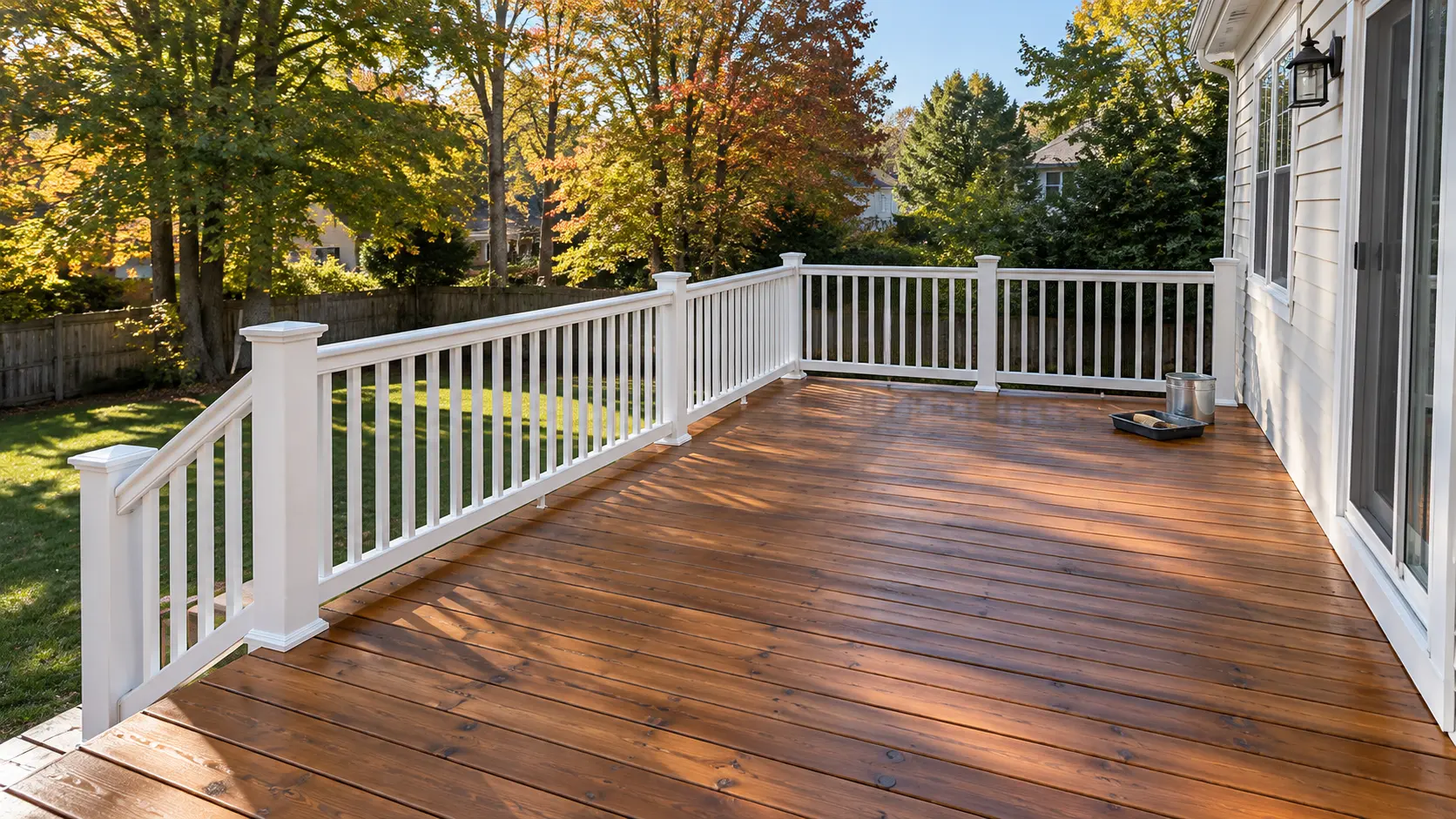
Professionally staining a deck costs about $550 to $1,250 nationally, or roughly $2 to $4 per square foot, according to 2026 cost data. In New Jersey, where painter wages run about 20 percent above the national median, a realistic planning range for a standard wash-and-stain is closer to $2.25 to $5 per square foot, which puts a typical 300 square foot deck at around $675 to $1,500. Decks that need stripping or heavy sanding, or that have long runs of railing and spindles, cost considerably more: a full sand and stain runs $3 to $9 per square foot nationally. Even then, refinishing costs a fraction of building a new deck.
The long answer matters, because a cheap deck job and a right one look identical the day the crew leaves and very different eighteen months later. We paint and stain decks, fences, shutters and garage doors across Monmouth, Middlesex, Ocean, Mercer, Somerset and Burlington counties, plus Union, Essex, Hudson, Bergen and Passaic in North Jersey. How we clean, prep and stain is on our deck staining service page; this guide is about what the work costs.
Deck Staining Cost: What the National Data Says
Three of the most-cited cost guides land in roughly the same place, with differences that mostly come down to what each one counts as "included."
- Angi's deck staining cost guide (updated July 2026) puts the professional range at $550 to $1,250, with an average of $850 and a general rate of $2 to $4 per square foot. It breaks labor out separately at $1 to $2.50 per square foot and notes it can reach $7 per square foot in high-cost areas.
- Fixr's deck staining cost data (January 2025) reports a national average of $750 and $2 to $5 per square foot for staining with light sanding and sealing, with power washing at $0.30 to $0.40 per square foot and stripping at $1 to $3.
- HomeGuide's cost guide (last updated July 2024) lists $1.57 to $4.04 per square foot for professional staining and a typical project of $450 to $1,000, with stripping as a separate line at $2.50 to $5.50 per square foot of deck floor.
The pattern is consistent. The low ends (about $1.50 to $2 per square foot) describe a sound deck that needs a cleaning and a maintenance coat. The high ends ($4 to $5) describe a weathered deck that needs real prep. None of the headline numbers include stripping a failed solid stain, and Angi and HomeGuide both price railings as a separate per-foot line.
Why New Jersey Costs More Than the National Average
Deck staining is mostly labor: a crew's time to wash, wait, prep and apply. Labor costs more here.
Bureau of Labor Statistics wage data, broken out by state on O*NET's painter wage page for New Jersey, puts the 2025 median for construction and maintenance painters at $28.49 an hour in New Jersey against $23.75 nationally. That is a 20 percent gap before insurance, vehicles and overhead.
That is why we suggest homeowners take the national per-square-foot figures and add 10 to 20 percent as a New Jersey planning number. Labor is not the whole bill, so the full 20 percent is the conservative end. The tables below show the math so you can check it. Our broader guide to what it costs to paint a house in NJ covers the same labor-market picture for interiors and exteriors.
Cost by Deck Size
The table below takes the national $2 to $4 per square foot range for a standard clean-and-stain and adjusts it for New Jersey labor (10 percent on the low end, 20 percent on the high end), which gives $2.20 to $4.80, rounded here to $2.25 to $5 per square foot. The second column adds stripping, using HomeGuide's $2.50 to $5.50 per square foot figure for deck floors. These are estimates built from published data, not a price list, and they cover the deck floor only.
| Deck floor size | Clean, brighten and stain ($2.25 - $5.00/sq ft) | Strip, sand and stain ($4.75 - $10.50/sq ft) |
|---|---|---|
| 200 sq ft (about 10 x 20) | $450 - $1,000 | $950 - $2,100 |
| 300 sq ft (about 15 x 20) | $675 - $1,500 | $1,425 - $3,150 |
| 400 sq ft (about 20 x 20) | $900 - $2,000 | $1,900 - $4,200 |
| 500 sq ft (about 20 x 25) | $1,125 - $2,500 | $2,375 - $5,250 |
For comparison, Angi's national figures put a 16 by 24 foot deck (384 square feet) at $775 to $1,550, which sits just under our New Jersey clean-and-stain column for a 400 square foot deck.
A lot of the decks we restain in Monmouth and Ocean counties are pressure-treated pine with a set of stairs down to the yard and railing on three sides. On those decks the extras below matter more than the square footage.
Sand and Stain Deck Cost
Sanding is the line that turns a maintenance coat into a refinishing job. Fixr's deck staining cost data (January 2025) puts sanding at an extra $1 to $4 per square foot on top of staining, and a combined sand-and-stain job at $3 to $9 per square foot. It lists full deck refinishing at $3 to $6.50 per square foot and restoration at $4.50 to $6.50. Angi's figures above split the sanding the same way: $1 to $1.50 per square foot for a light sand, $2 to $4 for a heavy one.
| Job | What it involves | National price per sq ft |
|---|---|---|
| Clean and stain | Wash, brighten, one or two coats | $2 - $4 (Angi) |
| Light sand added | Knock down raised grain and fuzz after washing | +$1 - $1.50 (Angi) |
| Heavy sand added | Remove gray fibers and worn coating | +$2 - $4 (Angi) |
| Sand and stain, combined | Full sanding plus stain | $3 - $9 (Fixr) |
| Strip and stain | Chemical removal of a failed solid stain, then stain | $2.50 - $5.50 for stripping alone (HomeGuide) |
On a 300 square foot deck, Fixr's sand-and-stain range works out to $900 to $2,700 nationally, or roughly $990 to $3,240 with our New Jersey adjustment, railings and stairs extra. Most decks do not need a full sand. We sand the handrail cap and any boards with lifted grain, and save a full sand for decks that have gone gray or carry a worn film.
Refinish or replace?
Refinishing costs a fraction of a new deck. Fixr's deck building cost guide (last updated January 2023, so treat it as a floor) puts a new deck at $15 to $55 per square foot installed, with pressure-treated wood at $15 to $25 and composite at $28 to $40, and a typical 320 square foot deck at about $14,000. Against that, even a heavy sand and stain on the same deck is a small number. Refinishing makes sense whenever the framing, joists and most boards are sound; a handful of rotted boards can be replaced as part of the job. Replacement is the answer when the structure itself is soft, loose at the ledger or failing at the posts, and that is a carpenter's call, not a painter's.
What Is Actually Included in a Deck Staining Price
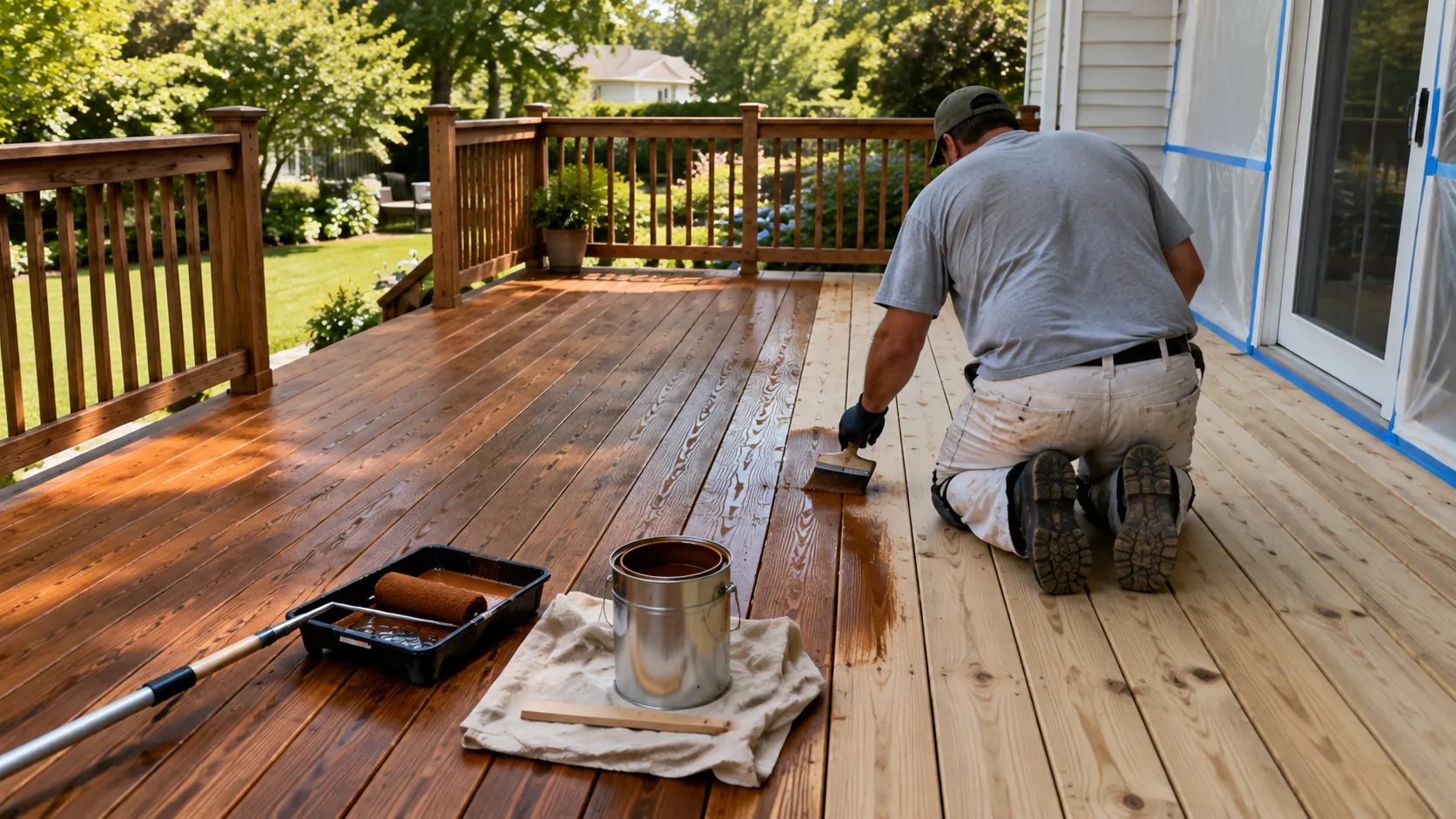
Two quotes for "stain the deck" can describe completely different jobs. Here is a complete scope.
Cleaning and washing
Every deck gets cleaned before stain. Fixr puts power washing at $0.30 to $0.40 per square foot and HomeGuide at $0.35 to $0.77; our power washing cost guide covers washing as a job of its own. The USDA Forest Products Laboratory's guidance on finishes for wood decks warns that aggressive scrubbing or power washing can remove wood from the surface, particularly on softer species like western redcedar. On cedar we run low pressure and let the cleaner do the work.
Brightener
Cleaners and strippers can leave wood darkened. A brightener restores the color so stain absorbs evenly. It is cheap in materials and a short step in labor. A quote that skips it should do so on purpose.
Stripping versus cleaning
This is the biggest cost variable. A worn semi-transparent stain can usually be cleaned and recoated. A solid stain or paint peeling in the traffic lanes has to come off, which is HomeGuide's $2.50 to $5.50 per square foot stripping line. Benjamin Moore's Arborcoat semi-solid technical data sheet says flaking or peeling stain should be removed before staining, and Sherwin-Williams' SuperDeck sheet says anything short of total removal of the old coating compromises the new one's service life.
Sanding
Light sanding knocks down raised grain after washing; heavy sanding removes failed coatings and gray fibers. Angi prices light sanding at $1 to $1.50 per square foot and heavy sanding at $2 to $4. On the pressure-treated decks we restain around Freehold and Marlboro, we usually sand the handrail cap (what people touch) and spot-sand floor boards with lifted grain.
Repairs
Popped nails, loose boards and the occasional rotted board show up during washing. Many stain quotes exclude carpentry, so ask. Deck repair before staining is part of our scope, priced as its own line: resetting popped nails, re-securing loose boards and swapping a bad board so it can weather in before the stain goes on. Replacing a board before staining beats having one bright new board in the middle of a finished deck. Soft joists, posts or a loose ledger are structural, and that goes to a carpenter.
Railings, spindles and stairs
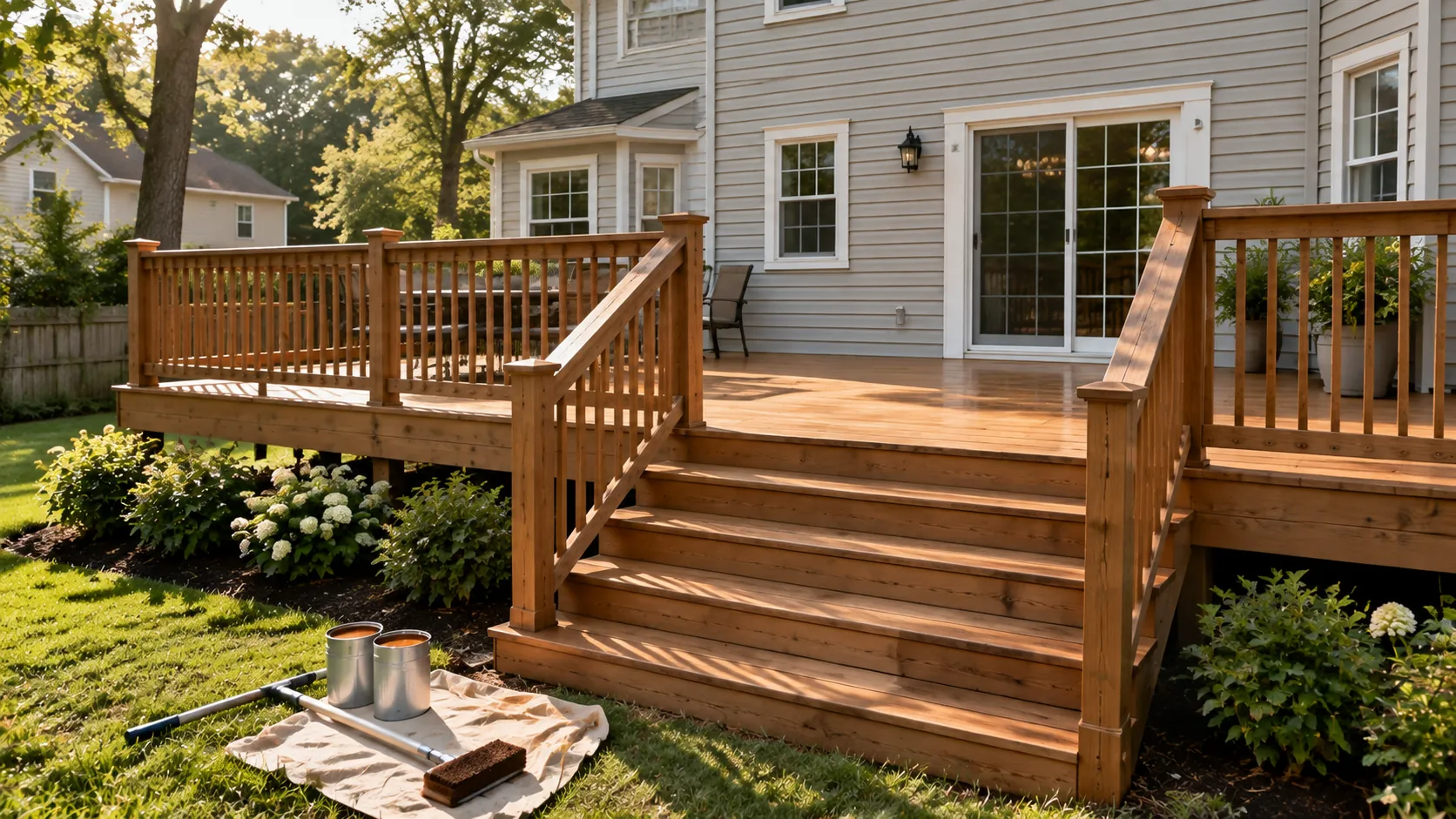
This is where labor multiplies. A deck floor rolls and back-brushes quickly. A railing has four faces on every spindle, plus rails, posts and caps, all brush work. Angi prices railings at $4 to $12.50 per linear foot, and HomeGuide at $4 to $8 per linear foot without stripping and $10 to $14 with stripping. Stairs work the same way: treads, risers, stringers and handrails, all cut in by hand. The worked example below shows how fast it adds up.
Transparent vs. Semi-Transparent vs. Solid Stain
Stain choice changes both what you pay now and how often you pay again. The Forest Products Laboratory, the U.S. government's wood research lab, is unusually specific about decks: penetrating finishes, not film-forming finishes, should be used on wood decks. Decks shrink and swell constantly, and film-forming finishes such as paint and solid-color stain wear fast in traffic areas, trap moisture and fail by peeling.
| Stain type | Look | Typical recoat interval | Cost and maintenance notes |
|---|---|---|---|
| Clear / toner | Wood grain and color fully visible | About every year | Cheapest per coat, but little UV protection, so you recoat most often |
| Semi-transparent | Color added, grain still visible | Every 2 - 3 years | Penetrates, does not peel; easiest to maintain; our default for deck floors |
| Semi-solid | Grain partly hidden | Every 2 - 4 years | Evens out mismatched or older boards; some film-building on repeat coats |
| Solid color | Grain hidden, looks like paint | 5 - 7 years on vertical surfaces; less on floors | Longest on railings and fences; on walking surfaces it can peel, and then it must be stripped |
The recoat intervals come from This Old House's guide to exterior stain, which gives about a year for clear toners, two to three years for semi-transparent, two to four for semi-solid and five to seven for solid color. Those are general exterior figures; a deck floor takes foot traffic and standing water, so in our experience it wears faster than a fence with the same product. The Forest Products Laboratory puts the service life of an unpigmented water-repellent preservative at about one year on exposed deck surfaces.
The takeaway: solid stain on a deck floor looks great the first season and often costs the most to fix later, because a penetrating stain cannot go back over it without stripping. (Our guide to why paint peels explains the moisture mechanics behind that failure.) The same Forest Products Laboratory guidance notes that paint and solid stain can perform quite well on railings, which take no foot traffic. That is the combination we recommend most: semi-transparent on the floor and stairs, solid color on railings and fascia for a two-tone look.
Oil-Based vs. Water-Based Deck Stain
Both work, but they schedule differently, and scheduling is cost. Oil-based stains penetrate deeply, per This Old House. Sherwin-Williams' SuperDeck oil-based semi-transparent product data sheet is a useful description of how this class of stain behaves: it calls the product one-coat (a second coat will not penetrate and stays tacky) and says it needs 24 to 48 hours before use. It also warns that oil-soaked rags can spontaneously catch fire, which is why our rags go into a sealed, water-filled metal can at the end of every day.
One caution before you buy that exact can. The same sheet lists that formula as not compliant with Ozone Transport Commission (OTC) rules, at up to 550 grams of VOC per litre. New Jersey is in the OTC region, and its own architectural coatings rule, N.J.A.C. 7:27-23, caps stains at 250 grams per litre for any coating sold in the state or applied here for pay. That puts this formula off the table for a New Jersey deck. If you want an oil-based stain, check that its label or data sheet says it meets OTC or New Jersey VOC limits before you buy it.
Water-based (acrylic) stains clean up with water and, per This Old House, stand up best to the sun. Benjamin Moore's Arborcoat sheet calls for one or two coats at least four hours apart, 48 hours before normal foot traffic, and wood moisture below 15 percent. Some waterborne deck stains, including the waterborne SuperDeck listed on the same Sherwin-Williams sheet, can go onto damp wood so washing and staining happen the same day, saving a trip.
On cost, the per-gallon prices overlap heavily. Angi lists water-based stain at $20 to $90 a gallon and oil-based at $35 to $120. What moves the price is how many trips the crew makes, not the can.
How Often Should You Stain a Deck in New Jersey?
For a semi-transparent stain on a sunny, well-used deck, plan on every two to three years, with a cleaning and an inspection in the years between. (For the house itself, see how often to paint a house in NJ.) Purdue Extension's publication on selecting and applying exterior wood finishes, co-authored with the Forest Products Laboratory, notes that a single coat of penetrating stain on new wood can be expected to last two to four years, and that succeeding coats last longer.
New Jersey adds its own wear. Humid summers invite mildew on shaded boards, freeze-thaw winters work water into checks and end grain, and shore decks in Monmouth and Ocean take more wind-driven moisture. South-facing stair treads and the lane to the grill always go first.
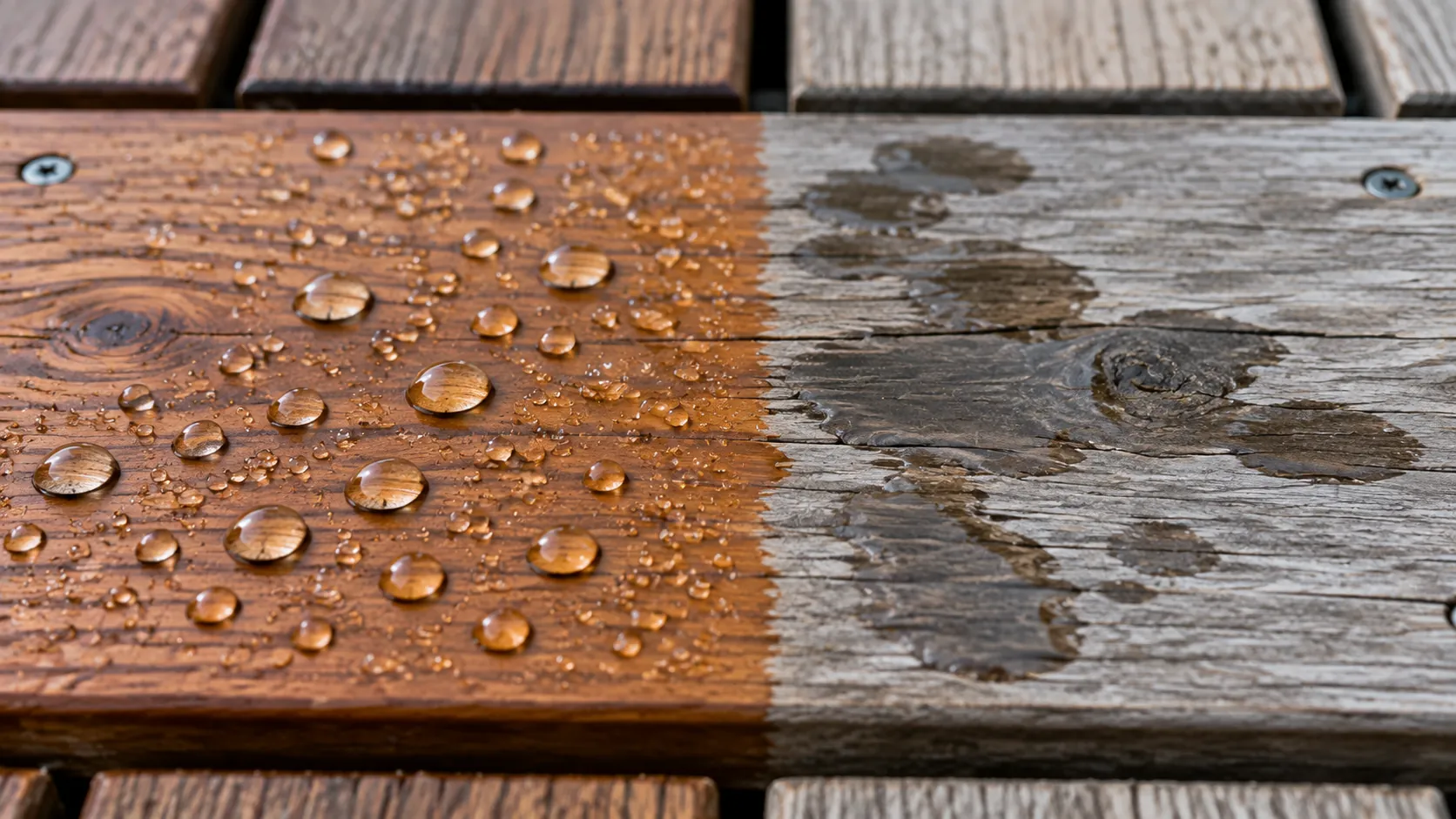
Do not go by the calendar alone. The same Purdue publication describes a simple test for water-repellent finishes that works as a rule of thumb for any penetrating stain: splash a little water on the boards. If it beads and runs off, the finish is still working. If it soaks in and darkens the wood, it is time to recoat. Recoating then is a clean-and-coat job. Waiting until the wood is gray and patchy turns it into a restoration with sanding or stripping, at roughly double the price per square foot above. The same case holds for painted siding.
New Pressure-Treated Decks: How Long to Wait Before Staining
The old rule was to wait six months or a year. Current guidance depends on how wet the lumber is, not a date.
YellaWood, a major pressure-treated lumber brand, says its lumber can be stained within about six weeks after construction as long as the wood is sufficiently dry, and it recommends a sprinkle test: put a few drops of water on the boards, and if they bead up, wait a few days and test again; if they soak in, the wood is ready. The Forest Products Laboratory adds a caution: if the decking came with a factory-applied water repellent, a stain may not absorb properly, and the wood should weather for two to three months first. It also notes that most decks are retired because of cracks and checks that timely finishing could have largely avoided.
Both positions come down to the water test. In practice, a deck built in spring in central New Jersey is often ready by late summer, while one built in fall usually waits for spring because the weather window closes first. Benjamin Moore adds a step for new wood: sand smooth-planed boards or use a brightener to break "mill glaze," then retest with a few drops of water.
Weather Windows for Staining a Deck in NJ
Product limits are stricter than most people expect. From the two data sheets above:
- Temperature. The oil-based SuperDeck sheet calls for surface temperatures of 50 to 90 degrees, and not to be applied if temperatures will fall below 50. Waterborne Arborcoat allows 40 to 90.
- Rain. No rain for at least 24 hours after application on the oil product, and 48 hours before normal foot traffic on the waterborne one.
- Sun. Both manufacturers say to avoid direct sun or hot surfaces, which cause lap marks and poor penetration. In July we work a deck in sections as the shade moves.
- Humidity and dew. Benjamin Moore notes that high humidity and cool temperatures lengthen dry times. Neither product should go on wet or damp wood unless it is specifically formulated for it. In October, dew often sits on the boards until mid-morning, so a June start time is too early.
- Drying after washing. The Forest Products Laboratory says to allow at least two warm, windy days after a bleach cleaning; YellaWood suggests about 24 hours. We go by the wood, not the clock.
Put together, the practical staining season in most of New Jersey runs from late spring through early fall, and a stretch of three dry days is the real scheduling unit. Our exterior painting page applies the same seasonal logic to siding and trim.
Composite Decks Are a Different Job
If your deck is composite, it should not be treated like wood. Trex's decking FAQ states that painting or staining its decking is not recommended and may void the limited residential fade and stain warranty. Wood fascia, posts or railings on a composite deck may still be worth staining, which is a smaller scope.
DIY vs. Hiring a Pro
Deck staining is a reasonable DIY project on a sound deck. HomeGuide puts DIY cost at $0.50 to $1.50 per square foot. Angi lists pressure washer rental at $35 to $175 a day and estimates the labor savings of doing it yourself at $300 to $900.
| DIY | Professional (NJ planning range) | |
|---|---|---|
| Out-of-pocket cost | About $150 - $450 (stain, cleaner, brightener, rental, supplies) | About $675 - $1,500 |
| Main risks | Gouged boards from a pressure washer, lap marks, stain applied too thick, rain on fresh stain | Choosing a crew that cuts prep |
DIY usually goes wrong in the same ways: too much washer pressure, staining wet wood, a second coat of a one-coat product, or puddles that dry tacky. Hiring out makes the most sense for peeling solid stain that needs stripping, long railing runs, second-story decks, and anyone who cannot spare several dry weekends.
Estimate Your Deck Staining Cost: A Worked Example
Here is how to rough out your own number using the published data above. Take a common central New Jersey layout: a 16 by 20 foot pressure-treated deck, railing on three sides, and one set of stairs. The existing semi-transparent stain is worn but not peeling.
- Measure the floor. 16 x 20 = 320 square feet.
- Price the floor. 320 x $2.25 to $5.00 = $720 to $1,600 for clean, brighten and stain.
- Measure the railing. 16 + 20 + 16 = 52 feet, less a 4-foot stair opening = about 48 linear feet.
- Price the railing. 48 x $4 to $12.50 (Angi's range) = $192 to $600. Add 10 to 20 percent for New Jersey labor: about $210 to $720.
- Total. Roughly $930 to $2,320, plus stair time, before any stripping or repairs. Stairs have no standard published rate; they are extra brush labor on treads, risers, stringers and handrails.
If the same deck had a solid stain peeling in the traffic lanes, switch step 2 to the strip-and-stain column ($4.75 to $10.50 per square foot), and the floor alone becomes $1,520 to $3,360. That is why we steer most deck floors toward penetrating finishes.
Red Flags in a Deck Staining Quote
- No registration number. New Jersey's Division of Consumer Affairs includes painting in its definition of home improvement work, and you can verify a contractor's home improvement registration online in a minute.
- No product named. "Stain and seal" is not a scope. A good quote names the product and opacity, so you can look up its data sheet yourself.
- "Two coats" of a one-coat product. Some oil-based semi-transparent stains are explicitly one-coat; the SuperDeck oil sheet says so in as many words. More is not better; it stays tacky.
- A new coat over peeling stain. Both Benjamin Moore and Sherwin-Williams say failing finishes must come off first. Coating over peeling stain is a guaranteed callback.
- Wash and oil stain on the same day. Unless the product is formulated for damp wood, the wood needs to dry first.
- Railings, stairs and prep left vague. Ask for floor, railings, stairs, prep and repairs as separate lines.
- A price far below the ranges above. The only places to save that much are prep and dry time, which decide how long the stain lasts.
You can see decks and exterior work we have completed in our project gallery, and what goes into our exterior scope on the exterior painting and staining page. For pricing on other services, the painting cost guide collects our planning ranges in one place.
Frequently Asked Questions
How much does it cost to stain a deck in NJ?
Angi's 2026 data puts professional deck staining at $550 to $1,250 nationally, or $2 to $4 per square foot. Adjusted for New Jersey painter wages, plan on about $2.25 to $5 per square foot, or $675 to $1,500 for a 300 square foot deck floor. Railings, stairs, stripping and repairs are extra.
How much does it cost to power wash and stain a deck?
Washing is usually built into a staining price. Listed separately, Fixr and HomeGuide put power washing at about $0.30 to $0.77 per square foot, roughly $90 to $230 on a 300 square foot deck. Stripping an old solid stain is a much bigger line at $2.50 to $5.50 per square foot.
How much does it cost to sand and stain a deck?
Fixr puts a combined sand-and-stain job at $3 to $9 per square foot nationally, with sanding alone adding $1 to $4 per square foot to the staining price. For a 300 square foot deck that is about $900 to $2,700 nationally, or roughly $990 to $3,240 adjusted for New Jersey labor, before railings and stairs.
Is it cheaper to refinish a deck or replace it?
Refinishing, by a wide margin. Fixr puts a new deck at $15 to $55 per square foot installed (about $14,000 for a typical 320 square foot deck), while refinishing runs $3 to $6.50 per square foot. Replace only when the framing or structure has failed.
How often should you stain a deck in New Jersey?
Every two to three years for a semi-transparent stain, sooner on sunny, busy or shore decks; about yearly for clear finishes. If water soaks in instead of beading, recoat before the wood grays.
How long should I wait to stain a new pressure-treated deck?
Until it passes the sprinkle test. YellaWood says its lumber can often be stained within about six weeks if dry; the Forest Products Laboratory suggests two to three months if the boards carry a factory water repellent.
Can you stain a composite deck?
Generally, no. Trex states that painting or staining its decking is not recommended and may void its fade and stain warranty. Composite decks need cleaning rather than coating. Any wood fascia, posts or railings can still be stained.
Is sealing a deck cheaper than staining it?
Per coat, a clear sealer or water repellent costs less, but it lasts less. The Forest Products Laboratory puts an unpigmented water-repellent preservative at about one year on exposed deck surfaces, and This Old House gives clear toners about a year, against two to three years for a semi-transparent stain. Over several years, a pigmented penetrating stain usually costs less because you recoat less often.
When is the best time to stain a deck in New Jersey?
Late spring through early fall, on a stretch of about three dry days. A typical oil-based stain sheet (Sherwin-Williams' SuperDeck oil) calls for surface temperatures of 50 to 90 degrees and no rain for 24 hours; waterborne Arborcoat allows 40 to 90 degrees. In October, wait for the morning dew to burn off before starting.
How much stain do I need for my deck?
Coverage varies widely with how porous the wood is. Sherwin-Williams lists 150 to 400 square feet per gallon for its oil-based semi-transparent SuperDeck (a formula its own sheet lists as not meeting OTC VOC rules), and Benjamin Moore lists 300 to 400 for Arborcoat semi-solid. Weathered wood absorbs more than new wood, so plan on the low end of the coverage range for an older deck.
Get a Real Number for Your Deck
Every figure here is a planning range built from published data. The number that matters comes after somebody walks your deck, sprinkles water on the boards and counts the stairs. NJ Painting Co. is a family-owned, licensed and fully insured company at 36 Church Rd, Morganville, NJ 07751, and we have been painting in central New Jersey for more than twenty years. Along with houses, we paint and stain decks, fences, shutters and garage doors. We work with Benjamin Moore and Sherwin-Williams products, put the product and scope in writing, and back our work with a two-year workmanship warranty.
We cover all of Monmouth County, including Freehold, plus Middlesex and Ocean County and shore towns like Toms River. See how we handle exterior painting in Monmouth County and in Ocean County, or check our full list of service areas to confirm your town. Call (732) 239-0932 or request a free estimate, and we will give you a line-item quote for the floor, railings, stairs and prep.
About the author
Written by the NJ Painting Co. team
NJ Painting Co. is a family-owned painting contractor based in Monmouth County, in business since 2004. We are licensed and fully insured, work with Benjamin Moore and Sherwin-Williams paints, and back our work with a 2-year workmanship warranty. We serve Monmouth, Middlesex, Ocean, Mercer, Somerset and Burlington counties, plus Union, Essex, Hudson, Bergen and Passaic in North Jersey.