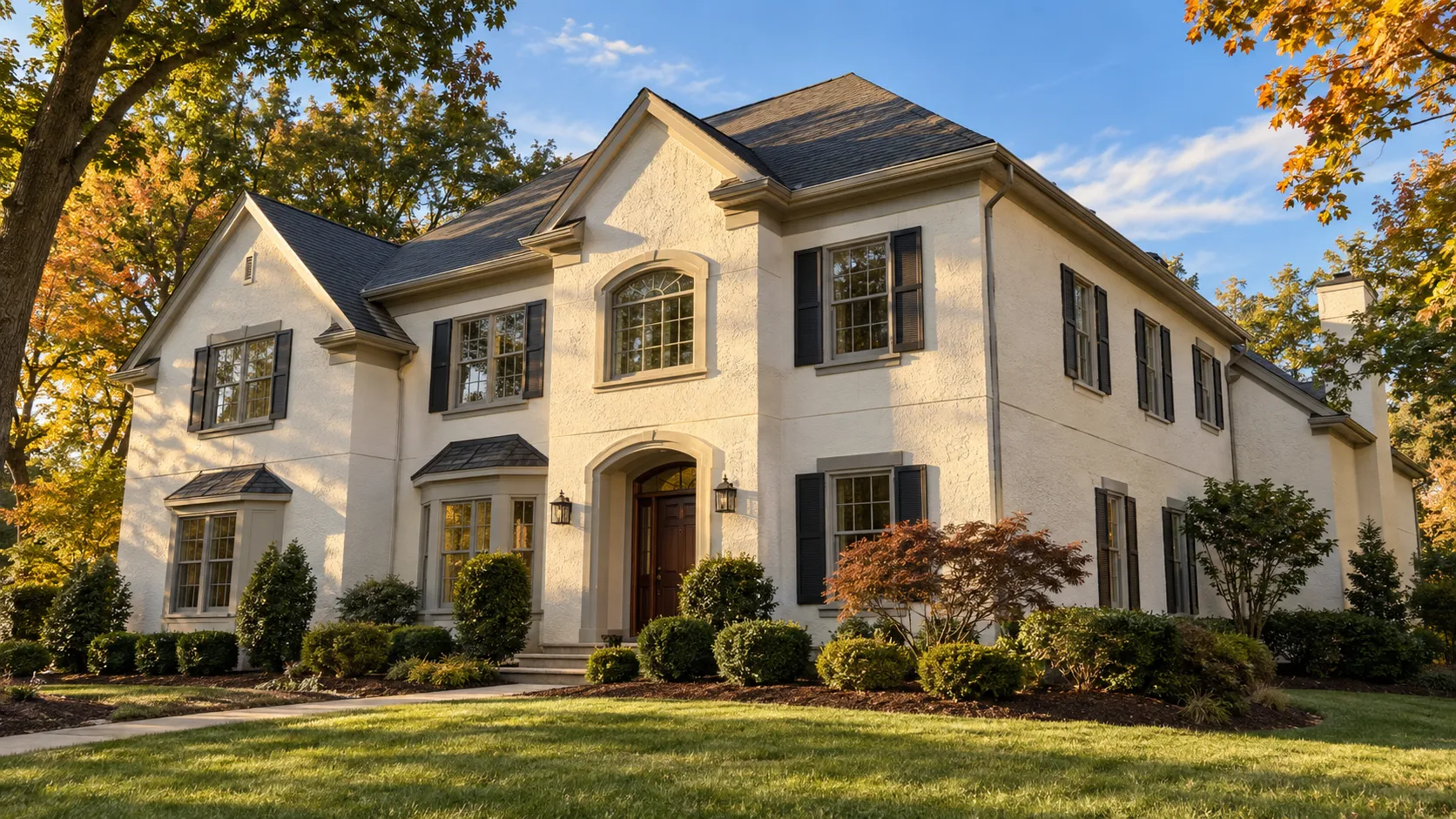
Yes, you can paint stucco: most cement stucco on New Jersey homes takes a breathable 100% acrylic masonry paint well, as long as the wall is dry, sound, clean and, if new, fully cured. Stucco painting works when it is done in the right order: fix any water problems, repair the cracks, wash the wall and let it dry, prime bare or patched areas with an alkali-resistant masonry primer, then apply two coats, spray-applied and back-rolled into the texture. It goes wrong on wet walls, on EIFS treated like hard stucco, and under an elastomeric coating the wall did not need.
Plan on far more paint than siding takes (about 80 square feet per gallon per coat on rough stucco) and on roughly $2 to $5 per square foot of wall for professional stucco painting in New Jersey, before repairs. A good job lasts about five to ten years.
We paint stucco homes, stucco foundations and stucco-and-siding combinations across Monmouth, Middlesex, Ocean, Mercer, Somerset and Burlington counties, plus Union, Essex, Hudson, Bergen and Passaic in North Jersey. This guide covers what we check before we give a price, which products we use and why, what the data sheets actually say about coverage and temperature, and what stucco painting costs in 2026. Every number below is linked to the manufacturer, trade association or cost survey it comes from.
| Question | Short answer |
|---|---|
| Can you paint stucco? | Yes, if it is dry, sound, clean and (if new) cured. EIFS and lime stucco need their own products. |
| Best paint for stucco | 100% acrylic masonry paint for most walls; elastomeric for widespread hairline cracking; mineral silicate for old or lime stucco |
| Primer needed? | On new, bare, patched or chalky stucco, yes: an alkali-resistant masonry primer. Sound painted stucco often needs only spot-priming. |
| Sheen | Flat or low sheen |
| Paint needed | About 80 sq ft per gallon per coat on rough texture |
| Cost in NJ | About $2 to $5 per sq ft of wall, plus repairs |
| How long it lasts | About 5 to 10 years, shorter on exposed and shore walls |
Can You Paint Stucco? The Short Answer and the Exceptions
Painting stucco is normal and accepted practice. The Stucco Manufacturers Association's 2024 bulletin on painting stucco calls painting "an appropriate option when a color change is desired" and says re-painting stucco "is a common practice." It recommends a vapor-permeable product made specifically for cement-based stucco, so that incidental water in the wall can escape as vapor.
That last point is the whole game. Stucco is not a waterproof shell; small amounts of water get into it and need a way back out. The paint you choose either lets that happen or fights it. The exceptions where we slow down or say no are:
- The wall is actively wet or damaged. Leaking windows, missing flashing, stucco buried in soil or mulch, or soft, crumbling patches. Paint hides these problems for a season and then fails over them. Fix the water first.
- It is not actually hard-coat stucco. EIFS (synthetic stucco over foam) looks similar but has its own manufacturer rules. More on that below.
- It is old lime stucco on an early house. Traditional lime stucco is softer and more vapor-open than modern cement stucco. It needs compatible coatings, not a heavy plastic film.
- The stucco was never painted and you like its color. Integral-color stucco can often be cleaned and refreshed with a cementitious fog coat instead. Once it is painted, it will need painting from then on; the SMA bulletin notes that fog coats cannot be used over painted stucco.
- The stucco is brand new. It has to cure first; the waiting times are covered below.
Is painting stucco a good idea? Pros and cons
| Pros | Cons |
|---|---|
| Any color, including covering stained, faded or patched stucco that no longer matches | Once painted, it stays a painted wall: the SMA notes a fog coat cannot go over paint later |
| A masonry coating adds a layer against wind-driven rain and seals hairline cracks | A repaint cycle of roughly five to ten years |
| Fresh, even color hides old repairs | The wrong coating, or too many heavy coats, can hold moisture in the wall |
| Cleans up and recoats more easily than bare, dirty stucco | Stucco takes far more paint and labor per square foot than siding |
Our view: painting is a good idea for stucco that is already painted, stained or mismatched, and a decision worth thinking about on sound, never-painted stucco whose color you still like.
What Kind of Stucco Do You Have?
Hard-coat (traditional cement) stucco
Most of the stucco we see on New Jersey houses is portland cement stucco applied over lath or directly over masonry. The building-envelope consultancy Lerch Bates explains in its guide on how to tell EIFS from stucco that traditional stucco uses a wire lath attached to the substrate with a base coat of fiber-reinforced portland cement about 1/2 inch thick. It sounds and feels solid when you tap on it, and it usually has control joints and some hairline cracking.
EIFS (synthetic stucco)
EIFS, Exterior Insulation and Finish Systems, is foam insulation board with a thin reinforced base coat and a textured acrylic finish. Lerch Bates puts that base coat at 1/16 to 3/32 inch. Its two quick field tests: tap the wall with your fingertips and listen for a hollow sound, and press firmly with a thumb to see if the surface deflects. EIFS gives slightly; hard stucco does not. We also look at the bottom edge and around penetrations, where the foam is sometimes visible.
It matters because EIFS is a proprietary system with its own maintenance rules. Dryvit's EIFS maintenance and repair guide says to clean with a low-pressure washer under 500 psi with a fan tip held at least 12 inches from the surface, to recoat with "a high-quality, breathable acrylic coating, ideally the same as used in the original application," and never to use oil-based paints because they can trap moisture. Treat EIFS like concrete, blast it with a turbo tip and seal it under a heavy film, and you can damage the finish and the foam behind it.
Historic lime stucco
According to the National Park Service's Preservation Brief 22 on historic stucco, stucco was mainly lime-based until the late 1800s. Portland cement was first made in the United States in 1871, and after about 1900 most stucco was mainly portland cement with some lime. If your house predates that, or has been restored with lime, the NPS says limewash or cement-based paints were traditionally used on stucco and that modern premixed masonry and mineral paints may also be used. It also says the new paint must be compatible with whatever coating is already there, and that a water-repellent coating after repairs is usually unnecessary because paints and colorwashes do the same job. For that kind of wall, see our guide to limewash and mineral finishes, which covers the same breathability issues on brick.
What Has to Be Repaired Before You Paint Stucco?
Cracks wider than 1/16 inch, efflorescence and anything letting water in have to be fixed first, and new stucco has to cure. Every stucco quote we write starts with a walk around the house. The paint is the easy part; what is under it decides whether the job lasts.
Hairline cracks vs structural cracks
Some cracking is normal. The Plaster Council's technical bulletin on stucco cracks, published with the Portland Cement Association among its member groups, says stucco "is relatively thin and brittle and will crack" under stress, that shrinkage during curing can cause hairline cracks, and that owners "should expect hairline cracks and diagonal cracks emanating from the corners of windows and doors." It also says each crack should be judged on its own for water penetration and whether it is still moving, and that industry practice is to repair any crack wider than 1/16 inch.
How we sort them on site:
- Hairline map cracking in the field of the wall: normal, cosmetic, handled in the paint system.
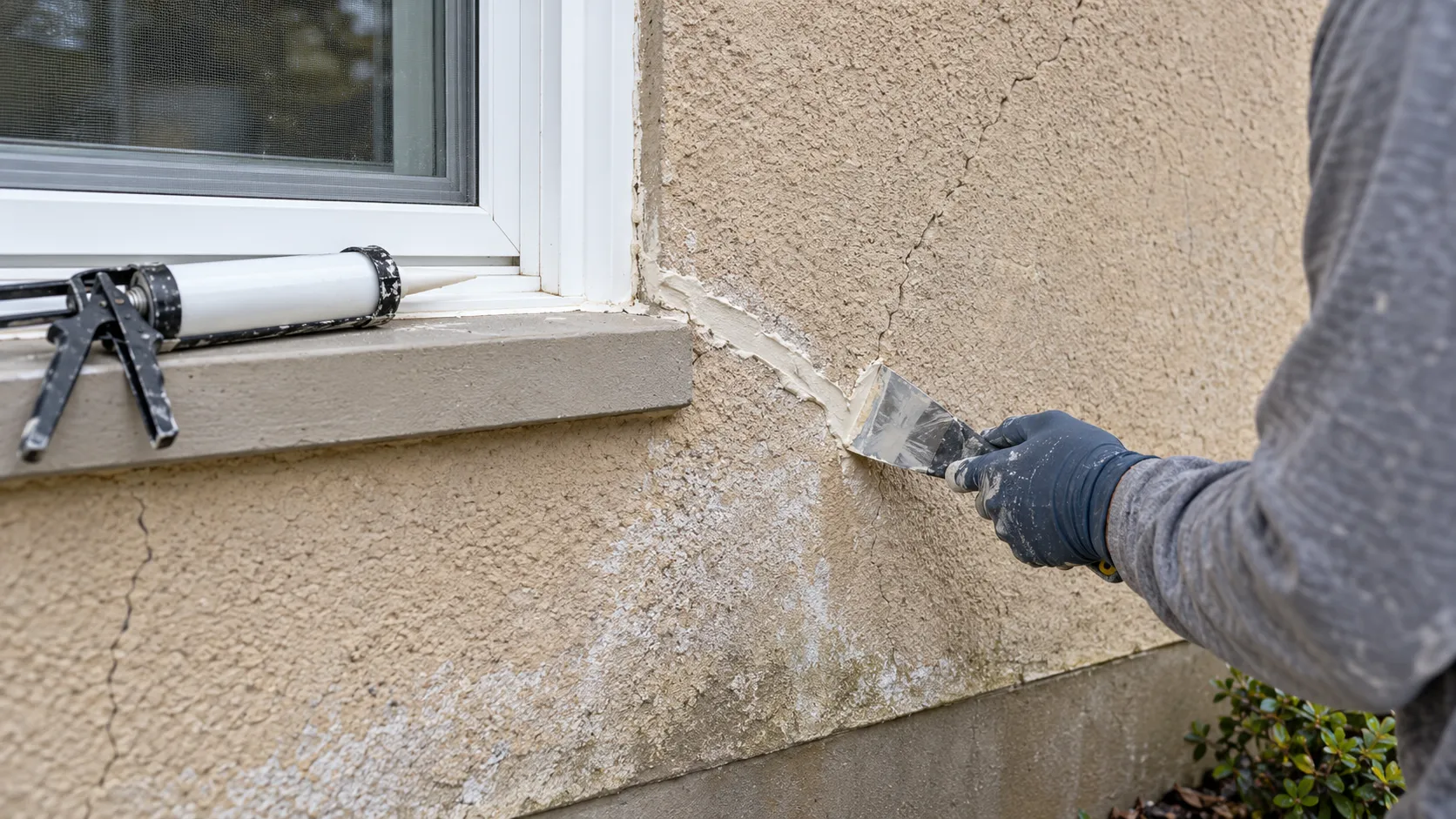
- Diagonal cracks off window and door corners: common; cleaned out, filled with an elastomeric patch or sealant and spot-primed.
- Wider cracks, cracks with offset edges, bulges, hollow-sounding areas, or stains running from a crack: these point to movement, loose stucco or water behind it. That is a stucco contractor's job before it is ours, and sometimes a moisture investigation first.
Benjamin Moore's data sheet for Ultra Spec Masonry Elastomeric Waterproofing Coating (359) gives a useful rule of thumb: the coating itself bridges cracks up to 1/32 inch; cracks from 1/32 to 1/16 inch should be caulked and covered with a brush- or knife-grade elastomeric patch; and cracks larger than 1/16 inch should be routed out to 1/4 by 1/4 inch and repaired before finishing. On historic stucco, the NPS brief warns that ordinary caulk is not suitable for hairline cracks because it weathers differently and attracts dirt; there, a thin slurry of the finish coat or simply the paint itself is the better fix.
Sherwin-Williams puts it plainly in its substrate guide for painters: "Stucco cracks will telegraph through the topcoat and should be repaired with patches and sealants prior to repainting."
Efflorescence
White, powdery salt on stucco is efflorescence. The Stucco Manufacturers Association's 2024 efflorescence bulletin says it forms when water dissolves salts in the stucco and carries them to the surface, often after damp, cool weather followed by warm sun, which describes a lot of New Jersey springs and falls. It says secondary efflorescence occurs most often at hairline cracks, where rain running down the wall soaks in, and that it is typically cosmetic. Its recommended removal starts with the gentlest step, brushing and rinsing with clean water, then a water-vinegar solution or a dedicated efflorescence cleaner.
Paint over efflorescence and it pushes the paint off. We scrub it off, let the wall dry, and use an alkali- and efflorescence-resistant primer or coating. If it keeps coming back in one spot, that spot is getting wet, and we look for the reason (a gutter, a sprinkler head, a missing kick-out flashing, soil against the wall).
How long new stucco must cure
Fresh cement is highly alkaline, and alkali attacks ordinary paint. The manufacturers' waiting times are:
- Benjamin Moore (Ultra Spec Masonry 359): new masonry should cure 30 days and have a pH of 10 or less for optimal performance. If the schedule is tight, masonry cured 7 days with a pH of 13 or less may be sealed with Benjamin Moore's masonry sealer (608) or high-build primer (N609) first.
- Sherwin-Williams: the Loxon Concrete & Masonry Primer-Sealer data sheet says it can go on masonry at least 7 days old with a pH of 6 to 13, and the Loxon XP data sheet says concrete and mortar must be cured at least 7 days at 75°F.
- Oil-based paint: the NPS brief says new stucco must cure up to a year before it can be painted with oil-based paint. We do not use oil paint on stucco.
The SMA bulletin adds that new stucco should be painted only once its pH has dropped to the level the paint maker specifies, using the primer that paint maker approves. In practice, if a stucco contractor has just patched your walls, we schedule painting around those cure times rather than the other way round. In cool, damp New Jersey weather we lean toward the longer wait.
Can You Pressure Wash Stucco Before Painting?
Yes, at a pressure that suits the stucco type. Cleaning matters, because paint will not stick to dirt, mildew or chalky old paint. Sherwin-Williams says the trick with repainting stucco "is to powerwash or clean the loose powdery surface well enough without destroying it." That second half matters, because a pressure washer can do damage:
- EIFS: under 500 psi, fan tip, 12 inches away, per Dryvit.
- Historic or soft lime stucco: the NPS brief recommends low-pressure water washing with soft natural-bristle brushes and possibly a non-ionic detergent, and warns that textured finishes are easy to damage while cleaning.
- Hard cement stucco in good condition: tolerates more, but we still use a wide fan tip and keep moving, and we let the chemicals do the cleaning rather than the pressure. Driving water into cracks and behind trim just means a longer wait before the wall is dry enough to paint.
After washing, stucco holds water for a while. We give it time to dry, especially on north walls and shaded elevations, before primer goes on.
Do You Need to Prime Stucco Before Painting?
On new, bare, patched or chalky stucco, yes; on sound, previously painted stucco, usually only the repairs. Sherwin-Williams says "new stucco always should be primed or conditioned for optimal results" because of pH, and recommends its Loxon masonry primer. On bare, patched or chalky stucco we use an alkali-resistant masonry primer:
- Loxon Concrete & Masonry Primer-Sealer: rated for pH 6 to 13 and listed for stucco and EIFS. Its data sheet gives 200 to 320 sq ft per gallon on smooth surfaces but only about 80 sq ft per gallon on porous, rough stucco, calls for spray and back-roll on rough stucco, and says an exterior prime coat must be topcoated within 14 days.
- Benjamin Moore Ultra Spec Masonry sealer (608) or high-build primer (N609): the primers Benjamin Moore names for new or quick-turnaround masonry.
On sound, previously painted stucco, a full primer coat is often unnecessary. Sherwin-Williams' Loxon XP data sheet, for example, calls for one coat of topcoat over previously coated stucco in good condition after power washing, with spot-priming of repairs. We decide wall by wall.
What Is the Best Paint for Stucco?
For most sound, previously painted cement stucco, the best paint is a 100% acrylic masonry or exterior paint. Elastomeric suits walls with widespread hairline cracking, and mineral silicate suits old or lime stucco. Each of the three families fits a different house.
100% acrylic masonry and exterior paint
For most previously painted, sound cement stucco, a good 100% acrylic exterior or masonry paint is the right answer. It is breathable enough, keeps the stucco texture crisp, and recoats easily. Sherwin-Williams' substrate guide recommends two coats of SuperPaint or one coat of Duration as topcoats over its Loxon primer. Its purpose-built masonry acrylic is Loxon XP, a high-build acrylic that its data sheet says is highly alkali- and efflorescence-resistant, can go directly on surfaces up to pH 13 without primer, and can be applied down to 35°F.
Elastomeric vs acrylic paint on stucco
Both are acrylics; the difference is film build and flexibility. Elastomeric is a flexible, rubbery acrylic applied in heavy coats, several times the film of ordinary house paint. Its selling points are real: it bridges hairline cracks, and it sheds wind-driven rain. Sherwin-Williams recommends ConFlex XL "if the job calls for waterproof protection," noting it "can cover and hide hairline cracks." Benjamin Moore's Ultra Spec Masonry Elastomeric lists 200% elongation and crack-bridging up to 1/32 inch.
The downsides are why we do not put it on every stucco house:
- Vapor drive. The SMA says elastomeric is "not required as properly applied cement plaster is highly water resistant," and lists long-term vapor drive, muting of the stucco texture and long-term maintenance as things to weigh first. A thick film on a wall that gets wet from behind, from a leak or from interior humidity, can trap that water and blister.
- Texture loss. Heavy coats soften a crisp sand or dash finish, and every repaint mutes it more.
- Harder to recoat and repair. Future paint has to be compatible with it, and patches show.
- It must go on thick to work. Film thickness is the product. Thinned or under-applied elastomeric is just expensive paint.
We recommend elastomeric where cracking is widespread, the wall is exposed to driving rain, and the stucco is otherwise dry and sound, and we tell homeowners what they are giving up.
Mineral silicate paint
Silicate paint bonds chemically with mineral surfaces and stays highly vapor-open. KEIM's Soldalit technical data sheet lists a vapor permeability of 77 perms (ASTM E96), says the product suits historic facades "due to high vapor permeability coupled with water repellency," and says it can go over sound acrylic paint and acrylic stucco but not aged alkyd or oil paint. It is our choice for older or lime-based stucco and for owners who want a flat mineral look. In our experience it costs more per gallon than acrylic, and it has to go over a compatible surface, but KEIM says the binder chemically bonds with the masonry and "won't peel or lose adhesion" the way a film can.
Stucco paint compared, from the data sheets
| Product | Type | Coverage per gallon | Dry film per coat | Minimum application temp | Vapor permeance |
|---|---|---|---|---|---|
| Sherwin-Williams Loxon XP (flat) | High-build acrylic masonry | 85 to 110 sq ft; about 80 on porous, rough stucco | 6.5 to 8.4 mils | 35°F | 18.03 perms (2 coats) |
| Sherwin-Williams ConFlex XL Smooth | Elastomeric | 100 to 125 sq ft (2-coat system) | 6.0 to 7.5 mils | 50°F (apply 50 to 100°F) | 16.9 perms (1 coat) |
| Benjamin Moore Ultra Spec Masonry Elastomeric 359 | Elastomeric | 80 to 100 sq ft | 6.3 to 7.8 mils | 50°F | 32 perms |
| KEIM Soldalit | Sol-silicate mineral | 150 to 200 sq ft on portland stucco (smooth finish; less on sand texture) | Not specified (penetrating) | 40°F | 77 perms |
| Sherwin-Williams Loxon Primer-Sealer | Alkali-resistant masonry primer | 200 to 320 sq ft; about 80 on porous, rough stucco | 2.1 to 3.2 mils | 40°F | 25.79 perms |
The ConFlex XL Smooth data sheet also lists a one-coat spray system at 50 to 60 sq ft per gallon and 12 to 15 dry mils. Higher perm numbers mean more water vapor passes through the film. The perm tests use different methods and film builds, so treat them as a rough guide rather than an exact ranking. Note that on paper these elastomerics are not less permeable than Loxon XP; the vapor concern with elastomeric is mostly about how thick the finished system ends up after several coats and repaints, and about walls that are wet from behind.
What Sheen and Color Should You Use on Stucco?
Flat or low sheen, almost always. Stucco is a textured surface, and any shine catches the light on every ridge and trowel mark. Sherwin-Williams' exterior color and coatings guide says a flat finish can soften the look of siding and hide blemishes, and Loxon XP, the masonry coating in the table above, is made as a flat: its data sheet lists a finish of 0 to 10 units at 85°. Save satin and gloss for the trim, doors and shutters, where they are easier to wash.
On color, stucco makes very light and very dark choices more visible than siding does, because the texture throws small shadows. Mid-tone warm whites, sands and greiges are forgiving on stucco; a stark white shows dirt and staining from runoff quickly. Our guide to popular exterior house colors lists specific Benjamin Moore and Sherwin-Williams colors with their light reflectance values. Sample on the wall itself, in sun and shade, because a chip on smooth card looks lighter than the same color on rough stucco.
How Much Paint Does Stucco Take?
Plan on about 80 square feet per gallon per coat on rough stucco, far less than house paint covers on smooth siding. This is where most DIY budgets and cheap quotes go wrong. Fixr's stucco painting cost guide works from a general coverage rate of 250 to 400 sq ft per gallon, which is about what you would expect from house paint on smooth siding. But look at the stucco-specific numbers above: 80 sq ft per gallon per coat on porous, rough stucco for both Loxon XP and Loxon primer, and 80 to 100 for Benjamin Moore's elastomeric.
Worked example: a house with 2,500 sq ft of stucco wall, rough texture, two coats of Loxon XP at 80 sq ft per gallon. That is about 31 gallons per coat and about 62 gallons for the job, before primer on any bare patches. Spread the same paint at "normal" house-paint rates of 250 to 400 sq ft and you have applied a third or less of the film the manufacturer specifies. The wall looks fine on day one and fails early.
That is also why we spray and back-roll stucco. Sherwin-Williams' data sheets call for spray and back-roll on porous and rough stucco to reach the required film build and a pinhole-free surface; Benjamin Moore says to work its elastomeric into the surface to fill cracks and voids and to keep checking wet film thickness during application. Spraying gets paint on fast; the roller behind it pushes paint into every pore and pit of the texture. A spray-only job on rough stucco often leaves pinholes you can see when the sun rakes across the wall.
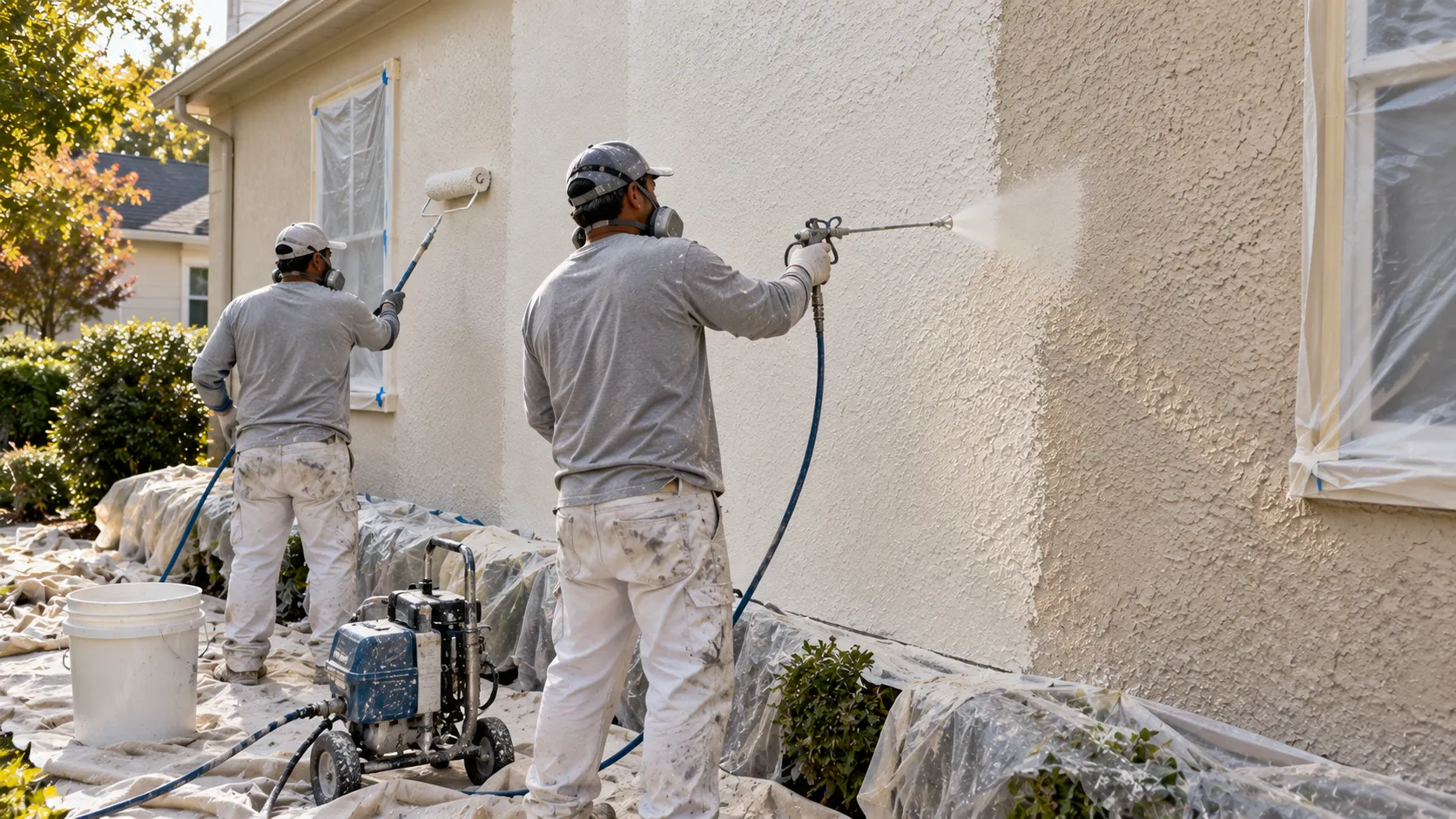
How Do You Paint Stucco? Step by Step
- Inspect and identify. Confirm hard-coat, EIFS or lime stucco; tap for hollow spots; note cracks, efflorescence, staining and any water sources. On pre-1978 homes, treat existing paint as potentially containing lead (see below).
- Fix water problems first. Gutters, downspouts, flashing, sealant at windows, and pulling soil and mulch away from the bottom of the wall.
- Clean. Wash at a pressure suited to the stucco type, treat mildew, and remove efflorescence and loose, chalky paint.
- Repair. Fill cracks with elastomeric patch or sealant by width, and leave structural or delaminating stucco to a plasterer.
- Dry and wait. Let washed walls dry, and let new stucco patches cure to the paint maker's schedule.
- Prime bare, patched, new or chalky areas with an alkali-resistant masonry primer.
- Protect. Mask windows, doors, light fixtures and trim; cover plantings and walkways.
- Apply the finish. Spray and back-roll at the specified spread rate, usually two coats, with the recoat time on the data sheet between them, then check film build and touch up.
- Trim and details. Paint trim, doors and any siding sections. On mixed-cladding houses, see our notes on painting vinyl and aluminum siding.
How Does New Jersey Weather Affect Stucco Painting?
Temperature minimums and the painting season
Minimum temperatures differ by product: 35°F for Loxon XP, 40°F for Loxon primer and KEIM Soldalit, and 50°F for both elastomerics in the table. The minimum is only half the rule. Sherwin-Williams says not to apply Loxon XP if air or surface temperatures may drop below 35°F within 48 hours, and to make sure surfaces are at least 5°F above the dew point. Benjamin Moore says not to apply its elastomeric if rain is expected within 24 hours, and notes that because it goes on in heavy coats, it stays sensitive to rain and condensation longer than normal paint. That makes a cold, dewy late-October evening a real risk.
We paint stucco in New Jersey from spring into mid-fall and plan around overnight lows, dew and rain rather than just the afternoon high. Our guide to painting in cold weather covers the late-season limits in more detail.
Freeze-thaw
Rutgers' Office of the New Jersey State Climatologist notes in its overview of the state's climate that every station has recorded 0°F or below, and that snow can fall from mid-October to the end of April in the highlands and from mid-November to mid-April in the southern counties. Water that gets into cracks or behind a coating freezes and expands. That is why a vapor-open system and properly sealed cracks matter more here than in a dry climate. Trapped water that cannot dry out gets a chance to freeze, and a blister or delamination follows.
Shore houses and salt air
On stucco homes near the water in Monmouth and Ocean counties, what we see is faster chalking and mildew on the weather sides, salt residue on the surface, and wind-driven rain working into cracks and around windows. Rutgers notes the coastal zone is milder than the interior in autumn and early winter, which lengthens the fall painting window slightly at the shore. The extra step there is washing: salt and chalk have to come off completely before primer, and we pay closer attention to sealant at openings. It is also where a high-build masonry coating that passes wind-driven-rain testing, such as Loxon XP or an elastomeric, earns its cost on the exposed elevations.
How Much Does It Cost to Paint a Stucco House?
Our NJ painting cost guide lists stucco at $2.00 to $5.00 per square foot of paintable surface, higher at the bottom end than vinyl or wood siding because of the extra paint and back-rolling stucco takes. For 2,000 square feet of stucco wall, that is about $4,000 to $10,000 before repairs. Published national data lands in the same area. Two sources give a starting point. Fixr's stucco painting guide, updated January 2025, puts professional stucco painting at $1.50 to $4 per square foot of exterior wall, labor and materials included, and a national average of about $4,000, with a typical range of $3,000 to $5,000. Homewyse's stucco painting cost calculator, dated May 2026, gives $2.45 to $4.75 per square foot for basic prep, two coats of latex paint and cleanup, before general contractor markup, permits or tax.
New Jersey costs more because painting is mostly labor. O*NET's 2025 wage data for painters puts the New Jersey median at $28.49 an hour against $23.75 nationally, about 20 percent higher. Labor is not the whole bill, so we add 10 percent to the low end and 20 percent to the high end of the national figures, rounded to the nearest $100, to get New Jersey planning ranges. That adjustment is our own estimate, not a published figure.
| Stucco wall area | National range (Fixr) | NJ planning range (our estimate) |
|---|---|---|
| 1,200 sq ft | $1,800 to $4,800 | $2,000 to $5,800 |
| 1,500 sq ft | $2,250 to $6,000 | $2,500 to $7,200 |
| 2,000 sq ft | $3,000 to $8,000 | $3,300 to $9,600 |
| 2,500 sq ft | $3,750 to $10,000 | $4,100 to $12,000 |
These are planning numbers built from published data, not our price list. What moves a quote up or down:
- Repairs. Fixr puts stucco repair at $600 to $1,700 on average; widespread cracking or delaminated sections can cost far more.
- Washing. Fixr lists pressure washing at $450 to $800. Our power washing cost guide covers what goes into that number.
- Coating choice. Fixr lists acrylic paint at $20 to $60 a gallon, masonry paint at $25 to $80 and elastomeric at $35 to $115, and elastomeric also needs more gallons than ordinary house paint because it goes on thicker.
- Texture and height. Rough dash finishes need more paint and more back-rolling; second- and third-story walls need ladders, planks or lifts.
- Color change. Going from light to dark, or dark to light, can add a coat.
- Trim, soffits and doors painted at the same time.
For houses that are part stucco and part siding, our full breakdown of what it costs to paint a house in NJ covers the rest of the exterior, and brick sections are priced in painting a brick house.
How Long Does Paint Last on Stucco?
Fixr says stucco typically needs repainting every five to ten years, with synthetic stucco at the shorter end (five to seven years) and high-moisture climates needing it more often. In our experience the range depends less on the brand than on three things: whether the paint went on at the specified film thickness, whether the cracks and water problems were fixed first, and how exposed the wall is. A shaded, sheltered side can look fine for years longer than the south wall or a wall facing the ocean.
Signs it is time: chalk rubbing off on your hand, fading on the sunny elevations, cracks opening back up, efflorescence, and peeling around windows. If paint is peeling in sheets rather than wearing, water is usually the cause; see why paint peels. Our guide to how often to paint a house in NJ compares stucco with other siding.
Should You Paint Stucco Yourself or Hire a Pro?
Honest answer: a one-story stucco wall, a garden wall or a foundation skirt in good condition is a reasonable DIY project if you are patient. Buy the masonry primer and paint the manufacturer names, use a thick-nap roller (Sherwin-Williams lists 1/2 to 1-1/2 inch nap for Loxon XP), and budget for about 80 sq ft per gallon per coat on rough texture, not the number on the front of the can.
Hire out if the house is two stories or more, has widespread cracking, is EIFS, is historic lime stucco, or needs an elastomeric system, where film build and application method decide whether it works. The same goes if the home was built before 1978. EPA's Renovation, Repair and Painting rule requires anyone paid to disturb painted surfaces in pre-1978 homes to be certified and follow lead-safe practices, and scraping or sanding old paint on stucco counts.
If you do hire, New Jersey requires home improvement contractors to register with the Division of Consumer Affairs. Its consumer brief on hiring a contractor says the contract must include the contractor's registration number, that the contractor must give you a copy of their liability insurance, and that you can cancel a signed contract before midnight of the third business day after you get a copy. Ask for a written scope that names the primer, the finish product, the number of coats and how cracks will be handled. Two stucco quotes can be far apart simply because one of them is planning a third of the paint.
Frequently Asked Questions
Can you paint stucco?
Yes. Cement stucco takes paint well when it is sound, dry, clean and, if new, cured. Use a masonry primer on bare or patched areas and a breathable acrylic, elastomeric or mineral paint made for masonry. EIFS and historic lime stucco can be painted too, but they need products and cleaning methods suited to them.
What is the best paint for stucco?
For most previously painted cement stucco, a 100% acrylic masonry or exterior paint such as Sherwin-Williams Loxon XP or Duration. Elastomeric such as ConFlex XL or Benjamin Moore Ultra Spec Masonry Elastomeric suits heavily cracked walls exposed to driving rain. Mineral silicate paint suits older and lime stucco that needs to breathe.
Should I use elastomeric paint on stucco?
Only when there is a reason. It bridges hairline cracks and resists wind-driven rain, but it goes on thick and mutes texture, and the Stucco Manufacturers Association says it is not required on properly applied stucco and lists long-term vapor drive among the things to weigh first. Use it on dry, sound walls with widespread cracking, applied at full film thickness.
How long should new stucco cure before painting?
Benjamin Moore recommends 30 days and a pH of 10 or less, or 7 days and a pH of 13 or less if you use its masonry sealer or high-build primer first. Sherwin-Williams' Loxon primer can go on masonry at least 7 days old. Oil-based paint needs up to a year, according to the National Park Service.
How much does it cost to paint a stucco house in NJ?
Our NJ cost guide lists stucco at $2 to $5 per square foot of paintable surface. National data from Fixr puts it at $1.50 to $4 per square foot of exterior wall, or $3,000 to $8,000 for 2,000 sq ft of stucco; adjusted for New Jersey labor, our own estimate is roughly $3,300 to $9,600 for that much wall, plus repairs.
Is it a good idea to paint stucco?
Yes for stucco that is already painted, stained or patched in mismatched colors, as long as the wall is dry and sound. Think twice on never-painted stucco you still like, because once it is painted it needs repainting every five to ten years and can no longer be refreshed with a fog coat.
Do you need to prime stucco before painting?
New, bare, patched or chalky stucco needs an alkali-resistant masonry primer such as Sherwin-Williams Loxon Primer-Sealer or Benjamin Moore Ultra Spec Masonry sealer. Sound, previously painted stucco usually needs only spot-priming of repairs, and some masonry coatings, such as Loxon XP, can go directly onto masonry up to pH 13.
What sheen is best for stucco?
Flat or low sheen. Texture makes any shine look blotchy, and a flat finish hides blemishes. Masonry coatings such as Sherwin-Williams Loxon XP are made as flats. Use satin or gloss on the trim and doors instead.
Can you paint stucco with a roller?
Yes, with a thick-nap roller (Sherwin-Williams lists 1/2 to 1-1/2 inch nap for Loxon XP) worked into the texture. On a whole house we spray and back-roll, which is faster and pushes paint into the pits so the film has no pinholes. Spraying alone on rough stucco often leaves pinholes.
How long does paint last on stucco?
About five to ten years according to Fixr, with synthetic stucco and wet climates at the shorter end. Film thickness, crack repair and exposure matter more than the brand: south-facing and ocean-facing walls wear first.
What temperature do you need to paint stucco?
It depends on the product. Sherwin-Williams Loxon XP can go on down to 35°F, Loxon primer and KEIM Soldalit need 40°F, and the elastomerics from both brands need 50°F. Sherwin-Williams adds that Loxon XP should not go on if air or surface temperatures may drop below 35°F within 48 hours, and that surfaces must be at least 5°F above the dew point. That is why cold, dewy late-fall evenings in New Jersey are the risk, not the afternoon high.
How much paint does stucco take?
Far more than siding. Sherwin-Williams rates its Loxon XP masonry coating and Loxon primer at about 80 sq ft per gallon on porous, rough stucco, and Benjamin Moore rates its elastomeric at 80 to 100 sq ft per gallon. Two coats on 2,500 sq ft of rough stucco is roughly 60 gallons.
Can you pressure wash stucco before painting?
Yes, carefully. Use a wide fan tip and moderate pressure on hard stucco, under 500 psi on EIFS according to Dryvit, and low pressure with soft brushes on historic stucco according to the National Park Service. Let the wall dry fully before priming.
Get a Straight Answer on Your Stucco
Whether your stucco needs paint, repair or just a good wash is something we can tell you in one visit. NJ Painting Co. is a family-owned, licensed and fully insured painting company at 36 Church Rd, Morganville, NJ 07751, with more than 20 years of experience on New Jersey homes. We use Benjamin Moore and Sherwin-Williams products, back our work with a 2-year workmanship warranty, and our estimates are free and include an in-home color consultation.
See what goes into our exterior work on the exterior painting page. We work throughout Monmouth County, Middlesex County and Ocean County, including shore towns like Point Pleasant where stucco takes the most weather. Call (732) 239-0932 or request a free estimate, and we will check your stucco, explain the options and give you a written quote that names every product and coat.
About the author
Written by the NJ Painting Co. team
NJ Painting Co. is a family-owned painting contractor based in Monmouth County, in business since 2004. We are licensed and fully insured, work with Benjamin Moore and Sherwin-Williams paints, and back our work with a 2-year workmanship warranty. We serve Monmouth, Middlesex, Ocean, Mercer, Somerset and Burlington counties, plus Union, Essex, Hudson, Bergen and Passaic in North Jersey.