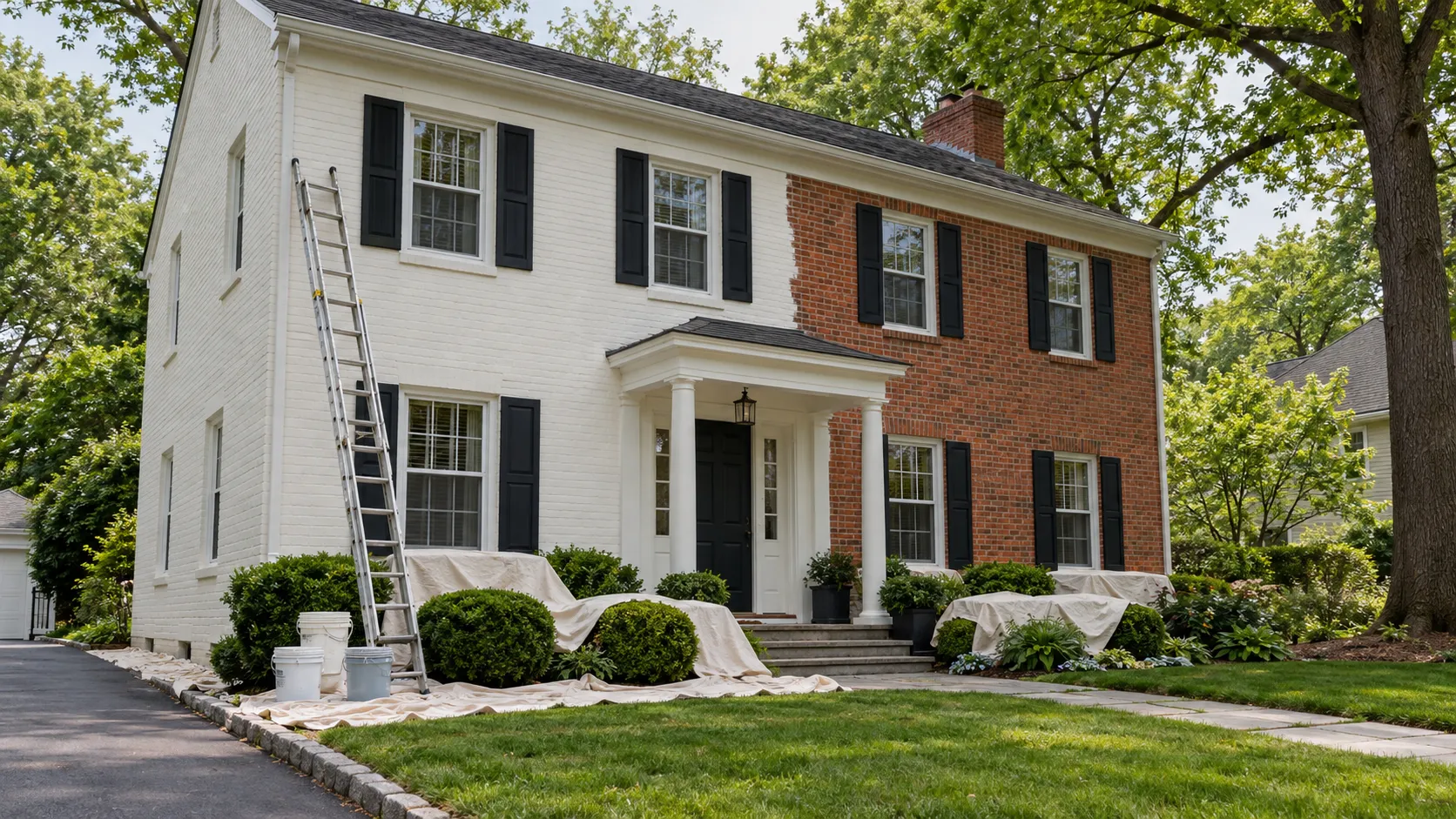
Yes, you can paint a brick house, and done right it can look great for years. But painting brick is a bigger decision than painting siding. Paint is very hard to get back off brick, it turns a no-maintenance wall into one that needs repainting, and the wrong coating can trap moisture that New Jersey winters then turn into flaking, spalling brick. Painting a brick house works when the brick and mortar are sound and dry, when the brick has been cleaned and tested, and when you use an alkali-resistant masonry primer under a breathable exterior paint, or a mineral paint made for brick.
We are a family-owned painting company in Morganville and have painted homes across Monmouth, Middlesex, Ocean, Mercer, Somerset and Burlington counties, plus Union, Essex, Hudson, Bergen and Passaic in North Jersey, for more than 20 years, using Benjamin Moore and Sherwin-Williams products. We paint brick, and we also talk people out of it when the wall is not a good candidate. This guide explains how we make that call, compares the alternatives, walks through our process and shows what painting a brick house costs as of September 2026, with every technical point linked to the Brick Industry Association, the National Park Service or the manufacturer's data sheet.
The Short Answer: Should You Paint Your Brick House?
- Paint it if the brick and mortar are sound, the walls stay dry, and you want a color change the brick cannot give you: mismatched repairs or additions, a dated orange or multicolor brick, or a house that was painted long ago.
- Think twice if you like the brick. Unpainted brick needs almost no upkeep; painted brick needs repainting for as long as you own it.
- Do not paint it yet if the wall shows efflorescence, spalling, failing mortar or leaks. Paint hides those problems for a season and then fails over them.
- Consider the alternatives. Limewash, mineral silicate paint and masonry stain change the color of brick while keeping it more breathable than a paint film.
- Budget $2.50 to $5.00 per square foot of paintable surface, per our NJ painting cost guide, before masonry repairs.
Why Painting Brick Is a Bigger Decision Than Painting Siding
The Brick Industry Association (BIA) publishes Technical Note 6, "Changing the Appearance of Brick Masonry" (March 2025). Its first recommendation is to "consider permanence and maintenance issues" before choosing any treatment. Three points shape everything we do on brick.
It is hard to reverse
The BIA says plainly that "paint can be very difficult to remove from brick masonry without causing damage, and painted exterior brickwork can require repainting on a regular basis." It says that many of the techniques it describes "are irreversible." Changing your mind later means a slow chemical stripping job, covered further down.
Brick has to dry out
The BIA explains that because exterior brick "is exposed to moisture, and in many cases freezing and thawing cycles, it is important that the treatment permits evaporation of moisture." Acrylic latex paint forms a film on the brick, and the BIA says it "is typically identified as vapor semi-permeable rather than fully vapor permeable." It warns that treatments "can further compromise the brickwork if they trap moisture in the wall."
The National Park Service makes the same point more bluntly in Preservation Brief 1. When water gets into a wall behind a coating that will not let it out, "during cold weather this water in the wall can freeze causing serious mechanical disruption, such as spalling."
It creates a maintenance cycle
The BIA notes that "applying acrylic latex paint to brick creates a recurring exterior maintenance task, requiring multiple reapplications over the life of the brickwork." That is the honest trade: a new look in exchange for a repaint schedule.
Brick That Should Not Be Painted
In our experience the best candidates are brick houses that were painted decades ago, and the mid-century ranches, split-levels and colonials common in central New Jersey where additions and repairs never matched the original brick. These are not good candidates:
- Walls with active moisture problems, until the source is found and fixed. The checks are below.
- Glazed or very dense brick. The BIA says glazed brick is "hard, glossy and generally impermeable," that mineral paints, stains and limewash "will not bond to glazed brick," and that film-forming paints on roughened glaze have "very limited durability."
- Brick steps, patios and walks. The BIA does not recommend treating pavers and floors, which stay wetter and wear under foot traffic.
- Early historic brick. The BIA says that on some structures built before about the 1870s, a limewash or similar mineral coating was part of the moisture-control system and should be maintained with a compatible product, ideally with a historic-masonry consultant. If your house is in a historic district, check with your town before changing an exterior finish.
Paint vs Limewash vs Mineral Paint vs Masonry Stain
"Painting brick" covers several very different products. The BIA's technical note describes each, and the table summarizes what it and the manufacturers say. We cover limewash in depth, including cost, weather limits and fireplaces, in our limewash brick guide, so here it appears only for comparison.
| Treatment | Look | How it bonds | Breathability | Upkeep and lifespan | Goes over painted brick? |
|---|---|---|---|---|---|
| Acrylic latex masonry paint | Opaque, any color, choice of sheen; softens brick texture | Film on the surface | Semi-permeable film; lower with every extra coat | Recurring repaints over the life of the wall | Yes, over sound paint |
| Mineral (silicate) paint | Opaque, dead-flat mineral look | Chemical bond into the brick | High; BIA says permeability is not affected | BIA: warranties typically 15+ years; KEIM and Romabio offer 20-year warranties | Traditionally no; some newer products yes, over sound acrylic |
| Masonry stain | Semi-opaque to opaque; keeps the natural brick texture | Absorbed into the pores | High when mineral-based | BIA: no maintenance required; projects lasting 20+ years | No; needs absorbent brick |
| Limewash | Chalky, matte, often washed back to show brick | Carbonates into the surface | High | Weathers by design; BIA says five to 10 years or more | No |
A few details the table cannot hold:
- Mineral paint uses a silicate binder that bonds chemically with the brick, so the BIA says classic mineral paint "can be applied only to brickwork that is clean and unsealed." Some newer products are more flexible: KEIM's Mineral Masonry Paint lists a system for previously acrylic-painted surfaces but says it is "not suitable for use over previously painted surfaces of elastomeric, oil-based paints or lacquers and varnishes." Romabio's FAQ calls for one coat of its MicroGrip primer, then two coats of Masonry Flat, on previously painted surfaces to keep its 20-year warranty.
- Masonry stain is what brick manufacturers themselves use for color correction. The BIA says staining "has been a widely accepted industry practice for more than 50 years" and that stains "do not alter the surface texture of the brick masonry." It is specialist work; the BIA recommends applicators with at least three years of staining experience and a warranty of 15 years or more.
Is Your Brick Ready for Paint? What We Check First
The BIA says the masonry "must be in good condition prior to application of a treatment." These are the checks we make on every brick estimate.
Mortar and cracks
The BIA recommends repointing any mortar that is "deteriorated, loose or missing, or contains cracks wider than the thickness of a business card," and recommends that repointing be done by "a mason experienced with repair and restoration." The Park Service's Preservation Brief 2 adds that new mortar "must be as vapor permeable and as soft or softer (measured in compressive strength) than the historic mortar," which matters on older houses.
Efflorescence and damp
White, powdery salt on brick is efflorescence, and the BIA treats it as a warning sign: "soiling or efflorescence on the exterior are also signs that excess moisture is present." It says efflorescence should be removed and the wall then "observed for reoccurrence prior to being treated." If it keeps coming back, something is feeding it water: a gutter, a missing flashing, or soil piled against the brick.
Old sealers and coatings
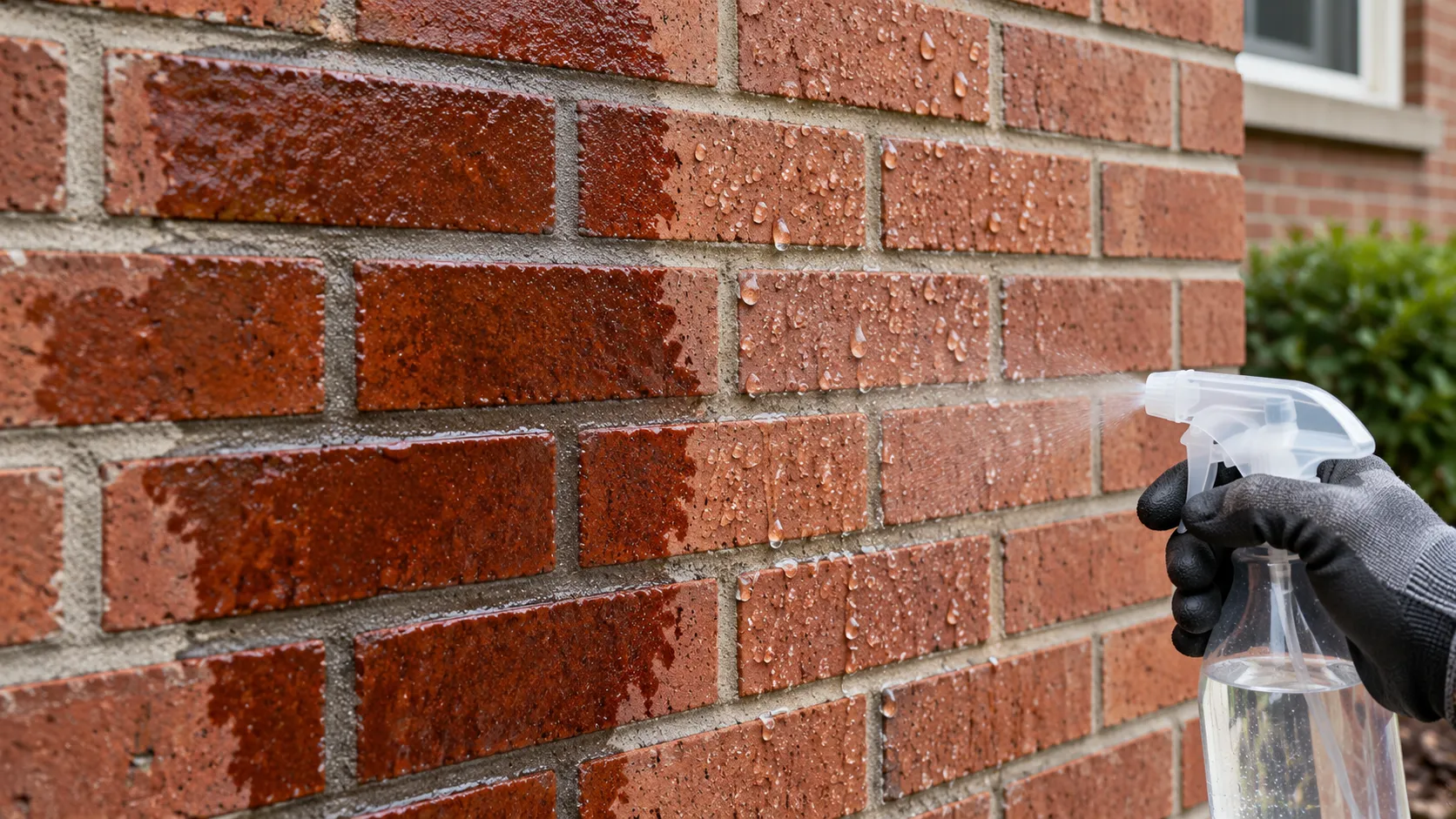
A clear water repellent applied years ago is invisible. The BIA says previously applied "sealers or water repellents, must be removed prior to application of a new treatment" in most cases. Our field check is the water test the BIA requires before staining: splash water on each elevation. If it soaks in, the brick is absorbent; if it beads, something is sealing the surface, and that changes the product choice.
Lead on previously painted brick
If your house was built before 1978 and the brick is already painted, assume the old paint may contain lead until tested. The EPA's Renovation, Repair and Painting program requires that "anyone paid to perform work that disturbs painted surfaces in homes, childcare facilities and preschools built before 1978 be certified." Scraping loose paint off brick counts.
How to Paint Brick Exterior: Our Step-by-Step Process
The data sheet always has the final say, but this is our sequence for a masonry primer and acrylic topcoat.
- Inspect and test mortar, brick, flashing and sealant joints, with a water test on every elevation.
- Fix water and masonry first. Gutters, downspouts, grading and flashing come before paint. Repointing and brick replacement go to a mason, and new mortar needs time: the BIA recommends allowing "at least 30 days for the mortar to cure," and longer in cool weather.
- Clean gently. The BIA recommends "the least aggressive technique necessary," often "scrubbing with a stiff-bristled, non-metallic brush and soapy water or low-pressure washing." For historic masonry, the Park Service recommends starting at 100 psi or below and generally staying under 300 to 400 psi. The BIA says not to use muriatic acid. Benjamin Moore's data sheet for its Ultra Spec Masonry acrylic sealer (608) notes that "a common exterior paint failure on masonry construction is peeling and scaling, often caused by painting over chalk deposits."
- Remove loose paint and efflorescence. On a pre-1978 house, paid scraping of old paint falls under the EPA's RRP rule described above. We are not an EPA Lead-Safe Certified firm, so if your brick is already painted and the house predates 1978, ask any bidder how they will handle that part of the job.
- Let the wall dry. The BIA says to wait at least 24 hours after cleaning, longer after rain or in humid weather, and notes that brick "does not dry at a uniform rate or evenly across a building." Its simple check: tape a sheet of 4-mil plastic tightly to the brick for at least 16 hours; moisture on the underside means wait longer.
- Mask and cover windows, trim, fixtures, plantings and walks.
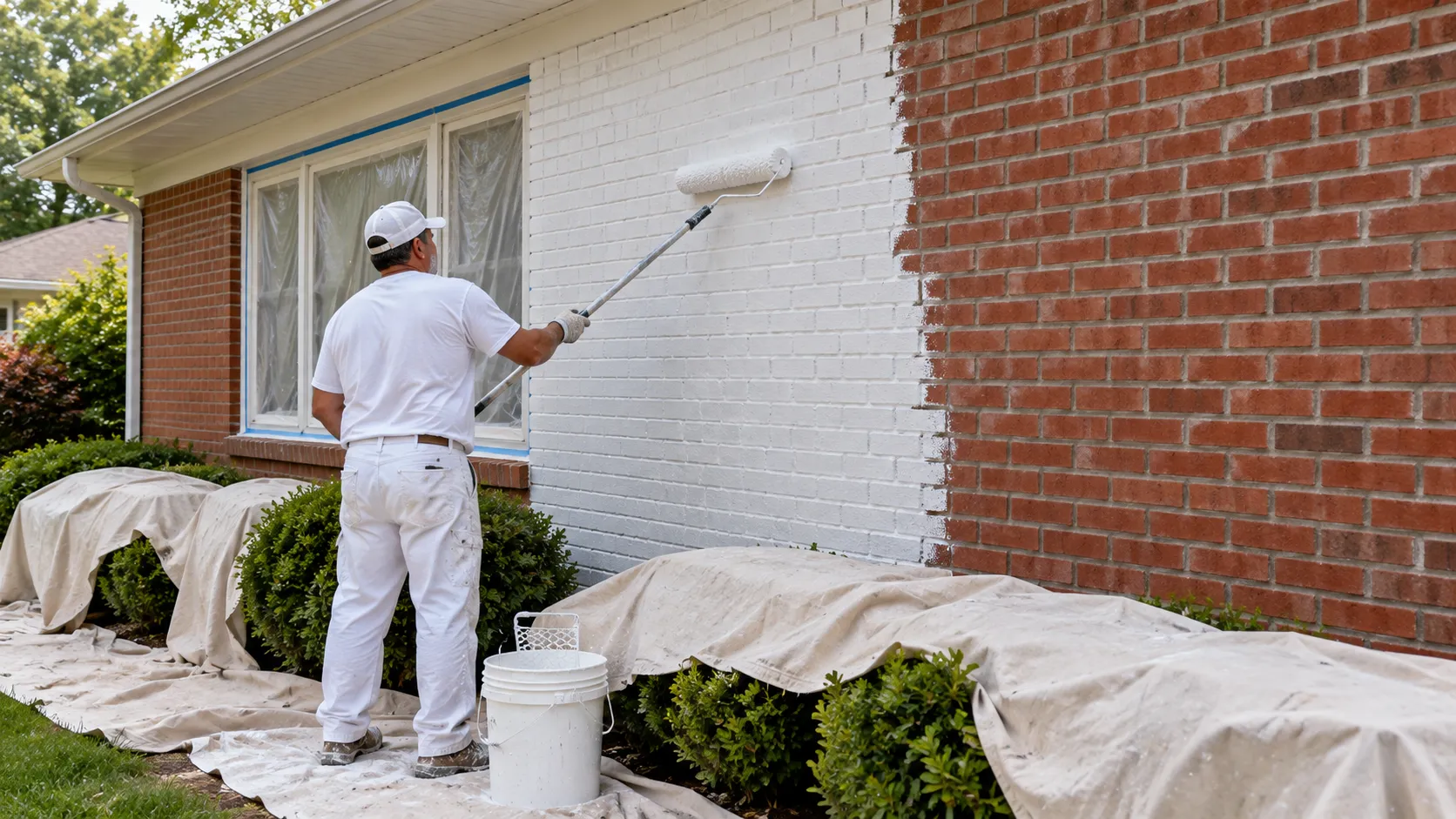
- Prime with an alkali-resistant masonry primer. Mortar is alkaline, and the BIA says "an alkaline-resistant primer or a paint specifically designated for use on masonry is recommended." On bare brick we prime the whole wall rather than spots; Sherwin-Williams' Loxon primer data sheet warns that spot priming can leave "a non-uniform appearance of the final coat."
- Work the paint into the joints with thick-nap rollers and brushes, or spray and back-roll, so no pinholes are left in the pores and recessed mortar.
- Two finish coats at the specified rate, with the data sheet's recoat time between them. The BIA also cautions to "avoid too many coats or heavy applications of paint, which will further lower the permeability of the walls."
- Trim, touch-up and a daylight walk-through with you.
Best Primer and Paint for Exterior Brick
Primer
We use primers made for high-pH masonry:
- Sherwin-Williams Loxon Concrete & Masonry Primer-Sealer. Its data sheet lists brick among its surfaces, says it "is highly alkali and efflorescence resistant," rates it for a pH of 6 to 13 on masonry at least 7 days old, gives 200 to 320 sq ft per gallon, and says it must be topcoated within 14 days outside.
- Benjamin Moore Ultra Spec Masonry Interior/Exterior 100% Acrylic Sealer (608). Benjamin Moore says it is "designed to penetrate and seal the surface of new or previously painted masonry," is alkali-resistant up to pH 13, and covers 200 to 400 sq ft per gallon depending on texture and porosity.
Topcoat
Over those primers, the manufacturers point to their exterior house paints. The Loxon primer data sheet lists topcoats including Duration Exterior, Emerald Exterior, SuperPaint Exterior and Loxon masonry coatings; Benjamin Moore's 608 sheet calls for an "appropriate Benjamin Moore exterior house paint." On most brick we use a premium 100% acrylic exterior in a flat or low-sheen finish, which in our experience hides the brick's surface variation and touches up best.
Mineral paint
For older brick, for walls that stay damp, or for owners who want the most breathable opaque finish, we recommend mineral silicate paint. KEIM's Mineral Masonry Paint data sheet lists a water vapor permeability of 77 perms, a two- or three-coat system, coverage of 200 to 250 sq ft per gallon on brick, and a substrate that must be "sound, dry, absorbent, clean." In our experience it costs more per gallon than acrylic, but it cannot peel the way a film can.
What about elastomeric?
We almost never put thick, waterproofing elastomeric coatings on brick walls. The Park Service groups them with waterproof coatings and says these "should almost never be applied above grade to historic masonry buildings," because water that gets in from the ground or the inside cannot get out. The BIA is similarly cautious about pigmented water-repellent coatings, recommending them only where water repellency is actually required and "strongly" recommending review by a registered design professional first. Elastomeric has a place on cracked stucco (see our stucco painting guide), not on sound brick.
Best Colors for a Painted Brick House
Brick is textured and full of shadow, so a color on brick reads darker and less even than the same chip on smooth siding. In our experience three families do almost all of the work on New Jersey brick houses:
- Warm whites, the most requested look. Benjamin Moore lists White Dove OC-17 at an LRV of 83.16 and calls it a "clean and classic white." A warm white hides the dust and pollen that collect in mortar joints better than a stark, blue-white one.
- Greige and soft gray, for a quieter change or a house with a gray or charcoal roof. Revere Pewter HC-172 (LRV 55.05) is Benjamin Moore's "versatile bridge between warm and cool tones."
- Charcoal and near-black, for a modern look on a ranch or a brick front. Kendall Charcoal HC-166 has an LRV of 14.61. In our experience dark colors show fading first on the south and west walls.
Painting a red or orange brick house gray is one of the most common requests we get. Start with the roof and any stone you are keeping. A brown or weathered roof usually wants a warm white or greige over a cool gray. Brick also makes the vinyl-siding heat rule irrelevant, so dark colors are an option here that they are not on vinyl. Because paint is so hard to get back off brick, test on large boards with two coats of each finalist held against the wall, and look at them in morning and afternoon light; only sample on the brick itself in a spot you have already committed to painting. Our guide to popular exterior house colors lists more Benjamin Moore and Sherwin-Williams colors with codes and LRVs, and explains trim and accent choices.
New Jersey Weather and Timing
Rutgers' Office of the New Jersey State Climatologist notes in its climate overview that every weather station in the state has a record of 0°F or below, and that the average freeze-free season runs 163 days in the northern highlands, 179 in the central and southern interior, and 217 along the seacoast. That means plenty of freezing and thawing, which is why a brick wall's ability to dry out matters here. It also sets the painting season, and minimums differ by product:
- Loxon primer: 40°F, and air and surface temperatures "must not drop below 40°F for 48 hours after application," with surfaces at least 5°F above the dew point.
- Benjamin Moore 608 sealer: not below 50°F air and surface temperature.
- KEIM Mineral Masonry Paint: 40°F and rising, below 86°F, out of direct sun on hot walls, and protected from wind and rain for at least 12 hours.
Washing is weather-dependent too. The Park Service says water cleaning should not be done "in cold weather or if there is any likelihood of frost or freezing," and notes that a masonry wall "may take over a week to dry after cleaning." We wash and paint brick from mid-spring into early fall and plan around overnight lows and dew, not the afternoon high.
How Much Does It Cost to Paint a Brick House in NJ?
Our cost guide puts professional brick painting in New Jersey at $2.50 to $5.00 per square foot of paintable surface, the highest starting price of the siding types we list. National figures agree: This Old House's exterior painting cost guide (updated March 2026) lists brick at $2.60 to $5.00 per square foot and notes that brick often requires "extensive prep work, multiple coats, or specialty paint," and Homewyse's brick painting calculator (September 2026) starts at $2.64 to $4.99 per square foot for prep and two coats, before a general contractor's overhead and markup, which it says adds 13% to 22%.
| Brick wall area | Typical situation | Estimated range |
|---|---|---|
| 400 sq ft | Brick front or lower story on a colonial or split-level | $1,000 to $2,000 |
| 1,200 sq ft | Brick ranch, most walls | $3,000 to $6,000 |
| 1,800 sq ft | Larger ranch or partial two-story | $4,500 to $9,000 |
| 2,500 sq ft | All-brick two-story colonial | $6,250 to $12,500 |
Brick wall area is not living area: multiply each wall's length by its height and subtract large openings. These are planning figures, not a quote. What moves the number:
- Masonry repairs. Fixr's brick repair cost guide (updated March 2025) puts simple tuckpointing at $3 to $7 per square foot for the first 10 feet of height, rising to about $10 per square foot where scaffolding is needed.
- Bare vs previously painted brick. Bare brick takes a full primer coat; peeling paint needs scraping, which on a pre-1978 home must be done by an EPA-certified firm.
- Height and access. Gables, chimneys and two-story walls mean ladders, planks or lifts.
- Trim, shutters and doors painted at the same time.
Maintenance: How Long Painted Brick Lasts
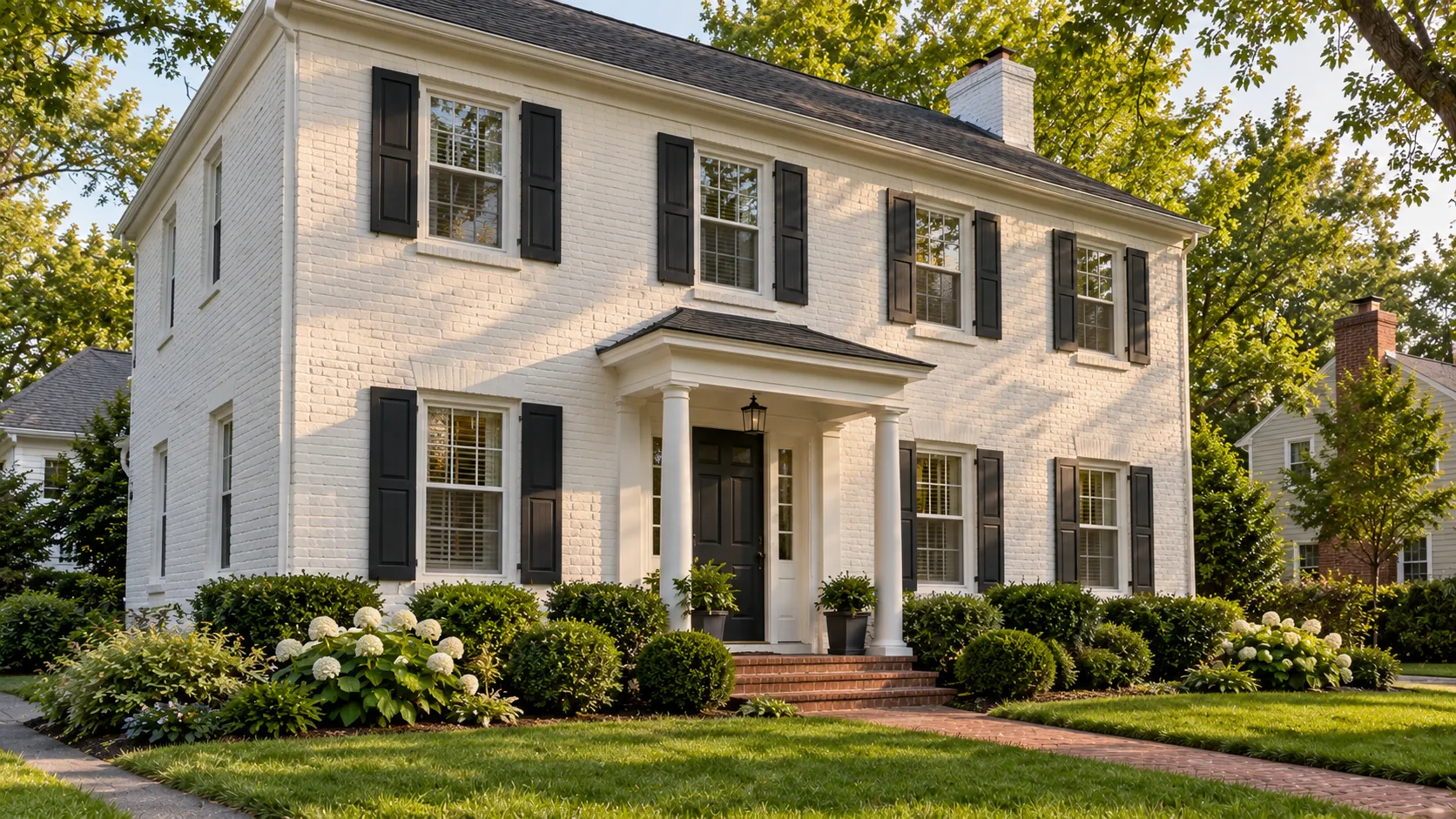
For a properly prepared exterior, our cost guide uses six to ten years as a general figure; where a brick job lands depends on prep, product and exposure. On brick, the south and west walls and anything near the shore usually show wear first. Our guide to how often to paint a house in NJ covers repaint intervals by siding type and location.
Mineral paints and stains last far longer, as the comparison table shows. Whatever you choose, keep gutters clear, keep soil and mulch off the bottom courses, and watch for returning efflorescence, the first sign that water is getting in.
Can You Undo It? Removing Paint From Brick
The BIA warns that some treatments "may be difficult or impossible to remove without damaging the brickwork." It says abrasive methods such as sandblasting "are not recommended, as the process will damage the brickwork," that pressurized water "is not recommended for removal of treatments because the pressures needed would be excessive," and that removal generally takes "a proprietary chemical solution specifically formulated for brickwork," tested on an inconspicuous area first. The Park Service's Brief 1 adds that abrasive blasting can strip the brick's fired outer surface, "permanently damaging the masonry."
So treat painting brick as a long-term decision, and if you are unsure, live with a sample first.
DIY or Hire a Pro?
A garden wall or a one-story section of sound, previously painted brick is a fair DIY job: wash it, let it dry, prime bare spots with masonry primer, and use a thick-nap roller. Hire out for two-story walls, masonry repairs, never-painted brick, or disturbing old paint on a pre-1978 home.
What we offer on brick is painting, acrylic or mineral, and staining. Limewash and German smear are compared above because they are real alternatives worth knowing about, but they are not services we list; if either is what you want, hire an applicator who specialises in it. Whether to paint your brick, stain it or leave it alone, we will give you a straight answer after testing the brick and checking the mortar. NJ Painting Co. is a family-owned, licensed and fully insured painting company at 36 Church Rd, Morganville, NJ 07751, working on New Jersey homes for more than 20 years with Benjamin Moore and Sherwin-Williams products. Every estimate is free, includes an in-home color consultation, and names the primer, finish and number of coats; our work carries a two-year workmanship warranty. See our exterior painting service, see the brick ranches and colonials we paint across Monmouth, Middlesex and Ocean counties, check that we cover your town on our service areas page, or call (732) 239-0932 and request a free estimate.
Frequently Asked Questions
Should I paint my brick house?
Paint it if the brick and mortar are sound, the walls stay dry, and you want a color change the brick cannot give you, such as covering mismatched repairs or a dated color. Leave it if you like the brick, since painting commits you to repainting, and never paint over efflorescence, spalling or failing mortar.
Is it a bad idea to paint brick?
Not if it is done right, but it is hard to reverse. The Brick Industry Association says paint can be very difficult to remove from brick without damage and that painted exterior brick can require repainting on a regular basis. The biggest risk is trapping moisture, which is why we use breathable masonry systems and fix water problems first.
How much does it cost to paint a brick house in NJ?
As of September 2026, our cost guide puts brick at $2.50 to $5.00 per square foot of paintable surface. For about 1,200 square feet of brick wall, a typical ranch, that is roughly $3,000 to $6,000, with repointing and other masonry repairs extra.
What kind of paint do you use on exterior brick?
An alkali-resistant masonry primer such as Sherwin-Williams Loxon Concrete and Masonry Primer or Benjamin Moore Ultra Spec Masonry sealer, followed by two coats of a premium 100% acrylic exterior paint. For older or damp-prone brick, mineral silicate paint is more breathable. We avoid elastomeric coatings on brick walls.
What Benjamin Moore paint is best for brick?
Benjamin Moore's masonry system starts with Ultra Spec Masonry Interior/Exterior 100% Acrylic Sealer (608), which its data sheet says can go on masonry up to pH 13. For rough or pitted masonry, the same sheet calls for an appropriate Benjamin Moore exterior house paint over it, or its Ultra Spec Masonry Elastomeric (flat 359 or low lustre 360). On sound brick we use the sealer under a premium 100% acrylic exterior in flat or low sheen, and avoid the elastomeric for the reasons above. Benjamin Moore itself is a New Jersey company; the 608 data sheet lists its headquarters in Montvale.
What color should I paint my brick house?
Warm whites such as Benjamin Moore White Dove OC-17, greiges such as Revere Pewter HC-172, and charcoals such as Kendall Charcoal HC-166 are the three directions most New Jersey brick houses take. Choose around the roof and any stone you are keeping, and test on large sample boards held against the brick before committing, because paint is very hard to remove from brick.
Is limewash or paint better for brick?
Limewash is more breathable and will not peel, but it only works on bare, absorbent brick, comes in limited light colors and weathers by design. Paint offers any color and a uniform look and can go over previously painted brick, but it forms a film. Mineral paint sits in between: opaque and long-lasting, with high breathability.
How long does paint last on brick?
Our cost guide uses six to ten years as a general figure for a properly prepared exterior; sun, shore exposure and prep move it up or down. Mineral paints and masonry stains typically last much longer, according to the Brick Industry Association.
Can paint be removed from brick?
Usually, but it is slow and costly. The Brick Industry Association recommends chemical removers made for brick, tested on a small area first, and advises against sandblasting and high-pressure water, which damage the brick face. Some coatings cannot be fully removed.
About the author
Written by the NJ Painting Co. team
NJ Painting Co. is a family-owned painting contractor based in Monmouth County, in business since 2004. We are licensed and fully insured, work with Benjamin Moore and Sherwin-Williams paints, and back our work with a 2-year workmanship warranty. We serve Monmouth, Middlesex, Ocean, Mercer, Somerset and Burlington counties, plus Union, Essex, Hudson, Bergen and Passaic in North Jersey.