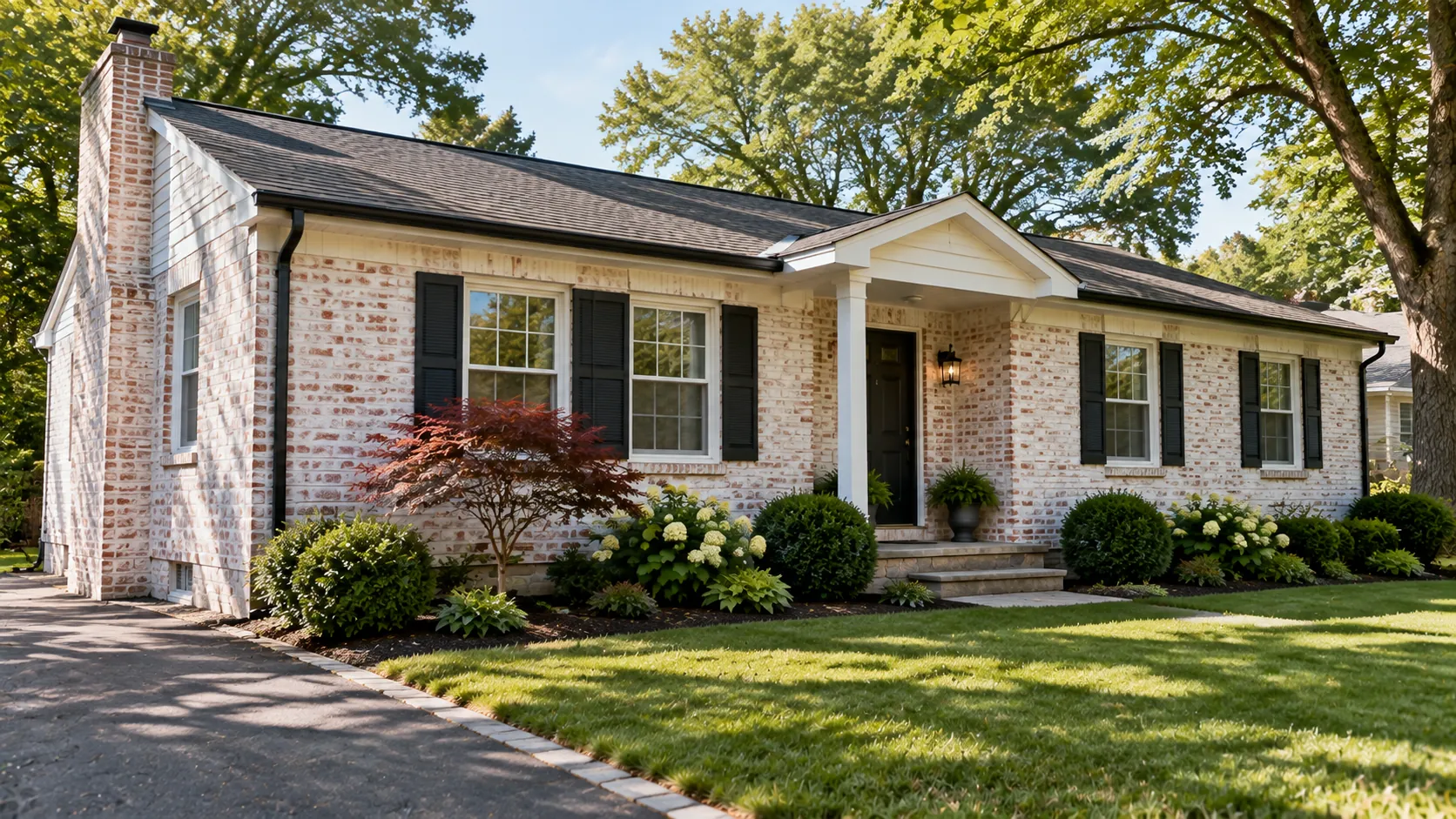
Limewash is a mineral coating made from slaked lime, water and natural pigments that soaks into bare brick and hardens as it absorbs carbon dioxide from the air. It gives brick a soft, matte, old-world look and lets the wall keep breathing, which matters in New Jersey's freeze-thaw winters. The trade-off is that it is meant to weather: it thins and patinas over the years instead of peeling, and it only works on brick that has never been painted or sealed.
What does limewash cost? Professional limewashing runs $1.50 to $5.00 per square foot of brick nationally, or about $1,500 to $6,700 for a whole house, according to Angi and HomeGuide. Adjusted for New Jersey labor, plan on about $1.65 to $6.00 per square foot: roughly $1,320 to $4,800 for an 800 square foot brick front and $2,475 to $9,000 for most of a brick ranch. Repointing, repairs and stripping old paint are extra. The full breakdown, and what moves the number, is in the cost section further down.
To be clear up front: limewashing is not a service we list. NJ Painting Co. paints and stains brick, and this guide is a painter's honest read of limewash for homeowners weighing it against those options. Everything below is either sourced from a manufacturer, a federal preservation guide or a published cost survey, or it is what we see on brick across Monmouth, Middlesex, Ocean, Mercer, Somerset and Burlington counties, plus Union, Essex, Hudson, Bergen and Passaic in North Jersey. If limewash turns out to be what you want, hire a limewash applicator who names the product and tests your brick; if paint or stain is the better answer, that is work we do.
What Is Limewash, Exactly?
Limewash is one of the oldest architectural finishes there is. It starts as limestone that is burned into quicklime and then "slaked" with water into a lime putty. Romabio's Classico Limewash technical data sheet describes its product as slaked lime aged for 12 to 48 months, with a 97 percent natural mineral content, and says it bonds to mineral surfaces by carbonation.
Carbonation is the key. Wet limewash is calcium hydroxide; as it dries on a damp wall it absorbs carbon dioxide and turns back into calcium carbonate, essentially limestone, locked into the pores of the brick. Romabio says full carbonation takes at most 20 to 25 days in ideal conditions (68°F, 60 percent relative humidity). Limewash does not sit on the brick like a plastic film; it becomes a thin mineral skin in the surface.
Three consequences follow:
- It needs absorbent brick. If the brick cannot drink the limewash, it cannot carbonate into it.
- It stays vapor-open. Moisture in the wall can still escape, because there is no film to trap it.
- It wears rather than fails. Rain slowly erodes lime, so limewash thins over the years instead of blistering or peeling.
Colors are limited to whites, off-whites and soft earth tones, because the lime itself is white and mutes whatever pigment is added. Portola Paints notes in its lime wash FAQ that really dark or vibrant colors are not achievable in lime.
Limewash vs Paint vs Mineral Paint vs German Smear vs Whitewash
These terms get used loosely, but they are very different finishes. The table compares the five we get asked about most.
| Finish | Look | Breathability | Durability and recoat cycle | Reversibility | Typical pro cost |
|---|---|---|---|---|---|
| Limewash | Chalky, very flat; translucent to fully opaque, often washed back to show brick | High; mineral, no film | Weathers gradually; commonly cited refresh every 5 to 7 years on exposed walls | Can be washed off in the first days; much harder once cured | $1.50 to $5.00 per sq ft |
| Whitewash (thinned paint or lime-chalk mix) | Similar washed look | Depends on what is in it; thinned latex is a film | Varies with the mix | Latex-based versions behave like paint | $1.40 to $4.20 per sq ft |
| Acrylic or latex masonry paint | Solid, uniform color; any shade | Lower; forms a film | Repaint roughly every 3 to 10 years depending on source and exposure | Stripping is slow and costly | $1.50 to $4.50 per sq ft |
| Mineral silicate paint | Solid, matte, mineral look; wide color range | High; bonds chemically, no film | Often cited at 20+ years | Effectively permanent | Not broken out; materials about $100 to $150 a gallon vs $25 to $70 for acrylic |
| German smear | Mortar partly covering brick; textured, rustic | Mortar layer, not a paint film | Described as permanent | Very difficult to remove without damaging brick | About $1,500 to $3,000 per project |
Where those numbers come from:
- Limewash and whitewash: Angi's limewash vs whitewash comparison puts professional limewashing at $1.50 to $5 per square foot and whitewashing at $1.40 to $4.20, and notes that whitewash can simply be watered-down white paint.
- Paint and mineral paint: HomeGuide's cost to paint a brick house guide lists painting brick at $1.50 to $4.50 per square foot, acrylic latex lasting 3 to 5 years, mineral masonry paint 20+ years, and mineral paint at $100 to $150 a gallon against $25 to $70 for acrylic. Angi puts most exterior paint at up to 10 years.
- Mineral silicate paint: KEIM describes its Mineral Masonry Paint as a potassium silicate paint that chemically bonds with brick and mortar and can go over previously painted masonry. Romabio says its opaque Masonry Flat carries a 20-year warranty on unsealed, unpainted masonry.
- German smear: Angi's German smear vs limewash guide describes German smear as mortar partially wiped off the brick, says it cannot be removed without seriously damaging the brick, and prices a professional job at $1,500 to $3,000.
In short: limewash is the softest-looking and most breathable, and asks for the most upkeep. Mineral silicate paint is the breathable choice for a lasting solid color. German smear is a one-way door. If you are leaning toward a solid color, our guide to painting a brick house covers primers, prep and cost for paint on brick.
Pros and Cons of Limewashing Brick
Pros
- It lets brick breathe. The biggest reason to choose it for older brick.
- It does not peel. Romabio says it calcifies into the surface and will not chip, peel or flake.
- The look is adjustable. Leave it opaque or wash it back while fresh to show the brick.
- Touch-ups blend. A worn area can be re-wetted and touched up without redoing the wall.
Cons
- It weathers. By design. Romabio offers no warranty on how its limewash ages, because that depends on the weather.
- Limited colors. Whites and light neutrals only.
- Strict substrate rules. Painted, sealed or non-absorbent brick needs primers that change the result.
- A narrow weather window. Tighter temperature, rain and frost limits than paint.
- Not for horizontal surfaces. No steps, patios or walks.
Is Your Brick a Candidate for Limewash?
This is where most limewash problems start. Romabio's data sheet says its limewash goes on without primer only over unpainted, unsealed, absorbent brick or stone. Glazed, reclaimed and concrete brick need its MicroGrip primer first, and primers are opaque and cannot be distressed, so you lose the washed-back look.
The test is simple: splash water on the brick. If it darkens and soaks in within seconds, the brick is absorbent. If it beads or runs off, something is sealing it and limewash will not bond. On the mid-century brick ranches and split-levels we see across Monmouth and Middlesex counties, every elevation needs testing separately, because one face may have had a clear sealer at some point and the others not.
What if the brick is already painted? Traditional limewash cannot go over it. Your realistic options are:
- Strip the paint back to bare brick, which HomeGuide prices at $1.50 to $9.50 per square foot, using chemical strippers rather than blasting.
- Use a system built for painted masonry: Romabio specifies MicroGrip primer plus its Masonry paints, Portola its Limeproof Undercoat, and KEIM's mineral primer is made to bond to sound latex or acrylic paint. The result is breathable but looks painted.
- Repaint with a quality masonry paint and accept a film-forming finish.
Limewash is for masonry only; vinyl or aluminum next to the brick needs its own prep, covered in can you paint vinyl or aluminum siding.
Why Breathability Matters on New Jersey Brick
Brick takes on water and has to dry out again. The National Park Service's Preservation Brief 1 explains that a coating that traps water lets it freeze and spall the masonry, and that salts unable to reach the surface as efflorescence can crystallize underneath and push the face off. It says elastomeric paints should almost never be applied above grade to historic masonry.
New Jersey's repeated winter freeze-thaw cycles make that worse, which is why older homes and chimneys are better served by a breathable finish, limewash or mineral paint, than by standard latex. At the shore in Monmouth and Ocean counties, salt air and wind-driven rain add wear, so expect exposed elevations to weather first whatever the finish.
Coatings do not fix water problems. Romabio requires brick free of rising damp, active leaks and salt stains before limewash goes on.
How to Limewash Brick the Right Way
We do not limewash, so this is not a sales pitch for a method of ours. It is the sequence a careful applicator follows on exterior brick, assembled from the manufacturer's instructions and the federal preservation briefs, so you can tell whether the quote in front of you describes the same job. The data sheet always wins.
- Inspect and repoint first. The NPS Preservation Brief 2 on repointing lists disintegrating mortar, cracked joints, loose bricks and damp walls as the usual signs, and says new mortar should be softer and at least as vapor-permeable as the brick and the original mortar. Repointing is mason's work, and it comes first.
- Clean gently. Brief 1 recommends the gentlest method that works, starting with low-pressure water and a non-ionic detergent. Romabio also calls for treating algae and mold ahead of time.
- Deal with efflorescence and stains. Brush off salt bloom and find its water source. Romabio warns its limewash is not a stain-blocking paint, and that iron, manganese or tannin residues in the brick may only show once it is coated, so a stain-blocking pre-primer may be needed in those spots.
- Protect everything else. Windows, trim, plantings and walks; Romabio also recommends sealing bare metal flashing to prevent streaking.
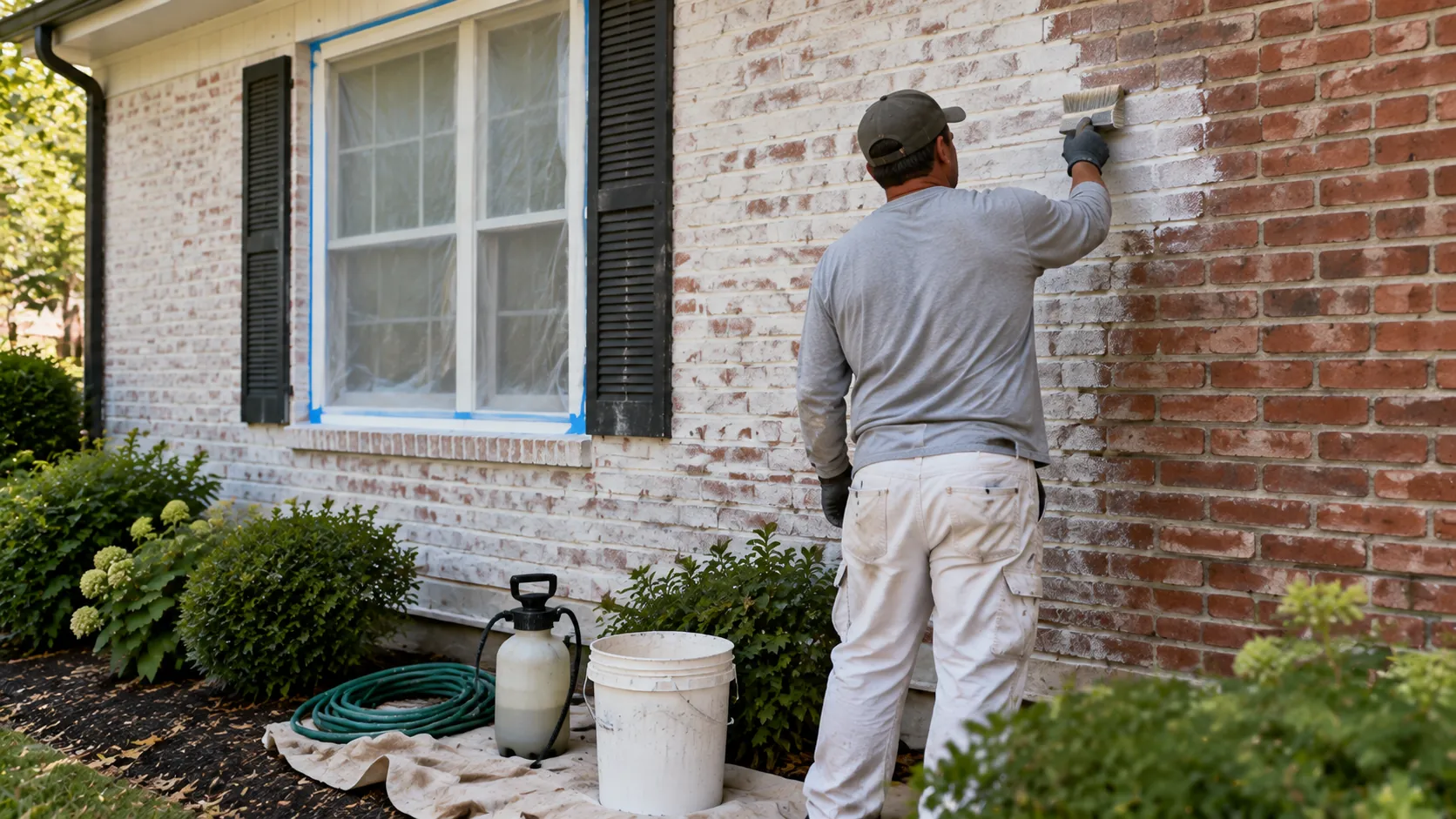
- Dampen the brick. Romabio says to mist the wall a few hours before starting so water soaks in without saturating it, and to wet the surface if it is above 80°F to stop flash drying.
- Mix and test. Romabio's limewash must be diluted 50 to 100 percent with water. A test patch always comes first; limewash dries much lighter than it looks wet.
- Apply one generous coat, top to bottom. Romabio describes Classico as a one-coat product on absorbent brick. Sprayed limewash gets back-brushed into the pits and mortar joints.
- Distress, if you want brick showing. Romabio suggests starting at about 30 minutes, with a garden hose outside.
- Protect vulnerable areas. Romabio recommends its breathable Mineral Shield topcoat, applied after 48 hours, on the bottom 3 feet of the house, sills and around downspouts.
Weather Limits in New Jersey
Romabio's weather rules for Classico Limewash, from its current data sheet and its FAQ:
- Air and surface temperature between 50°F and 88°F.
- Relative humidity of the air below 80 percent, and no application in direct sun or on surfaces with constant condensation.
- No exterior application if there is a risk of severe thunderstorms or showers during the 12 to 24 hours the product needs to dry and carbonate; the FAQ adds that after 3 to 4 hours of drying, normal rain will not affect the finish.
- No application if the surface will see two nights of freezing temperatures immediately afterward.
New Jersey's summer humidity matters as much as its temperature here. A humid July afternoon can push past the 80 percent limit even when the thermometer is fine, and a hot south-facing wall above 80°F has to be wetted down first to stop flash drying.
In practice that puts New Jersey exterior limewashing between mid-spring and early fall, chasing the shade on hot days. A cold snap in the forecast pushes late-fall work to spring. The same window applies to the exterior painting and staining we do.
Limewashing a Brick Fireplace
Fireplaces are popular limewash projects and more forgiving than exteriors, with a few differences.
- Keep it off the firebox. Romabio's limewash FAQ says its limewash can technically be used inside a fireplace but that it does not recommend it, because it will char and pick up soot. Limewash belongs on the face and surround, never the firebox.
- Soot comes off first. Romabio's fireplace guide starts by wiping off soot; heavily stained brick needs more cleaning before testing.
- Check for old sealers. Do the water test here too.
- Don't forget the mantel and floor. Drop cloths and tape go down first; wet limewash drips are easier to prevent than to clean up.
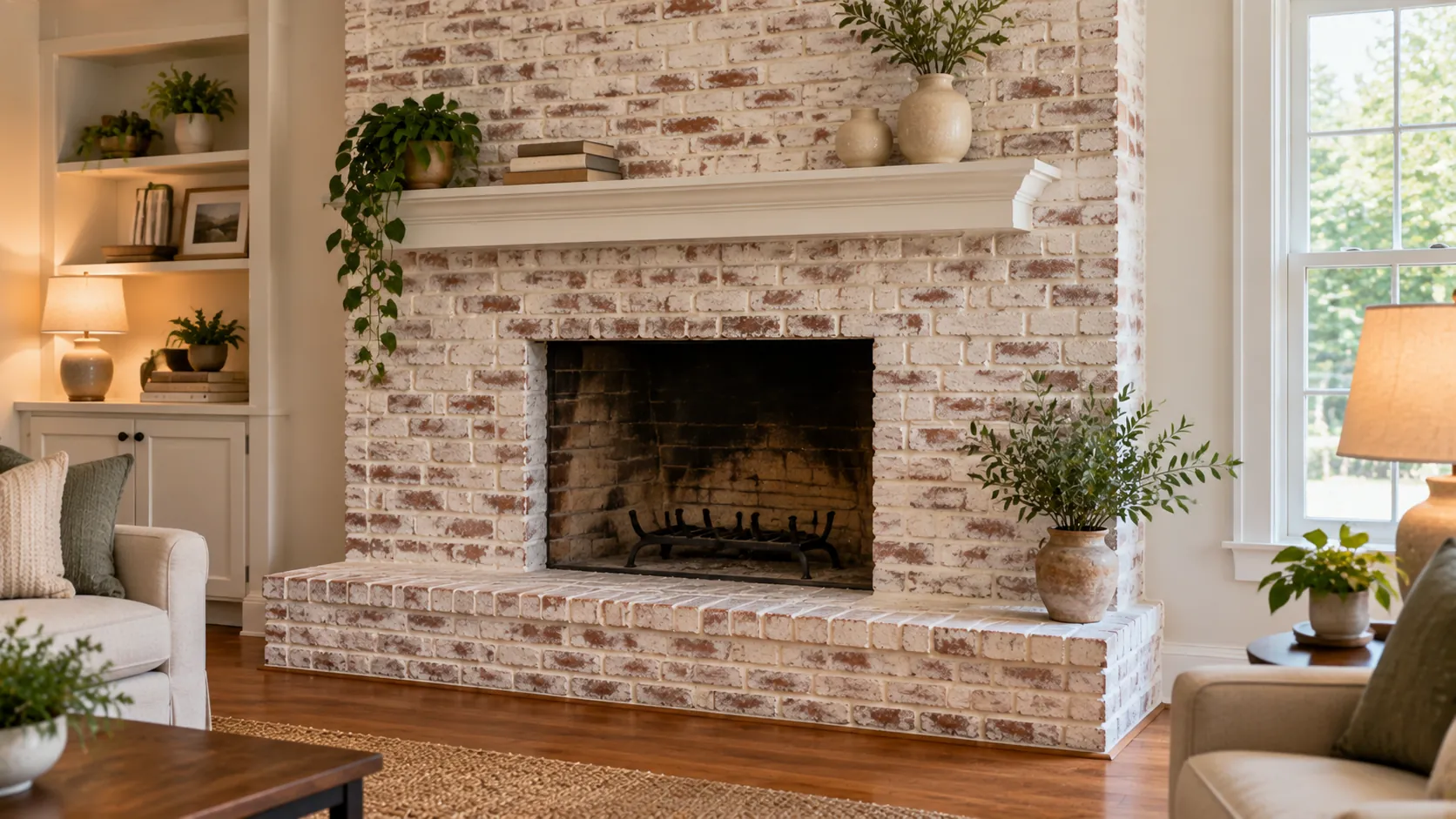
Limewashing the fireplace itself is not work we take on. Once a limewash applicator has finished and the lime has cured, our interior painting crews can repaint the room's walls, ceiling and trim around it.
How Long Does Limewash Last on Brick?
Published figures disagree widely.
- HomeGuide says limewashed brick fades gradually and needs reapplication every 5 to 7 years to keep its original coverage.
- Angi's German smear comparison also says limewash lasts five to seven years, while other Angi articles quote 20 years or more, and its how-to-limewash-brick guide says a well-prepared finish can last up to 30 years.
- Romabio does not give a number at all. It says the finish is formulated to patina and needs no repainting unless you want a different look.
Carbonated lime stays in the brick a long time, but the visible layer on rain-exposed walls thins. Our advice: budget a refresh on the weather side of the house in the five-to-seven year range, and treat longer as a bonus. Sheltered walls and interior fireplaces, out of the rain, typically hold up longer.
Can You Remove Limewash?
Early on, yes. Limewash is designed to be washed back while it is still drying: Romabio's data sheet says distressing is best started at about 30 minutes, with a stiff garden hose outside. Its current data sheet gives no window for stripping a whole application once it has set, and its FAQ advises against pressurized water for routine care. That is why a test area goes on before the wall does, and why the test area is the only part of the job you should treat as easily reversible.
Once carbonated, getting it all off becomes a masonry-cleaning job, often with acid-based cleaners, which NPS Brief 1 warns can etch masonry if misused. Limewash is far more reversible than paint or German smear, but treat it as a long-term choice once cured.
How Much Does It Cost to Limewash Brick in NJ?
National cost guides line up closely on limewash:
- Angi's how-to-limewash-brick guide (updated July 2026) puts professional limewashing at $1.50 to $5.00 per square foot, or $1,500 to $6,700 for an entire house. It prices DIY at $110 to $200 per 250 square feet, or about $0.45 to $0.80 per square foot.
- HomeGuide's brick house guide puts whitewashing or limewashing at the same $1.50 to $5.00 per square foot, with $1.50 to $2.50 for a one-story home, $2.50 to $3.50 for two stories and $3.50 to $4.50 for tall or detailed homes.
Material is the small part of the bill. Romabio's data sheet gives one-coat coverage at 50 percent dilution of 80 to 100 square feet per liter, or 1,200 to 1,500 square feet from a 15-liter bucket, and warns that deep mortar joints, absorbency and texture change that a lot. An 800 square foot brick front is therefore roughly one large bucket, before the test patch. The rest of the price is the cleaning, protection, dampening, application and distressing labor.
Limewash is mostly labor, and labor costs more here. Bureau of Labor Statistics data on O*NET's New Jersey painter wage page puts the 2025 median for construction and maintenance painters at $28.49 an hour in New Jersey against $23.75 nationally, a 20 percent gap.
To turn the national range into a New Jersey planning number, we add 10 percent to the low end and 20 percent to the high end, since not every dollar of the price is wages: $1.50 x 1.10 = $1.65, and $5.00 x 1.20 = $6.00. That gives a planning range of about $1.65 to $6.00 per square foot of brick. These are estimates from published data, not our price list.
| Brick wall area | Typical situation | NJ planning range ($1.65 - $6.00/sq ft) |
|---|---|---|
| 100 sq ft | Fireplace wall or small accent area | $165 - $600, before the applicator's job minimum |
| 800 sq ft | Brick front on a colonial or split-level | $1,320 - $4,800 |
| 1,500 sq ft | Brick ranch, most walls | $2,475 - $9,000 |
| 2,500 sq ft | Larger all-brick two-story | $4,125 - $15,000 |
Brick wall area is not your home's living area; measure walls and subtract openings. Small jobs like a single fireplace are rarely priced purely by the square foot, since setup and cleanup take the same time either way.
What moves the number:
- Repointing. HomeGuide puts chimney repointing at $8 to $30 per square foot.
- Height and access. Two-story walls, gables and chimneys need ladders or staging.
- Look. A heavily distressed, washed-back finish takes more labor than a straight opaque coat.
- Protective topcoat on the lower 3 feet, sills and splash zones.
- Stripping paint, if the brick was painted before: $1.50 to $9.50 per square foot per HomeGuide.
For trim, doors and shutters painted alongside, see what it costs to paint a house in NJ and our painting cost guide. Our brick painting guide prices the paint alternative for the same wall areas.
Older and Historic Brick Homes
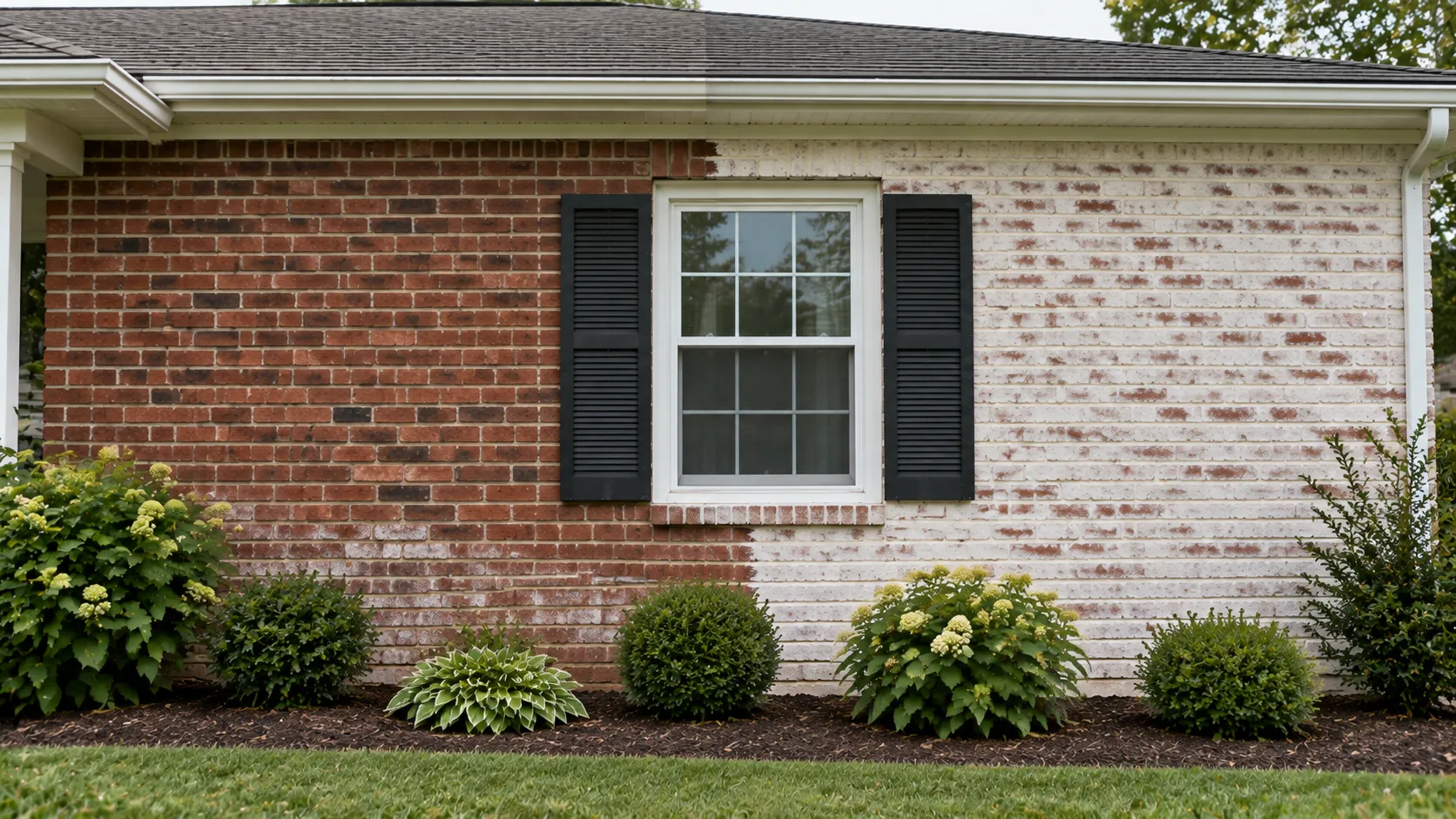
On older brick, a breathable finish is not just a style choice. The NPS briefs make the case that historic masonry must shed moisture, that repointing mortar should be softer than the brick, and that waterproof coatings do harm above grade. Angi notes limewash's long use in historic restoration.
In a historic district, check with your town's preservation commission first; exterior finish changes often need approval. And sound bare historic brick may be best left alone.
When Not to Limewash, and Red Flags in a Quote
Skip limewash if:
- The brick is painted, sealed, glazed or does not absorb water, and you want the classic washed look.
- You want a bold or dark color.
- The wall has active moisture problems: rising damp, leaking gutters, heavy efflorescence or spalling faces. Fix the water first.
- You want a finish that looks exactly the same in ten years with no upkeep. Look at mineral silicate paint instead.
- The surface is horizontal, like steps, caps, walks or patios.
Red flags in a limewash quote:
- No water test.
- "Limewash" over painted brick with no primer system named.
- No product named.
- Pressure washing at high pressure as the cleaning method, or acid cleaning without a test patch.
- A schedule that ignores the weather.
- No registration number. You can verify a New Jersey home improvement contractor's registration with the Division of Consumer Affairs.
You can see exterior work we have completed in our project gallery, and what goes into our exterior scope on the exterior painting page. If the brick is on an older house, read painting historic homes in NJ first; if you are working late in the season, painting in cold weather explains why the calendar matters as much as the product; and power washing cost covers the cleaning step on its own.
Frequently Asked Questions
What is limewash brick?
Limewash brick is brick coated with a mix of slaked lime, water and mineral pigments. The lime soaks into the brick and hardens as it absorbs carbon dioxide, leaving a matte, breathable mineral finish that can be left opaque or washed back to show the brick.
How much does it cost to limewash brick?
Angi and HomeGuide both put professional limewashing at $1.50 to $5.00 per square foot, and Angi's July 2026 update puts a whole house at $1,500 to $6,700. Adjusted for New Jersey painter wages, plan on about $1.65 to $6.00 per square foot of brick, with repointing and repairs extra.
How much does it cost to limewash a brick fireplace?
A fireplace wall is often around 100 square feet of brick, which at the New Jersey planning range of $1.65 to $6.00 per square foot works out to about $165 to $600. In practice small jobs are priced with a minimum, because setup, protection and cleanup take the same time whatever the size. Heavy soot cleaning adds time. Those are figures from published national guides adjusted for New Jersey wages, not a quote: limewashing is not a service we list.
Is limewash cheaper than painting brick?
Not by much up front. HomeGuide puts limewashing at $1.50 to $5.00 per square foot and painting brick at $1.50 to $4.50 nationally. The bigger difference comes later: limewash wears thin and is refreshed without stripping, while paint that peels has to be scraped before it can be recoated, and paint cannot easily be taken back off brick.
Is limewash better than paint for brick?
For unpainted brick, limewash is more breathable and will not peel, which suits older masonry and freeze-thaw climates. Paint offers any color and a uniform look, but it forms a film. Mineral silicate paint is the middle ground: breathable, long-lasting and opaque.
How long does limewash last on exterior brick?
HomeGuide and Angi cite a refresh every 5 to 7 years on exposed walls, though some sources quote far longer. Romabio gives no fixed figure because the finish is designed to patina with the weather. Sheltered walls and interior fireplaces, out of the rain, typically hold up longer.
Can you limewash painted brick?
Not with traditional limewash. It needs bare, absorbent brick. Painted brick has to be stripped, or finished with a mineral system made for painted masonry, such as a mineral primer and mineral paint, which gives a more solid look.
Can limewash be removed?
While it is still wet, yes: it is meant to be washed back, starting about 30 minutes after it goes on. Romabio's current data sheet gives no window for removing a whole application once it has set, and once it has fully carbonated, removal usually takes masonry cleaners and is much more work. Test a patch first.
Can you limewash a brick fireplace?
Yes, on the face and surround of the fireplace. Clean off soot first, check that the brick is not sealed, and keep limewash out of the firebox, where Romabio says it will char and collect soot.
When is the best time to limewash brick in New Jersey?
Mid-spring through early fall. Romabio requires air and surface temperatures between 50°F and 88°F, relative humidity below 80 percent, no risk of storms or showers during the 12 to 24 hour drying time, and no two nights of freezing temperatures right after application.
How much limewash do I need for a brick house?
Romabio's data sheet puts one coat at 50 percent dilution at 80 to 100 square feet per liter, or 1,200 to 1,500 square feet per 15-liter bucket. Deep mortar joints and very absorbent brick use more, so measure the wall area, subtract windows and doors, and do a test patch before buying the whole order.
Does NJ Painting Co. limewash brick?
No. Limewashing is not a service we list, which is why this guide names no price of ours and points you to a limewash applicator. What we do on brick is painting and staining, across Monmouth, Middlesex, Ocean, Mercer, Somerset and Burlington counties, plus Union, Essex, Hudson, Bergen and Passaic in North Jersey.
What We Do Instead: Brick Painting and Brick Staining
Limewashing is not a service we list, and we are not going to pretend otherwise to win a brick job. If you have read this far and decided limewash is the finish you want, hire a limewash applicator and use the red-flag list above on their quote.
If you are open to the alternatives, two of them are ours. Brick painting gives you any color with an alkali-resistant masonry primer under a premium acrylic, and it is the only one of these finishes that can go over brick somebody already painted; our guide to painting a brick house covers the products, prep and cost. Brick staining is the breathable, texture-preserving option on bare absorbent brick, closer to limewash in how it sits in the pores, and it does not wash back off in the rain. We will tell you plainly which of the two your brick can take, or that it is better left alone.
NJ Painting Co. is a family-owned, licensed and fully insured company at 36 Church Rd, Morganville, NJ 07751, and we have been working on central New Jersey homes since 2004, using Benjamin Moore and Sherwin-Williams products. Estimates are free and include an in-home color consultation, and the scope, products and warranty terms are spelled out in the written estimate.
We work throughout Monmouth County and Ocean County (see exterior painting in Monmouth County and in Ocean County), including Marlboro, and down the shore in towns like Point Pleasant; see all of our service areas to check your town. Call (732) 239-0932 or request a free estimate, and we will test your brick, check the mortar and give you a written, line-item quote for painting or staining it.
About the author
Written by the NJ Painting Co. team
NJ Painting Co. is a family-owned painting contractor based in Monmouth County, in business since 2004. We are licensed and fully insured, work with Benjamin Moore and Sherwin-Williams paints, and back our work with a 2-year workmanship warranty. We serve Monmouth, Middlesex, Ocean, Mercer, Somerset and Burlington counties, plus Union, Essex, Hudson, Bergen and Passaic in North Jersey.