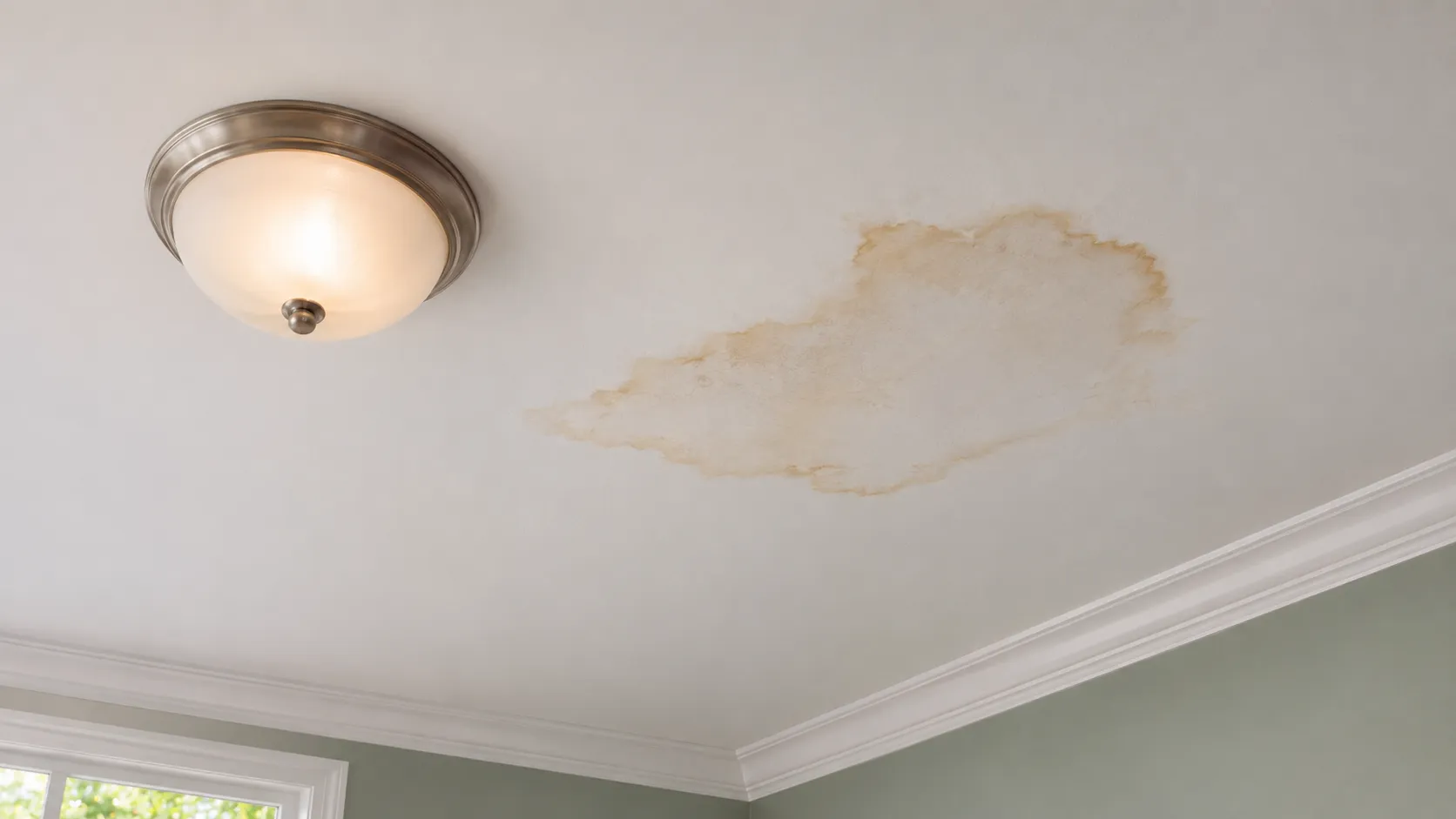
To cover a water stain on a ceiling, fix the leak first, let the ceiling dry completely, seal the stain with a stain-blocking primer made for water damage, and then repaint the whole ceiling in flat ceiling paint. Ordinary ceiling paint will not hold a water stain back, no matter how many coats go on.
Most guides stop there, which is where the job goes wrong. How dry is dry? Which primer, when every can says "stain blocking"? Why does a spot that looked perfect on Saturday show a brown ring by Monday? When is the board too far gone to paint? Those are the questions this guide answers.
We are a family-owned painting company in Morganville and have painted New Jersey homes across Monmouth, Middlesex, Ocean, Mercer, Somerset and Burlington counties, plus Union, Essex, Hudson, Bergen and Passaic in North Jersey, for more than 20 years, using Benjamin Moore and Sherwin-Williams products. Water-stained ceilings are some of the most common rooms we are asked to look at, usually a few weeks after a roofer or plumber has been and gone. We paint ceilings and we repair drywall. We do not fix roofs or pipes, we do not do water damage restoration, we do not repair plaster and we do not treat mould, and this guide says where each of those lines falls.
Every technical figure below comes from a document we fetched and read on 15 November 2026: the Zinsser, KILZ, Benjamin Moore and Sherwin-Williams technical data sheets; the EPA's and the Gypsum Association's drying and replacement guidance; NJDEP's copy of the state VOC rule, N.J.A.C. 7:27-23; and the New Jersey Department of Health's asbestos booklet. Where something is our own practice rather than a published figure, we say so. For painting a ceiling in general, our guide to how to paint a ceiling covers the roller, the wet edge and the light.
The Short Answer
- Stop the water first. The EPA's first instruction is "Fix plumbing leaks and other water problems as soon as possible. Dry all items completely." A stain over a live leak comes straight back.
- Make sure it is dry, not just looks dry. Zinsser's B-I-N sheet says "Substrate moisture should not exceed 12%." The EPA says wet materials should be dried within 24 to 48 hours to prevent mould.
- Use a primer whose data sheet names water stains. B-I-N is "recommended for permanently sealing heavy fire and water stains." KILZ 2, a general waterborne primer, says it handles only "minor water stains."
- Ceiling paint is not a stain sealer. Benjamin Moore's own ceiling paint sheet points you to its "specialty primers" where "stain suppression is a particular problem."
- Test before you paint everything. KILZ and Sherwin-Williams both say to topcoat a small section first, and to add a second coat of primer if the stain bleeds.
- Prime and paint the whole ceiling. Zinsser says spot priming is "recommended only under high-hiding topcoat" paints and that, "for best results, prime entire surface before painting." A spot-primed patch under a thin coat shows as a dull or shiny ghost.
- Soft, crumbling or sagging board gets cut out, not painted. The Gypsum Association's rule of thumb: if there is ever a doubt about whether to keep or replace wet gypsum board, replace it.
- In New Jersey, primers made on or after 18 August 2026 have a 100 g/L limit. Expect low-VOC versions of the old oil primers on the shelf.
What Causes a Water Stain on the Ceiling?
A water stain on the ceiling is water that came through from above, soaked the drywall, and dried. In a New Jersey house the source is almost always one of four things: the roof, the plumbing, the heating and cooling equipment, or condensation in the attic.
The roof. Stains near an outside wall, a chimney, a skylight or a vent pipe usually start at the roof. Cracked shingles let water in, but in our experience the more common culprit is flashing, the metal that seals the joints where the roof meets a wall, a chimney or a pipe boot. Roof stains tend to darken after heavy rain and fade between storms. The National Park Service's guide to plaster puts it plainly: "Roofs may leak, causing ceiling damage."
Ice dams. New Jersey gets enough snow, and enough freeze-thaw, for ice dams to be a real winter cause, especially on older capes with little insulation in the knee walls. North Dakota State University Extension explains that snow melts on a warm roof, the meltwater "hits cooler parts of the roof near the eaves" and freezes, and the backed-up water "can lead to water stains on the ceiling, structural damage and mold growth inside the home." It names the cause as "heat loss from the home into the attic through openings and the insulation," and adds that "another cause of ice dams is improper attic ventilation." A stain along the outside edge of an upstairs ceiling after snow is often this.
The plumbing. A stain under a bathroom is a plumbing question first: a leaking shower pan, a wax ring under a toilet, a tub drain, or a pinhole in a supply line. The NPS notes that "interior plumbing leaks in older houses are common." A plumbing stain does not care about the weather.
Heating and cooling. Air conditioning makes water. An air handler in the attic sits over a drip pan and a condensate line, and when the line clogs the pan overflows onto the ceiling below. Uninsulated ducts sweating in July leave a stain that follows the duct, often mistaken for a roof leak.
Condensation. Moist air from a bathroom or kitchen that reaches a cold attic condenses under the roof and drips onto the insulation and ceiling; a bath fan venting into the attic is a classic cause. Small, scattered water spots on the ceiling are often condensation, even with no leak anywhere.
Finding which it is belongs to a roofer, a plumber or a heating contractor, not a painter, and that is as true of plaster ceilings as drywall. Clear gutters, downspouts and HVAC drains prevent a large share of these.
Why Is a Ceiling Water Stain Brown or Yellow, With a Darker Ring?
Because the water was not clean when it reached the ceiling. On its way down it passed through roof sheathing, framing lumber, insulation, dust and sometimes rusty nails, and it picked up whatever would dissolve. Wood gives up tannin, the brown extract that also bleeds through paint on cedar and knotty pine. Old fasteners give up rust. Attic dust and old insulation add their own colour. When the wet patch evaporates, the water leaves and those discoloured deposits stay behind in the paper face of the drywall and the paint on it.
The darker ring is the tide line. Water spreads outward from where it came through, and it evaporates fastest at the edge of the wet area, where the patch is thinnest. Dissolved material is carried outward with the moving water and is left concentrated at the edge as it dries. That is why a ceiling water stain is often pale in the middle with a crisp brown or yellow outline, and why a stain that got wet several times has several rings, one inside the next, like the rings of a tree. Each ring is a separate leak event, which is worth telling whoever is looking for the source.
The practical point is that the colour is still soluble. Sherwin-Williams files dried water stains with "smoke stains and other water-soluble stains," and New Jersey's coatings rule defines the primers made for them as formulated "to block water-soluble stains resulting from: fire damage, smoke damage, or water damage." That is why the stain bleeds through paint, and why bleach fades some stains and not others.
Is the Leak Still Active, and Is the Ceiling Dry Enough to Paint?
These are two different questions, and both have to be yes before any primer goes on.
Is the leak fixed?
The person who fixed it should be able to tell you what it was. "We replaced the step flashing at the chimney" is an answer. "It looked fine up there" is not. A few checks are worth doing yourself:
- Does it change with the weather? Some guides put it simply: a stain that grows in rain points to the roof, and one that grows in dry weather points to a pipe.
- Does the meter move? With every tap, toilet and appliance off, a water meter that keeps turning means water is going somewhere. Several guides suggest this, and it is a reliable first test for a hidden supply leak.
- Is the stain growing? Pencil a light line around the edge of the stain. If it is outside the line in a week, it is not finished.
Our own practice on a roof leak is to wait until the ceiling has been through at least one heavy rain after the repair, and stayed dry, before we prime it. On a plumbing leak, we want the fixture above to have been used normally for a few days.
Is the ceiling dry?
A stain can look dry on the surface and still be damp in the core of the board, and the primer data sheets are specific about this. Zinsser's B-I-N sheet says "Substrate moisture should not exceed 12%." All of the sheets in this guide require a surface that is clean and "dry" before they go on. The EPA's guidance sets the clock for preventing mould: "It is important to dry water-damaged areas and items within 24-48 hours to prevent mold growth." The Gypsum Association uses the same window for whether board can be kept: board wet with clean water that "can be dried thoroughly before the possibility of mold growth sets in (typically 24 to 48 hours depending on environmental conditions) may not demand replacement."
A moisture meter is the tool for this, read with care. The Gypsum Association's 2015 release says hand-held meters need "careful calibration according to ASTM C1789" for gypsum panels, and that this "type of rank ordering is not necessarily a reliable means of assessing the need for replacement." In plain English: a meter tells you whether the stain reads wetter than the rest of the ceiling, not whether the board is sound. Our own practice is to compare the stain with a dry part of the same ceiling, then press the board with a flat hand. Dry but soft or springy board is a drywall problem, covered below.
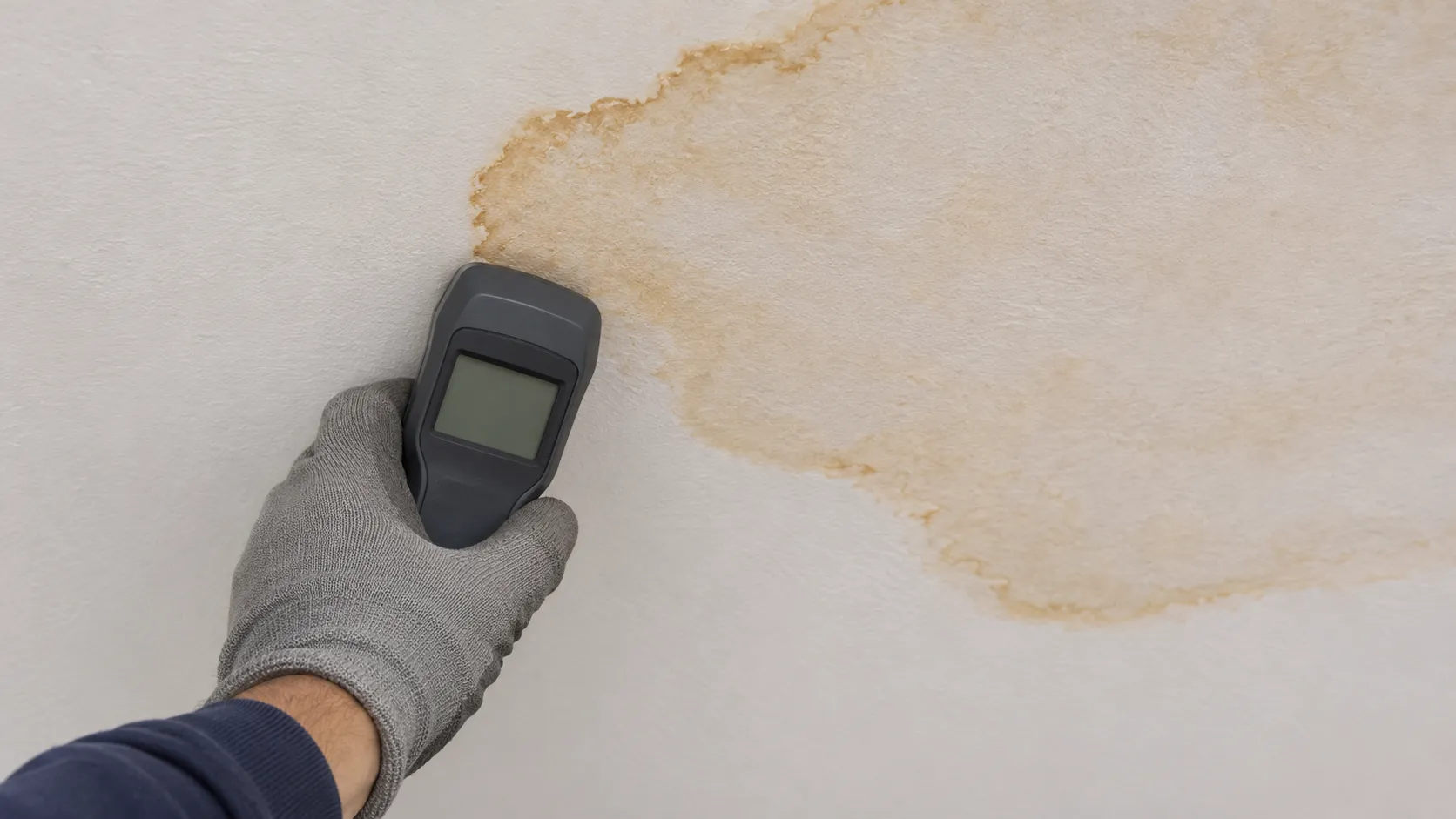
To speed drying, run a dehumidifier and a fan and pull any wet insulation off the back of the board; the U.S. Department of Energy's brief Repairing Roofs & Ceilings says "wet insulation must be removed for the ceiling to dry properly." The same brief gives a short keep test: keep ceiling drywall that "has only been wet by clean rainwater, is not sagging, is not mildewing, and has not lost its smooth texture." A ceiling still reading damp after a week of that has a leak that is still going, or wet insulation sitting on it.
Why Do Water Stains Bleed Through Ordinary Paint?
Because the stain is water-soluble, and most wall and ceiling paint is mostly water.
When you roll a waterborne ceiling paint or a latex paint over a dried water stain, the water in the wet paint soaks into the stained paper and redissolves the deposits. They migrate up into the wet film, and as the water evaporates they are left sitting in it. The stain comes back, often within a day or two, sometimes paler, sometimes with a softer, larger edge than the original. A second coat does the same thing again. Three coats of ceiling paint over a water stain is three chances for the stain to come up.
The paint makers do not pretend otherwise. Benjamin Moore's Ceiling Paint Ultra Flat 508 is a very good ceiling paint and its data sheet says so, but under "Difficult Substrates" it sends you elsewhere: "Benjamin Moore offers a variety of specialty primers for use over difficult substrates such as … grease stains, crayon markings … or other substrates where paint adhesion or stain suppression is a particular problem." Sherwin-Williams' four-step instruction for water stains ends with "Seal the stained area with a primer designed to 'hold out' water stains (such as White Pigmented Shellac Primer)." Sherwin-Williams' ceiling guide says the same in fewer words: "We encourage you to use a quality primer for ceilings with water damage or other stains."
That is why the right product is a dedicated stain sealer whose data sheet names water damage. Sherwin-Williams' contractor FAQ on water-stained ceilings notes that its ProBlock stain blockers come in "both alkyd and latex-based versions," and says which usually wins: "the alkyd stain blocker will usually seal water stains better … because it doesn't contain water that could re-wet the stain." A waterborne stain blocker can work too, but only one formulated, and rated on its sheet, for the size of stain in front of you. The rust and tannin in a stain do not care how good the topcoat is.
What Is the Best Primer for Water Stains on a Ceiling?
The best primer for a water stain on a ceiling is one whose own data sheet says it blocks water stains, applied over a dry surface: a shellac primer such as Zinsser B-I-N, an oil-type primer such as Zinsser Cover Stain or KILZ Original, or a waterborne stain blocker whose sheet names heavy water damage, such as KILZ Restoration or B-I-N Advanced. For one small ring, the shellac primer is the fastest. For a whole stained ceiling, any of them will do if you follow its sheet.
These are the figures from each maker's sheet. We have not added any claim the sheets do not make.
| Primer | Base, per the sheet | What the sheet says about water stains | Dry to touch / recoat | VOC, per the sheet |
|---|---|---|---|---|
| Zinsser B-I-N Shellac-Base Primer | Shellac base | "recommended for permanently sealing heavy fire and water stains"; one coat blocks water stains, "some stains require a second coat" | 20 min / 45 min | Max 550 g/L |
| Zinsser B-I-N Advanced Synthetic Shellac | Synthetic shellac | "Seals severe water stains, fire & smoke damage"; allow 2 hours for stain blocking | 25 min / 45 min | Under 100 g/L |
| Zinsser B-I-N Shellac-Based Primer (13-oz spray) | Shellac | "blocks grease spots, fire, smoke, water stains"; 10–12 sq ft per can | 15 min / 30 min | Not stated on the sheet |
| Zinsser Cover Stain Oil-Based Primer | Styrenated modified alkyd | "blocks most stains from nicotine, fire, smoke and water damage" | 30 min / 1 hour | 450 g/L |
| Zinsser Cover Stain Classic Oil 100 | Low-VOC modified alkyd | "stain blocking power for interior and exterior surfaces damaged by fire, water and smoke" | 1 hour / 2 hours porous, 3–4 hours painted | Under 100 g/L |
| KILZ Original Interior Oil-Base Primer | Modified alkyd | "blocks out most stains including water, smoke, tannin" | 30 min / 1 hour | 450 g/L (No. 1000) or 350 g/L (No. 1003) |
| KILZ Restoration | Acrylic modified epoxy, water-based | "tackles tough stains including heavy water damage" | 30 min / 1 hour | Under 100 g/L |
| Benjamin Moore Fresh Start Multi-Purpose Oil Based Primer 024 | Alkyd | lists "water stains" among the stains it suppresses | 6 hours / 8 hours | 344 g/L |
| Benjamin Moore Fresh Start High-Hiding All-Purpose Primer 046 | 100% acrylic | "suppresses most bleeding type stains such as tannin bleed, water stains"; two coats may be needed on severe stains | 30 min / 1 hour | Under 50 g/L |
| Zinsser B-I-N Water Base | Water-based | "will seal moderate stains and odors from water"; allow 2 hours for stain blocking | 30 min / 1 hour before topcoat | Under 100 g/L |
| Zinsser Bulls-Eye 1-2-3 | Water-based | "light water stains"; sends "severe water and smoke stains" to B-I-N | About 30 min / 1 hour; 2 hours to seal stains | Under 100 g/L |
| Sherwin-Williams Extreme Block | Water-based | "Seals minor dried water stains" | 30 min / 1 hour as a primer, 24 hours as a stain sealer | Under 50 g/L |
| KILZ 2 All-Purpose | Water-based | "blocks medium stains including minor water stains" | 30 min / 1 hour | Under 50 g/L |
Sherwin-Williams' ProBlock Interior Oil-Based Primer "seals out water sensitive and dried water stains," per its product page, which prints no VOC figure.
Three things stand out in that table, and in New Jersey the VOC column is a fourth, covered further down.
First, the language changes as you go down it. The shellac and oil primers, and KILZ Restoration, say "heavy" or "severe" water damage. Fresh Start 046 says water stains with a caveat about severe ones. Zinsser grades its own water-based primers "moderate" (B-I-N Water Base) and "light" (Bulls-Eye 1-2-3) and points severe stains to B-I-N, and Sherwin-Williams and KILZ call Extreme Block and KILZ 2 fit for "minor" ones. Bulls-Eye 1-2-3, the most common general primer on the shelf, is not a heavy water-stain sealer by its own maker's account. That is the makers telling you where each product's limit is. A faint grey shadow from a long-ago drip can be handled by a good acrylic primer. A dark ring with a tide line wants one of the products at the top.
Second, these stain blockers are white. Zinsser says "tinting the primer towards the topcoat improves the hiding power of the topcoat." For a white ceiling, leave it white.
Third, there is no stain blocker that treats mould. Some guides call for an "oil-based, mold-resistant" primer, and Fresh Start 046 does say it "provides a mildew-resistant coating." That describes the film resisting growth on its own surface. It does not kill anything underneath, and every sheet here requires a surface free of mildew before it goes on. The mould section below covers that.
Whichever you pick, read the limits. B-I-N wants humidity "below 70%" and says "do not apply B-I-N if surface temperature is within 15°F of the dew point." KILZ Restoration and Fresh Start 024 both set a 50°F floor. A cold top-floor bedroom in January can break those rules unnoticed. The handling differences, the odour, the denatured alcohol and the mineral spirits, are in the next section.
Shellac, Oil or Water-Based: Which Stain Blocker Should You Use?
Each family has a job it does best, and in our experience the choice is mostly about the size of the stain and the room you are working in.
Shellac: the small ring, fast
A pigmented shellac primer is the classic water-stain sealer and still the one we reach for first on a single ring. It dries in minutes, it can be topcoated in under an hour, and because it is alcohol-based it does not redissolve a water stain. Sherwin-Williams' stain instruction recommends "White Pigmented Shellac Primer for interior surfaces," and Zinsser says B-I-N is "recommended for permanently sealing heavy fire and water stains."
The trade-offs are smell and handling. B-I-N cleans up with "acetone, denatured alcohol, ammoniated detergent or 99% isopropyl alcohol," not water, it has a strong alcohol odour until it dries, and its flash point is 54°F, so no open flames in the room. For one stain over a bed, the 13-ounce aerosol is handy: dry to the touch in 15 minutes and paintable in 30, though at "10-12 sq.ft./can" it is a spot product, not a ceiling primer.
Oil: the whole stained ceiling
The alkyd primers, Cover Stain, KILZ Original and Fresh Start 024, are slower than shellac but cover more and sand easily. They are the right tool for a ceiling stained all over: smoke, nicotine, or a ceiling with three or four rings from separate leaks. They need mineral spirits for clean-up and good airflow while they dry. KILZ Original's sheet is blunt: "DO NOT use this product unless you can achieve cross-ventilation by opening windows and doors during application and drying." Fresh Start 024, at 344 grams per litre of VOC on its sheet, takes "6 Hours" to touch and "8 Hours" to recoat, so it costs a day, but it will take a coat of latex paint over it the next morning.
Waterborne stain blockers: low odour, if the sheet says heavy
The newer waterborne stain blockers are the answer for a lived-in house where nobody wants the smell. KILZ Restoration is "a new generation water-based primer, sealer and stainblocker offering performance of traditional oil and shellac-based primers" and "tackles tough stains including heavy water damage." B-I-N Advanced, a synthetic shellac that cleans up with soap and water, "seals severe water stains." Its sheet adds a detail worth knowing: "When sealing water stains, some stain may appear in the primer film as it dries. The stain is locked and will not bleed into the topcoat." So a faint shadow in a dry coat of that primer is not, on its own, a failure.
Our general rule: a dedicated stain blocker on the stain, then, if it covers only part of the ceiling or there are other repairs, a good primer over the whole ceiling before the finish. That is about porosity, covered under spot-prime versus whole-ceiling priming below. For the wider oil-versus-water question, see our guide to oil vs latex paint and primer.
Does New Jersey's VOC Rule Change Which Primer You Can Buy?
Yes, gradually. New Jersey limits the VOC content of architectural coatings under N.J.A.C. 7:27-23, and the limits that matter here tightened for products made on or after 18 August 2026.
The rule has a category made for water-stain primers. For products made on or after that date, a "specialty primer, sealer and undercoater" is defined as "a coating that is formulated for application to a substrate to block water-soluble stains resulting from: fire damage, smoke damage, or water damage." Its limit in the rule's Table 1 drops from 350 to 100 grams per litre. The ordinary "primer, sealer, and undercoater" limit drops from 200 to 100 g/L, and flat coatings, which is what ceiling paint is, drop from 100 to 50 g/L.
Set those numbers against the table above. Fresh Start 024 is 344 g/L and Cover Stain Oil-Based and KILZ Original No. 1000 are 450 g/L on their sheets. Cover Stain Classic Oil 100, B-I-N Advanced and KILZ Restoration are all under 100 g/L, which is why low-VOC versions of the old oil primers exist at all. Shellac has its own line in the table, with opaque shellac at 550 g/L; the August 2026 column prints no new figure for it, and B-I-N's sheet gives "Max 550 g/l."
Three details keep this from being a sudden change:
- Stock made before the date can still be sold and used. The rule says a coating "manufactured prior to the operative date … that complied with the standards in effect at the time of its manufacture, may be … sold … or applied at any time," as long as its label carries a date of manufacture or a date code.
- Aerosol coatings are outside the rule: it "shall not apply to … an aerosol coating product." That covers the spray cans of shellac and oil primer.
- A painter who buys the coating in New Jersey is exempt from the content limits when applying it, under 7:27-23.1(e).
In practice, the high-solvent oil primer you remember may give way on the shelf to its low-VOC replacement. Read that product's sheet for "water stains" or "water damage" rather than assuming it behaves like the old one. This is a summary of the rule as NJDEP publishes it, not legal advice.
How Do You Paint Over a Water Stain on a Ceiling, Step by Step?
Once the leak is fixed and the board is dry and sound, the painting itself is a short job. Doing it in this order is what makes it permanent.
- Protect the room. A drop cloth over the floor and furniture, and plastic sheeting over anything that cannot be moved. Primer drips off a ceiling, and shellac and oil primers do not wash out of carpet. Painter's tape along the top of the walls if they are not being repainted.
- Set up a safe ladder. A step ladder tall enough that you are not reaching overhead with your arms straight is the difference between a clean job and a fall. Ceiling fixtures near the stain should be switched off at the breaker; water and light fittings are an electrical question before they are a painting one.
- Clean the stain. Zinsser's Cover Stain sheet says "when priming over stained areas, first attempt to remove as much of the stain as possible by washing, sanding, scraping, etc." B-I-N's sheet suggests "household ammonia and water solution" and says "do not use TSP as a cleaner." A sponge barely damp with warm water rinses it. Let it dry.
- Scrape and sand anything loose. If the old paint has bubbled or flaked over the stain, scrape it back to sound paint and sand the edges smooth. KILZ says "Peeling or Checked Paint: Scrape off loose paint and sand to a smooth surface." Paper that has torn or fuzzed is a drywall repair first; see below. On a house built before 1978, read the lead section before sanding anything.
- Spot-prime the stain. Apply the stain blocker past the outer edge of the ring by a few inches on every side. One coat, at the thickness the sheet asks for, not a thin skim. The tide line is the part that comes back when the primer stops short of it.
- Test it. KILZ's instruction is the clearest: "After priming, test for stain bleed-through by applying the topcoat to a small section. If the stain bleeds through the topcoat, apply a second coat of primer and test again before topcoating the entire area." Sherwin-Williams' ProBlock aerosol sheet says to "allow to dry 1 hour, test a small area for bleeding by applying the topcoat before painting the entire project." Waterborne blockers can need longer before that test: Extreme Block's sheet says to wait 24 hours.
- Prime the rest of the ceiling if the stain blocker covers only part of it, or if there are other patches. The reason is in the next section.
- Paint the whole ceiling. Two coats of flat ceiling paint, rolled wall to wall, with a wet edge. Not a patch in the middle. Benjamin Moore's 508 recoats in "1 – 2 hours" at 77°F and 50 percent humidity; slower in a cold or humid room. A textured ceiling takes a thicker nap cover; the popcorn section covers that.
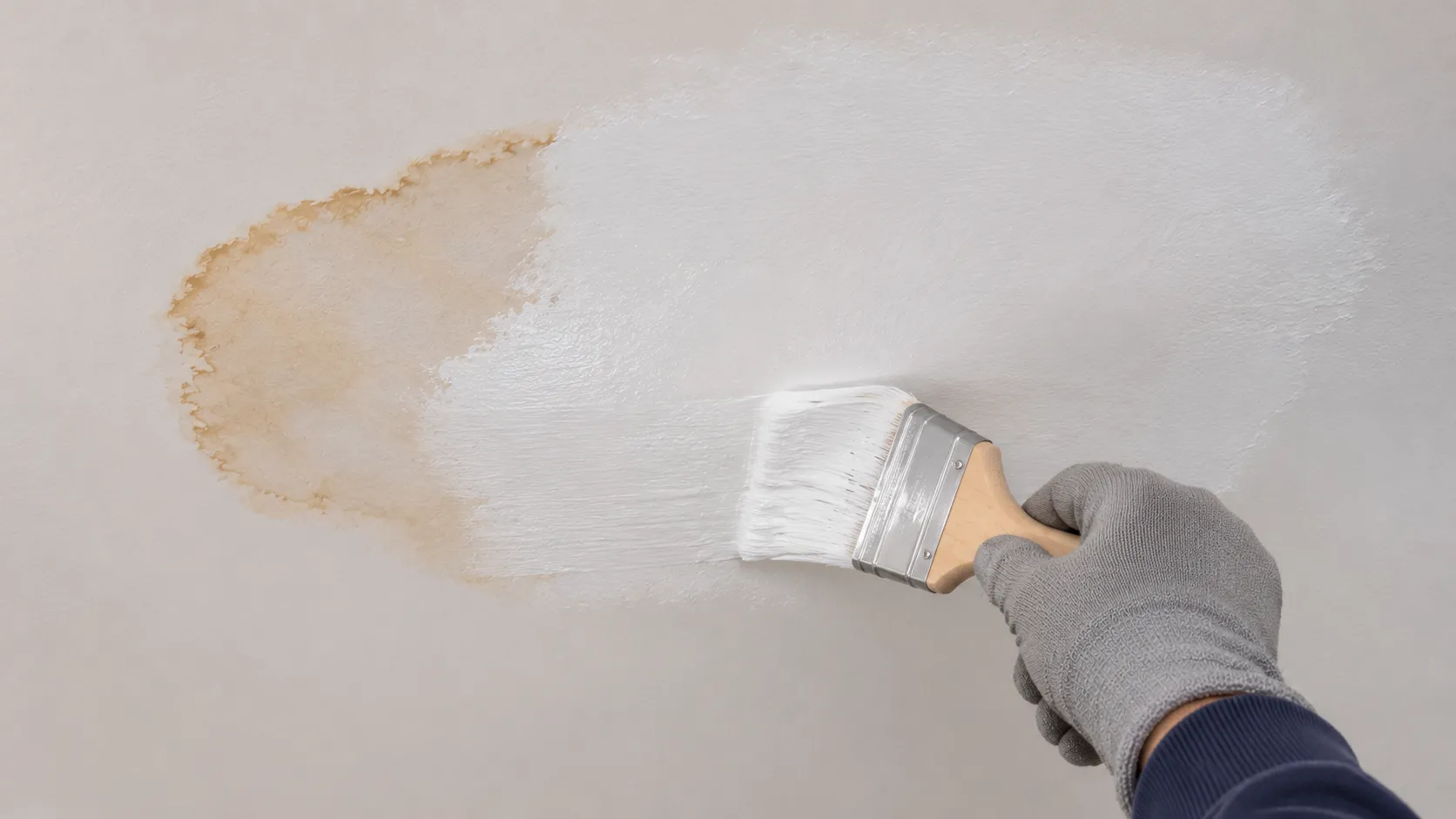
Some guides give fixed times, such as two hours for primer and four for paint. Use your products' own sheets instead: they differ tenfold between shellac and oil, and all assume warm, dry rooms. Benjamin Moore's sheets say "high humidity and cool temperatures will result in longer dry, recoat and service times." Our guide to how long paint takes to dry and cure covers why.
Should You Spot-Prime the Stain or Prime the Whole Ceiling?
Spot-prime the stain with the stain blocker, then, unless the whole ceiling is getting the stain blocker anyway, prime or paint the whole ceiling so the spot does not show. The primer makers say so themselves. Zinsser's B-I-N sheet: "Spot priming is recommended only under high-hiding topcoat finishes. For best results, prime entire surface before painting." Cover Stain's sheet says the same, word for word, about high-hiding topcoat paints.
The reason is porosity. A stain-blocking primer dries to a sealed, slightly different surface from the old, chalky ceiling paint around it. When the finish coat goes over both, it soaks into the old paint a little and sits up on the primer, and in light raking across the ceiling the two dry with a different sheen. The shape of the primed patch shows through as a dull or slightly shiny ghost, even when the colour is perfect. Painters call this flashing, and on a flat ceiling lit from a window it is the most common reason a "fixed" stain still shows.
Sherwin-Williams' flashing guide lists the causes, including "coating over a porous surface" and "paint applied at uneven film thickness (i.e. lapping)," and gives the cure: "Prime or seal surfaces before applying the topcoat to ensure a uniform surface," and "spot-prime any patched areas to level off the porosity of the surface." So the sequence that works is the stain blocker on the stain, a uniform primer or paint coat over everything, and the finish coats over that.
For one small ring in a sound, recently painted ceiling, a second coat of ceiling paint over the whole plane can be enough. For several stains, drywall patches, or old paint of unknown age, our practice is to spot-prime each stain, prime the whole ceiling, then paint two coats in one ceiling white. On textured ceilings flashing shows less, because the texture breaks up the light.
Why Does the Repaired Spot Still Show, and How Do You Make It Disappear?
If the stain itself is gone but you can still see where it was, one of four things is happening, and each has its own fix.
The patch is flashing. That is the porosity problem from the previous section. The fix is a full coat over the whole ceiling, wall to wall, after priming. Touching up the middle of the patch again makes the ghost bigger, not smaller.
The paint is the wrong white. "White" ceilings are not all the same white. A 20-year-old ceiling painted with a ceiling paint has yellowed a little, and a fresh coat of brilliant white next to it looks blue and clean. Benjamin Moore's ceiling paint comes in its "Ceiling White (09)" base, and other brands have their own ceiling whites. The answer is not to colour-match the old paint, which you cannot do on a ceiling by eye, but to paint the whole ceiling so there is only one white on it.
The sheen is wrong. Ceilings should be flat. The Gypsum Association defines a flat paint as one "specifically manufactured to produce 0 to 5 Gloss Units (GU) at a 60° angle and 0 to 10 Gloss Units (GU) at an 85° angle." Anything with more gloss than that catches the light at every repair, every roller lap and every joint. A leftover can of eggshell wall paint is the most common way a ceiling patch becomes visible. A crisp painter's tape line at the top of the walls stops the ceiling paint marking a freshly painted wall. Our paint sheen guide sets the sheens side by side.
The drywall underneath is not flat. If the leak swelled the paper, or a patch was not feathered far enough, the shape shows in side light. The Gypsum Association calls it "joint photographing," "the shadowing of the finished joint areas through the surface decoration." That is a compound-and-sanding fix before primer.
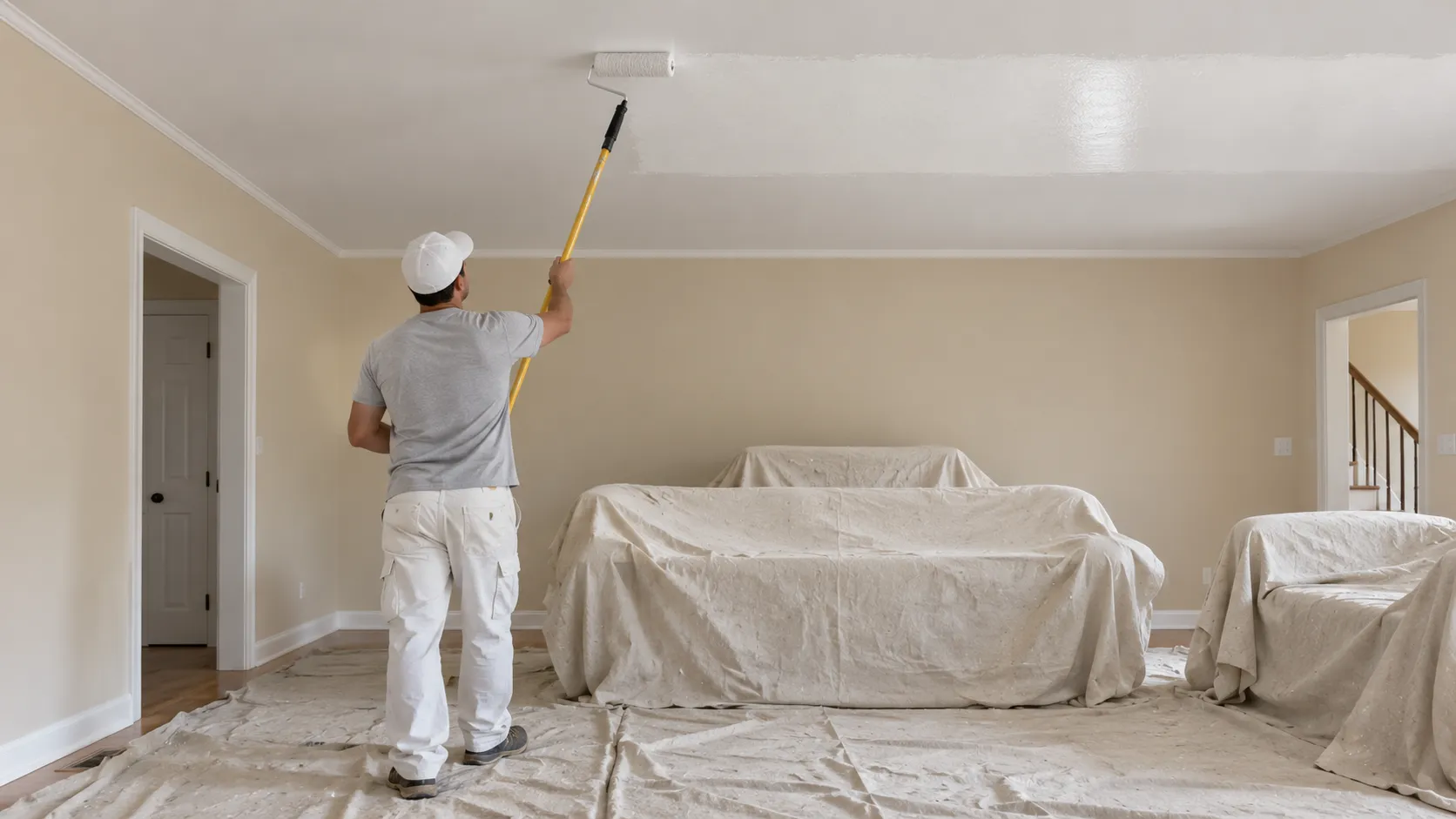
In our experience the simplest fix is the cheapest: seal the stain, then paint the whole ceiling, corner to corner, in one flat white. Our ceiling painting guide covers the rolling.
Can You Bleach a Water Stain Off the Ceiling Instead of Painting?
Sometimes you can lighten it, but you will not reliably remove it, and you should not soak a ceiling to try.
Several guides recommend a solution of about 1 cup of bleach to three cups of warm water, wiped on with gloves and goggles, rinsed and left to dry. Others suggest hydrogen peroxide, or oxygen bleach on coloured ceilings. Some light, recent stains do fade with this, because bleach acts on some of the organic colour in the discoloured deposits. The rust in a ring is a mineral and the bleach does nothing to it, and an old stain baked into the paper over years rarely comes out fully.
There are three reasons we do not lead with bleach on a ceiling.
First, it puts water back into board you have just dried. Mist it lightly, never soak it, and let it dry fully.
Second, it does not seal anything. Whatever is left of the stain is still water-soluble, so the paint that follows still needs a stain-blocking primer under it. The bleach step is optional; the primer step is not.
Third, bleach is not a mould treatment, and the EPA says so. Its Brief Guide says that using a biocide such as chlorine bleach "is not recommended as a routine practice during mold cleanup," and warns: "Never mix chlorine bleach solution with other cleaning solutions or detergents that contain ammonia." That matters on a ceiling because the cleaner some primer sheets suggest is household ammonia. Pick one, rinse, dry, and do not combine them. Zinsser's B-I-N sheet does give a bleach wash for interior mildew stains, "one cup household bleach in a gallon of water," as surface preparation, which is a cleaning step, not mould treatment.
Some guides also suggest dabbing light stains with chalk or white shoe polish instead of painting. It is a short-term cosmetic trick, it changes the sheen of a flat ceiling, and it gives the paint something to slip on later. We would rather prime it properly.
When Does Water-Damaged Drywall Need to Be Cut Out and Patched?
Most stained ceilings only need primer and paint. Some need the wet section of board cut out and replaced first, and the Gypsum Association sets out how to tell.
Its guide, Assessing Water Damage to Gypsum Board (GA-231), was revised in 2015 and again since. The Association's 2015 summary says "key to assessment is identifying and eliminating the source of the water," that "gypsum board exposed to sewage or flood water, must be replaced," and that board exposed to clean water that can be dried thoroughly in time "may not demand replacement." The older 2006 edition, which we were able to read in full, lists the conditions. Board exposed to water "should be replaced unless all of the following conditions are met":
- "The source of the water or moisture is identified and eliminated."
- "The water or moisture to which the gypsum board was exposed was uncontaminated."
- "The gypsum board can be dried thoroughly before mold growth begins (typically 24 to 48 hours depending on environmental conditions)."
- "The gypsum board is structurally sound and there is no evidence of rusting fasteners or physical damage that would diminish the physical properties of the gypsum board or system."
And then, in capitals: "IF THERE IS EVER A DOUBT ABOUT WHETHER TO KEEP OR REPLACE GYPSUM BOARD THAT HAS BEEN EXPOSED TO MOISTURE -- REPLACE IT."
In practice the signs that we will cut out a section of ceiling rather than paint it are:
- Board that is soft or crumbles when pressed, or that a screwdriver tip sinks into.
- Paper that has delaminated, bubbled or torn from the gypsum core.
- Screw or nail heads that have rusted through and are staining or popping.
- A sag or bulge between joists, even a slight one (see the next section).
- Any mould growth on the face or the back of the board.
- Water from a toilet overflow, a sewer backup or a flood. The Gypsum Association says that board goes, whatever it looks like.
A cut-out is a routine drywall repair: the wet section is cut back to the joists, new gypsum panels are screwed in, taped, finished and sanded, then primed and painted with the rest of the ceiling. Where the board is sound but the paper face is torn, Zinsser's B-I-N sheet says to "spot prime area of torn drywall facing paper or exposed gypsum core with Zinsser GardZ® Problem Surface Sealer and then skim coat with drywall mud before priming the total area." Waterborne primer straight onto torn paper raises it into fuzz and bubbles.
Drywall and sheetrock repair is work we do; our guide to drywall repair covers what a patch involves. Replacing whole ceilings or a whole flooded floor of board is a drywall contractor's job, and we prime and paint after. Before wet board comes down, confirm with a moisture meter that the leak is finished.
What Should You Do About a Sagging Ceiling?
Stay out from under it, and do not paint it.
A drywall ceiling sags after a leak for two reasons. The board has absorbed water and lost its strength, or water is sitting on top of it, held in by the paper and the paint like a bag. Either way, sagging drywall is board the Gypsum Association would replace, and a ceiling holding water can come down suddenly when someone pokes it. Keep people and pets out of the room, move what you can from under it, and call the plumber or roofer if the water has not been stopped. Turn off the power to any light fixture in or near the wet area and have an electrician look at it before it goes back on.
Once the water is stopped and the area is safe, the wet board is cut out and replaced as described in the previous section. Primer and paint on a sagging ceiling do nothing. They add weight to board that is already failing, and they hide the problem until it gets worse. Do not set a ladder under it to "have a look."
Check the screws too: rusting fasteners are on the Gypsum Association's list of reasons to replace board. There are two kinds of sag that are not a painting or drywall-patch question at all:
- A large area, a whole ceiling, or a ceiling that has always sagged a little between joists. That points to a structural or installation issue: framing, undersized board, fasteners. A builder or drywall contractor should look at it. Framing and structural damage are not work we do.
- A sagging plaster ceiling. That is plaster detaching from its wood lath, which is a plaster repair and a safety question. See the plaster section below.
Is It Mould, and Can You Paint Over It?
If it is mould, do not paint over it. Clean it up properly, fix the moisture, and paint once it is gone and dry.
A water stain is a flat discolouration with a ring. Mould is usually fuzzy or speckled, black, green or grey, often musty, and grows where the ceiling stayed wet. The EPA is clear about painting: "Do not paint or caulk moldy surfaces. Clean up the mold and dry the surfaces before painting," because "paint applied over moldy surfaces is likely to peel." No stain-blocking primer changes that, and neither does one sold as mold-resistant. Every primer sheet in this guide requires a surface free of mold or mildew before it goes on, and KILZ Restoration's says so in as many words: "The surface must be clean, free of dust, grease, wax, peeling paint, mold, mildew and wallpaper paste."
The EPA also gives a size line: if the moldy area is "less than about 10 square feet," in most cases you can handle it yourself; above that it points to professional guidance. It warns that mould "may be hidden in places such as the back side of dry wall," says that "absorbent or porous materials, such as ceiling tiles and carpet, may have to be thrown away if they become moldy," which settles a mouldy drop-ceiling tile, calls for "a professional who has experience cleaning and fixing buildings damaged by contaminated water" after sewage or contaminated water, and tells anyone with health concerns to speak to a health professional first. Zinsser's interior mildew wash, about 1 cup of household bleach to a gallon of water with gloves and goggles, is preparation, not remediation, and its B-I-N sheet says that if you are "concerned about mold and mildew behind walls," you should "contact a professional who specializes in mold and mildew remediation."
To be plain about our part: NJ Painting Co. does not offer mould or mildew treatment or remediation. We wash surfaces we are about to paint, which is ordinary preparation. When we find mould on a stained ceiling, we stop, tell you, and come back to repair and paint once it has been dealt with. The long-term answer is indoor humidity "below 60 percent (ideally between 30 and 50 percent)," per the EPA. Our guide to mildew on painted walls and siding covers the washing side.
How Do You Cover a Water Stain on a Popcorn or Textured Ceiling?
The same way as a smooth one, sealed and then painted, but with two extra questions first: is the texture safe to disturb, and will it survive being wetted?
Asbestos first, on older texture
Popcorn and other sprayed ceiling textures were made with asbestos for decades. The New Jersey Department of Health's booklet on asbestos in the home says "textured paint used for decorative purposes once contained asbestos," that drywall patching compounds "manufactured before 1978, usually contained asbestos," and that "no one can tell if it is asbestos-containing by examining it without the aid of a microscope." Its advice is to "treat it as if it does until you know otherwise." Before anyone scrapes, sands or wets a popcorn ceiling applied before 1978, have the texture tested. Our guide to popcorn ceiling removal covers testing and who may remove it in New Jersey.
The same booklet has a warning that fits a water-damaged popcorn ceiling exactly: "If the material is crumbling and deteriorated, encapsulating the area with a spray-on, sealer-like paint can do more harm than good. The added weight of the encapsulant will pull the damaged materials away from the substrate and cause a fiber release episode." Texture that has been soaked and is now loose or falling is not something to paint. If it has tested positive, it goes to a licensed abatement contractor.
Sealing a stain on sound texture
Where the texture is sound and either tested clear or left undisturbed, with plastic sheeting under the work, the stain gets the same stain blocker without rubbing. A wet roller worked back and forth pulls popcorn off in strips. A shellac or oil-based primer from a spray can is the easy way to do one stain; for a larger area, spray, or make one light pass with a thicker nap roller. Sherwin-Williams says to "use a higher nap, like 3/4-inch, for textured ceilings." The ceiling paint goes on the same way, one direction, no going back over wet texture.
If the stain is the excuse you needed to lose the popcorn, removal is a service we offer, after testing, on homes built in 1978 or later; the scraped ceiling then gets a skim coat and primer, which also takes care of the stain. One guide suggests misting smoke-stained popcorn with hydrogen peroxide; we would not wet old texture.
What If the Stained Ceiling Is Plaster?
Many older New Jersey houses, the pre-war colonials and capes and the city housing in Essex, Hudson and Union, have plaster on wood lath rather than drywall. A water stain on sound plaster can be primed and painted exactly like one on drywall. The primer sheets support it: B-I-N, Cover Stain and KILZ Restoration all list plaster among their surfaces.
What changes is what happens when the plaster itself is damaged, because unlike gypsum panels it cannot simply be cut out between joists and screwed back. The National Park Service's preservation brief on plaster says "gypsum plaster was more vulnerable to water damage than lime." It describes a dining room under a leaking second-floor bathroom: "After fixing the leaking pipes, the wall covering and rotted plaster will need to be replaced and any holes repaired." And it says of plaster that stayed wet during curing, "since there is no cure for rotted plaster, the affected area had to be removed and replastered." Plaster that has been soaked can soften, crumble, or lose its grip on the lath, and a plaster ceiling that has let go of the lath can come down in a sheet.
Plaster repair is not a service we offer. Drywall and sheetrock repair is, and they are different trades. Sound plaster with a stain we will prime and paint. Plaster that is soft, crumbling, bulging or sagging goes to a plasterer first, and we paint once the repair has cured; Benjamin Moore's sheets say new plaster needs 30 days. Our drywall repair guide explains how to tell plaster from drywall.
Why Do Water Spots Keep Appearing in Bathrooms, Kitchens and Basements?
Because the water is coming from the room, not from above it. Repeated small water spots on the ceiling, scattered rather than one ring, are most often condensation, and painting over them without changing the air in the room only buys a few months.
Bathrooms. A shower puts a lot of water into the air, and a cold ceiling, especially a top-floor ceiling under a poorly insulated attic, is where it condenses. Spots appear, dry, and come back as faint brown dots and streaks, often with mildew following. The fixes are ventilation and insulation: an exhaust fan that is actually ducted outdoors and is run during and after the shower, and enough attic insulation that the ceiling is not the coldest surface in the room. The EPA's line is that "if you see condensation or moisture collecting on windows, walls or pipes," you should act quickly, because "condensation can be a sign of high humidity." Our guide to the best paint for bathroom walls covers the paint side, including ceilings.
Kitchens. Steam above the range does the same, and the stain is often grease-yellow, so degrease before the stain blocker. See the best paint and sheen for kitchen walls.
Basements. Stains on a basement ceiling are often a real leak from a toilet, tub or washer above, or condensation from cold pipes and ducts in summer. Our guide to painting basement walls and ceilings covers drywall and exposed-joist ceilings.
The house itself. Inspect the attic condensate pan and line once a year, keep gutters and downspouts clear, and keep indoor humidity in the EPA's 30 to 50 percent range. Those habits prevent more stains than any primer covers.
Who Do You Call First: Roofer, Plumber, Drywall or Painter?
In this order: whoever stops the water, then whoever repairs damaged material, then the painter.
- The source. A roofer for anything coming through cracked shingles, chimney or vent pipe flashing, a skylight or an ice dam. A plumber for a shower pan, a toilet, a supply line, anything under a kitchen or laundry, or anything that does not change with the weather. A heating and cooling contractor for an attic air handler, a drip pan or a sweating duct. Ice-dam stains also usually need someone to look at the attic insulation and ventilation, which NDSU names as the causes.
- Electrical, if needed. If water reached a light fixture, a fan or a junction box, an electrician checks it before it is used again.
- Mould and contaminated water, if needed. A remediation professional, per the EPA thresholds above or if anyone has health concerns, and after a sewer backup or flood, someone who does water damage restoration.
- Damaged material. Drywall that is soft, sagging or past saving is cut out, and we replace it; a plasterer for damaged plaster. Small and medium drywall repairs we do ourselves as part of the painting job. Whole ceilings, sagging drywall across a room or structural damage go to a drywall contractor or a builder.
- The painter. Last, once the ceiling is dry, sound and cleared. We inspect the repaired area with a meter and a light before we prime it.
If a leak was sudden, such as a burst pipe or a storm, talk to your insurer before damaged material is removed or painted over. We do not get involved in claims, but we can give you a written estimate for the painting and drywall repair.
Old Ceilings, Old Paint and the EPA Lead Rule
Old ceilings are also where old paint is. If your house was built before 1978, the paint on the ceiling, and any you scrape or sand off around a stain, may contain lead. Every primer sheet in this guide carries the same warning; Zinsser's reads: "If you scrape, sand or remove old paint, you may release lead dust. LEAD IS TOXIC." Popcorn and textured ceilings from the same era carry the asbestos question above as well.
The EPA's Renovation, Repair and Painting rule requires that anyone paid to perform work that disturbs painted surfaces in homes, childcare facilities and preschools built before 1978 be certified, and the agency "recommends that homeowners hire a lead-safe certified contractor." We are not an EPA Lead-Safe Certified firm and do not scrape or sand paint on homes built before 1978. If your house was built before 1978 and old paint will be scraped or sanded, that part of the job goes to a certified firm: ask for its firm certification number and check it on the EPA's Renovation, Repair and Painting program page. Our guide to lead paint in older NJ homes covers testing and New Jersey's own rules. A drop cloth and good intentions are not a substitute for the rule.
What We Do, and Do Not Do, on Water-Stained Ceilings
What we do:
- We prime and paint water-stained ceilings, drywall or sound plaster, once the leak is fixed and the ceiling is dry, using a stain blocker whose data sheet names water damage.
- We repair drywall, including cutting out and replacing water-damaged sections of a ceiling, taping, skim coating and sanding before paint.
- We paint the whole ceiling, wall to wall, in a flat ceiling paint, so the repair does not show.
- On homes built in 1978 or later, we remove popcorn ceilings after the texture has been tested, and skim, prime and paint the ceiling afterwards.
- We write the surfaces, repairs, products and number of coats on the estimate, so you can compare bids line by line.
What we do not do: roofing, plumbing, gutters, HVAC or electrical work; water, fire or insurance restoration; mould or mildew treatment or remediation; plaster repair; asbestos testing or abatement; framing or ceiling structural repair; replacing whole ceilings or whole floors of drywall; and, as the lead section above says, scraping or sanding paint on homes built before 1978.
Get a Price for Your Water-Stained Ceiling
A stained ceiling is priced by the size of the ceiling, the height, whether there is drywall to cut out and replace, whether it is textured, and how many other repairs the room needs, and it is usually priced as part of a larger interior job rather than on its own. For how ceiling and room pricing is built, see our guide to what it costs to paint a room in NJ, the drywall repair cost guide and the interior section of our painting cost guide. For the work itself, see our interior painting service, and for offices, schools and medical buildings our commercial painting service. NJ Painting Co. is a family-owned painting company in Morganville, NJ, working on New Jersey homes for more than 20 years with Benjamin Moore and Sherwin-Williams products, and every estimate is free. Call (732) 239-0932 or request a free estimate, and ask us about the job minimum when you enquire.
Frequently Asked Questions
Can you paint over a water stain on a ceiling?
Yes, once the leak is fixed and the ceiling is dry, but not with ceiling paint alone. Water stains are water-soluble, so waterborne paint redissolves them and they come back within a day or two. Seal the stain first with a primer whose data sheet names water stains, such as a shellac primer like Zinsser B-I-N or an oil-type primer like KILZ Original, then paint the whole ceiling in flat ceiling paint.
What is the best primer for water stains on a ceiling?
One whose own data sheet says it blocks heavy water stains. Zinsser says B-I-N is recommended for permanently sealing heavy fire and water stains, and KILZ says its waterborne Restoration primer tackles heavy water damage. Oil-type primers such as Cover Stain and Fresh Start 024 also list water stains. A general primer such as KILZ 2 claims only minor water stains, so save it for faint marks.
Why is there a water stain on my ceiling but no leak?
Usually condensation, or a leak that only happens sometimes. When there is no leak you can find, look at a bath fan venting into the attic, an air conditioning drip pan or condensate line, sweating ducts, or ice dams after snow. North Dakota State University Extension says ice dams can lead to water stains on the ceiling. A stain that grows only after rain is still a roof leak, even if the attic looks dry.
How long should a ceiling dry before you paint over a water stain?
Until it is actually dry, which can be longer than it looks. The EPA says water-damaged areas should be dried within 24 to 48 hours to prevent mould, and Zinsser's B-I-N sheet says substrate moisture should not exceed 12 percent. Use a moisture meter to compare the stain with a dry part of the ceiling, and on a roof leak we prefer to wait through a heavy rain after the repair.
Will Kilz cover water stains on a ceiling?
KILZ Original, the oil-based primer, says it blocks out most stains including water. KILZ Restoration, a water-based primer, says it tackles heavy water damage. KILZ 2 All-Purpose says it blocks minor water stains only. Whichever you use, KILZ says to test a small section with the topcoat first and, if the stain bleeds, apply a second coat of primer before painting the whole area, or it will come back.
Do you need to replace drywall with a water stain?
Not usually. A stain on dry, firm board only needs sealing and painting. The Gypsum Association says board should be replaced unless the source is fixed, the water was clean, the board dried within about 24 to 48 hours, and it is sound with no rusting fasteners. Soft, crumbling, delaminated or sagging board, and any board wet by sewage or flood water, gets cut out.
Can you paint over mould on a ceiling?
No. The EPA says not to paint or caulk moldy surfaces, because paint applied over mould is likely to peel. Clean the mould up and fix the moisture first, and the EPA suggests professional help above about 10 square feet or where contaminated water was involved. A primer described as mildew-resistant only resists growth on its own surface; it does not treat what is underneath.
How do you cover a water stain on a popcorn ceiling?
If the texture was applied before 1978, have it tested for asbestos before anyone disturbs it. If it is sound, spray the stain with a shellac or oil-based stain blocker so nothing rubs the texture, then paint with a thick-nap roller in one light pass, or spray. Soaked texture that is loose or falling should not be painted; it needs removing, after testing.
Can you cover a small ceiling water spot without painting?
Not in a way that lasts. Some guides suggest dabbing light spots with chalk or white shoe polish, or lightening them with diluted bleach, and these can make a faint mark less obvious for a while. They do not seal the stain, they change the sheen of a flat ceiling, and the mark usually returns. A spray can of stain-blocking primer and a little ceiling paint is a small job that actually fixes it.
Can I cover a ceiling water stain myself?
Yes, if the leak is fixed, the ceiling is dry and the board is sound. A small, dry, hard stain needs a stable ladder or an extension pole, goggles, a stain blocker and enough flat ceiling paint to repaint the whole ceiling. The cause and the condition of the board matter more than the size of the stain. Get help for sagging or soft board, for mould, for high or textured ceilings, and on any house built before 1978 where old paint might be disturbed.
How much does it cost to fix a water stain on a ceiling?
There is no flat price, because the leak repair, any drywall work, the ceiling size and the number of stains change the job more than the primer does. The leak repair is a separate bill from a roofer or plumber. Our painting cost guide and drywall repair cost guide explain how the painting side is priced, and a written estimate from us is free.
About the author
Written by the NJ Painting Co. team
NJ Painting Co. is a family-owned painting contractor based in Monmouth County, in business since 2004. We are licensed and fully insured, work with Benjamin Moore and Sherwin-Williams paints, and back our work with a 2-year workmanship warranty. We serve Monmouth, Middlesex, Ocean, Mercer, Somerset and Burlington counties, plus Union, Essex, Hudson, Bergen and Passaic in North Jersey.