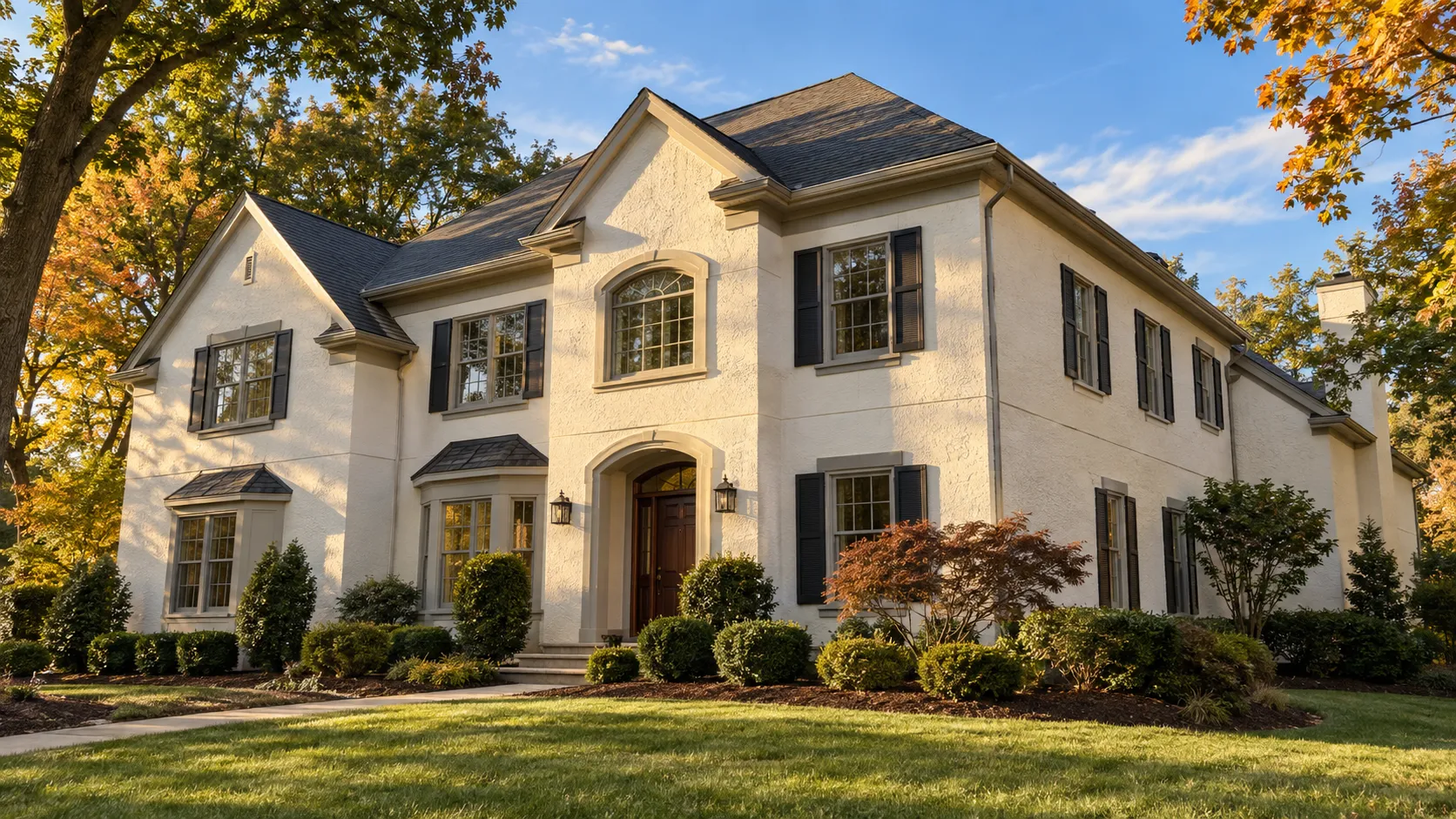
Brick stain is a thin mineral or acrylic coating that soaks into bare, absorbent brick and changes its color without leaving a paint film on top. The brick keeps its texture, its mortar lines and its ability to dry out. You can stain brick only if it drinks water, has never been painted or sealed, and is in sound condition.
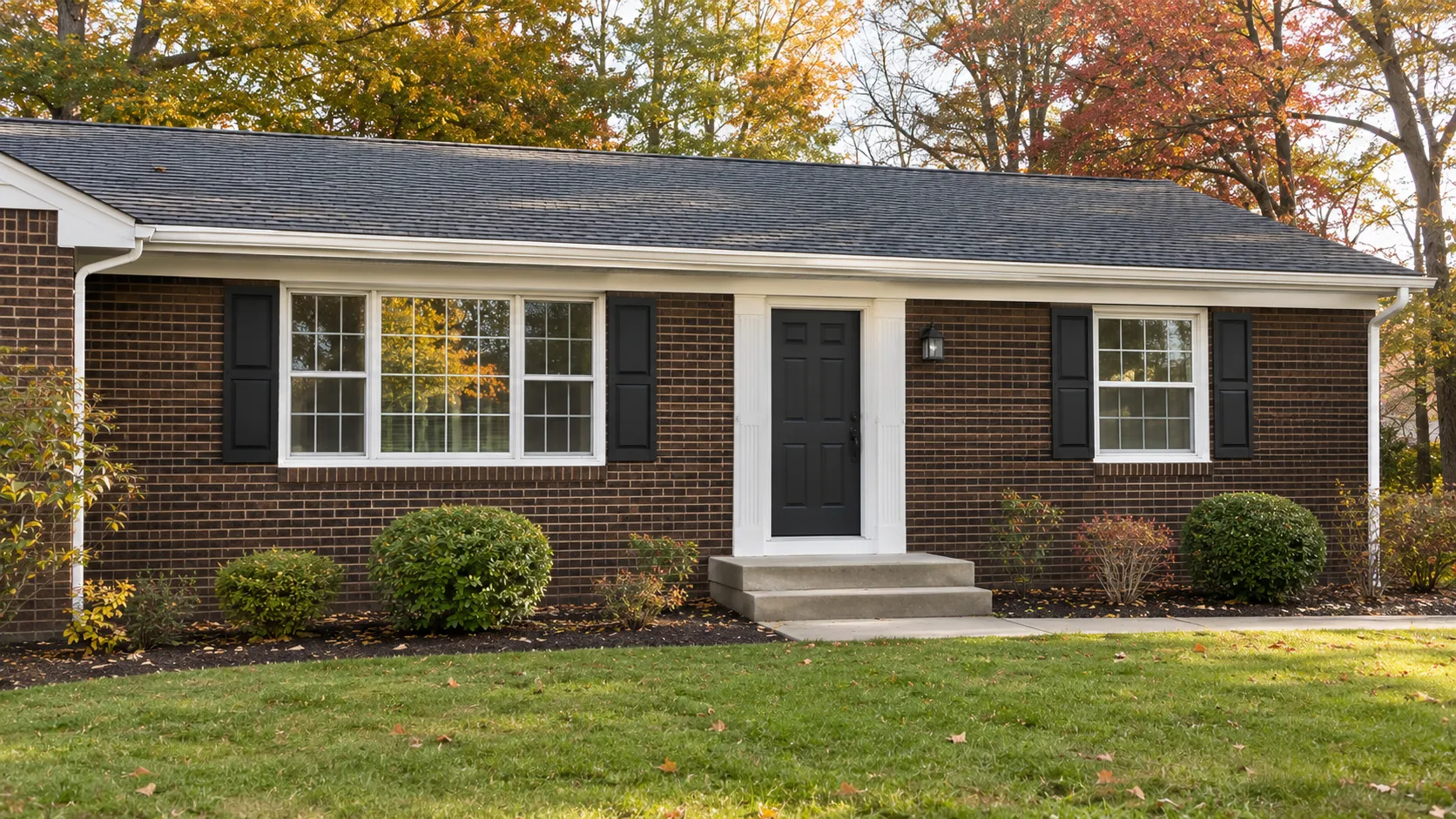
That last sentence is the whole job in miniature. Stain is a good answer for a lot of New Jersey brick: the 1960s ranch whose orange-red brick has never suited the house, the addition that was built with a brick that never matched, the patched wall where a run of replacement brick sticks out from the street. On the right brick it changes the color for good and asks for almost nothing afterwards. On glazed, dense or sealed brick it will not go in, and on wet, crumbling brick it makes things worse.
We are a family-owned painting company in Morganville and have painted New Jersey homes across Monmouth, Middlesex, Ocean, Mercer, Somerset and Burlington counties, plus Union, Essex, Hudson, Bergen and Passaic in North Jersey, for more than 20 years, using Benjamin Moore and Sherwin-Williams products. Brick painting and brick staining are both part of our exterior painting work. This guide is the long version of the conversation we have at the estimate, standing in front of the wall with a spray bottle.
Every technical figure below comes from a document we fetched and read on 15 November 2026: the Brick Industry Association's Technical Notes 6, 6A, 7, 20, 23 and 23A and its Brick Brief on staining, the National Park Service's Preservation Briefs 1, 2 and 38, the data sheets and product pages of KEIM, Nawkaw, Sherwin-Williams and Romabio, New Jersey's coatings rule, the Rutgers climate office and the EPA's lead rule. Where something is our own practice, we say so. If your question is painting rather than staining, our guide to painting a brick house covers the paint side.
The Short Answer
- Stain changes the color, not the surface. The Brick Industry Association (BIA) says masonry stains change the color "while maintaining its natural texture" and "do not alter the surface texture of the brick masonry."
- Mineral stains are the breathable first choice. The BIA says "generally mineral-based stains are preferred due to their high water vapor permeability." Many water-based acrylic stains are also sold for brick; they hold by adhesion and should be chosen for permeability.
- The brick must drink water. "A water test must be performed prior to staining." If water beads on the surface, the brick is glazed, very dense or already sealed, and stain will not take.
- Paint and sealers come off first, or the answer is paint. The BIA says earlier "sealers or water repellents, must be removed prior to application of a new treatment" in most cases. That removal is specialist work.
- Fix the wall first. Loose mortar, cracks wider than a business card, missing flashing or recurring efflorescence come before any color. Repointing is a mason's job, and not one we do.
- Test on the wall, let it dry, then decide. Stain is semi-transparent to opaque, and the brick under it shows through. The BIA wants mock-ups, judged dry, because "the treatment may appear different when wet."
- It lasts. The BIA describes projects "where the stain has lasted 20 years or more" and says masonry stains "do not require maintenance."
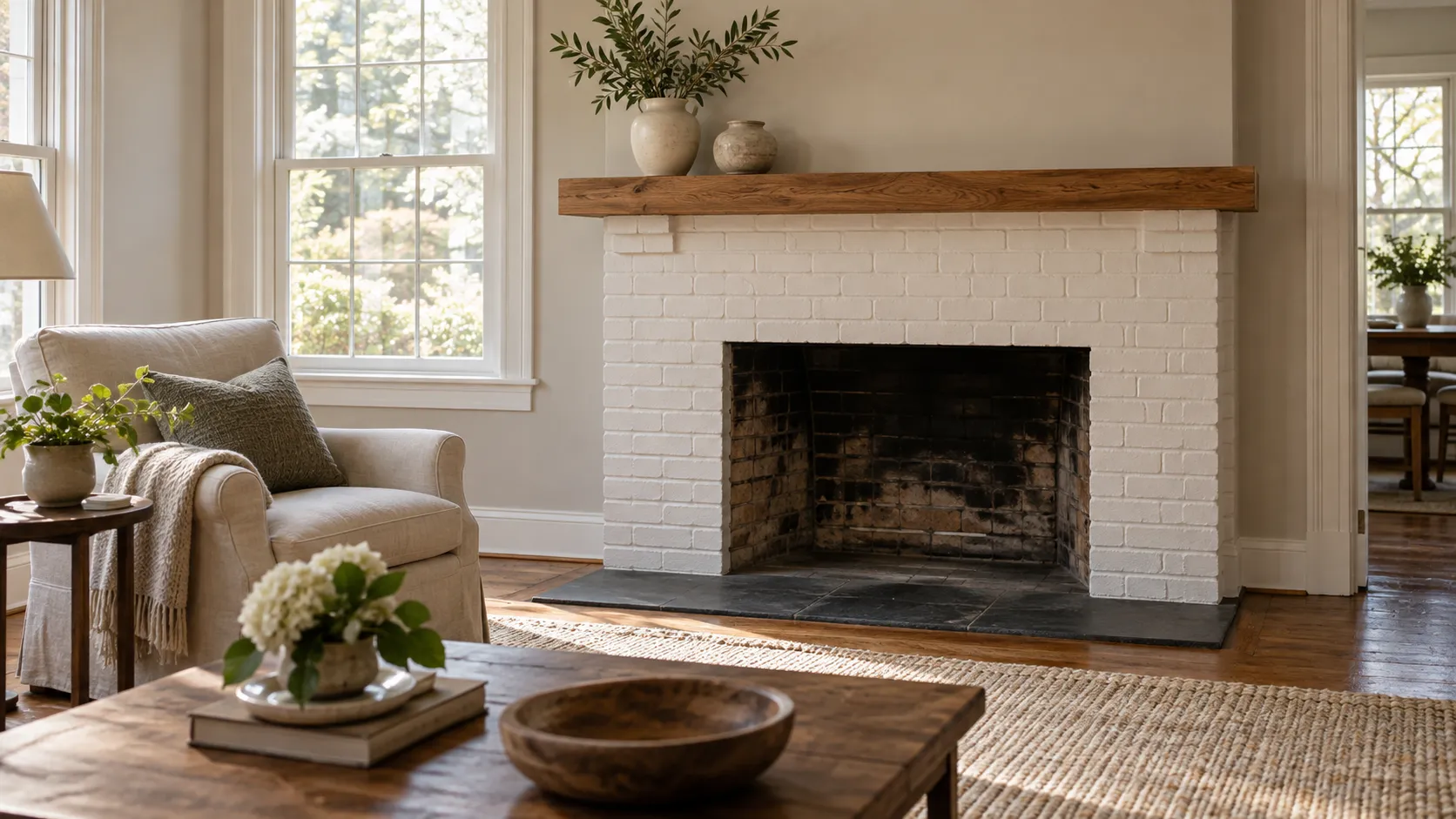
- Interior brick can be stained too, a fireplace surround included, but never the firebox where the fire burns. The soot has to come off first.
What Is Brick Stain, and How Is It Different From Paint?
Brick stain is a pigmented liquid that goes into the pores of the brick instead of sitting on it. Paint is a film. That one difference explains almost everything else about the two.
The BIA's technical note on changing the appearance of brick, Technical Note 6, puts staining in its own category. "Masonry stains are used to change the color of the masonry while maintaining its natural texture. As such they are sometimes considered semi-opaque but can also provide opaque coverage." It also says "staining has been a widely accepted industry practice for more than 50 years" and has been "used by nearly all brick manufacturers in the United States for color correction of brickwork." The BIA's Brick Brief on the subject dates the practice "since at least 1960" and describes the material as "certain ceramic stains and pigments specifically formulated for brick and mortar" that permeate "the porous surface of the brickwork, resulting in a colorfast, durable finish."
Paint behaves differently. The same note says painting "provides a fully opaque appearance that softens the natural texture of brickwork, smoothing the variations on the surface of the brick and between the brick and mortar profiles." Acrylic latex paint, it says, forms "a film on the surface of the brick," is "typically identified as vapor semi-permeable rather than fully vapor permeable," and "creates a recurring exterior maintenance task, requiring multiple reapplications over the life of the brickwork." A paint film can trap moisture behind it. On a cold wall that is where the flaking starts.
So the choice is not really about color. Paint gives more color options, any sheen and a smooth, uniform face, and it can go over old paint; stain is matte, keeps the brick looking like brick, and mostly skips the repaint cycle.
New Jersey's air-quality rule, N.J.A.C. 7:27-23, defines a stain the same way: "a semi-transparent or opaque coating formulated to change the color of a surface, but not conceal the grain pattern or texture." It caps stains at 250 grams of VOC per liter.
The other difference is that you cannot change your mind cheaply. Stain is in the brick. You can stain darker later, but you cannot get back to the original color without damaging the face of the brick, which is why the test area later in this guide matters so much.
Can You Stain Brick? The Water Test That Decides It
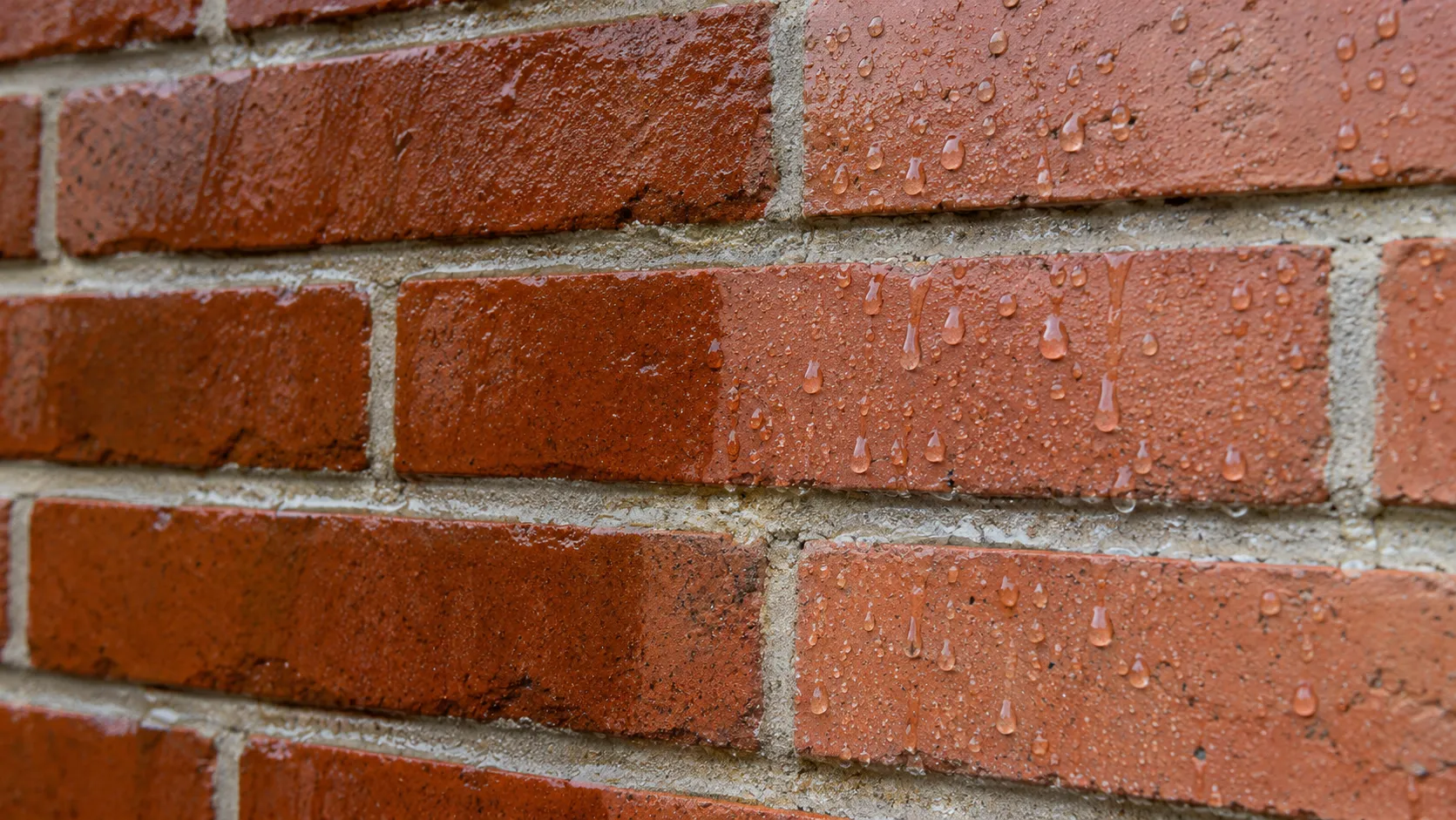
You can stain brick that absorbs water. If water soaks in and darkens the brick within a few seconds, it will take stain. If water sits up in beads or runs off, it will not, at least not until whatever is stopping it has been dealt with.
The BIA is blunt about it. "Because masonry stains rely on absorption into the pores of the brick, a water test must be performed prior to staining to qualitatively evaluate the surface absorption behavior of the brick. Glazed brick cannot be stained due to the impermeability of the exposed surfaces. There are also some unglazed brick with dense surfaces that will not successfully receive masonry stains."
How we do the water test
Our practice on every brick estimate: spray or splash clean water onto several bricks on each side of the house, including the mortar, and watch for half a minute. We test each elevation separately, because the front of a house is sometimes cleaned, patched or treated differently from the back. The results fall into three groups.
- It soaks in and the brick darkens evenly. The brick is unsealed and absorbent. It is a candidate for stain.
- It soaks in on some bricks and sits on others. The wall has mixed absorption, often from a mix of production runs, an addition, or old patching. That is not a no, but it means the stain will take differently across the wall, and the test area has to include every kind of brick on it.
- It beads, all over. Something is on the surface. Either the brick is glazed or very hard-fired, or someone has applied a clear water repellent. A repellent can be years old and completely invisible.
What beading usually means
A clear repellent is the usual reason a house that looks like bare brick fails the test. The National Park Service's Preservation Brief 1 says modern repellents "are almost invisible if properly applied," and that they are "often referred to incorrectly as 'sealers'." The BIA says one generally has to be removed before staining, chemically; see painted and sealed brick below.
Glazed brick is a different case. The BIA says its surface is "hard, glossy and generally impermeable to moisture," so treatments that rely on the pores, "such as mineral paints, stains and limewash", "will not bond to glazed brick." Glazed brick is a no for stain, full stop.
Some guides suggest testing a spare brick left from the build. That tells you about the brick as it left the yard, not the wall after decades of weather and possibly a repellent. Test the wall, after a wash with a stiff brush and soapy water if it is dirty, because grime can make good brick look less absorbent than it is.
Mineral or Acrylic: Which Kind of Brick Stain Is Better?
Mineral stain is the better choice for exterior brick in a freeze-thaw climate, and the BIA says so in one sentence: "Generally mineral-based stains are preferred due to their high water vapor permeability." Acrylic stains are easier to find and easier to work with, and good ones are made for masonry, but they hold to the brick by adhesion and have to be chosen for permeability.
Mineral (silicate) stains
Mineral stains use a silicate binder, the same chemistry as mineral paints, but carried thin enough to color the brick without hiding it. The BIA's description of mineral-based treatments in general applies: they "penetrate the pores of the brickwork while maintaining the water vapor permeance," are "highly compatible with brickwork, form a chemical bond and naturally have no volatile organic compounds (VOCs)." General Shale, a large brick maker, says in its color-correction bulletin that "there are a variety of proven application methods including Sodium Silicate, Potassium Silicate, and Acrylic bases," that "inorganic color fast pigments are used in all of these bases," and that the stains "are custom mixed on site to match the required color range."
Two data sheets show what this looks like on paper. Nawkaw's NawTone-K is described as a stain that uses "silicate as a binding agent to form a permanent chemical bond with substrates," applied between "41°–110°F," with a recoat time of "24 hours for masonry" and a VOC of "0 g/L." KEIM's residential site makes the same kind of claim for its mineral masonry products: "Chemical fusion to brick, masonry, stone, stucco, and concrete is permanent."
The catch is that silicate products need clean, open pores. The BIA says mineral paint "can be applied only to brickwork that is clean and unsealed," and that it "is sensitive to acid," so acid-cleaned brick must be neutralized first.
Acrylic (water-based) stains
When people search for water-based brick stain, this is mostly what they find: an acrylic resin with pigment, thinned to soak in. Nawkaw's NawTone is "a water-based formula designed with high-quality polymers and lightfast pigments" that "can be applied to brick, block, mortar, stucco, exterior insulation and finish systems (EIFS), and concrete surfaces," and the company lists it as "vapor-permeable" with a curing period of 21 days. Sherwin-Williams' Loxon Vertical Concrete Stain is a related product built on an "Acrylic" vehicle, sold in "Solid and Semi-Transparent colors," with a measured water vapor permeance of "21.3 perms" on its data sheet.
Two cautions. The Loxon sheet's own list of uses is concrete, block and stucco, not clay brick, so treat it as an example of how acrylic stains are specified. And the BIA notes that non-mineral treatments "typically form a film on the surface of brickwork, which can adversely affect the water vapor permeance," and that "in some cases, a colorless coating is applied over a non-mineral-based masonry stain" to even out the look when wet. That clear coat has to be breathable too.
| Stain family | Binder | How it holds | Breathability | Goes on |
|---|---|---|---|---|
| Mineral (silicate) | Potassium or sodium silicate with inorganic pigment | Chemical bond in the pores | High; the BIA says permeance is maintained | Clean, unsealed, absorbent brick and mortar only |
| Acrylic (water-based) | Acrylic polymer with pigment | Adhesion, partly in the pores | Varies by product; check the sheet's perm figure | Absorbent brick; some systems add a clear top coat |
What about oil-based and solvent-based stains?
Some guides describe oil-based and solvent-based brick stains as giving deep penetration at the cost of stronger fumes and longer dry times, and recommend water-based products as the eco-friendly choice. The BIA's preference for mineral products rests on breathability, not on how deep a stain goes.
Who applies it
Some of the best-known brick stain systems are not sold over the counter: Nawkaw says its products are "exclusively applied by our experts." The BIA's Brick Brief describes the work as done by "trained, experienced professionals" and notes that "most stain manufacturers provide a warranty for their product." Ask what warranties come in writing. The Brief also notes that "there have been no formal technical resources or ASTM Standards related to stain materials or their application," and that the process "differs among practitioners," which is why it asks a staining contractor for references with photos and addresses of past projects. Whoever you hire, ask which product they will use, whether it is mineral or acrylic, and what perm figure its data sheet gives.
Why Does Breathability Matter So Much on New Jersey Brick?
Because brick in New Jersey gets wet and then freezes, over and over, and the water has to get back out. A coating that slows it down leaves water in the face of the brick when the temperature drops.
The BIA's Technical Note 7 lists what too much water does to brick: "efflorescence on exterior surfaces; and cracking, crazing, spalling or disintegration due to repeated freeze-thaw cycling." Technical Note 6 makes the link to coatings: "Because exterior brick masonry is exposed to moisture, and in many cases freezing and thawing cycles, it is important that the treatment permits evaporation of moisture." Its note on clear coatings goes further for film-formers, saying their reduced breathability "is of special concern in exterior brick masonry subject to freezing and thawing cycles," and that they "are not recommended for brick masonry in such environments."
New Jersey has both halves of that problem. The Rutgers state climate office says many areas average "between 43 and 47 inches" of precipitation a year, with measurable precipitation on "approximately 120 days," and that nor'easters "are most frequent between October and April." Wet brick going into a freezing week is the normal winter here, not an exception.
What "breathable" means in numbers
Breathability is measured as water vapor permeance, in perms. The BIA classifies materials above 10 perms as "vapor permeable" and between 1 and 10 as "vapor semi-permeable," and says "treatments used for brick masonry commonly report a permeance of 20 to 85 perms depending on the type of treatment." Two things in that note matter at the estimate. "The thickness of the treatment also affects its permeance. Thus multiple layers of a treatment will decrease its permeance." And the perm figures from the two test standards are not interchangeable, so compare like with like. KEIM's Mineral Masonry Paint reports "77 perms" by ASTM E96; the Loxon stain sheet reports 21.3 perms by ASTM D1653.
Your wall type changes how much it matters
The BIA separates two kinds of brick wall. A drainage wall, which most brick veneer houses are, has "an airspace and a water-resistive barrier between the brickwork and the interior wall substrate," so water can leave through the flashing and weeps and "there is more flexibility in treatment selection." A barrier wall, which includes "mass masonry multi-wythe walls," manages water by soaking it up and drying out, so "it is more critical to select a treatment that does not inhibit the water vapor permeance of the brick."
In our experience most post-war brick houses in central New Jersey are veneer over a framed wall; older city houses are more often solid brick. If header bricks are turned end-out every few rows, the wall is probably solid. Either way, the BIA's rule is the safe one: choose treatments "that result in brick masonry with a high water vapor permeance."
Brick Stain vs Paint vs Limewash vs Whitewash: How Do They Compare?
Stain changes the color and keeps the brick's look and breathability. Paint gives full, opaque color and a recurring repaint. Limewash and whitewash give the soft, washed look that is popular now, and wear away or behave like paint. Here is how the BIA's technical note describes each one.
| Finish | Look | How it holds | Breathability | Upkeep | Over painted brick? | Do we do it? |
|---|---|---|---|---|---|---|
| Masonry stain | Semi-opaque to opaque, keeps the brick texture | Absorbed into the pores | High when mineral-based | BIA: "do not require maintenance"; projects of 20+ years | No | Yes |
| Acrylic latex paint | Opaque, any color, softens the texture | Film on the surface | "Vapor semi-permeable"; drops with each coat | "Multiple reapplications over the life of the brickwork" | Yes, over sound paint | Yes |
| Mineral (silicate) paint | Opaque, dead-flat mineral look | Chemical bond into the brick | High; BIA says permeability is not affected | BIA: warranties typically 15+ years | Traditionally no | Brick painting, yes |
| Limewash | Chalky, matte, non-uniform, weathers on purpose | Carbonates in the surface | High | BIA: "five to 10 years or more" | No | No |
| Semi-opaque paint ("whitewash") | Diluted paint, brick shows through | Film on the surface | Lower with heavy coats | "Will require reapplication over time" | Not usually | No |
| Mortar wash (German smear) | Mortar smeared over the brick | Mortar bond | Mineral-based | Durable | No | No |
Limewash and whitewash, for information only
We do not limewash brick, and we do not whitewash it either. Both come up at nearly every brick estimate, so here is what they are.
Limewash is slaked lime and water, sometimes tinted. The BIA calls it "a mineral- and water-based treatment" that "provides a naturally nonuniform matte finish," says it "can last five to 10 years or more depending upon the level of weathering desired," and that "moisture will remove limewash over time." Romabio, which sells one, says its Classico Limewash goes only on "unsealed, unpainted, and absorbent brick," and that "there is no warranty as it is unknown to how your limewash finish will change based on your natural elements." Our limewash brick guide covers it in depth, and explains what to ask a limewash applicator.
What most people call whitewash today is not lime at all. The BIA describes it as "semi-opaque paint (faux limewash/whitewash)" made with "diluted acrylic latex paint," typically one part paint to one part water, and warns that it "should not be expected to be as durable as limewash in exterior applications." Once it is dry, it is paint.
Where stain wins, and where it does not
Stain can transform a house's curb appeal without turning it into a painted house. It wins when you like brick and just do not like your brick's color: a rustic wall you want darker and calmer, a patchy wall you want even, a red you want browner. It loses when you want a crisp white, a smooth accent wall indoors, or any color lighter than the brick itself, because a translucent stain cannot lighten what it sits in. For those, an opaque stain or a paint is the honest answer, and paint brings its own protective barrier and repaint cycle.
What Problems Can Brick Staining Fix?
Mostly color problems on brick that is otherwise fine. The BIA's Brick Brief lists the cases, and they are worth reading, because most homeowners do not know stain can do this.
- Brick that was never blended properly. The Brief lists "correcting brickwork in which multiple brick colors may not have been properly blended, resulting in a patchwork appearance."
- Brick from different production runs. "Matching brickwork constructed of brick from different production runs."
- An addition that never matched. "Not only can the new brickwork be matched to the existing brickwork, but the existing brickwork can be matched to the new brickwork."
- Chips and pops. "Covering surface imperfections of brick due to the presence of chips, lime pops or pyrite pops."
- Damage from bad cleaning. "Repairing brickwork that was damaged due to improper cleaning."
- A new look that still reads as brick. "Updating existing brickwork to change aesthetics yet maintain natural brick appearance."
- The mortar alone. "Modifying only the mortar joints to match the color of surrounding mortar joints."
The point the Brief makes about patches is the one we see most. In our experience the commonest reason people ask us about stain is an addition, a filled-in garage door or a rebuilt chimney whose brick is close but not right. The Brief says staining individual brick "allows the existing mortar to remain in place and avoids the possibility of mismatching the color of fresh mortar with the existing mortar color."
Stain works brick by brick when it needs to. The BIA says it "can be used to lighten or darken the appearance of individual brick units, mortar joints, a field of brickwork or any combination thereof." That is how a wall full of discolored or orange outliers is brought into line without touching the rest. And it does not weaken anything: "staining brick masonry does not affect the structural integrity of the brick or mortar."
What stain cannot fix is anything that is not color. Cracked brick, loose mortar and a wall that stays wet are masonry and water problems.
How Do You Choose Brick Stain Colors?
Start from the brick you have, not from a chip. A semi-transparent stain adds its color to the brick's, so the result is always a mix of the two. Sherwin-Williams' guide to brick stain puts it simply: "The original brick color also plays a part in the final color of the stain."
Three rules that hold
- It is easier to go darker than lighter. A translucent stain over red brick can make it browner, deeper, more muted or more even. It cannot make it pale. Lightening brick takes an opaque stain, or paint.
- Decide what the mortar does. The joints are a big share of what you see from the street. Stain can leave them alone, or color them too: the BIA notes "mortar color can be changed as well if desired." Some guides suggest a lighter base color on the joints than on the brick, which keeps the pattern of the wall visible after a dark stain.
- Look at the whole house. Sherwin-Williams advises choosing "a color that compliments your roof, door and window frame colors." The roof does not change, so it leads. A front door or shutters can be repainted to suit the new brick, and our guide to garage door, front door and shutter painting covers that part.
How much change do you want?
Sherwin-Williams frames it as two levels. "A semi-transparent stain should do the trick if you simply want to give your masonry new life," while "if you're looking for a complete makeover, opt for an opaque stain." An opaque stain still keeps the brick's texture, which is what separates it from paint, but it does hide the brick's own color. The BIA's photos of a fully stained house show exactly that: every brick changed, "a matte finish that maintains the natural texture of untreated brickwork."
Blended brick needs extra care, and so does any color matching job where new brick has to meet existing brick. On a wall laid with several shades, the BIA says "mock-ups and sample panels" must "incorporate the full range of colors," because a stain that looks right on the light bricks can look muddy on the dark ones.
Staining red brick
Red brick is the most common case we see, and the most common request is to calm it down. Browns, deep reds, charcoal and muted earth tones work well over red, because they work with the red underneath instead of fighting it. A dark stain over a bright orange-red can look rich and even. A pale grey or white over red, in a translucent stain, will not look pale; it will look pink or dirty. If the goal is a light house, plan on an opaque stain or a paint from the start, and test it.
We help with color choices as part of the estimate. Our guide to popular exterior house colors in NJ has trim and door colors that sit well beside red and brown brick. If you are still deciding between stain and paint, a test patch of each, side by side, settles most arguments.
Why Test Brick Stain on a Hidden Area First?
Because the brick decides the final color, not the can, and you cannot undo it. The BIA says "mock-ups or sample panels should be used for color selection prior to completing the work," and its application section adds the detail that catches people out: "allow the surface to dry completely before evaluating the results, as the treatment may appear different when wet."
How a good test area works
- Choose an inconspicuous spot that is still typical. A back corner of the house, behind a shrub, on brick and mortar that are the same as the front. The Park Service gives the same advice for testing anything on masonry: test "in a discrete location."
- Make it big enough. A couple of bricks will not tell you much. The BIA asks for samples "of an adequate size to ensure that the desired effect is achieved." For cleaning trials it asks for "a 20 sq ft" area; we use something similar for stain.
- Include every kind of brick on the wall. If the house has mismatched or discolored brick from an addition, test on both.
- Test the whole process. Clean the area the way the house will be cleaned, wait until it is dry, then apply the stain the way it will really be applied, at the same dilution and number of coats, by sprayer or brush, or with sponge brushes on a small patch.
- Judge it dry, in daylight, from the street. Look in the morning and the afternoon. A stain that looks right at arm's length can look heavy from the curb.
Some products come in a trial kit for exactly this. Some guides suggest testing on a fireplace corner or a spare brick; on an exterior job, test on the wall itself. Keep the test area until the job is finished, as the BIA recommends for mock-ups, so everyone can compare the work against what was approved. In our practice the approved test area, the product and the number of coats are written on the estimate.
How Do You Prepare Brick for Staining?
Clean it gently, let it dry, deal with anything wet or broken, and remove anything sitting in the pores. Preparation on brick is less about scraping than about making sure the stain has clean, dry, open pores to go into.
1. Look for water problems first
The BIA says "the masonry must be in good condition prior to application of a treatment," and lists what to look for: discoloration, biological growth, "cracks in brick units or mortar wider than the thickness of a business card," loose or damaged brick, "loose, missing or deteriorated mortar," damaged flashing, clogged weeps, signs of water getting in, and failed sealant joints. "If any of the conditions above are identified, they should be corrected prior to applying a treatment." Fine hairline cracks are a different matter: the BIA says those "not visible from a distance of 15 to 20 ft" can stay if the brick is securely set.
2. Get the mortar right, by a mason
Mortar that is loose, missing or cracked has to be raked out and repointed before any stain goes on. The BIA recommends that repointing "be performed by a mason experienced with repair and restoration," and the Park Service's Preservation Brief 2 explains why it is not a casual job: new mortar "must be as vapor permeable and as soft or softer (measured in compressive strength) than the historic mortar." Some DIY guides show a homeowner pressing mortar mix into joints with a pointing trowel and staining a few days later. We do not do masonry repair or repointing. A mason does it first, and then the new mortar has to cure (see step 6).
3. Clean, gently
The BIA's advice is "to use the least aggressive technique necessary," and "in many cases scrubbing with a stiff-bristled, non-metallic brush and soapy water or low-pressure washing is sufficient." Its cleaning note, Technical Note 20, sets the limits for a pressure washer: "Do not use water pressures higher than 400 psi (2800 kPa) as measured at the nozzle tip unless permitted by brick manufacturer," with "a stainless steel 25 to 50 deg. fan tip, held a minimum of 12 in. (305 mm) from the brick surface." High pressure, above 800 psi, "is not appropriate for brick and may damage the brickwork." Some guides suggest 1,000 to 1,500 psi on brick. We stay within the BIA's numbers. Our guide to power washing a house explains the difference between washing siding and washing masonry.
Two cleaning rules matter especially before stain. Never use muriatic acid: the BIA says "do not use diluted or undiluted muriatic (hydrochloric) acid," because unbuffered acid causes "damage and staining that cannot be removed or repaired." And work top down, keeping the wall below wet, so dirty runoff is not drawn into dry brick. Mildew is washed off; we do not offer mold or mildew treatment.
4. Deal with efflorescence
White, powdery salt on brick is efflorescence. The BIA describes it as "a white, crystalline deposit" that "is normally harmless" and forms when water carries salts to the surface and evaporates. On a house under a year old it is often "new building bloom," which usually dissipates as the wall dries; later, it points to "excessive water penetration or poor drainage." The BIA says efflorescence "should be removed, and once removed the surface should be observed for reoccurrence prior to being treated," and that coatings "are not recommended as the sole treatment to control efflorescence." If it keeps coming back, find the water first: a roof or gutter leak, a downspout, a missing flashing, soil against the wall.
5. Remove old repellents and coatings
If the water test showed beading, something is in the pores. The BIA says previously applied treatments, "including sealers or water repellents, must be removed prior to application of a new treatment, including brick color correction," that "abrasive methods such as sandblasting are not recommended," and that "generally, a proprietary chemical solution specifically formulated for brickwork is required." Some repellents cannot be fully removed, and then the brick cannot be stained.
6. Let it cure and dry
New brick and new mortar need time. The BIA says "allow at least 30 days for the mortar to cure prior to treatment, although longer waiting periods may be necessary, especially in cooler weather," and "after cleaning, wait at least 24 hours for the masonry to dry before applying treatments." Rain and high humidity stretch that. It gives a simple check: tape a sheet of 4-mil plastic tightly to the brick for at least 16 hours, and "if moisture is present on the plastic sheet after the duration of the test, it indicates that additional drying time is needed."
7. Protect everything else
In our experience stain that lands on stone or concrete does not wipe off the way wet paint sometimes does. Walks, stone steps, the foundation, plantings and anything else the spray could overlap get drop cloths or masking, and glass and painted trim get covered.
How to Stain Brick, Step by Step
Follow the stain maker's instructions for the product you use. The BIA says so directly for stains: they "are proprietary products that vary by manufacturer. For these products, follow the manufacturer's application instructions." What follows is the general sequence, with the figures from the sheets we read and our own practice marked as such.
- Check the weather window. Pick a warm, dry day and avoid extreme temperatures. The BIA gives "the typical minimum air, material and surface temperature" for brick treatments as "40 °F," and says to "avoid painting surfaces that are less than 5 °F above the dew point." The sheets vary: NawTone-K lists "41°–110°F," KEIM's mineral paint wants 40°F "and rising" and below 86°F and no "sun-heated substrates," and the Loxon stain sheet wants "air and surface temperature … between 50° and 90°F."
- Mix thoroughly, and keep mixing. Stains carry heavy pigment that settles. Some guides suggest a drill with a paint mixer paddle. When more than one container is used, the Loxon sheet's advice applies generally: "intermix all containers together to ensure color uniformity."
- Start where it shows least. Begin on the least visible side, at the top of a wall, and work down. The finished test area tells you the dilution and the number of coats.
- Work in small sections with a wet edge. Stain applied over stain that has started to dry can leave lap marks and darker bands. Work in small sections that end at a natural break: a corner, a window opening, a downspout.
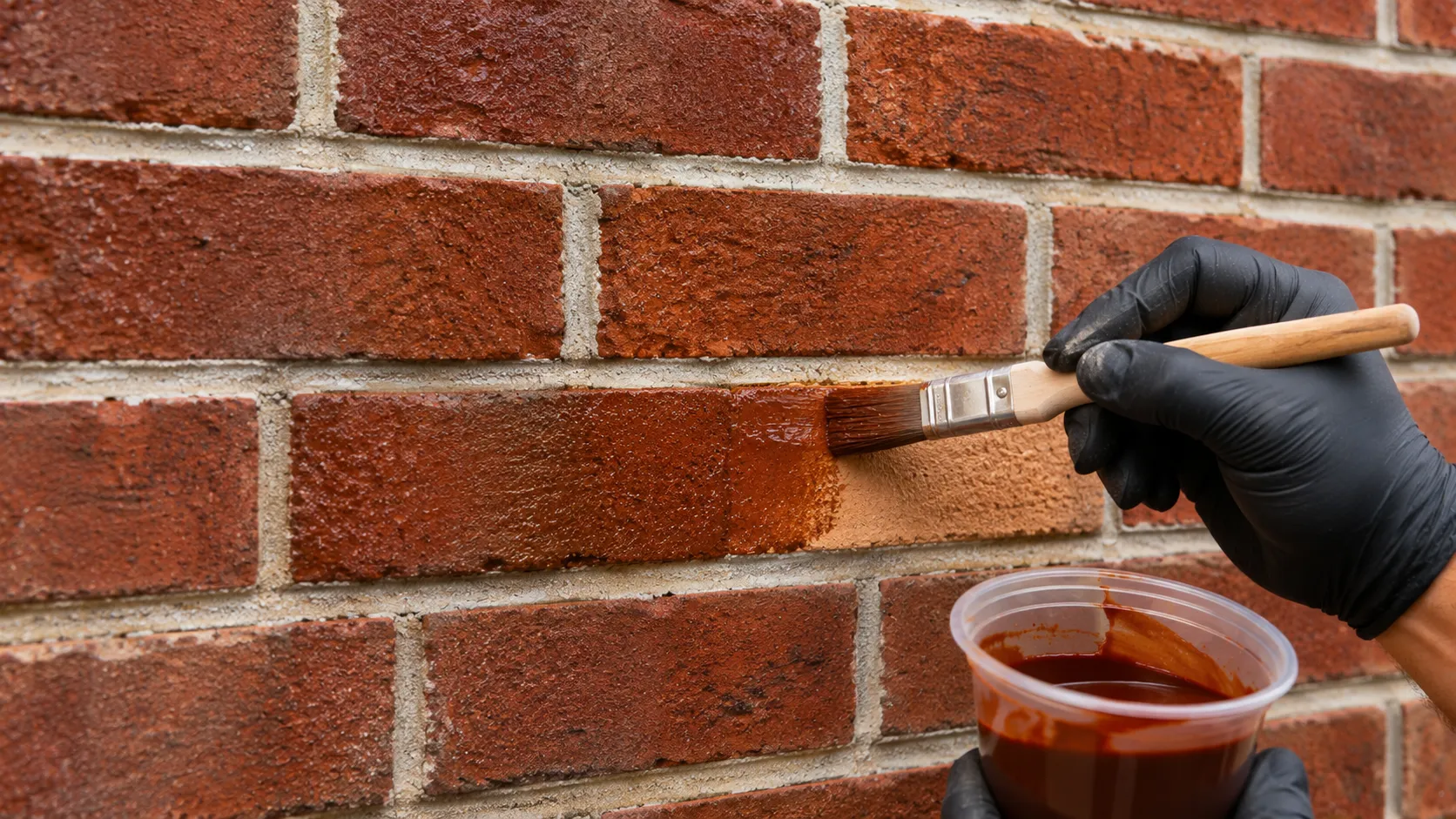
- Choose the tool for the job. For a whole wall, a sprayer or roller lays the stain on and a brush works it into the texture and the joints. For brick-by-brick color correction, the stain goes on with small brushes, brick by brick. Some guides use sponge brushes on small areas. When spraying, the passes overlap and the spray is kept off everything that is not brick.
- Build color with thin coats. It is easier to add a second coat than to take one off. The Loxon sheet calls for two coats as a rule: "the first coat will penetrate and seal the surface, the second coat will uniform the color." NawTone-K's sheet gives "24 hours for masonry" between coats.
- Let it cure. Keep water off the fresh stain for as long as its sheet says. KEIM asks for protection "from wind and rain for a minimum of 12 hours during and after application." Nawkaw's NawTone sheet allows "21 days for curing."
How Long Does Brick Stain Last?
A properly applied masonry stain on sound brick lasts a long time, and it does not peel. The BIA says masonry stains "have a long history of successful performance on brick masonry, with projects where the stain has lasted 20 years or more," and that they "do not require maintenance." The BIA's Brick Brief calls the result "a durable, colorfast finish that preserves the minimal maintenance associated with traditional brickwork."
Some guides put stain at 7 to 10 years before fading becomes obvious, others at 20 years or more. The difference is mostly the product and the prep. A mineral stain bonded into clean brick is a different thing from an acrylic stain over a dirty or partly sealed wall. The BIA's own caution is that "all stain products are proprietary, and they do not necessarily provide equal levels of performance and durability."
How stain fails, compared with paint
Stain does not fail by peeling or chipping, because there is no film to peel. Its life is measured in decades when the wall is sound. When it does wear, it tends to fade gradually, most on the sunniest and wettest walls. That is why stain is described as low maintenance: there is no scraping and no recurring repaint. Paint on brick fails at the film: it blisters and flakes where water gets behind it, and the BIA describes painted brick as "requiring multiple reapplications over the life of the brickwork." Limewash, by design, wears away; the BIA's figure is "five to 10 years or more."
What shortens it
Water in the wall, from a gutter, a flashing or a wet foundation, pushes salts through any finish. Patches that once had a repellent take less stain and fade first. A non-breathable clear coat can cloud. And high-pressure washing wears the face of the brick and the stain with it, so wash stained brick as gently as unstained brick.
Should You Seal Brick After Staining?
Usually not. A mineral stain needs no top coat, and on most brick walls a clear coat is not necessary at all. If an acrylic stain system calls for a clear coat, it should be the breathable one that its maker specifies, not a glossy film.
This is the point where the guides online disagree most with the people who study brick. Several guides tell you to finish with a sealant, one with a "solvent-based satin acrylic sealer." The BIA's note on clear coatings says "application of a water repellent coating is not necessary to achieve water resistance in brickwork subjected to normal exposures where proper material selection, detailing, construction and maintenance have been executed," and "do not apply film-forming coatings to brickwork located in freeze-thaw environments." The Park Service is just as direct about older buildings: "the application of water-repellent coatings to historic masonry is usually unnecessary."
Why a clear coat can hurt
The BIA explains the mechanism. A film slows the escape of water vapor. In the BIA's words, a film-former "inhibits evaporation of water within the masonry through the exterior face and can result in clouding … and spalling … if the source of moisture is not addressed." With low-permeability coatings, it adds, "efflorescing salts may become trapped under the coating, causing damage to the brick." The Park Service adds that "a water-repellent coating should never be applied to a damp wall."
Some guides say a stain with a built-in waterproofing agent gives a watertight finish. The Loxon sheet, which is a stain with water repellency built in, says the opposite in its own words: it "is not designed to waterproof concrete block or other porous substrates."
If a clear coat is used
The BIA's guidance is to "use only breathable coatings" and to "consider the use of a siloxane or siloxane/silane pre-blended coating." In its table of typical properties, siloxanes and silanes score "very good" for water vapor transmission and last "10+" years, while acrylic film-formers score "poor" and last "5 to 7" years. Penetrants are also "typically more resistant to UV degradation." The BIA adds a caution that matters on a stained wall: "Reapplication of a coating (especially if carried out prematurely) may decrease the vapor permeability of the brickwork."
Our practice: we do not add a clear coat to stained brick unless the stain maker's system calls for one, and then we use the clear coat its sheet names.
A New Jersey VOC note
New Jersey's architectural coatings rule changed for clear masonry products. For products made on or after 18 August 2026, a "concrete/masonry sealer" is capped at 100 grams of VOC per liter, and the old "waterproofing concrete/masonry sealer" category, which allowed 400, is discontinued. Older stock made before that date can still be sold and used, so the date code on the can matters more than the label. Stains stay at 250.
Can You Stain Interior Brick or a Brick Fireplace?
Yes. Interior brick takes stain the same way exterior brick does, with two differences: it is usually drier and protected from frost, and a fireplace has a firebox that must not be treated.
The BIA says "interior brick masonry is typically not exposed to moisture or freezing conditions. As a result, a wider range of treatments may be used." There is one exception worth knowing: "applying some treatments to the inside face of a mass masonry wall can inhibit evaporation," so on the inside of a solid exterior brick wall it recommends treating "interior brick like exterior brick."
The fireplace
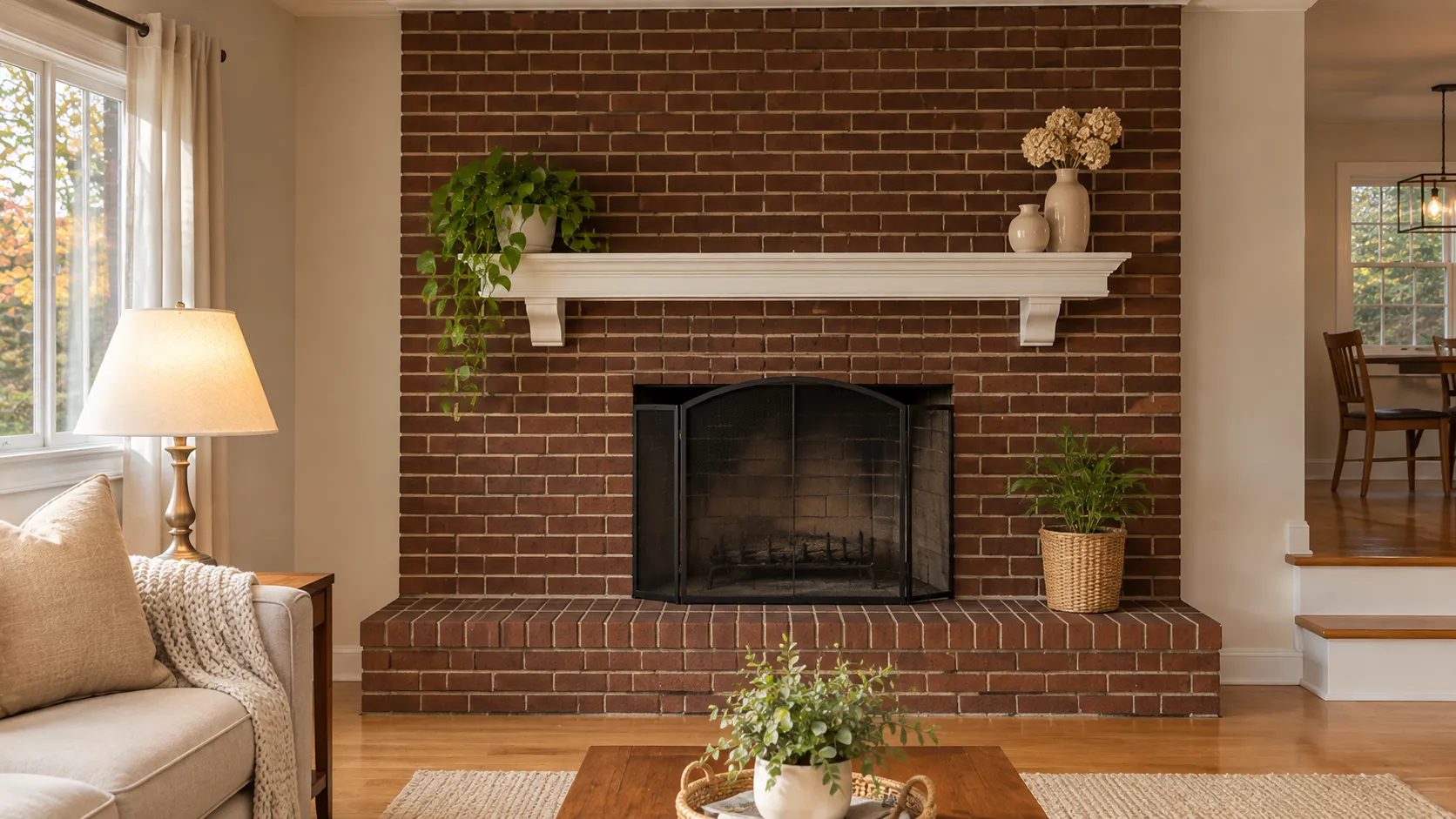
The firebox is off limits. The BIA defines it as "the recessed portion of a fireplace … in which the fire occurs," including "the bottom, tapered sides and back," and says that if the fireplace "remains functional and will be exposed to open flames, treatments should not be applied to the firebox." The surround, the hearth face and the chimney breast are fair game.
Fireplace brick also needs more cleaning than a wall. The BIA's routine: "Dry brush the brickwork with a non-metallic stiff-bristled brush to remove surface debris, and then vacuum. Pre-wet the brick and use a sponge or rag to clean the fireplace surround with a grease-cutting detergent and water, or a stronger agent such as trisodium phosphate if needed. Carefully rinse and let dry." A fireplace that has been painted needs the painted-brick answer below. Our guide to painting a brick fireplace covers paint, heat, the mantel and the hearth in detail.
Indoors, the smell and the timing
Working indoors changes the logistics more than the method: water-based products, with windows open. The BIA does not recommend treating brick floors and pavers, because treatments "can also reduce the slip resistance of the walking surface," so a brick floor that is walked on is not a stain job. Interior brick in kitchens collects grease, which has to be cut with a degreaser before any stain will soak in.
Interior brick work is part of our interior painting service, and the test-area rule applies inside just as much as out.
Can You Stain Brick That Has Already Been Painted or Sealed?
No. Stain needs bare, open pores. Painted brick is a paint job, or a paint-removal job first. Sealed brick is a coating-removal job first, if the coating can come off at all.
Painted brick
Paint on brick fills the pores and sits on the face. Stain over it will not soak in. The choices are to repaint it and accept paint's touch-ups and repaint cycle, with the alkali-resistant primer and masonry paint that our brick house guide describes, or to strip it back to bare brick and then decide.
Stripping paint off brick is harder than it sounds. The BIA says "paint can be very difficult to remove from brick masonry without causing damage," and that "abrasive methods such as sandblasting are not recommended, as the process will damage the brickwork." Pressure washing does not do it either: "the pressures needed would be excessive." The Park Service warns that some strippers "may permanently discolor or stain the masonry surface if not used correctly." Aggressive cleaning can ruin the face of a brick in an afternoon. Paint removal from brick is specialist work that we do not do.
Old paint and the EPA lead rule
If your house was built before 1978 and the brick is painted, assume the paint may contain lead until it is tested. The EPA's Renovation, Repair and Painting rule requires certification for "anyone paid to perform work that disturbs paint in housing and child-occupied facilities built before 1978," and the agency "recommends that homeowners hire a lead-safe certified contractor." We are not an EPA Lead-Safe Certified firm. That is a licensing fact, not a choice of wording. We do not scrape or sand paint on homes built before 1978. If old paint on a pre-1978 house is going to be scraped, stripped or disturbed by someone else, ask that contractor for their firm certification number and check it with the search tool on the EPA's Renovation, Repair and Painting program page. Our guide to lead paint in older NJ homes covers testing and New Jersey's rules.
Sealed brick
Sealed brick fails the water test. The BIA's guidance is a proprietary chemical remover tested on a small area first. Some guides suggest an acid wash to remove sealant; the BIA says not to use muriatic acid on brick at all. If a repellent will not come out, stain will not go in, and the honest options are an opaque finish made for coated masonry, or leaving the brick alone.
Stained brick, restained
Brick that was stained before can usually be stained again. You can go darker over an old stain easily. Going lighter means an opaque product, because a translucent stain cannot hide a darker color under it.
When Is the Best Time to Stain Brick in New Jersey?
Late spring and early fall, on a run of dry days with temperatures comfortably above the product's minimum. In our experience May into June and September into October give the most reliable windows for exterior brick.
The figures behind that come from the sheets and the BIA. Most treatments need at least 40°F in the air, the stain and the brick, and the surface should be at least 5°F above the dew point. Cleaning comes first, and the BIA's cleaning note is stricter than the stain sheets: "do not clean during freezing weather or when freezing weather is expected," use water-only cleaning "when the ambient temperature will be 40 °F or above and will remain so until the wall is dry," and "ideally, temperatures should be above freezing for seven days after cleaning is completed." Then the wall needs at least 24 hours to dry, longer "when rain or high-humidity conditions occur." That is a minimum. The Park Service notes that "a masonry wall may take over a week to dry after cleaning," and the BIA warns that "brick masonry does not dry at a uniform rate or evenly across a building," so the shaded side gets its own plastic-sheet check before it is stained.
Why not midsummer or late fall?
High summer is not ideal. KEIM's sheet wants the surface below 86°F and warns against "sun-heated substrates," and stain sprayed onto hot brick in direct sun dries before it can soak in evenly, which is where lap marks come from. A wall that goes into a hard freeze still damp from cleaning is the other thing to avoid. Work the shady side and follow the sun around the house. Late fall brings cold mornings, heavy dew and brick that never dries between rains, and nor'easters, which Rutgers says peak between October and April.
Our guide to the best time to paint a house exterior in NJ and the companion piece on how cold is too cold to paint outside cover the same window for painted surfaces.
Older and historic brick
The BIA flags one category to leave alone: "in some historical masonry structures (typically built prior to the 1870s), painting of the exterior was part of the moisture-control system," usually limewash, and "the existing coating should not be removed but rather maintained with a product compatible with the historical coating." That is historic restoration work, and it is not ours. If your house is in a historic district, check with your town before changing an exterior finish; our guide to NJ permits, HOA and historic approval explains when approval is needed. Painting or staining an ordinary older brick house is fine; restoring a historic masonry finish is a specialist's work.
What We Do, and Do Not Do, on Brick Staining
- We stain brick, exterior and interior, as a whole-wall color change or brick by brick to blend an addition, a patch or mismatched brick.
- We water-test every elevation before we recommend stain, and tell you plainly if the brick is glazed, too dense or sealed.
- We clean brick gently, with soapy water, brushes and low-pressure washing within the BIA's limits, and never with muriatic acid.
- We make a test area, let it dry, and have you approve it before the wall is stained.
- We write the product, the stain type, the number of coats and the test-area result on the estimate, so you can compare bids line by line.
- We paint brick when paint is the better answer, including brick that has been painted before.
- We help you choose colors for the brick, the trim and the doors together.
What we do not do: limewash, whitewash or mortar wash (German smear); repointing, masonry repair, flashing or weep repair; paint stripping from brick; historic restoration; mold or mildew treatment (washing is part of the job); or brick floors and pavers. And we do not hold EPA Lead-Safe (RRP) certification: on a house built before 1978, ask us, and every other bidder, for a firm certification number before anyone disturbs old paint.
Get a Price for Brick Staining in New Jersey
Brick staining is labour-intensive in a way that does not show in the finished wall: the water test, the cleaning, the drying time, the test area and, on a color-correction job, a lot of small-brush work brick by brick. The size and height of the walls, how many elevations, the condition of the brick, whether old coatings have to come off first and whether you want a whole-wall change or a blend all move the number. That is why we look at the wall rather than quote from a photo. For how exterior pricing is built, see our article on what it costs to paint a brick house in NJ and the exterior section of our painting cost guide.
Some guides note that professionals "often" offer warranties, and the BIA's guidance for stain applicators asks for "a minimum of three years of experience applying masonry stains" and "a warranty of 15 years or more," plus references with photos and addresses. Ask every bidder what they will put in writing. DIY staining is cheaper on paper and very possible on a small, absorbent wall; on a whole house, the prep and the test are where the money is saved or lost.
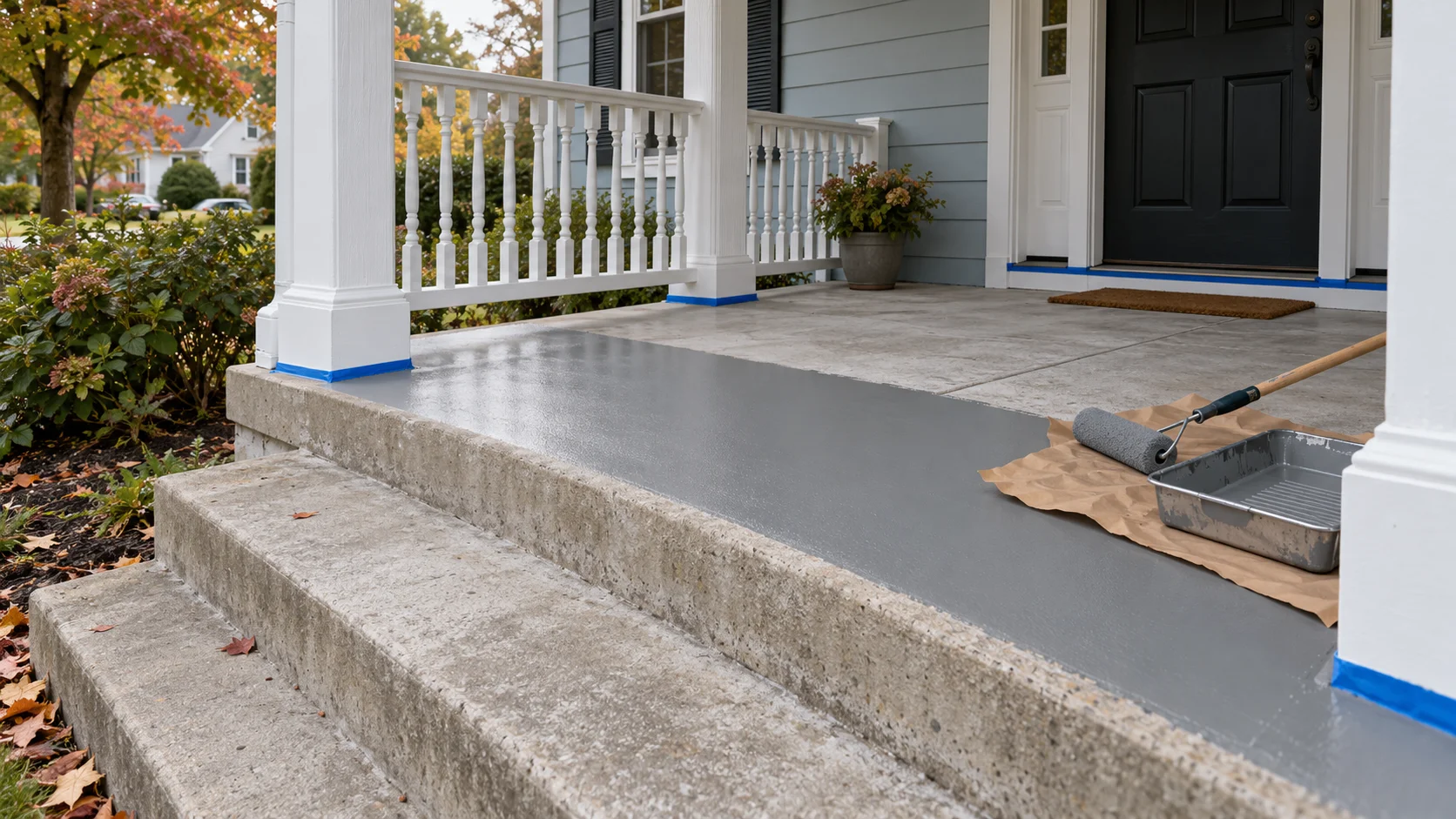
NJ Painting Co. is a family-owned painting company at 36 Church Rd, Morganville, NJ 07751, working on New Jersey homes for more than 20 years with Benjamin Moore and Sherwin-Williams products. Every estimate is free and spells out surfaces, prep, products and number of coats. For the work itself, see our exterior painting service, and for other masonry we coat, our guides to stucco painting and painting concrete patios and porches. Call (732) 239-0932 or request a free estimate, and ask us about the job minimum when you enquire.
Frequently Asked Questions
Can you stain any brick?
No. Brick has to absorb water for stain to work. The Brick Industry Association says "glazed brick cannot be stained" and that some dense unglazed brick "will not successfully receive masonry stains." Brick that has been painted or treated with a clear water repellent will not take stain either until the coating is removed. Spray water on the wall: if it soaks in and darkens the brick, it is a candidate; if it beads, it is not.
What is the best stain for brick?
For exterior brick in New Jersey, a mineral stain with a silicate binder, because the BIA prefers mineral-based stains "due to their high water vapor permeability" and the brick here freezes wet every winter. A good water-based acrylic masonry stain can also work on absorbent brick if its data sheet shows high vapor permeance. Whichever product is used, it should be named on the estimate and proven on a dry test area first.
Is water-based brick stain any good?
Yes, if it is made for masonry and stays breathable. Most brick stains are water-based, either silicate or acrylic, and water-based products have little odor, which matters indoors. The BIA notes that acrylic stains hold by adhesion and sometimes get a clear top coat to even out the look when wet. Check the perm figure on the sheet, apply thin coats that let the brick breathe, and avoid glossy film-forming sealers over it.
How long does brick stain last on a house?
The BIA describes stain projects lasting decades and says masonry stains "do not require maintenance." Some guides quote 7 to 10 years, others "20 years or more", and the difference is mostly product and prep: a mineral stain in clean, dry brick will outlast an acrylic stain over a dirty or partly sealed wall. Stain fades slowly over decades rather than peeling, so there is no scraping when it eventually needs attention.
How long does brick stain take to dry?
It depends on the product and the weather, so follow the sheet for the stain in the can. KEIM asks for protection "from wind and rain for a minimum of 12 hours during and after application," NawTone-K gives "24 hours for masonry" between coats, and Nawkaw's NawTone allows "21 days for curing." Cool, damp weather stretches all of it. Judge the color only when the whole wall is dry, because the BIA warns a treatment "may appear different when wet."
Is it better to stain or paint brick?
Stain is better when you want the brick to keep looking like brick and want to avoid a repaint cycle; paint is better when you want a light color, a smooth look, or the brick is already painted. Stain keeps the wall breathable and does not peel. Paint forms a film that the BIA says needs "multiple reapplications over the life of the brickwork." Previously painted brick can only be repainted or stripped.
Can you stain red brick a lighter color?
Not with a translucent stain. A semi-transparent stain adds its color to the original brick color, so a pale grey or white over red brick tends to look pink or muddy. Darker, browner and more even results over red brick are easy. A genuinely light house needs an opaque stain, which keeps the texture but hides the brick's own color, or paint. Test both on a dry patch of the actual wall.
Does brick stain cover efflorescence?
No, and it should not be used to. The BIA treats efflorescence as a sign of excess moisture and says it "can hamper the performance of treatments on masonry": it should be removed, and the wall "observed for reoccurrence prior to being treated." A stain over the white bloom is a stain on a wall that is still wet. Find the water first, whether that is a gutter, a downspout, a flashing or soil against the wall.
Do you need to seal brick after staining it?
Usually not. A mineral stain needs no top coat, and the BIA says a clear water repellent "is not necessary" on most brick and that film-forming coatings should not go on brick in freeze-thaw climates. If an acrylic stain system calls for a clear coat, use the breathable one its maker specifies, typically a siloxane or silane product, never a glossy sealant such as the solvent satin acrylic sealer some guides suggest, which can trap water and salts.
Can you stain brick yourself?
On a small, absorbent wall, yes, if you follow the BIA's basics: clean gently below 400 psi, never use muriatic acid, let the brick dry at least 24 hours, test a dry sample area first, mix it well with a paint mixer, and work in small sections with thin coats. DIY is cheaper, but a whole house is labour-intensive and harder, mostly because of the prep, the drying time and keeping the color even across walls of mixed brick.
Can you stain brick in cold weather?
Not safely. The BIA gives 40°F as the typical minimum air, material and surface temperature, with the surface at least 5°F above the dew point, and some stain sheets set 50°F. Cleaning comes first, and the Park Service says water cleaning "should never be done in cold weather or if there is any likelihood of frost or freezing," because water in the masonry can freeze and cause spalling. In New Jersey, plan brick staining for late spring to early fall.
Can stained brick be changed or removed later?
It can be stained darker, or covered with an opaque stain or paint. Going back to the original brick is a different matter, because the stain is in the pores. Removing it means chemical or abrasive work that the BIA warns can damage the brick face. Treat a brick stain as permanent and use a test area to be sure of the color before the wall is done.
Does NJ Painting Co. stain brick near me?
Yes. Brick staining is part of our exterior and interior work across Monmouth, Middlesex, Ocean, Mercer, Somerset and Burlington counties, plus Union, Essex, Hudson, Bergen and Passaic in North Jersey. Compared with specialist staining companies, we start with the same water test, gentle cleaning and dry test area. We do not limewash or whitewash brick, and repointing goes to a mason first. If you searched for brick staining near me and you are in those counties, estimates are free; call (732) 239-0932 or use our contact page.
About the author
Written by the NJ Painting Co. team
NJ Painting Co. is a family-owned painting contractor based in Monmouth County, in business since 2004. We are licensed and fully insured, work with Benjamin Moore and Sherwin-Williams paints, and back our work with a 2-year workmanship warranty. We serve Monmouth, Middlesex, Ocean, Mercer, Somerset and Burlington counties, plus Union, Essex, Hudson, Bergen and Passaic in North Jersey.